Introduction
The spotted-wing drosophila, Drosophila suzukii (Matsumura) (Diptera: Drosophilidae), has emerged as one of the most destructive pests of soft- and thin-skinned fruits worldwide, causing significant economic losses in fruit production (Walsh et al., Reference Walsh, Bolda, Goodhue, Dreves, Lee, Bruck, Walton, O’Neal and Zalom2011; De Ros, Reference De Ros2024; see fig. 1). This invasive species, native to Southeast Asia, has rapidly expanded its distribution throughout Europe, a spread facilitated by favourable climatic conditions driven by climate change, including rising temperatures and milder winters (Skendžić et al., Reference Skendžić, Zovko, Živković, Lešić and Lemić2021), which create more favourable conditions for its survival and reproduction. Unlike most other Drosophila species that typically infest overripe or damaged fruits, female D. suzukii lay their eggs in ripening, marketable fruit, rendering them unsuitable for sale and consumption (Shrader et al., Reference Shrader, Burrack and Pfeiffer2018). Consequently, the infestation not only leads to direct economic loss from damaged produce but also increases susceptibility to secondary infections by microorganisms such as fungi and bacteria, which can lead to conditions like sour rot and further accelerate postharvest spoilage (Ioriatti et al., Reference Ioriatti, Guzzon, Anfora, Ghidoni, Mazzoni, Villegas and Walton2017).
Drosophila suzukii male (left) and female (right).

Currently, the primary control strategies for managing D. suzukii infestations rely heavily on the repeated use of synthetic chemical pesticides. However, extensive insecticide applications have led to numerous challenges, including rapid development of insecticide resistance in D. suzukii populations (Gress and Zalom, Reference Gress and Zalom2022), negative impacts on non-target organisms, and increasing concerns regarding pesticide residues in fruit products (Gomes et al., Reference Gomes, Menezes, Da Costa, Coutinho, Teixeira and Nascimento2020). These factors have consequently led to stricter regulations and the withdrawal of several active ingredients from the market, further limiting the options for growers (Hillocks, 2012; Gensch et al., Reference Gensch, Jantke, Rasche and Schneider2024). As a result, there is an urgent need to develop effective pest management strategies to control this insect while minimising chemical residues in fruits and avoiding insecticide resistance issues associated with conventional synthetic insecticides (Tait et al., Reference Tait, Park, Nieri, Crava, Mermer, Clappa, Boyer, Dalton, Carlin, Brewer, Walton, Anfora and Rossi-Stacconi2020). Alternative strategies, including repellents and oviposition deterrents, have also been evaluated, with substances such as methyl N,N‐dimethylanthranilate, ethyl propionate (Conroy et al., Reference Conroy, Fountain, Whitfield, Hall, Farman and Bray2024), and other plant-based repellents (Erland et al., Reference Erland, Rheault and Mahmoud2015) showing varying degrees of success. Nonetheless, these alternatives often have limitations, such as inconsistent efficacy under field conditions, short persistence, and high costs, reducing their practicality for widespread use (Dam et al., Reference Dam, Molitor and Beyer2019). Consequently, there remains a critical need to explore additional naturally derived substances that exhibit stable, effective, and economically feasible repellency against D. suzukii, thereby addressing these gaps and enhancing integrated pest management (IPM) programmes in fruit production (Santos et al., Reference Santos, Abeijon, da Cruz Araújo, Garcia and de Oliveira2023).
Methyl jasmonate (MeJA), a volatile plant hormone and naturally occurring plant growth regulator belonging to the jasmonate family, is a promising candidate for managing insect pests due to its role in plant defence mechanisms against herbivore attacks (Chen et al., Reference Chen, Song, Wang, Ye, Deng, Wu, Wu and Ren2023; Wang et al., Reference Wang, Wu, Wang and Xie2019; Yao and Tian, Reference Yao and Tian2005). Previous research has demonstrated MeJA’s effectiveness as a repellent against medically important arthropods, including mosquitoes and ticks (Bissinger and Roe, Reference Bissinger and Roe2009; Xu et al., Reference Xu, Choo, De La Rosa and Leal2014). MeJA-induced plant defences can also negatively impact herbivorous insect pests by disrupting their development and enzymatic activity. For example, MeJA treatment in rice significantly reduced survival, slowed larval development, and inhibited key digestive and detoxification enzymes in the rice leaf-folder Cnaphalocrocis medinalis (Senthil‐Nathan, Reference Senthil‐Nathan2018). Despite these promising results, very limited attention has been given to the direct application of MeJA against economically significant agricultural pests, particularly invasive fruit flies such as D. suzukii, with most studies primarily focusing on inducing plant defence responses rather than evaluating its direct repellent or deterrent effects (Zhan et al., Reference Zhan, Liu, Liang, Wu, Liu, Shui, Zhang, Wang and Chen2022). Although MeJA has been widely studied in the context of plant defence responses, there is a lack of direct evidence regarding its behavioural effects on D. suzukii, especially concerning its potential as a repellent or oviposition deterrent. This represents a significant research gap, particularly given the urgent need for alternative tools in D. suzukii management. For example, although field applications of MeJA in crops such as cotton have successfully triggered the emission of volatiles and extrafloral nectar, these changes did not result in significant reductions of pest populations or improvements in biological control under real-world conditions (Williams et al., Reference Williams, Rodriguez-Saona and Del Conte2017). Interestingly, previous studies have shown that the effects of jasmonate compounds, including MeJA and JA, on herbivorous insects can vary depending on dose, with lower doses sometimes promoting tolerance or development, while higher doses suppress growth or enzymatic activity (Yang et al., Reference Yang, Cao, Peng and Xie2022). This dose-dependent behaviour may provide practical benefits for IPM programmes, where MeJA could be utilised both to repel pests from fruit crops and as an attractant in traps for monitoring or mass-trapping strategies (Bayram, Reference Bayram2018). In particular, push–pull strategies, which combine the use of repellents to drive pests away from crops (‘push’) and attractants to lure them into traps (‘pull’), have shown promise in pest management frameworks (Alkema et al., Reference Alkema, Dicke and Wertheim2019). Given MeJA’s dose-dependent dual action, this compound may be ideally suited for integration into such systems, offering both repellent and attractant potential depending on application context. Thus, evaluating the bioactivity of MeJA specifically against D. suzukii is necessary to explore its full potential and practicality as a novel, natural control agent for sustainable fruit production systems.
In light of the challenges associated with current chemical-based control strategies and the limited exploration of MeJA in managing D. suzukii, this study aimed to evaluate the behavioural responses of D. suzukii to a range of MeJA doses. Specifically, we investigated its effects on adult orientation and oviposition behaviour using a two-choice bioassay system. By identifying dose-dependent repellency or attractiveness, this research seeks to assess the feasibility of MeJA as a natural and dual-function agent for sustainable pest management.
Materials and methods
Reagents
Agar powder and yeast extract were purchased from VWR Chemicals (Solon, OH, USA); benzoic acid from Carlo Erba Reagents (Rodano, Italy); ethylparaben, hexane, and MeJA from Sigma-Aldrich (St. Louis, MO, USA). Blueberry juice, fructose, and mashed potato flakes are ingredients for human consumption. The MeJA was purchased from Merck, Italy, as a colourless to pale yellow liquid with a purity greater than 98%.
Mass rearing of D. suzukii
The D. suzukii adults used in the bioassays originated from a laboratory colony maintained at the Department of Agriculture, Food and Environment of the University of Pisa. This colony was established in 2019 from wild-caught individuals and has been reared in the laboratory since. The mass-rearing was maintained in Plexiglas and mesh cylindrical cages (24 cm diameter, 40 cm length) under controlled laboratory conditions (T 22–24 °C, RH 60–70%, natural photoperiod). Cages are provided with water ad libitum and an artificial medium used by gravid females for the oviposition as well as a solid diet for adults and larvae. This medium, based on Yoon’s (Reference Yoon, Singh and Moore1985) recipe, contained 100 mL water, 30 g mashed potato flakes, 8 g fructose, 3.5 g yeast extract, 0.5 g ethylparaben, and 0.25 g benzoic acid. The dishes with developing larvae and pupae inside the medium were moved weekly into empty cages waiting for the emergence of the new generation’s adults.
Behavioural assays in the presence of MeJA
Summer-morph D. suzukii adults, 5–7 days old, were starved for 8 h before being tested, although they were given a regular supply of water ad libitum. The bioassays were conducted under the same temperature and humidity conditions as the mass rearing, with illumination provided by a fluorescent tube (Philips 30 W/33) placed directly over the arena. Light intensity was approximately 1000 lx.
Oviposition deterrence bioassays
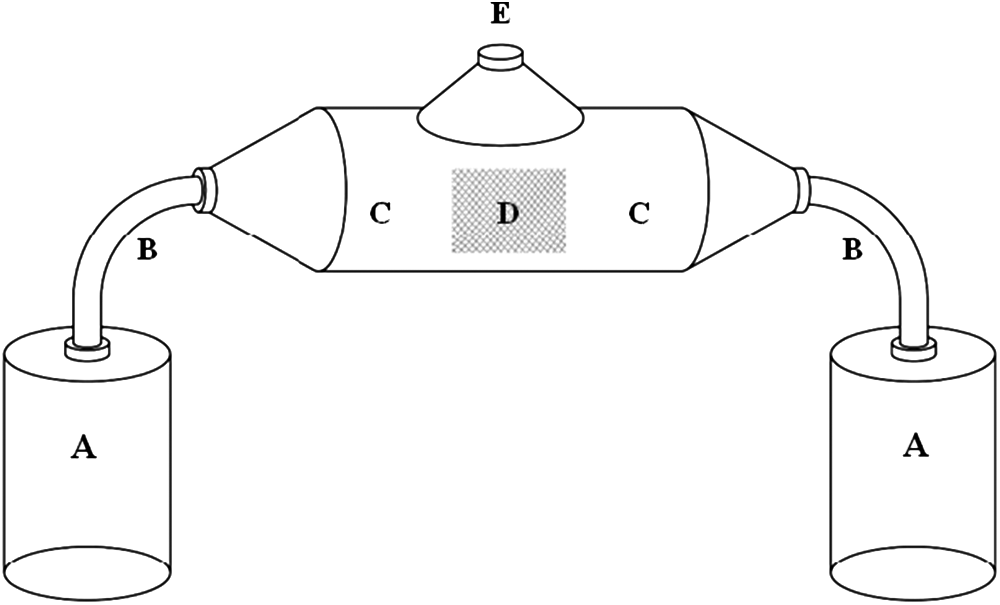
For oviposition deterrence bioassays, a two-choice test was used to evaluate oviposition site selection. In fact, for the oviposition evaluation, positive controls are essential to validate negative responses by showing that the specimen had the capacity for oviposition (Van Driesche and Murray, Reference Van Driesche and Murray2004). This approach is the most commonly used to measure oviposition site selection (Cha et al., Reference Cha, Roh, Hesler, Wallingford, Stockton, Park and Loeb2020; Edwards, Reference Edwards1999; Otárola-Jiménez et al., Reference Otárola-Jiménez, Nataraj, Bisch-Knaden, Hansson and Knaden2024; Roh et al., Reference Roh, Meier, Shrestha, Hesler, Zhu, Kendra, Loeb, Tay and Cha2023). The oviposition deterrence tests using MeJA were conducted in a two-choice cage, structured as described in Bedini et al. (Reference Bedini, Cosci, Tani, Pierattini, Venturi, Lucchi, Ioriatti, Ascrizzi, Flamini, Ferroni, Taglieri and Conti2020) and shown in fig. 2.
Schematic representation of the two-choice cage used for oviposition deterrence bioassays on Drosophila suzukii. A: 500 mL glass lateral chamber; B: PVC connection tube; C: central release chamber; D: net-covered holes for air supply; and E: insect entrance with the cap.

Filter paper discs (Ø 1 cm) were treated with 100 µL hexane containing concentrations of 1, 1.25, 2, and 2.5% v/v corresponding to 1030, 1287.5, 2060, and 2575 µg of MeJA/filter paper. After solvent evaporation (∼2 min), treated filter papers were suspended 1 cm above the artificial fruits within the corresponding lateral chamber. To make the two parts of the olfactometer perfectly equal, avoiding the variability associated with natural fruits, such as differences in size, ripeness, and colour, a 2.5 cm Ø dish containing 10 g of an agarised medium (mimicking an artificial fruit) was used as the oviposition substrate and was positioned into each of the two 500 mL glass lateral chambers. This substrate was composed of 100 mL blueberry juice, 6.5 g fructose, 2.5 g yeast extract, 1.2 g agar powder, 0.5 g ethylparaben, and 0.5 g benzoic acid. The artificial medium was prepared by mixing the components on a hot plate stirrer (VELP Scientifica, Usmate, Italy) at 125 °C and 500 rpm for 20 min. A filter paper disc (Ø 1 cm) was treated with 100 µL of hexane as a control (C). After the solvent evaporated, the filter paper discs (C or T) were suspended 1 cm above the artificial fruit with a paperclip in the corresponding lateral chamber of the cage (C or T). Five males and five females were gently introduced into the central release chamber using a small glass vial, and the number of eggs laid in the two artificial fruits was recorded after 24 h under a stereo microscope (Leica EZ4, Leica Biosystems Italia, Buccinasco, Italy). For each dose, the experiment was conducted with three biological replicates and the entire experiment was repeated twice, resulting in a total of six replicates per treatment.
The protective effect of MeJA was expressed as the percentage of effective repellency ER (%) using the formula:
ER (%) = [(NC − NT)/NC] × 100
where NT denotes the number of eggs in the treated artificial fruit and NC the number of eggs in the control one.
Adult behaviour bioassays
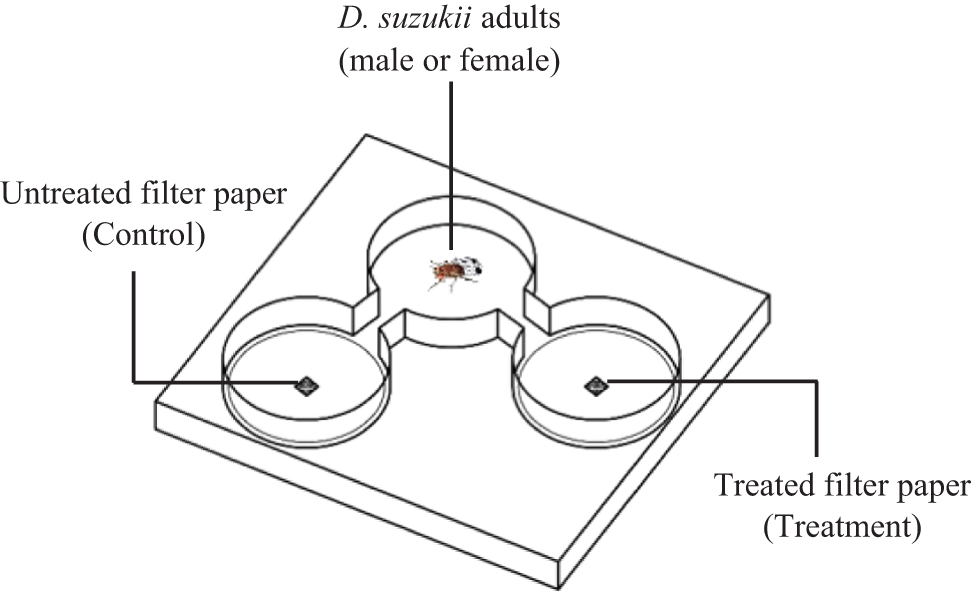
The tests were conducted in a two-choice, planar olfactometer, composed of a polymethylmethacrylate arena (15 × 15 × 1 cm) covered by removable glass panels, according to Bedini et al. (Reference Bedini, Cosci, Tani, Pierattini, Venturi, Lucchi, Ioriatti, Ascrizzi, Flamini, Ferroni, Taglieri and Conti2020). Two linear paths, measuring 2 cm in length and 1 cm in width, connect the circular chamber (4.0 cm Ø) in the centre of the unit to the other two identical chambers at a 90° angle. One of the two chambers contained a disc of filter paper (0.8 mm Ø) pipetted with 3 µL of hexane as a control (C), and the other chamber contained the same size disc of filter paper treated with 3 µL of hexane at concentrations of 0.125, 0.25, 0.5, 1, 2.5, 5, and 10% v/v corresponding to 3.86, 7.73, 15.45, 30.90, 77.25, 154.50, and 309.00 µg of MeJA/filter paper. After the solvent evaporation (∼2 min), a single D. suzukii was gently transferred into the central release chamber using a glass vial, and the upper glass panel was closed (fig. 3). Following the method reported in Bedini et al. (Reference Bedini, Cosci, Tani, Pierattini, Venturi, Lucchi, Ioriatti, Ascrizzi, Flamini, Ferroni, Taglieri and Conti2020) each adult (male or female) was observed for a maximum of 6 min. We evaluated the latency time (at least 20 s) spent in the release chamber and the permanence time (at least 30 s) in the selected chamber (C or T). Individuals who did not choose within 5 min and 30 s, as well as those who chose before 20 s or remained in the selected chamber for less than 30 s, were discarded. These time criteria were established based on preliminary observations to ensure that choices were deliberate and not the result of random movement or inactivity, and are consistent with previous studies (Bedini et al., Reference Bedini, Cosci, Tani, Pierattini, Venturi, Lucchi, Ioriatti, Ascrizzi, Flamini, Ferroni, Taglieri and Conti2020). Overall, we tested 10 males and 10 females for each dose of MeJA and repeated the full experiment three times.
Schematic representation of the two-choice planar olfactometer used for the adult behavioural bioassays on Drosophila suzukii. A single fly (male or female) was released into the central chamber and allowed to choose between one of two side chambers. One chamber contained a filter paper treated with hexane (Control), while the other contained a filter paper treated with a methyl jasmonate solution (Treatment).

All observations were conducted under a daylight fluorescent tube (10,000 lx) placed exactly over the olfactometer. With each new specimen, the arena was rotated 90° clockwise to prevent positional bias, and the filter paper discs were renewed.
After four bioassays, the arena and glass lids were first wiped with hexane for about 30 s, then cleaned in a water bath with mild soap for about 5 min, rinsed with hot water for about 30 s, then with distilled water at room temperature, and, finally, dried.
Statistical analysis
Prior to conducting parametric tests, all data were tested for normality using the Shapiro–Wilk test and for homogeneity of variances using Levene’s test. All datasets met the assumptions for parametric analysis (P > 0.05). The data on the protective oviposition effect of MeJA on D. suzukii are expressed as the mean ± standard deviation (n = 10), with data collected in three experimental replicates. The effect of MeJA doses on the number of eggs laid in control and treatment chambers was assessed using one-way analysis of variance (ANOVA). The percentage of ER was analysed as the dependent variable, with MeJA treatment as the main factor, using ANOVA followed by Duncan’s multiple range test for mean separation at P < 0.05.
For the two-choice behavioural assays, chi-squared tests (Pearson’s and likelihood ratio) were used to assess whether the number of insects choosing the MeJA-treated chamber differed significantly from a 50:50 distribution under the null hypothesis. Additionally, chi-squared analyses were performed to confirm the homogeneity of responses across experimental replicates, with results presented in Supplementary Table S1.
Probit analysis was used to estimate the median repellent dose (RD50) for females, males, and the combined adult group. All statistical analyses were performed using SPSS software (version 22.0, IBM SPSS Statistics, Armonk, North Castle, NY, USA).
Results
Effect of MeJA on the oviposition of D. suzukii
In our experiment, the doses of MeJA affected D. suzukii oviposition in Table 1. At 1030 µg/filter paper, MeJA inhibited egg-laying by 85.30 ± 5.55%. When applied at doses greater than 1287.5 µg/filter paper, the deterrent effect increased further, ranging from 93.75% to 99.63%. However, no statistically significant differences were observed among the three highest doses, as confirmed by Duncan’s multiple range test (P > 0.05).
The ovideterrent activity of methyl jasmonate (MeJA) against Drosophila suzukii

Data are presented as mean ± standard error (n = 10).
A–B Different uppercase letters indicate significant differences in the mean number of eggs within the control and treatment groups (Student’s t-test, two-tailed, P < 0.05).
a–b Different lowercase letters indicate significant differences in the mean number of eggs within the same groups at varying MeJA doses (Duncan’s multiple range test, P < 0.05), as well as significant differences in the percentage of effective repellence (ER) (Duncan’s multiple range test, P < 0.05).
Behavioural response of D. suzukii adults to MeJA
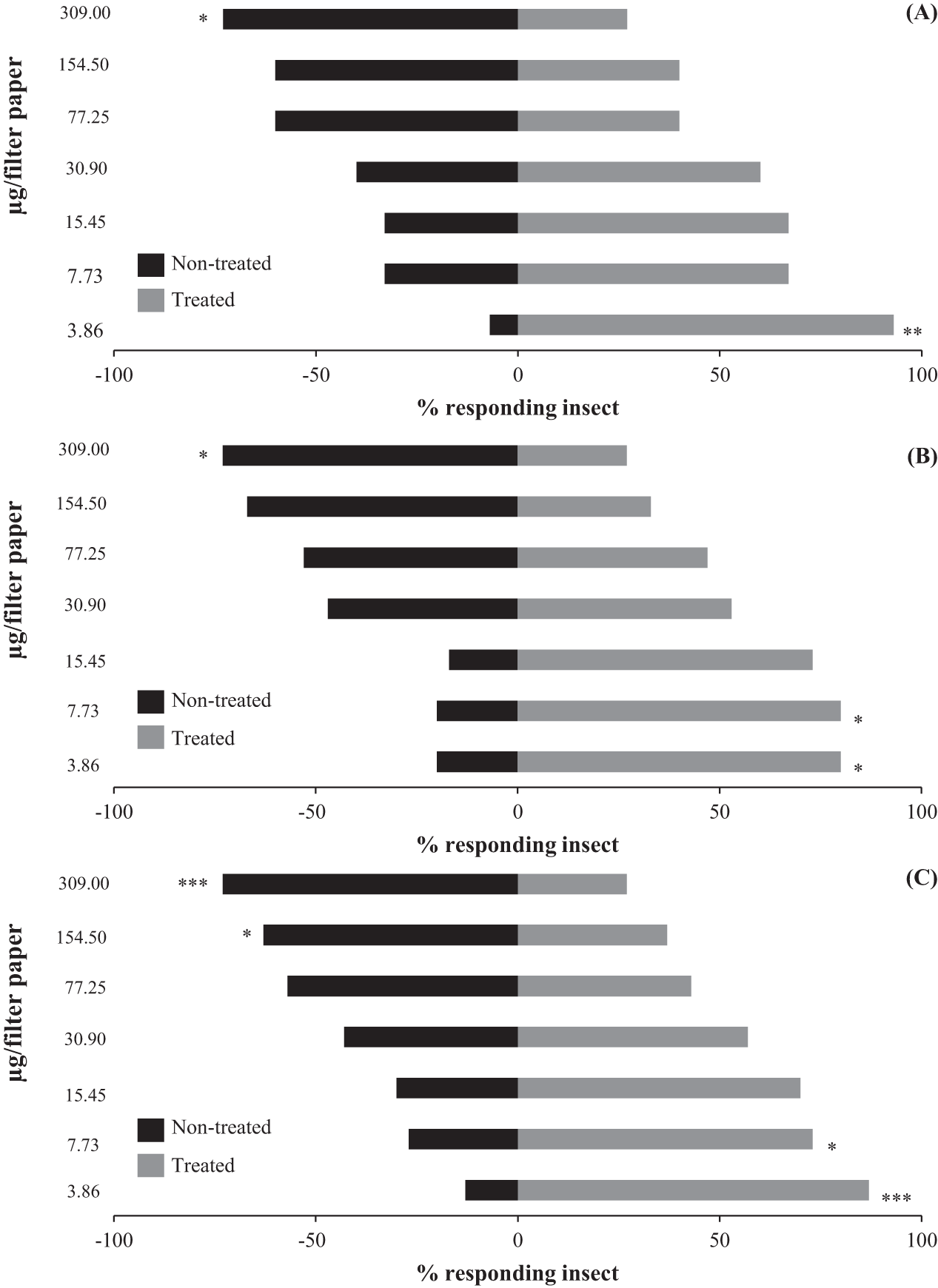
The behavioural assays in the two-choice olfactometer revealed dose-specific effects of MeJA on adult D. suzukii (fig. 4). At 309.0 µg/filter paper, MeJA exhibited a significant repellent effect on total adults (χ2 = 4.27, P = 0.04), as well as on females (χ2 = 4.80, P = 0.03) and males (χ2 = 6.53, P < 0.01) when analysed separately.
Behaviour of (A) female, (B) male, and (C) total adults of Drosophila suzukii in the presence of MeJA at the various doses. Notes: bars represent the percentage of insects that chose the treated or control chamber. Control represents the percentage of insects that chose the non-treated chamber; Treated represents the percentage of insects that chose the MeJA-treated chamber. Asterisks indicate significant differences in the number of choosing insects (χ 2 test; *P < 0.05, **P < 0.01; ***P < 0.001). A total of 28% of the initially tested insects were discarded as they did not meet the choice criteria and were excluded from the analysis.

In contrast, significant attraction was observed at lower doses: 3.86 µg/filter paper (χ2 = 32.27, P < 0.00), 7.73 µg/filter paper (χ2 = 13.07, P < 0.00), and 15.45 µg/filter paper (χ2 = 9.60, P = 0.02) for total adults. In males, the attractive effect was significant at all three doses: 3.86 µg/filter paper (χ2 = 10.80, P < 0.00), 7.73 µg/filter paper (χ2 = 10.80, P < 0.00), and 15.45 µg/filter paper (χ2 = 6.53, P < 0.01). In females, attraction was only significant at 3.86 µg/filter paper (χ2 = 22.53, P < 0.00).
Chi-squared tests confirmed consistency across replicates, with no significant differences observed among trials within each treatment group (P > 0.05; see Supplementary Table S1).
table 2 presents the median repellent dose (RD50) values of MeJA, which were 55.24 µg/filter paper for females, 55.03 µg/filter paper for males, and 55.14 µg/filter paper for total adults. The RD₅₀ values of males and females were comparable to those of adults overall, and their 95% confidence intervals overlapped substantially, indicating no pronounced sex-related differences in MeJA sensitivity under the tested conditions.
Repellency of methyl jasmonate (MeJA) against Drosophila suzukii adults

RD50, dose of MeJA that repels 50% of the exposed insects; CI, confidence interval; χ2, chi-square; df, degrees of freedom.
Data are expressed as µg/filter paper. P refers to the Pearson goodness-of-fit test; a non-significant result (P > 0.05) indicates that the model is a good fit for the data.
a Values ± standard error.
Discussion
The behavioural effects of MeJA on D. suzukii observed in this study provide new insights into the potential application of this plant-derived compound in pest management. Specifically, the dual activity of MeJA as both a repellent and an attractant depending on the dose reflects a biphasic dose-response pattern, a phenomenon often observed in studies on semiochemicals and plant volatiles. The significant reduction in oviposition at higher MeJA doses indicates a strong deterrent effect, likely mediated by the insect’s chemosensory system. These findings are consistent with previous research showing that MeJA and other jasmonates can act as semiochemicals influencing insect behaviour.
Indeed, besides its role in modulating plant defence responses to herbivore feeding (Reyes-Díaz et al., Reference Reyes-Díaz, Lobos, Cardemil, Nunes-Nesi, Retamales, Jaakola, Alberdi and Ribera-Fonseca2016), MeJA has also demonstrated significant direct repellent activity against some insect and arthropod pests. For instance, in laboratory tests using Ixodes ricinus nymphs, MeJA-treated cloths showed increasing repellency, with up to 99% of nymphs avoiding the treated surfaces (Garboui et al., Reference Garboui, Jaenson, Borg-Karlson and Pålsson2007). Similar results were observed in field trials, where MeJA significantly reduced the number of ticks on treated cloths in a woodland environment. Additionally, MeJA has been shown to deter feeding in Frankliniella occidentalis (Thysanoptera Thripidae) larvae (more than 90%), suggesting a broader application for pest control strategies (Egger and Koschier, Reference Egger and Koschier2013).
The observed behavioural responses suggest that D. suzukii adults are capable of detecting MeJA via olfactory cues, consistent with evidence that D. suzukii can detect and respond to host- and non-host plant volatiles (Bolton et al., Reference Bolton, Piñero and Barrett2021), which may activate avoidance behaviour at higher doses. This is consistent with prior studies showing that insects can respond behaviourally to plant-derived jasmonate volatiles, which may act as signals associated with plant stress or defence activation (Egger and Koschier, Reference Egger and Koschier2013; Xu et al., Reference Xu, Choo, De La Rosa and Leal2014). Given that MeJA is involved in systemic defence signalling in plants, its detection by herbivorous insects like D. suzukii may serve as an ecological cue to avoid damaged or unsuitable hosts.
The dual behavioural effect observed – repellency at higher doses and attraction at lower ones – suggests a biphasic dose-response pattern, as also described in studies on essential oils (Bayram, Reference Bayram2018; Bedini et al., Reference Bedini, Djebbi, Ascrizzi, Farina, Pieracci, Echeverría, Flamini, Trusendi, Ortega, Chiliquinga and Conti2024). This phenomenon could be due to dose-dependent activation or inhibition of chemosensory pathways, potentially reflecting compensatory mechanisms triggered by low-level stimuli as previously described in biphasic response models (Calabrese and Baldwin, Reference Calabrese and Baldwin2002), potentially involving different classes of odorant-binding proteins (Zhan et al., Reference Zhan, Li, Dewer, Niu, Li and Luo2021). In this regard, MeJA behaves similarly to compounds like eugenol and methyl anthranilate, which have also been reported to exhibit both attractant and deterrent effects depending on dose and target species (Bedini et al., Reference Bedini, Djebbi, Ascrizzi, Farina, Pieracci, Echeverría, Flamini, Trusendi, Ortega, Chiliquinga and Conti2024; Conroy et al., Reference Conroy, Fountain, Whitfield, Hall, Farman and Bray2024). These findings emphasise the importance of defining application thresholds when considering MeJA for practical use in pest management. Volatile-based repellents have previously been evaluated in field settings for D. suzukii. For instance, Wallingford et al. (Reference Wallingford, Connelly, Brind’Amour, Boucher, Mafra-Neto and Loeb2016) demonstrated that a spatial repellent formulation of 1-octen-3-ol significantly reduced D. suzukii oviposition in raspberry fields without adverse effects on beneficial insects. Field applications of jasmonates have previously demonstrated reduced oviposition and fruit damage in crops such as wine grapes (Hussain et al., Reference Hussain, War and Pfeiffer2023), and repellent effects on lepidopteran pests in cabbage and tobacco (Avdiushko et al., Reference Avdiushko, Brown, Dahlman and Hildebrand1997). These findings support our results and reinforce MeJA’s practical potential in pest management. The RD₅₀ values for total adults, females, and males (55.14, 55.24, and 55.03 µg/filter paper, respectively) were broadly similar, with overlapping confidence intervals. This suggests that both sexes exhibited similar sensitivity to MeJA under the tested conditions.
Tait et al. (Reference Tait, Park, Nieri, Crava, Mermer, Clappa, Boyer, Dalton, Carlin, Brewer, Walton, Anfora and Rossi-Stacconi2020) investigated the chemical and behavioural aspects of short-range ovipositional site selection to better understand D. suzukii reproduction. They discovered that only six volatile organic compounds (VOCs) found on the skin of egg-infested berries, namely methyl myristate, methyl palmitate, myristic acid, lauric acid, palmitic acid, and palmitoleic acid, increased the rate at which conspecific females laid their eggs. Hence, using MeJA as a VOC to disturb the insect’s olfactory system may help deter D. suzukii from laying eggs on soft- and thin-skinned fruit crops (Amo et al., Reference Amo, Mrazova, Saavedra and Sam2022).
The ability of D. suzukii to respond differentially to MeJA doses suggests that this species can adapt its oviposition and foraging behaviour based on volatile chemical cues (Bolton et al., Reference Bolton, Piñero and Barrett2021; Tait et al., Reference Tait, Park, Nieri, Crava, Mermer, Clappa, Boyer, Dalton, Carlin, Brewer, Walton, Anfora and Rossi-Stacconi2020). Drosophila suzukii prefers to lay eggs in healthy and whole fruit rather than damaged or overripe ones (Lee et al., Reference Lee, Bruck, Curry, Edwards, Van Steenwyk and Yorgey2011). Thanks to its comparatively large, sclerotised, and serrated ovipositor, it can provide a protected environment for its eggs and larval stages by penetrating the fruit’s skin (Atallah et al., Reference Atallah, Teixeira, Salazar, Zaragoza and Kopp2014). In a natural setting, such a response may function to avoid laying eggs on damaged or stressed fruit, which typically emit higher levels of jasmonate-related volatiles as part of plant defence responses (Peña-Cortés et al., Reference Peña-Cortés, Barrios, Dorta, Polanco, Sánchez, Sánchez and Ramírez2004; Tait et al., Reference Tait, Park, Nieri, Crava, Mermer, Clappa, Boyer, Dalton, Carlin, Brewer, Walton, Anfora and Rossi-Stacconi2020). This behavioural flexibility in response to volatile chemical cues may play a significant role in the ecological adaptability of D. suzukii, contributing directly to its invasive success. The broad ecological plasticity, rapid reproductive capacity, and ability to exploit diverse host fruits (Asplen et al., Reference Asplen, Anfora, Biondi, Choi, Chu, Daane and Desneux2015; Lee et al., Reference Lee, Bruck, Curry, Edwards, Van Steenwyk and Yorgey2011) highlight the importance of understanding and manipulating its chemosensory behaviours, such as responses to MeJA, for effective pest management.
Even though several studies have confirmed that utilising MeJA on agricultural fields can repel female pests’ oviposition, exogenous application of MeJA to plants also induces the release of VOCs similar to those produced during herbivore attacks. These VOCs can influence ecological interactions between plants, herbivores, and natural enemies (Amo et al., Reference Amo, Mrazova, Saavedra and Sam2022). For example, Zhang et al. (Reference Zhang, Xie, Xue and Wang2009) demonstrated that MeJA treatment of persimmon trees infested with scale insects induced VOC emissions that attracted the predatory lady beetle Chilocorus kuwanae, highlighting MeJA’s potential role in recruiting natural enemies through indirect plant signalling. Although the direct attraction of pests by low-dose MeJA applications remains unclear, such VOC profiles might still affect pest behaviour or their natural enemies indirectly.
Furthermore, Concha et al. (Reference Concha, Figueroa, Poblete, Oñate, Schwab and Figueroa2013) confirmed the role of exogenous MeJA during fruit ripening. Indeed, the administration of 10 µM MeJA to unripe fruits increased the activity of anthocyanin, ethylene, jasmonate, and lignin biosynthesis genes, making the fruits redder with a significant accumulation of anthocyanins and lignin. According to Wei et al. (Reference Wei, Wen and Tang2017), MeJA promotes peach ripening by modulating anthocyanin accumulation. Also, Peña-Cortés et al. (Reference Peña-Cortés, Barrios, Dorta, Polanco, Sánchez, Sánchez and Ramírez2004) reported that both climacteric and non-climacteric fruits naturally produce jasmonates, which induce the production of ethylene, known to boost fruit ripening. Given that D. suzukii is especially attracted (but not only) to red, ripe fruits (Cahenzli et al., Reference Cahenzli, Bühlmann, Daniel and Fahrentrapp2018), all the previous statements (Concha et al., Reference Concha, Figueroa, Poblete, Oñate, Schwab and Figueroa2013; Peña-Cortés et al., Reference Peña-Cortés, Barrios, Dorta, Polanco, Sánchez, Sánchez and Ramírez2004; Wei et al., Reference Wei, Wen and Tang2017) support the results of our experiment, which indicate that the application of low doses of MeJA has an attractive effect on D. suzukii, probably because it is involved in the pathway of fruit ripening.
The significant reduction in egg-laying behaviour at high MeJA doses may reflect either deterrence due to olfactory repulsion or physiological disruption linked to the perception of stress-related volatiles (Hussain et al., Reference Hussain, War and Pfeiffer2023). However, further physiological studies are needed to confirm these mechanisms. Additional studies are needed to investigate whether MeJA influences reproductive physiology or modulates egg-laying behaviour through chemosensory pathways in D. suzukii females.
A limitation of our oviposition assay was the absence of a control-versus-control treatment, which would have helped quantify any inherent directional bias in the apparatus. Future studies should include such a control to provide a baseline for oviposition behaviour in the absence of any added volatiles. Additionally, the variation in the total number of eggs laid across different doses suggests that the presence of MeJA, even at a distance, might have had a systemic effect on the overall oviposition rate, a phenomenon that warrants further investigation.
An important aspect to consider is the ecological relevance of the doses tested in our laboratory bioassays. While it is difficult to directly compare these values with the doses that D. suzukii might encounter from naturally stressed plants in the field – given the variability among plant species, environmental factors, and distance from the source – our findings nonetheless provide a valuable starting point for field applications. Notably, the lower doses identified as attractive (0.125–0.5%) are likely feasible for use in lure-based trapping systems. Conversely, the higher dose required for repellency (10%), though seemingly elevated, could be effectively deployed via localised slow-release dispensers that establish a protective ‘push’ zone around fruit clusters. Moving forward, it is essential that future research bridges the gap between laboratory-derived dose-response relationships and real-world application strategies. Optimising field-ready formulations and delivery methods will be a key step towards integrating MeJA into IPM programmes.
Altogether, our findings demonstrate that the dose-dependent effect of MeJA on D. suzukii positions it as a uniquely versatile candidate for advanced IPM programmes. Specifically, this dual action – repellency at high doses and attraction at low doses – is ideal for a ‘push–pull’ strategy. High doses of MeJA could be formulated to ‘push’ D. suzukii away from valuable fruit, while low doses could be used to ‘pull’ the insects into traps for monitoring or mass-trapping purposes. To make this strategy viable, further research is needed to evaluate field efficacy and to develop optimised formulations, such as slow-release devices or microencapsulation technologies (Riseh et al., Reference Riseh, Vatankhah, Hassanisaadi and Kennedy2024), that can maintain stable and effective dose ranges in an orchard setting. Such advancements, combined with cost–effectiveness analysis, would be critical for integrating MeJA-based push–pull systems into sustainable pest management programmes for soft fruit crops.
Conclusion
This study demonstrates that MeJA can significantly influence the oviposition behaviour and adult orientation of D. suzukii, with clear dose-dependent effects. Application of MeJA at doses above 1287.5 µg/filter paper effectively inhibited egg laying by females, while lower doses (3.86–15.45 µg/filter paper) elicited an attractive response in both males and females. MeJA’s volatility and the dose-sensitive nature of its effects highlight the importance of selecting appropriate doses for specific pest control objectives. The dose-dependent dual effect, observed in this study, which aligns with previous findings on other natural compounds, suggests that MeJA could be exploited as either a repellent or an attractant, depending on the strategy. Therefore, MeJA holds strong potential for dual-function use in IPM programmes, particularly within a ‘push–pull’ strategy. It could be developed as a spatial repellent to ‘push’ pests from ripening fruit or, alternatively, be integrated as a lure component in traps to ‘pull’ them away, offering a promising natural alternative to existing chemical or commercial lures. The outcomes of this study will provide insights into the potential integration of MeJA into environmentally friendly pest control programmes targeting D. suzukii in soft fruit production systems.
Supplementary material
The supplementary material for this article can be found at https://doi.org/10.1017/S0007485325100369.
Acknowledgements
We are grateful to Mr. Paolo Giannotti for the insect photos.
Author contributions
P.P.: Data curation, Formal analysis, Writing – original draft, Writing – review & editing, and Visualisation. L.A. and P.F.: Investigation, Writing – review & editing, and Visualisation. B.C.: Conceptualisation, Supervision, and Writing – review & editing,
Financial support
The research is not funded.
Competing interests
The authors declare no conflict of interest.
Data availability
The datasets are available from the corresponding author on request.