Introduction
Youth’s perceptions of their environmental contexts, such as their neighborhoods, schools, and families, can play a critical role in academic, interpersonal, and occupational success (Brosschot et al., Reference Brosschot, Verkuil and Thayer2017; Burton et al., Reference Burton, Price-Spratlen, Spenser, Brooks-Gunn, Duncan and Lawrence Aber1997; Caspi et al., Reference Caspi, Kawachi, Subramanian, Adamkiewicz and Sorensen2012; Chen et al., Reference Chen, Langer, Raphaelson and Matthews2004; Orstad et al., Reference Orstad, McDonough, Stapleton, Altincekic and Troped2017; Repetti et al., Reference Repetti, Taylor and Seeman2002; Roosa et al., Reference Roosa, Jones, Tein and Cree2003, Reference Roosa, White, Zeiders and Tein2009; Thapa et al., Reference Thapa, Cohen, Guffey and Higgins-D’Alessandro2013). Specifically, youth’s perceptions of threat in their neighborhoods, schools, and families are associated with poorer mental health (e.g., Aldridge & McChesney, Reference Aldridge and McChesney2018; Aneshensel & Sucoff, Reference Aneshensel and Sucoff1996; Kasen et al., Reference Kasen, Johnson and Cohen1990), social functioning (e.g., Aldridge et al., Reference Aldridge, McChesney and Afari2018; Fite et al., Reference Fite, Vitulano, Wynn, Wimsatt, Gaertner and Rathert2010), and neurocognitive performance (e.g., Fay-Stammbach et al., Reference Fay-Stammbach, Hawes and Meredith2014). In contrast to objective measures such as crime reports or census data, youth’s perceptions of their neighborhoods, schools, and families have been found to be more predictive of mental health and peer relationship outcomes (Baranyi et al., Reference Baranyi, Di Marco, Russ, Dibben and Pearce2021; Danese & Widom, Reference Danese and Widom2020; El-Sheikh & Harger, Reference El-Sheikh and Harger2001; Goldman-Mellor et al., Reference Goldman-Mellor, Margerison-Zilko, Allen and Cerda2016; Hadley-Ives et al., Reference Hadley-Ives, Stiffman, Elze, Johnson and Dore2000). However, despite these general trends, several limitations in previous research on perceived threat constrain our understanding of the relationships between youth’s perceptions of threat in the neighborhood, school, and family and developmental outcomes. Notably, research often examines each context separately as if development occurs in only one setting; outcomes within a single domain (e.g., mental health, social, neurocognitive), hindering a more complete, cross-domain, understanding of the risks posed by perceived threats in each context; or homogenous samples limiting knowledge about the extent to which documented trends generalize across youth. Addressing these limitations is important in order to develop more holistic conceptualizations of the risks associated with perceived threat across these three primary contexts in which youth spend time (Hofferth & Sandberg, Reference Hofferth and Sandberg2001).
Many foundational theories of development emphasize the importance of examining multiple contexts at different levels of proximity to youth (Bronfenbrenner, Reference Bronfenbrenner, Gauvain and Cole1994; Bronfenbrenner & Morris, Reference Bronfenbrenner, Morris, Lerner and Damon2006; Cicchetti & Lynch, Reference Cicchetti and Lynch1993; Lerner, Reference Lerner1991; Magnusson & Stattin, Reference Magnusson, Stattin and Damon1998). However, a large majority of research on the influence of perceived neighborhood, school, and family threats on development has examined each of these contexts separately. Yet, it is possible that youth have different experiences of threat within each context, such as perceiving threat in only one context versus more than one or not at all, which might impact development in unique ways (Cohodes et al., Reference Cohodes, Kitt, Baskin-Sommers and Gee2020; Youngblade et al., Reference Youngblade, Theokas, Schulenberg, Curry, Huang and Novak2007). Moreover, youth environments grow increasingly complex throughout development, shifting from primarily family focused in early childhood to peer, school, and neighborhood focused in later childhood and adolescence (Eccles & Roeser, Reference Eccles, Roeser, Lerner and Steinberg2009; Steinberg, Reference Steinberg2005; Wigfield et al., Reference Wigfield, Byrnes, Eccles, Alexander and Winne2006). Therefore, solely examining perceived threat in a single context, as was often done in previous research, may fail to capture precise relationships between perceived threats in youth contexts and developmental outcomes.
For example, perceptions of neighborhood and school threat independently have been associated with youth substance use and mental health (Kasen et al., Reference Kasen, Johnson and Cohen1990; Lambert et al., Reference Lambert, Brown, Phillips and Ialongo2004; LaRusso et al., Reference LaRusso, Romer and Selman2007; Wang & Degol, Reference Wang and Degol2016). However, one study found that, when modeled together, perceived neighborhood threat, but not perceived school threat, was associated with adolescentsʼ substance use and depressive symptoms (Nails et al., Reference Nails, Mullis and Mullis2009). Another study showed that both perceived neighborhood and school threat relate to alcohol use (Friese et al., Reference Friese, Grube and Seninger2015), yet findings suggested there was an overall larger effect of perceived neighborhood threat on youth alcohol use. Although these two studies indicate that perceived neighborhood threat may be a specific risk for youth substance use, neither study examined an interaction between perceived neighborhood and school threat or considered the potential influence of perceived family threat, which also is associated with substance use outcomes (Repetti et al., Reference Repetti, Taylor and Seeman2002).
Additionally, outcomes associated with perceived neighborhood, school, and family threat span multiple domains of functioning (e.g., mental health, social, neurocognition). However, studies often examine a limited set of outcomes, often within a single domain, impeding comprehensive understanding of the influence of perceived threat in each context. For instance, perceived neighborhood threat has been associated with increased symptoms of depression, anxiety, and disruptive behavior disorders (DBD) (Aneshensel & Sucoff, Reference Aneshensel and Sucoff1996; Dawson et al., Reference Dawson, Wu, Fennie, Ibañez, Cano, Pettit and Trepka2019), delinquency and proactive aggression (Byrnes et al., Reference Byrnes, Chen, Miller and Maguin2007; Fite et al., Reference Fite, Vitulano, Wynn, Wimsatt, Gaertner and Rathert2010), and poorer academic performance (Bowen et al., Reference Bowen, Rose, Powers and Glennie2008; Williams et al., Reference Williams, Davis, Cribbs, Saunders and Williams2002) and verbal ability (Kohen et al., Reference Kohen, Brooks-Gunn, Leventhal and Hertzman2002). Yet, each of these studies only examined the few outcomes listed making it difficult to know whether the same youth who show symptoms of mental health difficulties also show decrements in social and neurocognitive functioning.
Consistent findings in the literature suggest that mental health, social, and neurocognitive functions are related, highlighting the importance of simultaneously examining a wide range of outcomes potentially related to perceived environmental threat. For example, a recent meta-analysis by Wagner et al. (Reference Wagner, Müller, Helmreich, Huss and Tadić2015) found that youth with depression perform worse on a range of neurocognitive tasks (e.g., sustained attention, working memory, verbal fluency) compared to youth without depression and neurocognitive deficits have been linked to interrupted social learning processes in DBD (Matthys et al., Reference Matthys, Vanderschuren, Schutter and Lochman2012). Other work has shown peer problems can be related to externalizing and internalizing in youth (Humphreys et al., Reference Humphreys, Katz, Lee, Hammen, Brennan and Najman2013), and neurocognitive deficits may be associated with risk for peer problems (and vice versa; Holmes et al., Reference Holmes, Kim-Spoon and Deater-Deckard2016). Given these interrelations between mental health, social, and neurocognitive functions (Blanken et al., Reference Blanken, White, Mous, Basten, Muetzel, Jaddoe and Tiemeier2017; Klimes-Dougan & Garber, Reference Klimes-Dougan and Garber2016; Ogilvie et al., Reference Ogilvie, Stewart, Chan and Shum2011), it is possible that previous research examining the influences of perceived environmental threat has overlooked important associations by failing to evaluate multiple outcomes within the same sample.
Finally, although some work has examined perceived threat in multiple contexts or a wider range of outcomes, conclusions are often undermined by the use of homogenous samples. For example, one study conducted in a national sample of primarily White youth (81%) found that neither neighborhood nor school threats were associated with academic achievement (Youngblade et al., Reference Youngblade, Theokas, Schulenberg, Curry, Huang and Novak2007). This finding contrasts with another study conducted in a regionally restricted sample of primarily Black youth (88%) in Baltimore that showed both perceived neighborhood and school threats were associated with significantly worse reading and math achievement (Millam et al., Reference Millam, Furr-Holden and Leaf2010). Similarly, inconsistent patterns have been observed regarding mental health and behavioral outcomes. One study in a sample of predominantly Black youth in Alabama found that neighborhood threat attenuated the influence of family threat on internalizing and externalizing symptoms (Mrug & Windle, Reference Mrug and Windle2010). However, another study in racially/ethnically diverse youth (49.5% White, 26.3% Black, 14.3% Hispanic, and 9.8% other) in Texas found that neighborhood threat only attenuated the influence of family threat for internalizing, but not for externalizing, symptoms (Rosenfield et al., Reference Rosenfield, Jouriles, McDonald and Mueller2014). Together this work provides some evidence that unique combinations of perceived neighborhood, school, and family threat can differentially relate to unique outcomes during development (see Bacchini & Esposito, Reference Bacchini, Esposito, Balvin and Christie2020 for review). However, it is not clear whether differences in findings across these studies should be attributed to combinations of perceived threat across multiple contexts, or whether differences in findings emerged from sample characteristics (i.e., racially or regionally homogenous samples). Therefore, before drilling down into comparisons between homogenous samples, research using a sociodemographically heterogeneous sample might be helpful for determining whether associations identified in previous work are representative of experiences more generally (Coley et al., Reference Coley, Sims, Dearing and Spielvogel2018; Simmons et al., Reference Simmons, Conley, Gee, Baskin-Sommers, Barch, Hoffman and Casey2021).
Across decades of theoretical and empirical work, a robust literature has emerged that underscores associations between perceived environmental threat in different contexts and problems in mental health, social, and neurocognitive domains. Several mechanisms have been identified that purportedly link perceptions in different contexts to these outcomes. For example, neighborhoods, schools, and families can serve as important socialization contexts where youth learn rules and norms through processes, such as social modeling, observational learning, and interactions with family members, peers, and other community members (Bugental & Grusec, Reference Bugental, Grusec, Damon, Lerner and Eisenberg2006). Youth’s experiences, including their perceptions of threat, also can influence psychological and cognitive processes that result in various outcomes across multiple domains. For example, alterations in attentional (Pollak, Reference Pollak2015; Shackman & Pollak, Reference Shackman and Pollak2014) and reward (Guyer et al., Reference Guyer, Kaufman, Hodgdon, Masten, Jazbec, Pine and Ernst2006) systems have been posited to underlie associations between youth’s experiences of family threat and mental health and social functioning. In addition, biological models suggest youth’s perceptions of threat get under the skin by influencing adaptations in nervous, endocrine, and immune systems (Danese & McEwen, Reference Danese and McEwen2012; Gunnar & Quevedo, Reference Gunnar and Quevedo2007; Lupien et al., Reference Lupien, McEwen, Gunnar and Heim2009; McEwen & Wingfield, Reference McEwen and Wingfield2003). Although research highlights several mechanisms at different levels of analysis that connect perceived threats with decrements in mental health, social, and neurocognitive development, little research has examined whether threat experienced across different contexts may differentially relate to outcomes across multiple domains in a sociodemographically diverse sample. It is therefore necessary to utilize a multicontextual, multioutcome approach to create a foundation for further investigation of how youth’s perceptions of multicontextual threat interact with youth’s changing biology to influence development.
As such, the goal of the present study was to examine heterogeneity in perceived threat in neighborhood, school, and family contexts in a large cohort of US youth. More specifically, we use the diverse Adolescent Brain Cognitive DevelopmentSM Study (ABCD Study®) sample (Compton et al., Reference Compton, Dowling and Garavan2019; Garavan et al., Reference Garavan, Bartsch, Conway, Decastro, Goldstein, Heeringa and Zahs2018) and longitudinal data. First, we implement a person-centered analysis (e.g., latent profile analysis [LPA]) to parse the heterogeneity across youth’s perceptions of threat at baseline (ages 9–10; T1), rather than using a variable-centered approach that solely describes relationships related to a single variable (Howard & Hoffman, Reference Howard and Hoffman2018; Magnusson & Stattin, Reference Magnusson, Stattin and Damon1998; Masyn, Reference Masyn and Little2013; Vermunt & Magidson, Reference Vermunt, Magidson, Hagenaars and McCutcheon2002). Second, we use mixed-effect models and post hoc pairwise comparisons to investigate whether person-centered profiles of perceived threat predict mental health, social, and neurocognitive outcomes 2 years later (ages 11–12; T2). Most of the previous research examining the correlation between youth’s perceptions of environmental threat and mental health, social functioning, and neurocognition is cross-sectional; therefore, using a longitudinal design advances our knowledge about the developmental sequelae of multicontextual perceived threat experiences in late childhood.
We hypothesized that profiles characterized by elevated perceived threat at baseline would be associated with decrements in developmental outcomes at the 2-year follow-up visit relative to profiles characterized by low perceptions of threat. Given that little progress has been made to identify person-centered profiles of perceived environmental threat, we did not have specific hypotheses about expected associations between the profiles and outcomes beyond the elevated threat versus low threat hypothesis described above. Rather, a key goal of this study was to explore whether heterogeneity in baseline perceived environmental threat differentially predicts mental health, social, and neurocognitive outcomes 2 years later and to create an empirical foundation for future research utilizing multicontextual and multioutcome approaches.
Materials and methods
Participants
Participants were children included in the ABCD Study Data Release 3.0 with complete baseline (T1; ages 9–10) and 2-year follow-up (T2; ages 11–12) data (n = 6571; 47.3% Female, 52.7% Male; 2.1% Asian; 11.9% Black; 19.3% Hispanic; 9.9% Other; 56.9% White; doi:10.15154/1519007; https://nda.nih.gov/study.html?id=901). A comparison based on baseline (T1) characteristics of participants with and without T2 data included in Data Release 3.0 is provided in Supplemental Table 1a–c. Participants were primarily recruited through schools in defined catchment areas for each of the 21 ABCD Study sites using a multistage probability sampling method to generate a sociodemographically diverse cohort (Garavan et al., Reference Garavan, Bartsch, Conway, Decastro, Goldstein, Heeringa and Zahs2018). Due to the geographic distribution of ABCD Study sites and potential self-selection bias in terms of enrollment, the sample is not perfectly representative of the US population overall (Compton, et al., Reference Compton, Dowling and Garavan2019) and therefore may not perfectly generalize to all youth and families in the US.
The ABCD Study includes assessments of physical and mental health, neurocognition, biospecimens, substance use, culture and environment, and an extensive neuroimaging battery (Casey et al., Reference Casey, Cannonier, Conley, Cohen, Barch, Heitzeg and Dale2018). All parents or caregivers provided written informed consent and children provided verbal assent for participation in the study (Clark et al., Reference Clark, Fisher, Bookheimer, Brown, Evans, Hopfer and Yurgelun-Todd2018). Baseline exclusionary criteria included a major neurological disorder (e.g., cerebral palsy, brain tumor, stroke, brain aneurysm, brain hemorrhage, subdural hematoma), multiple sclerosis, sickle cell disease, seizure disorders such as Lennox−Gastaut syndrome, Dravet syndrome, and Landau Kleffner syndrome, a diagnosis of schizophrenia, moderate to severe autism spectrum disorder, intellectual disability, or history of substance use (i.e., all participants were substance use naive at baseline enrollment).
Assessments
ABCD Study data collection involves biennial visits with extensive (i.e., 6–7 h) mental health, social, and neurocognitive assessments and MRI scans, as well as brief (i.e., 2 h) yearly behavioral visits including interviews, questionnaires, and neurocognitive testing that touch on various domains, as well as biospecimen collection (Casey et al., Reference Casey, Cannonier, Conley, Cohen, Barch, Heitzeg and Dale2018). Because only the biennial visits include an extensive evaluation across domains (Jernigan et al., Reference Jernigan and Brown2018; https://abcdstudy.org/scientists/protocols/), in the present study we analyzed behavioral data collected from the baseline (T1) and 2-year (T2) follow-up visits across all 21 ABCD sites (doi:10.15154/1519007; https://nda.nih.gov/study.html?id=901).
Perceived environmental threat
Perceived environmental threat at T1 was estimated across three settings: neighborhood, school, and family. Correlations across perceived environmental threat and demographic variables are visualized in Supplemental Figure 1. Since the youth-report ABCD Neighborhood Safety/Crime Survey Modified from PhenX (NSC) (Echeverria et al., Reference Echeverria, Diez-Roux and Link2004; Mujahid et al., Reference Mujahid, Diez Roux, Morenoff and Raghunathan2007) included only one item asking youth to indicate whether they strongly agreed or strongly disagreed with the statement: My neighborhood is safe from crime, perceived neighborhood threat was assessed using the mean of all youth- and parent-report items. The parent-report NSC included the exact same item described above and two additional items asking participants to indicate whether they strongly agreed or strongly disagreed with the statements: I feel safe walking in my neighborhood, day or night and Violence is not a problem in my neighborhood. All items were reverse-scored so that higher scores indicated more neighborhood threat (range = 1–5).
Perceived family threat was assessed using the youth-report summary score derived from the ABCD Youth Family Environment Scale-Family Conflict Subscale Modified from PhenX (FES-FCS) (Hoffman et al., Reference Hoffman, Clark, Orendain, Hudziak, Squeglia and Dowling2019; Moos & Moos, Reference Moos and Moos1994). The FES-FCS consisted of nine items evaluating the amount of conflict expressed by family members (e.g., we fight a lot in our family; family members often criticize each other; family members sometimes hit each other.) For each item, youth indicated whether each statement was true or false for most members of their family. All items were summed and scored with higher scores indicating more family conflict (range = 0–9).
Perceived school threat was assessed with the youth-report summary score derived from the School Environment subscale of the School Risk and Protective Factors (SRPF) Survey (Arthur et al., Reference Arthur, Briney, Hawkins, Abbott, Brooke-Weiss and Catalano2007). The SRPF School Environment subscale included six items evaluating youth’s perceptions of the school climate related to safety and support (e.g., I feel safe at my school; My teacher(s) notices when I am doing a good job and lets me know about it; Zucker et al., Reference Zucker, Gonzalez, Feldstein Ewing, Paulus, Arroyo, Fuligni and Wills2018). For each item, youth indicated whether a statement was definitely true (YES! (4)) or definitely not true (NO! (1)). All items were summed and scored with higher scores indicating a less safe/supportive school environment (range = 1–24).
Mental health symptom outcomes
Mental health symptoms at T2 were evaluated using youth- and parent-reports. Different measures were available for a variety of mental health symptoms. Because some mental health symptoms may be difficult for parents and caregivers to detect (e.g., anxiety and depressive symptoms; Tandon et al., Reference Tandon, Cardeli and Luby2009), youth-report data were used where available. Supplemental analyses using only dimensional parent-report data were conducted and are available in Supplemental Materials.
Kiddie Schedule for Affective Disorders and Schizophrenia for DSM-5
The computerized Kiddie Schedule for Affective Disorders and Schizophrenia for DSM-5 (KSADS-5-PL) (Kaufman et al., Reference Kaufman, Birmaher, Brent, Rao, Flynn, Moreci and Ryan1997, Reference Kaufman, Birmaher, Axelson, Perepletchikova, Brent and Ryan2013; Kobak et al., Reference Kobak, Kratochvil, Stanger and Kaufman2013) was used to assess symptoms associated with various mental health diagnoses. The KSADS-5-PL has high reliability and validity for assessing psychopathology in youth ages 6–18 and was optimized for use in ABCD Study data collection (Barch et al., Reference Barch, Albaugh, Avenevoli, Chang, Clark, Glantz and Sher2018). Youth-report symptom counts were generated for anxiety disorders, conduct disorder, eating disorders, mood disorders, and suicidality. Parent-report symptom counts were generated for modules that were not included in the youth assessment including alcohol/substance use disorders, attention-deficit hyperactivity disorder (ADHD), DBD, homicidality, obsessive and compulsive disorders (OCD), other specified neurodevelopmental disorders, psychotic disorders, and trauma/stress disorders. Categorical diagnoses were included in supplemental analyses (see Supplemental Materials; Supplemental Table 5).
Achenbach System of Empirically Based Assessment Child Behavior Checklist
Broad dimensions of psychopathology symptoms (i.e., externalizing and internalizing t-scores) were evaluated using the Achenbach System of Empirically Based Assessment Child Behavior Checklist (CBCL). The CBCL is a well-established parent-report assessment used for identifying problem behavior in youth that is standardized and normed by age, sex, informant, and race/ethnicity (Achenbach, Reference Achenbach2009). CBCL subscales were included in supplemental analyses (see Supplemental Materials).
Sleep Disturbance Scale for Children
Difficulties with sleep are a common feature of many mental health disorders, have been related to risk for substance use and subsequent psychopathology (Hasler et al., Reference Hasler, Kirisci and Clark2016), and have been related to perceived neighborhood and school threat (Meldrum et al., Reference Meldrum, Jackson, Archer and Ammons-Blanfort2018). Total sleep problems were assessed using the ABCD Parent Sleep Disturbance Scale for Children (SDSC). The SDSC is a 26-item parent-report questionnaire that evaluates common sleep disorders in youth and has been validated for use in clinical and nonclinical samples (Bruni et al., Reference Bruni, Ottaviano, Guidetti, Romoli, Innocenzi, Cortesi and Giannotti1996). The sum of the 26 items was used as a total score with higher scores indicating more difficulties with sleep.
Social outcomes
Social behavior and peer interactions were evaluated using measures from the ABCD culture and environment (Zucker et al., Reference Zucker, Gonzalez, Feldstein Ewing, Paulus, Arroyo, Fuligni and Wills2018) and mental health (Barch et al., Reference Barch, Albaugh, Avenevoli, Chang, Clark, Glantz and Sher2018) assessments. All social outcomes were assessed at T2.
Peer network health protective scale
The degree of protection and support in peer networks was assessed with the ABCD Peer Network Health Protective Scale adapted from the Adolescent Social Network Assessment (Mason et al., Reference Mason, Cheung and Walker2004). This instrument prompted youth to indicate whether their closest friends had exhibited behaviors such as discouraging the use of substances, adopting healthy habits such as exercising or joining school clubs, or providing instrumental (e.g., school, money, transportation) and psychological support over the last 6 months. For items that were positively endorsed, youth selected how much encouragement their friends had provided from 1 to 10. Higher scores represented a greater protective peer network, and lower scores represented decreased peer network protection.
Youth peer behavioral profile
The Youth Peer Behavior Profile, derived from the Peer Behavior Profile/Peer Activities Questionnaire (Bingham et al., Reference Bingham, Fitzgerald and Zucker1995), assessed two dimensions of youth peer networks: prosocial peers and rule breaking/delinquent peers. Each dimension corresponded to a 3-item subscale asking youth to report what proportion of their peers were involved in prosocial (e.g., excelling in school, playing sports) or rule breaking/delinquent (e.g., skipping school, shoplifting) behavior (range = 1, none or almost none–5, all or nearly all). Because the two subscales are not mutually exclusive, items for each subscale were summed separately.
ABCD peer experiences questionnaire
The ABCD Peer Experiences Questionnaire assessed 18 negative peer experiences such as overt, relational or reputational victimization from peers and perpetrating overt, relational or reputational aggression towards peers. For each item, youth indicated how often they had each experience in the past year using a five-point scale (range = 1, never–5, a few times a week). Total negative peer experiences were measured by summing all items with higher scores reflecting more negative peer experiences in the year prior to assessment.
Prosocial behavior scale
The ABCD Prosocial Behavior Scale from the Strengths and Difficulties Questionnaire (Goodman et al., Reference Goodman, Meltzer and Bailey1998; Goodman & Scott, Reference Goodman and Scott1999) included three items that assessed youth’s inclination to engage in behaviors that helped or supported others (e.g., being considerate of others’ feelings). For each item, youth were asked to reflect on their behavior over the past 6 months and select whether each statement was Not True (0), Somewhat True (1), or Certainly True (2). All items were summed and higher scores indicated more prosocial behavior.
Neurocognitive outcomes
Neurocognitive outcomes were evaluated using behavioral data from 8 neurocognitive tasks administered at T2. All neurocognitive tasks were administered using iPads and have been previously detailed (Luciana et al., Reference Luciana, Bjork, Nagel, Barch, Gonzalez, Nixon and Banich2018).
The National Institutes of Health Toolbox Cognition Battery
Five cognitive tasks from the National Institutes of Health (NIH) Toolbox Cognition Battery were assessed at T2: a picture vocabulary task assessing language ability and vocabulary knowledge (Gershon et al., Reference Gershon, Cook, Mungas, Manly, Slotkin, Beaumont and Weintraub2014), a Flanker task assessing attention and cognitive control (Fan et al., Reference Fan, McCandliss, Sommer, Raz and Posner2002), a picture sequence task assessing episodic memory and visuospatial sequencing (Bauer et al., Reference Bauer, Dikmen, Heaton, Mungas, Slotkin and Beaumont2013; Dikmen et al., Reference Dikmen, Bauer, Weintraub, Mungas, Slotkin, Beaumont and Heaton2014), a pattern comparison task assessing visual information processing speed (Carlozzi et al., Reference Carlozzi, Beaumont, Tulsky and Gershon2015, Reference Carlozzi, Tulsky, Chiaravalloti, Beaumont, Weintraub, Conway and Gershon2014, Reference Carlozzi, Tulsky, Kail and Beaumont2013), and an oral reading task assessing language and reading ability (Gershon et al., Reference Gershon, Slotkin, Manly, Blitz, Beaumont, Schnipke and Weintraub2013). Because age-corrected scores are undergoing revision by the NIH Toolbox (Luciana et al., Reference Luciana, Bjork, Nagel, Barch, Gonzalez, Nixon and Banich2018), uncorrected standard scores were used to measure performance.
Rey Auditory Verbal Learning Test
The Rey Auditory Verbal Learning Test (RAVLT) was used to assess auditory verbal learning and memory (Lezak et al., Reference Lezak, Howieson, Loring and Fischer2004). The test involved five learning trials where participants were read a list of 15 unrelated words (list A). After each learning trial, participants were asked to recall as many words as possible. Next, participants were read a distractor list of 15 new words (list B) and were then asked to recall as many words as possible from the distractor list (list B). After the distractor trial, a recall trial was immediately assessed for words from the initial list (list A). After a 30-min delay where participants rest or complete nonverbal tasks, a final delayed recall trial is assessed for words from the initial list (list A). Here, we assessed performance (total correct) on the immediate and delayed recall trials (i.e., RAVLT Trials VI and VII).
Little Man Task
The Little Man Task (Acker & Acker, Reference Acker and Acker1982) assesses visuospatial processing, perspective-taking and mental rotation. During administration of the task, participants saw a cartoon holding a briefcase in the left or right hand. The cartoon appeared in different presentations including right side up, upside down, facing the participant or facing away. Across these different presentations, the briefcase could be in either the left or right hand. Participants were instructed to indicate whether the briefcase was in the left or right hand. Performance was measured with percent accuracy (Luciana et al., Reference Luciana, Bjork, Nagel, Barch, Gonzalez, Nixon and Banich2018).
Social Influence Task
The Social Influence Task measures risk perception, propensity for risky decision making, and susceptibility to perceived peer influence (Knoll et al., Reference Knoll, Magis-Weinberg, Speekenbrink and Blakemore2015). Youth were presented with various risky scenarios (e.g., skiing really fast down a hill; hitchhiking; stealing honey out of a beehive) across 40 trials, and asked to rate each activity’s risk using a slider ranging from “very low risk” to “very high risk.” After initial ratings were submitted, youth were presented with a risk rating they were told was provided by a group of peers for the exact same scenarios. The peer rating condition was either 4 points lower (−4 condition), 2 points lower (−2 condition), 2 points higher (+2 condition), or 4 points higher (+4 condition) than the participant’s initial rating. Participants were then asked to rate the riskiness of the scenario again. Social decision-making was measured for each of the four peer rating conditions by subtracting the mean initial rating from the mean final rating across all trials in each condition. Negative scores indicated more susceptibility to peer influence on the negative conditions (i.e., −4 and −2) and higher scores indicated more susceptibility to peer influence on the positive conditions (i.e., +4 and +2).
Analytic plan
All statistical analyses were performed in R version 3.6.3 (R Core Team, 2020). First, LPA was used to identify profiles of perceived environmental threat (i.e., family, school, neighborhood) at T1 using the tidylpa package (Rosenberg et al., Reference Rosenberg, Beymer, Anderson, van Lissa and Schmidt2018), which utilizes the maximum likelihood estimator via the expectation–maximization algorithm (Scrucca et al., Reference Scrucca, Fop, Murphy and Raftery2016). This analysis was performed on all participants who had complete perceived neighborhood, school, and family threat data (n = 6530). The optimal number of profiles was selected by comparing fit across six latent profile models (1–6 class models) and evaluating interpretability. The comparative fit of the models was assessed using the Bayesian Information Criterion (better fit indicated with smaller values; Schwarz, Reference Schwarz1978), entropy (a measure of classification uncertainty ranging from 0–1 with more certainty and class discrimination indicated with values approaching 1 and values > 0.8 considered acceptable; Celeux & Soromenho, Reference Celeux and Soromenho1996; Weller et al., Reference Weller, Bowen and Faubert2020), and bootstrapped likelihood ratio tests where a model k was considered to have preferable fit relative to a model k−1 when indicated with a significant p-value. Robustness of cluster results from the LPA was validated using k-means cluster analysis (see Supplemental Materials; Supplemental Figures 2–3). Participants were assigned to one profile for which their conditional probability of membership was the largest.
Next, associations between profile (a between-subjects factor) of T1 perceptions of threat and mental health, social, and neurocognitive outcomes at T2Footnote 1 were examined with mixed-effect models using the lmer() function from the lme4 package (Bates et al., Reference Bates, Mächler, Bolker and Walker2015). For all models, dependent variables and covariates were standardized and county-level crime and household income were included as fixed-effect covariatesFootnote 2. Consistent with recommendations for the three-step model of LPA with multilevel data (Vermunt, Reference Vermunt2010), ABCD Study site was included as a random intercept in all models to account for the multisite sampling design.
Finally, post hoc pairwise comparisons were performed using the emmeans package (Lenth, Reference Lenth2021) and used to evaluate differences in the magnitude of pairs of associations between outcome variables and separate latent profiles. Because the ABCD Study included siblings and twin pairs (Iacono et al., Reference Iacono, Heath, Hewitt, Neale, Banich, Luciana and Bjork2018), mixed-effect models and pairwise comparisons were performed using only one randomly selected child per family to avoid confounds introduced by family structure (final n = 5525; see Supplemental Table 2 for comparison of demographics for complete and incomplete datasets). Bonferroni correction was applied to account for the number of mixed-effect models generated for each outcome variable (n = 33). While visual inspection indicated that some outcome measures were not normally distributed (Supplemental Figures 4a–4c), mixed-effect models are robust violations of normality (Schielzeth et al., Reference Schielzeth, Dingemanse, Nakagawa, Westneat, Allegue, Teplitsky and Araya-Ajoy2020; Verbeke & Molenberghs, Reference Verbeke and Molenberghs2013) and the adequacy of all models was evaluated using the check_model() function from the performance package (Lüdecke et al., Reference Lüdecke, Ben-Shachar, Patil, Waggoner and Makowski2021) to ensure that no modeling assumptions were violated.
Results
Person-centered profiles of perceived environmental threat at T1
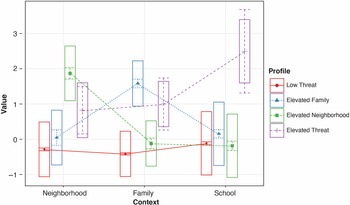
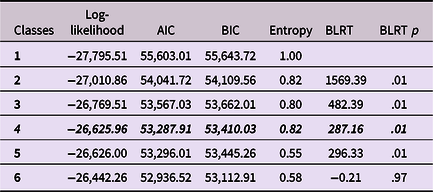
Solutions for models with 1–6 latent classes were evaluated (Table 1). Bootstrapped likelihood ratio tests indicated that models with 2, 3, 4, and 5 classes showed improved fit relative to those with one fewer class. Of these, the five-class solution was rejected because of low classification certainty as indicated by a low entropy value (0.55). Ultimately the four-class solution was selected as the best fitting model because it showed a preferable classification certainty (entropy = 0.82) and a lower BIC value (53,410.03) than the two and three-class solutions. As illustrated in Figure 1, the first profile was characterized by low threat ratings across all three contexts (profile 1 [Low Threat]; n = 3953; 71% of the sample) corresponding with low neighborhood threat (mean 1.80 (SD = 0.58)), low school threat (mean = 4.74 (SD = 2.48)), and low family threat (mean = 1.13 (SD = 1.06)). The second profile was characterized by elevated family threat (mean = 5.12 (SD = 1.18)), low neighborhood threat (mean = 2.04 (SD = 0.75)), and low school threat (mean = 5.42 (SD = 2.51)) (profile 2 [Elevated Family]; n = 974; 18% of the sample). The third profile was characterized by elevated neighborhood threat (mean = 3.75 (SD = 0.47)), low family threat (mean =1.74 (SD = 1.38)), and low school threat (mean = 4.42 (SD = 2.46)) (profile 3 [Elevated Neighborhood]; n = 458; 8% of the sample). The fourth profile was characterized by elevated ratings across all three contexts (profile 4 [Elevated Threat]; n = 140; 2.5% of the sample) corresponding with elevated neighborhood threat (mean = 2.80 (SD = 0.79)), elevated school threat (mean = 12.72 (SD = 2.15)), and elevated family threat (mean = 3.91 (SD = 1.79)). Profile demographics are presented in Supplemental Table 3.
Box plot showing classification results from the latent profile analysis. Bars reflect confidence intervals for profile centroids and boxes reflect the standard deviations within each profile.

Model fit of the latent profile analysis

Note. AIC = Akaike information criterion; BIC = Bayesian information criterion; BLRT = bootstrapped likelihood ratio test. The selected class solution (4-class) is italicized and bolded.
Profiles of perceived environmental threat predict developmental outcomes at T2
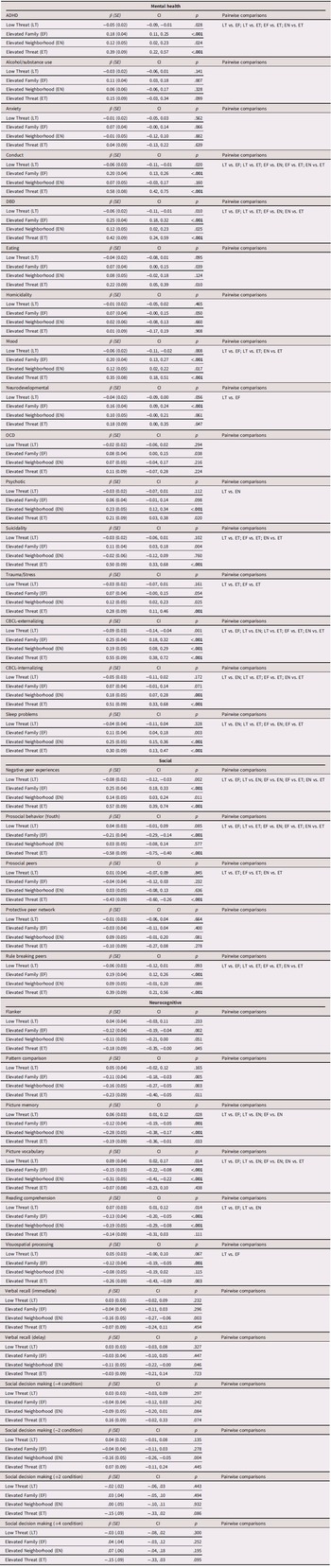
We examined whether each profile (at T1) differed on measures of mental health, social, and neurocognitive outcomes (at T2)Footnote 3,Footnote 4 using mixed-effect models and post hoc pairwise comparisons. Means and standard deviations for mental health, social, and neurocognitive data are presented in Supplemental Table 4. Results from the mixed-effect models and post hoc pairwise comparisons are detailed below (Table 2) and summarized in Figures 2–5.
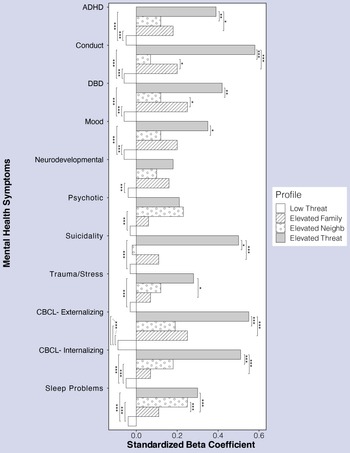
Bar plot showing mental health symptoms at T2 as a function of each perceived environmental threat profile at T1. ADHD = attention deficit hyperactivity disorder; CBCL = Child Behavior Checklist; DBD = disruptive behavior disorders.

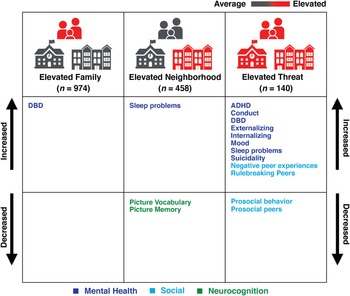
Schematic depicting largest unique effects across elevated profiles. Outcomes displayed reflect associations that were significantly greater in magnitude than at least one of the other elevated profiles and were not significantly lower than any of the other elevated profiles. Outcomes displayed for more than one profile (i.e., DBD, sleep problems) were not significantly different between those profiles. Icons in red represent elevated perceived threat in that context. ADHD = attention deficit hyperactivity disorder; DBD = disruptive behavior disorders.

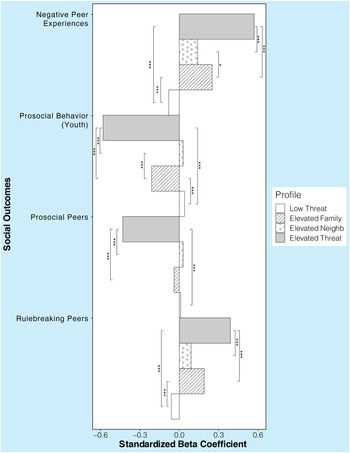
Bar plot showing social outcomes at T2 as a function of each perceived environmental threat profile at T1.

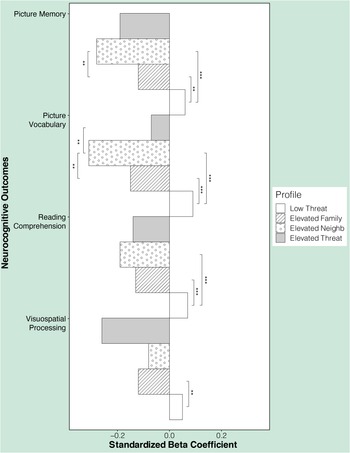
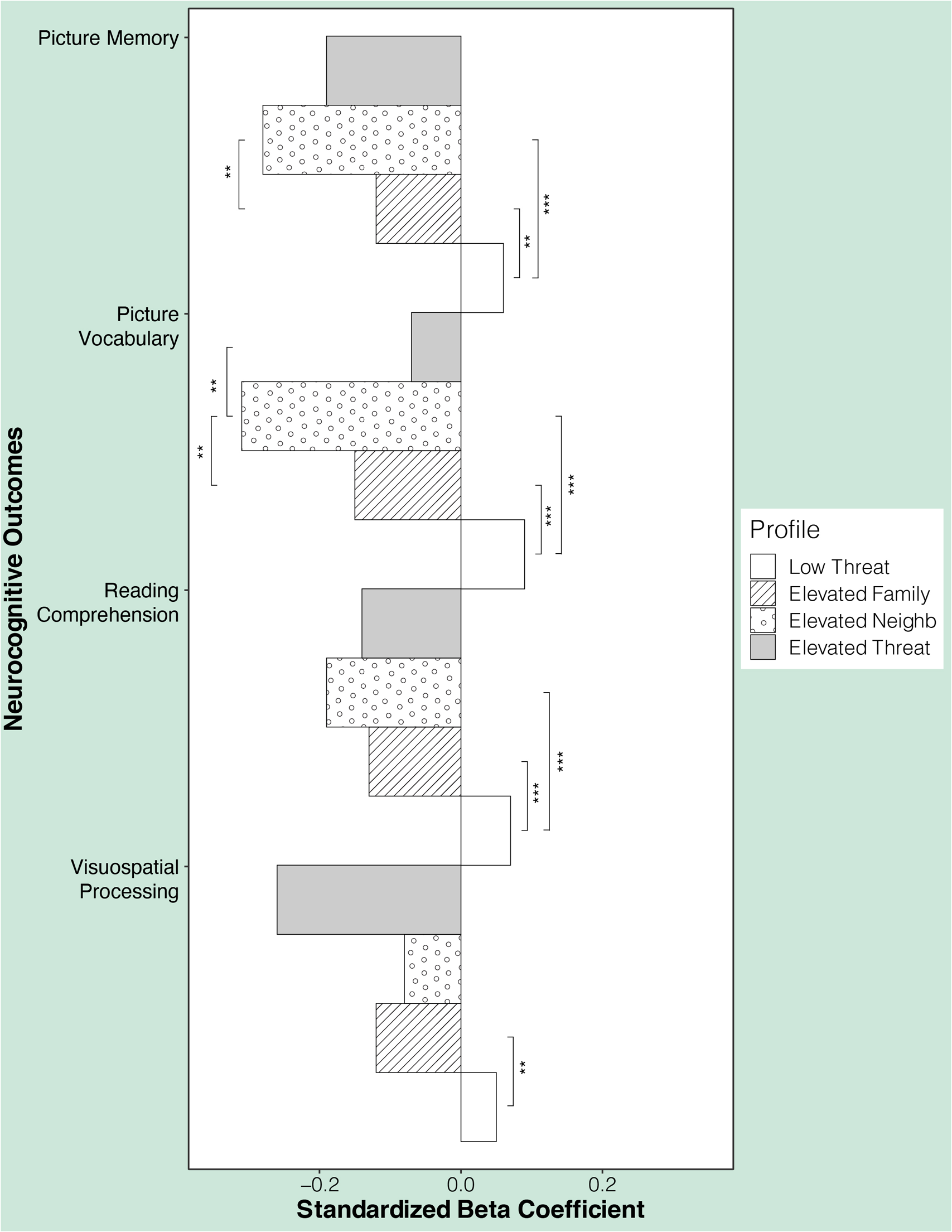
Bar plot showing neurocognitive outcomes at T2 as a function of each perceived environmental threat profile at T1.
Results of mixed effect models and post hoc pairwise comparisons

Note. All models include household income and county-level crime as covariates. Bold p values indicate significance following Bonferroni correction. Listed pairwise comparisons (far right column) indicate significant differences (p < .05) between profiles. ADHD = attention deficit hyperactivity disorder; CBCL = Child Behavior Checklist; DBD = disruptive behavior disorders; OCD = obsessive and compulsive disorders.
Mental health symptom outcomes
Results within the mental health domain (Table 2 and Figure 2) demonstrated that membership in the Low Threat profile at T1 was associated with lower ADHD, conduct, DBD, externalizing, internalizing, mood, neurodevelopmental, psychotic, suicidality, sleep problem, and trauma/stress symptoms at T2 relative to one or more of the elevated threat profiles. The Low Threat profile was not significantly different from the elevated threat profiles in alcohol/substance use, anxiety, eating, homicidality, or OCD symptoms at T2. Conversely, membership in the Elevated Threat profile at T1 was associated with increased ADHD, conduct, DBD, externalizing, internalizing, mood, sleep problem, suicidality, and trauma/stress symptoms at T2 relative to the Low Threat profile. Furthermore, membership in the Elevated Threat profile was related to even greater ADHD, conduct, externalizing, internalizing, sleep problem, suicidality, and trauma/stress symptoms relative to the Elevated Family profile and even greater ADHD, conduct, DBD, externalizing, internalizing, mood, and suicidality symptoms relative to the Elevated Neighborhood profile (summarized in Figure 3). Membership in the Elevated Family profile at T1 was significantly associated with increased conduct and DBD symptoms at T2 relative to the Elevated Neighborhood profile. Lastly, membership in the Elevated Neighborhood profile at T1 was significantly associated with increased externalizing and internalizing symptoms relative to the Low Threat profile, and increased sleep problems relative to both the Low Threat and Elevated Family profiles.
Social outcomes
Results within the social domain (Table 2 and Figure 4) demonstrated that membership in the Low Threat profile at T1 was associated with increased prosocial behavior and affiliation with prosocial peers and decreased negative peer experiences and affiliation with rule breaking peers relative to one or more of the elevated threat profiles at T2. By contrast, membership in the Elevated Threat profile at T1 was associated with increased negative peer experiences and affiliation with rule breaking peers and decreased prosocial behavior and affiliation with prosocial peers relative to all other profiles. Membership in the Elevated Family profile at T1 was associated with increased negative peer experiences and affiliation with rule breaking peers and decreased prosocial behavior relative to the Low Threat and Elevated Neighborhood profiles. Lastly, membership in the Elevated Neighborhood profile at T1 was not significantly associated with social behavior at T2.
Neurocognitive outcomes
Results within the neurocognitive domain (Table 2 and Figure 5) demonstrated that membership in the Low Threat profile at T1 was associated with increased performance on the Picture Memory, Picture Vocabulary, Reading Comprehension, and Visuospatial Processing tasks relative to one or more of the elevated profiles. Conversely, membership in the Elevated Threat profile was not significantly associated with neurocognitive performance at T2. Membership in the Elevated Family profile at T1 was associated with decreased performance on the Picture Memory, Picture Vocabulary, Reading Comprehension and Visuospatial Processing tasks relative to the Low Threat profile. Lastly, membership in the Elevated Neighborhood profile at T1 was associated with decreased performance on the Picture Vocabulary and Picture Memory tasks relative to all other profiles, and decreased performance on the Reading Comprehension task relative to the Low Threat profile.
Discussion
Heightened perceived threat in youth’s environments is a well-known factor that can impact functioning. During development, youth’s perceptions of threat may influence mental health, social, and neurocognitive outcomes. Using a large, diverse sample of US youth, the present study examined youth’s perceptions of threat in their neighborhoods, schools, and families and evaluated whether profiles of perceived threat at ages 9–10 differentially predicted outcomes at ages 11–12. Broadly speaking, results from the profile analysis indicated variability in where and the extent to which youth perceive threat in their environments. Further, while the Low Threat profile was consistently related to generally better outcomes, differential effects were observed for specific outcomes when comparing profiles characterized by elevated perceived threat.
We identified four distinct profiles characterized by differences in perceived threat in the neighborhood, school, and family. As expected, there was a profile characterized by Low Threat and another profile characterized by Elevated Threat in all three contexts. The presence of two profiles that have fully aligned levels of perceived threat across all contexts is consistent with research showing that youth’s experiences of stressors within and outside of the family can co-occur (Herrenkohl & Herrenkohl, Reference Herrenkohl and Herrenkohl2007) and that neighborhood factors can be associated with family dynamics and school environments (see Minh et al., Reference Minh, Muhajarine, Janus, Brownell and Guhn2017 for review). The other two profiles were uniquely characterized by Elevated Family or Elevated Neighborhood threat, providing evidence that while some youth may perceive threat in multiple contexts, others have concentrated experiences of threat. These two profiles can be contextualized in light of other work showing variability in associations between family environments and neighborhoods (Furstenberg et al., Reference Furstenberg, Cook, Eccles and Elder2000). For example, family threats can occur in the context of supportive neighborhoods (Silk et al., Reference Silk, Sessa, Morris, Steinberg and Avenevoli2004) and many families in neighborhoods high in crime or other indicators of threat provide ample support for their children (Beyers et al., Reference Beyers, Bates, Pettit and Dodge2003; Cuellar et al., Reference Cuellar, Jones and Sterrett2015; Li & Fischer, Reference Li and Fischer2017; Voisin et al., Reference Voisin, Harty, Kim, Elsaesser and Takahashi2017). Together, results from the LPA identified discernible profiles of perceived threat in three primary contexts in which youth spend time (Hofferth & Sandberg, Reference Hofferth and Sandberg2001) and suggest that the presence of threat in one context does not necessarily connote the presence of threat in another context or in all contexts.
The majority of the sample had the highest probability of membership in the Low Threat profile (n = 3953). Overall, this profile predicted fewer mental health symptoms and increased social functioning at ages 11–12. By contrast, membership in the smallest profile, Elevated Threat (n = 140), predicted increased mental health symptoms, negative peer experiences, afilliation with rule breaking peers, and decreased prosocial behavior and affiliation with prosocial peers. These findings are consistent with previous work showing that childhood adversity often co-occurs (Green et al., Reference Green, McLaughlin, Berglund, Gruber, Sampson, Zaslavsky and Kessler2010) and that risk for long-term negative outcomes can increase with exposure to multiple stressors (Evans et al., Reference Evans, Li and Whipple2013). Although the Low Threat versus Elevated Threat comparison is unsurprising, these findings dovetail with and potentially advance several prominent theories of early life adversity. Namely, cumulative risk approaches account for the number of adversities (including perceptions of threat) children experience (Dube et al., Reference Dube, Fairweather, Pearson, Felitti, Anda and Croft2009; Evans et al., Reference Evans, Li and Whipple2013), and propose that cumulative adverse experiences impact functioning via overload of youth’s changing biological systems (Danese & McEwen, Reference Danese and McEwen2012). Yet, a common criticism of cumulative approaches is that they fall short in capturing differential effects of distinct types of adversity (Felitti et al., Reference Felitti, Anda, Nordenberg, Williamson, Spitz, Edwards and Marks1998). In contrast, dimensional (Sheridan & McLaughlin, Reference Sheridan and McLaughlin2014) or splitting approaches (Manly et al., Reference Manly, Kim, Rogosch and Cicchetti2001; Smith & Pollak, Reference Smith and Pollak2021; St Clair et al., Reference St Clair, Croudace, Dunn, Jones, Herbert and Goodyer2015) propose that different aspects of youth’s experiences may impact distinct outcomes via specific alterations in biological systems (Kuhlman et al., Reference Kuhlman, Chiang, Horn and Bower2017; McLaughlin & Lambert, Reference McLaughlin and Lambert2017; Palacios-Barrios & Hanson, Reference Palacios-Barrios and Hanson2019). Our findings potentially suggest that for some, but not all, youth, cumulative perceived threat experiences across contexts may explain outcomes more than perceived threat in any single context alone and are associated with the largest mental health and social risks. Better understanding the ways in which diffuse (e.g., multiple contexts) versus concentrated (i.e., one context) perceptions of threat confer risk for mental health and social difficulties will allow for greater accuracy and precision in detecting risk and targeting intervention efforts. At the same time, the Elevated Threat profile did not show significantly increased risk for neurocognitive decrements relative to the Elevated Family or Elevated Neighborhood profiles. Accordingly, different aspects of perceived threat experiences, such as concentrated threat in one context, may be more related to neurocognitive outcomes than cumulative experiences alone.
The second largest profile, Elevated Family (n = 974) captured nearly a fifth of the sample. The Elevated Family profile predicted increased mental health symptoms and decreased neurocognitive and social functioning relative to the Low Threat profile. Additionally, the Elevated Family profile showed increased conduct (youth-report) and DBD (parent-report) symptoms and decreased social functioning relative to the Elevated Neighborhood profile. The prominence of the family in predicting disruptive behavior symptoms is consistent with previous work detailing family processes characterized by harsh, coercive, or psychologically-controlling parenting as risks for disruptive and aggressive behavior (Gard et al., Reference Gard, Waller, Shaw, Forbes, Hariri and Hyde2017; Kawabata et al., Reference Kawabata, Alink, Tseng, van IJzendoorn and Crick2011; Latham et al., Reference Latham, Mark and Oliver2017; Oliver, Reference Oliver2015; Patterson, Reference Patterson1982; Pinquart, Reference Pinquart2017; Romano et al., Reference Romano, Tremblay, Boulerice and Swisher2005). Childhood externalizing disorders, which have been linked with social impairment (Greene et al., Reference Greene, Biederman, Zerwas, Monuteaux, Goring and Faraone2002) and persistent antisocial and criminal behavior throughout the lifespan (Copeland et al., Reference Copeland, Goldston and Costello2017; Fergusson et al., Reference Fergusson, Horwood and Ridder2005; Herba et al., Reference Herba, Ferdinand, van der Ende and Verhulst2007; Rivenbark et al., Reference Rivenbark, Odgers, Caspi, Harrington, Hogan, Houts and Moffitt2018), can increase risk for other forms of psychopathology including depression and anxiety, and substance abuse (Copeland et al., Reference Copeland, Goldston and Costello2017; Herba et al., Reference Herba, Ferdinand, van der Ende and Verhulst2007), posing high cost for the individual, their community, and society-at-large.
Family socialization models propose that the family provides a context where children learn a good deal about intra- and inter-personal functioning through social modeling and observational learning during their interactions with caregivers and the larger family climate (Denham et al., Reference Denham, Mitchell-Copeland, Strandberg, Auerbach and Blair1997; Morris et al., Reference Morris, Silk, Steinberg, Myers and Robinson2007; Parke, Reference Parke1994). Threat in the family context may contribute to aberrations in self-regulation (e.g., increased impulsivity), which is implicated in the onset and maintenance of externalizing symptoms (Cappadocia et al., Reference Cappadocia, Desrocher, Pepler and Schroeder2009; Fairchild et al., Reference Fairchild, Hawes, Frick, Copeland, Odgers, Franke and De Brito2019; Masi et al., Reference Masi, Milone, Pisano, Lenzi, Muratori, Gemo and Vicari2014). Therefore, known perceptions of family threat may warrant specialized screening for externalizing disorders, increased targeted social skills development, and self-regulation interventions, and more general parenting skills and family support interventions.
Lastly, the Elevated Neighborhood profile (n = 458) was characterized by increased mental health symptoms relative to the Low Threat profile and increased sleep problems relative to the Low Threat and Elevated Family profiles. In addition, membership in the Elevated Neighborhood profile also was associated with the largest decreases in picture memory (i.e., episodic memory) and picture vocabulary (i.e., language ability and vocabulary knowledge) performance relative to all other profiles. These results are consistent with previous work showing that youth who perceive less neighborhood safety are at risk for insufficient sleep (Bagley et al., Reference Bagley, Tu, Buckhalt and El-Sheikh2016; Mayne et al., Reference Mayne, Mitchell, Virudachalam, Fiks and Williamson2021; Meldrum et al., Reference Meldrum, Jackson, Archer and Ammons-Blanfort2018), which is theorized to be one factor linking neighborhood conditions to disparities in multiple physical and mental health outcomes (Hale et al., Reference Hale, Hill, Friedman, Nieto, Galvao, Engelman and Peppard2013; Jackson et al., Reference Jackson, Redline and Emmons2015; Roberts & Duong, Reference Roberts and Duong2017; Shan et al., Reference Shan, Ma, Xie, Yan, Guo, Bao and Liu2015). Notably, poor sleep quality is one factor known to impair neurocognitive functioning (Arnsten et al., Reference Arnsten, Raskind, Taylor and Connor2015; Telzer et al., Reference Telzer, Fuligni, Lieberman and Galván2013).
Youth in the Elevated Neighborhood profile showed the largest decreases in neurocognitive performance. This finding aligns with documented associations between exposure to neighborhood violence and decrements in performance on vocabulary and reading tasks (Sampson et al., Reference Sampson, Sharkey and Raudenbush2008; Sharkey, Reference Sharkey2010). It is possible that in the face of perceived neighborhood threat it may benefit youth to prioritize other cognitive processes such as attention to negative stimuli in the environment (McCoy et al., Reference McCoy, Roy and Raver2016). Although this might support short-term adaptation to a specific, stressful environment (Amso, Reference Amso2020), over time negative attentional bias may contribute to depression (Gotlib & Joormann, Reference Gotlib and Joormann2010) or other mental health risks (Mogg & Bradley, Reference Mogg and Bradley2005). As cognitive performance, especially language ability, is a strong predictor of academic (Young et al., Reference Young, Beitchman, Johnson, Douglas, Atkinson, Escobar and Wilson2002) and vocational outcomes (Maughan, Reference Maughan1995), it may be advisable to assess school performance in youth experiencing neighborhood threat and increase academic support and skills to optimize learning. Additionally, youth who report experiencing threat in their neighborhoods may benefit from other skills and strategies to cope with stress, manage sleep, and increase their feelings of safety (Rasmussen et al., Reference Rasmussen, Aber and Bhana2004). While we did not observe significantly increased mental health risk in the Elevated Neighborhood profile relative to the two other elevated profiles, these youth do show risk for mental health difficulties relative to the Low Threat profile (i.e., increased internalizing and externalizing symptoms) and future work is needed to elucidate complex links between neighborhood factors, neurocognition, and physical and mental health outcomes.
Before concluding, several limitations and considerations for future research should be noted. First, while we explore how experiences at ages 9–10 predict outcomes at ages 11–12, the correlational nature of the analysis cannot speak directly to potential shared antecedents, mechanisms, or moderators that may influence the observed associations. For example, there may be shared antecedent factors (e.g., genetics, history of stressful life events, and so forth) that make individuals more susceptible to perceiving threats and showing decrements in mental health, social functioning, or neurocognitive performance (Cicchetti, Reference Cicchetti2010; Germine et al., Reference Germine, Robinson, Smoller, Calkins, Moore, Hakonarson and Gur2016; Harkness et al., Reference Harkness, Bruce and Lumley2006; Wade et al., Reference Wade, Zeanah, Fox, Tibu, Ciolan and Nelson2019). Additionally, several mechanisms at multiple levels of analysis (e.g., social-contextual, cognitive, neurobiological, and so forth) have been identified as important for linking youth’s experiences of threat to functioning across mental health, social, and neurocognitive domains (Bugental & Grusec, Reference Bugental, Grusec, Damon, Lerner and Eisenberg2006; Danese & McEwen, Reference Danese and McEwen2012; Gunnar & Quevedo, Reference Gunnar and Quevedo2007; Guyer et al., Reference Guyer, Kaufman, Hodgdon, Masten, Jazbec, Pine and Ernst2006; Lupien et al., Reference Lupien, McEwen, Gunnar and Heim2009; Pollak, Reference Pollak2015; Shackman & Pollak, Reference Shackman and Pollak2014). Future work is needed to investigate potential mechanistic pathways by which differential associations emerge between multicontextual perceived threats and specific developmental outcomes. Further, the present study does not speak to potential moderating factors that may attenuate or increase vulnerability for certain outcomes given perceptions of threat. For instance, supportive, close relationships (Colich et al., Reference Colich, Sheridan, Humphreys, Wade, Tibu, Nelson and McLaughlin2021; Rudolph et al., Reference Rudolph, Monti, Modi, Sze and Troop-Gordon2020), participation in community organizations (Garmezy, Reference Garmezy1991), and individual-level characteristics such as high self-esteem or achievement motivation can serve as protective factors for youth facing hardship (Hostinar & Miller, Reference Hostinar and Miller2019; Masten, Reference Masten2001; Masten & Narayan, Reference Masten and Narayan2012). A better understanding of protective and vulnerability factors that may influence complex associations between youth’s perceptions of multicontextual threat and developmental outcomes will be important for optimizing intervention efforts to promote resilience.
Second, youth psychopathology and normative variation in certain symptoms (e.g., anxiety) can influence youth’s perceptions of threat across multiple contexts (Puliafico & Kendall, Reference Puliafico and Kendall2006) and bidirectional links between youth behavior and different contexts, especially the family, are well-documented (Burt et al., Reference Burt, McGue, Krueger and Iacono2005; Masten & Cicchetti, Reference Masten and Cicchetti2010; Wiggins et al., Reference Wiggins, Mitchell, Hyde and Monk2015). Given limitations associated with lagged designs examining within-person variance with 3 or fewer waves of data (Orth et al., Reference Orth, Clark, Donnellan and Robins2021; Usami et al., Reference Usami, Todo and Murayama2019), longitudinal evaluation of directionality between youth’s perceptions of threat and mental health and behavior was not possible in the present study due to variation in which measures are assessed across ABCD Study visits for which data are currently available (https://abcdstudy.org/scientists/protocols/). However, research with future waves of ABCD Study data can be used to better understand the associations between perceived threat and outcomes at later stages of development and the directionality between youth’s perceptions of threats in different contexts and youth mental health and behavioral outcomes.
Third, although perceptions of threat in the neighborhood, school, and family have been shown to be distinct risk factors and influences on development (Danese & Widom, Reference Danese and Widom2020; El-Sheikh & Harger, Reference El-Sheikh and Harger2001; Goldman-Mellor et al., Reference Goldman-Mellor, Margerison-Zilko, Allen and Cerda2016; Hadley-Ives et al., Reference Hadley-Ives, Stiffman, Elze, Johnson and Dore2000), there are contexts and indicators of threat that were not assessed in the ABCD Study. For example, youth become increasingly peer-oriented throughout development (Eccles & Roeser, Reference Eccles, Roeser, Lerner and Steinberg2009; Steinberg, Reference Steinberg2005; Wigfield et al., Reference Wigfield, Byrnes, Eccles, Alexander and Winne2006) and future research including measures of perceived peer threats will be important for further understanding youth’s experiences of threat throughout development. In addition, the present study was unable to account for multiple objective indicators of threat. The ABCD Study battery does not assess objective school or family threats (e.g., objective reports of school violence or childhood maltreatment) and residential history-derived crime-report data, which was included as a covariate in our analyses, is only available at the county-level at this time. Future releases of ABCD Study data may have more fine-grained objective measures (i.e., crime-report data at the neighborhood level) and future work comparing the influence of youth’s perceptions to objective indicators of threat is needed.
Fourth, while we used a conservative threshold for evaluating significance, the overall magnitude of observed effects is small using traditional heuristics (Cohen, Reference Cohen1988). That said, recent work using ABCD Study data has suggested new benchmarks for effect size such as small ≤ .05, medium = .06–.15, large = .16–.25 (Owens et al., Reference Owens, Potter, Hyatt, Albaugh, Thompson, Jernigan and Garavan2021). Nonetheless, replication is needed to evaluate the reliability of associations between membership in the perceived threat profiles and outcomes. Although it is likely that small, yet meaningful, environmental and biological factors work in concert to influence development (Dick et al., Reference Dick, Lopez, Watts, Heeringa, Reuter, Bartsch and Stuart2021), some of the smaller effects observed in the present study may be related to variability in the sequelae of perceived environmental threat. Responses to perceived threat are theorized to be informed by interactions between demands (i.e., perceptions of uncertainty, danger, and effort) and resources (i.e., coping skills/ability, dispositional factors, social support) (Jamieson et al., Reference Jamieson, Hangen, Lee and Yeager2018). In the present study, youth who perceived elevated environmental threat (i.e., demands) and had adequate coping skills/ability, dispositional factors, or social/other support (i.e., resources) may not have shown the same mental health, social, or neurocognitive outcomes as youth who perceived the exact same profile of environmental threat without adequate coping and support resources. Further research exploring individual differences in which youth are most affected by perceived environmental threat will be important for increased understanding of the developmental sequelae of perceived environmental threat. Moreover, clinicians and other professionals who work with youth should consider the availability of resources that may interact with youth’s perceptions of environmental threat when developing interventions.
Lastly, while the use of a large sample that estimates the diversity of the US on race and ethnicity, socioeconomic status, and urbanicity is a strength of the current study, the ABCD Study sample is limited with regard to the representation of rural families and is not perfectly representative of the US population overall (Compton et al., Reference Compton, Dowling and Garavan2019). Moreover, participants included in the current study (i.e., those with T2 data included in Data Release 3.0) were significantly older and had a higher proportion of youth who identified as White, and parents who indicated higher levels of education and household income relative to the rest of the ABCD Study sample (Supplemental Table 1a–c). Further, youth from different backgrounds may have different experiences of threat across multiple contexts and may perceive threat in their environments for different reasons. In the present study, the Elevated Neighborhood profile had a significantly higher proportion of youth who identified as Black or Hispanic, and whose parents reported lower education levels and household income relative to the other three profiles. This pattern is consistent with other work showing that people of color are overrepresented in lower socioeconomic status neighborhoods (Williams & Collins, Reference Williams and Collins2001) and encounter the highest rates of exposure to violence (Friedson & Sharkey, Reference Friedson and Sharkey2015; McNulty & Bellair, Reference McNulty and Bellair2003; Williams & Jackson, Reference Williams and Jackson2005). While exposure to violence may be one factor that influences youth’s perceptions of neighborhood threat, other research shows that youth of color can have disproportionate contact with the criminal legal system relative to White youth despite similar or lower levels of criminal offending (Padgaonkar et al., Reference Padgaonkar, Baker, Dapretto, Galván, Frick, Steinberg and Cauffman2021), which also may influence perceptions of neighborhood threat. That said, there was sociodemographic variability across all four profiles suggesting that sociodemographic factors do not solely shape youth’s perceptions of threat across different contexts. Ultimately, more research is needed to understand how youth’s intersectional identities (Cole, Reference Cole2009; Crenshaw, Reference Crenshaw and Weisbert1993) interact with their experiences in different contexts to influence perceptions of threat and confer risk for or resilience against difficulties across multiple domains.
Increased knowledge of heterogeneity in youth experiences of perceived environmental threat is important for moving closer to the goal of more fully understanding multifaceted associations between youth environments and developmental outcomes. Understanding youth’s specific experiences of threat in different contexts is important for tailoring skills and strategies to focus on the individual to help support youth in coping and meeting developmental goals. Here our findings implicate perceived threat in youth’s environments as a common risk factor that cuts across diagnostic boundaries and domains of functioning. Further, specific profiles of threat may pose greater risk for certain types of outcomes. Together, results underscore calls to action for clinicians to not only treat individuals, but also advocate for research-based policy that bolsters safe and supportive environments that promote positive youth development.
Supplementary material
The supplementary material for this article can be found at https://doi.org/10.1017/S095457942100184X
Data availability statement
Data used in the preparation of this article were obtained from the Adolescent Brain Cognitive Development (ABCD) Study (https://abcdstudy.org), held in the NIMH Data Archive (NDA). This is a multisite, longitudinal study designed to recruit more than 10,000 children age 9–10 and follow them over 10 years into early adulthood.
Funding statement
The ABCD Study is supported by the National Institutes of Health and additional federal partners under award numbers U01DA041048, U01DA050989, U01DA051016, U01DA041022, U01DA051018, U01DA051037, U01DA050987, U01DA041174, U01DA041106, U01DA041117, U01DA041028, U01DA041134, U01DA050988, U01DA051039, U01DA041156, U01DA041025, U01DA041120, U01DA051038, U01DA041148, U01DA041093, U01DA041089, U24DA041123, U24DA041147. A full list of supporters is available at https://abcdstudy.org/federal-partners.html. A listing of participating sites and a complete listing of the study investigators can be found at https://abcdstudy.org/consortium_members/. ABCD consortium investigators designed and implemented the study and/or provided data but did not necessarily participate in analysis or writing of this report. This manuscript reflects the views of the authors and may not reflect the opinions or views of the NIH or ABCD consortium investigators. The ABCD data repository grows and changes over time. The ABCD data used in this report came from DOI: 10.15154/1519007.
Conflicts of interest
None.