The Athenians of the fifth century BCE both created and were captivated by an unusual and memorable concept that provided citizens with an ancestry that was closely linked to the very earth they inhabited: autochthony. Although autochthony in classical Athens has been studied extensively, the methodology of viewing the myth as a representation of a ritual and performative act has not been widely considered. This paper reflects upon autochthony from the angle of its ceremonial (re)presentation, considering how iconography helped shape a concrete and specific understanding of Athenian civic identity, including familial ties with the gods and eponymous ancestors. By situating fifth-century visual representations in vase painting as the most effective conduit for what autochthony meant, we can better understand its power as a visual action that replicates a ritual gift.
The imagery of autochthony, found primarily in Attic vase painting, is the most comprehensive surviving record of what the concept meant to the Athenians in the fifth century BCE. Centered predominantly on a single scene—that of Ge's transfer of the child Erichthonios to Athena—autochthony is displayed as a gift, an offering from gods to humans that had strong implications for the Athenians and how they conceived of their origins, their relationships to one another, and their links to the gods. Autochthony in vase painting is also performative in nature, by virtue of the fact that artists chose a particular scene, imbued with a standardized, focused action, to illuminate the process by which Athenians understood their identity as closely linked to the earth and derived from a heroic and eponymous ancestral background.
In viewing the myth of autochthony as a gift from the gods, the Athenians were able to closely equate this ritual to developing notions of citizenship, a tightly bound inclusivity, and a strong, tangible connection to their indigenous roots. By developing a concrete and recognizable iconography for autochthony, they established an identity for themselves that helped to secure their status as not only born from the earth, but also as a gift from the earth. Using this framework of autochthony as a gift, I argue that the presentation of Erichthonios from Ge to Athena constitutes an essential reflection of citizenry, rooted in ritualistic performance, and transfers a grounded identity with the land from the gods to humans. With this gift, the Athenians came to understand their relationships to one another, the gods, and the polis in which they lived.
Autochthony's Rise in Athens
The idea of autochthony was not unique to the Athenians, and indeed, according to Herodotus, several other ancient Mediterranean peoples believed in their earthborn nature.Footnote 1 These narratives arose out of a ‘general signification’ that pointed to peoples who always lived in the same place.Footnote 2 Prior to the fifth century, the Athenians attempted to trace their origins to Ionian colonies through analogies with various foundation myths and linguistic and etymological similarities.Footnote 3 At first, the Athenians latched onto these foundation stories in a desire to participate in a ‘mythical restructuring’ and ultimately shape their own narrative that connected their origins to Ionian genealogies.Footnote 4
By the fifth century BCE, however, the Athenians appear to have crafted a unique foundation myth to bring their origins closer to home, made expressly evident in artistic sources. They developed a local, Attic autochthony as a political instrument that was closely aligned with the way they imagined themselves and their ancestry.Footnote 5 As Mark Fisher discusses in this volume, the ascendancy of heroic values in Athenian democracy was incorporated into monumental displays of iconography in the wake of the victories against the Persians.Footnote 6 Autochthony in vase painting brought these ideals to a smaller but no less impactful scale. In scenes of the presentation of Erichthonios, the focus on Athenian identity through the gift of autochthony became paramount for understanding civic identity. For the Athenians, myth and reality became fused, a physical imaginary that became relatable to Attica's familiar terrain.Footnote 7 The notion of being ‘born of, not on, the land’ provided the Athenians with a special status that was ‘ethnically and culturally superior’ and marked them apart from others by virtue of belonging to a particular place that was not grounded in the movement of peoples but in timeless (in)habitation.Footnote 8
In the decades after the Persian Wars, these isolated identities of ‘us’ and ‘them’ developed out of exposure to other cultures, particularly in the aftermath of war and strife, and were fueled by Athenian political leadership and dominance.Footnote 9 The Athenian way of asserting their distinct place in an ever-expanding perception of the Mediterranean world was to cultivate a visual story that illuminated the origins of their genos, or race, in a particular place. Understanding autochthony as ‘always having the same land’, as Rosivach does, allowed the Athenians to lay claim to their land in Attica, which had been threatened and repeatedly laid to waste during the Persian Wars.Footnote 10 Yet in their eventual conquest of the Persians, Athens and its citizens became the center of political dominance, not only geographically but metaphorically, through the careful construction of autochthony.
A connection to the land of Attica was therefore of considerable importance for the understanding of autochthony's strength in forging Athenian identity following their victorious return to the city after Salamis in 480 BCE. In Perikles’ Funeral Oration, for example, Thoukidydes is careful to note how the Athenians dwelled in Attica from ‘generation to generation’, and such mythological ties meant that they had a longevity of place, with autochthony providing both a genealogical link and a physical connection to their ancestry.Footnote 11 Both hereditary and land-based connections are emphasized in vase painting scenes of autochthony, which accentuated the Athenian ancestor Erichthonios’ earthborn status; his gift from Ge connected him to two of the most important gods for the Athenians, Athena and Hephaistos.Footnote 12 By mingling mortal and immortal aspects of the terrain and these key Athenian deities, artists highlighted the means by which they closely entwined themselves with the land they inhabited but also with the gods.
Gifts of Identity: The Autochthony Scene
In choosing how to depict autochthony, Athenian vase painters focused on one moment of the story, in contrast to longer literary narratives, which are only extant in much later sources. Rather than depicting Hephaistos’ pursuit of Athena and Erichthonios’ subsequent conception, vase painters concentrated on the moment just after Erichthonios’ birth, when the earth goddess Ge gives him to Athena as he reaches out toward her.Footnote 13 This choice of moment was deliberate, I argue, motivated by a conscientious emphasis on the sacred ritual of gift-giving and how it could be expressed in visual terms. By providing the gift of Erichthonios, the earth bestows upon the Athenians an ancestral claim that links them to both the land they inhabit but also to the recipient of the gift, the goddess Athena. From land to goddess, this exchange from the mytho-historic past creates deep repercussions for the future ancestry and citizenry of the Athenians. Between the earth and the goddess, the Athenians receive their heritage and simultaneously lay claim to their land.
The imagery of the autochthony myth is recognizable despite a number of variations on the scene found in vase painting. The choice of this particular narrative moment is depicted in just a handful of surviving vases found in in Italy and Greece, most often without secure provenience, or known findspots, and therefore difficult to associate with particular archaeological contexts, rituals, or meaning.Footnote 14 The gift of Erichthonios to Athena was, in fact, neither a frequent nor popular motif in black-figure vase painting, nor were any related stories, such as Hephaistos’ pursuit of Athena or even the myth of the daughters of Kekrops.Footnote 15 The focused iconography of Ge, Erichthonios, and Athena became more established in red-figure pottery, however, most likely due to the historic impetus of the Athenian victories in the Persian Wars that established Athenian dominance in the Mediterranean.Footnote 16 In addition, the autochthony myth was probably depicted in sculpture and monumental architecture, although evidence of imagery on this scale is largely fragmentary.Footnote 17
These scenes are often identified as the birth of Erichthonios, but I suggest that the image instead should be read as a presentation: that of the child Erichthonios to Athena. The birth is implied through Ge's presence, and the action focuses on the gesture between her and Athena. By extension, Erichthonios is bestowed metaphorically upon the Athenian people.Footnote 18 Their ancestor is a gift who is given and then received, and by this action, he becomes the symbolic link between the earth (Ge) and Athena (patron goddess of Athens and the Athenians). While each depiction of the scene in vase painting varies in its performative details and iconography, the ritualistic repetition of the core motifs of the gift of the child from one goddess to another underscores the importance of this myth for an understanding of Athenian autochthony and civic identity.
Visual Autochthony in Red-Figure Athenian Vase Painting
The variations of Erichthonios’ presentation suggest that there was a standard, acceptable format for recognizing the myth of autochthony through visual imagery, a perceptible style with diverse and elusive yet intriguing variations. In fact, there are no fifth-century literary sources that describe the careful action of Ge's gift of Erichthonios to Athena, raising the question of how audiences would have interpreted this iconography and how it may have reflected the idea of the Athenians as having been ‘born from the earth’. To understand this reading of the gift of Erichthonios to Athena and the Athenians, we will look closely at two vases from the fifth century BCE, one by the Painter of Munich 2413, and another by the Codrus Painter, and explore the ways that they present the idea of autochthony to viewers through gesture, ritual, and heroic and divine familial connections.
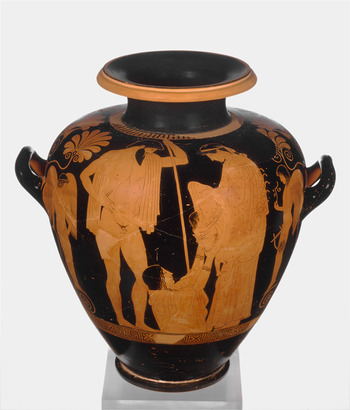
A red-figure stamnos, dated to 470–455 BCE and said to have been found at Vulci, depicts the autochthony scene most clearly, accentuated by a minimalist composition that concentrates on autochthony's key players (Figure 1).
Red-figure stamnos by the Painter of Munich 2413, 470–455 BCE. © State Collection of Antiquities and Glyptothek Munich, Photograph by Renate Kühling (BAPD 205571).

On the name vase of the Painter of Munich 2413, Hephaistos and Athena dominate the body while flanking the goddess Ge as she lifts the child up toward Athena. Subtle in its simplistic and delicately outlined forms, the iconography is centered on this group of three figures, with two winged erotes flanking them and directing focus toward the cosmic event that is before the viewer.Footnote 19 Ge is nearly sunk into the ground, with just her torso emerging from the arbitrary line of pattern demarcating the lower body of the vase.
This depiction of Ge, halfway between two worlds, emphasizes her close connection to the earth and the intermediary status that she embodies. Meanwhile, as Hephaistos stands erect in monumental nudity, Athena reaches toward the child, her snaky aegis turned away and the soft cloth of her garment ready to embrace Erichthonios, albeit with a sense of anticipation. Hephaistos as observer and Athena as recipient of the gift are ‘proud and slightly anxious parents’, while Ge might be read as the ‘true mother’ as well.Footnote 20 The birth scene is essentially reduced to the most important moment, Erichthonios’ transferal from Ge to Athena. In turn, it restores the myth to its basic elements, augmenting the meaning of this particular action for the understanding of the Athenians’ earthborn status.
By acknowledging this scene as a presentation, rather than simply as the birth of Erichthonios, autochthonous identity is portrayed by a specific action with ritual undertones.Footnote 21 The scene is but a moment, but it is one that is deeply imbued with meaning, manifest in a captivating act. The birth has already occurred; the critical point is the transfer from Ge to Athena, from one goddess to another. Athena is entrusted with a gift that is an offering to her, but it can be interpreted as one to the Athenian people as well. The scene embodies strong political overtones for the Athenians because it cements the connection between the earth that they inhabit, the ancestor of the Athenians, and the gift of civic identity that is conferred to them through this metaphor.
Gifts and Ritual in Archaic and Classical Athens
Autochthony's mythical roots seem almost alienated from reality, but it is more than simply a metaphor.Footnote 22 As Kennedy emphasizes, autochthony had an end goal, that of signifying differences between Athenians and others based on ‘groupings’ that are cultural, political, and even organic;Footnote 23 thus the visual manifestation of the concept informed cogent understandings of what it meant to be an Athenian. The presentation scene of Ericththonios from the earth to Athena visually solidifies the relationships between gods, the Athenian genos, and the land. Contextualizing the autochthony scene within the realm of gift-giving in antiquity further permits a broad framework for this specific iconography's impact in understanding Athenian identity. Since gifts and exchange were integral components of Greek and Athenian religion and played a part in the formation of cultural, political, and social identities, a brief overview of the range of meanings for gift-giving in ancient Greece will be outlined here.Footnote 24
Even in the Bronze Age, rituals of gift-giving and exchange were frequently embedded with political connotations, and gifts are often viewed as social norms and economic determinants for relationships between peoples.Footnote 25 When rooted in politics, gift exchange in the ancient Mediterranean denoted social connections between peoples and existed between multiple strata of class systems, from trade between the working classes to elite-specific forms of exchange. Creating a bridge between the political underpinnings of gift exchange and reciprocity can help us to understand autochthony's broad interrelatedness with gifts, exchange, and ritual, and how its iconography propelled the narrative of the Athenians’ political claim to their land and the primacy of its citizenry. Simply put, as Ge gives Erichthonios to Athena as a gift, a lineage is forged from the earth that the Athenians inhabit as well as control, one that is distinct from those who are not citizens.Footnote 26
Ultimately, gifts and exchange were integral components of Athenian religion as well. Gifts to the gods were given as regular sacrifices at festivals that were central to the Athenian calendar system; women oscillated between the oikos and the polis to make private dedications in public sanctuaries; gifts to the dead were given at the grave as an integral part of funerary practice.Footnote 27 Gifts were also given from the gods to humans, such as Demeter's gift of grain, which provided the Greeks with the ability to cultivate their land.Footnote 28 This sustaining and nourishing gift carried a heavy metaphorical weight, as well as a literal one, for the Athenians. Furthermore, Demeter is alluded to in Plato's Menexenus (237e7–38a1), and this dialogue also gestures to the Homeric Hymn: the earth first gives birth to citizens metaphorically and is then nourished by the gift of ‘wheat and barley’ (τὸν τῶν πυρῶν καὶ κριθῶν καρπόν, 238a1).Footnote 29
By considering these varied parameters of gifts and exchange, from political motivations to religious initiatives, autochthony can be seen in a broader light. Gifts to the gods are an idiomatic reflection of humans who ‘seek to do business with them’;Footnote 30 these gifts ensured human sustenance and flourishing but also solidified relationships between humans and the gods. Contextualizing autochthony under the umbrella of gifts and exchange helps us to understand the myth and its associated ritual and iconography not merely as explanations or visualizations of a simple story, but as the backbone of an aitiology of Athenian identity. Autochthony also tied the Athenians closely to the gods and provided a link to the earth and a sort of god-sponsored idea of citizenry: that, as a gift from the gods, the autochthonous nature of the Athenians legitimately established their standing as inhabitants of Attica and recipients of a special status of citizenship.
Ge, Athena, and the Performance of Gesture
Both as a personification of the earth and a ‘source of creation’, Ge is a constant presence in the autochthony myth on Athenian vases.Footnote 31 It is not surprising, therefore, that vase painters depicted her in a concrete, personified form,Footnote 32 and her epithet ‘All-Giving’ applies readily to her prodigious gift of Erichthonios to the Athenians.Footnote 33 She accords well with the ‘first mother’ referred to by Socrates in the Menexenus (237c); Athenian mothers are ‘descendants’ of her yet also ‘imitations’ of Ge.Footnote 34 The difference between the Menexenus and vase painting, however, is that vases always depict Athena on equivalent ground with Ge. Athena is the ‘caregiver and protector’ of one of the most important ancestors of the Athenians, and even her dress is imbued with meaning related to this role. Bundrick suggests that Athena's garments in scenes of autochthony, which are far less militaristic than her usual guise, help to drive home the idea that cloth is a symbolic feature of ‘themes of family and community’.Footnote 35 In several vases, Athena's snakes turn away from her aegis, a shorthand that signals how she has ‘let down her guard’ in her typical role as a warrior goddess. Athena assumes this motherly stance as she reaches out, readying herself to receive the child. While Avramidou argues that she is the ‘protagonist’ in these scenes,Footnote 36 I suggest that the trio be given equal measure and that their interactions as a whole drive the narrative meaning of the gift-giving scene.
Athena's role in this imagery also links her to an established position in Athens. Her contest with Poseidon for control over Attica, which was depicted prominently on the west pediment of the Parthenon, solidified her stance as patron goddess of the Athenians. Nearby, an olive tree was said to have grown near the Erechtheion, a token from Athena to the Athenians that was part of her successful agon to become patron goddess to the city of Athens.Footnote 37 Her first words in Euripides’ Erechtheus, in fact, refer to this contest, imploring Poseidon not uproot her land and ruin her city (F 370.55–7).Footnote 38 Both the olive tree and Erichthonios become important symbols integral to the polis, and each functions as a gift for the Athenians: the olive tree was important to religion as well as the Athenian economy, and Erichthonios became a direct ancestral link to the earth.Footnote 39 Athena's close ties to the land thus represent a continuum between Ge and subsequent generations of Athenians who are descended from Erichthonios.
Furthermore, a subtle gesture is represented at the heart of the autochthony presentation in Ge's transfer of Erichthonios to Athena. At their core, gestures denote visual ways of conveying information through specific actions that can be ‘read’ by the viewer in a multitude of ways.Footnote 40 In the case of the presentation of Erichthonios, the scene is charged with both literal and metaphorical meaning as our attention is directed to the child; this specific narrative moment forges a connection between the earth and the gods. It provides a visual dimension to the crucial moment between Ge, Erichthonios, Athena, and the future of the Athenian people, whose status as ‘children of the earth’ is legitimized by this specific and recognizable action.Footnote 41
This imagery from vase painting is also reminiscent of a scene from Euripides’ Ion, one of several referring to Erichthonios that are woven into the dialogue. In the first scene of the play, the following exchange between Ion and Kreousa occurs:
Ἴων: ἦ καί σφ᾽ Ἀθάνα γῆθεν ἐξανείλετο;
Κρέουσα: ἐς παρθένους γε χεῖρας, οὐ τεκοῦσά νιν.
Ἴων: δίδωσι δ᾽, ὥσπερ ἐν γραφῇ νομίζεται…;
Κρέουσα: Κέκροπός γε σῴζειν παισὶν οὐχ ὁρώμενον.
(Ion 269–72, tr. Kennedy, Roy, and Goldman)
Ion: And did Athena really take him up from the earth?
Kreusa: Yes, and right into her virgin Hands; she didn't give birth to him.
Ion: And then she gave him, as the paintings usually show…
Kreusa: …to the daughters of Kekrops to keep safe and hidden.
Kreusa's line ὥσπερ ἐν γραφῇ νομίζεται (‘as the paintings usually show’) provides evidence that the iconography found in vase paintings of Erichthonios’ presentation was known and readily visualized, perhaps referring to a larger, painted image such as a wall painting that is now lost.Footnote 42 Surviving vases reinforce parallel imagery, but the iconography condenses the dual action of this scene to focus solely on Athena's reception of the child.Footnote 43 In vase painting, too, the visually centered figure of Erichthonios is always reaching out toward Athena, anticipating his reception as a gift from the earth.
In Erichthonios’ extended reach toward Athena, Räuchle interprets a ‘longing’ motif in ancient art, demonstrative of a basic need for care but also indicative of recognition.Footnote 44 Described by Loraux as ‘confident’ yet also ‘impatient’, Erichthonios’ gesture also ‘implies a strict and exclusive relationship between the autochthonous hero and the goddess Athena’.Footnote 45 Yet beyond these readings, the coordinated movement of Ge handing Erichthonios to Athena also signifies the transfer of a gift. Both goddesses were fundamental players in the public, or civic, political, and religious centers of the polis, but while Ge can be seen as a ‘biological conception of motherhood’, Athena reveals a more social angle.Footnote 46 Together, they form a visual bracket to an emerging citizenry. By reading the presentation scene as a focused event that visually signals the earthborn identity of Erichthonios as a gift for the Athenian genos, the imagery provides a concrete link between the Attic soil and the future of Athens and its citizens.
Performing Autochthony, Performing Citizenship
It is in the gesture of the presentation of Erichthonios that we can perhaps interpret a nod to evolving notions of Athenian citizenship. When read as illuminating a ‘congenital connection with the earth’ and as ‘a process of semantic amplification’,Footnote 47 the gesture of autochthony becomes charged with a symbolism that goes beyond the straightforwardness of the myth. The gesture of passing the gift of Erichthonios from one parent to another caretaker imbues the myth with an apprehension of the origins of the Athenians, and what it truly meant to be an Athenian, manifest through the performance of the ritual scene.
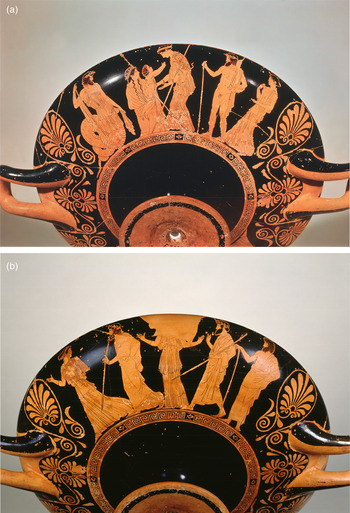
Another example of a red-figure vase that illustrates this convergence of performance, gesture, and familial relationships at the momentous occasion of Erichthonios’ birth is a kylix by the Codrus Painter (Figures 2a and 2b). Dated to 440–430 BCE and found at Tarquinia, two sides of the exterior of the cup display a gathering of heroes, ancestors, and deities, all named by inscription, to bear witness to the moment of Erichthonios’ presentation.
Red-figure kylix by the Codrus Painter, 440–430 BCE © Antikensammlung, Staatliche Museen zu Berlin—Preussischer Kulturbesitz (Johannes Laurentius, F2537) (BAPD 217211).

The scene includes not only Athena and Hephaistos, as in the Munich stamnos, but also Kekrops, the half-serpent, half-human early king of Athens, and his daughters, Aglauros, Pandrosos, and Herse. Early Athenian kings and eponymous heroes, including Erechtheus, Aegeus, and Pallas, are also included in order to forge a more deep and concrete connection to the Athenians, similar to other gatherings depicted in Athenian vase painting that enunciate royal genealogies.Footnote 48 Autochthony becomes a kind of family affair, played out in a frieze-like parade of ancestors.Footnote 49 This ordering takes the ritual aspect of the scene to a new level, putting forth an explicit display of hereditary relationships and heroic associations amongst eponymous ancestors, all linked to the emerging citizenry connected to Erichthonios at the center of the kylix's exterior.
Visually, these relationships are played out in a narrative structure that is reminiscent of a stage or frieze, and viewers of the vase would become audiences of this performance themselves, just as in religious or festival processions or as onlookers at the theater.Footnote 50 Emblematic examples from vase painting such as the Painter of Munich 2413's stamnos and the kylix by the Codrus Painter illustrate variations on an iconic motif that contained multiple, interconnected threads that the Athenians could perceive as autochthonous: Athena and Hephaistos as the parents of Erichthonios, the presence of Ge as a conduit for communicating the critical nature of the land, and the ritual presentation of the child to Athena as a metaphor for the gift of identity to the Athenians. Perhaps most importantly, it is the action of the gift of Erichthonios and the relationships between these gods and ancestors of the Athenians that helps to solidify the relationships between autochthony and its iconography.
Furthermore, the performative aspects of autochthony demonstrate the gift of earth-born status to the Athenians, a contribution that provided them with the keys to their identity. As Johanna Hanink discusses in this volume, the theater frequently served as the centrifugal environment for conceptions of political community and civic identity. I extend this argument to incorporate the iconography of vase painting discussed here as a kind of visual performance with a similar goal of focusing notions of the Athenian political imaginary. As a staged kind of citizenship, in that autochthony legitimized belonging through a vivid and visual metaphor, the concept enunciated a mythological narrative of civic identity. Building upon the victories of the Persian Wars and an increased preoccupation with the land, autochthony—as described and demonstrated through an established yet variable iconography in vase painting—was a visual way for Athenians to conceive of their identity in a retrospective manner, aligned with Mark Fisher's hypothesis in this volume regarding the civic and heroic continuity shared by Athenian citizens.Footnote 51
Autochthony as illustrated in the vases discussed here and others also allowed Athenians to visualize a civic continuity and connection to a common ancestor. In this regard, it echoed the literary tradition of the funerary epitaphios of the fifth and fourth centuries.Footnote 52 The classical Athenian funeral oration was marked by a pervasive acknowledgment of space, as Bakker maintains, with its location in the Kerameikos as a performative ‘panoramic backdrop’ that ‘breathed solemnity and civic pride.’Footnote 53 Unlike the mythological imagery of vase painting, however, notions of autochthony were so firmly embedded in the democratic, public discourse of the funeral oration that, as Nimis puts it, the epitaphios was ‘translated into an ideal devoid of any mention of Erechtheus or Athena’.Footnote 54 Allusions in spoken words, explicitly visualized images: these varying methods of portraying the long, grounded lineages of the Athenians were essential to understanding the intrinsic nature of autochthony.
In addition, the shared nobility of Athenian citizens’ origin through Erichthonios echoed that of other methods by which they exemplified their pedigree and, in effect, their superiority.Footnote 55 To be a citizen in archaic and classical Athens meant a variety of things throughout the sixth and fifth centuries, but ultimately was bound to increasingly narrow notions of community, relationships, and descent over time.Footnote 56 In other words, to be a citizen in the emerging imperialistic political setting of Athens was dependent on a shared heritage, as well as ‘communitarian structures’ that emphasized the connection between individual and community, essential for the understanding of Athenian collectivism that became particularly important after the Persian Wars.
Effectively, as Ismard argues, the Kleisthenic reforms managed to create ‘forms of linkage’.Footnote 57 These associations were best described through ancestral connections, which are well illustrated in the images of autochthony found in the vase paintings examined here. Then, at the height of imperialistic power in 451 BCE, Perikles’ Citizenship Law was passed, essentially sandwiched in the years between the Painter of Munich 2413's stamnos and that of the Codrus Painter's kylix.Footnote 58 In restricting citizenship to children born of two Athenian citizen parents, autochthony as a concept became a legal reality: there is no clearer way of expressing descent from two grounded citizens as aligned with the notion of a deep-rooted connection to the land. The Citizenship Law drew a clear-cut line in defining citizenship, one which it became increasingly difficult to obtain, unless one was born into it. In effect, this legal and conceptual framework articulated the lines between those who belonged ‘to’ the land of Attica and those who did not.Footnote 59
Moreover, the legal precedents set down in the fifth century between the Kleisthenic reforms and the Citizenship Law of Perikles not only created a line that demarcated political inclusion and exclusion, but also set up a closely interwoven network within this boundary of belonging that was grounded in geography and ancestry. The autochthony myth ultimately represents a kind of ethnic exclusivity and exceptionalism that separated Athenians from those who were not born from the earth and existed outside that metaphorical boundary.Footnote 60 Continuity of kingship and ancestral lines, made manifest through successive genealogies, formed links between generations, yet these successive generations were eventually ‘collapsed’ into a single comprehension of legitimate Athenian-ness.Footnote 61 The Munich stamnos, as well as the more elaborate kylix by the Codrus Painter, both compress these lengthy histories into a legitimizing visual myth of a gift shared between Ge, Erichthonios, and Athena and the Athenians.
In the emerging citizen ideology of the fifth century, this iconographic link to ancestors and the gods outwardly stood in contrast to an elite, aristocratic status that could be claimed by any Athenian who was born in Athens to two Athenian parents. The bonds that were subsequently constructed—visualized in the gift from the earth to Erichthonios to Athena—alluded to this nexus, with Athena as the patron goddess of Athens as the key connector to and metonym for the Athenian people. Autochthony, in effect, allowed everyone who had the ‘correct’ ancestry to claim aristocratic privilege and pedigree. The two seemingly contradictory claims of ‘born from the earth’ and ‘always inhabiting the same place’ are actually ‘not only compatible but in fact complementary’, as Robitzsch argues; they characterize the Athenians as autochthonous both in iconography as well as the epitaphios on display in Perikles’ Funeral Oration and Plato's Menexenus.Footnote 62
Conclusion
This paper suggests that the iconography of autochthony makes manifest in visual form the relationships and rituals that were central to understanding Athenian identity and the process of gift-giving as a core component of the myth. No literary sources explicitly replicate this imagery, but in visualizing the presentation of Erichthonios in vase painting the earth, Ge, presents a gift to the Athenian people via Athena. It is a moment that looks to the past through a crucial ritual of the Athenian ancestor's birth from the earth, but also glances at the future and the potential for Erichthonios’ upbringing under the protection of Athens. A carefully crafted metaphor with deep roots and embodied meanings, the longevity of the autochthony myth into the fourth century and beyond reveals the Athenians’ attempt to ‘direct the course of their future’ long after an understanding of Athenian civic identity had been established.Footnote 63
In the iconography of autochthony, Erichthonios is almost always reaching out toward Athena, as she gestures to receive him as a gift from Ge. This dual acknowledgement and reciprocity between the ancestor of the Athenians and their patron goddess effectively serves as a ‘vital function in initiating contact’ and unites the two figures, establishing ‘a pathway for subsequent communication.’Footnote 64 Ge's offering of the gift of Erichthonios results in the groundwork that lays the path for an understanding of Athenian citizenship, a relationship between ancestral connections that is both ‘personalized’ and ‘enduring’, which Kurke argues is an essential element of understanding gift exchange.Footnote 65 Time is lost in this iconographic narrative; as Kasimis suggests, the myth of autochthony ‘eschews generational time to make each citizen appear as the unmediated offspring of the land.’Footnote 66 Yet through the process of perceptible ritual and gift-giving, the autochthony narrative was propelled along, clarified and strengthened by the visual imagery through which it is most widely known.Footnote 67