Language brokering is a language contact phenomenon in which children or adolescents are enlisted to serve as informal translators for their family or community members (Shannon, Reference Shannon1990). Language brokering may occur in a range of contexts – employment and immigration, financial transactions, parent-teacher conferences, hospital settings, or everyday conversation. The practice of language brokering is widespread among refugee and immigrant communities (e.g., Guan, Nash & Orellana, Reference Guan, Nash and Orellana2015; Lazarevic, Raffaelli & Wiley, Reference Lazarevic, Raffaelli and Wiley2014), and has been an active topic of study in the disciplines of sociology, education, law, communication, and health; however, psychological studies of brokering experience are only recently emerging (Martinez-Gomez, Reference Martinez-Gomez2015).
Psychological investigations of language brokering have, for the most part, examined social, affective, developmental, and family dynamics aspects of the brokering experience rather than cognitive or linguistic aspects. Experience in language brokering experience has been associated with a range of outcomes, including higher self-esteem and self-confidence, and a heightened connection to ethnic identity (Love & Buriel, Reference Love and Buriel2007; Weisskirch, Kim, Zamboanga, Schwartz, Bersamin & Umaña-Taylor, Reference Weisskirch, Kim, Zamboanga, Schwartz, Bersamin and Umaña-Taylor2011), but also feelings of ambivalence (see Morales & Hanson, Reference Morales and Hanson2005, for a review). The nature of the effects associated with language brokering vary depending on the time frame of the assessment (current or retrospective), as well as on a range of sociocultural factors (e.g., gender, birth order) still to be disentangled (see Guan et al., Reference Guan, Nash and Orellana2015, for further discussion).
Previous studies in bilingualism suggest that bilinguals may show differential conceptual representation as a function of the language in which events or experiences were encountered (e.g., López & Vaid, Reference López and Vaid2017; Vaid, Reference Vaid1988; Ward, Chu, Vaid & Heredia, Reference Ward, Chu, Vaid, Heredia, Bara, Barsalou and Bucciarelli2005). Relatedly, there is a body of work examining the cognitive impact of formal training in translation or interpretation, within the framework of expertise effects. These studies have compared professional interpreters or students with formal training in translation/interpretation with untrained bilinguals or monolinguals in shadowing, paraphrasing, or translation in relation to the role of the two brain hemispheres (e.g., Green, Schweda Nicholson, Vaid, White & Steiner, Reference Green, Schweda Nicholson, Vaid, White and Steiner1990; Green, Vaid, Schweda Nicoholson, White, & Steiner, Reference Green, Vaid, Schweda Nicholson, White, Steiner, Lambert and Moser-Mercer1994;), translation directionality effects (Christoffels, de Groot & Kroll, Reference Christoffels, de Groot and Kroll2006; Garcia, Ibanez, Huepe, Houck, Michon, Lezama, Chadha & Rivera-Rei, Reference Garcia, Ibanez, Huepe, Houck, Michon, Lezama, Chadha and Rivera-Rei2014; Tzou, Eslami, Chen & Vaid, Reference Tzou, Eslami, Chen and Vaid2012), translation strategy (preference for a meaning-based versus a form-based translation strategy) (Tzou, Vaid & Chen, Reference Tzou, Vaid and Chen2017), working memory capacity (Christoffels et al., Reference Christoffels, de Groot and Kroll2006; Tzou et al., Reference Tzou, Eslami, Chen and Vaid2012), and cognitive control (e.g., Becker, Schubert, Strobach, Gallinat & Kuhn, Reference Becker, Schubert, Strobach, Gallinat and Kuhn2016; Dong & Xie, Reference Dong and Xie2014; Yudes, Macizo & Bajo, Reference Yudes, Macizo and Bajo2011). On the whole, this body of work suggests that expertise gained through formal training in translation may differentially influence bilinguals’ language and cognitive processing.
What has been less studied is whether there may be distinct cognitive repercussions of differences among bilinguals in informal translation experience as well. Like formal translation, informal translation experience is also a kind of expertise, although the range of linguistic (and pragmatic) skills that language brokers may call on may extend beyond those used by students of translation, given that brokering occurs in real life settings with more varied types of language use and a greater affective investment in the practice of translation, given that one is translating for one's family. By virtue of being more “practiced” in translation per se, or more practiced in handling different types of domains, one may expect that language brokering could lead to greater sensitivity to nuances of meaning, and easier retrieval of translation equivalents. Despite some early work on “natural translators” (e.g., Malakoff & Hakuta, Reference Malakoff and Hakuta1991), there has been little empirical investigation of the potential cognitive and linguistic repercussions of informal translation practice, Indeed, there are currently only a handful of published studies that have compared the performance of informal translators (language brokers) and bilinguals without brokering experience (Garcia et al., Reference Garcia, Ibanez, Huepe, Houck, Michon, Lezama, Chadha and Rivera-Rei2014; López & Vaid, Reference López and Vaid2017; Rainey, Davidson & Li-Grining, Reference Rainey, Davidson and Li-Grining2015; Vaid & López, Reference Vaid and López2014; Vaid, López & Martinez, Reference Vaid, López, Martinez, Heredia and Cieslicka2015). The present research sought to fill this gap.
Our study examined the long-term impact of variability in language brokering experience on the processing of figurative language, with a particular focus on idiom processing. We focused on exploring idiom comprehension in relation to language brokering experience because idiomatic expressions comprise a sizeable portion of everyday language use and because their effective translation requires considerable linguistic facility, given that there may not be counterparts of an idiom in another language, and, thus, alternate ways of expressing the meaning of the idiom may be required. Brokers may be more practiced in handling varied forms of language use, including more colloquial, culture-laden expressions (such as idiomatic expressions) that are likely used more in day to day contexts. We thus reasoned that individuals with extensive experience in informal translation may have become more adept at identifying idiomatic expressions and finding appropriate ways of conveying them, and thus, should be more readily able to access the meaning of idioms and words related to them. Importantly, we hypothesize that this would be the case regardless of whether the related words are in the same language as the idiom phrases or in the other language. That is, we hypothesized that brokering experience will be associated with an ease of making semantic judgments of idioms in a particular language and words related to the idioms’ meaning, whether or not they are in the same language as the idiom.
Before turning to our study, we provide a brief discussion of findings in the idiom processing literature and relevant studies of language processing in language brokers versus non-brokers.
Figurative language and idiom processing
Figurative language refers to uses of language in which the intended meaning of an utterance is not always derivable from the literal meaning of the individual words in the utterance. Examples of figurative language use include irony, sarcasm, metaphor, humor, and formulaic language involving fixed expressions, such as idioms and proverbs. Despite its prevalence in everyday discourse, psycholinguistic research on figurative language processing, particularly in second language users or bilinguals, is relatively scarce (e.g., Bortfeld, Reference Bortfeld, Heredia and Altarriba2002; Cieslicka, Reference Cieslicka2006, Reference Cieslicka, Heredia and Cieslicka2015; Heredia & Munoz, Reference Heredia, Munoz, Heredia and Cieslicka2015; Vaid, Reference Vaid2000, Reference Vaid and Pavlenko2006; Vaid, Choi, Chen & Friedman, Reference Vaid, Choi, Chen and Friedman2008).
Idioms comprise a sizeable part of the repertoire of native language users (Pawley & Snyder, Reference Pawley, Snyder, Richards and Schmidt1983) and have been extensively studied in monolinguals (Wray, Reference Wray2012), and, to a lesser extent, in second language users (e.g., Cieslicka, Reference Cieslicka, Heredia and Cieslicka2015) or bilinguals (Titone, Columbus, Whitford, Mercier & Libben, Reference Titone, Columbus, Whitford, Mercier, Libben, Heredia and Cieslicka2015). They are of interest to linguists because they have a fixed, conventional meaning, which may or may not be related to the literal meaning of the individual words in the idiomatic expression. For instance, the meaning of the idiom, Pop the question (“propose marriage”) can be understood by considering that the word, pop, relates to the meaning to ask and the word, question, can be related to marriage proposal. By contrast, the meaning of idioms like kick the bucket (“to die”) cannot be discerned by a compositional analysis, as the component words kick, and bucket, do not individually contribute to conveying the idiomatic meaning of the phrase. For psycholinguists, developing a coherent theory of idiom comprehension has presented a challenge: “how to account for the unitary nature of idioms, given the literal interpretation of the single words involved” (Sprenger, Levelt & Kemper, Reference Sprenger, Levelt and Kemper2006, p. 163).
Studies of idiom comprehension (and, to a lesser extent, idiom production) have generated a large body of empirical evidence to bear on the issue of how idioms are accessed and represented in the mental lexicon. The central debate is whether the figurative meanings of idioms are directly retrieved from the mental lexicon as unanalyzed strings, or are accessed by means of a compositional analysis (Cieslicka, Reference Cieslicka2006; Titone & Libben, Reference Titone and Libben2014). Studies using a range of offline (e.g., whole sentence reading, paraphrase judgments) and online methods (e.g., cross-modal priming, eye tracking) have presented evidence that has been used to support either a direct access view (Bobrow & Bell, Reference Bobrow and Bell1973; Swinney & Cutler, Reference Swinney and Cutler1979) or a compositional view (Gibbs, Nayak & Cutting, Reference Gibbs, Nayak and Cutting1989).
It is now generally accepted that a hybrid model of idiom representation in the mental lexicon best characterizes the evidence, taken as a whole (Libben & Titone, Reference Libben and Titone2008). That is, idioms are thought to involve both direct retrieval of a unitary meaning, and the computation of phrase meaning based on the activation of the literal meaning of the constituent words of the idiom phrase. In other words, the interpretation of an idiom may involve both a compositional analysis of the literal meaning of the individual words in the phrase and a holistic interpretation of the idiom's meaning to different degrees. According to an early articulation of this hybrid view, termed the configuration hypothesis (see Cacciari & Tabossi, Reference Cacciari and Tabossi1988), Cacciari and Glucksberg (Reference Cacciari, Glucksberg and Simpson1991) proposed that an idiomatic phrase is typically interpreted literally until a point in the phrase is reached (the idiom's key) that uniquely identifies the phrase as a special configuration. At this point, the phrase is recognized to be an idiom and the figurative meaning is activated. Thus, according to the configuration hypothesis, whereas the literal meanings of the individual words in the idiom phrase contribute to the activation of an idiom's representation, the introduction of certain elements (the idiom's key) enables a direct activation of the idiom's unitary, figurative representation in the mental lexicon.
A recent extension of the hybrid model of idiom representation, based on a primed idiom production task, was proposed by Sprenger et al. (Reference Sprenger, Levelt and Kemper2006), in their Superlemma Hybrid Model. According to this model, idioms are not stored solely at the level of individual lexical concept entries that connect to simple lemmas, but also at a superlemma level that preserves lexical-syntactic information of the idiom phrase as a whole. Furthermore, this model posits a process of spreading activation (from lexical concept nodes to simple lemmas to superlemma nodes, and vice versa) to account for how idiom meaning is activated.
Although Sprenger et al. (Reference Sprenger, Levelt and Kemper2006) proposed that all idioms have a hybrid representation in the mental lexicon, their model leaves open the possibility that idioms may differ in ways that affect how easily their meaning is accessed. Indeed, the potential contribution of linguistic properties along which idioms differ, such as frequency, transparency, literal plausibility, and semantic decomposability, has been a focus of several studies in the idiom comprehension literature (Caillies & Butcher, Reference Caillies and Butcher2007; Libben & Titone, Reference Libben and Titone2008; Titone et al., Reference Titone, Columbus, Whitford, Mercier, Libben, Heredia and Cieslicka2015). In particular, idiom familiarity and literal plausibility have been found to have robust effects on idiom comprehension, in monolinguals and bilinguals alike (Cieslicka, Reference Cieslicka, Heredia and Cieslicka2015; Titone & Libben, Reference Titone and Libben2014; Titone et al., Reference Titone, Columbus, Whitford, Mercier, Libben, Heredia and Cieslicka2015). In bilinguals, the variable of cross-language meaning overlap, or similarity in idiom meaning across languages, also appears to affect processing (Cieslicka, Reference Cieslicka, Heredia and Cieslicka2015; Titone et al., Reference Titone, Columbus, Whitford, Mercier, Libben, Heredia and Cieslicka2015).
The effect of idiom semantic decomposability is less clear. For example, in a task in which participants were to judge if a phrase was a permissible phrase in English, Gibbs et al. (Reference Gibbs, Nayak and Cutting1989) reported faster responses by monolinguals to decomposable than to non-decomposable idioms. Further, when judging the meaningfulness of an idiom, decomposable idioms showed faster processing times than non-decomposable ones (Gibbs et al., Reference Gibbs, Nayak and Cutting1989). However, Libben and Titone (Reference Libben and Titone2008) found that the effect of decomposability in monolinguals is inconsistent and varies across tasks. Specifically, when a task required overt judgments of idiom meaningfulness, idiom decomposability facilitated comprehension, but on other tasks there was no effect of decomposability on comprehension.
A recent study by Titone and Libben (Reference Titone and Libben2014) used a cross-modal priming task in which idioms varying in familiarity, literal plausibility, and semantic decomposability were embedded in auditorily presented, semantically neutral sentences, and visual target words were presented at different time points. The authors found that, whereas literal plausibility interfered with idiom priming prior to phrase offset, familiarity interfered with it at phrase offset, and decomposability interfered with idiom priming 1000 ms following phrase offset (Titone & Libben, Reference Titone and Libben2014). This study suggests that idiom decomposability as a factor does not affect idiom processing until well after the idiom is initially processed (but see Caillies & Butcher, Reference Caillies and Butcher2007), and that other factors, such as the idiom's familiarity and literal plausibility, may be more relevant in constraining the idiom's initial processing. Interestingly, Titone and Libben (Reference Titone and Libben2014) found that non-decomposable idioms were actually processed faster than decomposable idioms, once sufficient time had elapsed to process the idiom for meaning (see also Wray, Reference Wray2012).
In addition to factors related to idiom properties, one might expect that figurative language comprehension, and idiom comprehension more specifically, may also vary depending on the language status (dominant or non-dominant) of second language users. Presumably, second language users might not acquire figurative meanings in a second language (L2) until they become more familiar with the range of possible meanings in their second language (Kecskes, Reference Kecskes2006). Cieślicka (Reference Cieslicka2006) reported that Polish L2 learners of English presented with English idioms were faster and more accurate in lexical decision of targets that were related to the literal than to the figurative meaning of the idioms (see also Cieslicka, Reference Cieslicka, Heredia and Cieslicka2015). This suggests that, at least for second language learners, the literal meaning of an idiom is initially more salient, even if a phrase is presented in a figurative context. Similarly, an eye tracking study showed that, even in the presence of a biasing context, non-native readers of English showed more processing effort in reading the figurative meanings of idioms as compared to native readers. Moreover, unlike native readers, who were faster in reading idioms than novel phrases, non-native readers did not show an idiom processing advantage in their L2 (English) (Siyanova-Chanturia, Conklin & Schmitt, Reference Siyanova-Chanturia, Conklin and Schmitt2011). Additionally, Carrol and Conklin (Reference Carrol and Conklin2014) reported that, on a primed lexical decision task, native speakers of Chinese with intermediate proficiency in English showed faster lexical decision to idiom targets than control targets for items translated from their first language, whereas English monolinguals showed no difference in their response to the two types. However, as an eye tracking study by Carrol and Conklin (Reference Carrol and Conklin2015) showed, Chinese–English advanced L2 users were faster at reading the literal than the figurative meaning of English idioms, even for Chinese-only idioms that were presented in translated form from their L1. In summary, the findings to date on idiom comprehension suggest that the default reading of idioms by second language users is a literal reading, and figurative readings appear to incur a processing cost. It remains an open question whether there would be individual differences in idiom processing among bilinguals differing in brokering experience.
Recent work on language brokering has hinted at effects of brokering in figurative language processing as well as differences in other domains of language processing. We turn to these studies in the next section.
Psycholinguistic research on language brokering
In one of the few studies that have compared the performance of bilinguals without translation experience with that of bilinguals with either formal or informal translation experience, Garcia et al. (Reference Garcia, Ibanez, Huepe, Houck, Michon, Lezama, Chadha and Rivera-Rei2014) found that bilinguals with formal translation expertise, of any kind, and bilinguals with a high degree of informal translation experience were better than bilinguals without translation expertise on word translation, and that only the translators were equally fast at translating words from their first to their second language as in the other direction. Thus, it would appear that prior translation experience, whether formal or informal, enhances activation of translation equivalents and facilitates lexical search across language boundaries.
A number of recent studies have compared the performance of proficient bilinguals with language brokering experience with that of bilinguals without brokering experience on a range of language tasks. On a phonological awareness task (Vaid, Milliken, López & Rao, Reference Vaid, Milliken, López and Rao2011) Spanish–English bilinguals’ perceptions of units of sounds was examined by asking them to delete “the first sound” in a word and say aloud what was left. On this task, English monolingual speakers typically delete the first phoneme of the word, whereas Spanish speakers delete the entire first syllable, reflecting the greater prominence of syllables for speech segmentation in Spanish relative to that in English. Language brokers’ performance on the task showed a sensitivity to this language difference. That is, they deleted sounds at the level of phonemes when performing the task in English, but showed syllable-based strategy in Spanish; by contrast, non-brokers showed a uniform phoneme-based strategy in both languages.
Using a category exemplar generation task, López and Vaid (Reference López and Vaid2017) compared the performance of Spanish–English bilinguals with or without prior language brokering experience across two sessions, in which participants were to use the same language to respond across sessions or they were to shift to the other language. Both groups generated more exemplars when the language of the response shifted across sessions. However, the brokers demonstrated a greater cross-language overlap in the exemplars generated when the response language changed across the test sessions (López & Vaid, Reference López and Vaid2017), suggesting that brokering experience may foster a more integrated conceptual organization of cross-language category exemplars.
Brokering experience has also been investigated at a semantic level, using the remote associates task, a widely used measure of creative thinking. In this task, participants are given a series of trials, each consisting of three words (e.g., cake, cream, cheddar), and they are to come up with a single word (a remote associate) that forms a collocational phrase with each of the three individual words. Thus, for the above example, the remote associate would be cheese, as it forms cheesecake, cream cheese, and cheddar cheese. On an English version of this task, Spanish–English brokers and non-brokers performed similarly; however, for Spanish items, brokers generated more correct remote associate solutions than non-brokers (Vaid et al., Reference Vaid, López, Martinez, Heredia and Cieslicka2015, Exp. 3).
If language brokering experience appears to affect how bilinguals activate remote associates of words, then how might it affect ambiguity resolution for various kinds of non-literal expressions, such as humorous expressions? This question was examined in a joke (ambiguity) detection task (Vaid, Chen, Rao & Manzano, Reference Vaid, Chen, Rao and Manzano2006). One-liner jokes were embedded among matched one line sentences in which the final word was replaced to make the sentence plausible, but not humorous. Further, the humorous one-liners were funny either for linguistic reasons (i.e., the humor relied on word play), or because they exploited extralinguistic (cultural) knowledge. Brokers were found to be significantly faster at detecting jokes than non-brokers, particularly in Spanish, and for jokes calling on extralinguistic knowledge.
Another study examined the performance of Spanish–English brokers and non-brokers on a phrase plausibility judgment task for phrases presented in each language and where plausible meanings were either literal or figurative (Vaid et al., Reference Vaid, Milliken, López and Rao2011). Brokers were equally fast at making phrase plausibility judgments for the literal and the non-literal meaning of the phrase, in each language, but non-brokers were faster at judging plausibility of literal than of figurative phrases. This study suggests that translation experience facilitates phrase-level semantic processing across languages, regardless of whether the phrase has a literal or non-literal interpretation. A similar finding was observed in an idiom translation judgment study that compared Chinese–English bilingual students who were formally trained in translation/interpretation with untrained bilinguals (Tzou et al., Reference Tzou, Vaid and Chen2017). Students with formal translation experience were significantly faster in verifying translations, in either language, compared to bilinguals without such training, and were equally fast at judging literal and non-literal idiom translations (Tzou et al., Reference Tzou, Vaid and Chen2017). A similar pattern of results was found on an idiom translation judgment task conducted with brokers and non-brokers (Vaid & López, Reference Vaid and López2014). These findings, taken together, suggest that formal or informal expertise in translation enhances the activation of word and phrase level meaning equivalents across languages.
The present study
The present study expands investigation of the impact of language brokering experience to the domain of idiom comprehension. Phrases with an idiomatic meaning in only one language (English) were presented to Spanish–English proficient bilinguals followed by target words in English or Spanish, and participants were to judge if the target word's meaning captured the figurative meaning of the idiom. It was expected that idiom/target relatedness judgments would be faster and more accurate when the target word is presented in the same language as the idiom. However, given that brokering experience is associated with a greater facility in activating translation equivalents (Vaid & López, Reference Vaid and López2014; López & Vaid, Reference López and Vaid2017), it was hypothesized that brokers would show less of a same-language facilitation effect than non-brokers.
The study also examined the possible role of idiom decomposability. We had no specific hypothesis for how idiom type might matter, given the mixed findings in the literature, with some studies showing faster, or earlier, activation of the meaning of decomposable than non-decomposable idioms (Caillies & Butcher, Reference Caillies and Butcher2007), but others showing an opposite effect (Titone & Libben, Reference Titone and Libben2014). Nor did we make any specific prediction regarding a possible interaction of idiom type and broker status. We assumed that, while differences among idioms in decomposability might, in turn, reflect differences in whether idiom meanings undergo composition and/or are retrieved as wholes, that brokering experience could facilitate both direct retrieval and computation of idiomatic phrase meaning.
Method
Participants
Forty-six proficient Spanish–English bilinguals from a southwestern university in the U.S. were recruited from the psychology participant pool and were compensated $8.00 for an hour of their time.
Brokering classification
Bilinguals were classified as brokers (N = 21; 13F) or non-brokers (N = 25; 19F) based on their self-reported frequency and pattern of informal translation experience, as determined from their responses on a detailed language background and brokering questionnaire (Vaid, Reference Vaid2012). Specifically, they were asked to rate on a scale of 1 to 5 (1 = never, 2 = rarely, 3 = sometimes, 4 = often; 5 = always) how often they translated for parents, grandparents, or guardians, and indicate in which settings (e.g., home, school, work, restaurants), and for what types of materials (e.g., immigration forms, job applications, school notes, homework, doctors’ notes), they engaged in translation. Those who indicated translating for parents, grandparents, or guardians sometimes, often, or always, in at least three different settings and for at least three different types of written materials, were classified as brokers, whereas those who reported translating for parents, grandparents or guardians rarely or never, in fewer than three settings, and for fewer than three types of written materials, were classified as non-brokers.
The mean age of brokers was 22.67 years (SD=2.60) and that of non-brokers, 21.88 years (SD=3.60). The majority of participants (84.8%) were born in the U.S. (17 brokers and 22 non-brokers). Over half of the brokers self-identified as Hispanic (57.1%), followed by Mexican American (23.8%), or Mexican (14.3%). For non-brokers, approximately 45% self-identified as Hispanic, followed by Mexican-American (32.0%), Latina/o (8.0%), or Mexican (4.0%). The remaining responses were combinations of the above.
Language background profile by broker status
Spanish was the first spoken language for 71.4% of brokers; two brokers reported English as their first language, and the remaining four reported using both English and Spanish from the outset. For non-brokers, almost half of the participants (N = 11) also reported Spanish as their first language, followed by seven (28.9%) reporting English, and six (24%) reporting both languages. The second language was typically acquired before the age of 8 years for both groups (brokers, 77.7% and non-brokers, 71%). The majority of both groups (over 70%) reported that their language of instruction from elementary school through college was English.
With respect to language use with family members, the vast majority of brokers (95.2%), as compared to slightly over half of non-brokers (52%), reported using more Spanish when speaking to their mother. The frequency of Spanish used when speaking with their father was slightly lower: M = 76.2% for brokers and 44% for non-brokers. For speaking with grandparents, the vast majority of brokers and most non-brokers (M = 90.5% and M = 70.8%) reported using more Spanish. Interestingly, for language use with siblings, about half of the brokers reported using both English and Spanish (52.4%), while non-brokers reported using either English only (37.5%) or both English and Spanish (37.5%).
Language proficiency
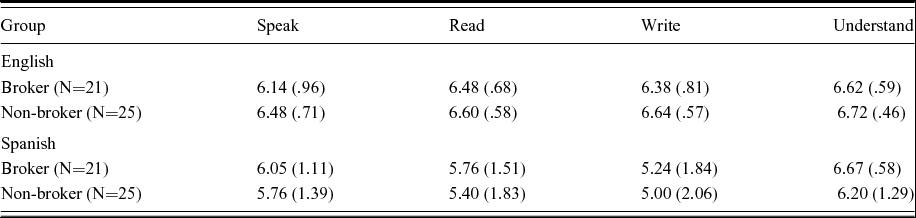
Self-report measures of language proficiency were prepared based on a composite measure and on component measures of self-ratings of participants’ English and Spanish abilities in speaking, reading, writing, and understanding each of their languages. Participants rated their abilities on each language modality on a 1–7 scale (1 = not at all proficient; 7 = highly proficient). An average of these ratings was computed per language as the composite measure of language proficiency. The mean composite language proficiency score for English was 6.40 (SD = .67) for brokers and 6.61 (SD = .54) for non-brokers. The difference between brokers’ and non-brokers’ self-rated English proficiency was not significant, t (44) = −1.16, p >.05. The mean composite language proficiency for Spanish was 5.93 (SD = 1.13) for brokers and 5.59 (SD = 1.53) for non-brokers, and the difference between these two means was also not significant t (44) = 0.84, p > .05.
Similarly, an analysis of self-rating scores on each of the four language modalities (see Table 1) revealed no significant differences between brokers and non-brokers. That is, there were no differences between brokers and non-brokers on their self-reported English speaking ability, t (44) = −1.36, p >.05, English reading ability, t (44) = −0.67, p > .05, English writing ability, t (44) = −1.28, p >.05, and English comprehension, t (39) = −0.83, p >.05. For Spanish, as well, no group differences were found in self-rated speaking ability, t (44) = 0.76, p >.05, reading ability, t (44) = 0.72, p >.05, writing ability, t (44) = 0.41, p >.05, or comprehension, t (44) = 1.53, p >.05.
Mean Self-Reported Language Proficiency Ratings by Group, Language, and Modality

a Standard deviation scores are presented in parentheses
Materials
Fifty-six idiomatic phrases in English were selected from the Titone and Connine (Reference Titone and Connine1994) and Heredia and Cieslicka (Reference Heredia and Cieslicka2015) norms. All were idiomatic only in English. That is, they did not have an idiomatic counterpart in Spanish. For example, the idiomatic meaning of the English phrase dressed to kill would be “dress to impress”. If the original English idiom or the literal translation of its paraphrased meaning were translated literally into Spanish, i.e., vestida para matar, it would not make any sense, as there is no equivalent idiomatic phrase in Spanish for the English idiomatic expression.
Phrases were classified in terms of their relative degree of semantic decomposability, and were also selected based on pretest measures to ensure that the phrases were familiar.Footnote 1 Stimuli were rated for their relative decomposability by two bilingual undergraduate research assistants. Based on their judgments, the items were classified as decomposable or non-decomposable. As noted earlier, semantically decomposable idioms refer to idioms whose meaning can be derived from the individual words of the idiom (e.g., get the picture), while non-decomposable idioms are those whose meaning is distinct from, and thus cannot be discerned by considering, the meaning of the individual words (e.g., dressed to kill). Of the 56 English idioms, 36 (18 decomposable; 18 non-decomposable) were used in critical trials, that is, trials in which a target word presented after the idiom was related to the meaning of the idiom, while the remaining 20 (10 decomposable, 10 non-decomposable) were used in control trials, that is, trials in which the target word was not related to the meaning of the idiom.
For each English idiomatic phrase presented in the critical trials, a target word was selected in English and Spanish that was related to the overall figurative meaning of the idiomatic phrase. For example, for the idiomatic phrase, dressed to kill, the related English target word was attractive, while, for Spanish, the target word was encanto (meaning, “pleasurable” or “likeable”). Two bilingual informants reviewed the materials to ensure that the target words across languages were similar in meaning and that they adequately captured the meaning of their corresponding idioms. An attempt was made to avoid using target words that had cognates in the other language; only 6 of the 36 critical target words were cognates. Control target words (for the present example, the control word was available) were unrelated in meaning to the idiom. Control words were matched to critical target words in frequency, part of speech, and word length (defined here as number of letters in each word). The EsPal database was used to arrive at appropriate matching of Spanish target words (Duchon, Perea, Sebastián-Gallés, Martí & Carreiras, Reference Duchon, Perea, Sebastián-Gallés, Martí and Carreiras2013), and the Subtlex-UK was used to find English target words (Van Heuven, Mandera, Keuleers & Brysbaert, Reference Van Heuven, Mandera, Keuleers and Brysbaert2014).
Procedure
Participants were tested individually in a laboratory setting. The software package E-Prime 2.0 (Schneider, Eschman & Zuccolotto, Reference Schneider, Eschman and Zuccolotto2002) was used to control stimulus presentation and data collection on a microcomputer. Participants were seated facing a computer and were instructed that they would see an English phrase. Upon reading the phrase silently for its meaning, they were to press the space bar on the computer after which a single word – in English or Spanish – would then appear (in upper case letters) on the computer screen, for 850 ms. They were to decide, as quickly and as accurately as possible, if this word was related to the meaning of the preceding phrase. If they judged it to be related in meaning, they were to press the ‘p’ key on the keyboard, which was labeled “Y”, and if they judged it not to be related in meaning to the phrase, they were to press the ‘q’ key, labeled “N”.
For example, on a given critical trial a participant may see an idiomatic phrase such as a piece of cake, followed by a target word in English (EASY) or Spanish (FÁCIL) that is related to the phrase's figurative meaning. In each case, they would have to respond “yes” by pressing the key designating a “yes” response. On a control trial, an idiom such as get the picture would be followed by a control target word in English or Spanish that was not related to the figurative meaning of the phrase and so they would have to respond “no”.
Participants were given a short practice set (12 trials) to get used to the task, and then the actual experiment began. There were a total of thirty-six critical trials and twenty control trials. Each trial type contained an equal number of decomposable and non-decomposable idioms. Per idiom type, half of the targets were presented in English and the other half were in Spanish. The language of the target word was counterbalanced across participants; thus, a participant saw either a Spanish or an English target word for any given idiom, but saw target words in each language equally often across the items.
Three dependent measures were recorded. The first was how long it took participants to read each idiom for comprehension. Reading time was measured from phrase onset until participants pressed the space bar to signal that they had finished reading the idiom for meaning. This served as a proxy measure of reading comprehension proficiency, supplementing the self-reported proficiency ratings. Immediately upon idiom offset, a target word appeared on the computer screen, and participants were to judge whether it was related to the idiom's meaning or not. This constituted the second dependent measure; reaction time latencies to semantic relatedness judgments were recorded from target word onset until participants pressed the key designating the “yes” response. Only response latencies to correct responses were analyzed. The third measure was percent accuracy of semantic relatedness judgments, that is, the likelihood of saying “yes” when the target word was in fact related to the meaning of the idiom.
Idiom reading latencies were analyzed in a two-way analysis of variance as a function of broker status and idiom type. Semantic relatedness response time and accuracy judgments for control and critical trials were each analyzed as a function of broker status, idiom type, and language of the target word, with separate analyses done by-participants and by-items.
Language background and brokering questionnaire
A detailed language background and brokering questionnaire was administered following the experiment (Vaid, Reference Vaid2012). Participants answered questions on age of acquisition of English and Spanish, frequency of language brokering (e.g., whom they brokered for, what they brokered and current brokering status). Responses to the questionnaire were used to classify participants as brokers or non-brokers.
Results
Mean idiom reading times
Since participants were to read the idioms for comprehension, mean idiom reading times were generally long, ranging from 1665 milliseconds (ms) to 1872 ms. A 2 (Idiom Type: decomposable vs. non-decomposable) X 2 (Broker Status: broker vs. non-broker) analysis of variance of idiom reading times, with repeated measures on the first variable, did not show a significant effect of idiom type, F1 (1, 44) = 3.44, p = .07, ηp 2 = .07, F2 (1, 68) = 0.31, p > .05, ηp 2 = .005, nor was there an effect of group, F1 (1, 44) = 1.89, p = > .05, ηp 2 = .041, F2 (1, 68) = 1.47, p > .05, ηp 2 = .021. The interaction between idiom type and broker status was also not significant, F1 (1, 44) = 0.16, p > .05, ηp 2 = .004; F2 (1, 68) = .097, p > .05, ηp 2 = .001. Thus, brokers and non-brokers did not differ in their reading time for English idioms, nor was there a difference in reading idioms as a function of idiom decomposability.
Accuracy of semantic relatedness judgments
Separate analyses were performed on the control trials (where the correct response was “no”) and on critical trials (where the correct response was “yes”).
Control trials
Inspection of accuracy data for control trials revealed three participants who responded incorrectly on all control items. Their data were considered outliers and were excluded from the analyses. Two separate analyses of variance were conducted, a by-participant and a by-item analysis, each involving a 2 (Broker Status: broker vs. non-broker) X 2 (Idiom Type: decomposable vs. non-decomposable) X 2 (Target language: English vs. Spanish) analysis. There was no effect of broker status in either analysis (F < 1) or of target language. There was a significant main effect of idiom type in the by-participant analysis, F1 (1, 41) = 5.03, p = .030, ηp 2 = .109, F2 (1, 36) = 1.60, p > .05, ηp 2 = .043, in the direction of better performance for decomposable than non-decomposable idioms (47.0% vs. 40.6% accuracy, respectively).
Critical trials
A 2 (Broker Status: broker/non-broker) X 2 (Idiom Type: decomposable vs. non-decomposable) X 2 (Target Language: English vs. Spanish) analysis of variance was run by participants and by items. Across both analyses, the main effect for target language was significant, F1 (1, 44) = 4.18, p = .047, ηp 2 = .087, F2 (1, 68) = 12.79, p = .001, ηp 2 = .160, indicating a same-language facilitation effect in relatedness judgment accuracy. That is, relatedness judgments were more accurate when the target word was in the same language as the idiom (M = 76.2%, SD = 18) than when it was in a different language (M = 69.9%, SD = 17). A main effect was also observed for idiom type, particularly in the by-participant analysis, F1 (1, 44) = 10.83, p = .002, ηp 2 = .197; F2 (1, 68) = 2.67, p = .107, ηp 2 = .038, indicating that relatedness judgments were more accurate for decomposable idioms (M = 75.9%, SD = 15) than for non-decomposable idioms (M = .70.2%, SD = 15).
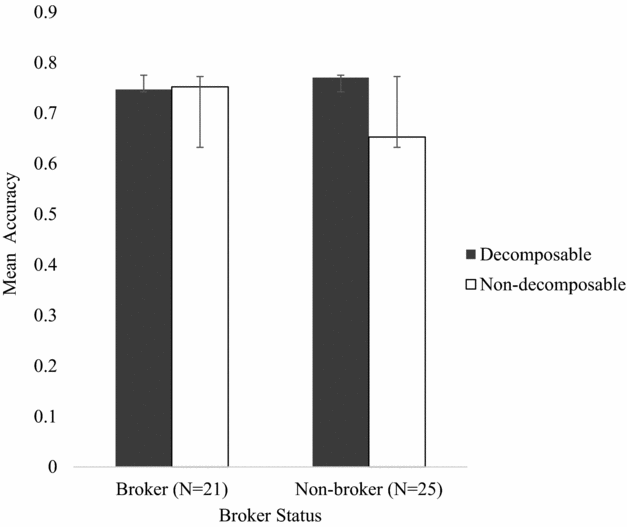
A significant two-way interaction between idiom type and broker status (which only approached significance in the by-item analysis), qualified the above effect, F1 (1, 44) = 12.84, p = .001, ηp 2 = .226; F2 (1, 68) = 3.08, p = .084, ηp 2 = .04, indicating that the higher accuracy for decomposable than non-decomposable idioms was restricted to non-brokers; (M = 77.02%, SD = 11.96 for decomposable idioms and M = 65.28%, SD = 13.46, for non-decomposable idioms), t (24) = 4.59, p < .001. Brokers were equally accurate in judging relatedness of target words and decomposable idioms (M = 74.69%, SD = 17.33) as they were for non-decomposable idioms (M = 75.19%; SD = 16.06), t (20) = −.233, p > .05. See Figure 1. Further, while brokers performed at the same level as non-brokers for decomposable idioms, t (44) = −.537, p > .05, they showed significantly higher accuracy than non-brokers on non-decomposable idioms (M = 75.19%, SD = 16.06 vs. M = 65.28%, SD = 14, respectively) t (44) = 2.28, p = .028. Also see Figure 1.
Idiom-Target Relatedness Judgments: Accuracy by Idiom Type and Group.

A significant interaction was also observed in the by-items analysis between idiom type and target language, F1 (1, 44) = 3.50, p = .068, ηp 2 = .074, F2 (1, 68) = 4.06, p = .048, ηp 2 = .056. Follow-up t-tests showed that for Spanish targets decomposable idioms had higher accuracy rates than non-decomposable idioms, t (70) = 2.58, p =.012 (74.2% vs. 64.1%). In addition, non-decomposable idioms with English target words showed higher accuracy than non-decomposable idioms with Spanish targets, t (35) = 3.76, p = .001 (76.8% vs. 64.1%, respectively).
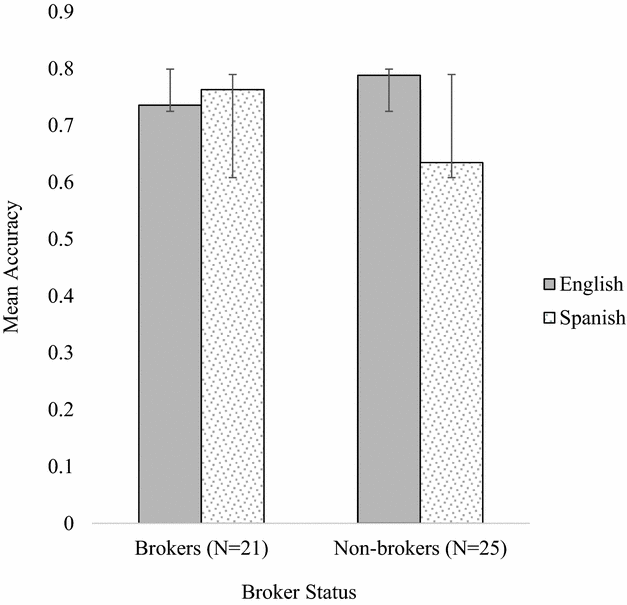
Finally, there was a significant two-way interaction between target language and broker status, which emerged in both the by-participants and by-items analyses, F1 (1, 44) = 8.60, p = .005, ηp 2 = .163. F2 (1, 68) = 6.04, p = .017, ηp 2 = .082. See Figure 2. Follow up t-tests revealed no significant differences in accuracy for English target words between brokers (M = 73.57%; SD = 22.09) and non-brokers (M = 78.82%; SD = 14.24), t (44) = −.97, p > .05. However, for Spanish words, brokers were significantly more accurate (M = 76.31%, SD = 16.06) than non-brokers (M = 63.48%, SD = 15.02), t (44) = 2.75, p = .009. Additionally, non-brokers had higher accuracy rates for English (M = 78.82%, SD = 14.24) than for Spanish target words (M = 63.48%, SD = 15.02), t (24) = 3.98, p = .001. Brokers were equally accurate for English (M = 73.57; SD = 22.09) and Spanish target words (M = 76.31; SD = 16.62), t (20) = −.56, p > .05. The higher order interaction was not significant.
Idiom-Target Relatedness Judgments: Accuracy by Target Language and Group.

Taken together, the analysis of accuracy data showed a same-language advantage was found in both groups for non-decomposable idioms, and in non-brokers overall. Brokers were equally accurate in judging idiom/target relatedness for same language and different language targets, and were significantly better than non-brokers in responding to non-decomposable idioms, and to Spanish targets.
Semantic relatedness judgment response latencies
Mean response latencies to correct semantic relatedness judgments were analyzed separately for control items (for which the correct response was “no”) and to critical items (for which the correct responses was “yes”). The analyses involved a 2 (Idiom Type: decomposable vs. non-decomposable) X 2 (Target language: English vs. Spanish) X 2 (Broker Status: broker vs. non-broker) analysis of variance performed by-participants and by-items separately.
Control trials
For the control trials, the analysis revealed no significant effects of broker status, F1 (1, 44) = 0.01, p > .05, ηp 2 = .00, F2 (1, 36) = 2.62, p > .05, ηp 2 = .068, or of the other variables, and the three way interaction did not reach an acceptable level of significance, F1 (1, 44) = 2.74, p = .105, ηp 2 = .059, F2 (1, 36) = 2.50, p = .123, ηp 2 = .065.
Critical trials
For the critical trials, the analysis showed a significant main effect for target language, F1 (1, 44) = 6.25, p = .02, ηp 2 = .169, F2 (1, 68) = 4.32, p = .042, ηp 2 = .060, indicating that participants were faster to respond when the target words were in English (same language as the idioms) (M = 642.40) than when they were in Spanish (different language as the idioms) (M = 668.34).
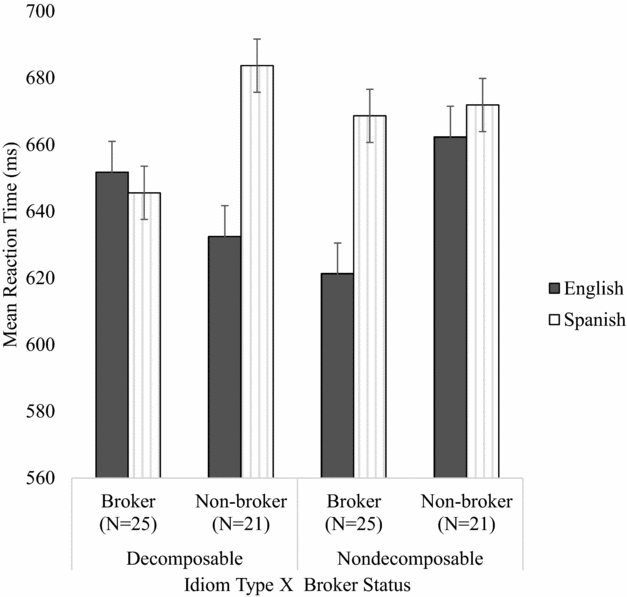
The three-way interaction of idiom type, target language, and broker status was significant in the by-participants analysis and approached significance in the by-item analysis, F1 (1, 44) = 8.66, p = .005, ηp 2 = .163; F2 (1, 68) = 3.48, p = .067, ηp 2 = .070. See Figure 3. Although follow-up analyses revealed no group differences in each of the four individual cells, the groups’ pattern of response differed as a function of idiom type and target language.
Idiom-Target Relatedness Judgments: Reaction Time by Idiom Type, Target Language and Group.

Non-brokers
For decomposable idioms, non-brokers showed faster relatedness judgments to same-language (English) targets (M = 632.45, SD = 83.97) than to different-language (Spanish) targets (M = 683.70, SD = 89.66), t (24) = −3.32, p = .003. For non-decomposable idioms, non-brokers showed no difference in response times to same language (M = 662.27, SD = 89.62) and different language targets (M = 671.88, SD = 111.53).
Brokers
For semantic relatedness judgments to decomposable idioms, brokers were equally fast for English (M= 651.74, SD = 106.16) and Spanish targets (M = 645.56, SD = 117.78). However, for non-decomposable idioms, they were significantly faster in response to English targets (M = 621.25, SD = 110.02) than Spanish targets (M = 668.64, SD = 117.58), t (20) = −3.68, p = .003. Brokers also showed significantly faster responses to non-decomposable than decomposable idioms with English targets, t (20) = 2.40, p = .03.
In summary, the higher order interaction revealed that a same-language facilitation effect characterized the performance of non-brokers on decomposable idioms, and of brokers on non-decomposable idioms. Moreover, brokers were faster in making relatedness judgments to same-language targets for non-decomposable than decomposable same language idioms.
Discussion
In this study, bilingual participants differing in their prior informal translation experience were asked to make semantic relatedness judgments to idioms presented in one of their languages (English) followed by target words presented in either English or Spanish. Since the idioms only had an idiomatic meaning in English, it was expected that semantic relatedness judgments would be generally facilitated to related target words presented in English than in Spanish. However, to the extent that brokering experience enhances the activation of cross-language semantic equivalents, it was hypothesized that brokers would be equally good at judging idiom/target relatedness for same-language and for different-language targets. Finally, our study explored whether idiom decomposability affects semantic relatedness judgments differently across bilingual groups.
Previous work on idiom comprehension in monolinguals and in second language learners examined idiom processing under contexts favoring literal or figurative interpretations (Cieslicka, Reference Cieslicka2006; Gibbs et al., Reference Gibbs, Nayak and Cutting1989; Giora, Reference Giora1997). The present study showed that there may be group differences in idiomatic processing even in the absence of a sentence context that biases a particular reading. Our study demonstrated that, when bilinguals process idiomatic phrases that are figurative in only one language (English), those with prior brokering experience are equally able to identify semantically related target words in the other language (Spanish) as they are to identify same-language targets.
Previous work (Carrol & Conklin, Reference Carrol and Conklin2015) suggested that L2 users may activate the non-target language when processing idiomatic language; non-native speakers of English read Chinese idioms that were translated into English faster than English control phrases. The present study offers the first evidence that there are individual differences in cross-language activation related to language brokering experience among bilinguals in how the meaning of fixed expressions, such as idioms, may be processed. Brokers appear to activate the underlying, idiomatic meaning of a phrase as readily when they are presented with a same language target word or a different language target word that conveys the phrase's meaning. By contrast, non-brokers’ responses are more accurate overall, and – in the case of decomposable idioms – faster, for same language than different language idioms and targets.
Our findings may also be understood in relation to studies of language switching costs in bilinguals. Previous studies have demonstrated that there are greater processing costs (reflected in longer reaction times or incorrect answers) when bilinguals have to switch from their dominant language to their less dominant language (Meuter & Allport, Reference Meuter and Allport1999). Although these switch cost studies have not used tasks such as semantic relatedness, our results suggest that non-brokers may have more difficulty integrating the meaning of Spanish language target words when processing idioms in English. Brokers, however, did not have difficulty responding in Spanish. As such, brokers, in comparison to non-brokers, appear to be showing reduced switching costs when reading an idiom in English and having to make a semantic relatedness judgment for a Spanish target word.
The motivating hypothesis this study tested was that prior brokering experience would lead to a heightened activation of idiom meaning, regardless of the nature of the idiomatic expression (decomposable or non-decomposable) or the language (same or different) in which the idioms and target words are presented. There were some converging sources of support for this hypothesis. Brokers were found to be equally fast at making semantic relatedness judgments for same language as for different language target words. For non-brokers there was a clear language preference: non-brokers were faster and better at judging the semantic relatedness of idioms when the target words were presented in the same language as the idiom (English). Non-brokers appear to use a particular language (English, in this case) as an anchor in making semantic judgments of the figurative meaning of idiomatic expressions.
With respect to the variable of idiom decomposability, we did not have a priori expectations, since it could be that non-decomposable idioms (e.g., kick the bucket) are easier to judge because they may be stored as unanalyzed entries in the mental lexicon, or that decomposable idioms (e.g., spill the beans) would be easier because of a compositional analysis of the literal meaning of each word of the idiom that would contributes to the overall phrase meaning. Our results provide support for both options. We found that semantic relatedness judgments were better and faster for non-decomposable than for decomposable idioms. However, brokers were better than non-brokers at judging relatedness of targets to non-decomposable idioms and non-brokers were better at processing decomposable than non-decomposable idioms. Nevertheless, these effects should be taken with caution as they emerged as significant only in the by-participants analysis.
More generally, the present research suggests that differences in early bilingual language experiences related to engaging in the practice of language brokering may have long-term repercussions in terms of how idiomatic expressions are processed. The fact that language brokers demonstrated a facilitative effect, unlike the non-brokers, in making semantic relatedness judgments across language boundaries is consistent with the idea reinforced by other studies that brokering experience results in a closer coupling of word/phrase meanings across language boundaries (Vaid et al., Reference Vaid, López, Martinez, Heredia and Cieslicka2015). Further work, using other paradigms, will be needed to get at the underlying mechanisms by which the claimed difference in lexical processing and/or representation is achieved, (e.g., whether it involves enhanced search of lexical entries, or a differential representation of semantic features associated with translation equivalents across languages, etc.).
Although our study used a paradigm that has not typically been used to address issues of language selectivity, it is instructive to consider the potential relevance of the present research to the longstanding issue within behavioral studies of the bilingual mental lexicon that have argued for non-selectivity (Dijkstra & Van Heuven, Reference Dijkstra and Van Heuven2002). Research in language non-selectivity has focused on the effects of word overlap in terms of semantic, orthographic, and phonological properties. The present research extends the scope of potential non-selectivity effects to the phrase level, and particularly to the domain of idiomatic expressions, and further suggests that there may be individual differences in degree of non-selectivity among bilinguals related to their history of language use.
Another explanation for some of the effects found in these experiments could be in terms of differences in being able to switch between languages for brokers and non-brokers. Brokers appear to be less affected by the language in which an idiom is presented and by whether a semantically related target word is in the same or different language. Non-brokers, however, demonstrate an English preference. Non-brokers use English as their primary linguistic vehicle for processing idiomatic meaning. Past brokering experience may enhance a bilingual's ability to actively have to switch between languages, especially when this switching involves semantic processing. Language brokering requires bilinguals to translate between languages all the while maintaining the overall semantic integrity of a phrase or expression. For bilinguals with this type of practice, processing the meaning of a phrase may, then, not be restricted to only one language; rather brokers may be more readily inclined to process meaning across languages. Non-brokers on the other hand, do not have extensive language brokering experience so their cross-language semantic processing abilities may not be as developed as those of brokers. This is not to say that they are not able to do this, but rather they may not have the sophisticated semantic processing abilities that brokers have developed as a result of having to listen, maintain, and reformulate meanings within and across two languages.
Limitations and further directions
It is important to recognize certain limitations of this study. One limitation has to do with the interpretation of the group differences, given the fact that, as in any study that compares the performance of pre-existing groups, there may be selection effects and/or other pre-existing differences between the groups that could have contributed in part to the observed differences in performance noted, besides the variable we investigated.
Another limitation has to do with the choice of task. We used an explicit semantic judgment task and measured judgment latencies only upon idiom offset. As such, our results do not offer insight into the issue of the time course of meaning activation in idiom processing, as has been the case in other studies that have used more sensitive, online tasks, such as eye tracking, or cross-modal priming at different time points (e.g., Caillies & Butcher, Reference Caillies and Butcher2007; Titone & Libben, Reference Titone and Libben2014). Presenting targets at different time points (e.g., just before idiom offset, at offset, or about a second following idiom offset) would provide more insight into how different aspects of idiom processing unfold over time.
Yet another limitation of the study is that idioms were presented only in a single language, and the idiom meaning was confined to that language; it did not have a counterpart in the other language of the bilinguals. In other work with bilinguals, cross-language overlap in idiom meaning has been shown to affect processing. For example, Pritchett, Vaid and Tosun (Reference Pritchett, Vaid and Tosun2016) found that collocations with counterparts in both languages of bilinguals showed better incidental free recall than did collocations that were specific to a single language, suggesting that idiomatic meanings with dual representation are likely to be more accessible. Titone et al. (Reference Titone, Columbus, Whitford, Mercier, Libben, Heredia and Cieslicka2015) and Cieslicka (Reference Cieslicka, Heredia and Cieslicka2015) have also found support for an effect of cross-language overlap in bilingual idiom processing (see also Degani, Prior & Tokowicz, Reference Degani, Prior and Tokowicz2011, for bidirectional transfer effects of sharing a translation). It will be important in future work to consider how brokering experience may interact with translation overlap, especially given that, even in the absence of such overlap, brokers show cross-language meaning activation.
Another aspect of the present study that limits its generalizability is that we did not consider differences across idioms in properties other than decomposability. In other work, such variables as idiom familiarity and literal plausibility have been found to exert strong effects on idiom processing (Libben & Titone, Reference Libben and Titone2008; Cieslicka, Reference Cieslicka, Heredia and Cieslicka2015). In the present study familiarity was controlled and the idiom's literal plausibility was not examined. For future work, it will be important to examine more precisely the contribution of differences in idiom frequency, familiarity, or transparency, in interaction with language brokering effects.
Finally, it would be important to investigate if there is a certain threshold level of brokering experience that gives rise to distinct effects. Our results do not speak to this issue since our brokers all had extensive prior brokering experience. In future work it may also be worthwhile to consider language brokering experience as a continuous dimension rather than a dichotomous one.
Theoretical implications
This research extends bilingualism research in various ways. First, this work aligns with the early psychological literature on bilingualism in which individual differences in language acquisition context and use were of theoretical interest (see Lambert, Reference Lambert1972). Our work adds to this body of scholarship in showing that, apart from comparisons of early with late bilinguals (e.g., Vaid, Reference Vaid, Paradis and Lebrun1984, Reference Vaid1987), it is informative to consider differences even among early bilinguals. Our research uncovered differences between brokers and non-brokers in how they process and access language-specific idiomatic meaning. Without identifying this individual difference in early language experience important effects would have gone unnoticed.
Recently, researchers in bilingualism are again beginning to acknowledge that the prior language history of bilinguals needs to be taken more seriously, and that the variability in bilingual experience needs to be “embraced” rather than treated as a nuisance variable (Baum & Titone, Reference Baum and Titone2014; Vaid & Meuter, Reference Vaid, Meuter, Cook and Wei2016, in press). Examining particular sources of variability in systematic ways can offer a way out of the current impasse in bilingualism research, in which the focus has been more on manipulating task parameters than on identifying systematic sources of individual differences in language use. This is also important if we are to advance our current theoretical understanding of bilingualism and refine existing models of the bilingual mental lexicon that, so far, have not theorized differences among bilinguals (other than those related to language proficiency or age of onset of bilingualism). Of course, noting the importance of taking bilingual language history and use seriously is not a new idea but was the cornerstone of the earliest psychological studies on bilingualism conducted by Lambert and his colleagues (e.g., Vaid & Lambert, Reference Vaid and Lambert1979; see Genesee, Reference Genesee2014). Models of bilingual language processing need to be appropriately revised to take individual differences in bilingual language experience into account.
Additionally, several previous studies of bilingualism have demonstrated support for non-selective activation. However, to date, there has been little examination of whether non-selective activation occurs in the processing of non-literal language. This investigation extends the literature by showing that differences in prior language brokering experience may affect the extent to which meaning is activated in both languages. Bilinguals with brokering experience appear to demonstrate more fluidity between languages than non-brokers. Whereas non-brokers appear to have a preferred language that serves as an anchor for idiomatic processing, brokers appear to be processing meaning equivalently, regardless of whether the target word is in the same or different language as the idiom.
Practical implications
Language brokering may be seen as a form of cognitive, linguistic, and social expertise. As Valdés (Reference Vaid, Milliken, López and Rao2003) notes, “young interpreters utilize resources of their two languages, search for available linguistic forms and structures, anticipate and strategically avoid some linguistic and lexical challenges, and try out and discard possible forms and structures” (p.162). Situations in which brokers are translating for their family and community members require young bilinguals to use language and pragmatic knowledge in ways that are often well above their current education level. Language brokering thus hones skills that can be effective in a variety of situations and that could be enlisted and developed in instructional settings.