1. Introduction
Are governments able to effectively redistribute the gains from trade among domestic groups? Continued economic integration between states may well depend on the answer to this question. Developed countries are facing a backlash against trade liberalization, which has been portrayed as benefiting some at the expense of others. The costs of adjustment to import competition, largely overlooked in general equilibrium models, are growingly apparent. A series of studies have found links between import exposure and the decline in employment, the adoption of authoritarian values, and the emergence of populism (Thewissen and van Vliet, Reference Thewissen and van Vliet2017; Ballard-Rosa et al., Reference Ballard-Rosa, Mashail, Rickard and Scheve2017; Hays et al., Reference Hays, Lim and Spoon2019). Among the instigators of this debate are findings by Autor et al. (Reference Autor, Dorn and Hanson2013) (hereafter ADH), showing longer and more painful adjustment to Chinese imports in the US than advocates of trade liberalization had assumed. The fundamental problem is a familiar one: trade is generally thought to increase the size of the pie, but in the short term, some are left with a smaller slice; the disruption this occasions is costly. Trade theory has a ready solution: given the magnitude of gains from trade, governments ought to be able to liberalize and redistribute the gains, in a way that leaves everyone at least as well off as they were prior to liberalization (Burgoon, Reference Burgoon2001). This is, in fact, the premise of embedded liberalism, namely that international openness can accommodate a range of domestic social purposes and corresponding institutions (Hays, Reference Hays2009). In the US, one government program is specifically designed to address labor dislocation resulting from trade liberalization: Trade Adjustment Assistance (TAA). TAA thus ought to be the means of reconciling two conflicting government objectives: reaping the benefits from trade, while mitigating its distributional effects. But of late, TAA has increasingly been getting bad press. Conservative bodies like the Heritage Foundation have urged members of Congress to “be wary of reauthorizing the ineffective and wasteful [TAA] program” (Muhlhausen and Sherk, Reference Muhlhausen and Sherk2014). Even traditional champions of the program, from the Brookings Institution to the International Monetary Fund (IMF), have called for its wholesale reform.Footnote 1 ADH's findings have played a central role in this change of heart. Brookings points to them as the main piece of evidence for the program's inadequacy: “most trade-displaced workers end up relying on Social Security and disability benefits, rather than the retraining resources provided by TAA” (Muro and Parilla, Reference Muro and Parilla2017). IMF et al. (2017) point to the same evidence and draw the same conclusions. This single study has become the focal point in the scholarly debate around the ongoing backlash against trade liberalization.
ADH's findings are indeed arresting. While import exposure weakly increases government transfers through TAA, these are dwarfed by disability and early retirement benefits. This is bad news, since those transfers are not designed to get individuals back to work—most disability recipients stay on the program for the rest of their lives. We revisit ADH's findings. To calculate the effect of import exposure on TAA transfers, ADH use state-level TAA budgets, and allocate these to commuting zones (CZs) in proportion with unemployment insurance (UI) payments.Footnote 2 This is a useful first approximation, but a problematic one: the way by which unemployment versus TAA payments are allocated differs. While the latter is specifically targeted toward trade dislocation, the former is not. To address these shortcomings, we rely instead on petition-level data. When we re-estimate the effects of trade exposure on levels of TAA transfers, our results differ markedly. Specifically, using the petition-level data, we find that the magnitude of the response of TAA to import shocks is between 1.7 and 3.3 times greater than in ADH's results.
These findings on TAA's greater responsiveness suggest that some of the hand-wringing over the program's ineffectiveness is undeserved. Yet the news is not all good. First, our approach reveals the considerable heterogeneity in TAA transfers: 12 percent of areas saw no TAA support at all over the two decades, something ADH necessarily overlook. Second, TAA's responsiveness to the trade shock over the past two decades has decreased considerably, just as developed democracies have increasingly struggled to contain the pushback against the distributional effects of liberalization. As we demonstrate, this growing shortfall is consequential: those areas with the greater trade compensation shortfall for the same level of trade shock were also more likely to turn to Trump in the 2016 Presidential election.
2. Reassessing TAA's responsiveness to trade shocks
Since WWII, OECD countries have committed to progressively more international liberalization, entailing considerable domestic adjustment. But the provision of mechanisms intended to assist in that transition varies significantly from state to state, and across time. The US’ TAA, managed by the Department of Labor (DOL), is the oldest and biggest of its kind anywhere, with the annual appropriated budget of USD 790 million (USD 667 million disbursed) as of 2018.Footnote 3 Put in place in 1962, TAA has gone through changes, but currently provides trade-impacted workers with income support while they complete training to re-enter the workforce, often in a different industry, as well as health coverage and relocation assistance.Footnote 4 TAA is the main program designed to help American workers adjust to liberalization. The most recent evidence suggests that TAA results in $50,000 higher cumulative earnings over a decade.Footnote 5 Yet the consensus is that it is falling short of its task. Recent critics point to one major study: Autor et al. (Reference Autor, Dorn and Hanson2013). As the first study examining the regional variation of TAA allocation as a function of trade shock,Footnote 6 ADH highlighted TAA's low responsiveness: that is, areas with industries most exposed to Chinese imports saw very modest increases of TAA benefits, but comparatively large increases in transfers through Social Security Disability Insurance (SSDI). An increase of $1,000 in per-worker exposure to Chinese imports translated into an additional $0.23 per capita in TAA benefits, versus $8 in disability benefits. This stark difference in TAA versus SSDI was consistently highlighted in follow-up policy discussions.Footnote 7
We take a closer look at these estimations. ADH calculate TAA payments using state-level budgets, which they allocate to CZs in proportion to UI payments. The assumption is that both are allocated in similar fashion in response to the trade shock. But the two differ in how their funding is sourced and allocated. First, UI is funded through a Federal Unemployment Tax paid by employers, which draws on workers’ contributions. Employers and workers are thus kept aware of UI's existence, while TAA suffers from low awareness among eligible workers. As the Economist magazine put it, “most Americans have not heard of [TAA].”Footnote 8 Second, TAA is targeted in a way that UI is not. TAA benefits are only extended to trade-impacted workers who demonstrate that they have lost their jobs due either to a surge of imports, or the explicit offshoring of labor. The eligibility criteria for UI are simpler: an individual must have worked for a specified minimum period and become involuntarily unemployed. Lastly, TAA imposes an administrative burden on petitioners. Its two-step process requires a minimum of three workers filing a petition (while individuals can claim the UI benefits) and the DOL must certify the firm's eligibility before any workers can apply for benefits. UI is thus an imperfect proxy for TAA transfers, in a way that should affect estimates of TAA responsiveness in the wake of trade shocks. A better proxy for CZ-level TAA payments is one based on the number of actual petitions. TAA responsiveness thus corresponds to the amount of trade compensation offered in reaction to local import exposure. Next, we describe our operationalization of both components.
2.1 Measuring trade compensation
Our measurement of trade compensation relies on all individual TAA petitions made over the relevant period, between 1990 and 2007.Footnote 9 The dataset includes 36,646 petitions covering 3,225,421 workers. We geocode the location of the employer in each petition, build CZ-level datasets, and allocate state-level TAA budgets to CZs in proportion to the number of TAA petitions and affected workers (see the Appendix Section A1 for data description).
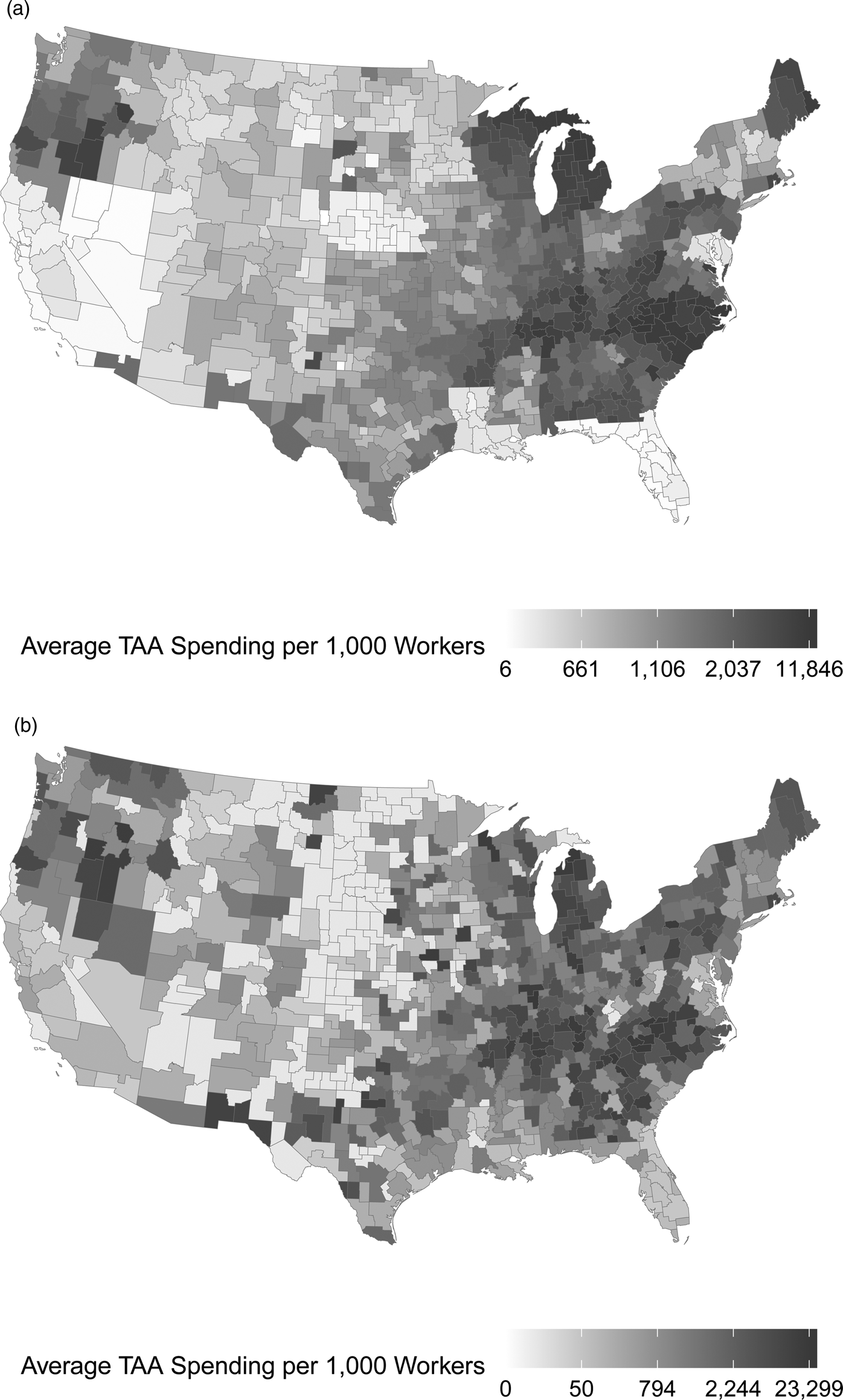
Our petition-based measures show greater variance than UI-based ones. Figure 1 illustrates the geographic variation of TAA spending across CZs according to the UI-based versus the TAA-based measure.Footnote 10 While TAA spending appears more or less evenly distributed within the same states according to the UI-based measure, the petition-based measure uncovers considerable variation in TAA distribution within the same states. By relying on UI claims to apportion TAA spending to CZs, ADH risk missing important variation: for instance, while all CZs in their data featured some TAA activity, the petitions data show that in fact, over 12 percent of CZs (88 out of 722) did not feature a single certified TAA petition during the entire period, from 1990 to 2007.
Average TAA spending per 1,000 workers across commuting zones. (a) TAA Spending Based on Unemployment Claims, (b) TAA Spending Based on TAA Certified Workers.

2.2 Measuring import exposure
We employ the measure of import exposure per worker derived by ADH. By leveraging geographical variation in industry specialization and national-level variation in Chinese imports in the industry, they capture the exogenous shock from China to the local economy. Specifically, they calculate the change in Chinese import exposure per worker in a region as follows:

where the ratio of L ijt to L ujt indicates the share of employment in industry j in the CZ i in the start of period t in the US (u); ΔM ucjt is the change in US imports from China in industry j between the start and end of the period. As realized Chinese imports to the US might be correlated with product demand in the US, we follow ADH and isolate demand-side factors by instrumenting for Chinese import penetration to the US using import exposure of eight other developed countries.Footnote 11
2.3 Results: TAA responsiveness
We are interested in TAA's responsiveness, or the amount by which TAA benefits change in response to a change in import competition. We re-estimate the ADH results with our petition-based measure instead of their proxy based on UI payments. Otherwise, we hew closely to their approach: we examine the effect of economic shocks from Chinese import competition, instrumented by non-US exposure to Chinese import shocks, controlling for the same set of demographic variables.
We begin by replicating their finding. In their analysis, the dependent variable is the ten-year equivalent change in TAA payments, and the independent variable is the ten-year equivalent change in Chinese import exposure.Footnote 12 Their study covers 722 CZs for the two decades from 1990 and 2007. We use TAA transfers in dollar terms, instead of log amount, for two reasons. First, we seek to directly engage with ADH's findings based on dollar terms that were highlighted in follow-up discussions. Second, the dollar-term measure allows us to retain the CZs that did not feature any petition activity in a given period, which are omitted from the analysis when using log change as the dependent variable. Retaining these “zero” observations is another way in which our approach appears more accurate than relying on unemployment claims.Footnote 13
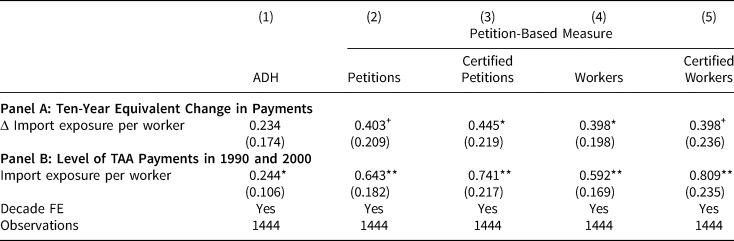
Table 1 presents the results. The first column in panel A replicates their estimate of the import shock effects on TAA payments. An increase of $1,000 in per-worker exposure is estimated to lead to $0.23 per capita in TAA benefits, but the coefficient is not statistically significant. In columns 2–5, we estimate the same models but using our measure of TAA payments. We apportion the state-level TAA payments to CZs based on the number of petitions (2), the number of certified petitions (3), the number of affected workers included in the petitions (4), and the number of certified workers (5).Footnote 14 The import shock now appears statistically significant throughout, and TAA payments appear to be substantially more responsive than initially estimated. The estimate translates to $0.40–$0.45 per capita in TAA benefits, which is 1.7 times larger than the original estimate.
TAA Responsiveness to Chinese Import Shock

Standard errors clustered on states in parentheses
+ p < 0.10, * p < 0.05, ** p < 0.01
We then estimate the models focusing on the level of import exposure per worker and the level of TAA payments in the beginning of the two decades: 1990 and 2000. The results presented in the panel B of Table 1 show a similar pattern, but the substantial effects of import shock on TAA responsiveness appear larger than in panel A. The estimate using Reference Autor, Dorn and HansonAutor et al.'s measure is $0.24, which is similar to the original estimate, but the estimates using our petition-based measure now range from $0.59 to $0.81 for every $1,000 increase in import exposure. In particular, the effects using certified petitions appear to be more than 3.3 times larger than Reference Autor, Dorn and HansonAutor et al.'s estimate.Footnote 15 The difference in size of coefficients in Model (1) versus Models (2)–(5) estimated in Panel B is statistically significant, as discussed in the Appendix Table A12. In sum, the findings suggest that TAA allocations are more responsive to trade shocks than previously thought.
Next, we explore the variation in TAA's responsiveness over time. How has the US fared in managing the labor dislocation from growing international integration? Our measure of responsiveness is calculated as follows:

where TAAit is the percentage of workers included in TAA petitions in CZ i and year t, and IPWit is the level of per-worker exposure to Chinese imports in CZ i in the beginning of the decade of year t. As the denominator's unit is $1,000, a score of one in Responsivenessit indicates that 1 percent of the workforce petitioned for TAA for every $1,000 of per-worker import exposure. Lower scores suggest a trade adjustment shortfall, and higher ones indicate greater TAA responsiveness.
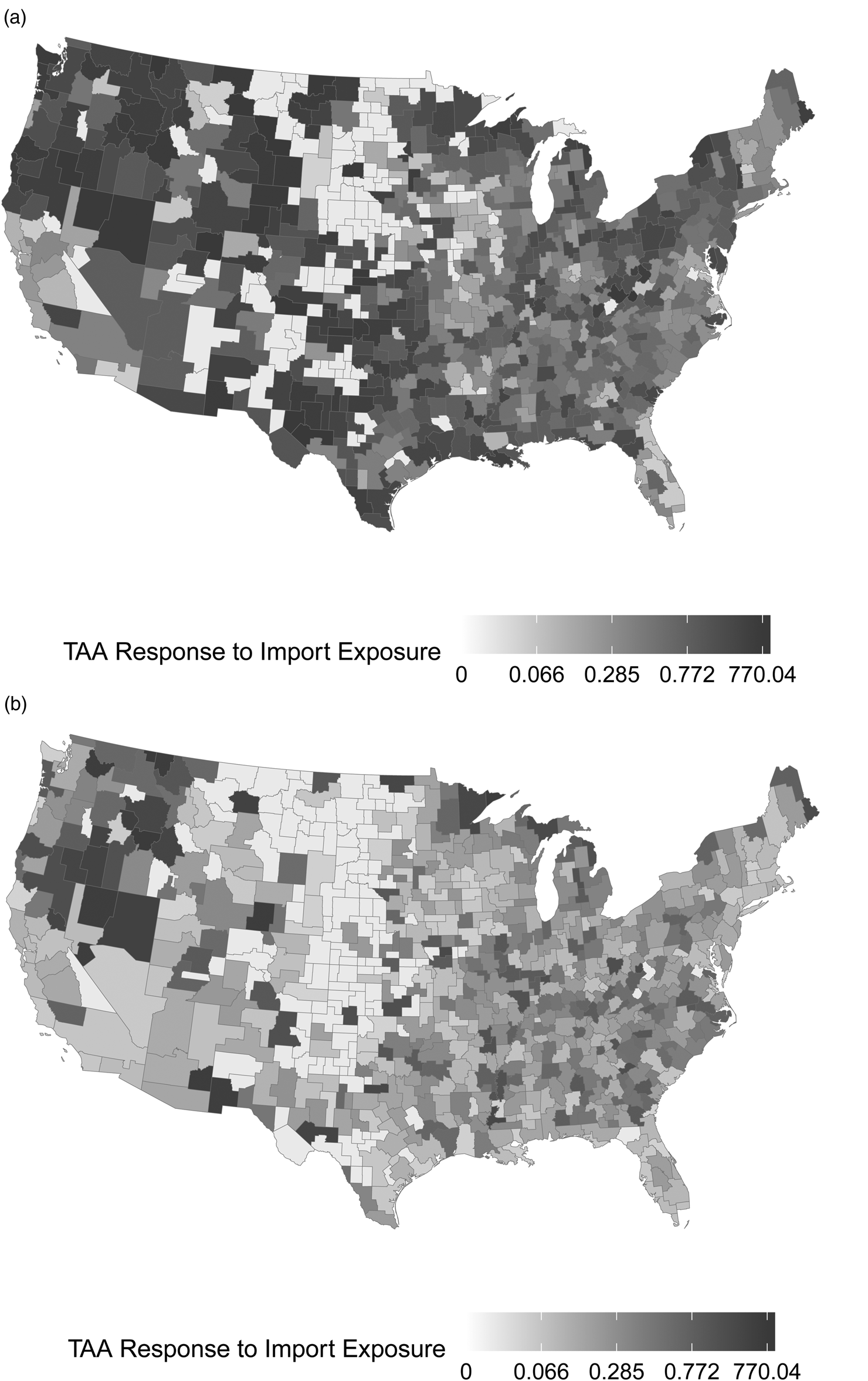
In Figure 2, we calculate the decade average of Responsivenessit for the 1990s (1990–1999) to the 2000s (2000–2007).Footnote 16 The figure makes clear the wide variation in trade adjustment responsiveness across space and time (a quantile-cut point is used in the legend). The responsiveness score ranges from 0 to 770.04. It is less than 1 for 78.5 percent of observations. Two trends emerge. First, the overall level of responsiveness decreased in the second decade: an increase in import exposure in the 2000s was not matched by a corresponding increase in TAA as further illustrated in Figures A7, A9, and A10 in the Appendix. We directly test the effects of import shock on TAA petitions in the two decades and find the same results (Table A13 in the Appendix).Footnote 17 Second, TAA responsiveness to trade shocks is lower in the central region across both decades, but there remains much variation in responsiveness within all regions. Together, these trends speak to a rising disconnect between the need for trade adjustment and its supply.
TAA petitioners by import exposure per worker in the 1990s (left) and 2000s (right).

3. TAA responsiveness and the 2016 presidential election
How does this disconnect between the demand and the supply of trade adjustment affect the political landscape amidst growing international integration? In follow-up work to their 2013 study, Autor et al. (Reference Autor, Dorn, Hanson and Majlesi2017) found that the trade shock contributed to the Republican vote share in 2016. Given our findings about TAA's responsiveness, it bears asking, did the shortfall in trade compensation hold electoral consequences in the 2016 presidential election?Footnote 18 We briefly address this question using our measure of TAA responsiveness, calculated as above in Figure 2.
Building on insights from Inglehart and Norris (Reference Inglehart and Norris2016), Autor et al. (Reference Autor, Dorn, Hanson and Majlesi2017) suggest that trade shocks may help conservative politicians by increasing support for nativist politicians.Footnote 19 Insofar as TAA can cushion the economic effects of trade shocks, it should also cushion their electoral effects. We thus expect that greater TAA responsiveness to local trade shocks could be negatively related with support for the Republican candidate in the 2016 election.Footnote 20
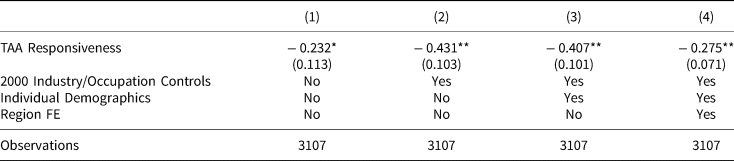
Table 2 presents the effect of TAA responsiveness on the change in the Republican vote share between 2000 and 2016 (see Table A14 in the Appendix for full results with coefficient estimates of all controls).Footnote 21 By focusing on change in vote share at the county level, we account for time-invariant county-level determinants of support for presidential candidates. Since the incumbent president was a Democrat in both the 2000 and 2016 election, the two elections are further comparable. We begin with a simple regression model with TAA responsiveness in the 2000s (2000–2007) as the only independent variable, and then add controls for the CZ-level industry and occupation composition in 2000 (the share of manufacturing employment in 2000, routine-task-intensity and offshorability index in 2000), demographic characteristics, and fixed effects for region. In the Appendix Table A17, we additionally control for the state-level unionization rate in 2000 and the CZ-level TAA certification rate in the 1990s that might be correlated with TAA responsiveness in the 2000s. The results remain robust to the inclusion of these controls.
TAA Responsiveness and the 2016 Republican Vote Share

Standard errors clustered on states in parentheses
+ p < 0.10, * p < 0.05, ** p < 0.01
The results suggest that higher TAA responsiveness was associated with significantly lower support for the Republican candidate between 2000 and 2016. Substantively, one unit decrease in TAA responsiveness is associated with increased support for the Republican candidate by 0.25–0.44 percentage point in the 2016 election, compared to the 2000 election. In other words, the shortfall in TAA responsiveness over the 2000s appears significantly associated with Republican gains.
4. Conclusion
The politics of trade compensation no longer bear only on the odds of ratifying trade agreements. Labor dislocation resulting from trade has been linked to geographically concentrated unemployment and lower wages. This, in turn, has been linked to a rise in populism and anti-immigration sentiment. Since the 2016 election, the US has chosen to externalize this domestic challenge, by threatening widespread protectionism against its trading partners.
In the face of this mounting urgency, the main program to deal with trade-impacted workers has been heavily criticized. The criticism has focused ADH's striking findings on how the governments transfers that rose most significantly in the face of trade exposure were not programs like TAA, but fallback mechanisms like disability insurance. We take a closer look at these findings. When we re-estimate their models using our petition-based measures, TAA suddenly appears to be up to 3.3 times more responsive to trade shocks. Some of the hand-wringing over TAA's ineffectiveness thus seems undeserved. This good news about TAA responsiveness notwithstanding, it remains that government transfers like disability insurance make up the larger share of transfers to trade-affected workers. Our analysis also points to significant geographic and cross-time variation in TAA responsiveness. Regions with similar levels of import shock get very different levels of trade compensation. And in the face of mounting trade pressure in the 2000s, we show that the responsiveness of trade adjustment has actually fallen. This shortfall, in turn, has political consequences: areas with lower TAA responsiveness to import exposure became more likely to vote for Trump in the 2016 election.
The TAA program is the oldest and largest trade adjustment program in existence anywhere. This makes it an ideal testing ground for developed democracies’ overall ability to respond to labor dislocation. With growing concerns over how technology will impact the labor market in coming years, the findings in this article hint at the obstacles ahead. While we show that TAA is far more responsive to trade shocks than current estimates suggest, we also document the growing shortfall of this program over recent decades.
Supplementary material
The supplementary material for this article can be found at https://doi.org/10.1017/psrm.2020.38.
Acknowledgement
Sung Eun Kim thanks the support for this research from a Korea University Grant (K2009071).