Introduction
Attention-deficit/hyperactivity disorder (ADHD) is one of the most prevalent childhood neurodevelopmental disorders, with a prevalence rate of 7.2% (Sayal et al., Reference Sayal, Prasad, Daley, Ford and Coghill2018; Wolraich et al., Reference Wolraich, Hagan, Allan, Chan, Davison, Earls, Evans, Flinn, Froehlich and Frost2019). The clinical symptoms of ADHD can be described as inattention and/or impulsivity-hyperactivity that are disproportionate to the level of development (American Psychiatric Association, 2013). Although the onset of ADHD occurs in childhood, approximately 40% of these persist into adulthood, with lifelong consequences (Nigg et al., Reference Nigg, Sibley, Thapar and Karalunas2020; Van Meter et al., Reference Van Meter, Sibley, Vandana, Birmaher, Fristad, Horwitz, Youngstrom, Findling and Arnold2024). What causes ADHD remains unclear; however, current research increasingly supports the association between ADHD symptoms and cognitive impairments, notably deficits in executive function (EF) (Groves et al., Reference Groves, Wells, Soto, Marsh, Jaisle, Harvey and Kofler2022; Silverstein et al., Reference Silverstein, Faraone, Leon, Biederman, Spencer and Adler2020). A developmental pathway has shown that adverse events disrupt the neural systems supporting EF, increasing the risk of broader psychopathological symptoms. Furthermore, training EF skills during early childhood and the transition to adolescence can help reduce the risk of psychiatric disorders (Zelazo, Reference Zelazo2020). Thus, exploring how EF deficits affect the core symptoms of ADHD is crucial for its early detection, diagnostic assessment, and effective intervention.
EF refers to a set of high-level cognitive processes that regulate and direct thoughts, behaviors, and emotions to fulfill objectives in a top-down manner (Diamond, Reference Diamond2013). Evidence indicates the prevalence of EF deficits among ADHD, making it a potential criterion for clinical diagnosis (Barkley, Reference Barkley1997; Faraone et al., Reference Faraone, Asherson, Banaschewski, Biederman, Buitelaar, Ramos-Quiroga, Rohde, Sonuga-Barke, Tannock and Franke2015). Much research has focused on the fact that ADHD is associated with deficits in EF (Kofler et al., Reference Kofler, Irwin, Soto, Groves, Harmon and Sarver2019; Liu et al., Reference Liu, Townes, Panesar, Lee, Devoe, Arnold, Crosbie and Schachar2024). A meta-analysis incorporating 149 studies (N = 165,095) found that early development in children with ADHD was closely associated with impaired abilities, among which EF domains (including inhibitory control, working memory, and planning) exhibited the most significant impact (g >0.50) (Shephard et al., Reference Shephard, Zuccolo, Idrees, Godoy, Salomone, Ferrante, Sorgato, Catão, Goodwin, Bolton, Tye, Groom and Polanczyk2022). It is undisputed that ADHD, as a neurodevelopmental disorder, involves specific developmental delays or abnormalities in the prefrontal cortex, which not only underpins the physiological basis of ADHD core symptoms but also correlates with EF deficits (Hoogman et al., Reference Hoogman, Bralten, Hibar, Mennes, Zwiers, Schweren, van Hulzen, Medland, Shumskaya and Jahanshad2017; Shaw et al., Reference Shaw, Malek, Watson, Greenstein, de Rossi and Sharp2013). The executive dysfunction theory supports the view that ADHD symptoms arise due to diminished executive control, which is caused by structural differences and abnormal activation in the fronto-striatal and fronto-parietal neural networks (Barkley, Reference Barkley1997; Isaac et al., Reference Isaac, Lopez and Escobar2024). Cumulative studies suggested that EF deficit exists in ADHD patients from childhood to adulthood (Biederman et al., Reference Biederman, Petty, Doyle, Spencer, Henderson, Marion, Fried and Faraone2007; Fossum et al., Reference Fossum, Andersen, Øie and Skogli2021), and EF in childhood can predict psychopathology symptoms in adulthood (Orm et al., Reference Orm, Andersen, Teicher, Fossum, Øie and Skogli2023). These findings indicate a close association between prefrontal-centered EF deficits and ADHD core symptoms, and executive dysfunction may be the potential cognitive mechanism underlying the neurodevelopmental abnormalities that lead to ADHD symptoms.
It is worth noting that EF is delineated into two distinct components, “cool” and “hot,” based on differences in prefrontal cortex functioning (Zelazo & Müller, Reference Zelazo, Müller and Goswami2002). Cool EF involves purely cognitive processing, engaging primarily the dorsolateral and ventrolateral prefrontal cortex areas, while hot EF relates to cognitive processing under high affective/motivational involvement, engaging the ventromedial prefrontal and orbitofrontal cortex areas (Salehinejad et al., Reference Salehinejad, Ghanavati, Rashid and Nitsche2021; Zelazo & Carlson, Reference Zelazo and Carlson2012). Definitions and functions of both cool and hot EF vary, yet there remains a lack of research exploring whether their impacts on the core symptoms of ADHD vary. The dual-pathway model theory proposes two separable etiologic pathways in an attempt to explain why ADHD manifests with two distinct behavioral patterns, including a cognitive dysfunction pathway linked to the central-cortical branch of the dopamine system and a motivational dysfunction pathway associated with the central-limbic branch of the reward circuit (Sonuga-Barke, Reference Sonuga-Barke2002, Reference Sonuga-Barke2003). Among them, the cognitive dysfunction pathway is considered the underlying cause of deficits in inhibition and other cognitive control processes, leading to ADHD-related cognitive and behavioral dysregulation. In contrast, the motivational dysfunction pathway accounts for delay aversion and impairments in reward processing, resulting in motivational dysregulation in children with ADHD (Shen et al., Reference Shen, Luo, Jia, Zhao, Desrivieres, Quinlan, Banaschewski, Millenet and Bokde2020; Zhu et al., Reference Zhu, Jiang and Ji2018). Further evidence supports the notion that these two pathways are distinct, and that deficits in cognition and motivation represent independent neuropsychological components of ADHD (Sonuga-Barke et al., Reference Sonuga-Barke, Bitsakou and Thompson2010). Although this model does not explicitly delineate the relationship between EF deficits and ADHD core symptoms, subsequent research has suggested that these pathways correspond closely to cool and hot EF deficits. From both neuroanatomical and cognitive perspectives, the cognitive dysfunction pathway involves the dorsal executive circuit of the prefrontal cortex-striatal system, which is responsible for cognitive control, corresponding to cool EF deficits; the motivational dysfunction pathway, which involves the ventrolateral prefrontal cortex and orbitofrontal cortex-striatum reward circuit, responsible for motivation and reward processing, primarily related to hot EF deficits (Geurts et al., Reference Geurts, van der Oord and Crone2006; Jiang et al., Reference Jiang, Liu, Ji and Zhu2018). Therefore, the dual-pathway model provides a valuable framework for understanding the relationship between cool and hot EF deficits and ADHD core symptoms, emphasizing the importance of considering two dimensions in ADHD symptomatology.
The distinction between cool and hot EF has been discussed as reflecting different etiological processes underlying various psychiatric conditions (Smith et al., Reference Smith, Jusko, Fosco, Musser and Raiker2024; Zelazo, Reference Zelazo2020). The two core symptoms of ADHD (inattention and hyperactivity-impulsivity) can be understood through the pathways of cool and hot EF deficits. Cool EF is primarily associated with cognitive control processes, such as working memory, inhibitory control, and cognitive flexibility. A growing body of evidence indicates that cool EF deficits are closely linked to inattention symptoms in ADHD (Irwin et al., Reference Irwin, Soto, Chan, Miller, Carrington-Forde, Groves and Kofler2021; Shakehnia et al., Reference Shakehnia, Amiri and Ghamarani2021; Silverstein et al., Reference Silverstein, Faraone, Leon, Biederman, Spencer and Adler2020). For instance, studies have shown that working memory impairments have a more significant impact on inattention than on hyperactivity-impulsivity, with working memory impairments indirectly affecting children’s life skills through inattention rather than impulsivity (Groves et al., Reference Groves, Wells, Soto, Marsh, Jaisle, Harvey and Kofler2022; Irwin et al., Reference Irwin, Soto, Chan, Miller, Carrington-Forde, Groves and Kofler2021). A study using a visual working memory paradigm found that, as memory load increased, ADHD patients struggled to maintain information, resulting in reduced efficiency in attentional selection (Luo et al., Reference Luo, Guo, Liu, Zhao, Li, Li, Zhao, Wang, Qian and Wang2019). Similarly, inhibitory control deficits, another key component of cool EF, have been consistently identified in ADHD children, with strong evidence linking these impairments to inattention symptoms (Janssen et al., Reference Janssen, Heslenfeld, van Mourik, Gelade, Maras and Oosterlaan2018; Mueller et al., Reference Mueller, Hong, Shepard and Moore2017). Longitudinal studies have shown that response inhibition deficits during childhood predict the persistence of inattention symptoms into adolescence, with these deficits impeding the natural improvement of attention-related symptoms over time (DeRonda et al., Reference DeRonda, Zhao, Seymour, Mostofsky and Rosch2021). Additionally, a recent study has demonstrated that inhibitory control not only predicts the presence of inattention but also influences its developmental trajectory (Pang et al., Reference Pang, Yang, Liu and Chang2025). Neuroimaging studies further support these findings, showing reduced functional connectivity within the inhibitory control network in ADHD children, with this reduction correlating significantly with the severity of inattention (Cai et al., Reference Cai, Griffiths, Korgaonkar, Williams and Menon2021). Intervention studies also bolster the relationship between cool EF deficits and inattention symptoms. Working memory training programs, such as central executive training, have demonstrated promising effects in improving attention and academic difficulties in ADHD children (Kofler et al., Reference Kofler, Wells, Singh, Soto, Irwin, Groves, Chan, Miller, Richmond, Schatschneider and Lonigan2020; Wiest et al., Reference Wiest, Rosales, Looney, Wong and Wiest2022). Additionally, digital cognitive training targeting inhibitory control and cognitive flexibility has been shown to significantly improve attention, as reported by parents and measured by objective behavioral indicators (Kollins et al., Reference Kollins, DeLoss, Canadas, Lutz, Findling, Keefe, Epstein, Cutler and Faraone2020). In summary, these findings collectively support the hypothesis that cool EF deficits are a primary contributor to inattention symptoms in ADHD.
In contrast, hot EF refers to the ability to make flexible evaluations and decisions under emotional or motivational influence, including functions such as delay gratification, reward processing, and emotion regulation (Salehinejad et al., Reference Salehinejad, Ghanavati, Rashid and Nitsche2021; Zelazo & Carlson, Reference Zelazo and Carlson2012). ADHD children also exhibit significant deficits in hot EF, and its deficits are often associated with the core symptoms of hyperactivity-impulsivity (Dekkers et al., Reference Dekkers, Popma, van Rentergem, Bexkens and Huizenga2016; Tegelbeckers et al., Reference Tegelbeckers, Kanowski, Krauel, Haynes, Breitling, Flechtner and Kahnt2018). For example, ADHD children struggle to inhibit impulsive behaviors, show a strong preference for immediate rewards, and exhibit emotional dysregulation—behaviors likely driven by hot EF deficits (Colonna et al., Reference Colonna, Eyre, Agha, Thapar, van Goozen and Langley2022; Petrovic & Castellanos, Reference Petrovic and Castellanos2016). A meta-analysis found that ADHD children exhibit greater delay discounting, demonstrating a preference for immediate gratification, which in turn manifests as increased impulsivity (Bunford et al., Reference Bunford, Kujawa, Dyson, Olino and Klein2022). Neuroimaging studies have revealed abnormalities in functional connectivity between the reward network and the fronto-parietal network in ADHD children during delay discounting tasks. This imbalance may contribute to impulsive behavior and could be the neural mechanism underlying hyperactivity-impulsivity symptoms (Dias et al., Reference Dias, Iyer, Carpenter, Cary, Wilson, Mitchell, Nigg and Fair2015). Additionally, ADHD children exhibit strong negative emotional responses to delayed rewards, with delay discounting jointly exacerbating impulsivity (Van Dessel et al., Reference Van Dessel, Sonuga-Barke, Mies, Lemiere, Van der Oord, Morsink and Danckaerts2018). Thus, these findings suggest that hyperactive-impulsive symptoms may result from hot EF deficits and their underlying neural mechanisms. Intervention studies have also demonstrated the effectiveness of targeting hot EF to reduce hyperactivity-impulsivity. For example, mindfulness-based training has been shown to improve hot EF by reducing stress, decreasing negative emotional awareness, and enhancing reward processing (Tang et al., Reference Tang, Hölzel and Posner2015). A meta-analysis of mindfulness interventions found significant reductions in hyperactivity-impulsivity and improvements in inattention symptoms in ADHD (Cairncross & Miller, Reference Cairncross and Miller2020). An eight-week mindfulness program for ADHD children and their parents led to sustained reductions in parent-reported hyperactivity and impulsivity (Van der Oord et al., Reference Van der Oord, Bögels and Peijnenburg2012). In conclusion, existing evidence suggests that hot EF deficits are strongly linked to hyperactivity-impulsivity in ADHD.
Together, these findings highlight that cool and hot EF deficits contribute differentially to the core symptoms of ADHD, with cool EF deficits primarily affecting inattention and hot EF deficits more strongly linked to hyperactivity-impulsivity. However, while these theoretical frameworks are supported by substantial research, existing findings remain fragmented and often focus on either specific symptoms or subtypes, typically employing a single analytical approach. Further empirical researches are needed to fully understand how cool and hot EF deficits interact with and affect the various core symptoms of ADHD. To address this gap, this study systematically examined the unique effects of cool and hot EF deficits on both core symptom dimensions (inattention and hyperactivity-impulsivity) and ADHD subtypes, using both variable-centered and person-centered approaches. By integrating these complementary methods, this study offers a comprehensive, multidimensional understanding of the universal and individual-level impacts of EF deficits on ADHD, providing novel insights into the disorder’s cognitive heterogeneity and potential developmental pathways. To assess EF deficits, we utilized parent-reported questionnaires, which offer valuable insights into children’s executive functioning in daily life. The questionnaire covers multiple dimensions to correspond to different components of EF, enabling it not only to capture EF deficits that may not be apparent in a structured test environment but also to complement performance-based cognitive assessments.
The purpose of this study is to explore the association between EF deficits and core symptoms in ADHD children across multiple approaches. We first focused on the relationships between different variables by using a variable-centered analysis approach to further explore how cool and hot deficits affect different core symptoms in children with ADHD. Building upon this, we considered different subtypes of ADHD using person-centered analyses to further examine whether different ADHD subtypes exhibit unique patterns of cool and hot EF deficits and whether these deficits influence the categorization of different ADHD subtypes (Weller et al., Reference Weller, Bowen and Faubert2020). This dual-approach design not only reveals the universal link between EF deficits and ADHD symptoms but also identifies unique differences and patterns of association between individuals and groups. Drawing on previous research, we hypothesize that cool and hot EF may be the two cognitive pathways leading to different core symptoms of ADHD, among which cool EF might be the dominant factor affecting inattention, and the hot EF could play the main role in the hyperactivity/impulsivity symptoms. Further, we also consider whether EF deficits indirectly affect social adaptation in children with ADHD, such as learning problems and peer relationships.
Methods
Participants
A total of 735 children with ADHD were initially recruited, of which 86 were excluded due to failure to meet the inclusion criteria, providing unreliable responses on the lie scale, or displaying low parental cooperation. The final sample consisted of 649 children with ADHD (83.10% boys; M age = 8.86 years, SD = 1.66, range = 6–12 years) from China. The sample was recruited through the pediatric psychology outpatient clinic of the local Children’s Hospital (N = 234) and online clinical research (N = 415). Detailed information about sample demographics is provided in Table S1.
Sample inclusion criteria included: (a) meet the diagnostic criteria for ADHD in the Diagnostic and Statistical Manual of Mental Disorders (DSM-IV; APA, 2013); (b) age between 6 and 12 years; (c) Wechsler Intelligence Scale for Children IQ >80; (d) absence of neurological disorders or other serious physical illnesses. Exclusion criteria were diagnoses of childhood schizophrenia, affective disorders, mental retardation, epilepsy, or any organic neurological disorders. Parents of children recruited online and offline were required to provide detailed visit information, such as a diagnostic report. Failure to provide this essential information resulted in exclusion from the study. All measures were completed by parents via the questionnaire platform (https://www.wjx.cn) on mobile devices, regardless of whether they were recruited online or offline. Lie scale and a minimum completion time of 5 min were implemented as strict criteria to ensure data quality. This study was approved by the Ethics Committee of the Children’s Hospital of Chongqing Medical University and the Southwest University. All parents or guardians of the children voluntarily consented to this experiment.
Measures
The self-designed Baseline Information Questionnaire was developed to collect general demographic information, including gender, age, visit situation, history of diagnosis, medication, school performance, parents’ education level, parents’ income, etc.
The Swanson, Nolan and Pelham Rating Scale (SNAP-IV) was used to assess ADHD core symptoms (Bussing et al., Reference Bussing, Fernandez, Harwood, Hou, Garvan, Eyberg and Swanson2008). The scale consists of 26 items using a 4-point Likert scale (from 0 = never to 3 always), indicating the frequency of parent-reported symptoms over the last six months. The first 18 items correspond to the DSM-5 ADHD symptoms of inattention (9 items) and hyperactivity/impulsivity (9 items), and the last 8 are symptoms of oppositional defiant disorder. The Chinese version of the SNAP-IV scale has exhibited good reliability and validity (Gau et al., Reference Gau, Lin, Hu, Shang, Swanson, Liu and Liu2009). In this study, the internal consistency reliability is 0.87.
The Behavior Rating Inventory of Executive Functioning, Second Edition (BRIEF-2) was used to assess EF performance in daily activities of children aged 6–18 years over the past 6 months (Gioia et al., Reference Gioia, Isquith, Guy and Kenworthy2015). It comprises 63 items across nine dimensions: Initiation, Working Memory, Monitoring, Planning/Organize, and Material Organization are part of the Cognitive Regulation Index (CRI), which is used to assess cool EF; Inhibition, Self-Monitor, Shift, and Emotional Control are part of the Behavioral and Emotional Regulation Index, which is also used to measure hot EF (Shakehnia et al., Reference Shakehnia, Amiri and Ghamarani2021; Shum et al., Reference Shum, Zheng, Chak, Kei, Lam, Lam, Lok and Tang2021). The Global Executive Composite (Global EF) is derived by aggregating all dimensions. The scale is rated on a 3-point scale (from 0 = never to 2 = often), with higher scores denote greater difficulties in EF. Additionally, the negative response and inconsistency subscales ensure the scale’s response validity and consistency, serving as control questions and excluded from the total score. The BRIEF has been translated into Chinese and has demonstrated high internal consistency (Qian & Wang., Reference Qian and Wang2007). In this study, the BRIEF, boasting an internal consistency reliability of 0.81, evaluated EF deficits in children with ADHD.
The Strengths and Difficulties Questionnaire (SDQ) was used to evaluate behavioral and emotional problems in children and consists of 25 items divided into five dimensions: emotional symptoms, conduct problems, hyperactivity, peer interaction problems, and prosocial problems (Goodman et al., Reference Goodman, Meltzer and Bailey1998). Scores range from 0 (not true) to 2 (certainly true), with higher scores indicating a more severe problem. The SDQ has demonstrated strong reliability and validity within the Chinese children population (Liu et al., Reference Liu, Chien, Shang, Lin, Liu and Gau2013). In this study, only the peer interaction problems were used to evaluate peer problems in ADHD (Cronbach’s α = 0.80).
Parent’s reported academic performance is used to measure children’s study problems. Parents rated their child’s academic performance on a scale of 1–5, including overall, math, language and English, with higher scores indicating poorer outcomes. The average scores of the three subjects were calculated and found to be highly correlated with the overall (r = 0.67, p < .01). Thus, in this study, the average score across three subjects was used to assess the study problems in ADHD.
Statistical analysis
Variable-centered analysis: Descriptive statistics outlined the basic demographic characteristics of ADHD children, while ANOVA assessed the influence of these variables on ADHD core symptoms, determining the need for control in further analyses (see Table S2). Partial correlation analysis established a direct correlation between variables, setting the stage for subsequent analyses. Hierarchical regression analysis was used to assess how different EF deficits affect various core symptoms of ADHD. After controlling for covariates such as gender and age (step 1), we entered cool/hot EF separately in the step 2, and then cool/hot EF (step 3), respectively, to distinguish the relative impacts of cool and hot EF on ADHD core symptoms and their potential independent effects. Given that core ADHD symptoms bring about severe social impairment, path analyses using the Lavan toolkit for the R language were constructed with core symptoms and problem behaviors as dependent variables, and further explored how core ADHD symptoms may mediate the impact of EF deficits on social impairment. Gender and age were included as covariates in the analyses. The full path model was saturated and we were unable to report the model fit indices; on this basis, we removed non-significant paths and found that the model remained significant. The final model’s path coefficients were reported, complemented by a full path model including non-significant paths.
Person-centered analysis: Only 565 children were included in the latent class analysis (LCA), because 84 children were missing complete ADHD items. The LCA on the 18 ADHD items aimed to identify potential ADHD subcategories and their prevalence. We evaluated models with 1–5 categories using several fit indices, including Akaike information criterion (AIC), Bayesian information criterion (BIC), sample-size adjusted BIC (aBIC), entropy, Lo-Mendell-Rubin adjusted likelihood ratio test (LMR), and bootstrapped LRT. BIC was prioritized as the primary fit index due to its reliability in model fit assessment, with lower values indicating better fit. Similarly, lower AIC values suggested superior fit. Entropy values, ranging from 0 to 1, with values near 1 indicating clear category differentiation (Sinha et al., Reference Sinha, Calfee and Delucchi2021). Subsequent analyses compared demographic, clinical characteristics, and EF deficits across latent classes (LCs) using ANOVA or chi-square tests. To examine the correlations between ADHD subtypes and EF deficits, multinomial logistic regression was conducted, referencing subtypes of LC2. Forest plots were employed to visually depict the influence of EF deficits across ADHD subtypes, enhancing interpretative clarity. All statistical analyses, except for path analysis and LCA, were conducted using SPSS software. Path analysis and LCA were performed with the R.
Results
Descriptive statistics and partial correlation analyses
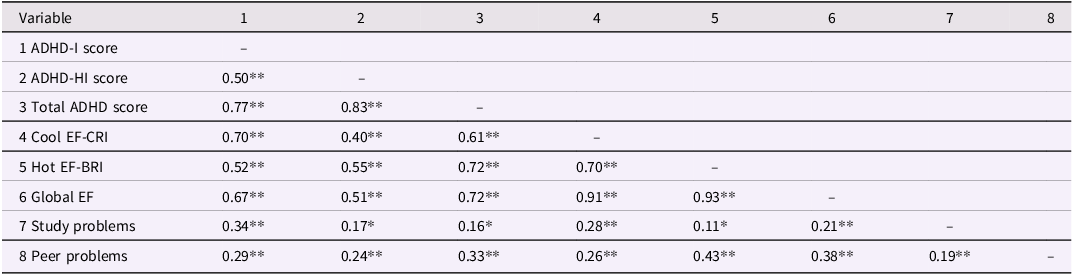
Demographic and descriptive statistics are shown in the Appendix (see Table S2). One-way ANOVA showed no significant differences in ADHD scores based on age, medication use, parental education, or family income. However, gender significantly influenced ADHD scores, with boys (M = 42.57, SD = 13.59) scoring higher than girls (M = 38.99, SD = 14.26). Thus, gender was controlled in the subsequent analysis. Partial correlation analysis indicated a positive relationship between ADHD scores and EF deficits across all dimensions (p < .05, see Table 1).
Partial correlations among analysis variables(controlling for gender and age, N = 649)

Note. I = inattentive; HI = hyperactive/impulsive; EF = executive function; CRI = Cognitive Regulation Index; BRI = Behavioral/Emotional Regulation Index. **p < .01, *p < .05.
The impact of executive function deficits on ADHD core symptoms
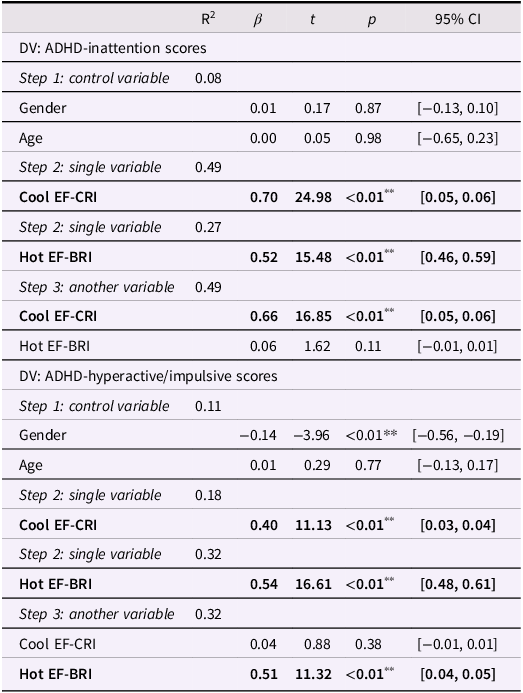
As shown in Table 2, the results showed that when cool EF was entered in step 2, it significantly positively predicted inattention (β = 0.71, p < .01) and hyperactivity/impulsivity scores (β = 0.40, p < .01). However, in step 3, after adding hot EF scores, the results indicated that only the cool EF was a significant predictor of inattention (β = 0.66, p < .01), but hot EF was not predicted significantly (β = .06, p = 0.150). Similarly, when hot EF was entered in step 2, it also significantly predicted inattention (β = 0.52, p < .01) and hyperactivity/impulsivity scores (β = 0.54, p < .01). Adding cool EF scores in step 3 indicated that only Hot EF remained a significant predictor of hyperactivity/impulsivity (β = 0.51, p < .01), whereas cool EF was not (β = .04, p = 0.378). The overall regression model predicted 49.4% and 31.9% of the variance in inattention and hyperactivity/impulsivity scores. These findings suggested that cool EF and hot EF uniquely predict different ADHD symptom domains, highlighting the specific contributions of varying EF deficits to ADHD symptomatology.
Hierarchical regression analysis predicting ADHD symptoms scores

Note. EF = executive function; CRI = Cognitive Regulation Index; BRI = Behavioral/Emotional Regulation Index. N = 649. **p < .01, *p < .05.
Path analysis for executive function and ADHD symptoms
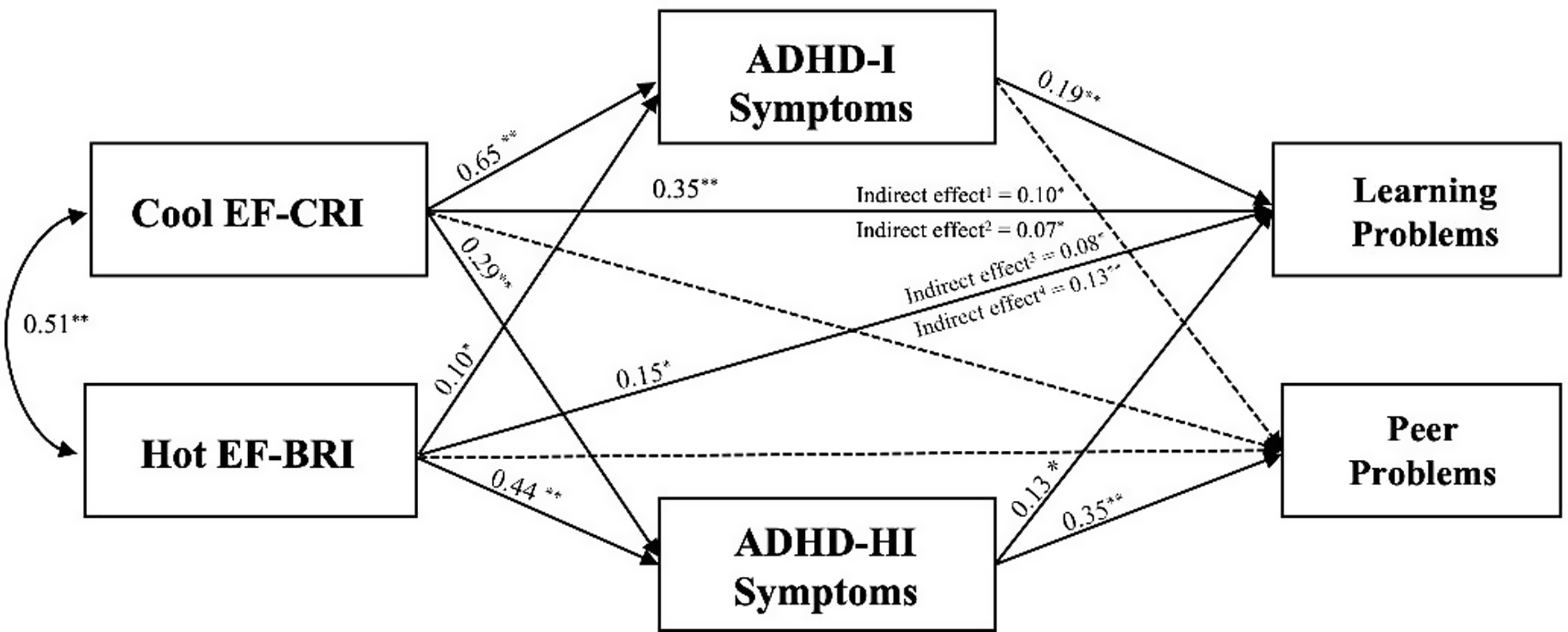
The final model with all paths is presented in Figure 1, and it had a good fit to the data, χ2/df = 42.115/14, RMSEA = .068, CFI = 0.945, TLI = 0.925, SRMR = .073. The results indicated that EF deficits predicted the severity of ADHD symptoms, and the path coefficient from cool EF to ADHD-I was larger than cool EF to ADHD-HI (β = 0.65 > 0.29), whereas the path from hot EF to ADHD-HI was greater than hot EF to ADHD-I (β = 0.44 > 0.10). This finding supported the notion that hot and cool EF deficits constitute distinct pathways influencing ADHD symptoms. Additionally, the study also found that EF deficits could indirectly impact problem behaviors. Specifically, cool and hot EF can affect the emergence of learning problems via the severity of inattention and hyperactivity-impulsivity. Details of these effects are provided in Table S3.
The path diagram model (controlling for gender and age). Note. The figure shows the model for full paths, with solid lines representing paths that are significant and dashed lines representing paths that are not significant and do not appear in the final model. 1The indirect effect among cool EF→ ADHD-I→Learning problems; 2the indirect effect among cool EF → ADHD-HI→Learning problems; 3the indirect effect among hot EF-BRI → ADHD-I→Learning problems; 4the indirect effect among cool EF → ADHD-HI→Learning problems. EF = executive function; CRI = Cognitive Regulation Index; BRI = behavioral regulation index; I = inattention; HI = hyperactive/impulsive.

Selection of the LCA models
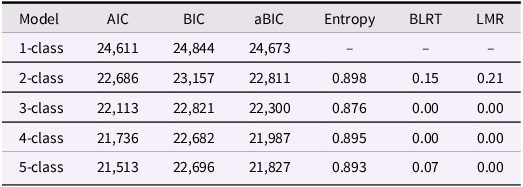
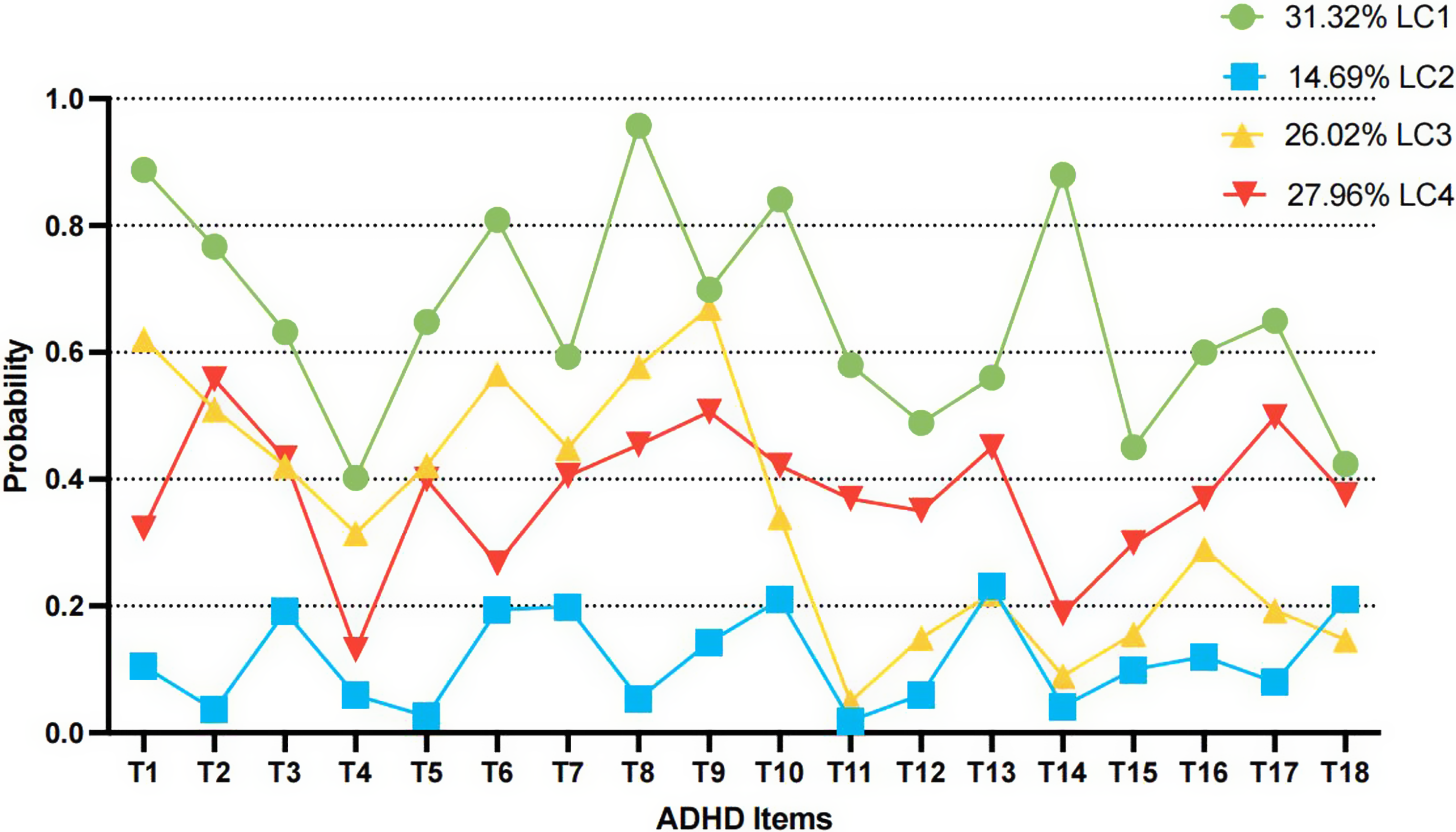
According to Table 3 and Figure S1, fit statistics indicated the BIC, which was a measure favoring parsimonious models, was lowest for the four-class model (BIC = 22,682), suggesting the highest model efficiency. Additionally, both the LMR and the BLRT tests were significant, coupled with the highest entropy value. These results identified the four-class as the most fitting model, according to our LCA. The four LC profiles included high ADHD, low ADHD, only IA, and moderate ADHD. The distribution of symptoms across these four classes is shown visually in Figure 2 and Table S4.
Fit statistics of the latent class analysis models

Note. N = 555. AIC = Akaike information criterion; BIC = Bayesian information criterion; aBIC = sample-size adjusted BIC; BLRT = bootstrapped likelihood ratio test; LMR = Lo-Mendell-Rubin likelihood ratio test.
Conditional probabilities of ADHD symptoms in all four latent classes. Note. LC1 = high ADHD (n = 177, 31.32%); LC2 = low ADHD (n = 83, 14.69%); LC3 = only IA (n = 147, 26.02%); LC4 = moderate ADHD (n = 158, 27.96%).

Clinical characteristics of the four LCs
Table S5 delineates the clinical characteristics across the four LCs. Table S6 presents a comparison of the differences in EF deficits under four LCs. Specifically, LC1 (high ADHD) exhibited significantly higher cool and hot EF scores compared to the other groups. LC2 (low ADHD) presented significantly lower cool EF scores, with no significant difference in hot EF scores when compared to LC3 (only IA). The cool EF scores between LC3 (only IA) and LC4 (moderate ADHD) were not significant, though both were significantly higher than LC2 (low ADHD). This indicated a significant prevalence of EF deficits within different ADHD subtypes.
Executive function deficits associations with the four LCs
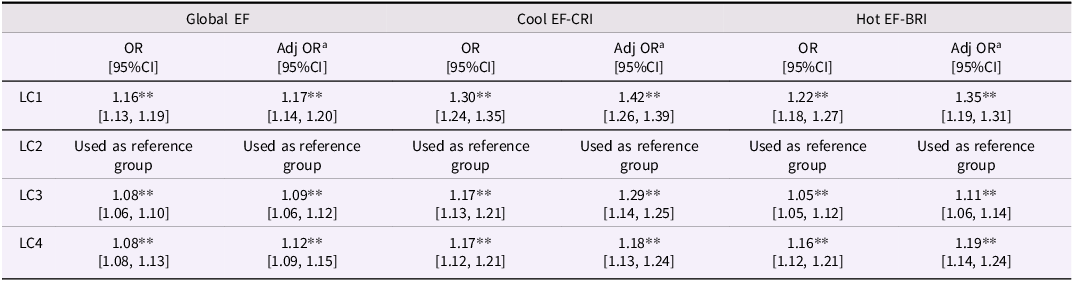
Multinomial logistic regression analyses were used to further explore the effects of EF deficits on different ADHD subtypes, with LC2 as the reference group (see Table 4 and Fig. S2). The results indicated that individuals classified into the LC1 (high ADHD) (compared with LC2 as the reference group) are at a 1.42-fold higher risk of deficits in cool EF and a 1.35-fold higher risk in hot EF. Similarly, one classified into the LC3 (only IA) exhibit a 1.29- and 1.11-fold increased risk for cool and hot EF deficits. One classified into the LC4 (moderate ADHD) exhibits a 1.18- and 1.19-fold increased risk for cool EF and hot EF deficits. The findings indicated that both cool and hot EF deficits could predict the classification of ADHD subtypes, and in particular, deficits in cool EF significantly affected the attribution of inattention subtypes.
Exploring the categorical effect of executive function deficits on ADHD subtypes

Note. LC = latent class; EF = executive function; CRI = Cognitive Regulation Index; BRI = Behavioral/Emotional Regulation Index. aadjusted for gender, age, no medicine.**p < .01, *p < .05.
Discussion
This study explored the associations between cool and hot EF deficits and different core symptoms of ADHD through an extensive behavioral investigation. Variable-centered analysis revealed that EF deficits could significantly predict the severity of ADHD core symptoms. Specifically, cool EF deficits were more prominently associated with inattention, whereas hot EF deficits were closely linked to hyperactivity/impulsivity. This finding highlights the unique contribution of different EF deficits in ADHD core symptoms. Furthermore, path analyses also found that EF deficits not only directly affect ADHD symptoms but may also indirectly affect learning problems through ADHD symptoms. Person-centered analyses further demonstrated the relationships between different ADHD subtypes and different EF deficits. Higher EF deficits in ADHD subtypes with more severe symptoms, and both cool and hot EF deficits could predict the classification of ADHD subtypes. In summary, these findings highlight the different roles of hot and cool EF deficits in the manifestation of ADHD symptoms, thereby enriching the conceptual framework of ADHD pathophysiology and providing a scientific foundation for the formulation of diagnostic instruments and tailored interventions from the perspective of specific EF deficits.
First, the present study found a significant positive relationship between EF deficits and the severity of ADHD symptoms, underscoring that children with poorer EF performances in daily life displayed more severe ADHD symptoms. Such findings support the prevailing nation that EF deficits are prevalent in ADHD, suggesting a crucial need for focused assessment and intervention for EF deficiencies in the diagnosis and treatment of ADHD (Faraone et al., Reference Faraone, Asherson, Banaschewski, Biederman, Buitelaar, Ramos-Quiroga, Rohde, Sonuga-Barke, Tannock and Franke2015; Nigg et al., Reference Nigg, Sibley, Thapar and Karalunas2020). Importantly, the unique impact of hot and cool EF deficits on the two core symptoms of ADHD was found in regression and path analysis. Specifically, cool EF, like working memory and behavior control, predominantly influenced inattention, while hot EF, including reward processing and emotion regulation, were closely linked to hyperactive/impulsive. This finding not only validates our research hypothesis but also provides direction in explaining the existence of heterogeneity in EF deficits among children with ADHD. Previous researchers have found that not all individuals with ADHD have difficulty with EF tasks, and still 21% of individuals with ADHD do not show weaknesses in any of the outcomes related to EF (Nigg et al., Reference Nigg, Willcutt, Doyle and Sonuga-Barke2005). This may be due to the fact that these studies focused only on tasks related to cool EF and ignored the presence of hot EF deficits in ADHD, making the examination of EF deficits in children with ADHD incomplete. A recent study also emphasized the significant predictive effect of hot EF on ADHD symptoms in children (Veloso et al., Reference Veloso, Vicente and Filipe2022). Thus, focusing on the impact of hot EF deficits on ADHD core symptoms could help to more fully characterize EF deficits in ADHD (Colonna et al., Reference Colonna, Eyre, Agha, Thapar, van Goozen and Langley2022; Rastikerdar et al., Reference Rastikerdar, Nejati, Sammaknejad and Fathabadi2023).
The present study further underscores the distinct roles that different types of EF deficits play in the core symptoms of ADHD, providing additional support for the dual-pathway model proposed by Sonuga-Barke (Reference Sonuga-Barke2002, Reference Sonuga-Barke2003). According to this model, the etiology of ADHD can be explained by two relatively independent pathways: the executive control pathway, associated with cool EF (cognitive EF), and the motivational pathway, associated with hot EF (affective EF) (Geurts et al., Reference Geurts, van der Oord and Crone2006). In this framework, deficits in cool EF primarily result in impaired inhibitory control, leading to failures in cognitive and behavioral regulation. Conversely, deficits in hot EF are characterized by aversion to delayed rewards and impaired emotion regulation, contributing to dysfunction in motivational processing. Our findings are consistent with previous empirical studies. For example, previous research has shown that motivation-related factors, such as delay discounting and reward sensitivity, predict impulsivity and hyperactivity symptoms but have limited predictive power for inattention symptoms. In contrast, EF factors related to executive control, such as inhibitory control and cognitive flexibility, are more closely associated with inattention symptoms (Lopez-Vergara & Colder, Reference Lopez-Vergara and Colder2013; Thorell, Reference Thorell2007). Additionally, Landis et al. (Reference Landis, Garcia, Hart and Graziano2021) found that the severity of EF deficits, as reported by parents and teachers, was positively correlated with children’s levels of inattention. Meanwhile, emotional problems, as assessed by parents and teachers, were more strongly associated with hyperactivity symptoms. These findings are further supported by longitudinal studies, which suggest that early deficits in cool EF predict later inattentive symptoms, while the predictive role of cool EF in hyperactive-impulsive symptoms is either weak or absent (DeRonda et al., Reference DeRonda, Zhao, Seymour, Mostofsky and Rosch2021; Wahlstedt et al., Reference Wahlstedt, Thorell and Bohlin2008). Furthermore, previous hypotheses suggested that executive control (linked to cool EF) and motivation (linked to hot EF) exhibit specificity in their associations with ADHD symptoms—motivation is primarily related to impulsivity and hyperactivity, while executive control is more closely associated with inattention (Castellanos et al., Reference Castellanos, Sonuga-Barke, Milham and Tannock2006; Sonuga-Barke et al., Reference Sonuga-Barke, Sergeant, Nigg and Willcutt2008).
Zelazo (Reference Zelazo2020) further emphasized the necessity of analyzing ADHD through the lens of cool and hot EF. Our findings build upon these theoretical and empirical foundations by providing a clearer understanding of the distinct roles of cool and hot EF in the core symptoms of ADHD. Specifically, cool EF regulates behavior by modulating attention, enabling individuals to engage in adaptive, goal-directed, and problem-solving behaviors (Zelazo & Müller, Reference Zelazo, Müller and Goswami2002). Cool EF deficits lead to failures in working memory representation maintenance, impaired inhibitory control, and difficulties in cognitive flexibility (Diamond, Reference Diamond2013). These impairments limit an individual’s ability to sustain attention, selectively focus, and shift attentional resources effectively. In contrast, hot EF refers to the ability to flexibly evaluate risks and rewards in emotionally or motivationally salient contexts, encompassing functions such as delay gratification, reward processing, and emotion regulation. Hot EF deficits culminate in impaired behavioral control and motivation dysregulation within emotional or social contexts. This primarily manifests as an aversion to delay, pursuit of immediate rewards, and motivational imbalances, driving individuals toward disinhibited actions and impulsive choices, hence presenting hyperactive and impulsive core symptoms (Dekkers et al., Reference Dekkers, Popma, van Rentergem, Bexkens and Huizenga2016; Shakehnia et al., Reference Shakehnia, Amiri and Ghamarani2021). In summary, our findings enhance the understanding of the cognitive mechanisms underlying ADHD, reinforcing the distinction between cool EF and hot EF deficits and their respective contributions to inattentive and hyperactive-impulsive symptoms. This differentiation is crucial for developing targeted interventions that address the specific EF impairments associated with each ADHD symptom domain.
In addition, ADHD was subdivided into four subtypes according to specific manifestations: high ADHD, moderate ADHD, low ADHD, and IA only. And EF deficits were found to be specific for different ADHD subtypes; for example, subtypes with high ADHD severity showed more pronounced EF deficits, and subtypes with high inattention severity exhibited more severe deficits in cool EF. Logistic regression analysis confirmed EF deficits as a significant predictor for the classification of ADHD subtype. This suggests that assessing EF can effectively identify distinct ADHD subtypes, facilitating more personalized intervention strategies. For example, individuals who perform poorly in cool EF are more likely to be categorized into the inattentive subtype, and they may particularly benefit from interventions aimed at enhancing working memory and cognitive flexibility (Kofler et al., Reference Kofler, Wells, Singh, Soto, Irwin, Groves, Chan, Miller, Richmond, Schatschneider and Lonigan2020; Wiest et al., Reference Wiest, Rosales, Looney, Wong and Wiest2022). In addition, the demographic distribution shown in Table S1 reveals that there are relatively few participants with the hyperactive/impulsive (H-I) subtype (4%) in the sample. This finding is consistent with a previous epidemiological study (Mak et al., Reference Mak, Chan, Chan, Tang, Lai, Wong, Leung, Hung, Lam and Lee2020), which indicates that the H-I subtype is relatively rare in Chinese populations (only 4%). Similarly, our LCA further supports this pattern, revealing that the representation of the H-I subtype is very low, and no clear clustering. This result also underscores the importance of using a person-centered analytical approach, as it allows for more flexible and developmentally sensitive categorization of ADHD symptomatology beyond traditional diagnostic categories (Reed et al., Reference Reed, First, Kogan, Hyman, Gureje, Gaebel, Maj, Stein, Maercker, Tyrer, Claudino, Garralda, Salvador-Carulla, Ray, Saunders, Dua, Poznyak, Medina-Mora, Pike and Saxena2019). By identifying potential ADHD subgroups based on symptom patterns rather than predefined diagnostic labels, our study not only deepens the understanding of the relationship between EF deficits and different core symptoms of ADHD but also helps identify which specific areas of EF may play a role in different ADHD subtypes, providing an empirical basis for the development of more effective assessment and treatment strategies.
It is noteworthy that path analysis, with social adaptation as the distal dependent variable, further reveals that EF deficits not only have a direct impact on the core symptoms of ADHD but may also indirectly affect social functioning through these symptoms, particularly in relation to study problems. This finding underscores the potential dual role that EF deficits may play in influencing the social adaptation abilities of individuals with ADHD. First, EF deficits directly negatively affect the core symptoms of ADHD (Irwin et al., Reference Irwin, Soto, Chan, Miller, Carrington-Forde, Groves and Kofler2021). Second, the worsening of these core symptoms further indirectly impacts the ADHD learning abilities in educational settings. For instance, ADHD with significant working memory problems may struggle with tracking and remembering classroom instructions, which not only increases the risk of difficulties in maintaining classroom attention but may also lead to poor learning outcomes and declining academic performance (Rapport et al., Reference Rapport, Kofler, Alderson, Timko and DuPaul2009). Additionally, the progressive nature of this relationship also hints at the importance of early intervention. By timely assessing and intervening in EF deficits, it is possible to mitigate their direct and indirect impacts before ADHD symptoms have a broader effect on social functions. A computerized intervention for central executive functioning in children with ADHD found that training not only significantly improved working memory and inhibitory control scores in ADHD but also further improved their academic performance by increasing attentional behavior in the classroom (Kofler et al., Reference Kofler, Irwin, Soto, Groves, Harmon and Sarver2019; Singh et al., Reference Singh, Gaye, Cole, Chan and Kofler2022). Therefore, interventions targeting EF deficits may not only improve the core symptoms of ADHD but also have the potential to enhance their academic performance and other social adaptation skills.
This study holds significant implications for clinical diagnosis and educational practices. From a clinical perspective, clinicians can diagnose subtypes of ADHD with greater precision by identifying deficits in specific components of EFs, thereby facilitating the construction of personalized treatment plans. The assessment and intervention of EF should be an integral part of a comprehensive ADHD treatment strategy. Moreover, understanding how EF deficits indirectly influence studying problems is likewise invaluable for educators. Teachers need to recognize the EF challenges that ADHD students may face and utilize adaptive teaching strategies and assistive technologies to support their learning. Measures such as offering a more structured learning environment, allowing extra time for exams, and employing graphic organizers can help mitigate the adverse effects of EF deficits. However, this study has its limitations. First, its cross-sectional design restricts our ability to infer causal relationships. Future research should employ longitudinal designs to track changes in symptoms and EF impairments over time and examine their interactions to establish causality. Second, this study relies on parent-reported measures, which, while widely used and demonstrating strong psychometric properties, may be subject to informant bias. Incorporating reports from multiple informants (e.g., teachers, clinicians, or self-reports from older children) could enhance measurement accuracy and mitigate potential biases. Furthermore, this study provides evidence for the relationship between EF and ADHD core symptoms only at the questionnaire level, lacking EF assessments based on cognitive tasks. Task-based cognitive assessments are commonly used in the literature to evaluate EF abilities more objectively. So, future research should adopt a multi-method approach, integrating both task-based cognitive measures and informant-reported behavioral ratings to comprehensively assess EF deficits in ADHD. This approach would allow for a more robust evaluation of the extent to which cool and hot EF differentially contribute to ADHD symptoms and help clarify whether the current findings are specific to parent-reported EF deficits or generalizable across different assessment modalities.
In conclusion, this study systematically investigated the impact of EF deficits on various core symptoms of ADHD, revealing that cool EF deficits predominantly affect inattention symptoms, while hot EF deficits primarily impact hyperactive-impulsive symptoms. These findings validated the hypothesis that EFs exert unique effects on the dimensions of ADHD symptoms and highlight the potential significance of these differences for diagnosis and intervention. Through this in-depth analysis, we not only deepened understanding of EF deficits in ADHD patients but also laid a solid theoretical foundation for the development of more effective diagnostic tools and personalized interventions in the future.
Supplementary material
The supplementary material for this article can be found at https://doi.org/10.1017/S0954579425100242.
Data availability statement
The datasets used or analyzed during this study are available from the corresponding author on reasonable request. The current study does not involve with any novel or unusual stimulus materials; all materials have been described in detail in the Methods section. There is no preregistration for this study.
Acknowledgments
Our sincere thanks go to the children, parents, and hospital staff for their participation and support in this research. We also thank the student assistants for their help in data collection across all studies. Special thanks to Prof. J. Buitelaar and Prof. C. Greven for their valuable advice on this study.
Funding statement
This study was supported by the National Key R&D Program of China (2022YFC2705201), the National Natural Science Foundation of China (32271123), the Chongqing’s Technological Innovation and Application Development Sichuan Chongqing Joint Implementation Key R&D projects (CSTB2022TIAD-CUX0003), the Key Project for Technological Innovation and Application Development of Chongqing (CSTB2022TIAD-KPX0150), and the Innovation Research 2035 Pilot Plan of Southwest University (SWUPilotPlan006).
Competing interests
The authors declare that they have no known competing financial interests or personal relationships that could have appeared to influence the work reported in this paper.