Introduction
It is well known that Australian Aboriginal women suffer a high mortality rate, reflected in a life expectancy of almost 20 years less than other Australian women (ABS, 2003, 2004a, b; ABS & AIHW, 2003). It is also known that, compared with non-Aboriginal children, Aboriginal children suffer higher levels of adverse life outcomes, including higher rates of mental health problems (Zubrick et al. Reference Zubrick, Silburn, Lawrence, Mitrou, Dalby, Blair, Griffin, Milroy, De Maio, Cox and Li2005). The relatively high rate of early death in the Australian Aboriginal population and, in particular, the loss of mothers during their child-rearing years lead to understandable concern, distress and conjecture about the contribution of maternal death to the well-being and life circumstances of the children, and the contribution that early death makes to the overall Australian Aboriginal circumstance. However, the extent to which the high rate of premature maternal death might contribute to negative psychosocial circumstances for Aboriginal children under the age of 18 years is unknown.
The loss of a parent is regularly cited among any list of the major life stresses or life-threatening events (Brugha & Cragg, Reference Brugha and Cragg1990). The consequences to a child's development are potentially several. In addition to possible sustained periods of reactive grief and bereavement, which resolve gradually, other developmental consequences of the loss of a mother may entail more prolonged dysphoria and depression (Dowdney, Reference Dowdney2000), post-traumatic stress, anxiety, and also poorer developmental outcomes associated with the impact of parental loss on the material and psychosocial environment of the child and of possible transition to care outside of the immediate biological family. These consequences may vary in their onset, intensity and duration depending upon (a) the child's age and development at the time of the parental loss, (b) the circumstances surrounding the loss of the parent, (c) the psychosocial resources available to moderate the impact of such a loss, and (d) the general level of other life stresses and social supports and their accumulative impact on the child and remaining carers.
There is a scant international literature covering the impact on non-Aboriginal children who have suffered the loss of their mother during childhood. It is principally focused on assessing the impact of childhood bereavement on the onward psychological outcomes of children experiencing this loss (Dowdney, Reference Dowdney2000). Most of these articles are based on very small non-representative convenience samples and lack suitable controls, or are primarily clinical in their focus, providing recommendations for treatment of grief reactions in children after maternal bereavement (Dowdney et al. Reference Dowdney, Wilson, Maughan, Allerton, Schofield and Skuse1999; Dowdney, Reference Dowdney2005). Most are also limited in their capacity to inform the wider social and family circumstances that children experience after they have lost a parent.
Very few studies are based on large random sample surveys that include children who can be identified as having lost their mother at some point in childhood, and a control group with which to compare outcomes. The Western Australian Aboriginal Child Health Survey (WAACHS) was a large-scale population-based random sample of 1999 families with Aboriginal children in Western Australia (WA), covering approximately one-sixth of the families with Aboriginal children in the state. The WAACHS provides a rare opportunity to test the association between measures of selected psychosocial circumstances of those Aboriginal children who have lost their mother due to early death and those children whose mother was still alive at the time of the survey.
Method
Data
The data comprised a population-based random sample of about one in six families with Aboriginal children from across WA. The sample used a multi-stage clustered design. Eligible households with at least one Aboriginal child under the age of 18 years were randomly selected to participate in the survey from the screening lists. In the survey, Aboriginal status was determined where a family member responded in the affirmative to the screening question: ‘Is (child's name) considered to be of Aboriginal or Torres Strait Islander descent?’ A child may be so identified where both or only one parent is of such descent. Once a family was selected, all Aboriginal children under 18 years living in the household were included in the survey. A total of 2386 families were selected to participate in the survey, of which 1999 (84%) participated. Interviews were conducted face to face in the home by a trained interviewer. There were 5513 in-scope children in these families and survey data were gathered on 5289 of these children. The survey methods are described extensively elsewhere (Zubrick et al. Reference Zubrick, Lawrence, Silburn, Blair, Milroy, Wilkes, Eades, D'Antoine, Read, Ishiguchi and Doyle2004, Reference Zubrick, Silburn, Lawrence, Mitrou, Dalby, Blair, Griffin, Milroy, De Maio, Cox and Li2005, 2006 b; Silburn et al. Reference Silburn, Zubrick, De Maio, Shepherd, Griffin, Mitrou, Dalby, Hayward and Pearson2006).
Data on each child were gathered through household face-to-face interviews with the primary carer of the child and also through interviews with school teachers and principals of those children attending school and for whom consent was given to gather these details. Interview content for children under the age of 4 years (n=1296) was adjusted for developmental appropriateness relative to the interview content used for children aged 4–17 (n=3993).
Definition of groups
Three groups are compared in this report: (1) of 5289 children in the survey, 4360 were living with their birth mother as their primary carer at the time of the survey. Of the remaining 929 children, vital status of the mother was assessed through record linkage; (2) for 57 of these children, the birth mother had died prior to the time of the survey, and (3) for the remaining 830 of the children, their birthmother was alive at the time of the survey but was not the primary carer of the child. For the remaining 42 children, consent was not given to link their survey data to administrative records.
Several circumstances contributed to the creation of the third group: the birth mother in many instances was no longer in the household; and/or the birth mother was under the age of 18 at the time of the survey; and/or the birth mother's relationship with the father had ended and she had moved into an extended family household; and/or the birth mother was incapacitated by drug or alcohol abuse or other overwhelming psychosocial circumstances that prevented her from caring for the child.
Ethical approval
The study was approved by the Ethics Committee of King Edward Memorial and Princess Margaret Hospitals, and by the Western Australian Department of Health's Confidentiality of Health Information Committee.
Measures
A range of social and demographic information was collected at the time of the survey. For the purposes of this report we have included geographical location, family structure, family financial strain, level of primary carer education, and the occupational skill level of the primary carer.
For children aged 4–17 years inclusive, emotional and behavioural difficulties were assessed using the carer and teacher report versions of the Strengths and Difficulties Questionnaire (SDQ; Goodman, Reference Goodman1999; Goodman et al. Reference Goodman, Ford, Simmons, Gatward and Meltzer2000). With permission, the SDQ questionnaire was modified to be more suitable for use in Aboriginal populations. The instrument demonstrated excellent psychometric properties across a range of urban to very remote settings with a 20-item SDQ Total Score scale reliability of 0.93 (Zubrick et al. 2006 a).
In addition to the SDQ, carers were asked to complete a short inventory of 11 problem behaviours that caused Aboriginal families distress. These behaviours were completed on children aged birth to 17 years inclusive. For all children this included bedwetting, nightmares, not getting enough sleep, not wanting to go to school, and running away from home. For children aged 4–17 years items also included drinking alcohol or getting drunk, substance sniffing, other drug use, talking about death or suicide, deliberately harming self, and suicidal behaviour. Carers were asked if any of these behaviours had occurred in the survey child in the 6-month period prior to the interview.
Teachers were asked to provide ratings on the overall academic performance of the survey child (far below average, below average, average, above average, far above average) and for this report, these results are aggregated to form a binary variable comparing those who were far below average and below average with those who were at average or better levels. Other data gathered included whether the survey child had ever been suspended from school, the child's total possible days of attendance so far in the school year, and number of days absent. Days absent from school were converted to an estimate for the full academic year by standardizing to a reference year of 209 days attendance at school. Finally, teachers were asked to complete the SDQ on each of the children.
Analysis
The mortality of mothers of survey children was compared with expected mortality using the relative survival method (Hakulinen, Reference Hakulinen1977; Therneau & Offord, Reference Therneau and Offord1999). In this method, expected mortality in the cohort was calculated by applying standard life tables to estimate the expected number of deaths taking into account age, calendar year and years of follow-up. Expected mortality was calculated taking the start date for follow-up as the date of the birth of the survey child, and the end date as the date of the survey interview.
The sample was weighted to represent the population of Aboriginal children in WA and estimates and their corresponding confidence intervals (CIs) were calculated for the above categories of mother status on a range of selected measures (Zubrick et al. Reference Zubrick, Lawrence, Silburn, Blair, Milroy, Wilkes, Eades, D'Antoine, Read, Ishiguchi and Doyle2004). Standard errors were calculated using the ultimate cluster variance estimation method (Wolter, Reference Wolter1985). The 5289 sample children represent a population of 29 800 children, of whom 22 900 were aged 4–17 years. Following record linkage, of the estimated 22 900 Aboriginal children and young people aged 4–17 years in WA, 19 600 were also currently attending school. The majority of students (81.2%, 95% CI 78.7–83.6) were in the care of their birth mother, 16.5% (95% CI 14.3–18.9) had a birth mother who was alive but was not their primary carer and 1.5% (95% CI 0.8–2.7) had a birth mother who had died. For the remaining children, consent was not given for the linkage of survey data.
Multi-variable logistic regression accounting for age and gender
Preliminary comparisons between those children whose birth mother was their primary carer with those whose birth mother had died and those whose birth mother was alive but no longer their primary carer were undertaken in respect of the child's age at the time of the survey and the child's gender. Children who were living with their birth mother were significantly younger (mean age=7.7 years, 95% CI 7.5–7.9) than those children whose birth mother had died (mean age=10.1 years, 95% CI 9.7–10.5) and those children whose birth mother was alive but was no longer their primary carer (mean age=11.9 years, 95% CI 10.6–13.3). Fewer males had a birth mother who had died (39.4%, 95% CI 22.4–61.2) whereas approximately equal proportions of males were living with their birth mother who was their primary carer (51.1%, 95% CI 49.4–52.8) or had a birth mother who was alive but was not their primary carer (54.5%, 95% CI 50.4–58.7). Because children in these groups varied by both developmental age and by gender in addition to the status of their birth mother, and because both age and gender are independently associated with emotional and behavioural development, we undertook to adjust for these factors through multiple logistic regression.
Results
Maternal mortality and the age of the child at maternal death
There were 46 deaths among birth mothers identified when the survey data were linked to the WA Register of Deaths, of which 42 had occurred prior to the date of the WAACHS. Of these 42 deaths, 16 occurred in the 2 years prior to the survey, nine occurred 3–5 years prior to the survey, another nine 6–10 years prior to the survey, and eight occurred more than 10 years prior to the survey. As each mother may have more than one child in the survey, these 42 deaths affected 57 survey children (1.1%). At the time of their mother's death, three of the children were aged 0–3, 21 were aged 4–11, and 33 were aged 12–17 years. The primary carers of over three-quarters of the children (81.8%, 95% CI 80.0–83.5) were also their birth mothers. For about 16% (16.2%, 95% CI 14.6–17.8) their birth mother was alive but was not the child's primary carer, and 1.2% (95% CI 0.8–1.8) had a birth mother who had died. For the remaining children, consent was not obtained for the linkage with death records. For the children attending school, information was collected in respect of 2379 students, of whom 1916 had a primary carer who was their birth mother, 31 had lost their birth mother, 417 were cared for by someone other than their birth mother although the birth mother was alive, and for 15 students record linkage was not possible.
Relative survival
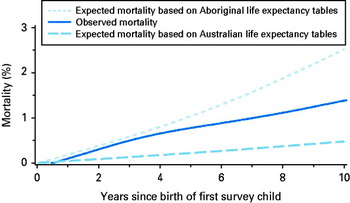
Applying the Australian life tables for all females, it would have been expected that 12 birth mothers would have died prior to the survey. This is significantly less than the 42 deaths observed (χ2=73.8, p<0.001). When the experimental life tables for Aboriginal and Torres Strait Islander women are applied instead, the expected number of deaths in the cohort of birth mothers was 68. This is significantly greater than the 42 deaths observed (χ2=10.22, p=0.001). Fig. 1 shows the observed and expected mortality curves for mothers of Aboriginal children in the survey, applying both the overall Western Australian life tables, and the experimental life tables for Aboriginal and Torres Strait Islander women.
Observed and expected mortality among mothers of Aboriginal children.

Keeping in mind that the birth mothers of 15% of these Aboriginal children identified themselves as non-Aboriginal (i.e. implying Aboriginal paternity), it seems that the number of deaths among carers in the WAACHS may be slightly less than might have been expected based on national estimates of life expectancy for Aboriginal women. It was not possible to collect information in the survey on Aboriginality of birth mothers who were no longer the primary carers of the survey children, and it is thus not possible to calculate directly the number of expected deaths in this cohort.
The slightly lower number of deaths could be due to differences in life expectancy for Aboriginal and non-Aboriginal women with and without children, differences in life expectancy between WA Aboriginal women and Aboriginal women in other states, and differences in participation rates in the survey between birth mothers and other carers of Aboriginal children. However, the experimental life tables for Aboriginal and Torres Strait Islander women are subject to some uncertainty (which is not included in the calculation of the χ2 statistic and p value), and taking this into account the number of deaths in the survey may not be significantly lower than expected.
Demographic characteristics of the child's family at the time of the survey
The sample was selected to be representative of the living circumstances of Aboriginal children in WA. About one-third (34.1%, 95% CI 31.5–36.8) lived in the Perth metropolitan area, less than half of the survey children lived in regional centres and rural communities (45.8%, 95% CI 42.2–49.3), and one in five survey children lived in geographically isolated areas (20.1%, 95% CI 16.7–24.1).
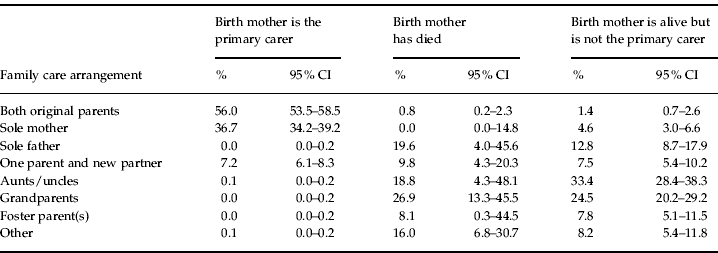
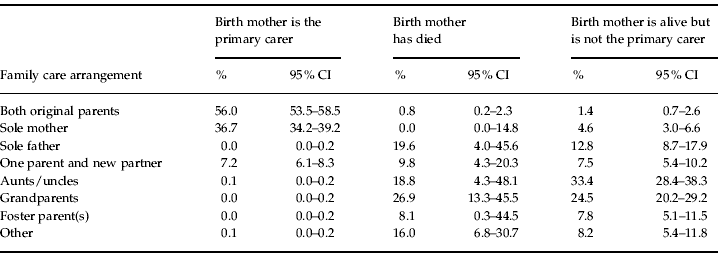
The loss of a mother understandably brings a change in family care arrangements. Each family in the study was classified by the nature of the family relationships that existed in the household at the time of the survey. This was done by drawing a pedigree of the household members who ‘usually live here’. Respondents were also asked to identify the person ‘who usually cared for’ the study child. This allowed us to determine who the child was usually living with and who, in that living arrangement, was their primary carer (see Table 1).
Proportion of Aboriginal children in various family care arrangements, by whether the birth mother has died, the birth mother is the primary carer, or the birth mother is alive but not the primary carer of the child
CI, Confidence interval.
For those children whose birth mother had died, 19.6% (95% CI 4.0–45.6) were living with and being cared for by a sole father, and another 9.8% (95% CI 4.3–20.3) were living with their original father and a new partner in a step and blended family arrangement. For the remainder of these children, 18.8% (95% CI 4.3–48.1) were living with and being cared for by aunts and uncles, 26.9% (95% CI 13.3–45.5) by grandparents, 16.0% (95% CI 6.8–30.7) were living in and being cared for through extended family arrangements, and 8.1% (95% CI 0.3–30.7) were in foster arrangements.
Some children whose birth mother was still living were not receiving their primary care from her. With the exception of a larger proportional share of care by aunt/uncle arrangements (33.4%, 95% CI 28.4–38.3), family care arrangements for these children were broadly similar to those where the mother had died.
The interview gathered information about the level of family financial strain experienced by the family at the time of the interview, the highest level of education attained by the primary carer, and the occupational skill level of the primary carer. No significant differences were noted in the distribution of these family demographic characteristics for children who were still living with their birth mother, compared with either those whose birth mother was alive but not caring for them or those whose birth mother had died.
Carer-reported child emotional or behavioural difficulties
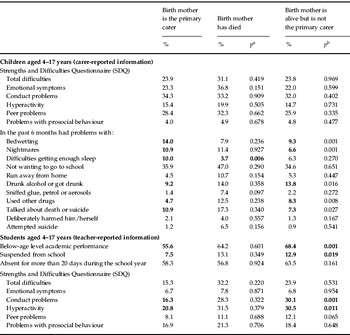
The risk of clinically significant emotional or behavioural difficulties was assessed using the parent-reported SDQ (Goodman et al. Reference Goodman, Ford, Simmons, Gatward and Meltzer2000; Goodman, Reference Goodman1999). Table 2 contains the weighted proportions for each of the three groups and Table 3 contains the multi-variately adjusted odds ratios (ORs) (and 95% CIs) for the group where the birth mother has died and the group where the birth mother is alive but not the primary carer relative to the reference group where the mother is the primary carer.
Proportions of Aboriginal children with various outcomes, by whether the birth mother is the primary carer, the birth mother has died, or the birth mother is alive but not the primary carer of the child (bolded estimates are significant)

a Test of significance of difference between proportions for those children whose primary carer is their birth mother and those children whose primary carer has died.
b Test of significance of difference between proportions for those children whose primary carer is their birth mother and those children whose birth mother is alive but is not the primary carer.
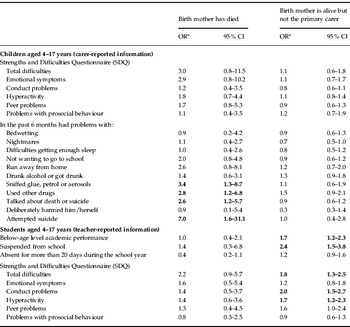
Adjusted odds ratios (ORs) of various outcomes for Aboriginal children according to birth mother status (bolded estimates are significant)

CI, Confidence interval.
a Reference category is ‘Birth mother is primary carer’: ORs adjusted for child's age in years, child's gender, and multi-level effects of clustering.
The proportion of children at high risk of clinically significant emotional or behavioural difficulties as measured by their SDQ Total Score was higher among children whose birth mother had died (31.1%, 95% CI 15.9–52.4) than among children whose birth mother was also their primary carer (23.9%, 95% CI 21.7–26.2) or whose birth mother was alive but not their primary carer (23.8%, 95% CI 19.4–28.5). These differences did not attain statistical significance (Table 2). This pattern was repeated for the component scores of the parent-reported SDQ and no statistically significant differences between these three groups was observed in the proportions of children with conduct problems, hyperactivity, peer problems or prosocial behaviour.
Adjusted ORs comparing children whose birth mother had died or children whose birth mother was no longer their primary carer with children whose birth mother was their primary carer revealed no statistically significant increases in the odds of emotional and behavioural difficulties as measured by the parent-reported SDQ (Table 3).
Other behavioural problems
The occurrence of a range of other emotional and behavioural difficulties was also assessed in the survey (Table 2). With the exception of trouble getting enough sleep, comparisons between children in the primary care of their birth mother and children whose birth mother had died found no statistically significant differences in the proportions of children in these groups for whom the carers reported problems with bedwetting, nightmares, emotional problems, not wanting to go to school, and alcohol consumption.
The proportions of children who had engaged in deliberate self-harm, talking about death or suicide, and attempted suicide (as reported by the primary carer) were also analysed against birth mother status. These differences were non-significant. Differences in the proportions of children reported to have run away from home, sniffed glue, petrol or other substances and used drugs were also non-significant.
The multi-variable analyses allowed adjustment for the age of the child at the time of the survey and the child's gender and were more revealing. These results showed that, relative to children who were living with their birth mother, children whose birth mother had died were at higher risk for parent-reported problems with sniffing glue or other substances (OR 3.4, 95% CI 1.3–8.7), using other drugs (OR 2.8, 95% CI 1.2–6.8), talking about suicide (OR 2.6, 95% CI 1.2–5.7), and attempting suicide (OR 7.0, 95% CI 1.6–31.1). With the exception of using other drugs, where there was an increased risk for children whose birth mother was alive but not their primary carer (OR 1.5, 95% CI 1.0–2.1), these other increased risks were observed only in those instances where the birth mother had died (Table 3).
Attendance at school and academic performance
Several school variables, including academic performance, whether suspended from school, and school attendance, were analysed against birth mother status. No significant differences were found between children whose birth mother had died and those whose birth mother was alive.
Teacher-reported risk of clinically significant emotional or behavioural difficulties
Teacher-reported risk of clinically significant emotional or behavioural difficulties (SDQ Total Difficulties) and risk of specific difficulties were also analysed against birth mother status. No statistically significant differences were observed in the proportion of children experiencing any of these difficulties in the group of children whose birth mother had died compared with those for whom the birth mother was their primary carer. Multi-variately adjusted ORs for these two groups were also statistically non-significant.
Teacher reports were more variable in respect of children whose birth mother was alive but no longer their carer than for children whose birth mother had died. After accounting for the child's age at the time of the survey and the child's gender, relative to children who were living with their birth mother, children whose birth mother was alive but was not their primary carer were at higher risk for total teacher-reported social and emotional difficulties (OR 1.8, 95% CI 1.3–2.5), conduct problems (OR 2.0, 95% CI 1.5–2.7), hyperactivity (OR 1.7, 95% CI 1.2–2.3), below-age overall academic performance (OR 1.7, 95% CI 1.2–2.3), and school suspension (OR 2.4, 95% CI 1.5–3.8) (Table 3).
Discussion
Using a large-scale population-based sample of families with Aboriginal children, this analysis sought to establish the extent to which the death of their birth mother is associated with the health, well-being and educational outcomes of these children during their developmental years.
Multi-variable adjustment accounting for the age of the child at the time of the survey and the child's gender found that, relative to children who were living with their birth mother, children whose birth mother had died were at higher risk for carer-reported problems with sniffing glue or other substances, using other drugs, and talking about or attempting suicide. With the exception of using other drugs, where there was also an increased risk for children whose birth mother was alive but not their primary carer, these other increased risks were observed only in those instances where the birth mother had died. Findings from teachers' reports generally indicated higher proportions of children with social and emotional difficulties, conduct problems, hyperactivity, below-age overall academic performance, and school suspension for those children whose birth mother was alive but who was no longer caring for them.
Our findings support those of Koenen et al. (Reference Koenen, Moffitt, Poulton, Martin and Caspi2007), who found an increased risk of post-traumatic stress disorder arising from early childhood externalizing characteristics and family environmental stressors, the latter specifically including maternal distress and loss of a parent, in their prospective analysis of the 1972–1973 New Zealand birth cohort. The elevated risk of drug and substance use and self-harming behaviour in the present study is in keeping with the observations by Koenen et al. (Reference Koenen, Moffitt, Poulton, Martin and Caspi2007). Similarly, using data from the US National Comorbidity Survey to examine the relationship between childhood adversity and adult psychiatric disorder, Kessler et al. (Reference Kessler, Davis and Kendler1997) found significantly elevated risks for alcohol dependency, drug addiction and adult antisocial behaviour among those adults who, as children, experienced the death of a mother. Finally, using the 1995 Wave 1 data from the National Longitudinal Survey of Adolescent Health, Cerel & Roberts (Reference Cerel and Roberts2005) observed elevated ORs for alcohol and substance use, violence towards others and suicidal ideation and attempt in adolescents where a family member had died by suicide.
Past methodological weaknesses in the extant literature, such as over-reliance on hospital samples, inadequate control groups and failures to control for independent or mediating variables associated with the outcome (Dowdney, Reference Dowdney2000), are addressed by the current study, which entails a large randomly selected community sample with high participation rates and high rates of comprehensive administrative linkage to vital statistics records. Of particular strength is the presence of a comparison group of children whose mothers were still alive but were not the children's primary carers in addition to a control group of children whose mothers were their primary carers.
There are limitations to this report. First, despite the sample size and the disproportionate burden of death in this population, the number of sampled children whose mother has died is very small. This restricts statistical power and precision. For example, inspection of both the unadjusted proportions and the adjusted ORs for teacher-reported SDQ Total Difficulties and parent-reported SDQ Total Difficulties and Emotional Symptoms shows substantial increases for children whose birth mother has died; indeed, most of the non-significant proportions reported by teachers for this group are as high as, or higher than, those (significant) results reported for children whose birth mothers were alive but no longer their primary carer. Second, we were unable to directly assess the children and relied entirely upon reports from carers and teachers. Although there are advantages to having multiple informant information, lack of direct child assessment is likely to produce an underestimate of negative developmental outcomes, particularly for internalizing behaviours.
Conclusions
Notwithstanding these limitations, what can be concluded from these findings? First, we note that the death of mothers does not occur at random, nor do the circumstances leading to their inability to provide primary care for their child where the mother is alive. Australian Aboriginal women aged 16–49 years have mortality rates at least three times greater than non-Aboriginal women of the same age. Almost 1.5% of Aboriginal children and young people in WA have lost their birth mother. A further 20% of children are cared for by someone other than their birth mother, even though their birth mother is still alive. The continuing circumstances that give rise to this remain a great national tragedy requiring a substantial ongoing focus for Australian government action. The results here show that both of these circumstances are associated with onward social, emotional and academic impacts for the children.
Second, the Australian Aboriginal population is a small, vulnerable, marginalized population consistently exposed to extraordinary levels of historical, cultural, social and environmental adversity (Silburn et al. Reference Silburn, Zubrick, De Maio, Shepherd, Griffin, Mitrou, Dalby, Hayward and Pearson2006; Stanley & Zubrick, Reference Stanley and Zubrick2007). Given the consistent exposure to high levels of adversity across the three groups reported here, it is surprising that there are distinguishing differences in the pattern of child development among these groups. The findings here suggest that there are differences in the developmental status of children where the birth mother has died as compared with where the birth mother is alive but no longer the primary carer. Where the birth mother has died, the children have a higher onward likelihood of substance use and suicidal behaviour.
Third, the causal processes are intertwined. There may be associated biological or genetic vulnerabilities and/or environmental and social circumstances that distinguish the outcomes of these two groups and that were not measured in the survey. For example, we note that where the birth mother is alive but her children are not being cared for by her, care arrangements using aunt/uncle relationships and grandparents are more common. By contrast, the pattern of family reformation for children whose birth mother has died is characterized by higher proportions of children who are in ‘other’ care. This may represent the disruption (through death of the mother) of the child's familial link to the mother's sister (the child's aunt) and the onward care of the maternal family and this may be part of the pathway towards engagement with substance use and associated risks of suicidal behaviour. Clearly, this is worthy of more research.
It is commonly accepted that the death of a child's mother is a traumatic experience that can have potential ramifications for the child's development and well-being, particularly where high levels of support are not provided (Fristad et al. Reference Fristad, Jedel, Weller and Weller1993; Christ et al. Reference Christ, Siegal and Christ2002; Cerel et al. Reference Cerel, Fristad, Verducci, Weller and Weller2006). Although the death of a birth mother is relatively rare and the vast majority of Aboriginal children with adverse developmental outcomes live in families and are cared for by their birth mother, the findings here suggest that the loss of a birth mother and circumstances arising from this do impart a level of onward developmental risk for mental health morbidity in Australian Aboriginal children.
Acknowledgements
The WAACHS was funded by the Australian Government (Department of Health and Ageing; coordinated through the Office for Aboriginal and Torres Strait Islander Health; Office for Indigenous Policy Coordination; Attorney General's Department; Department of Education, Science and Training; and Department of Families, Community Services and Indigenous Affairs), the Government of Western Australia (Department of the Premier and Cabinet; Department of Education and Training; Department of Health; Department for Community Development; Disability Services Commission; West Australian Drug Strategy; Department of Justice; Department of Housing and Works; and Western Australia Police), Healthway (the Health Promotion Research Foundation of Western Australia), Lotterywest, and the Rio Tinto Aboriginal Foundation.
Declaration of Interest
None.