Introduction
For decades now the Northern bobwhite (Colinus virginianus) and Scaled quail (Callipepla squamata) have been experiencing a rapid decline, >3% annual population loss for both species from 1966 to 2013, throughout their entire range (Sauer et al., Reference Sauer, Hines, Fallon, Pardieck, Ziolkowski and Link2013). Similarly, the Gambel's quail (Callipepla gambelii) have been experiencing a slight population decline throughout their range (Sauer et al., Reference Sauer, Hines, Fallon, Pardieck, Ziolkowski and Link2013). The decline of quail populations is widely recognized and raises concern because quail are important for generating a considerable amount of economic benefits to their respective communities from both recreational activities and hunting opportunities (Engel-Wilson & Kuvlesky, Reference Engel-Wilson and Kuvlesky2002; Johnson et al., Reference Johnson, Rollins and Reyna2012). Peterson & Perez (Reference Peterson and Perez2000) stated that hunters spend less time hunting and/or do not participate in quail harvest during years where quail abundances are low, which they have been for many years. Much of the quail decline research has generally focused on habitat quality and variable weather conditions (Brennan, Reference Brennan1991; Guthery, Reference Guthery2000). While this research has continued to advance our knowledge of quail population dynamics, the populations have yet to respond back to historical levels and numbers remain lower than expected.
Recently, parasitic infection in quail has been one of the primary research focuses throughout the Rolling Plains ecoregion of Texas, which has led to the documentation of a parasitic eyeworm, Oxyspirura petrowi, significantly infecting quail. In Mitchell County, Texas, a county within the Rolling Plains ecoregion of Texas, O. petrowi was recently reported at epizootic levels in Northern bobwhites (90%) and Scaled quail (80%), and these eyeworm infections revealed haemorrhaging, oedema and inflammation of the lacrimal duct, gland and its associated tissues (Dunham et al., Reference Dunham, Soliz, Fedynich, Rollins and Kendall2014, Reference Dunham, Soliz, Brightman, Rollins., Fedynich and Kendall2015). Additionally, O. petrowi infection has been documented to cause corneal scarring, conjunctivitis and acinar atrophy in infected Northern bobwhites (Bruno et al., Reference Bruno, Fedynich, Smith-Herron and Rollins2015).
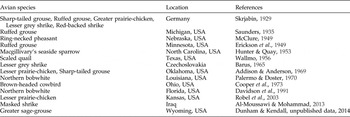
Oxyspirura petrowi is a parasitic nematode that is found primarily in quail; however, eyeworm infection has been found over the years in many other wild avian species (table 1). Oxyspirura petrowi has been found in the orbital cavity behind the eye, underneath the eyelids and nictitating membrane, within the nasal sinuses, and inside the lacrimal and Harderian glands of its host (Addison & Anderson, Reference Addison and Anderson1969; Robel et al., Reference Robel, Walker, Hagen, Ridley, Kemp and Applegate2003; Dunham et al., Reference Dunham, Soliz, Fedynich, Rollins and Kendall2014; Bruno et al., Reference Bruno, Fedynich, Smith-Herron and Rollins2015). While the life cycle is still not completely known, many suspect that the O. petrowi life cycle is similar to that of Oxyspirura mansoni, which is known to commonly infect poultry (Schwabe, Reference Schwabe1951). The life cycle of O. mansoni, described by Fielding (Reference Fielding1927), states that embryonated eyeworm eggs are passed via the naso-lacrimal ducts into the mouth and then swallowed before being passed in the faeces. This parasite has an indirect life cycle, requiring an intermediate arthropod host to then eat faeces containing embryonated eyeworm eggs, which starts the development of the eyeworm. Finally, the infected arthropod is eaten by the quail and the infective L3 eyeworm larvae then crawl up the oesophagus, through the mouth and into the orbital cavity (Fielding, Reference Fielding1927; Schwabe, Reference Schwabe1951). While several arthropods may be capable of being eyeworm intermediate hosts, a recent study discovered that the Plains Lubber grasshopper (Brachystola magna), collected from the Rolling Plains of Texas, is a possible intermediate host, with as many as 90 L3 infective-stage O. petrowi being found within one grasshopper (Kistler et al., Reference Kistler, Hock, Hernout, Brake, Williams, Downing, Dunham, Kumar, Turaga, Parlos and Kendall2016).
First reports worldwide of Oxyspirura petrowi in Passerines and Galliformes.

The diet of O. petrowi has yet to be thoroughly examined and is undetermined; however, these parasites have mouthparts that enable them to attach to host tissue and likely feed, thus causing pathological damage to the eye of the infected host. While yet to be determined, severe O. petrowi infection has been suggested to impair the host's vision (Dunham et al., Reference Dunham, Soliz, Fedynich, Rollins and Kendall2014). Visual acuity problems in quail can possibly impact a bird's ability to find/secure food, flying efficiency when escaping predators, and decreases their chances of finding a mate and/or rearing a brood, which may reduce individual fitness.
Eyeworms have been well documented throughout the Rolling Plains and are now considered endemic throughout the region (Dunham et al., Reference Dunham, Bruno, Almas, Rollins, Fedynich, Presley and Kendall2016). This is important because, given the right environmental conditions, such as frequent and/or heavy rainfall, the potential for an increase of infection is high due to the potential for more intermediate hosts (Dunham, Reference Dunham1978). With O. petrowi now considered endemic to the Rolling Plains ecoregion, there is concern about the spread of infection to Northern bobwhite, Scaled quail and Gambel's quail inhabiting other areas, such as New Mexico or Arizona, where infection has yet to be documented.
The primary objectives of this study were to understand the prevalence of eyeworm infection in different species of quail, to expand on the known distribution of infection, and/or to determine if there were any species–location combinations that have not been identified previously.
Materials and methods
Collection and examination of quail
Northern bobwhites, Scaled quail and Gambel's quail were hunter-donated to the Wildlife Toxicology Laboratory at The Institute of Environmental and Human Health (TIEHH), Texas Tech University from November 2013 to February 2014. All quail were hunted during established hunting seasons using an upland guide service, a bird dog and harvested with a shotgun. Gambel's quail are commonly found occupying a hot and dry desert-like habitat consisting of sparse desert annuals, whereas Scaled quail prefer more of an open semi-arid grassland (Engel-Wilson & Kuvlesky, Reference Engel-Wilson and Kuvlesky2002); however, Northern bobwhite prefer semi-arid rangeland vegetation with plenty of cover (Jackson, Reference Jackson1969). After being shot, the head and wing from each donated quail were removed, placed in a bag, labelled, frozen and provided to the Wildlife Toxicology Laboratory to be analysed for eyeworm infection. Because eyeworm infection is generally not seen without a complete necropsy, no hunter bias between infected and non-infected harvested quail existed. Gambel's quail were donated from Graham County, Arizona (33.0092°N, 109.8853°W); Scaled quail were donated from Eddy County, New Mexico (32.4700°N, 104.3000°W); and Scaled quail and Northern bobwhite quail were donated from Mitchell County, Texas (32.3000°N, 100.9200°W). Each juvenile and adult quail were aged according to the presence or absence of buffed tips on the primary wing coverts, whereas gender was determined based on the coloration of the feathers on the head (Lyons et al., Reference Lyons, Schroeder, Robb and Silvy2012). Some quail heads were not donated with the corresponding wing necessary to age the specimen, so they are referred to as N/A because their age is unknown. Voucher specimens of O. petrowi (Northern bobwhite: 107283; Scaled quail (TX): 107284; Scaled quail (NM): 108250; Gambel's quail: 108252), were deposited in the US National Parasite Collection, Beltsville, Maryland.
The examination process for all quail began by thoroughly thawing each sample, then lifting each eyelid with forceps and looking underneath for eyeworms. Next, the nictitating membrane was found and thoroughly examined, because eyeworms are commonly found in this location. After the surface examination, the eyelids, beak and excess tissue were removed, which allowed the eyeball and the associated ducts/tissues to be removed and placed into a saline-filled Petri dish. The lacrimal and Harderian glands with the remaining eye-associated tissues were removed from the eyeball, teased apart and examined with an ocular headset for eyeworms. Once the lacrimal duct and associated tissue from both eyes had been examined, the head of the quail was floated in a jar of saline, which causes eyeworms that are still attached within the orbital area to release and fall to the bottom of the jar. Any eyeworms that were found during the examination process were placed in a 70% ethanol solution and stored for future studies.
Data analysis
A Kruskal–Wallis test was conducted to determine the difference in mean eyeworm abundance among species, sex and age (R Development Core Team, 2015). Scaled quail from Texas and New Mexico were treated separately during analysis because they represent different locations of infection. The prevalence, mean abundance, mean intensity and range of eyeworm infection were determined for each species from each location harvested. Range of infection refers to the number of eyeworms found within a single infected host. Mean abundance refers to the average number of eyeworms per quail from the entire sample, while mean intensity refers to the average number of eyeworms per quail excluding quail that weren't infected within the sample. Prevalence refers to the number of quail infected with O. petrowi in the sample divided by total quail examined in the sample, and mean abundance is the number of O. petrowi found in the quail sampled divided by the total number of quail examined (Bush et al., Reference Bush, Lafferty, Lotz and Shostak1997). Abundance and intensity statistics are presented as a mean ± standard error (SE). A P ≤ 0.05 level was used to determine significance.
Results
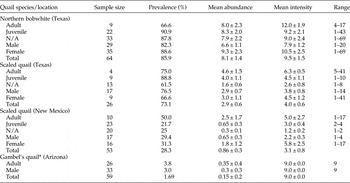
Sixty-four Northern bobwhites were examined, of which 55 (85.9%) were infected with 517 eyeworms and abundance averaged 8.1 ± 1.4 (range: 1–69). Of the 26 Scaled quail examined from Texas, 19 (73.1%) were infected with 76 eyeworms and abundance averaged 2.9 ± 0.6 (range: 1–41). Fifteen of the 53 (28.3%) Scaled quail from New Mexico (mean abundance: 0.86 ± 0.3; range: 1–17) and one of the 59 Gambel's quail (1.69%) (mean abundance: 0.15 ± 0.2; range: 9) from Arizona were also infected with eyeworms. There was a significant difference between host sex in mean abundance of infection (χ2 4 = 12.1, P < 0.017) and mean intensity (χ2 4, = 10.8, P < 0.028), but no significant difference in mean abundance of infection and age (χ2 4 = 7.54, P = 0.11). There was no significant difference detected in mean eyeworm abundance and age class and eyeworm abundance and sex among all of the species. Mean abundance, mean intensity, prevalence and range of eyeworm infection were calculated for all species (table 2).
The prevalence (%), mean abundance (±SE), mean intensity (±SE) and range of Oxyspirura petrowi infection from each age class and sex of Northern bobwhite (Colinus virginianus), Scaled quail (Callipepla squamata) and Gambel's quail (Callipepla gambelii) collected from Texas, New Mexico and Arizona, USA, from November 2013 to February 2014. N/A, Age unknown.

* Thirty-three juveniles and 26 females examined were not infected.
This is the first study to report O. petrowi in Gambel's quail, the first documentation of infection in Arizona and also the highest reported eyeworm infection in Scaled quail and Northern bobwhite.
Discussion
The results of the present study indicate that both Northern bobwhite and Scaled quail inhabiting the Rolling Plains of Texas are much more infected with eyeworms than the Scaled quail collected from Eddy County, New Mexico and Gambel's quail from Graham County, Arizona. While the habitat conditions are very different for all three quail species (desert to grassland to rangeland), we speculate that the desert and/or extremely dry conditions may represent a barrier for eyeworms, due to the likelihood that there is a difference in abundance and distribution of intermediate hosts caused by these conditions (Rouault et al., Reference Rouault, Candau, Lieutier, Nageleisen, Martin and Warzee2006).
Eyeworm infection was expected to be significantly higher in adult versus juvenile quail for all species, due to the increased opportunities that an adult quail has to consume an infected arthropod. We expect that one of the reasons why there wasn't a difference is because many donated quail were unidentifiable in terms of age. Our ability to detect age-related differences may have been hampered by sample size and limitations associated with the ageing technique, which allows the observer to distinguish between two age classes (young-of-the-year and adults). A total of 66 of the 202 donated birds (33%) could not be allocated to an age group, due to the head missing a corresponding wing upon donation. We suspect that a larger sample size would have documented differences between age classes of these quail, based on the literature reports of adult quail being more infected with eyeworms (Villarreal et al., Reference Villarreal, Fedynich, Brennan and Rollins2012; Dunham et al., Reference Dunham, Soliz, Fedynich, Rollins and Kendall2014). As expected, no significance was found in the interaction of mean eyeworm abundance and sex or age within each quail population studied.
The dietary differences of these three species of quail may also influence their exposure to an intermediate host. Gorsuch (Reference Gorsuch1934) estimated that the diet of a Gambel's quail consists of more than 90% plant material. This differs from that of the Northern bobwhite and Scaled quail, which have almost identical diets that require more protein (Rollins, Reference Rollins1981; Brennan, Reference Brennan2007). In areas where bobwhite and Scaled quail overlap, Rollins (Reference Rollins1981) observed that Scaled quail consume four times as much green vegetation than bobwhites on the same range, meaning that in these areas they presumably don't forage on as many arthropods. Due to the availability and distribution of these intermediate hosts, this will significantly influence both prevalence and the intensity of eyeworm infections, because of increased opportunities for both the intermediate host and definitive host to become infected.
Several species of helminths require a minimum temperature and have a maximum temperature to successfully complete their life cycle (Benavides et al., Reference Benavides, Huchard, Pettorelli, King, Brown, Archer, Appleton, Raymond and Cowlishaw2012). Insect development is often inhibited by the effects of heat and/or drought-like conditions, which likely disrupts population abundance in these particular areas (Tinsley, Reference Tinsley1999; Rouault et al., Reference Rouault, Candau, Lieutier, Nageleisen, Martin and Warzee2006). While this cannot be confirmed yet with Oxyspirura spp., these infection dynamics are interesting because in this study the quail occupying mostly arid, desert-like conditions were less infected with eyeworms. Despite sample sizes being small and data only being collected from a few locations, the data suggest that these areas have both intermediate hosts and quail that are susceptible to being infected with eyeworms.
The spread of eyeworm infection in quail has been documented to happen quickly with population explosions of intermediate hosts (Dunham et al., Reference Dunham, Soliz, Fedynich, Rollins and Kendall2014). Arthropods are an excellent source of protein for quail and, if they are plentiful in number, they are easily aquired for quail to consume. Quail often rely on these arthropods as a protein source during critical stages of development or during times of reproduction (Hernández & Guthery, Reference Hernández and Guthery2012). An increased diet of arthropods may increase their chance of infection. The infection dynamics of O. petrowi had not been thoroughly examined until recently, when Kistler et al. (Reference Kistler, Hock, Hernout, Brake, Williams, Downing, Dunham, Kumar, Turaga, Parlos and Kendall2016) documented up to 90 L3 infective-stage larvae in naturally infected intermediate hosts, and as many as 47 O. petrowi from one experimentally infected house cricket (Acheta domesticus). Luong et al. (Reference Luong, Hudson and Braithwaite2011) documented decreased mobility and performance in intermediate hosts infected with parasites, thus rendering them susceptible to being preyed upon because they are an ‘easy’ meal due to their inability to escape. If the same is true for O. petrowi, infected intermediate hosts may be advantageous for quail to consume and the likelihood of getting a moderate to heavy infection from consuming one infected intermediate host is a possibility, considering that Kistler et al. (Reference Kistler, Hock, Hernout, Brake, Williams, Downing, Dunham, Kumar, Turaga, Parlos and Kendall2016) documented a significant O. petrowi infection inside one grasshopper. In the present study, co-infection with other parasites was not looked at, due to hunters only donating the head and designated wing from each bird.
While there remain many unanswered questions concerning O. petrowi and its potential impact on quail, this study documents eyeworm infection in Gambel's quail, which was previously unknown. The study also expanded the known distribution of eyeworm infection, as well as documenting the highest infection within two species of quail. This research also suggests that O. petrowi infections may be limited due to unfavourable desert-like conditions. Much more research needs to be conducted to determine if eyeworms can cause population or sub-population level effects on quail. Additional research emphasis needs to focus on the life cycle and infection dynamics of eyeworms, as well as increasing the known infection distribution, so that appropriate management practices can be applied to infected areas.
Acknowledgements
We thank The Wildlife Toxicology Laboratory for their laboratory and field assistance. Special thanks to Steve Brugman of Brugman Outfitting Service and all of the hunters who donated quail. We also thank all of the reviewers of this manuscript for their time, comments and consideration.
Financial support
Funding support for this project was provided by the Rolling Plains Quail Research Foundation.
Conflict of interest
None.
Ethical standards
All quail were handled according to Texas Parks and Wildlife permits SRP 1098-984 and consistent with both Texas Tech University Animal Care and Use Committee 11049-07 and 13066-08.