Lucia di Lammermoor is arguably one of the most popular Italian bel canto operas in the repertoire today. This is due in large part to the virtuosic vocal writing for the tragic heroine in the celebrated ‘mad scene’ of act 3, where Lucia succumbs to the ravages of her mental illness brought on by hysteria. As many scholars have shown, regardless of its popularity today, the ‘mad scene’ of Lucia was not popular in the several years that followed the premiere in 1835. In fact, audiences, critics, and publishers of opera selections for the salon preferred the love duet of act 1 or the final scene of the opera when Edgardo kills himself upon hearing the news that Lucia is dead.
In the pages that follow, I will explore the reception of the ‘mad scene’ in Paris by discussing Lucia's madness in the context of the French medical community and how madness in women was diagnosed and treated in the first half of the nineteenth century. More often than not, female madness was seen as a result of hysteria, a disease that manifested with both physical and emotional symptoms. If untreated, the individual suffering from the disease would experience muscle contractions, shortness of breath, fever, hallucinations, vocal fits of anger, in short, madness. One of the most seminal studies on hysteria in the first half of the nineteenth century was written by the French physician and medical historian Frédéric Dubois d'Amiens (1799–1873), who published in 1833 Histoire philosophique de l'hypochondrie et de l'hystérie, a 500-plus page investigation into the cause and cure of hysterics and hypochondriacs. Through an investigation of the diagnosis of hysteria in Dubois d'Amiens's work and the sound and look of hysteria in Donizetti's opera, now made more acute through familiarity with the newly invented stethoscope and its ability to deliver the internal sounds of the body, we can see how close the opera comes to mirroring the look and sound of the disease as understood by the French medical community. Furthermore, in this investigation I hope to explain why the lack of enthusiasm and in some cases outright hostility to Lucia's ‘mad scene’ of act 3 is a result of the cultural reception in the mid-nineteenth century of hysteria but also, and equally important to the early reception of Lucia in France, the auscultation of disease, medical asylums and androcide.
The Operatic Work and its Early Reception in France
Lucia di Lammermoor is a three-act tragic drama composed by Gaetano Donizetti (1797–1848) and first performed in Naples at the Teatro San Carlo on 26 September 1835. The libretto, written by Salvadore Commarano (1801–1852), is based on Sir Walter Scott's novel The Bride of Lammermoor published in 1819. Owing much to the phenomenal vocal performance of Italian soprano Fanny Tachinardi-Persiani (1812–1867) as Lucia and French tenor Gilbert Duprez (1806–1896) as Edgardo, the opera was an instant success and quickly dominated the stages of Europe.
Following the success of Lucia di Lammermoor at its Italian premier, the opera came to Paris, first, in the original Italian, performed at the Théâtre-Italien on 12 December 1837, then two years later in a French version in four acts by Alphonse Royer and Gustave Vaëz for the Théâtre de la Renaissance in 1839. The work finally reached the heights of French theatrical glory with a premiere at the Paris Opéra in 1846 with an adaptation of the Royer/Vaëz version of the libretto. Owing to the opera's successful run at three well-known theatres in Paris, and the number of potpourri concerts, piano fantasies and instrumental arrangements that followed, one can conclude that the French embraced Lucia like no other Italian bel canto opera to date and desired to hear more of it, either in the original Italian or as a French-adapted dramatic work.Footnote 1
As mentioned above, the ‘mad scene’ in act 3 was often dismissed and heard as irrelevant to the overall dramatic arc of the opera.Footnote 2 Beyond the fact that Cammarano went further than the Scott original by having Lucia kill her husband (more on this later), the scene was viewed as trivial by many, forcing even Emma – the title character in Gustave Flaubert's Madame Bovary (Paris: Michel Levy Frères, 1857), an individual who was desperate to find in Lucia a sympathetic portrayal of her own desire to escape the demands of bourgeois domesticity – to find the ‘mad scene’ exaggerated and lacking interest.Footnote 3
Looking beyond the negative appraisal of the ‘mad scene’ in a popular French literary work of the time, we find similar responses by the critical press following the initial performances in Paris. As witnessed here in a review article of the Parisian premiere at Théâtre-Italien for the conservative newspaper La Presse, Gérard de Nerval makes no mention of the ‘mad aria’ of Lucia:
The success of Donizetti's opera continues to grow: this score will certainly remain in the repertory … In the third act, everything is savoured and applauded with reason … the andante of the final air of Giovanni Battista Rubini [the singer who premiered the role of Edgardo in Paris] and the majority of the funereal choir that follows are admired for their great scenic effect.Footnote 4
Writing for the working and middle-class consumer, de Nerval, an individual who succumbed to his own bouts of depression and mental illness, seemed to share the same opinion of the critics’ circle, which favoured Edgardo and his sacrifice and not the madness and subsequent death of Lucia. Even the most prestigious music journal in Paris, La revue et gazette musicale de Paris, in its own review of the 1837 premiere, made no mention of Lucia's madness as a key dramatic element in the work, simply stating that in act 3 ‘a cavatina by the dying Lucia’ is presented.Footnote 5
The apparent lack of interest in Lucia's ‘mad scene’ by Parisian audiences is surprising due to the sheer number of operas performed at the Théâtre-Italien contemporary with the premiere of Lucia that featured female madness, such as Bellini's Il Pirata of 1827, La Sonnambula of 1831 and I Puritani of 1835; and even Donizetti's own Anna Bolena of 1830. In all, it must have seemed to the French as if the entire Italian operatic world had gone mad. And, as Sarah Hibberd has shown, from 1827 on, Paris was already awash with madwomen on stage from the genres of ballet, comedy, tragedy and vaudeville.Footnote 6 Mad women were indeed everywhere on the stages of Paris, which makes the dismissal of Lucia's ‘mad scene’ by audiences even more astonishing. And yet, near the end of the nineteenth century, the ‘mad scene’ of Lucia grows in such popularity in France that the aria is even extended in an 1889 performance at the Paris Opéra and has become as we know of it today, a vehicle for operatic stardom.Footnote 7 The question remains then why was the ‘mad scene’ of Lucia/Lucie dismissed in the years following the premiere? To answer this question, let us first examine the sound and look of the title character of the work.
Medical Case Study: Lucy AshtonFootnote 8
In the opera, Lucia is bombarded with the realities of others, most especially her brother's fear for his own life and the destruction of the Ashton family fortune. Equally, Lucia is filled with an overwhelming sense of guilt after agreeing to marry Arturo, a man she does not love and thus receives the hatred of Edgardo, the man she had promised to marry.Footnote 9 Owing much to the family pressures thrown upon her and a growing sense of mental derangement, in the penultimate scene of the opera Lucia murders Arturo. Following the off-stage murder, the libretto indicates the appearance and look of Lucia as she enters the stage:
Lucia is dressed simply, in white: her dishevelled hair and the pallor of death on her face give her more the appearance of a ghost than of a living creature. Her stony gaze, her convulsive movements and her malevolent smile discloses not only a frightening insanity, but the signs that her life is approaching its end.Footnote 10
To highlight Lucia's confused mental state, Donizetti composes a multi-sectional aria interspersed with choruses that begins with Lucia's memory of Edgardo voice (‘il dulce suono’), which sparked the tragic events in Lucia's life that lead us to this very moment in the opera. The orchestral accompaniment to these words recalls the music from the ballad aria of act 1, ‘Regnava nel silenzio’, where Lucia tells her handmaiden the murderous tale of her Ashton relative, whose ghost now haunts the ancestral fountain. This same aria in act 1 was replaced at the Théâtre-Italien with ‘Perché non ho del vento’ from Donizetti's earlier opera Rosmonda d'Inghilterra.Footnote 11 The change was requested by the singer, Fanny Tachinardi-Persiani, who wanted a more traditional vocal showpiece for her Paris debut and one with which she was already familiar, as she premiered the role of Rosmonda in Florence at the Teatro della Pergola on 27 February 1834. The music for ‘Regnava nel silenzio’ is what appeared at the beginning of Lucia's act 3 aria nonetheless in the score published in Paris, which tied the fate of Lucia with her ghostly ancestor.Footnote 12
As is well known, Donizetti originally composed Lucia's ‘mad aria’ to be accompanied by the distinctive sound of the glass harmonica, an instrument understood to have connections to both the supernatural and madness owing to its disorienting high resonance.Footnote 13 Although the instrument was eventually replaced by a solo flute,Footnote 14 Lucia's accompaniment by an instrument isolated in pitch range and timbre from the rest of the orchestra helps to signal the listener to the lonely and delicate position that Lucia now occupies.
In the aria itself, Lucia presents a host of melodic runs, twists and turns to demonstrate her excited and breathless state. As Mary Ann Smart has shown, however, the conventional nature of the ‘mad aria’ with its predictable cadences and melodic repetitions ‘are rarely disruptive [and] almost never unsettle the unfolding of music and text’.Footnote 15 Yet, in the context of her dilapidated appearance, blood spattered in a white wedding dress with convulsive movements and a fixed gaze,Footnote 16 the conventional setting of this aria makes Lucia even more irrational and horrific. In fact, throughout the aria, Donizetti continually presents incongruities between what Lucia sings (the external or diegetic reality of her state of mind) and what we the audience and Lucia both hear (the internal or non-diegetic reality). Note that the reference here is from the chorus's point of view, who does not hear the actual music that Lucia hears in her mind as represented by the orchestra, only we in the audience hear it. It is as if Donizetti defines a disembodied reality to Lucia, the chorus on stage sees her body and hears her voice, but the audience hears her inner thoughts and the reasons for why she sings what she sings. Thus, the reactions of the chorus, frozen on stage, who cannot look away, help to frame Lucia as an abhorrent individual who appears as a ghost – ‘Par dalla tomba uscita’Footnote 17 – physically present but not all there.
Continuing with the medical case study, as dictated by the libretto, physically shaking, Lucia urges Edgardo (who only appears in her mind and not on stage) to let her rest by the ancestral fountain. Here we hear in the orchestra the exact melody and B-flat major harmony of ‘Verranno a te’, the love duet from act 1, when Edgardo and Lucia secretly exchanged wedding rings at the same fountain. Once again, by setting the love duet in the orchestra and not in her voice, so as to allow the audience to hear what Lucia hears internally, Donizetti opens us up to the mind of Lucia, which is separate from what is seen and spoken on stage: ‘Edgardo, I am yours again … I escaped from your enemies’.Footnote 18 Lucia's madness has an inner voice separate from the one sung on stage.
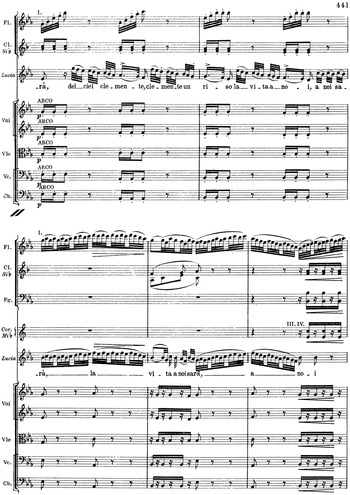
This moment of bliss is followed quickly with visions of the dead ancestor, thus recalling an omen of betrayal and revenge that awaits Lucia foretold by the appearance of the ghost in act 1. Imagining Edgardo is with her in a church, Lucia hears a wedding hymn (an altered version of the earlier wedding chorus from the end of act 2 played by the orchestra) and sees her own ceremony taking place, while at the same time she smells the heavy smell of incense wafting through the air even though none appears on stage (‘Ardon gl'incensi’). Curiously, as Lucia begins this section of the aria, Donizetti structures it as a theme and variation, whereby the wedding music from the end of act 2 (the theme) is heard in the context of Lucia's own vision of reality: marriage to Edgardo that continuously varies and becomes further distorted from the original marriage to Arturo. Following this misaligned vision, Lucia ends this section of the aria with a set of flourishes imitated by the flute (once again, originally written for the glass harmonica and only heard by the audience and Lucia). Like Narcissus and his image, Lucia falls in love with her own voice as it is echoed by the flute, thus the characteristic pairing of the voice with the flute showcases the myopic vision of a diseased mind (see Ex. 1).Footnote 19 Lucia and the audience are now paired as spectators to her own madness, which is sonically characterized by the echo played by the flute.
Gaetano Donizetti, Lucia di Lammermoor, act 3, scene 5, no. 14: Scena ed Aria; no. 31, bars 17–21 (Milan: G. Ricordi, 1910; rep. New York: Dover, 1992): 441.

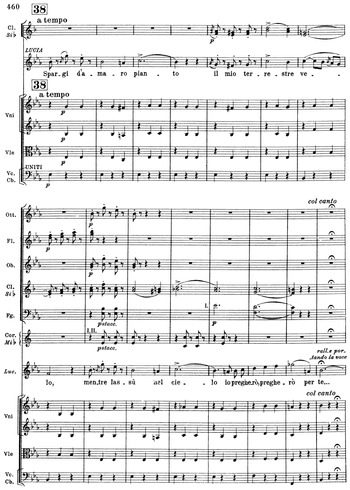
Lucia's brother Enrico, who now rushes onto the stage to condemn his sister for what she has done, is soon chided by the chorus who inform him of Lucia's obvious derangement. After confusing Enrico with Edgardo, then with the husband she was forced to marry, Lucia in vain searches for a glimpse of Edgardo. She then concludes her aria (‘Spargi d'amaro pianto’) with a number of exposed flourishes that climax once again in a final vocal display, proclaiming to all those who look upon her that she will wait for Edgardo in death. Donizetti sets this final section of Lucia's aria in E-flat major in a waltz-like tempo, a key often denoting noble heroism and courage, while at the same time Lucia sings of death and mourning.Footnote 20 This happy dance of death, this Totentanz, becomes a kind of scream or nonsensical utterance of a woman who has literally reached her end (see Ex. 2). What we hear in this final statement is a pure expression of her irrational self: the unequivocal sonic evidence of Lucia's madness. She has nothing more to say and so, following the choral response, Lucia falls limp into the arms of her handmaiden. Like Laertes to Ophelia in Shakespeare's Hamlet, Enrico, who has been observing in horror the apparent madness of his sister, asks those near Lucia to lead her away and to watch over her, to speak to her and to calm her. Lucia passes away the next day with moans and murmurs of Edgardo's name on her lips.
Gaetano Donizetti, Lucia di Lammermoor, act 3, scene 5, no. 14: Scena ed Aria; no. 38, bars 1–15 (Milan: G. Ricordi, 1910; rep. New York: Dover, 1992): 460.

Through the narrative flow of diegetic and non-diegetic sounds filled with reminiscences of past melodies that embody the actions and feelings of Lucia, Donizetti details in the ‘mad scene’ a diagnostic form of listening for the audience. It is the audience that hears the internal sounds within Lucia, as represented by the orchestra and the timbre and range of the solo flute, and which define her external actions and vocal display. As opposed to the individuals on stage (the chorus), who hear only her external voice and see her external movements, we know exactly what causes Lucia to say and react the way she does in this final scene. Curiously, it is when she is perceived as mad by the chorus that she is able to become a spectator to her own performance, as she hears and responds to her own voice as well as the orchestra. The fourth wall is now breached, and she becomes like an audience member hearing and seeing an opera, a ghost to the actual work itself.
The audience's awareness of external symptoms that are connected to internal realities is the privileged position of a physician to a patient. Like a physician, the audience observes and diagnoses Lucia's state of health by hearing her voice and perceiving within Lucia the cause of what we hear externally. This form of internal diagnosis is primarily defined by listening, which was understood in both the medical community and the public at large to reveal an objectified truth that went beyond the visual realm.
Sound, Mediate Auscultation and Diagnosis
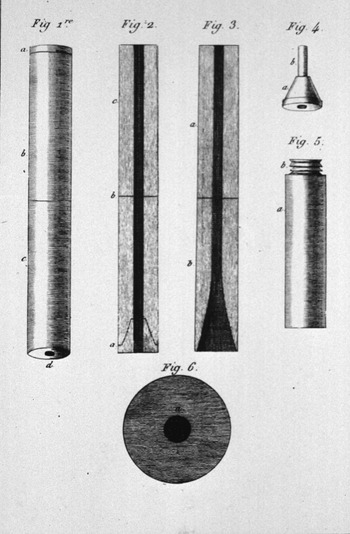
Invented in 1816 by French physician René Laennec (1781–1826)Footnote 21 the stethoscope (see Fig. 1) was and remains a medical instrument used to identify the inner sounds of the body.Footnote 22 Medical professionals today are invariably seen wearing a stethoscope, a testament to its effectiveness in helping the physician diagnose a patient's state of health. More than a new diagnostic tool to nineteenth-century medical practice, ‘the stethoscope marks an important point in the history of listening and connects it to the history of medicine's industrialization of professionalization: it marks the articulation of the faculty of hearing to reason’.Footnote 23 The stethoscope thus represents a new way of rationalizing one's world, whereby the invisible is made known through ‘audile examination’.Footnote 24
René Laennec, De l'Auscultation Médiate ou Traité du Diagnostic des Maladies des Poumons et du Coeur, vol. 1 (Paris: Brosson et Chaudé, 1819): 457.

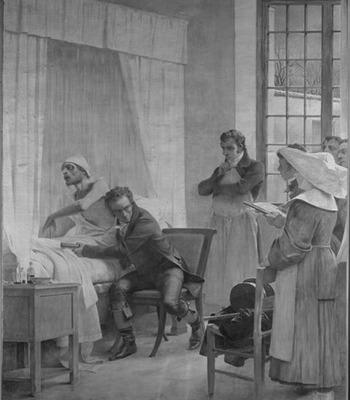
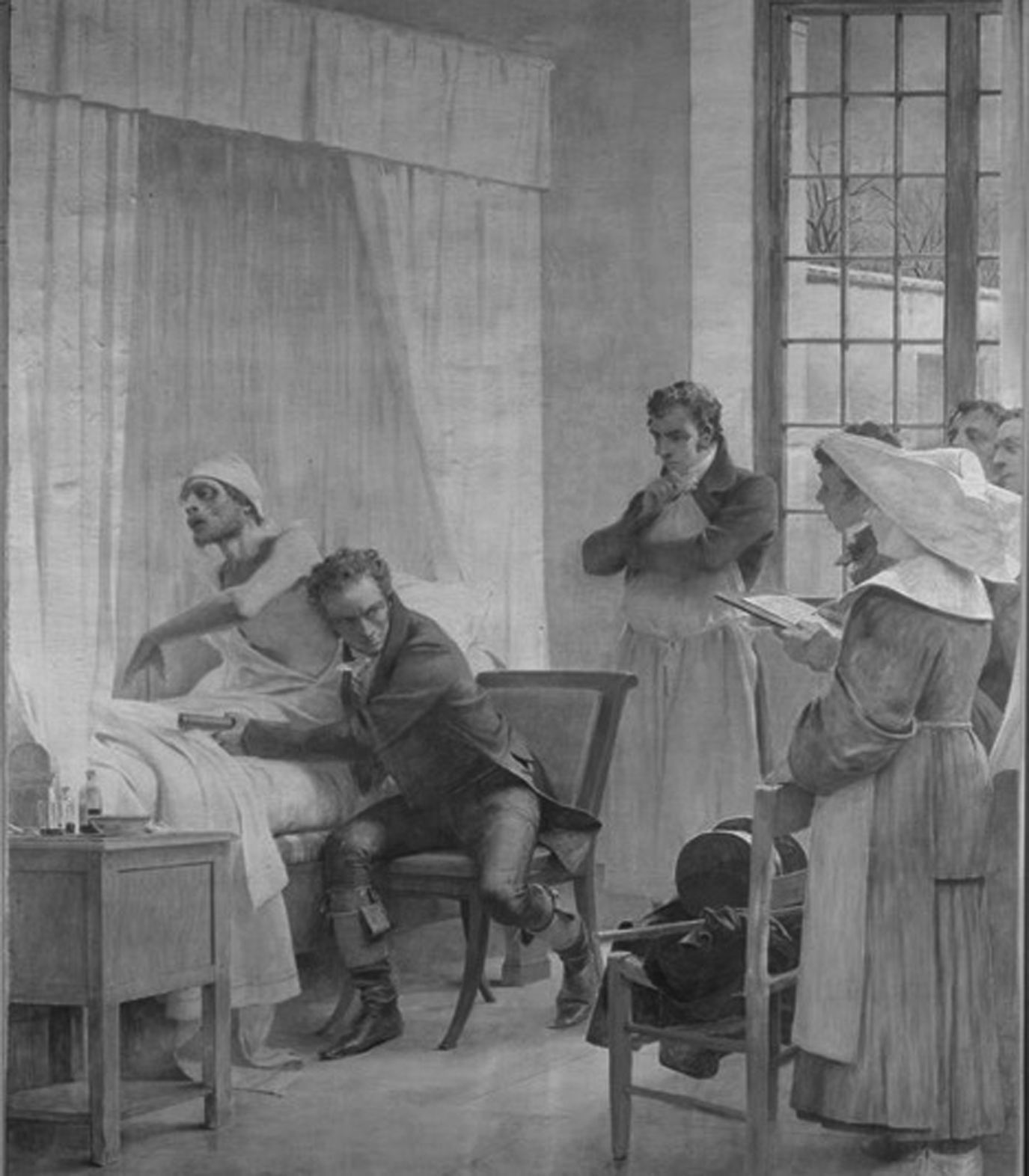
In an 1867 mural in the Sorbonne (Fig. 2), French painter Théobald Chartran (1849–1907) demonstrates Laennec auscultating a tubercular patient at the Hôpital Necker in Paris. Laennec began working at the hospital in 1816, the same year he invented the stethoscope. After attending and dissecting thousands of heart and chest patients at the hospital, noting the sounds of the diseased parts of the body as they revealed themselves to the ear, Laennec was able to document his findings in a lengthy 900-plus page treatise with several illustrated plates. First published in 1819, his two-volume treatise on mediate auscultation, De l'Auscultation Médiate ou Traité du Diagnostic des Maladies des Poumons et du Cœur (Paris, 1819), was a revolutionary tool in making sense of the sounds that emanate from the various cavities of the body. As can be expected, the book immediately gained interest by the medical community and the public at large. As Jacalyn Duffin writes, ‘the stethoscope was one of the first medical inventions to attain an international profile in an impressively short time’.Footnote 25 Favourable reviews began pouring in throughout France, including a 138-page review appearing in the January 1820 premier issue of the Revue médicale historique et phisolosophique, which determined that Laennec's treatise was ‘indispensable’ to the field of medicine.Footnote 26 In addition, when the treatise was translated by the English physician John Forbes in 1821, the stethoscope and Laennec's use of the instrument in medical diagnoses became widely known to the English-speaking public. Evidence of such interest can be found in opinion pieces and even poems that appeared in the popular press, such as the following opinion piece that appeared in the London Times (19 Dec. 1824), which highlighted the wonders of the stethoscope but also the fear that perhaps the instrument revealed secrets that are best hidden to the patient:
A wonderful instrument called the Stethoscope, invented a few months ago [sic], for the purpose of ascertaining the different stages of pulmonary affections, is now in complete vogue at Paris. It is merely a hollow wooden tube, about a foot in length (a common flute, with the holes stopped and the top open, would do, perhaps, just as well) … It is quite a fashion if a person complains of a cough … but should you unfortunately perceive in the countenance of the Doctor, that he fancies certain symptoms exist, it is very likely that a nervous person might become seriously indisposed and convert the supposition into reality.Footnote 27
Théobald Chartran, Laënnec à l'hôpital Necker ausculte un phtisique devant ses élèves (1816), 1879.
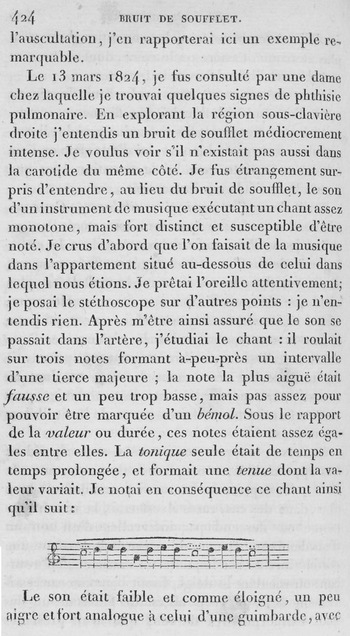
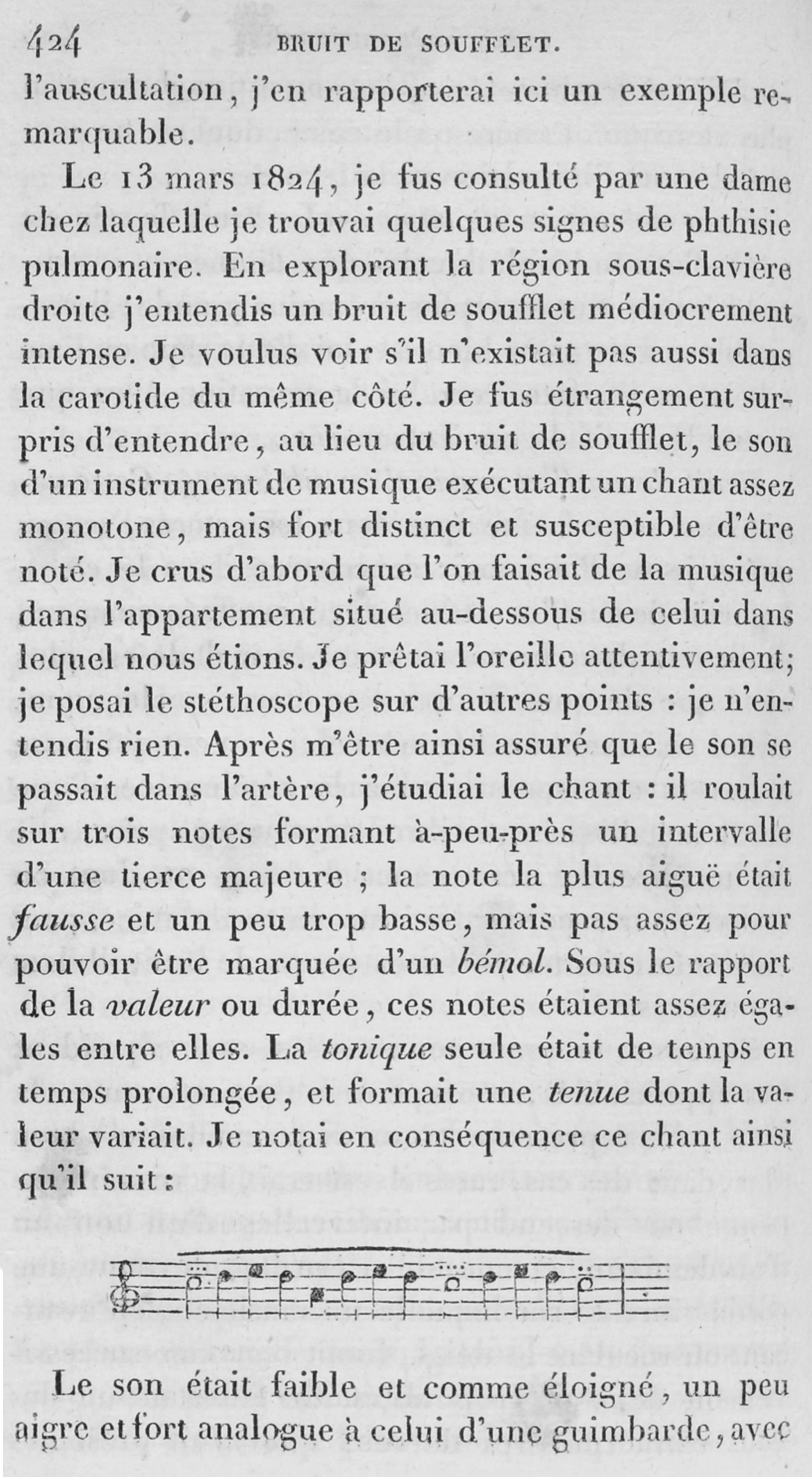
Perhaps to address some of these fears and to make clear the discovery and meanings of various sounds discussed in the treatise, in the second edition published in 1826, in a section entitled ‘Des anomalies des bruit du cœur et des artères’, Laennec used musical notation to define the sound of various diseases of the heart and major arteries (see Fig. 3). As Jonathan Sterne suggests in his study of the ‘audible past’, Laennec's use of notation ‘was one of the first attempts to develop a metalanguage of sound, a set of descriptions for the shape and texture of sounds that was independent of subjective experience (i.e., independently verified)’.Footnote 28 In the treatise, Laennec's music notation articulates ‘a moderately intense bellows sound’ (‘bruit du soufflet musical’) that is heard accompanying the diastole of the heart, so that at each diastole the ventricle, auricle, or artery in which the phenomenon takes place one distinctly hears a blow of bellows whose noise ceases during systole:
The sound occurs particularly when the patient is unusually agitated from any cause, becoming like the sighing of the wind through a keyhole, or the sound of a metallic cord that still vibrates long after being struck. The resonance of the tuning fork used to tune keyboard instrument can still be perfectly imitated by the sound of these [diseased] arteries … as if the artery had become a vibrating string on which a musician, advancing or recoiling a finger, would resonate successively two or three notes.Footnote 29
René Laennec, Traité de l'auscultation médiate et des maladies des poumons et du coeur, 2nd ed., vol. 2 (Paris: Brosson et Chaudé, 1826): 424.
What I find interesting about this account of the ‘bellows sound’ by Laennec is twofold. First, by describing the sounds emanating from the body as those produced by musical instruments, Laennec invites the reader to hear the sounds of the body as a kind of musical performance. His use of musical examples highlights this link and, thus, similarly, a musical performance can be interpreted to represent the health of a body. The corporeality of music is literally defined in these sounds. All we have to do is listen and analyse its structure to perceive the truth within.
A second point of interest in Laennec's discussion is when such sounds are heard in the patient. After describing in detail the examination of two female subjects, who both shared a ‘constitution très-nerveuse’,Footnote 30 Laennec concludes that the sound is heard when a diseased individual is in the last stages of life – what David Kasunic calls a sort of death knell, ‘a swan song’Footnote 31 – the result of a spasmodic contraction of the heart or arteries.Footnote 32 Laennec's treatise thus makes clear that when death is near, the body creates sounds that not only reveal a wavering between notes but also between life and death.Footnote 33 All this of course has curious implications for Lucia's own swan song in the ‘mad scene’ at the end of act 3.
Through the proliferation and acceptance of the stethoscope as a medical auditory device for diagnosis, audiences who heard Lucia's final aria were now more aware that there are a lexicon of sounds that reveal the inner health of the body.Footnote 34 And, with the increased interest to hear in a music performance the inner health of the composer or performer in the mid nineteenth century, for example hearing the pain of deafness in the symphonic music of BeethovenFootnote 35 or Berlioz's own invitation to his listeners to hear the ‘life of an artist’ in Symphonie fantastique, audiences were certainly ready to hear in the voice of Lucia a reality that defined her health. The conventions of Italian bel canto opera aside, having Lucia voice her mental anguish and display her physical symptoms gave audience members an opportunity to medically diagnose her, as reflected here in this review of the work in Le Temps:
The symptoms [italics added] of this cruel and dramatic epidemic are frighteningly simple: a white dress, a pale face, hair that falls and leaves a few strains on the shoulders at random … a great aria accompanied by clashing gestures and somewhat exaggerated effects … produces today only a mediocre effect, even on the youngest and least jaded imaginations.Footnote 36
Like the use of the stethoscope, in combination with bodily signs, Lucia's internal state is made logical and understood by an engaged form of listening for health and well-being. Of course, before the proliferation of the stethoscope in society, opera audiences would have certainly heard and understood the sounds of pain and anguish of an opera character on stage. But now, more so than ever, one can equate the voice of an operatic character on stage as reflective of the actual human sounds that define disease, sounds that are not just heard on the opera stage but exist throughout society, made logical, once again, by a new active form of listening.Footnote 37 And, as evidenced by the tone of the above review, perhaps this new form of listening renders the sound of illness too logical, making Lucia's ‘mad scene’ function less as an artistic presentation in an opera house and more as a diseased hysteric in an operating theatre, leaving little to the imagination.Footnote 38 I will return to this point later, in the conclusion.
This very act of critical listening to diagnose the diseased did not stop with Lucia in the reviews but it was also used to perceive the failing health of the composer. As many authors have pointed out, when Lucia premiered at the Paris Opéra on 20 February 1846 as Lucie de Lammermoor, Donizetti was suffering from symptoms later diagnosed as neurosyphilis, which included ‘fierce headaches, neck pain, convulsions, high debilitating fevers, nervous complaints, mental disorientation, and personality changes’.Footnote 39 His afflictions were so acute that Donizetti's nephew Andrea checked him into the Maison-Esquirol in the Ivry-sur-Seine region outside of Paris, a sanatorium for the mentally ill founded by the famous French psychiatrist Jean-Étienne Dominique Esquirol (1772–1840). There Donizetti would remain for nearly 17 months (January 1846–June 1847), before being allowed by his doctors to return to Bergamo, Italy, his birthplace, where he died on 8 April 1848.Footnote 40 As Rebecca Harris-Warrick points out, news of Donizetti's deteriorating health became known to the Parisian critics’ circle by the time of the premiere at the Paris Opéra, colouring some of the responses to such a degree that when they heard the sound of disease in Lucie they also heard the suffering of the composer, who was described by one member of the press as ‘a harmonious lyre that had been broken before its time’.Footnote 41
Hysteria in Lucia
As stated above, madness in women was seen as a symptom of hysteria, understood at the time to be a particular female ailment with a long history of documentation in society.Footnote 42 The sound of hysteria as projected by the voice of Lucia and the orchestra is what I believe individuals heard in the act 3 aria, which caused early reviewers and publishers of music for the salon to dismiss the climactic moment in the life of a title character. As compared to other scenes of madness on the stages of Paris, was Lucia's ‘mad scene’ not artful enough? Was it too close to what individuals knew to be true about the disease? In order to explore these final questions, I look now at how Lucia's sound, look and actions match that of an hysteric, and thus present a possible reason why her ‘mad scene’ failed to impress those who heard the opera in the early decades following the premiere in France. I start with an examination of the scientific literature of the time, namely the 1833 publication on hysteria by the French physician Frédéric Dubois d'Amiens (1799–1873), Histoire philosophique de l'hypochondrie et l'hystérie (Paris, 1833).Footnote 43
As indicated by Dubois d'Amiens's title, hysteria and hypochondria were often linked in the early nineteenth century, but separated nonetheless by the sexes: hysteria occurred only in women, while hypochondria, a disease related to monomania, an obsessed focus in the mind, was an ailment mostly found in men but not exclusively.Footnote 44 Interestingly enough, marriage was seen as the ultimate cure for both men and women suffering from hypochondria or hysteria.Footnote 45 The ‘marriage bed’ was not only the common prescribed medical cure for hysterics and hypochondriacs but also the dramatic impetus of Donizetti's opera. In Lucia di Lammermoor, marriage is the lynchpin to both the dramatic action of the opera and Lucia's health. It is in marriage that Lucia is defined. As a bride, she is valuable to her brother, her lover, and to herself. With the murder of her husband Arturo, Lucia ceases to have value, becoming no longer a part of the world of the sane and well-balanced, but an uncured hysteric.
At the time of Dubois d'Amiens's publication, there was much discussion on the origins, cure and who were the actual sufferers of hysteria. What underlined the debate was whether the disease was a purely female malady grounded in reproductive anatomy and physiology, or, as evidenced by an 1821 report by the alienist or early psychiatrist Étienne-Jean Georget (1795–1828),Footnote 46 the origins of hysteria were purely cerebral. In his award-winning publication, Dubois d'Amiens studied the previous arguments of his predecessors, compiled them with his own observations and interjected the whole with a rigorously applied method of analysis. In the end, his 551-page work on hysteria sided with the female-centric debate, but only in part. Although he saw the disease manifested primarily in the uterus, he believed the nerves of the uterus spread throughout the body to cause all nervous and mental maladies in women:
The uterine apparatus is struck with neuroses, that is to say, it is sieged by abnormal sensations, and with a blocking of nerves [‘l'innervation viciée’], it will further propagate disorders that constitute hysteria, as we shall later explain; but this is only the initial point of departure. The more the nervous system dominates, the more frequent and varied are the neuroses.Footnote 47
Furthermore, according to Dubois d'Amiens and others who shared the same psycho-somatic view that with the examination of an hysteric, one would find lesions – ‘tumors, inflammation, deformations and swellings’Footnote 48 – in the uterus upon autopsy, which affected the mind, thus supporting the notion that organic lesions were the cause of the disease.Footnote 49
Dubois d'Amiens's discussion of hysteria begins by stating that hysteria results from ‘chlorosis’, or anemia, an iron deficiency in the blood.Footnote 50 It was believed that anemia was brought on in women due to the loss of blood during menstruation. According to Dubois d'Amiens, hysteria is thus understood as a disease primarily affecting menstruating women, whereby sudden emotional swings, such as joy, grief, fright or surprise further induce the symptoms of the disease. Returning briefly to our case study of Lucia it is striking to note that she is bathed in blood at the end of the opera, which can be seen as a possible sign of the anemic condition necessary for the onset of the disease.Footnote 51 Although it is not Lucia's blood, but the blood of her victim, the blood is an outward sign of the onset of hysteria in Lucia. For indeed, throughout the opera, Lucia is continually referred to as being quite pale and frail. Once again, a possible sign to many in the nineteenth century that Lucia, a young woman, ready to bear a child, was menstruating and thus more susceptible to hysteria, which is made more striking by her blood-filled appearance in act 3.Footnote 52
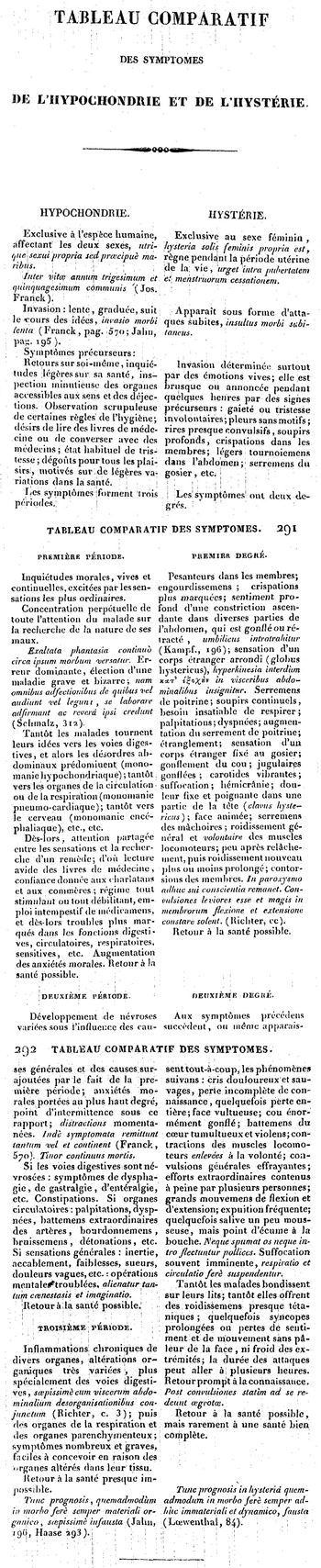
To help the reader better understand the outward signs of the disease, Dubois d'Amiens included in his study a comparative chart that highlights the symptoms of both the hypochondriac and the hysteric (see Fig. 4). One reads in this list the physical and emotional signs of the two diseases, the symptoms of the hysteric being divided into two stages: a mild or first degree stage, which can be reversed, and the severe or second degree stage, from which, if prolonged, the patient is rarely restored to health.Footnote 53 In examining Lucia through Dubois d'Amiens's chart and throughout his text, we see in the first act of the opera that Lucia is already showing outward signs of the second degree stage with pronounced trembling, brought on by her fear of her brother finding out she is in love with a member from a rival clan and the supernatural vision she perceived at the ancestral fountain. The hallucinations of a ghost she describes to her handmaiden in the first act are clear symptoms of an evident mental instability. Crucially, it is to be remembered, as requested by Tacchinardi-Persiani, the female lead performing Lucia in Paris, ‘Regnava nel silenzio’, a ballad-like cavatina filled with gothic imagery, was taken out of the Paris productions of the opera and replaced by the cavatina ‘Perché non ho del vento’ from Donizetti's earlier opera Rosmonda d'Inghilterra (1834). Dramatically speaking, ‘Perché non ho del vento’ reveals Lucia as impatient for her lover to appear and not as the authors’ originally designed, to reveal a woman filled with an irrational, tyrannical fear of a ghost that only she saw but etched nonetheless in her memory:
At dead of night, in the silent darkness, a pallid ray of eerie moonlight fell upon the fountain, when a low moan was heard on the breeze, and there on the verge, the spectre appeared to me.Footnote 54
Frédéric Dubois D'Amiens, Histoire philosophique de l'hypochondrie et de l'hystérie (Paris: DeVille Cavellin, 1833): 290–92.

The replacement of ‘Regnava nel silenzo’ in the Paris productions takes away a crucial symptom of the disease, whereby nervous agitation gives way to hallucinations of a ghost who is never seen in the opera.Footnote 55 And the visions remain only with Lucia. In the Paris productions then, definitive signs of mental instability are not truly perceived until Lucia enters the stage at the beginning of act 2. As Lucia is summoned by her brother Enrico, the stage directions in the libretto draw attention to her condition, which presents a listing similar to that found in Dubois d'Amiens's stage two of the disease, where ‘the pallor of her face, her bewildered gaze, everything about her points to the afflictions she suffers, and to the first symptoms of a mental derangement’.Footnote 56 The fact that the libretto lays claim to her physical condition, once again, symptoms to be diagnosed by the audience, it highlights the increasing reality of Lucia as a diseased individual who is steadily getting worse.
Furthermore, during the ensuing dialogue with her brother, Lucia suffers a succession of shocks and is seized by uncontrollable shaking: ‘Lucia reads … great anxiety is etched on her countenance, and tremors shake her from head to toe.’Footnote 57 But it is during the finale of the act 2, just after having been forced to sign the nuptial contract that she complains of faintness (‘Io gelo ed ardo. Io manco’),Footnote 58 which occur right before she is confronted by Edgardo, whose accusations of infidelity cause Lucia ‘l'ambascia è giunta all'estremo’ (‘anguish at its extreme’).Footnote 59 Parsed according to Dubois d'Amiens's system, taken collectively, Lucia is suffering from symptoms of hysteria.
Decisively, in the last act, in the ‘mad scene’, Lucia, after murdering her husband, lurches from one hallucination to another: first she believes she sees Edgardo, then the ghost, who separates her from Edgardo; she senses the presence of enemies who want to destroy her happiness with Edgardo. Then, believing herself safe with her lover, she begins to tremble with joy as she hallucinates that she is with him in paradise. This idyll is then shattered by her brother's sudden arrival on stage, triggering a new set of hallucinations in which Lucia sees Edgardo stomping on the wedding ring and cursing her.
The hallucinations that Lucia experiences are what Dubois d'Amiens refers to as hallucinations singulières,Footnote 60 an affliction often diagnosed in both hypochondriacs and hysterics. As previously pointed out, Donizetti returns to the music of Edgardo throughout Lucia's aria (for example, the love duet of act 1). Like Laennec's bruit du soufflet musical, which resolves to a central note, the sound of Edgardo becomes for Lucia an obsession, ‘il dulce suono’, so that musically we hear in the writing of the voice, in Lucia's own swan song, a singular focus: ‘the sweet sound’ of Edgardo's voice. In addition, note that the vocal utterances of Lucia (see Ex. 2) are not highlighted for their own sake but always in response to ideas expressed in the text, thus the sounds of disease in Lucia are rationalized so as to highlight her affliction of monomania. This is an extremely crucial point for I believe it is this very lack of musical excess that made the aria less desirable by Parisian audiences and critics alike, yet, at the same time, helps to frame the nosological symptoms of hysteria.
When Lucia's ‘mad scene’ ends, she is finally taken off to her bedroom, where she quickly succumbs off stage to the final stages of the disease by falling into a state of muteness, where only moans and inarticulate mumblings of Edgardo's name can be heard. Presumably, lock jaw (‘serrements des mâchoires’) has set in and the muscles have contracted, leading one to believe that her heart will soon stop.
Hysteria in French Society
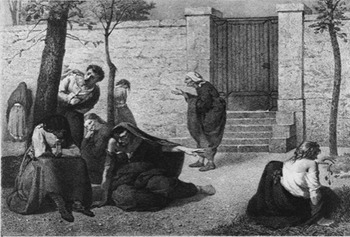
Hysteria was not a distant disease in some distant locale, but was readily seen and heard in all major cities throughout France. Women suffering from hysteria could be found in nearby asylums and became daily engagements for paid observers.Footnote 61 In Figure 5, a lithograph by Armand Gautier, we see the depiction of women in all known forms of mental illness, including mania, monomania, dementia and idiocy, all of which are pathologies of hysteria. In fact, the practice of visiting on Sundays the local asylum by the bourgeois as a spectator was a common practice dating from the late eighteenth century.Footnote 62 For Parisian residents, the hospitals at La Maison Royale de Charenton (southeast of the city in the Paris suburb of Saint-Maurice in the Val-de-Marne region) and the much larger Salpêtrière (on the left bank of the Seine in the treizième arrondissement) became popular destinations for ‘moral instruction’, as if to say, this is the reason why civil society exists: to nurture the ‘sick’ in order to return them to society.Footnote 63
Armand Gautier, Les folles de l'Salpêtrière, 1855.

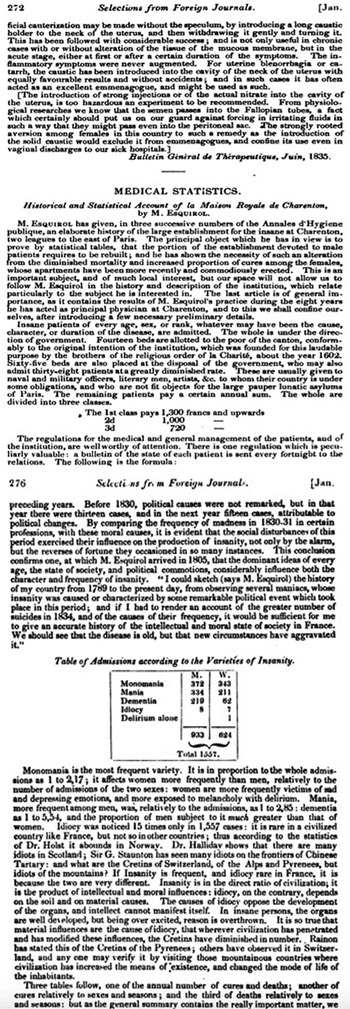
These houses would receive the rich as a way of gaining support for their services and thus helped the paying public to better understand the conditions of the poor. This was pure zoological entertainment or, at best, observed education for those who desired a deeper understanding of what defines health and well-being within society. Indeed, for many in the public, in spite of what the medical community argued was the cause of mental illness, madness was still commonly seen as brought on by the environment, a symptomatic response to poor living, or, as alluded to in Lucia's case, for those who avoided marriage.Footnote 64 However, with the change in medical science in the nineteenth century, the public now engaged the sufferers of mental illness in a much more up-close and somewhat sympathetic manner. The visitors to the asylums included family and friends of the patient, clergy, tourists, actors, philanthropists, subscription holders and government inspectors, who would often report on the gender, age and general reason for patients to be admitted to the asylums.Footnote 65 As seen here in this 1834 report from the Charenton, the inhabitants of the asylum and their cause of insanity is listed, note that monomania, which we observed in Lucia's ‘mad scene’, is the most prolific form of mental illness found among women (see Fig. 6).
British and Foreign Medical Review, or, A Quarterly Journal of Practical Medicine, 1/2 (April, 1836), 272, 276.

In the end, such reports on the lives of the mentally ill helped to humanize the asylum inhabitants and the very place where they lived. In fact, it was Esquirol, the director of the Charenton, who petitioned the government to rewrite the laws that defined the treatment and care of the mentally ill, the so-called ‘Lunacy Act’ of 1838.Footnote 66 The new law was designed for the protection of people with mental illness from abuse and mistreatment. It mandated every district in France to set up an asylum to accommodate the mentally ill; to provide a framework for the assistance, care and protection of people with mental illness; and to eliminate the possibility of arbitrary detention. This law remained unchanged in France well into the twentieth century, eventually modified in 1990 to reflect current treatment of the mentally ill as well as improved rights for the admitted patient.Footnote 67
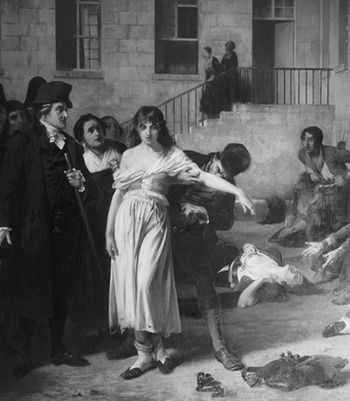
Esquirol was a student of Philippe Pinel (1745–1826), the famous French physician who freed the 'insane' from the Salpêtrière in 1795, mythically defined in Tony Robert-Fleury's oil painting of 1876 (see Fig. 7). In the center of the painting is a limp and passive woman being freed from her chains as the commanding figure of Dr. Pinel looks on with authority. This was part of a widespread asylum reform movement that began during the late eighteenth century and continued well into the nineteenth.
Tony Robert-Fleury, Pinel, médecine en chef de la Salpêtrière, délivrant les aliénés de leurs chaînes, 1876.

Dubois d'Amiens, a researcher in the history of medicine, knew of the work of Esquirol, who was frequently cited in Dubois d'Amiens's publication on hysterics and hypochondriacs. In particular, in the section ‘Thérapeutique’, Dubois d'Amiens cites Esquirol when indicating patient therapy, arguing that the patient should be first brought into a dialogue with the physician, and with the power of suggestion, the physician would get the hysteric or the hypochondriac to recognize their own malady and begin the process of healing.Footnote 68 Note that in Lucia, instead of tackling her, putting her in chains or arresting her for the murder of her husband, individuals simply observe her, albeit in horror, allowing Lucia to wander the stage as they gently console her, a form of moral treatment similar to that prescribed by the medical community in France.
Conclusion
The phenomenon of hysteria was a spectacle observed by a paying public, where individuals were often transfixed by female madness, both on and off the stage. Unlike other displays of female madness in opera throughout the first half of the nineteenth century, Lucia does not just ‘snap’ and become mad – we see and hear her progress to madness from the very start of the opera. Her digression into full hysteria and eventual death were perceived as a possibility from the very beginning, and thus whenever she is on stage the symptoms of hysteria continue to mount. Indeed, throughout the opera, the brother, the priest, her lover and all the members of the Ashton household are worried about her health. The diagnosis of hysteria is continually being performed on Lucia by everyone around her, and thus her climactic appearance on stage is no surprise; we all saw it coming. Dishevelled, splattered with her victim's blood, convulsing, with fixed hallucinations, Lucia no longer became a diversion from everyday life nor a simple bel canto tragic figure, but a reflection of the very souls who filled nearby asylums and the pages of medical treatises, reminding one of the potential harm such diseased individuals can inflict upon themselves and others – in this case her husband.
In France, a woman who murdered her husband was considered a traitor to the state. As the husband was viewed as the king of the household and the household was viewed as a reflection of the state, such murderous acts were a threat to social order and in need of immediate suppression.Footnote 69 It is interesting to note that of all the madwomen who appeared on the stages of Paris in the first half of the nineteenth century, Lucia is the only one who kills. By departing from the Walter Scott original, where Lucy Ashton simply wounds her husband, the off-stage androcide in Lucia has obvious implications on the reception of Lucia's madness in France as compared to say Anna Bolena (Anna Bolena), Amina (La Sonnambula), Elvira (I puritani), Imogene (Il pirata), or even Ophelia (Hamlet). It would not be until the second half of the nineteenth century, when the ‘mad scene’ of Lucia was lengthened to accommodate an extreme vocal performance, that the diagnosis and reception of Lucia's madness would change, eclipsing even the reception of Edgardo's sacrifice or the love duet heard earlier in the opera:Footnote 70
Mme. Melba's performance [on 9 Dec. 1889] was a great success. This is to be expected, for such a delightful voice has never been heard with such virtuosity. After the mad aria, which is a page of immeasurable boredom, ovations were heard from all sides of the room. It is here that it has a dizzying cadenza [‘un point d'orgue vertigineux’], where it follows the flute of [Paul] Taffanel [1844–1908] in all its acrobats with incomparable mastery. We can even say that it is because of this moment in the work that the directors of the Opéra have thought it necessary to snatch Donizetti's opera from the repertoire of the Château d'Eau [Paris theatre in the treizième arrondissement].Footnote 71
As Romana Margherita Pugliese has shown, Nelly Melba (1861–1932), an Australian singer with a light soprano voice (soprano leggero), came to Paris with an extended cadenza for Lucia's ‘mad aria’ in order to impress audiences with her virtuosity.Footnote 72 It is interesting to note in the above review, like many critics before him, Heugel (under the pseudonym or H. Moreno)Footnote 73 found Lucia's ‘mad aria’ filled with ‘immeasurable boredom’ (‘un ennui incommensurable’). Henri Heugel (1841–1916) was one of the main music publishers in Paris and owner of the music journal Le Ménestrel, where the review appeared, so certainly he knew of the aria's inability to attract attention and hence his surprise at its sudden acclaim by the audience of the Opéra. Ironically, however, by lengthening the mad scene with more vocal virtuosity, hence more artistic display, the madness reflected in this scene no longer is rationalized by the text and staging of the opera. The voice in fact transcends the symptomatic reality of hysteria that compromised her earlier in the century, thus making the ‘mad scene’ at the end of the nineteenth century more in align with the artist's virtuosic ability within a theatrical performance than the sound of disease.Footnote 74