Media outlets and scholarly works are inundated with discussions of the influence and repercussions of nationalism and nationalistic policies around the world. With events such as former Prime Minister Abe Shinzo's pledge to revise Japan's Constitution to formalize the role of the Self-Defense Force, Japan's trade wars with South Korea, and the increase of books and articles in recent years focusing on the influence of the nationalist lobbying group Nippon Kaigi, also known as the Japan Conference, concerns regarding an increasingly nationalist Japan are on the rise. Influenced by the memory of a government-created, nationalist version of State Shinto,Footnote 1 the religion of Shinto is perceived to at least have nationalistic inclinations, if not being fully nationalistic (Azegami Reference Azegami2012). This perception is often supported by occurrences such as political visits to Yasukuni Shrine, which causes both national and international controversy due to the fact that Yasukuni enshrines Japan's war dead, including Class-A war criminals (Breen Reference Breen2008; Pye Reference Pye2003; Ryu Reference Ryu2007). Thus, official political visits are associated with an endorsement for State Shinto and Japan's aggressive, militaristic past. Additionally, politicians holding memberships in both Nippon Kaigi and Jinja Honcho, the Association of Shinto Shrines, further cement the association between far-right, nationalist ideologies and Shinto. For example, as of 2018, 18 out of the 19 ministers in Abe's Fifth Cabinet were members of Nippon Kaigi or Jinja Honcho's political organization, Shinto Seiji Renmei.Footnote 2
With the Liberal Democratic Party's (LDP) tendencies toward nationalist policies, including the Abe Cabinet's extremely high rate of membership in nationalist groups with Shintoist affiliations, it is logical to assume that members of the LDP would commonly be associated with Shintoist groups, such as Jinja Honcho and their affiliated political group, Shinto Seiji Renmei (Shinseiren). Furthermore, Shinseiren commonly endorses the LDP but not other parties, as Shinseiren's positions on nationalist policies such as restricting non-Japanese from being able to vote are most closely aligned with the LDP (Klein and Reed Reference Klein, Reed, Ehrhardt, Klein, McLaughlin and Reed2014). However, the number of Shinseiren members among the LDP Lower House experienced an increase from 51% in 2013 to about 75% in 2014. Since the number of people in Japan who are affiliated with any religion has only been shrinking over time, this increase in Shinseiren membership cannot be explained by a turn toward religion. Further, as members of the LDP were largely not associated with Shinseiren in 2012, the escalation of memberships would also not be prompted by general ideological similarities, either.Footnote 3 So, if not for religious or ideological reasons, why was there a sudden surge in Shinseiren membership by politicians within the LDP after the 2012 general election?
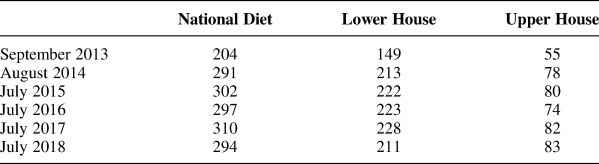
While nationalism in Japan is commonly associated with Shinto due to their shared history, this article finds that identifying with or belonging to a religious organization can be done for politically strategic reasons, in this case, to guarantee more votes in order to ensure reelection. Religion and religious organizations certainly influence politics in Japan, but the motivations for religious memberships are not necessarily driven by ideological reasons. Instead, I argue that membership into the religious organization, Shinseiren, is motivated by strategic reasons, as the LDP legislators now had electoral incentives to join Shinseiren after the 2012 general election. In Table 1, the number of Shinseiren members in the Japanese National Diet are outlined by year, with a few LDP-leaning independents, but almost all being LDP politicians. Between 2013 and 2014, the number of Shinseiren members in the Diet increased by 87 members. While individual changes in ideology cannot be ruled out, it does not seem likely that the noteworthy increase in Shinseiren memberships between these two years would only be due to ideological reasons. Considering the Japanese general election had just occurred in 2012, the timing of the increase in memberships could be due to political motivations.
Number of Shinto Seiji Renmei members in the Japanese National Diet by year

Before the 2012 general election, Japan's party politics largely functioned as a two-party competition, with the LDP and its main opponent, the Democratic Party of Japan (DPJ) competing for the centrist voters. However, with the DPJ's drastic decline in popularity after its stint as the ruling party following the 2009 election, the LDP no longer has a viable competitor, changing the LDP candidates' incentive strategies. The LDP experienced a strong return to power in the 2012 general election, with many legislators being rookie Diet members. With virtually no external competition, the electoral incentive changes for the individual freshman LDP legislators to focusing on core LDP voters instead of centrist voters. Thus, if individual members of the LDP won by a smaller vote margin during the 2012 general election, joining Shinseiren could serve as a signal to core supporters, appealing to a specific bloc of voters and increasing their chances of reelection.
To explain how members of the LDP use Shinto and its connection to nationalism strategically, this article first discusses how connections between Shinto and Japanese nationalism have been made in the past, and how this legacy, despite its questionable historical accuracy, lives on. Next, the article discusses how rookie LDP legislators were incentivized to join a religious organization in order to ensure their political survival when their vote margins were narrow in the 2012 Japanese general election. The research design describes the original dataset created to test the hypothesis that membership in a religious organization is affected by vote margins. The analysis finds support for the argument that the vote margin affects the likelihood of joining Shinseiren. Finally, the article concludes by explaining how the results found more generally suggest that memberships in religious organizations are not necessarily motivated by ideological reasons, and instead can be used in a way that helps achieve political goals. And specifically in the case of Japan, these findings might indicate changes in future LDP political strategy, such as putting the longstanding coalition with Komeito into question.
NATIONALISM and RELIGION in CONTEMPORARY JAPAN
While religion is not a necessary component of nationalistic ideologies, religion is a natural pair with nationalism, as it most likely already has a set of guidelines that creates boundaries between the in-group and the other. Thus, further rooting oneself into religious traditions can create a sense of comfort and belonging when feeling socially, politically, or economically ostracized (Kinnvall Reference Kinnvall2004). Furthermore, these boundaries can be justified through the nation's (imagined) religious past (Anderson [1983] Reference Anderson2006; Gellner Reference Gellner1983; Juergensmeyer Reference Juergensmeyer2019). Although these religious “traditions” are actually more modern creations, this does not mean that their influence on nationalist ideologies is any less impactful.
The connection between religion and nationalism in Japan is not as straightforward as it is in some other cases around the world. Indeed, the idea of whether Shinto should even be considered a religion is still debated.Footnote 4 Furthermore, there is a disagreement in the literature regarding Shinto's historical connection to nationalism. In his book, Faking Liberties: Religious Freedom in American-Occupied Japan, Thomas details how the common narrative that the United States brought religious freedom to Japan contains great inaccuracies, and as a result, our understanding of a nationalistic Shinto is flawed (2019). Thomas states, “Japanese governance in the first half of the twentieth century was repressive because it was secularist, not because it was dominated by Shintō as a state religion” (2019, 3). Authors such as Guthmann, on the other hand, argue that the Japanese government tried to characterize Shinto as non-religious in order to appear secular (2017). This article, however, does not contribute to or make a claim for either side of this discussion. Instead, it is the collective memory surrounding this debate that matters to my argument (Assmann and Czaplicka Reference Assmann and Czaplicka1995). Regardless of the veracity of the claim, scholars and historians have long perpetuated the idea that State Shinto is shrouded in a history of religious fundamentalism and restrictions to religious freedoms. Whether or not this is true does not lessen the impact of the long-term effects this narrative has created between Shinto and nationalism.
In order to understand religious nationalism in Japan today, it is necessary to examine the ties between various groups and political organizations associated with nationalist ideologies. Guthmann refers to these groups of organizations as “nationalist circles” (2017). These nationalist circles do not limit their issues to religious ones, and they are not even necessarily religious groups. For instance, Nippon Kaigi is a lobby group with nationalist goals. Even Shinseiren is more accurately a political organization that is a wing of Jinja Honcho. And while Jinja Honcho is the Association of Shinto Shrines, it is largely a bureaucratic organization. Indeed, as with special interest groups that appeal on their own behalf to political officials, religious organizations are no different. Nippon Kaigi, Shinseiren, and Jinja Honcho at large take an active role in lobbying on behalf of their political interests.
To elucidate on how these nationalist groups fall under the category of religious nationalism, Guthmann explains,
Thus, the majority of the political battles waged by nationalist circles in Japan do not have religious dimensions. Yet the fact remains that within these circles, popular devotion for the emperor and the existence of a national cult of the war dead at Yasukuni Shrine are considered as two fundamental, indispensable elements of a Japan that has regained all its state power. The cult of the emperor and the cult of the war dead are two remnants of State Shinto, which, I argue…have a religious character (2017, 208–209).
In order to more fully elaborate on how these nationalist circles are tied together, the remainder of this section will take a closer look at the issue of Yasukuni shrine, the nationalist ideologies of Nippon Kaigi and Jinja Honcho, and how the LDP is connected.
Perhaps most commonly discussed when considering contemporary religious nationalism in Japan is the issue of political visits to Yasukuni shrine, which is dedicated to all verifiable Japanese war dead. This includes honoring Japanese war criminals who have died. As a result, Japanese politicians who visit the shrine face the possibility of heavy criticism, both from the international community and from Japan's domestic audiences (Deans Reference Deans2007; Pollmann Reference Pollmann2016). This is not to say that Yasukuni is a representation of all Shinto shrines, or even the tenets of Shinto in general. However, on the world stage, Yasukini is perhaps the most recognized Shinto shrine.Footnote 5 This contributes to the perception of Shinto as a nationalistic religion, regardless of whether or not Shinto shrines more generally participate in nationalist practices.
Visits to Yasukuni shrine are not the only examples of religious nationalism commonly discussed in the case of in Japan. Nippon Kaigi, a right-wing organization/lobby group, is a prime example of Guthmann's nationalist circles, as the group advocates for its nationalist ideologies. However, its religious connections are not immediately apparent. Coverage regarding Nippon Kaigi has spiked only in the last several years despite the fact that the group was established in 1997 and has played a role in Japanese politics since its inception (Tawara Reference Tawara2017). While it is not a Shinto organization, its ideologies are based in religious organizations, one of which being Jinja Honcho (Mizohata Reference Mizohata2016)Footnote 6. Like Jinja Honcho, Nippon Kaigi proposes nationalistic policies such as revising historical textbooks to downplay or remove discussions of war crimes committed by Japan during World War II, and rewriting the Japanese Constitution to allow Japan's Self-Defense Force to officially become a national army that can act offensively as well as defensively (Tawara Reference Tawara2017). Furthermore, the group also lobbies politicians to support and visit Yasukuni (Shibuichi Reference Shibuichi2017).
Jinja Honcho, which oversees approximately 80,000 Shinto shrines, also actively campaigns to promote their political interests, such as urging for state support of Yasukuni.Footnote 7 One of the early and notable victories of the organization was in the late 1960s with establishing State Foundation Day, a national holiday based on the day that the first emperor, Jinmu, allegedly took the throne (Hardacre Reference Hardacre2017). Much of Jinja Honcho's lobbying work is performed by Shinseiren (Breen and Teeuwen Reference Breen and Teeuwen2010). As with Nippon Kaigi and Jinja Honcho, some of Shinseiren's prominent issues include supporting Yasukuni shrine, reforming the education system, and revising the Constitution (Burchardt, Wohlrab-Sahr, and Middell Reference Burchardt, Wohlrab-Sahr and Middell2015).Footnote 8
One notable member of Nippon Kaigi and Shinseiren is former Prime Minister Abe Shinzo. Often characterized as a proponent of nationalistic values, Abe is well known for his support of constitutional revision that would allow Japan to take a more offensive stance militarily (Pyle Reference Pyle2018). As the head of the LDP at the time of the 2012 general election, Abe's values might be assumed to represent the ideologies of the LDP. However, the LDP's platform is not necessarily consistent, and there can be wide variation among individual members. This may be partially due to the fact that the LDP has been the ruling party in Japan all but two times since it was formed in 1955, and thus having some more moderate policy proposals helps to keep a larger number of voters satisfied (Rosenbluth and Thies Reference Rosenbluth and Thies2010). Nevertheless, the LDP is a consistently conservative party with nationalist policy tendencies, takes a pro-business approach (Crespo Reference Crespo1995), and has a large support base in rural areas (Maeda Reference Maeda2010).
Under the leadership of Abe Shinzo, the LDP's ties to far-right policies and its support from conservative nationalist voters was apparent. Like the LDP's former Prime Minister Koizumi Junichiro, Abe's nationalism also demonstrates ties to religious elements, as with his official visits to Yasukuni shrine (Fukuoka Reference Fukuoka2013; Larsson Reference Larsson2017; Mochizuki and Porter Reference Mochizuki and Porter2013). As state support of Yasukuni is one of the goals of Nippon Kaigi (Shibuichi Reference Shibuichi2017), Jinja Honcho (Hardacre Reference Hardacre2017), and Shinseiren (Burchardt, Wohlrab-Sahr, and Middell Reference Burchardt, Wohlrab-Sahr and Middell2015) the similarities of the nationalistic goals and ideologies between these groups become evident (Hardacre Reference Hardacre2005; Tawara Reference Tawara2017). Furthermore, Jinja Honcho and their political organization, Shinseiren, have shown strong support for the LDP's attempts at constitutional revision, even though revision is not inherently a religious issue (Hardacre Reference Hardacre2005).
With these parallel goals and ideologies, it is logical to assume that there would be widely shared memberships between these organizations, such as Abe's membership in Nippon Kaigi and Shinseiren. However, only about half (51%) of LDP legislators were members of Shinseiren as of September 2013.Footnote 9 This could perhaps be explained by the fact that shared ideologies do not automatically result in shared memberships with organizations that have similar values. With 57% of Japanese citizens saying they are unaffiliated with any religion as of 2015, it is possible that while members of the LDP support nationalist policies, they do not necessarily affiliate with Shinto (Pew Research Center 2016).
Furthermore, Japan has institutional regulations of the separation between religion and the state. Articles 20 and 89 in the Japanese Constitution addresses these regulations, stating:
Freedom of religion is guaranteed to all. No religious organization shall receive any privileges from the State, nor exercise any political authority. No person shall be compelled to take part in any religious act, celebration, rite or practice. The State and its organs shall refrain from religious education or any other religious activity (Article 20)…No public money or other property shall be expended or appropriated for the use, benefit or maintenance of any religious institution or association, or for any charitable, educational or benevolent enterprises not under the control of public authority (Article 89).
Thus, it is reasonable that Japanese politicians would not want to politically affiliate with a religious organization for fear of violating the constitutional separation of state and religion, even though they are free to associate with any religious group as individuals (Klein and Reed Reference Klein, Reed, Ehrhardt, Klein, McLaughlin and Reed2014). For example, Japan's Komeito political party was originally founded under the ideologies of the Soka Gakkai religious group, which is a sect of Buddhism based on the teachings of Nichiren (McLaughlin Reference McLaughlin, Ehrhardt, Klein, McLaughlin and Reed2014). Because of this religious affiliation, the Komeito party came under heavy criticism by its opposition on both the right and the left as being unconstitutional. Komeito was also attacked by the Japanese public as using their influence in politics to give an advantage to Soka Gakkai's goals. As a result, the Komeito party officially cut ties with Soka Gakkai in order to assert its secular nature (Abe and Endo Reference Abe, Endo, Ehrhardt, Klein, McLaughlin and Reed2014).
Yet, only one year later, in 2014, the number of LDP Lower House members who were also part of Shinseiren increased to about 75%. Consequently, fear of being accused of breaking constitutional laws does not appear to be a motivator for whether or not politicians join the Shinseiren political organization. Furthermore, as the population of Japan is only getting less religious over time (Pew Research Center 2016; Reader Reference Reader2012), the increase in Shinseiren membership would also not be due to a growth of religiosity. Thus, the sudden surge of cross-membership between the LDP's Lower House politicians and Shinseiren does not appear to be driven by ideological similarities, fear of constitutional violations, or an increase in religiosity.
In other words, Japan is commonly considered a secular country in the sense that its government takes a stance in officially recognizing a separation between religion and the public domain of the state.Footnote 10 While individuals, including politicians, are allowed to privately observe the religion of their choosing, the promotion of a particular religion in an official capacity by a public figure runs the risk of being unconstitutional, and at the very least could draw criticism from the national and international community, such as we have seen with a politician visiting Yasukuni Shrine or the suspected pull of Soka Gakkai on the Komeito Party. Furthermore, the Japanese population itself is increasingly unaffiliated with any religion, with over half the population stating they do not belong to any religion as of 2015.Footnote 11 Accordingly, if affiliating with the political organization Shinseiren has the potential to damage the LDP ability to win median voters from the general voting population, what motivations might the LDP candidates have had in joining after the 2012 general election?
THE LDP and MEMBERSHIPS in SHINSEIREN
This article argues that politicians make strategic decisions based on individual motivations that will benefit their self-interests. Thus, politicians are rational actors that make choices in order to stay in power. In this case, individual members of the LDP in the House of Representatives made a calculated decision to become members of Shinseiren in order to guarantee more votes in future elections.
The influence of religion on Japanese politics has come increasingly into question as public awareness of organizations such as Nippon Kaigi and their connection to powerful political groups continues to grow. As mentioned above, almost all of Abe's cabinet ministers are members of either Nippon Kaigi or Shinto Seiji Renmei, with a majority being members of both.Footnote 12 Because of the sudden increase of membership in Shinseiren by the LDP Lower House politicians right after the 2012 election, this specific period of time is important to study in order to understand the puzzle of the affiliation of LDP politicians with Shinseiren. Decidedly, this timeframe is significant due to the unique circumstances of both the LDP's return to power over its main competitor and the high number of junior LDP politicians that joined the Lower House for the first time. This particular set of conditions allows us to gain valuable insights on the relationship between religion and politics in Japan by observing the aftermath of the 2012 general election in the Lower House.
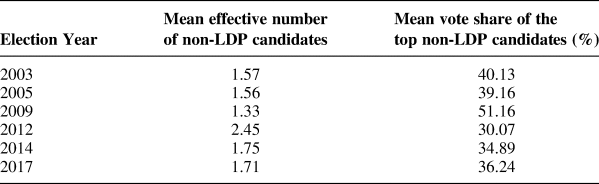
Before it disbanded, the DPJ has long been the LDP's largest opposition party. As such, the LDP and DPJ essentially functioned as two-party system competition for much of its history. The DPJ even won the 2009 general election. In the second column of Table 2, the mean effective numberFootnote 13 of non-LDP candidates by the district is calculated for each election year, showing that 2003, 2005, and 2009 elections functioned largely as a two-party competition. Due to a variety of factors, the DPJ plummeted in popularity after the 2009 election.Footnote 14 The DPJ only won a total of 57 seats in the 2012 election, which was down from 308 seats in 2009. With the Japan Restoration Party winning 54 seats, the DPJ's status as the LDP's only viable rival completely disappeared. This heavy loss resulted in the reinstitution of the LDP as the ruling party in 2012. Table 2 shows the fragmentation of the LDP's opposition after 2009, which resulted in a major spike in the mean effective number of non-LDP candidates and has still not come back down to pre-2012 levels. With the LDP's most notable adversary out of the way, the party itself has no real threat to its power.
Unity/fragmentation of the LDP's opposition, 2003–2017

Under the essential two-party system, most districts experienced a two-candidate competition between the LDP and the DPJ candidates. Thus, when the LDP was competing with the DPJ for votes, it was in the interest of the LDP politicians to appeal to the centrist voters in order to win as many votes away from the DPJ as possible, since winning the median voter was the best way to guarantee election (Downs Reference Downs1957). However, since the LDP's opposition experienced heavy fragmentation in the 2012 general election, the LDP candidates no longer have the need to win 50% of the votes. In Table 2, the third column signifies the average vote share of non-LDP candidates who won the most votes in single-member districts (SMDs) by election year. Before the 2012 election, the LDP's biggest competitors won more shares of votes, and posed a larger threat to the LDP candidates. However, with the drop in the competition's vote shares in 2012, the LDP candidates, including the rookie candidates, did not have the need to seek to win 50% of the votes.
Instead, in order to ensure their electoral survival, it was in the interest of the individuals within the LDP to appeal to their core set of voters in order to guarantee an election. This is particularly true for the individual members of the LDP who won by a smaller vote margin, as their electoral insecurity makes it more advantageous to appeal to a reliable support base. In this case, joining Shinseiren sent a strong signal to a more cohesive set of voters, as voters who are concerned with nationalist issues as proposed by these nationalist circles supply a significant base for the LDP.
On the other hand, those LDP politicians who won by a larger margin have no incentive to change their behaviors as they are already electorally secure. In fact, an LDP legislator who is already secure and becomes a Shinseiren member could even be a dangerous strategy, as it could look like they are changing from their previous political stances. Similarly, another possible cost of an LDP politician joining Shinseiren is creating a potentially negative impact on the LDP's coalition with Komeito. Although Komeito and the LDP may have ideological differences, the coalition formed between the two in 1999 has greatly benefited both parties strategically in national elections (Liff and Maeda Reference Liff and Maeda2019). By coordinating an agreement where Komeito and the LDP decide which of their two parties will run in each SMD, they ensure that their parties are never in direct competition with one another. Furthermore, the LDP endorses the candidates from Komeito in SMDs where the LDP is not running, and vice versa (Maeda Reference Maeda2010). Because of the tensions between the nationalist circle groups and Soka Gakkai and Komeito, it is possible that joining Shinseiren could potentially be detrimental for the LDP politician.
Accordingly, I suggest that an LDP legislator's SMD vote margins affect the legislator's decision to join Shinseiren. If the vote margin is small, meaning the legislator barely won or lost the SMD seat, then the legislator would be more likely to become a member of Shinseiren in order to signal to the LDP's core supporters and guarantee more votes in the next election. In this instance, the cost of not joining Shinseiren is greater than the risk incurred by sending a potentially negative signal to a voter who supports Komeito.
I by no means intend to argue that the candidates' electoral incentives are the only factors that determine their affiliation with Shinseiren. For example, it is possible that, like any interest group, Shinseiren made direct appeals to the running LDP candidates to become members. Religious groups have an advantage politically in that they are able to both organize and mobilize others, which as Klein and Reed mention, is “the key to electoral success” (2014, 25). Thus, joining a group such as Shinseiren could have great political appeal to LDP politicians, as membership could serve as a sort of shorthand to indicate to members of that particular group that the politician might represent their interests.
To further complicate the matter, however, the scale of influence that Nippon Kaigi and Shinseiren have over politics is uncertain, with some sources stating that these groups have exceptionally large mobilizing power and financial resources (Aoki Reference Aoki2016), while others argue that their political power and financial strength have been exaggerated (Terada Reference Terada2017). The number of LDP candidates who experienced a direct appeal from Shinseiren is unknown. However, whether the motivation was due to a direct appeal by Shinseiren or otherwise, I expect a similar result. If an LDP political candidate was only interested in appealing to the particular group of core voters, then there should be no variation in new memberships. The legislator would be equally advantaged whether they had experienced a high or a low vote margin. However, as mentioned above, I argue that if they have a larger vote margin, the legislator risks votes they have already won. Yet, if they have a smaller vote margin in the 2012 election, the legislator would then have good reason to want to signal to a specific group of voters in order to gain a better advantage in the next election. Thus, I expect that it is a low vote margin that encourages an increased chance in Shinseiren membership, regardless of active appeals from Shinseiren.
Furthermore, it could also be argued that the LDP legislator's motivation for joining Shinseiren could be a signal to Abe, rather than voters, in order to appeal to his nationalist tendencies in exchange for political security. The idea of joining Shinseiren as an appeal to core voters and to Abe are not mutually exclusive. Yet, while the intent of signaling to Abe is a possibility, I would not expect variation in Shinseiren memberships, as trying to be in Abe's good graces should be appealing to all LDP legislators. Thus, if there is variation in Shinseiren memberships dependent on vote margins, this would be a good indication that the LDP legislator's decision was motivated by their desire to appeal to a specific group of voters.
In summary, I expect that the LDP politicians' decision to join Shinseiren after the 2012 election can be explained by the level of electoral (in)security. Thus, if my argument is accurate, the following hypothesis should be empirically supported:
LDP politicians who were elected with a smaller margin were more likely to join Shinseiren.
RESEARCH DESIGN
Because of the surge of Shinseiren memberships by the LDP, this article utilizes an original dataset that details certain characteristics of individual LDP members in the Lower House between 2012 and 2014 general elections in Japan. My cutoff of the 2014 general election does not imply that the effects of vote margins on the likelihood of increased Shinseiren memberships would not be relevant beyond 2014. However, major redistricting occurred between 2014 and 2017, resulting in district boundary changes. As a result, I am unable to equally evaluate vote share changes beyond the 2014 general election, as there are not enough observations.
The unit of analysis is individual Lower House members of the LDP. The LDP won 294 seats in the 2012 election. Among them, 18 ran only in the proportional representation (PR) tier and were elected. These legislators were not included in the analysis since they did not compete in any SMDs. Furthermore, 82 members were excluded as they were already Shinseiren members before the 2012 election, leaving 194 observations in the sample.Footnote 15 The dependent variable takes a value of one if the legislator was a Shinseiren member right before the 2014 election, and zero otherwise. The Shinseiren's website (sinseiren.org) shows a list of its members, and using the Internet Archive (archive.org), I was able to obtain membership lists at various points in time since 2012.Footnote 16
The vote margin serves as the main independent variable, and it reflects the vote share by which the politician won or lost the SMD election. As noted earlier, a candidate may lose in an SMD but still secure a seat from the PR tier. This variable takes a negative value for those politicians, meaning the vote margin can be even smaller than zero. It is expected that this variable would take a negative coefficient, as the hypothesis predicts that the legislators who are electorally weak will have a higher chance to join Shinseiren. The electoral results data were obtained from newspaper websites.
There are a number of other factors that could influence an LDP legislators' membership in Shinseiren and should be controlled for in the analysis. For instance, common factors that might indicate a person's membership in Shinseiren include being a representative of an older district and being a representative of a more rural area (Golder Reference Golder2003; Mudde Reference Mudde1996, Reference Mudde2010). Thus, age and urbanization are included as control variables. The age variable measures the median age of the representative's district, and the level of urbanization is measured by the percentage of residents who live in densely inhabited districts as defined by the 2010 Japanese census.Footnote 17 The number of terms served is also used as a control, as the number of times a politician has served could also influence their choices in memberships. Particularly junior legislators might be interested in appealing to core voters through Shinseiren since they do not currently have a stable support base. Finally, a variable that indicates whether the candidate was officially recommended by the Komeito Party is included as a control, based on the above discussion regarding the coalition between the LDP and Komeito. Logistic regression is used due to the binary nature of the dependent variable.
RESULTS
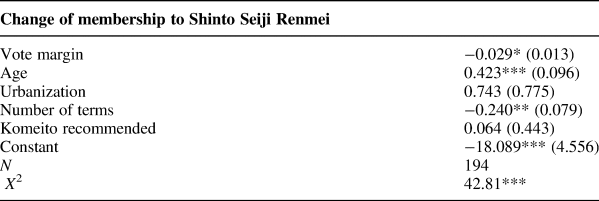
As indicated in the results from Table 3, this article finds support at the 0.05 level for the argument that joining Shinseiren is motivated by strategic reasons.Footnote 18
Effect of vote margin on Shinto Seiji Renmei membership

Standard errors in parentheses *p < 0.05 **p < 0.01 ***p < 0.001.
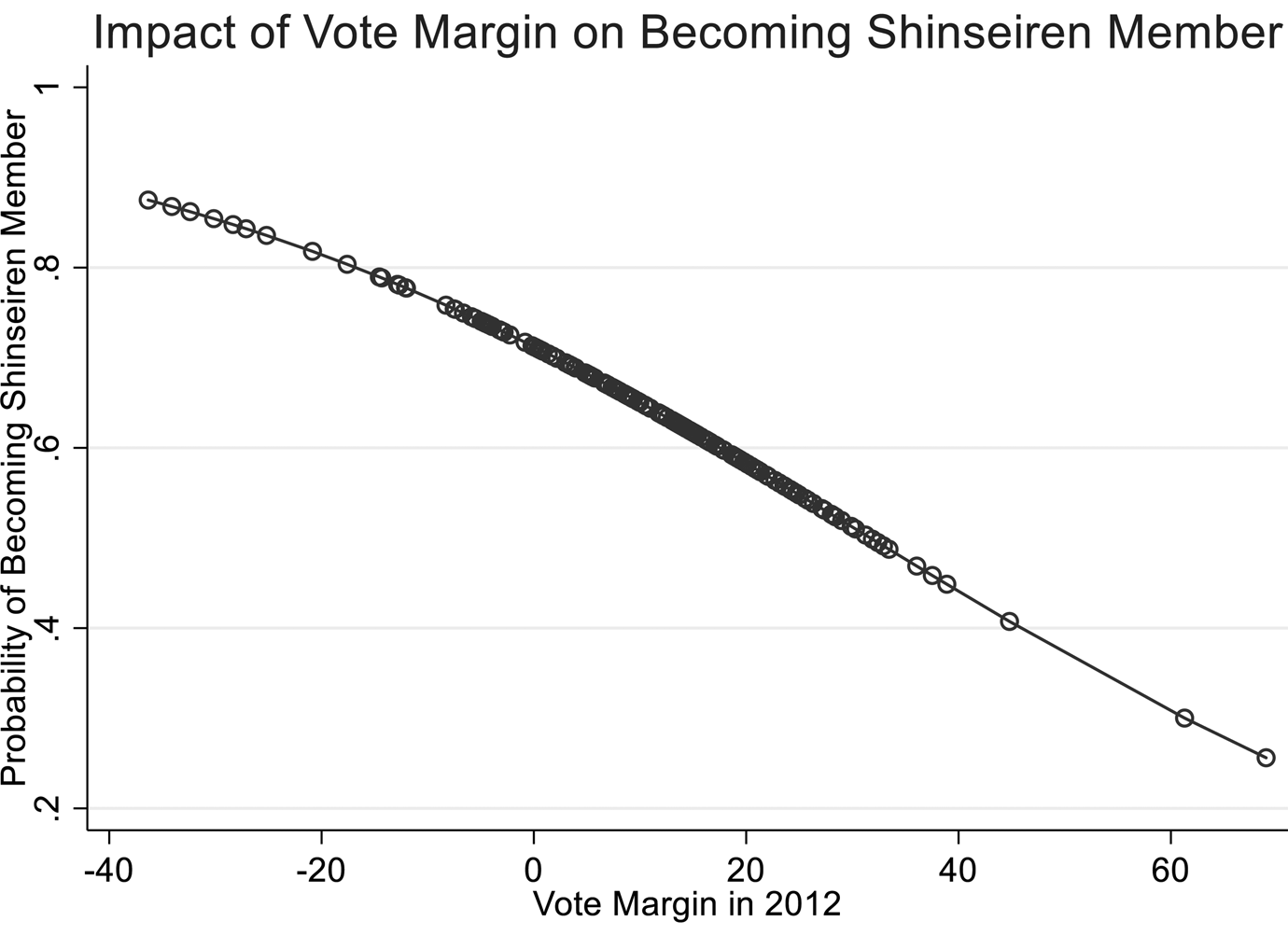
To understand how vote margins affect an LDP Lower House politician's likelihood of becoming a member of Shinseiren in a more substantive way, it is useful to discuss this relationship in terms of the predicted probabilities. Figure 1 plots the predicted probabilities against the vote margin while holding age, urbanization, and the number of terms at their means and Komeito recommendations at a value of 1. It is clear that there is a strong pattern between vote margins and Shinseiren membership.
Predicted probabilities of joining Shinseiren.

With a vote margin of about 69%, there is only a 26% chance that the LDP politician will become a member of Shinseiren. This finding supports the idea that if the LDP legislator is already electorally secure, they do not have a strong incentive to join Shinseiren. However, as the vote margin decreases to 36%, the likelihood of joining Shinseiren already increases to almost 47%. As the margin gets closer to zero, indicating the politician barely won their election, the probability that the politician joins Shinseiren climbs to around 71%.
Additionally, as for the control variables, the number of terms a politician has been in the office also has a significant effect on whether or not an LDP member in the Lower House joins Shinseiren. Based on the negative coefficient, an LDP politician is more likely to join in an earlier stage of their careers. Rookie legislators concerned about the prospects of reelection would especially have incentives to join Shinseiren since they do not have a stable base of voters to rely upon. Furthermore, the variable for age also has a significant impact on the probability that an LDP politician joins Shinseiren. As expected, those who represent older districts have a higher likelihood of becoming members of Shinseiren. Since older voters are traditionally main supporters of the LDP, it is logical that those elected in these areas, where the most traditionalist voters are, would possibly be incentivized to appeal to these voters through Shinseiren memberships. On the other hand, the results for urbanization and being recommended by Komeito were inconclusive.
CONCLUSIONS
This article finds support for the idea that when an LDP politician identifies with Jinja Honcho's political organization Shinto Seiji Renmei, it is done with electoral incentives in mind, particularly with the purpose of securing more votes for future elections. Because the number of Shinseiren memberships experienced the increase after the 2012 general election, it is less likely that these memberships were due to ideological reasons or from a sudden growth of religiosity. Instead, because the LDP candidates had no need to make sure it secured over 50% of the vote due to the lack of a unified opposition after the 2012 election, the individual members of the LDP were then incentivized to appeal to the LDP's core supporters, as opposed to the swing voters. This is particularly the case for those politicians who only won by a small margin, are junior LDP members, and represent rural areas.
While this article is not arguing that joining Shinseiren is only motivated by an LDP legislator's desire to appeal to voters, the analysis does demonstrate variation in Shinseiren memberships, indicating at least in this case, that it is the voters the SMD candidates have in mind when they join Shinseiren. For example, when the LDP legislator had already won by a large vote margin and was thus electorally secure, they were less likely to join Shinseiren. If membership in Shinseiren was motivated by a desire to appeal to Abe, for example, we would not expect to witness this variation. While outside the scope of this paper, in future research, it could be possible to explore the behavior of PR only legislators and their position on the list in order to determine if joining religious nationalist organizations are also done as a signal to Abe.
Furthermore, with the LDP's lack of external competition with the dissolution of the DPJ, there may be changes to the future of Japan's political landscape. With less incentive to take a more centrist position and greater risk for not appealing to core voters, it is possible that the longstanding coalition between Komeito and the LDP may be in jeopardy. As discussed above, these nationalist circle organizations have a history of proactively lobbying on behalf of their political interests, and they actively appeal to representatives in the LDP. What is more, the findings of this article indicate that this is a two-way street. It is not only that religious groups (and groups with the religious character) try to gain favor with political officials in order to promote their interests, but also politicians who appeal to these religious and religiously affiliated groups to promote their electoral interests.
With the surge of nationalism and nationalistic policies around the world, many scholars have been trying to understand the circumstances under which this seemingly sudden growth has occurred. With the ministers of Abe's cabinet having such a high rate of membership in Nippon Kaigi and Jinja Honcho's Shinto Seiji Renmei, it is clear that the degree to which these nationalist circles and religious nationalism affect Japanese politics needs to be explored. As Japan is a democracy with institutionalized separations of religion and the state, it is easy to assume that even though groups with nationalist ideologies exist, the secular democratic institutions would not allow for religious nationalism to take hold in politics, as these institutions can help address the divisions in a society and mediate any potential conflicts (Fox Reference Fox2007; Lijphart Reference Lijphart2004). Yet, with this rise in nationalist sentiment around the globe, and its growing influence, it is apparent that secular democracies can also be affected by nationalism in diverse ways. By examining the motivations behind individual LDP legislators' joining Shinseiren, we are able to see an example of how political officials strategically appeal to religious nationalism in order to promote their own electoral interests. Rather than only focusing on nationalist sentiment and ideology in general, this article demonstrates the importance of looking at political and electoral factors in considering how religion affects politics, even in a democratic state with institutional structures that mandate the separation of politics and religion.
Financial support
No outside funding was received for this study.