Implications
The quality of handling of piglets during the suckling period aggravates the behavioural distress response to weaning. This could aggravate welfare problems associated with weaning such as susceptibility to disease and mortality. In addition, piglets seem to be able to recognise and avoid handlers they associate with aversive handling. This could impact on ease of handling and ability to cope with stressors in the long term. These welfare problems have relevant economic and ethical implications for the pig industry.
Introduction
Negative handling during husbandry routines can act as a daily stressor to domestic animals. Fear of handlers who carry out the daily routine can cause distress to animals and reduce their welfare (Rushen et al., Reference Rushen, Taylor and De Passillé1999b; Hemsworth, Reference Hemsworth2003; Spoolder and Waiblinger, Reference Spoolder and Waiblinger2009). Unpredictability and lack of control, especially when associated with aversive experiences, may also reduce the welfare of captive animals (Bassett and Buchanan-Smith, Reference Bassett and Buchanan-Smith2007). In intensive housing systems, pigs usually have little or no control over the situations to which they are subjected during routine husbandry procedures. Hence, threatening postures, shouting and negative physical handling may be particularly aversive for these animals. If such negative stimuli are repeated routinely, the animals may associate such quality of handling to the people who apply it, or generalise it to all handlers in the farm. As a result they may express avoidance or aggressive behaviours towards handlers during management, reinforcing their attitudes, in a positive feedback process (Hemsworth and Coleman, Reference Hemsworth and Coleman1998). Furthermore, aversive handling may have a negative impact on stress physiology (Gonyou et al., Reference Gonyou, Hemsworth and Barnett1986), reproduction (Hemsworth et al., Reference Hemsworth, Barnett and Hansen1986a and Reference Hemsworth, Barnett, Coleman and Hansen1989; Pedersen et al., Reference Pedersen, Damm and Kongsted2003) and productivity (Gonyou et al., Reference Gonyou, Hemsworth and Barnett1986).
Studies involving positive or neutral interactions between humans and animals indicate that early social contact with humans may influence the subsequent behaviour towards humans in pigs (Hemsworth et al., Reference Hemsworth, Barnett, Hansen and Gonyou1986b), and other farm animals such as sheep (Markowitz et al., Reference Markowitz, Dally, Gursky and Price1998), goats (Boivin and Braastad, Reference Boivin and Braastad1996) and cattle (Krohn et al., Reference Krohn, Jago and Boivin2001). For instance, compared with piglets socialised later, piglets socialised with humans during the first 3 weeks of life showed less fear towards humans when tested at 18 weeks of age, suggesting that piglets’ first week of life may represent a sensitive period of socialisation (Hemsworth and Barnett, Reference Hemsworth and Barnett1992). Therefore, aversive treatment of pigs early in life may influence their behaviour in a particularly harmful way, and have negative effects on interactions with humans later in life. Young pigs have the ability to recognise humans that handled them previously in a gentle way, choosing their presence (Tanida and Nagano, Reference Tanida and Nagano1998) or interacting more with them than with a person they do not know (Tanida et al., Reference Tanida, Miura, Tanaka and Yoshimoto1995). Other farm animals may recognise handlers based on an aversive treatment (De Passillé et al., Reference De Passillé, Rushen, Ladewig and Petherick1996; Rushen et al., Reference Rushen, De Passillé and Munksgaard1999a). Thus, one aim of this study was to investigate the ability of young piglets to discriminate handlers based on the quality of treatment. We predicted that after weaning piglets would be able to discriminate a handler that treated them neutrally or aversively during the suckling period, from an unknown person.
Early-weaned piglets usually display behavioural responses indicative of distress, such as increased frequency of vocalisations (Weary et al., Reference Weary, Appleby and Fraser1999; Colson et al., Reference Colson, Orgeur, Foury and Mormède2006), abnormal behaviours (Gonyou et al., Reference Gonyou, Beltranena, Whittington and Patience1998; Weary et al., Reference Weary, Appleby and Fraser1999; Worobec et al., Reference Worobec, Duncan and Widowski1999), aggression (Jarvis et al., Reference Jarvis, Moinard, Robson, Sumner, Douglas, Seckl, Russell and Lawrence2008; Devillers and Farmer, Reference Devillers and Farmer2009), escape attempts (Worobec et al., Reference Worobec, Duncan and Widowski1999; Hötzel et al., Reference Hötzel, Machado Filho, Irgang and Alexandre Filho2010) and low-feed intake (Gonyou et al., Reference Gonyou, Beltranena, Whittington and Patience1998; Van der Meulen et al., Reference Van der Meulen, Koopmans, Dekker and Hoogendoorn2010), which is accompanied by impaired intestinal integrity and functionality, growth depression, increased susceptibility to disease and mortality (Pluske et al., Reference Pluske, Hampson and Williams1997; Van der Meulen et al., Reference Van der Meulen, Koopmans, Dekker and Hoogendoorn2010). These responses are attributed to the early and abrupt separation from the dam and change in diet, although it is recognised that pre- and post-weaning environmental stressors may also contribute (Weary et al., Reference Weary, Jaspers and Hötzel2008). In this context, the quality of interactions between humans and animals prior to weaning may interact with the various stressors that influence the behavioural response to weaning, jeopardising the adaptation of piglets to weaning. Thus, another aim of this study was to compare the post-weaning behaviour time budget of piglets treated neutrally or aversively during the suckling period. We predicted that the post-weaning behavioural distress response of aversively handled piglets would be greater, and feed intake and growth would be lower than that of groups handled neutrally during suckling.
Material and methods
Local, animals and housing
The experiment was carried out at the experimental research station of EMBRAPA Swine and Poultry (Concórdia, Santa Catarina State, Brazil, 27°S) during the summer. All rooms used in the study were naturally ventilated.
A total of 24 litters crossbred from multiparous F1 females (Large White × Landrace) and EMBRAPA MS sires (Duroc × Large White × Pietrain) were used in the study.
Sows were housed in individual pens during gestation and transferred to four farrowing rooms, two used for each treatment, 1 week before the estimated farrowing date. During nursing, sows were housed individually in standard farrowing crates (0.6 × 2.2 m), within a pen of 1.8 × 2.2 m, with plastic slatted floor. A creep area of 0.4 × 0.6 m with solid flooring covered with sawdust was available for the piglets. Nipple drinkers were available for sows and piglets. Sows received feed from a semi-automatic feeder, whereas piglets received creep feed in a tray at the floor level. Piglets also had access to the sow's feeder.
After weaning, piglets were housed in four different rooms, two used for each treatment, in suspended pens (0.8 × 1 m) with plastic slatted floor. A nipple drinker and a feeder were positioned at opposite ends of the pen.
Management
Lactating sows were fed a diet containing 3300 kcal metabolizable energy (ME)/kg and 17.1% crude protein (CP). Piglets were offered a diet containing 3500 kcal ME/kg and 16% CP from 2 weeks of age until the end of the study. All animals were fed ad libitum. Farrowing pens were cleaned and sawdust was changed twice daily. From 2 weeks of age, a female experimenter performed the feeding and cleaning routine, except at the weekends when this was performed by an unfamiliar person. This person was instructed to perform the routine in silence, to minimise interactions with the animals and to keep the use of voice to a minimum.
Two days after birth, piglets had their tails docked and teeth clipped, and received an iron injection. Males were castrated within 7 days of birth. All piglets were ear-notched for identification, and were weighed at birth, at weaning and 5 days after weaning. Any cross-fostering to adjust litter size was limited to the first week after birth.
Weaning of all piglets was carried out in the morning, at 28.2 ± 0.3 days after birth. The sows were removed from the crates, and the litters stayed in their respective pens until the end of a test that was conducted outside the farrowing rooms. This took approximately 2 h, after which time the piglets were transferred to the nursery rooms in groups of four animals, two males and two females, all originating from different litters from the same treatment. Groups were homogeneous with respect to weight and age.
Treatments
A female experimenter (P1) subjected half the litters to an aversive treatment (Aver) and the other half to a neutral treatment (Neut). The treatment was performed twice a day every day, between days 10 and 27 after birth, except on weekends. In the Aver while conducting the handling of routine cleaning, feeding, and animals’ inspection, P1 spoke with an aggressive tone, occasionally making postural threats to the sows. Once a day P1 placed the piglets inside the creep, a management perceived to cause fear or avoidance reactions in the piglets (Hötzel et al., Reference Hötzel, de Souza, Machado Filho, Irgang and Probst2007). In the Neut, during the same management routines P1 directed little attention to the sow and piglets, was careful when moving objects and used a soft tone of voice, only when necessary. Both treatments involved non-tactile interactions, and no physical aggression was directed towards the sows and piglets at any time in either treatment.
Behavioural observations
On the day of weaning the avoidance response of piglets to an approaching experimenter was tested with P1 and another person (P2) who was unfamiliar to the animals. Both experimenters were females, who differed considerably in height and hair length and colour. They showered before entering the premises and wore blue coveralls and white boots supplied by the farm, though only P1 wore blue trousers and a white T-shirt (throughout the experiment P1 wore the same clothing).
Four piglets chosen at random from each litter, half of each sex per litter, were tested by the two people separately. The order of testing was randomised. The test began by placing a pig at the end of a corridor 2 m long and 0.8 m wide, marked in the ground at 0.5 m intervals. At the other end of the corridor the test person was positioned; after a period of 2 min, she walked slowly toward the piglet. The response of the animals was classified according to the following scores: (1) piglet allows being touched by the person, (2) person can pass the 0.5 m mark, but piglets moves away before being touched, (3) piglets moves away when person arrives at 0.5 m mark and (4) piglet runs before person arrives at 0.5 m mark.
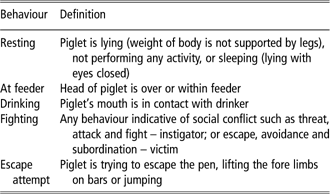
Behavioural time budgets were recorded over 4-h periods from day 1 (weaning day) to day 4. Two observers, previously calibrated to ensure reliability of results, did all the observations by direct visual observation. Behaviours listed in Table 1 were registered using scan sampling every 2 min, which resulted in 120 samples per group per day. On day 1 sampling began at 1100 h, which was 30 min after all piglets were housed in the new pens; from day 2 to day 4 sampling was done from 0700 to 1100 h.
Behaviour definitions
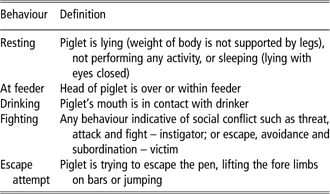
Feed and water intake
Drinkers were connected to a water reservoir graduated in litres to allow observation of the daily consumption of the pen. At weaning, 5 kg of dry feed were supplied to each group, and in subsequent days the feeder was replenished when necessary. Group consumption was calculated from the total offered and the residues on the morning of the 5th day.
Data analysis
Effects of treatment, day and interactions on performance data (BW, feed and water intake) were analysed with a GLM. Behavioural time budgets presented are the averages and standard errors of the relative frequencies of each behaviour, calculated from results obtained in each observation of each group. Effects of treatment, day and their interactions on behaviours were analysed using a mixed model ANOVA for repeated measures, with group as a random effect, determined using a mixed model, using an autoregressive covariance structure. Behaviour data were square root transformed for the analysis. Scores from the avoidance test were analysed with non-parametric statistics. The Mann–Whitney U-test was used for comparisons between treatments and the Wilcoxon-signed ranks test was used for comparisons within litter. Results are presented as medians with 25th and 75th percentiles.
Ethical note
This project was approved by the Ethics Committee for animals used for experimentation of the Federal University of Santa Catarina.
Results
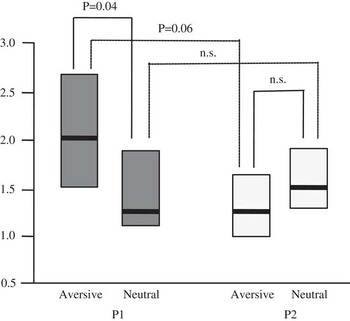
Responses to the human avoidance test are shown in Figure 1. There were no treatment differences in piglets’ avoidance score when tested by P2 (P = 0.8), but a higher score was found in Aver than Neut piglets when tested by P1 (P = 0.04). When piglets’ responses to the different handlers were compared within each treatment, no differences were found for Neut piglets (P = 0.94), but there was a tendency for higher avoidance scores in Aver piglets when tested by P1 than by P2 (P = 0.06).
Median and interquartile ranges for avoidance score for litters treated aversively (dark grey) or neutrally (light grey) during suckling. Scores are: 1 = piglet allows being touched by the person; 2 = person can pass the 0.5 m mark, but piglets moves away before being touched; 3 = piglets moves away when person arrives at 0.5 m mark; 4 = piglet runs before person arrives at 0.5 m mark; 5 = piglet runs, vocalising, as soon as person moves. The Mann–Whitney U-test was used for comparisons between treatments and the Wilcoxon-signed ranks test was used for comparisons within litter.

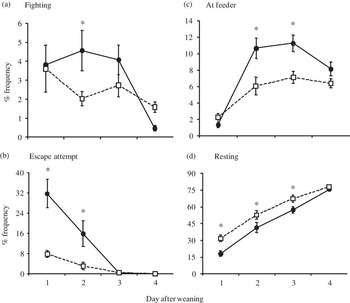
Frequencies of piglets’ behaviours are shown in Figure 2. There was an effect of day (P < 0.001) for all behaviours studied. A main effect of treatment was found for presence at feeder, resting (P < 0.001) and escape attempts (P < 0.03), with interactions between treatment and day for presence at feeder (P < 0.001), fighting and resting (P < 0.02). Aver groups had a higher frequency of fighting on day 2 (Figure 2a), of escape attempts on days 1 and 2 (P < 0.03; Figure 2b) and of at feeder on days 2 and 3 (P < 0.001; Figure 2c) than Neut groups. In contrast, Aver groups had lower frequencies of resting behaviour on days 1 to 3 (P < 0.0001; Figure 2d). There was no treatment effect on drinking behaviour (Aver 0.95 ± 0.17% v. Neut 0.79 ± 0.21%).
Relative frequency (mean ± s.e.) of behaviours, during the first 4 days after weaning, in groups of four piglets that were handled aversively (closed circles) or neutrally (open squares) during suckling (n = 12/treatment): (a) fighting, (b) escape attempt, (c) at feeder and (d) resting. Asterisks indicate differences between treatments on a given day.

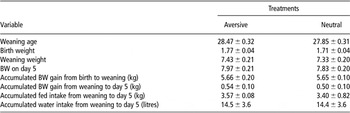
There was no treatment effect on any of the performance traits recorded (Table 2).
Performance of litters (means ± s.e.)

Data referring to periods before weaning (day 1) are mean each of litter; after weaning data are the mean of four piglets in group (n = 12/treatment).
Discussion
Piglets subjected to aversive handling during suckling presented higher frequencies of fighting and escape attempts, and lower frequencies of resting, compared to piglets that had been treated neutrally. Overall, the post-weaning behavioural response observed in this study corroborate several studies that conclude that early and abrupt weaning is a source of distress for young piglets (Weary et al., Reference Weary, Appleby and Fraser1999; Colson et al., Reference Colson, Orgeur, Foury and Mormède2006; Hötzel et al., Reference Hötzel, Machado Filho, Irgang and Alexandre Filho2010). In addition, this suggests that handling quality may contribute to aggravate the distress response to weaning. This adds to studies describing other factors associated with the pre-weaning environment, such as housing (Weary et al., Reference Weary, Pajor, Bonenfant, Fraser and Kramer2002; Hötzel et al., Reference Hötzel, Machado Filho, Wolf and Dalla Costa2004; O'Connell et al., Reference O'Connell, Beattie, Sneddon, Breuer, Mercer, Rance, Sutcliffe and Edwards2005), and opportunity to socialise with non-littermates (Weary et al., Reference Weary, Pajor, Bonenfant, Fraser and Kramer2002; Kutzer et al., Reference Kutzer, Bünger, Kjaer and Schrader2009), that influence piglets’ response to weaning.
However, handling quality did not influence piglets’ growth before and after weaning, nor the post-weaning feed intake, which was low in both treatments, as usually reported for early-weaned pigs (Pajor et al., Reference Pajor, Fraser and Kramer1991; van der Meulen et al., Reference Van der Meulen, Koopmans, Dekker and Hoogendoorn2010). Because treatment differences in frequency at the feeder were not associated with differences in feed intake or weight gain, we conclude that aversively handled piglets were possibly more aroused, rather than more motivated to ingest the solid feed. Even if treatment differences may be considered modest and short-lived, the behaviour response of aversively handled piglets involved and increase in energy-demanding active behaviours and low-energy intake. Thus, this may contribute to aggravate the challenge to maintain thermal regulation and metabolism, increasing susceptibility to disease (Pluske et al., Reference Pluske, Hampson and Williams1997).
Piglets that were treated aversively during suckling by the familiar handler avoided her more in the test conducted immediately after weaning than those that were treated neutrally by the same person. In contrast, no treatment differences were found in response to the unfamiliar person. This suggests that weaned piglets can discriminate a human handler based on the experience of previous aversive interactions during suckling. These findings are in agreement with those of Tanida et al. (Reference Tanida, Miura, Tanaka and Yoshimoto1995), who used slightly older piglets and compared a handling v. no-handling treatment, and corroborate preliminary results of a study using fewer animals reared in different, richer environmental conditions (Hötzel et al., Reference Hötzel, de Souza, Machado Filho, Irgang and Probst2007). In addition, other farm animals can learn to avoid humans that treated them aversively (Rushen et al., Reference Rushen, Taylor and De Passillé1999b; Boivin et al., Reference Boivin, Lensink, Tallet and Veissier2003). Our results also suggest that the piglets did not generalise the avoidance response to other humans. In contrast, Tanida et al. (Reference Tanida, Miura, Tanaka and Yoshimoto1995) concluded that reduced fear of humans in handled piglets was generalised to an unfamiliar handler. Hemsworth et al. (Reference Hemsworth, Coleman, Cox and Barnett1994) also reported that pigs generalised the quality of treatment to unknown humans. Although in this study the treatment was consistent within each group, in Hemsworth's study the same pigs were handled by different humans using either predominantly negative or predominantly gentle behaviour, which is likely to better reflect everyday handling, when different people may have different behaviours. Nonetheless, in small farms few people may be involved in the daily routine, allowing animals to recognise them individually, which may bring different outcomes to the human–animal interactions. The long-term consequences of early aversive treatment on ease of handling and ability to cope with stressors merit further investigation.
It is difficult to discuss which cues from the handler the piglets might have used to associate her with the quality of treatment. Previous studies have shown that piglets use auditory, visual and olfactory information to discriminate one person from another (Tanida and Nagano, Reference Tanida and Nagano1998). In this study, although the use of voice cues was an important component of the treatments, both humans remained silent during the avoidance tests, which allows us to conclude that auditory information is not essential for recognition of humans by pigs, corroborating findings of Koba and Tanida (Reference Koba and Tanida2001). These authors showed that 8- to 16-week-old piglets can discriminate a previously known, gentle handler, from an unfamiliar person exclusively by visual cues, more specifically body size and facial cues, which differed between our human experimenters. Thus, visual cues associated with the clothes or the body of the handlers or other aspects like subtle posture or behaviour movements are the most likely candidate cues.
In conclusion, 4-week-old piglets show different avoidance responses to a human, according to the quality of handling received during suckling. Furthermore, aversive handling during suckling seems to aggravate the distress response that usually follows early weaning.
Acknowledgements
We are grateful to Francieli Bertoli, Clarissa Silva Cardoso, Samira de Aquino Leite and the staff at EMBRAPA Swine and Poultry for their help during the experiment, and to Vanessa T. Kanaan for helpful contribution to the discussion. We would also wish to thank two anonymous reviewers for helpful comments. This project was supported by the Postgraduate Programme in Agroecosystems (UFSC, CAPES and CNPq).