The biofilm-associated protein (Bap) of Staphylococcus aureus is a high-molecular weight cell-wall-anchored protein of 2276 amino acids and was first described in bovine mastitis strains from Spanish dairy herds (Cucarella et al. Reference Cucarella, Solano, Valle, Amorena, Lasa and Penades2001). Bap was shown to be involved in intercellular adhesion and accumulation in multilayer cell clusters, and also in primary attachment to abiotic surfaces. These functional characteristics confer a strong biofilm-forming phenotype to strains carrying the bap gene (Lasa & Penadés, Reference Lasa and Penadés2006).
Bap was the first described member of a family of surface proteins (BAP) now detected in other staphylococcal species and unrelated Gram-positive or Gram-negative species (Tormo et al. Reference Tormo, Knecht, Götz, Lasa and Penades2005; Latasa et al. Reference Latasa, Solano, Penadé and Lasa2006). In Staph. aureus, bap is carried in a transposon-like element located within the SaPIbov2 pathogenicity island.
Experiments in vitro showed that bap-positive Staph. aureus was significantly less able to attach to immobilised fibrinogen and fibronectin, probably because of an interference of Bap with functional properties of the microbial surface components recognising adhesive matrix molecules (MSCRAMM). Nevertheless, in the experimental infection, the same bap-positive strain was more able to persist inside the mammary gland (Cucarella et al. Reference Cucarella, Tormo, Knecht, Amorena, Lasa, Foster and Penadés2002). Also, bap-mediated biofilm demonstrated higher resistance to antimicrobials (Cucarella et al. Reference Cucarella, Tormo, Ubeda, Trotonda, Monzon, Peris, Amorena, Lasa and Penades2004).
The location of bap in a mobile genetic element could allow horizontal gene transfer among Staph. aureus strains (Tormo et al. Reference Tormo, Knecht, Götz, Lasa and Penades2005). However, the low frequency of bap-positive Staph. aureus strains seems to indicate that such an event is not common (Vautor et al. Reference Vautor, Abadie, Pont and Thiery2008). In fact, since the first description, several attempts to identify bap carriage in Staph. aureus were unsuccessfully performed on isolates from different animal species (Vasudevan et al. Reference Vasudevan, Nair, Annamalai and Venkitanarayanan2003; Vancraeynest et al. Reference Vancraeynest, Hermans and Haesebrouck2004; Nitzsche et al. Reference Nitzsche, Zweifel and Stephan2007; Vautor et al. Reference Vautor, Abadie, Pont and Thiery2008; Szweda et al. Reference Szweda, Schielmann, Milewski, Frankowska and Jakubczak2012). Recently, Darwish & Asfour (Reference Darwish and Asfour2013) detected bap in one Staph. aureus strain from bovine mastitis in Egypt and Goyal et al. (Reference Goyal, Kerketta, Kumar, Rawat, Viswas and Agarwal2014) identified 11 Staph. aureus bap-positive isolates from cattle and dog clinical specimens in India.
So far, studies regarding the virulence of bap-carrying Staph. aureus isolates have been mainly based on wild type strain V329 and its mutants (Di Poto et al. Reference Di Poto, Sbarra, Provenza, Visai and Speziale2009; Shukla & Rao, Reference Shukla and Rao2013). The other Spanish isolate strain V858 was compared with V329 for the variation in number of a conserved tandem repeat in the C region of the bap gene, showing differences that could be attributed to homologous recombination (Cucarella et al. Reference Cucarella, Tormo, Ubeda, Trotonda, Monzon, Peris, Amorena, Lasa and Penades2004). Nevertheless, information regarding the epidemiology and genetic variability of bap-positive Staph. aureus strains is, to the best of our knowledge, not yet available in the literature. Therefore, the aim of the present study was to screen dairy cows with subclinical mastitis for bap-positive Staph. aureus and to investigate the molecular characteristics of bap-positive Staph. aureus isolates, to assign them to sequence types and to compare them to the Spanish prototypic strain V329.
Materials and methods
Isolation of Staph. aureus strains and DNA extraction
The 8 Staph. aureus isolates considered in the paper were isolated from quarter milk samples aseptically taken from lactating cows in 5 different Italian dairy herds. Bacteriological analyses were performed according to a previously published protocol (Hogan, Reference Hogan, Gonzales, Harmon, Nickerson, Oliver, Pankey and Smith1999) and milk somatic cells were counted on a Bentley Somacount 150 (Bentley Instruments, Chaska MN, USA). Briefly, an aliquot of 10 μl of each sample was spread onto blood-agar plates (5% bovine blood; Oxoid, UK), and incubated at 37 °C. Plates were evaluated after 24 and 48 h, and colonies of growth were isolated. Phenotypic identification as Staph. aureus based on standard biochemical tests, was further confirmed by PCR (Pilla et al. Reference Pilla, Snel, Malvisi and Piccinini2013). Thereafter, the isolates were frozen at −80 °C in MicroBank Bacterial Preservation System (Thermo Fisher Scientific, USA) for further molecular analysis.
After thawing, each isolate was subcultured on 5% bovine blood agar plate (Oxoid, USA) and DNA was extracted using DNeasy kit (QIAgen, Germany) according to the manufacturer's instructions. DNA amount and purity were tested with a ND-100 Spectrophotometer (NanoDrop Technologies Inc., Wilmington DE, USA).
PCR analysis for bap
PCR to detect bap was performed using primers and conditions described by Cucarella et al. (Reference Cucarella, Tormo, Ubeda, Trotonda, Monzon, Peris, Amorena, Lasa and Penades2004). PCR products were analysed by electrophoresis on 0·8% agarose gel with ethidium bromide (0·5 μg/ml) in TAE buffer. The expected bap amplicon size was 971 bp. As positive control, the Spanish reference strain V329 was used. PCR results were further confirmed by sequencing. The bap gene was also covered by the microarray analysis (see below).
Multilocus sequence typing (MLST) and spa typing
All bap-carrying strains were genotyped by MLST, using the procedure described at the Staph. aureus MLST website (http://saureus.mlst.net/misc/info.asp) and by Enright et al. (Reference Enright, Day, Davies, Peacock and Spratt2000). The spa typing analysis was performed following Shopsin et al. (Reference Shopsin, Gomez, Montgomery, Smith, Waddington, Dodge, Bost, Riehman, Naidich and Kreiswirth1999) and spa types were assigned using the Ridom SpaServer (http://www.spaserver.ridom.de).
Strain characterisation by DNA microarray
The strains were further characterised using a DNA microarray based assay (StaphyType; Alere Technologies, Jena, Germany) which detects a total of 333 different sequences, including accessory gene regulator (agr) alleles, genes coding for virulence factors (toxins, enterotoxins, putative toxins, haemolysins, proteases, and biofilm formation molecules) and microbial surface components recognising adhesive matrix molecules (MSCRAMMs), capsule type-specific genes, and numerous antimicrobial resistance genes. With regard to bap, the binding sites or probes and primers used in the array analysis were designed in a conserved region from 1807–2770; this region (B) is also homologous in other Staphylococcus species, while A, C and D regions show the major differences among species (Tormo et al. Reference Tormo, Knecht, Götz, Lasa and Penades2005). Microarray analyses were performed following the recommendations of the manufacturer. The recorded hybridisation patterns were analysed using a designated reader and software (ArrayMate and IconoClust, both by Alere Technologies).
Results
PCR analysis for bap and array characterisation of bap-positive strains gave identical results. The bap amplicons that were localised within the constant part of the gene showed >98% DNA sequence homology with the reference gene (NCBI accession AY220730·1), using BLAST® analysis (http://blast.ncbi.nlm.nih.gov/).
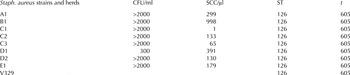
Bacteriological analysis of quarter milk samples showed minor differences in the shedding of the 8 bap-carrying Staph. aureus strains in the milk. Overall, the counts were higher than 2000 CFU/μl, and only 1 out of the 2 isolates from herd D was present in the milk in low counts (300 CFU/μl). To the contrary, SCC values ranged 1–998 cells/μl, with the lowest value associated with Staph. aureus herd C strain 1, and the highest with the only strain detected in herd B. Large variations in SCC were observed not only among herds, but also within them (Table 1).
Results of bacteriological analysis of quarter milk samples infected by Staph. aureus strains carrying bap gene, collected in 5 different dairy herds: somatic cell counts (SCC) and Staph. aureus counts in milk. Genetic relatedness of field strains and Spanish V329 strain is also reported as Sequence Type (ST) and SPA Type (t)

The investigation of genetic relatedness using MLST and spa typing showed that all field isolates, as well as strain V329, belonged to Sequence Type (ST)126, t605 (Table 1). Nevertheless, some genetic differences among bap-positives could be evidenced by array characterisation (Table 2).
Genetic differences among Staph. aureus V329 and bap-positive strains from the 5 dairy herds (A, B, C, D and E), revealed by the array characterisation

All strains carried the ica operon and shared the capsular polysaccharide (CP) serotype 5; among the regulatory genes, both δ-haemolysin and accessory gene regulator allele II (agrII) were overall present.
All tested strains were methicillin-susceptible, lacking the mecA gene (mecC was ruled out for representative isolates); they also did not harbour any of the antibiotic resistance genes comprised in the array. Exceptions were two isolates, from herds A and B, which harboured the β-lactamase operon (including repressor and regulatory genes; blaZ, blaI, blaR). The genes coding for toxic shock syndrome toxin 1 and enterotoxins were absent, those for staphylococcal superantigen-like proteins (ssl) were present in all tested isolates; only ssl11 was not detected being either absent, or present in an unknown, undetectable allele.
All isolates were negative for Panton Valentine leukocidin genes as well as for the cattle-associated leukocidin genes lukM/lukF-P83, while all Staph. aureus strains but V329 harboured both components of leukocidin D/E (lukD/E). Analogously, serin-protease genes A and B (splA, splB) were present in all field strains, but not in V329, while serin-protease E (splE) was absent from V329, as well as from one herd A isolate.
Among MSCRAMMs comprised in the array, only 3 adhesins were not detected: the collagen-binding adhesin, the Staph. aureus surface protein G and the Ser-Asp rich fibrinogen-/bone sialoprotein-binding protein D. The fibronectin-binding protein B (fnbB) was carried by 4 strains and V329.
Other lineage-specific markers such as type I site-specific deoxyribonuclease subunit (hsdS) was carried by all strains, indicating their affiliation to one lineage. However, the gene hsdS3 (as defined by GenBank BA000017·4; 1 935 723 to 1 936 952) was absent from V329 but present in the field isolates.
Discussion
The small number of strains examined in the study poses some limitation in data analysis, but it should be emphasised that bap-positive Staph. aureus has been rarely isolated from dairy cow mastitis. Moreover, the 8 strains tested had been collected in different and unrelated herds, situated in different regions, in Northern or in Southern Italy. The results of the study showed some molecular differences among bap-positive Staph. aureus strains considered, even though all of them belonged to ST126, t605. The major divergences regarded two virulence factors, namely lukD/E and serin-proteases, which were absent exclusively in the prototypic strain V329. Both factors affect the host's immune response, targeting the neutrophils. It was previously demonstrated that the leukocidin promotes Staph. aureus replication in vivo by directly killing mice phagocytes recruited to sites of infection (Alonzo III et al. Reference Alonzo, Benson, Chen, Novick, Shopsin and Torres2012). The proteases affect human neutrophil functions, increasing bacterial resistance to phagocytosis (Kolar et al. Reference Kolar, Ibarra, Rivera, Mootz, Davenport, Stevens, Horswill and Shaw2012). In a study including hospitalised patients with or without invasive endocarditis, the genes encoding splA and splB were significantly associated with invasive isolates. The same was shown for lukD/E (Rasmussen et al. Reference Rasmussen, Monecke, Ehricht and Söderquist2013). Therefore, the lack of these genes could result in a decreased/attenuated virulence of V329 strain compared with the other bap-positive strains.
Fibronectin-binding proteins are important adhesins for Staph. aureus infection. Even though fnbA plays a major role in infections both in vitro and in vivo, nevertheless synergism between fnbA and fnbB was demonstrated to be crucial in human medicine, for the induction of severe infections ending in septic death in (Shinji et al. Reference Shinji, Yosizawa, Tajima, Iwase, Sugimoto, Seki and Mizunoe2011). Loss of these MSCRAMMs reduced the initial adherence of bacteria, indicating that these genes are involved in primary attachment. Also, expression of both fibronectin-binding proteins increased bacterial aggregation, suggesting that they can promote the accumulation phase of biofilm (McCourt et al. Reference McCourt, O'Halloran, McCarthy, O'Gara and Geoghegan2014). Such expression was shown throughout the growth cycle of an MRSA field strain, not only during the exponential phase of growth as previously thought (Geoghegan et al. Reference Geoghegan, Monk, O'Gara and Foster2013). Therefore, we may hypothesise a more active production of biofilm in V329 and in those field strains harbouring not only ica operon and bap, but also both fnb genes. An interesting finding was the demonstration of the genes for bone sialoprotein-binding and cell wall associated fibronectin-binding protein in all bap-positive ST126 strains, and the absence in bap-negatives belonging to the same ST, detected in other Italian herds (data not shown). Notably, bone sialoprotein-binding protein is regarded as an important virulence factor, closely related to biofilm formation (Vancraeynest et al. Reference Vancraeynest, Hermans and Haesebrouck2004).
The β-lactamase operon was carried only by 2 isolates, from 2 herds in Northern Italy. This finding diverges from that observed in bap-negative ST126 strains.
Type I site-specific deoxyribonuclease is a mechanism blocking transfer of resistance genes and other mobile genetic elements into Staph. aureus isolates between isolates of different lineages and from other species (Waldron & Lindsay, Reference Waldron and Lindsay2006). Therefore, a key role of hsdS was suggested in controlling genetic exchange and evolution of Staph. aureus. The partial lack of such mechanism might be the result of a random deletion especially in a laboratory strain kept in vitro, i.e., without outside selective pressures, but it could also be speculated that that such genetic configuration might confer lower stability to V329 strain in comparison with the others.
The association between gene carriage and virulence of Staph. aureus field strains could not be analysed owing to the reduced number of strains. Nevertheless, it should be noted that SCC showed the highest value reaching 1000 cells/μl, in herd B quarter milk sample, the only one affected by a Staph. aureus carrying all virulence factors considered.
Conclusion
The results of the study showed important genetic differences among the 8 Staph. aureus field strains considered and with the Spanish prototypic strain V329. Such results indirectly confirm previous findings (Cucarella et al. Reference Cucarella, Tormo, Ubeda, Trotonda, Monzon, Peris, Amorena, Lasa and Penades2004) which demonstrated variation in the C region of the bap gene, hypothetically attributed to homologous recombination. The information is now expanded to a higher level, evidencing potential large variability of virulence among V329 and all bap-positive Staph. aureus strains considered. The best example is the carriage by V329, but not by all the other strains, of an important virulence factor such as fibronectin-binding protein B gene, and the absence of leukocidin D/E and serin-protease exclusively in V329. While the carriage of fnb could enhance the accumulation of biofilm, on the other hand the lack of lukD/E and splA, B or E decrease the invasiveness ability of strain. The demonstration of such genetic differences among bap-positive Staph. aureus requires further research, in order to expand the results of the present study, investigating the association between gene carriage and virulence of the strains.
We thank Dr José Penades (Centro Investigación y Tecnologia Animal, Instituto Valenciano de Investigaciones Agrarias, Segorbe, Spain; Universidad Cardenal Herrera-CEU, Moncada, Spain) for kindly providing Staph. aureus bap-positive strain V329. We also thank the InfectoGnostics research campus consortium for supporting experimental work performed in Jena.
Conflicts of interest
R.E. and S.M. are employees of Alere technologies, the company that manufactured the arrays used for this study. This had no influence on study design and implementation. The other authors declare no competing interests.