In July 1936, Francisco Franco and his band of right-wing insurgents began their overthrow of Spain's left-leaning Second Republic, igniting the Spanish Civil War.Footnote 1 Driven by what Cary Nelson has described as “ethical clarity,” leftists in the United States rallied in support of the Republican (Loyalist) cause.Footnote 2 In doing so, they encountered several obstacles: the official neutrality of the Roosevelt administration (also the stance of the League of Nations and defied only by the Soviet Union and Mexico); the pro-Franco sentiments of many US Catholics and social conservatives; and the indifference of many of their fellow citizens, caught up in the woes of the Depression. One way US leftists could challenge the status quo was to fight Franco in Spain with the Abraham Lincoln Brigade.Footnote 3 Another was to circulate petitions or serve on committees. A third response, at least for artists and intellectuals, was to address the conflict in creative work. As a result, the Loyalist cause inspired an impassioned outpouring of fiction, poetry, essays, dance, paintings, film, and music.Footnote 4
This aesthetic-political zeal has been amply acknowledged. Literary scholar Robert Shulman writes that the Spanish Civil War “mobilized the best energies of the [literary] left” and folk music historian Robbie Lieberman notes the “tremendous emotional significance” of Civil War songs.Footnote 5 Also recognized is the extent to which this fervor bordered on a quest for utopia. Frederick B. Pike has referred to “America's utopian intellectuals in the mid-1930s . . . turn[ing] their attention . . . [to] the revolutionary spark” ignited in Spain.Footnote 6 Additionally, since many—although by no means all—US pro-Republicans were communists or had communist leanings, the example of the Soviet Union, which “fulfilled deep utopian longings,” served as a powerful goad.Footnote 7 Consequently, the Spanish Civil War remained a beacon for decades: in the 1960s, historian Stanley Weintraub went so far as to describe the heady mix of political activism and artistic creation it precipitated as reflecting “the last great cause.”Footnote 8
Civil War literature has received a good deal of scholarly attention.Footnote 9 Music, however, and the “ethical clarity” it purported to convey, remain largely unexamined. Few scholars have addressed, for example, Lou Harrison's sextet for string quartet and two percussionists, France 1917–Spain 1937; Henry Cowell's Sarabande for oboe, clarinet, and percussion; Cowell's Deep Song for woodwinds and percussion (both choreographed by Martha Graham); or Samuel Barber's “A Stopwatch and an Ordnance Map” for male chorus and timpani.Footnote 10 Among US composers inspired by Abraham Lincoln was Abel Meeropol, who wrote the words and music for the song “Abraham Lincoln Lives Again.”Footnote 11 The assassination of Federico García Lorca by a fascist firing squad also proved compelling, as can be seen in Elie Siegmeister's “Three Elegies for García Lorca” for baritone and orchestra, along with works by various Latin American composers.Footnote 12 Performers were active as well: Benny Goodman, Artie Shaw, Paul Robeson, and Woody Guthrie all gave benefit concerts for the Republic, and organizations such as the Theater Committee to Aid Spanish Democracy, the Spanish Relief Fund, and the Committee on Republican Spain used music in their fund-raising events.Footnote 13
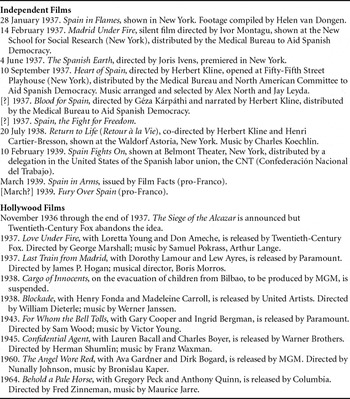
Even less studied is music in Spanish Civil War films.Footnote 14 Between 1936 and 1964, several films related to the war were produced by independent directors and, to a lesser degree, Hollywood, and are listed in Table 1. Most involved music and most sought to awaken Loyalist sympathies. Because pro-Loyalist filmmakers in Hollywood had to contend with the pro-Franco Catholic Legion of Decency and other pressures, the war was likely to serve as a mere backdrop for adventure or romance in their films, as will be detailed below. Independent pro-Loyalist filmmakers, also subject to political pressures and long at odds with Hollywood, generally enjoyed greater freedom, and groups such as the Workers Film and Photo League routinely attacked the “philistinism” and “standardization” of the major studios.Footnote 15 Accordingly, the independents have traditionally been seen as the more active participants in what Michael Denning has called a “narrative of anti-fascism,” a congeries of activities and principles that united supporters—a loose federation he calls the “cultural front”—in a broadly politicized consciousness of which defending the Spanish Republic was a part.Footnote 16
Selected Films Related to the Spanish Civil War

In the end, only a handful of pro-Loyalist films was produced. Yet they nonetheless bring to mind another of Denning's areas of inquiry, namely, the relationship between the cultural front and the culture industry. The latter, famously enshrined by Adorno and Horkheimer, has long been the subject of scholarly reflection, often with emphasis on the shallowness of bourgeois culture or, in Adorno studies, on Adorno's own elitism.Footnote 17 Yet Denning (and others) have challenged the critical practice of opposing slick, profit-oriented movies for mass consumption to “art” films charged with nuanced social messages.Footnote 18 Further, Denning detects a “contested space” between these two perspectives, one he himself considers in relation to the Hollywood “allegories of anti-fascism” of Orson Welles.Footnote 19
Perhaps no element of film offers itself as a “contested space” as aptly as music, with its capacity to suggest multiple meanings only partially conveyed by images and narrative; likewise, the perceived clash between presumably facile commercial music and more “authentic” musical utterances remains ripe for continued interrogation.Footnote 20 To further explore this “contested space,” I consider here the music of two pro-Loyalist Civil War films. The first, The Spanish Earth (1937), is an independent documentary directed by Joris Ivens, and as such, reflects the values of the cultural front. Its music consists of excerpts from recorded collections of folk and traditional music of various regions of Spain, chosen by Marc Blitzstein and Virgil Thomson.Footnote 21 The second film, Blockade (1938), is a Walter Wanger Production released by United Artists and directed by William Dieterle. It uses a score by Werner Janssen in the symphonic style typical of Hollywood's “Golden Age.” Although Blockade departs in certain ways from Hollywood's practices, it is nonetheless “a product of the industrialized Hollywood studio system” and thus reflects the values of the culture industry.Footnote 22 Thus, both The Spanish Earth and Blockade respond to the ideological premises of their respective constituencies. Both also sought to rally greater US support for the Republic. In addition, both films offer a musical argument, that is, a point of view capable of complementing or contradicting image and/or narrative and thus mediating each film's political import. In this essay, I propose that the music for each film, realized through a variety of musical codes, attempts a utopian argument.
To be sure, all the dimensions of utopian thinking and the vast literature it has generated cannot be summarized here. Yet we can highlight some relevant constants. First, the concept of utopia is filled with contradictions, often expressed in binarisms. Utopianism is either rabidly anti-philosophicalFootnote 23 or rife with interpretive complexities.Footnote 24 Utopia is either future-oriented, directing us toward “a collectivity that has not yet come into being,”Footnote 25 or it looks to the past, as with so-called primitive communism.Footnote 26 It is either personalFootnote 27 or societal; “technological . . . organizational” or “libidinal . . . aesthetic.”Footnote 28 Thus it should hardly surprise us that the term is used both to condemn and inspire. Compare, for example, George Kateb's declaration that “utopia is a bore” with Lewis Mumford's exhortation (of 1922) that “in the midst of the tepid and half-hearted discussions that continue to arise out of prohibition laws and strikes and ‘peace’ conferences let us . . . consider Utopia!”Footnote 29 We might even wonder if the idea of “utopia”—which Sir Thomas More defined in 1516 as “no place”—has any meaning whatsoever.
Yet however wide-ranging its connotations, the concept of utopia can nonetheless be called upon to critique an existing situation. Such a rhetorical strategy is especially evident in the work of Fredric Jameson, to whose thinking the main points of this essay are indebted. As one critic reported in 2000, Jameson “feel[s] the need to end many essays with a call to utopian thinking . . . to insist on our power to change the world” even as he acknowledges “how limited our utopian imagination is.”Footnote 30 Thus, for Jameson, utopia, which embodies Ernst Bloch's principle of Hope, is both a goad to action and an interpretive tool. To illuminate the ways in which society either represses or encourages the utopian impulse, especially through culture, Jameson proposes cultural analysis in utopian terms, using what he calls the “Utopian principle” as a “hermenuetic or technique of decipherment.”Footnote 31 Yet this hermeneutical application is rooted in the reality of social and political tensions, which makes it as rich in meaning as it is “useful and preeminently practical.”Footnote 32 Further, the Utopian principle is invested with both interpretive force and practical meaning, reflecting “the permanent tension of human reality towards a radical transformation of itself and everything about it, towards a Utopian transfiguration of its own existence as well as of its social context.” Provided we set our sights accordingly, such a utopian transfiguration can be realized regardless of the content or style of the cultural expression in question.Footnote 33
Can a utopian argument be articulated musically? As many have observed, music has long been seen to possess utopian properties. Some scholars have considered styles or genres in this light (Flinn, Dyer), while others are concerned with performing communities (Yri, Eyerly) or sweeping ideological trends (Dahlhaus).Footnote 34 Here, I propose that the musical arguments in these two films attempt a “useful and preeminently practical” critique of the reaction to the Spanish Civil War in the United States, at the same time that they engage with musical ideologies of the moment. In The Spanish Earth, the ideology in question is the idealization of folk music, especially as practiced by “art music” composers of the cultural front during the 1930s. In Blockade, the relevant ideology is that of Hollywood's Golden Age, that is, of commodification and distraction. Here, both are related to their respective films in light of an overarching—and “preeminently practical”—question: which musical argument makes a stronger case for defending Republican Spain? Is it The Spanish Earth, a socially sensitive documentary that relied on two modernist composers to depict the “music of the people” in accordance with the values of the cultural front? Or is it Blockade, with its political concessions and array of stock Hollywood musical codes, marked by the “philistinism” and “standardization” of the culture industry? As it turns out, closely listening to each film's musical argument will illuminate the intersections between these two ostensibly opposing forces while validating the Utopian principle of interpretation.
I. Utopia, Folk Music, and The Spanish Earth
The Spanish Earth was shot in Fuentedueña, Spain, a village twenty-five miles east of the Jarama River on the Madrid-Valencia road. That area was strategically important in the defense of Madrid, under siege since the beginning of the war. A central concern in the film is the villagers' construction of an irrigation system to increase food production for starving madrileños; images of parched earth and life-giving water recall the Dust Bowl iconography of Pare Lorentz's The Plough That Broke the Plains (1936). Also filmworthy are the villagers' everyday activities: street sweeping, washing clothes in the river, or saddling mules. Reflecting Kafka's observation that “the ordinary is itself a miracle,” these shots convey rural Spain's dignity in the face of tragedy.Footnote 35 Throughout, Ernest Hemingway's narrative emphasizes the courage of Republican soldiers while the camera suppresses all images of enemy leaders.Footnote 36 At no point does the viewer glimpse even a photograph of Franco, Hitler, or Mussolini, although prominent Spanish Republicans, such as President Manuel Azaña and officers of the International Brigades, appear in a brief, newsreel-style sequence. A human interest element emerges in the character of Julián, an eager young soldier who drills the young men of Fuentedueña during his three-day leave and whose presence prompted one critic to consider The Spanish Earth “half documentary and half fiction.”Footnote 37
Certain elements of the conflict were not be concealed, however. If Ivens avoided images of the enemy, he unflinchingly drew the viewer's attention to its most lethal tactic, the bombing of civilian populations. Although not completely unprecedented in the 1930s, previous “air control operations” had been directed almost exclusively toward rebellious colonies, as in the Royal Air Force's attacks on Iraqi villages in the 1920s. As the late Susan Sontag observed, what was shocking about the Spanish Civil War was that such things “were not supposed to happen here,” that is, in Europe.Footnote 38 Thomas Waugh, who considers The Spanish Earth the “cinematic Guernica,” has even condemned as essentially racist the shock with which the destruction of “urban apartments rather than grass huts” was greeted by US news consumers familiar with images of similar disasters in Ethiopia and China.Footnote 39 In The Spanish Earth, shots of Fuentedueña's rural calm are interrupted with scenes of brutal civilian casualties, such as the bookkeeper gunned down on his way to work in Madrid or corpses lying on a stone slab. (References to anticlerical violence, such as the church vandalism perpetrated by the extreme left since the Republic's inception in 1931, are notably absent.)Footnote 40 Other scenes emphasize preparations for battle, all taking place under a vast and imperturbable sky.
What sort of music would enhance these alternating images of simplicity and catastrophe? Most of Blitzstein and Thomson's selections were readily identified by US viewers as folk music, a genre that, as will be detailed shortly, signaled one vision of utopia.Footnote 41 Two non-folkloric excerpts hint at similar values, however, and, since they embody filmic concepts relevant to the utopian dimension of both The Spanish Earth and Blockade, are briefly considered here. The first is that quintessentially utopian statement, the national anthem. The Republican “Himno de Riego,” whose cheerful and harmonically straightforward strains resounded in the streets when the Second Republic was proclaimed on 14 April 1931, is heard in The Spanish Earth at a rally, where representatives of several militias are listening to Dolores Ibarruri, the fiery orator known as “La Pasionaria.”Footnote 42 As she rouses the crowd with her message of fortitude and hope, the camera cuts from the enthusiastic gathering to the field and the “Himno de Riego” is abruptly silenced, mid-phrase. Still, La Pasionaria's voice perseveres, now emitted over the field via loudspeaker. This stark conclusion recalls the distinction drawn by film scholar Michel Chion between empathetic and anempathetic effects. Whether through music or noise, the former participate directly “in the feeling of the scene”; the latter, on the other hand, “exhibit conspicuous indifference to the [dramatic] situation, by progressing in a steady, undaunted and ineluctable manner,” as in, Chion observes, the running shower in Hitchcock's Psycho or the fan in Antonioni's The Passenger.Footnote 43 In The Spanish Earth, the silencing of the “Himno de Riego,” coupled with the cut to the field, strips La Pasionaria's words of all fanfare, ostensibly reducing one of the Republic's most dynamic figures to a “voice in the wilderness.” Yet although no longer buoyed up by the jaunty music, the “noise” of the human voice perseveres in a “steady, undaunted, and ineluctable manner,” its idealistic message “indifferent” to the sudden throttling of its musical support.
Another non-folkloric selection, this one from an 1890 zarzuela by Fernando Chueca, also seems “indifferent” to the ongoing tragedy. The lively seguidillas from El chaleco blanco (The White Vest), “Pa' sortijas y gracia” (Fun and Games), is emitted over the Altavoz del Frente, a microphone system intended to boost troop morale.Footnote 44 First, a soldier inside a booth is shown selecting and then playing a scratchy 78. The camera then takes us outdoors, where some of the men are occupied with their weapons. As the perky zarzuela tune continues, the camera cuts back inside, where several soldiers, some of whom “have never held a rifle before,” study a map with grave, attentive faces. The incongruity between the music's “fun and games” and the situation depicted onscreen recalls the much-debated relationship between music and narrative. Central here is Claudia Gorbman's term “mutual implication” for the “narrative/music relationship,” which she proposes as an alternative to the terms “parallelism” (in which music complements image) and “counterpoint” (in which music contradicts image).Footnote 45 Also relevant are Mary Ann Doane's observations on “the ideology of the visible,” which prevails in a culture in which the phrase “‘to see’ means to understand” and in which sound is used “to reassert the notion that the world is the same as it looks.”Footnote 46
Is the world “the same as it looks” in this sequence or as it sounds? Let's first consider El chaleco blanco. In it, an impoverished young man loses a winning lottery ticket in the pocket of his white vest, which he must retrieve from the laundry if he is to win over his fiancée's materialistic parents.Footnote 47 The popular zarzuela could easily have been broadcast over the Altavoz del Frente and real soldiers might well have recognized it. Real soldiers might also recall that “Fun and Games” is sung by a bevy of high-spirited laundresses: between long stretches of nonsense syllables, these working-class women comment that their wealthiest clients give them clothes that are stained, or, as they put it, “shameful.” Indeed, as the girls brightly propose, the only solution is a drastic one—the scissors. Some real soldiers might even recall that “Fun and Games” reappears as an orchestral reminiscence in the final bars of El chaleco blanco. This parting shot, however, is a pithy aside on the social implications inherent in the zarzuela's fairy-tale ending (naturally, the young man wins over the grasping parents). For however gleefully the laundresses mock the class structure that keeps them in their degraded station—and whatever the unexpected good fortune suddenly enjoyed by one of their own—that orchestral “last word” encapsulates their collective coping with the status of “human beings converted into mere machines for the fabrication of surplus-value,” in Marx's words.Footnote 48 As for “mutual implication” in the map-reading scene, the determined singing of the “mere machines” lends urgency to the images of the soldiers' earnest faces, which beckon the viewer toward the new world to come. That world, the new social order, is neither “as it looks” nor as it sounds, but with greater US backing for the Republic, within reach.
The choice of zarzuela in this sequence relates to practically all the rest of the music in The Spanish Earth in an important way. After Franco's victory in early 1939, his regime began promoting zarzuela as the musical embodiment of españolismo (Spanish nationalism), largely because of the genre's long association with Madrid.Footnote 49 Much the way a Broadway or MGM musical might unfold in an identifiably US environment (New York City, the plains of Oklahoma), many zarzuelas are set in the Spanish capital and abound with madrileño slang, place names, character types, and references to local cuisine.Footnote 50 Few musical genres could have better matched Franco's vision of Spain, which rested on a centralized and absolute authority based in Madrid.Footnote 51 That vision, however, required repressing the regional identities of Catalonia, Galicia, and the Basque country, in part, through banning the official use of regional languages and regionalist cultural expressions, including folk music and dance.Footnote 52 Such restrictions were felt especially keenly in Catalonia, frequently at odds with Madrid. It is through this regionalist lens that the great majority of the musical selections in The Spanish Earth must be addressed. For although Blitzstein, Thomson, and viewers in the United States overwhelmingly understood the music in The Spanish Earth as a collective expression of the “folk,” much of it accentuates regionalist tensions, which, during the war, contributed to hastening the Republic's eventual demise.
Some of this regional music is so fleeting as to pass almost unnoticed. For example, we hear only a snippet of cante jondo, the Phrygian-based flamenco “deep song” common in Andalusia (southern Spain) and readily associated with Spain by the international audience.Footnote 53 A few phrases, sung by a solo voice, emerge from the buzz of aircraft and motorcycles before being overtaken by the thunder of gunshot. Equally fleeting is the reference to the Galician muniera, a compound-meter genre often accompanied by the gaita (bagpipe).Footnote 54 Yet one form of regional music is given pride of place: the sardana, symbol of Catalonian identity. Throughout The Spanish Earth, sardanas are offered not as snippets, like the other selections, but almost always in their entirety. As a result, near-complete sardanas appear eight times over the course of the fifty-minute film. Given the ongoing tension between Catalonia and the capital this is a curious balance for a film about the defense of Madrid. This privileging of the sardana thus invites reflection on how folk music was understood in the United States during the mid-1930s.
As Richard A. Reuss has noted, a clear position on folk music was lacking during the first decade of US communism (from 1919): although Marx evidently appreciated some folk song, he recognized that its potential for sentimentalizing a tainted past could threaten the new proletarian culture.Footnote 55 This new culture, which also embraced “proletarian music,” engaged US composers eager to test their mettle with complex, avant-garde techniques while still communicating to the masses. Of course, the main apologist for proletarian music was Charles Seeger, who insisted that workers would “not have any trouble” performing musically complex works (although he did advise composers to be judicious in their technical demands).Footnote 56 Exalting the masses' affinity for “high art” was part of a worldwide phenomenon. In Republican Spain, for example, the long-awaited Madrid premiere of Stravinsky's Rite of Spring in December 1932 prompted critics for the leftist press to claim that this masterwork was now securely “in the hands of the authentic people,” having been wrested from “the powerful bourgeoisie . . . [dedicated only to] protecting the most insubstantial and crude of frivolities.”Footnote 57 Not surprisingly, many composers and critics condemned folk music as an obstacle to those revolutionary goals to which the “authentic people” aspired.Footnote 58
Yet as early as the mid-1930s, several US composers began seeking a simpler, more accessible musical language. As Elizabeth B. Crist has noted, one reason for this shift was the influence of Soviet-style socialist realism; also, the Americanization of the Communist Party began to encourage the view that complexity for its own sake was uncongenial to the national psyche.Footnote 59 In one of his more spirited columns for the Daily Worker, critic Mike Gold allowed that although “a new content often demands a new form,” audiences would rightly complain if “the new form gets so far ahead of all of us that we can't understand its content.”Footnote 60 Gold also attacked “professional aestheticism,” to the point of condemning Seeger's “use of Arnold Schoenberg or Stravinsky as a yardstick [for musical criticism]” as “utopian,” reflecting that term's elasticity.Footnote 61 Tellingly, Gold notes no particular distinction between the roles of folk and commercial music in the “working-class revolution.” “What songs do the masses of Americans now sing?” he queried. “They sing ‘Old Black Joe’ and the semi-jazz things concocted by Tin Pan Alley.” “This,” he added, “is the reality.”Footnote 62
In fact, composers replaced one utopia with another. If that promised by Schoenberg and Stravinsky proved impracticable, an “emerging sense of utopia” reflecting collective identity could now be “materialized” through folk music, as Caryl Flinn has noted.Footnote 63 Again, Seeger weighed in. Convinced that US composers (himself included) had lost their way, Seeger exhorted his compatriots to draw on their own folk music, which he believed was “probably as alive as that of any ‘advanced’ country,” surpassed—not surprisingly—only by the Soviet Union and Spain.Footnote 64 Seeger urged composers to mingle with the people, to assume their status as “plain, unpretentious persons,” and to learn their songs. Composers would thus be positioned to teach the people that their “undoubtedly limited musical tastes and capacities, crippled as they have been by a century of savage industrialism and sophisticated snubbing can develop to a higher level.”Footnote 65 Reciprocity was also called for: not only were the people to be uplifted via the composer but the composer had to reject the “prejudices of music-professionalism,” with its stultifying mix of “pride and plain hokum,” so that he or she could be “forged into that link” between “the stylist and the life about us.”Footnote 66 Accordingly, the American Music League (an organization in which Blitzstein participated) was established in 1936 to “collect, study, and popularize American folk music and its traditions.”Footnote 67 Members of the African American musical community echoed these values. Harlem Renaissance leader Alain Locke complained that “[African American] musicians with formal training are cut off from the people and the vital roots of folk music.”Footnote 68 Folk music was even elevated to a kind of Platonic ideal to which other genres might aspire. Apropos “hot jazz,” Charles Edward Smith declared that “in its best moments . . . [hot jazz] has the merit of being folk music, truly expressing the creative and emotional depths of the people.”Footnote 69 As Barbara A. Zuck has observed, advocacy of folk music implicitly recognized a “musical language [that could communicate] regardless of social class,”Footnote 70 reminding us, in turn, of Jameson's tendency to “use the words utopia and classless interchangeably.”Footnote 71
In addition to this enthusiasm for the US folk tradition, folk music of other countries was seen as a beacon for the masses worldwide. When the Workers Music League Bulletin announced a concert of Latin American folk music at New York's Town Hall, the reporter declared that the event would convey only the “most burning social desires.”Footnote 72 Still, folk music's international dimension presented certain complications. An example is Woody Guthrie's “Jarama Valley,” sung to the tune of “Red River Valley.” “Jarama Valley” reflects the practice of parody (rewriting words to an existing folk melody), which some advocated over working with an original melody by a composer, since a tune “hallowed and sanctified by the people” was likelier to prompt interest in a writer's words, as Earl Robinson declared.Footnote 73 Yet parodies so conceived could give rise to unanticipated meanings. A paean to the Lincoln Brigade, “Jarama Valley” was sung at rallies at home and on the battlefield in Spain. Yet while US composers wrangled over the nature of folk and “proletarian” music, a Catalan-language version of the “hallowed and sanctified” tune that had nothing to do with the war circulated in Spain. Clearly, pro-Loyalist musical polemicists in the United States could be completely oblivious to the meaning of the music, which they so passionately debated, in the actual site of the conflict.
This brings us to the sardanas in The Spanish Earth. A sardana is a multisectional, duple-meter dance and will likely involve extended ostinati of one eighth note followed by two sixteenth notes, with sections demarcated either via a shift to the parallel major (or minor) or a shift in meter (simple to compound or vice versa). Sardanas are performed by the cobla, an eleven-player ensemble dominated by the piercing sound of the tenora, a double-reed instrument pitched in B-flat. Complementing the first and second tenora are the flabiol, a one-handed flute that introduces the dance (with his free hand, the flabiol player beats a small drum); the fiscorno (flugelhorn); two tibles (shawms tuned an octave higher than the tenora); two trumpets; two trombones; and string bass.Footnote 74 The dance is performed in a circle, with men and women alternating. Its complicated steps require not only a leader but a good bit of counting on the part of the dancers; not for nothing has the sardana has been called “a classical and mathematical dance.”Footnote 75 Unlike flamenco, with its soloistic flamboyance, proper execution of the sardana depends upon the coordination of the group, members of which must concern themselves with “count[ing] the musical beats” and “translat[ing] them into steps . . . exactly according to the traditional norms that govern [the dance].”Footnote 76 In principle, anyone may participate. In practice, however, the sardana is not for the “merely” spontaneous, since those who have not mastered the complex patterns of llargs and curts (long and short steps) join in at their peril, for one incorrect move can throw off the entire circle.
One detail that threatens rather significantly the folkloric utopia proposed by The Spanish Earth is that the sardana is not folk music at all. Rather, sardanas were composed, not collectively or anonymously authored, nor orally transmitted. The sardana attained its symbolic status primarily during the Renaixença, a late nineteenth-century flowering of Catalonian culture and language accompanied by rapid socioeconomic change. Its principal musical engineer was Pep Ventura, who, caught up in the spirit of the Renaixença, composed many of the sardanas heard today.Footnote 77 Thus, the sardana is an apt example of what Eric Hobsbawm and Terence Ranger have famously called “invented tradition”; anthropologist Stanley Brandes even considers the dance a “prototypical invented tradition.”Footnote 78 As with similar cultural expressions, the sardana has flourished in periods of fervent regional pride.Footnote 79 It also enshrines some central values of Catalonian identity, such as sobriety, calculation, skill mastery, and, depending on one's point of view, group solidarity or clannishness. Further, in its capacity as “the true national anthem of Catalonia” (the “sincere dance of a people,” as Catalan poet Joan Maragall claimed), the sardana possesses characteristics that do not simply mirror “underlying” social and cultural patterns but that themselves generate meaning.Footnote 80 For the sardana is certainly “democratic” if we allow that anyone may join in. But that “anyone” will need to have undertaken special study to perfect the complicated steps or, in the case of the cobla musicians, have studied for years to master note-reading and the technical demands of their instruments. As such, participation in the sardana proposes an us/them dichotomy, an understanding that those who have mastered the intricate patterns are different from those who have not. In essence, it was an us/them dichotomy that caused Franco to ban the dance during the initial stage of his regime. For the dictator well knew—and feared—that for many Catalans, “them” was Madrid and being one of “us” implied, from a Catalanist standpoint, resistance to Madrid's centralized authority.
With these points in mind, we consider representative sardanas in The Spanish Earth. One of the more emblematic, “La Santa Espina” (The Sacred Thorn), dominates one of the film's initial sequences. Written in 1907 by the Catalan composer Enric Morera, its identity-conscious sentiments are crystal clear. “We are and will be the Catalonian people . . . there is no land more splendid under the sun,” proclaim Àngel Guimerà's lyrics, complemented by the instrumentation and formal requirements described above. We first hear “La Santa Espina” (in an instrumental rendering) in the back room of a bakery. Accompanied by the flabiol's introit, two men knead dough and place baked loaves on a long tray beneath war propaganda posters. The camera then takes us to the rhythm of village life: women sweeping, drying laundry on the ground or seeing off their husbands, who depart in a mule train to work on the irrigation project. The camera then swings back to the bakery, where the baker passes fresh loaves to smiling young housewives through a small window. Each loaf bears the stamp of the Unión General de Trabajadores (UGT), the socialist labor union.
Yet rather than reflect collective solidarity, the unabashedly Catalanist music contradicts the utopian images onscreen. For almost three decades prior to the outbreak of the war, Catalanist agitation had been intensifying. During the Setmana trágica (Tragic Week) of 1909, Barcelona was convulsed with riots over enforced military conscription and high tariffs—that is, over what many Catalans perceived as Madrid's administrative incompetence.Footnote 81 In 1931, when the Republic was proclaimed, separatists urged Catalonia to “declare war on Spain”; although politician Lluis Companys tried to sound a more moderate note, he nonetheless proclaimed a “Catalan Republic.” In October 1934, during a general strike (elsewhere in Spain, a full-scale revolution broke out), a Catalan rebellion was swiftly crushed by the Republic's army, and Companys and the entire Catalan government found themselves in jail. Even if some socialists and Republicans considered Catalonia “the last remaining outpost of the ‘authentic’ Republic,”Footnote 82 Catalans themselves were far from unified: the leftist Esquerra party was composed largely of small businessmen and the lower middle class while another entity, the Lliga Catalana (Catalan League), attracted powerful Catalan industrialists alarmed by the infiltration of anarchist, anarcho-syndicalist, Trotskyist, and communist elements among their factory workers. Finally, some in Republican circles felt that Catalonia was not pulling its weight militarily.Footnote 83
Enhancing this lack of consensus in the “Santa Espina” sequence is the UGT stamp on the loaves of bread. “It is good bread,” the narrator intones, “stamped with the union label.” In fact, the UGT was often at odds with Spain's other principal labor union, the anarcho-syndicalist CNT (Confederación Nacional del Trabajo); as in the realm of regionalist tension, conflicts between communists and anarchists simmered within such organizations.Footnote 84 To be sure, the women's satisfied faces reflect the prospect of nourishment achieved through community; as in the New Testament, a higher power—the union—provides the loaves. Yet the UGT stamp, together with “La Santa Espina,” suggests not the utopian “union” to which the narrator alludes but rather factionalism and intransigence.
This musical “indifference” (to return to Chion's term) continues unabated. Following on the heels of “La Santa Espina” is another sardana, “El Saltiró de la Cardina” (The Goldfinch's Leap), by Vincens Bou. The long sequence it accompanies shows the initial stages of the irrigation project: as the men plow, measure, and guide their mules, we hear almost the entire sardana until it is overwhelmed by gunfire. But within seconds isolated, out-of-tune fanfares cue yet another sardana, “Camprodón,” by Joan Manén. Initially “Camprodón” (the title refers to a city north of Barcelona) accompanies a line of sober-faced men ascending a hill in preparation for battle. We then revert to the homelier side of the conflict, with images of soldiers eating, reading the paper, and getting a shave at a makeshift barbershop. During the shaving sequence we hear the section of “Camprodón” that quotes the Catalonian folk song “La Filadora” (The Girl Who Spins). Normally sung in 3/4, here, the folk song is fitted into duple time in keeping with the sardana's traditional—and inflexible—norms.
What happens if we apply Jameson's Utopian principle to The Spanish Earth? Certainly the film embraces several utopian values. It upholds simple, rural life even as the water irrigation system prods Fuentedueña into a world of enlightened technology. It emphasizes societal well-being and solidarity, and, in isolated moments, highlights personal satisfactions. Yet rather than enhancing these values, the music unwittingly subverts the utopia evoked onscreen. Undoubtedly unaware that the sardanas so abundant in the film were not the spontaneous utterances of “plain and unpretentious persons” but rather were composed in response to—and as an agent of—a controversial ideology rooted in the real world of political strife, Blitzstein and Thomson could not have anticipated their musical selections' potential for “indifference.” Does this lapse negate the efforts of Ivens and his crew? Does it call into question the idealization of folk music? Before we reflect further on this apparent misreading by the cultural front, we turn to Hollywood's musical argument on the Republic's behalf.
II. Hollywood as Utopia: Blockade
As we have seen, Mike Gold had no qualms about equating the folk song “Old Black Joe” with “the semi-jazz things concocted by Tin Pan Alley,” given “the reality” of their appeal to “the masses of Americans.” In this section, I discuss ways in which the score of Blockade, like The Spanish Earth, attempts a utopian argument, despite political pressures and Hollywood's constraints. Blockade, however, relies more on “mutual implication” through a complex web of musical styles, which, because of their currency among viewers, suggest something akin to Gold's “reality.”
Blockade drew on the energies of several like-minded collaborators. By the time it was released, director William Dieterle and screenwriter John Howard Lawson had been identified as “leading Hollywood leftists”; Lawson, for example, was a member of the CPUSA and had served as treasurer of the Medical Bureau to Aid Spanish Democracy. Producer Walter Wanger, a well-known anti-fascist, had a reputation for defending freedom of speech on screen.Footnote 85 Composer Werner Janssen, a native New Yorker, had studied conducting with Weingartner and composition with Respighi. Assisting him were Ann Ronell, music director Boris Morris, and conductor Irwin Talbot.Footnote 86
Denning has called Blockade “the one Hollywood film made about the Spanish Civil War.”Footnote 87 Yet, as noted, it was hardly Hollywood's only attempt to nudge the movie-going public's attention toward Spain. In November 1936, Twentieth-Century Fox announced The Siege of the Alcazar, to feature Barbara Stanwyck and Robert Taylor under Henry King's direction. It would dramatize an emblematic event: in the first weeks of the war, a group of Franco's rebels holed up in Toledo's stone fortress, the Alcázar, resisting Republican offensives for seventy days so that Toledo ultimately fell to the Nationalists. The Siege of the Alcazar was abandoned, however, and all press announcements ceased by the end of 1937, by which time Franco had called Roosevelt “a true gentleman” for not taking sides.Footnote 88 The same year, Paramount produced Last Train from Madrid, a “topical melodrama” billed as “the first picture in the market dealing with the Spanish conflict” and the first to “capitalize on the tragedy of Spain.”Footnote 89 Featuring Dorothy Lamour, Lew Ayres, and Anthony Quinn, Last Train from Madrid received mixed reviews, with one critic noting that it kept “carefully away from the political issues.”Footnote 90 Also in 1937, Fox produced Love Under Fire, set in Spain. Directed by George Marshall, it featured Loretta Young and Don Ameche, and, although seen to be “aided by the newspaper buildup of the revolt in Spain,” the film took its setting as little more than a backdrop for romance and adventure.Footnote 91 There was also Frank Davis's Cargo of Innocents, which proposed to treat the evacuation of children from Bilbao but was shelved in 1938.Footnote 92 It is worth noting, too, that the Motion Picture Artists Committee worked on behalf of the Republic and from 1938, under the chairmanship of Dashiell Hammett, collaborated with British Liberal leader Lloyd George, the Duchess of Athol (the so-called Red Duchess), and President Lázaro Cárdenas of Mexico, the only other country besides the Soviet Union that aided the Republic.
The films just mentioned, with their strong dose of fantasy and overdetermined human interest element, might be considered little more than commodities, with their sole purpose to make money by distracting the public. Such an abased status might even suggest that they ultimately trivialize the war. Yet rather than dismiss these films out of hand, we might instead interrogate them as representatives of a given cultural domain, just as we have questioned folk music's capacity to represent utopia. In doing so, we must accept the idea that the cultural domain in question is not “separated from economic, political, and social life but . . . intersects with . . . other social fields.”Footnote 93 Thus, while we remain mindful of Hollywood's ideological postures and aesthetic gaffes—amply manifested in Blockade—we can at the same time open ourselves to the possibility, as Jameson proposes, that “even a cultural product whose social function is that of distracting . . . can only realize that aim by fastening and harnessing our attention and our imaginative energies in some positive way and by some type of genuine, albeit disguised and distorted, content.”Footnote 94
Certainly Blockade “disguises and distorts” the Spanish Civil War in some rather remarkable ways.Footnote 95 Its studied vagueness vacillates between a bucolic utopia (“an imaginary district in Southern Spain,” as critic Douglas Churchill put it) and the frustrations of fighting for it.Footnote 96 The protagonist is an idealistic young peasant, Marco, played by Henry Fonda. His very name (the Spanish equivalent is “Marcos”) is but one of a series of Italianisms: the coastal towns in which the drama unfolds, Montefiore and Castelmare, seem to have been selected from an Italian tour guide, as does an advertisement in a store window for “Vino secco” (the Spanish is “seco”). Even the bulls suffer from ill-defined identities: according to Carlos Fernández Cuenca, those shown in the opening scene are not Spanish at all but American.Footnote 97
Still, as Jake Barnes remarks in Hemingway's The Sun Also Rises, “it really was Spain.” We learn this in the first frame, which reads “Spain: the spring of 1936,” although this is the only time the word Spain appears, either in print or in dialogue. Other details that confirm a Spanish setting would register only with initiates. The townspeople of Castelmare (the name is reminiscent of Castellón de la Plana, on the Mediterranean) drink horchata, a sweet, milk-based beverage associated with Valencia but popular in many regions of Spain. Standing out among the opera buffa place names is Tarragona, a real city, also on the Mediterranean. Granada, too, is mentioned, albeit less than satisfactorily: shortly after the war begins, Norma, the beautiful daughter of an art dealer (Madeleine Carroll), travels by car to that Andalusian city with her father and one of his crooked companions so as to be “out of the danger zone.” In fact, Granada was convulsed with violence in the early weeks of the war (nearby Víznar was the site of Lorca's assassination). Similarly leveled are the majority of Blockade's characters. A foil to Marco is his roly-poly buddy, whom Fonda addresses as “Lewis” (the name appears in the final credits as “Luis”). As acted by Leo Carrillo, Lewis is a pleasantly goofy, “mañana-is-good-enough-for-me” innocent, a Hispanic stereotype that has served Hollywood for decades.Footnote 98 Norma, as the blond society goddess, exudes sophistication.
Both story line and music must support this flip-flopping between contemporary reality and a hazy, depoliticized realm. The action begins on a lovely day in the country, with Marco and Lewis engaging in a friendly debate on modern agricultural methods, which Marco defends. A fancy car drives up and suffers a small accident. The driver, Norma, is unharmed and insists on continuing to Castelmare. Marco, playing Don Quixote to Lewis's Sancho Panza, offers to accompany her in the damaged car, which he resourcefully hooks up to two oxen so that Lewis may drive them. During their conversation in the “Oxen Express” it becomes clear that despite Marco's humble station, he knows what's important in life. The worldly Norma, on the other hand, is confused. Like Marie Antoinette playing milkmaid, she confesses her appreciation for sun, soil, and life's simple pleasures even as we sense her reluctance to part with deeply ingrained habits.
Defying their difference in social station, Norma and Marco become attracted to each other and after many longing gazes part in Castelmare with Norma giving him a flower. When war breaks out (its cause is never quite clear) Marco joins the people's army, quickly rising in its ranks. Before long, he discovers that Norma, whose girlhood was disrupted by the Russian Revolution, is spying for a corrupt army official. Can he still adore her? Various circumstances throw the two together (at one point Marco must kill Norma's father) and the specter of unrealized love hovers. Finally, after Norma observes at close range the stoicism of innocent civilians—and having seen “the eyes of the children”—she is won over to the people's cause and the unlikely love affair is cemented when she and Marco prevent a supply ship, the Fortuna, from being torpedoed so that it can bring food to a starving Mediterranean town.Footnote 99 In the final scene, Marco's superior officer commends him for this action, granting him leave to enjoy a few days of “peace.”
The music of Blockade addresses this interplay of compromise, limitation, and thinly veiled Loyalist sentiments through three principal means: (1) diegetic music, using both folk and commercial idioms, (2) leitmotivs, and (3) allusions to the genre of the musical. All are compatible with the practices of Hollywood's Golden Age, which, in its “social function of distracting,” sought to extend its own “promise of utopia,” as Flinn observes.Footnote 100 In addition, certain moments in the score are highlighted by a distinctly modernist musical language, suggesting a rapprochement among musical styles.Footnote 101
Some of the diegetic folk-like music recalls Mike Gold's remarks. Here, the equivalent of “Old Black Joe” is Lewis's paean to the simple joys of “a jug of Porto” (shown in Example 1). Its mixed meter, Mixolydian mode, and Scotch snaps (presumably to convey natural speech rhythms) all serve as signifiers. Seeger's “plain and unpretentious persons” would feel very much at home singing this song, but use of the exclamation “!‘Ay!” identifies it as Spanish. Upon hearing Lewis's unaffected singing, Norma remembers happier times, when her father “used to sing little songs like that.” The restorative power of these “little songs” resurfaces when Norma, seething with resentment over her father's death, travels by train to Castelmare and hears several soldiers lustily celebrating “a jug of Porto” with the same song, now accompanied by what seems to be the bandurrías (the hybrid Spanish instrument, of the guitar family, is never actually shown). She decides to leave her compartment door ajar so as to hear the singing. It is folk music, therefore, that gives the venial Norma pause, hinting at her eventual conversion to a cause she does not yet understand.
Werner Janssen, “Jug of Porto,” Blockade (1938). Transcriptions prepared by the author.

Folk-like music also hails the film's deus ex machina, that is, the delivery of food from the deck of the Fortuna. This is also one of few instances in which a film scholar refers to Blockade's music: here, Kathleen Valleau finds it to have “ludicrous folksy gaiety.”Footnote 102 What actually happens, musically? The horn announces the unloading of the food by referring to a pentatonic chant (slightly altered) universally associated with children. The trumpet responds and eventually low brass enter contrapuntally, in a playful polyphony (and instrumentation) reminiscent of Revueltas's lighter moments (shown in Example 2). Then, a pseudo-pasodoble kicks in as food items are lowered from the ship.
Janssen, Arrival of the Boat, Blockade.

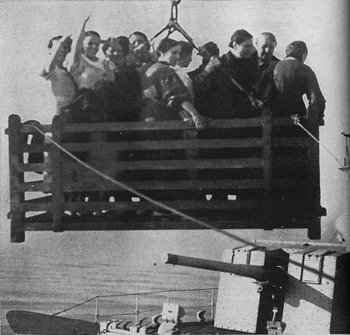
Among these is a cow fidgeting in a box-like crane, a shot that recalls a photo in Life magazine, then covering the war in some detail. In the issue of 10 May 1937, that is, in the immediate aftermath of Guernica, the magazine ran a report on the recent breaking of one of Franco's blockades by the British captain W. H. “Corn” Roberts, including photos of refugees being lifted in a similar conveyance (shown in Figure 1).Footnote 103 In Blockade, the camera sidesteps any identification with Republican Spain by swooping into the town chapel, where a woman is lighting a candle before the Virgin, an image surely directed at traditionalist Catholic viewers.
Evacuation of Basque women by a British destroyer, Life, 10 May 1937. Courtesy AP/Wide World Photos.

While the festivities continue, the music relaxes into a plagal cadence and the sequence concludes with a baby sucking contentedly on a full bottle of milk. Viewers are thus prompted to respond as Norma does: the children's chant that launched the sequence, signaling hope to the collective, culminates in an “Amen” to the well-being of an individual child. It thus elicits humanitarian sympathies and outrage over attacks on civilians rather than adhesion to one political position or another. At the same time, the “ludicrous folksy gaiety” of the Spanish musical signifier, the pasodoble, engages in a subtle relationship of “mutual implication” between the action onscreen and its real-life representation as found in the pages of a mass-circulation magazine.
Diegetic music on a par with the “semi-jazz things concocted by Tin Pan Alley” emerges in “Beloved, You're Lovely,” a ballroom number with a beguine rhythm and orchestration worthy of bandleader Xavier Cougat. Evoking Norma's world of sophistication and artifice, “Beloved” is first heard as underscoring for Marco's recitation of the first four lines of Byron's “She Walks in Beauty” as he and Norma ride to Castelmare in the “Oxen Express.” (Although Byron may seem an odd choice, a quote from Espronceda or Bécquer would have been lost on the average US viewer.) Later, “Beloved” is sung in a tavern by a guitar-playing crooner dressed in the dark felt hat, velvet lapels, and elegantly cut suit of a jinete, or Andalusian horseman, with suitably sentimental words sung in the falsetto range. Marco, who has entered the tavern to look for spies, pauses to listen and withdraws Norma's flower from his pocket; by caressing it, he leaves no doubt that like Don José in Carmen, he, too, is susceptible to love, even if Norma has not yet been won over to the cause. Thus the mellifluous phrases of the stylized, “semi-jazz” song invite Marco to contemplate utopian union, both political and libidinal, with his own beloved, a microcosm of the human interest appeal on which the true political message of Blockade was forced by Hollywood to depend.
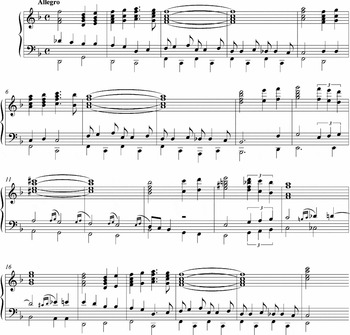
As for leitmotivs, their main source is the march that accompanies the opening credits (shown in Example 3). Here, the viewer confronts the image of a white eagle on a white background, suggesting the inherent purity—or neutrality—of the US national symbol. A series of regular, four-bar phrases unfolds, with a largely stepwise melody and simple repeat structure, similar to many a newsreel march. Yet, like the posters hawking horchata, the music confirms that “it really [is] Spain” through Phrygian inflections, such as D-flat–C (tenor) in m. 4 and m. 8; the large-scale motion to V/vi via half-step (B-flat major in m. 9 yielding to A major in m. 11); and the embellished Phrygian tetrachord (tenor) in mm. 11–12. Another stock signifier of “Spanish temperament” is the triplet figure in m. 10 and m. 14, with its duple/triple tension. Equally “Spanish” are the augmented seconds, E–D-flat, in m. 4 and m. 8 (tenor).
Janssen, March, main title, mm. 1–21, Blockade.

One especially persistent leitmotiv derives from the march's initial phrase. In the first scene, as Lewis is playing a rustic wooden flute to his flock of sheep, Marco launches into a disquisition on the virtues of fertilizer, which Lewis has never seen. Grasping a fistful of soil, Marco insists, “This dirt gives us bread and wine!” Here, the bass clarinet interjects the march leitmotiv (mm. 1–4), asserting imminent progress over moribund tradition. Unimpressed, Lewis returns to his flute and, in an accent that jars with Fonda's American English, retorts, “When you get a tractor, I will get a saxophone!” Lewis's good-natured rejection of modernization, symbolized by a reference to the jazz instrument par excellence, prepares the viewer for his eventual role in the cause, which he comes to embrace as fervently as Norma. It also alludes to a theme some have detected in Spanish Civil War imagery, namely, the opposition between mechanization, presumably advocated by the Nationalists, and a more “authentic” contact with nature, presumably represented by the Republicans.Footnote 104 Later, when Marco and Norma are trapped in a cellar after an enemy attack, Lewis breaks through a pile of rubble to rescue them. Just before the rocks tumble away from the escape hatch, the leitmotiv, now in D minor and in the English horn, accompanies Marco's agitated declaration of love for his country.
At two other plot points, the same leitmotiv heralds more overtly utopian musical procedures. The first occurs just as the war begins. After enjoying an evening swim, Marco confesses to Lewis his interest in Norma, although he is resigned to the fact that nothing will come of it. “What's it matter?” Marco complains. At that moment, we hear the leitmotiv in F-sharp major in the strings, a “romantic” orchestration set here in parallel thirds, hinting that the oncoming conflict and Marco's sentiments as a man in love will proceed in tandem. As noted, Marco is much concerned with the land. “This [land] belongs to us, Lewis,” he remarks, a declaration some US viewers might have interpreted as advocating private ownership. “Nothing can take it from us!” he adds.Footnote 105 Seconds later, the march leitmotiv, now in the English horn, and again with chromatic alteration, intermingles with the sounds of distant gunfire, highlighted by a trumpet call reminiscent of Rimsky-Korsakov's Capriccio espagnol. A massive evacuation begins, and as streams of peasants haul bedding, furniture, and other household items, a Phrygian second is urgently reiterated in the strings. His voice tinged with desperation, Marco shouts to the retreating crowd, urging them to stay and defend their land. “But this isn't our fight!” Lewis protests, echoing the sentiments of many US viewers. “You're wrong, Lewis,” Marco counters. “This is our fight! This earth, this valley—it belongs to us, it's part of us!” The music stops on a dime and suddenly the peasants pause to listen to Marco, digesting his words in stunned silence. Then, an explosion from the river ushers in a full-blown rendering of the march, now in a choral setting. As disembodied voices resound from some unknown realm—some “no place”—the peasants make an about-face and march briskly to confront the enemy. Another choral rendering of the march occurs when the Fortuna triumphantly enters the harbor at Castelmare (just before the foodstuffs are unloaded to the children's chant). Again, we hear the disembodied voices, faintly at first, singing the now familiar melody as the Fortuna approaches. Gradually, the music reaches those on the shore. The women praying in the chapel turn in surprise. A sympathetic foreign correspondent asks, “What's that?” and steps onto the balcony of his pensión. As the jubilant song grows louder the inhabitants of Castelmare flock to the shore, and quite literally, the “ship comes in.” With the human voices soaring from somewhere outside of immediate reality, the viewer reasonably anticipates a happy “Hollywood ending.”
To be sure, in neither of these choral sequences do actual characters sing. Yet the sudden intervention of massed voices, occurring at important plot points, powerfully invokes what many consider the defining gesture of the Broadway or Hollywood musical, that is, spontaneously “bursting into song.” As such, the sung march reminds us of the utopian sensibility of that genre, a phenomenon Richard Dyer has explored. For Dyer, the musical embodies two “taken-for-granted descriptions of entertainment . . . ‘escape’ and ‘wish-fulfillment’ . . . the stuff of utopia.”Footnote 106 Yet, Dyer cautions, the musical offers not organized “models of utopian worlds,” such as those suggested by Sir Thomas More or William Morris, but hints at “what utopia would feel like.”Footnote 107 Given the political situation from which Blockade tries so hard to distance itself, this nod to the musical is striking. For clearly, the sung march invites us to experience “what utopia would feel like.” Yet since no characters participate directly in either of these peak musical moments, the “feeling of utopia” thus adumbrated is experienced as strictly vicarious. Can the optimistic singing—and the possibility of “utopian transfiguration” it promises—transfer itself to our lives? As with Jameson's “cultural product whose social function is that of distracting,” these incongruous gestures borrowed from the genre of “escape” and “wish-fulfillment” sum up in a few measures the compromise and indecisiveness Blockade embodies at the same time that they invite viewers to engage “in some positive way,” that is, to support the Spanish Republic.
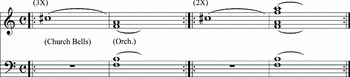
As for Blockade's modernist music, it addresses other ideologies. In another scene undoubtedly intended to placate US Catholics, Marco, Lewis, and Norma are on their way to Castelmare in the “Oxen Express” and hear church bells, rung by a nun (shown in Example 4). Lewis stops so that he and Marcos may remove their hats and bow their heads; Norma, less reverent, murmurs something about “peace.” Yet the open-ended whole-tone sonorities, without harmonic resolution, that alternate with each of the five rings suggest not the “peace” of a rural convent but hint at the uncertainty to come, perhaps even alluding to the inconclusiveness of church-state debate.
Janssen, Angelus Bells, Blockade.

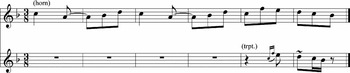
Another example is the opening scene in which, as noted, Lewis plays to his sheep on a wooden flute (shown in Example 5). The melody is anything but “rustic” or “simple,” however. Its chromatic inflections and range would be difficult to sing; additionally, the concluding pitch, C, sounds unexpectedly open-ended for a melody so strongly rooted in E. Although one critic expressed wonderment that a “simple shepherd should play a tune which sounds like an afterthought inspired by . . . Debussy's Afternoon of a Faun,” the sheep are quite taken with this modernist style, as Lewis himself notes.Footnote 108 Their attentiveness suggests that even unschooled masses can digest less-than-straightforward music with “no trouble,” as Seeger argued in 1934. In short, the flute melody fulfills the requirements of proletarian music.
Janssen, Shepherd's motive, Blockade.

If these brief departures from Hollywood codes tell us we're watching a “serious” movie, so does Blockade's conclusion. Instead of the happy ending the triumph of the Fortuna might lead us to expect, the movie closes with a blistering speech delivered by Fonda that plays on post-Guernica outrage over Franco's bombing of civilian populations. “Peace?” Fonda splutters. “Where can you find it?” He goes on:
Our country has been turned into a battlefield! There's no safety for old people and children. Women can't keep their families safe in their houses, they can't be safe in their own fields! Churches, schools, and hospitals are targets. It's not war, war's between soldiers. It's murder. Murder of innocent people. There's no sense to it. The world can stop it! Where's the conscience of the world?
With Fonda taking the same impassioned—but nearly desperate—tone as in the rallying scene, the march comments with a string-heavy orchestration. As we hear his words and listen to the music, is the earlier scene, in which he single-handedly persuaded the peasants to fight for their land, in our minds? Are we viewers alive to the same hope that motivated the peasants by the river, their sudden idealism heightened by the singing of disembodied voices, or is the reality as bleak as Fonda now paints it? In response to his final question, “Where's the conscience of the world?” the film reverts to the white eagle on the white background, the image with which Blockade began. Now, however, the neutrality of its overwhelming whiteness has been unsettled by a musical argument that doggedly proposes utopia even as it chafes under aesthetic conventions and political expediency.
Reactions to the two films were remarkably similar. With Blockade, Fonda's final harangue marked it as pro-Republican. The German and Italian embassies pressured United Artists to withhold the film and Life magazine observed that Blockade would be considered “a stern indictment of General Franco.”Footnote 109 Indeed, Life, the same publication that ran photos of the real blockade, held that what saved the “hackneyed and dull” story was Blockade's realism, stating: “[W]hat really brings [the film] to life with sledge-hammer force is its almost newsreel version of the Spanish war . . . done with magnificent fidelity.”Footnote 110 Of course, the Catholic Legion of Decency weighed in. Joseph Breen, head of the Production Code Administration since 1934, had initially approved the script since, in his view, neither place names, uniforms, nor, as Frank Walsh points out, “even songs,” had anything to do with the Civil War.Footnote 111 Yet many in the Church were not persuaded and, under pressure from Catholics, Blockade suffered delays and calls for boycotts.Footnote 112 Eventually, it received a special classification from the PCA, along with the accompanying statement that “many people will regard this picture as containing foreign political propaganda in favor of one side in the present unfortunate struggle in Spain.”Footnote 113 The Catholic right had reason to worry: Blockade did well at the box office and leftist publications such as The Nation, New Masses, and American Guardian embraced its message, as did non-Catholic religious groups such as the YMCA, the Federal Council of Churches of Christ, the Board of Education of the Presbyterian Church, and the Council for Social Action of the Congregational Church.Footnote 114 All this publicity, negative and positive, gave Blockade greater success than it perhaps merited and at the Academy Awards it was nominated for best original score, although Erich Wolfgang Korngold's The Adventures of Robin Hood won. Of greater significance is that Blockade was carefully watched by the industry for indications of how films with any political content whatsoever—even when conspicuously diluted—would be greeted.Footnote 115
The Spanish Earth proved similarly controversial. After a special viewing at the White House in July 1937, Roosevelt posed several questions to Ivens and Hemingway about the war, although he ultimately took no official action on behalf of the Loyalists.Footnote 116 The Catholic and right-wing press reacted indignantly to the White House event. The Inland Catholic of Spokane, Washington, ran a column provocatively titled “Lure President into Backing Radical Film,” railing against “tireless propaganda . . . carried on . . . by the radical sympathizers with the Communist portion of Spain.”Footnote 117 The Brooklyn Tablet described Ivens and his collaborators as “radicals,” and the Michigan Catholic dubbed The Spanish Earth a “leftist movie.”Footnote 118 Mrs. A. Mitchell Palmer, widow of the former US attorney general, condemned The Spanish Earth as “horribly gruesome and not proper for general release.”Footnote 119 Yet several critics applauded the film's artistic merits, some even hinting that these helped neutralize anxiety over its political message. “As it happens,” insisted one reviewer, “The Spanish Earth . . . has appeared for five weeks in New York without causing any comment save praise for the excellence of its photography.”Footnote 120 Concurring here was Frank Scully, who wrote a largely sympathetic review in Variety.Footnote 121 Another critic commended Ivens's emphasis on the dignity of human existence,Footnote 122 while Sidney Meyers and film composer Jay Leyda held that The Spanish Earth combined “exquisite tenderness with consummate craftsmanship” so aptly that the film was sure to appeal to “broad audiences.”Footnote 123 Another critic admired the “startlingly beautiful and expertly photographed scenes” and the “effective musical background,” despite the conspicuous absence of any shot of “a desecrated church, a butchered nun or a murdered priest.”Footnote 124 Indeed, as Russell Campbell would observe decades later, The Spanish Earth suppresses the communist presence in Republican circles to the point of overlooking the fissures on the Loyalist side.Footnote 125
As I have argued here, the sardanas in The Spanish Earth subtly expose some of these fissures. Yet remarks on the music by contemporaneous reviewers are so scant as to suggest that its folkloric intent was so widely understood that little comment was necessary. Evidently, the “Spanish folk tunes” succeeded in persuading viewers of “a quiet and lilting reminder of prewar happiness,” as one later critic would have it.Footnote 126 In fact, the only reviewer to discuss the music at any length was George Antheil. In his column “The Hollywood Front,” Antheil describes The Spanish Earth as a “remarkable” film and applauds its “anti-Hollywood” tendencies. He especially admired Blitzstein and Thomson's rejection of literal underscoring, believing, like other critics, that Blitzstein and Thomson composed an original score. He adds that “many intelligent persons” liked the music. But ultimately Antheil is unconvinced: despite its anti-Hollywood zeal, the music, he maintains, “plays against its picture in an odd way,” and failing to “play either for or against any specific ideas; it merely strings along.”Footnote 127
Of course, Blitzstein and Thomson's score did “play against” the message of the film and did articulate “specific ideas,” although not those the production team intended.Footnote 128 Blockade, on the other hand, was produced, written, and edited to avoid direct association with Spain. We began this essay by asking whether the music of The Spanish Earth or Blockade makes a stronger case for defending the Spanish Republic. Even if The Spanish Earth misreads its materials, even if Blockade is the richer of the two (due in part to the greater resources available to Janssen), we cannot realistically declare one or the other a “winner.” What emerges instead is far more interesting: the extent to which listening to the two films crystallizes the intersections between the cultural front and the culture industry. This overlap emerges not only in the aesthetic values each film espouses but in the reaction each sparked. For just as the true motivation of Blockade was recognized (and contested) by its public, The Spanish Earth inspired its core constituency: unions, cooperatives, liberal church groups, and anti-fascist organizations all raised funds for the Republic despite the exigencies of the Depression.Footnote 129 Returning to Jameson, we are thus reminded that “utopian transfiguration” can arise from utterances, musical or otherwise, that have been “disguised and distorted,” whether by the cultural front or the culture industry. The “permanent tension” between society and its quest for utopia, infinitely susceptible to theorizing, may thus be ultimately reducible to what is probably the most enduring definition of utopia, namely, Thomas More's “no place.” A scene from Hemingway's For Whom the Bell Tolls, the quintessential Spanish Civil War novel, is apt here. Protagonist Robert Jordan, fighting in Spain for the Loyalists, initiates a long rhapsody in which he and his Spanish lover Maria anticipate life together someday in Madrid. Yet both know it is a Madrid that will never come to be and that talking about it is simply a way to sustain them in the terrible present. Finally Maria exclaims, “If we live nowhere . . . better.” If utopia is “nowhere,” if it exists solely as a critical tool, as an ineffable yet exacting standard—as a function of Hope—then music, open-ended and hermeneutically elusive, is the ideal vehicle with which to convey this sense of no place that nonetheless so often seems to feel as if it were just within our grasp.