Introduction
On 10 February 1948 Moscow's Politburo launched an ideological campaign called the ‘Resolution on Vano Muradeli's opera The Great Friendship’.Footnote 2 This directive started one of the fiercest campaigns in Soviet musical life, not only during the Stalinist period but throughout the entire history of Soviet music (Herrala Reference Herrala2012, p. 2). The campaign, which was directly connected to the international situation associated with post-WWII conflict between the West and the Soviet Union at the beginning of the Cold War, launched an attack against formalismFootnote 3 in music.
A month after the announcement of The Great Friendship campaign, on 21 March 1948, the word jazz disappeared from the official name of the state-owned Eesti Raadio džässorkester (Jazz Orchestra of Estonian Radio). The politically incorrect name – including the word ‘jazz’ – was replaced a year later with the more appropriate Eesti Raadio estraadiorkester (The Estrada Orchestra of Estonian Radio). The disappearance of the name of Eesti Raadio džässorkester is described by Estonian journalist and jazz historian Valter OjakäärFootnote 4 as the beginning of the ‘hidden-name period’. His suggestion is based on the fact that the ideological campaign of 1948 involved the authorities' trial to prohibit jazz and to hide the word from public discourse (Ojakäär Reference Ojakäär2008, p. 166).
However, the Resolution on Vano Muradeli's opera The Great Friendship was just one signpost in the ideologically driven journey of jazz towards its extinction from the public arena in the Soviet Union. In order to present the entire course of the attempt to silence jazz in Soviet Estonia, this article investigates the period of late Stalinism (1944–1953), which coincided with the country's Sovietisation. Through a close reading of jazz-related texts of the Estonian cultural newspaper Sirp ja Vasar (Sickle and Hammer), the article focuses on the dynamic of the processes which led to the temporary exclusion of jazz from public discourse. It also seeks to reflect on the complex interplay between ideology and discourse. This study tries to show the ways in which the meaning of jazz was constructed in official public narratives of the time.
In a disciplinary sense I would like to locate my investigation in the field of jazz studies. Jazz is more than ever understood as a practice developed through a range of influences and exchanges (Whyton Reference Whyton and Whyton2011, p. xx). I would call this heightened interest in intercultural dialogue and acceptance of pluralistic views a paradigm shift leading to the globalisation of the discipline of jazz research (Reimann Reference Reimann2013). The cultural/historical space which has, however, remained relatively neglected is the former Eastern bloc. For whatever reason, there is little written on Eastern European jazz in scholarly journals and books. The first attempts to bring together scholars interested in Eastern European jazz was the Warsaw conference ‘Jazz Behind the Iron Curtain’ in 2008, with a collection of articles based on the conference published in 2010. As the organiser of the conference and editor of the book, Rüdiger Ritter, stated: ‘For the first time, a few isolated strands of research were being combined to create the new approach to jazz in Eastern and East central Europe’ (Pickhan and Ritter Reference Pickhan and Ritter2010, p. 7).
As the dearth of publications indicates, Soviet jazz as a scholarly subject has received relatively little attention. The only extensive scholarly monograph on jazz in the Soviet Union is still S. Frederick Starr's Red & Hot: The Fate of Jazz in Soviet Union, published in 1983. Other authors include Gaut (Reference Gaut, Bruckner and Weiland1991), Novikova (Reference Novikova and Raphael-Hernandez2003), Lücke (Reference Lücke2004, Reference Lücke, Pickhan and Ritter2010), Minor (Reference Minor1995), Feigin (Reference Feigin1985) and Belichenko (Reference Belichenko2006), as well as my own articles on Soviet Estonian jazz (Reimann Reference Reimann, Pickhan and Ritter2010a, Reference Reimann2010b, Reference Reimann and Mäkelä2011), which have helped to add to the perspectives on jazz in the former Soviet Union. Russian authors writing on Soviet jazz include Batachev (Reference Batachev1972), Konen (Reference Konen1977) and Feiertag (Reference Feiertag1981, Reference Feiertag1999, Reference Feiertag2010).
Conceptualising the study
Cultural theorist Mieke Bal claims that ‘interdisciplinarity in the humanities should seek its heuristic and methodological basis in concepts rather than in methods’ (Bal Reference Bal2009, p. 13). And I shall follow this model in framing my discussions of the concepts of rupture and Sovietisation in the period of late Stalinism.
This paper focuses on just one component of jazz discourse, and on the texts originating from one particular historical source – the public discourse on jazz as constructed in jazz-related articles in the Sirp ja Vasar. My intent is not to provide a ‘macroscopic’ overview of the entire public discourse, but rather to undertake a closer ‘microscopic’ examination of a small selection of texts, thereby revealing the public meanings of Estonian jazz during the period of late-Stalinism. I take my approach from the microhistory of Carlo Ginzburg (Reference Ginzburg1989, p. 164), who argues that ‘a close reading of a relatively small number of texts, related to a possibility circumscribed belief, can be more rewarding than the massive accumulation of repetitive evidence’. The combination of a close reading applied to a ‘microscopic’ study, as discussed by Ginzburg, can provide important insights into how a small group is able to negotiate with a larger regime. In the present study, the vehicle of this negotiation is an important newspaper.
The choice of Sirp ja Vasar has two justifications. First is the importance of the newspaper in the field of cultural media at the time. As a single publication reflecting cultural life in Soviet Estonia it held an authoritative position within the public press. Like the entire public press in Soviet society, Sirp ja Vasar formed a part of the Soviet propaganda apparatus. Although the newspaper was censored and subjected to strict ideological control, it says much about the role of different cultural forms and cultural life in the country of the time. The weekly Sirp ja Vasar has been published since October 1940, except for during the period of German occupation between August 1941 and September 1944. The second justification for the microhistorical approach is the relative uniformity of Soviet journalistic discourse. What can be observed from Sirp ja Vasar is likely to have strong relevance to other publications of that era.
For the purpose of providing better contextualisation and support for the analysis, the study also draws on Valter Ojakäär's book on Estonian jazz history, Sirp ja saksofon (Sickle and saxophone), and some interviews with musicians as a secondary sources.
It is important to say something about the presentation of Soviet-era texts. Two factors need to be borne in mind. First, the texts were imbued with Soviet ideology. The extremely high level of ideological content is the salient characteristic of Soviet-era public texts. The artificial and violent employment of ideology, however, facilitates the reading of the texts: they are too transparent and unequivocal, and leave no space for alternative interpretations (Kreegipuu Reference Kreegipuu and Tannberg2007, p. 362). While a democratic text is formed in a social process in which the reception plays an important role, a totalitarian text may possess only certain predetermined meanings, because reality is defined by one person or group who specify the meaning of the text (Lõhmus Reference Lõhmus2002, p. 29). The second aspect of Soviet public texts is the mode of verbal presentation. The language was designed to indoctrinate; it was objective, anonymous and dominated by ideology-driven rhetoric.
This ‘microscopic’ exploration of public texts is guided primarily by strategies of close reading. The technique of close reading, or what can also be called ‘interpretive reading’, entails a number of activities: discovering the system of meanings embedded in the texts; situating the text in its cultural and historical contexts; and expanding the web of meanings by taking advantage of the referential potential of the text. I would like to point out here the importance of contextualisation as a common methodological practice for microhistorians. Placing the small unit of study in a broader context is how microhistorians respond to criticism of the narrow perspectives of their studies (Magnusson and Szijarto Reference Magnússon and Szíjártó2013, p. 148).
The central concept framing the main argument of the study – the argument that the impact of the ideology-driven sociopolitical processes led to the temporary extinction of jazz in public discourse – is the concept of ‘rupture’. Social theorist William Sewell, Jr. defines rupture as ‘a surprising break with routine practice … [that] touches off a chain of occurrences that durably transforms previous structures and practices’ (Sewell Reference Sewell1996, p. 844). In the following, I will investigate how the process of ruptureFootnote 5 took place at the ‘microscopic’ level: as it acts at the realm of official discourse of one quite marginal cultural form. Based on the most critical ideological and sociopolitical turning points in 1946, 1948 and 1950 and their impact on the public discourse of jazz, I will make a distinction between four periods which led to the deletion of the word jazz from public discourse. For the purpose of analysis these periods are titled: the ‘post-Estonian’ era and the continuation of jazz tradition; the beginning of Zhdanovshchina and the call for the ‘Sovietising’ of jazz; the ‘Great Friendship’ campaign and anti-jazz reforms; and the accomplishment of Sovietisation and the disappearance of jazz from public discourse.
From the end of WWII to 1953, Estonia was overshadowed by late-StalinismFootnote 6 and Sovietisation. The period of late-Stalinism is most frequently described in Soviet studies by a number of ideological campaigns. These campaigns played out Stalin's growing desire to assert control over every facet of society and to reign over the thoughts of all individuals. As summarised by historian Julianne Fürst (Reference Fürst and Fürst2006, p. 9), the campaigns, sometimes ridiculous in their utopianism, focused predominantly on vague notions of anti-Westernness, anti-intelligentsia and anti-Semitism, and aimed to regulate the postwar ideological world. I will investigate how those three ideological campaigns impacted on the official status of jazz as well as reshaping the meaning of entire musical practice.
For Estonian society the beginning of late-Stalinism indicated the onset of Soviet occupation, and the entire late-Stalinist era meant the implementation of Soviet norms and rules. Soviet studies scholar Jelena Zubkova (Reference Zubkova2009, p. 98) makes a distinction between two periods of the Sovietisation process. ‘Cautious Sovietisation’ started in 1944 when the Red Army reoccupied Estonia and lasted until mid-1947. This period is frequently called the ‘post-Estonian era’. It did not involve intense repression, but rather the Soviets supported the participation of officials of local origin at the level of local power institutions and looked for a dialogue with the intelligence services (Zubkova Reference Zubkova2009). The subversive moment in the process of Sovietisation was the year 1947 when more repressive methods were used to impose Soviet organisational and ruling models on the entire country (Zubkova Reference Zubkova2009).
The ‘Post-Estonian’ era and the continuation of the jazz tradition
The phrase ‘post-Estonian’ era is based on the suggestion that under conditions of cautious Sovietisation no considerable ideological interference took place in Estonia in cultural life, and creative people could continue their activities as they had in the period of the Estonian Republic.Footnote 7 As Tiiu Kreegipuu claims (Reference Kreegipuu and Tannberg2007, pp. 356–7), immediately after the war Soviet ideologists and political executives avoided applying the most repressive and violent tactics against the Estonian cultural elite. This raised expectations of the Estonian republic continuing within the framework of the Soviet Union. People believed that socialism could have a human face.Footnote 8
In Soviet history the postwar era was a period of relative political liberalism. During the years from 1944 to 1946, the ideological opposition between the two political systems was buried for a while: the Soviet Union was ‘floating’ in the euphoria of victory and enjoying the spirit of ‘Great friendship with the Allies’. Jazz, as one of the symbols of this friendship, was performed during WWII and was not the object of political intervention until 1946. Alexei Yurchak (Reference Yurchak2006, p. 106) connects the meaning of jazz in 1944 with the victory over the Nazis: ‘With the opening of the British and American second front in 1944 and the meeting of Soviet and American troops in Germany, American jazz became associated with the nearing victory over Nazis.’ That jazz experienced no restrictions until 1946 was also confirmed, for instance, by a member of the Estonian jazz group Swing Club, Ustus Agur, who mentions the movie Sun Valley Serenade as an indicator of the liberal political climate. ‘There were no restrictions from 1945 to 1946’, he said, reflecting on the general atmosphere in the period after WWII; ‘The movie Sun Valley Serenade was very popular and the music from the film was known to everybody. Jazz had not fallen into disfavour just yet.’Footnote 9
The recovery of Estonian jazz after the war was a relatively rapid process since the majority of musicians active before the war could continue their musical activities. According to Ojakäär (1981, cited in Starr Reference Starr1983, p. 231), who was an active participant in the jazz scene during postwar times, the artistic level of the music in Estonia was high. In his opinion only the finest Swedish bands played better jazz in Northern or Eastern Europe at that time. The ‘post-Estonian’ era can be identified, therefore, as a period of continuity in Estonian jazz, when the tradition continued to travel along its previously trodden path.Footnote 10
On 18 November 1945, Sirp ja Vasar published an article on the Jazz Orchestra of Estonian State Art Ensembles in Yaroslavl,Footnote 11 entitled ‘Touring with jazz orchestra throughout the Soviet Union’. Its author, H. Prants, mentioned the important role that the orchestra had in introducing the musical tradition of Estonia to the people of the Soviet Union. As the conductor Rostislav Merkulov mentioned in the article, this orchestra of 22 musicians had been touring since its formation in 1942, giving almost 500 concerts in all 15 republics of the Soviet Union. The most remarkable event was the concert in Kreml for Stalin's guard. The number of jazz pieces included in the repertoire of the orchestra is difficult to tell from the information provided in the article. The pieces listed refer to the repertoire of Estonian authors. Titles like ‘Fantaasia’ (Fantasy), ‘Süda tuksub’ (Heart Throb), ‘Las lennata’ (Let it Fly) or ‘Kalevite kants’ (The Citadel of Kalevs) do not reveal any stylistic features of the pieces. However, Helene JohaniFootnote 12 recalls that the orchestra's repertoire included arrangements of American jazz pieces and well-known songs by Soviet composers, as well as original compositions by Estonian composers, mostly those of Boriss Kõrver and Edgar Arro. The proportion of the music with elements of jazz in the repertoire cannot be determined simply by reference to the use of the word jazz. As Ojakäär (Reference Ojakäär2008, pp. 463–4) observes, the word jazz was a hazy term in the Soviet Union and was sometimes used arbitrarily. He recalls an occasion where the word ‘jazz’ was used as a synonym for popular music: in one cultural newspaper the Beatles were attacked because they were claimed to play jazz. That the Jazz Orchestra of Estonian State Art Ensembles in Yaroslavl played, in fact, in a jazzy manner is evidenced by the only preserved recording from 1945. The arrangement of the Estonian folk tunes Karjapoiss/Tiri aga tõmba (Herd boy/Drag and Draw)Footnote 13 by Boris Kõrver makes a clear reference to jazz with a syncopated jazzed-up vocal theme and a typical swing arrangement.
As already mentioned, the film Sun Valley Serenade and its music became very popular in Estonia after WWII. On 20 January 1945 Sirp ja Vasar published the following announcement under the headline ‘Cinema news’:
The prime cinema of Tallinn, Helios, will screen the 20th Century Fox movie called The Sun Valley Serenade, starring Sonya Heine, in the near future. Besides the well constructed story, The Sun Valley Serenade provides high quality music for its audiences. The Sun Valley Serenade is a musical film and its storyline is a real work of art. In the Soviet Union the movie has been screened with the great success, remaining in the cinemas' repertoire for several months.Footnote 14
The significance of the movie as a source of new repertoire and musical taste should not be underestimated in the context of Soviet Estonian jazz history. For Estonian swing lovers whose artistic ideals were firmly attached to American models, and who in the conditions of a closed social system had no access to primary sources like records and sheet music, the other legal channel for jazz along with radio stations was the cinema. The tunes of Sun Valley Serenade such as ‘Moonlight Serenade’, ‘In the Mood’ and ‘Chattanooga Choo Choo’ were copied directly from the movie and were in the repertoire of every self-respecting Estonian jazz band after the war. The influence of the movie on the entire Soviet jazz is discussed by Feiertag (Reference Feiertag1981, p. 320). He points out the impact of Sun Valley Serenade on the style of arrangements. Miller's so-called ‘Crystal chorus’ – a technique of combining sax and clarinet with the leading voice – became very popular. According to Feiertag, the application of swing techniques, such as a particular style of articulation and phrasing, and the usage of patterns of call and response, approximated the orchestra's general sound palette to swing.
Although Sun Valley Serenade premiered in 1941 and was available to Soviet movie-goers shortly after that, it screened in Estonia four years later – in 1945. The music from the film, however, was included in the repertoire of Estonian jazz bands some years earlier. Tunes including ‘In the Mood’ and ‘Moonlight Serenade’ were already performed by Eesti Laskurkorpuse jazzorkester (Jazz Orchestra of the Estonian Rifle Corps) during WWII.Footnote 15 Since Soviet conditions permitted only limited access to written sources of music, the only opportunity for musicians to renew their repertoire was transcribing. For instance, Emil Laansoo (Ojakäär Reference Ojakäär2008, p. 11), a member of the Jazz Orchestra of the Estonian Rifle Corps, told a story in which he was driven to one stopover of the travelling cinema; the soundtrack was played for him from a projector, without the images, and thanks to his perfect pitch Laansoo managed to transcribe the music almost synchronously the first time through.
Although the focus of Sirp ja Vasar was mainly on politics and state-sanctioned culture it occasional published announcements reflecting events not having a place in the list of high priority cultural forms.Footnote 16 For instance, on 22 December 1945 it printed the advertisement for an upcoming event:
Conceding the demand of the audiences the Culture House of J. Tomp arranges the evening of humor on December 25th and 26th featured by the leading humorists Hugo Laur, Mari Möldre, Agu Lüüdik, Ruut Tarmo from the theater ‘Estonia’ and Voldemar Panso from theater of drama. Announcer – Voldemar Panso. Merry jazz and entertainment music is played by Kuldne 7 conducted by comrade Erich Kõlar.
The first aspects of the advertisement to which I pay attention are the dates, 25 and 26 December. One of the strategies used by the Soviet authorities to control the populace was a deliberate diversion of attention from something that was inappropriate to the Soviet ethos. Since the celebration of Christmas did not accord with Soviet ideological rules, the task of cultural officialdom was to shift people's focus away from this undesirable event by attracting their attention with highly popular entertainment. The event can be interpreted as serving exactly that purpose: the task of the well-known actors and music was to lure people away from their homes and the celebration of Christmas.
The second keyword in this short announcement is Kuldne 7 (Golden Seven) – a popular jazz group of 15 members conducted by Erich Kõlar. The group, which was regarded as a leading big band jazz group at the time, played mostly for dancing. Dancing was a very popular mode of entertainment, and was primarily practised at school parties and in the Houses of Culture.Footnote 17 The important venues for dancing were gyms, where parties were arranged after sporting events (Ojakäär Reference Ojakäär2008, p. 50). However, these dances were prohibited because they were claimed to be unhygienic. According to Ojakäär, the flourishing of dance culture during the postwar period was a counter-reaction to the wartime situation when Nazis prohibited dancing in public places (Ojakäär Reference Ojakäär2008, p. 51).
The repertoire of Kuldne 7 included the classics of swing, such as Goodman and Basie, which were mostly copied directly from the recordings, but also original arrangements of pieces by Estonian composers. In spite of the attacks by ideologists in 1946, for whom the style of dancing and modern Western dance music was deemed to lack culturedness and to be an inappropriate activity for a Soviet person, insufficient finance was the reason for the final break-up of the band (Ojakäär Reference Ojakäär2008, pp. 26–83).
The announcement cited above also refers to a widespread form of popular entertainment of the time – the two-part, mixed format programme. This traditional form of entertainment included a formal estrada show called isetegevusõhtu (the evening of amateur entertainment), huumoriõhtu (the evening of humour) or meeloluõhtu (mood evening). By common practice the shows were often arranged to celebrate some event of state importance such as, for instance, the October Revolution or International Workers' Day on 1 May, and were a combination of short-form drama, music and dance. The performers were usually well-known artists whose popularity increased the attractiveness of the shows for the audiences. The second part of the programme belonged to a less formal but more popular type of entertainment – dancing.
The beginning of Zhdanovshchina and the call for the ‘Sovietising’ of jazz
August 1946 marked the beginning of the extensive cultural doctrine called Zhdanovshchina,Footnote 18 which aimed to accommodate the cultural life to the dominant ideology. In the climate of rising international tensions Andrei Zhdanov was appointed by Joseph Stalin to direct the Soviet Union's cultural policy in 1946. He and his associates railed against foreign cultural influence which was associated with modernism and formalism. The resolution of the Central Committee in 1946, considered as the onset of Zhdanovshchina, was directed against two literary magazines, Zvezda and Leningrad,Footnote 19 which had supposedly published the apolitical, ‘bourgeois’, individualistic works of the satirist Mikhail Zoshchenko and the poet Anna Akhmatova.Footnote 20 Zhdanov's decree on literature was shortly followed by similar announcements on theatres and cinemas. Although the attacks in 1946 were not channelled directly against music, these campaigns, however, did have an impact on jazz, as I show below.
On 21 September 1946, Sirp ja Vasar published an article called ‘The jazz concerts of the State Philharmonic’, written by an anonymous author. The review of the concerts of the Jazz Orchestra of the Estonian State Philharmonic echoes the directives of the decree pronounced about month earlier. The orchestra was accused of an inappropriate repertoire which consisted of too many pieces of American and German origin, and lacked compositions that were ‘national in form and Soviet in content’. The biggest fault of the orchestra was said to be the style of the arrangements. As the author claims: ‘Talking about formalism in music, jazz is the style where the remnants of formalism can still be found. Here our jazz composers and arrangers are following a strange and inappropriate path by copying with childish belief the worn-out patterns of American jazz orchestras […] We could experience the extreme noisiness of the brass and the great poverty of the melodic lines.’ The other reprimands concerned the generally low artistic level of the performance, the amateurism of the singers and the absence of new repertoire.
The orchestra's concert shows, in fact, provided a typical estrada type of entertainment, where the instrumental pieces were combined with vocal scenes, dance and the announcer's theatrical appearances. The extent of jazz in these shows can be seen from the programme list of the orchestra's concert from April 1945 (Ojakäär Reference Ojakäär2008, p. 177). The concert with one intermission consisted of 17 pieces, where nine of them were instrumental. The only foreign author presented on the list was Goodman, with pieces called ‘Varjude tants’ (The Dance of Shadows) and ‘920 nooti’ (920 Notes). Those pieces were Estonian versions of Eddie Sauter's ‘Benny Rides Again’ and Earl Warren's ‘9.20 Special’.
The alternative meaning for the word ‘jazz’ in Soviet discourse emerges at the beginning of the article, where the author states: ‘Jazz gave its last concert [in Tallinn] a year ago.’ The semantics of the word ‘jazz’ in the sentence make an obvious reference to the orchestra, rather than the music itself. Therefore the word джаз (jazz) marked both the musical style and the orchestra in Soviet discourse. As Ojakäär (Reference Ojakäär2008, p. 80) explains in a somewhat ironical manner: ‘Because all the orchestras with saxophones were called jazzes their music should have been called jazz automatically. The faith in the magic of the word meant that the prohibition of a word should have also abolished the meaning of a word. When the word džäss (jazz) was replaced with the word estraadimuusika (estrada music), the music itself did not disappear.’
The next article on jazz was printed on 19 October 1946. Serafim Milovski'sFootnote 21 ‘About Jazz Music’ began with a fierce attack against foxtrots and jazz. ‘The programmes of our jazz orchestras contain plenty of eccentric Western foxtrots’, claimed Milovski. He continued by describing the music as non-melodic and arrhythmic, saying that ‘The hysterical swing and hot music writhing convulsively with a throaty broken rhythm and absence of melody – this is what is considered to be “real” jazz’. Interestingly, it was the foxtrot that became the chief culprit in the article: ‘Soviet audiences are not content with rumbling and squawking foxtrots which tend to get on the nerves rather than give real aesthetic satisfaction.’ In Soviet musical discourse the foxtrot was portrayed in predominantly negative terms. Attacks on the music spoke of its inherent Western values. For instance, as early as the 1920s, the RAPM'sFootnote 22 newspaper The Proletarian Musician published an article in which the foxtrot was characterised as an embodiment of power over human bodies and as a synonym for the capitalist world order. According to the article, ‘The foxtrot subordinates the human body, the human will and thought to a mechanical movement. Such is the rhythm and the pulse of capitalist society’ (cited in Slonimsky Reference Slonimsky1944, p. 5).
The second issue in Milovski's article was the dilemma between classical and jazz music. The author inevitably preferred classical music. ‘Western jazz music exists only due to the conflation of classical chamber music’,Footnote 23 declared Milovski. The adaptation of the classical repertoire, such as Liszt's rhapsodies, Chopin's waltzes, Tchaikovsky's romances and the music of Puccini, Rubinstein and others for jazz orchestras seemed to him to be an attempt to elevate the status of jazz. The latter leads to drawing parallels with general jazz history in which the key factor in designating its social status has been the way jazz is defined in relation to other musical categories, such as art, popular or folk music, or to class, as DeVeaux (Reference Deveaux2005, p. 23) has put it.
The central idea of Milovski's article seemed to be the state of jazz in the Soviet Union, and its ‘Sovietising’ – the music's adaptation to Soviet aesthetic paradigms. ‘Can Soviet jazz be allowed to take a course towards hysterical eccentrism, where the erotic reek of barrelhouses and formalist tricks are mingled?’ is Milovski's rhetorical question. The answer to the question was given in the negative: ‘The answer is certainly no! This culture should flourish where it was born, but Soviet jazz musicians must create their own jazz music, which is not for barrelhouse visitors but for Soviet people who listen to music in the theatre and concert hall.’ Milovski's unwillingness to admit the backwardness of Soviet jazz made him pose another rhetorical question: ‘Is it to be allowed that Soviet jazz musicians will trail behind Western musicians while we have our own first-class symphonic music, first-class choir culture and first-class music performers?’ Although the article was a direct attack against jazz for its hysterical eccentrism and eroticism, it nevertheless recognised the existence of the music and made no efforts to ban it. The author still recognised the role of Western jazz by saying that, ‘Of course our jazz musicians cannot entirely dismiss Western jazz music, because there are quite a lot of things to learn, first of all in the orchestration and various forms of jazz’. The primary complaint Milovski made against Estonian jazz musicians was the absence of an appropriate repertoire written in the spirit of true Soviet music. ‘Estonian composers have unfortunately done nothing to replace this boring Western eccentrism with new, healthier music with a closer affinity to the Soviet listener’, claimed Milovski. He continued: ‘The composers of our jazz music must start to work immediately on new Soviet repertoire.’ Similar propagandistic announcements for the ‘Sovietising’ of jazz were made, for instance, in Izvestiia and Pravda in 1936. The newspaper debates ended with a plea for the proletarian jazz style and the formation of several orchestras playing this Soviet style of jazz (Lücke Reference Lücke, Pickhan and Ritter2010, p. 89).
The ‘Great Friendship’ campaign and anti-jazz reforms
The important turning point in the ideological purges was the decision taken in 1948 about Vano Muradeli's opera The Great Friendship. The decree was issued on 10 February 1948 and it marked the beginning of the most intense pressure in the history of Soviet culture, launching a campaign against what was branded as formalism and bourgeois nationalism.Footnote 24 Although formally aimed at Vano Muradeli's opera, it signalled a sustained campaign of criticism and persecution against many of the Soviet Union's foremost composers, notably Dmitri Shostakovich, Sergei Prokofiev and Aram Khachaturian, for alleged ‘formalism’ in their music. The decree was followed in April by a special congress of the Composers' Union. This witnessed a general assault on the entire high-culture tradition in 20th-century music. In response to the declaration, the Board of the Composers Union of the ESSR made a public announcement in Sirp ja Vasar.Footnote 25 It was that ‘We have to start with serious self-criticism which would fill the gaps in our creative output’. It included a brief line on jazz: ‘We blame our light and entertainment music for their imitation of American jazz.’
The third crucial postwar campaign was the struggle against cosmopolitanism.Footnote 26 This new campaign in the cultural professions was launched by an unsigned Pravda editorial in January 1949, entitled ‘On a Group of Antipatriotic Theatre Critics’. The editorial supplemented the attack made by the Party with a new concept, ‘rootless cosmopolitanism’. The term ‘anti-cosmopolitanism’ had a diverse array of meanings. The most widely recognised features of anti-cosmopolitanism were anti-Semitism and the fear of foreign influence.
As already mentioned above, the most evident result of the Great Friendship campaign was the erasure of the word ‘jazz’ from public use by renaming jazz orchestras as estrada-orchestras. The renaming of Eesti Raadio džässorkester was not just a cosmetic act; it led to changes in the orchestra's instrumentation and the selection of the repertoire. Although radio administrators avoided immediate intervention in the politics of the repertoire of the renamed collective, the instrumentation of the orchestra, nevertheless, soon became the target of ‘musical purges’. The main object of the reorganisation was the saxophone section. As OjakäärFootnote 27 describes:
The sound of the saxophones was hidden in the general sound of the orchestra and the saxophone section was eliminated. Two saxophonists became clarinettists, one tenor player was hired by the Estonia theatre orchestra as a bassoon player and the former alto players remained in a vague position playing sometimes the part of the third clarinet or remaining hidden under a unison of strings.
The displacement of the saxophone group was the only change in instrumentation during the ideology-driven orchestra reform ‘from above.’ The adding of a violin group, which was a part of orchestra reform in most state jazz orchestras in the Soviet Union, was not necessary since the orchestra had three violins in its personnel from its foundation in 1944. The string section was enlarged in 1952 when three more violinists joined the orchestra (Ojakäär Reference Ojakäär2008, p. 165). Nevertheless, the reform was more noticeable in the impact on the repertoire and the qualities of the general sound palette. In order to abolish the reference to jazz, the task of the arrangers became to soften the general sound of the orchestra by hiding the jazziness of woodwinds behind the strings. The repertoire reform, in turn, brought about an increase in vocal tunes. This led to the loss of independence of the orchestras on the concert scene – their role was primarily as a passive accompanist. In the estrada show the instrumental pieces could be found only at the beginning of the first and second halves of the concert.
The other state-run jazz orchestra in Soviet Estonia, the Jazz Orchestra of the Estonian Philharmonic, went through similar kinds of changes. That the influence of American jazziness had decreased was announced in Sirp ja Vasar on 13 March 1948:
The personnel of current jazz orchestra (4 violins, two accordions, guitar, piano, saxophone, clarinet, trombone and drums) differ considerably from American jazzes where wind instruments are in the dominant position. The greatest innovation is the inclusion of a compère who integrates the parts of the programme, and colours the show with witty humour and bon mots.
The initial reason for reorganisation was the conflict between the bandsmen and the management: the musicians, spending most of the year touring around the Soviet Union, asked for a short break in Estonia between two long tours, which the management refused to permit. This disagreement led to the dismissal of the entire orchestra and the recruitment of new musicians. And yet the orchestra was disbanded by the directorate of the Philharmonic in November 1948. A new orchestra of light music called the Estrada Orchestra of the State Philharmonic was assembled three years later in 1951 (Ojakäär Reference Ojakäär2008, p. 192).
Somewhat symbolic is the short entry at the end of the diaryFootnote 28 of the conductor of the orchestra, Vladimir Sapozhnin, from 8 November. The prophetic phrase Kanets s dzhazom! (the end of jazz) can be interpreted in two different ways: either as an eschatological shout before the final disappearance of the word jazz from the public arena, or as a remark on the disbanding of the orchestra, since the word ‘jazz’ also meant a jazz orchestra in Soviet discourse on music.
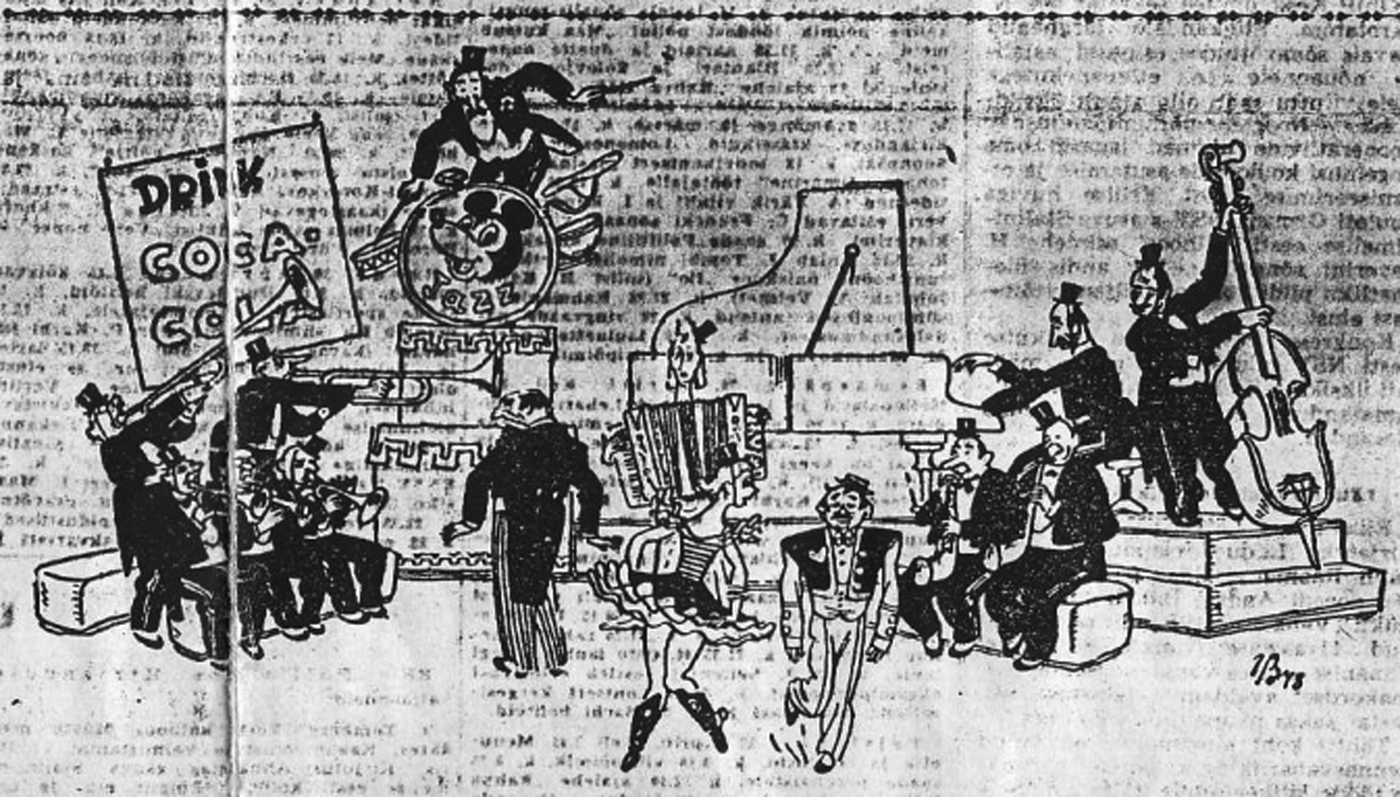
Two months after the party declaration about Muradeli's opera, Sirp ja Vasar published an article critical of jazz called Kutse tantsule (Call to dance)Footnote 29. This piece,Footnote 30 taken from Soviet central newspapers, was an assault against jazz and Western dance music. Its author, Viktor Gorodinski, critiques what he calls modern bourgeois dance music and sees sharp – ‘diametrical’ – contradictions between modern and old forms of dance music. His attack, in fact, accorded with the critique of dancing and modern Western dance music in the late 1940s. Dances like foxtrots and tangos, and the music associated with modern dancing such as jazz, were announced to be at odds with the conception of Soviet ‘kulturnost’Footnote 31 (culturedness) and accordingly had to be removed from the practices of Soviet citizens (Stites Reference Stites1992, p. 119). As an essential part of entertainment culture, dance was treated in a similar way to other forms of cultural production. While the total prohibition of dancing as a significant form of entertainment turned out to be impossible, a way out was found through the replacement of modern dances by older forms with more neutral connotations, and through giving the dances a new identity by renaming them. For instance, the foxtrot was renamed the ‘quick-step’, the tango the ‘slow dance’ and the waltz the ‘ballroom dance’ (Stites Reference Stites1992).
The article was illustrated with a caricature of a jazz group performance with comic dancing figures in front of the band (Figure 1). The most striking elements of this drawing are the symbols of American life – the comic cartoon character Mickey Mouse and Coca-Cola – ridiculing and mocking American society and its commercial nature. The physical appearance of the musicians, the reference to their Jewish origin, is open to a reading of the caricature as symbolising the role of bourgeois Jewish capital in jazz and the Jewish ownership of the music.
The caricature published with the article ‘Kutse tantsule’.

The next article on jazz published in Sirp ja Vasar appeared on 8 August 1949 and was titled Tänapäeva Ameerika džässimuusikast (On present day American jazz music). Valter Ojakäär argues that the piece was initially aimed at briefly introducing jazz history from its very beginning in the 19th century to the middle of the 20th century. Unfortunately the final edited text deviated radically from the initial version: after passing by the censor the article was changed. According to Ojakäär (Reference Ojakäär2008, p. 335), ‘Reading now the text published under my name, I barely recognise no more than 25 percent of what I wrote originally. The article was written before the attack began against all that was Western-like. I was still spurred on by the naïve hope of illuminating the real essence of jazz for a wider audience at this time.’
The role of censorship cannot be underestimated in the Soviet Union. It was the all-embracing or total system of ideological control of a single party state over all cultural and social spheres (Gorjajeva Reference Gorjajeva2009, pp. 134–5). Being part of the propaganda establishment, censorship functioned as a controlling and prohibiting agency, which had political and manipulative functions directed towards controlling society and its individuals. It was a mechanism for affecting of mass consciousness through formal and informal restrictions, and the purposeful regulation of cultural space (Gorjajeva Reference Gorjajeva2009). Historically, a distinction can be made between two types of censorship in printed production – preventive or preliminary, and repressive or penal (Veskimägi Reference Veskimägi1996, p. 9). In the Soviet Union, censorship covered not only printed production but all public media – radio, newspapers, journals; it deserves the title of permanent censorship (Veskimägi Reference Veskimägi1996).
How censorship-in-action functioned in a journalistic context is discussed in detail by Ojakäär in his volume Sirp ja Saksofon. As he tells it, his refusal to make changes in the text resulted in him being persuaded by the editor to write a new article. Although the content of the article had no connection to the author's real views, Ojakäär took advantage of the situation – his ‘strategy of compliance’ was designed solely to obtain practical experience of journalism (Ojakäär Reference Ojakäär2008, p. 334).
I got an invitation from the editor of Sirp ja Vasar, Aron Tamarkin, to meet for a discussion about the publishing of the article. […] First of all I was told that it was impossible to publish the article in the present form. I refused to publish the article in a rewritten form. Anyway, Tamarkin still continued to persuade me to publish the article. After several hours of editing, the text contained a more negative critique. I gave up finally and added Spike Jones' witty musical parodies as examples of the dark side of jazz although they had nothing to do with jazz. […] The last sentence of the article – ‘Modern American jazz music is a vivid reflection of the condescending mentality of American bourgeois society’ – was not written by me. I suggested that Tamarkin publish the article under his own name, since it contained more of his ideas than mine. But his answer was negative: as a member of the editorial staff he was not entitled to do this. […] After finishing the editing I went home and enjoyed American jazz. … The reception of the article by my friends was expressed in two ways. Some sneered, some were displeased! (Ojakäär Reference Ojakäär2008, p. 335)
While Milovski's article still demonstrated some tolerance towards the West and Western jazz music, Ojakäär's writing expressed no sympathy for it. American jazz was called ‘barbaric entertainment’ and a sign of the ‘declining mentality of American bourgeois society’. The text was full of expressions of Soviet rhetoric, and made direct assaults on American lifestyle, values and culture, reflecting directly the vocabulary of the anti-cosmopolitanist campaign against unhealthy foreign influences.
The article opens by positioning jazz in American musical culture and disparaging its ‘prosperity’:
In present day American musical life, it is jazz that has the biggest say. More than half of radio broadcasts consist of jazz music, record industries produce millions of jazz music records and concert halls are more and more at the disposal of jazz orchestras. It is the brightest example of the ‘prosperity’ of American musical culture.
The main body of the article can be described as a simplistic ‘Soviet-style’ construction of jazz history, in which the main goal seems not to be the historical overview of jazz, but rather anti-American and anti-capitalist propaganda. Jazz history was portrayed through the framework of the Soviet ‘distorting mirror’ by focusing on those aspects that were suitable for ideological manipulation.
The article seems to pay special attention to the external non-musical attributes of jazz by jeering at the titles of the pieces, the names of the bands and the association of jazz with psychedelic substances. The examples criticised in the article were actually meant to be musical jokes and their titles just a humorous play on words. But instead of interpreting them through the prism of humour, as was expected by the composers of the music, the Soviet ‘distorting mirror’ provided its own tendentious rendition of the pieces by interpreting the titles word-for-word without any figurative undercurrents, and by listening to the music with a censoring, ideologically biased ear.
For instance, the ‘The avocado seed soup symphony’ of American jazz artist Slim Gaillard, whose name was written in the article as ‘Skim Caillard’ probably because that is how it was heard on the radio, was described as ‘a ten minutes musical bacchanal which consisted of the senseless babbling of three singers, accompanied by piano, guitar and bass’. The audiences were said to be lured by musicians who are ‘under the influence of a drug made of the marihuana-plant’. The passage ends with the rhetorical question: ‘What should one to think of music that has titles like “Mop, Mop”, “Blop, Bah”, “Pom Pom”, “Grip an axe, Max”, “Don't beat your wife with a spade”, etc.?’ Slim Gaillard was, in fact, known in late 1930s and early 1940s America as a musician who entertained audiences with comic spoofs, irreverent parodies, ethnic humour and songs that verged on nonsense. Throughout his career Gaillard was the master of song titles that could raise a smile – such as ‘Banana Skins Are Falling’ or ‘Serenade to a Poodle’ – and staged subversive performances that mixed hard-swinging jazz, humorous chatter and imaginative comic language invented by Gaillard himself (Garrett Reference Garrett, Ake, Garrett and Goldmark2012, p. 57).
The penultimate paragraph of the article represents a typical construction of the black-vs.-white paradigm in Soviet public jazz discourse. While the black origin of the music was the main reason for Soviet officials to support jazz, the ‘bourgeois whiteness’ of jazz was seen as the object of enmity. It is, however, necessary to bear in mind that in the Soviet Union the political view of foreigners was ideologically, not ethnically or racially defined as a derivation from the Marxist sociological paradigm emphasising the primacy of class. The official image of black people was a positive one, as a ‘friendly foreigner’, a socially close friend and full of worth, in contrast to the ‘alien foreigner’, who was almost always ‘white, rich and fat’ bourgeois (Weitz Reference Weitz2002, p. 17).
The following excerpt discusses ownership of jazz by blaming whites for the loss of the music's true identity:
Step by step the whites tore from blacks their monopoly on jazz music and developed from it, during the last thirty years, the ‘music’, which is proudly regarded as the clearest expression of American art by American apologists.
The next example is an illustration of a typical naïve mode of presentation of American racial injustice:
Although black and white jazz musicians perform shoulder to shoulder on stage, the colourline between them has not disappeared. In concerts the Negroes are sitting only in the last row. Some Negro musician can be a big favourite of the audiences, but beyond the stage they are humiliated like every other black.
As Ojakäär (Reference Ojakäär2008, p. 336) recounts, the final sentence stating that ‘Modern American jazz music is a vivid reflection of the condescending mentality of American bourgeois society, and its rapid approach to decline’ was not written by him. This led Ojakäär to suggest that the article could be published under Tamarkin's name, since it contained more of the editor's ideas than those of the author. But Tamarkin's answer was negative, as a member of the editorial staff was not entitled to publish under his own name.
The increasing need for ideological control over cultural life forced officials to toughen the policy regulating the arrangement of public entertainment. On 4 December Sirp ja Vasar printed the decree of the Council of Ministers of the ESSR, which tried to ‘eliminate the footslips in arranging artistic performances’. This regulation strictly determined the institutions which were entitled to organise public cultural entertainment. In the list of tolerated institutions were – apart from the Estonian State Philharmonic and state theatres – cultural and educational institutions, culture houses, public houses, houses of officers, cafes and restaurants. Strictly prohibited were the gigs that took place outside the institutions for professional actors in state-owned theatres and for musicians of the State Philharmonic.
The completion of Sovietisation and the disappearance of jazz from public discourse
The most significant local event to affect the political and cultural climate of Estonia during late-Stalinism was the decision taken at the VIII Plenum of the Estonian Communist Party in March 1950. The decision was, in fact, a reaction to the ideological onslaught, conducted at all-Union level, to homogenise society nationally and to form a unitary Soviet nation loyal to the state. Estonian historian Olaf Kuuli (Reference Kuuli, Kalda and Sarapik2005), in his overview of party texts on cultural politics from 1946 to 1952, claims that the year 1950 was an important turning point in the cultural politics of Estonia. For Kuuli, the year marked the end of a relatively liberal cultural climate. The decrees of the All-Union Communist Party announced during ideological campaigns in 1946, 1948 and 1949 were, indeed, received by the local Estonian Communist Party (ECP), but the Estonian-minded Party officials tried to protect the Estonian cultural sphere from the most severe effects of the directives and applied them in a relatively mild form. As Kuuli (Reference Kuuli, Kalda and Sarapik2005, p. 62) states, in a somewhat simplified manner, the ECP, while approving the ideological policy of the All-Union Communist Party, sought to restrain the most brutal attacks against the creative intelligentsia. The so-called soft critique was, however, replaced by an exhaustive ‘cleanout’ in 1950 during which a large number of the writers, artists and composers active in pre-Soviet times were blamed for being representatives of ‘bourgeois cosmopolitanism’ (Kuuli Reference Kuuli, Kalda and Sarapik2005, p. 63).
The lack of articles on jazz in Sirp ja Vasar during this period is an obvious sign of the music's public silencing: jazz was swept away from the public musical arena and the public press, and supposedly from the consciousness of the musical audience. A glance at the headlines of the articles appearing on the pages of Sirp ja Vasar demonstrates that genres of popular music became a part of state-promoted institutionalised forms of entertainment called estrada-art. The evidence of this official paradigm is the titles of the articles: ‘Thoughts on estrada-concert’ or ‘Impressions on estrada-concert’.
As the articles in Sirp ja Vasar show, the new state-promoted form of popular music in 1952 seems to be the mass song. The sign of this campaign is the relatively high frequency of articles on mass song titled, for instance, ‘On some problems of mass song’ or ‘Thought on text and melody of mass songs’. Mass song as a widespread genre in Soviet Union was considered an important means of organisation and education of the populace. These songs, with lyrics based on social-political themes, were intended for ‘broad masses’ of Soviet people.
The article which attempts to return the word ‘jazz’ back into the public discourse was Leonid Utyosov'sFootnote 32 ‘On singing and light music’, translated from Sovetskaja Muzyka (Soviet music) and published on 18 December 1953. The author's position as the greatest authority on Soviet jazz granted him permission to speak more openly and to debate the issues that had been kept quiet. His main critique was targeted against the old ballroom dances, such as pas de quatre, pas de grace and others promoted during the dance reform of the late 1940s. The author came up with self-evident ideas which during the years of ideological cleanout had been considered inappropriate. That the dull and outmoded ballroom dances with old-fashioned forms inhibited the creation of expressive and gripping light music, and that the music played by jazz orchestras should not be called ‘third-rate’ were ideas that could only be pronounced after Stalin's death. Utyosov was probably one of the first speakers who attempted to rehabilitate the position of the saxophone in the Soviet field of music.
The resistance to the politicisation of the sound of the musical instrument led him to criticise those who still shared this ideology-driven distinction. As he claimed: ‘there are a lot of people who are still talking about the “socialist” or “capitalist” sound of one or another musical instrument. They think, for instance, that that saxophone (used also in classical music) is a brainchild of capitalism and to play Soviet tunes on those instruments is inappropriate.’
Summary
My microhistory-inflected study, based on a close reading of the jazz-related texts of the Estonian cultural newspaper Sirp ja Vasar, allows me to conclude that the time from 1944 to 1953 was a dynamic period in Estonian jazz history, when the official status of the music changed from a highly prized musical form during the postwar era to the status of musica non grata in 1950, when it experienced a temporary rupture. While jazz became a symbol of victory and friendship with the allies in the immediate postwar period, in the course of Soviet ideological campaigns the music happened to be at the forefront of Soviet ideological attacks against the entire Western world and its values.
The principle of microhistory, focusing on a small unit such as an individual, event or small community, can reflect a larger whole (Magnusson and Szijarto 2013, p. 149). It allows me to offer the following summary of the processes of rupture and the meaning of jazz in Estonia during the period under investigation.
The rupture appeared at the level of discourse, not in the form of a sudden turn but taking place gradually in the course of the intensification of political pressure ‘from above.’ The public texts of the first postwar years – the ‘Post-Estonian era’ – portrayed jazz as a musical practice through concert reviews and announcements. Therefore, jazz in Estonia experienced no rupture at this time. On the contrary, Estonian jazz shared the sociopolitical climate in which the Soviet Union enjoyed the euphoria of victory in the spirit of Great Friendship with the allies, the domestic policy of the Soviet Union turned to postwar reconstruction, and Estonia lived in the condition of cautious Sovietisation. This continuity was experienced in the personnel of jazz orchestras. For instance, two state-owned jazz orchestras were formed on the basis of previously existing collectives: the Jazz Orchestra of Estonian Public Broadcasting appeared on the basis of Landessender Reval'sFootnote 33Tanzkapelle and the Jazz Orchestra of State Philharmonic, in turn, was a successor of the Jazz Orchestra of Estonian State Art Ensembles in Yaroslavl.
As a state-sponsored form of music, jazz was part of an estrada-type of entertainment and could be heard in formal concert hall settings played by large orchestras. Although, on the one hand, the institutionalisation of the orchestras was part of the politics of Soviet overwhelming controlling apparatus; on the other hand, it contributed to the professionalisation of the genre and provided permanent job opportunities for musicians. The two state-owned jazz orchestras in Estonia – the Jazz Orchestra of Estonian Public Broadcasting and the Jazz Orchestra of the State Philharmonic – provided musical entertainment to their audiences in radio studio concerts and recordings, and in public concert venues. As a glance at the programme lists indicated, the appearance of the word ‘jazz’ in the title of the orchestras did not necessarily describe the stylistic parameters of the repertoire. The musical baggage of the jazz orchestras was usually a mixture of the original, sometimes jazz-influenced, pieces by Estonian authors, the tunes of Soviet composers and swing tunes of American origin. Therefore, the meaning of jazz as promoted in a public discourse was different from what DeVeaux (Reference Deveaux2005) has defined as the core jazz tradition: jazz was rather the common denominator or even a synonym for the popular musical genres covering the entertainment scene of the time.
The Soviet jazz orchestra of the immediate postwar period and later estrada-orchestra aesthetic can be seen to parallel the jazz-with-strings trends in 1940s and early 1950s America. The mixing of big band instrumentation with string-based backgrounds became a highly successful commercial trend which, however, is not deemed to be part of the accepted canon of jazz. Howland (Reference Howland, Ake, Garrett and Goldmark2012, p. 111) sees this vogue as related to mid-century trends in American ‘middle-browism’. The term ‘middlebrow’ as a hybridisation of mass and highbrow cultures has evident parallels with the music's overriding glorified entertainment aesthetic and its often presumed dilution of ‘higher’ musical traditions. In the Soviet Union, by contrast, the jazz-with-strings trends or jazz/estrada-orchestra movement was part of state-sanctioned cultural politics responding to the attempts by cultural ideologists to elevate this tradition to the position of high-art music and to create a Soviet form of entertainment.
In less formal settings jazz functioned as part of the dance culture, extensively practised at a large number of sites. These venues – such as culture houses, school halls and even gyms – became the public places where dancing, as the most popular mode of entertainment during the postwar period, was prospering. The two reasons for the popularity of dances, according to Ojakäär (Reference Ojakäär2008, pp. 48, 51), were the association with prewar nostalgia and the counter-reaction to the Nazis' wartime prohibition of dances in public places. That the collapse of the Fascist regimes and the relaxation of wartime psychology caused an awakening of forms of popular music and culture is also mentioned by Starr (Reference Starr1983, p. 209). He links the popularity of jazz in postwar Europe to the sheer appeal of the music and to the favourable conditions in the host countries.
The extensive shift in public discourse about jazz appeared with the commencement of Zhdanovshchina in 1946. The three Stalinist campaigns – the Zhdanovshchina as a campaign for stricter ideological discipline, the Great Friendship as a march against formalism and finally anti-cosmopolitanism as a campaign of anti-Semitism and the fear of foreign influence – meant that jazz experienced a gradual loss of tolerance, leading finally to a temporary rupture in 1950. These ideology-driven events involved the extensive shift in the meaning of jazz in public discourse: jazz was not constructed as a musical practice any more but rather as a cultural phenomenon imbued with ideologically incorrect meanings. The agency of the discourse became instead the external attributes of the music, such as lyrics, band names or titles, and its origins. Noticeable too are the changes in journalistic language: it became a vehicle for attack, indoctrination and ideology.
The first step towards rupture taken during the Zhdanovshchina was the mildest in the sequence and caused no endangering effect on jazz. The core of the attack in 1946 relied on the ‘authenticity’ of Soviet jazz. It was a call for jazz composers to create authentic Soviet jazz music which would be adjusted to the parameters of the Soviet musical paradigm instead of being a mere imitation of American styles. The launching of the Great Friendship decree in 1948 involved the rapid intensification of the anti-jazz campaign. Several politically sanctioned ‘anti-’ campaigns such as anti-cosmopolitan, anti-American, anti-Western, anti-Semitic had direct links to anti-jazz and anti-dance operations in the late 1940s.
What Tomoff (Reference Tomoff2006, p. 160) calls an anti-American estrada programming evolved into a discursive shift in the landscape of Soviet popular music. This was the next attempt to reduce the discomfort felt with Western popular music, stemming from the longstanding ambivalence towards popular music in general in the Soviet Union. The essence of this ambivalence lies in the desire of the authorities to shape the popular musical taste of the populace rather than responding to it (Tomoff Reference Tomoff2006). The strategies enforced in the late 1940s, such as anti-jazz orchestra reform, dance reform banning foxtrot and other modern dances, and the eradication of the word ‘jazz’ from public discourse served the purpose of developing the taste of the masses. This artificial attempt to extract Soviet popular music from the processes occurring in the rest of the world, however, never completely succeeded. Nonetheless, the years 1950–1953 experienced a temporary rupture of jazz in official discourse, the contours of which started to blur after the death of Stalin in March 1953.
It is important to recall that the anti-jazz rhetoric flourishing in Soviet public discourse was not something exceptional: jazz as a musical and cultural practice has been under fire from critics since its very inception. But the main feature distinguishing Soviet or totalitarian anti-jazz rhetoric from the rest relies on its agency. The totalitarian discourse delivered its jazz-inimical doctrine ‘from above’ as a part of an official, ubiquitous and overwhelming propaganda of state ideology, while it was initiated ‘from below’ as a manifestation of individual or a certain social group outside the totalitarian paradigm. For instance, jazz was condemned as decadent by Australian communists in 1940s (Johnson Reference Johnson and Atkins2002, p. 160) and had enemies at both ends of the social scale in Sweden during the early Swedish Jazz Age (Fornäs Reference Fornäs and Atkins2002, p. 210). In Ireland in the 1920s and 1930s the idea of ‘jazz’ was associated with sexual impropriety, ‘paganism’ and racial impurity, and was attacked by Catholic conservatives (Hogan Reference Hogan2010, p. 76).
As with American jazz discourse, where the ownership of the music has been one of the central issues, Soviet debates also faced the need to define the possession of the music. Whether the music belonged to blacks, whites or Jews served as a basis for tolerance or intolerance towards the music depending on the political climate. It is also necessary to acknowledge the similarities between Soviet journalistic rhetoric and black essentialist discourse: both construct blacks roughly as oppressed people fighting against racial injustice. But we cannot overlook the major difference between the Soviet and American black vs. white dilemma. In the Soviet Union the politics towards blacks was mainly ideologically, not racially, defined, and the issue of race was anything but an extension of the class struggle. Thus, to talk about a class-based bourgeois vs. proletarian dilemma in the Soviet case is more appropriate than to use a race-based white vs. black paradigm. This dilemma emerged, however, at the level of public journalistic discourse having no capacity, at least in the Estonian context, to reach the territories of musical production. As my interviews with Estonian jazz musiciansFootnote 34 have indicated, the issues of race and class played no role in their everyday musical activities.
In the general context of the Estonian culture of the era, the situation of jazz was not exceptional: all cultural forms were suffering the impact of Sovietisation in a climate of ‘tightening the screws’. However, while cultural forms such as classical music, theatre or the arts maintained their position in the Soviet cultural space in spite of the changes dictated by the Soviet cultural paradigm, jazz, whose ambiguity was unacceptable to Soviet monistic ideology, was banned in public spaces along with any verbal reference to it in the public realm.Footnote 35
In spite of the ambiguities emerging in politically authoritative discourse and the strategies of officialdom to silence inappropriate sounds, jazz as a musical form managed to survive. The sounds of jazz were occasionally heard even in the years of the lowest political tolerance. For instance, Uno Loop, a member of the jazz group Swing Club, stated that the musical activities of the group continued away from the ‘public ear’. As he recalls, ‘We were rehearsing literally underground – Swing Club became an underground organization’.Footnote 36