I. INTRODUCTION
Metal ions separation and recovery from industrial effluents has been an intensive topic due to economic concern and ecological demands.Reference Yuan, Ping, Rongjun, Chunhua, Hegen and Zhongxi1 Current techniques for separation and concentration of metal ions involved filtration, chemical precipitation, ion exchange, adsorption, electrodeposition, and membrane.Reference Navarro, Wada and Tatsumi2–Reference Song, Oh, Kong and Jang6 Among the techniques available, the membrane separation process has advantages such as low cost, efficient and complete metal removal, and shows great promise for commercial application.Reference Fane, Yeo, Law, Parameshwaran, Wicaksana and Chen7 The nanofiltration (NF) process has been demonstrated as an efficient strategy for removal of multivalent ions in water softening and other applications including purification of wastewater in industries.Reference Murthy and Chaudhari8–Reference Wahab, Hilal and Nizam15
Typical procedures for preparing NF composite membranes with a selective skin layer on a highly permeable support include interfacial polymerization, grafting, phase inversion, film deposition, or layer-by-layer (LbL) assembly technique.Reference Zhang, He, Gao and Chen16–Reference Ba, Langer and Economy28 Various composite polyamide NF membranes have been used for removal of metal ions, such as nickel, cobalt and lead ions, copper, and arsenic, from wastewater in industries.Reference Murthy and Chaudhari8–Reference Wahab, Hilal and Nizam15 However, most of these membranes, such as commercial NF 270, should be used at or below their isoelectric point for charge repulsion. For instance, at a pH of 1.50, the rejection of cadmium and manganese ions by NF270 was 99% and 89%, respectively. While, the retention of the same two ions decreased to 68% and 33% at a pH of 5.0, respectively.Reference Al-Rashdi, Johnson and Hilal14 The fundamental studies on removal of multivalent ions using NF membrane suggested that separation of charged solutes was based on both ion size and Donnan exclusion.Reference Deng, Xu, Chen, Wei and Zhu29,Reference Bruening, Dotzauer, Jain, Ouyang and Baker30 Therefore, a series of positively charged NF membranes have been produced since the positively charged poly(2,6-dimethyl-1,4-phenylene oxide, PPO) NF membranes was firstly prepared by in situ amines crosslinking.Reference Sullivan and Bruening31 Other ways included chemical cross-linking quaternized chitosan derivatives, or poly (2-methacryloyloxy ethyl trimethylammonium chloride-co-2-hydroxyethyl acrylate) (PDMCHEA) copolymer, chemical modification using branched poly(ethyleneimine) (PEI), as well as using UV graft polymerization, etc.Reference Zhong, Widjojo, Chung, Weber and Maletzko18,Reference Deng, Xu, Chen, Wei and Zhu29,Reference Wang, Zhang, Ji, Qin and Liu32–Reference Malaisamy and Bruening34 However, most of these positively charged NF membranes have been used just for salt rejection.
LbL technique, deposition of multilayer polyelectrolyte (PE) films on substrate by intercalation of positive and negative PEs, has been demonstrated as a versatile and feasible way to prepare composite membranes. Numerous recent papers confirmed utility of this technique for creating gas-separation, pervaporation, and NF membranes.Reference Deng, Xu, Zhu, Wei, Liu and Cui35–Reference Stanton, Harris, Miller and Bruening39 This method is attractive for preparing the acquired skin layer and the charge of the outer surface of the NF membrane, depending on deposition condition and whether the outer film was terminated with polycation or polyanion.Reference Jin, Toutianoush and Tieke38 A number of recent studies examined the use of polyelectrolyte multilayers (PEMs) in NF of anion separations.Reference Stanton, Harris, Miller and Bruening39–Reference Egueh, Lakard, Fievet, Lakard and Buron42 For removal of multivalent cations, Jin et al.Reference Jin, Toutianoush and Tieke38 reported that PEMs comprised of 60 layer pairs of poly(vinylamine) and poly(vinylsulfate) exhibiting a 95% rejection of MgCl2 at an operating pressure of 10 bar. Bruening’s group studied NF of monovalent/divalent cation separations by alternating deposition of poly(styrenesulfonate) (PSS) and protonated poly(allylamine) (PAH) on a porous alumina support, which exhibited 95% rejection of Mg2+ and a Na+/Mg2+ selectivity of around 20.Reference Wang, Tsuru, Nakao and Kimura25,Reference Jin, Toutianoush and Tieke38 However, these reported multilayered PEs NF membranes were still mainly relevant to separation of multivalent cations for water softening.
Metal ions presented in industrial effluents, such as electroplating, mining, tanneries industries etc., have been the dominating environmental pollutants and are becoming one of the most serious environmental problems. In this work, a positively charged NF membrane has been fabricated by alternating adsorption of PEI and PSS on a hydrolyzed polyacrylonitrile (PAN) ultrafiltration substrate for removal of typical metal ions, such as Ni(II), Cd(II), Cu(II), and Zn(II). The resulting membranes were characterized by zeta potential, Fourier transform infrared spectroscopy (FTIR), scanning electron microscopy (SEM), etc. The rejections of Ni2+, Cd2+, Cu2+, and Zn2+ ions were investigated. This work may provide a new pathway to produce positively charged membranes for removal and recovery of metal ions.
II. EXPERIMENTALS
A. Materials
A polyacrylonitrile (PAN-50) ultrafiltration membrane with molecular weight cutoffs of 100 kDa was purchased from Sepro, Membranes Inc (US). Poly(ethyleneimine) (PEI, M w = 750,000) and poly(sodium 4-styrenesulfonate) (PSS, M w = 70,000) were purchased from Sigma-Aldrich Co., (St. Louis, MO). Cadmium chloride (CdCl2·2.5H2O), copper sulfate (CuSO4), nickel chloride (NiCl2·6H2O), and zinc sulfate (ZnSO4·7H2O) with A.R. grade, obtained from Tianjin Fu Chen Chem. Reagents (Tianjin, China), were used to prepare the simulated waste water solutions. Deionized water (conductivity of 18.0 MΩ cm) was used for membrane rinsing and preparation of PE solutions.
B. Preparation of PAN-PEI/PSS composite membranes
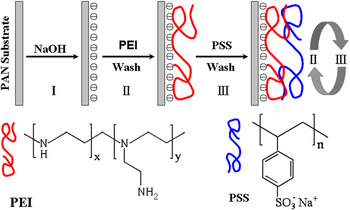
As shown in Fig. 1, the polyacrylonitrile (PAN) ultrafiltration membrane was firstly hydrolyzed with 1.0 M NaOH solution for 1.0 h at room temperature, followed by washing with deionized water thoroughly. PE LbL deposition was performed by exposing the top surface of the membrane to PEI polycation and PSS polyanion solutions alternatively, with 2 min water rinse between each adsorption step. Specifically, the modified PAN support was first immersed in a solution of PEI, and rinsed with water. Then, it was immersed in a solution of PSS, and rinsed again with water. The procedure was repeated until the required number of layers was obtained. Unless noted otherwise, films were deposited from solutions containing 5.0 g/L PE. For the PEI/PSS films, deposition of both PEs occurred at a natural pH of 7.0 or 9.0, and adsorption times were 10 min. The structures of the PEs investigated in this work were shown in Fig. 1.
Illustration for LbL deposition of PEI and PSS.

C. Characterization of the membranes
Zeta potential of the membrane was determined using an Electrokinetic analyzer (Anton Paar, SurPASS, Germany) with 0.83 mM KCl electrolyte solution operating at 300 m MPa. Attenuated total reflectance (ATR) infrared spectra were acquired using a Vertex-70 FTIR spectrophotometer (Bruker, Germany) with an ATR accessory. A background spectrum of each support membrane was obtained prior to adsorption of PEs. The spectra were collected by 32 scans at a resolution of 2 cm−1. For field-emission scanning electron microscopy (FESEM) observation, all the samples were dried under vacuum, and sputter-coated with Au. The images were obtained using a S-4300 instrument (Hitachi, Japan) at an acceleration voltage of 15 keV. Before cross-sectional observation of the membrane and the substrate, samples were freeze-fractured in liquid nitrogen and coated with gold. The cross-sectional SEM images were observed from the vertical surface of the membranes. The pore size and its distribution of the membranes were measured by the gas adsorption technique using a Tristar II 3020 Surface Area Analyzer (Micromeritics, Atlanta, GA). The thickness of the membrane was measured as reference on a quartz substrate using a XP-1 profilometer (Ambios, Santa Cruz, CA). A groove in the film was made using a razor blade, and the depth of the groove was measured by the stylus of the profilometer to give the membrane thickness. The tensile strength and the elongation at break of the membranes were tested by a UTM-1432 mechanical testing machine (Chengde Jinjian Testing Instrument Co., Ltd., Chengde City, Hebei, China) at room temperature. The samples were cut into two parts with the width of 5 mm. The rate of tensile speed was 10 mm/min and the clip distance was 55 mm.
D. NF performance of the membranes
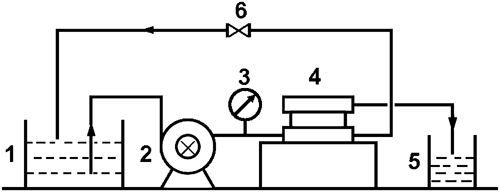
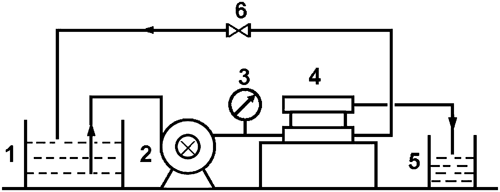
NF was performed with a home-made cross-flow NF set up shown schematically in Fig. 2. The system was pressurized to 0.4 MPa with a diaphragm pump. The exposed active membrane area for filtration in the cells is 22.90 cm2. The feed solution was then changed into the simulated waste water solutions, respectively. Initially, pure water was nanofiltered for at least 30 min at 0.4 MPa. The concentrations of metal cationic ions in these solution samples were determined by conductivity detection using DDS-11A conductivity meter (Inesa scientific instrument Co., Ltd., Shanghai, China). The rejection ratio, R, was calculated using Eq. (1), where C f and C p were concentrations of solutes in the feed and permeate, respectively. The permeate flux, J, was calculated by Eq. (2), where V is the volume of the permeate, which was flowing across the membrane of area A in the time period Δt and operative pressure ΔP.
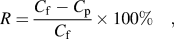 $$R = {{C_{\rm{f}} - C_{\rm{p}} } \over {C_{\rm{f}} }} \times 100\% \quad ,$$
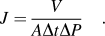 $$J = {V \over {A\Delta t\Delta P}}\quad .$$
Setup for NF experiments 1. Feed solution (initial volume:5.0 L, 25 °C), 2. Pump, 3. Pressure gauge, 4. NF membrane cell, 5. Permeate vessel, 6. Valve.
III. RESULTS AND DISCUSSION
A. Zeta potentials of the membranes
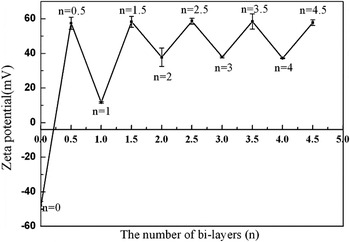
Figure 3 indicates that zeta potentials of the membranes showed alternate changes after each new PE adsorption. The hydrolyzed PAN substrate (n = 0) showed a negative zeta potential of −48 mV. After the first adsorption of PEI, ζ potential of the negative PAN membrane reversed to +58 mV. However, the zeta potential decreased to around +12 mV without inversion of the surface charge after adsorption of the PSS layer. Then, periodic variations in zeta potential between +37 and +58 mV appeared for whole multilayer films.
ζ potential of the membrane surface varied with a number of bi-layers.

Generally, zeta potential alternated between positive or negative after each polycation or polyanion adsorption, as demonstrated by many researchers.Reference Trybała, Szyk-Warszyńska and Warszyński43,Reference Deng and Ting44 However, Fig. 3 shows that the zeta potential was always positive with deposited multilayer films. Egueh et al.Reference Nyström, Kaipia and Luque45 demonstrated that zeta potential was obviously dependent on PE solution concentration, in which the always positive zeta potential was obtained both at 1 and 5 g/L of PE concentrations. They ascribed it to the adsorption competition between chloride ions and PSS, both negatively charged. In this work, the PE concentration was 5 g/L, and the charge behavior of the PEI polycation, a weak PE, can be controlled by pH of the PE solution, as Egueh’s suggested.Reference Nyström, Kaipia and Luque45 At a pH of 7.0, the amine groups in PEI can be 30% prorogated, making it highly positively charged.Reference Baticle, Kiefer, Lakhchaf, Larbot, Leclerc, Persin and Sarrazin46 While, the negative charge of PSS, a strong PE, was little affected by the pH of the solution.Reference Jin, Toutianoush and Tieke38 Consequently, the positively charged modification of the outer membrane surface was accomplished by changing the concentration and pH value of the PE solutions.
B. ATR-FTIR spectra of the membranes
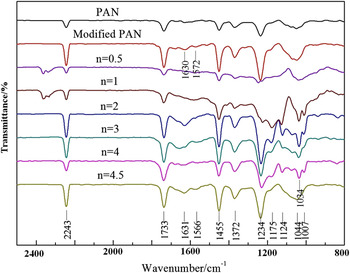
ATR-FTIR was used to further confirm LbL deposition of [PEI/PSS]n films, as shown in Fig. 4. It can be seen that more distinct bands appeared in the FTIR spectrum of the hydrolyzed PAN membrane. The absorptions at 1630 and 1572 cm−1 were assigned to carbonyl C=O and C–N stretching vibrations, respectively, which confirmed that some of the nitrile groups of PAN have been hydrolyzed by NaOH solution.Reference Malaisamy, Talla-Nwafo and Jones40 After deposition of the PEI polycation (n = 0.5), all peaks stemmed from PAN became weaker with a new wide peak at 1039 cm−1, which was ascribed to the interaction between amine of PEI and carbonyl of hydrolyzed PAN. New signals, appeared at 1175, 1124, 1034, and 1007 cm−1, were due to sulfonate moieties in the deposited PSS polyanions (n = 1).Reference Malaisamy, Talla-Nwafo and Jones40 The intensity of these peaks increased with increasing the number of bi-layers to 4.0. When the 4.5 bi-layer was further deposited by PEI, the characteristic peaks of the sulfonate group were covered by a wide peak at 1052 cm−1. The peaks at 1372 and 1566 cm−1, assigned to C–N–C and C–N stretching, respectively, indicated the existence of a PEI layer.Reference Baticle, Kiefer, Lakhchaf, Larbot, Leclerc, Persin and Sarrazin46,Reference Liu, Xu and Zhou47 Thus, it was suggested that the PEMs were alternately assembled on the PAN substrate.
ATR-IR spectra of each layer of the membrane.

C. Morphologies and growth of the membranes
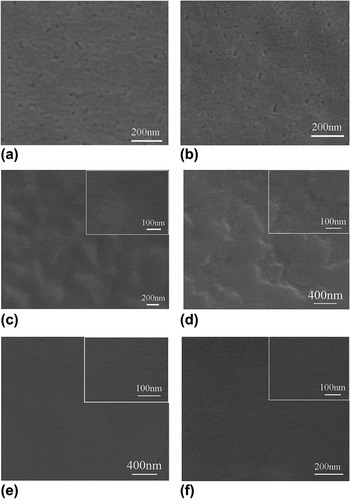
Surface morphologies of the films with alternative deposition of each layer were observed using FESEM as shown in Fig. 5. It was noted from Fig. 5 that the surface of the multilayer membranes became more compact with increasing number of bi-layers. Compared with the surface of the unmodified PAN substrate [Fig. 5(a)], the image in Fig. 5(b) shows that the hydrolyzed PAN support exhibited more distinct nanoporous with a pore size of about 10–20 nm. After deposition of PEI polycations, the pores of the support membrane were little overlaid and became much blurred [Fig. 5(c)]. Figure 5(d) shows that there were no apparent pores on the top surface. The surface became more compact but uneven due to formation of the PE complex, after depositing PSS polyanions for a bi-layer (n = 1). When the number of bi-layers was increased to 4.0, the membrane surface seemed completely covered and became flatter [Fig. 5(e)]. After deposition of the outer PEI 4.5 bi-layers, the membrane surface became much more compact and smooth, which can be clearly observed in the inset of Fig. 5(f).
SEM morphologies of (a) PAN, (b) Modified PAN, (c) PAN-(PEI)0.5, (d) PAN-(PEI/PSS)1, (e) PAN-(PEI/PSS)4, and (f) PAN-(PEI/PSS)4.5.

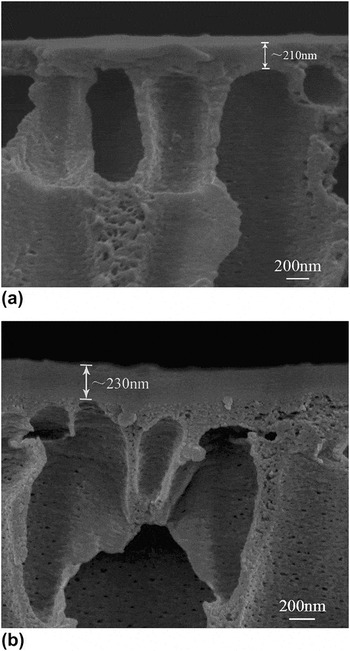
Furthermore, the cross-sectional morphologies (Fig. 6) showed a thickness of 230 nm for skin of 4.5 bi-layers, compared with that of 210 nm for the PAN substrate. However, using a XP-1 profilometer (Ambios),Reference Ahmadiannamini, Li, Goyens, Meesschaert and Vankelecom37 we calculated the thicknesses of 221 ± 0.5 and 237 ± 0.3 nm for 2.0 and 4.5-bilayer on rigid quartz substrates, respectively. Therefore, the average bilayer thickness was approximately 6.0 nm measured by the profilometer, while 4.4 nm according to SEM. The difference between two thicknesses may be due to some penetration of PEs into pores of the substrate, and the overlap of the PE chains during deposition.
SEM cross-section morphology of (a) the modified PAN substrate, and (b) the multilayer membrane with 4.5 bi-layers.

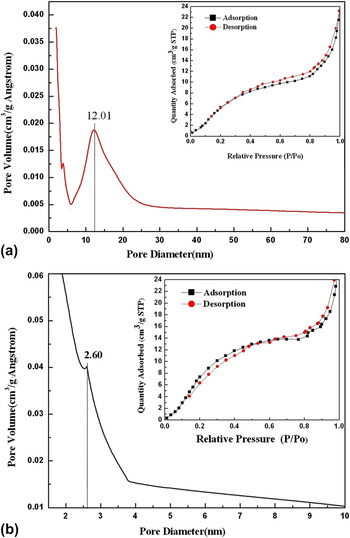
The overlay of PEs on the porous substrate was further demonstrated by changes in pore size distributions measured by N2 adsorption/desorption technique shown in Fig. 7. The resultant average diameter of pores of the substrate was about 15.7 nm, and that of the 4.5 bi-layer membrane was about 2.6 nm. These results indicated that the PAN ultra-filtration membrane was fully covered by the PEM, and can be used for NF.
The pore size distribution of (a) substrate and (b) 4.5 bi-layer membrane.

D. Weight changes of the membranes
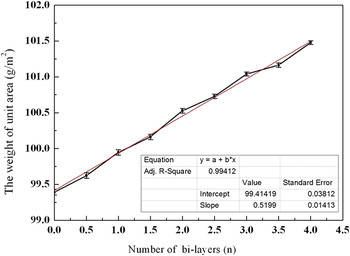
The weight changes were measured to further monitor the deposition process of PEI/PSS multilayers, using a CPA-225 electronic balance (Sartorius scientific instruments Co. Ltd., Genthin, Germany). Figure 8 showed that the average weight of unit area of the membrane increased with the layer number of deposition. The average weight of unit area of PEI/PSS films showed a nearly linear increase starting from the first deposition cycle, with a linear coefficient of 0.99412. The average weight of unit area of the substrate was 99.39113 g/m2. It increased to 101.04001 and 101.47804 g/m2 after 3 and 4 deposition cycles, respectively.
The weight of unit area with the number of bi-layers.

E. NF performances with bi-layer numbers
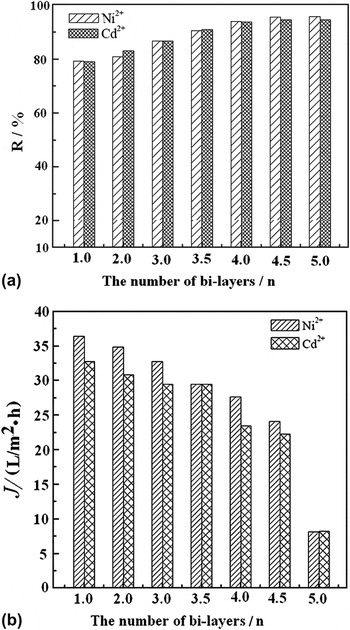
NF of Ni2+ and Cd2+ metal ions was performed using different number of bi-layers. As shown in Fig. 8, the rejection of the two metal ions increased, while the permeate fluxes decreased, with the number of bi-layers. The NF results in Fig. 8(a) indicated that the rejections of Ni2+ and Cd2+ were both about 79% with 1.0 bi-layer of PEI/PSS. When the number of bi-layers was 3.5, the rejections increased to 90.6% and 91.6%, respectively, higher than that of 3.0 bi-layers with 86.0% rejection. Moreover, the membrane of 4.5 bi-layers showed higher rejections of 95.7 and 95.0% for Ni2+ and Cd2+, respectively, compared with that of 4.0 bi-layers with a rejection of about 94.0%. When the number of bi-layers increased to 5.0, the rejections showed almost little change. Meanwhile, Fig. 8(b) indicated that the permeation flux of membranes showed a little decline with increasing number of bi-layers. For example, permeation flux of the membrane with 3.5 bi-layers was about 29.5 L/m2/h for 500 mg/mL Ni2+ and Cd2+ solutes. They decreased to about 22.2 and 25.0 L/m2/h, respectively, with 4.5 bi-layers. Moreover, they obviously decreased to about 8.0 L/m2/h with 5.0 bi-layers. These results really indicated that the higher positively charged surfaces favored rejection of metal ions due to Donnan effect.
In contrast, commercial NF270 membrane has been used for rejection of metal ions by Hilal et al., which indicated that it can remove about 99%, 89% and 74% of Cd2+, Mn2+and Pb2+, respectively, along with a flux of about 21.0 L/m2/h at 4 bar, at a pH of 1.50. When pH was increased to 5.0, the retention of Cd2+, Mn2+ ions decreased to 68% and 33% respectively.Reference Al-Rashdi, Johnson and Hilal14 Moreover, NF300 membrane has shown 96.35% rejection of Ni2+, when the feed concentration was 10 ppm at a pH of 5.0 under 12 atm pressure.Reference Murthy and Chaudhari8 Comparatively, at a pH of 6.0, the composite membrane in this work with 4.5 bi-layers of PEI/PSS showed much higher rejection of Ni2+ and Cd2+ ions than NF270 and NF 300, along with a little higher flux.
F. Influence of the metals ion concentration
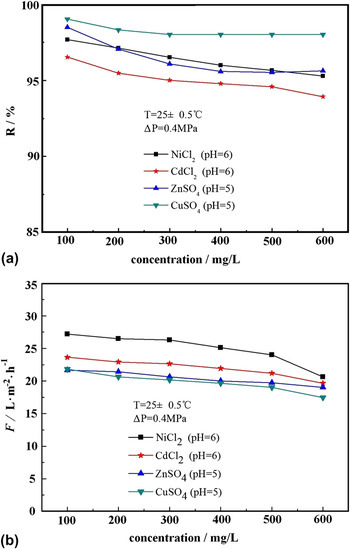
NF separation results of 4 kinds of typical electroplating metal ions, such as Ni2+, Cd2+, Cu2+, and Zn2+, with concentrations varying from 100 to 600 mg/mL, were presented in Fig. 9. The curves in Fig. 9 showed typical dependence of NF performance on feed concentration. As for charged membranes, both salt rejection and flux decreased with increasing feed concentration.Reference Ji, An, Zhao, Chen, Qian and Gao48–Reference Murthy and Chaudhari52 At a low concentration of 100 mg/L, the rejections of the solutes were 99.0% for CuSO4, 98.5% for ZnSO4, 97.7% for NiCl2, and 96.5% for CdCl2, and the corresponding permeate fluxes were 21.8, 21.7, 27.2 and 23.7 L/m2/h, respectively. When the metal salt concentration increased to 500 mg/L, the rejections declined to 98.0%, 95.5%, 95.7%, and 94.9%, along with permeation fluxes between 19.0 to 24.0 L/m2/h, respectively. The increased feed salt concentration would lead to the stronger shield effect from the anionic ions of salts on the positively charged surface of the membranes. As a consequence, the electrostatic repulsive force between the positive sites of membrane and metal cations decreased, resulting in decline of rejection.Reference Murthy and Chaudhari52 The viscosity of the feed solution increased with increase of the salt concentration. The resulting higher osmotic pressure may reduce the real driving force of the NF membrane and lead to decrease of flux.Reference Garba, Taha and Cabon53,Reference Paugam, Taha, Dorange, Jaouen and Quéméneura54
NF performance with the number of bi-layers of the membrane at a pH of 6.0 with (a) rejections and (b) permeate fluxes.

NF performances of the membranes with 4.5 bi-layers as a function of metal ion concentration.

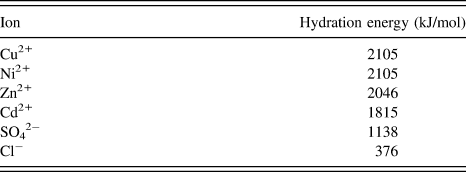
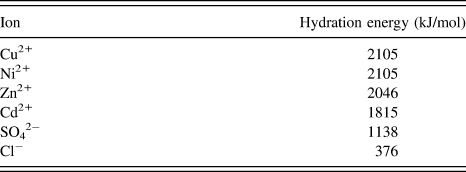
In addition, as shown in Fig. 9(a), the rejection of these four metal ions showed a sequence of R(Cu2+) > R(Zn2+) > R(Ni2+) > R(Cd2+) for CuSO4, ZnSO4, NiCl2, and CdCl2—water solutions. This was ascribed to that Cl−1 were less hydrated than SO42− (the hydrated energy of 1047 and 325 kJ mol/L for sulfate and chloride, respectively), resulting in less rejection of cations associated to Cl−1.51,54 Moreover, as shown in Table I, the hydration energy of Cu2+ and Ni2+ was larger than that of Zn2+ and Cd2+. Thus, the rejection sequence of CuSO4 > ZnSO4 > NiCl2 > CdCl2 was in accordance with that of ion hydration energies.
Hydration energy of ions51,54
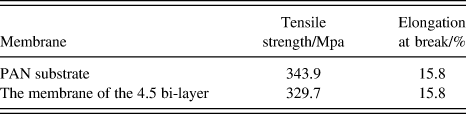
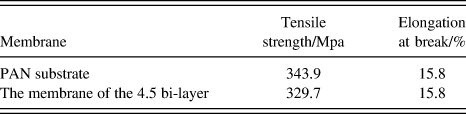
The mechanical performances of membranes.
G. The mechanical performance of the membrane
Generally, most of NF membranes are composed of a thin active skin deposited on a thick, permeable support, e.g., an ultra- or micro-filtration membrane. The separation property of the NF membrane is mainly dependent on the composition of the active layer, while the mechanical strength is much relied on the substrate.Reference Du and Zhao26 In this work, we used a UTM-1432 mechanical testing machine (Chengde, China) to measure the tensile strength and the elongation at break of the membranes. The results shown in Table I indicated that the elongation at break of the membrane with 4.5 bi-layers was the same as that of the substrate, while the tensile strength of the membrane showed a little decrease than that of the substrate. This may be due to that the elongation at break of the membrane mainly depended on the substrate. The decreased tensile strength of the membrane was mainly owing to some hydrolysis of the PAN substrate during membrane processing.
IV. CONCLUSIONS
In this work, the positively charged composite NF membrane was prepared by LbL self-assembly of poly(ethyleneimine) (PEI) and poly(sodium-4-styrenesulfonate) (PSS) on the modified polyarcylonitrile ultrafiltration membrane. The surface of the membrane seemed more smooth and compact with deposition of bilayers, and the pore size showed obvious decrease from 15.7 to 2.6 nm. The ζ potential of the membrane suggested its controlled positively charged surfaces. The NF performance showed that the higher positively charged membrane favored separation of metal ions due to Donnan effect. The rejections of the solutes were 98.02% for CuSO4, 95.53% for ZnSO4, 95.66% for NiCl2, 94.9% for CdCl2, and permeation fluxes were 19.02, 19.72, 24.02 and 21.19 L/m2·h, respectively. All the results suggested that the positively charged membranes through LbL deposition of PEs exhibited high rejections of divalent metal ions.
ACKNOWLEDGMENTS
The authors acknowledge financial support from National Natural Science Foundation of China (Grant No. 21176005) and Natural Science Foundation of Beijing, China (Grant No. 8122010). Also, we are grateful for Miss Kate Dory’s kind help on refining the English of the whole text.