


Exactly nine decades after his birth and close to completing his seventh tlalpilli or 13-year cycle, Miguel León-Portilla exemplifies for all of us what is known in the Nahuatl language as an omacic oquichtli, that is to say, a “mature man” (Sahagún Reference Sahagún, Anderson and Dibble1961:12; León-Portilla Reference León-Portilla2004a, Reference León-Portilla2011). Let me clarify, however, that for ancient Mexicans such a condition was not achieved by simply tallying the days, weeks, 20-day months, or years of one's life, but by gradually acquiring a resolute and vigorous character that was also prudent, insightful, and discrete. The omacic oquichtli was considered to be a seasoned and consummate individual, in short, someone replete with life experiences in whom nothing—absolutely nothing—was lacking. In metaphoric terms, it was said that he was the “master of a face” and also the “master of a heart”; but not just any face, rather the face of a sage, and not just any heart, but one that is rock solid and as resistant as the trunk of a tree.
The tribute paid to Dr. Miguel León-Portilla on his ninetieth birthday. Photograph courtesy of the Proyecto Templo Mayor.

To Ana Carolina Ibarra and Eduardo Matos Moctezuma: I owe the privilege of being with you today on this splendid stage [in the Juan Ruiz de Alarcón Theater on the campus of the Universidad Nacional Autónoma de México [UNAM], in Mexico City], as well as the opportunity to talk about the “mature man” to whom this February 22 we pay homage for his 90 years spent here on tlalticpac, the face of the earth (Figure 2). I have been tasked with speaking to you about the profound imprint that Miguel León-Portilla has left on the field of archaeology, that “discipline of ancient things,” which is my life's desire and passion. A persistent clock will not let me do justice to an entire legacy, but it should at least allow me to offer a few snapshots from the past of an individual and his circumstances, which continue to have repercussions in our present.
An always smiling Miguel in his office at Universidad Nacional Autónoma de México, February 2016. Photograph courtesy of the Proyecto Templo Mayor.
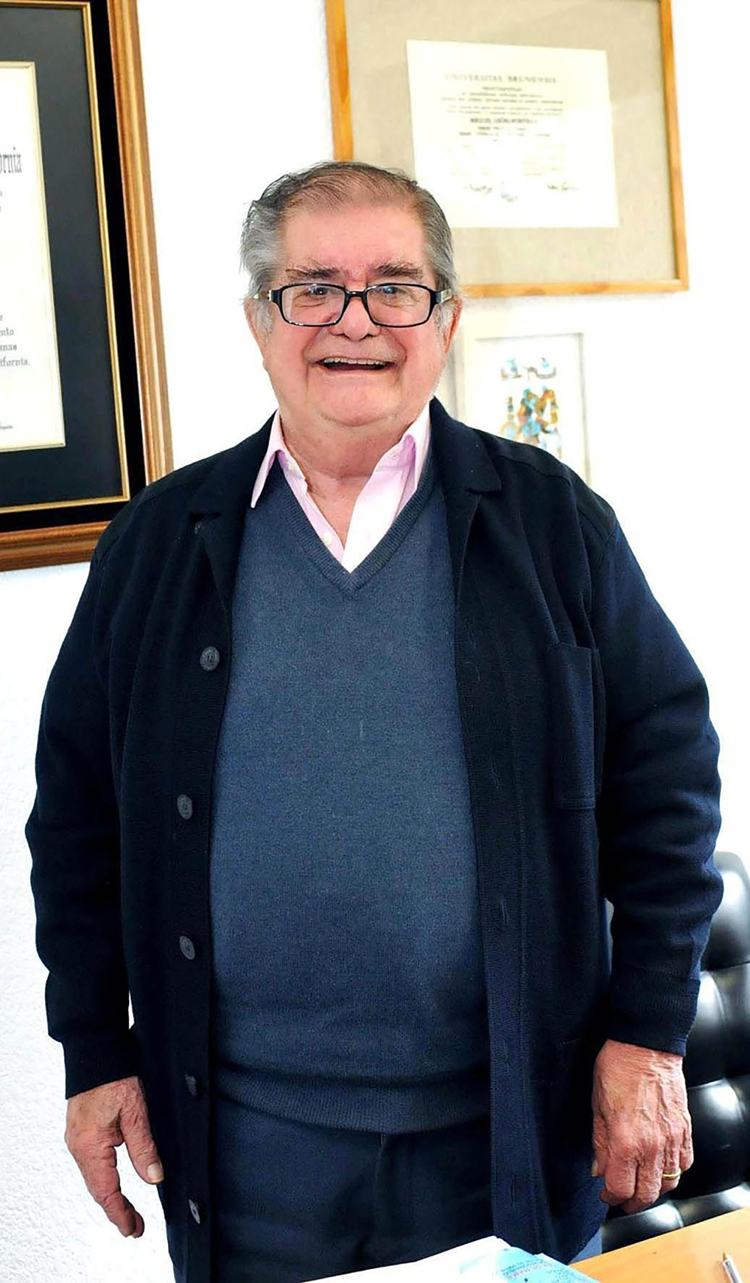
First, I would like to go back to the distant year of 1963, when an impetuous Miguel was chosen to direct the former Instituto de Historia [now Instituto de Investigaciones Históricas] of the UNAM (León-Portilla Reference León-Portilla and Meyer1993). After receiving the baton from a prestigious archaeologist, Pablo Martínez del Río, the new director found himself heading a research center urgently in need of reorganization. Without hesitation, he took decisive measures, one of which we now recognize as visionary: creating the institute's Anthropology Section, putting the tireless Juan Comas Camps in charge, and thus bringing together the impetus of several veritable giants in this area of knowledge including Paul Kirchhoff, Pere Bosch Gimpera, Morris Swadesh, Fernando Horcasitas, Santiago Genovés, and Yolanda Lastra. Additionally, in order to strengthen archaeological studies, he enlisted a pair of young specialists—Jaime Litvak and Carlos Navarrete—who were beginning to shine. As one might expect with such a distinguished group, the Anthropology Section quickly blossomed to the point of soon having to move from the seventh to the first floor of the Tower of Humanities. In fact, the success of this melting pot of exceptional minds led León-Portilla, with the support of the president of the university, Guillermo Soberón, to establish the Instituto de Investigaciones Antropológicas in 1973, which currently houses a team of about 50 specialists, many of them devoted body and soul to archaeology.
Another key moment in the history of my discipline dates from the period between 1987 and 1992 when Miguel León-Portilla was our brilliant ambassador to UNESCO (León-Portilla Reference León-Portilla and Meyer1993). During those challenging years in Paris, he not only successfully navigated the turbulence of an institution that was in full political and economic crisis, but also spearheaded a process that altered the course of some of the most important archaeological sites in Mexico. I am specifically referring to the five candidates that León-Portilla put before the plenary of that organization of the United Nations to be added to the roster of World Heritage Sites. Thanks to compelling applications and skillful diplomacy, Teotihuacan, Monte Albán, Palenque, Chichen Itza, and the Templo Mayor of Tenochtitlan—the latter including a large part of the historic center of Mexico City—came to join that exclusive list. As Miguel has repeatedly pointed out, this designation not only represents an enormous privilege, but also a major responsibility for those of us in charge of safeguarding these sites.
A third snapshot, corresponding to the year 1959, brings us to the beginning of Estudios de Cultura Náhuatl, the internationally renowned journal founded by the eminent Ángel María Garibay K. and continued with erudition and fortitude by Miguel León-Portilla (Garibay K. Reference Garibay and María1959). From the very first volume, archaeology has been present in this serial publication (López Luján Reference López Luján2015b), even though its essential vocation is the study of “all kind[s] of documentary sources, indigenous codices, and texts of historical, ethnographic, linguistic, or cultural importance in relation to the various Nahua peoples, [of] the pre-Columbian, colonial, and independent Mexico periods” (http://www.historicas.unam.mx/publicaciones/revistas/nahuatl/nahuatl.html). Such a presence, for those who like statistics, is easily corroborated by perusing the tables of contents of the 49 volumes that have been published to date. Among the 996 contributions listed, 100 of them are wholly or partly dedicated to archaeology, which together represent no fewer than 1,783 pages. These tables of contents also reveal the richness and diversity of this “archaeological corpus,” in addition to a clear predilection for certain theoretical positions, methodologies, and topics. For example, immediately apparent is a preference for iconographic analyses of isolated sculptural monuments or groups, in order to reveal their historical and symbolic content as well as their aesthetic value. Equally recurrent are articles on urban centers, especially their ceremonial precincts, where the finest temple-pyramids, plazas, shrines, and tombs are usually concentrated. Something similar can be said of the most sophisticated intellectual expressions of the pre-Hispanic world such as writing, mathematics, the calendar, and astronomy, which are often examined in the pages of Estudios de Cultura Náhuatl. To all of this I must add the reviews and obituaries Miguel wrote concerning the protagonists of Mexican archaeology and anthropology (León-Portilla Reference León-Portilla1974c, Reference León-Portilla1980, Reference León-Portilla1989, Reference León-Portilla2002).
Obviously, the role of our honoree in the field of archaeology is not limited to his highly successful initiatives in the realms of university administration and politics, cultural diplomacy, or journal publication. Rather, the field of ideas is where we will find his greatest achievements. Let me say at the outset that Miguel León-Portilla, with an acute sense and clear vision, has explored practically every corner of the ancient world, and is often at the forefront in uncharted areas.
A prime example of this is his historiographical research on what he himself has called “protoarchaeologists,” undoubtedly beginning with those Mexica and Tlaxcaltecans of the fifteenth and sixteenth centuries who used to explore with fascination the desolate ruins of Teotihuacan and Tula-Xicocotitlan with the express purpose of exhuming all sorts of relics from their depths (León-Portilla Reference León-Portilla2008). In this same area we may include León-Portilla's biographical studies of the dragoon captain from Luxembourg, Guillermo Dupaix, and the naturalized French artist, Jean-Frédéric Waldeck. Dupaix, as is well known, headed the Royal Antiquarian Expedition in New Spain, an ambitious and ill-fated endeavor that was able to complete only three outings between 1805 and 1809 (León-Portilla Reference León-Portilla1971, Reference León-Portilla1978c), while Waldeck scrutinized the ancient buildings of Palenque and Uxmal in the 1830s vainly searching for evidence of contacts with Egypt, Carthage, Niniveh, and India (León-Portilla Reference León-Portilla1997). In an analogous manner, Miguel has documented the successive passage of “proto-” and professional archaeologists through the same site—as occurred in the paradigmatic case of Xochicalco (León-Portilla Reference León-Portilla1995b)—and, conversely, has traced the explorations of one man of science in a multitude of sites, illustratively following his dear uncle, Manuel Gamio (Figure 3), through Chalchihuites, Azcapotzalco, Tenochtitlan, Teotihuacan, and Kaminaljuyu (León-Portilla Reference León-Portilla1960, Reference León-Portilla2009).
A young Miguel with his uncle Manuel Gamio evoking the “Noche Triste” in front of the Popotla's cypress. Photograph courtesy of the Proyecto Templo Mayor.

León-Portilla also has successfully ventured into Mexico's ever uncertain remote past. And, when his research requires him to go back centuries or even millennia, he has been accompanied by exceptional guides, nourished by the works of the most renowned archaeologists of his time, including Jorge Acosta, Ignacio Bernal, Alfonso Caso, Richard MacNeish, Ignacio Marquina, René Millon, Eduardo Matos Moctezuma, Eduardo Noguera, Román Piña Chan, César Sáenz, and Laurette Séjourné, to name only a few (León-Portilla Reference León-Portilla1974b). This is how Miguel has managed to heed rigorously the call of his wide range of interests concerning our ancestors.
In this respect, the topic of technology recurs in his publications. For instance, let me say that he has written many pages on mining and metallurgy, from mineral exploitation using wells, tunnels, and shafts to the production of ornaments and implements out of gold, silver, copper, tin, and lead (León-Portilla Reference León-Portilla1978b, Reference León-Portilla1984). And something similar can be said about his curiosity for hydraulics, from the Olmec cisterns and channels of San Lorenzo, to the chinampas and drainage systems of Teotihuacan, to the dams and aqueducts that scored Lake Tetzcoco during the Postclassic (León-Portilla Reference León-Portilla1992a). All of this has led Miguel León-Portilla to ponder how, in spite of multiple technical limitations and an absence of draft animals, Mesoamericans independently achieved a level of civilization equal to the societies of the Tigris and Euphrates, Nile, Indus, and Huang Ho river valleys. His solution to such an elusive question is that here they followed evolutionary paths that differed from those in the Old World, but that all of them, in the end, converged in the establishment of urban life, the production of fine art, and the creation of writing systems (León-Portilla Reference León-Portilla1974d, Reference León-Portilla2004b).
The heights of León-Portilla's insights are also discernable in his taste for general historical overviews of entire areas such as Mesoamerica and the Andes (León-Portilla Reference León-Portilla1974b, Reference León-Portilla1974d, Reference León-Portilla1979, Reference León-Portilla2004c), or regions rarely considered in the social sciences such as the peninsula of Baja California (León-Portilla Reference León-Portilla1983, Reference León-Portilla1995a; León-Portilla and Piñera Ramírez Reference León-Portilla and Ramírez2011). In that geographic and cultural blind alley he has reconstructed 12 millennia of tradition with brief but masterly treatments based on data pieced together from the excavation of shell works, rock shelters, and open-air camps and compared with the accounts of sailors, pearl fishermen, and missionaries.
As a lover of the exegesis of the spoken and written word, León-Portilla has paid particular attention to the material recording of knowledge (León-Portilla Reference León-Portilla1989, Reference León-Portilla1992b, Reference León-Portilla1996, Reference León-Portilla2002). Thus he has examined ceramics, murals, and stone monuments for their systems of images and glyphic notations that made possible the preservation and transmission of ideas. And, conversely, his careful study of the spoken and written word, in Nahuatl as well as Castilian and Latin, has helped him unravel the meaning of enigmatic sculptures and paintings, no matter if they take the form of feathered serpents, decapitated deities, or majestic sovereigns (León-Portilla Reference León-Portilla1974b, Reference León-Portilla2004a, Reference León-Portilla2007). This is how he manages to breathe life into inert material remains with no apparent reason, which proliferate in our museums and archaeological sites.
As you may have guessed, among the contributions that I personally value most are the ones that León-Portilla has made concerning the Templo Mayor in collaboration with my mentor Eduardo Matos Moctezuma (Alcina Franch et al. Reference Alcina Franch, León-Portilla and Moctezuma1992; León-Portilla Reference León-Portilla1978a, Reference León-Portilla1982, Reference León-Portilla and Boone1987; León-Portilla et al. Reference León-Portilla, Moctezuma and Verut1981). In the 1970s and 1980s, they joined forces to show how the archaeological and historical data complement and corroborate each other. Combining the methods of their respective disciplines they came to understand the transformative construction phases of this pyramid over the course of two hundred years, and, even more important, the political and religious context that led to each change.
In closing, I would like to say that just a couple months ago I invoked León-Portilla's teachings before a group of young archaeologists, while excavating at the foot of the Templo Mayor (López Luján Reference López Luján2015a; Pedraza Rubio et al. Reference Pedraza Rubio, Luján and Hoyos2017). I explained to them how, based on pictographs and chronicles, Miguel and Eduardo had recognized in the building's physiognomy the material representation of the archetypal Coatepec (Serpent Mountain), an evocation of the myth of the birth of the sun, Huitzilopochtli, and a theater for reenacting the defeat of the moon, Coyolxauhqui (León-Portilla Reference León-Portilla1978a:45–46).
In the middle of the talk, we were struggling to free from the mortar an offering that a Mexica priest had devotedly deposited five hundred years earlier (Figure 4). All of a sudden, a ray of sunlight revealed the presence of several gold ornaments belonging to the lunar goddess: they were the luminous earpieces of Coyolxauhqui, accompanied by the bells worn on her cheeks, which divulged her identity (Figure 5). The priest had surrounded these insignias with obsidian points and flint knives, perhaps to denote the setting of the moon at the base of the mountain. The next day, four beautiful representations of hearts, also made of gold, appeared below the assemblage (Figure 6). There is no doubt that these pieces allude to the hearts of the goddess and her stellar siblings which, according to the version of the myth in the Crónica Mexicayotl (Alvarado Tezozómoc Reference Alvarado Tezozómoc1975:33–34), were devoured by Huitzilopochtli, an act interpreted by León-Portilla (Reference León-Portilla1978a:22–23) as an appropriation of the vital energy of adversaries. One of the gold hearts that we found had clearly been deformed by the priest's hands (Figure 7). I wonder if this was intended to signify that Coyolxauhqui was “perverse,” as inferred by the words yollochico and yollonecuil, literally translated as “crooked heart” and “bent heart” (Burkhardt Reference Burkhardt1989:177; León-Portilla Reference León-Portilla2004c; Molina Reference Molina1944). Or maybe he wanted to “offend” the goddess magically or to “damage someone's heart,” the literal sense of the verb teyolitlacoa (Burkhardt Reference Burkhardt1989:28–29; León-Portilla Reference León-Portilla2004c; Molina Reference Molina1944). Although I still do not know the answer, I am confident that at the end of the day we will come to understand this priest's ritual gesture, for Miguel is always with us, the one who is the master of a wise face and a resistant heart like the trunk of a tree.
Excavation of Templo Mayor's offering 167 in 2016. Photograph courtesy of the Proyecto Templo Mayor.

Offering 167: golden earpieces of the Moon Goddess, Coyolxauhqui. Photograph courtesy of the Proyecto Templo Mayor.

Offering 167: golden pieces representing human hearts. Photograph courtesy of the Proyecto Templo Mayor.

Offering 167: a human heart made of gold plate that was intentionally deformed. Photograph courtesy of the Proyecto Templo Mayor.

ACKNOWLEDGMENTS
I am grateful to Eduardo Matos Moctezuma, Ana Carolina Ibarra, William R. Fowler, and Scott Sessions.



