‘Nine Years in an Orphanage’ is an aria for soprano, orchestra, electronics and 3D image. Lying at the heart of Michel van der Aa’s Sunken Garden (2011–12), the aria represents the moment in the opera – and in opera history – when stereoscopic visioning enables music and image to produce a single, intermedial act of telling. ‘Nine Years’ performs a complex and contradictory role. Self-reflexive, while at the same time anticipating future events, the audio-visual aria places the audience in the same emotional state and (illusory) physical space as the protagonist, a positioning that enables a unique performative journey through the opera.
Contemporary opera directors have long welcomed the moving image to the stage, embracing its ability to enlarge the proscenium physically and the work metaphorically; an expansion particularly apparent in Gary Hill’s setting of Fidelio in outer space (Opéra National de Lyon, 28 March–12 April 2013). In recent years, it has even been possible for composers to create music with a screened staging in mind: Gavin Turk’s video-rich set design is tightly woven into the fabric of Opera Erratica’s Triptych (2014), for instance. Sunken Garden, a work described by its librettist David Mitchell as ‘an occult mystery film opera’, takes the possibilities for audio-visual integration even further.Footnote 1 Scored for chamber orchestra, analogue synthesisers, 4-channel soundtrack, baritone, two sopranos and, on film, baritone and mezzo-soprano, the film-opera’s orchestral and dance music textures perform closely with 3D visual ones to open up an immersive and liminal space that not only lies to the back and sides of the stage, but also reaches forward to engulf the audience. In staged opera, the singing voice presses across the ‘mystic gulf’ that lies between stage and auditorium to create a feeling of physical depth and dimensionality. The stereoscopic image provides an accompanying form of visual immersion, breaking from the stage to bathe the audience not only in sound but also in image. This expanded viewing field can influence the ways in which we listen to opera.
As composer and director of the staged and filmed elements of Sunken Garden, Aa was able to form a fully integrated audio-visual composition, complete with a quintet of staged and filmed actors and frequent conversations between live orchestra and pre-recorded voices. Many reviewers of the work complained that Aa’s attempts to create a more immersive – or realistic – experience amounted to little more than a gimmick, serving only to defer ‘the emotions another degree further away’.Footnote 2 Used to depict the sunken garden physically and metaphorically, however, the new 3D technology was, according to the composer, ‘locked into the DNA of the libretto’; in fact, Aa maintains that ‘the 3D elements remain functional and fully integrated with the requirements of the drama’.Footnote 3 He asserts that Sunken Garden’s enlarged dimensionality flexes and extends the edges of the traditional operatic form via an ‘expanded’ vocabulary, adding ‘something that I can’t achieve with my music; that I can’t achieve on a stage’.Footnote 4
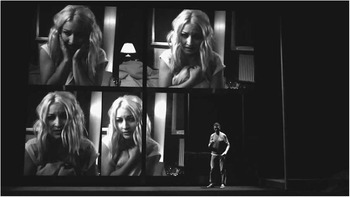
The possibilities of such expanded forms of audio-visuality have been embraced by many contemporary filmmakers. Martin Scorsese, for instance, has used 3D technology to provide a perspective as multifaceted as cubism – where the photographic plane is unfolded upon the canvas – and sculpture, where a visitor can walk around an object to unveil various different perspectives.Footnote 5 This idea of simultaneity lies at the heart of Sunken Garden. The libretto, Mitchell explains, is ‘essentially about an entity, a woman who, for a number of decades, has cheated death by stealing the souls of the desperate and lonely, of people who might not want to live anymore’.Footnote 6 Toby, a documentary filmmaker, is commissioned by the patroness of a mysterious arts foundation – Zenna – to make a film investigating the disappearances of two characters: Simon, an IT engineer, and his girlfriend Amber. Zenna’s ample funds allow Toby to make use of cutting-edge 3D technology. At first, the opera proceeds via live singing and excerpts from Toby’s film, which appear in the form of 2D talking heads (Fig. 1). But as the investigation proceeds, the filmmaker finds himself in a beautiful yet mysterious garden where he encounters the frozen images of the missing characters, along with a strange character known as Marinus. As in Avatar (James Cameron, 2009) and Coraline (Henry Selick, 2009), the move into an alternative, transcendent reality appears both to us and to Toby in hyper-saturated 3D.
Filmed, 2D talking heads in Michel van der Aa’s Sunken Garden (2011–12).

Prominent in the new cinematic grammar required for 3D film is an expansive sense of time and space. The traditional theatrical and cinematic experience creates a plausible sense of depth through sound immersion: 3D technology allows image to join sound in the auditorium. Buzz Hays, senior 3D visual effects producer for Beowulf (Robert Zemeckis, 2007) explains that the technology privileges the long cut for movement within shots, as this enables the audience to construct their own illusory sense of space: ‘We are in effect editing the 3D scene with our own eyes since we are able to better understand the components of a scene in relation to one another because we are given greater depth awareness.’Footnote 7 Miriam Ross takes Hays’s understanding further, arguing that stereoscopy ‘has unique modes for incorporating the embodied and synaesthetic nature of perception, so that both film and viewer are physically present in the production of meaning’.Footnote 8 Aa embraces the possibilities for synaesthetic visioning to allow opera-goers the same visual, as well as aural, point of view as the characters: at one stage Toby announces prophetically that ‘The public will only believe the truth if it is shot in 3D.’ Fully embodied, tactile and immediate, this visual space provides a form of audio-visual immersion new to the operatic stage, as audience members are invited to share an intense physical, as well as emotional proximity to the characters.
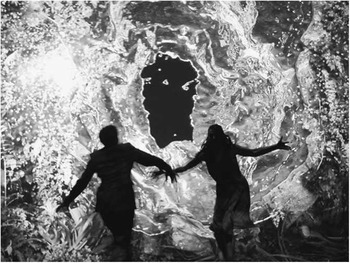
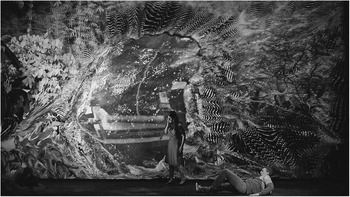
The opera’s double form of immersion coincides with a musical turn from ensemble singing to a string of self-reflexive arias, in which the characters relay their troubled pasts. Through the soliloquies, we learn that the garden is an occult engine created by Zenna to house souls – as ‘moths’ – caught between life and death, a liminal space used as fuel for her own immortality. Between arias, Marinus struggles for Simon and Amber’s return to reality. Towards the end of the opera, the soundtrack becomes purely electronic as Iris and Zenna fight, causing the garden to buckle and elongate in a 3D explosion towards the audience (Figs. 2a and 2b). The Zenna we see here, it transpires, is merely image: while her mind is manifest in the garden, her corporeal body lies safely elsewhere. The 3D shapes act as a portal between Zenna’s mind and body that allows opera-goers an awareness of two places at once. When the door to the real world vanishes, Toby finds himself sucked into the portal as the entire garden and the screen and stage go black. The opera ends with a film, in which it becomes apparent that Toby’s mind has become trapped in Zenna’s body. Aa explains that:
There are three inter-related levels in Sunken Garden. In simplest terms the opera is a whodunit investigating the disappearances, what happened to the missing persons and solving the mystery of who was behind the crime. The second level deals with the film-maker Toby and the technical process of making the film which opens and closes the opera. The third is more abstract and inhabits the dreamlike occult world of the sunken garden, pitched between life and death.Footnote 9
The garden moves towards staged characters and audience in a 3D explosion.

The garden moves towards staged characters and audience in a 3D explosion.

It is film – and 3D technology in particular – that affords the liminal space in which these three layers can collide.
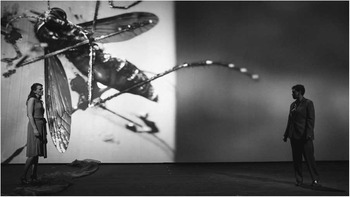
‘Nine Years’ is the first aria from the sunken garden (scene 6) and is performed live by Zenna. We learn of the troubled past that led to her wicked ways – she was orphaned, raped and widowed – as a large and watery 3D eye billows behind her, spilling its tears into the audience in perfect synchronicity with the music. As the tears envelope the auditorium, the character shatters the fourth wall by turning from the filmed world behind her to address her tale directly to the audience: ‘I, a poor widow, withdrew from the world, To build my Garden in the Dusk.’ As she sings of her pride in her work, the watery hole that symbolises the portal to her real-life body becomes a seething red pool that seems to spit drops of blood into the audience’s laps in illustration of the life-taking truth behind her garden. The boiling blood that connects Zenna’s mind and body coincides with a musical frenzy, as it crescendos to a sforzando oscillation between F sharps and G sharps in opposing registers, a screaming dissonance driven forward by a persistent dotted rhythm. Suddenly the music stops, as though all the life had been squeezed from it. Zenna hits the side of the stage as if killing a fly, initiating a buzzing re-entry of the soundtrack with ‘distant strings and mosquito’ as an enormous 3D midge, crushed and struggling, replaces the image of the garden (Fig. 3).
Zenna watches the struggling 3D mosquito.

Here, the stereoscopic image is not simply a form of immersive visual spatialisation; nor is it a gimmick, as some reviewers would have it. If we return to Mitchell’s ‘three-tiered’ libretto and Hays’s notion of embodied viewing, we can understand the 3D portal as a ‘functional’ and additional narrative device that imparts information absent (at least at this stage) from the libretto, music and traditionally staged elements. It works in several ways: first, the portal gives the audience the same viewpoint as Toby, who is witnessing its multi-dimensional pull for the first time. Like the protagonist, the audience find themselves pitted somewhere between real world and garden, between Zenna’s mind and body, and ‘between life and death’. Latent in Toby’s earlier ironic assertion that ‘The public will only believe the truth if it is shot in 3D’ is the type of simultaneous, cubist-like visioning initiated by the portal: the only way back to the truth – to reality – is through this liminal threshold that surrounds the audience. Second, although music and lyrics move in tandem towards their frenzied climax, the 3D image provides a visual counterpoint to what we hear, opening up to reveal the stricken mosquito that symbolises the demise of garden and the ‘moths’ kept therein. Positioned aurally and visually within Toby’s point of view, audience members are invited to construct his film with him in real time. Significantly, they are able to do so via the cutting-edge 3D technology that Zenna herself enabled Toby to use.