Introduction
Prostate cancer (PC), which accounts for 27% of all male cancers and has a frequency of 268 490 new cases and 34 500 deaths, has emerged as the most common malignancy among men (Ref. Reference Siegel1). The chance of developing PC is influenced by a number of demographic factors, including ethnicity, lifestyle and family history of the disease. A huge medical and financial burden is placed on society by the prevalence of diseases, the overtreatment of benign tumours, the under-treatment of high-risk PC and the lack of early detection methods, which all negatively affect the quality of life. The rate of diagnosis, surveillance and combining several diagnostic modalities for early detection of PC is essential for improving patient health outcomes and achieving the ultimate aim of clinical usefulness. For PC diagnosis, currently used techniques include digital rectal examination (DRE), serum prostate-specific antigen (PSA) level, trans-rectal ultrasound (TRUS), multi-parametric magnetic resonance imaging (mp-MRI) and TRUS/MRI-guided fusion biopsy followed by histopathology-based Gleason score (GS) grading. DRE is an unrefined, basic first step in PC detection. PSA is still the required test for PC; however, its usage is controversial due to its limited sensitivity and specificity. It lacks a specific prognosis, and its associations with age, an infectious disease, and benign prostatic hyperplasia (BPH) increase the likelihood of false-positive results (Ref. Reference Roberts2). High inter-observer inconsistency, the risk of missing the more advanced or aggressive parts of the tumour by using other methods, and the need for particularly vigilant, careful monitoring and re-evaluation of PC for a conclusive diagnosis. Additionally, PC has molecular heterogeneity that is multifocal and spatially heterogeneous at the tissue and cellular levels. A spatial strategy for biological enquiry and biomarker development is therefore required to have correct tissue functioning and associated pathological changes occurring throughout the PC prognosis (Ref. Reference Steiner3).
Metabolomics profiling is a method that holds promise since it enables an understanding of the changes in the metabolic environment that are linked to disease and are responsible for pathophysiology. In-depth knowledge of disease, aggressiveness, therapeutic targets and treatment resistance can be gained through metabolomics studies (Refs Reference Giunchi4, Reference Eidelman5). The application of clinical metabolomics has demonstrated that it can improve diagnosis accuracy and may even replace conventional PSA testing in the future (Ref. Reference Letertre6).
The metabolome of tumours has been characterised using a variety of spectroscopic methods. The most effective techniques for collecting information on tumour metabolomics employ state-of-the-art tools, including nuclear magnetic resonance (NMR) and mass spectrometry (MS). Lack of sample derivatisation, great repeatability, the inherent non-destructiveness of NMR-based techniques, and high sensitivity, selectivity and lower limits of detection of MS-based techniques are the key features of analytical platforms utilised in metabolomics (Ref. Reference Choi7). MS is frequently used in conjunction with a separation method like gas or liquid chromatography (GC-MS or LC-MS). The wide range of objectives specifies the choice of procedure, which depends on the competence, cost and chemical variety of the study's target metabolites. However, it is crucial to keep in mind that no one analytical platform can provide information about all metabolites; as a result, a variety of analytical methods have been utilised to generate comprehensive metabolic information to achieve maximal metabolite coverage (Ref. Reference Alseekh8).
Diseases and the onset of metabolic changes are frequently initiated by the cellular functions of the tissue. Tissue metabolic phenotyping may provide more reliable and sensitive biomarkers at the early stages of development because it represents the localised location of disease (Ref. Reference Rinschen9). There have been numerous PC tissue metabolomic studies performed, with variations in tissue collection, homogenisation, metabolite extraction, sample pre-treatment choice, extraction procedure, metabolomics measurement method (targeted or non-targeted metabolomics) and analytical and biological interpretation of the obtained data.
Hence, this review examines a significant metabolic pathway-based turning point in the cellular metabolism of PC with the aim of offering fresh insight into cutting-edge metabolites for better understanding and the potential for improving PC detection because early diagnosis of PC can be done in non-invasive matrices. Once the biopsy has been taken, the objective is to determine the severity and stage of the cancer, which can also be determined with the help of metabolites as biomarkers.
Pathophysiology of PC
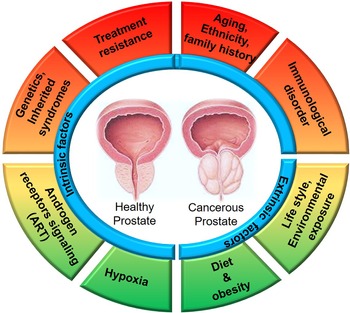
Right, left and centre lobes are the three anatomical types of the prostate gland (PG) lobes. Histologically, it has a peripheral zone (PZ), a central zone (CZ), a transition zone (TZ) and anterior fibro-muscular zones (Ref. Reference McNeal10). PZ comprises approximately 70% glandular tissue in the form of small, rounded epithelial glands with loose stroma and loosely interlacing smooth muscles. The CZ is positioned at the base and in between the peripheral and transition zones. It contains around 25% of the glandular tissue. It has large polygonal epithelial glands with a compact stroma. TZ comprise only 5% of glandular tissue and have small, rounded glands with compact stroma (Ref. Reference Sinnott11). A typical Figure 1 exhibits an overview of the numerous factors that contribute to the onset, progression and recurrence of PC.
A typical presentation of an overview of the numerous factors that contributes to the onset, progression and recurrence of PC.

The route that healthy cells follow towards cancer cells is typically influenced by extrinsic, intrinsic and systemic variables. The key risk factors for PC include race, ethnicity, family history and age (Ref. Reference Freedland12). In addition to these factors, oxygen supply, environmental factors and genetic alterations (including changes in genes related to epidermal growth factors, phosphatidylinositol 3 kinase (p13 K) and AKT signalling, androgen signalling, DNA repair genes and epigenetic deregulation) support tumorigenesis in the prostate. PC cells use metabolic reprogramming to rearrange their cellular metabolism to support growth and survival (Ref. Reference Wang13). Traditionally, cells generate energy by citrate oxidation, which occurs during aerobic respiration and is a crucial phase in the Krebs cycle. However, zinc (Zn) plays a distinctive role in prostate cells, particularly PZ epithelial cells, which are designed to generate citrate rather than oxidise it (Ref. Reference Eidelman14). Zn prevents the m-aconitase enzyme from converting citrate to isocitrate, which results in citrate accumulation. Citrate is an important component of prostatic fluid. Because of this, it's possible that the citrate-producing prostate cells adopt alternative metabolic pathways and reduce other nonessential activities in order to meet their energy needs for survival and reproduction (Ref. Reference Ahmad15). The hallmarks of healthy prostate epithelial cells are zinc accumulation and citrate synthesis; however, there is a significant swing in cancerous prostate cells. They change this metabolic phenotype and adopt the zinc-wasting, citrate-oxidising phenotype, which represents a significant change in energy metabolism (Ref. Reference Franz16) and results in the malignant transformation of normal prostatic epithelial cells (Refs Reference Franz16, Reference Kumar17). These metabolic changes in the prostate are likely to contribute to oncogenesis and the creation of malignant cells with no specific purpose other than those required for their generational propagation. In order to assess the metabolic status of prostate pathology in three different forms, namely in vivo, ex vivo and in vitro, spectroscopic techniques, which have been developed because of advances in metabolomics, have become crucial tools.
Methods
The review comprises a systematic search of the published literature.
Search strategy
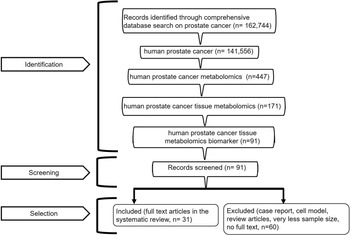
A thorough search of all publications pertaining to PC tissue metabolomics was conducted. Using the following MeSH term combinations, during the period of January 2004 to August 2022: prostate cancer, human prostate cancer (tiab) intervention with tissue intervention with (metabolomics OR metabolite) intervention with (biomarker OR marker). All PC metabolomics studies were initially screened for titles and abstracts. Subsequently, a more in-depth investigation into the human PC tissue metabolomics research report was screened. After that, the full texts of works that passed a more thorough evaluation for human PC tissue metabolomics prediction, identification and development or used various metabolomics spectroscopic techniques as an analytical tool were chosen.
Selection criteria
Important full-text articles in the English language were examined, following notable titles and abstracts. Human PC tissue metabolomics biomarkers for prediction, identification, progression, diagnosis or recurrence with their clinical efficacy employing metabolomics analytical platforms were included in the inclusion criteria. Cell model studies, reviews and research using animal models were excluded.
In particular, the number of studies on PC metabolomics that have been published in the biomedical literature has dramatically expanded over the past few decades. Therefore, a systematic search was followed to extract the majority of relevant studies for this review. The five-step, rigorous approach used to abstract research began with the PC and continued until PC tissue metabolomics biomarkers were identified, as illustrated in Figures 2 and 3. The 91 studies that were chosen for further consideration were carefully prospected for PC tissue metabolite biomarkers using the sample type, sample size, participant age, investigative method employed in the study, result, statistical analysis, validation, potential biomarker, year of publication and any additional or significant comments about the study.
Depiction of the systematic literature search using PRISMA guidelines.

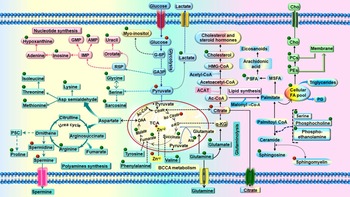
A classical presentation of contributory metabolic pathways and their intermediate metabolites involved in cellular metabolism of PC. Up-regulated and down-regulated metabolites are delineated with green dot and red dot, respectively.

Results
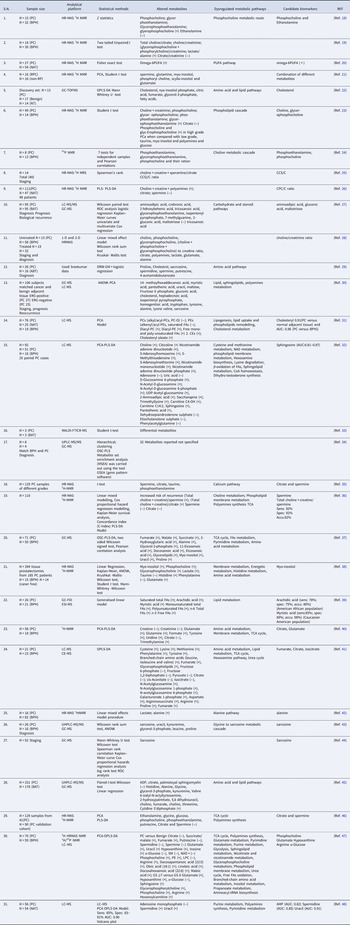
After rigorous screening, 31 of 91 studies have been included in this review. PC metabolism is of enormous clinical relevance in figuring out how cancer develops and how to find new treatment targets. Tumour cells produce a number of metabolic effects that rewire and reprogramme the metabolic pathway in order to grow and adapt to the tumour microenvironment. To proliferate and adapt to the tumour microenvironment, tumour cells induce a variety of metabolic effects that reprogramme and rewire the metabolic pathway. This review understands the function of several tissue metabolomics-derived signatures for PC based on different metabolic pathways. To better comprehend the connection between these metabolic pathways and their potential signature metabolites and their clinical importance, we have categorised the complete review into different metabolism-based biomarkers Table 1.
Cellular metabolomics of PC-based signatures using NMR and MS

Cho, Cholin; PCh, phosphocholine; GPC, glycerophosphocholine; PE, phosphoethanolamine; GPE, glycerophosphoethanolamine; AUC, area under curve; (+), Increased; (−); decreased.
Lipid metabolism
According to the available literature, systemic metabolic changes brought on by increasing consumption of saturated fat have been linked to an increased risk of PC development and mortality (Ref. Reference Richman49). The discovery and confirmation of disease-specific biomarkers have been aided by advancements in lipidomic spectroscopy (Ref. Reference Yan50). Understanding the underlying metabolomics of tumour aggressiveness and potential biomarkers of tumour aggressiveness is made easier by the changes in metabolic levels between healthy cells and malignant cells (Ref. Reference Sharma51). Increased lipogenic phenotype, high triglycerides, high-density lipoprotein (HDL) cholesterol and high total low-density lipoprotein are all characteristics of transformed PC cells (LDL). Phospholipids (PLs), sphingolipids and cholesterol levels have been found to be increased to sustain continuous membrane production. Acetyl CoA carboxylase (ACC) and fatty acid synthase (FASN), which are responsible for the synthesis of saturated fatty acids (SFA), were discovered to be overexpressed and consistently linked to increased PC cell proliferation. High FASN activity enhances the production of SFAs that lead to their acylation in phospholipids, resulting in a high ratio of SFA and polyunsaturated FAs (SFA/PUFA) for the cell membrane (Ref. Reference Giunchi4). Choline, an important dietary amine, is a crucial part of membrane PLs and helps to keep cell membranes structurally sound. In PC versus BPH tissue samples, it was found that cholin (Cho) and other membrane components, including phosphocholine (PCh), glycerophosphocholine (GPC), phosphoethanolamine (PE) and glycerophosphoethanolamine (GPE), were increased, whereas ethanolamine (Eth) was noticeably decreased. Additionally, malignant tissues had considerably greater PC/GPC, PC/PE, PE/Eth and GPE/Eth ratios than benign tissues (Ref. Reference Swanson18). Studies gleaned significant metabolic variations between malignant and benign tissue levels of GPC + PC/Cr, Cho/Cr, tCho/Cr, Cit/Cr, tCho/Cit and CC/C. Additionally, there is a considerable difference in the (tCho + Cr)/Cit signal ratio (CC/C), which has frequently been employed by in vivo MRS to determine the presence of PC (Ref. Reference Asten19). A distinct peak of omega-6 PUFA species was found in PC tissue using non-destructive high-resolution magic angle spinning (HR-MAS) NMR spectroscopy (Ref. Reference Stenma20). Maxiner et al. studied sixteen consecutive PC-recurrence cases and revealed that after prostatectomy, recurrence cases paired by age and Gleason score with cases without recurrence of the same pathological and clinical stages had PCh and metabolomic profiles that were disrupted in PC development (Ref. Reference Maxeiner21). According to the study, prostate metabolomic profiles measured with intact tissue HR-MAS 1H MRS are capable of offering an additional parameter to predict the risk of PC recurrence (Ref. Reference Maxeiner21). Thysel et al. used GC-MS to examine the relationship between cholesterol and PC metastasis in BPH, PC and normal bone tissue. As compared to bone metastases from other origins and normal bone, PC bone metastases had significantly higher cholesterol levels. Class B type 1 and 3-hydroxy-3-methylglutaryl-coenzyme reductase receptors are found in high concentrations in cancer epithelial cells, which provides additional support for the findings (Ref. Reference Thysell22). In a pilot study, the HR-MAS study was explored to investigate phospholipid metabolite concentrations, GS and tumour stage affinity. The findings indicated subtly higher PCh and GPC concentrations in high-grade PC than in low-grade PC. In comparison to PCh and GPC, PE and GPE levels were four times higher in benign and malignant tissues (Ref. Reference Keshari23). In the same year, Komoroski et al. discovered analogue results and revealed elevated amounts of PE, GPE, PCh and GPC (Ref. Reference Komoroski24). Subsequently, Selnaes et al. carried out the investigation to consider the idea of non-invasive MRSI using metabolic profiles of tissue samples and GS. According to the study, there is a strong positive association between GS and the ratio of choline + creatine + spermine/citrate (CCS/C) in spatially matched locations, as determined by both in vivo and ex vivo MRS. High-grade GS showed elevated CCS/C ratios (Ref. Reference Selnaes25). A study by Giskedegard et al. showed that the total choline + creatine + polyamines/citrate (CCP/C) ratio or the total choline + creatine/citrate (CC/C), was considerably elevated in high-grade PC samples compared to low-grade PC samples (Ref. Reference Giskeødegard26). Cerebrobic acid, 2-hydroxybehenic acid and tricosanoic acid were examined by Jung et al. and suggested that malignant PC tissue had higher quantities of these highly unique fatty acids than non-malignant PC tissues (Ref. Reference Jung27). In other analyses, recurrent PC was found to have higher PCh, GPC and free Cho levels compared to BPH (Ref. Reference Zhang28). Additionally, in the later stages of PC, there was a rise in cholesterol levels, which was considered to be the starting point for the synthesis of steroid hormones (Ref. Reference Liu29).
Compared to BPH, malignant tissues showed considerably higher quantities of FA such as 2-hydroxybehenic acid, cerebronic acid or glycerol phosphate. According to the study, the same group of fatty acids was associated with increased expression of linked proteins and mRNA (Ref. Reference Meller30). Another interesting study investigated the role of FA in PC. There were 350 different lipid species examined in all, and of these, diacyl-PCh and diacyl-PE were enhanced in PC, whereas ether-linked PCh and PEs were diminished. When compared to free SFA, the proportions of free mono- and poly-unsaturated fatty acids (MUFA and PUFA) were higher. Two cholesteryl esters (CEs), six PUFAs and one phosphatidylglycerol (PG) were among the nine lipid species that were substantially associated with GS grades, whereas three CEs and seven triacylglycerol (TAG) species were strongly interrelated with metastatic grades (Ref. Reference Li31). Compared to the BPH and nearby tumour tissue samples, the PC tissue sample had higher levels of citicoline and choline (Ref. Reference Ren32). Wang et al. conducted a study, and though 1032 lipids were detected, only a very limited number of metabolites were imaged. The study's findings show that lipid dissemination differs between cancerous and non-cancerous tissue regions. The most frequently found lipids in these GPL were sphingolipids, TAG, neutral lipids and choline, along with its derivatives (Ref. Reference Wang33). Using metabolomics-based biomarker identification, Cacciatore et al. identified 114 lipid compounds with differential expression from 460 metabolites in their initial metabolomic investigation. Out of these, the majority of FA includes lysophosphatidylethanolamine, glycerolipids, phosphatidylcholines and lysophosphatidylcholines. Compared to BPH, α-linoleic acid and linoleic acid metabolism were found to be up-regulated in PC. α-Linoleic acid was also found to be associated with the aggressiveness of PC (Ref. Reference Cacciatore34). Discrepant expression of phosphoethanolamine was also documented in an ex vivo metabolomics study (Ref. Reference Sandsmark35). Another ex vivo HR-MAS MRS investigation found that choline and its derivatives were more prevalent in PC and that a higher concentration is linked to a higher probability of PC recurrence (Ref. Reference Braadland36). Long-chain fatty acids, such as 11-eicosenoic acid, docosanoic acid, eicosanoic acid, dehydrocholesterol, glycerol-2-phosphate and glycerol-3-phosphate, were identified by Shao et al. as having associations with tumour stage and GS (Ref. Reference Shao37). In contrast to PC and BPH, Vandergrift et al. study found that only GPC and PCh were statistically significant among the other metabolites (Ref. Reference Vandergrift38). According to Zhou et al., the concentrations of 8 of the 16 total FA (TFA) and 4 of the 10 free fatty acids (FFA) determined by ESI-MS had discriminating values. Study suggested that, rising prostatic FAs – either TFA or FFA – were linked to the development, progression and racial disparity of PC (Ref. Reference Zhou39). A tissue metabolomics study of BPH, APC and MPC revealed lipid metabolic phenotypic changes in poly UFA, VLDL/LDL, adipic acid and formate. The study also gleaned that trimethylamine, an intermediate metabolite in choline metabolism, exhibits a high level in advanced PC stages (Ref. Reference Zheng40). Franko et al. research also described the increased level of GPL in PC samples as compared to BPH. Perturbed concentrations of the intermediate oncometabolite fumarate have also been reported. Phosphocholine, docosapentaenoic acid, oleic acid, linoleic acid, docosahexaenoic acid, maleic acid and fumarate lipid metabolites were found to be significantly higher in PC compared to BPH, while lysophophotidyl choline was found to be significantly lower in BPH. Glycerophosphorylcholine and phosphocholine levels increased further in a higher grade of PC (Ref. Reference Franko41).
Protein metabolism
Continuous tumour growth requires increased biosynthetic activity, which is kept up by metabolic rewiring that occurs both intrinsically in cancer cells and extrinsically in the tumour cells. To achieve this, cancer cells diversify their metabolic processes, maintain a steady flow of biomolecules and maintain the advancement of their cellular processes. Cancer cells, which need amino acids (AAs) for energy synthesis as well as sustaining cell growth, have significantly altered AA metabolism. AAs participate in a number of cellular metabolic pathways, either directly or indirectly. According to the gleaned research, glutamine (glu) is anaplerotic and relinquishes both amine groups in order to support cellular metabolism. Other AAs, not lagging behind, act as flexible fuel sources for cells. Isoleucine, leucine and valine, together known as the ‘branched-chain amino acids’ (BCAAs), are additional supplies that support the TCA cycle and feed lipogenesis through their catabolic breakdown. Purine biosynthesis requires carbon and nitrogen, which are supplied by aspartate, glycine and glutamine. Other AAs are also involved in purine and pyrimidine biosynthesis. Additionally, the methionine-folate cycle is known to provide nucleobases with one-carbon units by way of the amino acids glycine, serine and methionine. Through a variety of molecular mechanisms, including altering gene expression by modifying global chromatin structure, inducing immunosuppression, mediating epigenetic regulation and mediating posttranscriptional modification, AAs derivatives also promote the growth and metastatic potential of cancer (Ref. Reference Lieu52). Using hyperpolarised 13C MRSI staging, Tessem et al. observed significantly higher alanine contents in PC compared to BPH tissue samples (Ref. Reference Tessem42). HR-MAS 1H NMR spectroscopy revealed metabolic alterations in intact PC and BPH tissue and said that choline and polyamines, particularly spermine, may serve as biomarkers for PC diagnosis. Aten et al. found an augmented level of the ratios tCho/Cit, Cho/Cr, (GPC + PC)/Cr and Lac/Ala in PC, while the Cit/Cr ratio was significantly lower in PC compared to BPH (Ref. Reference Asten19). Sreekumar et al. profiled the metabolomes of 59 positive cancer patients and 51 negative control individuals. The results reveal interesting observations of 626 metabolites among three diagnostic classes, namely BPH, clinically localised PC and metastatic PC. Sarcosine, uracil, kynurenine, glycerol-3-phosphate, leucine and proline were identified using rigorous statistical mining as possible metabolites that were linked with the course of the disease from BPH to PC to MPC. After further processing of the data, sarcosine emerged as the top metabolite candidate for future development in biomarker panels for early disease detection and the aggressive prophecy of PC (Ref. Reference Sreekumar43).
To evaluate the risk of recurrence in an ex-vivo tissue MRS study on patients with reoccurrence in comparison with prostate tissue of their matched recurrence-free counterparts the spermine/polyamines, glutamine are linked with PC progression (Ref. Reference Maxeiner21). The two-dimensional HR-MAS total correlation spectroscopy (TOCSY) study executed by Keshari et al. was largely focused on phospholipids but also revealed a reduced peak of polyamines in benign glandular tissues in comparison to benign stromal tissues (Ref. Reference Keshari23). Jentzmik et al. conducted the investigation using PC tissue samples from cancerous and non-cancerous conditions and noted conflicting findings when comparing the studies with Sreekumar et al. (Refs Reference Sreekumar43, Reference Jentzmik44). The results of this study showed that sarcosine values were not related to PC aggression and that they were also not related to tumour stage, tumour grade or biochemical recurrence (Ref. Reference Jentzmik44). With the aim of evaluating the alliance between PC biomarkers (choline + creatine + spermine)/citrate (CCS/C) and GS spatially matched tissue, both in vivo and ex vivo MRS studies exhibited an increased ratio of CCS/G. The CCS/G ratio between the high-risk and low-risk PC groups was significantly different (Ref. Reference Selnaes25). To envisage PC combativity from low-grade (GS6) to high-grade PC (GS7) with NAT (n = 47), the study presented an upsurge in the total choline, creatine and polyamines/citrate (CCP/C) ratio. These metabolites exhibited a significant correlation with GS, with 86.9% sensitivity and 85.2% specificity (Ref. Reference Giskeødegard26).
In another study executed on two retrospective cohorts of PC patients who had prostatectomies, levels of 25 metabolites significantly increased as GS progressed in PC. However, both of the two metabolic manifestations of aggressive PC they saw demonstrated loss of prostate-specific metabolic processes. The levels of a plethora of AAs and FA were high in one group, whereas NAD and choline phosphate were elevated in the other group. The study emphasised the intriguing fact that there may not be a one-size-fits-all model of PC (Ref. Reference McDunn45).
Zhang et al. claim that 124 biopsy specimens were evaluated to identify quantitative metabolic biomarkers to distinguish between aggressive and indolent cancer. The findings showed that untreated cancer and BPH samples differed significantly in their levels of polyamines, alanine and glutamate. The results also confirm that the total choline to creatine ratio can distinguish between a PC that is advancing or aggressive and one that is indolently slow. (Ref. Reference Zhang28).
A retrospective protein expression-targeted study of matched malignant and normal adjacent PC tissue from each subject revealed that nine AAs were among the top ten separating metabolites. Putrescine and spermine diminished and spermidine augmented in PC. Other than these, tryptophan, tyrosine, lysine, isoleucine, aspartate, threonine, valine and sarcosine were deregulated in PC metabolomics (Ref. Reference Meller30).
According to Liu et al., the most potent AAs that differentially express in MPC and have the ability to severalise BPH, PC and MPC are alanine and proline. The study also recommended that sarcosine, which is intricate in both the arginine and proline metabolism pathways as well as in the glycine, serine and threonine metabolism pathways, has the potential to be considered a differential metabolite for PC (Ref. Reference Liu29). In two independent patient cohorts, the spermine level goes down in PC as the tumour aggressiveness goes up. The study also observed choline and creatine as metabolites that have the potential to be used as biomarkers in a clinical setting (Ref. Reference Hansen46).
Ren et al. observed decreased levels of phenylacetyl-glutamine and carnitine C14:2 and increased levels of citicoline and choline in a human PC and ANT investigation using LC-MS. To further reveal the latent metabolic biomarker study, it was discovered that the levels of 2-aminoadipic acid, saccharopine, trimethyllysine and carnitine had decreased in the PC samples, leading to less lysine degradation in the PC. They were all perfect examples of the complicated metabolism of cysteine and methionine that resulted in the disruption of several other cellular pathways (Ref. Reference Ren32). In the search for the metabolic signature of PC, an ex vivo and in vivo metabolomics study on prostatectomy samples revealed perturbed levels of spermine, phosphoethanolamine and taurine. A reduced level of spermine was associated with aggressive PC (Ref. Reference Sandsmark35). The study on 110 tissue samples from retrospectively collected PC samples from three different cohorts of recurrent PC followed for 5 years yielded the same results as Sandsmark's for spermine. They also reported that the tChoCre/Spm ratio was significantly higher in patients who experienced recurrence within 5-years of follow-up, and hence it can be used as a prognostic biomarker for PC reoccurrence (Ref. Reference Braadland36). The results of an intact tissue metabolic investigation on 414 tissue samples showed that glutamate, glutamine and alanine concentrations rose as PC progressed, whereas taurine and phenylalanine concentrations decreased. Spermine may discriminate between PC and ANT. The study advised closely examining the metabolic fingerprinting of the PC patients to gain a profound understanding (Ref. Reference Vandergrift38). Creatine, creatinine, trimethylamine, uridine, glutamate, glutamine and tyrosine were the significant metabolites that had the potential to be discriminating metabolites in the investigation of BPH from various phases of PC. The glutamine level increased while creatine, creatinine, and tyrosine decreased as PC progressed. The trimethylamine level goes up significantly from the early stages to APC. The study laid out that metabolic phenotyping may be a pragmatic tool for disease diagnosis (Ref. Reference Zheng40).
Given that the metabolic fingerprint of the disease varies as it advances, Franko et al. specifically considered BPH, PC and ANT samples when designing the study. These different classes of samples can be characterised by different metabolic patterns. The study observed cysteine, lysine, methionine, phenylalanine, tyrosine and branched-chain AAs that were disturbed. The main metabolites that differ significantly between PC and ABT are from the TCA, hexosamine and urea pathways (Ref. Reference Franko41).
Intact tissue was thoroughly analysed by Dudka et al. to demonstrate the various PC phenotypes, ranging from latently asymptomatic to aggressively fatal forms. The goal of the study was to identify a metabolic signature that would clearly distinguish PC from BPH and determine whether a metabolic change could be used to predict PC progressivity. With a decreased level from non-malignant to malignant PC, glutamate, hypoxanthine and arginine emerged as highly suggestive biomarkers for tumour growth and aggression (Ref. Reference McDudka47).
Carbohydrate metabolism
Cancer cells re-programme their cellular metabolism to fulfil the demands in order to support tumour growth and survival. The well-known ‘Warburg effect’ states that even when oxygen is abundant, tumour cells choose to engage in aerobic glycolysis to turn glucose into lactate. This promotes rapid cell division through an increase in biomass. The primary job of the prostate is to make the prostatic fluid, which supports, shields and transports sperm. Metabolic pathways work well in prostate cells. Large amounts of zinc are kept in reserve by the prostate-specific acinar epithelial cells. Zinc, in particular, blocks the activity of the enzyme mitochondrial aconitase, which catalyses the oxidation of citrate and prevents citrate from entering the TCA cycle. As a result, the TCA cycle is disrupted, and this synthesised citrate is secreted as an essential component of prostatic fluid. The Krebs cycle appears to be stopped by citrate accumulation in the prostate cells.
Consider using different metabolic pathways that work quite differently from the bulk of body cells in the creation of ATP to counteract the need for energy (Ref. Reference Ahmad15). The PC cells in prostate cancer somehow switch from this phenotype to one that degrades zinc and oxidises citrate, causing a drastic change in energy metabolism. This change enables PC cells to make use of the Krebs cycle and subsequent oxidative phosphorylation. On the other hand, zinc buildup may cause prostate cells to exhibit a phenotype associated with mitochondrial apoptosis. To overcome this, the tumour cells preferentially decrease the quantity of stored zinc in an effort to avoid PC-induced cell death.
The idea that the altered zinc and citrate phenotype in prostate cancer plays a dual role is therefore contested (Ref. Reference Eidelman5). The study that focused on the impact of citrate and carbohydrate metabolism on PCs is summarised in the current review.
For the first time, a study by Tasneem et al. revealed that the lactate content was higher in PC patients compared to BPH. The research showed that elevated lactate concentrations may play a significant role in creating an environment that is favourable for tumour progression through the induction of hypoxia-inducible factor-1 (HIF-1) (Ref. Reference Tessem42).
The assessment of the intact tissue's metabolome by HR-MAS NMR reveals a strong relationship between the GS of PC and the signal ratios of cho, total cho and citrate over creatine. The tCho/Cit, Cho/Cr, (GPC + PC)/Cr, Lac/Ala and Cho/Cr ratios in PCa were noticeably elevated in malignant tissue compared to BPH, although the Cit/Cr ratio in PC was decreased. PC and BPH have significantly different (tCho + Cr)/Cit signal ratios (CC/C) [23].
The ability of tissue metabolomic profiles with ex vivo spectroscopy to predict the PC's aggressiveness in terms of recurrence was also assessed. It was discovered that the development and recurrence of PC were associated with perturbed myo-inositol levels along with other metabolites (Ref. Reference Maxeiner21). Keshari et al. found that BPH had higher citrate levels than PC. Citrate levels are beneficial for determining grade since they are low in well-differentiated, low-grade PC and sufficiently absent in poorly-differentiated, high-grade PC, according to the study (Ref. Reference Keshari23).
Giskeodegard research aids in the utilisation of metabolic profiles to distinguish between aggressive and indolent PC. The study also highlights the benefits of using in vivo MRS and HR-MAS in addition to transrectal ultrasound-guided biopsies as diagnostic tools. Between low-grade and high-grade PC, the citrate content was seen to be noticeably different. The association between GS and citrate was found to be quite strong (r = 20.43) (Ref. Reference Giskeødegard26).
Using hyperpolarised 13C MR methods, higher lactate concentrations were found in untreated cancer biopsies compared to benign ones, and they were linked to the grade of PC (Ref. Reference Zhang28).
The Hansen et al. study, which evaluated the efficacy of the TMPRSS2-ERG gene fusion test as a prognostic marker for PC, found that lower citrate concentrations are linked to higher cancer aggressiveness. The study also examined related targeted metabolic pathways and found that the pathways for glucose and TCA had been significantly perturbed in PC (Ref. Reference Hansen46).
Sandsmark et al. looked at the Wnt signalling pathway (WP) and metabolic change interactions with PC. Via a process of epithelial-to-mesenchymal transition, β-catenin-independent non-canonical WP (NCWP) promotes tumour invasion and metastasis (EMT). They postulate that alterations in citrate metabolism in PC are linked to NCWP-EMT activation. According to the study, citrate modifications can result from changes in the metabolism or luminal space of the cell. PCs that were aggressive had lower citrate levels (Ref. Reference Sandsmark35).
An ex vivo HR-MAS MRS analogue investigation on tissue samples reveals that greater intratumor citrate concentrations and higher (total-choline + creatine)/citrate (tChoCre/Cit) levels are associated with a shorter time to recurrence. The authors suggested that metabolite concentrations in combination with conventional clinicopathological indicators may offer more accuracy in predicting recurrence than clinicopathological parameters alone (Ref. Reference Braadland36).
Results from a pilot investigation that compared tissues and biofluids using a 1H NMR-based metabolomics technique through five phases revealed that the tissue metabolome had a statistically significant advantage. This study also showed that the citrate level decreased as the PC developed (Ref. Reference Zheng40).
The experiment carried out by Franko et al. revealed modest concentrations of TCA cycle metabolites that were the game-changing metabolites. The study emphasised fumarate as a significant oncometabolite and found that it was elevated in PC as compared to BPH. Additional investigation found that fumarate may be directly associated with the oncogenic NF-B and HIF1 pathways, which were significantly more prevalent in the PC than the BPH (Ref. Reference Franko41).
In a different study, McDudka et al. explored the relationship between the disease's progression and the rearrangement of the TMPRSS2-ERG gene during PC development. One of the essential metabolites that distinguish PC from BPH as well as between low- and high-grade PC, and whose concentration decreases as PC development increases, is glucose (Ref. Reference McDudka47).
Nucleotide metabolism
Cancer cells use a variety of biological pathways for endless growth and population expansion. Nucleotide metabolism (NAM) is also reorganised by cells during the development and progression of tumours. The primary components of genetic material are nucleotides, which are made up of purines and pyrimidines. NAM was thought to be the most important connection in the replication of cancer cells and carcinogenesis. The co-occurrence of NAM during carcinogenesis has come to light in recent investigations. In addition to accelerating the growth of cancer cells, aberrant NAM also limits the normal immune response in the tumour microenvironment (Ref. Reference Ma53). Uracil upregulation in PC development was observed by Sreekumar et al. (Ref. Reference Sreekumar43). Thirty distinct nucleotide combinations were found to change the expression of PC, according to McDunn et al. Adenine levels increased while adenosine diphosphate (ADP) levels in PC decreased (Ref. Reference McDunn45). Adenosine monophosphate (AMP) has been identified as a potential biomarker for distinguishing between malignant and benign PC. The study put forward the rationale that a diminished level of AMP may be due to ADP and/or adenine triphosphate (ATP) metabolic activity deviations (Ref. Reference Huan48). Ren et al. found that S-adenosylhomoserine (SAH), 5-methylthioadensine (MTA), S-adenosylmethionine (SAM), nicotinamide mononucleotide (NMN), nicotinamide adenine di-nucleotide (NAD) and nicotinamide adenine dinucleotide phosphate (NADP) were significant reconstructions in PC. In PC tumour cells, the level of uracil diphosphate acetyl-glucosamine (UDP-GlcNAc) was increased (Ref. Reference Ren32). Uracil levels have been linked to PC progression and have been found to be higher in tumour cells (Refs Reference Zheng40, Reference Huan48).
Summary
Though normal prostate cells obtain the majority of the lipids needed for membrane formation and energy fuel from the diet, as shown by the studies mentioned above, however, unique upregulation of de novo lipid synthesis occurs in PC cells and influences metabolic changes to strengthen PC cells' ability to use alternative enzymes and pathways to accelerate the production of fatty acids, phospholipids and sphingolipids. The accumulation of intra-tumour lipids occurs as triglycerides in the form of lipid droplets (LD). These LD serve as excellent reservoirs for building blocks and energy under conditions favourable for PC proliferation, progression, survival and metastatic spread. FASN and ACC are the key lipogenic enzymes that play a lead role in the synthesis of SFA. Increased FASN has been associated with (i) the proliferation of PC cells, the growth, migration and invasion of tumours, the activation of oncogenic signalling, the prevention of apoptosis through post-translational modifications, the response to DNA damage, redox maintenance, the ER, oxidative stress, etc. (ii) FASN accelerates SFA synthesis, which causes SFA acylation in phospholipids, instigating membranes characterised by enhanced SFA/PUFA and MUFA levels. (iii) During tumour growth, dynamic remodelling and disrupted cross-talk among lipid synthesis encourage different elements of cancer development.
According to the findings of the aforementioned studies of protein metabolism, the prostate gland undergoes significant pathophysiological changes when a tumour develops. Numerous metabolic alterations take place from indolent to aggressive stages. To adapt the balance between necessary and non-essential AAs in order to survive and reproduce AAs that aid tumour cells in life or death and to match the dynamics of the cellular environment. The metabolic pathways of all AAs are intricate and highly interconnected with other pathways (Ref. Reference Li54). The metabolism of AAs is critical in tumour cells via (1) serve as stockpiles of many building blocks for pathways like protein biosynthesis of non-essential AA, which convert into glucose and lipids; precursors of nitrogen-containing metabolites, such as purines and pyrimidines for nucleic acid synthesis; as nutrient signals to activate important pathways; or as neurotransmitters, such as glycine and D-serine; (2) act as a biofuel by producing α-ketoacid, a key molecule in the TCA cycle for ATP production; (3) provide methyl donor SAM from the methionine cycle for epigenetic modification and immune response; (4) convert ammonia into non-toxic urea, which aids in detoxification; (5) preserving redox homoeostasis via GSH synthesis (Ref. Reference Wei55). AAs are involved in a variety of cellular processes and intercellular communication. Hence, any irregularity in AA's metabolism may adversely impact cellular functioning. Research has gleaned that AA limitations may help in cancer interventions and are emerging as a therapeutic strategy. The AAs are so deeply embedded in the PC's cellular cascade of anaplerosis and energy production. The AAs are described as having antitumor effects and becoming effective anticancer agents in the treatment of PC (Ref. Reference Butler56).
The research mentioned above highlights the significance of carbohydrate metabolism in PC. The body primarily uses glycolysis, the citric acid cycle and oxidative phosphorylation to produce the energy molecule ATP and to provide building blocks through the anabolic and catabolic breakdown of carbohydrates. In contrast to other cancers, PC relies more on lipid and glutamine metabolism in the early stages than on aerobic glycolysis. But in the last phases, aerobic glycolysis takes the lead. The new use of citrate as a major metabolite, the modification of zinc accumulation and inhibition of m-aconitase activity, and the use of lactate in the last stages of glycolysis as anabolic supplies are all examples of how carbohydrate metabolism is essential and innovative in PC (Ref. Reference Costello57). Targeting these pathways and using metabolic treatments for PC are current research priorities. Although there are several challenges that need to be overcome before this becomes a reality.
The tumour microenvironment includes the immune milieu as a critical component, and the relationship between NAM in cancer cells and immune cells is evolving. Only a few reports are currently accessible, but they are developing quickly. Profoundly complicated NAM will be helpful for the investigation and development of medications targeted at specific tumours and may improve the survival and prognosis of cancer patients.
Discussion of the present and future prospective
As gleaned from the above-mentioned studies, it would not be unfair to say that cancer cells have altered metabolic reprogramming that helps the cells either survive stressful situations or allow for cell proliferation. These altered metabolic pathways may be necessary for metastasis and dispensable in malignancies. Maybe these altered metabolic pathways help anabolic and catabolic pathways when nutrients are scarce and combine to cause cancer. A precise and effective tool to find new PC biomarkers using tissue metabolic profiling is cellular metabolomics. Many cellular studies have shown that alterations in the metabolism of polyamines, the TCA cycle, amino acids and fatty acids occur during the development of cancer and its progression. The primary metabolic modification in PC cells includes (1) a specific mechanism to assemble metabolites; (2) intimate metabolic contact with the tumour microenvironment; (3) opportunistic food acquisition; (4) deregulated assimilation of glucose and amino acids; (5) production of lactic acid; (6) adjustment in citrate cellular pathways; (7) drop in zinc accumulation; (8) utilising glycolysis and TCA cycle intermediates for biosynthesis; (9) augmented nitrogen demand; and (10) amplified de novo FA synthesis; (11) modification in FA transport, oxidation and (12) adaptations in cholesterol metabolism (13) modified phospholipid synthesis and membrane remodelling; (14) oxidation of the branched-chain amino acids (BCAAs); (15) changes in glutamine metabolism; (16) in later stages diversification in metabolite-driven gene regulation; and (17) presentation of the incredible genetic and histological heterogeneity of PC.
Several investigations have identified a number of metabolites. Various studies have shown the importance of citrate, choline, glycine, glycerol-3-phosphate, kynurenine, leucine, proline, sarcosine and uracil as effective biomarkers for disease detection. Citrate was advised for staging purposes, either alone or in conjunction with choline, polyamines and spermine. Choline and metabolites containing choline are being developed to predict the aggressiveness of the PC. Few studies have been done so far in the field of PC tissue metabolomics to give an overall picture of the malignant state and, consequently, insight into unambiguous dysregulated metabolic pathways and the transparent underlying disease progression. The above-garnered studies offer a thorough view of biomarkers for differentiating PC from BPH or NAT, as well as their grading and development. The primary objective is to help patients through the clinical translation of metabolomics. To validate the data and give the most sensitive and specific metabolic biomarkers for PC, research organisations must work together before reaching that milestone to conduct multi-centre, multi-ethnic, age-group and significant subject investigations. In summary, the amazing power of PC's cellular metabolomics to provide distinctive signatures for clinical use is beyond a doubt. Although PC tissue metabolomics is still in its infancy, it has the potential to be a significant tool for PC diagnosis, development and progression. This could advance treatment by assisting in the transition of the disease's signature biomarkers from bench to bedside to support patient management.
Author's contributions
N. B. and A. G. searched data for this review article. N. B. and A. G. wrote the manuscript, made figures and tables. M. K. and S. N. S. edited the manuscript and suggested clinical part of the manuscript. All authors made substantial contributions to discussions of content and reviewed and edited the manuscript before submission.
Financial support
Financial support was provided by the Indian Council of Medical Research (5/3/8/35/2020-ITR), New Delhi, India.
Competing interest
The authors have no relevant affiliations or financial involvement with any organisation or entity with a financial interest in or financial conflict with the subject matter or materials discussed in the manuscript. This includes employment, consultancies, honoraria, stock ownership or options, expert testimony, grants or patents received or pending or royalties.
Abbreviations
PC: prostate cancer; NAT: antiandrogen therapy; DRE: digital rectal examination; PSA: prostate-specific antigen; TRUS: trans-rectal ultrasound; mp-MRI: multi-parametric magnetic resonance imaging; GS: Gleason score; BPH: benign prostatic hyperplasia; NMR: nuclear magnetic resonance; MS: mass spectrometry; GC: gas-chromatography; LC: liquid chromatography; PG: prostate gland; PZ: peripheral zone; CZ: central zone; TZ: transition zone; AKT: protein kinase B; HDL: high density lipoprotein; LDL: low-density lipoprotein; PL: phospholipids; ACC: Acetyl CoA carboxylase; FA: Fatty acid; SFA: saturated fatty acids; FASN: fatty acid synthase; PUFA: polyunsaturated FAs; Cho: choline; tCho: total choline; PCh: phosphocholine; GPC: glycerophosphocholine; PE: phosphoethanolamine; GPE: glycerophosphoethanolamine; Eth: ethanolamine; Cr: Creatine; Cit: Citrate; CC/C: choline + creatine/citrate; HR-MAS: high resolution magic angle spinning; CCP/C: choline + creatine + polyamines/citrate; CE: cholesteryl esters; PG: phosphatidylglycerol; TAG: triacylglycerol; FFA: free fatty acids; ESI-MS: electrospray ionisation mass spectrometry; APC: advanced prostate cancer; MPC: metastatic prostate cancer; AA: amino acid; Glu: glutamine; BCAA: branched-chain amino acids; TCA cycle: tricarboxylic acid cycle; Lac/Ala: lactate/alanine; TOCSY: total correlation spectroscopy; CCS/C: choline + creatine + spermine/citrate; NAD: Nicotinamide adenine dinucleotide; ANT: adjacent noncarcinoma tissues; ATP: adenosine try phosphate; HIF-1: hypoxia-inducible factor-1; NCWP: β-catenin-independent non-canonical WP; EMT: invasion and metastasis tumour; NAM: Nucleotide metabolism; ADP: adenosine diphosphate; AMP: Adenosine monophosphate (AMP); ATP: adenine triphosphate; SAH: S-adenosylhomoserine; MTA: 5-methylthioadensine; SAM: S-adenosylmethionine; NMN: nicotinamide mononucleotide; NAD: nicotinamide adenine di-nucleotide; NADP: nicotinamide adenine dinucleotide phosphate; UDP-GlcNAC: uracil diphosphate acetyl-glucosamine; LD: lipid droplets.