Implications
In our study, there were only minor behavioural differences between primiparous sows in indoor pens and outdoor huts, except for a higher response towards playbacks of screaming piglets in outdoor sows. A higher responsiveness towards piglet distress vocalization in outdoor sows might improve piglet survival. The different maternal experience during first parity did not affect the maternal behaviour in the second parity. This suggests that it is not problematic for a second parity sow with initial maternal experience from an indoor farrowing pen to be kept outdoors in farrowing huts during its following farrowing.
Introduction
Outdoor farrowing huts facilitate a less restricted maternal behaviour in sows compared with sows kept indoors. They meet the behavioural needs of the pigs to a larger extent and facilitate behavioural performances similar to those observed in pigs kept in semi-natural environments (e.g. isolation before and after parturition from the herd, walking distances, rooting, wallowing) (Jensen et al., Reference Jensen, Florén and Hobroh1987 and 1993). In our previous investigation of this study (Wülbers-Mindermann et al., Reference Wülbers-Mindermann, Algers, Berg, Lundeheim and Sigvardsson2002), we found a lower piglet mortality, higher piglet weight gain and shorter farrowings in outdoor primiparous sows. However, it is unknown whether sows in outdoor farrowing huts compared with indoor pens indeed have a ‘better’ maternal behaviour the first few days after parturition when piglet mortality peaks. One causative factor of early piglet mortality may be the prevention of adequate nest-building activity by the sow, followed by increased restlessness (posture changes and activity) leading to a stress reaction in the sow (Lawrence et al., Reference Lawrence, Petherick, McLean, Deans, Chirnside, Vaughan, Clutton and Terlouw1994), prolonged farrowing duration (Oliviero et al., Reference Oliviero, Heinonen, Valros and Peltoniemi2010) and increased number of stillborn piglets (Zaleski and Hacker, Reference Zaleski and Hacker1993; Van Dijk et al., Reference Van Dijk, van der Lende and Taverne2005). Under free-ranging conditions, nest-building behaviour is completed several hours before farrowing and the sow mainly remains lying in its nest as labour contractions occur (Jensen, Reference Jensen1986). During parturition, the sow only rises after the birth of the first third of piglets to sniff at the newborn (Petersen et al., Reference Petersen, Recén and Vestergaard1990). Such a calm behaviour with few movements by the sow favours piglet survival. If body exercise during the nest-building phase is restricted, it often causes restlessness during parturition (Thodberg et al., Reference Thodberg, Jensen, Herskin and Jørgensen1999; Damm et al., Reference Damm, Vestergaard, Schrøder-Petersen and Ladewig2000). This is detrimental for new born piglets, as every careless movement by the sow might be a risk for the piglets to get injured or crushed. The question arises whether sows in outdoor huts compared with indoor-housed sows differ in the extent of lying and posture changes around parturition, and in particular whether the prepartum behaviour is linked to parturition parameters.
When a piglet gets trapped, it immediately starts screaming and generally survives if the sow reacts in <1 min to the trapped piglet (Weary et al., Reference Weary, Pajor, Fraser and Honkanen1996). It has been shown in some studies that sows when able to move freely in farrowing pens have a greater maternal responsiveness to playbacks of pre-recorded piglet screams during trapping compared with crated sows (Arey and Sancha, Reference Arey and Sancha1996; Thodberg et al., Reference Thodberg, Jensen and Herskin2002b; Melišová et al., Reference Melišová, Illmann, Chaloupková and Bozděchová2014), whereas other studies have not found any differences between crates and pens (Harris and Gonyou, Reference Harris and Gonyou1998; Nowicki and Schwarz, Reference Nowicki and Schwarz2010). Good maternal ability resembles calmness and also a fast response in cases of piglet distress calls; therefore, it is important to know whether outdoor sows are more responsive towards piglet screams than indoor-penned sows.
The duration of udder contact between the sow and the piglets is another aspect. Under semi-natural conditions, the piglets stay close to the sow’s body, preferably at the sows udder, during the first two days postpartum (Stangel and Jensen, Reference Stangel and Jensen1991), whereas in conventional farrowing systems, piglets are supposed to use a heated creep area to be protected from risky movements of their mother. Nevertheless, during the first 2 days, neonatal piglets remain near the sow (Vasdal et al., Reference Vasdal, Glærum, Melišová, Bøe, Broom and Andersen2010; Melišová et al., Reference Melišová, Illmann, Andersen, Vasdal and Haman2011). Piglets reared in outdoor huts have no other heat source other than their mother. It is not known whether a longer lasting udder contact differs between indoor pens and outdoor pens.
Furthermore, Thodberg et al. (Reference Thodberg, Jensen and Herskin2002b) showed that the maternal behaviour during the second parturition was to a large degree governed by the maternal experience in the first farrowing environment. They stated that restricted movements during the first parity in a crate favour a calm behaviour with less risky posture changes during the following farrowing (in a ‘get-away-pen’), independent of whether that environment offered more space. From a practical point of view, it is important to know whether these results could be applied for other housing systems. It is not known whether the change from a farrowing pen, where more movements are possible than in a crate but less than that in an outdoor environment, influences the maternal behaviour.
The aim of this study was to assess how the maternal behaviour during the last 2 h before the birth of the first piglet, parturition and the first 2 days postpartum was affected by (i) the housing system (indoor pens v. outdoor huts) in primiparous sows and (ii) by the change of housing system from pens to outdoor huts in the second parity.
Material and methods
This investigation was carried out in the western part of Sweden. Farrowings, both indoor and outdoor, took place all year round. The air temperature ranged from −25°C during winter to +32°C during summer.
Two different housing systems were investigated: a conventional Swedish indoor farrowing pen (the sow can move freely within the pen and is not crated) and an outdoor farrowing hut. Investigations were made during the animals’ first and second parity, applying the same procedure.
Animals
A total of 26 Yorkshire×Swedish Landrace sows were studied. Of these, 11 sows were housed outdoors in farrowing huts during their first and second parturition (group=OUTOUT). The other 15 sows were kept indoors in a barn with single farrowing pens during their first parturition. During the second parturition, they were kept outdoors in farrowing huts (group=INOUT). All sows were bred using Hampshire boars. The distribution of farrowings was, for parity 1 and 2, respectively, 2 and 8 in the cold season and 13 and 6 in the warm season for INOUT sows. For OUTOUT sows, the corresponding distribution was 11 and 0 in the cold season and 0 and 11 in the warm season.
Housing
Outdoors
The sows were kept in groups of no more than ten sows on a pasture of 3840 m2 (64×60 m) with access to another 1920 m2 (64×30 m) forest consisting of pine, birch, juniper and willow trees. The land was fenced with three electrical wires, with the lowest wire ~15 cm and the highest ~40 cm above the ground. Two types of rainbow-shaped huts without floors were used, five of each type. One type was imported from Great Britain (hut A) and the other was manufactured in Sweden (hut B). Hut A: The hut was built of galvanized sheet metal. The roof, front and back walls were insulated with 4 cm ‘celotex’ (a type of fibre glass). The entrance could be closed with a metal door. Measurements were 1.05 m height, 2.8 m width and 1.65 m depth. Hut B: Only the roof of this hut was insulated with fibreglass. The outside of the roof was enamelled green while the inside was galvanized. The front and back walls were built of plywood. The entrance could be closed with a wooden door. Measurements were 1.2 m height, 2.6 m width and 1.6 m depth. During winter, a plastic venetian blind was attached above the entrance of both types of huts to conserve heat inside the hut. A ventilation hole was situated at the back wall in both huts and an additional one in the roof of hut A. The ventilation hole at the back was also used for inspecting the animals without causing disturbance. In front of the entrance, a fender (measuring: height 0.4 m, length 1.2 m and width 0.9 m) could be attached to prevent piglets from escaping during the first few days after parturition, while the sow easily could step over it. One common feeding station for all sows was placed near the fence to simplify refilling. Drinking water was always available in a water bowl for the sows and a nipple drinker for the piglets during summer time or in a tub during frost season. During warmer periods, a wallow was dug by the sows themselves, supported by extra water provided from a tank. Shade was always available in the forest and behind the huts.
Indoors
A total of 28 standard farrowing pens for loose housing, commonly used in countries where crating of sows is prohibited, were erected in an insulated room. Each pen measured 2.2 by 2.2 m, plus the manure aisle, which measured 1.3 by 2.2 m. A section of the pen, the piglet creep area, was separated by an iron bar gate where the piglets had access to a heat lamp and a feeder box. The sow was kept loose in the farrowing pen – that is, no crating for the sow was applied. Windows provided natural light. An additional low-intensity light was turned on 24 h. Fresh air was provided through a negative-pressure ventilation system. Additional heat was supplied that was automatically turned on when the indoor air temperature fell below 8°C.
Management
During the dry sow period, all sows were kept in groups of six animals in pens with concrete floors and provided with small amounts of straw bedding. A lying area for each sow was partly separated by iron bar gates, also functioning as feeding area. The sows were fed twice daily with a home-made grain mixture topped with commercial concentrate (feed contained 13 MJ ME/kg; allowance was 27 MJ ME/day per sow). No later than 5 days before the predicted day of farrowing, the sows were moved from the dry sow compartment to either the pasture or to the farrowing pens indoors.
Outdoors
A commercial complete pelleted diet (12.4 MJ ME/kg) was used as sow feed. (Pellets are used in outdoor environments as they reduce the feed spillage.) The animals were fed restricted rations (27 MJ ME/day) until all sows within a group had farrowed (at a maximum of 5 days after the first parturition within a group), and thereafter feed was available ad libitum. The piglets were not provided with extra creep feed, but they followed their mother and consumed the sow feed. The huts were placed in the field next to a forest with a distance of not <4 m from each other, with the entrances turned towards the predominant leeward side. Each hut was supplied with straw (about 50 kg) 5 days before parturition when the sows were moved outdoors. The following weeks, except during the first 4 days after parturition, straw was added only when needed, ~12 kg per week per hut. To prevent nest-building activity in the forest, the sows had no access to the forest area before parturition. When a sow showed signs of nest building, it was not disturbed unless it started to build a nest outside the hut. In such cases, the sow was immediately locked into a hut and was kept locked in until farrowing was completed, which was the case in OUTOUT sows in 54% when primiparous, in 7% when second parity and in INOUT sows in 45% as second parity sows. Afterwards, the hut entrance remained open unless any disturbances were observed, such as two sows lying in one hut. The fender preventing piglets from escaping was attached in front of the entrance on the day of parturition or the day after. It was removed as soon as one piglet managed to jump over, which usually happened at around 5 days of age. After each weaning, the huts were removed and cleaned and the remaining straw was dismissed.
Indoors
The sows were fed twice a day with a home-made grain mixture topped with commercial concentrate (feed contained 13 MJ ME/kg; allowance for one sow with 10 piglets: 100 MJ ME/day). In relation to farrowing, the increased feed allowance began 2 days postpartum. The piglets were provided with creep feed in their own feed trough from 10 days of age. Water was supplied ad libitum via nipple drinkers for the sow and its litter. Manure was removed twice daily, followed by the addition of about 1 kg oat or barley straw in each pen. The gate to the manure aisle was closed when the staff noticed that the sow had milk, swollen vulva, showed restlessness or began showing nest-building behaviour – for example, rooting or carrying straw – and then remained closed until 4 days postpartum.
Piglet treatments
In both environments on day 4 postpartum, the piglets received an iron injection and male piglets were castrated. Exceptionally, outdoor piglets received an iron injection intramuscularly only when the ground was frozen. Weaning was done between 5 and 6 weeks of age. Cross-fostering was not practised.
Data collection
Behaviour observations
To observe the behaviour in indoor and outdoor sows and their litters, video equipment was used. A multiplexer video system (JVC BR-S925E) made it possible to record observations using eight cameras simultaneously, each in 24 h time-lapse mode (0.16 s play-back interval). Black and white cameras with a wide-angle lens of 35 mm were used. Infrared light was attached to the cameras to make it possible to record during night time. The cameras were installed on top of the huts, through the ventilation hole (30×30 cm) of hut A and through a separate hole (30×30 cm) for hut B. Indoors, the cameras were attached to a vertical iron bar that was placed in the corner of the piglets’ creep area.
Recorded behaviours
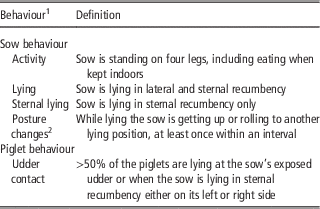
The behaviour of sows and piglets was analysed by instantaneous sampling at 5 min observations (=12 observations/h) from 2 h (2 h) prepartum until 48 h (48 h) postpartum. One exception was the behaviour ‘posture changes’, which was recorded to know whether it occurred at least once within an interval. The observed behaviours are shown in Table 1
Observed sow and piglet behaviour during 2 h prepartum until 48 h postpartum

1 Behaviour declared as instantaneous observations.
2 The only behaviour declared as an event.
Sow responsiveness test
Presuming that the sow cannot distinguish between a squeal of its own piglet or an alien piglet on the 2nd or 3rd day postpartum (Horrell and Hodgson, Reference Horrell and Hodgson1992), a squealing piglet from a tape recorder was played on day 2 or 3 postpartum for 50 s to the sow. The screaming piglet that was recorded was 3 days old and was placed on its back while recording its squeals. When performing the test outdoors, the tape recorder was placed in front of the ventilation hole at the back of the hut, and indoors it was placed in the piglet creep area. The precondition before the start of the test was that the sow and its piglets had to be in a resting position – the sow either lying sternal or lateral without an on-going nursing. The sow’s reaction was filmed with a portable video camera. During the playbacks of piglet screams, the sow’s latency to the behavioural response ‘lifting head’ and ‘getting up’ was recorded. When a sow did not respond within 50 s of the playback, it was scored as a non-responder.
Data analyses
The animals behaviours were 24 h video recorded and later analysed during four consecutive periods: 2 h prepartum=2 h prior the birth of the first piglet; Parturition=first until last piglet born; Postpartum period=end of parturition up to 12 h postpartum (PP1 to 12); and 13 h until 48 h postpartum (PP13 to 48). The PP1 to 12 period reflects the time span when colostrum is still available and nursings are not cyclic, followed by the period PP13 to 48 when the content of colostrum decreases and the nursings become more cyclic (Nielsen et al., Reference Nielsen, Thodberg, Dybkjær and Vestergaard2006).
Sows with farrowing durations exceeding 500 min or a litter size of fewer than six piglets were excluded from the study. Based on these criteria, four sows from 30 sows initially allocated were considered outliers, and hence were excluded.
Statistical procedures
Statistical analyses were carried out using the statistical software package SigmaStat, version 3.0. The analyses were based on individual values for the sows and on litter averages for piglet traits. First, the number of 5-min observations per hour, maximum 12 observations per hour, for a specific behaviour was summarized, the value 4 observations indicated that – for instance, sternal lying was observed in 4 of the 12 five-min observations during an hour.
To test behavioural differences of sows and their litters between housing systems in the first parity and maternal experience during second parity, respectively, a Mann–Whitney rank sum test was used because of non-normally distributed data. A Spearman rank order correlation was used to calculate whether a correlation existed between behavioural parameters and parturition parameters (farrowing duration, average time for birth of piglet, total litter size, number of stillborn).
When not specifically stated, only significant results (P<0.05) are presented in the text. Results from the analyses with the Mann–Whitney rank sum test are presented as median values with its interquartile range. The effect of housing system on the proportion of sows responding to the piglet’s screaming (‘lifting head’ and ‘getting up’, respectively) was tested by means of Fisher’s exact test.
Results
Two-hour (2 h) prepartum behaviour
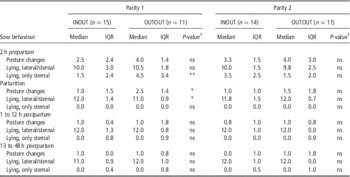
During both parities, sows were mainly lying the last 2 h before the onset of parturition (Table 2).
Number of 5 min samples per hour (median/IQR) of sow behaviour from 2 h prepartum until 48 h postpartum

IQR=interquartile range; ns=not significant (Mann–Whitney rank sum test).
1 Significances, *P<0.05, **P<0.01, ***P<0.001.
Parity 1
The intervals with ‘changing position’ and the observations with ‘lying’ did not differ between OUTOUT and INOUT sows. However, there were more observations with ‘sternal lying’ in OUOUT than in INOUT sows (Table 2).
Parity 2
There were no evident behavioural differences in prepartum behaviour between groups.
Effect of 2 h prepartum behaviour on parturition parameters
Parity 1
In OUTOUT sows, no correlation was found between the 2 h prepartum behaviour and parturition parameters (parturition time, average time for birth of one piglet, litter size, n of stillborn). However, in INOUT sows, two correlations were found. First, more intervals with posture changes during 2 h prepartum were associated with decreased occurrence of stillborn piglets (r=−0.51, P<0.05), and, second, more observations with sternal lying during 2 h prepartum were associated with increased duration of parturition (r=0.51, P<0.05).
Parity 2
No correlation was found in INOUT sows, instead two were found in OUTOUT sows. More lying (lateral and sternal) during the 2 h prepartum was associated with increased occurrence of stillborn piglets (r=0.70, P<0.05), whereas more sternal lying during the 2 h prepartum was associated with diminished occurrence of stillborn piglets (r=−0.63, P<0.05).
Parturition and postpartum behaviour
In general, sows were mainly lying calm and had only few posture changes during parturition until 48 h postpartum (Table 2). Behavioural differences were marginal and occurred only during parturition in parity 1.
Parity 1
During parturition, OUTOUT sows showed significantly more intervals with posture changes and significantly fewer observations with lying (lateral and sternal) compared with INOUT sows. No differences during the following phases (PP1 to 12 and PP13 to 48) were found (Table 2).
Parity 2
No differences in lying position or posture changes were found between groups during the observed phases (Table 2).
Udder–piglet contact
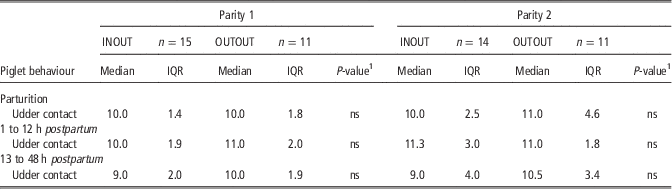
During parturition and the postpartum period, piglets mainly had udder contact with their mother. The extent did not differ between groups in parity 1 or in parity 2 (Table 3).
Number of 5 min samples per hour (median/IQR) of udder contact between sow and piglets during parturition until 48 h postpartum

IQR=interquartile range; ns=not significant (Mann–Whitney rank sum test).
1 Significances, *P<0.05, **P<0.01, ***P<0.001.
Sow responsiveness test
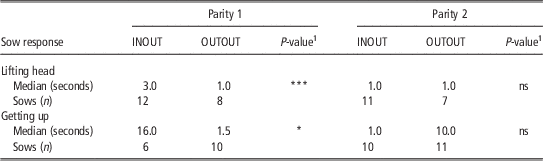
Differences in sow response towards the playback of piglet screams occurred only in parity 1. The proportion of sows responding with ‘lifting head’ did not differ between groups (INOUT 80% v. OUTOUT 100%, P=0.5257), whereas the proportion of sows responding with ‘getting up’ differed significantly between groups (INOUT 43% v. OUTOUT 100%, P=0.0064). Furthermore, of those sows responding, outdoor sows responded significantly faster than indoor sows, both in ‘lifting head’ and ‘getting up’ (Table 4). During parity 2, the proportion of sows responding to the test did not differ significantly any longer between groups (‘lifting head’ a 100% in both groups; ‘getting up’, INOUT 83% v. OUTOUT 100%, P=0.4783). The latency of sow response did not differ either in ‘lifting head’ or in ‘getting up’ any longer (Table 4).
Latency (median) of sow response towards a 50 s lasting playback with a screaming piglet

ns=not significant (Mann–Whitney rank sum test).
1 Significances, *P<0.05, **P<0.01, ***P<0.001.
Discussion
General
Regarding the growing limitation of keeping farrowing sows crated in European countries, this study is of great interest dealing with the difference between farrowing pens and outdoor huts (Baxter et al., Reference Baxter, Lawrence and Edwards2011). In both environments, sows can move freely, although the behavioural needs are fulfilled more in the outdoor environment – for example, walking longer distances, rooting, wallowing and the possibility for visual and acoustic isolation from the herd. In our study, in general, there were a number of only marginal behavioural differences between primiparous sows in indoor pens and outdoor huts. Inevitably, confounding between season and housing system in the analyses caused by facility constrains may have influenced the results, although only negligibly, as behavioural differences were marginal and few. We have discussed the possible effect of season below when required. However, we did not find that different maternal experience during first parity affected the second parity.
Prepartum behaviour
Parity 1
Our results indicate that primiparous sows had finished the prepartum activity before the last 2 h before parturition in indoor pens and in huts, as activity was seen only at one observation per hour. This is in agreement with sows kept in a semi-natural environment, where calmness 2 h before parturition indicated that nest building was completed (Jensen et al., Reference Jensen, Vestergaard and Algers1993). Interestingly, OUTOUT primiparous sows showed three times more sternal lying than INOUT primiparous sows, which may support thermoregulation in outdoor sows during the winter period (e.g. seasonal effect), because the body surface area is reduced when lying sternal.
Parity 2
There were no differences detected in the prepartum activity between second parity OUTOUT and INOUT sows. This indicates that the change from pens to outdoor huts in the second parity did not influence the prepartum behaviour.
Effect of 2 h prepartum behaviour on parturition parameters
In contrast to Fraser et al. (Reference Fraser, Phillips and Thompson1997), we did find associations between 2 h prepartum behaviour and parturition parameters. Interestingly, regardless of the parity, the diminished occurrence of stillborn was associated with increased posture changes (INOUT, parity 1), with less lying (OUTOUT, parity 2) and with increased sternal lying (OUTOUT, parity 2) during the last 2 h prepartum. It might be concluded that the number of stillborn piglets can be reduced with a certain extent of body movements by the sow during the last 2 h prepartum, possibly because more body movements at that stage may have promoted the passage of the piglets through the horn of the uterus (Illmann unpublished data). Consequently, prepartum restlessness shortly before parturition should not necessarily be seen as an indicator of problems during parturition. The sternal lying position might have both a negative and a positive impact on parturition parameters, obviously depending on the housing system kept in. Indoors, sternal lying might be an indicator of stress, as it associated with longer parturitions (Cronin et al., Reference Cronin, Schirmer, McCallum, Smith and Butler1993). Outdoors, sternal lying was associated with fewer stillborns (parity 2), assuming a positive impact on the process of parturition probably facilitated by an environment being constructed in a way that meets the behavioural needs of a maternal sow to a larger extent.
Parturition and postpartum behaviour
In general, sows in both environments were mainly lying during parturition, thus being calm, such a behaviour is considered as good maternal behaviour offering piglets the opportunity to quickly find a teat, and thus learning the suckling process.
Parity 1
Regarding the slightly increased posture changes and the lesser extent of lying in OUTOUT sows, it may just be a matter of the degree of restlessness (posture changes) that is possibly harmful to the newborn piglets, getting trampled or squeezed by the sow’s movements. As mentioned earlier, a certain extent of body movements by the sow might even be beneficial for the unborn piglets helping them through the birth canal.
Parity 2
There was no difference in lying position or posture changes between sows having different environmental farrowing experience. This stands in contrast to Thodberg et al. (Reference Thodberg, Jensen and Herskin2002a) findings, stating that primiparous sows farrowing in a crate made fewer posture changes as second parity sows during the first part of parturition, independent of which farrowing environment they were then kept in. It might be that the sow behaviour is more affected by crates than by pens and outdoor huts, as crates restrict the maternal behaviour (e.g. turning around, walking, rooting in nesting material) to a larger extent than the other two environments.
Udder–piglet contact
Piglets had udder contact with the sow most of the time during parturition and the first 48 h postpartum in both housing systems (parity 1), as well as during parity 2. Interestingly, not only in outdoor huts but also in pens, piglets were in close udder contact during the first 2 days postpartum. This confirms studies carried out on pigs in farrowing pens (Vasdal et al., Reference Vasdal, Glærum, Melišová, Bøe, Broom and Andersen2010; Melišová et al., Reference Melišová, Illmann, Andersen, Vasdal and Haman2011) and in a semi-natural environment (Stangel and Jensen, Reference Stangel and Jensen1991). However, despite technical achievements in supplying piglets with adequate heat, it seems, as commented by Vasdal et al., (Reference Vasdal, Glærum, Melišová, Bøe, Broom and Andersen2010), like ‘a battle against biology’ to attract piglets away from their mother when they are <3 days of age. Our results indicate that, despite different housing systems, different parities and a possible impact by the cold season, piglets mainly had udder contact during parturition until 48 h postpartum, which puts an emphasis on the natural behaviour of the piglets to stay close with the mother.
Sow responsiveness test
Parity 1
Sows from both groups heard the playback very well; this is shown by the fact that almost all sows lifted their heads. However, all OUTOUT sows (100%) responded towards playbacks with the piglet’s screams by getting up compared with <50% in indoor pens. Furthermore, OUTOUT sows got up faster compared with INOUT sows (1.5 v. 16 s). Thus, we suggest that sows in outdoor huts are more responsive towards playbacks of piglet screams than sows in pens, which could be interpreted as better maternal behaviour by preventing fatal piglet crushing (Weary et al., Reference Weary, Pajor, Fraser and Honkanen1996). In our study, outdoor sows reacted much faster than outdoor sows in the study by Held et al. (Reference Held, Mason and Mendl2006), which could be explained by the use of 6-day-old piglets for recording the distress vocalization in the last study. Recently, it has been shown that the signalling intensity during simulating crushing was much higher in 1-day-old piglets compared with 7-day-old piglets (Illmann et al., Reference Illmann, Hammerschmidt, Špinka and Tallet2013), which consequently could lower sow responsiveness to older piglets.
In general, the sows low responsiveness (getting up) towards playbacks is not uncommon in pens and crates (Chaloupková et al., 2008; Illmann et al, Reference Illmann, Neuhauserová, Pokorná, Chaloupková and Šimečková2008; Melišová et al., Reference Melišová, Illmann, Chaloupková and Bozděchová2014). Possibly, outdoor-housed sows, compared with those housed in indoor pens, are more responsive to lower urgency situations, especially with regard to the sows instinct of being isolated from the herd during this phase (Jensen, Reference Jensen1986), as piglet distress calls are audible it could always be the sows’ own piglet. Another explanation for the lower response in indoor sows could be the higher noise level in indoor pens (e.g. ventilation system and screaming piglets), possibly causing sows to become blunted (habituated) towards distressed screams of piglets. Instead, the noise level in the outdoor environment was very low, suggesting that this was the reason why OUTOUT primiparous sows reacted stronger towards a screaming piglet compared with INOUT primiparous sows.
Parity 2
Regarding the difference in maternal experience between groups, no difference in sow response was found. Both groups had a high response towards playbacks of piglet screams. This indicates that the effect of previous experience is limited in relation to the effect of the current environment.
Conclusions
The behavioural differences in the sows were minor and few and only occurred during parity 1. During parity 2, when all sows were kept outdoors in farrowing huts, no difference in behaviour prevailed any longer. We, therefore, suggest that it is not at all problematic for a second parity sow with maternal experience from an indoor pen to be kept outdoors in farrowing huts.
Acknowledgements
The authors thank the Swedish Board of Agriculture, the Swedish University of Agricultural Science and the County Administrative Board of Värmland (Sweden) for financial support. Furthermore, they thank the staff at Lillerud Agriculture School and at the Department of Animal Environment and Health for helping collecting the data and making information available. Gudrun Illmann was supported by the grant MZERO0714 from the Czech Ministry of Agriculture.