Introduction
Rice (Oryza sativa L.) is the staple food for more than half of the world’s population. It is among the most cultivated cereals, with 782,000 million kg produced annually in 167 million ha (Chaudhari et al. Reference Chaudhari, Tamrakar, Singh, Tandon and Sharma2018; FAO 2020). In Brazil, the southern states Rio Grande do Sul and Santa Catarina produce more than 80% of the national supply, with an average productivity of 7,500 kg ha−1 (Conab 2020). However, there are challenges to produce quality food in enough quantities to meet the growing global demand (Calicioglu et al. Reference Calicioglu, Flammini, Bracco, Bellù and Sims2019; Juliano et al. Reference Juliano, Donayre and Martin2020).
Since rice production has become entrenched in various world regions, weedy rice (Oryza spp.) has become a severe threat to global rice production, as this weed coevolved with rice culture and is causing high economic losses to rice growers (Li and Olsen Reference Li and Olsen2020; Ziska et al. Reference Ziska, Gealy, Burgos, Caicedo, Gressel, Lawton-Rauh, Avila, Theisen, Norsworthy, Ferrero, Vidotto, Johnson, Ferreria, Marchesan, Menezes and Sparks2015). Weedy rice is more difficult control in rice fields than other weeds, because it is genetically, biochemically, physiologically, and morphologically similar to cultivated rice (Shivrain et al. Reference Shivrain, Burgos, Agrama, Lawton-Rauh, Lu, Sales, Boyett, Gealy and Moldenhauer2010a, Reference Shivrain, Burgos, Scott, Gbur, Estorninos and McClelland2010b; Shrestha et al. Reference Shrestha, Sharma, Burgos and Tseng2020). Phenotypic and morphological similarities at early growth stages make weedy rice difficult to distinguish from cultivated rice. In addition, weedy rice has traits that contribute to its proliferation and persistence, including high seed shattering, high ability to germinate, and seeds that can persist within the soil for a long time due high dormancy (Gu et al. Reference Gu, Shahryar and Foley2005; Noldin et al. Reference Noldin, Chandler and McCauley2006). The success of weedy rice as a weed is attributed to its long seed dormancy, as this is directly related to seed longevity in soil, resulting in the formation of a persistent seedbank (Noldin et al. Reference Noldin, Chandler and McCauley2006). Further, outcrossing with cultivated rice, specifically herbicide-resistant cultivars, and subsequent selection with herbicides also increase the weed population diversity (Singh et al. Reference Singh, Singh, Black, Boyett, Basu, Gealy, Gbur, Pereira, Scott, Caicedo and Burgos2017).
Large diversity among weedy rice populations has been described across many geographic regions (Chen et al. Reference Chen, Huang, Tian, Wing and Han2019; De Leon et al. Reference De Leon, Karn, Al-Khatib, Espino, Blank, Andaya, Andaya and Brim-DeForest2019; Hoyos et al. Reference Hoyos, Plaza and Caicedo2019; Merotto et al. Reference Merotto, Goulart, Nunes, Kalsing, Markus, Menezes and Wander2016; Noldin et al. Reference Noldin, Chandler and McCauley1999; Shivrain et al. Reference Shivrain, Burgos, Scott, Gbur, Estorninos and McClelland2010b; Singh et al. Reference Singh, Singh, Black, Boyett, Basu, Gealy, Gbur, Pereira, Scott, Caicedo and Burgos2017; Xia et al. Reference Xia, Wang, Xia, Zhao and Lu2011). The diversification of weedy rice is a result of adaptation to several factors, including local environment, management practices by the farmers, new introductions of weedy types via rice seed importations, and the low-level bidirectional gene flow between crop and weed (De Leon et al. Reference De Leon, Karn, Al-Khatib, Espino, Blank, Andaya, Andaya and Brim-DeForest2019; Shivrain et al. Reference Shivrain, Burgos, Gealy, Sales and Smith2009a, Reference Shivrain, Burgos, Sales, Mauromoustakos, Gealy, Smith, Black and Jia2009b). Studies have been highlighting the need to investigate the quantitative and qualitative traits of weedy rice across diverse biogeographies to gain a better understanding of weedy rice diversity, evolution, and implications for crop breeding and weed management (Nam et al. Reference Nam, Kim, Moon, Pack, Jeong, Kim and Kim2020; Rathore et al. Reference Rathore, Singh, Kumar and Chauhan2016; Sudianto et al. Reference Sudianto, Neik, Tam, Chuah, Idris, Olsen and Song2016; Wang et al. Reference Wang, Fu, Zhu, Zhu, Zhao and Lu2019).
In southern Brazil, herbicide-resistant weedy rice was identified after three growing seasons of imidazolinone-resistant (IMI-R) rice (Merotto et al. Reference Merotto, Goulart, Nunes, Kalsing, Markus, Menezes and Wander2016). Mutations in the ALS (acetolactate synthase) gene responsible for resistance of cultivated rice to imidazolinone herbicides were detected in weedy rice in fields where IMI-R rice was grown, resulting from gene flow (Roso et al. Reference Roso, Merotto, Delatorre and Menezes2010). It is important to study the diversity of weedy rice in rice cropping systems in southern Brazil, one of the world’s largest rice production areas, to determine the best management practices for weedy rice and improve the adoption of stewardship recommendations for herbicide-resistant rice. Understanding weedy rice diversity can help in designing and implementing effective and economical weed management options. This study aimed to characterize weedy rice diversity in the Rio Grande do Sul and Santa Catarina states of southern Brazil, based on qualitative and quantitative phenotypic traits.
Material and Methods
Weedy Rice Accessions
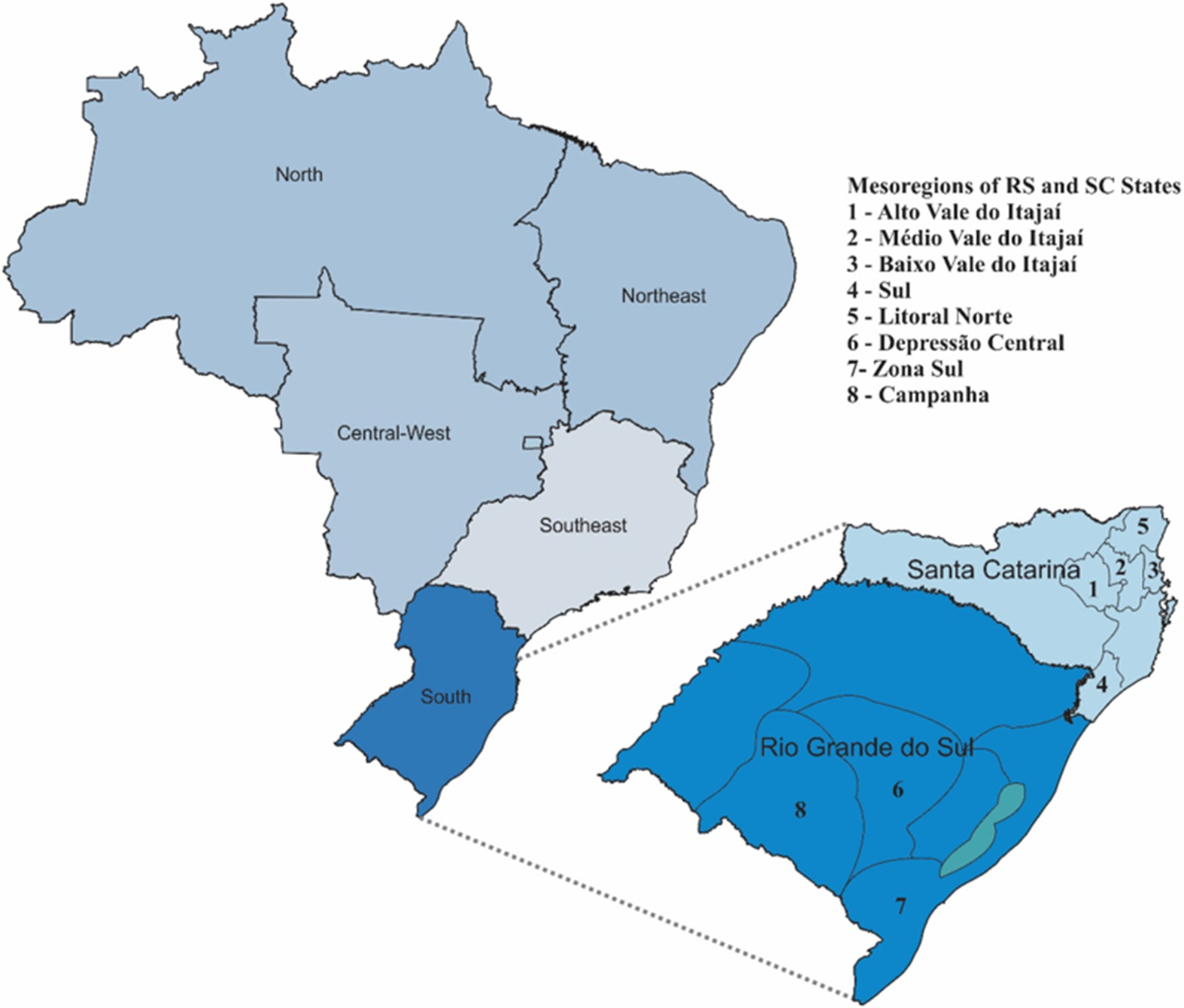
Weedy rice (Oryza spp.) accessions (249) were collected from commercial paddy rice fields during the 2012 to 2013 season in Rio Grande do Sul (RS) and Santa Catarina (SC), Brazil (Figure 1; Supplementary Table 1). In each field, up to 10 panicles were collected for each accession. The collection sites were mapped using GPS.
The map of Brazil showing the Rio Grande do Sul (RS) and Santa Catarina (SC) states and the geographic localities where the weedy rice (Oryza spp.) accessions were collected. The eight mesoregions represented in the sampling are indicated by numbers within each state and demarcated by black lines. The other highlighted mesoregions are rice-growing but non-sampled regions. This figure was adapted from SOSBAI (2018).

Experimental Conditions
The weedy rice accessions were characterized in three locations: (1) in the field at the Centro Tecnológico do Chasqueiro (Arroio Grande, RS, 2013 to 2014 season, 32.19°S, 52.96°W); (2) in the field at the Centro Agropecuário da Palma (CAP) (Capão do Leão, RS, 2014 to 2015 season, 31.81°S, 52.48°W); and (3) in the greenhouse at the Crop, Soil, and Environmental Sciences Department, University of Arkansas (Fayetteville, AR, USA, 2016, 36.07°N, 94.17°W). Field experiments were performed in a completely randomized design with four replications. Seeds were drill seeded into plots (8 rows per plot, 17 cm between rows) 1-m long. The planting density was 30 seeds per linear meter in the 2013/14 season. In 2014/15, 10 seedlings per linear meter were transplanted by hand. In the greenhouse in 2016, weedy rice seeds were pregerminated in petri plates, and five seedlings were transplanted into each 8-L pots filled with field soil. The experimental units (pots) were arranged in a completely randomized design with four replications. After initial growth evaluation, one plant was maintained per pot.
In the field, complete fertilizer (300 kg ha−1 of 5-20-20 N-P-K) was applied at planting, supplemented later with 90 kg ha−1 N from urea. One-half of the urea fertilizer was applied at the V3 stage (beginning of tillering) and the remainder at V9. The field was flooded permanently until R9 (maturation). The other cultural practices were based on the technical recommendations of rice production for southern Brazil (SOSBAI 2018). During the experiment, offtype plants were removed from the plots.
Morphological Characterization
For the morphological descriptors of quantitatively inherited traits (Supplementary Table 2) in field experiments, 10 random plants were evaluated within each plot in each season. For the qualitative traits, five plants were evaluated in each season. To determine whether the weedy rice accessions were of the same subspecies as rice cultivars grown in Brazil, seed samples were tested using the phenol reaction technique (Gross et al. Reference Gross, Skare and Olsen2009). Cultivated rice varieties belong to one of two subspecies (japonica or indica) depending on their origin (Ikehashi Reference Ikehashi2009). In this test, the polyphenol oxidase enzyme reaction results in a color change of the caryopsis from light to dark only in the indica subspecies.
Fourteen quantitative and 10 qualitative variables were analyzed using the distance matrix approach to assess the phenotypic diversity among the 249 accessions from RS and SC. The quantitative variables were subjected to univariate ANOVA. Afterward, the data were subjected to multivariate analysis, wherein the measures of dissimilarity were obtained by generalized distance (Mahalanobis Reference Mahalanobis1936). To estimate the adjustment between the dissimilarity matrix and the generated dendrogram, the cophenetic correlation coefficient (CCC) was calculated (Sokal and Rohlf Reference Sokal and Rohlf1962).
A single dissimilarity measure was used for the qualitative data, which presented the same definition range. For this, Gower (Reference Gower1971) proposed a general similarity coefficient applied simultaneously to the various types of characters. The dissimilarity matrix was obtained from the similarity matrix, and the accessions were grouped in a hierarchical mode by unweighted pair group method with arithmetic mean (UPGMA), verifying the CCC. The correlations between the pairs of qualitative and quantitative matrices of the data sets were estimated using the Mantel matrix correlation test, with 10,000 simulations (Mantel Reference Mantel1967), and the significance was tested using the t-test to detect the relationships between the dissimilarity matrices and their respective dendrograms. The statistical procedures were conducted using the computational application in genetics and statistics, GENES (Cruz Reference Cruz2013).
Results and Discussion
Phenotypic Diversity in Weedy Rice Plants
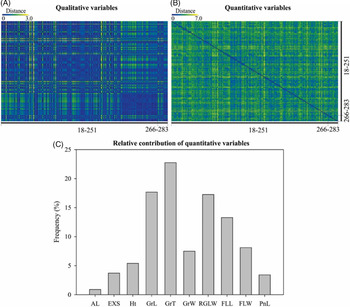
The weedy rice accessions were distant from one another in terms of both qualitative and quantitative variables (Figure 2A and B). The 14 qualitative variables analyzed collectively enabled the separation of accessions into distinct phenotypic groups (Figure 2A). The accessions were morphologically diverse, except in ligule shape and subspecies group. All accessions had a 2-cleft ligule, and all were indica based on the phenol reaction test. Therefore, these two variables were excluded from the analysis. In accordance with the phenol reaction test result, all weedy rice accessions exhibited indica-type morphology. Historically, rice cultivars planted in Brazil are indica (Streck et al. Reference Streck, Magalhaes, Aguiar, Facchinello, Fagundes, Franco, Nardino and Oliveira2018).
Morphological diversification of weedy rice (Oryza spp.) in southern Brazil. The data set included 249 weedy rice accessions from the Rio Grande do Sul and the Santa Catarina states. Mahalanobis distance among the accessions is shown for 14 qualitative variables (A) and 10 quantitative variables (B). The accession numbers, from 18 to 283, are indicated in the x and y axes. The relative contribution of quantitative variables to the genetic dissimilarity across 249 accessions of weedy rice is shown in C. AL, awn length; EXS, panicle exsertion; Ht, plant height; GrL, grain length; GrT, grain thickness; GrW, grain width; RGLW, the ratio between length and width of the grain; FLL, flag leaf length; FLW, flag leaf width; PnL, panicle length.

Several traits (e.g. kernel shape, culm angle, leaf morphology, panicle morphology) collectively can distinguish between indica and japonica subspecies in general. Generally, kernels of japonica subspecies are short, wide, and rounded, while those of indica subspecies are long, narrow, and relatively thin. Indica varieties are also generally tall, with open canopy structure, high tillering, rough leaves, and open panicles. However, with the vast morphological diversity across populations, one can no longer rely solely on phenotypic traits to determine the weedy rice subspecies group. Morishima and Oka (Reference Morishima and Oka1981) reported a close to 40% probability of misclassification of subspecies between indica and japonica groups when only quantitative descriptors of the caryopsis are used. The phenol reaction test is a reliable chemical assay used to distinguish rice subspecies group. In the southern United States, at least 90% of weedy rice populations are indica (Bevilacqua et al. Reference Bevilacqua, Basu, Pereira, Tseng, Zimmer and Burgos2015; Gross et al. Reference Gross, Skare and Olsen2009). The few japonica weedy rice types among the population could be attributed to introgression from cultivated rice, which has been historically tropical japonica types until the recent decade. The morphological traits of weedy rice alone cannot distinguish the japonica types from the predominant indica ones.
The quantitative variables analyzed enabled the discrimination of weedy rice accession groups (Figure 2B). The univariate ANOVA showed a significant difference among accessions at 1% probability by F-test. The coefficient of variation ranged from 2.01% (for culm width) to 14.6% (for awn length) (Supplementary Table 3). The variation coefficient associated with awn length reflects the fact that some accessions produce a mixture of awned and awnless kernels in one panicle, with awns of different lengths in one panicle. The relative contribution of the quantitative variables to the genetic dissimilarity of weedy rice accessions by the generalized Mahalanobis distances (Singh Reference Singh1981) showed that the accessions were most differentiated by the thickness (22.7%) and length (17.6%) of caryopsis, as well as the ratio between the width and length of caryopsis (17.3%) (Figure 2C). These traits collectively contributed more than 55% toward the discrimination of weedy rice accessions. The other traits had a significant but minimal contribution to the differentiation of weedy rice accessions, which were all indica.
Quantitative and Qualitative Variables in Weedy Rice
Plant Structure: Culms and Leaves
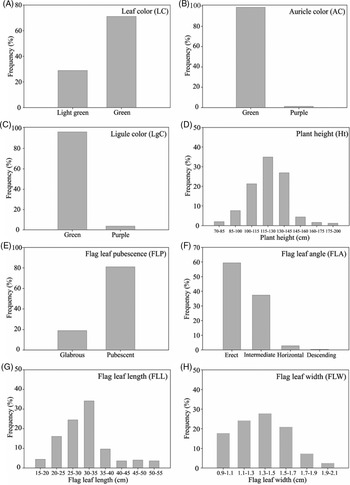
The qualitative traits had minimal variability across weedy rice accessions (Figure 3A–C). The majority (71.1%) of the accessions had dark green leaves, while the rest had light green leaves (Figure 3A). Having light green leaves is one of the most common traits associated with weedy rice (Dornelles Reference Dornelles2009). This is true only for about 30% of the Brazilian weedy rice populations; therefore, leaf coloration is not a reliable trait to use in identifying weedy rice. Some of the dark green weedy rice in southern Brazil might be outcrosses if these were collected from fields with a history of Clearfield® rice. It is doubtful that 70% of weedy rice populations in Brazil are outcrosses. It is more logical to assume that the dark green leaf coloration is an attribute of weedy rice ecotypes in this region. Almost all accessions (98.8%) had green auricles and green ligules (96.4%). Some accessions (15-45, 15-46, and 15-58) had purple auricles and purple ligules, while others (15-24, 15-85, 15-94, 15-95, 15-218, and 15-240) had green auricles and purple ligules.
Frequency distribution of stem and leaf characteristics of 249 weedy rice (Oryza spp.) accessions from the Rio Grande do Sul and Santa Catarina states, Brazil. (A) Leaf color, (B) auricle color, (C) ligule color, (D) plant height, (E) flag leaf pubescence, (F) flag leaf angle, (G) flag leaf length, and (H) flag leaf width.

Plant height is one of the primary traits that rice producers use to identify weedy rice and remove it by hand, spot spray with herbicide, or wipe on a herbicide treatment. These practices, combined with the natural hybridization between weedy and cultivated rice, have been fundamental in selecting ecotypes that are morphologically very similar to cultivated rice (Bocchi et al. Reference Bocchi, Vandoni and Maggiore2002; Gealy et al. Reference Gealy, Agrama and Jia2012; Merotto et al. Reference Merotto, Goulart, Nunes, Kalsing, Markus, Menezes and Wander2016). The height of Brazilian weedy rice ranged from 70.3 to 192 cm (Figure 3D). The shortest ecotype (15-246) was 16 cm shorter than the cultivars ‘IRGA 422 CL’, ‘Puitá INTA CL’, and ‘SCS115 CL’. This short weedy rice was collected from the mesoregion of Campanha in RS. This is one example of weedy rice evolution toward more crop-like traits after years of coexistence (Dornelles Reference Dornelles2009). In this study, we found that 30.9% of the weedy rice accessions were as tall as the modern rice cultivars, while the rest were taller than the current rice varieties (Figure 3D). More than a decade ago, Schwanke et al. (Reference Schwanke, Noldin, Andres, Procópio and Concenço2008) characterized weedy rice in RS, Brazil, as taller than the cultivars ‘BR-IRGA 409’, ‘IRGA 417’, and ‘El Paso L 144’. Without the height differential and the prevalence of dark green weedy rice plants, farmers and farm consultants will miss many weedy rice plants when scouting fields, which prevents removal of remnant weedy plants and negates zero tolerance in seed production fields.
Flag Leaf Traits
The flag leaf is positively associated with rice yield, as it is the primary source of photoassimilates for the kernels. Approximately 50% of carbohydrates in the grain comes from the flag leaf (Wang et al. Reference Wang, Zhou, Yu and Yu2011). Flag leaf morphology is an important index to determine a suitable parent material for rice breeding, because some flag leaf traits (i.e., leaf area and leaf shape) affect the photosynthetic rate (Dai et al. Reference Dai, Lu, Zou, Wang, Shen, Hu, Zhang, Ren, Chen, Zhang, Xue, Dong, Gao, Guo and Zhu2020; Zhang et al. Reference Zhang, Ye, Ren, Tian, Peng, Gao, Ruan, Wang, Zhang, Guo, Qian and Gao2015).
Regarding qualitative variables, 81.1% of accessions had pubescent leaves (Figure 3E). A slight majority (59.4%) had erect flag leaves (Figure 3F), which is a desirable rice trait. A smaller proportion (37.4%) of accessions had an intermediate flag leaf angle. Erect leaves allow for high light penetration down the canopy, making the lower leaves contribute more to carbon fixation, resulting in higher yields (Taiz and Zeiger Reference Taiz and Zeiger2013).
The flag leaf length and width varied greatly across accessions. The flag leaf length ranged from 15 to 55 cm, with 34.1% of the accessions having flag leaves 30- to 35-cm long (Figure 3G). The flag leaf width ranged from 0.9 to 2.1 cm (Figure 3H). Some ecotypes had significantly wider leaf blades. An increase in flag leaf area can lead to increases in kernel number per panicle and results in higher grain yield (Bing et al. Reference Bing, Wei-Ya, Li-Jun and Yong-Zhong2006).
Panicle Traits
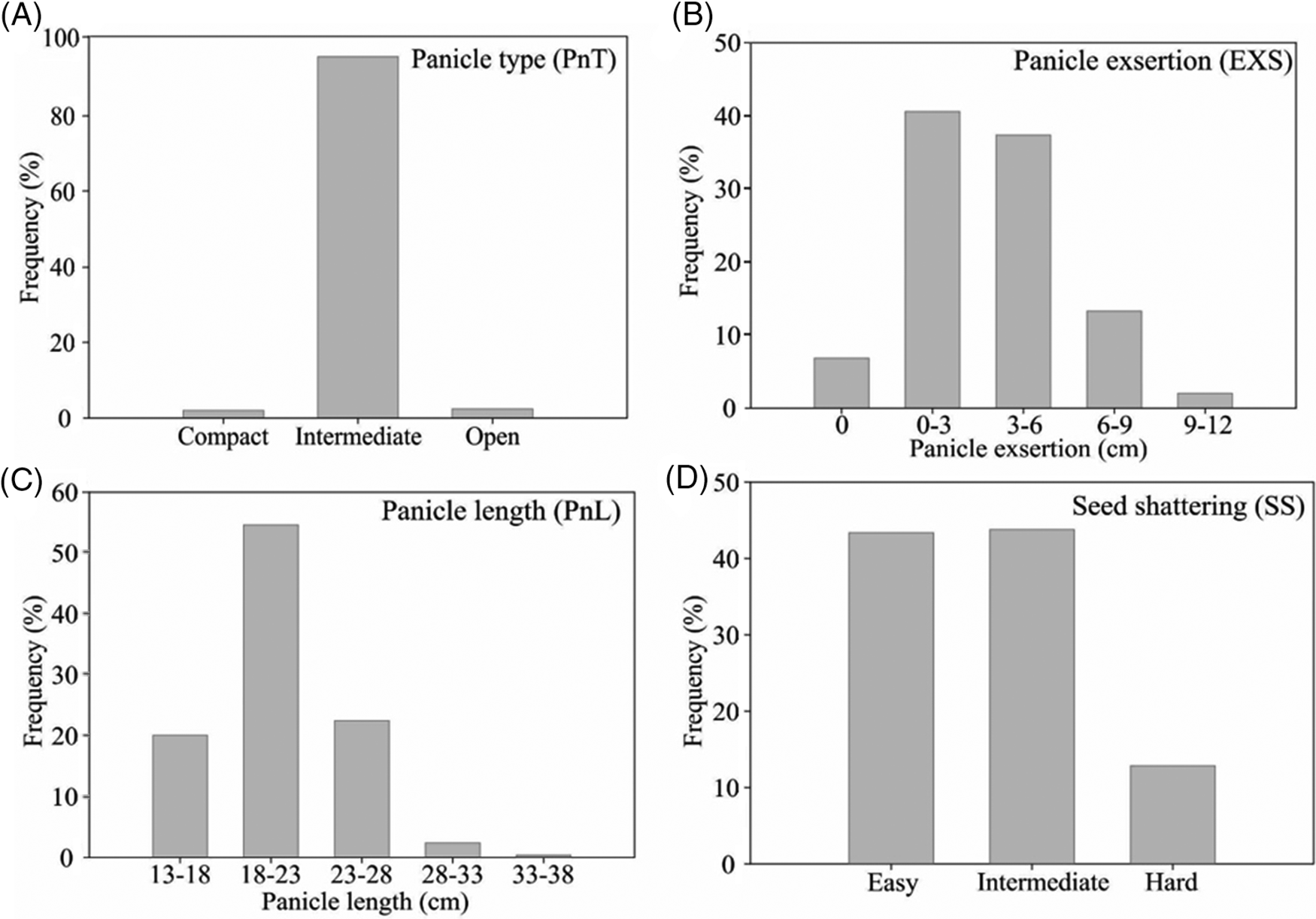
Rice panicles, like panicles of other grasses, vary in length, degree of exsertion from the flag leaf, and branching architecture. Compact panicles have been selected for modern rice cultivars, because spreading panicles are associated with lower yield (Moldenhauer and Gibbons Reference Moldenhauer, Gibbons, Smith and Dilday2003). Among the weedy rice accessions, 95.6% had an intermediate panicle type, which is also true in rice cultivars (Figure 4A). Only 2.0% of weedy rice had compact panicles. Historically, weedy rice in Brazil had open panicles. In this survey, only 2.4% of weedy rice had open panicles.
Frequency distribution of panicle characteristics and seed shattering of 249 weedy rice (Oryza spp.) accessions from the Rio Grande do Sul and Santa Catarina states, Brazil. (A) Panicle type, (B) panicle exsertion, (C) panicle length, and (D) seed shattering.

Panicle exsertion varied widely across accessions. The majority (84.7%) had barely exerted panicles, 0 to 6 cm from the flag leaf collar (Figure 4B). One accession, 15-66, was noteworthy, as it had a distinctively long (11.4 cm) uppermost node. The panicle lengths also varied widely, with 54.6% of accessions having 18- to 23-cm-long panicles (Figure 4C).
Seed dormancy and seed shattering are necessary for weedy rice persistence and maintenance of the soil seedbank (Avila et al. Reference Avila, Andres, Marchezan and Menezes2000; Concenço et al. Reference Concenço, Andres, Teló and Martins2017; Gu et al. Reference Gu, Foley, Horvath, Anderson, Feng, Zhang, Mowry, Ye, Suttle, Kadowaki and Chen2011; Schwanke et al. Reference Schwanke, Noldin, Andres, Procópio and Concenço2008; Tseng et al. Reference Tseng, Shivrain, Lawton-Rauh and Burgos2018). Equal proportions of accessions exhibited intermediate shattering (43.8%) and easy shattering (43.4%) (Figure 4D). In other words, almost 90% would drop a large number of seeds on the soil before rice harvest. Seeds remaining on the panicles at harvest would shatter further, while the rest would be harvested with the rice. From the standpoint of persistence, low shattering (12.8% of accessions) hinders the perpetuation of a population, as it allows the removal of most seeds during harvest with the rice crop. Low-shattering weedy populations have a low probability of becoming dominant.
Grain Traits
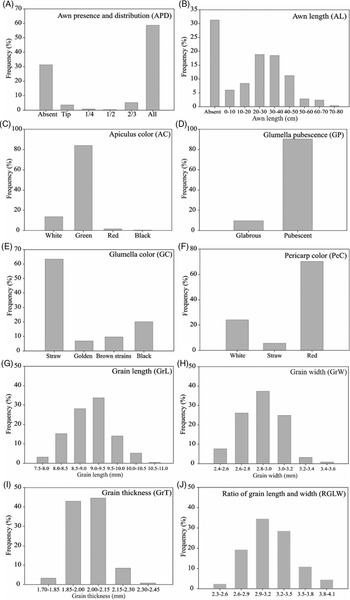
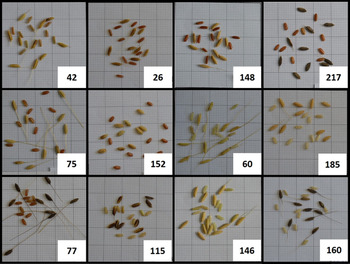
Awns typically are extensions from the lemma of rice florets and fulfill two primary functions: seed dispersal and limiting predation by animals. In other cereals, such as barley (Hordeum vulgare L.) and wheat (Triticum aestivum L.), awns are a target for breeding for higher grain yield (Svizzero et al. Reference Svizzero, Ray and Chakraborty2019). The majority of Brazilian weedy rice (58.6%) had awned kernels on the entire panicle (Figure 5A). The awn length differed significantly across accessions (Figure 5B). Accession 15-87 from mesoregion Médio Vale do Itajaí (SC) had the longest awn (74 mm). The diversity in awn characteristics is shown in Figure 6.
Frequency distribution of kernel characteristics of 249 weedy rice (Oryza spp.) accessions from the Rio Grande do Sul and Santa Catarina states, Brazil. (A) Awn presence and distribution, (B) awn length, (C) apiculus color, (D) glumella pubescence, (E) glumella color, (F) pericarp color, (G) grain length, (H) grain width, (I) grain thickness, and (J) grain length to width ratio.

Photographic illustration of the diversity in kernel characteristics among weedy rice (Oryza spp.) plant types from the Rio Grande do Sul and Santa Catarina states, Brazil. White box numbers refer to the weedy rice accession number.

The apiculus coloration results from anthocyanin pigmentation and has been used as a morphological marker, as it shows a considerable variation across rice varieties (Liu et al. Reference Liu, Sun, Wang, Ding, Liu, Li, Jiang, Zhu and Yao2012). The majority (83.9%) of weedy rice accessions had a green apiculus (Figure 5C). Cultivated rice commonly has a purple apiculus, and so do wild rice (Oryza sativa L.) and landraces (Tsago et al. Reference Tsago, Wang, Liu, Sunusi, Eshag, Akhter, Shi and Jin2019). It is believed the purple apiculus attracts insects and animals, which favors pollination and seed dispersal.
A great majority (90,4%) of the weedy rice accessions had pubescent glumellas (Figure 5D), which are also found in rice cultivars (Nascimento et al. Reference Nascimento, da Silva and Veasey2011). The weedy rice glumella color was highly variable: 63.5% were straw; 20.1%, black; 9.6%, brown; and 6.8%, gold (Figures 5E and 6).
As observed with glumellas, the pericarp was also highly variable among the weedy rice accessions. Most dehulled grains (70.3%) were red, 24.1% were white, and 5.6% were straw-colored (Figures 5F and 6). The red pericarp pigmentation and high seed shattering are weedy traits that were bred out of modern domesticated rice varieties (Gross et al. Reference Gross, Reagon, Hsu, Caicedo, Jia and Olsen2010). The red pericarp exhibited by many weedy ecotypes is conferred by proanthocyanidins (flavonoids), a trait controlled by the Rc gene, which is targeted for selection during rice domestication (Sweeney et al. Reference Sweeney, Thomson, Cho, Park, Williamson and Bustamante2007). The rice cultivars, which mostly do not have a pigmented pericarp, lost the Rc allele function (Sweeney et al. Reference Sweeney, Thomson, Cho, Park, Williamson and Bustamante2007). This allele is also involved in abscisic acid synthesis, which plays a vital role in seed dormancy (Gu et al. Reference Gu, Foley, Horvath, Anderson, Feng, Zhang, Mowry, Ye, Suttle, Kadowaki and Chen2011).
The largest group of weedy rice accessions had grains 9- and 9.5-mm long (33.7%), 2.8- and 3-mm wide (37.3%), and 2- and 2.15-mm thick (44.6%) (Figure 5G–I). Accession 15-83, from the mesoregion Médio Vale do Itajaí (SC), had the most elongate grains (10.8 mm), whereas 15-180, from the mesoregion of Depressão Central (RS), had the shortest grains (7.7 mm).
The grain length to width (L/W) ratio allows the calculation of an index that roughly indicates the grain shape. Following the scale used by Dornelles (Reference Dornelles2009) and Fonseca et al. (Reference Fonseca, Rangel and Prabhu2001), the typical japonica subspecies group should have an L/W ratio of less than 2.0. Of the 249 weedy accessions, 95.6% (238) had an L/W ratio ranging from 2.76 to 3.75, which falls in the long-grain category, typical of the indica group (Figure 5J). This long-grain characteristic is also typical of the leading commercial cultivars in RS and SC, Brazil (SOSBAI 2018).
Similarity of Weedy Rice Accession
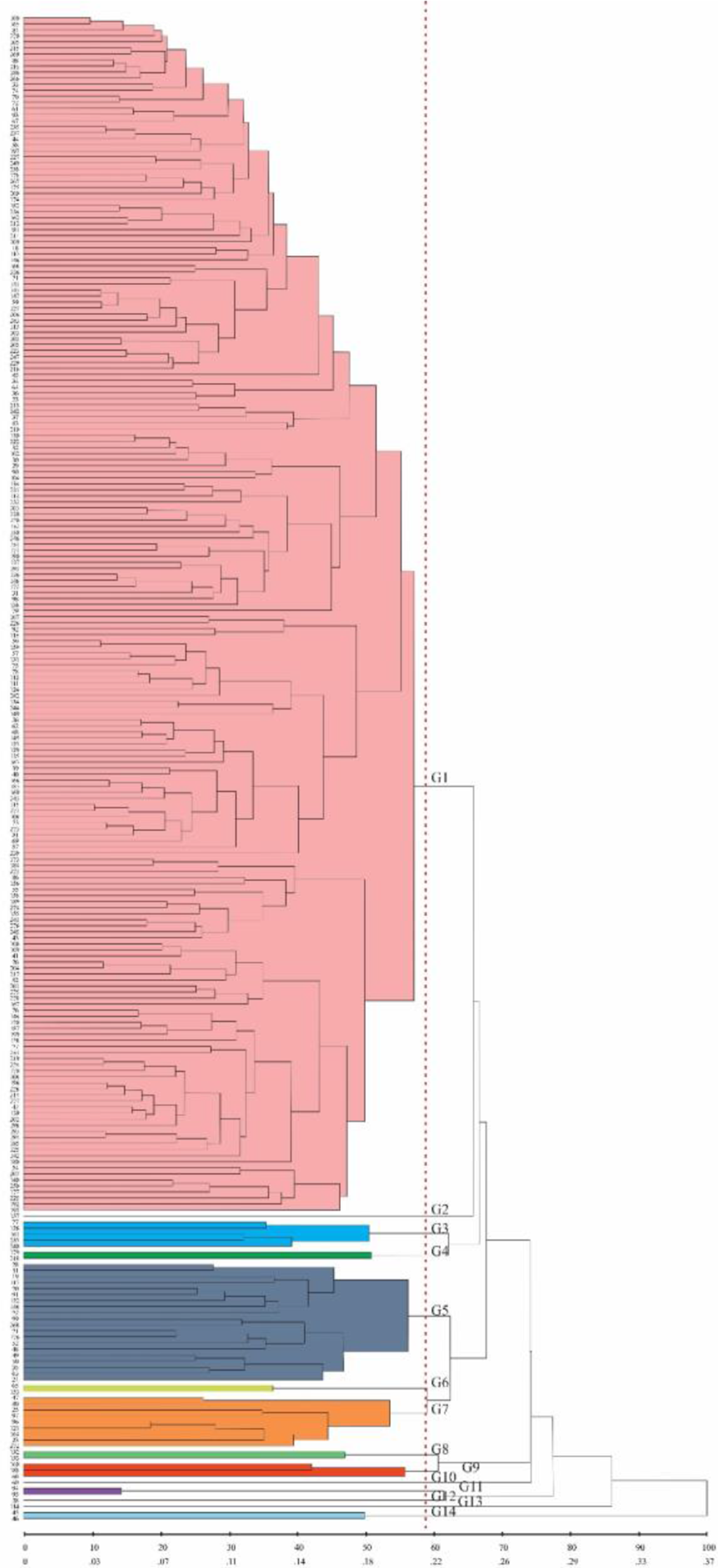
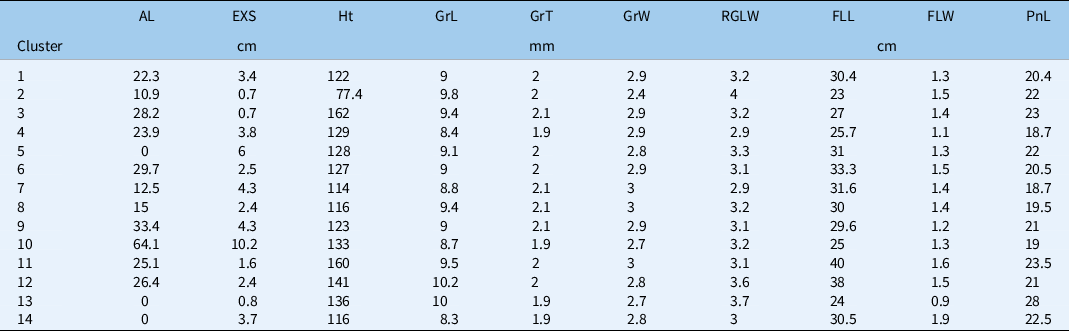
To evaluate the similarity among the 249 weedy rice accessions, a dissimilarity matrix analysis was performed with the quantitative and qualitative variables following the UPGMA method. At a mean similarity degree of 0.2181, 14 clusters were formed (Figure 7; Table 1). Given that, each cluster retains various levels of heterogeneity.
Dendrogram generated from the dissimilarity matrix using 10 quantitative and 12 qualitative morphological characteristics of 249 weedy rice (Oryza spp.) accessions from the Rio Grande do Sul and Santa Catarina states, Brazil by the unweighted pair group method with arithmetic mean (UPGMA) method. Average similarity measure between groups = 0.2181. The analysis generated 14 clusters.

Means of the quantitative descriptors of the 14 weedy rice (Oryza spp.) clusters from Rio Grande do Sul and Santa Catarina states, Brazil. a

a Abbreviations: AL, awn length; EXS, panicle exsertion; Ht, plant height; GrL, grain length; GrT, grain thickness; GrW, grain width; RGLW, grain length to width ratio; FLL, flag leaf length; FLW, flag leaf width; PnL, panicle length.
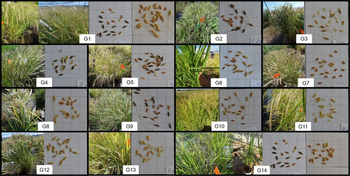
The first group comprised 198 accessions (Figure 7). It indicates a narrow similarity among the remaining accessions in irrigated rice fields, indicating that crop production practices broadly favor certain weedy rice types. All accessions in Group 1 were from the mesoregions of RS and SC. All had pubescent leaves, light green auricles, and colorless to green ligules. Plants in this group varied in glumella color. Group 2 consisted of one accession 15-157 from Zona Sul (RS), which was short (77 mm) with an erect flag leaf angle and low seed shattering (Figures 7 and 8). Short plants can escape detection and replenish the soil seedbank. Group 3 was composed of two accessions, 15-77 and 15-126, from the mesoregion of Médio Vale do Itajaí (SC). Plants in this group had pubescent glumellas, white grain pericarps, and low seed shattering (Figures 7 and 8). Group 4 had three accessions, 15-161, 15-233, 15-240, all from Zona Sul (RS). These plants typically had a pubescent and narrow flag leaf, an intermediate flag leaf angle, a colorless auricle, a green apiculus, a pubescent and black glumella, a white pericarp, and intermediate seed shattering (Figures 7 and 8). Group 5 was composed of two accessions, 15-179 from Zona Sul (RS) and 15-218 from Campanha (RS). The plants had a pubescent flag leaf, a colorless auricle, a green apiculus, an intermediate flag leaf angle, a black glumella, a red pericarp, and low seed shattering and were awnless (Figures 7 and 8).
Photographic illustration of the diversity of plant morphology, glumella color, hulled grain color, and presence or absence of awn among weedy rice (Oryza spp.) types from the Rio Grande do Sul and Santa Catarina states, Brazil, represented by the 14 clusters generated using 10 quantitative and 12 qualitative morphological characteristics.

Group 6 was the second-largest cluster, comprising 20 accessions, almost all of which (18) were from SC. These plants generally had a glabrous flag leaf, a colorless auricle, and a red pericarp (Figures 7 and 8). Group 7 included 10 accessions (eight from SC and two from RS), with a glabrous flag leaf, a colorless auricle and ligule, and an erect flag leaf angle. Group 8 contained one accession (15-132) from Sul (SC) and one (15-272) from Depressão Central (RS). These accessions had a glabrous flag leaf, a colorless auricle and ligule, an intermediate flag leaf angle, a straw-colored glumella, and a red pericarp (Figures 7 and 8). Group 9 was composed of four accessions (two from SC and two from RS). This group was distinctive primarily due to having light green, pubescent leaves. The plants also had colorless auricles and ligules, glabrous glumellas, and red pericarps (Figures 7 and 8).
Group 10 contained only the 15-60 accession from Médio Vale do Itajaí (SC). These plants had light green and glabrous leaves, colorless auricles and ligules, a horizontal flag leaf angle, a green apiculus, awned grains on the entire panicle with awns longer than 6 cm, pubescent and straw-colored glumellas, red pericarps, and low seed shattering (Figures 7 and 8). Group 11 included 15-94 and 15-95 accessions from Médio Vale do Itajaí (SC) with light green and pubescent leaves, colorless auricles, purple ligules, an erect flag leaf angle, a red apiculus, awned grains, pubescent and straw-colored glumellas, white pericarps, intermediate seed shattering, and plants taller than 160 cm (Figures 7 and 8). Being so tall, this ecotype could be more problematic.
Group 12 contained one accession (15-58) from Médio Vale do Itajaí (SC) with a pubescent flag leaf, a purple auricle and ligule, an erect flag leaf angle, a green apiculus, awned grains, pubescent and straw-colored glumellas, white pericarps, and low seed shattering (Figures 7 and 8). Group 13 also contained one accession (15-114) from Médio Vale do Itajaí (SC) with a glabrous flag leaf, colorless auricles and ligules, an intermediate flag leaf angle, a green apiculus, awnless grains, pubescent and straw-colored glumellas, white grain pericarps, and high seed shattering. Group 14 included 15-45 and 15-46 accessions from Médio Vale do Itajaí (SC), with a pubescent flag leaf, a purple auricle and ligule, an erect flag leaf angle, compact panicles with awnless grains, a green apiculus, glabrous glumellas, red pericarps, and intermediate seed shattering (Figures 7 and 8). This type of panicle is typical of modern rice cultivars.
Several weedy rice accessions exhibited various “crop mimicry” strategies. One aspect of crop mimicry exhibited by plants in cluster 2 was being of similar height as rice cultivars. This contributes greatly to escaping detection and eliminates the management option of spot spraying or wiping on a nonselective herbicide such as glyphosate. Important weedy traits were still retained, especially having highly shattering, awned seeds. The one accession in cluster 10 exhibited different crop-mimicry: reduced seed shattering. This trait does not favor weed persistence but would cause high contamination of harvested rice. Being carried with the crop seed also facilitates long-distance dispersal, especially if contamination occurs in certified seed production fields. The lone accession in cluster 12 was unique for having a straw-colored pericarp, whereas the majority of other accessions had a red pericarp, and some were white. Plants with white grains are not crop mimics; rather, we propose that these are outcrosses with cultivated rice. Being awnless is a crop trait. Awnless weedy rice types were in clusters 5, 13, and 14. In all cases, the plants retained the grain-shattering trait.
Related to the “wild-like” strategy, plants in all clusters, except in cluster 2, were tall, as were the wild relatives in other regions of the world. Weedy plants had awned grains, except those in clusters 5, 13, and 14, and the great majority had a red grain pericarp.
The absence of a precise classification in adaptation strategy demonstrates the high degree of phenotypic diversity among the accessions typical of many weedy species. Also, morphological differentiation was not delimited by mesoregions, as the largest cluster, cluster 1 (198 accessions), contained accessions from all mesoregions. The same is true of cluster 6 (20 accessions) and cluster 7 (10 accessions). The absence of a relationship between geographic location and weedy rice morphological traits was also observed in other regions worldwide (Hoyos et al. Reference Hoyos, Plaza and Caicedo2019; Rathore et al. Reference Rathore, Singh, Kumar and Chauhan2016; Ratnasekera et al. Reference Ratnasekera, Perera, He, Senanayake, Wijesekara, Yang and Lu2014; Shivrain et al. Reference Shivrain, Burgos, Agrama, Lawton-Rauh, Lu, Sales, Boyett, Gealy and Moldenhauer2010a; Sudianto et al. Reference Sudianto, Neik, Tam, Chuah, Idris, Olsen and Song2016). The diversity in weedy rice traits described here indicates an opportunity for mining desirable traits among the weedy populations for rice crop improvement (Busanello et al. Reference Busanello, Venske, Stafen, Pedrolo, da Luz, Pedron, Paniz, Batsta, de Magalhães Júnior, de Oliveira and Pegoraro2020).
We conclude that weedy rice in Brazil belong to the indica subspecies and generally exhibit indica traits. The weedy populations had diversified greatly, forming 14 distinct morphological groups. Several populations exhibit crop traits, indicative of adaptation to rice production practices and natural hybridization between crop and weed. The contemporary weedy populations include an admixture of crop–weed outcrosses. Henceforth, management of weedy rice will become more difficult with crop-like plants that cannot be detected during field scouting.
Acknowledgments
This research was partially supported by the Coordenação de Aperfeiçoamento de Pessoal de Nível Superior–Brasil (CAPES): Project Finance Code 001, and Programa Nacional de Pós-Doutorado (PNPD) financing of VEV’s postdoctoral scholarship. It was also supported by the Conselho Nacional de Desenvolvimento Científico e Tecnológico (CNPq) financing of the research in Brazil (grant 562451/2010-2); the study abroad scholarship of LBP (Bolsas no País–Ciência sem Fronteiras/CHAMADA DE PROJETOS 400897/2014-8 MEC/MCTI/CAPES/CNPQ/FAPS–BOLSA PESQUISADOR VISITANTE–PVE 2014); and the research fellowships of LAdA (N.Proc. 310538/2015-7) and FPL (N.Proc. 305816/2016-0). It was partially financed by Fapesc–Fundação de Amparo à Pesquisa e Inovação do Estado de Santa Catarina (grant 6946/2011-9). Research at the University of Arkansas was supported by Hatch Project ARK02210. No conflicts of interest have been declared.
Supplementary material
To view supplementary material for this article, please visit https://doi.org/10.1017/wsc.2021.23