Introduction
Night-time agitation, a symptom complex that is part of different subtypes of dementia, includes confusion, agitation, aggressive behavior, aimless wandering, and disturbances of the sleep–wake cycle (Burns et al., Reference Burns, Jacoby and Levy1990; Finkel, Reference Finkel2000). Because the need for night care also impairs sleep duration and quality of caregiving relatives, night-time agitation is a frequent cause for nursing home placement and high care costs (Sanford, Reference Sanford1975; Spira et al., Reference Spira2012). Pharmacological interventions show inconsistent results and bear the risk of side effects especially in the elderly (Declercq et al., Reference Declercq2013 ,; Mahlberg et al., Reference Mahlberg, Kunz, Sutej, Kuhl and Hellweg2004; Seitz et al., Reference Seitz2011). Both sleep disturbances in old age (Campbell et al., Reference Campbell, Kripke, Gillin and Hrubovcak1988; Satlin et al., Reference Satlin1991; van Someren et al., Reference Van Someren, Mirmiran and Swaab1993) and night-time agitation in dementia were reported to be linked to a dysregulation of the circadian system that causes disturbances in sleep–wake regulation (Witting et al., Reference Witting, Kwa, Eikelenboom, Mirmiran and Swaab1990; Cohen-Mansfield et al., Reference Cohen-Mansfield, Werner and Freedman1995; van Someren et al., Reference Van Someren1996; Altimus et al., Reference Altimus2010; Bedrosian and Nelson, Reference Bedrosian and Nelson2012).
The circadian system in humans is governed by a master clock located in the suprachiasmatic nuclei (SCN) that modulates a system of peripheral internal clocks. Light is the main zeitgeber (“time cue,” a term coined by Jürgen Aschoff, according to Oxford English Dictionary 2016 “a rhythmically occurring natural phenomenon which acts as a cue in the regulation of the body's circadian rhythms,” see also Lockley, Reference Lockley and Larry2009) of the circadian timing system, predominantly conveyed via melanopsin-expressing retinal ganglion cells (with greatest sensitivity at 480 nm); these cells are also modulated by rod and cone input (Altimus et al., Reference Altimus2010), which project directly to the SCN via the retinohypothalamic tract (Foster, Reference Foster2005). The master clock in the SCN and peripheral biological clocks thus stay aligned with the astronomical 24 hours day with its natural dichotomy of light and dark in seasonally changing proportions and its spectral transitions at dusk and dawn.
With age, the synchronization between internal and external clocks tends to weaken and the amplitudes of circadian rhythms (e.g. body temperature, melatonin, sleep propensity) flatten (Sellix et al.; Van Gool and Mirmiran, Reference Van Gool and Mirmiran1986). In dementia, the decrease of circadian strength is even more severe (Liu et al., Reference Liu2000; Harper et al., Reference Harper2005; Wu et al., Reference Wu, Zhou, Van Heerikhuize, Jockers and Swaab2007). Potential physiological reasons for these changes are a functional disruption in the SCN starting in the early stages of dementia (Liu et al., Reference Liu2000; Wu et al., Reference Wu, Zhou, Van Heerikhuize, Jockers and Swaab2007), a decline of melatonin production related to pineal calcification (Mahlberg et al., Reference Mahlberg2008) and age-related changes in the functioning of the eye with less light reaching the retina (Turner et al., Reference Turner, Van Someren and Mainster2010). Insufficient exposure to the main zeitgeber light adds to this weakening of the circadian system in old age and dementia (Mishima et al., Reference Mishima, Okawa, Shimizu and Hishikawa2001). Natural light could thus serve as an ideal model for the design of dynamic lighting systems that use different light intensities and spectral compositions in the course of 24 hours (e.g. Figueiro, Reference Figueiro2008).
Some studies aiming to stabilize circadian rhythms with electrical light interventions reported positive influences on night-time agitation (e.g. Lovell et al., Reference Lovell, Ancoli-Israel and Gevirtz1995; Van Someren et al., Reference Van Someren, Kessler, Mirmiran and Swaab1997a; Mishima et al., Reference Mishima, Hishikawa and Okawa1998; Skjerve et al., Reference Skjerve2004; Burns et al., Reference Burns, Allen, Tomenson, Duignan and Byrne2009; Wahnschaffe et al. Reference Wahnschaffe2017). Natural lighting conditions change with season and weather. Thus, season and weather characteristics could also add to or compensate for an existing lack of natural light exposure for entraining circadian rhythms in the elderly. Studies focusing on links between weather and circadian parameters in the elderly (Obayashi et al., Reference Obayashi2012) or people with dementia (Figueiro et al., Reference Figueiro, Hamner, Higgins, Hornick and Rea2012) are rare. A recent study showed that higher actual light exposures (measured with wrist worn luxmeters) had positive impacts on emotions, alertness, and life quality in nursing home residents living with dementia (Münch et al. Reference Münch2017). Understanding the impact of season and weather on rest-activity cycles in nursing home residents with dementia could enhance the development of architectural environments and compensatory electrical lighting systems or treatment with exogenous melatonin (e.g. Riemersma-van der Lek et al., Reference Riemersma-van der Lek, Swaab, Twisk, Hol, Hoogendijk and Van Someren2008).
Therefore, the objective of the present study was to determine in a retrospective and explorative analysis the impact of day length and cloud amount as season- and weather-dependent natural light parameters on rest-activity cycles of 20 elderly nursing home residents living with dementia. We hypothesized that day length and cloud amount as major determinants of outside day light patterns affect rest-activity cycles in residents with dementia.
Methods
We investigated the influence of season and weather on 24-hour rest-activity rhythms in nursing home residents living with dementia. Therefore, we retrospectively analyzed a data set that was collected to assess the effects of a dynamic lighting system (Wahnschaffe et al., Reference Wahnschaffe2017).
Setting
The nursing home (“Splitt-Fennert”, Berlin, Germany, latitude 52.506 N) is a small institution, specialized on care of residents living with dementia. At the time of this data collection, there were 34 residents living there. It is located in an old villa with large windows made off standard glass, allowing high daylight fluxes to enter the residents’ bedrooms and common rooms (about 90% of natural light are transmitted through standard glass). Windows could be covered with curtains, when residents went to sleep or when they felt blinded by direct sunlight. During daylight hours, windows remained mostly uncovered. Most residents spent the majority of their waking time in the common living room or outside in the garden, if the weather allowed it (information from personal communication with nursing home stuff). Accordingly, a high amount of natural light exposure across seasons was warranted for all participating residents.
Electrical lighting consisted of ordinary room light from ceiling mounted and standard lamps equipped with incandescent light bulbs (2700 K). This kind of illumination is known to be between 70 and 170 lx at the eye level and was switched on/off according to individual needs. One of the nursing home's care guidelines is to only use a minimum of sedative medication, which reduces its possible confounding effect in the study. Psychopharmacological medication in the study sample included anti-depressants (three residents received citalopram, three mirtazapine, one venlafaxine), neuroleptics (three risperidone, three pipamperone, one melperone), antidementives (one memantine, two donezepil), and only one resident received bencodiazepines (oxacepam). Dosages ranged in the lower third of recommended amounts.
Participants
Inclusion criteria for the study were being a resident in the assigned nursing home and having a diagnosis of dementia. Exclusion criteria were bilateral blindness and a lack of tolerance to wear an actigraph as expressed verbally or non-verbally by efforts to get rid of the device or signs of stress when it was put on. The study was conducted in accordance with the Declaration of Helsinki; legal representatives of all participants had given their written, informed consent. Only residents with reliable activity data (see below) for more than 120 days were included in the analysis. Twenty residents were included in the analysis (19 female and 1 male), their mean age being 83.8 years (± 8.8 SD) at the beginning of the study. The dementia diagnoses were made based on ICD-10 criteria and included: Alzheimer's disease (n = 9); vascular dementia (n = 2); fronto-temporal dementia (n = 1); Korsakoff's syndrome (n = 1) and dementia subtypes, which were not further specified (n = 7). Regarding psychiatric comorbidity, there were three residents with a concomitant diagnosis of depression. Two residents had cataract replacements, one patient had a retinal detachment in one eye, and one patient was visually blind in one eye.
Activity data
Rest-activity cycles were continuously recorded over a three-year period between July 21, 2009 and June 17, 2012 by activity monitors (Actiwatch, Cambridge Neurotechnology, UK), worn on the non-dominant wrist. Rest-activity data was recorded in 2-minute intervals. Every three months, data were downloaded onto a hard drive. Data processing was performed semi-manually by an independent scorer. The 24-hour days with missing data for less than 3 hours were edited with the 24-hour average, and 24-hour days with more than 3 hours of missing data were excluded from the analysis, similarly as it was done by Bromundt et al. (Reference Bromundt2012). A non-parametric circadian rhythm analysis (Sokolove and Bushell, Reference Sokolove and Bushell1978; Van Someren et al., Reference Van Someren1999) was performed on edited rest-activity data with the software Sleep Analysis 7 (Software Package Cambridge Neurotechnology, UK, Version 7.3) and the following parameters were calculated: (1) relative amplitude (RA), defined as the difference between the average hourly movement duration over the most active uninterrupted 10-hour period (day) and the least active uninterrupted 5-hour period (night) of the average 24-hour pattern, normalized with the sum of day and night activity to a scale from 0 to 1; (2) inter-daily stability (IS): quantifying the invariability between the days (“strength of coupling to zeitgebers (=time cues)” (Van Someren et al., Reference Van Someren1999); scale 0 to 1; the higher, the more stable); (3) intra-daily variability (IV): quantifying the frequency and extent of transitions between rest and activity (“fragmentation of the rhythm”; scale 1 to > 2; the higher, the more fragmented (Van Someren et al., Reference Van Someren1999)); (4) mean hourly movement duration during the uninterrupted 5-hour period with the lowest activity level in the average 24-hour pattern (L5), with high L5 indicating nocturnal restlessness; (5) clock time at the beginning of L5 (L5 onset); (6) mean hourly movement duration during the uninterrupted 10-hour period with the highest activity level in the average 24-hour pattern (M10); (7) clock time at the beginning of M10 (M10 onset; for formulas, see Van Someren et al., Reference Van Someren, Lijzenga, Mirmiran and Swaab1997b; Reference Van Someren1999) based on forward-moving averages from seven-day intervals (i.e. the value on a certain date represents the parameters calculated from the interval including the current day and the following six days), as recommended for this software.
Weather data
Daily regional weather data (Berlin Tegel Airport, Germany, latitude 52.506 N, 6.3 km linear distance from the nursing home) was downloaded from the webpage of the German Meteorological Services (DWD, 2015) for the time span of activity data acquisition.
The variable “cloud amount” was included in further analysis as determining variable defined as the proportion of the sky that is completely covered by clouds. Cloud amount is expressed as daily arithmetic mean of three measurements at fixed times: 7:30 hours, 14:30 hours, and 21.30 hours (DWD, 2015). Its assessment is conducted by a human observer and is reported on a scale between 0 and 8; 0 is indicating that there are no clouds at all; 4, that maximally 50% of the sky is covered by clouds; and 8 that the whole sky is covered by clouds. Because sunshine duration correlates strongly and inversely with cloud amount (Pearson correlation in our data set: r = −0.835, p < 0.0001), sunshine duration was not entered in the analysis as relevant separate variable. The variable “day length” was derived from a commercial website (Gerding, Reference Gerding2015) for the latitude of the nursing home and verified with the Berlin communal weather web page (BerlinOnline, 2015). Day length is defined as the duration from sunrise until sunset in hours (Oxford Dictionary, 2016).
Statistical analyses
All statistical analyses were conducted with PASW Statistics 18 (2009, SPSS Inc., Hong Kong). We first calculated descriptive statistics for sample and activity data (see Table 1). Second, we explored the association of cloud amount and day length with the different rest-activity variables to identify relevant parameters for further analysis. To this end, we performed for each participant linear multiple regression analyses with weather parameters (cloud amount, day length) as predictors and rest-activity parameters (IS, IV, and RA indicating circadian rhythm characteristics; L5 indicating nocturnal restlessness) as dependent variables (see Table 2). To rule out random day-by-day variations and include preceding time periods (taking into account light history and slow and cumulative effects of light on circadian rhythms), we smoothed weather parameters in 14-day backward-moving averages. For activity parameters, we choose the corresponding forward-moving seven-day-based averages. We chose backward-moving averages for weather and forward-moving averages for activity because we presuppose that prior weather influences the following activity and never the other way round. We only included every seventh value in the analysis to avoid overestimation of associations by combining the same values several times as a consequence of the moving average data due to the seven-day intervals. To control for potential subgroup differences between dementia subtypes, we exploratively compared intra-individual linear regressions (cloud amount predicting rest-activity variables as described above) between residents with a diagnosis of Alzheimer's disease and those with other dementia subtype diagnoses in an independent sample t-test.
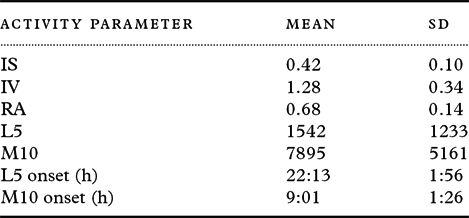
Descriptive statistics of circadian rest-activity variables

Values are reported in arbitrary units, except for L5 and M10 onsets.
Abbreviations: SD = standard deviation; IS = interdaily stability (strength of coupling to zeitgebers; the higher, the more stable), IV = intradaily variability (fragmentation of the circadian rest-activity rhythm; the higher, the more fragmented); RA = relative amplitude (L5/M10 ratio), L5 = activity during the 5-hour period with the lowest activity during 24 hours; M10 = activity during the 10-hour period with the highest activity during 24 hours; L5 onset = start time of L5; M10 onset = start time of M10.
Intra-individual linear regression analyses

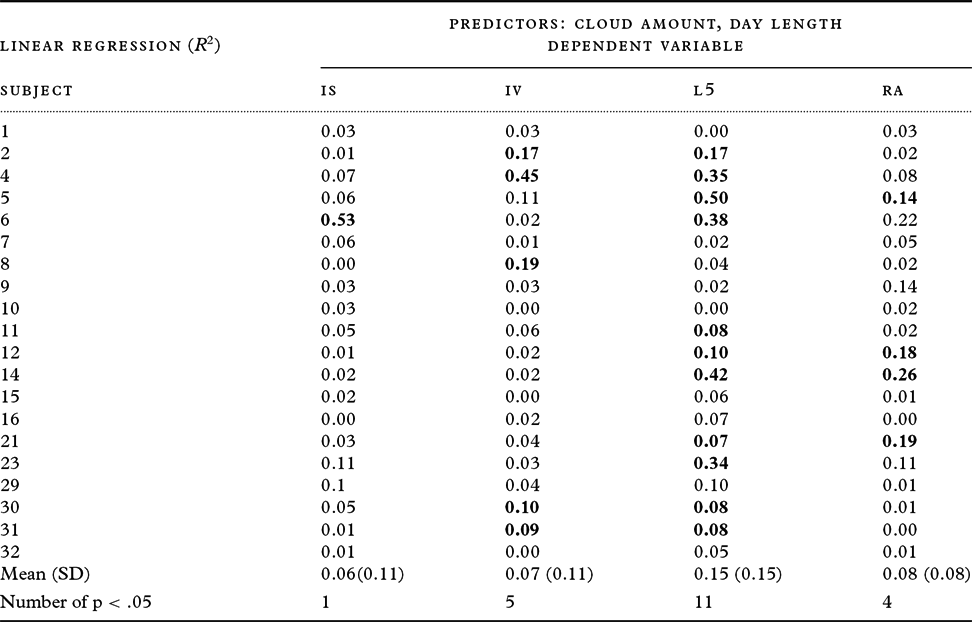
The 5 hours with the least consecutive motor activity during 24 hours (L5), indicative for nocturnal rest, was the most predictable activity variable per participant. Dependent variables: individual activity parameters (seven-day forward-moving averages). Predictors: cloud amount and day length (14-day backward-moving averages). Only every seventh day was included in the analysis to avoid overestimation of associations caused by moving averages. Significant results (p < 0.05) are marked in bold.
Abbreviations: IS = interdaily stability (strength of the coupling to zeitgebers; the higher, the more stable); IV = intradaily variability (fragmentation of the rhythm; the higher, the more fragmented); RA = relative amplitude (relative ratio of day and night activity); L5 = activity during the 5-hour period with the lowest activity during 24 hours.
After selecting L5 as the rest-activity variable with the highest intra-individual regression coefficient as predictor of cloud amount, we plotted a sequence chart of L5 in relation to cloud amount and day length. Then we calculated post-hoc Pearson correlations between date and activity parameters (L5, M10) to describe development over time after visual analysis of the graph as well as between cloud amount and L5 to test the observed correspondences for significance. Last, a linear mixed-model analysis was performed using cloud amount and day length both as dichotomous variables (cloudy vs. clear days; long vs. short days), by applying a median split on all available days. For significant interactions, t-tests for dependent samples were used to assess differences in the outcome measures between four fixed subgroups: short cloudy days, long cloudy days, short clear days, and long clear days.
Results
The time intervals of included rest-activity data ranged between 140 and 723 days (mean ± SD: 479 ± 206 days) per participant. Mean values of rest-activity variables (± SD) are displayed in Table 1 and were for IS: 0.42 (± 0.10); for IV: 1.28 (± 0.34); and for RA: 0.68 (± 0.14); L5: 1542 (± 1233); M10 = 7895 (± 5161); L5 onset (h): 22:13 (± 1:56); and M10 onset (h): 9:01 (± 1:26). The onset times indicate that M10 predominantly occurred during daytime and L5 during night-time.
The multiple regression analyses for predicting rest-activity-related variables (IS, IV, L5, and RA) with light-related weather parameters (cloud amount and day length) per participant showed a high inter-individual variance of regression coefficients (see Table 2). There were no significant differences in regression coefficients between subgroups of residents, i.e. participants living with Alzheimer´s disease and those having other dementia subtype diagnoses (p > 0.05). Therefore, the analyses were performed with the entire group of study participants within one sample.
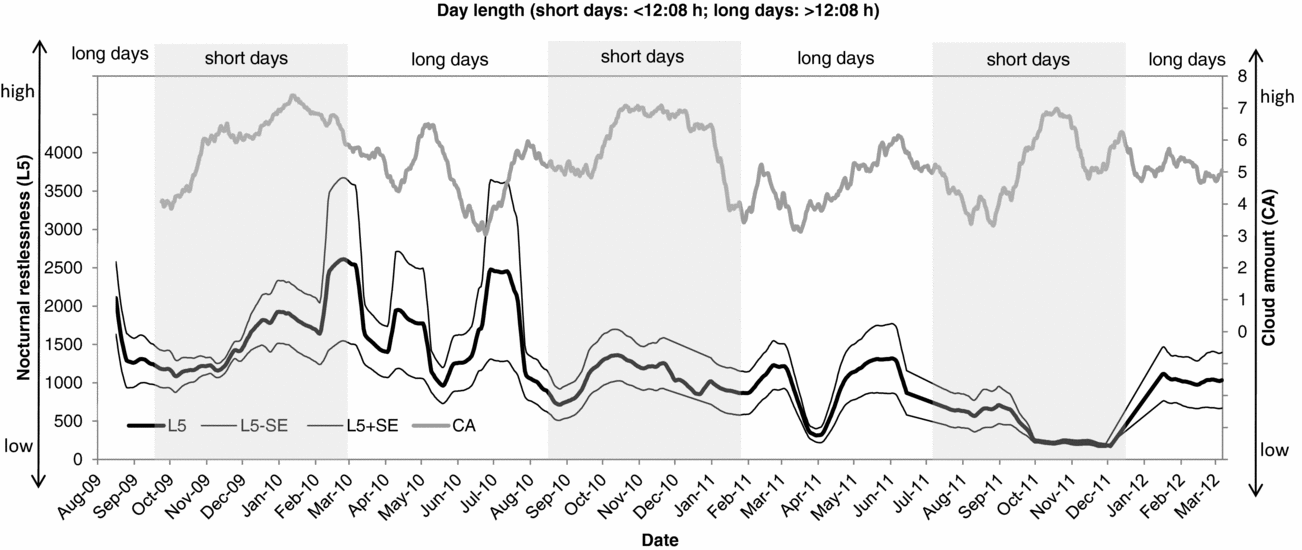
Intra-individual regression coefficients showed that cloud amount and day length were significant predictors for IS in only two participants, for IV in five participants, and for RA in four participants (Table 2). On the other hand, L5 was significantly predicted by cloud amount in 11 (0.074 ≥ R 2 ≤ 0.504; p < 0.05) out of 20 participants. Thus, the rest-activity parameter L5 had the highest proportion of significant predictions by cloud amount and day length and the highest overall mean ± SD (R 2 = 0.146 ± 0.153) across participants. L5 was therefore chosen as the dependent variable for further analysis. Figure 1 shows the time course of mean L5 (as an indicator of nocturnal restlessness) in relation to cloud amount and day length over the study period (n = 20). The time courses of the two variables mean L5 and cloud amount show visually some similarities with co-occurrence of peaks and troughs. They correlate moderately but significantly (r = 0.206, p = 0.015). A decline of L5 over time is observable and is reflected in a significant negative correlation of L5 with date (r = −0.524; p < 0.01). This decline might be attributed to a general decline in activity due to illness progression because M10 also declines with time (M10 vs. date: r = −0.676; p < 0.01).
Time course of nocturnal restlessness (L5) is related to cloud amount and day length. Thick black line (left y-axis) represents the time course of L5 (30-day centered moving average; n = 20 nursing-home residents with dementia; 140–723 days of activity recordings); thin black lines indicate ± standard errors. Grey line (right y-axis) represents time course of cloud amount (30-day backward-moving average). Day length is represented dichotomously as short (<12:08 hours; light grey rectangle) versus long days (>12:08 hours; white rectangles). The dates (month, year) are noted on the horizontal x-axis. Time courses of cloud amount and L5 are significantly associated (r = 0.206, p < 0.05). Abbreviations and definitions: L5 = averaged movement counts per hour (arbitrary unit) during the 5-hour period with the lowest activity during 24 hours indicating nocturnal restlessness; cloud amount = size of the part of the sky that is completely covered by clouds reported in eighths.

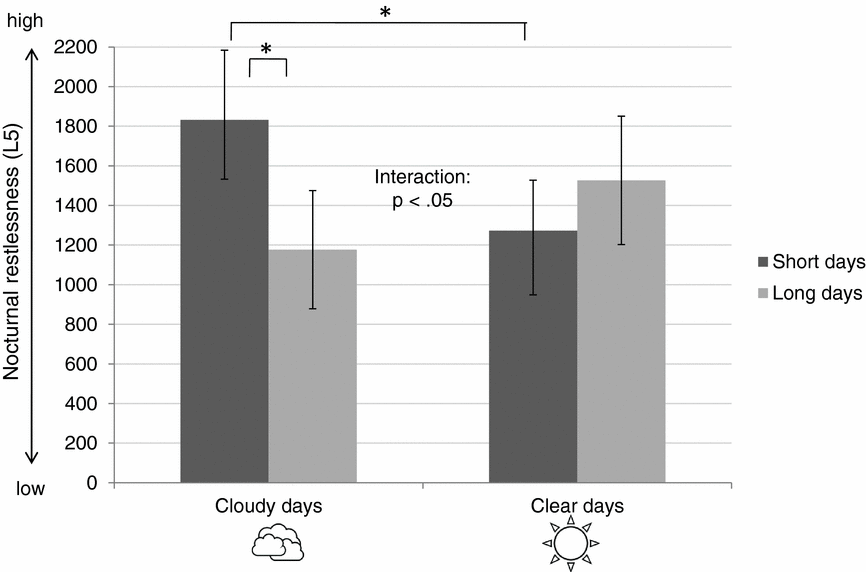
For L5, the mixed-model analysis showed a significant interaction between day length and cloud amount (p = 0.036; F 1,1174 = 4.39; Figure 2). There were no significant main effects of cloud amount or day length. Post-hoc tests showed that night-time activity was higher during cloudy short days when compared to clear short days (T 19 = 3.1; p = 0.007). Night-time activity was also higher during cloudy short days when compared to cloudy long days (T 17 = −2.3; p = 0.032).
Nocturnal restlessness is influenced by natural light conditions. Bars represent L5 group means calculated from individual means in subgroups; error bars represent standard errors. In the mixed-model analysis with nocturnal restlessness (L5) as dependent variable there was a significant interaction with day length and cloud amount (F 1173.8 = 4.39; p = 0.036; both entered in the model as dichotomous variables determined by median split and expressed as cloudy versus clear days and short versus long days, respectively; n = 20 nursing-home residents with dementia; 140–723 days of activity recordings). * indicates significant differences in post-hoc t-tests for dependent samples (p < 0.05). Abbreviations: L5 = averaged movement counts per hour (arbitrary unit) during the 5-hour period with the lowest activity during 24 hours indicating nocturnal restlessness.

Discussion
The aim of the study was to analyze possible effects of season and weather on rest-activity patterns in nursing home residents with dementia. Activity during the 5 hours with the lowest activity within 24 hours (L5) turned out to be the rest-activity parameter that showed the highest association with cloud amount and day length in the explorative analysis. These 5 hours predominantly occurred during night time (L5 onset mean ± SD = 22:13 ± 1:56 hours) and might be an objective indicator of the clinical observation of nocturnal restlessness as well as a proxy for night-time agitation in dementia (Burns et al., Reference Burns, Jacoby and Levy1990; Finkel, Reference Finkel2000). Our results showed that season- and weather-dependent natural lighting conditions had an influence on nocturnal restlessness. Cloud amount and day length interacted in their impact on night-time activity: only when there was already little natural light available regarding intensity (cloud amount) or exposure duration (day length) did a further reduction of natural light dose play a role.
Several attempts to stabilize rest-activity cycles of nursing home residents and home-dwelling elderly with dementia through interventions with light therapy or enhanced ambient light yielded inconsistent results. However, most studies reported a stabilizing effect of light therapy on rest-activity patterns (Satlin et al., Reference Satlin, Volicer, Ross, Herz and Campbell1992; Mishima et al. Reference Mishima1994; Ancoli-Israel et al., Reference Ancoli-Israel, Martin, Kripke, Marler and Klauber2002, Reference Ancoli-Israel2003; Dowling et al., Reference Dowling2005), on agitation (Lovell et al., Reference Lovell, Ancoli-Israel and Gevirtz1995; Mishima et al., Reference Mishima, Hishikawa and Okawa1998; Skjerve et al., Reference Skjerve2004; Burns et al., Reference Burns, Allen, Tomenson, Duignan and Byrne2009), and on sleep (Lyketsos et al., Reference Lyketsos, Lindell Veiel, Baker and Steele1999; Fetveit and Bjorvatn, Reference Fetveit and Bjorvatn2005). Light-intervention studies are mostly conducted in the winter months to yield clearer results by avoiding the influencing effects of natural light. Our results suggest that daylight should also be taken into account as a potentially effective intervention. Cloud amount could be a still-underestimated interacting variable in light-intervention studies because from our results, it seems relevant for nocturnal activity (which is at least partly circadian regulated), especially during the winter months.
Seasonal variations in circadian rhythms of hormones, mood, and activity are often reported for northern latitudes with variable daylight lengths but not for latitudes close to the equator with lower day length variability (e.g. Laakso et al., Reference Laakso, Porkka-Heiskanen, Alila, Stenberg and Johansson1994; Park et al., Reference Park, Kripke and Cole2007; Friborg et al., Reference Friborg, Bjorvatn, Amponsah and Pallesen2012). Former studies on day length and weather influences on activity only address overall activity levels and not the circadian pattern of activity (e.g. Feinglass et al., Reference Feinglass2011; Klenk et al., Reference Klenk, Buchele, Rapp, Franke and Peter2011; Goodman et al., Reference Goodman, Paskins and Mackett2012). We found only two studies directly addressing daylight and weather effects on circadian parameters in elderly and persons with dementia. Obayashi and colleagues reported from a field study with a sample of 192 elderly a positive association of duration of bright daylight exposure (>1,000 lx) and amount of urinary 6-sulfatoxy melatonin excretion (Obayashi et al., 2012). Another field study with people with dementia showed lower rates of daylight exposure and a lower amplitude of the circadian-driven rest-activity rhythm in winter (Figueiro et al., Reference Figueiro, Hamner, Higgins, Hornick and Rea2012). Other studies report a generally low level of light exposure in nursing-home residents with dementia (Ancoli-Israel et al., Reference Ancoli-Israel1997; Shochat et al., Reference Shochat, Martin, Marler and Ancoli-Israel2000). The potentially lower circadian amplitude with lower light exposure (Figueiro et al., Reference Figueiro, Hamner, Higgins, Hornick and Rea2012; Obayashi et al., Reference Obayashi2012) suggests that more daylight would always improve rest-activity cycles. It was therefore surprising that our findings suggest that beyond a certain level of light exposure, additional light does not lead to further improvements. Several causes could lead to the observation: (1) in the summer, the investigated nursing-home residents were not only exposed to daylight through the windows for longer periods of time but also spent more time outside in the garden so that they were more activated during the day and could receive relevant circadian light input even during cloudy days. Accordingly, light exposure through the windows of the nursing home on cloudy winter days may have been of much lower efficacy for circadian rhythmicity; (2) seasonal and weather-dependent differences in daily activity and habitual bedtimes might add to these effects; (3) there might have been additional disturbing influence of indoor evening light on short days. (4) a yet to be specified “saturation effect” might be responsible for the fact that the received light dose was high enough to have a positive influence on nocturnal restlessness at some point so that it could not be enhanced by more light exceeding this dose. Accordingly, it was shown earlier that the gain in phase shifting effects of light diminishes with growing exposure duration (Rimmer et al., Reference Rimmer2000; Beersma et al., Reference Beersma2009). This effect could be caused by an interaction of response reduction under light and response restoration in darkness (Comas et al., Reference Comas, Beersma, Spoelstra and Daan2007); (5) an additional explanation of the fact that clear days did not significantly add to the reduction of nocturnal restlessness on long (summer) days could be the high temperatures occurring especially on such days. High ambient temperatures might cause physical discomfort, high blood pressure, and sleep disturbances especially in old age, which could counteract benefits from light effects.
There are some limitations to our study. One is the small sample size of 20 participants, which was accepted to allow for the extended data acquisition period of three years. Additionally, the sample was, while homogenous in terms of age, diagnosis, and living circumstances, heterogeneous regarding mobility and eye functioning of participants. The small sample size and its heterogeneity might also be the reason that possible main effects of day length and cloud amount did not yield significance. It was not controlled for potentially moderating variables like social activities. The explorative character of rest-activity parameter selection and the post-hoc hypothesis testing determine the preliminary character of our results, which should be replicated in another sample with predefined parameters. Furthermore, we did not record systematic subjective reports on behavior that would have allowed drawing conclusions on the clinical relevance of the observed variability in night-time activity.
To conclude, the results showed lower nocturnal restlessness in nursing-home residents with dementia during summer seasons or after clearer days in fall/winter/spring. The observed higher nocturnal restlessness after short and cloudy days may indicate a weakness of light as zeitgeber for the circadian system, especially during time periods with low natural light levels and exposure durations. For the planning of light interventions, this would imply that complementary light exposure to electrical lighting could be highly efficient in winter and on cloudy days.
Conflict of interest
None.
Description of authors' roles
D. Kunz and A. Wahnschaffe had developed concept and design of the study. C. Nowozin, A.Wahnschaffe, and A. Rath conducted data aquisition. M. Münch, A. Wahnschaffe, T. Floessner, and S. Appelhoff analyzed and interpreted the data. A. Wahnschaffe drafted the paper and all authors revised it with substantial contributions and approved the final version.
Acknowledgments
We thank the residents of the Splitt-Fennert nursing home and their relatives for participating in the study. We thank the team for their help with collecting data and the specialist for seismology Prof Dr Frederik Tilmann for his data analysis advice (because long-term activity patterns can sometimes resemble seismic wave patterns). We thank Prof Dr Andrea Rodenbeck, Dr Frederik Bes, Dr Alexandra Papakonstantinou, and Jan de Zeeuw for their helpful comments on an earlier version of the paper and Julia Ritter for proofreading this document. The data collection phase of the study was financially supported by the German Federal Ministry of Economics (FKZ 0319057L) as preparation for a later intervention study.