Background
Persistent pulmonary hypertension of the neonate can cause acute and life-threatening hypoxia. Cases resistant to common vasodilator therapy should be supported with extracorporeal membrane oxygenation, but this is not indicated for some patients, such as preterm or low birth weight neonates and infants with cerebral bleeding. We report the unique case of an extremely preterm neonate with life-threatening persistent pulmonary hypertension refractory to triple vasodilator therapy, which has been saved with the addition of adenosine infusion.
Brief report
An outborn female neonate was vaginally delivered at 25+6 weeks’ gestation (weight: 920 g, 5’ Apgar score: 8, critical risk index for babies-II score: 11). Delivery was quick, and no antenatal steroids were given. The obstetrical history was uneventful. The baby had mild respiratory distress and was initially started on nasal continuous positive airway pressure following current European guidelines; arterial and venous umbilical lines were placed and full monitoring was provided. Due to worsening respiratory failure (high lung ultrasound score: 11 and oxygenation index: 5), she was intubated at 1.5 hours of life, 200 mg/kg poractant-alpha were administered with poor response (oxygenation index: 8, lung ultrasound score 12). Point-of-care echocardiography showed ventricular underfilling and persistent pulmonary hypertension of the neonate (right-to-left shunt) through patent ductus arteriosus, systolic pulmonary arterial pressure 40 mmHg, while systolic systemic arterial pressure was 30 mmHg (reference 42–46 mmHg Reference Vesoulis, El Ters, Wallendorf and Mathur1 ). Volume filling, stepwise alveolar recruitment with high-frequency oscillatory ventilation, norepinephrine, and hydrocortisone were provided. Immediately after alveolar recruitment, inhaled nitric oxide (20 ppm) was started. There was no response to nitric oxide; thus, nebulised iloprost (1 µg/kg every 4 hours) was added using high-frequency membrane nebulisers (Aerogen Solo®, Dangan, Ireland) placed on the inspiratory limb close to the Y-piece. Short and transient oxygenation improvements were seen during iloprost nebulisation.
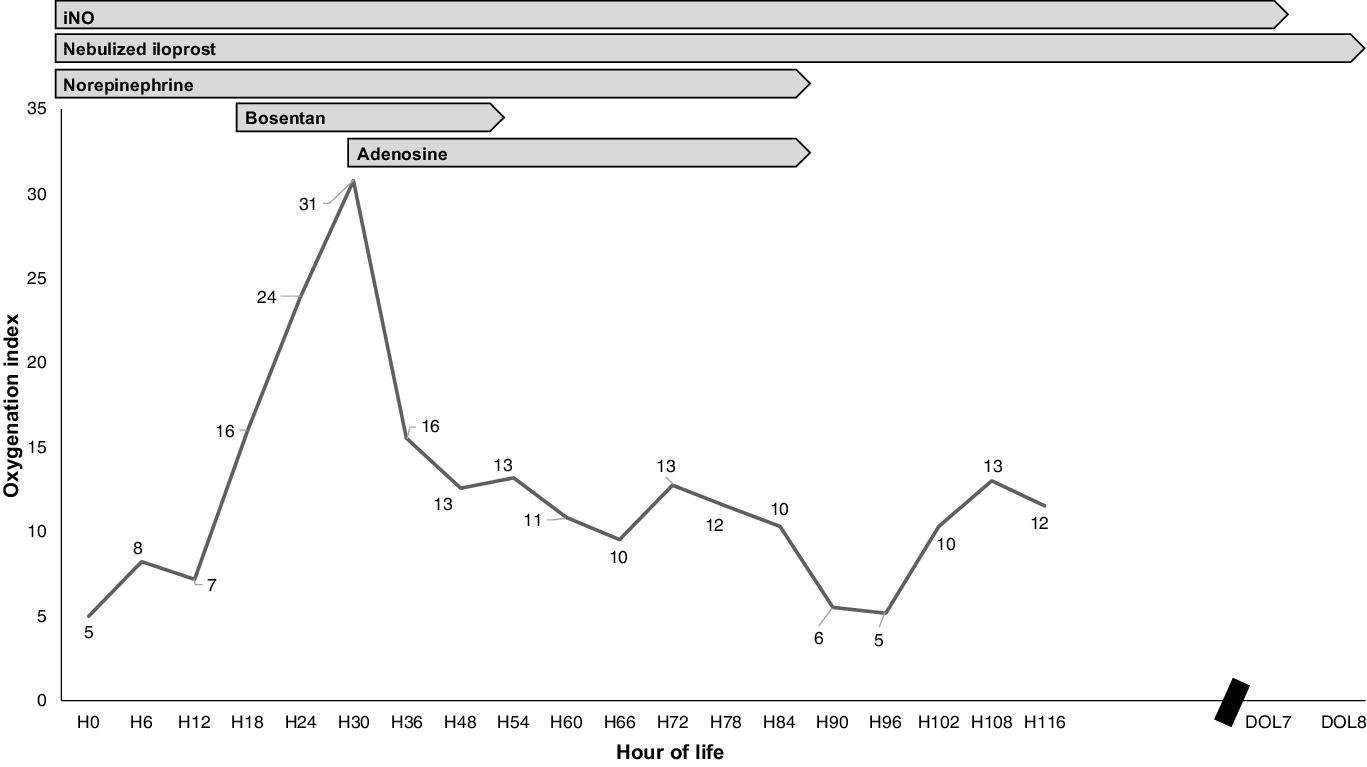
Despite these measures, oxygenation index (Fig 1) and echocardiographic findings of persistent pulmonary hypertension were worsening. Norepinephrine and volume fillings were titrated, poractant-alpha (100 mg/kg) was re-administered, and bosentan (1 mg/kg every 12 hours as syrup through the feeding tube) was started. After 6 hours, as systolic pulmonary arterial pressure was estimated at 55 mmHg, iloprost was increased to 1 µg/kg every 3 hours.
Oxygenation index trend overtime. Grey horizontal arrows depict the duration of pulmonary vasodilator and inotrope therapies. Oxygenation index has been calculated as mean airway pressure × inspired oxygen fraction × 100/PaO2 using blood gas analysis obtained from umbilical arterial line. Abbreviations: DOL: day of life; H: hours of life; iNO: inhaled nitric oxide.

There was again no response and the neonate needed 100% oxygen to reach 80% pre-ductal saturation: we informed the parents and, at 30 hours of life, started adenosine (50 µg/kg/minute as continuous infusion through umbilical line). Other pulmonary vasodilators were not modified. Oxygenation index immediately decreased, and pulmonary hypertension became sub-systemic (systolic pulmonary arterial pressure: 30 mmHg; systolic systemic arterial pressure: 40 mmHg); no bradycardia was noticed. Adenosine dose was halved after 48 hours. Adenosine, nitric oxide, and iloprost were discontinued at 4, 7, and 8 days of life, respectively; the obtained improvement in oxygenation was fairly maintained despite drug weaning. Parents gave written consent to publish this report.
Discussion
Adenosine dilates pulmonary vessels as metabolic precursor of cAMP, which is the second messenger of the prostacyclin pathway. Reference Motti, Tissot and Rimensberger2 Adenosine-nitric oxide dual therapy has been successfully used in case of nitric oxide failure, since cGMP is the intracellular messenger of nitric oxide, and therefore, these drugs may have a synergistic effect. Reference Motti, Tissot and Rimensberger2,Reference Ng, Franklin, Vaidya, Pierce and Petros3 Nonetheless, this is the first report of adenosine efficacy in refractory pulmonary hypertension resistant to multiple vasodilator therapy (nitric oxide, iloprost, and bosentan). Our patient was already treated with a molecule acting on the prostacyclin pathway, since iloprost is the carbacyclin analogue of the prostacyclin PGI2. Despite iloprost and nitric oxide have similar potency and well-known synergistic effect, Reference De Luca, Zecca, Piastra and Romagnoli4,Reference Piastra, De Luca and De Carolis5 this combination had been globally ineffective until the addition of adenosine. It is possible that higher levels of intracellular cAMP were needed to effectively relax pulmonary artery smooth muscular cells, and iloprost was unable to permanently achieve this because of its short half-life. The addition of another molecule increasing cAMP, given on continuous infusion, allowed a more significant and constant increment, resulting in improvement of pulmonary hypertension. The drugs were weaned relatively early as the oxygenation improvement that was quick and evident and given their off-label and life-saving use. This experience suggests the use of adenosine for similar cases of refractory pulmonary hypertension in patients who are not suitable candidate for extra-corporeal life support.
Acknowledgements
None.
Authors’ contribution
LG collected the data and wrote the first manuscript draft; DDL analysed and interpreted the data, critically reviewed the manuscript for important intellectual content and supervised the work.
Financial support
This research received no specific grant from any funding agency, commercial or not-for-profit sectors.
Conflicts of interest
None.
Ethical standards
The authors assert that all procedures contributing to this work comply with the ethical standards of the relevant national guidelines on human experimentation and with the Helsinki Declaration of 1975, as revised in 2008, and that parents of the patients have approved the publication of this report.