

Birds have long had relationships with humans that go beyond their nutritional value (Kost & Hussain Reference Kost and Hussain2019; Overton & Hamilakis Reference Overton and Hamilakis2013). Certainly many species of wild birds were collected for food worldwide, for millennia (e.g. Avery & Underhill Reference Avery and Underhill1986; Bovy et al. Reference Bovy, Moss, Watson, White, Jones, Ulrich and Parrish2019; Lefèvre Reference Lefèvre1997; Prummel et al. Reference Prummel and Brinkhuizen2008), in some cases driven to extinction (e.g. Steadman Reference Steadman1989). They were also collected for feathers and other body parts across the globe (e.g. Buono Reference Buono2007; Crown Reference Crown2016), non-subsistence demands that likewise led to destructive loss when commercialized (e.g. Davis Reference Davis2017, 185–219). These sorts of exploitative relationships are worthy of zooarchaeological study in their own right, but an anthropocentric perspective on birds puts unnecessary limits on the interpretation of the bony remains of creatures known cross-culturally as sentient and agential. In what Overton and Hamilakis (Reference Overton and Hamilakis2013) call ‘zoontology’, birds and humans are mutually constitutive, each coming into being through social interactions. Their way of thinking goes beyond ritual uses of birds or their representation in art or symbolic expression. A social zooarchaeology structured by zoontology rejects the dichotomies of predator-prey, human-animal and nature-culture to consider the multinaturalism and spiritual unity of otherwise diverse beings (Viveiros de Castro Reference Viveiros de Castro1998). Such relational qualities are revealed in the cosmologies of non-western people and ritual practices for renewing or rebalancing the world.
Birds are prominent and powerful agents in the cosmologies of Native North America (Hudson Reference Hudson1976, 128–30; Ladd Reference Ladd and Bol1998; Lankford Reference Lankford2011, 75–80; Olsen Reference Olsen and Bol1998, 102–8). In ethnohistoric accounts from the American Southeast, birds move between realms of the cosmos, typically conceived as a tripartite scheme of Upper, Middle and Lower Worlds (Hudson Reference Hudson1976, 122–8). Birds also factor in cosmogonic myths, such as Earth Diver, in which Upper World people (i.e. birds) dispatch liminal creatures (e.g. beaver, otter, crawfish) into the watery Lower World to retrieve earth for the creation of the Middle World (Hall Reference Hall1997, 18–19; Lankford Reference Lankford2011, 108–9). World renewal rituality recapitulates cosmogony by relating emergence events like Earth Diver to cycles of the sun or other Upper World beings, themselves avian agents.
Ritual serving to balance the Upper and Lower Worlds involves more than birds, but judging from the pervasiveness and time-depth of bird imagery, avian agents have long held a central role in cosmologies of the Native American Southeast (Anderson & Sassaman Reference Anderson and Sassaman2012, 140; Brown Reference Brown, Charles and Buikstra2006; Claassen Reference Claassen2015, 153–4; Crawford Reference Crawford2003; Hudson Reference Hudson1976, 128–30; Pluckhahn Reference Pluckhahn and Alt2010, 62; Serjeantson Reference Serjeantson2009; Spivey-Faulkner Reference Spivey-Faulkner2018; Sunderhaus & Blosser Reference Sunderhaus, Blosser, Charles and Buikstra2006). Bird effigy mounds at Poverty Point attest to world renewal ritual more than 3000 years ago (Kidder Reference Kidder, Sassaman and Holly2011). Stone beads in the shape of owls are among the portable avian items of Poverty Point rituality (Gibson Reference Gibson2001). Platform pipes, copper cut-outs and pottery of the ensuing Hopewell traditions feature diverse bird imagery, much of it interred with the dead in crypts and mounds (Bernardini & Carr Reference Bernardini, Carr, Carr and Case2004; Brown Reference Brown, Charles and Buikstra2006; Carr Reference Carr, Carr and Case2004, 586; Carr & Case Reference Carr, Case, Carr and Case2004, 203–8; Claassen Reference Claassen2015; Donop Reference Donop2017; Hall Reference Hall1997; Reference Hall, Charles and Buikstra2006; Sunderhaus & Blosser Reference Sunderhaus, Blosser, Charles and Buikstra2006; Weets et al. Reference Weets, Carr, Penney, Carriveau, Carr and Case2004). During the Mississippian era, paraphernalia of avian derivation personified ritual authority of the Upper World, of the Sun, in the personhood of Bird Man (Brown Reference Brown1997; Brown & Rodgers Reference Brown and Rogers1989; Cobb & King Reference Cobb and King2005; Knight Reference Knight1986; Larson Reference Larson and Brown1971; Phillips & Brown Reference Phillips and Brown1978; Reference Phillips and Brown1984).
Great time depth to ritual involving bird imagery does not imply continuity in religion or world view over millennia. Indeed, the actual content or form of such imagery varied over time, as did the context in which objects were manipulated and deposited. Despite this diversity, can we identify ritual practices involving birds that speak to cosmological principles of enduring or recurring significance? Celestial cycles, for instance, offer frameworks of ritual significance and timing for anyone attentive to movements of the sun and moon and the stars. It follows that our understanding of rituality would benefit from better data on the specific timing of ritual events. When and how often did they occur? Were events involving birds routinized or situational? If routinized, were events synchronized to annual solar cycles, like the solstices or equinoxes? What other activities took place in the context of rituals involving birds or bird imagery that help to explain their timing?
Answers to these questions turn on the availability of season-specific evidence for ritual activities. Such data are often derived from the remains of plants and animals whose time of collection can be inferred from biological development, seasonal migration, or reproductive cycles, among other indicators (Monks Reference Monks1981). Found in archaeological contexts in the American Southeast dating as early as 11,000 years ago (e.g. Walker Reference Walker, Walker and Driskell2007), the bones of birds have good potential for inferring season of collection. Of course, this potential alone does not implicate ritual practice. Indeed, birds were collected and consumed as part of routine subsistence, even as the contexts of some early remains invite speculation about ritual practice (e.g. Claassen Reference Claassen2010, 172, 176; Walker & Parmalee Reference Walker and Parmalee2004). In later-period mortuary contexts and in the deposits of large-scale feasts, bird remains provide less ambiguous evidence for the content of ritual practice (e.g. Fishel Reference Fishel1997; Jackson & Scott Reference Jackson and Scott2003; Kelly & Kelly Reference Kelly and Kelly2007), if not also its timing.
In this paper we present evidence for the collection and ritual use of water birds during summer solstice events on the northern Gulf Coast of Florida, c. ad 400–650. The site of Shell Mound (8LV42) is one of several civic-ceremonial centres in the region with historical affinity to the Hopewell traditions of the lower Midwest. Such places are noted for world-renewal ceremonialism and communal feasting (Knight Reference Knight, Dietler and Hayden2001), much of it presumably associated with mortuary rites. Bird imagery abounds in the various objects emplaced with the dead, but little evidence exists for the ritual uses of actual birds. Shell Mound is an exception. Recovered from large pits at this location were abundant faunal remains that included the bones of various water birds, most notably the white ibis (Eudocimus albus), a wading bird common to coastal and wetland environments of the American Southeast. Of particular significance is the predominance of bony elements from juvenile white ibises, birds that were collected in mid to late June, the time of summer solstice. What is more, Shell Mound and its associated mortuary facilities were located at the end of a relict dune with solstice orientations. Whereas Hopewell centres in the Midwest and their civic-ceremonial counterparts in the southeast are noted for astronomical alignments of mounds and related architecture (e.g. Romain Reference Romain2000; Williamson Reference Williamson1984, 258–62), Shell Mound invites consideration into the predisposition of particular places on the landscape for the siting of ritual infrastructure and the timing of practices it supported.
In the section that follows we describe Shell Mound and the pit contexts from which large assemblages of vertebrate fauna were recovered in recent excavations. Details on the avian fauna from pits are then described with emphasis on the bones of juvenile white ibises. The basis for inferring the timing of white ibis collection follows, a subject necessitating an excursion into the breeding ecology of this species. We conclude with discussion of the implications of these findings for the siting and timing of rituals at Shell Mound in particular and world renewal rituality more generally.
Shell Mound and its pit assemblage
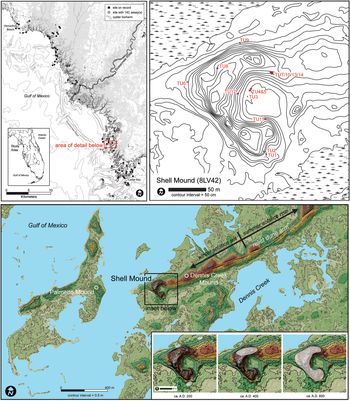
Shell Mound (8LV42) is one of several archaeological sites in the Lower Suwannee National Wildlife Refuge of Florida with mounds and related facilities of ritual activity dating to the first millennium ad (Fig. 1). Since 2009, the Lower Suwannee Archaeological Survey of the University of Florida has conducted survey and test excavations at a variety of sites along a 42 km long expanse of the northern Gulf Coast (Sassaman et al. Reference Sassaman, Wallis and McFadden2017). The cultural-historical outline of the area dating from about 2500 bc is well established by the results of testing at 25 sites and scores of radiometric age estimates. Shell Mound has received the greatest level of testing and dating (Sassaman et al. Reference Sassaman, Palmiotto, Mahar, Monés and McFadden2013; Reference Sassaman, Mahar, Donop, Jenkins, Boucher, Oliveira and Goodwin2015; Reference Sassaman, Barbour and Blessing2019a,Reference Sassaman, Blessing and Goodwinb). Our results firmly indicate this was a place of gathering and ritual activity, as well as residence, from c. ad 400–650. A mortuary facility across intertidal water 500 m west of Shell Mound (Palmetto Mound [8LV2]) pushes the onset of ritual activity in the immediate area back to at least 400 bc (Donop Reference Donop2017).
Map of the study area of the Lower Suwannee Archaeological Survey (upper left); topography of Shell Mound (8LV42) with locations of test excavations (upper right); and the landscape surrounding Shell Mound and the relict dune arm (bottom), including Palmetto Mound (8LV2), Dennis Creek Mound (8LV41) and Komar (8LV290). Inset at lower right shows the evolution of Shell Mound over a 400-year period (200–600 ad).

Shell Mound is an arcuate ridge of largely oyster shell that was emplaced on the arm of a relict dune around 550 ad. When the site achieved its final form and was abandoned around 650 ad, Shell Mound was 180×170 m in plan and nearly 7 m tall, enclosing a 60 m diameter central area (i.e. plaza) devoid of shell. This final form belies a more complex history of site use involving the relict dune. Before the era of terraforming that brought Shell Mound into an arcuate shape, a considerable number of large pit features were dug into the south-facing slope of the dune arm. The top of the dune arm appears to have supported intensive habitation when pit use ensued, but the scale and number of these features implies activities beyond the domestic sphere. Extrapolating the density of pits exposed in test excavations to the expanse of the south-facing dune slope, an estimated 675 pits at least one metre in diameter and up to 2 m deep were excavated and backfilled between c. 400 and 650 ad. As we argue below, avian remains from these pits support the inference that these features were among the infrastructure of feasts that took place during summer solstices.
The overall historical context and supporting details of ritual feasts at Shell Mound are provided elsewhere (Sassaman et al. Reference Sassaman, Blessing and Goodwin2019b) and only summarized here. The backdrop of this history is millennia of sea-level rise in the post-glacial era, as much as 80 m since people arrived in the region 14,000 years ago, resulting in over 250 km of shoreline retreat in the study area. Before it was flooded to present levels, the Lower Suwannee region was the locus of Ice Age parabolic dunes that formed by prevailing winds blowing ~60° east of north, which coincidentally, is the direction of the summer solstice rise. As early as 4500 years ago cemeteries were emplaced at the ends of dune arms, which pointed in the opposite direction, ~240° east of north, towards the setting winter solstice sun. Some early cemeteries evidently were re-emplaced landward from dune arms that were inundated by rising sea. One of the last cemeteries to be established (Palmetto Mound, c. 400 bc) was at the end of the relict dune on which Shell Mound would later take shape. Early in the first millennium ad the shoreline retreated 2–3 km with an overstep event that separated the cemetery from the dune arm. Dug into the dune arm starting around 400 ad and continuing for ~250 years were these large pits. They were backfilled with abundant vertebrate faunal remains (especially mullet); oyster shell; charcoal and ash; sherds of large, expedient cooking vessels; sherds of small, refined serving vessels; and occasional pieces of non-local material (e.g. mica, quartz crystal). Facilitating the mass capture of mullet and other fishes common in pits was a tidal trap constructed 2 km south of Shell Mound. Putting these observations into the ethnohistoric context of communal feasting in the American Southeast, we inferred that pit digging and backfilling at Shell Mound attended to world renewal during this time of environmental instability. With feasts sited on a dune arm oriented to the solstices, we expected the timing of these activities to coincide with solar standstills. The bird remains from pits point more specifically to summer solstices. They also provided insight on world renewal via their Upper World agency.
Here we present the basis for inferring the timing of these events, most directly from the bony remains of juvenile white ibises. We stress that the value of this inference goes beyond its chronological specificity to help situate these events cosmologically on the solstice-oriented landform on which they took place. We return to this point in the closing discussion and now review the details of pit context that bear on the sampling of vertebrate faunal remains, bird and otherwise.
Pit form, function, chronology and content
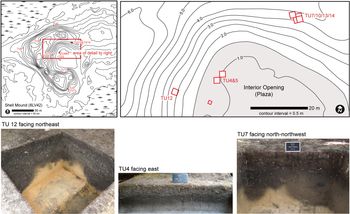
Large pit features encountered in two locations on the south-facing slope of the dune arm varied from cylindrical to conoidal in profile (Fig. 2). The upper portions of these features were indistinguishable in the context of organic midden, but below about 30 cm from the surface, the organic fill of pits stood in stark contrast with underlying inorganic dune sand. Several pits in both locations overlapped, making it difficult to enumerate the total population or provide accurate volumetric estimates for most pits. All pits encountered in excavation were sectioned, profiled and sampled for fine recovery, but some were not detected until wall profiles were cleaned and mapped. Of the 22 pits exposed in test excavations in these locations, six were particularly well preserved and largely discrete. It is from these six pits that vertebrate fauna were selected for analysis. The contents of flotation samples that provide insight on bone elements of less than ¼-inch are reported elsewhere (Sassaman et al. Reference Sassaman, Barbour and Blessing2019a). The results reported here are from the ¼-inch fractions of samples of pit fill. Volumetric controls for these fractions are not as precise as those of flotation samples, but samples are consistently large (>200 litres each). As we detail below, over 25,000 bony elements were recovered from the ¼-inch fractions of these six pits and no pit had fewer than 2743 elements.
Profiles of large infilled pits in the sideslope of the relict dune (bottom left and right) stand in sharp contrast with the thin organic midden of the interior opening (plaza) of Shell Mound (8LV42). All profiles are 2 m wide.

Before delving further into pit content and chronology, some brief comments on pit function are warranted. To state the obvious, fill recovered from pits does not necessarily relate to purposes for which they were intended. Considering the features as pits and not pit fill, none could have been left open for very long, given the unconsolidated nature of the dune sands into which they were dug. None of the pits we sectioned expressed oxidation attending heat exposure, nor did they contain burned material other than particulate charcoal and ash. Given the low iron content of the dune sands, the lack of oxidation expected from burning does not preclude thermal uses for these pits. That they were used to steam oysters, other shellfish and other foods is likely. In any such application, pits would have been emptied of their contents and then filled in, in this case with abundant vertebrate remains, as well as shell, pottery sherds, shell and stone tools and other material culture. Whereas we cannot be sure that the fill of pits is directly related to their potential function in cooking food, we are confident that pits were backfilled soon after the pits were emptied.
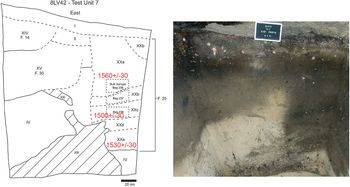
All pits contained abundant charcoal for radiometric dating. As noted earlier, AMS assays on charcoal from each of the pits range between 400 and 650 ad at the two-sigma calibrated range. Age estimates for individual assays range from 80 to 175 years at two sigma, and each overlaps with the successive assay by at least 50 years. In short, pits appear to have been dug and backfilled routinely over the 250-year span of Shell Mound's history as a civic-ceremonial centre. The relatively homogeneous fill of most pits suggests that pits were infilled quickly with similar materials. The chief exception to homogeneous fill is the well-stratified Feature 25, among the densest and richest of the assemblage (Goodwin Reference Goodwin2017). Despite its stratified fill, Feature 25 also appears to have been infilled instantaneously: AMS assays on charcoal from lower, middle and upper strata of this 1.8 m deep pit overlap at one-sigma ranges (Fig. 3).
Stratigraphic drawing (left) and photograph (right) of the east profile of Test Unit 7, showing Feature 25 and three AMS assays on charcoal from successive strata.

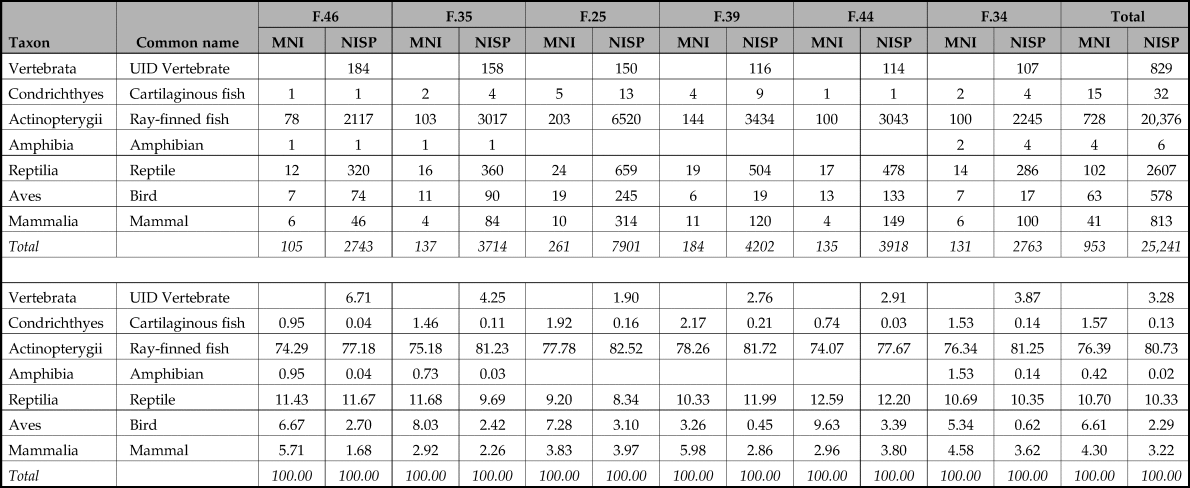
The fill of large pits at Shell Mound is arguably the result of large-scale feasting events involving abundant fish and shellfish, along with turtles, deer, birds and other animals and plants (Sassaman et al. Reference Sassaman, Barbour and Blessing2019a,b). Table 1 lists the frequencies of vertebrate faunal remains of the six features of our sample, tabulated by general categories for number of individual specimens (NISP) and minimum number of individuals (MNI). A total of 25,241 bony elements were identified from screened fill of six pit features at Shell Mound. These account for a minimum of 953 individuals distributed across 74 taxa. Fish make up the vast majority of individuals, a total of 728, or nearly 76 per cent of all MNI. Mullet comprise nearly half of all the fish, followed by lesser but appreciable numbers of jack, sea trout, red drum, hardhead catfish and sheepshead (see Sassaman et al. Reference Sassaman, Blessing and Goodwin2019b for species-level data). Black drum, flounder, pinfish and gar contribute modest fractions, and bowfin, requiem shark, Gulf sturgeon and ladyfish each occur as more than a trace. Turtles and tortoises comprise about 10 per cent of the total MNI, with relatively equal numbers of sea turtle and mud turtles and about half the number of box turtles. All pits also contain the bones of white-tailed deer. We count at least 17 individuals and note that some, maybe most, were young. The remains of other mammals are not numerous but include opossum, raccoon, panther, skunk, wood rat, cotton rat and dolphin.
Absolute and relative frequencies of Minimum Number of Individuals (MNI) and Number of Individual Specimens (NISP) of vertebrate faunal remains >¼ inch by feature and general taxon, Shell Mound (8LV42).

Among the mélange of animals with bony remains in pit fill are various wading birds and other water birds. By MNI, birds (n = 63) account for 6.6 per cent of the vertebrate assemblage. Although the avian assemblage includes members of nine specific and four non-specific taxa, 62 per cent of the MNI goes to the white ibis (Eudocimus albus), a common wading bird in the region. Notably, the overwhelming majority of the white ibis elements analysed from Shell Mound belong to immature individuals. While the choice of juvenile white ibis is of interest for what it might say about food preferences or cuisine among those who gathered at Shell Mound for feasts, analytical value accrues from the timing of ibis bone development. Several studies (Avery & Underhill Reference Avery and Underhill1986; Gotfredsen Reference Gotfredsen1997; Lefèvre Reference Lefèvre1997; Serjeantson Reference Serjeantson1998; Reference Serjeantson2009; von den Driesch et al. Reference von den Driesch, Kessler, Steinmann, Berteaux and Peters2005) have demonstrated the utility of archaeological bird bone for estimating season of capture, especially immature bones, which, according to Dale Serjeantson (Reference Serjeantson1998, 27), offer ‘the greatest potential for identifying seasonality’.
Avian remains in pits
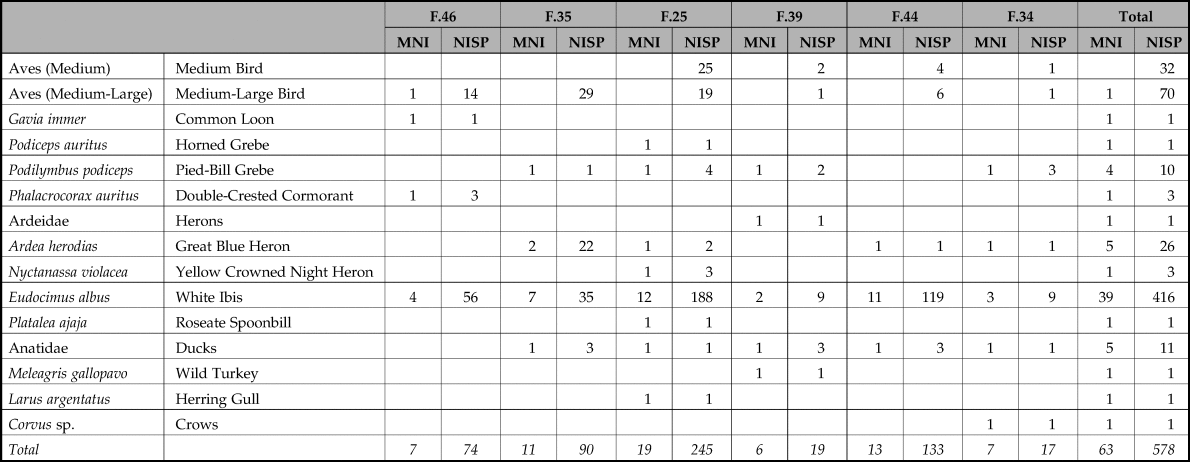
Counts of avian faunal remains in pit fill by NISP and MNI are given in Table 2. General size categories for non-specific avian remains are included in this table and they occasionally account for MNIs that cannot be included with individuals given to more specific taxa. Avian remains were recovered from all six pits, and they each include the remains of at least two and as many as 12 white ibises, the majority of which were juvenile. The largest number of juvenile ibises came from Feature 25, which also presented the highest diversity of avian species. The avian remains of Feature 25 rightfully garnered the most attention (Goodwin Reference Goodwin2017) and thus serve as our point of departure. Brief comments on avian remains from the other features follow and we then outline the basis for inferring season of capture and ultimately the timing of feasting events from the bones of juvenile white ibises.
Absolute frequencies of Minimum Number of Individuals (MNI) and Number of Individual Specimens (NISP) of avian faunal remains >¼ inch by feature and general taxon, Shell Mound (8LV42).

Feature 25
A total of 7901 faunal specimens was analysed from ¼-inch fraction samples from Feature 25, representing an estimated total of 261 individuals across 60 different taxa. The fish, reptiles and mammals of Feature 25 are like those of other features, with fish dominating the assemblage (77.8 per cent of all MNI) and mullet comprising more than half of all fish. Although the vast majority of the identified bony remains from Feature 25 are fish, bird specimens comprise the second largest estimated number of individuals. A total of 245 bird elements were identified to nine taxa, representing an estimated 19 individuals.
The bones of white ibis comprise the majority of bird bones (76.7 per cent NISP) and individuals (63.3 per cent MNI) in Feature 25. White ibis bones represent the full range of the skeleton, from cranium fragments to axial and paired limb elements. No evidence of burning or butchery was detected on any of the bird specimens, ibis or otherwise. Nine of the 12 white ibises from Feature 25 were juveniles, which we discuss further below.
The second largest NISP of any bird taxon in Feature 25 is given to the general class Aves, and consists mostly of unidentifiable long bone fragments and small distal limb elements of medium to medium-large birds that either lacked sufficient landmarks or were too fragmented to identify further. Pied-billed and horned grebe, great blue and yellow-crowned night heron, roseate spoonbill, herring gull, crow and duck are represented by a single individual each. Most bird species are represented by only one or a few bones: the roseate spoonbill, herring gull, crow and great blue heron were each identified by wing elements alone. Given their limited skeletal representation, birds of these species may not have been deposited in pits as food remains, but for non-subsistence purposes (e.g. Kelly & Kelly Reference Kelly and Kelly2007).
Avian remains in other features
Of the other five features, Feature 44 matches Feature 25 in having an abundance of bird bone, although consisting almost exclusively of white ibis, eight of 11 individuals being juveniles. One duck and one blue heron are the only other individuals identified from Feature 44. It is worth noting that Feature 44 intercepted Feature 25 on its southwest margin. Although mixing between the fill of these two features blurs their contexts, the age estimate for Feature 44 is about 50 years younger than Feature 25 and it was a large hemispherical feature (~150 cm wide, 100 cm deep), whereas Feature 25 was cylindrical in profile (~100 cm wide, 160 cm deep).
All other features have from two to seven ibises each, or 16 total, most of which are juvenile. Occasional ducks, grebes and herons accompany ibises in lesser numbers. None of the other features have bird assemblages as diverse as Feature 25, although Feature 44 provides an equally robust sample of ibises and thus serves as an independent source of inference about the timing of events involving the collection of juvenile birds.
When were juvenile white ibises collected?
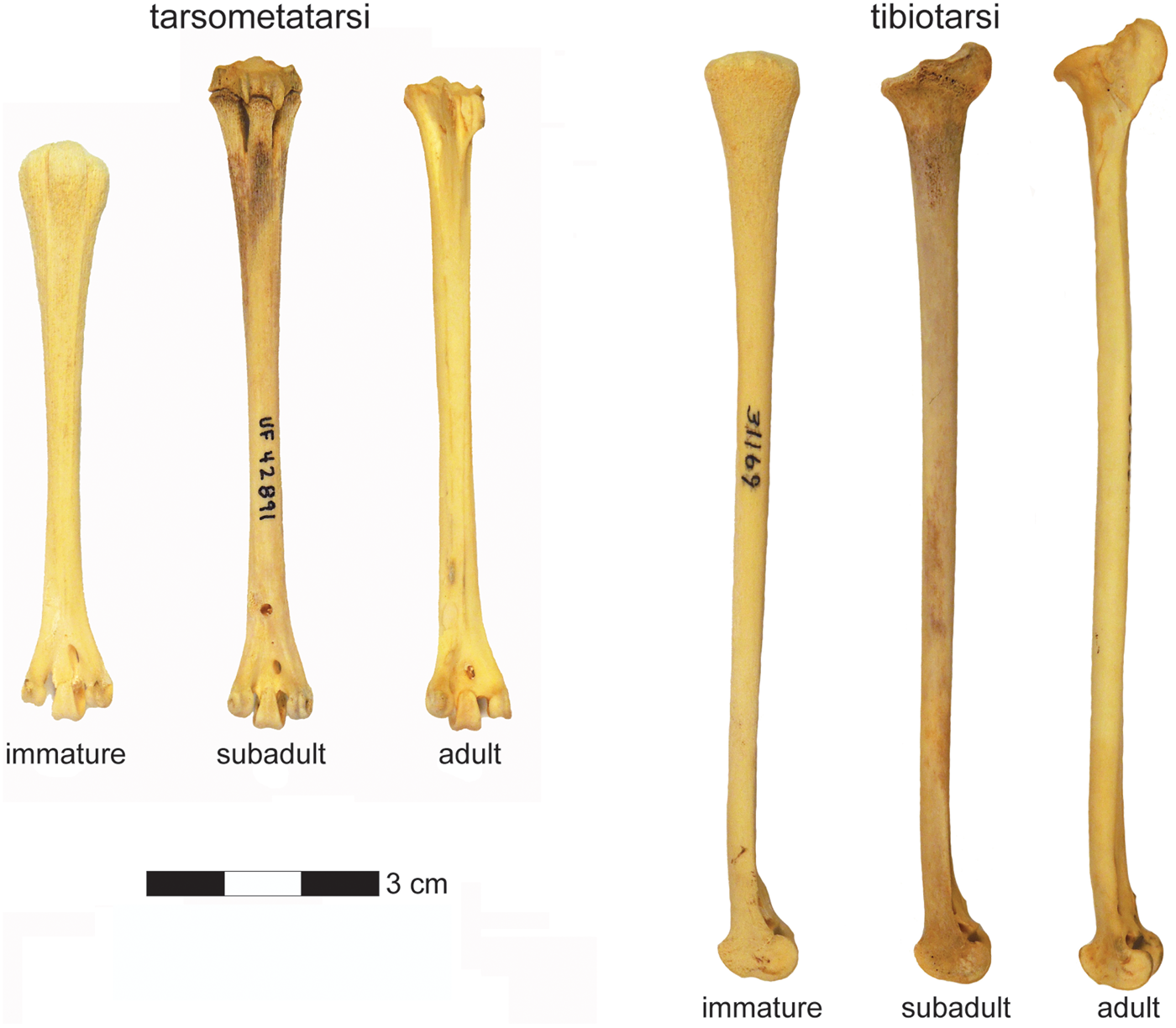
Of the total 12 white ibises in Feature 25, nine were determined to be juveniles based on the presence of underdeveloped and unfused elements. Of the 11 ibises in Feature 44, eight were juveniles. This designation is used as it relates to the immaturity of the bones and should not be confused with the definition used by ornithologists, which would refer to individuals who have yet to display adult plumage (Serjeantson Reference Serjeantson1998, 27). In birds, body growth occurs over a very short time span and bones reach maturity before a bird exhibits adult plumage (Serjeantson Reference Serjeantson1998, 27; von den Driesch et al. Reference von den Driesch, Kessler, Steinmann, Berteaux and Peters2005, 215). The term juvenile, as used here, refers to nestling young to distinguish them from fledgling subadults. These elements represent the life stage of young individuals who have yet to leave the nest as opposed to those ibises that are not yet adult but fully independent. In the Cambridge Manual Birds, Dale Serjeantson (Reference Serjeantson2009, 47) writes that the fusion stage of bird elements is ‘the best source of evidence for age at death’. Serjeantson (Reference Serjeantson2009, 45–6) draws on zooarchaeological studies on the fusion and porosity of bird bone (e.g. Avery & Underhill Reference Avery and Underhill1986; Gotfredsen Reference Gotfredsen1997; Lefèvre Reference Lefèvre1997; von den Driesch et al. Reference von den Driesch, Kessler, Steinmann, Berteaux and Peters2005) to define four age categories: Very Young (hatchling), Immature (nestling), Subadult (fledgling) and Adult. Because not all elements fuse, and the rates of fusion differ between elements, the tibiotarsi and tarsometatarsi are recommended elements for making age determinations. According to Serjeantson (Reference Serjeantson2009, 46), the bones of Immature (nestling) birds are porous and unfused at relevant locations whereas the bones of fledgling subadults ‘are of adult length but still have some evidence of porosity and, where relevant, a visible fusion line’ (see Serjeantson Reference Serjeantson1998, 27–9, for further details on avian skeletal ossification).
Figure 4 shows tarsometatarsi and tibiotarsi from white ibis comparative specimens at the latter three life stages proposed by Serjeantson (Reference Serjeantson2009, 46). These examples show that although the epiphyses are not completely fused, Subadult morphology closely resembles the Adult examples. In contrast, the Immature examples demonstrate a markedly underdeveloped morphology and higher porosity relative to more mature specimens. Serjeantson (Reference Serjeantson2009) suggests that this distinguishing characteristic seems to be most notable in the proximal portions of the tibiotarsus and tarsometatarsus. As observed on comparative specimens, this holds true for the white ibis. In the Immature specimens, the proximal epiphyses of the elements are not attached at this stage of bone development.
Examples of Immature, Subadult and Adult tarsometatarsi and tibiotarsi of white ibises (Eudocimus albus) from the comparative collection of the Florida Museum of Natural History.

Owing to the morphological characteristics unique to different developmental stages of the white ibis along with robust data on white ibis breeding ecology in the immediate vicinity (see below), long bone elements are useful in providing an estimate for the timing of events associated with the capture of these birds and their deposition into pits at Shell Mound. The Cedar Keys of Florida are well known as a major colonial nesting site for the white ibis with consistent annual survey data stretching back to the 1950s (Frederick & Ogden Reference Frederick and Ogden1997). Common in both fresh- and salt-water wetlands of the lower Southeast, white ibises gather at inland bodies of water and on coastal islands at breeding sites that offer abundant foraging resources and safety from predators (Frederick et al. Reference Frederick, Bildstein, Fleury and Ogden1996, 208; Rudegeair Reference Rudegeair1975). Due to their conspicuous and social nesting habits, white ibises are amenable to sight surveys that have provided useful population data. Colonial nesters, these birds aggregate in the spring at Cedar Key nesting sites in the several to tens of thousands, and as many as 100,000 breeding pairs have been recorded in one year (Frederick et al. Reference Frederick, Bildstein, Fleury and Ogden1996).
White ibis breeding pairs in the Cedar Keys have experienced wide swings in population size. For example, over a two-year period in the mid 1970s the number of mating pairs at Cedar Key increased from 20,000 to 100,000 (Frederick & Ogden Reference Frederick and Ogden1997). White ibises are classified as nomadic due to low rates of breeding-site fidelity and have been noted for their ability to move in order to adapt to ecological changes (Kushlan Reference Kushlan1979; Reference Kushlan1986). In the Everglades, Frederick and Ogden (Reference Frederick and Ogden1997, 318) found that ibises are capable of rapidly changing breeding locations, with ‘large colonies disbanding and new ones forming, often in the space of 1 or 2 years’. In a study of seven different species of waterbirds, white ibises had the lowest site fidelity, although they averaged the shortest distance between nesting sites over consecutive years (Melvin et al. Reference Melvin, Gawlik and Scharff1999, 413–14). So while they may be classified as ‘nomads’, these wetland wanderers tend to remain in the same general area year after year as long as adequate foraging habitat is available (Kushlan Reference Kushlan1986). Given notable long-range studies that have been conducted on white ibis breeding in a single location (Bildstein Reference Bildstein1993; Rudegeair Reference Rudegeair1975), it would seem that the nomad epithet speaks to the bird's ability to move when conditions become unfavourable, rather than a general tendency. As recently as 2015, the long-lived nesting colony on Seahorse Key was abandoned for reasons still unknown, but many of the evacuees relocated to Snake Key, only 3 km to the east (Swirko Reference Swirko2018).
Seahorse Key, located 12 km south of Shell Mound, has been the site of a multi-year research study on white ibis breeding ecology. Over four consecutive years, Thomas Rudegeair (Reference Rudegeair1975) observed and documented every stage of white ibis breeding habits from the first arrival of birds on the island through independence of recently hatched young. Importantly for our study, these results showed consistency in the timing and duration of the white ibis breeding cycle in the Cedar Keys. As Rudegeair observed, the first birds arrive in mid March. Their first young usually hatch by the end of April. The developmental stages of white ibis young are accompanied by decreasing levels of parental dependence as they progress from helpless hatchlings to immature nestlings large enough to hop and fly awkwardly in short bursts around the nest, and then to subadults capable of flying and foraging on their own (Rudegeair Reference Rudegeair1975).
Once hatched, the young are fed by direct regurgitation and guarded by at least one parent for the first 10 days, when they are most vulnerable to falling from the nest and predatory attacks by other birds such as black-crowned night herons and fish crows (Rudegeair Reference Rudegeair1975, ix, 7). After about 10 days, the newly hatched young become increasingly mobile and by week four they have the limited ability of flight to hop about the surrounding branches and limbs of the tree canopy. Still, they do not venture out of the tree-tops, but rather roost outside the nest and wait for their returning parents to bring food (Rudegeair Reference Rudegeair1975, 77). White ibis juveniles were fully independent at six to seven weeks, and feedings from parents become much less frequent. The juveniles can now fly and follow their parents on short circular trips around the island after feedings. At Seahorse Key, Rudegeair (Reference Rudegeair1975, 80) observed seven-week-old juveniles leaving the tree-tops for the first time to walk about in flocks around the island foraging for small fish and fiddler crabs. The end of parenting was signalled when the juveniles followed a parent inland, never to return to the parents’ nest (Rudegeair Reference Rudegeair1975, 82). Given Rudegeair's (Reference Rudegeair1975) observed lengths of time for each period of the breeding season from pair forming of the parents to independence of the young, if white ibis breeding season began on Seahorse Key in mid March, then that year's young would be leaving the island about 100 days later, near the end of June.
Discussion
Developmental life stages of the white ibis, as well as other birds, are recognizable in archaeofauna through the porosity and fusion of skeletal elements and offer the best source of evidence for inferring the timing of a bird's age at death (Serjeantson Reference Serjeantson2009, 47). Of the white ibis elements from Shell Mound, most exhibit morphological characteristics similar to those described by Serjeantson (Reference Serjeantson2009, 46) for Immature (nestling) elements. Comparison of archaeological tibiotarsi and tarsometatarsi with modern specimens of different ages showed that many of these ancient elements were indeed less developed than Subadult (fledgling) individuals. Exhibiting morphological characteristics of greater bone porosity, underdeveloped proximal portions of the elements and completely detached epiphyses, these elements represent the life stage of juvenile individuals that have yet to leave the nest, as opposed to those ibises that are not yet adult but otherwise fully independent birds.
As Rudegeair's (Reference Rudegeair1975) data demonstrate, the white ibis breeding period lasts about 100 days from the time when the first males begin to populate the nesting site until the young birds are independent of their parents. Though not an exact calculation because of the variation of timing involved in nesting-site selection and mate pairing, as well as year-to-year variation in timing due to environmental factors, 100 days from early to mid March calculates to some time in mid to late June. This timing coincides with the summer solstice, occurring annually on 21 June. Given the morphological characteristics of the majority of white ibis bones recovered at Shell Mound, it would appear that nestling juveniles (‘Immatures’) were either preferred over adults, or more likely, their inability fully to fly made them easier targets for mass capture. Serjeantson (Reference Serjeantson1998, 24) has noted that ‘bird capture is most effective during breeding season’, as the resource is concentrated, conspicuous, and flightless young are easily apprehended.
Although little ethnohistoric evidence exists to suggest that white ibises were eaten by indigenous Floridians, the scarlet ibis (Eudocimus ruber), biologically similar to the white ibis in almost every way except for the colour of their feathers, was regarded as an important resource for the Tupinambá of coastal Brazil, who produced floor-length coats worn only by their chiefs from those brilliant red feathers (Antas et al. Reference Antas, Roth, Morrison, Frederick, Gonzalo Morales, Spaans and Luthin1990; Bildstein Reference Bildstein1993; Buono Reference Buono2007). Scarlet ibises were hunted for food as well, and as Antas et al. (Reference Antas, Roth, Morrison, Frederick, Gonzalo Morales, Spaans and Luthin1990, 34) note, ‘Breeding colonies of ibises were considered property of the tribe inhabiting the area, and many locations still bear the Indian name for Scarlet Ibis colony (Guara- plus –tiba or –tuba)’. During and well after colonial rule, the scarlet ibis populations on the northeastern South American coast were severely depleted by hunting for food and for the European feather and artificial flower trades. Dujardin (Reference Dujardin, Frederick, Gonzalo Morales, Spaans and Luthin1990, 112) recounts how in French Guiana, ‘breeding colonies were systematically raided by poachers for young; nesting trees were vigorously shaken, and the large young picked up from the ground’.
Given the similarities between these two closely related ibis species, the previous accounts speak to the potential edibility of white ibis and offer an example of a strategy for procuring juvenile ibises in large numbers. In Dujardin's (Reference Dujardin, Frederick, Gonzalo Morales, Spaans and Luthin1990, 112) account of scarlet ibis poaching in French Guiana, he writes that an estimated 90 per cent of the season's offspring were decimated through these annual colony raids. In early summer, fledgling young are nearing adult size yet are still underdeveloped, less mobile and perched precariously on their island tree-top roosts. Based on the reports of South American scarlet ibis poaching, it is not difficult to imagine white ibis colonies on the Cedar Keys being harvested in similar ways. Serjeantson (Reference Serjeantson1998, 29) writes that ‘there are obvious advantages in taking immature birds which reached a good size. The chicks are easily captured before they are fully fledged and the flesh is sweeter and more tender than that of adults’.
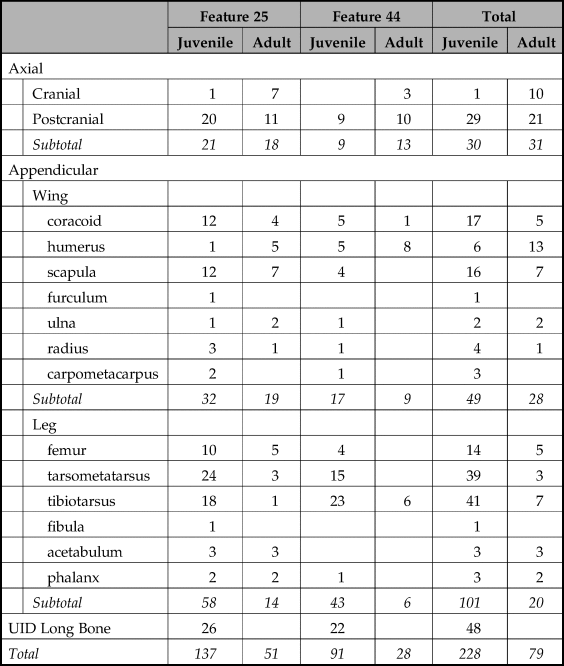
Judging from the distribution of bony elements of white ibises in Shell Mound pits, juveniles and adults may have been treated differently. Table 3 shows the breakdown of white ibis elements for juvenile and adult bone in Features 25 and 44. Beyond the overall higher frequency of juvenile elements over adult elements, the juvenile birds are represented by a disproportionately higher fraction of leg bones, notably tibiotarsi and tarsometatarsi. The results of a Chi-square test show that the distribution of axial, wing, and leg elements across these two age classes is non-random (Chi Sq. = 39.5768; p-value <0.00001; p <0.01). The distribution of adult bone mirrors roughly the distribution of elements of a complete ibis skeleton, but juvenile bones are biased toward leg elements. Whereas this may in part be the result of bias insofar as leg elements are good indicators of relative maturity, we hypothesize that juvenile and adult ibises were processed and/or deposited in pits following different protocols. Moreover, we are certain that juveniles were taken from rookeries, whereas adults could have been captured elsewhere.
Absolute frequency of White Ibis (Eudocimus albus) bone by age group and element in Features 25 and 44, Shell Mound (8LV42).

The white ibis rookeries on the offshore islands of the study area would have offered a prolific resource for summer solstice feasts at Shell Mound. If Seahorse Key was targeted for juvenile ibis procurement, Shell Mound provisioners would have travelled about 12 km one way by watercraft. The other locus of recent rookeries, Snake Key, was another 3 km farther away. Although no direct archaeological link has been made between the offshore islands and Shell Mound, the presence of two other offshore species in Shell Mound pits—sea turtle and lightning whelk—lends credence to the assertion that people were in fact routinely travelling to these islands.
Conclusion
Juvenile white ibis bones deposited in large pits dating from 400–650 ad at Shell Mound offer a rare opportunity to situate the timing and siting of ritual feasting, arguably a matter of world renewal. A consistent pattern of immature bone development among ibis elements provides a strong basis for inferring that these birds were collected in mid to late June. Although they are not as time-specific as those of ibises, the bones of fish and marine turtles from these same pits corroborate the summer timing of feasts involving not only large pit features, but also large pots, oyster mariculture and the use of tidal fish traps (Sassaman et al. Reference Sassaman, Blessing and Goodwin2019b). Given the estimated timing of these events, we infer further that they were synchronised to the summer solstice, the solar standstill of the longest day of the year.
Feasting was common at first-millennium civic-ceremonial centres in the American southeast, typically sited on the platform mounds of centres that included mortuary mounds (Knight Reference Knight, Dietler and Hayden2001). The timing of feasting at these centres is ambiguous, but Knight (Reference Knight, Dietler and Hayden2001) draws a comparison to the world-renewal busk ceremonies of later Mississippian societies, summer events set around the first harvest of corn. Although Middle Woodland societies were not agricultural, world-renewal rituals timed to the summer solstice are a possible precedence for busk ceremonialism and may have served then, as they did in Mississippian times, to reinforce communal relations in a society with latent potential for social inequality (e.g. Pluckhahn & Thompson Reference Pluckhahn and Thompson2018). Notably, Knight (Reference Knight, Dietler and Hayden2001) sees a distinction in Middle Woodland rituality between the world-renewal communalism of feasting and other rituals, such as mortuary rites, imbued with such latency.
Evidence for summer solstice feasts at Shell Mound adds unprecedented detail to rituality at civic-ceremonial centres. However, given the lack of comparable evidence at other centres in the region, we are reluctant to generalize much beyond this particular site and its events. That Shell Mound was chosen as a location for summer solstice feasts was arguably predetermined by the history of prior land use, especially the siting of cemeteries on the arms of parabolic dunes. As mentioned earlier and detailed elsewhere (Sassaman Reference Sassaman, Roddick and Stahl2016; Sassaman et al. Reference Sassaman, Blessing and Goodwin2019b), dunes in the region were aligned to solstice angles. Their long, open arms pointed to the winter solstice set (~240°) while their reciprocal at the higher, closed end (head) pointed to summer solstice rise (~60°), the prevailing direction of dune formation. Cemeteries were emplaced at the ends of dunes in the area since at least the Late Archaic period (c. 2500 bc) and one associated with Shell Mound (Palmetto Mound) was initiated no later than 400 bc (Donop Reference Donop2017). Relative sea level in the region fluctuated but generally rose since the Late Archaic period, inducing coastal communities to relocate cemeteries and settlements landward as shorelines retreated. Given that the overall trend for shoreline retreat was in the direction of the summer solstice rise, dunes in the area may have materialized not only the pathways of annual solar migrations, but also long-term trends of environmental change, in this case the encroachment of water over land.
It may seem counterintuitive that the summer solstice would signal a moment of world renewal because days grow increasingly shorter for six months after this standstill. However, given that the Lower World was considered to be the realm of future time (Hudson Reference Hudson1976, 127–8), increasingly longer nights meant that the sun spent more and more time each day being replenished. To the extent that water was a portal into the Lower World, the long-term encroachment of sea may have been regarded as a world in need of regular rebalancing.
The role of white ibises in this emerging model of world renewal is uncertain, but we doubt that juvenile ibises were collected simply because they were abundant. We reiterate that avian bone in general and white ibis bone in particular is sparse at Middle Woodland sites in the region. Persons provisioning feasts at Shell Mound had to travel to a rookery to collect immature birds, so ibises were targeted resources, as were others (Sassaman et al. Reference Sassaman, Blessing and Goodwin2019b). Rookeries in recent decades are at least 12 km from Shell Mound. Whereas this distance is hardly prohibitive, the assumption of coastal subsistence studies in the region is that procurement was highly localized. The pit fill of Shell Mound challenges this assumption. The juvenile white ibis bones are especially insightful for revealing when targeted procurement took place. We may also come to understand that the ibises were regarded as agents of world renewal in their annual reproductive cycle, marked as it was by aggregations of birds in the thousands.
How the remains of ibises and other waterbirds were treated by those feasting at Shell Mound is unknown. Birds were likely collected for reasons other than eating. As Serjeantson (Reference Serjeantson2009, 184) notes, ‘there is hardly a community in the world which has not used feathers and bird skins for decoration’. Bird feathers used as clothing, decoration, and as ritual paraphernalia items have been widely recorded in ethnographic and ethnohistoric accounts from around the world as well as in ethnohistoric accounts of southeastern indigenous peoples of the colonial period (Bartram Reference Bartram1791; Hudson Reference Hudson1976; Jackson & Scott Reference Jackson and Scott2003; Kelly & Kelly Reference Kelly and Kelly2007; Russell Reference Russell2012, 140; Serjeantson Reference Serjeantson2009). Kelly and Kelly (Reference Kelly and Kelly2007) have noted that the bones of certain birds may have held more importance symbolically and ritually than economically. Likewise, Jackson and Scott (Reference Jackson and Scott2003) argue that in relatively unusual faunal assemblages such as the mound-top pit contexts of Moundville, when the wing elements of birds are present, the possibility should be considered that these are inclusions of ritual paraphernalia rather than food. Some specimens of the bird assemblage from Shell Mound may very well have been part of the paraphernalia rather than the meal, as Kelly and Kelly have suggested. Notwithstanding analytical bias in our enumeration of juvenile and adult ibises, protocols for processing and depositing these birds were possibly age dependent. Other birds identified from Shell Mound have limited skeletal representation, such as ducks, which are represented only by vertebrae, or the roseate spoonbill, great blue heron, crow and herring gull, which are represented only by wing elements.
Birds may have been collected simply for their parts rather than for food, but judging from historical accounts of ibis being eaten by westerners and non-westerners alike, ibises from pit features may very well have fed people gathered at Shell Mound. Bone elements of ibises show no evidence of butchering or burning, although most birds can be dressed with the minimal use of cutting implements and many cooking methods would leave little recognizable trace of heat alteration (Serjeantson Reference Serjeantson2009, 163; Steadman et al. Reference Steadman, Plourde and Burley2002). The ritual value of this animal could have been in the eating. As noted by Jackson and Scott (Reference Jackson and Scott1995, 106–7), ‘the symbolism of certain animals extended beyond regalia to food consumption’, through the belief that eating certain animals may have imbued the consumer with the properties or qualities of the consumed. Did consuming ibises, an Upper World agent, help to counter-balance an encroaching Lower World?
The greater cultural milieu of Middle Woodland feasting is rife in bird imagery and the residues of ritual practice involving bird parts (Milanich et al. Reference Milanich, Cordell, Knight, Kohler and Sigler-Lavelle1997; Pluckhahn Reference Pluckhahn and Alt2010). In this greater context we find ample support for the inference that humans and birds experienced a variety of relationships beyond predator and prey. We can only speculate on the sorts of relations white ibises and other waterbirds practised with those who gathered at Shell Mound. Although we cannot be certain how people interacted with white ibises, elements of juvenile birds enable us to infer with confidence when events involving white ibises and humans resulted in the deposition of bone in pits. Similarly, the history and geomorphology of Shell Mound and vicinity informs on why these activities were situated in this particular place. It is worth noting that ritual activity during summer solstice events has not been documented at any other civic-ceremonial centre in the region. At the Roberts Island site just downriver from Crystal River, oyster shell used to construct a platform mound was harvested during winter months (Pluckhahn & Thompson Reference Pluckhahn and Thompson2018). The same appears to be the case for a civic-ceremonial centre known as Garden Patch, north of Shell Mound (Wallis et al. Reference Wallis, McFadden and Singleton2015; Neill J. Wallis pers. comm., 2019), which has also produced evidence for migratory birds that were likely taken in winter (Kohler Reference Kohler1975).
Rather than viewing the winter timing of ritual at other centres as contradictory to the evidence for summer solstice feasts at Shell Mound, we suggest that the Middle Woodland landscape of cemeteries and gathering places was structured by a ritual circuit through which people and objects travelled over the course of the year to conduct rituals that were synchronized with and recapitulated the solar cycle and its materialization on earth. In this regard, it may not be coincidental that the centres of Crystal River and Roberts Island occupy a watercourse that is the solstice reciprocal of parabolic dunes of the Shell Mound locality. A ritual circuit that sited winter solstice (mortuary) and summer solstice (world renewal) events at different locations not only reinforces the distinction Knight (Reference Knight, Dietler and Hayden2001) notes for Middle Woodland rituality, but also accounts for the geographical displacement of mortuary pottery that is well documented by geochemical sourcing (e.g. Wallis Reference Wallis2011; Wallis et al. Reference Wallis, Pluckhahn and Glascock2016). Summer solstice feasts at Shell Mound are perhaps only part of a differentiated but integrated ritual circuit (e.g. Bernardini Reference Bernardini2004; Howey & O'Shea Reference Howey and O'Shea2006). Additional research on ritual interactions among birds and other animals, plants, objects and substances holds promise for evaluating this possibility, but it will require a multi-sited perspective with attention to the relationship between celestial cycles and the materialization of such movements in physical features on earth, both ’natural’ (e.g. dunes, rivers) and constructed (e.g. mounds, cemeteries).
Acknowledgements
Excavations at Shell Mound were conducted under permit with the United States Fish and Wildlife Service (USFWS). The authors thank USFWS Archaeologist Richard Kanaski and Refuge Managers Andrew Gude and Larry Woodward for their support of our efforts. Funding for this research was provided by the Hyatt and Cici Brown Endowment for Florida Archaeology, Department of Anthropology, University of Florida. We are grateful to staff of the Environmental Archaeology unit of the Florida Museum of Natural History for access to their comparative collection. The authors thank Neill Wallis for sharing information about Garden Patch and for comments on a draft of this paper. We are also grateful for the comments of Ed Jackson and one anonymous reviewer in improving the clarity and impact of this paper.