The Semitic relative is enjoying a resurgence in interest in recent years, with several works partially or fully dedicated to its history and syntax (for example, Deutscher Reference Deutscher2001, Reference Deutscher, Givón and Shibatani2009; Huehnergard Reference Huehnergard, Hurvitz and Fassberg2006; Hasselbach Reference Hasselbach2007; Watson and Retsö Reference Watson and Retsö2009; Holmstedt Reference Holmstedt2016). These works join important earlier contributions on this topic including Ravn (Reference Ravn1941), Pennacchietti (Reference Pennacchietti1968) and Goldenberg (Reference Goldenberg1995). Among scholars interested in the historical origins of the relative sentence, there are a number of widely accepted assumptions, first and foremost that the Semitic relative marker is derived from a demonstrative. In this paper we will review the evidence supporting these assumptions and argue that the current analysis of the Semitic relative is a procrustean bed, into which the Semitic evidence does not fit comfortably.
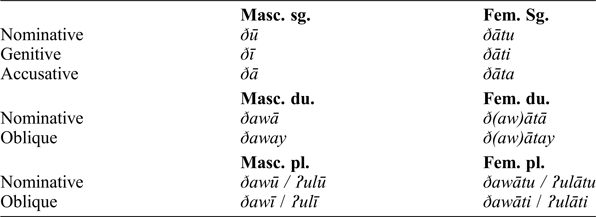
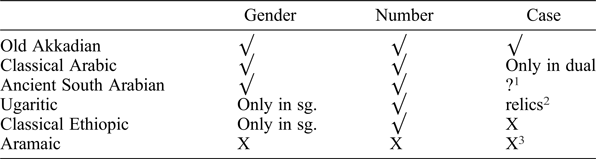
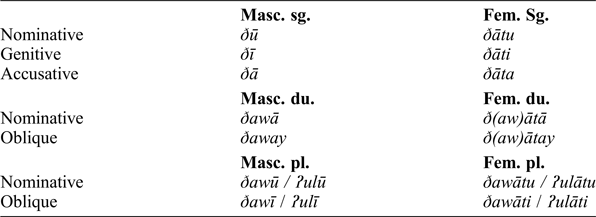
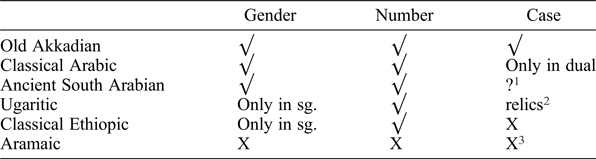
All Semitic languages use a relative marker as at least one strategy of relativization, and all branches show reflexes or relics of reflexes of a relative marker with an initial interdental fricative. The relative marker is also used as a head in genitive constructions, but for the sake of clarity we will refer to it here as a relative marker. The inflection of the relative marker is reconstructible on the basis of full or partial paradigms in a number of languages. Old Akkadian and Eblaite have the most complete paradigms, but partial paradigms are also found in Classical Arabic, Classical Ethiopic, Ugaritic and Ancient South Arabian (Huehnergard Reference Huehnergard, Hurvitz and Fassberg2006). See Table 1 for the reconstructed paradigm, and Table 2 for a representative sample of languages.
A reconstruction of the relative marker in Semitic (Huehnergard Reference Huehnergard, Hurvitz and Fassberg2006: 112).
A summary of the inflection of the pronoun in the extant Semitic languages
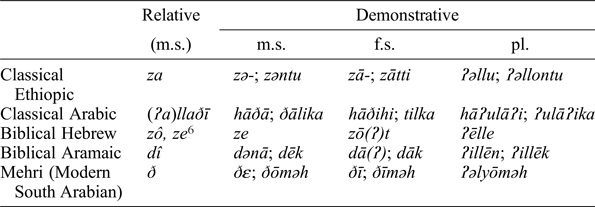
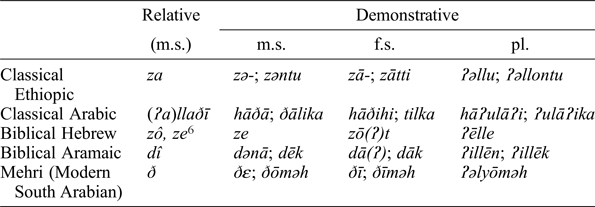
There is a broad consensus among Semitists that the relative marker was originally identical to the proximal demonstrative (Deutscher Reference Deutscher2001; Huehnergard Reference Huehnergard, Hurvitz and Fassberg2006; Hasselbach Reference Hasselbach2007). Such an assumption is based on the formal identity between the bases of the two in West Semitic, and on the wide attestation of the process Demonstrative > Relative in world languages (Heine and Kuteva Reference Heine and Kuteva2002: 106–7; Diessel Reference Diessel2009: 2).Footnote 4 A representative sample of the West Semitic demonstratives and relatives appears in Table 3.Footnote 5
Demonstratives in West Semitic
Syntactically, at least in some languages, both the relative and the demonstrative follow their head noun, as in the following pair of examples:
(1) Biblical Aramaic (Northwest Semitic)
a. qarn-āʔ dāʔ
horn-def dem.fs
‘This horn’ (Daniel 7: 8)
b. millǝt-āʔ dî-malk-āʔ šāʔēl
thing-def rel-king-def ask.ptcp.ms
‘The thing that the king requires’ (Daniel 2: 11)
(2) Biblical Hebrew (Canaanite; Northwest Semitic)
a. hinnē ʔĕlōhê-nû ze qiwwînû l-ô
here god.pl.cst-our rel hope.pf.1cp to-him
‘Here is our god in whom we trust’ (Isaiah 25: 9)
b. bən-ēnû ze sôrēr û-mōre
son-our dem.ms stubborn and-rebellious
‘This son of ours is stubborn and rebellious’ (Deuteronomy 21: 20)
The morphological similarity between the relative and the demonstratives in West Semitic certainly suggests a fairly straightforward reconstruction; and indeed Semitists tend to reconstruct both as if they are in fact one paradigm.
There are, however, a number of significant problems with the reconstruction of the relative marker, which, when taken together, make tracing its origin to the demonstrative highly unlikely. In what follows we will outline the main differences between the paradigms and argue that the order of development, if one existed, could not have been Demonstrative > Relative as is usually argued.
The relative marker in early Semitic was always a construct form, and thus was always specifically marked as the head of a relative sentence. Evidence for this comes primarily from the Old Akkadian and Eblaite paradigm, where the relative forms do not show the final mimation expected of independent forms (see examples 3 and 4 below), and Classical Ethiopic, where relative forms are marked with -a (see example 5 below), the typical marker of construct state in that language (Goldenberg Reference Goldenberg1992: 84; Kapeliuk Reference Kapeliuk, Lionel Bender, Takács and Appleyard2003: 220; Cohen Reference Cohen2008: 27–8).
(3) Old Akkadian (examples from Hasselbach Reference Hasselbach2005: 162–4; Kienast and Sommerfeld Reference Kienast and Sommerfeld1994: 298–301)
a. Sarru-kēn sar Kiš θū Enlil māhira(m) lā iddin-u-sum
Sargon king Kish rel.ms.nom Enlil rival.acc neg give.pret.3ms-subord-to.him
‘Sargon, king of Kish, to whom Enlil permitted no rival’
b. in santim θaliθtim θāti Enlil sarrūtam iddin-u-sum
in year.gen third.gen rel.fs.gen Enlil kingship.acc give.pret.3ms-subord- to.him
‘In the third year (in) which Enlil gave him the kingship’
(4) Eblaite (examples from Tonietti Reference Tonietti2005; Catagnoti Reference Catagnoti2012: 84)Footnote 7
a. ŠE šu (for /θū/) ú-wa-ì-da-am 6 AL6-GÁL
barley rel.ms.nom promise.pret.1cs.ventive be-present
‘The barley that I promised is available.’
b. na-se 11 na-se 11 PN šu-ti (for /θūti/) in [GN]
people people PN rel.mp.obl in GN
‘the people of PN who are in GN’
(5) Classical Ethiopic (West Semitic)
nəguś makwannən za-yəreʕʕəy-omu la-ḥəzb-əya ʔəsrāʔel
king judge rel-lead.impf.3ms-them to-people-my Israel
‘A king-judge who will lead my people Israel’ (Matthew 2: 6)
The construct state, however, is not a possible morphological state for pronouns in Semitic, including the demonstrative. In fact, without exception, no pronoun in any Semitic language is allowed to be in construct. Pronouns can only stand in apposition to nouns, or independently, or as post-clitics, and there is no evidence to suggest a different situation in the proto-language. Deriving a construct form from the demonstrative, therefore, seems unlikely.
Semantically, the functions of the relative marker do not overlap with those of the demonstrative; specifically, the relative marker has no deictic functions.Footnote 8 Furthermore, with the sole exception of the Classical Arabic relative ʔallaðī, which is an innovation (Huehnergard Reference Huehnergard and Al-Jallad2017: 22–3), the relative particle never takes any of the affixes that are commonly found on Semitic demonstratives (e.g. -n, -k, li-), even when the demonstratives in the same language do.Footnote 9 In short, the relative marker does not behave like a demonstrative syntactically, morphologically, or semantically.
There are two additional inconsistencies between West and East Semitic that require addressing. The first is the consonantal base of the relative marker, which is distinct in East Semitic and West Semitic. The relative marker in East Semitic shows clear reflexes of a voiceless interdental fricative /θ/, while West Semitic languages show clear reflexes of a voiced interdental fricative /ð/ with the same inflection and function. This is a well-known problem, which has remained unresolved even in the most complete reconstructions (Huehnergard Reference Huehnergard, Hurvitz and Fassberg2006; Hasselbach Reference Hasselbach2007). This mismatch is not a result of any known sound correspondence, as typically PS *ð > Akk. z, while PS *θ > WS θ (OSA, MSA, Ugaritic and Arabic), š (Canaanite), s (Ethiopic), or t (Aramaic).Footnote 10
The second inconsistency is the lack of a demonstrative in East Semitic with an etymological base similar to that of the relative marker. While West Semitic has a proximal demonstrative with an initial etymological interdental (*ðv̄-), East Semitic has a proximal demonstrative that is unrelated either to the West Semitic form or to the East Semitic relative, namely, *han-nī.Footnote 11 There is no evidence that East Semitic ever had a demonstrative with a base similar to that of the relative, though of course it could have been lost. In fact, all previous reconstructions of the proximal demonstrative to proto-Semitic are based on the East Semitic relative marker, not its proximal demonstrative (e.g. Hasselbach Reference Hasselbach2007: 20). Such a reconstruction privileges the West Semitic demonstrative and relies heavily on typological generalizations, but is not supported by internal evidence.
The lack of a demonstrative with an initial interdental in East Semitic and the syntactic behaviour of the relative marker strongly suggest that the relative marker is older than the demonstrative and that the proximal demonstrative with an initial interdental should not be reconstructed with this function to proto-Semitic. The Akkadian situation, where the relative and each of the demonstratives are based on different roots, is likely closer to proto-Semitic. The question, then, is how to derive the relative and demonstrative in West Semitic.
If the East and West Semitic relatives are related, despite the difference in voicing, then the demonstrative in West Semitic is most likely a derivation by extension from the relative, based on the latter's function as the marker of adnominalization par exellence (see example 9 below). This must have happened in proto-West Semitic, since all West Semitic sub-branches have a demonstrative and a relative with the same base. A scenario of syncretism, namely the falling together of the demonstrative and relative, is partially supported by the inflectional bases of the relative and demonstratives. In Akkadian and in most West Semitic languages, the relative marker has a consistent base throughout its paradigm. Furthermore, the only fully inflected, and therefore more archaic, paradigms attested (Classical Arabic, Eblaite and Old Akkadian) show a single base throughout the paradigm of the relative marker. (This is also the case in Ugaritic, which does not have a complete paradigm.) Additionally, other demonstratives (e.g. the distal demonstrative *su) all have a single base throughout the paradigm. But in some West Semitic languages, namely Ancient South Arabian, Classical Ethiopic, Modern South Arabian and Classical Arabic (in a secondary paradigm), a two-base system is attested: a singular in *ðv̄ and a plural in *ʔvl (see Table 4).
Singular and plural bases of the relative marker

In Huehnergard (Reference Huehnergard, Hurvitz and Fassberg2006: 112–3) a single base is reconstructed for the relative on the basis of the Ugaritic plural form dt /dūtu/, where the final -t is similar to the Old Akkadian plural θūt(i), and cannot be explained as a result of analogy or extension, since there is no other form in Ugaritic with such a plural. Hasselbach (Reference Hasselbach2007: 19–20), on the other hand, argues for an original two-base paradigm similar to Ancient South Arabian, arguing that the Arabic plurals with *ð- are secondary,Footnote 12 and that since the relative is derived from the proximal demonstrative, which in West Semitic does have a two-base paradigm, it too should have a two-base paradigm.
There are two objections to Hasselbach's reconstruction. First, in both branches of Semitic, *ʔvl is primarily a demonstrative base, but only in one of the branches is *ðv̄ also a demonstrative and in even fewer languages is *ʔvl also a relative. Second, the languages with relative plural *ʔvl belong to a fairly well-defined group. All of the West Semitic languages with a two-base system – Ethiopic, Modern South Arabian, Ancient South Arabian, and some dialects of Arabic – are located in the Arabian Peninsula or across the Red Sea and are known to have had early contact with each other. That these four sub-branches form a Sprachbund was already suggested in Huehnergard and Rubin (Reference Huehnergard, Rubin and Weninger2011: 271–4) on the basis of several features: *p > f, internal plurals, L-stem and the levelling of -k in the first and second persons of the suffix conjugation. To these we can now add the two-base relative paradigm, with a singular based on *ð and a plural based on *ʔvl, a feature that is not attested outside this group. If this is correct, the evidence of these languages does not constitute good grounds for suggesting a two-base relative for proto-Semitic, or even for proto-West Semitic. The evidence, in other words, suggests that the relative had a single base.
We therefore prefer to reconstruct a relative marker with a single base, namely *ðv̄. The common Semitic anaphoric/distal pronoun also exhibits a single base, *sv(ʔ) (Huehnergard and Pat-El Reference Huehnergard and Pat-El2012). We believe that two other Semitic demonstratives are also to be reconstructed, both with single bases: a proximal demonstrative with base *hanni- and a remote/distal demonstrative with base *ʔvl(l)-.Footnote 13 Thus, proto-Semitic would have exhibited a three-way contrast in deixis, as in Babylonian Akkadian, which has anaphoric distal šū, proximal (h)anni-, and remote/distal (ʔ)ulli-. East Semitic also exhibits another demonstrative base, ammi-, found in Assyrian Akkadian and (once) in Eblaite.Footnote 14 This is probably an East Semitic innovation, which was subsequently lost in Babylonian.Footnote 15
In West Semitic, the proximal demonstrative *hanni- was replaced by a new demonstrative that was based on the relative *ðv̄; then, in most of the West Semitic languages, the new demonstrative *ðv̄- and the demonstrative *ʔvl- merged into a single paradigm, with *ðv̄- used as the base of singular forms and *ʔvl- used as the base of plural forms.Footnote 16 This mixed paradigm is probably due to a weakening of the original remote aspect of *ʔvl- because of competition with the use of the anaphoric pronoun as a remote demonstrative.
The date of this innovation is unclear. The mixed paradigm is attested in all West Semitic languages, with the exception of a number of modern languages, which are likely to have generalized one of the variants to the entire paradigm. Among the Ethio-Semitic languages, Tigre has only a reflex of *ʔvl (ms ʔəlli, fs ʔəlla, mp ʔəllom, fs ʔəllan), while Tigrinya and Amharic show levelling of a reflex of *ðv̄-. It is possible that Tigre reflects the original paradigm, and is therefore a retention, but given the Amharic and Tigrinya paradigms and the expected two-base paradigm in Classical Ethiopic, we find this less likely. Some dialects of Arabic, primarily in North Africa, also show levelling of *ðv̄- to the plural, for example, Tunis haðuma (m.p.) and Muslim Tripoli hāðūma (m.p.) (Magidow Reference Magidow2016). It is therefore more economical to assume that the two-base paradigm for the proximal demonstrative is original and that some branches generalized one form. If this is correct, then the two-base paradigm of the proximal demonstrative is a West Semitic innovation.
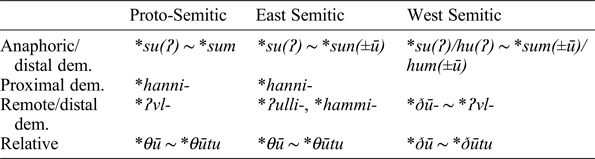
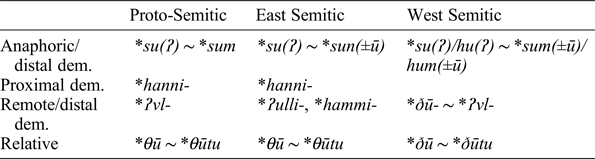
This scenario still does not account for the sound difference between East and West Semitic in the relative base. One possible explanation, although ad hoc and thus rather weak, is that once the new demonstrative was derived in proto-West Semitic, it assumed an absolute form with final mimation like other demonstratives (*θv̄+m), creating an environment which caused the voiceless interdental fricative to become voiced in partial assimilation to the final voiced nasal (> *ðv̄m). A possible reflection of this can be found in Sabaic, where the demonstratives show final nunation (ms ðn, mp. ʔln), while the relative pronouns lack it (ms. ð, mp. ʔl). Speakers could, then, have generalized the consonant to the relative. This proposed explanation is independent of our main point in this paper, but if it is correct, then East Semitic reflects the original phonology, morphology and distribution of the relative marker. Table 5 summarizes our reconstruction.
A reconstruction of the relative and demonstrative in Semitic and its main branches
Given how crucial typological literature on the topic has been for the traditional view (see n. 4 above), it is necessary to comment briefly on how our analysis interacts with typological generalizations before we move on. Cross-linguistically, relative pronouns develop primarily from demonstratives (e.g. Heine and Kuteva Reference Heine and Kuteva2002: 113–5; although see Hendery Reference Hendery2012: ch. 2 for a more complex picture). In addition, demonstratives are described as linguistic primes, with almost no known historical sources (Diessel Reference Diessel2006). Diachronic typology is, however, not a fixed system; it is, and should be, open to revisions, when new evidence is presented. The absolutist approach, which rejects the reconstruction of unique phenomena, has not been adopted by most typologists; rather, the theory is driven by accounting for all the evidence.Footnote 17 In other words, one should not avoid reconstructing typologically rare constructions if the evidence supports such a reconstruction; likewise, we should not adhere to an implausible analysis that lacks internal evidence simply because it is typologically common.
What is the origin of the relative marker then? It is typically described as a pronoun and is listed among other pronominal elements in grammars of Semitic languages. Given the syntactic behaviour of the relative marker, however, it is unlikely that it is a pronoun. Rather, the relative marker shares its syntax and morphology with adjectives. In Semitic, the inflection of adjectives is similar to that of demonstratives, as is their syntactic positioning after their heads, but unlike demonstratives, adjectives can assume construct forms before other elements while still functioning as adnominal modifiers. In such constructions, adjectives are in apposition to their head nouns, and agree with them in all their attributes with the notable exception of state (that is, the head is in absolute form, unlike its modifier). This is not possible for demonstratives and other pronouns. See the following examples, where the head noun is followed by a complex adnominal modifier whose head, an adjective, is in construct.Footnote 18
(6) Biblical Hebrew
a. ʕam qəšē ʕōrep
people.ms.abs hard.ms.cst nape
‘a people hard of neck’ = ‘a stubborn people’ (Exodus 32: 9)
b. ʔiššā yǝpat marʔe
woman.fs.abs beautiful.fs.cst appearance
‘a woman beautiful of appearance’ = ‘a beautiful woman’ (Genesis 12: 11)
c. ʔănāšîm mārê nepeš
people.mp.abs bitter.mp.cst soul
‘people bitter of soul’ = ‘angry people’ (Judges 18: 25)
(7) Akkadian
a. nišū ṣalmāt qaqqadi
people.pl black.pl.cst head.gen
‘people black of head’ = ‘the black-headed people (humanity)’
(8) Classical Ethiopic
a. bǝʔsit ṭabbāba lǝbb
woman wise.fem.cst heart
‘a woman wise of heart’ = ‘a skilful woman’ (Exodus 35: 25)
We can, in fact, reconstruct to the proto-language both relative markers and adjectives as having identical morphology and syntax, as is shown in example 9 below:
(9) Adnominal attributes:
Adjective: *ʔimm-u-m ṭāb-at-u yad-ayna
mother-nom-indep good-fs-nom.cst hand-pl.obl
‘a skilful mother’
Relative: *ʔimm-um θ-āt-u nubarrik-u-sā̆
mother-nom-indep rel-fs-nom.cst bless.1cs-subord-her
‘a mother whom we blessed’
Synchronically, the relative marker is semantically empty. This does not mean that it was not originally an adjective. Lexemes may be bleached once they become grammaticalized. Such bleached lexemes are found in several Semitic languages, and it is usually possible to reconstruct their semantics on the basis of cognate material.Footnote 19 That is, however, not always the case; cf. the Aramaeo-Canaanite direct object marker *ʔayāt (Hebrew ʔōt-, Syriac yāt), whose root (√ʔyt) and pattern can be reconstructed, but not its original semantics (Wilson-Wright Reference Wilson-Wright2016).Footnote 20
The relative marker lost most or all of its inflectional morphology in all branches that retained it. Of the modern languages that still use the original marker – Neo-Aramaic (d/t-), Ethio-Semitic (Amharic yä-, Tigrinya zə, Harari zi), and North African Arabic dialects (ð-) – none shows any inflection. Even the ancient languages lost or significantly reduced the inflection of the relative marker during their attested history. In Akkadian, for example, already Old Babylonian and Old Assyrian show a single form, ša, whereas the demonstratives did not.Footnote 21 In addition, in West Semitic the associated demonstrative did not lose its inflection.
Deutscher (Reference Deutscher2001) attempts to explain the loss of inflection on the Akkadian relative in typological perspective. Noting the typological rarity of the Akkadian (and Semitic) relative syntax, Deutscher claims that the case on the relative not only fails to serve “any useful purpose”, but is also “counter-productive” because the relative does not indicate the role of the head noun in the relative clause (p. 408). According to Deutscher, the relative marker belongs syntactically with the relative sentence, but its case marks it as belonging to the main sentence. Deutscher further argues that since the relative almost always follows its head noun, the case on the relative marker is essentially redundant. The disappearance of the inflection, Deutscher suggests, is therefore not surprising as it burdened linguistic processing; it is the rise of such a marker that requires explanation (p. 409).
There are a number of problems with this explanation. First, in the Semitic languages, any appositional post-nominal attribute carries morphology that matches its head noun. The relative marker identifies as attributes constituents that cannot carry appositional morphology, namely sentences, nouns and prepositional phrases (Pat-El and Treiger Reference Pat-El and Treiger2008). Since these constituents cannot be marked morphologically as appositional, they require an external carrier of such morphology. As (9) above shows, the relative marker behaves exactly like an adjective, both morphologically and syntactically. Thus, the argument that the case on the relative marker is redundant should also extend to adjectives and demonstratives, and yet both retain their full inflection in Akkadian for over a millennium after the relative marker lost its inflection. In fact, the inflection of the relative is expected and regular.
Second, Deutscher argues that the relative marker and the resumptive pronoun are contradictory, because they reflect different case assignment. This is, however, a problem only if we assume that the relative and the resumptive pronoun have the same function. But they do not: the relative marker marks the boundary of an adnominal modifier, while the resumptive pronoun marks the role of the head noun in the relative sentence. These functions have not changed even in languages that lost inflection on the relative marker.
The inflectional morphology of attributive markers indicates their appositional status in relation to their head noun. Given that there is another type of relationship between head nouns and their modifier, namely construct, inflectional morphology serves a rather important role. In languages where case was lost, the difference between construct and appositional attributes sometimes becomes blurred. For example, in Modern Arabic dialects, adjectives are sometimes marked as dependent on their head noun (see example 10). Similarly, in Biblical Hebrew relatives are sometimes marked as dependent on their head noun, whereas semantically they should be appositional; compare example 11a, where the head noun is construct, to example 11b where it is not.
(10) Arabic (Central Semitic)
a. bi-mayy-at il-bērdi
in-water.fs-cst def-cold.fs
‘In the cold water’ (Anatolian, Procházka Reference Procházka2002)
b. qōndar-t el-lexxi
shoe.fs-cst def-other.fs
‘The other shoe’ (Christian Baghdadi, Blanc Reference Blanc1964)
(11) Biblical Hebrew (Northwest Semitic)
a. bi-mqôm ʔăšer yihyê ššām ʔădōn-î ham-melek
in-place.cst rel be.impf.3ms there master-my def-king
‘In the place where my lord the king is’ (2Sam. 15: 21)
b. ham-māqôm ʔăšer hāyā šām ʔohŏl-ô
def-place.abs rel be.pf.3ms there tent-his
‘The place where his tent was’ (Gen. 13: 3)
We suggest that the Akkadian relative marker lost inflection not as a result of cognitive processing, but rather because of internal changes in Akkadian phonology. In proto-Semitic, construct forms were fully declined (as they are in Classical Arabic and in Ugaritic, for example). In Old Akkadian, construct forms are still partly declined: nom.-acc. ḫarrān sarrim vs. gen. ʔin ḫarrāni sarrim ‘(in) the king's road’. In Akkadian, after the Old Akkadian period, the general loss of final short vowels left most construct forms unmarked for case; that is, proto-Akkadian *ḫarrānu/i/a sarrim ‘king's road’ became ḫarrān šarrim for all three cases. In words that had final long vowels in the construct, such as *ʔabū/ī/ā sarrim ‘king's father’, one of the forms was generalized for all three cases, as in abī šarrim. The relative marker, also a construct form, underwent the same process of generalization, resulting in the single form ša (originally *θā). It is this same process of generalization, following the general loss of case vowels, that results, for example, in the single form *ðī > dī for the relative marker in Aramaic, and *ðū > zû in Hebrew (originally the genitive and the nominative, respectively, vs. the accusative ša in Akkadian). In short both the rise and fall of the relative marker's inflection and agreement pattern are typical of Semitic and indeed attested in the family.
Summary and conclusions
The hypothesis that the Semitic relative is derived from the demonstrative pronoun has been taken as a fact by most Semitists. In this paper we have attempted to show that there is no evidence that the direction of borrowing is from demonstrative to relative; in fact, the reverse is much more likely. Given that East Semitic has no evidence of a demonstrative with initial interdental, but only a relative marker, and given the distributionally distinct syntax of the relative marker and demonstrative, it seems more likely that the relative marker is proto-Semitic, while the demonstrative should only be reconstructed to proto-West Semitic. The evidence, we argue, also aligns well with an original three-way demonstrative system: proximal, remote and distal, a system that was simplified to varying degrees in all attested branches. We have outlined a possible explanation for the typical West Semitic mixed proximal demonstrative paradigm, and the Arabian Sprachbund relative mixed paradigm. Finally, we have suggested a scenario to account for the difference in voicing between East Semitic and West Semitic, which can only work if we assume that West Semitic derived its demonstrative from the relative, but not vice versa.