Regret is a fundamental element of decision making. People frequently experience regret in almost all areas of life that require decisions, including consumption (Simonson Reference Simonson1992), gambling (Ritov Reference Ritov1996), and apologizing (Zeelenberg et al. Reference Zeelenberg, van Dijk, Van der Pligt, Manstead, Van Empelen and Reinderman1998). It is considered to be “an aversive, cognitive emotion that people are motivated to regulate in order to maximize outcomes in the short term and learn maximizing them in the long run” (Pieters and Zeelenberg Reference Pieters and Zeelenberg2007, 29). As such, it can be used to do immediate psychological damage control as well as to induce longer-term learning. Though regret in everyday decisions has been extensively examined, little attention has been paid to regret in political choices, such as in voting. There is perhaps good reason for this lacuna. Classic democratic theory holds that citizens choose the party or candidate whose issue stances most closely resemble their own (Downs Reference Downs1957). If people indeed make informed vote choices, then there is little reason to believe that they would feel they made a mistake and regret their choice after the election. However, political research has long shown that the majority of the population has relatively low levels of political information, both general and campaign-specific (Converse Reference Converse and Apter1964; Carpini and Keeter Reference Carpini and Keeter1996; Zaller Reference Zaller1992). In fact, the lack of political sophistication among citizens constitutes one of the most consensual findings in the political science literature. As such, it is possible that citizens indeed regret the choices they make on Election Day after the fact. The first question we endeavor to address is thus: does being politically informed mitigate experiences of post-election regret?
Despite citizens’ generally low levels of political information, a substantial proportion are nevertheless able to vote in accordance with their underlying preferences, or “correctly” (Lau and Redlawsk Reference Lau and Redlawsk1997; Lau, Andersen, and Redlawsk Reference Lau, Andersen and Redlawsk2008). This is possible, the argument goes, through the use of cognitive heuristics. In order to circumvent a lack of knowledge, citizens use mental shortcuts, such as relying on a candidates’ party affiliation (Lodge and Hamill Reference Lodge and Hamill1986) or likeability (Sniderman, Brody and Tetlock Reference Sniderman, Brody and Tetlock1991) to determine whether to vote for that candidate. The present study explores how correct voting affects the extent to which citizens regret their vote choice after Election Day. Relying on data from 11 elections in five different countries, we first assess in a comparative context the prevalence of post-election regret. Then, taking classic democratic theory as a point of departure, we examine the extent to which being politically informed mitigates or exacerbates post-election regret. The results show that being politically informed is indeed associated with a decrease in regret. Yet irrespective of information, we also find that correct voting leads to lower levels of regret. That is to say, regardless of whether citizens are informed or not, their propensity to feel regretful decreases when they vote correctly. The impact of correct voting is also conditioned by an individual’s level of information. While there is a substantial difference in regret among incorrect and correct voters at low levels of information, the gap narrows at higher levels of information.
AN OVERVIEW OF ELECTORAL REGRET
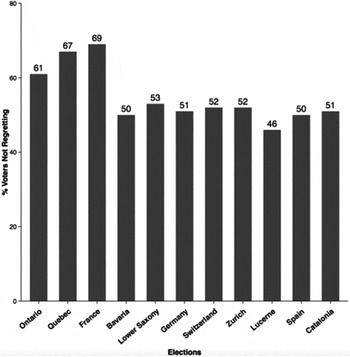
To understand whether political information and correct voting mitigate experiences of regret, it is first necessary to understand the prevalence of regret itself. In the context of the Making Electoral Democracy Work project, voters in Canada, France, Switzerland, Germany, and Spain were asked ex-post the extent to which they considered the party or candidate for whom they voted to have been a good choice. Post-election surveys were conducted in regional and national elections in 10 different regions in these five countries. The full list of the regions and elections covered can be found in the online appendix. All in all, we have 11 different elections and a total of about 27,000 respondents (for more information see Blais Reference Blais2010 and www.electoraldemocracy.com). The Likert scale response options to the regret question ranged from indicating that the individual’s choice in the election was a “a very bad decision” to indicating it was “a very good decision.” Most people do not regret their vote choice after the fact. This outcome might be due to a choice-supportive bias leading people to retroactively evaluate their choices as good in order to avoid a form of cognitive dissonance (Pieters and Zeelenberg Reference Pieters and Zeelenberg2007). Figure 1 presents the proportion of citizens that express no post-election regret. Footnote 1 French voters express the least regret, with 69% of respondents believing their choice to have been a very good one, followed by voters in Quebec and Ontario, with 67% and 61% respectively. In most of the European regions surveyed about 50% of citizens express no regret.
Proportion of Voters with No Regret

POLITICAL INFORMATION, COGNITIVE HEURISTICS, AND CORRECT VOTING
While most voters do not second-guess their choice after Election Day, some nevertheless do. What accounts for differences in regretfulness? Much work in organizational science and consumer behavior argues that regret often follows either a subjectively considered poor choice or a poorly-reasoned choice. In the context of a national election in the Netherands, Pieters and Zeelenberg (Reference Pieters and Zeelenberg2005) show that inconsistencies between vote intentions and vote choices lead to higher levels of post-election regret. If vote intentions tap into underlying political preferences for at least some voters, then there is reason to believe that voting correctly may lead to lower levels of regret as well. Moreover, both Pieters and Zeelenberg (Reference Pieters and Zeelenberg2005) and Connolly and Zeelenberg (Reference Connolly and Zeelenberg2002) show that people are more likely to feel regretful of a decision if the decision they made was uninformed. Is it possible that information operates similarly in the political realm? Citizens are notoriously poorly informed about politics. This phenomenon is among the most well-documented in social science research (Converse Reference Converse and Apter1964; Carpini and Keeter Reference Carpini and Keeter1996; Zaller Reference Zaller1992). And political information affects a multitude of political behaviors and attitudes, such as how a person evaluates political candidates (Lodge, Steenbergen, and Brau Reference Lodge, Steenbergen and Brau1995) and whether he or she participates politically (Blais et al. Reference Blais, Gidengil, Fournier and Nevitte2009; Verba, Scholzman, and Brady Reference Verba, Scholzman and Brady1995). Because citizens are generally not very well informed, they are often considered ill-equipped to cast a well-reasoned vote. If citizens behave politically as they do commercially, as some have suggested (O’Cass and Pecotich Reference O’Cass and Pecotich2005), then a lack information might impact people’s post-election regretfulness much as it does their post-purchase regretfulness: negatively. People with less political information may cast less well-reasoned votes, thereby increasing the probability of making an error that is later regretted. From this line of reasoning, we can formulate a first hypothesis:
Hypothesis 1: Political information is negatively related to post-election regret.
It might thus be the case that information is not necessary to reducing error in voting and post-election regret. Citizens might be able to cast a vote of which they are proud regardless of information level, so long as they have adeptly used heuristics to make a “correct” choice.
Yet much scholarship has argued that citizens are able to overcome informational limits when voting. Such studies posit that people are “limited information processors” or “cognitive misers” (Fiske and Taylor Reference Fiske and Taylor2013; Lau and Sears Reference Lau and Sears1986) who use mental shortcuts to make reasonable decisions while circumventing cognitively-intensive processes of information gathering. Much theorizing has been done about precisely how generally uninformed citizens use mental shortcuts to make reasonable vote choices. Campbell et al. (Reference Campbell, Converse, Miller and Stokes1960) famously argued that citizens unfamiliar with the policy positions of candidates rely on party labels when attempting to approximate a reasoned decision. In a later study, Popkin (Reference Popkin1994) proposed several heuristics upon which little-informed voters rely when casting a vote, including the sociodemographic characteristics of a candidate. Citizens can also cast reasonable votes by taking into account the positions of groups whose views or interests they share or oppose (Lupia Reference Lupia1994). In their seminal 1997 study, Lau and Redlawsk evaluate how successful citizens actually are in using these cues. They found that the majority of citizens are indeed able to use heuristics to “vote correctly,” that is, vote the way they would have had they been fully informed. It might thus be the case that information is not necessary to reducing error in voting and post-election regret. Citizens might be able to cast a vote of which they are proud regardless of information level, so long as they have adeptly used heuristics to make a “correct” choice. Moreover, political information may condition the impact of correct voting on regret. Indeed, whether one votes correctly or not should matter most for the least informed. This general line of reasoning leads to two additional hypotheses:
Hypothesis 2: Correct voting is negatively related to post-election regret.
Hypothesis 3: The impact of correct voting on post-election regret is greatest among the least politically informed.
DATA AND METHODS
To evaluate these three hypotheses, we rely on public opinion data emerging from the Making Electoral Democracy Work (MEDW) project. MEDW surveys are online quota- based surveys that ensure samples are representative of the population in terms of age, gender, education, and region. The data are informative as they evaluate the extent to which citizens regret their vote choice after Election Day in 11 elections across five different countries (see online appendix for a full list of regions and elections). Right after the election campaign, individuals who had responded to the campaign wave of the survey were re-interviewed and asked about the extent to which they feel their decision to vote the way they did was a very good decision, a good decision, neither a good nor bad decision, a bad decision, or a very bad decision. We construct a five-category post-election regret scale, coded from 0 (if the respondent believes he/she made a very good decision) to 1 (if he/she thinks that it was a very bad decision), with each category in between corresponding to the response options in order. In total, 11,097 people responded to the question. The MEDW data also include a question asking people to match political candidates’ pictures with their correct parties, which we rely on to capture respondent’s levels of campaign-specific political information. A respondent has a score of 1 on the continuous measure if he or she was able to match all of the candidates’ pictures with their respective names and a score of 0 if he or she was not able to match any.
In developing a measure of correct voting, we rely on Lau, Andersen and Redlawsk’s (Reference Lau, Andersen and Redlawsk2008) “normative naive” measure. The measure is developed by first estimating the utility each respondent derives from a political party with respect to each of the three factors—party identification, economic evaluations, and ideological proximity—and then calculating for every respondent the party that maximizes their utility across these three factors. If a person voted for their utility-maximizing party, they are coded as having voted correctly (1) and if they voted for any other party, they are coded as having voted incorrectly (0). Footnote 2 All control variables are also coded between 0 and 1. The hypotheses are evaluated using ordered logistic regression analyses. Each model also controls for having voted for the winning party, as research shows having voted for a losing party may encourage a person to distance himself or herself from that party, and regret may be a distancing mechanism (Boen et al. Reference Boen, Vanbesalaere, Pandelaere, Dewitte, Duriez, Snauwaert, Feys, Dierckx and Van Avermaet2002; Pieters and Zeelenberg Reference Pieters and Zeelenberg2005).
RESULTS
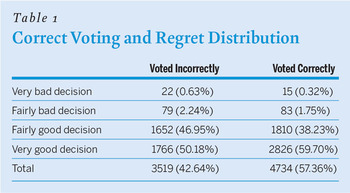
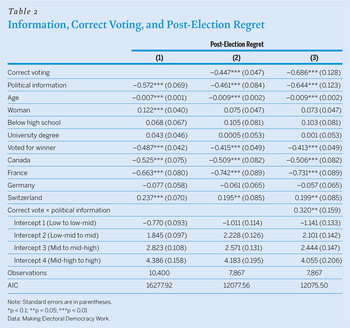
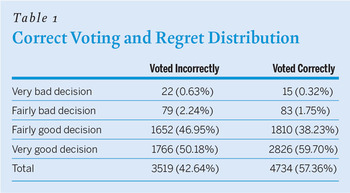
Before evaluating whether being informed or having voted correctly mitigate experiences of post-election regret, we examine the relationships between information and regret and the joint prevalence of correct voting and regret. As previously demonstrated, the majority of citizens have no regret when it comes to their vote choices. Political information is slightly negatively correlated with regret, at -0.11, suggesting that the politically well- informed are somewhat less regretful than the ill-informed. Similarly, correct voters tend to be less regretful than incorrect voters. As table 1 shows, slightly more correct voters are very satisfied with their vote choice than incorrect voters, at 60% and 50% respectively. The proportion of citizens that regret their vote choice, feeling it was either a bad decision or a very bad decision, is higher among incorrect voters than correct voters. Overall, however, few people in either category regret their electoral choice. Again, this is likely related to the psychological tendency to remember choices as being better than they were. Though there seems to be some relationship between voting correctly and regretting one’s vote choice, it might be the product of external factors, such as differential levels of education among correct and incorrect voters. It remains possible that the observed relationships between political information and regret and correct voting and regret reflect other extraneous differences between citizens. In order to evaluate the independent impact of political information on feelings of regret, we estimate an ordered logistic regression assessing the impact of information when sociodemographic factors are taken into account. The model also includes fixed country effects to capture any systematic differences across the countries in which the surveys were conducted. Footnote 3 As table 2 highlights, political information is indeed negatively related to feeling regretful of one’s vote choice after the election, when sociodemographic factors and having voted for the winning party are taken into consideration. This effect is statistically significant at the p < 0.05 level. A very well-informed individual has a 71% predicted probability of not regretting her vote choice at all. By contrast, an ill-informed person has a 59% predicted probability of not regretting her decision. The data thus appear to support the first hypothesis that political information mitigates experiences of post-election regret.
Correct Voting and Regret Distribution
Information, Correct Voting, and Post-Election Regret

Note: Standard errors are in parentheses.
*p < 0.1; **p < 0.05; ***p < 0.01
Data: Making Electoral Democracy Work.
Regardless of information, do those who vote correctly, all else being equal, experience similarly lower levels of regret? A second ordered logistic regression re-estimates the first model with the inclusion of the “normative naive” measure of correct voting. As the second column of table 2 shows, when the effect of information is parsed out, having voted correctly leads to a decrease in the extent to which an individual regrets his or her electoral choice (p < 0.05). Since few correct voters regret their vote choice and most people believe they made a good choice, it is substantively more interesting to assess how correct voting affects the probability of not regretting one’s choice at all. There is a 67% predicted probability that a correct voter will believe her electoral choice was a very good one and thus experience no post-election regret, all other factors held at their means. By contrast, there is only a 55% probability that an incorrect voter would feel the same way. As such, the second hypothesis—that correct voting is negatively related to electoral regret—is also supported by the data.
Our final hypothesis posits that correct voting and political information might not actually be independent of one another, and that the effect of correct voting on post-election regret is conditioned by an individual’s level of political information. To estimate whether the impact of correct voting on post-election regret is different across different levels of information, we estimate a third and final regression model, presented in the third column of table 2. The statistically significant coefficient on the interaction term suggests that the impact of correct voting on regret is indeed different for people at different points of the information spectrum. As expected, differences in the probabilities that correct and incorrect voters avoid regret entirely are higher among the least informed. Thus, the data also support our third hypothesis. An incorrect voter with no political information (0 on the information scale) has only a 40% predicted probability of avoiding regret entirely, whereas a very well-informed incorrect voter (1 on the scale) has a 60% predicted probability of falling in that category. Conversely, the difference in the probability of experiencing no regret among uninformed and informed correct voters is smaller, less than 10 percentage points. Moreover, differences in the probabilities that correct and incorrect voters avoid having to face any regret are greater at lower than higher ends of the political information spectrum.
Both political information and correct voting lead to a lesser propensity to regret one’s vote choice net of one another.
CONCLUSION
This study aimed to assess whether political information and correct voting affect the extent to which citizens regret the choices they made on Election Day. We find that regret is less prevalent among the politically well-informed and those who vote correctly. Correspondingly, we find that higher regret is more prevalent among the less well informed and those who vote incorrectly. Both political information and correct voting lead to a lesser propensity to regret one’s vote choice net of one another. There is also heterogeneity in the effect of correct voting across levels of political information. Correct voting attenuates regret to a greater extent among the less well-informed. At higher levels of information, differences in regret among correct voters and incorrect voters are substantially less than at lower levels of information. Thus, having voted correctly matters for an individual’s vote choice most when he or she is not well-informed. Such individuals may be those who, despite not having very much information, are nevertheless able to make good use of heuristics.
More research is necessary to understand the relationships between information and correct voting and electoral regret. The less informed may be less likely to regret their choice when voting correctly because they are better able to use relevant cognitive heuristics when deciding for whom to vote. By contrast, the better informed may be less likely to regret their vote choice even when they do not vote correctly if they are voting strategically—an act typically constrained to the well-informed—instead of in accordance with their underlying preferences. Better-informed voters may also simply be better equipped to rationalize their choices. Citizens may also be conflicted between voting correctly and “jumping on the bandwagon” to vote for the party deemed most likely to win. Indeed, we find voting for the winning party consistently exerts a negative effect on regret levels, implying there is a psychological incentive to vote for the winner. However, a measure of which parties voters expected to win prior to the election would be necessary in order to directly examine the tradeoff between these two voting strategies.
Ultimately, more research is needed to understand the precise mechanism underlying the relationship between having voted correctly and experiencing a lower level of post-election regret. The present study endeavors to lay the foundation for the development of our understanding of what leads voters to regret or not the decisions they make. Other disciplines have looked at how people react ex post facto to the choices they make. We are aware of no prior research that examines what makes people happy or unhappy with their decision to support a given party or candidate. Political scientists have devoted much research to examining what makes citizens happy or unhappy with the way democracy works (Anderson et al. Reference Anderson, Blais, Bowler, Donovan and Listhaug2005) yet we know almost nothing about what makes voters satisfied or dissatisfied with their own personal decisions. We hope this study will spur further investigation of this question.
SUPPLEMENTARY MATERIAL
To view supplementary material for this article, please visit http://dx.doi.org/10.1017/S1049096516001372.Footnote *