Implications
The seasonality of reproduction is an important limiting factor for sheep farming, and although hormonal treatments were developed to overcome this limitation, society has now become concerned by the environmental and health consequences of these hormonal treatments and is asking for alternative techniques that do not require the use of exogenous hormones to manage reproduction. One example is the ‘ram effect’ or the introduction of a ram into a group of seasonally anovulatory ewes. However, the response to the ‘ram effect’ is more variable than are responses to hormonal treatments. This has limited the widespread use of the ‘ram effect’ and highlights the critical need for research to understand the origins of this variability and to improve the efficacy of the technique to levels comparable with those achieved using hormonal treatments.
Introduction
In sheep and goats, the introduction of males into a flock of seasonally anoestrous females results in the increased secretion of LH, leading to synchronized ovulation (reviewed by Martin et al., Reference Martin, Oldham, Cognié and Pearce1986). This phenomenon is commonly known as the ‘male effect’ or by its more species-specific forms, the ‘ram effect’ or the ‘buck effect’. It was first reported in the 1940s (Underwood et al., Reference Underwood, Shier and Davenport1944) and it is an adaptative survival strategy in wild populations of small ruminants to cope with, for example, heavy predation. In this situation, the ‘male effect’ reduces risks to survival by shortening and concentrating the period of sexual activity and by synchronizing births. In modern systems of sheep and goat production, the ‘male effect’ has been used successfully to synchronize reproduction and extend the period during which conception is possible in a way that is compatible with sustainable agriculture, and because of the need to reduce or eliminate hormonal treatments to control reproduction (Thimonier et al., Reference Thimonier, Cognié, Lassoued and Khaldi2000). However, its practical use is limited by the high variability of responses to the ‘ram effect’ among breeds and seasons.
The mechanism of the ‘ram effect’ involves a complex series of neuroendocrine (hypothalamic) and endocrine (pituitary and ovarian) events that can be summarized as follows. In sheep, the introduction of a ram into a flock of anoestrous ewes leads to the stimulation of gonadotrophin-releasing hormone (GnRH) secretion within minutes. The secretion of LH from the anterior pituitary gland is thus stimulated. The rapid increase in the pulsatile and basal secretion of LH has been described as the short-term response to the ‘ram effect’ (Martin et al., Reference Martin, Oldham, Cognié and Pearce1986). If the contact with rams is maintained, the ewes can go on to have a preovulatory surge of LH 6 to 52 h, after the introduction of rams (Oldham et al., Reference Oldham, Martin and Knight1978), followed by ovulation around 24 h later. Not all of the resulting corpora lutea (CL) have a normal life span and in some ewes the CL regresses prematurely after 6 to 7 days, producing the so-called ‘short cycle’. Invariably with the ‘ram effect’, the induced ovulation is not accompanied by oestrus and the ovulation is said to be ‘silent’ (Oldham and Martin, Reference Oldham and Martin1978) because in the ewe oestrus only occurs when preceded by a sustained period of high progesterone. Thus, following the ‘ram effect’ oestrus if present is seen approximately 18 days or 25 days after the introduction of rams corresponding to ewes having either a normal luteal phase (oestrus on day 18) or a short luteal phase, ovulation again silent and a normal luteal phase (25 days).
Thus, the ovarian response to the ‘ram effect’ can take several forms: there may be no ovulation and the ewes remain anoestrus, other ewes may return to anoestrus after ovulating in response to the ‘ram effect’, whereas others may continue to ovulate and thus show oestrus 18 or 25 days after the introduction of the rams. From this description, it is apparent that the response to the ‘ram effect’ is variable and this variability limits its efficacy as a management tool in sheep production.
Although the origins of variability in the response to the ‘ram effect’ have been investigated (Rosa and Bryant, Reference Rosa and Bryant2002; Ungerfeld et al., Reference Ungerfeld, Forsberg and Rubianes2004), the causes and mechanisms are not well defined. The depth of anoestrus defined as the proportion of ewes in a flock showing spontaneous ovulation, is one factor that may contribute to this variability (Thimonier et al., Reference Thimonier, Cognié, Lassoued and Khaldi2000). Support for this suggestion comes from the reported observation of a negative correlation between the depth of anoestrus and the proportion of ewes responding to the ‘ram effect’ (Lindsay and Signoret, Reference Lindsay and Signoret1980). However, this relationship was not confirmed in another study (Tournadre et al., Reference Tournadre, Bocquier, Petit, Thimonier and Benoit2002); thus, the general validity of the negative correlation between these two parameters is questionable. The frequency of LH pulses, which varies in response to oestradiol negative feedback, is another measure of the depth of anoestrus (Goodman and Karsch, Reference Goodman and Karsch1981), but its relationship with the response to the ‘ram effect’ has neither been fully determined nor has adenohypophyseal sensitivity to GnRH. Nevertheless, the depth of anoestrus apparently varies among breeds and the point in time during anoestrus, and these seem to be related to the response to the ‘ram effect’. Thus, animals from seasonal breeds generally respond to the ‘ram effect’ only when they are close to the start of the breeding season, whereas less seasonal breeds can respond throughout anoestrus (Martin et al., Reference Martin, Oldham, Cognié and Pearce1986). However, these data come mainly from studies in the Merino and various English breeds; the limited data available for native French breeds suggest that the efficacy of the ‘ram effect’ is similarly variable (Chanvallon et al., Reference Chanvallon, Sagot, Pottier, Scaramuzzi and Fabre-Nys2009).
The aim of our investigation was to define more fully, the origins of the variability in the response to the ‘ram effect’ and to determine the relative roles of breed, time and the depth of anoestrus on the response to the ‘ram effect’ in four breeds of French sheep. These breeds of sheep were the highly seasonal Mouton Vendéen, the moderately seasonal Île-de-France breed and the less seasonal Romane and Mérinos d'Arles breeds. Initially, we determined the duration and the depth of the anoestrous season. Next, the response to the ‘ram effect’ was determined at three physiological levels (the hypothalamus, the anterior pituitary gland and the ovary), three times during anoestrus (early, middle and late). We then used our data to examine the relationship between the depth of anoestrus and the response to the ‘ram effect’. Our hypothesis was that the response to the ‘ram effect’ is greater in less seasonal breeds and that the response to the ‘ram effect’ is related to the pulse frequency of LH and to adenohypophyseal responses to GnRH of anoestrus ewes.
Material and method
The experiments using animals reported in this paper were performed with authorization from the French Ministry of Agriculture (Authority No. 006259).
Experiment 1: Tracking the period and depth of the anoestrous season
Adult ewes (2 to 9 years and having lambed at least once) from four breeds (n = 117) were used. All animals were kept under natural photoperiod and were housed in pens, in groups of 10 to 15 ewes of the same breed; the pens were well isolated from rams. The ewes were fed a maintenance diet of hay and concentrates following INRA recommendations (Bocquier et al., Reference Bocquier, Theriez, Prache and Brelurut1988), which maintained body condition score; the ewes had free access to water at all times. Before the beginning of the experiment, body condition scores were determined by trained persons on a scale of 0 (emaciated) to 5 (obese) according to Russel et al. (Reference Russel, Donney and Gunn1969). Samples of jugular venous blood were taken weekly during anoestrus (approximately December to September), the blood was centrifuged at 3000 r.p.m. for 20 min and the plasma was removed and stored at −20°C. A female was considered to be anoestrus from the first week when the concentration of progesterone fell below 1 ng/ml and remained there for at least 2 consecutive weeks and the end anoestrus was the week in anoestrus when the concentration of progesterone first rose above 1 ng/ml.
Experiment 2: ‘Ram effect’ in early, mid and late anoestrus
Animals
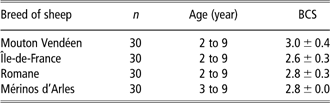
We used different groups of 10 adults, anoestrous ewes (2 to 9 years and having lambed at least once), three times (early, mid and late) anoestrus from each breed (n = 120); the details of the ewes used in these experiments are summarized in Table 1. Mature sexually active rams from relatively non-seasonal breeds that were different from the breed of ewe (Romanov or Île-de-France crossed with Lacaune or Moureous breeds) were used to provide the olfactory, visual, auditory and tactile stimuli required for the ‘ram effect’. The rams were chosen for high libido as determined in a pre-test by recording ano-genital sniffing, sexual approaches and attempted mounts in a group of five anoestrous ewes. These rams had been trained to stimulate anoestrous. Within breeds, the same rams were used for all test periods. The ewes were housed and fed as described for Experiment 1.
Characteristics of the ewes used in Experiment 2
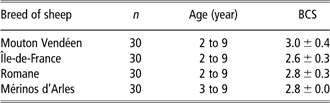
BCS = body condition score (scale 0 to 5) given as the median and the inter-quartile range.
Experimental protocol
Selection of test periods and anoestrous ewes
Groups of 10 anoestrous ewes from each breed were chosen from the same flock as the ewes used in Experiment 2 and were used to determine the stage of anoestrus in the flock on the basis of weekly progesterone concentrations. The ewes were housed indoor in groups of 15 to 30 and blood samples were taken weekly. Blood and the plasma were assayed for progesterone. A ewe was considered cyclic if the plasma concentration of progesterone was above 1 ng/ml for 2 consecutive weeks. Early anoestrus was defined as the date when the proportion of cyclic females in the flock first fell below 50%, mid-anoestrus was defined as 6 to 8 weeks later and late anoestrus was defined as the date when the proportion of cyclic females in the flock first rose above 25%. When a breed had reached the desired stage of anoestrus, another group of 10 anoestrous ewes were randomly selected for the experiment, and once used they were not re-used. The anoestrous states of ewes at the introduction of rams (day 0) were confirmed after the end of the experiment and any cyclic ewes (progesterone above 1.0 ng/ml) were excluded from the data sets.
LH in anoestrus: basal secretion and the response to a GnRH challenge
To assess the sensitivity of the adeno-hypophysis to GnRH, the ewes were injected intravenously with 75 ng of GnRH, a dose that induced a physiological LH pulse, but that was unlikely to have further physiological consequences (McLeod et al., Reference McLeod, Haresign and Lamming1982; Sakurai et al., Reference Sakurai, Adams and Adams1992; Caraty et al., Reference Caraty, Smith, Lomet, Ben Saïd, Morrissey, Cognie, Doughton, Baril, Briant and Clarke2007). The dose of GnRH was determined in a preliminary test on 15 Île-de-France ewes; groups of ewes were treated with an intravenous injection with 67.5, 100 or 150 ng of GnRH in 1 ml of sterile saline (Sigma Aldrich L8008, Saint Quentin Fallavier, France). The concentration of LH was measured at −30, −15, −5, 5, 15, 30, 45 and 60 min relative to the injection. All ewes except one treated at the lowest dose had an LH pulse in response to GnRH. The maximum concentration of LH was observed 15 to 30 min after GnRH and the mean amplitudes of the LH pulses were 1.23 ± 0.95, 1.77 ± 0.85 and 2.18 ± 0.76 ng/ml for the 67.5, 100 and 150 ng doses of GnRH, respectively. We selected a dose of 75 ng for the experiment, which we expected would induce an LH pulse of 1 to 2 ng/ml.
For the experiment, the ewes were first acclimatized to handling and the presence of staff, over a period of a week before the experiment. On day 2 (day 0 being the day the of rams were introduced to the ewes), a blood sampling catheter was introduced into the jugular vein. On day 1, 5 ml blood samples were collected every 15 min for 6 h, a period previously shown to be sufficient to determine LH pulsatility before the ‘ram effect’ with minimum stress to the ewes (Poindron et al., Reference Poindron, Cognie, Gayerie, Orgeur, Oldham and Ravault1980). This was immediately followed by an intravenous injection of 75 ng of GnRH. Additional blood samples were collected at 5, 15, 30, 45 and 60 min after GnRH. The blood samples were processed and the plasma was stored as described above.
The ‘ram effect’
On day 0, blood samples (5 ml) were collected from the jugular venous catheter, every 15 min for 90 min. After 90 min, at 1000 h rams were introduced to the females at a ratio of one ram per five ewes (i.e. a ram in a pen of five ewes). Blood samples continued to be collected at intervals of 15 min for a further 4 h. After 4 h, the timing of the blood samples was reduced to a sample every 4 h and sampling at this frequency continued for the next 56 h, that is, until 60 h after the introduction of the rams. The timing was then changed daily until day 11 and finally twice weekly until day 25, at which time the blood sampling ended. During the first 4 h, the rams were changed every hour to avoid individual effects and to increase their level of sexual activity. After 3 days, the 10 ewes were placed in a single group with a ram; the ram was changed 7 days later. Between days 15 and 28, rams were fitted with harnesses and marker crayons so that oestrus could be recorded daily.
Hormone assays
The plasma concentrations of LH were determined using an ELISA (Faure et al., Reference Faure, Nicol, Fabre, Fontaine, Mohoric, McNeilly and Taragnat2005). The sensitivity of the assay was 0.10 ng/ml and the intra-assay and inter-assay coefficients of variation for a reference sample (0.5 ng/ml) were 9.3% and 5.2%, respectively.
The concentration of progesterone was measured using an ELISA (Canépa et al., Reference Canépa, Laine, Bluteau, Fagu, Flon and Monniaux2008). The sensitivity of the assay was 0.4 ng/ml and the intra-assay and inter-assay coefficients of variation were 8.1% and 6.8% for a reference sample at 1.5 ng/ml and 10.3% and 6.6% for a second reference at 2.5 ng/ml. Samples around any presumed short cycles were re-assayed, using a larger volume of plasma, which increased assay sensitivity to 0.2 ng/ml.
Data and statistical analysis
All data are expressed as means ± s.e.m.s, except for the body condition score, which are expressed as medians ± interquartile ranges.
Experiment 1
In Experiment 1, the dates for the start and end of anoestrus were derived for each ewe and converted into days of the year (i.e. 1 January = day 1, 2 January = day 2, … 31 December = day 365). The duration of anoestrus was the number of days between the start and end of anoestrus. These parameters were compared among breeds using a univariate ANOVA. This was followed when appropriate, by pair-wise comparisons using the Bonferroni correction.
Experiment 2
The response to the GnRH challenge was evaluated two ways: first by the maximum LH concentration after GnRH injection and second by the sum of all post-injection values of LH.
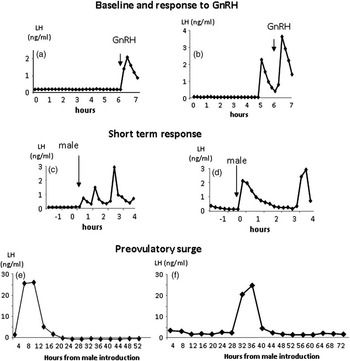
The pulsatile patterns of LH secretion were determined as previously described (Martin et al., Reference Martin, Oldham and Lindsay1980). Briefly, a pulse was defined as an increase in the concentration of LH that exceeded the baseline concentration by three standard deviations. The frequency of LH pulses and the mean concentration of LH before and after the introduction of rams were calculated for each female. A female was classified as having had a short-term response if the LH pulse frequency was increased over the 4 h after the introduction of rams. A preovulatory LH surge was defined as an increase in the concentration of LH exceeding 10 ng/ml in at least one sample and lasting for a minimum of 4 h. The latency or the time to the start of the LH surge was defined as the time in a surge, when the concentration of LH first exceeded the mean concentration before the introduction of rams by three standard deviations (Caraty et al., Reference Caraty, Delaleu, Chesneau and Fabre-Nys2002). Examples of LH pulses and preovulatory surges are shown in Figure 1.
Types of LH responses observed in experiment 2. (a, b) Short-term responses to GnRH observed, respectively, in a Mouton Vendéen ewe at the end of anoestrus and a Mérinos d'Arles ewe in middle anoestrus. (c, d) Short-term responses to the ram, respectively, in a Mouton Vendéen ewe in early anoestrus and an Île-de-France ewe in middle anoestrus. (e, f) The LH surge in response to the ram, respectively, in an Île-de-France ewe and a Romane ewe, both at the end of anoestrus.

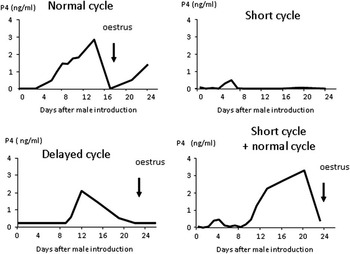
The type of ovarian response to the ‘ram effect’ was determined from the pattern of progesterone over the 25 days after the ‘ram effect’. A normal cycle was defined as cycles in which the concentration of progesterone was above 1 ng/ml for at least 10 days, indicating a luteal phase of at least 12 days. Abnormal cycles included short cycles and delayed cycles. Short cycles were defined as cycles in which the concentration of progesterone was above 0.5 ng/ml for 1 to 2 days indicating that ovulation occurred, but the luteal phase was shortened to less than 3 days (Chemineau et al., Reference Chemineau, Pellicer-Rubio, Lassoued, Khaldi and Monniaux2006) and delayed cycles were defined as cycles in which the concentration of progesterone first rose above 0.5 ng/ml after day 7, indicating that the luteal phase was delayed (Ungerfeld et al., Reference Ungerfeld, Pinczak, Forsberg and Rubianes2002). Examples of ovarian responses are shown in Figure 2.
Types of ovarian responses observed in experiment 2. Normal cycle: cycle in which the concentration of progesterone was above 1 ng/ml for at least 10 days, indicating a luteal phase of at least 12 days. Short cycle: cycle in which the concentration of progesterone was above 0.5 ng/ml for 1 to 2 days indicating that ovulation occurred, but the luteal phase was shortened to less than 3 days. Delayed cycle: cycles in which the concentration of progesterone first rose above 0.5 ng/ml after day 7 indicating that the luteal phase was delayed.

The data were analysed using the statistical software package SAS 2000, release 8.0 (SAS Institute, Cary, NC, USA) The proportion of ewes with increased secretion of LH after GnRH and after the ‘ram effect’ and the proportion of ewes with an LH surge, a cycle and showing oestrus were all compared among breeds and periods of anoestrus using binary logistic regression and the odds ratio (OR) to determine P-values. The proportions within a breed were then compared using the Fisher exact probability test. The maximum concentration of LH after GnRH, the frequency of LH pulses and the mean concentration of LH before and after the ‘ram effect’, the latency of the LH surge and the maximum concentration of progesterone after the introduction of rams, were compared among breeds and periods of anoestrus using a factorial ANOVA run under the General Linear Model with post-hoc pair-wise comparisons where appropriate, using the Bonferroni correction. The maximum concentration of LH after GnRH, and the frequency of LH pulses before and after the introduction of rams were re-categorized into five classes defined by ovarian response: (i) no response, (ii) short cycle, (iii) short cycle followed by normal cycle, (iv) normal cycle and (v) delayed cycle and re-analysed using univariate ANOVA with post-hoc pair-wise comparisons where appropriate, using the Bonferroni correction. The correlation between the percentage of spontaneously ovulating females before the ‘ram effect’ and the percentage of females responding to the ‘ram effect’ was calculated using the non-parametric Spearman Rank Correlation.
Results
Experiment 1: Timing and depth of the anoestrous season
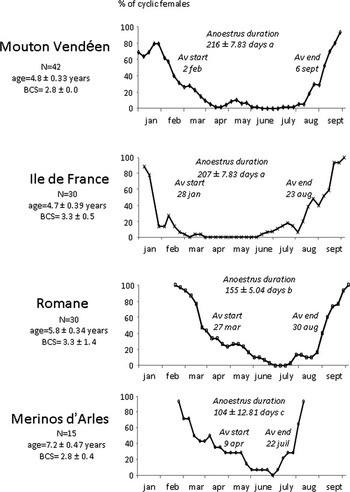
There were significant differences for the start, end and duration of the anoestrous season among breeds (Figure 3). The anoestrous season in the Île-de-France and Mouton Vendéen breeds started about 2 months earlier than in the Romane and Mérinos d'Arles breeds. The end of the anoestrous season was the earliest in the Mérinos d'Arles breed and this was significantly different from all other breeds that all commenced their new breeding seasons about 6 to 8 weeks later (Figure 3). The duration of the anoestrous season was shortest in the Mérinos d'Arles breed at 105 days and was significantly shorter than all other breeds (Figure 3). The Romane breed had an anoestrous season that was also significantly different from all other breeds. The Mouton Vendéen and Île-de-France breeds had longer anoestrous seasons that were not significantly different from each other.
Timing and duration of the anoestrous season in four French breeds of sheep. The proportion of cyclic female in each group was calculated from the weekly progesterone concentrations. A female was considered anoestrus when the concentration of progesterone concentration was below 1 ng/ml for 2 consecutive weeks. The end of anoestrus was on the first day progesterone concentration rose above 1 ng/ml. Duration was the number of days between the start and end of anoestrus.

Experiment 2: ‘Ram effect’ in early, mid and late anoestrus
Response to GnRH
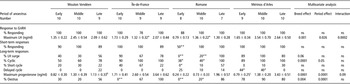
The proportion of females responding to GnRH was high (97%) and did not differ among breeds or periods of anoestrus and there was no interaction (Table 2). The maximum concentration of LH after GnRH was higher in Mérinos d'Arles compared with the Romane breed (2.62 ± 0.046 v. 1.14 ± 0.053 ng/ml; P = 0.001). The Île-de-France breed (1.72 ± 0.047 ng/ml) and Mouton Vendéen (1.96 ± 0.046 ng/ml) were intermediate. It was also higher in mid-anoestrus compared with early anoestrus (2.18 ± 0.040 v. 1.39 ± 0.036 ng/ml; P = 0.030). There was no interaction between breed and period of anoestrus. The sum of LH values after the administration of GnRH also differed between breeds (P < 0.04) and periods (P < 0.008), but there was no interaction.
The response to GnRH (75 ng), the short-term and long-term responses to the introduction of rams depending on the breed and the period of anoestrus.

Data are presented as the percentages responding or as the means ± s.e.m.
aDifferent from Mérinos d'Arles during the same period P < 0.02.
bDifferent from Île-de-France during the same period P < 0.002.
cDifferent from late in the same breed P < 0.0007 GLM analysis.
*Different from the proportion in late anoestrus in the same breed P < 0.05.
**Different from the proportion in late anoestrus in the same breed P < 0.005 Fisher test.
The maximum concentration of LH after GnRH was significantly lower in ewes that did not ovulate compared with ewes that did (1.28 ± 0.18 v. 2.06 ± 0.16 ng/ml; P < 0.018). These differences were also found if the response was measured by the sum of all post-injection LH values (3.65 ± 0.403 v. 5.52 ± 0.415 ng/ml; P = 0.0018).
Endocrine response to the ‘ram effect’
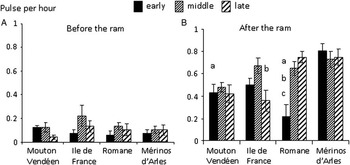
The proportion of females with a short-term increase in LH secretion was high (93%) and did not differ among breeds or periods of anoestrus and the interaction was not significant (Table 2; all P > 0.05). The few ewes that did not show a short-term response to the ram were not always the same as those that did not respond to the GnRH challenge. The frequency of LH pulses and the mean concentration of LH before the introduction of rams did not differ among breeds or periods of anoestrus and the interaction was not significant (Figure 4; all P > 0.05) nor did they differ among groups with different patterns of ovarian response (P = 0.52).
LH pulse frequency before (A) and after (B) the introduction of rams in four breeds of sheep and at three times during anoestrus. Data are means ± s.e.m. (a) Mérinos d'Arles different from Mouton Vendéen and Romane in early anoestrus (P < 0.05). (b) Mérinos d'Arles and Romane different from Île-de-France (P < 0.05). (c) Early anoestrus different from mid and late anoestrus in Romane (P < 0.05).

The frequency of LH pulses after the introduction of rams differed among breeds (P < 0.0001); periods of anoestrus (P = 0.023) and the interaction between them were also significant (P = 0.0002). It was higher in Merinos d'Arles (0.76 ± 0.007 pulses per hour) than in other breeds (Île-de-France: 0.51 ± 0.007 pulses per hour, P = 0.0002; Romane: 0.54 ± 0.009 pulses per hour, P = 0.003; Mouton Vendéen: 0.44 ± 0.007 pulses per hour, P < 0.0001) and in mid-anoestrus compared with early anoestrus (0.63 ± 0.040 v. 0.49 ± 0.049 ng/ml; P = 0.019). The interaction shows that the average LH pulse frequency after the ‘ram effect’ differed among periods of anoestrus only in the Romane breed (P = 0.013). The frequency of LH pulses after the introduction of rams was higher in the groups that ovulated than in groups that did not (0.62 ± 0.025 v. 0.35 ± 0.057 pulses per hour; P < 0.0001).
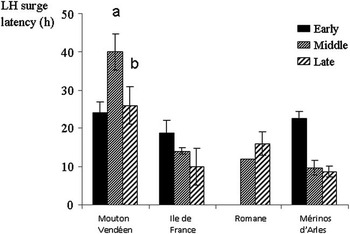
The proportion of females with an LH surge did not differ among breeds, although the difference was close to significance (Table 2; P = 0.060). In the Romane, the proportion of female showing a surge in late anoestrus was higher than in early or middle anoestrus (Table 2; P < 0.005). The latency of the LH surge differed among breeds (Figure 5; P < 0.0001); it was longer in Mouton Vendéen compared with Île-de-France and Mérinos d'Arles breeds (P < 0.0001) and the interaction between breeds and periods was also significant (P = 0.007).
Latency of the LH surge (h) after the introduction of rams in four breeds of sheep and at three times during anoestrus. Data are means ± s.e.m. (a) Mouton Vendéen different from other breeds in mid-anoestrus (P < 0.05). (b) Mouton Vendéen different from Mérinos d'Arles (P < 0.05) and Île-de-France (P < 0.10) in late anoestrus. Note: No LH surges were detected in Romane ewes in early anoestrus.

Ovarian responses to the ‘ram effect’
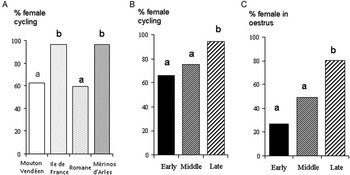
The proportion of ewes in which ovarian activity was stimulated by the ‘ram effect’ (i.e. ewes with a normal, short or delayed cycle) differed among breeds (Table 2; P = 0.0001). It was higher in Île-de-France than in Romane (OR = 0.038; 95% confidence interval (CI) of 0.006 to 0.256) and Mouton Vendéen breeds (OR = 0.049; 95% CI 0.008 to 0.326). It was also higher in Mérinos d'Arles than in Romane (OR = 0.039; 95% CI 0.006 to 0.259) and Mouton Vendéen breeds (OR = 0.051; 95% CI 0.008 to 0.331; Figure 6A). This proportion also differed among periods (P = 0.0056); it was higher in late anoestrus than in early (OR=0.088; 95% CI 0.020 to 0.388) and middle anoestrus (OR = 0.155; 95% CI 0.036 to 0.669; Figure 6B). There was no interaction between breeds and periods of anoestrus. In Romane, the proportion was higher in late anoestrus compared with early and middle anoestrus (Table 2; P < 0.025).
Percentage of females having a cycle in four breeds of sheep (A) and at three times during anoestrus (B) and percentage of females expressing oestrus at three times during anoestrus (C). Bars with different letters differ P < 0.001.

There were no effects of breed or period on the proportion of ewes with short or delayed cycles (Table 2). However, a few differences were detected within breeds. In the Romane, the proportion of females showing short cycles in early anoestrus was higher than in late anoestrus (P < 0.05; Table 2). In the Merinos d'Arles, the proportion of females showing delayed cycles was higher in early and middle anoestrus than in late anoestrus (P < 0.05; Table 2).
The maximum concentration of progesterone during the first 11 days after the introduction of rams differed among breeds (P < 0.0001) and periods of anoestrus (P < 0.0001), but the interaction was not significant (P = 0.088; Table 2). It was higher in Île-de-France (2.65 ± 0.043 ng/ml) compared with Mouton Vendéen and Romane breeds (1.08 ± 0.042 and 0.94 ± 0.050 ng/ml; P < 0.0001) and with a trend towards significance in the Mérinos d'Arles (1.87 ± 0.043 ng/ml) compared with the Romane breed (P = 0.059). It was also higher in late compared with early (2.54 ± 0.035 v. 0.89 ± 0.033 ng/ml; P < 0.0001) and middle anoestrus (1.50 ± 0.032 ng/ml; P = 0.0015). In Merinos d'Arles, it was higher in late anoestrus than in early anoestrus (P < 0.0007) than in middle anoestrus (P < 0.02; Table 2).
The expression of oestrus
The proportion of ewes expressing oestrus differed among periods (P = 0.0001). It was higher in late anoestrus than in early (OR = 0.093; 95% CI 0.031 to 0.278) and middle anoestrus (OR = 0.238; 95% CI 0.084 to 0.672; Figure 6c). The proportion of oestrous females was higher in late anoestrus than in early anoestrus (P < 0.005) in the Île-de-France and in early (P < 0.005) and middle (P < 0.025) anoestrus in the Romane.
Relation between the response to the male effect and the depth of anoestrus
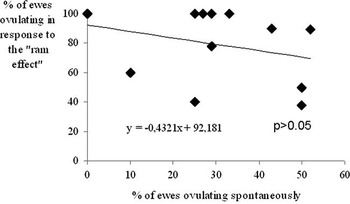
There was no significant correlation (Spearman coefficient = −0.310, P > 0.05) between the proportion of ewes in the flock that were ovulating spontaneously and the proportion of anoestrous ewes in the same flock, which had an ovarian response to the ‘ram effect’ (Figure 7). Similarly, there was no significant correlation (Spearman coefficient = −0.180, P > 0.05) with the proportion showing oestrus in response to the ‘ram effect’.
Relationship between the percentage of females having spontaneous ovulation and the response to the ‘ram effect’.

Discussion
The proportion of females having a spontaneous ovulation, a criteria used to define the depth of anoestrus, was recorded across the anoestrous season for four breeds. These data confirm that the Mouton Vendéen is a highly seasonal breed with an anoestrus of around 7 months during which virtually all of the ewes are non-cyclic. They also confirm that the Romane and Mérino d'Arles breeds are less seasonal with a shorter anoestrus and with around 10% of the flock cycling at any one time. However in the Île-de-France breed, known as a moderately seasonal breed, anoestrus was surprising at around 7 months and during which virtually all of the ewes were non-cyclic. This result does not agree with the findings of Thimonier and Mauléon (Reference Thimonier and Mauléon1969) who, in the same breed, detected considerable levels of ovulatory activity in April to May. There are two possible explanations for this difference: (i) in our experiment, we used concentrations of progesterone to define anoestrus, whereas they used direct laparoscopic observation of ovulation and (ii) in our experiment, ewes were completely isolated from rams, whereas in their study rams were continuously present in the flock and used to detect spontaneous oestrus and the presence of rams may have modified the endogenous pattern of seasonality (O'Callaghan et al., Reference O'Callaghan, Donovan, Sunderland, Boland and Roche1994).
The depth of anoestrus is a factor often cited in the literature as influencing the response to the ‘ram effect’ (Rosa and Bryant, Reference Rosa and Bryant2002; Ungerfeld et al., Reference Ungerfeld, Forsberg and Rubianes2004). We tested the effectiveness of the ‘ram effect’ during early, middle and late anoestrus. The data revealed that there was no association between the proportion of females in the flock with spontaneous ovulation and the capacity of the anoestrous females in that flock to respond to the ‘ram effect’. This result was unexpected because it does not agree with the findings of Lindsay and Signoret (Reference Lindsay and Signoret1980) who reported a positive correlation between these two factors. However, our results do agree with those of Oldham (Reference Oldham1980) for the Merino ewe and those of Tournadre et al. (Reference Tournadre, Bocquier, Petit, Thimonier and Benoit2002) for the Limousine ewe. In our experiment, we selected anoestrous females to test their response to the introduction of rams, and we isolated them from cyclic females, to prevent a possible ‘female effect’. Indeed, the mixing of cyclic and anoestrous ewes can induce a synchronized ovulation in the anoestrous ewes, a phenomenon called the ‘female effect’. This effect is well known and effective in goats (Restall et al., Reference Restall, Restall and Walkden-Brown1995), but it is more controversial in sheep (Nugent and Notter, Reference Nugent and Notter1990; O'Callaghan et al., Reference O'Callaghan, Donovan, Sunderland, Boland and Roche1994; Zarco et al., Reference Zarco, Rodriguez, Angulo and Valencia1995). This effect, if real in sheep, could interfere with the response to the ‘ram effect’ and its effect would vary depending on the proportion of spontaneously ovulating females in the flock.
As described for other breeds (Cushwa et al., Reference Cushwa, Bradford, Stabenfeldt, Berger and Dally1992), in our study the ‘ram effect’ was effective in late anoestrus, regardless of the breed. At other periods of anoestrus, the response varied depending on breed. The response to the ‘ram effect’ in Mérinos d'Arles ewes was typical of the less seasonal breeds, and was characterized by a good response to the ‘ram effect’ throughout anoestrus. However in the Romane, which is also a less seasonal breed, the response to the ‘ram effect’ was poor in the early and middle parts of anoestrus, which was surprising. These animals were flighty and nervous and they were difficult to train and habituate to human presence. Subjectively, they appeared more stressed during the experimental procedures compared with the other breeds and this may have interfered with their responses. In highly seasonal breeds, recommendations for the use of the ‘ram effect’ are that its use should be restricted to the end of anoestrus where it can advance the new breeding season by 2 to 4 weeks (Martin et al., Reference Martin, Oldham, Cognié and Pearce1986). Our results in the Mouton Vendéen are coherent with this recommendation with 78% cyclic in this breed after a ‘ram effect’ in late anoestrus. Surprisingly in this breed, the responses in early anoestrus were greater than expected and suggest that the ‘ram effect’ can also delay the end of the breeding season in this breed. More studies should be conducted to better explore this possibility.
The disparity between the pattern of seasonality and the capacity to be stimulated by ‘ram effect’ observed in the Île-de-France presents opportunities. This French breed has been selected for several decades for its ability to breed naturally, outside the breeding season, and thus indirectly for its ability to respond to the ‘ram effect’. This suggests a heritable trait, but the heritability of the ‘ram effect’, although reported to be low in one study on Barbarine sheep from Tunisia (Bodin L, personal communication), has not been examined in depth. Further investigation of the genetic basis of the ‘ram effect’ or of some of the more detailed physiological (endocrine or neuroendocrine) responses associated with the ‘ram effect’ would be helpful and may eventually provide new criteria to select the animal for their ability to respond to the ‘ram effect’ in early- and mid-anoestrus without altering their patterns of seasonality.
Because anoestrus has been identified as a period of reduced LH pulse frequency (Goodman and Karsch, Reference Goodman and Karsch1981), it is often suggested but with as yet, no definitive evidence that the frequency of LH pulses is a measure of the depth of anoestrus. In spite of these limitations, we have measured the frequency of LH pulses before introduction of the ram to estimate the depth of anoestrus. The frequency of LH pulses before the ‘ram effect’ did not differ among periods in our experiment and it was not an accurate predictor of the ovarian response. These findings need to be interpreted with some caution because the 6-h sampling window that we used was probably too short to accurately determine small, but physiologically important, differences in LH pulse frequency. The sampling window we selected was the same as the window used in other studies where a 6-h sampling window was sufficient to detect statistical differences in LH pulse frequency (Poindron et al., Reference Poindron, Cognie, Gayerie, Orgeur, Oldham and Ravault1980; Chanvallon et al., Reference Chanvallon, Blache, Chadwick, Esmaili, Hawken, Martin, Viñoles and Fabre-Nys2010). It remains to be confirmed whether LH pulse frequency is indeed a satisfactory physiological correlate of the depth of anoestrus. However, the frequency of LH pulses immediately after the introduction of rams was higher in ewes that went on to ovulate.
This study provides some new insights into the endocrine and neuroendocrine mechanisms involved in response to the ‘ram effect’. First, 97% of ewes responded to the GnRH test with a pulse of LH and in 93% of ewes, pulsatile secretion of LH was induced by the introduction of the rams regardless of breed or period of anoestrus, suggesting that the hypothalamo–pituitary axis is functional in anoestrus (Minton et al., Reference Minton, Coppinger, Spaeth and Martin1991). The LH response to the GnRH test was greater in animals that went on to ovulate suggesting that this response may predict ovulatory outcome. When planning this investigation, it appeared to us that the possible role of the anterior pituitary gland has by and large, been ignored and that the mechanism of the ‘ram effect’ involved the hypothalamus and the ovary, with the pituitary gland reduced to the role of a passive relay. The literature suggested that the response of the pituitary gland to GnRH did not vary between seasons and the standard view of hypothalamo–pituitary–ovarian regulation attributed control solely to variations in LH pulse frequency. This is a view based largely on data derived from the use of non-physiological doses of GnRH. However, a recent study shows that the GnRH receptor gene expression in the anterior pituitary is lower in anoestrus than during the luteal phase and suggests that this could contribute to the lower level of LH during anoestrus (Ciechanowska et al., Reference Ciechanowska, Lapot, Malewski, Mateusiak, Misztal and Przekop2008). Our data show that LH response to 75 ng of GnRH does indeed vary with both breed of ewe and period of anoestrus and that it was correlated with the ovulatory outcome, following the ‘ram effect’. Thus, we suggest that both LH pulse frequency and LH pulse amplitude are involved in the mechanism of the ‘ram effect’. Second, the proportion of ewes going on to have an LH surge was lower than the proportion of females showing a short-term response, especially in the Mouton Vendéen and Romane breeds (Table 2). Because the LH follows an increase in oestradiol secretion by the follicle, a failure of the LH surge suggests that the secretion of follicular oestradiol was insufficient to induce positive feedback, further suggesting that folliculogenesis in the anoestrous ewe is compromised in some way. Third, in some Île-de-France and Mérinos d'Arles ewes an LH surge was induced with a latency of between 0 and 4 h. Early LH surges have occasionally been reported (Oldham et al., Reference Oldham, Martin and Knight1978, Pearce et al., Reference Pearce, Martin and Oldham1985). The reasons for these atypical responses are unknown, they could be due to co-incidental spontaneous ovulation or they could be genuine induced ovulations such as those occurring in cats and rabbits, and in ewes with very early LH surges, the mechanisms involved and especially the role of oestradiol remain to be investigated.
Finally, 28% of ewes that responded to the ‘ram effect’, with a normal oestrous cycle, did not re-ovulate showing that these females had returned to anoestrus (Oldham and Cognié, Reference Oldham and Cognié1980). As there was no re-ovulation, there therefore was no opportunity to establish a pregnancy. The failure to re-ovulate reduces the practical efficacy of the ‘ram effect’. It is a problem because with the ‘ram effect’, unlike the ‘buck effect’, the first induced ovulation is silent and thus the ewe is not mated. The efficacious use of the ‘ram effect’ requires the maintenance of ovarian cyclicity for at least 2 cycles after the ‘ram effect’ to ensure that the ewes have an ovulation accompanied by oestrus, thus permitting conception.
In conclusion first, this study has shown in contrast to the common idea that the response to the ‘ram effect’ is not linked to the proportion of cyclic females in a flock. This means that the ‘ram effect’ could be used in a wider range of breeds of sheep than previously thought. However, more research is needed to identify these breeds. Second, as previously thought, the ‘ram effect’ can be used in seasonal breeds at the end of the anoestrus season, but our results also suggest that ‘ram effect’ can also be used to delay the beginning of anoestrus. Again, more research is needed to explore this possibility. Third, the presence of an ovulatory response was related to both the LH response to a GnRH challenge before the introduction of rams and to the frequency of LH pulses immediately after the introduction of rams. This indicates that the changing responsiveness of both the hypophysis and the hypothalamus to endocrine and environmental stimuli might be involved in the ‘ram effect’, and again, the precise mechanisms need to be studied. Fourth, the absence of ovulation is generally due to a lack of preovulatory LH surge. To increase the success of the ram effect, a priority would be to understand the mechanisms implicated in the induction of an LH surge after exposure of anoestrus ewes to rams.
Acknowledgments
This work is a part of PhD thesis (A. Chanvallon) that was funded by the CIFRE convention between CIIRPO and ANRT. We thank the Région Centre (convention 200800030333) and the European Union Framework 6 funding program (MEXC-CT-2006-042499) for funding support. RJS is the recipient of an EU Marie Curie Chair of Excellence (MEXC-CT-2006-042499). The authors also wish to thank the staff from the hormone assay laboratory and the research stations at Nouzilly, La Sapinière and Frejorgues for their help. We would also like to thank several MSc students, Ségolène Bertaux, Marion David, Amélie Durand, Amandine Pelletier and Ophélie Robineau, who participated in various parts of these experiments. The authors thank also Dr Hannah Brown for her scientific comments and Sandrine Freret for help with the binary logistic regression.