

In his November 1584 eulogy for the funeral of Cardinal Archbishop Carlo Borromeo, the orator Francesco Panigarola lamented Borromeo’s passing as a monumental event that promised to impact the entire city of Milan for years to come:
And behold o Milanese, your Cardinal and mine is dead. Behold, our crown has fallen, our north wind has vanished, our lamp is extinguished. And I, unhappy and miserable and deprived of him, wish one of two things, namely to be able to forget the good that I have lost, or else remembering it, to find others to console me. Yes, I am driven in the pulpit to do two things directly opposed: to recount the good that has been taken from us and to console others about it . . . Yet since tears do not accomplish anything, only two things remain for us to do: one is to ensure, as much as possible, that we retain his sacred institutions and walk in the ways that he ordained for us, and the other is that we all beseech God to give us a successor worthy of him . . .Footnote 1
Panigarola’s entire address was alternately devoted to enquiring rhetorically how Milan could possibly survive without its fallen spiritual leader and to recounting his numerous pastoral acts, and the path to civic recovery which he prescribed therein was to provide the fundamental core of later sermons on the subject of Carlo Borromeo’s sanctity. Throughout the oration Panigarola repeatedly gives voice to intense sorrow, and his single-minded focus on the city’s irreparable loss was apparently reflected in the only polyphony surviving from the funeral ceremonies, an eight-voice setting of Lamentations 5: 15–17 entitled Defecit gaudium cordi nostri by Giulio Cesare Gabussi, then maestro di cappella at the Duomo.Footnote 2 Panigarola’s eulogy (and Gabussi’s motet) set the tone for the commemorations of Borromeo’s death in the seventeen years that followed, the centrepieces of which were annual Requiem Masses in the Duomo. This pattern was broken in 1601, however, when Pope Clement VIII discouraged further commemoration of the former archbishop with such a Requiem Mass, instead publicly acknowledging his miracles and recommending an annual solemn Mass in his honour. From that point Carlo Borromeo’s canonisation seemed, at least to local authorities, imminent, and all energies, including literary and artistic ones, were refocused on building the case for sainthood.Footnote 3
That art and literature played an important role in advancing the canonisation of San Carlo Borromeo and thereafter maintaining his saintly reputation is not, of course, a revolutionary concept. Beginning with Angelo Turchini’s encyclopedic La fabbrica di un santo: Il processo di canonizzazione di Carlo Borromeo e la Controriforma of 1984,Footnote 4 scholarly studies have recognised the extensive production of art and literature aimed at shaping the former Cardinal-Archbishop’s public image. Most recently, in fact, Annalisa Albruzzi,Footnote 5 Fabrizio Pagani,Footnote 6 Simonetta Coppa,Footnote 7 Francesco FrangiFootnote 8 and Danilo ZardinFootnote 9 have taken up in greater detail particular strains of that artistic and literary production. Turchini’s approach to the literary and artistic works was collective rather than analytical in that it was focused upon cataloguing and describing the artefacts, rather than on evaluating the features that they share and integrating the results into a focused discussion on image-making across the various genres, and this approach still dominates much discussion of the art and literature, perhaps because there is so much of it with which to grapple. Although a considerable amount of music promoting San Carlo’s sanctity also exists, it has heretofore received little attention in the literature. Yet study of it may begin to reveal some of the concepts of branding that the various artistic media share, for the music was dependent on text and intended to enhance a spectacle that was as reliant upon sonic elements as it was on visual ones. This essay, therefore, examines the role of the plainchants, sacred polyphony, and spiritual madrigals for San Carlo composed during the years leading to and immediately following the canonisation of 1610 in promoting the officially sanctioned image of the former Cardinal-Archbishop. It further considers how the musical structures that characterised these works may have derived from other modes of textual presentation, and in particular the sermons used to deliver the message in comparable settings. Finally, it explores how various styles of performance may have subliminally underscored certain constructed images of the archbishop and his city that developed in the years leading to the canonisation.
THE PUBLIC IMAGE OF CARLO BORROMEO
Carlo Borromeo, who served as the administrator of the Archdiocese of Milan from 1560 to 1564 and Archbishop from 1564 until his death in 1584, was certainly not an uncontroversial figure during his own lifetime.Footnote 10 His clashes with the canons of Santa Maria della Scala, the Jesuit community in Milan, the order of the Humiliati, the Spanish governors, and the nobility of the city over ecclesiastical authority, liturgical reform, and secular entertainments are not only documented in current research,Footnote 11 but also acknowledged in contemporary accounts such as the diary of Urbano Monti.Footnote 12 Yet his stalwart devotion to the poor and infirm during the plague of 1576 and his unparalleled success in partially redesigning the city’s social fabric around spiritual activities appears to have won him some measure of favour among the masses, if the contemporary diaries and chronicles are any indication.Footnote 13 The image of Carlo Borromeo projected during the run-up to canonisation relied upon these latter memories and was narrowly focused around a two-pronged campaign in which his reputation as a pastor, legislator and reformer of the church was balanced by his personal virtue, his heroic acts of charity, and his penitence—the ‘santo vescovo’ characterised by the motto ‘humilitas’.Footnote 14 It is further evidenced in the papal bull of canonisation issued by Paul V, wherein Borromeo is positioned among the biblical heroes of the Old Testament such as Jacob, Moses and Elijah, and compared to the Church Fathers, including the apostle Paul and the city’s patron Ambrose. Within this context he emerges as a ‘splendid light’ who ‘illuminated the church’ and ‘shined before the clergy’ in his virtue and pastoral leadership.Footnote 15
The image-making campaign waged in Milan and the surrounding territories on behalf of Carlo Borromeo differed, however, from that forged by members of aristocratic families such as the Medici archduchesses during the same era in that it did not involve self-fashioning. Rather, it was driven by proponents of an initiative that sought to retain Milan’s newly established civic identity as a bastion of Catholic reform and spirituality by providing a modern saint, namely its ‘santo vescovo’, around whom to rally. The literary and artistic campaign to define Borromeo’s image, moreover, was to some degree reactive rather than proactive, marked as it was by intense production and dialogue among the various authors and a sort of trial-and-error approach in which certain liturgical items seem to have been considered and then discarded for others.Footnote 16 Yet certain aristocratic or ecclesiastical figures do appear to have been central to the process and their names—Giovanni Pietro Giussano, Geronimo Trivulzio and Marco Aurelio Grattarola, for example—recur among the various sources, including in connection with several official printed accounts that were circulated after the fact for the purposes of memorialising and explicating particular symbols chosen to represent the new saint for the literate of the city.Footnote 17
THE INFLUENCE OF THE SERMONS
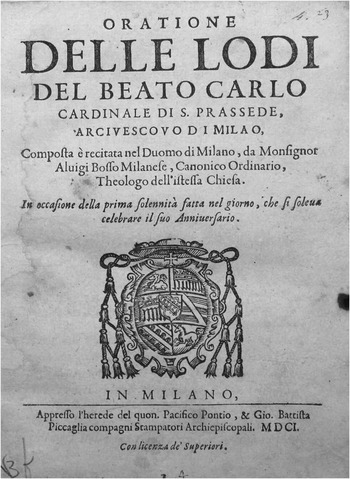
Fundamental to understanding how the dimensions of the music for San Carlo took shape are the sermons for the annual commemorations of Carlo Borromeo held in the Duomo in Milan on 4 November between 1601 and 1610 in which, as Turchini has noted, the tone turned from mourning to dancing and was embedded within the context of a drama in which Milan became the theatre, its citizens the chorus and Borromeo the main protagonist.Footnote 18 These sermons, which were delivered and printed in the vernacular, addressed the city at large as part of a ceremonial tradition that relied heavily upon scriptural and symbolic references. Their general content, style, and structure were established by the sermon given by Aluigi Bosso for the pivotal commemoration of 1601, which took its theme from Matthew 5:13–14, ‘Ye are the salt of the earth . . . ye are the light of the world’ (see Figure 1). This theme, which prefigured the language of the papal bull of Paul V, probably derives from the Matins readings and Gospel for the feasts of the Doctors of the Church and St Ambrose in the Roman rite.Footnote 19 It was perhaps chosen for both its effectiveness in positioning the new beato alongside Milan’s revered patron saint and its convenient allusion to Milan as the ‘city set on a hill’. Bosso’s sermon further takes up the cause of the ‘santo vescovo’. Throughout it he reminds the audience of Carlo Borromeo’s penchant for fasting and physical mortification and recounts his many ecclesiastical accomplishments, including founding the doctrine schools, reinstituting the practice of preaching, encouraging frequent participation in the sacraments in the oratorios, colleges, confraternities, seminaries and monasteries, making pastoral visits, leading public devotions and decorating and refurbishing the city’s altars and churches. Bosso thereby positions the new beato as a reformative light in the city set on a hill, at more than one juncture proclaiming him the salt of the earth and the light of the world.Footnote 20
Aluigi Bosso, Oratione delle lodi del Beato Carlo, title page. I-Mb FII.450. Courtesy of Milan, Biblioteca Nazionale Braidense, by permission of the Ministero per i Beni e le Attività Culturali

The introductory section of Bosso’s 1601 sermon further reflects a conscious ‘ramping up’ in the drive to canonisation by formally announcing a change of tone in keeping with Pope Clement VIII’s recommendation of setting aside the Requiem Mass in favour of an annual solemn one:
Behold that mournful and melancholy offices are no longer heard, but rather merry and joyful songs; the wall and the columns are no longer seen hung with black cloth, but rather decorated with colourful and handsomely embellished tapestries; the Requiem is no longer intoned, but rather the Alleluia is sung; death, burial, pain and affliction are no longer represented, but rather life, joy, glory and paradise recalled. A dear change, a most amiable passage from crying to singing, from sadness to joy, from hope and fear to a true and living consolation . . . it seems to me that [Milan] is a majestic theatre where are represented the splendours, the heroic virtues, the most illustrious works, the perpetual vigilance, the unceasing struggles, the zeal, the goodness and the marvellous saintliness of Beato Carlo, formerly our pastor on earth and now our protector in heaven.Footnote 21
The 1601 revision in tone served, in part, to position Borromeo both socially and spiritually at a time when not all locally proclaimed saints were canonised and the canonisation process itself was still evolving procedurally.Footnote 22 It pervaded the sermons given in the Duomo after 1601 by presenting the former Cardinal-Archbishop as a conquering hero in the theatre of a rejoicing Milan whose victory over the carnal mind assured him a place among the stars of heaven. Whether enumerating his virtues as in the commemorative sermons of 1603Footnote 23 and 1604,Footnote 24 exalting his spiritual heroism as in the speech of 1605,Footnote 25 or applauding his humility as in the address of 1607,Footnote 26 the speakers wove into their texts comparative scriptural references to Old Testament prophets and military heroes, comparisons to the early Church Fathers, textual allusions to Matthew 5:14, ‘ye are the light of the world’, including lamps, stars and suns, and exhortations to rejoice at Carlo’s virtual sainthood. By the time of the canonisation in 1610, these emblematic references had become part and parcel of the content of the sermon. Don Paolo Arese opened his sermon for the 1610 canonisation by proclaiming:
Today you are reassured that [Carlo Santo] is enjoying himself with the glorious angels in heaven, and he must be venerated as a Saint on earth. And I see well, o my Milanese, in your happy faces the signs of the uncommon joy of your hearts; I see the reverent and surging multitudes that converge, the peculiar rejoicing of my dear country. I see the walls and columns themselves of this most august temple that have already been for some time the spectators and theatre for the many heroic works of this glorious Saint . . .Footnote 27
He then inquired rhetorically ‘But how is San Carlo to be represented today, if not as that most beautiful and resplendent Sun?’,Footnote 28 and exhorted the nation to celebration, stating: ‘Our grand Cardinal of Santa Prassede has been declared a saint; go then, o Milan; for such happy news be merry, celebrate, rejoice . . . sing everyone “This is the day which the Lord has made, let us be glad and rejoice in it”.’Footnote 29
The oratorical themes of the sermons pervaded the liturgies and hymns developed for the commemorations of San Carlo as well, thus suggesting that there was a concerted effort to coordinate the message. A manuscript miscellanea from the Archdiocese of Milan preserved in Biblioteca Ambrosiana S.M.GH.V.28 and containing folios dating from between 1605 and 1674, for example, includes the text of a liturgy for the Beato Carlo that must have been in some sort of local use prior to the canonisation. It indicates that the psalm group that opened Vespers (see Appendix I) featured five items accompanied by antiphons that reference Borromeo’s elect status from infancy and his career as a heroic pastor of his Milanese flock. The first of these, which alternated with Psalm 109, sets the stage by asserting: ‘A great light appeared above the house of the blessed Carlo, a light sent from the eternal light to drive out the darkness of this generation when it came forth from the womb.’Footnote 30 Similarly, the first two stanzas of the four-strophe hymn for Matins announce the arrival of a new luminary in the heavens and exhort the nation to rejoice with the angels:
A new luminary arising in the heavens,
to last the period of entire generations,
pours forth its light;
it conquers all the stars with its rays of light.
Let a gathering of the presiders and the faithful nation rejoice.
Let all the earth resound in praise,
together with the happy gathering of angels.Footnote 31
The other chants and readings draw correlations between the Archbishop’s noble lineage and his destiny as leader and elaborate upon his reputation as an exemplary pastor of his flock and his success in combatting indiscipline and heresy in his diocese and beyond, all merits that qualified him as a civic and spiritual hero.
A similar approach to image-making can be found in other hymns for the Beato Carlo not included in the liturgy of S.M.GH.V.28. The manuscript Milan, Biblioteca Ambrosiana P. 145 sup. 5, for instance, contains the texts of seven hymns to the Beato, the last four of which are in a different hand than the first three and appear to have been copied separately, since they comprise a separate quire and are characterised by other minor differences in presentational format. Although it remains unclear when, where, and how any of these hymns were used, the second and third of them, in particular, develop the concept of Carlo Borromeo as a spiritual luminary lighting the city, thereby further attesting to its widespread adoption as an emblem for San Carlo.Footnote 32 Interestingly, the officially sanctioned hymn, Urbis parentem Carolem, is not included in this group of seven. It did not begin to appear in liturgical books until the second decade of the seventeenth century, but the theme of San Carlo as a heroic reformer lighting the way for a once mourning, but now rejoicing Milanese ‘nation’ pervades it as well. The first two strophes of Urbis parentem Carolem, in fact, are essentially tropes of the aforementioned Vespers antiphon and Matins hymn for the Beato found in Biblioteca Ambrosiana S.M.GH.V.28:
Carlo, the father of his city,
let us the suppliant children worship,
who as a dawning sun,
put to flight the night of the lying high priests.
The light set forth a good omen.
Beginning from the innocent years,
he played at making offerings.
Soon the light increased to purple-coloured
from a dazzling white after the manner of snow.
And with a mass pressing the islands,
it shined on the tottering fatherland.Footnote 33
Clearly Bosso’s concept of San Carlo as a light of the world, a luminary for the nation was lost on neither those who composed the successive sermons for the commemoration nor those who compiled the liturgies that were intended to adorn it. The annual repetition of such unifying themes from one sermon to the next reinforced them among the local populace so that by the time of the canonisation they had become relatively commonplace.
When considered against the backdrop of the calculated construction of his image in the sermons and liturgical items, the sacred concerti composed in honour of San Carlo seem at first glance surprisingly generic, relying as they do on celebratory texts cobbled together from the Jubilate psalms and other similar texts. A dissection of them, however, reveals that they are replete with images of Carlo Borromeo as a shining light and a conquering hero celebrated amidst the rejoicing nation that is Milan, albeit in the trappings of ancient Israel. In Andrea Cima’s O felicissimus dies, a four-voice concerto first published in his Il secondo libro delli concerti of 1627, the people rejoice upon the solemnity of San Carlo, whose pastoral works have assured him victory over death and aligned him with the stars of heaven. The angels and archangels serenade him with songs and instruments common to the Jewish nation:
O most happy day, day of merriment and joy, day of gladness and rejoicing in which the new light and ornament of the sky is the most beautiful gracious Charles. In the brilliant light shining with budding gems and ornamented by stars, the angels rejoice and the archangels sing together, rejoicing with hymns and songs and organs, harps and jubilation with trumpets. He enters into Paradise and takes possession of eternal joy. Alleluia.Footnote 34
In its references to Psalms 97 and 116, as well as Genesis 4 and 31, the text casts the Archbishop as a luminary in the heavens among the serenading angels and the Milanese in the role of the children of Jacob celebrating the translation of a great prophet. A similar approach may be seen in two solo concerti for San Carlo printed in Vincenzo Pellegrini’s Sacri concentus of 1619, although both admittedly eschew references to the saint’s role as a luminary. Exultate Deo for soprano and organ invites the people to ‘Make a joyful noise to the God of Jacob, Play on the psaltery and strike the timbrel, the sweet sounding harp with the timbrel’ (Ps. 80:2–3), in celebration of its ‘santo vescovo’, an exhortation that appears repeatedly in the sermons:
Rejoice to God our helper.
Make a joyful noise to the God of Jacob.
Take a psalm and strike the timbrel,
the sweet-sounding psaltery with the harp
In celebration of San Carlo
who was inclined towards compassion,
who is blessed by the people, who acquired victory. Alleluia.Footnote 35
Congratulamini omnes in Domino for basso and organ, which describes a nation rejoicing in concert with the angels, borrows its refrain from the Nativity responsory Congratulamini mihi omnes in diem:
Let everyone rejoice in the Lord.
Today celebrating the feast of San Carlo in whose solemnity the church rejoices,
The people rejoice and the angels sing sweet melodies saying
Let everyone rejoice in the Lord.Footnote 36
In their invocation of the rejoicing children of Jacob, their evocation of the heavenly angel concert and their allusion to the Jubilate psalms and other similar pre-existing liturgical texts, especially those alluding to the birth of Christ and the triumph of Old Testament heroes, these concerti reflect the content of the sermons delivered at the annual commemorations of San Carlo held in the Duomo after 1601, which rejected the former emphasis on recalling the solemnity and sorrow associated with Borromeo’s death in favour of a more joyous ceremony in which the once-mourning nation celebrated the birth, career and spiritual victory of its greatest pastor since Saint Ambrose.
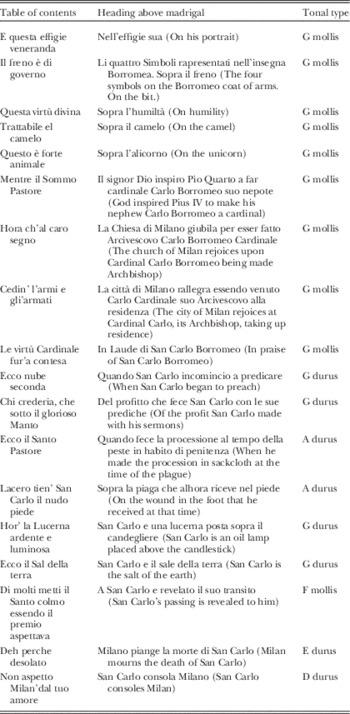
Giovanni Battista Porta’s Madrigali . . . in laude di S. Carlo (1616) even more directly documents the influence of the sermons than do the sacred concerti, for two madrigals in the centre of the cycle are full devoted to an exposition of Matthew 5:13–14 (see Table 1).Footnote 37 Comprised of eighteen spiritual madrigals on texts by Giovanni Pietro Giussani and dedicated to the Milanese commissioner general Gabrio Recalcati by the Archpriest Gerolamo Trivulzio, Porta’s Madrigali were intended for private domestic use, and according to the dedication, had been performed among members of the nobility both at the home of Trivulzio in Monza and in the rooms of Recalcati in Milan prior to their publication.Footnote 38 The madrigals contained are organised into smaller sections—a portrait of the saint, a study of the Borromeo family stemma, the young Cardinal’s appointment and entry into the city as Archbishop of Milan, the pastoral acts and the death and translation—and this layout derives, in part, from the vitae and miracle books, including the one by Giussani himself,Footnote 39 prepared in advance of the canonisation and distributed in printed form after 1610. The content comprising these books differs from author to author, but their basic organisation is roughly the same: a biography of Carlo Borromeo focusing on his noble lineage and his most significant public and pastoral acts, followed by detailed accounts of the miracles attributed to him. The adoption of this format was not accidental, but rather adheres chronologically to the documentation prepared to support the canonisation, which between 1601 and 1603 focused primarily upon recording the public and pastoral acts and thereafter turned to the miracles. In fact, the forty-four hangings depicting the life and miracles of Carlo Borromeo that were commissioned from various local artists by the Fabbrica of the Duomo followed this same model in both their relative order of preparation and organisation: twenty images of the life commissioned between 1602 and 1604 followed by twenty-four devoted to his miracles in 1610.Footnote 40
Organisation of Giovanni Battista Porta, Madrigali a cinque voci in laude di S. Carlo (Venice: Bartholomeo Magni, 1616)

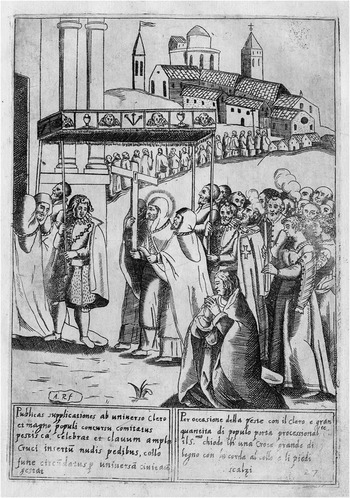
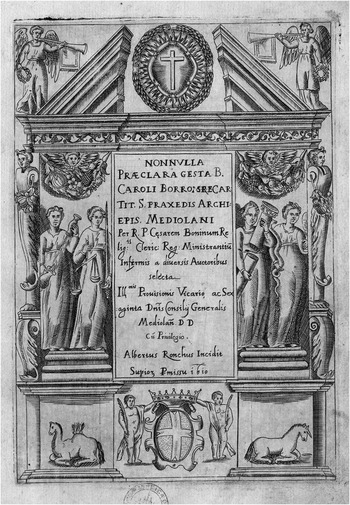
In the case of Porta’s Madrigali, the models admittedly extend well beyond the sermons and demonstrate not only the influence of literature and art on San Carlo available after the canonisation of 1610, but also the control exerted by certain dignitaries, namely Giussani and Trivulzio, who played a central role in shaping of San Carlo’s image. The first five madrigals echo the apparati designed for the canonisation celebration at the Duomo of Monza, where Giussani himself reportedly gave the sermon,Footnote 41 all of which are described in detail by Trivulzio in the official published account of the canonisation ceremonies in Monza. The organisation of the entire programme into smaller sections, moreover, appears partly inspired by Cesare Bonino’s Nonnulla preclara gesta B. Caroli Borromei of 1610, a widely disseminated collection of woodcuts accompanied by brief Latin explanations recounting the saint’s life and miracles (see Figure 2). Like the triumphal arch displayed on Bonino’s frontispiece (see Figure 3), four of Porta’s Madrigali highlight various components of the Borromeo family coat of arms, including the motto, the unicorn, and the camel, and, like Bonino’s introductory letter to his readers, the section of Porta’s Madrigali devoted to San Carlo’s pastoral acts emphasises his ministry and intercessory processions during the plague of 1576.Footnote 42
Cesare Bonino, Nonnulla praeclara gesta B. Caroli Borromei, tavola 27. I-Md S.C.B. 37. Copypright © Veneranda Fabbrica del Duomo di Milano

Cesare Bonino, Nonnulla praeclara gesta B. Caroli Borromei, title page. I-Md S.C.B. 37. Copyright © Veneranda Fabbrica del Duomo di Milano

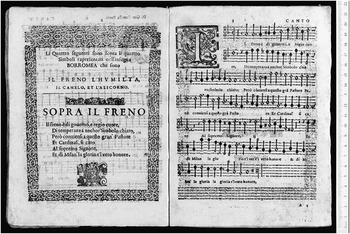
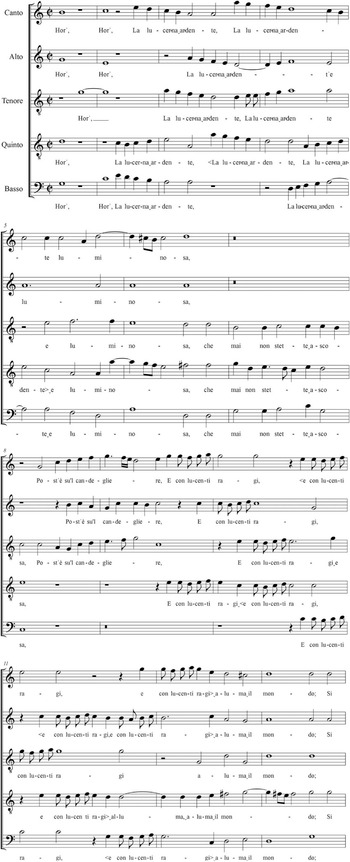
The painstaking attention to the layout of the volume suggests an attempt to target the growing audience of readers who were accustomed to using such collections for domestic meditation. Its appearance is strikingly similar to Orfeo Vecchi’s Marian cycle of spiritual madrigals entitled La donna vestita di sole,Footnote 43 which was published by Tini and Besozzi of Milan in 1602, in that the text and music of the Madrigali are arranged on facing pages of the print (see Figure 4).Footnote 44 Like La donna vestita di sole, moreover, the various sections of the programme are distinguished from one another tonally. In the case of the Madrigali, the selections devoted to the saint’s portrait, family heraldry, and ascension to the office of Archbishop of Milan are cast in G mollis, his first pastoral acts in G durus, the events associated with the plague of 1576 in A durus, and the death and translation in descending durus and mollis keys. The descent from A durus to D durus, moreover, is marked by a temporary shift from biographical narrative to scriptural commentary as the two madrigals expounding Matthew 5:13–14 ‘ye are the light of the world, ye are the salt of the earth’ are delivered in G durus. The Madrigali themselves, although destined for domestic use, are sophisticated in their free alternation of imitative and declamatory passages, frequent use of reduced textures, shifting vocal combinations, and the occasional chromatic inflection. In addition to the overwhelmingly syllabic setting of the text mentioned by Robert Kendrick,Footnote 45 what perhaps rendered the madrigals accessible to amateur singers were the numerous instances of stepwise motion and the short, easily identifiable imitative motifs (see Example 1). When singing them, the aristocratic participants collectively brought San Carlo’s story alive via a series of static musical portraits not unlike those in Bonino’s book of woodcuts, sonically tranferring the portraits painted in the public sermons to the private realm.
Giovanni Battista Porta, Madrigali a cinque voci in laude di S. Carlo, Canto 2–3. I-Bc BB.179. By permission of Bologna, Museo internazionale e biblioteca della musica

Giovanni Battista Porta, San Carlo è una lucerna. Hor’ la lucerna ardente, bb. 1–13

SERMONISING AND MUSICAL STRUCTURES
Sermonising was considered an art in post-Tridentine Italy, and, perhaps recognising its link to poetry and music as a performed art, writers of sermon manuals utilised terminology common to literary and musical essays in discussing it. It thus is useful to consider what the annual sermons commemorating Carlo Borromeo, which were also given in churches other than the Duomo, may have shared with the musical oratory, particularly the sacred concerti that undoubtedly had some place in the Milanese commemoration ceremonies themselves. Prior to 1610, the most commonly used manual on sermonising was the Modo di comporre una predica, a guide prepared in 1581 by the celebrated orator Francesco Panigarola,Footnote 46 who gave the funeral sermon for Carlo Borromeo in 1584. The volume’s popularity is witnessed by the fact that it was reissued several times during the late sixteenth and early seventeenth centuries, and further is referenced frequently in the most influential manual in use after 1610, Paolo Arese’s Arte di predicare.Footnote 47 In it, Panigarola defines the eight parts of the sermon and advises the speaker how to prepare it, placing particular emphasis on defining a primary proposition and including no more than three or four avenues of proof for it. He also instructs the speaker in what he terms the ‘ricercata di madrigale’, or the manner of composing a little prologue inserted at the beginning, middle or end in which the principal proposition is introduced via comparisons from nature, the Scriptures or other writings, a technique that he describes as good elocution. Finally, he points out the importance of scriptural writings in supporting an argument and suggests warning or exhortation as effective modes of concluding.Footnote 48 Panigarola’s prescriptions for organising the sermon apparently were widely known. In his Arte di predicare, in fact, Arese retains the basic structure outlined by Panigarola, with the exception that he takes issue with Panigarola’s assertion that the ‘ricercata di madrigale’, or ‘proemio’, can be inserted at the beginning, the main point of division or the end. Observing that Panigarola derives his placement of the ‘ricercata di madrigale’ from the placement of prayers in the liturgy, Arese advises the reader to use it at the beginning only, arguing that its proper role is to set the stage for the sermon.Footnote 49
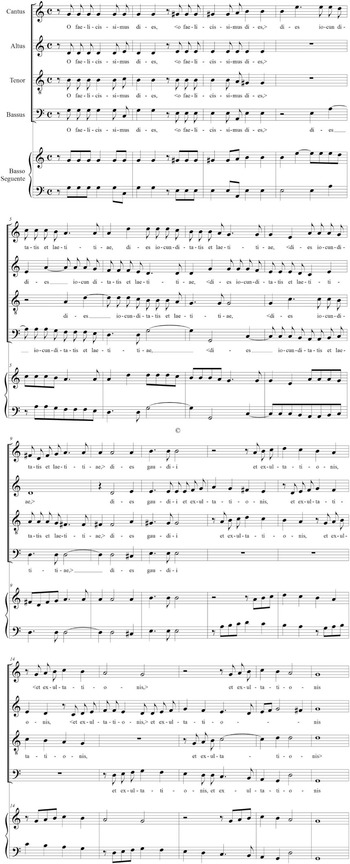
Many of the structural principles espoused by Panigarola are evident in the text of Cima’s O felicissimus dies. The principal proposition, correlating directly with the sermon of 1610, is that the feast of San Carlo is an occasion for rejoicing. The proofs lie in the fact that Carlo has been a light of the world and has now taken possession of his place among the angels, for which reason we are exhorted to sing ‘Alleluia’. Cima’s musical setting, as might be expected, adheres closely to the sermonising structure of the text, making use of several strategies suggested by Panigarola. Panigarola states that the primary proposition can be approached dialectically or rhetorically (meaning through techniques derived from classical rhetoric), and here, in keeping with the textual structure, the latter approach is chosen. The opening exordium ‘O felicissimus dies’ is declaimed twice homophonically in close succession, once in G durus and again in E in a sort of musical anaphora, after which the invention is amplified in two successive phrases that are linked to the exordium by the repetition of the word ‘dies’, using musical imitatio (see Example 2). The imitative material attached to the second and third phrases of text cleverly mirrors the exordium by reversing its harmonic direction, with an articulation on E (b. 11) followed by a cadence on G (b. 18), thereby effecting a sort of tonal antimetabole (repetition in transposed order) that provides a natural closure to the opening section.
Andrea Cima, O felicissimus dies, bb. 1–18

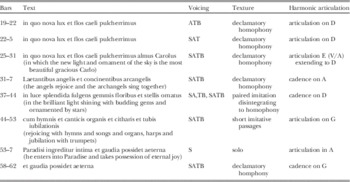
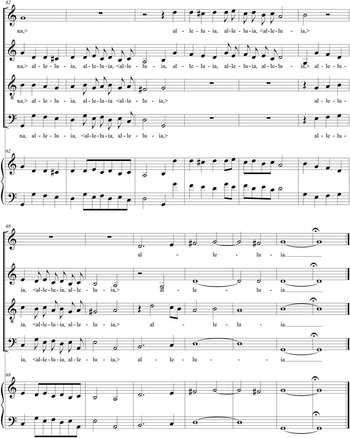
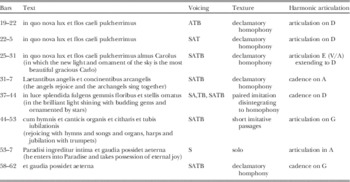
Panigarola also recommends constructing the proofs of the primary proposition, which should number no more than three or four in total, around a passage or a combination of passages from the Gospels, and then using other scriptural passages, histories, commentaries, theological writings and pre-existing sermons to augment it. In O felicissimus dies, Matthew 5:14, ‘ye are the light of the world’, is, of course, the central passage from the Gospel on which the proof is based, and it is retrofitted to the primary proposition of rejoicing on the feast of San Carlo through biblical allusions to the Israelites making a joyful musical noise from Psalms 97 and 116 and Genesis 4 and 31. Cima’s ‘proofs’ are further delineated through what Panigarola defines as ‘elocution’, in which San Carlo is compared to ornaments, gems and stars in the angelic constellation, all images that were surely familiar to those who had attended the annual commemorative sermons given in the Duomo between 1601 and 1610. It would be convenient to be able to argue that these textual proofs were musically mirrored by the use of quotation, allusion and imitatio, but the musical organisation of the proofs is more subtle. As Panigarola advises, Cima considers all the various stylistic conceits at his disposal, settles on the recommended number of three—declamatory homophony, imitation, and solo singing—and then logically organises them into two larger sections (see Table 2), the first of which (bb. 19–37) features declamatory homophony marked with a strong conclusion in the form of a long-awaited cadence on A, a point of division that had been foreshadowed by articulations on E as early as bar 10. Although Cima does not follow Panigarola’s suggestion that the first half of the section devoted to proofs be longer than the second, he does observe the recommendation that the second half (bb. 37–62) should present conceits diverse from the first and conclude with a brief recapitulation of the main proof. This is accomplished musically by introducing imitative and solo textures and then reintroducing the declamatory homophony that characterised the first half, as well as by reasserting the opening G durus tonality. After the proofs are expounded, there remains only the closing exhortation to rejoice, which is effected via repeated homophonic exclamations of the word ‘alleluia’ that serve to fully re-establish the G durus tonality (see Example 3).
Proofs of the proposition in Andrea Cima, O felicissimus dies, bars 19–62
By comparison, Pellegrino’s Exultate Deo makes no allusions to Matthew 5:14, ‘ye are the light of the world’, but instead paraphrases Psalm 80 as a point of departure. Yet the concerto’s primary proposition again derives from the sermons in that it calls on the Milanese populace to ‘Make a joyful noise to the God of Jacob’ in honour of its victorious saint. Here, however, the concisely stated proofs, which are again three, lie in the fact that San Carlo was inclined towards compassion, blessed by the people and thereby acquired victory, images of the ‘santo vescovo’ that were especially prominent in the sermons of 1605, 1607, and 1609. In the final paragraph of his sermon of 1609, in fact, the orator Maurizio de Domi interlaces these themes of San Carlo’s charity and compassion with the by then familiar portrait of an Old Testament-style prophet lighting the way for the children of Jacob when he proclaims:
We still will sing, o Beato, oh we will glorify the most high God, who through you wrought his mercy; thus we will form a sort of concert of two choirs, the one high with your voice in the midst of Jerusalem, the other low with ours in the hall of the temple of the God of Gods, when in the sight of all the people, you are canonised a saint with solemn ceremony and ceremonious triumph . . . you were a Sun, and a Sun you are, but do not leave us here alone nor abandon us . . . this city was your city . . .Footnote 50
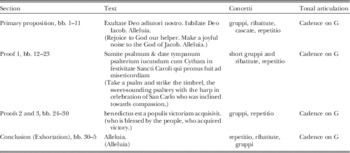
The joyous vocal delivery of Exultate, while on the surface seeming to proceed with a certain abandon, is actually highly organised from the sermonising perspective, as each of the major sections of the text culminates with a clear cadence in G mollis. The conceits that lend variety to the presentation of the proofs, however, are not in this case textural, as in O felicissimus dies, but rather gestural (see Table 3), and reflect in some measure the innovations introduced to sermonising by Arese and his circle around 1610.
Sermonising structure of Vincenzo Pellegrini, Exultate Deo . . . Sancti Caroli

Although Arese relied heavily on Panigarola’s theories of structure, he is credited with redirecting the discussion beyond the basic organisation and content of the sermon to issues of language and eloquence, thereby re-establishing the importance of fourteenth-century rhetoric’s three principal aims: docere, muovere and delectare.Footnote 51 The Arese scholar Erminia Ardissino argues that in this respect the early seventeenth-century rhetoric of Arese had much in common with contemporary trends in music: ‘Music itself assimilates the rhetorical theories and proposes the figure of the musical orator whose duties are to teach, to delight and to move, realised through a song for one voice only that makes possible a better comprehension of the content so that the words affect the thoughts of the listeners.’Footnote 52 For Arese, muovere (to move) meant to quiet the passions of the listener and focus the thought, while delectare (to delight) was ‘to find through a subject at this point familiar and characterised by repetitiousness “some new qualities, and [to do so] with unusual formality”’.Footnote 53Delectare, somewhat of an overriding preoccupation in Arese’s Arte di predicare, occurred when the invention was perceived to be both wondrous and paradoxical. To incite maraviglia or wonder, moreover, was of particular value because maraviglia served to sustain the curiosity and attention of the listener,Footnote 54 and it required ‘the demonstration that the subject was worthy of admiration and the amplification [of it]’.Footnote 55 Arese describes at length the means by which the subject of the sermon can be demonstrated worthy and the amplification that renders it wondrous, at one point neatly summarizing his proposals as he elucidates the analogous value of recounting classical legends: ‘First, therefore, the intellect takes pride in understanding new, curious and strange things; in knowing secret things, obscure to others; in penetrating the reasons of whatever effect. It willingly hears the histories and deeds of others and it enjoys the subtle, ingenious and unexpected inventions . . .’.Footnote 56
In the case of the concerto Exultate Deo, the musical form takes shape linguistically, with each of the three aforementioned sections elaborated via extension, variation and repetition in a manner not dissimilar to the two modes recommended for elongating periods by Arese:
either this extension will be of some single word that does not introduce a new conceit or a new sentence . . .—and this is not to suppose adding to the period, but rather the addition or even declaration of the last word of the period—or else the addition of words that have a particular or distinct meaning.Footnote 57
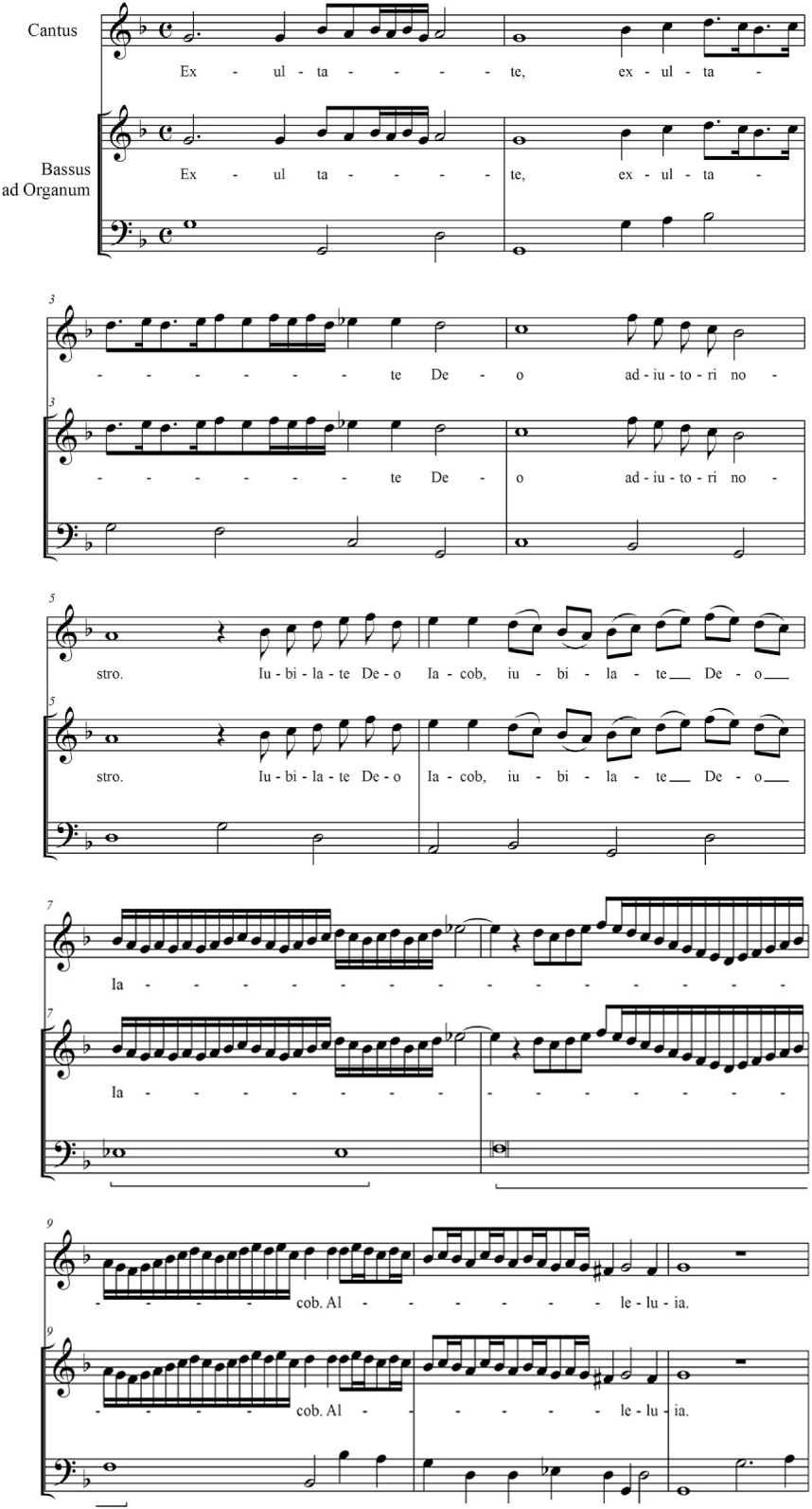
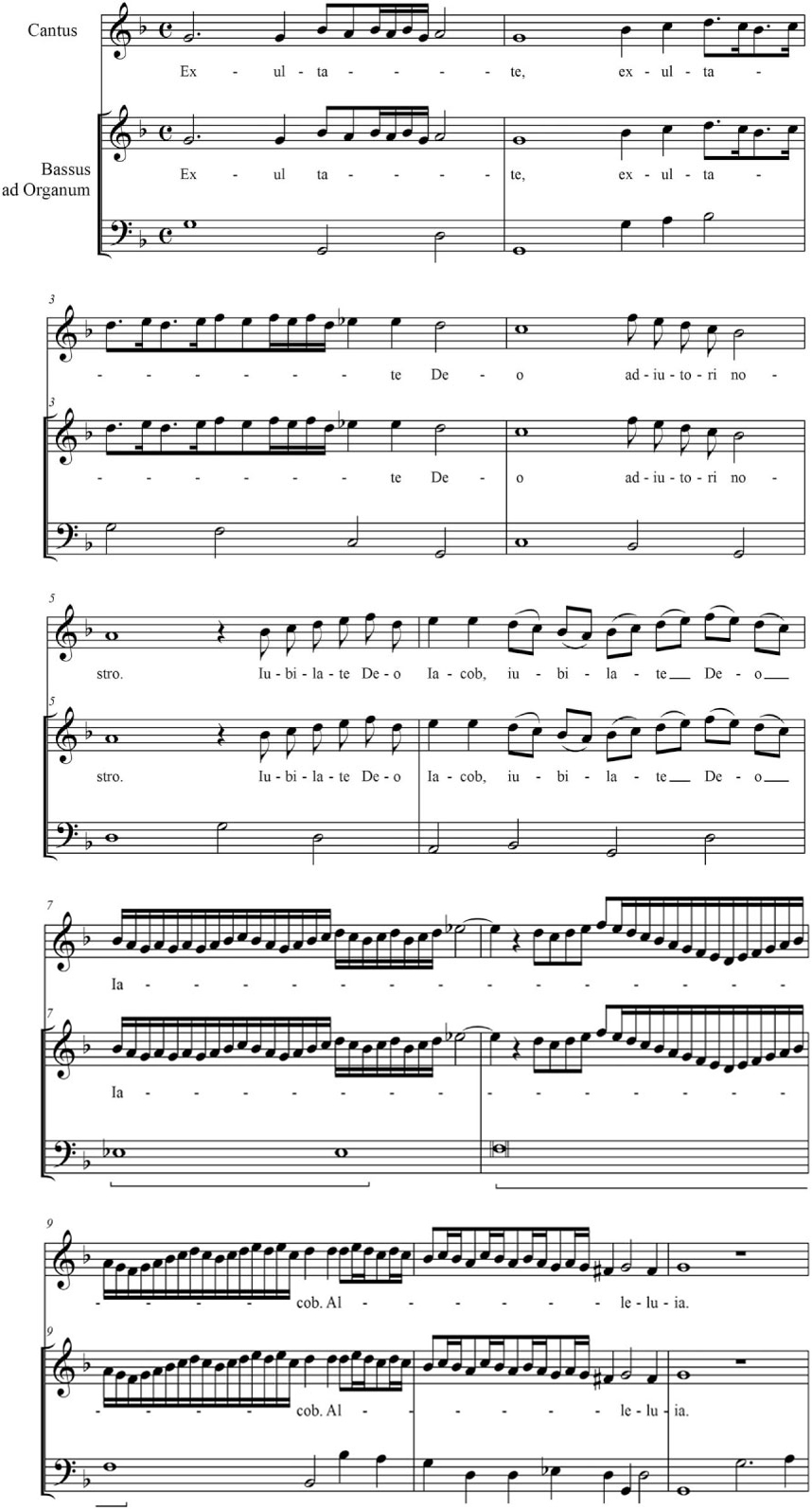
Within each section, moreover, the texture of solo soprano and organ facilitates comprehension of the text, thus making it possible for the listener to focus thought on delivery of the musical gestures. The individual vocal gestures to be utilised in arguing the proofs—gruppi, ribattute, and repetitii common to the early seventeenth-century solo song as described by Giulio Caccini—are introduced as part of the exordial primary proposition (see Example 4) and thereafter amplified through repetition, variation and recombination. The result is a tightly constructed vehicle for seemingly unrestrained vocalisation.
Andrea Cima, O felicissimus dies, bb. 62–74

Vincenzo Pellegrini, Exultate Deo … Sancti Caroli, bb. 1–11
DELIVERY, AURAL COLLECTION, AND MEDITATION
Early in the first part of his Arte di predicare, Arese acknowledges that ‘one divides rhetoric or the art of oratory into two principal parts . . . to the first part pertains composing the speech, to the second reciting it’.Footnote 58 As Andrew Dell’Antonio has shown, this new-found emphasis on delivery increasingly catapulted professional musicians into the role of cultural object and encouraged the aural collection of performances among the aristocracy, and this phenomenon extended even to sacred music of the period.Footnote 59 In Milan it is shown in the hiring practices of confraternities such as the Madonna Addolorata at Santa Maria dei Servi, which began enlisting solo singers from other institutions to perform at its services in the 1590s,Footnote 60 and the Society of the Ave Maria in Duomo, which around 1608 contemplated reducing the ranks of its singers, often described as the best in the city, from eight (2 sopranos, 2 altos, 2 tenors, 2 basses) to four in order to offer compositions that featured solo singing with organ rather than the standard unaccompanied polyphony.Footnote 61 It is further apparent in Giovanni Paolo Cima’s Concerti Ecclesiastici of 1610, which includes a number of concerti individually dedicated to singers active in the city and presumably tailored to their voices.Footnote 62 In short, the orator, the delivery, and the space in which the performance was displayed became important mental markers, both individually and collectively, of the collection process.
Unfortunately, it is not possible to document in every case precisely who sang the pieces dedicated to San Carlo or exactly how and when they sang them. As far as the canonisation ceremonies themselves are concerned, for example, the evidence reveals only that those held in the Duomo of Milan featured a procession during which litanies were sung, as well as a Mass and Vespers adorned by music for multiple choirs.Footnote 63 The cappella of the Duomo, some twenty additional singers drawn from other institutions throughout the city, several singers from the papal retinue, two extra organists, at least five local trumpeters and a few ‘musicians’ from the Castello participated in the festivities.Footnote 64 Nothing is said about solo concerti or solo singing, and because most of the extant sacred concerti date from slightly later, it is likely that they found their way into successive commemorations. Particularly intriguing are the potential scenarios for performances of Andrea Cima’s concerto a 4 O felicissimus dies, discussed above. Between 1621 and 1629 Cima served as an extra organist at the Duomo on the feast of San Carlo, and he may have composed the concerto for use there.Footnote 65 It is also possible, however, that O felicissimus dies was first sung by four well-known local singers before the famous Fiammenghini frescoes of the 1571 victory of the imperial forces at Lepanto that surrounded the organ loft at Santa Maria della Rosa, where Cima was serving as organist, during an annual commemoration of the canonisation.Footnote 66 Giovanni Battista Piccaglia’s Relatione reports that on the octave of the feast of the canonisation ‘the Reverend Dominicans . . . held a solemn Mass and Vespers of unusual splendour in their flourishing church of the Rosa before a very large attendance of the populace’,Footnote 67 an observance that may well have become customary on the octave of the feast during the succeeding years.
Pellegrini’s Exultate Deo and Congratulamini omnes in Domino appear to have originated with the annual commemorations of the feast of San Carlo held in the Duomo during the first decade following the canonisation. Both concerti were included in Pellegrini’s massive Sacri concentus of 1619, a volume that dates from the same year as his polyphonic Vespers for the feast published by the Duomo’s official printer.Footnote 68 The letter to the readers in the 1619 collection self-consciously addresses the especial importance of having the concerti sung by virtuoso singers well practised in the art of singing and ornamentation:
Nobody doubts (o kindest readers) that the music is rendered charming and delightful the more it is sung in tune and performed by good and excellent singers. . . even if my compositions at first glance may seem more easy than difficult, it is, however, obvious that without first rehearsing them, they should be sung with the skill they require; for improvising any action is a matter of fate, if one intends to achieve a fortunate end; whence I ask all the virtuosi to give it first consideration and rehearse them, for in so doing they will produce the desired end.Footnote 69
Robert Kendrick has postulated that Pellegrini intended Exultate Deo and Congratulamini omnes for Francesco Lucino, a bass who served at the Duomo between 1579 and his death in 1617. Exultate Deo, however, is a solo concerto for soprano,Footnote 70 and only one concerto in the Sacri concentus, Sub tuum praesidium, bears any dedication at all. The latter is, nonetheless, dedicated to Lucino and lies in the same relative range as Congratulamini omnes, so Kendrick is probably at least partially correct. Lucino, who was also the dedicatee of concertos by Giovanni Paolo Cima, Andrea Cima and Orazio ScalettaFootnote 71 and the highest-paid member of the Duomo choir aside from the maestro di cappella throughout the period,Footnote 72 was responsible as vice-maestro for supervising the additional singers hired for the canonisation ceremony in 1610Footnote 73 and participated in the ceremonies as a member of the Duomo choir between 1610Footnote 74 and 1616.Footnote 75 As Marina Toffetti has noted, his singing was lauded by the seventeenth-century chroniclers Girolamo BorsieriFootnote 76 and Filippo Picinelli,Footnote 77 and was the subject of a poem by Cherubino Ferrari.Footnote 78 The latter text not only alludes to Lucino’s local reputation and his mastery of the new solo style, but also lauds his sonorous low range and thunderous sound. In it, Ferrari equates Lucino’s singing of florid passages with lightning and his tone with thunder:
Sweetest bass,
profound base of the sovereign accents,
you are the wonder of the people.
No other is lauded from the Indian to Black Seas.
So low pitched, so sonorous,
that lowering your voice, you raise yourself up,
so that on beautiful Parnassus
the Muses sing of you in sweet song.
Lucino is lightning and his voice is thunder.Footnote 79
A bit more about the peculiar characteristics of Lucino’s voice can perhaps be inferred from a madrigal dedicated to him by the chronicler Giovanni Magistri. Its text is essentially borrowed from the well-known tribute to the bass Giulio Cesare Brancaccio by Giovanni Battista Guarini.Footnote 80 Magistri’s wholesale borrowing of the Guarini poem suggests that he perceived some similarities between the vocal attributes of the two singers in terms of range and quality. Like Cherubini, Magistri focuses on the issues of register, power and prowess; he describes Lucino’s voice as emanating from a tomb-like chamber with the qualities of an earthly bellows and a vast thundering sky:
When the lowest accents from his vital singing chambers
Lucino utters with delightful horror, they seem to reverberate round
about the air and the earth. And who does not hear the sound
without seeing who moves it and who welcomes it?
Do you say perhaps it is the grand world that bellows with art?
And the sound of the musician breathes from the depths?
Or do you believe that that the spacious sky was singing,
[and] that the spacious sky thundered with melody?Footnote 81
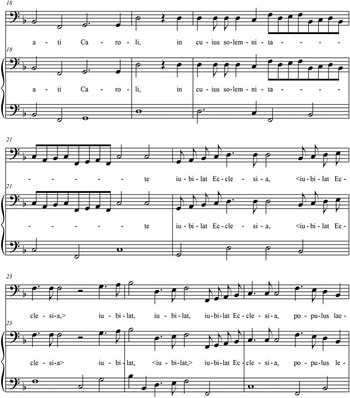
In keeping with the talents described by Cherbino and Magistri, Congratulamini features only modest fioratura, but it requires the ability to declaim passages over an extended register and also offers opportunities to add ornamentation of the sort implied by Pellegrini in his introduction to the Sacri concentus (see Example 5). With its emphasis on the demands of singing across the lower register, Congratulamini armed Lucino with a vehicle for casting the sonic spells for which he was apparently well known and thereby made possible his embodiment of the joyful singing demanded of Milanese citizens by the preachers who spoke at the commemorations.
Vincenzo Pellegrini, Congratulamini omnes in Domino, bb. 18–25

Exultate Deo is far more florid, and any singer wishing to improvise extensively throughout would be required to tastefully rework some already highly embellished passages for an agile virtuoso voice. There are, nonetheless, plenty of opportunities to add additional ornamentation without markedly altering the written fioratura, particularly at the cadences. Although Exultate Deo is designated as a soprano solo, it is possible that Lucino sang it in some version if he possessed the extensive range and skill in singing the ‘basso alla bastarda’ for which his nemesis Giulio Cesare Brancaccio was known.Footnote 82Exultate Deo, however, was more likely composed for Giovanni Battista Corrado, a soprano who was also serving in the cappella of the Duomo during and in the years following the canonisation of 1610. Corrado was the dedicatee of a concerto for cantus and bassus found in Giovanni Paolo Cima’s Concerti ecclesiastici of 1610Footnote 83 and, according to Picinelli, he was a favourite singer of Carlo Borromeo’s nephew, Cardinal-Archbishop Federico Borromeo.Footnote 84 Corrado was the highest-paid soprano in the Duomo choir at the time of the canonisation, a status which he retained throughout the decade that followed,Footnote 85 and had succeeded Lucino as vice-maestro by 1618.Footnote 86 Less is known about Corrado’s voice than of Lucino’s, but he clearly was a singer with whom composers such as Cima and aural collectors such as Federico Borromeo associated virtuosity and taste. He would have been seen as a representative voice of the nation, one that could sing in concert with the heavens.
That the singers for the canonisation personified both the Milanese populace and the angelic choir of which San Carlo was now a part seems to have been universally understood by the chroniclers and poets who witnessed the ceremonies, as well as the musicians who performed at them. According to the chronicler Giovanni Battista Piccaglia, the ceremonies in the Duomo on the day of the canonisation featured, among other things, a pontifical Mass in the Ambrosian rite sung in ‘the fullest and most exquisite’ music for four choirs and Vespers of equal magnificence,Footnote 87 a description supported by the archival sources.Footnote 88 Thus, when the Milanese nobleman Geronimo Trivulzio sought to describe the music sung at a makeshift chapel constructed in the piazza S. Francesco during the canonisation celebration held in neighbouring Monza, he not only took care to note the presence of a double choir, but also adopted the conceit of the human harmonising with the angelic:
The other eminent bell tower of the church was filled with lamps accommodated in various ways . . . and all were lit. In the location of the bells a choir of musicians ascended with a regal, who with the sweetest melody represented among the numerous lights a chorus of angels among the stars; and the sound of this choir harmonising with another stationed near the chapel, the one responding to the other with the sweetest songs, was a great wonder.Footnote 89
The image of human voices both intermingling with and embodying the angelic seems even to have pervaded the consciousness of the maestro di cappella Vincenzo Pellegrini when he composed the polyphonic Vespers for the feast of San Carlo printed by Giorgio Rolla in 1619 and preserved in Librone 11 and 11bis of the Duomo.Footnote 90 Although the polyphony is ostensibly for double choirs and the Duomo registers show that five to ten extra singers where hired annually to perform it on the feast,Footnote 91 the second choir sings in alternation with the first choir, duplicating exactly the counterpoint sung by the first, or sings with the first in reduced textures, so that while the musical forces are sometimes doubled, the polyphonic texture itself is never expanded beyond five to six voices. The special effects associated with it, therefore, were as visual as they were auditory in terms of the necessity of an expanded number of singers. Yet through the use of alternation and additional vocal reinforcements, Pellegrini effectively invoked the metaphor of a great nation singing in concert with the angels. Within this context of the human imitating the divine, the solo singer of the sacred concerto straddled both worlds through his ability to translate the nuanced declamation of brief sermonising texts and the vocal fioratura that elaborated them into angels’ food. In lines 4–6 of his sonnet in honour of the canonisation, Cesare Grassi perhaps unwittingly expressed this ability most eloquently:
When I learn through you new songs and sounds
It is a sweet, delicate feast, beloved and dear,
[of] angelic harmonies, high and happy.Footnote 92
Like the forty-four hangings commissioned by the Duomo, the vita and miracle books, and the poetry inspired by San Carlo, the sacred concerti composed for San Carlo in the years following the canonisation served to sustain and amplify the public perception of him as a national hero in the spirit of Moses or Elijah, two of the many prophets to whom he was often compared. By borrowing from the subject matter of the sermons given at the annual commemorations of the new beato between 1601 and 1610 and imitating the compositional techniques taught to the orators who gave them, the composers of the sacred concerti in honour of San Carlo reinforced the light-infused emblems that had been chosen to represent him and literally gave voice to the orators’ repeated and insistent exhortations to rejoice in the manner of the angels. The well-known virtuoso solo voices that delivered the message not only embodied the reception the nation was expected to imitate, but also stylistically heralded the arrival of a new Milanese patron saint whose persona was especially tailored to the modern age in which they lived.
Whereas the success of the sacred concerti for San Carlo depended upon the ability to evoke a visceral response to overwhelmingly aural stimuli, Porta’s Madrigali . . . in laude di S. Carlo (1616) resonated more strongly with the meditative practice of internalising visual cues, a process derived, in part, from the Spiritual Exercises of St Ignatius of Loyola.Footnote 93 According to their dedication, the Madrigali were sung in the rooms of local aristocrats and ecclesiastics on at least two occasions, and it may well be that certain of the attendees not only listened, but also sang as each successive image in the cycle was vocally reconstructed. The resulting aural pictures shared with the woodcuts of Bonino’s Nonnulla preclara gesta B. Caroli Borromei or the forty-four hangings of the Duomo the possibility of isolating specific images and engaging them more fully via the contemplation of content, form, gesture, colour, and texture, thereby allowing both the performer and the listener to meditate upon them and assimilate them into his personal experience.
REIMAGINING SAN CARLO
As with most enduring cultural icons, San Carlo Borromeo has been reimagined by succeeding generations who sought to refit his image to the changing social and political climate. Perhaps the first identifiable shift in posturing following the canonisation occurred with the plague of 1630, when the concept of a national hero lighting the way of a rejoicing populace no longer seemed fitting. Milan’s eternal noon had been dimmed by the ravages of yet another plague, and the memory of a barefoot pastor leading his penitent flock in processions and administering to the infirm during the epidemic of 1576 was rekindled. Among the various tactics adopted by the authorities to combat the plague of 1630 was the organisation of a procession that reportedly included carrying the saint’s recently exhumed remains through the city, an event that grotesquely, yet symbolically, mimicked San Carlo’s famed city-wide processions with the sacred nail.Footnote 94 Carlo Borromeo’s new-found role within this context is perhaps best captured musically by Michel’angelo Grancini’s concerto a 2 entitled O sol et salus Carole.Footnote 95 One of several concerti from Grancini’s Sacri fiori concertati of 1631 that appear to address the desolation and destruction of a great city and its population,Footnote 96 the concerto retains the familiar references to San Carlo as sun and light, but invokes his intercession as the pastor and defender of his people in time of affliction:
O Carlo sun and salvation, o light and love, o radiance and honour, o glory of Milan, San Carlo. Look down from the heavens, father, and see your afflicted and forsaken people. How greatly they suffer evil, famine, pestilence, and war. O good, benign pastor, o good merciful defender, holy Father, dear father, visit your people devoted to you and liberate us from every evil.Footnote 97
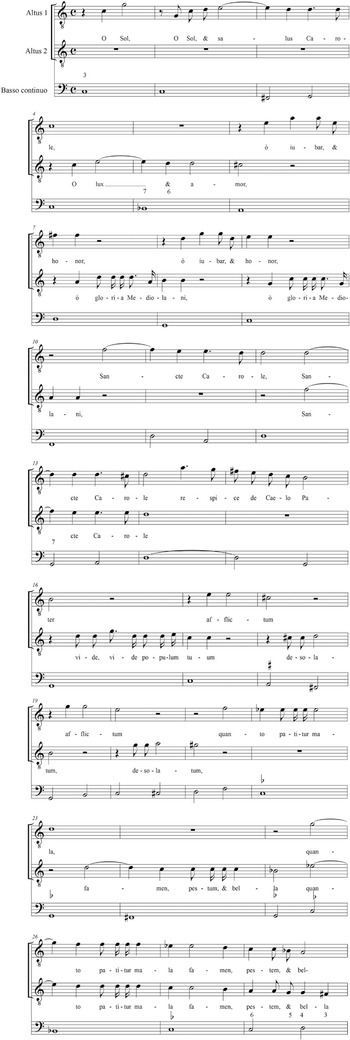
Gone are the biblical allusions to a rejoicing nation making a joyful noise in concert with the angels, gone are the charming vocal effects derived from the solo madrigal. Despite the pictorial rising fourths on words such as ‘sol’ (sun), ‘salus’ (salvation), and ‘gloria’ (glory) and the spirited imitative dialogue with which the initial acclamations to San Carlo are delivered, O sol et salus Carole is a lament of sorts (see Example 6). The descending half steps (bb. 5–13), falling thirds (bb. 17–19), and descending scales (bb. 14–16 and 25–8) found in the altus parts of the exordium in conjunction with the chromatic half steps of the accompanying bass (bb. 18–21), which itself repeatedly migrates downward and then crawls back upward, create a sensation of angst and ceaseless struggle.
Michel’angelo Grancini, O sol & salus Carole, bb. 1–28

A similar construction can be found in the first of three hymns to San Carlo preserved in Milan, Biblioteca Ambrosiana C. 193 inf., a source reportedly once in the possession of a member of the Lescot family who served in the parliament of the Ancien Régime.Footnote 98 Although the Ambrosiana’s catalogue suggests a date of 1501–1600 for this manuscript, perhaps on the basis of a theory that the texts were composed by Matheus Lescot, a sixteenth-century author who penned a Latin tribute to Ludovico Mazenta also preserved in the library’s collection,Footnote 99 it more likely dates from after 1610, as all three hymns contained refer to the saint repeatedly as San Carlo rather than the beato Carlo. The manuscript’s lengthy first hymn, Pange lingua singularis, sings of San Carlo’s famous brush with assassination by the Humiliati, praises his preaching and reforms, lauds his discipline of the clergy and recounts his ministry to the infirm during the plague of 1576. Here, however, the recollection of San Carlo tending his pestilence-ridden flock eclipses the images of a victorious hero lighting the way for a rejoicing city.
Vir Dei, contagion A man of God, in contact
Pestilentis aëris, with the pestilential atmosphere,
Solus urbe paenè sola nearly alone in the empty city,
Pastor atque Praetor est: he is shepherd and pastor:
Iura dat, ministrat idem He makes the law and administers
Sacra pestilentibus. the sacraments to victims of the plague.Footnote 100
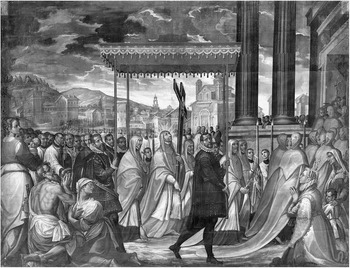
Such refashioning of San Carlo as an intercessor for the infirm in the time of plague is, of course, not entirely without precedent in the literature for the canonisation. Accounts describing him moving among the diseased of the city, providing for them and leading them in penitential processions, pervaded the life and miracle books and the sermons, and were famously depicted in the hangings designed to decorate the Duomo during the commemorations of the Beato Carlo and the subsequent feasts of San Carlo held there each year (see Figure 5). San Carlo’s pastoral activities during the plague of 1576 were likewise central to his biographical depiction in Porta’s aforementioned Madrigali. During the plague of 1630, however, the metaphor of San Carlo as a benevolent shepherd caring for his ravaged flock almost entirely eclipsed the previously advanced image of the victorious prophet looking down upon his rejoicing nation from among the angels of heaven, for the former expressions of joy were no longer socially current. Nonetheless, the core themes introduced in Bosso’s celebratory commemorative sermon of 1601 and perpetuated during the years leading to the canonisation—Milan as the theatre of the world, its citizens as the adoring chorus, and San Carlo as its central actor and eternal sun—continued to be sonically immortalised via the most current structural and stylistic devices that expressive singing had to offer, devices only befitting a new patron saint for the modern age.
Giovan Battista della Rovere detto il Fiammenghino, ‘Porta il Santo Chiodo in processione per scongiurare la peste’, Vita di San Carlo, 1602. I-Md. Copyright © Veneranda Fabbrica del Duomo di Milano

Appendix I
Canonical Hours in Honour of Carlo Borromeo in Milan, Biblioteca Ambrosiana S.M.GH.V.28 n. 7
AD VESPERAS
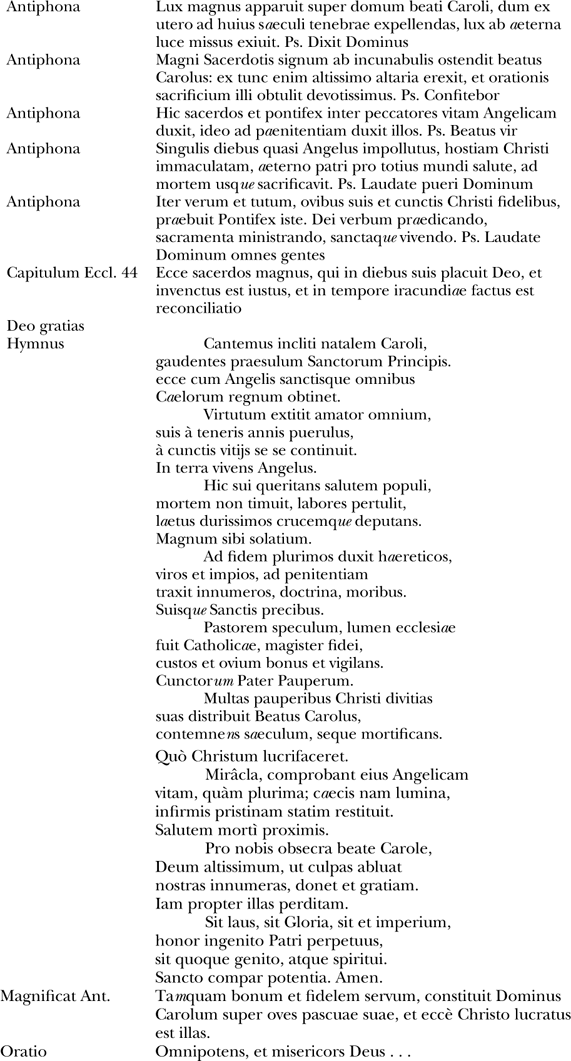
Matutina

In Primo nocturno

In secundo nocturno

In tertio nocturno

In tertio nocturno

AD LAUDES, ET PER HORAS ANTIPHONAE

AD Tertiam

AD Sextam

AD Nonam

AD Vesperas

Appendix II
Musicians Paid for Performing at the Duomo on the Feast of San Carlo in 1610
Lists of the names of the extra singers hired on the feasts of the Nativity of the Madonna and San Carlo for the years 1600–30 are included in Appendix 6 of Toffetti, ‘La cappella musicale del Duomo di Milano’, pp. 528–40, but the individual salaries paid to them are not reported there.
Regular musicians of the Duomo with their quarterly salaries as shown in I-Md, Mandati 36/3 (novembre–dicembre 1610), 14 December 1610

Extra musicians as shown in I-Md, Mandati 36/3 (novembre–dicembre 1610), 19 November 1610

Appendix III
Payments to the Extra Singers Hired for the Feast of San Carlo 1611–1618
I-Md, Mandati 38/3 (novembre–decembre 1611), 16 November 1611

I-Md, Mandati 40/3 (novembre–dicembre 1612), 22 November 1612

I-Md, Mandati 42/3 (novembre–dicembre 1613), 18 and 30 November 1613

I-Md, Mandati 44/3 (novembre-decembre), 17 November 1614
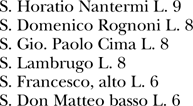
I-Md, Mandati 46/3 (novembre–dicembre 1615), 12 November 1615

I-Md, Mandati 48/3 (novembre–decembre 1616), 14 November 1616

I-Md, Mandati 50/3 (novembre–dicembre 1617), 28 November 1617

I-Md, Mandati 52/3 (novembre–dicembre 1618), 19 November 1618