

In this Brooklyn Rapid Transit incident is much suggestiveness as to what just now ‘goes’ in Wall Street. Establish a mystery, back that mystery by good, strong, stock-market manipulation, be cheerful continually, proclaim much of wondrous possibilities – and the speculative crowd on the Stock Exchange will fairly tumble over themselves in efforts to take all your securities off your hands. (New York Times, 2 April 1899)
Near the beginning of the Ridley Scott film A Good Year, Max Skinner (played by Russell Crowe) leads his trading team in a little financial skullduggery. The traders begin by massively shorting 10-year Gilts to push prices down. They then cover their position once prices have dropped, making over $70 million in just a few minutes. A particularly telling moment occurs when the falling prices induce another trader to panic and dump his bonds on the market, enhancing the profitability of Max's trade. In a later scene, Max thanks this trader for ‘contributing to my Aston Martin fund’.
In a case of art imitating life, London-based traders at Citigroup pursued a similar strategy about a year before the film was shot. On 2 August 2004, traders launched ‘Dr Evil’, selling €12.4 billion of various eurozone government bonds, pushing prices down. One half hour later, they bought back €3.77 billion at lower prices, earning a profit of €17.5 million. While various regulators investigated the trade and imposed sanctions, none pursued charges of market manipulation. However, Citigroup agreed to pay fines totaling almost £14 million to Britain's Financial Services Authority, suffered a damaged reputation, and was restricted from underwriting government bonds for a while, losing fees well in excess of the profit from the trade.Footnote 1
Seeking insights into price manipulation strategies, we examine a remarkable period in the history of the New York Stock Exchange (NYSE). In 1899, the Spanish–American war had just concluded and the US economy was finally booming after enduring a great depression following the Panic of 1893. After several years of light volume and despite the lack of investor protections available today, trading volumes reached record levels.
In this environment, a prominent bull, ex-New York Governor Roswell Flower, and a prominent bear, James Keene, both attempted to manipulate the price of Brooklyn Rapid Transit (BRT), a young, intermittently profitable commuter railway company. Flower and Keene were stock ‘operators’ who used ‘pools’ of cash from like-minded investors to push share prices higher or lower. We show how these two operators attempted to manipulate prices.
BRT is an ideal vehicle for studying price manipulation. It was the most actively traded company in 1899, with average turnover rates exceeding 300 percent per month. Moreover, trading around the turn of the twentieth century was its most active in NYSE history. BRT shares were a favorite of gamblers and speculators; long-term investors had little interest in the company because it did not pay a dividend. BRT was also one of approximately eight stocks publicly associated with Flower, who began promoting his interest in the shares in 1897.
For the less powerful, participating on Wall Street was fraught with risks as traders had few of the protections enjoyed today. Insider trading was legal, even expected. While there were rules setting minimum equity positions in margin accounts, buying or shorting on margin was cheap and easy. Speculators typically borrowed $9 for every $1 they invested.
Moreover, it was a challenge to obtain reliable information. Operators made frequent use of rumors, placed ads in the press, and traded with multiple brokers to inflate trading volumes, hide trades and influence prices. Though the NYSE required listed companies to submit annual reports starting in 1895, actual disclosure remained rare for many years (Sobel Reference Sobel1965). Finally, the press was biased in favor of the bulls with respected newspapers such as The New York Times talking up every rally and disparaging the bears, calling them ‘scarecrows’ and ‘grewsome’ (sic).
This open environment facilitated the activities of both bull and bear operators. Their techniques were more likely to succeed because many investors were highly leveraged, and they employed stop-loss limit orders to protect themselves. Operators were able to place speculators in untenable positions such that they had to close positions quickly. Overall, operators followed a simple strategy: create price momentum and let the market take over.
Financial crises which outrage the public often lead to legal and regulatory changes. In the US, there have been at least four such crises over the last century: (1) The panic of 1907 prompted the governor of New York to initiate an investigation of Wall Street practices which laid the groundwork for tightening margins and other reforms (Van Antwerp Reference Van antwerp1913) and the subsequent Congressional Money Trust Investigation fostered the creation of the Federal Reserve in 1913; (2) the Crash of 1929 triggered a series of reforms including the Securities Act of 1933, the Securities Exchange Act of 1934 and the Glass-Steagall Banking Act of 1933; (3) the dot.com bubble and Enron revelations led Congress to pass the Sarbanes-Oxley Act in 2002; and (4) the most recent financial crisis, centering on sub-prime mortgage loans, produced the Dodd-Frank Wall Street Reform and Consumer Protection Acts in 2010. While reforms often beget cleaner markets, at least in the short run, traders inevitably find ways to circumvent the new rules, sowing the seeds for future problems.Footnote 2
Though our study examines a period before investors enjoyed modern, legal protections, the strategies traders used to game the markets in 1899 are remarkably similar to the methods employed today, especially in lightly or unregulated private markets such as derivatives. Indeed, there are many such parallels in financial market history. For example, Allen and Moessner (Reference Allen and Moessner2012) compare the recent crisis to that of the early 1930s. They note that while the crises differ in their details, both crises were propagated by a set of suspect assets, and a subsequent flight to high-quality, liquid assets.
Our discussion continues with a general description of price manipulation strategies. Then, we focus on three distinct periods in 1899 when bull or bear operators were able to successfully manipulate BRT prices. We conclude with a synthesis of our story, drawing parallels to current attempts at manipulation by hedge funds and high-frequency traders.
I
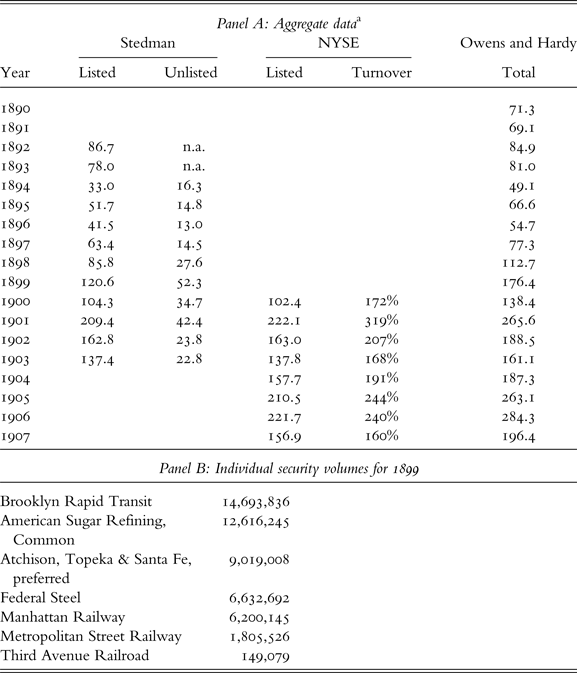
After surviving a prolonged recession in the wake of the Panic of 1893, the economy was booming at the turn of the twentieth century. Increases in agricultural and manufacturing exports facilitated the first significant gold imports in US history (Noyes Reference Noyes1909). The gold imports and improved economic conditions led to commensurate increases in banks' deposits and gold reserve holdings, an important determinant of the amount of money available for lending purposes. By 1899, sentiment nationally and among traders was mostly buoyant and this is reflected in trading activity, summarized in Table 1, panel A. Trading turnover, expressed as the ratio of shares traded to shares outstanding, rebounded from post-panic lows, reaching 319 percent in 1901, the highest figure in NYSE history. That number dwarfs modern-day figures, where the highest recent turnover rate was 105 percent in 2002, a number boosted by high-frequency trading.Footnote 3
Trading volumes

aStedman and Owens and Hardy report data for NYSE trading of both listed and unlisted securities while the NYSE reports data for listed securities only. Trading volumes reported in panel A are millions of shares. Turnover is the share volume divided by the average number of shares outstanding as reported by the NYSE.
Sources: Stedman (Reference Stedman1905), New York Stock Exchange (1956), historical data from the NYSE web page, Owens and Hardy (Reference Owens and Hardy1930) and the New York Times annual stock summary of 1 January 1900.
BRT was a traction, or commuter railway. It went public on 16 January 1896 following the acquisition of the Long Island Traction Company in a foreclosure sale (Poor's 1899, p. 1027). The three most actively traded traction stocks in the New York area were BRT, the Metropolitan Street Railway (MSR) and the Manhattan Railway. BRT was the most actively traded stock in 1899 (see Table 1, panel B), with a turnover rate of 39.3 based on a weighted average of 374,050 shares outstanding. This means every share of BRT traded over three times per month on average. In summary, BRT was the most actively traded stock during one of the most active years in NYSE history.
While it is difficult to determine its extent, manipulation by both bull and bear operators was common. Both the New York Times (hereafter, the Times) and the Wall Street Journal (the Journal) ran stories describing various bull pools and bear raids almost every day. Investors accepted operations were occurring and tried to predict which party would dominate for a particular period and stock. For example, on 16 September 1899 the Times commented:
Brooklyn Rapid Transit, which on Saturday appeared to have been rather neglected by the bears while their raid upon Metropolitan and Manhattan stocks was in progress, was again an object of serious and active attention yesterday, when the bears renewed their attack. The fates, apparently, were favorable to the crusade. Aided by the somewhat depressing London dispatches, the continued fear of tight money, and heavy speculative liquidation, it needed in the early day but a very little more to bring about a more or less general demoralization of timid holders, and thereby to encompass the further depression of the stock.
It is not surprising manipulation occurred given the limited investor protections extant. In contrast, the record trading volumes in the face of such manipulation is surprising. Observers such as John Moody (Reference Moody1906) of bond rating fame noted the preponderance of ‘get rich quick’ schemes. He divided market participants into three categories. Long-term investors carefully researched their positions, looking for quality companies offering a decent dividend yield. Well-informed speculators took shorter-term positions, maintaining respectable margins. Gamblers followed every hot ‘tip’ concerning the plans of the ‘big fellows’ while using ruinous degrees of leverage. One estimate suggested trading attributable to speculation and gambling represented more than 90 percent of all stock exchange activity (Noyes Reference Noyes1905). The presence of gamblers and speculators allowed prices to diverge from intrinsic value and made the operations possible. Indeed, since BRT did not pay a dividend, its intrinsic value to a long-term investor was zero. Speculators' focus on capital gains as opposed to dividend income allows the prices of non-dividend paying stocks to become unanchored from fundamentals (Hirota and Sunder Reference Hirota and Sunder2007). BRT's all-time high of 137 at the height of the speculative frenzy reflects a remarkable divergence from intrinsic value.
II
In 1908, The Ticker ran a series of articles by ‘Rollo Tape’ detailing the four steps of a successful bull operation. First, the operator would depress the price and begin acquiring a ‘line’ of stock while shaking out investors who placed a low value on it. The second step was to temporarily remove the stock from the headlines to persuade investors to look elsewhere. The operator simultaneously would add to his line, carefully avoiding dramatic changes in price. Then the excitement began. The operator would attempt to push prices up and induce the general public to buy as well, distributing buy orders over several brokers to hide his activity. Some orders might be ‘matched trades’, which were simultaneous buy and sell orders placed with different brokers to artificially inflate trading volumes. While illegal, matched trades were difficult to identify and according to The Ticker, were fairly common. All the while, the operator would test public sentiment by occasionally withdrawing his orders and observing whether the stock continued upward based on public buying. Once the investing public was in a state of excitement, the operator would gradually sell his line and count his profits. Typically, he would not expect to sell the entire line at the highest prices. Thomas (Reference Thomas1967) provides a telling anecdote involving Edward Harriman, the railroad magnate most known today for his role in the infamous Northern Pacific corner of 1901.Footnote 4 An associate asked Harriman if he could sell the associate's line of Southern Pacific for $80 per share, 10 above the prevailing price. Harriman said probably not, but he could boost the stock to 150 and have the line sold before the price fell to 100.
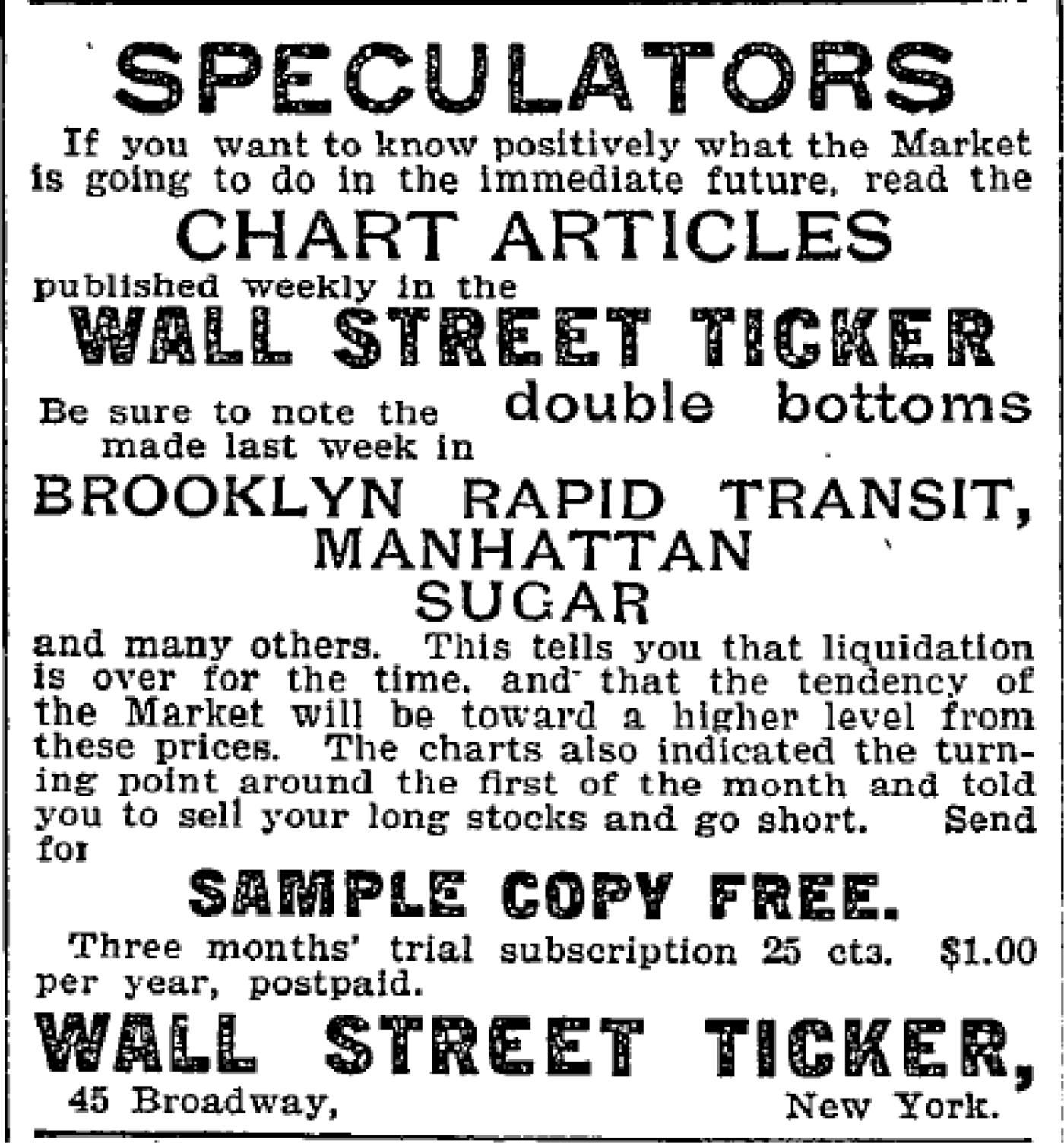
The operator might develop and spread rumors. For BRT, the most common bull rumors involved potential alliances with MSR and/or Manhattan, impending acquisitions, and the initiation of dividend payments. BRT insiders would also confidently talk about future prices, predicting targets of 150 or even 200. A difficult challenge for traders was to determine the source and veracity of the rumors. A few, such as those of impending mergers, were actually placed by insiders and were true. However, other rumors, such as the frequent discussion of upcoming dividends, were not and were deployed for the sole purpose of manipulating prices. Moreover, other rumors proved to be hot ‘tips’ of dubious origin. Newspaper ads touting various stocks or trading strategies were common. On 24 September, the Times ran an ad from the Wall Street Ticker claiming BRT, Manhattan and American Sugar Refining had all hit ‘double bottoms’ and were due for a rise (see Figure 1). Generally, the uncertainty engendered by poor disclosure of financial information, particularly by manufacturing firms, enabled this sort of behavior. However, by the 1920s, NYSE disclosure rules proved quite effective in reducing information asymmetries, especially for established firms (see Simon Reference Simon1989).
New York Times ad from 24 September 1899
In the latter stages of an operation, bull operators benefitted from the widespread practice of buying on margin, which allowed small speculators to borrow a significant portion of the investment and buy larger stakes than they could otherwise afford. It encouraged active trading and magnified gains or losses.Footnote 5 If share prices rose, the speculator would repay the loan from the sale proceeds and pocket the gain, earning a magnified return. However, the speculator would receive a margin call requiring a deposit of additional funds if prices fell and his account balance fell by half. If the margin call was not met, the broker would ‘call’ the loan and close the account, imposing substantial losses on the trader. There were no formal rules regarding borrowing in 1899 and the typical margin was 10 percent, although margins of 5 and 20 percent also were common (Nelson Reference Nelson1900). The interest paid by the speculator was determined by the ‘call money rate’, which fluctuated throughout the day with the supply of funds available for loaning purposes.
Both bull and bear operators would try to manipulate the call money rate directly by depositing or withdrawing funds from banks or indirectly by spreading rumors. One of the most important determinants of the call rate was the reserves held by New York banks, which were required to keep 25 percent of their deposits on reserve.Footnote 6 Anything beyond this amount could be loaned to margin buyers, and weekly bank statements from the New York Bank Clearing-House showing excess reserves were carefully scrutinized. Given the substantial gold imports of early 1899, banks had plenty of money to loan and call rates were quite low, benefitting bull operators as they were trying to induce small investors to enter the market.
III
Bear operators would also try to manipulate the call money rate:
Actual conspiracy has been not merely operating but clearly disclosed. Take, for example, an instance of this week. A broker hurrying upon the floor of his Stock Exchange, shouting anxiously for money, was able to borrow many hundreds of thousands. He started in at somewhere around a 10 percent rate, and by hysterical bids against himself lifted the quotation up to 30 or 40. The total of the loans he engaged is placed as high as $3,000,000. The excited vociferousness of him was supposed to show how very dire was his distress; how altogether necessary was it that he procure funds forthwith at whatever price. And under the pressure of his apparent exigencies the money rate went kiting upward to three or four times what it had been. Then he did not take a single dollar that he had contracted for. He paid the interest and let the lenders keep their money. The flagrancy of this needs no elaboration. (Times, 5 October 1899)
The strategy was effective at that moment as bank reserves had been steadily falling with the weekly bank statement of 7 October being one of the worst of the year.
Bear operators attempted to push prices lower. They would execute short sales by borrowing and then selling targeted shares. The cash, along with the required collateral, would be held in the short seller's account. Eventually, the short seller would cover by actually buying shares to fulfill his obligation. If prices had fallen in the meantime, the short would be able to buy the shares using only a portion of the initial proceeds of the short sale and pocket the difference. Then, as now, short sellers generally were not popular with the investing public.
Common bear rumors regarding BRT addressed the poor quality of its equipment, the likelihood of a strike, and the company's financial health. The substantial leverage employed by margin buyers assisted bear operators, since leveraged investors could go broke within days if prices fell 10 percent or more. As a precaution, a margin buyer who bought shares at $90 might place a stop-loss order at, say, $85, thereby protecting himself against losses greater than $5, and impracticable margin calls.
The Times coverage on 1 May 1899 suggests the goal of the bear raider was to depress prices enough to trigger the stop-loss orders of risk-averse margin buyers. ‘Of news developments none figured at all. The market was raided, it showed a tendency to yield, raiding vigor was redoubled, nearly every room trader on the Stock Exchange joined in attack, some nervous holders of stocks were frightened, stop orders were reached – liquidation was forced.’ Ideally, the selling pressure from stops that were triggered would depress prices further, triggering more stop-loss orders, creating a downward spiral in prices. This strategy proved to be more effective during periods of high call money rates, as interest costs would become more burdensome.
As short sellers had a legal obligation to eventually buy shares and deliver them to their broker, increasing share prices was a significant threat. Unlike regular purchases of shares which had a limit on losses (when the share price falls to zero), short sales' losses could explode if prices spiked. The risk was greatest during the infamous ‘corners’ which occurred periodically throughout the nineteenth and early twentieth centuries. An operator caught with a large short line during a corner was said to be ‘squeezed’ and would be forced to repurchase the shares at ruinous prices. As some of the bear operators had short positions of 50,000 or more shares out of 430,000 BRT shares outstanding, a squeeze had to have been a concern. One squeeze occurred on 20 September when the stock jumped 9.6 percent in the last few minutes of trading (Times, 21 September 1899).
A Times comment following one bear raid shows some things never change. ‘The one bear factor in the market has been that too many people have been carrying too many stocks – too many brokers have been enjoying more business than capital.’ That is, everybody was overleveraged. It concluded, ‘Markets such as yesterday's cure trouble of this sort’ (Times, 9 May 1899).
IV
Independent operators' activities captured the public imagination (Cowing Reference Cowing1957). The most prominent operators in 1899 were Roswell Flower and James Keene. Flower was a former New York governor and acknowledged market leader from late 1898 until his death on 12 May 1899. The NYSE and certain ‘Flower stocks’ experienced an incredible bull run under his tenure, keeping ‘the Stock Exchange in a constant state of ferment’ and filling ‘the newspapers with column upon column of sensational stories’ (Clews Reference Clews1908). In contrast, Keene was a bear throughout 1899. Many contemporary observers considered him to be the greatest operator in Wall Street history, saying Keene ‘does not bet on price-fluctuations; he makes them’ (Lefevre Reference Lefevre1902; see also Lawson Reference Lawson1905).
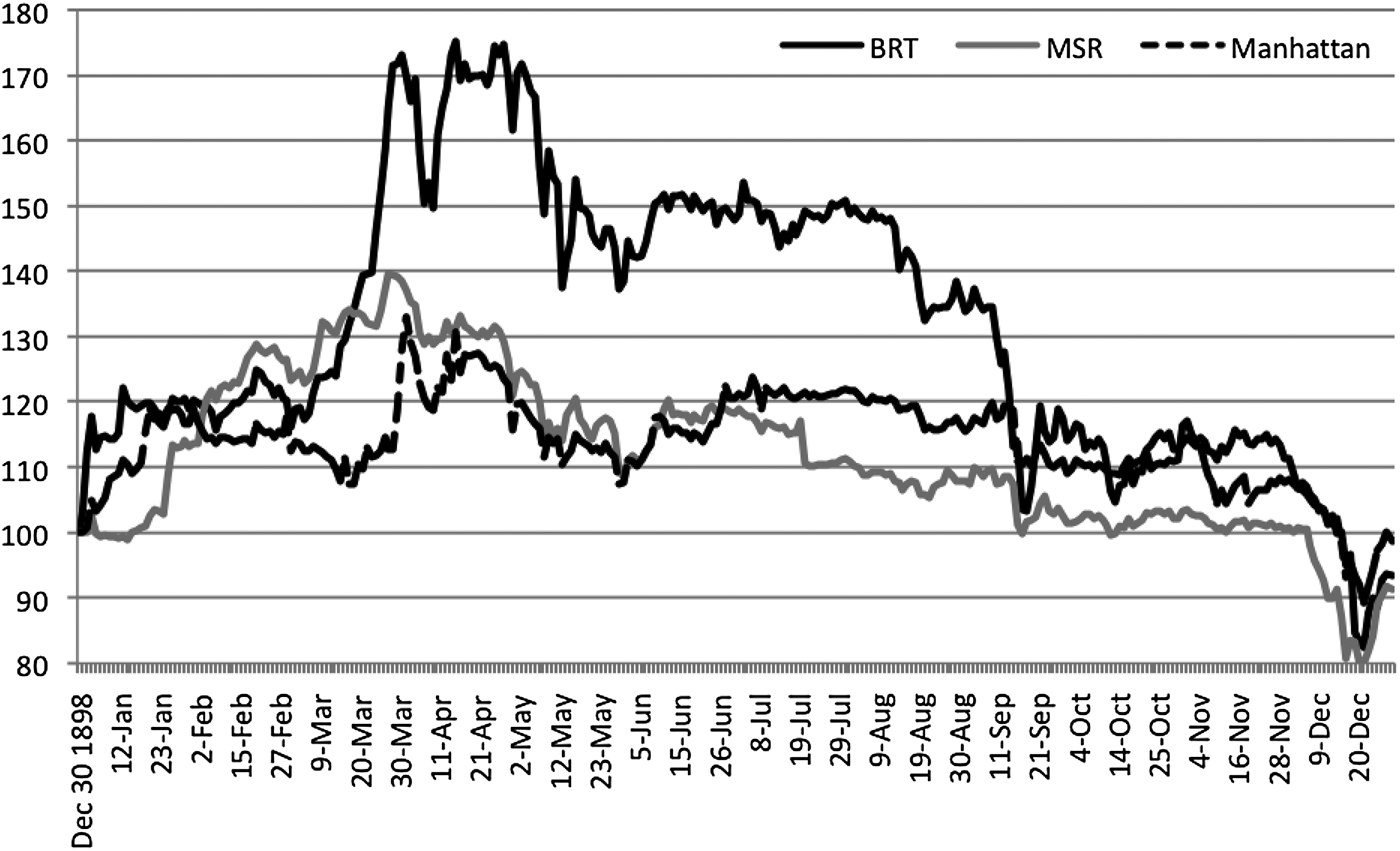
There were six distinct trading phases for BRT. We focus on three that are of particular interest: the great bull run of mid March to mid April, the two-week correction culminating in the carnage following Flower's death, and the various bear raids beginning in August and intermittently continuing through the end of the year. In Figure 2, we show the performance of BRT, MSR and Manhattan in 1899. While MSR and Manhattan also show signs of strength in the spring and weakness in the late fall, the movement in BRT is much larger.
Performance of BRT, MSR and Manhattan over 1899
The initial bull market of 1 to 13 January. BRT started 1899 with a bang and ‘maintained its reputation as one of the most remarkable stocks in the history of the stock exchange’ (Journal, 6 January 1899). The primary bull point was the rumor of an impending merger with the Nassau Electric Railroad. BRT jumped from 79 7/8 to 87 3/4 on 4 January, the day the rumors were strongest, leading BRT to issue a statement ‘You can deny absolutely that there is any truth in the rumor. The B.R.T. Company has no desire for, and does not intend any consolidation of interests with the elevated system’ (Journal, 5 January 1899). Despite the denials, the merger was announced on 12 January. The market generally was buoyant and active compared to the rest of the year. There were four one million shares days compared with an average daily volume of 592,082 shares over all of 1899 and call money was typically easy, ranging from 2 to 6 percent. Overall, BRT's rise of 21.9 percent was among the best returns of the year.
The lull of 14 January to 7 March. While overall NYSE volumes continued to set new records throughout January, trading in BRT was in a quiet phase. BRT ranked first or second in trading volume on 151 days in 1899, but only one of those days occurred during the lull. BRT's performance was similarly flat, with a loss of 1.6 percent.
Shareholders did approve an increase in equity capital from $20 million to $45 million. The voting trust controlling BRT used the proceeds to consolidate its control of Brooklyn's commuter railways, providing operators with bull points. While there were minor bear raids, insiders used the temporarily depressed prices to increase their positions with little overall impact on prices. By March, the insiders were well positioned to profit during the next phase of their operations.
The great bull market of 8 March to 28 April. Flower power reached its peak with BRT advancing 47.8 percent to its all-time intraday high of 137 on 15 April.
Brooklyn Rapid Transit . . . has been boosted close to $140 per share. Just why nobody knows. Agreeable tales of the tremendous earnings of the property go the rounds; suggestions of wondrous accomplishments close at hand are the vogue; yet, as matter of fact, nobody but the few men in control of the property know actually anything about what the corporation is doing, can do, or is likely to do. One clear fact is that no money is being dissipated on dividends. (Times, 2 April 1899)
Despite the Times' professed ignorance, BRT clearly was in the hands of a masterful manipulator.
The run began with reports of heavy Flower buying and more acquisition rumors. The Times was prescient in its reporting of 10 March, ‘In Brooklyn Rapid Transit and People's Gas there was Flower buying that was looked upon as indicating new activity on the part of that group of financiers headed by ex-Gov. Flower’ (Times, 10 March 1899). Flower helped move prices up, saying ‘The market acts all right. It is a bull market, and there's no mistaking it’ (Journal, 14 March 1899). Flower buying probably reached its peak around 29 March when the intraday high was 136 3/4, just shy of the record for the year. However, the broader market had joined in the fun: ‘Flower interests were again the most conspicuous buyers, but there was more commission house activity in the stock than there has been at any time since its sensational advance began’ (Times, 30 March 1899). Commission house activity indicated buying by other speculators and investors. BRT trading of 254,282 shares represented 22.5 percent of NYSE volume and an incredible 86.2 percent of BRT shares outstanding.
Rumored and actual acquisitions provided the significant bull points. For example, the rumored acquisition of the Long Island Rail Road appeared in the Times on 10 March. Subsequent rumors concerning the negotiations followed and the actual alliance was announced on 2 April. BRT's price concurrently increased from 95.75 to 132. There were also frequent vague rumors of good things to come, including potential alliances with either MSR or Manhattan and the initiation of a dividend (all of these rumors persisted throughout the year without coming to fruition). In summary, between judicious buying and the careful spreading of rumors, the insiders were able to bring about a dramatic increase in prices.
BRT experienced a short correction in early April. The Times suggested a bear raid on BRT and other Flower stocks might be beginning. Under the headline ‘Bears and the Flower Stocks’, they noted:
Professional room traders concentrated most of their bearishness yesterday upon the Flower group of stocks. They sold Federal Steel, Brooklyn Rapid Transit, and People's Gas aggressively all day, taking advantage of the natural profit-taking movement that was general throughout the market. The bears succeeded in reaching stop orders in Flower quarters, and, with the help of these, they were able to bring about declines in the stocks. (Times, 5 April 1899)
BRT opened at its daily high of 132.5 and fell all day to close at 128.5.
Worse was to come. Another big fall on 6 April was attributed to ‘the execution of stop-loss orders, and rather aggressive selling for the short account’. However, insiders were seen as supporting the stock at around 121 (Times, 7 April 1899). Trading on 7 April was particularly volatile with a trading range of 14 points, the largest of the year. Moreover, the trading volume of 149,480 represented 39.7 percent of the shares outstanding.
The market was primed for such a correction; it was overbought and overleveraged. Wall Street gossip suggested several banks had borrowed about $20,000,000 each on behalf of their clients. It is not surprising the correction was precipitated by a spike in call rates given this ‘enormous’ leverage. While call rates had ranged from 2 to 6 percent for much of the year, they spiked to 15 percent on 7 April, forcing the liquidation of many margin accounts.
BRT began its last significant bull run on 11 April as the call money market returned to normal and buying by the Flower interests induced short covering. The stock received a boost towards its all-time high of 137 on 17 April from more rumors of buying by people associated with the MSR or even the creation of a great alliance between BRT, MSR and Manhattan. Even so, the final move was in the face of increased bear activity, the first hints of trouble ahead.
The correction of 29 April to 13 May. The correction had its genesis in the passage of the Ford Franchise Tax bill by the New York legislature on 29 April. The bill was designed to tax the assets of New York based companies, especially traction companies such as BRT. Bears took the opportunity to short the stock, inducing liquidation by margin buyers and causing a fall of 10 1/8 over the next two trading sessions. The drop in prices was not entirely unwelcome, ‘Cynical observers are inclined to believe that such (important bull) operators were indeed willing to see just such a reaction as has been brought about, inasmuch as it may afford them opportunities to get back large lines of stocks sold quietly during recently buoyancy . . . The most powerful financial interests of Wall Street were buyers on a tremendous scale throughout the weakness’ (Times, 2 May 1899). The rebound continued until 8 May when the correction began in earnest and culminated with Flower's death on the evening of 12 May and the stock market reaction on 13 May. In total, BRT dropped 21.3 percent.
The raid beginning on 8 May was significant as it was the first time Keene was publicly identified as an operator in BRT. There was a prevalent idea among brokers that ‘James R. Keene, the leader of the “bears”, was out after the pelt of ex-Gov. Flower, the leader of the “bulls”. While the entire list of stocks was affected by the decline in prices, the so-called Flower stocks led in the downward movement’ (Times, 9 May 1899). Typically, BRT was the most actively traded stock with 175,486 shares changing hands. The next few days were volatile with intermittent inside support. The volatility ensured that most of the margin buyers had already been forced to close their positions. If they had not, trading in the short session of Saturday, 13 May would have been worse.
Flower took the weekend off to go fishing and had a heart attack around 2 p.m. on Friday. Rumors concerning his ill health began circulating just before the market closed, resulting in a ‘smashing drive’ on BRT (Times, 12 May 1899). He died at 10:30 p.m. following a second attack. Trading the next morning was intense, with declining prices across the board, but especially in the Flower stocks.
When the large clock in the Stock Exchange indicated the hour of 10 yesterday morning, a roar of human voices arose from the densely crowded floor such as had not been heard there in many years. Never before were there so many brokers assembled in the trading room, and never before was there manifested such an ungovernable eagerness to sell stocks. (Times, 14 May 1899)
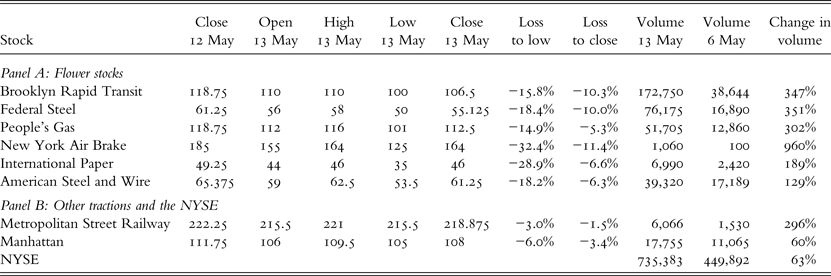
We report the close on 12 May, and the open, low, close and change from the previous days' close on 13 May for selected Flower stocks, plus MSR and Manhattan in Table 2. The Flower stocks all suffered precipitous declines at the open. In contrast, MSR and Manhattan's losses were relatively small. Prices did rebound, probably due to some timely intervention. Clews (Reference Clews1908) claims:
The Rockefellers, the Vanderbilts and his (Flower's) other wealthy friends rushed into the market with millions and sustained values. They were in a position to attribute the threatened reaction to his death and pointed out the absurdity of letting such an incident affect the value of stocks. They discounted the break that must have come in the natural course of events under the forcing process that was going on.
Price changes in the ‘Flower’ and selected traction stocks on 13 May 1899, the day following the death of Roswell Flowera
a The loss to low is the percentage change in price from the close of 12 May to the low of 13 May. The loss to close is the change in price from the close of May 12 to the close of 13 May. The base for the change in volume is 6 May, the previous Saturday.
Source: New York Times daily stock quotes.
Table 2 also reports volume figures for 6 and 13 May, which were up across the board, but especially for the Flower stocks. The Times estimated Flower & Co. alone was responsible for 30,000 shares of the trading in BRT, demonstrating the impact Flower and a limited number of other operators had on the stock market (Times, 14 May 1899).
The summer lull of 14 May to 12 August. ‘Midsummer dullness, nobody of importance engaged in active operations, results in a market exceedingly uninteresting’ (Times, 20 July 1899). BRT rebounded 8 percent over the first week following Flower's death and was nearly flat over the remainder of the summer, losing 0.2 percent on reduced volume. The only item of interest was a short-lived strike beginning on 16 July. However, even strikes can be a tool of the operators. The Economist newspaper reported charges that ‘members of certain organisations, newspapers, and houses in the Street, who may or may not be interested on the bear side of the market, have conspired to induce the dissatisfied employés of the Brooklyn railways to tie up the roads to bring great loss upon the companies, and so depress the prices of their securities.’ It went on to note that the Wall Street representative of ‘one of the best-known newspapers in the world’ might have been in league with the operators.Footnote 7 Otherwise, the typical rumors regarding alliances, dividends and gold flows had little effect. Even so, Anson Flower predicted BRT would hit 200 in 1900 and 150 ‘before the leaves fall’ (Times, 18 June 1899). He was wrong.
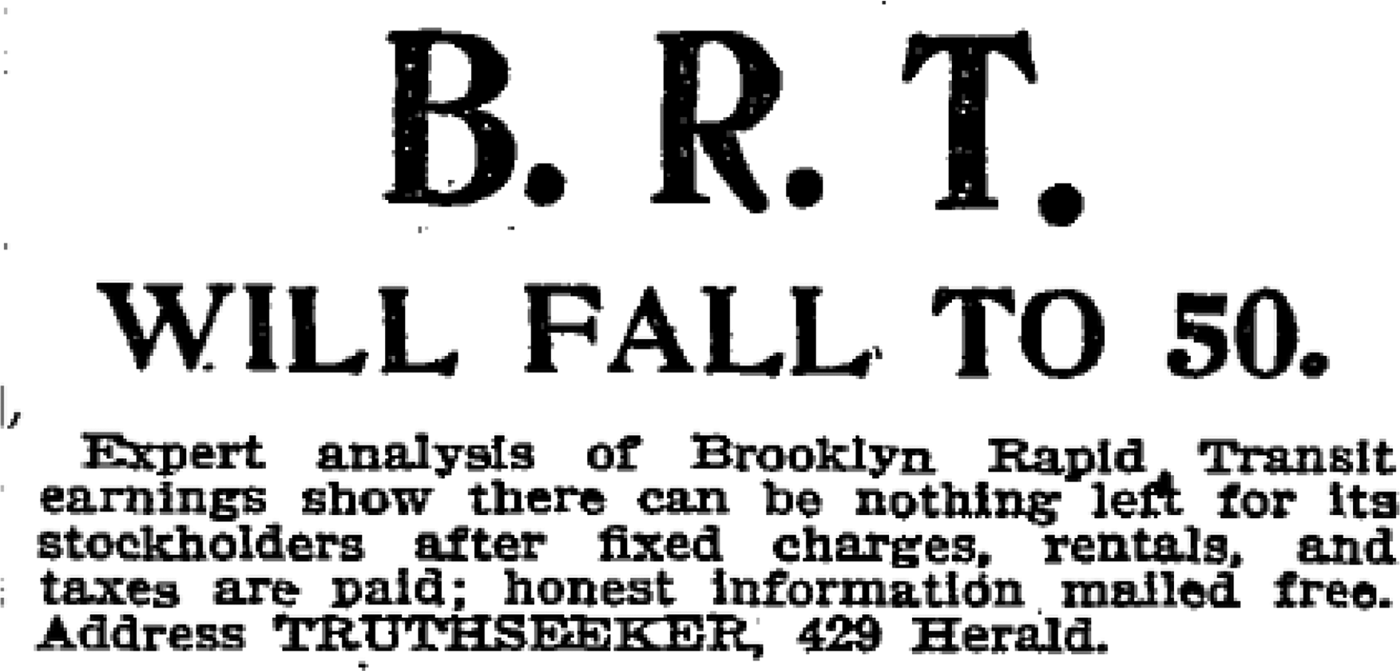
The bear raids of 14 August to 31 December. On Sunday, 13 August, the Times carried an ad, shown in Figure 3, from ‘TRUTHSEEKER’ claiming ‘B.R.T. will fall to 50.’Footnote 8 The ad initiated a battle that resulted in a roller-coaster of ups and mostly downs for BRT through year end. There were significant bear raids in mid August, mid September, mid October to early November, and mid to late December with BRT losing a net total of 37.0 percent. The raids were aided by a general pessimism engendered by the start of the Second Boer War between the British Empire and two Boer republics in South Africa. Plus, call rates increased as money underwent its annual tightening due to the fall process of ‘moving the crops in’ and money out to pay for them.
The First ‘Truthseeker’ ad
The raids had several common features, including significant short-selling designed to trigger stop-loss orders, reduced inside support and a lack of credible bull rumors to offset increasingly dramatic bear rumors, some of which were deliberate falsifications. Keene's plans and the size of his short position were subjects of intense interest. While prices typically would recover as the shorts covered their positions and bargain hunters began buying, each rebound stopped at successively lower prices with the exception of the October raid.
Comprehensive data concerning short-selling or insider buying is unavailable, but the Times' coverage is suggestive. One rumor claimed ‘a holder of 50,000 shares for the long account had sold his stock privately to the short element at 80, having had it intimated to him that unless he yielded gracefully the quotation would be forced much lower’ (Times, 21 September 1899). In October, Keene and another disgruntled trader were said to be short more than 50,000 and 100,000 shares respectively.Footnote 9
The October/November raid was notable for its duration, the strength of the raiders' efforts, and its lack of success due to the equally strong response by insiders supporting the stock. It began on 13 October when BRT fell from 85 7/8 to 82 3/8 and ‘90 percent of the sales of it were palpably for short account, and the short interest in that stock is practically half a dozen times as great as all similar commitments in any other security on the list’ (Times, 14 October 1899). However, the bears faced a formidable foe; a buying pool organized by the Flower and Standard Oil interests purchased 120,000 shares during the September raid, again predicting the stock would hit 150 within a year (Times, 6 October 1899).
Rumor-mongering and short-selling during this period were nothing short of spectacular. On 17 October, the Times reported rumors that excessive electricity was escaping from BRT wires near the Brooklyn Bridge, supposedly harming pipes and the vitals of the bridge. Moreover, BRT rails were ‘being rapidly reduced to streaks of rust’. Keene released a bearish manifesto around 22 October in which he noted that the managers of all the traction stocks preferred to deal in mysteries and made little in the way of tangible disclosure.
However, by 5 November the talk was turning in favor of the bulls when the Journal quoted a trader as saying ‘About the only talk that is heard during times of excitement in a stock like Brooklyn Rapid Transit is in the nature of discussions of how large a short interest may be, and how long before it will be forced to cover. In BRT, for instance, the buying certainly indicated that there was a concerted movement to bid the price up to a point where a supposedly large short interest would be forced to cover’ (Journal, 6 November 1899). The raid was finished by 10 November when the stock closed at 86 (1/8 higher than the open on 13 October) and the Journal reported a trader as saying ‘I would not care to stay short of this market too long. In fact, I presume the amount of shorts stocks carried over night on this decline are unusually small’ (Journal, 11 November 1899).
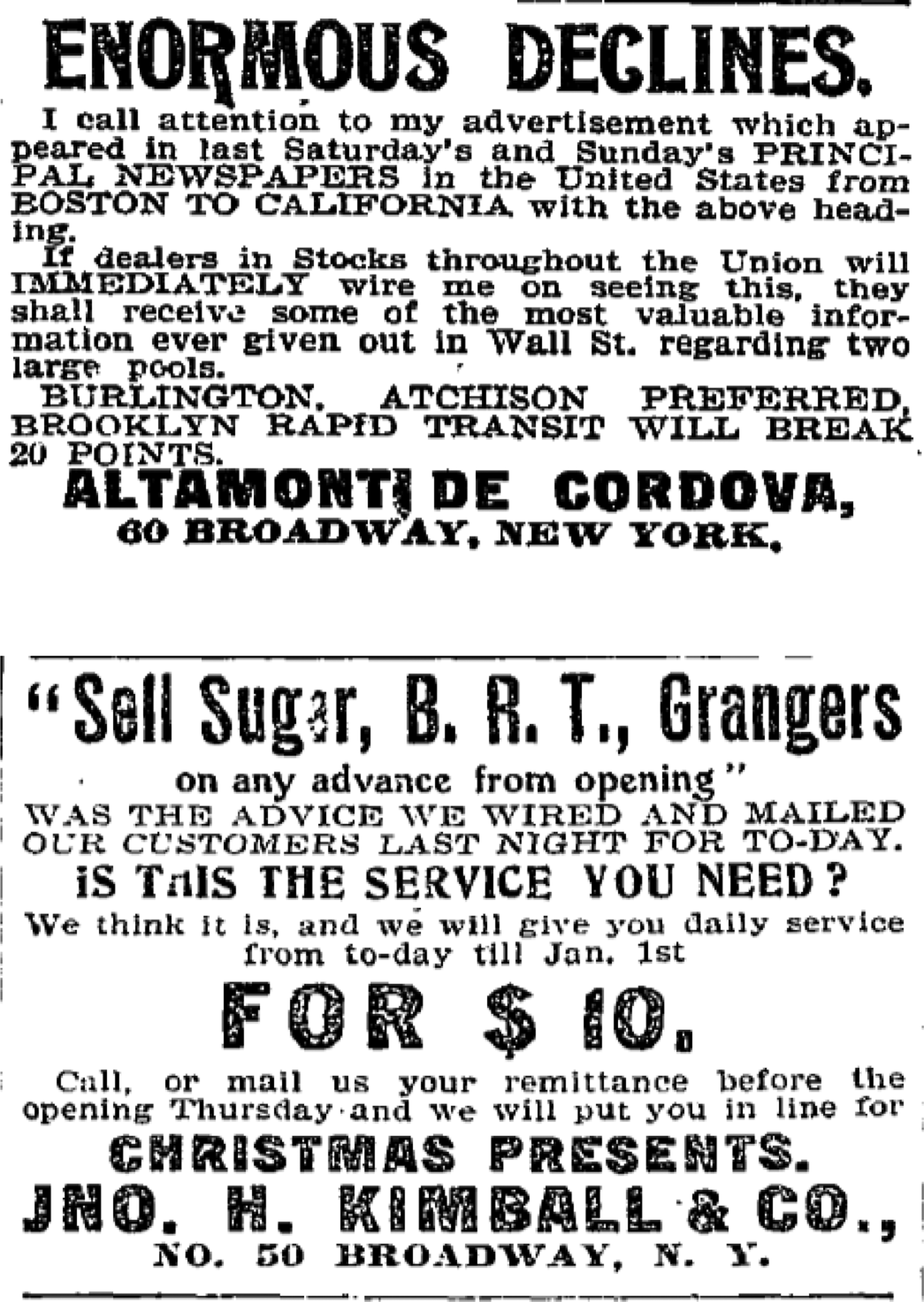
The December raid was the most dramatic of the year for BRT and a number of other stocks, including MSR and Manhattan. It started slowly, on 4 December, with rumors that BRT would be forced to issue new debt. Moreover, both the Supreme Court and President McKinley made decisions widely seen as anti-business. It climaxed on 21 and 22 December on rumors that BRT would be forced into receivership. Along the way was a ‘Day of Panics and Financial Wrecks’ when nearly every stock on the NYSE dropped and the call rate spiked to 186 percent. The general collapse began on 13 December as pools formed to buy and bid up BRT, MSR, Manhattan and American Sugar unwound (Times, 14 December 1899). The next day, two ads, shown in Figure 4, appeared in the Times suggesting imminent declines in BRT. Moreover, there were new rumors that lawsuits targeting BRT were prompting inside liquidations (Times, 15 December 1899).
Bearish ads from stock picking services
As the Times commented, 18 December ‘in many respects . . . was probably the worst single-day panic the Street had ever known’ (Times, 19 December 1899). Losses were near uniform, with only three thinly traded stocks up for the day. BRT's decline of 5.2 percent was typical, with MSR, Manhattan and the Dow Jones Railway Index falling by 7.2, 5.5, and 4.3 percent, respectively.
The market opened unsettled on bad news from the Boer War, London and Boston. The uncertainty was exacerbated by the failures of two moderately prominent Wall Street firms and the inability of banks to keep their promise to maintain call rates of less than 6 percent. Finally, there were rumors of the death of Queen Victoria (which actually occurred in 1901). The Times provided an evocative account:
On the floor of the Exchange, which all day had been a perfect bedlam, the scene was wellnigh indescribable. Brokers – and the room was alive with them as it had not been in years – gathered at the various trading posts and shouted and shrieked and sold, all the while prices falling, falling, falling. Stocks were dumped on the market by the wholesale, and where there was no ready buyer the quotations went down until a purchaser was found. Often sales prices dropped a point or two at a time. (Times, 19 December 1899)
As was so often the case, J. P. Morgan & Co initiated the rescue, offering to lend $1 million at 6 percent at 2.30 p.m. Several banks followed and prices stabilized by the close.
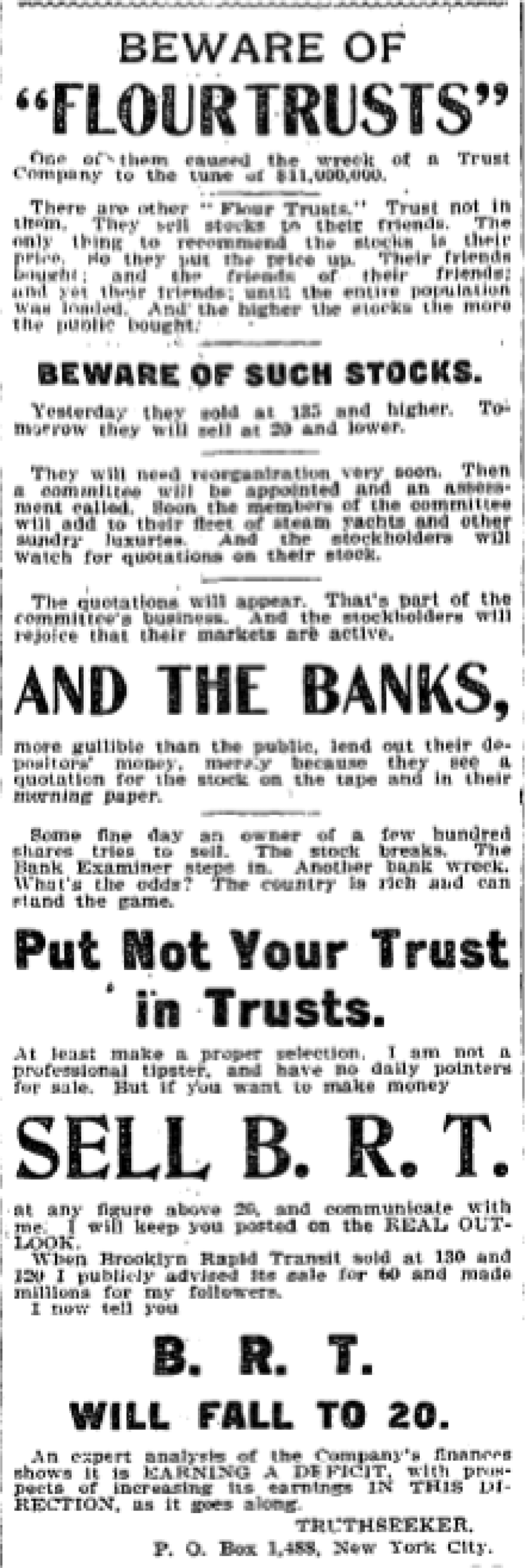
Even worse was to come for BRT when ‘the most sensational stock “raid” known in Wall Street in recent years’ took place on the 20th (Times, 31 January 1904). The day started with copious short-selling supported by two atypically exact rumors precipitating a rapid decline. The more damaging story was that BRT was headed into receivership. Moreover, a BRT insider supposedly was about to fail and would be forced to dump his entire line (Times, 21 December 1899). BRT shares fell 13 ¾ points (18.4 percent) to its intraday low, moderately recovered, and closed down 9 ¼. The intraday low of 61 was the lowest price of the year. The next day, another Truthseeker ad appeared, shown in Figure 5, warning against ‘Flour Trusts’ and predicting BRT would fall to 20.
Truthseeker ad
BRT had its lowest close of 64 7/8 on 22 December. Despite a moderate general panic, the consensus was that BRT was now safely in the hands of the Flower, Standard Oil and Vanderbilt interests, and was finished as a speculative play for the moment (Times, 23 December 1899). Consequently, it only lost 5/8 while the overall market experienced larger declines.
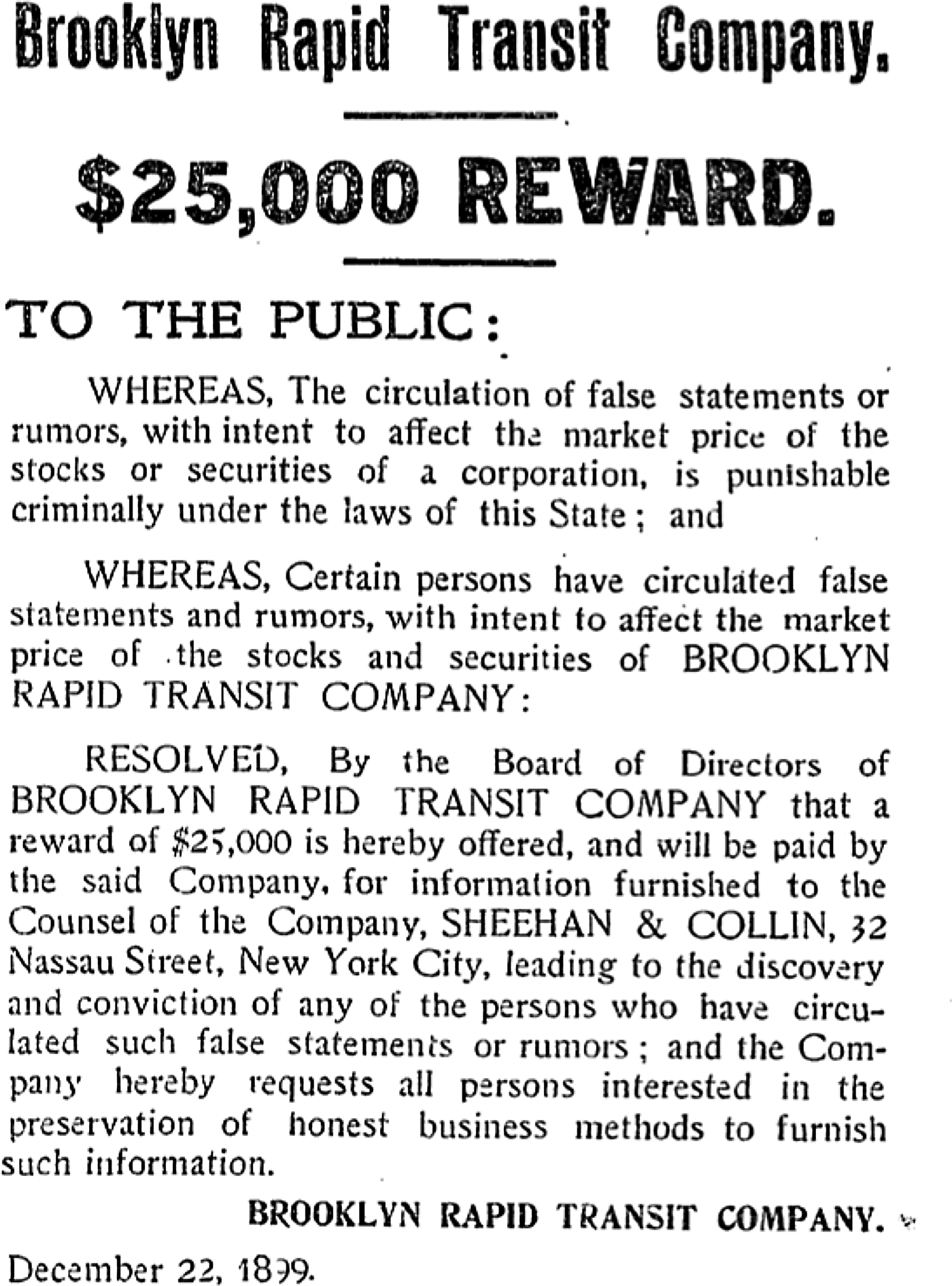
BRT offered a reward of $25,000 for information regarding the parties behind the receivership and other rumors. The ad, shown in Figure 6, first appeared in the Times on 23 December and intermittently reappeared there and in the Journal over the next two weeks. The District Attorney also convened a grand jury investigation into the affair. These actions effectively curtailed the raids on BRT for some time. Several years later, it was revealed that the parties charged with spreading the receivership rumor had the same Post Office Box number as those associated with most of the Truthseeker ads and a hearing was convened to determine how the $25,000 reward would be distributed over 19 claimants (Times, 31 January 1904).
Brooklyn Rapid Transit ad offering reward for information on rumor mongers
During BRT's dramatic rise and fall, both bulls and bears used rumors and innuendo to support their efforts to manipulate prices. Perhaps the natural impulse of the press is to forgive the bulls and chastise the bears. This impulse may seem balanced, given the market's tendency towards bullish optimism. However, as noted by ‘Quid pro quo’ in a letter to the Times, bullish lies are no more benign than bearish ones:
To the Editor of The New York Times: The counsel of the Brooklyn Rapid Transit feel justified in punishing the guilty party who circulated stories that caused the price of the stock to go down. Turn about [sic] is fair play; therefore, the District Attorney ought to punish the insiders in the Brooklyn Rapid Transit who bunkoed people into buying its stock at 130 and over on reports of dividends ‘sure this year’. Or is lying on the bear side only criminal? (Times, 23 December 1899)
V
Thus far, our story provides anecdotal support for profitable trade-based manipulation. BRT operators, both bulls and bears, deployed an array of tactics such as rumor-mongering, engaging in camouflaged trading practices, claiming insider status to confuse other investors, placing ads in the press, using leverage to accumulate large positions, seeking nervous gambler- and speculator-type investors (such as short-term long or short positions with stop-loss limit orders), and manipulating borrowing costs.Footnote 10
Similar claims of trade-based manipulation were levied against the stock pools that operated in the 1920s, which were the subject of the Pecora Investigation, an inquiry begun in March 1932 by the US Senate Committee on Banking and Currency. Though current anti-manipulation law reflects a perception that stock pools acted as manipulators, Jiang, Mahoney and Mei (Reference Jiang, Mahoney and Mei2005) find that turnover, return and long-term performance data on pool stocks support a finding of informed trading rather than manipulation. Pool stocks experienced higher trading volumes and returns during the pool formation period, but both effects were small, on average. Moreover, over the decade following pool formation, pool stocks underperformed their industry-matched peers, though by an insignificant amount.
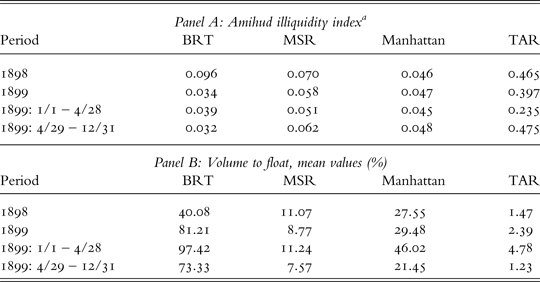
In Table 3, we examine two measures of liquidity for BRT and the other New York traction stocks. We use weekly data to calculate the Amihud (Reference Amihud2002) illiquidity index as the ratio of the absolute value of the return scaled by the dollar trading volume (higher values denote greater illiquidity). We also calculate trading turnover equal to the trading volume divided by float, or shares outstanding. Both measures confirm that BRT was the most liquid traction stock in 1899. Moreover, during the 1899 manipulation period, BRT's liquidity increased relative to the prior year.
Measures of liquidity for BRT and other traction stocks
a The Amihud (Reference Amihud2002) illiquidity index is calculated weekly as the absolute value of the return divided by the dollar value of the shares traded. Volume to float is the weekly trading volume divided by the shares outstanding.
Source: New York Times daily stock quotes.
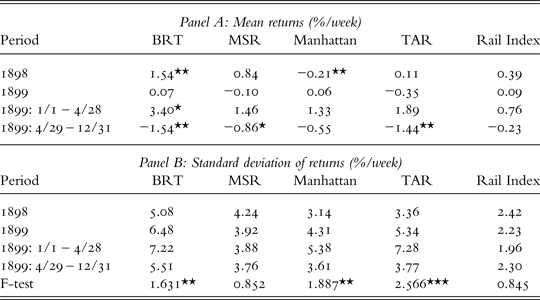
In Table 4, we compare BRT returns and volatility to the other traction stocks and the Dow Jones rail index. BRT enjoyed significantly positive performance in 1898 followed by neutral performance during the manipulation period. However, when we break 1899 into its two distinct phases, a bull phase starting January 1 and ending April 28, and a bear phase from April 29 through year-end, we see that BRT had significant abnormal performance during both phases. Moreover, volatility increased markedly in 1899 relative to the prior year. This is true for BRT and for Manhattan and TAR.
Returns and volatility for BRT and other traction stocks and the Rail Indexa
a In panel A, we compare the mean returns on the individual stocks to the mean return on the rail index. In panel B, we compare the variance of returns for the year 1898 to the variance of returns for the year 1899. The F-test null is equal standard deviations of returns for 1898 and 1899. *, **, ***denote statistical significance at the 10, 5 and 1 percent levels, respectively.
Source: New York Times daily stock quotes.
These findings comport with Allen, Litov and Mei (Reference Allen, Litov and Mei2006), who study 14 security corners in equity and commodity markets over the period 1863–1980. Manipulation led to an increase in market volatility and had an adverse price impact on other assets. Price discovery, which normally occurs through free, competitive markets, is hindered by false information signals. The presence of large investors discourages arbitrageurs, resulting in a loss of market efficiency.
While greater investor protections and regulatory scrutiny should dampen the opportunities for traders to engage in predatory trading, in recent years new technologies and new markets have provided fresh opportunities for financial predators. There are many examples of unscrupulous trader behavior in the last two decades similar to Citigroup's Dr Evil trade, many of which bear a striking resemblance to the methods used in 1899.
In 2008, the German company Porsche launched an unsolicited takeover offer for Volkswagen. Instead of using shares as the means of acquiring control, however, Porsche used call options. In the process, Porsche inadvertently cornered the stock, pushing prices from €210.85 on 24 October to a high of 945 on the 28th. Porsche insisted that it broke no German law and placed blame on ‘speculative short-sellers’ (Times, 30 October 2008)
‘Pump and dump’ schemes, the modern version of planting stories and front-running trades, rely on internet message boards. In 1999, NEI Webworld, Inc. (NEIP) was an obscure, nearly bankrupt printing company. Within a two-week period in November 1999, three traders purchased nearly 97 percent of the company's stock at prices ranging from $0.05 to $0.17 per share. They proceeded to post more than 500 internet messages claiming the company was a ‘fast mover’ with a target price of $5–$10 per share. Investor interest was sparked and the stock moved from $0.13 to a high of $15 per share, allowing the traders to secure profits of approximately $364,000 (Leinweber Reference Leinweber2009). More recently, John Mackey, co-founder of Whole Foods Market, anonymously posted more than 1,100 Yahoo bulletin board messages between 2000 and 2006 promoting his company at the expense of a key competitor, Wild Oats Markets (Journal, 11 July 2007).
Efforts to manipulate prices still persist. The SEC defines ‘marking the close’, as ‘attempting to influence the closing price of a stock by executing purchase or sale orders at or near the close of the market’. Carhart, Kaniel, Musto and Reed (Reference Carhart, Kaniel, Musto and Reed2002) collect overwhelming evidence that mutual funds have engaged in this illegal behavior for years.
Other institutional investors appear to be using the same playbook. In a new study, Ben-David, Franzoni, Landier and Moussawi (forthcoming) provide evidence that hedge funds engage in manipulation on critical reporting dates. Stocks in the top quartile of hedge fund holdings (usually very liquid stocks) exhibit abnormal returns of 0.30 percent on the last day of the quarter and a reversal of 0.25 percent on the following day. Most of the abnormal return is earned during the last minutes of trading. Moreover, the effect is more likely to take place among funds where the incentives to manipulate prices are stronger.
The SEC does prosecute manipulators, but with limited resources it is not possible to police all misbehavior. Aggarwal and Wu (Reference Aggarwal and Wu2006) analyze SEC litigation releases of 142 cases of prosecuted stock manipulation over the period 1990–2001. The median manipulation period was 202 days, with a range of two to 1,373 days. Manipulators were likely to be informed parties such as management, large shareholders, market-makers and brokers.
A recent study suggests the SEC is just skimming the surface, when it comes to enforcing laws against manipulation. Comerton-Forde and Putnins (forthcoming) find that about 1 percent of all equity closing prices are manipulated, with much of the manipulation occurring on month and quarter end days. Only a small fraction of these cases are detected and prosecuted.
Today, some traders may be using new technologies to engage in predatory trading behavior. High-frequency trading, flash trading and dark pools are all relatively recent innovations that promise to enhance liquidity.Footnote 11 But critics argue that they provide modern-day opportunities for front-running and creating two-tier markets where some investors can prey on others (Journal, 2 October 2010). Right now, US regulators are investigating whether high-frequency traders are distorting stock and futures markets by acting as both buyers and sellers in the same transaction (Journal, 17 March 2013). These so-called ‘wash trades’ are banned because they create false information signals which can be used to manipulate prices. The scale of the suspicious trading is quite large. An analysis of futures trading data from 2012 indicates several hundred thousand potential wash trades occur each day on futures exchanges.
Further research is needed to ascertain the frequency of manipulation attempts as well as the ultimate costs to different investor classes both now and during the period we chronicle. It is possible that modern attempts to manipulate asset prices are as common, though less overt than the example of BRT. Today's predators rely on new technologies, such as the internet, derivative securities, high-frequency trading or dark pools. They know they must not be too obvious, lest the SEC should discover their activities and prosecute. The returns modern-day predators seek to realize are also likely to be smaller, but they may try to make up in volume what they concede in price.
Socially optimal policy balances the benefits of fair and efficient markets against the costs of policing predatory behavior. While we do not have precise estimates of either the costs or benefits of competitive markets, we know they exist. This article should persuade readers that manipulation occurred in the past, is occurring in the present day, and will most likely occur in the future. Moreover, new technologies may create new opportunities for manipulation. Perhaps the most useful lesson that all astute investors should grasp is the old expression, attributed to Jean-Baptiste Alphonse Karr: ‘plus ça change, plus c'est la même chose’, or ‘the more things change, the more they stay the same’.