Introduction
The outlook for individuals with human immunodeficiency virus (HIV) has changed dramatically since its isolation in the 1980s, from a rapidly fatal disease to a chronic manageable illness. This shift, first catalysed by the introduction of highly active anti-retroviral therapy (HAART) in 1996, and subsequently through further refinement in drug therapies to today's combined anti-retroviral therapy (cART) regimens, has been such that today, patients with HIV who are diagnosed promptly and have access to cART can expect to achieve almost normal life expectancies.1, Reference May, Gompels and Delpech2
The result of this success has been a year-on-year increase in the numbers of people living with HIV. In the UK alone, in the last decade, the number of HIV-positive (HIV+) individuals accessing care and who are aged over 50 years (the age usually taken as ‘older’ in the context of HIV) has doubled from 12 to 21%.3 This is echoed in the United States (US), where it has been predicted that, by 2015, 50% of the HIV-positive population will be over 50,Reference Effros, Fletcher and Gebo4 a statistic now realized in San Francisco.Reference O'Keefe, Scheer and Chen5 Similar trends are also being seen in resource-poor nations,Reference Negin and Cumming6 making the challenge of ageing in HIV a global issue.Reference Mills, Bärnighausen and Negin7
The numbers of older adults with HIV are climbing through both prolonged survival and late acquisition of the disease.3 Older adults may be particularly vulnerable to HIV through a number of prejudices or oversights from various directions. These may include social policy makers who infrequently target older adults in preventative campaigns. Sexual activity certainly continues into later life in those withReference Onen, Shacham, Stamm and Overton8 and withoutReference Dolcini, Catania, Stall and Pollack9, Reference Lindau, Schumm, Laumann, Levinson, O'Muircheartaigh and Waite10 HIV. Older individuals may not consider themselves at risk, which may result in high-risk sexual activity or avoidance of testing. In addition, increased global travel, later-life divorce and enhanced treatment of erectile dysfunction may contribute to acquisition or risk of HIV.Reference Pratt, Gascoyne, Cunningham and Tunbridge11–Reference Kearney, Moore, Donegan and Lambert13 In the older HIV+ group, though sexual activity decreases, inconsistent condom use remains a problem, risking transmission and highlighting the need for ongoing patient education.Reference Onen, Shacham, Stamm and Overton8
A further issue in the epidemiology of older age and HIV is that older people are more likely to be diagnosed with advanced immunosuppression. UK statistics for 2012 revealed that a higher proportion of older adults were diagnosed late (with a CD4 count < 350) compared with younger adults (61% in those over 50 versus 45% in those younger).3 Late diagnosis is known to be associated with worse clinical outcomes and higher mortality,Reference May, Gompels and Delpech2 and this appears to be accentuated in those who are diagnosed late and who are older.Reference Smith, Delpech, Brown and Rice14 Clinicians may fail to acknowledge patients’ risk of HIV by under-estimating sexual activity (past and especially present) and/or attributing presenting symptoms to ‘normal ageing’ or other disease entities, resulting in less testing and therefore missed/delayed diagnosis. Indeed, whilst recent enhancements in HIV testing have resulted in a reduction in late diagnosis in younger people, they appear to have had no impact on older age groups.Reference Iwuji, Churchill and Gilleece15
Older age appears to have a deleterious effect on the natural history of HIV infection. In the absence of cART, being older at the time of diagnosis is associated with a faster decline in CD4+ cell counts post-seroconversion, increased incidence of and shorter time from acquisition to AIDS-defining events or death compared with younger adults.Reference Vance, Mugavero, Willig, Raper and Saag16, 17 However, it appears that the availability of cART has reversed this negative effect and older people may now be at least as well protected from disease progression as younger people.Reference Perez and Moore18
Many authors have raised the possibility that HIV may have a negative impact on the ageing process.
In many respects the effects of both HIV and natural ageing on the immune system are similar, with declines in both B- and T-cell lines, thymic involution, and shortened telomere lengths. Furthermore, individuals with HIV infection – even if virologically controlled with cART – appear to be in a state of chronic inflammation, which theoretically may accelerate the normal ageing process.Reference Deeks and Phillips19, Reference Reiss20 Whilst many cohort studies have suggested that such accelerated ageing may manifest by earlier and increasing frequency of typical age-related diseases, others have challenged whether current data are sufficiently robust to prove this and have urged for well-controlled longitudinal studies.Reference Fisher and Cooper21 Indeed, after controlling for adverse lifestyle factors, longevity in the Danish HIV population is identical to the general population.Reference Obel, Omland and Kronborg22
Why does this matter to geriatricians?
Whether due to accelerated ageing or to adverse lifestyle factors and co-infections, the number of HIV-associated non-AIDS-related co-morbidities increases with age, with a clear trend towards accumulation,Reference Vance, Mugavero, Willig, Raper and Saag16, Reference Guaraldi, Orlando and Zona23, Reference Hasse, Ledergerber and Furrer24 with observed prevalence being in line with HIV-negative individuals 10–15 years older.Reference Guaraldi, Orlando and Zona23 This occurrence of co-morbidities associated with HIV and HIV treatments has taken over as the major health concern as opposed to the HIV management itself, with serious non-AIDS events outnumbering AIDS events in frequency and severity, including cause of death.Reference Lewden, May and Rosenthal25
Previous reviews of this subject have taken broad systems approaches explaining the effect of HIV on specific organ-based pathologies such as cardiovascular or renal disease. We aim to review the literature with particular emphasis on areas where HIV (diagnosed or undetected) may impact on the work of clinical geriatricians, exploring such issues as stroke, falls and bone health, function and frailty amongst others. We hope to provide practical advice where guidelines or literature suggest recommendations for practice.
Search method
We conducted searches in MEDLINE, CINAHL and Embase databases for studies published in English between January 1984 and January 2013 using search terms ‘HIV’ and ‘aging’/‘older’/‘elder’ and terms appropriate to each featured section. Individual reference lists were reviewed for relevant studies.
Issues surrounding anti-retroviral drugs
Efficacy, adverse effects and interactions
In common with many drug trials, in efficacy studies of cART, the under-representation of older individuals makes generalizations of response difficult.Reference Kearney, Moore, Donegan and Lambert13, Reference Rhee and Greenblatt26 In general terms, people aged over 50 initiating cART tend to have higher viral loads and lower CD4+ cell counts, which may partly reflect later diagnosis.Reference Nogueras, Navarro and Anton27 Although data on response to cART in older adults are sometimes conflicting with the heterogeneous nature of trials making comparisons difficult,Reference Rhee and Greenblatt26, Reference Gebo28, Reference Sabin, Smith and d'Arminio Monforte29 the general consensus is that older patients achieve at least as good, if not better, virological outcomes than younger patients, but that the immunological (i.e. CD4 recovery) response to cART is blunted. The improved virological success of cART has been attributed to improved adherence associated with older age.Reference Vance, Mugavero, Willig, Raper and Saag16, Reference Branas, Berenguer and Sanchez-Conde30 In view of the blunted response to cART in older people, and the possible enhanced risk of co-morbidities (outlined below), some cART guidelines have historically advocated starting therapy earlier in older patients.31
The safety and tolerability of cART has improved significantly since its initial introduction in the mid-1990s.Reference Rhee and Greenblatt26 Older HIV-infected adults experience more co-morbidity, which may impact on the efficacy and safety of HIV treatment through multiple mechanisms, including altered drug pharmacokinetics through liver or renal dysfunction or potential drug–drug interactions (PDDI) with necessary non-HIV treatments. These may significantly increase the risk of drug toxicities.Reference Kearney, Moore, Donegan and Lambert13 Furthermore, older adults appear to be at increased risk of drug-induced metabolic changes or co-morbidities such as hyperlipidaemia, insulin resistance, renal dysfunction and cardiovascular events.Reference Orlando, Meraviglia and Cordier32, Reference Sabin, Smith and Delpech33
Despite this, there does not appear to be a difference in patient-reported side-effects or drug tolerability between younger and older individualsReference Marzolini, Back and Weber34 and, indeed, older patients may take a more stoical perspective of perceived drug toxicity.Reference Sherr, Harding and Lampe35
Polypharmacy and drug–drug interactions
It is extremely important for clinicians to consider the pharmacology of cART and to understand the risks in co-prescription of non-HIV drugs. Non-nucleoside reverse transcriptase inhibitors (NNRTIs) and protease inhibitors (PIs) are both metabolized by the cytochrome P450 (CYP450) enzyme system and can act as inducers or inhibitors as well as substrates. This introduces the risk of significant pharmacokinetic interactions causing either reduced or increased levels of either cART agents or co-prescribed medications.Reference Marzolini, Back and Weber34 Nucleoside reverse transcriptase inhibitors (NRTIs) are often renally excreted and may therefore require dose-adjustment in renal diseaseReference Gebo28 but as they do not affect CYP450 systems, interactions are less common.Reference Rhee and Greenblatt26, Reference McLennon, Smith and Orrick36
Polypharmacy is more common in older adults with HIV,Reference Marzolini, Back and Weber34, Reference Marzolini, Elzi and Gibbons37 present in 50% of patients aged 50 or more in one report.Reference Waters, Patterson and Scourfield38 Polypharmacy introduces the risk of significant PDDI (21% in the aforementioned study). The Swiss HIV cohort reported that CNS- and cardiovascular drugs were responsible for the bulk of PDDI, reflecting the frequency of co-prescription.Reference Rastegar, Knight and Monolakis39
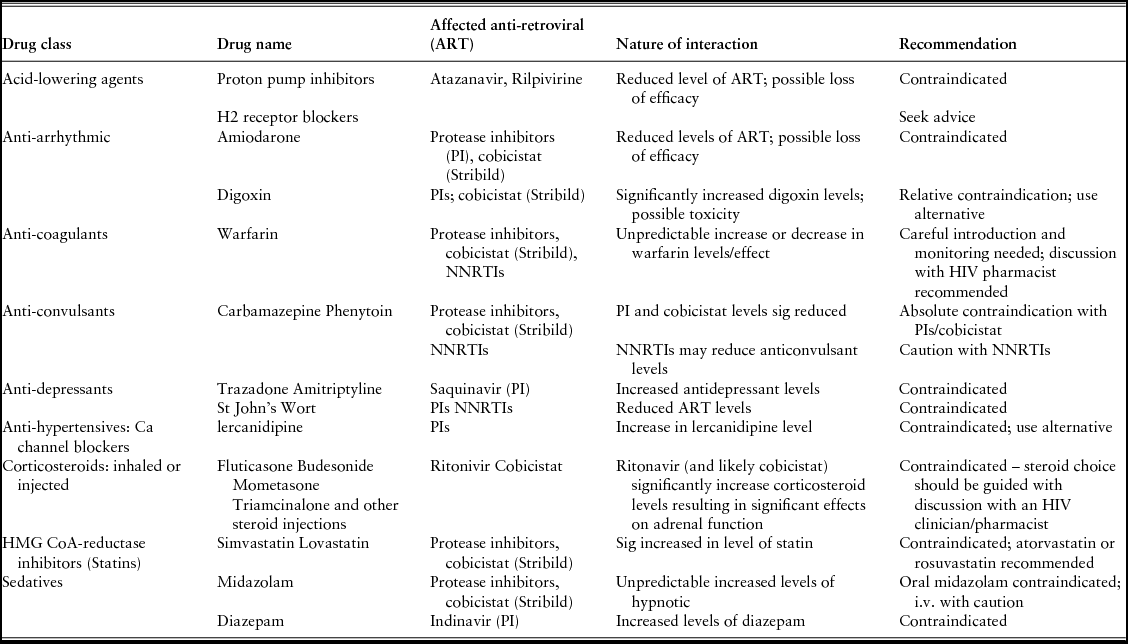
Both the physiological changes of age and the pharmacology of cART make the risk for PDDIs and toxicity high in older adults. Many of the drugs commonly used in geriatric practice pose potential risk, and all new drugs should be considered for potential interactions pre-prescription. Table 1 details some of the most significant and common drug interactions. This list is by no means exhaustive and a useful reference point is the University of Liverpool Drug Interactions website (www.hiv-druginteractions.org), which is a comprehensive information source for co-prescribing. In routine clinical practice, the major interactions that have caused clinical harm are statins (simvastatin levels are massively increased by protease inhibitors), proton-pump inhibitors (which reduce the levels of the cART agents atazanavir and rilpivirine), and certain inhaled and injected corticosteroids (which, if co-administered with the protease inhibitor ritonavir can result in Cushing's and subsequent Addison's syndromes). It is recommended that, prior to initiating new co-medications, the new prescriber should prompt either a discussion with the patient's regular HIV physician, a specialist HIV pharmacist, or utilize the Liverpool website.
Examples of significant drug–drug interactions

Medication errors with ART and PDDI from co-prescriptions are common in hospital settings,Reference Rastegar, Knight and Monolakis39, Reference Mok and Minson40 are under-recognized by clinicians,Reference Evans-Jones, Cottle and Back41 and overall risk is increased when care is provided outside of specialist settings.Reference Mok and Minson40 Careful drug history taking and prescription is required alongside emphasizing the importance of cART to ensure treatment regimens are safe, accurate and received on time. In addition, we must investigate barriers to adherence, including cognitive impairment,Reference Hinkin, Hardy and Mason42 and facilitate mechanisms to improve this, as we would in the traditional aged populations.
HIV and stroke
Worldwide, stroke is a major cause of mortality and a leading cause of disability in adults. In the UK, stroke incidence and related mortality are decreasing.Reference Lee, Shafe and Cowie43 The converse appears true for strokes occurring in those with HIV, with a 67% increase in the proportion of hospitalized strokes observed between 1997 and 2006, although actual stroke events remain small.Reference Ovbiagele and Nath44 Although this suggests an association between HIV and stroke, factors such as the climbing incidence of HIV, the effect of cART on stroke risk and general improved survival may also have contributory roles in this increase.Reference Benjamin, Bryer, Emsley, Khoo, Solomon and Connor45 However, stroke appears to be a common neurological manifestation of HIV, with incidence comparable to that seen in general populations, though occurring at younger ages.Reference Corral, Quereda and Moreno46
Aetiology and risk factors
A 1996 review of stroke in the pre-ART era by Pinto suggests that stoke is associated with HIV, but mainly seen in advanced disease or AIDS.Reference Pinto47 Ischaemic events were more common, with CNS infection/tumours with associated vasculitis or cardio-embolic events underpinning stroke aetiology.Reference Cole, Pinto and Hebel48, Reference Modi, Modi and Mochan49 In the post-ART era there remains a lack of prospective work. A Danish cohort study with young median age (36 years) showed an increased risk of stroke in those with HIV compared with negative controls.Reference Rasmussen, Engsig and Christensen50 Additionally, a 2012 American study demonstrated that HIV was an independent predictor for ischaemic stroke after adjustment for traditional stroke risk factors. Factors associated with increased stroke risk in the HIV cohort included female gender, age under 50, higher viral load, atrial fibrillation and prior CNS malignancy/infection.Reference Chow, Regan, Feske, Meigs, Grinspoon and Triant51 Associations shown elsewhere include acquisition through intravenous drug use, pre-ART CD4 counts < 200 and abacavir use.Reference Rasmussen, Engsig and Christensen50
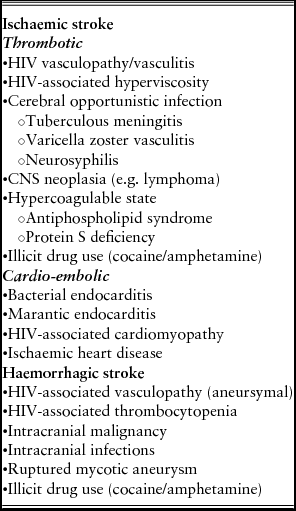
The increase in stroke incidence in HIV is primarily related to ischaemic events,Reference Corral, Quereda and Moreno46, Reference Tipping, de Villiers, Wainwright, Candy and Bryer52 with no real change in the frequency of primary intracerebral haemorrhage (ICH),Reference Ovbiagele and Nath44 which has low incidence but confers high mortality, 62.5% in one report.Reference Roquer, Palomeras, Knobel and Pou53 There are multiple mechanisms by which HIV can potentially cause stroke, which are summarized in Table 2.
Stroke aetiologies in HIV/AIDSReference Benjamin, Bryer, Emsley, Khoo, Solomon and Connor45, Reference Dobbs and Berger59
Strokes have been reported to occur in younger HIV+ individuals, with one American series reporting a mean age of 42.Reference Ortiz, Koch, Romano, Forteza and Rabinstein54 Younger individuals have a low prevalence of traditional risk factors and variable stroke aetiology, including uncommon mechanisms of infection, vasculitis and hypercoagulability.Reference Ortiz, Koch, Romano, Forteza and Rabinstein54, Reference Kumwenda, Mateyu, Kampondeni, van Dam, van Lieshout and Zijlstra55 In older individuals, stroke appears to be associated with conventional vascular risk factors.Reference Chow, Regan, Feske, Meigs, Grinspoon and Triant51
Though controversial, cART exposure in itself may play a role in stroke risk. Some studies suggest that cART (for longer rather than shorter duration) may reduce stroke incidence,Reference Corral, Quereda and Moreno46, Reference Chow, Regan, Feske, Meigs, Grinspoon and Triant51 potentially by reducing opportunistic infection and AIDS-associated disorders whilst negating direct HIV-related vascular changes.Reference Lindsberg and Grau56 Conversely, cART has been associated with dyslipidaemias and insulin resistance, which may promote/accelerate atherosclerosis and increase the risk of vascular events.Reference Sen, Rabinstein, Elkind and Powers57 In addition, there is the positive effect on life expectancy with enhanced HIV+ longevity allowing for acquisition of traditional vascular risks. An assessment of vascular risk and risk factor management should be incorporated into routine practice.Reference Sen, Rabinstein, Elkind and Powers57
Treatment strategies
A differential diagnosis exists for those presenting with symptoms and signs consistent with stroke; mimics are not uncommon and were as high as 43% in one Malawian study.Reference Kumwenda, Mateyu, Kampondeni, van Dam, van Lieshout and Zijlstra55 Clinical suspicion for an alternative diagnosis should therefore remain high.
Evidence-based or consensus guidance on how to investigate and treat stroke in HIV is lacking but suggestions exist.Reference Benjamin, Bryer, Emsley, Khoo, Solomon and Connor45, Reference Modi, Modi and Mochan49 Once stroke is confirmed, the aetiology should be investigated, HIV managed and secondary prevention, alongside any specific treatment for reversible causes, initiated. Stroke thrombolysis has not been studied in HIV+ populations but has been used in the setting of myocardial infarction and, though numbers are small, reported outcomes do not imply harm.Reference Boccara and Cohen58 However, the possible range of non-traditional causes for HIV-related stroke may increase bleeding risk and cases should be viewed on an individual basis. Standard stroke care in terms of secondary prevention through anti-platelet use and risk factor management, though not evidence-based in this group, appears appropriate. It should be remembered that a stroke may represent the first presentation of HIV, and testing and subsequent treatment may be needed.
Cognition and HIV
The success of cART has significantly impacted on the prevalence of many associated conditions and complications of HIV. There is a view, however, that cognitive impairment remains common, and indeed, a mild degree of neurocognitive impairment may be increasing. Prevalence data range from 19 to 69% of people with HIV, with high rates reported in the US,Reference Heaton, Franklin and Ellis60 but rates not dissimilar from the general population in the UK.Reference Garvey, Surendrakumar and Winston61 The difference in these frequencies has not been fully explained, but one possibility is that the UK HIV population has typically higher levels of viral suppression than those seen in the US.
HIV-associated neurocognitive disorders (HAND) include ‘asymptomatic’ neurocognitive impairment, mild neurocognitive impairment and HIV dementia.Reference Antinori, Arendt and Becker62 Cognitive impairment in the HIV ageing cohort is a significant management challenge for health care providers. All forms will impact on patient quality of life with increasing associated co-morbidities, problems with medication adherence, progression to more severe impairment and shorter survival. Before cART, dementia was a common HIV-related complication, affecting up to 40% of patients.Reference González-Scarano and Martín-García63 In the post-ART era the incidence of dementia has decreased dramatically, but milder forms of HAND are increasingly reported.Reference Heaton, Franklin and Ellis60 Older age has been identified as a risk factor for HANDReference Garvey, Surendrakumar and Winston61, Reference Robertson, Smurzynski and Parsons64 and estimates report that there will be up to a 10-fold increase in HIV-related cognitive disorders in the next 15 years.Reference Mateen and Mills65
The pathophysiology of cognitive decline is highly complex, heterogenous and a national research priority. A detailed analysis is beyond the scope of this review. Key areas are important to consider for the management of individual patients as well as optimizing local service provision. It is well known that ageing is associated with an increase in Alzheimer type-, vascular- and mixed aetiology dementias, as well as many other neurodegenerative conditions. With an ageing HIV population, the incidence of patients with cognitive impairment due to non-HIV-related aetiologies will increase and will be exacerbated by intercurrent illness, polypharmacy, delirium, depression and lack of social support. As previously discussed, cART has been associated with dyslipidaemias and insulin resistance, with an associated increased risk in cerebrovascular disease.Reference Sen, Rabinstein, Elkind and Powers57
HIV is a neurotropic virus, with invasion of the CNS seen within days of initial infection. As above, in the era of cART, there has been a dramatic reduction in the incidence of HIV dementia and often reversal of cognitive deficit can be seen. However, a delay in the diagnosis of HIV, as often seen in older individuals, and subsequent delay in treatment with anti-retrovirals, may result in irreversible cognitive impairment. Undiagnosed HIV infection should be considered in patients being evaluated for dementia, particularly if it is subcortical in pattern, and HIV testing should form part of the routine evaluation of such patients.
The importance of early detection of dementia for timely intervention and support is emphasized in the Department of Health White Paper ‘Living well with dementia: a national dementia strategy’.66 Monitoring for cognitive impairment is recommended in the latest British HIV Association (BHIVA) guidelines.Reference Asboe, Aitken and Boffito67, 68 The BHIVA Standards of Care for People Living with HIV in 2013 recommend annual screening.69 These recommendations are not consistently implemented in HIV services because of a lack of consensus as to the benefits of screening asymptomatic individuals as well as to which tool has best evidence for use in this cohort; research in this field is ongoing.
Some anti-retrovirals have better CNS penetration than others.Reference Smurzynski, Wu and Letendre70 It remains controversial, however, whether CNS penetration should be considered as a significant factor in which cART regimen to use. Current British guidelines69 recommend using the optimal cART regimen for each patient irrespective of CNS penetration, but to re-consider should cognitive impairment either develop whilst on therapy or not improve if present already. The investigation and management of cognitive impairment in the older HIV cohort will therefore require a multi-professional strategy in keeping with national guidelines.66 Joint assessment of older patients by general physicians and specialist HIV doctors will maximize accurate diagnosis, investigations, and referral to the appropriate specialist teams including community support alongside therapeutic interventions. Comprehensive studies to investigate the assessment, diagnosis and continuing management of HAND in older patients are warranted, especially those evaluating the use of current memory-enhancing medications (acetylcholinesterase inhibitors and memantine) in this cohort with mixed aetiologies of cognitive decline, considerable polypharmacy, and altered drug handling, and will be central to the health economic assessment of this potential ‘epidemic’.
Falls and bone health
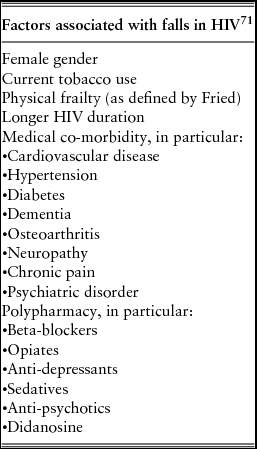
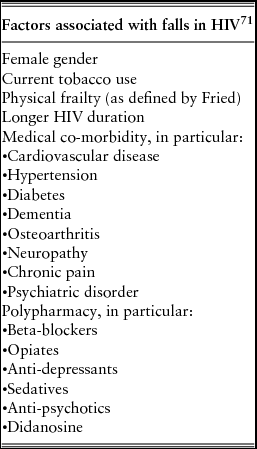
Falls in older adults are common and are often multi-factorial in origin, with contributory factors including medical co-morbidity and disordered physical functioning acting alongside environmental factors. Many risk factors for falls exist in HIV+ individuals, though there is limited published work on falls rates and associations. A 2012 study by Erlandson et al. of 359 HIV+ men and women with mean age 52, showed that 30% had fallen in the last year and of these 61% fell recurrently. The authors felt this to be comparable to rates in uninfected individuals aged over 65. Factors associated with falling are shown in Table 3. Longer duration since HIV diagnosis was the only HIV-associated factor. The odds of falling were increased by 1.7 and 1.4 for every additional co-morbid condition and contributing drug, respectively.Reference Erlandson, Allshouse and Jankowski71 This knowledge should promote routine falls enquiry, risk factor review and preventative/intervention strategies that could include or follow those used in elderly medicine.72
Factors associated with falls in HIV+ individuals
Individuals with HIV have been shown to be at increased risk of bone mineral density (BMD) loss, with a reported prevalence of 67%, and risk increases of 6.4- and 3.7-fold for osteopaenia and osteoporosis, respectively.Reference Brown and Qaqish73 BMD loss may develop at younger ages than seen traditionally and affects menReference Arnsten, Freeman, Howard, Floris-Moore, Lo and Klein74–Reference Mary-Krause, Viard and Ename-Mkoumazok76 and both pre- and post-menopausal women.Reference Prior, Burdge and Maan77–Reference Yin, McMahon and Ferris79 This loss appears to be progressive and not ameliorated by cART.Reference Bonjoch, Figueras and Estany80
Multiple factors contribute to this BMD loss including the presence of traditional risk factors such as increased age, smoking, low body mass index,Reference Jones, Restrepo and Kasowitz81 undernutrition, excess alcohol intake and use of illicit drugs, especially opiates,Reference Arnsten, Freeman, Howard, Floris-Moore, Santoro and Schoenbaum78 as well as hypogonadism and hepatitis co-infections.Reference Bonjoch, Figueras and Estany80 These work alongside HIV-specific factors such as chronic inflammation and cytokine induction,Reference Ofotukun and Weitzmann82 malabsorption of calcium and changes in body composition.Reference Prior, Burdge and Maan77 Lastly cART may have a deleterious effect on BMD, particularly on initiation, though the clinical significance remains unproven. Some studies have shown enhanced BMD loss with cART historically PIs,Reference Brown and Qaqish73, Reference Bonjoch, Figueras and Estany80 and the NRTI tenofovir,Reference Mary-Krause, Viard and Ename-Mkoumazok76, Reference Jones, Restrepo and Kasowitz81 although this has not been associated in clinical trial populations with an increased fracture risk.
Research in older adults shows that fragility (low-trauma) fractures are costly, confer excess morbidityReference Cummings and Melton83 and predict future fracture.Reference Klotzbeucher, Ross, Landsman, Abbott and Berger84, Reference Van Staa, Leufkens and Cooper85 HIV infection and associated BMD reductionReference Arnsten, Freeman, Howard, Floris-Moore, Santoro and Schoenbaum78 increase the risk of fragility fracture,Reference Pepe, Isidori and Falciano75, Reference Triant, Brown, Lee and Grinspoon86–Reference Young, Dao and Buchacz88 which may be under-reported, under-diagnosed and undertreated.Reference McComsey, Huang and Woolley89 Importantly, fracture prevalence increases with age in both HIV+ men and women;Reference Triant, Brown, Lee and Grinspoon86 other associations included lower CD4 nadir, viral hepatitis co-infection and current smoking.Reference Young, Dao and Buchacz88
Investigating and managing low BMD in HIV
Readers may have experience of the FRAX algorithm, an online tool designed to aid in evaluating individual patients’ 10-year fracture risk in those vulnerable to osteoporosis, falls and fracture. Resulting risk estimates can guide further investigation and/or treatment.Reference Kanis, Johnell, Oden, Johansson and McCloskey90 It should be noted, however, that FRAX is not validated in the HIV-positive population, raising the concern of underestimation of fracture risk.Reference Gazzola, Comi and Savoldi91
BHIVA recommend an assessment of risk factors for reduced BMD at time of HIV diagnosis, prior to cART initiation and in those aged over 50 on a 3-year basis. Dual-energy X-ray absorptiometry (DXA) scanning assesses BMD and is recommended for all HIV+ women over 65 and men over 70. For those aged 50 or over, a FRAX assessment with intermediate or high risk stratification or the presence of risk factors for low bone mass (long duration HIV, low CD4 nadir or HBV/HCV co-infection) or prior fracture should prompt BMD assessment. In confirmed low BMD, secondary causes such as hyperparathyroidism, hyperthyroidism or vitamin D deficiency should be excluded.Reference Asboe, Aitken and Boffito67
The anti-resorptive bisphosphonate drugs are first-line agents in the management of osteoporosis in wider settings. A 2007 randomized controlled trial evaluating the efficacy and tolerability of the weekly oral bisphosphonate alendronate with supplemental calcium and vitamin D in HIV+ individuals with at least osteopaenia showed significant improvement in BMD at the lumbar spine and femoral neck compared with placebo. Alendronate effect was independent of baseline t-score and gender and the treatment was safe and well tolerated.Reference McComsey, Kendall and Tebas92 This finding is supported by other earlier work on alendronate in HIV.Reference Guaraldi, Orlando and Madeddu93–Reference Negredo, Martınez-Lopez and Paredes95 It is important to note, however, that the effect of bisphosphonates on fracture in HIV has yet to be studied in depth. Discussion of second-line agents is beyond the scope of this review.
HIV and the individual
Frailty
Frailty describes an at-risk state of vulnerability to external stressors conferred through negative alterations in multiple physiological systems that occur usually as a product of ageing. Frailty is difficult to defineReference Markle-Reid and Browne96 but models have been conceptualized.Reference Fried, Tangen and Walston97, Reference Rockwood and Mitnitski98 Frailty is a predictor for adverse clinical outcomes such as falls, hospitalization, institutionalization and death.Reference Fried, Tangen and Walston97
Frailty is mentioned relatively frequently within HIV ageing literature but primary research into frailty in HIV is in its infancy, with few studies directly examining the issue.Reference Desquilbet, Jacobson and Fried99, Reference Desquilbet, Margolick and Fried100–Reference Pathi, Gilbert and Weiss104 These studies have mainly looked at younger individuals with median ages ranging from 39 to 42 and frailty prevalence ranging from 8 to 20%. Research in older adults with HIV is lacking. A study by Ianas et al. included 42% of participants over 50, showing a 16% frailty prevalence in this group, though interestingly, frailty had a stronger association with CD4 count <200 than age itself.Reference Ianas, Berg, Mohler, Wendel and Klotz103 All authors describe HIV infection as being associated with an earlier occurrence of a frailty phenotype, with associations including increasing age, HIV duration, poor HIV control (low CD4 counts) and AIDS diagnosis. In terms of adverse outcomes in a group initiating cART, pre-existing frailty was a predictor of progression to AIDS or death.Reference Desquilbet, Jacobson and Fried105 In line with frailty outcomes in older adults, Onen et al. reported increased rates of hospitalization and length of stay in those with HIV and frailty.Reference Onen, Agbebi, Shacham, Stamm, Onen and Overton101 Frailty has even been reported as a reason for referral to palliative care in one HIV study.Reference Ruiz and Cefalu106 cART may play a role in protecting against frailty.Reference Desquilbet, Margolick and Fried100, Reference Ianas, Berg, Mohler, Wendel and Klotz103, Reference Pathi, Gilbert and Weiss104
Palliative care
Although mortality secondary to HIV/AIDS has decreased in the ART era there remains a need for palliative care approaches in symptom management, psychosocial support, advanced care planning and terminal care. A 2005 American study of individuals with advanced HIV reported a mean number of physical and psychological symptoms of 10.9–12.7, with lack of energy, pain and worrying being most prevalent. Symptoms were often reported as severe and/or distressing, with high patient perceptions of symptoms remaining untreated.Reference Karus, Raveis and Alexander107 Similar reports of high symptom burden have been reported around diagnosis.Reference Simms, Higginson and Harding108 Symptom status, regardless of level of disease, affects physical functioning and well-being,Reference Lorenz, Cunningham, Spritzer and Hays109 and can negatively affect medication adherence.Reference Corless, Nicholas, Davis, Dolan and McGibbon110 Ameliorating symptoms can improve health-related quality of life. Importantly, overall health scores were worse for those aged over 50, and though not commented on specifically, may make them a prime target for intervention.Reference Lorenz, Cunningham, Spritzer and Hays109
Inequalities in access to, and quality of, palliative care exist, and barriers to access have been explored in a review by Harding et al.Reference Harding, Easterbrook, Higginson, Karus, Raveis and Marconi111 Clinician barriers include lack of knowledge and skills, under-recognition of symptoms, especially pain, with wariness of prescribing.Reference Green, Tuan, Vu Hoang, Thi Trang, Thanh Ha and Hung112 Communication barriers are evident from both clinician and patient perspectives,Reference Ruiz and Cefalu106 particularly with regard to readiness to engage in the conversation or fear of recognizing terminal changes.Reference Harding, Easterbrook, Higginson, Karus, Raveis and Marconi111
The transformation of HIV to a chronic disease has introduced uncertainty for patientsReference Cochrane113 and this, alongside confidence in treatment, may have reduced acknowledgement of the risks of dying resulting in less acceptance and preparation.Reference Karasz, Dyche and Selwyn114 This prognostic challenge may not be an isolated issue for patients; the uncertainties around the success or limitations of cART for the individual and the increase in HIV-associated non-AIDS-related conditions may make the timing of advanced-care planning difficult. This would support a more integrated approach to palliative care throughout the patient's HIV journey,Reference Corless and Nicholas115, Reference Harding, Karus, Easterbrook, Raveis, Higginson and Marconi116 which has been operationalized in developingReference Green, Tuan, Vu Hoang, Thi Trang, Thanh Ha and Hung112, Reference Kell and Walley117 and developedReference Ruiz and Cefalu106 countries.
Palliative care services for patients with HIV/AIDS should take a multi-professional, discrimination-free approach to meet the needs of heterogeneous and often minority patient populations.Reference Harding, Easterbrook, Higginson, Karus, Raveis and Marconi111 Those engaged in HIV care should be enquiring about physical, psychological, social and spiritual problems throughout the HIV course and instituting specialist palliative care where needed.Reference Simms, Higginson and Harding118 The paucity of literature surrounding palliative issues in HIV has been highlightedReference Harding, Simms and Krakauer119 and this appears particularly lacking for older adults who may place increased demands on services in the face of multiple co-morbidities, frailty and functional and cognitive decline seen with ageing. In one 2011 study, 23% of palliative referrals were for rapidly deteriorating functional status with marked frailty, with problems of immobility and ability to self-care.Reference Ruiz and Cefalu106 If similar patterns are seen elsewhere, then geriatricians could play a role alongside palliative and HIV care.
Successful ageing
All individuals strive to achieve ‘successful ageing’, whereby one ages with preservation of physical, mental and social well-being alongside maintained functional independence. HIV challenges this in many ways. A cross-sectional study by Erlandson et al. examining functional status in a cohort of middle-aged (median 51) HIV+ individuals on effective cART suggests that the frequency of functional decline was similar to that of HIV-negative individuals aged 20–30 years older. The strongest associations with functional impairment included low physical activity, arthritis, debilitating pain, psychiatric disease, multiple co-morbidities and polypharmacy (5 or more non-ART drugs).Reference Erlandson, Allshouse and Jankowski120 Co-morbidity has been shown to be independently associated with reduced physical functioning in HIV previously.Reference Oursler, Goulet and Leaf121
A person's need for social support varies depending upon circumstances and personal abilities. Social issues, particularly support, have been the subject of research in HIV.Reference Cahill and Valadez12 Trends suggest older adults with HIV are more likely to live alone than negative contemporaries, with men particularly at risk of social isolation.Reference Emlet122 A 2005 study by Shippy et al. examined social networks in HIV+ individuals aged over 50, and showed that, in spite of what appeared to be diverse social support, 57% of those studied had unmet emotional support needs and 79% required more assistance with instrumental activities of daily living.Reference Shippy and Karpiak123 Non-disclosure of HIV status is more common in older HIV+ individualsReference Onen, Shacham, Stamm and Overton8, Reference Nokes, Holzember and Corless124 and this, along with stigma, are thought to be barriers to seeking help from close contacts and others.Reference Emlet122, Reference Shippy and Karpiak123 These may also be drivers for formation of predominantly HIV+ social networks, which provide support but are vulnerable to shrinkage through HIV or age-related illness and death.Reference Poindexter and Shippy125 Despite this apparent vulnerability, a small qualitative study found that older adults were knowledgeable about HIV and its treatment, were conscious of personal health and social needs and knew where they could access resources.126
In addition to fragile social networks, when assessed by age, older HIV+ individuals have been shown to experience higher levels of poverty compared with those under 50.Reference Pitts, Grierson and Misson127 Those exposed to HIV for longer durations (particularly pre-ART acquisition) may be at greatest risk of financial disadvantage due to interruptions in careers or earning potential due to HIV-related illness, resulting in dependence on social security.Reference Owen and Catalan128 Low socioeconomic status is associated with adverse outcomes in HIV+ individuals, particularly with excess mortality.Reference McMahon, Wanke, Terrin, Skinner and Knox129 It is important to note that a 2009 study of 788 British HIV+ individuals showed no difference in educational and employment demographics, and hence their ability to take an active economic role, between older and younger individuals.Reference Sherr, Harding and Lampe35
A UK survey conducted by the Terence Higgins Trust charity of 410 HIV+ over-50s showed that the two biggest concerns about growing older with HIV were financial worries and difficulties with self care, with over 75% anticipating a future need for help with this.Reference Power, Bell and Freemantle130 It appears that those aged over 50 are more likely to be financially disadvantaged and socially isolated, and disconnected from traditional social networks that would provide informal support and care (such as friends and family), with resultant reliance on formal care providers.Reference Shippy and Karpiak123 This is likely to increase, particularly where co-morbidities impact upon independent living. This does and will increasingly present challenges to social and welfare systems.
Service models and the role of the geriatrician
The individualized or specific care of older adults with HIV and the host of potential problems they may incur is in its infancy, but clearly individuals do and will require a range of multi-professional health care services. A consensus document on HIV and ageing published by the National Institute for Health of the United States, promotes the role of geriatricians in providing their expertise in managing medical complexity and polypharmacy, their focus on preservation of function and contribution towards both the clinical and research agendas.Reference High, Brennan-Ing and Clifford131 As professionals primarily involved in the care of older adults, this is an area where we will have to increase our knowledge. A 2011 study by Hughes showed that, although attitudes towards and general knowledge of HIV in physicians, nurses and social workers specializing in geriatric care was good, specific knowledge on issues of HIV and ageing was lacking.Reference Hughes132 Older adults themselves are keen that issues of ageing are integrated into HIV services, particularly in proactive rather than reactive ways.126
In the UK, various models of care are emerging. Waters et al. published their experiences of running a dedicated 50-plus multi-disciplinary clinic since 2009. It focuses on key areas of screening, alongside a comprehensive medical review. They report positive response from service users.Reference Waters, Patterson and Scourfield38 To share our own personal experience in Brighton, UK, we have recently established a targeted clinic run jointly between a consultant geriatrician (not included in the above model) and HIV physician, which includes a pre-clinic multidisciplinary team meeting to incorporate feedback from, and allow appropriate referrals to, team members.
Conclusion
It is clear that there is an emerging demographic shift and that the number of older adults with HIV is climbing as their life expectancy approaches that of the general population. In addition, more older individuals are newly acquiring HIV for a variety of biological, psychological and societal reasons. Furthermore, older individuals are more likely to be diagnosed late, with a significant deleterious effect on outcome. Whether the emerging spectrum of non-AIDS-related events seen in HIV represents ‘premature ageing’ is controversial, and it remains to be seen whether the increased rate of co-morbidities represents an increased contribution of traditional risk factors rather than any acceleration of natural ageing due to HIV or cART.
This complex patient group affected by multi-morbidity along with polypharmacy, functional decline and complex social issues will increasingly benefit from geriatrician input or geriatric models of care, which will need to adapt to reflect the particular issues of co-prescribing, interplay between HIV and non-HIV clinical manifestations, and stigma. Furthermore, geriatricians will need to play their part in enhancing and normalizing HIV testing to reduce the burden of undiagnosed and late infection, which is now the leading cause of HIV-related mortality.
Conflicts of interest
The authors have no conflicts of interest to declare.
Acknowledgement
The authors would like to acknowledge H. Leake-Date, HIV pharmacist, Royal Sussex County Hospital, for her support in the development of Table 1.