Case presentation
A previously active 17-year-old young man with a Fontan circulation was admitted to our intensive care unit with massive haemoptysis. His background diagnosis was left atrial isomerisation, unbalanced atrio-ventricular septal defect, and pulmonary atresia. His initial palliation was with a central aorto-pulmonary shunt followed by a left modified Blalock–Taussig shunt. His fenestated Fontan-type circulation was eventually completed at the age of 10 years. The patient was chronically anticoagulated with warfarin as per our protocol to prevent thromboembolism. His baseline oxygen saturations were 85–89%, and he led an active lifestyle. He had been playing football in his back garden with his brother the night before his admission.
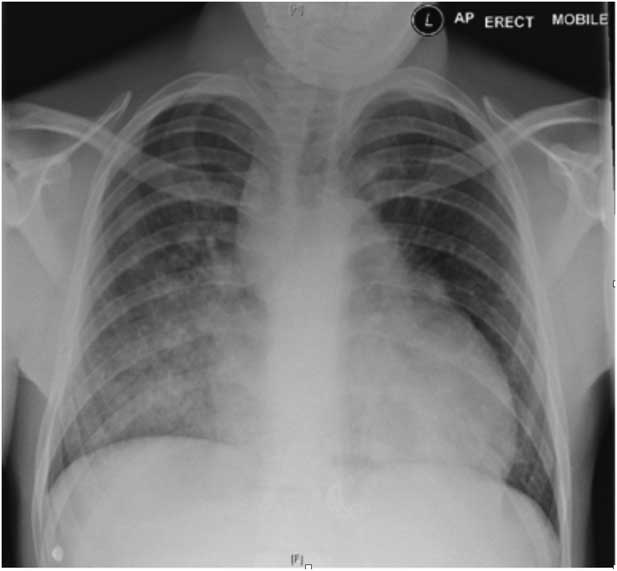
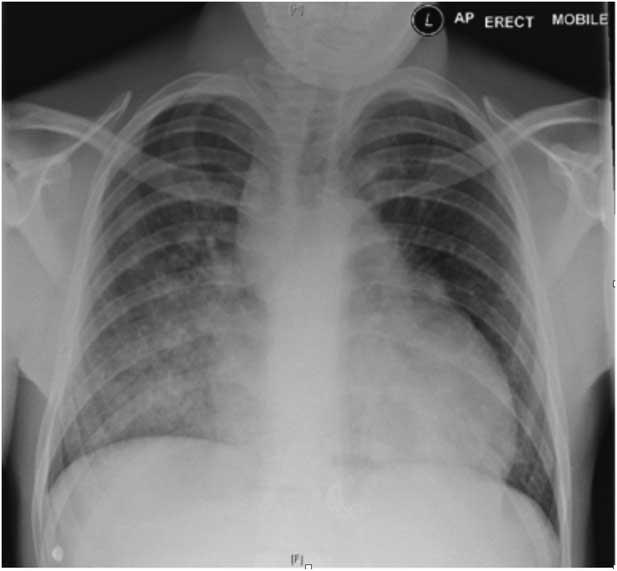
The patient was intubated and ventilated and transferred from his local hospital following presentation with haemoptysis and respiratory compromise. On arrival, he was hypoxic and had ongoing bleeding with oxygen saturations <70% despite an FiO2 of 1.0. He was haemodynamically stable. His chest radiograph is shown in Figure 1. His admission international normalised ratio was 1.4. Anticoagulation was fully reversed during initial treatment. Cardiac catheterisation showed mildly elevated Fontan pressures and multiple major aorto-pulmonary collaterals to the right lung, which were embolised with coils. The patient’s condition improved, and he was extubated and transferred to the ward after 48 hours. He was re-admitted to the ICU 4 days later with recurrent massive haemoptysis and required an emergency intubation. Further catheterisation was performed, but given his extensive recent procedures no new targets for occlusion were identified. Pulmonary angiogram excluded any arteriovenous malformations as an additional source of haemoptysis. He was transferred back to the ICU with ongoing haemoptysis, rising oxygen requirements, fevers, and renal failure. Supportive therapy progressively increased over the following 12 hours with ongoing blood suctioned through his endotracheal tube. He was considered too unstable for bronchoscopy or any other further interventions, and the situation was bleak.
Antero- posterior chest radiograph on clinical presentation. The key finding is that of diffuse patchy infiltrates predominantly in the right middle and lower lobes representing the inflammatory response to hemorrhage.
The patient had received extensive blood product support throughout, and his clotting parameters were within normal limits: international normalised ratio<1.5, activated partial thromboplastin time ratio<1.5, and platelet count 110×109/L. He received tranexamic acid 1 g quater die sumendum. After careful consideration, 40 μg/kg of recombinant factor VIIa (rFVIIa) was administered in an attempt to reduce or terminate the haemoptysis. After administration of rFVIIa, the haemoptysis reduced to 50 ml over the following 12 hours and had virtually ceased at 24 hours. The patient remained intubated for a further 5 days but was extubated uneventfully and discharged to the ward 7 days later. He returned home ~3 weeks after his admission and has returned to college and everyday activities. Anticoagulation has not been re-started. In recent months, his overall functional status and ventricular function have declined, and he is currently being considered for cardiac transplantation.
Discussion
Haemoptysis is a recognised complication of a Fontan circulationReference McRae 1 and may be secondary to major aorto-pulmonary collaterals or pulmonary arteriovenous malformations. Previous cases have been treated with coil embolisation, extracorporeal membrane oxygenation, and lobectomy.Reference Bedard, Lopez and Perron 2 In this case, coil embolisation was performed on three occasions without sustained resolution of haemoptysis. Given the ongoing, large-volume haemoptysis, the anticoagulation required for extracorporeal membrane oxygenation was deemed to be an absolute contraindication to its use. Given the poor prognosis, rescue therapy with rFVIIa was attempted. The major risk was that the rFVIIa would cause extensive clotting throughout the Fontan circuit, leading to reduced cardiac output and death; however, the desperation of the situation justified this risk. To our knowledge, this is the first case report to document the use of rFVIIa in a patient with massive haemoptysis related to a Fontan circulation.
rFVIIa is only licensed for use in haemophiliacs with acquired inhibitors to anticoagulation. It has been used off-license in the setting of uncontrollable haemorrhage, notably in the case of a 19-year-old Israeli soldier who suffered a gunshot wound to the inferior caval vein, which continued to bleed despite surgical attempts to achieve haemostasis.Reference Kenet, Walden, Eldad and Martinowitz 3 The American Society of Thoracic Surgeons and the Society of Cardiovascular Anaesthesiologists recommend the use of rFVIIa in patients with uncontrollable non-surgical bleeding who have undergone cardiac procedures on bypass.Reference Ferraris, Brown and Despotis 4 A Cochrane review evaluating the use of rFVIIa in the control of haemorrhage in patients without haemophilia has been performed.Reference Simpson, Lin, Stanworth, Birchall, Doree and Hyde 5 In the setting of therapeutic use of rFVIIa, there was no significant difference in mortality, red cell transfusion requirements, or total number of thromboembolic adverse events. There were non-significant trends towards reduced mortality and increased thromboembolic events in patients treated with rFVIIa, and alarmingly there was a significant increase in the total number of arterial thrombotic events. At present, expert opinion recommends that off-license use of rFVIIa in patients without haemophila be restricted to clinical trials.Reference Simpson, Lin, Stanworth, Birchall, Doree and Hyde 5
In conclusion, where conventional options for haemostasis have been exhausted, the use of rFVIIa as a rescue therapy in extremis may be considered after carefully assessing the risk–benefit profile. Significant haemoptysis in the setting of a Fontan circulation may be indicative of deteriorating haemodynamics; successful treatment of the acute situation may only provide temporary relief in the setting of a failing Fontan circuit.
Acknowledgement
None.
Conflicts of Interest
None.
Ethical Standards
The contents of this report meet the ethical standards of Guys and St Thomas’ NHS foundations trust.