

Various media use promoted by technological advances has changed how people communicate. The introduction of new types of online media has reduced psychological distance among people who are geographically far from one other, and has made communication among people more immediate and interactive. However, online media has also widened the gap of political information available between people who use online media and those who do not. Those who are familiar with online media can obtain more diverse information through this source than those who use offline media. The digital divide that stemmed from the popularisation of the internet is now being replicated in the form of social media divides between its users and non-users (Jaeger, Bertot, & Shilton, Reference Jaeger, Bertot, Shilton, Reddick and Aikins2012). One can anticipate the effects of rapid media development on media use preference and political engagement as well. Media use preferences can differ depending on the media circumstance when people are of secondary school age. People who have lived primarily utilising offline media may feel more comfortable communicating offline, whereas those who experienced a digitalised education system may be accustomed to using online media. How these differences in utilising media affect political engagement is in need of investigation, to confirm whether those familiar with online media will feel more at ease with establishing their political stance online, and whether those who are not familiar with online media find it more effective to establish their political position through direct communication with others offline. It might lead to diverse political engagement when social issues emerge.
From this perspective, this study aims to examine differences in the use of online/offline media communication for political engagement, particularly between two generational groups of Korean adults. The main interest is whether uses of and communication through media change political engagement: How do the two groups differ in their use of online and offline media and does their communication through online and offline media affect their political engagement? The specific research questions are as follows: Does online media use and communication change the basic orientation of people towards political engagement? Does online media use and communication enhance political engagement more than offline media use, regardless of individual political efficacy for political engagement? Does online media use and communication within the the younger generation have a stronger effect on their political engagement than that of the older generation who were socialised in circumstances when online media were not universal?
Differences in the types of media people use and communicate with are not simply an issue of individual preference. The fast development of technologies may have an effect on how people communicate with others increasing the opportunities to show their opinions. With political engagement considered an essential element for the development of a stable democracy (Huntington, Reference Huntington1968), and people gaining more opportunities to take a stance and act politically with one another, we need to identify the effects of media use on political engagement for long-term societal development.
Political Context of Korean Generation Groups
Korea is a unique space to examine the impact of online media. Korea has been identified as the most ‘wired’ country in the world, with 82.7% internet penetration (Cha, Reference Cha2013). Economic strategies that have concentrated on internet industries as one of the solutions to recover from the 1997 economic recession has stimulated the technical development and uses of online media, such as electronic commerce, e-government, and social media. The explosive spread of the internet and the ease of access to online media over the past two decades have most likely contributed to changing the way members of Korean society communicate: from direct contact and face-to-face meetings to immediate online interactions.
The invigoration of online media seems to have been a turning point to divide members of society into two distinctive generational groups. One of the two groups in this study was made up of individuals in their forties and fifties, called the ‘4050 generation’. They share experiences and memories of significant political changes. This group, who were born in the 1960s or 1970s and were students of college or high school in the 1980s, participated directly and indirectly in extensive anti-oppressive government demonstrations that led to the democratisation of the country in 1987. They assembled through phone calls, materials sent through the postal service, and face-to-face meetings.
In contrast, the ‘2030 generation’ is made up of individuals who are currently in their twenties and thirties and share economic and cultural experiences that grew out of the 4050 generation's political experiences. This 2030 generational group was educated during the 1997 Asian economic recession and spent their stormy period of adolescence during the economic turbulence thath originated from the U.S. subprime mortgage crisis. They are the ones most heavily affected by the unemployment and job instability that has existed in the economic market since the mid 2000s. Culturally, this age group actively experienced the various nationwide candlelight vigils held to express solidarity, such as that in 2002 to show anti-American sentiment and in 2008 to demand a renegotiation on the Korea-U.S. Free Trade Agreement. This generation also enjoyed being young adults when the country cohosted the 2002 World Cup with Japan. Online media (such as blogs, websites) gave them opportunities to gather information and run out into the streets in protest whenever social issues emerged.
Differences between the two groups in interacting with media technologies is more evident nowadays. For example, during the 2010 local election, when photos of celebrities sharing that they had participated in voting appeared on social media, the polls saw an increase in voter turnout among younger adults. This was dubbed the ‘Twitter politics’ of the younger generation (Asia Today, 2011). Many politicians and political parties are attempting to utilise social media to increase the participation of those who fall into the 2030 generation. Also, the National Election Commission made advertisements with teen-idol stars to heighten the low voting rates of those in their twenties and thirties.
Media Uses and Political Engagement
Currently, political engagement is an interchangeable term with political participation, since voting during regular elections is a typical form of political participation (Ansolabehere, Iyengar, Simon, & Valentino, Reference Ansolabehere, Iyengar, Simon and Valentino1994; Berelson, Lazarsfeld, & McPhee, Reference Berelson, Lazarsfeld and McPhee1954). However, technological advances have widened the scope of political engagement. Online media allows people to become involved in social issues or other political things easily and quickly. Individuals and organisations worldwide can get in touch with politicians, parties or any institution, gather information, declare their own opinions, and make contact with others through online media more immediately (Bennett, Reference Bennett2012; de Zúñiga & Valenzuela, Reference de Zúñiga and Valenzuela2011; Tolbert & McNeal, Reference Tolbert and McNeal2003; Xenos & Moy, Reference Xenos and Moy2007).
Previous studies showed that media use contributes to political engagement positively (Jung, Kim, & de Zúñiga, Reference Jung, Kim and de Zúñiga2011; Schmitt-Beck, Reference Schmitt-Beck2003; Shah et al., Reference Shah, Cho, Nah, Gotlieb, Hwang, Lee, Scholl and McLeod2007; Sotirovic & McLeod, Reference Sotirovic and McLeod2001; Tian, Reference Tian2011; Willnat, Wong, Tamam, & Annette, Reference Willnat, Wong, Tamam and Annette2013). Voting, a typical form of political engagement, requires political information related to whether and how much a certain party or candidate is close to voters’ own stances (Downs, Reference Downs1957). Ease of access to much more information through the use of new online media contributes to increased political engagement, due to reducing the individual cost to get information.
Complicating this relationship, previous studies that investigated the effects of online media use found differences among individuals’ characteristics and style of communication (Bimber, Reference Bimber2001; Bennett, Reference Bennett2012; Ikeda & Boase, Reference Ikeda and Boase2011). Online communication is associated with online political participation (Valenzuela, Kim, & de Zúñiga, Reference Valenzuela, Kim and de Zúñiga2012), and the influence online communication has on political engagement is stronger than that between offline communication and political engagement (de Zúñiga & Valenzuela, Reference de Zúñiga and Valenzuela2011). Based on this, we anticipated that the more actively people engage in online communication, where they share their own opinions and observe and react to others’ opinions, the more politically engaged they will be.
Further, does online media use and communication change the basic orientation of people towards political engagement? Does online media use have stronger effects on political engagement than offline media use, regardless of individuals’ orientation for political engagement? To answer these questions, we need to consider political efficacy as an internal psychological factor for political engagement. Political efficacy — that is, feeling capable of influencing the political decision-making process — is understood as an acceleration factor of political engagement (Campbell et al., Reference Campbell, Gurin and Miller1954; Milbrath & Goel, Reference Milbrath and Goel1977). That is, the higher political efficacy is, the more positively people try to engage in political affairs.
However, the effect of political efficacy on political engagement can be mediated by media use and communication because information acquisition may change people's attitudes to political engagement. A higher level of political efficacy motivates the use of media to gather political information, which is a factor in increased interest in political engagement (Miller, Miller, & Schneider, Reference Miller, Miller and Schneider1980; Verba, Schlozman, & Brady, Reference Verba, Schlozman and Brady1995). In socialisation, most people form patterns of information acquisition as well as political efficacy (Semetko & Valkenburg, Reference Semetko and Valkenburg1998), but the effect of political efficacy on political engagement can be differentiated depending on how information is obtained from media use and communication. Frequent media use promotes political engagement, and online communication is studied as a significant predictor of voting, especially among younger generations (Moeller, de Vresse, Esser, & Kunx, Reference Moeller, de Vresse, Esser and Kunx2013). Supposing that internalised political efficacy is seldom changed, different media circumstances of the socialisation process can change media use and information acquisition patterns, which can differentiate the effect of media use on political engagement among age groups.
If that is the case, does online media use and communication utilised by the younger generation have stronger effects on their political engagement than that of the older generation who were socialised in circumstances when online media was not universal? Although there is a controversy over whether differences of age groups in political engagement comes from a cohort effect or a period effect, conventional wisdom says that the younger generation is less interested in politics than older generations (cf. Henn, Weinstein, & Wring, Reference Henn, Weinstein and Wring2002; Hooghe, Reference Hooghe2004). Another way of putting this into perspective is that the older generation is more engaged in politics. Although age cannot be separated from political experience, as in people being exposed to more experiences as they age, ageing is a powerful factor to explain offline active participation (Watts, Reference Watts1999).
However, age differences in online political engagement can be different from offline political engagement because online political engagement is relatively free from financial constraints and external pressures, especially for the young generation (Barnhurst, Reference Barnhurst2011; Jugert, Eckstein, Noack, Kuhn, & Benbow, Reference Jugert, Eckstein, Noack, Kuhn and Benbow2013). For the younger age group who is willing to pay the low cost of online media, their higher online political engagement can be anticipated. In the same vein, a report by the Pew Research Center showed that younger social media users are more likely to exhibit online political engagement behaviours (Pew Research Center, 2012). Most online activists in the United States are part of the younger generation aged under 35 years old and are less active in offline political participation (Oser, Hooghe, & Marien, Reference Oser, Hooghe and Marien2013). Thus, a new trend of political engagement and a generational shift in public realm are predicted when the younger generation, called ‘digital natives’, familiar with online communication, enter the electorate (Ferri, Reference Ferri and Cartelli2012; Xenos & Moy, Reference Xenos and Moy2007).
Research questions of this study echo previous studies in Asia. According to a comparative study on Asian and African countries, the frequencies of online media use promote expressions of democratic demands (Nisbet, Stoycheff, & Pearce, Reference Nisbet, Stoycheff and Pearce2012). Also, a study in China shows that the effect of media use and communication can be explained by individual cultural orientation linked to online behaviours such as the style, content, and expressed values of online debates (Ye, Sarrica, & Fortunati, Reference Ye, Sarrica and Fortunati2014). The younger generation, a group with increased exposure and application in online media, can be more expressive than the older generation, who have possibly less experience with online media. In this vein, we need to pay attention to the case in Hong Kong in which the younger generation did not show markedly different characteristics in online media use, which means that assumptions about generational differences in online media use is a topic that needs to be explored (Chu, Reference Chu2010).
From this perspective, the current research examined whether political efficacy can explain different uses of various online/offline media, and whether this, in turn, results in different levels of political engagement. Furthermore, patterns of such relations in different age groups are explored. Considering the context of South Korea, one would expect that the 4050 generation, compared to the 2030 generation, would have higher political efficacy due to their experiences of the collective movements that would encourage more active political engagement. Also, one might expect media use and communication to have more positive effects on political engagement among the 2030 generation, who are more familiar with the use and means of communication of online media than the 4050 generation.
Hypothesised Model
To investigate these differences between generational groups, this study aimed to test the model presented in Figure 1. The hypothesised model represents the examination of relationships between political efficacy, offline and online media use, communication, and political engagement. It was hypothesised that the relationships between both offline and online media use would be positively related to political engagement both directly and indirectly via mediating variables (i.e., offline and online communication). Based on previous studies (Bimber, Reference Bimber2001; Bennett, Reference Bennett2012; Valenzuela et al., Reference Valenzuela, Kim and de Zúñiga2012), offline and online communication were tested as mediating variables between media use and political engagement.
Hypothesised model of political efficacy, media use, citizen communication, and political engagement.

Measures
Political engagement
Political engagement initially referred to voting in regular elections (Ansolabehere et al., Reference Ansolabehere, Iyengar, Simon and Valentino1994; Berelson et al., Reference Berelson, Lazarsfeld and McPhee1954). The concept has further expanded to include various other political activities as well (Verba et al., Reference Verba, Schlozman and Brady1995). In this study, political engagement included participation in five activities: voting, signing petitions, participating in social movements, participating in legal demonstrations, and joining political parties/civic associations. Among the five types of political engagement, the more direct type of political engagement is joining political parties and civic associations. Participating in these activities is distinctive in terms of the inclusive purpose and persistency of the behaviour, which requires a higher level of volunteerism than the other types of political engagement. Not only should one have an active and consistent interest in social issues to participate in social movements, but it can also lead to related communal activities in the long term.
The remaining four activities shared two characteristics. First, those activities are one-time events. Elections are only held during set periods. Social movements and demonstrations may not persist long enough, depending upon the introduction and decline of the social issues to which they are responding. Second, these activities require a high level of interest in social issues and voluntarism for individuals’ direct intervention. Individuals who become involved are motivated by the possibility of affecting electoral results and political processes. The reliability coefficient using Cronbach's alpha coefficient for this scale was .72.
Political efficacy
An important individual psychological factor for understanding political engagement is political efficacy. Political efficacy is defined as ‘the feeling that political and social change is possible, and that the individual citizen can play a part in bringing about this change’ (Campbell et al., Reference Campbell, Gurin and Miller1954, 188p.). Specifically, one's internal political efficacy, which refers to the subjective belief about one's own ability to affect politicians’ policy decision, influences political engagement (Miller et al., Reference Miller, Miller and Schneider1980; Verba et al., Reference Verba, Schlozman and Brady1995). In other words, people with high political efficacy believe it is possible to change political systems, and thus they become actively involved in politics.
Political efficacy was measured using four items (e.g., who people vote for makes a difference). This scale was rated on a 5-point Likert scale scored from 1 (strongly disagree) to 5 (strongly agree). Items were coded so that higher scores indicate a higher sense of political efficacy. The reliability coefficient using Cronbach's alpha coefficient for this scale was .77.
Media use
Media use was measured by eight items. Respondents were asked to rate on a 4-point scale from 1 (not at all) to 4 (very frequently) how often they used the following media to get information about election and political issues: offline media (e.g., print newspapers, print news magazines) and online media (e.g., online newspapers, online news magazines). The items were coded, so that a higher number indicated more news consumption. The reliability coefficient using Cronbach's alpha coefficients for this scale was .74 and .76, for offline and online media use, respectively.
Citizen communication
Citizen communication was measured by 10 items. The respondents were asked to indicate, by means of a four-point scale from 1 (not at all) to 4 (very frequently), how frequently they discussed political issues (e.g., elections, voting, political parties) during an election period, either offline (face to face) or online. The reliability coefficient using Cronbach's alpha coefficients for this scale was .92 and .79 for offline and online communication respectively.
Data and Statistical Analysis
This study investigated the relationship between political efficacy, media use and communication, and political engagement using data drawn from the 19th General Election Survey in Korea, conducted by Korean Social Data Center and funded by the National Election Commission of Korea. We selected this data because it has diverse questionnaires on voters’ political behaviours and media use, and thus we could identify various routes for political information and diverse types of political engagements around electoral periods.
This survey was administered through face-to-face interviews from April 12 to April 23, right after the 19th general election of April 11, 2012. It included 1,000 respondents who were 19 years and older in 16 metropolitan areas and major cities. It closely approximates national demographic benchmarks. Respondents were randomly selected using stratifications based on gender, age, and region from residents who were registered to the Korean Statistical Information Service. Among the total sample, the mean age was 44.15 years (SD = 15.29 years, range 19–90 years). The gender distribution was 49.6% males and 50.4% females. There were 2.2% upper class (80–100 percentile), 11.7 % upper middle class (60–80 percentile), 45.4 % middle class (40–60 percentile), 28.7 % lower middle class (60–80 percentile), and 12.1 % lower class (60–80 percentile). Response rates of study variables ranged from 97.8% to 99.8%.
The composition of the two generational subgroups was as follows: the gender distribution was 51.5% females and 48.5% males for the 2030 and 4050 generations, respectively. Regarding socioeconomic status, the distribution was 1.9% and 3.1% upper class (80–100 percentile), 12.3 % and 12.4% upper middle class (60–80 percentile), 51.8 % and 44.7% middle class (40–60 percentile), 26.2 % and 27.6% lower middle class (60–80 percentile), and 7.8% and 12.1% lower class (60–80 percentile) for the 2030 and 4050 generations, respectively.
Participants were deliberately separated into two age groups for comparison. One group came of voting age before the mid-1990s and was referred to as the 4050 generation since they are currently in their forties and fifties. The other group that reached voting age after the mid-1990s was referred to as the 2030 generation, since they are currently in their twenties and thirties. In addition to the different political and societal environments these two age groups experienced as young adults, the assumption was that the older 4050 generation was not as accustomed to the internet and social media because they had to learn the technology as adults. In contrast, the assumption was that those in their twenties and thirties were younger when they were exposed to the internet and social media and thus were expected to be more familiar with the technology.
Demographic Variables
Studies have suggested that family socioeconomic status level is associated with the degree of political engagement (Bachmann, Kaufhold, Lewis, & de Zúñiga, Reference Bachmann, Kaufhold, Lewis and de Zúñiga2010; Brady, Verba, & Schlozman, Reference Brady, Verba and Schlozman1995; Rosenstone & Hansen, Reference Rosenstone and Hansen1993; Verba & Nie, Reference Verba and Nie1972). Voters with a higher educational level have higher rates of political engagement (Blais & Dobrynska, Reference Blais and Dobrynska1998; Wolfinger & Rosenstone, Reference Wolfinger and Rosenstone1980). Therefore, family income and educational level were also included in the study as control variables.
Statistical Analysis
We used structural equation modeling (SEM) to assess the hypothesised structural relationships among latent variables. SEM was selected because it is an appropriate analytic approach to specify directionality among variables of interest and generate flexibility to test causal relationships. Specifically, this study conducted an evaluation of the hypothesized model of the relationships among political efficacy, offline and online media use, communication, and political engagement. In addition, two mediational models were tested as a comparison to derive the best model. To test the significance of the mediating effects, we conducted bootstrapping methods, outlined by Shrout and Bolger (Reference Shrout and Bolger2002).
In general, chi-square goodness-of-fit tests are known to be sensitive to sample size, particularly when the sample size is large (Steenkamp & Baumgartner, Reference Steenkamp and Baumgartner1998). In these cases, the null hypothesis may be rejected and the model that should be determined statistically inadequate may be ruled adequate. Therefore, we decided to assess the model fit based on several other criteria. Specifically, we used the non-normed fit index (NNFI; Bentler & Bonett, Reference Bentler and Bonett1980), comparative fit index (CFI; Bentler, Reference Bentler1990), and root mean square error of approximation (RMSEA; Steiger & Lind, Reference Steiger and Lind1980). Values lower than .08 for the RMSEA and values close to .95 for the NNFI and CFI were used to determine a good-fitting model. All analyses were conducted using Mplus 7.11 (Muthén & Muthén, Reference Muthén and Muthén2010).
Results
General Findings Based On Age Groups
T tests were conducted to see if there are group differences regarding the variables of interest (see Table 1). There was a significant difference in both kinds of media use, with the 2030 generation reporting stronger preferences for online media use, while the 4050 generation reporting stronger preferences for offline media use. With regard to citizen communication, there were significant group differences using offline means. The 4050 generation reported stronger preferences for offline communication compared to the 2030 generation. Lastly, group differences were found in political engagement. The 2030 generation reported greater engagement in social movements and demonstrations compared to the 4050 generation, while the 4050 generation reported higher voting rates compared to the 2030 generation. Significant correlations were found among the study variables in both groups (see Table 2). The 2030 generation reported political efficacy only being related to offline communication. For the 4050 generation, political efficacy was related to both online and offline communication.
Descriptive Statistics
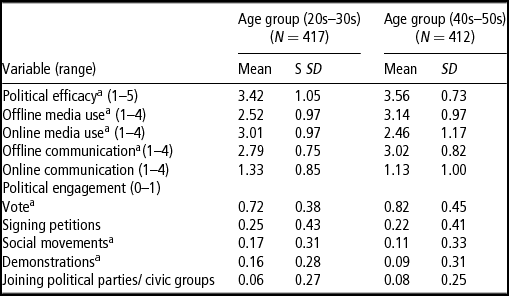
Note: aGroup difference is significant at p < .05.
Correlations Among Study Variables Across Age Groups
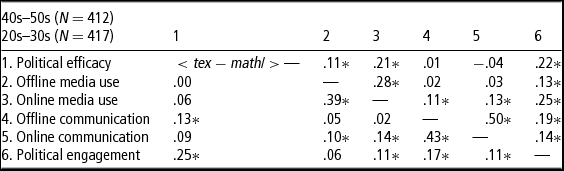
Note: *p < .05; correlations for the 20–30 year group are below the diagonal; correlations for the 40–50 year group are above the diagonal.
Testing the Mediational Models
To assess the plausibility of the hypothesis that the relationship between media use and political engagement is mediated by communication, we tested two mediational models. The initial structural model (see Figure 1) reflecting partial mediation was specified with both direct and indirect paths from media use to political engagement via two mediators. The second structural model represented the full mediational model, which did not include direct effects of media use to political engagement.
Results indicated that different mediational models showed good fit for the two groups. For the 2030 generation, the full mediational model yielded a good fit to the sample: an overall χ²(9) value of 81.84, with CFI = .946 and RMSEA = .064; and the partial mediational model yielded a poor fit to the sample: an overall χ²(7) value of 76.59, with CFI = .628 and RMSEA = .157. For the 4050 generation, the partial mediational model yielded a good fit to the sample; an overall χ²(7) value of 29.99, with CFI = .997, and RMSEA = .023; and, in contrast, the full mediational model yielded a poor fit to the sample; an overall χ²(9) value of 33.67, with CFI = .605, and RMSEA = .152. Thus we chose the full mediational model as the final theoretical model for the 2030 generation while the partial mediational model was chosen as the final theoretical model for the 4050 generation. The fit of the final models was deemed acceptable in terms of three fit indices. The standardised parameter estimates for final models are presented in Figure 2.
Final structural model with standardised solution.
Note: *p < .05; significant path coefficients are shown in bold line; NS = non-significant.
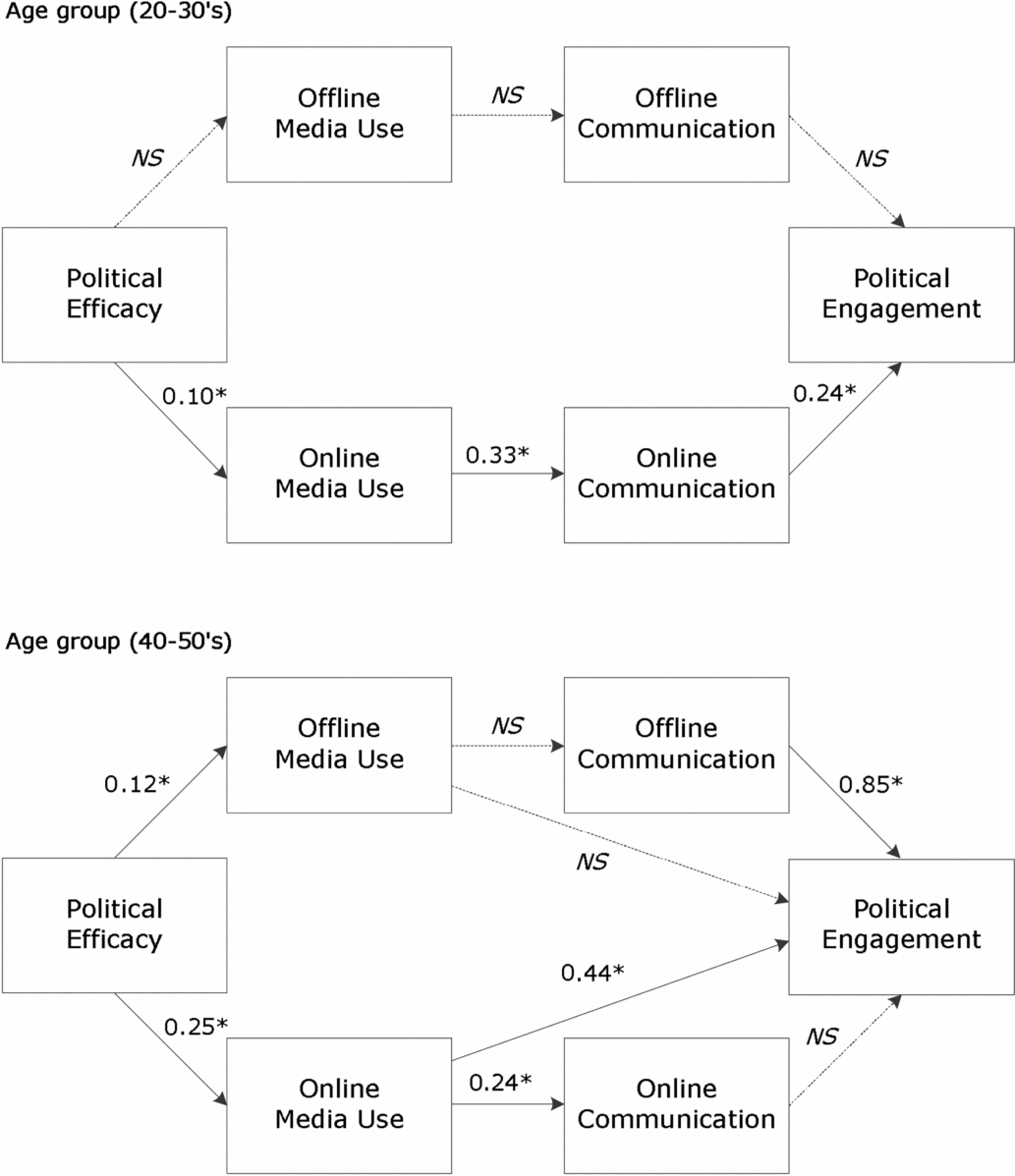
Maximum likelihood bootstrapping with a 95% confidence interval (see Shrout & Bolger, Reference Shrout and Bolger2002) was used to test whether there was a significant indirect effect from media use to political engagement through two mediating variables. After controlling the income and educational level, for the 2030 generation, results revealed that indirect (mediated) effects of online media use to political engagement via online communication was significant (p < .05). The largest path coefficient was from online media use to the mediator online communication (β = .33). For the 4050 generation, results for direct effects indicated that online media use had significant meaningful effects on online communication and political engagement. The largest path coefficient was from online media use to political engagement in this group (β = .44). Results from the mediating analyses revealed that none of indirect (mediated) effects of media use to political engagement via communication were significant for this age group. Political efficacy exerted a significant effect on online media use for both age groups (β = .10 and .25, respectively), but it only had a significant effect on offline media use for the 4050 generation (β = .12).
Discussion
How political engagement can be enhanced is not an issue that only concerns South Korea. The continuous drop in rates of voting, a typical type of political engagement, has been a political issue in many countries, as well as a theme of academic research (Boulding, 2015; Mahler, Jesuit, & Paradowski, Reference Mahler, Jesuit and Paradowski2014) because it is a sign of crisis for representative democracy. Thus, more attention is needed to investigate whether proactive utilisation of new media can increase political engagement (cf. Delli Carpini, Reference Delli Carpini2000). In the long term, the focus is on the political landscape of representative democracy at the time of younger generations’ entry into the electorates.
Our results demonstrate that the internal psychological factor of political efficacy is a significant predictor of whether people use and communicate through media (Moeller et al., Reference Moeller, de Vresse, Esser and Kunx2013; Jung et al., Reference Jung, Kim and de Zúñiga2011). Specifically, the 2030 generation did not show a significant association between political efficacy and media use, whereas the 4050 generation showed that their political efficacy had significant relations between both offline and online media use. For the 4050 generation, their past political experiences might inform their high levels of political efficacy, having been socialised by their belief that political change is possible by political engagement (Semetko & Valkenburg, Reference Semetko and Valkenburg1998). This works as an internal motive to use media for political information (Miller et al., Reference Miller, Miller and Schneider1980; Verba et al., Reference Verba, Schlozman and Brady1995). However, the country's economic instability might make the 2030 generation assume fewer positive attitudes towards engagement with politics.
We found the two generational groups had different preferences for types of political engagement. The 4050 generation was interested in formal political engagement (voting) while the 2030 generation showed more interest in informal political engagement, such as social movements. The preference of the 2030 generation for informal political engagement implied that cultural experiences of their socialisation process (e.g., candlelight vigils, green products campaign) rather than formal political participation can have steadying effects on their political attitudes and political engagement. These findings provide evidence that socialisation circumstances are important in understanding types of political engagement.
Unique experiences of two generations are related to generational effects. In order to understand the issue of current political engagement, generational effects should be considered rather than the life cycle effect (Putnam, Reference Putnam2001). Differences between age groups who share similar experiences and attitudes (Mannheim, Reference Mannheim and Kecskemeti1952) may have more explanatory power about why there are differences in political engagement than arbitrarily defined age group distinctions. It implies that each generation has a unique style of communication attributed from their socialisation process (cf. Bimber, Reference Bimber2001; Bennett, Reference Bennett2012).
Technological advances in media have altered the sources from which people obtain information and, in particular, have exerted an influence on the socialisation process of how the generations communicate. The present study revealed that the 2030 and the 4050 generations are different in their use of communication and online and offline media. The older age group was found to prefer offline media, whereas the younger group mostly used online media, as found in other studies (Oser et al., Reference Oser, Hooghe and Marien2013; Pew Research Center, 2012). This supported the idea that the media environments in which people spent their young adulthood contribute to the types of media they mostly used. Additionally, these differences in how easily each generational group adopts new technology and the values held regarding that technology contribute to making communication between age groups more difficult (McLeod, Reference McLeod2000; Moeller et al., Reference Moeller, de Vresse, Esser and Kunx2013; Hahm, Reference Hahm2002). Lack of communication across age groups may become a larger societal concern in the political realm.
As our research has shown, online media use had more direct effects on political engagement of the 4050 generation than the 2030 generation, showing that different media use influenced political engagement through different paths between the age groups. That is, people of this age group who used online media tended to be more active in participating in politics, and their online media use was strongly linked to their communication through online media. Specifically, the 4050 generation who had not been socialised in new media demonstrated positive connections between online media use and political engagement, which is in the same vein of the previous literature (de Zúñiga & Valenzuela, Reference de Zúñiga and Valenzuela2011; Jung et al., Reference Jung, Kim and de Zúñiga2011; Tian, Reference Tian2011; Willnat et al., Reference Willnat, Wong, Tamam and Annette2013). The fact that online media use is closely related to voluntary political engagement in this age group, who encountered this new type of media for the first time after adolescence, suggests that provision of political information through online media can encourage their political engagement and their political efficacy might exert indirect effects on their political engagement.
Among the 2030 generation, however, online media use did not directly affect their political engagement. Rather, online media use had an indirect influence via the mediation of online communication, echoing findings from other studies with different national samples (Moeller et al., Reference Moeller, de Vresse, Esser and Kunx2013; McLeod, Shah, Hess, & Lee, Reference McLeod, Shah, Hess, Lee, Sherrod, Torney-Purta and Flanagan2010). This group not only used online media more often than offline media, but also did not show significant paths towards political engagement through offline media. Online media use did not have direct connections to political engagement. Rather, their political engagement happened indirectly through communicating online with others. Therefore, communication through online media is needed to reach the 2030 generation with political information, but further research is needed to examine how this age group may be encouraged to go beyond communicating with others and actually participating more in politics.
Although an Australian election study showed that online communications are not as effective in mobilising offline political participation (Gibson & McAllister, Reference Gibson and McAllister2013), we cannot reject that online media use can promote a sense of solidarity among group members. In a study on participants in Hong Kong, online media use mediated the relationship between in-group identification and collective action, maintaining social identification with the group and strengthening willingness for collective actions (Chan, Reference Chan2014). Also, according to an empirical study in Singapore, online bridging ties do not contribute to traditional political participation, but online bridging ties and online political engagement were linked with each other (Skoric,Ying, & Ng, Reference Skoric, Ying and Ng2009).
While the current research revealed that the paths through which media use functions differently in predicting political engagement according to the two generational groups, the study was not without limitations. First, it did not consider people's evaluation of how they perceive online media. The analyses found that the 4050 generation relied less on online media than the 2030 generation did, but their use of online media had a more significant influence on their political engagement. Although such effects of media were apparent even after controlling for income and education levels, the analyses did not take into consideration whether the 4050 generation relied more on or had more favourable attitudes toward online media than the 2030 generation. One area of further research would be to examine not only media preferences, but also the value attributed to online and offline media. Second, the study was cross-sectional in nature, and therefore causal impacts of political efficacy, media use and communication, and political engagement cannot be claimed. Further research should examine these factors at multiple time points to determine this more conclusively. Another limitation of the study was that it does not answer how the different kinds of online communication contents might promote political engagement. With online media, people can see others’ opinions and fierce debates on unfamiliar public issues. This may discourage some individuals from becoming involved. Communication with people having opposing opinions may impede one's political engagement (Hopmann, Reference Hopmann2012; Mutz, Reference Mutz2002).
The main findings of this study imply that the activation of online media use and communication are not efficient strategies to promote political engagement by people in the 2030 generation. That is, merely relying on the universal use of and communication through online media does not enhance the level of political engagement among members of this generation. Rather, a viable alternative might be systemic civic education to build individuals’ political efficacy (Jung et al., Reference Jung, Kim and de Zúñiga2011; Meoller et al., Reference Moeller, de Vresse, Esser and Kunx2013). Regardless of media use preferences and communication means, the study showed that attitudes of political efficacy had significant links to media use for both age groups, echoing studies conducted in other countries (Campbell et al., Reference Campbell, Gurin and Miller1954; Morrell, Reference Morrell2003; Delli Carpini, Reference Delli Carpini and Kaid2004). Thus, the study provides additional factors we need to consider when attempting to solve low political participation and heighten political efficacy.
This relationship between media use and political engagement is echoed in other countries. The new democracies of Eastern Europe, like that of South Korea, experience generational differences in online communication and socialisation (McLeod, Reference McLeod2000). Additionally, the universalisation of online media in the United States can be a pivotal factor to change the political landscape when the younger generation reaches voting age (Xenos & Moy, Reference Xenos and Moy2007). Considering the emergence of a digitally divided society, the older generations are more likely to be less active in accessing new media (Sylvester & McGlynn, Reference Sylverster and McGlynn2010), which means that the generational gap can become a greater societal issue in the long term.
Acknowledgments
This work was supported by the National Research Foundation of Korea Grant funded by the Korean Government (NRF-2013S1A3A2042859).



