1. Introduction
Within obducted Phanerozoic ophiolite sequences, suites of felsic rocks termed ‘oceanic plagiogranites’ (Coleman & Peterman, Reference Coleman and Peterman1975; Le Maitre et al. Reference Le Maitre, Streckeisen, Zanettin, Le Bas, Bonin and Bateman2002, p. 118) occur as small-volume (<10%) components (Coleman & Peterman, Reference Coleman and Peterman1975; Koepke et al. Reference Koepke, Berndt, Feig and Holtz2007). The petrogenesis of these plagiogranites is controversial, having been variously proposed to have formed by the late-stage crystallization of mafic melts (Coleman & Peterman, Reference Coleman and Peterman1975), hydrous partial melting (and assimilation) of mafic rocks (Gerlach, Leeman & Ave Lallemant, Reference Gerlach, Leeman and Ave Lallemant1981; Amri, Benoit & Ceuleneer, Reference Amri, Benoit and Ceuleneer1996; Gillis & Coogan, Reference Gillis and Coogan2002; France, Ildefonse & Koepke, Reference France, Ildefonse and Koepke2009; France et al. Reference France, Koepke, Ildefonse, Cichy and Deschamps2010; Erdmann et al. Reference Erdmann, Fischer, France, Zhang, Godard and Koepke2015) or silicate–liquid immiscibility (Dixon & Rutherford, Reference Dixon and Rutherford1979).
Significantly, plagiogranites have compositional similarities to trondhjemite, tonalite and granodiorite (TTG) rocks that are common in Archaean terranes from the period 4.0–2.5 Ga (e.g. Drummond, Defant & Kepezhinskas, Reference Drummond, Defant and Kepezhinskas1996; Kerrich & Polat, Reference Kerrich and Polat2006; Moyen & Martin, Reference Moyen and Martin2012; Kusky et al. Reference Kusky, Windley, Safonova, Wakita, Wakabayashi, Polat and Santosh2013). Although themselves controversial, Archaean TTG are considered, by many, to be generated by the partial melting of mafic igneous source regions (e.g. Drummond, Defant & Kepezhinskas, Reference Drummond, Defant and Kepezhinskas1996; Foley, Tiepolo & Vannucci, Reference Foley, Tiepolo and Vannucci2002; Rapp, Shimizu & Norman, Reference Rapp, Shimizu and Norman2003; Martin et al. Reference Martin, Smithies, Rapp, Moyen and Champion2005; Moyen & Stevens, Reference Moyen, Stevens, Benn, Mareschal and Condie2006; Nutman et al. Reference Nutman, Bennett, Friend, Jenner, Wan, Liu, Cawood and Kröner2009; Hastie et al. Reference Hastie, Fitton, Mitchell, Neill, Nowell and Millar2015, Reference Hastie, Fitton, Bromiley, Butler and Odling2016). Significantly, the compositional similarity of Phanerozoic oceanic plagiogranites to Archaean TTG suggests that, if we can better understand how plagiogranites are formed, it may further our understanding of how primitive continents were formed on the early Earth (Rollinson, Reference Rollinson2008, Reference Rollinson2009, Reference Rollinson, Rollinson, Searle, Abbasi, Al-Lazki and Kindi2014).
In this paper, we present major- and trace-element data for oceanic plagiogranites sampled from a sheeted dyke complex within the Late Cretaceous (Neo-Tethyan) Muslim Bagh Ophiolite in northwestern Pakistan (Kakar et al. Reference Kakar, Collins, Mahmood, Foden and Khan2012). We investigate the composition of these plagiogranitic lenses and dykes in the sheeted dyke complex to determine their petrogenesis. We then discuss the implications of these results for the generation of Archaean continental crust.
2. Ophiolites and plagiogranites
Oceanic plagiogranites are found throughout geological time, in strata of both Precambrian (e.g. Samson et al. Reference Samson, Inglis, D'Lemos, Admou, Blichert-Toft and Hefferan2004; Kaur & Mehta, Reference Kaur and Mehta2005) and Phanerozoic (e.g. Tilton, Hopson & Wright, Reference Tilton, Hopson and Wright1981; Flagler & Spray, Reference Flagler and Spray1991; Rollinson, Reference Rollinson2009) age, and are common in the crustal sections of ophiolitic sequences (e.g. Flagler & Spray, Reference Flagler and Spray1991; Amri, Benoit & Ceuleneer, Reference Amri, Benoit and Ceuleneer1996; Twining, Reference Twining1996; Yaliniz, Floyd & Goncuoglu, Reference Yaliniz, Floyd and Goncuoglu2000; Samson et al. Reference Samson, Inglis, D'Lemos, Admou, Blichert-Toft and Hefferan2004). Plagiogranites have also been recovered from recent oceanic ridge systems around the world, for example the Southwest Indian (e.g. Dick et al. Reference Dick, Natland, Alt, Bach, Bideau, Gee, Haggas, Hertogen, Hirth, Holm, Ildefonse, Iturrino, John, Kelley, Kikawa, Kingdon, LeRoux, Maeda, Meyer, Miller, Naslund, Niu, Robinson, Snow, Stephen, Trimby, Worm and Yoshinobu2000), Central Indian (e.g. Nakamura et al. Reference Nakamura, Morishita, Chang, Neo and Kumagai2007) and Mid-Atlantic ridges (e.g. Aranovich et al. Reference Aranovich, Bortnikov, Serebryakov and Sharkov2010; Grimes et al. Reference Grimes, Ushikubo, John and Valley2011). The morphology of oceanic plagiogranites is complex and they have been documented in a range of intrusive forms from small veins (millimetre- to centimetre-scale; e.g. Dick et al. Reference Dick, Natland, Alt, Bach, Bideau, Gee, Haggas, Hertogen, Hirth, Holm, Ildefonse, Iturrino, John, Kelley, Kikawa, Kingdon, LeRoux, Maeda, Meyer, Miller, Naslund, Niu, Robinson, Snow, Stephen, Trimby, Worm and Yoshinobu2000; Nakamura et al. Reference Nakamura, Morishita, Chang, Neo and Kumagai2007), to dykes and inclusions (millimetre- to metre-scale; e.g. Flagler & Spray, Reference Flagler and Spray1991; Jafri, Charan & Govil, Reference Jafri, Charan and Govil1995), to large kilometre-scale plutonic bodies (e.g. Rollinson, Reference Rollinson2009).
Oceanic plagiogranites are predominantly composed of sodic plagioclase and quartz, with mafic (usually hornblende and pyroxene) minerals being minor constituents (<10%) and K-feldspar being a rare phase. In addition to the major modal mineralogy, several accessory minerals including zircon, magnetite and ilmenite are also commonly found in oceanic plagiogranites (Coleman & Peterman, Reference Coleman and Peterman1975; Coleman & Donato, Reference Coleman, Donato and Barker1979).
In the mid-1970s, plagiogranites were considered to represent the likely silicic end-products of crystallizing basaltic magmas (Coleman & Peterman, Reference Coleman and Peterman1975; Coleman & Donato, Reference Coleman, Donato and Barker1979). Although such a crystallization model is still advocated by some authors, who have shown that oceanic plagiogranites fall along the liquid lines of descent of evolving magmas in other ophiolite units (e.g. Jafri, Charan & Govil, Reference Jafri, Charan and Govil1995; Rao, Rai & Kumar, Reference Rao, Rai and Kumar2004; Freund et al. Reference Freund, Haase, Keith, Beier and Garbe-Schonberg2014), the genesis of oceanic plagiogranites is more commonly attributed to the partial melting of mafic igneous source regions (Gerlach, Leeman & Ave Lallemant, Reference Gerlach, Leeman and Ave Lallemant1981; Flagler & Spray, Reference Flagler and Spray1991; see Koepke et al. Reference Koepke, Berndt, Feig and Holtz2007 for a review of oceanic plagiogranite petrogenesis models). Melting models propose that oceanic plagiogranites are derived through partial melting of mafic protoliths, either by hydrous partial melting of crustal gabbros (e.g. Gerlach, Leeman & Ave Lallemant, Reference Gerlach, Leeman and Ave Lallemant1981; Flagler & Spray, Reference Flagler and Spray1991; Amri, Benoit & Ceuleneer, Reference Amri, Benoit and Ceuleneer1996) or the assimilation and partial melting of hydrothermally altered sheeted dykes (e.g. Gillis & Coogan, Reference Gillis and Coogan2002; France, Ildefonse & Koepke, Reference France, Ildefonse and Koepke2009; France et al. Reference France, Koepke, Ildefonse, Cichy and Deschamps2010; Erdmann et al. Reference Erdmann, Fischer, France, Zhang, Godard and Koepke2015).
A partial melting origin is supported by the experimental work of Koepke et al. (Reference Koepke, Feig, Snow and Freise2004), who undertook hydrous melting experiments on oceanic cumulate gabbros at temperatures from 900 – 1060°C and a relatively shallow pressure of 0.2 GPa. Koepke et al. (Reference Koepke, Feig, Snow and Freise2004) showed that lower temperature runs (900 – 940°C) generated partial melts with similar major element compositions to natural oceanic plagiogranites. One important finding from the P-T experiments was that the melts replicate the low TiO2 concentrations that can be found in oceanic plagiogranites (<1 wt%; Koepke et al. Reference Koepke, Feig, Snow and Freise2004). Low TiO2 is now considered a key characteristic of oceanic plagiogranites that have been derived by partial melting, as opposed to oceanic plagiogranites derived through fractional crystallization that display higher TiO2 contents (>1 wt%; Koepke et al. Reference Koepke, Feig, Snow and Freise2004, Reference Koepke, Berndt, Feig and Holtz2007). Further experimental work conducted by France et al. (Reference France, Koepke, Ildefonse, Cichy and Deschamps2010) has also shown that oceanic plagiogranites derived by partial melting have low TiO2 contents, supporting the experimental work of Koepke et al. (Reference Koepke, Feig, Snow and Freise2004).
3. Geological setting
3.a. Regional setting
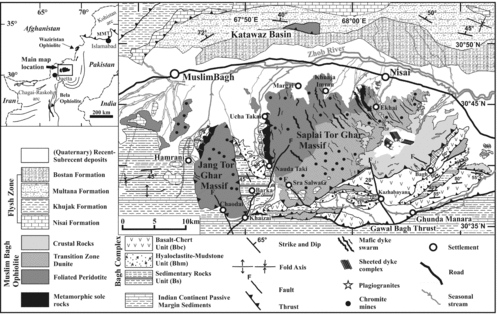
The Muslim Bagh Ophiolite (MBO) is one of a number of ophiolites (i.e. Bela, Waziristan, Khost, Zhob) of Neo-Tethyan origin (Kakar et al. Reference Kakar, Kerr, Mahmood, Collins, Khan and McDonald2014) that comprise the Western Ophiolite Belt of the Zhob Valley, northwestern Pakistan (Ahmad & Abbas, Reference Ahmad, Abbas, Farah and DeJong1979; Mahmood et al. Reference Mahmood, Boudier, Gnos, Monie and Nicolas1995; Gnos, Immenhauser & Peters, Reference Gnos, Immenhauser and Peters1997) (Fig. 1). These ophiolites represent fragments of Neo-Tethyan Ocean crust that were obducted onto the margin of the Indian continent prior to its final collision with Asia (e.g. Gnos, Immenhauser & Peters, Reference Gnos, Immenhauser and Peters1997; Khan et al. Reference Khan, Walker, Hall, Burke, Shah and Stockli2009); they therefore mark the boundary between the Indian and Eurasian plates (Asrarullah, Ahmad & Abbas, Reference Asrarullah, Abbas, Farah and DeJong1979; Mengal et al. Reference Mengal, Kimura, Siddiqui, Kojima, Naka, Bakht and Kamada1994; Gnos, Immenhauser & Peters, Reference Gnos, Immenhauser and Peters1997).
Geological map of the Muslim Bagh area. Inset highlights the location of the Muslim Bagh Ophiolite in northwestern Pakistan (modified from Kakar et al. Reference Kakar, Kerr, Mahmood, Collins, Khan and McDonald2014).

The Muslim Bagh area comprises four main geological units (Fig. 1). These units are (south to north) the Indian Passive Margin, the Bagh Complex, the MBO and the Flysch Belt (Mengal et al. Reference Mengal, Kimura, Siddiqui, Kojima, Naka, Bakht and Kamada1994; Kakar et al. Reference Kakar, Kerr, Mahmood, Collins, Khan and McDonald2014). Triassic–Paleocene sediments of the Indian Passive Margin (Kakar et al. Reference Kakar, Kerr, Mahmood, Collins, Khan and McDonald2014) are overthrust by the Mesozoic Bagh Complex along the Gawal Bagh thrust (Mengal et al. Reference Mengal, Kimura, Siddiqui, Kojima, Naka, Bakht and Kamada1994). The Bagh Complex comprises a series of thrust-bounded units including a melange unit, two volcanic units (basalt-chert unit (Bbc), hyaloclastite-mudstone unit (Bhm)) and a sedimentary unit (Bs); see Mengal et al. (Reference Mengal, Kimura, Siddiqui, Kojima, Naka, Bakht and Kamada1994) for detailed descriptions of each unit. Thrusted over the Bagh Complex is the MBO (Kakar et al. Reference Kakar, Kerr, Mahmood, Collins, Khan and McDonald2014), described in more detail in the following section. The uppermost unit is the Eocene–Holocene Flysch Belt that rests unconformably on top of the MBO and Bagh Complex in the Katawaz Basin (Mengal et al. Reference Mengal, Kimura, Siddiqui, Kojima, Naka, Bakht and Kamada1994; Qayyum, Niem & Lawrence, Reference Qayyum, Niem and Lawrence1996; Kasi et al. Reference Kasi, Kassi, Umar, Manan and Kakar2012). The Flysch Belt can be broadly divided into four thrust-bounded formations (Nisai, Khujak, Multana and Bostan formations) comprising fluvial and deltaic successions (Qayyum, Niem & Lawrence, Reference Qayyum, Niem and Lawrence1996; Kasi et al. Reference Kasi, Kassi, Umar, Manan and Kakar2012).
3.b. Muslim Bagh Ophiolite
The MBO is exposed as two massifs: the Saplai Tor Ghar and Jang Tor Ghar massifs (Ahmad & Abbas, Reference Ahmad, Abbas, Farah and DeJong1979; Mahmood et al. Reference Mahmood, Boudier, Gnos, Monie and Nicolas1995; Gnos, Immenhauser & Peters, Reference Gnos, Immenhauser and Peters1997) (Fig. 1). The tectonic setting of formation of the MBO has been variously interpreted as a mid-ocean ridge (Mahmood et al. Reference Mahmood, Boudier, Gnos, Monie and Nicolas1995), a back-arc basin (Siddiqui et al. Reference Siddiqui, Aziz, Mengal, Hoshino and Sawada1996) or an island arc (Khan, Kerr & Mahmood, Reference Khan, Kerr and Mahmood2007). Most recently however, Kakar et al. (Reference Kakar, Kerr, Mahmood, Collins, Khan and McDonald2014) have presented evidence that the MBO formed above a slow-spreading supra-subduction zone, based on both the structure of the ophiolite and its arc-like geochemistry. Recent U–Pb dating of zircons in MBO plagiogranites by Kakar et al. (Reference Kakar, Collins, Mahmood, Foden and Khan2012) gave a crystallization age of 80.2±1.5 Ma, similar to the c. 82–81 Ma K–Ar ages obtained by Sawada et al. (Reference Sawada, Nagao, Siddiqui and Khan1995). Dating of amphiboles from the sub-ophiolitic metamorphic sole have yielded K–Ar and plateau Ar/Ar ages of 80.5±5.3 Ma (Sawada et al. Reference Sawada, Nagao, Siddiqui and Khan1995) and 70.7±5 Ma (Mahmood et al. Reference Mahmood, Boudier, Gnos, Monie and Nicolas1995), respectively. The younger age of 70.7±5 Ma (Mahmood et al. Reference Mahmood, Boudier, Gnos, Monie and Nicolas1995) is interpreted to date the age of emplacement of the MBO which, when taken in conjunction with the crystallization age of the ophiolite, suggests that the ophiolite was obducted soon after formation (e.g. Kakar et al. Reference Kakar, Kerr, Mahmood, Collins, Khan and McDonald2014).
The Saplai Tor Ghar Massif displays a near-complete ophiolite sequence (Kakar et al. Reference Kakar, Kerr, Mahmood, Collins, Khan and McDonald2014), with only the extrusive basalts absent (Mahmood et al. Reference Mahmood, Boudier, Gnos, Monie and Nicolas1995). The Jang Tor Ghar Massif only preserves mantle sequence rocks (i.e. foliated peridotite) of the oceanic lithosphere, however (Mahmood et al. Reference Mahmood, Boudier, Gnos, Monie and Nicolas1995; Kakar et al. Reference Kakar, Kerr, Mahmood, Collins, Khan and McDonald2014). The mantle sequence of the MBO has been divided into a foliated peridotite section and mantle–crust transition zone (Kakar et al. Reference Kakar, Kerr, Mahmood, Collins, Khan and McDonald2014). The foliated peridotite is located in both massifs, and comprises serpentinized harzburgite with minor dunite and chromite deposits (Mahmood et al. Reference Mahmood, Boudier, Gnos, Monie and Nicolas1995; Khan, Kerr & Mahmood, Reference Khan, Kerr and Mahmood2007; Kakar et al. Reference Kakar, Kerr, Mahmood, Collins, Khan and McDonald2014). Lherzolite is also found in the lower part of the mantle sequence (Kakar et al. Reference Kakar, Kerr, Mahmood, Collins, Khan and McDonald2014). The mantle–crust transition zone of the MBO is a dunite-rich zone with minor gabbro, wherlite, pyroxenite and chromite only exposed in the Saplai Tor Ghar Massif (Mahmood et al. Reference Mahmood, Boudier, Gnos, Monie and Nicolas1995; Khan, Kerr & Mahmood, Reference Khan, Kerr and Mahmood2007; Khan, Mahmood & Casey, Reference Khan, Mahmood and Casey2007; Kakar et al. Reference Kakar, Kerr, Mahmood, Collins, Khan and McDonald2014). Chromite bodies of the transition zone are larger than those in the foliated peridotite section of the mantle sequence (Kakar et al. Reference Kakar, Kerr, Mahmood, Collins, Khan and McDonald2014).
The oceanic crustal sequence, as exposed in the Saplai Tor Ghar Massif, comprises a 200–1500 m thick ultramafic–mafic cumulate zone (Ahmad & Abbas, Reference Ahmad, Abbas, Farah and DeJong1979; Siddiqui et al. Reference Siddiqui, Aziz, Mengal, Hoshino and Sawada1996) and a 1 km thick, poorly developed sheeted dyke complex (Siddiqui et al. Reference Siddiqui, Aziz, Mengal, Hoshino and Sawada1996; Khan, Kerr & Mahmood, Reference Khan, Kerr and Mahmood2007). The ultramafic–mafic cumulate zone displays both single and cyclic sequences grading from basal dunite through pyroxenite to gabbro, with infrequent anorthosite at the top of the cumulate zone (Ahmad & Abbas, Reference Ahmad, Abbas, Farah and DeJong1979; Siddiqui et al. Reference Siddiqui, Aziz, Mengal, Hoshino and Sawada1996; Khan, Kerr & Mahmood, Reference Khan, Kerr and Mahmood2007; Kakar et al. Reference Kakar, Kerr, Mahmood, Collins, Khan and McDonald2014). Above the cumulate zone, the sheeted dykes are doleritic, dioritic and plagiogranitic in composition, and all display greenschist to amphibolite grade metamorphism (Sawada et al. Reference Sawada, Nagao, Siddiqui and Khan1995; Kakar et al. Reference Kakar, Kerr, Mahmood, Collins, Khan and McDonald2014).
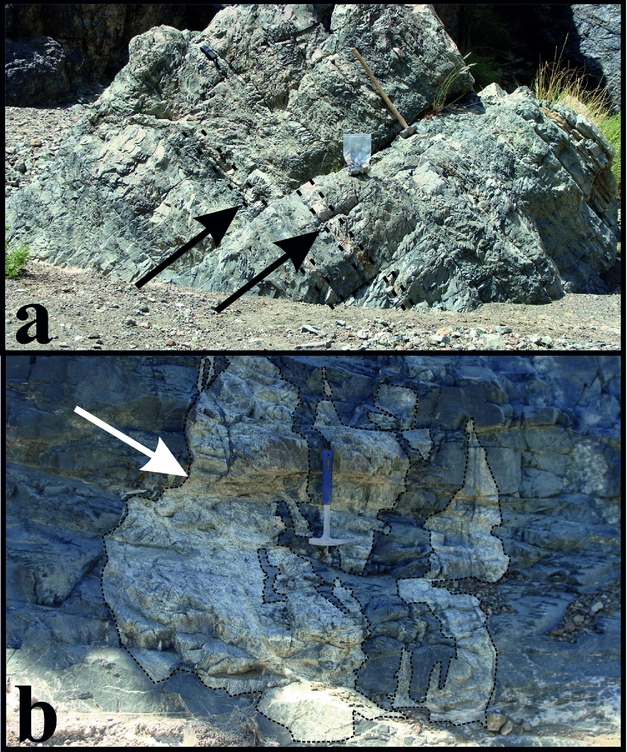
Plagiogranites of the MBO are exclusively located at the base and middle portions of the sheeted dyke complex (Mahmood et al. Reference Mahmood, Boudier, Gnos, Monie and Nicolas1995; Siddiqui et al. Reference Siddiqui, Aziz, Mengal, Hoshino and Sawada1996). The plagiogranites are rare, comprising <5% by volume of the sheeted dyke complex, and take the form of dykes and small lenses (Fig. 2). They are discontinuous, intrusive bodies, sometimes tapering, displaying a range of sizes. Lenses range from 0.1×0.3 to 1.0×3.0 m, with more dyke-like bodies ranging from 0.3×1.0 to 1.5×3.0 m. The plagiogranites have sharp contacts with the enclosing sheeted dykes, and have also undergone greenschist-amphibolite facies metamorphism with foliated to mylonitized textures (Sawada et al. Reference Sawada, Nagao, Siddiqui and Khan1995; Siddiqui et al. Reference Siddiqui, Aziz, Mengal, Hoshino and Sawada1996; Kakar et al. Reference Kakar, Kerr, Mahmood, Collins, Khan and McDonald2014). Samples for the current study were collected from a range of separate plagiogranite dykes and lenses from across the region. The general sampling locality is shown on Figure 1; more detailed localities and sample information are given in Supplementary Table S1 (available at http://journals.cambridge.org/geo).
Field photographs of the Muslim Bagh Ophiolite plagiogranites. Plagiogranites are exclusively located within the sheeted dyke complex of the ophiolite crustal sequence, where they take the form of (a) dyke-like bodies and (b) lenses.
4. Petrography
The plagiogranites sampled from the MBO for the current study are predominately composed of quartz (c. 40 vol.%) and plagioclase (c. 50 vol.%), with hornblende and pyroxene comprising minor amounts (<<10 vol.%; hornblende > pyroxene) and zircon and Fe-Ti oxides common as accessory phases. Phenocryst phases of plagioclase, quartz, hornblende and pyroxene are surrounded by a fine groundmass composed of plagioclase, quartz, hornblende, pyroxene, potassium feldspar (rare) and accessory phases. All phenocryst phases have subhedral to anhedral crystal shapes, with plagioclase displaying simple and albite twinning; hornblende twinning is rare. Throughout the sections, quartz is composed of sub-grains. However, unlike Coleman & Peterman's (Reference Coleman and Peterman1975) original definition of oceanic plagiogranites, the MBO plagiogranites do not display vermicular intergrowths of quartz and plagioclase. Evidence for hydrothermal alteration and low-grade metamorphism includes moderate sericitization of plagioclase crystals (concentrated in the core of crystals; see online Supplementary Figure S1, available at http://journals.cambridge.org/geo).
5. Geochemical results
5.a. Analytical techniques
Plagiogranite samples were prepared and analysed for major, minor and trace elements at the School of Earth and Ocean Sciences, Cardiff University, Wales, UK. Loss on ignition (LOI) was measured using c. 1.5±0.0001 g of sample powder baked at 900°C in a Vecstar Furnace for 2 hours. Major and minor elements and Sc were measured using a JY-Horiba Ultima 2 inductively coupled plasma optical emission spectrometry (ICP-OES). Minor, trace and the rare Earth elements (REE) were measured using a thermoelemental X series (X7) inductively coupled plasma mass spectrometer (ICP-MS) following methods described by McDonald & Viljoen (Reference McDonald and Viljoen2006). The accuracy and precision of the data were assessed using the international standard reference materials JB1a, JA2 and JG-3 (obtained analysis, certified values and detection limits for JB1a are shown in Supplementary Table S2, available at http://journals.cambridge.org/geo). The full plagiogranite sample dataset is shown in Table 1.
Major- and trace-element analyses of the Muslim Bagh Ophiolite plagiogranites.

Fe2O3(T): total iron
5.b. Element mobility
The altered nature of the plagiogranite samples means that some of the major elements and large-ion lithophile elements (LILE) may have been mobilized relative to the high-field-strength elements (HFSE) and REE (e.g. Hastie et al. Reference Hastie, Kerr, Pearce and Mitchell2007). Although low LOI values (0.59–2.45 wt%) suggest that the plagiogranites have suffered little alteration, the high proportion of quartz (c. 40%) means that the effective LOI of the non-quartz components may double the whole-rock values. However, major element (v. LOI) variation plots of the plagiogranite samples show no correlation with LOI, all displaying very low R 2 values (see Supplementary Fig. S2, available at http://journals.cambridge.org/geo). With the exception of MgO (<0.52), all major elements display R 2 values of <0.32. These data suggest that the major-element concentrations are not primarily controlled by alteration, and can confidently be used to compare with literature Archaean TTG data. Additionally, Sr (v. LOI; Supplementary Fig. S3, available at http://journals.cambridge.org/geo) also displays a very low R 2 value of <0.45. Consequently, the following discussion focuses on the major elements and HFSE and REE, generally regarded as relatively immobile up to greenschist facies (e.g. Floyd & Winchester, Reference Floyd and Winchester1975; Pearce & Peate, Reference Pearce and Peate1995; Hastie et al. Reference Hastie, Kerr, Pearce and Mitchell2007, Reference Hastie, Kerr, Mitchell, Millar, James, Lorente and Pindell2009).
5.c. Major elements
The plagiogranites display a relatively narrow, high-SiO2 range (70.8–80.2 wt%, anhydrous values), with most also having relatively high Al2O3 (10.7–15.8 wt%) and Na2O (1.7–4.5 wt%) contents (Fig. 3). Samples have low TiO2 (<0.4 wt%), MgO (0.1–1.8 wt%) and K2O (<1.1 wt%). Al2O3, MnO (not shown), MgO and K2O decrease with increasing SiO2, while other oxides such as TiO2, Na2O, Fe2O3(T) and CaO show little to no correlation (Fig. 3). Further, the plagiogranites do not fall on clear liquid lines of descent along with the gabbros and sheeted dykes of the MBO. On a normative ternary An–Ab–Or plot, the plagiogranites classify as tonalites and trondhjemites (Fig. 4).
(a–g) Major-element variation plots (v. SiO2) of the Muslim Bagh Ophiolite plagiogranites. Also plotted are the sheeted dykes and gabbros of the crustal section of the Muslim Bagh Ophiolite (data from Kakar et al. Reference Kakar, Kerr, Mahmood, Collins, Khan and McDonald2014) and Archaean TTG average compositions; C2005 (Condie, Reference Condie2005), M2005 (Martin et al. Reference Martin, Smithies, Rapp, Moyen and Champion2005) and MM2012 (Moyen & Martin, Reference Moyen and Martin2012). The black dashed line in (b) separates plagiogranites derived by hydrous partial melting (below the line) and those plagiogranites derived through differentiation or liquid immiscibility (above the line) (after Koepke et al. Reference Koepke, Berndt, Feig and Holtz2007).

Normative An–Ab–Or ternary plot. Muslim Bagh Ophiolite plagiogranites classify as either tonalites or trondhjemites. Fields from Barker (Reference Barker and Barker1979).

The major-element abundances of the plagiogranites are very similar to those of Archaean TTG (Condie, Reference Condie2005; Martin et al. Reference Martin, Smithies, Rapp, Moyen and Champion2005; Moyen & Martin, Reference Moyen and Martin2012), with TTG compositions consistently plotting at the lower SiO2 end of the plagiogranite compositions (Fig. 3). However, this similarity is not observed in K2O contents, with TTG generally having much higher K2O contents (1.65–2.22 wt%) compared with the MBO plagiogranites (<1.1 wt%).
5.d. Trace elements
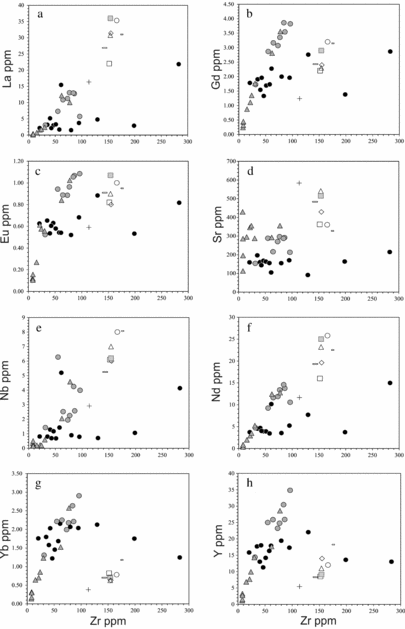
The plagiogranites show no convincing intra-formation fractionation trends on trace-element variation plots (Fig. 5). This is not surprising, considering that the samples are collected from a diverse range of geographically distinct dykes and lenses. The plagiogranites span a wide range in Zr concentrations (c. 20–280 ppm), although the majority of samples fall in the range 20–90 ppm; only three have higher concentrations (130, 199, 283 ppm), suggestive of zircon accumulation (e.g. Rollinson, Reference Rollinson2009). In general, the plagiogranites have lower trace-element concentrations than the sheeted dyke complex of the MBO and, with the exception of Sr, have trace-element contents similar to, or slightly greater than, the majority of the gabbros of the crustal section of the ophiolite (Fig. 5). As is the case with the major elements (Fig. 3), the plagiogranites do not fall on clear liquid lines of descent along with the gabbros and sheeted dykes of the MBO (Fig. 5). As seen above, the major-element compositions of the MBO plagiogranites are very similar to those of TTG compositions (Fig. 3); however, this similarity is not as evident for the trace elements (Fig. 5).
(a–h) Representative trace-element variation plots of the Muslim Bagh Ophiolite plagiogranites. The sheeted dykes and gabbros of the crustal section of the Muslim Bagh Ophiolite (data from Kakar et al. Reference Kakar, Kerr, Mahmood, Collins, Khan and McDonald2014) and Archaean TTG average compositions are also plotted; symbols and references as in Figure 3.

The plagiogranites show broadly coherent trends in the middle- to heavy-REE (M/HREE) on chondrite-normalized REE plots, but have variable light-REE (LREE) contents, from markedly enriched to relatively depleted patterns (e.g. 4.8–0.7 (La/Sm)N; Fig. 6a, c). The LREE-enriched patterns shown by the majority of the plagiogranite samples are inconsistent with the original definition of plagiogranites (Coleman & Peterman, Reference Coleman and Peterman1975), and are shown to be enriched relative to the well-studied crustal plagiogranites from the Oman and Troodos Ophiolites (Fig. 6a). However, plagiogranites from the Sjenica (Milovanovic et al. Reference Milovanovic, Sreckovic-Batocanin, Savic and Popovic2012) and Tasriwine (Samson et al. Reference Samson, Inglis, D'Lemos, Admou, Blichert-Toft and Hefferan2004) ophiolites with LREE-enriched patterns have recently been reported (Fig. 6a). When compared with Archaean TTG compositions, plagiogranite samples are not as enriched in LREE (Fig. 6a). Most samples also show a slight chondrite-normalized enrichment in the heaviest REE relative to MREE, and display small U-shaped (concave upwards) patterns. The U-shaped patterns can be quantified using the Dy/Dy* ratio of Davidson, Turner & Plank (Reference Davidson, Turner and Plank2012), which ranges over 0.96–0.43 (Fig. 6b). Most plagiogranites have weak positive Eu anomalies (1.06–1.51 (Eu/Eu)*), with only three samples having negative Eu anomalies (0.74–0.94; Fig. 6c). Interestingly, two of the three samples with negative Eu anomalies are also significantly enriched in LREE.
(a) Plot of (La/Sm)N v. (Gd/Yb)N highlighting the LREE-enriched nature of the majority of the Muslim Bagh Ophiolite plagiogranites relative to the depleted Oman (Rollinson, Reference Rollinson2009) and Troodos Ophiolites (Freund et al. Reference Freund, Haase, Keith, Beier and Garbe-Schonberg2014). Also plotted are LREE-enriched plagiogranites from the Sjenica (Milovanovic et al. Reference Milovanovic, Sreckovic-Batocanin, Savic and Popovic2012) and Tasriwine Ophiolites (Samson et al. Reference Samson, Inglis, D'Lemos, Admou, Blichert-Toft and Hefferan2004) and Archaean TTG average compositions (symbols and references as in Fig. 3). (b) Plot of Dy/Dy* v. Dy/Yb showing the majority of the Muslim Bagh Ophiolite plagiogranites to plot in the concave-upwards quadrant (black dotted lines) and follow the amphibole vector (arrow) in figure 4 of Davidson, Turner & Plank (Reference Davidson, Turner and Plank2012). The plot quantifies the degree of concavity, and supports a role for amphibole in the petrogenesis of the plagiogranites either as a residual or crystallizing phase. (c) Chondrite-normalized REE plot of the Muslim Bagh Ophiolite plagiogranites. Normalizing values after Sun & McDonough (Reference Sun, McDonough, Saunders and Norry1989).

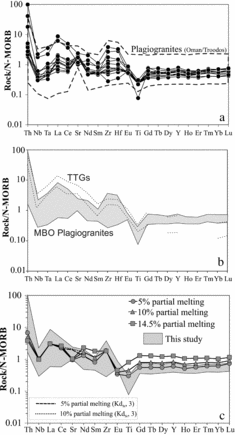
On normal mid-ocean-ridge basalt (N-MORB) normalized multi-element plots most plagiogranites display relatively flat patterns at concentrations just below N-MORB, with positive Th anomalies and negative Nb–Ta–Ti anomalies (Fig. 7a). Zr and Hf contents vary from enriched to depleted, relative to N-MORB. Most samples also have positive Sr anomalies; however, three samples have negative Sr anomalies, two of which display corresponding negative Eu anomalies (Fig. 6c).
(a) Normal-MORB normalized multi-element plot of the Muslim Bagh Ophiolite plagiogranites. Dashed plagiogranite field represents analyses of plagiogranites from the Troodos (Freund et al. Reference Freund, Haase, Keith, Beier and Garbe-Schonberg2014) and Oman (Rollinson, Reference Rollinson2009) Ophiolites. (b) Normal-MORB normalized multi-element plot comparing the Muslim Bagh Ophiolite plagiogranites with Archaean TTG average compositions (Condie, Reference Condie2005; Martin et al. Reference Martin, Smithies, Rapp, Moyen and Champion2005; Moyen & Martin, Reference Moyen and Martin2012). (c) Trace-element modelling of batch melting. The primitive mantle-normalized multi-element plot compares the trace-element composition resulting from trace-element melt modelling of a crustal hornblende gabbro with the composition of the Muslim Bagh Ophiolite plagiogranites. Plagiogranite compositions can be replicated by 5–10% partial melting of a hornblende gabbro. Dashed black lines represent melts derived by partial melting when using a lower (i.e. 3; Laurent et al. Reference Laurent, Doucelance, Martin and Moyen2013) partition coefficient for Sr in plagioclase. Normalizing values after Sun & McDonough (Reference Sun, McDonough, Saunders and Norry1989).

6. Discussion
The modal abundance of quartz and plagioclase in combination with the low K2O contents (<1.1 wt%) of the MBO plagiogranites is similar to oceanic plagiogranites found elsewhere (e.g. Gerlach, Leeman & Ave Lallemant, Reference Gerlach, Leeman and Ave Lallemant1981; Amri, Benoit & Ceuleneer, Reference Amri, Benoit and Ceuleneer1996; Rollinson, Reference Rollinson2009). Additionally, the trace-element compositions of plagiogranites from the Muslim Bagh, Oman and Troodos ophiolites all show a high degree of compositional overlap (Fig. 7a, plagiogranite field) (Rollinson, Reference Rollinson2009; Freund et al. Reference Freund, Haase, Keith, Beier and Garbe-Schonberg2014). Nevertheless, the LREE-enriched and slightly concave-upwards MREE patterns of the majority of MBO samples are distinct relative to the original oceanic plagiogranite definition (Coleman & Peterman, Reference Coleman and Peterman1975; Coleman & Donato, Reference Coleman, Donato and Barker1979).
High SiO2 (>70 wt%) and Na2O (3<Na2 O<4.5 wt%) concentrations and low modal K-feldspar contents, low K2O/Na2O ratios and low Fe2O3+MgO+MnO+TiO2 (most < 5 wt%) of the MBO plagiogranites make them compositionally similar to Archaean TTG as defined by Martin et al. (Reference Martin, Smithies, Rapp, Moyen and Champion2005) and Moyen & Martin (Reference Moyen and Martin2012). Additionally, when compared with Archaean TTG compositions on an N-MORB normalized multi-element plot, the plagiogranites display broadly similar concentrations, overlapping the TTG field at the lower LREE and higher HREE concentrations (Fig. 7b).
6.a. Plagiogranite petrogenesis
The majority of plagiogranites display enrichment in LREE relative to HREE (Fig. 6c), and all plagiogranites have negative Nb–Ta and positive Th anomalies (Fig. 7a). Additionally, the N-MORB-like concentrations of the other trace elements suggest that the plagiogranites (Fig. 6c) were generated at a MOR setting with a subduction input, likely a supra-subduction zone. This supports recent work by Kakar et al. (Reference Kakar, Kerr, Mahmood, Collins, Khan and McDonald2014) who propose a supra-subduction model for the formation of the MBO. However, the petrogenesis of oceanic plagiogranites is controversial; fractional crystallization, partial melting or silicate–liquid immiscibility are variously proposed as petrogenetic models (see Koepke et al. Reference Koepke, Berndt, Feig and Holtz2007 for a review). In the following sections, we discuss the implications the plagiogranite compositions have for each of the possible petrogenetic models.
6.a.1. Fractional crystallization and liquid immiscibility
The layered gabbros and sheeted dykes of the MBO crustal section represent possible cumulates and parental melts, respectively, from which to derive the plagiogranites by crystallization. However, major- and trace-element variation diagrams (Figs 3, 5) show that the plagiogranites do not plot along the same liquid lines of descent as any of the other MBO units. The fact that the plagiogranites define their own distinct field clearly indicates that they are not related to the other units by simple fractional crystallization processes. The lack of intermediate units within the ophiolite sequence also argues against an origin for the plagiogranites by fractional crystallization from a basic parental melt. Additionally, the narrow SiO2 range of the plagiogranites would suggest that fractional crystallization did not play a primary role in their petrogenesis.
Concave-upwards patterns displayed by the plagiogranites (Fig. 6c) support a role for amphibole during their petrogenesis, as a result of amphiboles preference for MREE over LREE and HREE (e.g. Davidson, Turner & Plank, Reference Davidson, Turner and Plank2012). However, the concave-upwards pattern on its own does not indicate whether amphibole was crystallizing from a parental magma or acting as a residual phase during the fusion of a mafic protolith.
An origin by silicate–liquid immiscibility (e.g. Dixon & Rutherford, Reference Dixon and Rutherford1979) is also unlikely for the MBO plagiogranites. This is evidenced by the absence of the associated immiscible Fe-rich liquid (as Fe-rich mafic units) from the MBO.
6.a.2. Partial melting
Experimental work of Koepke et al. (Reference Koepke, Feig, Snow and Freise2004) and France et al. (Reference France, Koepke, Ildefonse, Cichy and Deschamps2010) has shown that low TiO2 contents (<1 wt%) are characteristic of oceanic plagiogranites derived through partial melting of a mafic protolith; this is a consequence of the gabbroic protoliths having initially low TiO2 contents, typical of cumulate gabbros of the oceanic crust (Koepke et al. Reference Koepke, Feig, Snow and Freise2004, Reference Koepke, Berndt, Feig and Holtz2007). Low TiO2 contents of the MBO plagiogranites (Fig. 3b) are similar to those in the experimentally derived high-SiO2 melts of Koepke et al. (Reference Koepke, Feig, Snow and Freise2004), suggesting they were derived by partial melting of a gabbroic protolith in the crustal sequence of the MBO. In addition, TiO2 contents of the MBO plagiogranites plot below the boundary line drawn by Koepke et al. (Reference Koepke, Berndt, Feig and Holtz2007) which separates plagiogranites derived by hydrous partial melting (plot below black dashed line, Fig. 3b) from those plagiogranites derived by crystallization or immiscibility processes (plot above black dashed line).
Additionally, as shown in Figure 3, major-element concentrations of the MBO plagiogranites are similar to Archaean TTG (Condie, Reference Condie2005; Martin et al. Reference Martin, Smithies, Rapp, Moyen and Champion2005; Moyen & Martin, Reference Moyen and Martin2012), generally regarded to have been generated through partial melting of a mafic igneous protolith (e.g. Drummond, Defant & Kepezhinskas, Reference Drummond, Defant and Kepezhinskas1996; Foley, Tiepolo & Vannucci, Reference Foley, Tiepolo and Vannucci2002; Rapp, Shimizu & Norman, Reference Rapp, Shimizu and Norman2003; Martin et al. Reference Martin, Smithies, Rapp, Moyen and Champion2005; Moyen & Stevens, Reference Moyen, Stevens, Benn, Mareschal and Condie2006; Nutman et al. Reference Nutman, Bennett, Friend, Jenner, Wan, Liu, Cawood and Kröner2009; Hastie et al. Reference Hastie, Fitton, Mitchell, Neill, Nowell and Millar2015, Reference Hastie, Fitton, Bromiley, Butler and Odling2016). We suggest that the lower K2O contents displayed by the plagiogranites, compared with Archaean TTG, is the result of the TTG rocks being derived from a more primitive mantle prior to continental crust extraction, and therefore a less-depleted mantle than the present. Trace-element variation plots (Fig 5) do not show as convincing a similarity between the MBO plagiogranites and Archaean TTG as the major-element variation plots (Fig. 3), however. Nevertheless, the MBO plagiogranites have broadly similar trace-element compositions to Archaean TTG (Fig. 7b).
Negative Eu and Sr anomalies (Fig. 6c, 7a) and decreasing Al2O3 with increasing SiO2 (Fig. 3) in some samples could potentially be explained by a small amount of late-stage plagioclase fractional crystallization. However, negative Eu and Sr anomalies can also be the result of plagioclase in the melting residue, while the decrease in Al2O3 with SiO2 can be reproduced through small degrees of partial melting as demonstrated by Beard & Lofgren (Reference Beard and Lofgren1991). In the following section we use trace-element modelling to test a partial melting model for the MBO plagiogranites.
6.b. Modelling of partial melting
To model the partial melting of a mafic protolith, the non-modal batch melting equation of Shaw (Reference Shaw1970) was used for the calculations:
 $$\begin{equation}
{C_1} = \frac{{{C_0}}}{{{D_0} + F(1 - P)}}
\end{equation}$$
where C l is the concentration of a particular trace element in a resultant melt, C 0 is the concentration of an element in the source region prior to partial melting, F is the mass fraction of melt generated, D 0 is the bulk partition coefficient of an element prior to partial melting and P is the partition coefficient of an element weighted by the proportion contributed by each mineral phase to the melt. Hornblende gabbro, C51 (from Kakar et al. Reference Kakar, Kerr, Mahmood, Collins, Khan and McDonald2014) was used as the protolith. This sample was collected from the cumulate sequence of the crustal section of the MBO and was chosen as the protolith since the concave-upwards pattern shown by the plagiogranites suggests that amphibole may have been left behind in the melting residue. The partition coefficients used are those for elements in equilibrium with TTG-like silicic melts from Bedard (Reference Bedard2006). Mineral modes of the hornblende gabbro are those of Kakar et al. (Reference Kakar, Kerr, Mahmood, Collins, Khan and McDonald2014) and Siddiqui et al. (Reference Siddiqui, Aziz, Mengal, Hoshino and Sawada1996). Melt modes were calculated using 1 kbar experimental runs from Beard & Lofgren (Reference Beard and Lofgren1991) as they provide enough petrological information to carry out the calculation. Melting was stopped at 14.5%, as this is the point at which hornblende is exhausted from the protolith. Mineral and melt modes, partition coefficients, hornblende gabbro starting composition and model results can be found in Supplementary Table S3, available at http://journals.cambridge.org/geo.
Figure 7c shows that the incompatible trace-element patterns (including negative Nb and Ti anomalies and positive Th and Zr anomalies) of the plagiogranites can be replicated by 5–10% partial melting of the hornblende gabbro. Nonetheless, the modelling generates a larger negative Sr anomaly than seen in the MBO plagiogranites. This result is attributed to the use of a high Sr partition coefficient in plagioclase (6.65; Bedard, Reference Bedard2006) and this discrepancy can be removed if a lower partition coefficient is used (i.e. 3, based on the range reported by Laurent et al. Reference Laurent, Doucelance, Martin and Moyen2013).
Despite the evidence supporting a partial melting model for the MBO plagiogranites, the reason behind the negative K2O trend displayed by the plagiogranites when plotted against SiO2 (Fig. 3) is uncertain. It is however possible that the negative trends displayed by both K2O and Al2O3 are the result of an interplay between fractional crystallization (plagioclase and biotite?) and/or varying degrees of partial melting and source variation.
6.c. Comparison with other Tethyan Ophiolite plagiogranites and implications for the tectonomagmatic setting of the MBO
As we have shown, some geochemical characteristics of the MBO plagiogranites (i.e. LREE enriched and concave-upwards MREE patterns) do not conform to the definition of oceanic plagiogranites as proposed by Coleman & Peterman (Reference Coleman and Peterman1975). The results from this study are similar to previous plagiogranite analyses from the MBO presented by Kakar et al. (Reference Kakar, Kerr, Mahmood, Collins, Khan and McDonald2014), who also report MBO plagiogranites with LREE-enriched patterns (1–7, (La/Sm)N), as well as negative Nb–Ta–Ti anomalies and low TiO2 contents (≤0.20 wt%).
The MBO plagiogranites are significantly different from those of other Tethyan Ophiolites in terms of both field and geochemical characteristics. First, LREE contents of Troodos and Oman ophiolite crustal plagiogranites are relatively depleted compared with HREE (Fig. 6a) (Rollinson et al. Reference Rollinson2009; Freund et al. Reference Freund, Haase, Keith, Beier and Garbe-Schonberg2014); a more depleted source is therefore required for these plagiogranites relative to the MBO plagiogranites. It is however beyond the scope of this study to investigate further the difference in source enrichment between the MBO plagiogranites and those plagiogranites situated in the Oman and Troodos ophiolites. Secondly, the plagiogranites of the MBO are solely located in the crustal section of the ophiolite, whereas geochemically distinct groups of plagiogranites have been identified in crust and mantle sections of the Troodos and Oman ophiolites (Rollinson, Reference Rollinson2009, Reference Rollinson, Rollinson, Searle, Abbasi, Al-Lazki and Kindi2014; Freund et al. Reference Freund, Haase, Keith, Beier and Garbe-Schonberg2014). Thirdly, the MBO plagiogranites are generally smaller intrusive bodies (on a scale of no more than a few metres) than those found in both the Troodos and Oman ophiolites, where plagiogranites range from several tens of metres to kilometre-sized plutons (Rollinson et al. Reference Rollinson2009; Freund et al. Reference Freund, Haase, Keith, Beier and Garbe-Schonberg2014).
The poorly developed sheeted dyke complex (Khan, Kerr & Mahmood, Reference Khan, Kerr and Mahmood2007; Kakar et al. Reference Kakar, Kerr, Mahmood, Collins, Khan and McDonald2014) of the MBO crustal section is likely the result of the imbalance between spreading rate and magma supply in a supra-subduction zone tectonic setting (Robinson et al. Reference Robinson, Malpas, Dilek and Zhou2008). Robinson et al. (Reference Robinson, Malpas, Dilek and Zhou2008) have proposed that both the fore-arc and back-arc of a supra-subduction zone generally experience lower magma supply rates, due to eruptions at the volcanic arc, and high extensional strain rates. The small size, restricted distribution and lack of geochemical variability (i.e. uniform composition) among the MBO plagiogranites could therefore be a result of this decreased magma supply in the supra-subduction zone where the MBO crystallized. Consequently, the decreased magma supply results in a small degree of partial melting of the plagiogranite source (i.e. crustal hornblende gabbros).
6.d. Implications for Archaean TTG genesis
Most previous and current research into Archaean TTG petrogenesis favours models in which juvenile Archaean continental crust is generated by partial melting of mafic igneous protoliths (e.g. Sen & Dunn, Reference Sen and Dunn1994; Wolf & Wyllie, Reference Wolf and Wyllie1994; Foley, Tiepolo & Vannucci, Reference Foley, Tiepolo and Vannucci2002; Rapp, Shimizu & Norman, Reference Rapp, Shimizu and Norman2003; Moyen & Stevens, Reference Moyen, Stevens, Benn, Mareschal and Condie2006; Laurie & Stevens, Reference Laurie and Stevens2012; Zhang et al. Reference Zhang, Holtz, Koepke, Wolff, Ma and Bédard2013; Ziaja et al. Reference Ziaja, Foley, White and Buhre2014; Hastie et al. Reference Hastie, Fitton, Bromiley, Butler and Odling2016), the setting of which is still controversial; both subduction/flat slab subduction/underthrusting (e.g. Drummond, Defant & Kepezhinskas, Reference Drummond, Defant and Kepezhinskas1996; Martin et al. Reference Martin, Smithies, Rapp, Moyen and Champion2005; Nutman et al. Reference Nutman, Bennett, Friend, Jenner, Wan, Liu, Cawood and Kröner2009; Hastie et al. Reference Hastie, Fitton, Mitchell, Neill, Nowell and Millar2015) and intracrustal (Hamilton, Reference Hamilton1998; Hawkesworth, Cawood & Dhuime, Reference Hawkesworth, Cawood and Dhuime2016) settings have been proposed for the derivation of Archaean TTG of various ages.
Since the original definition of oceanic plagiogranites in the mid-1970s by Coleman & Peterman (Reference Coleman and Peterman1975), oceanic plagiogranites have been shown to differ compositionally from Archaean TTG by being less potassic and having MORB-like LREE and flat HREE patterns. Numerous studies on oceanic plagiogranites from the Oman Ophiolite (Rollinson, Reference Rollinson2008, Reference Rollinson2009, Reference Rollinson, Rollinson, Searle, Abbasi, Al-Lazki and Kindi2014) have suggested that although the Oman Ophiolite plagiogranites have compositions that are similar to oceanic plagiogranites (as defined by Coleman & Peterman, Reference Coleman and Peterman1975) and differ compositionally from Archaean TTG, they can be instructive on Archaean TTG genesis. Rollinson (Reference Rollinson2009) noted that, in addition to the conditions of plagiogranite petrogenesis, a source region enriched in LREE is also required in order to generate the LREE-enriched nature of Archaean TTG. Additionally, Rollinson (Reference Rollinson2008) has suggested that trondhjemite (plagiogranite) petrogenesis in the Oman Ophiolite acts as a possible analogue for the generation of Earth's first felsic crust during Hadean time. Rollinson (Reference Rollinson2008) has argued that early (Hadean) felsic crust was of low volume, and this corresponds to the low volume of plagiogranites we see in recent ophiolite sequences.
The MBO plagiogranites are compositionally different (LREE-enriched and concave-upwards MREE patterns) from the original oceanic plagiogranite definition, but are geochemically similar to Archaean TTG (e.g. Condie, Reference Condie2005; Martin et al. Reference Martin, Smithies, Rapp, Moyen and Champion2005; Moyen & Martin, Reference Moyen and Martin2012) (Figs 3, 7b). Consequently, the MBO plagiogranites can be used as a recent (Late Cretaceous) analogue to investigate the formation of some Archaean TTG rocks.
The MBO plagiogranites are found within mafic crust that was formed at a convergent margin, specifically the upper plate above the subduction zone (e.g. Siddiqui et al. Reference Siddiqui, Aziz, Mengal, Hoshino and Sawada1996, Reference Siddiqui, Mengal, Hoshino, Sawada and Brohi2011; Kakar et al. Reference Kakar, Kerr, Mahmood, Collins, Khan and McDonald2014). The similarity in composition between the MBO plagiogranites and Archaean TTG suggests that some of the earliest silicic continental crust may have been derived from melting the overriding plates in primitive subduction-like zones. We acknowledge that there is a contrast in volume between the MBO plagiogranites and Archaean TTG; however, we infer that the genesis of these plagiogranites can be instructive on the generation of some, but not all, Archaean TTG. In addition, the overall greater enrichment in LREE relative to HREE of Archaean TTG compared with the MBO plagiogranites suggests that to source a larger portion of Archaean TTG requires a slightly more enriched source than that of the MBO plagiogranites (e.g. Rollinson, Reference Rollinson2009). Again, this could possibly be due to the extraction of continental crust and depletion of the mantle over time.
7. Conclusions
1. Oceanic plagiogranites of the MBO are exclusively located at the base and middle portions of the sheeted dyke complex, where they form small, intrusive dyke-like bodies and lenses.
2. Low TiO2 contents (<0.4 wt%) in the plagiogranites and a lack of intermediate rocks in the sheeted dyke complex suggest an origin by partial melting of mafic rocks. This is confirmed by batch melt trace-element modelling of a crustal hornblende gabbro from the crustal sequence of the MBO. This modelling shows that the plagiogranites can be replicated by 5–10% partial melting, possibly with a small degree of late-stage fractional crystallization of plagioclase(?) to account for negative Sr and Eu anomalies and a decrease in Al2O3 with SiO2.
3. The similarity in composition of the MBO plagiogranites to Archaean TTG rocks supports the model that some Archaean TTG could be generated by partial melting of a mafic protolith, possibly in the overriding plate of a subduction-like zone.
Acknowledgements
Iain McDonald is thanked for the major- and trace-element analyses of the samples. We also thank Ahmed Shah, Inayatullah and Akbar for assistance during fieldwork. The Volcanology Igneous Petrology Experimental Research (VIPER) Workshop of the University of Birmingham is thanked for access for petrological study of the samples. Hugh Rollinson is thanked for comments on an earlier draft which substantially improved the manuscript. S. Nasir, S. Köksal and an anonymous reviewer are also thanked for their careful and well-considered reviews which have improved the manuscript. This research received no specific grant from any funding agency, commercial or not-for-profit sectors.
Declaration of interest
None.
Supplementary material
To view supplementary material for this article, please visit https://doi.org/10.1017/S0016756818000250