Introduction
A series of contributions in volume 19(2) of Archaeological dialogues debated the utility and nature of the concept of structured deposition. Critiquing the concept within British prehistory, Garrow (Reference Garrow2012a) argued against the assumption that all structure in deposition relates to symbolic meanings, either of objects or of places. In particular he argued for a contrast to be drawn between ‘odd deposits’, which might be considered the result of explicit ‘ritual’ action, and ‘material culture patterning’. That patterning may be the result of regulated deposition, but is more likely to have been structured by the rhythms of everyday life. In response to this paper, Thomas (Reference Thomas2012), one of the original proponents of the concept, expressed concerns that such a view could return to a processual interpretation of waste, in which past lifeways can be simply ‘read off’ of the material. He also finds parallels between Garrow's approach and the concept of habitus, in which deposition is the result of social practice within which the logic of action is situated. Indeed, in his response, Garrow (Reference Garrow2012b) makes the subtle point that meaning is situated in practice, rather than particular deposits being meaningful in themselves. Perhaps a more significant concern raised by Thomas (Reference Thomas2012, 124) and Hansen (Reference Hansen2012, 129), however, is that what was originally a heuristic device has become an interpretation in itself. Garrow's approach tempers this concern to some extent by seeking to understand what structures deposition, principally by associating the two ends of a spectrum of structure, ‘odd deposits’ and ‘material culture patterning’, with activities ranging from ‘ritual’ to ‘mundane’. Berggren's (Reference Berggren2012) response highlights that these categories of action can overlap and Brück's (Reference Brück1999) work in particular demonstrates that activity which the modern analyst may identify as in some way unusual or special is likely to have been rational within the mindset of a past community, a realization which has also been drawn from recent work examining devotional activity in later medieval and early post-medieval towns (Herva Reference Herva2009; Hall Reference Hall2011).
The concept of structured deposition has recently been the subject of debate within early medieval archaeology in Britain. Hamerow (Reference Hamerow2006) argued for the presence of ‘special deposits’ within early Anglo-Saxon settlements, principally related to the foundation or termination of structures. This work was critiqued by Morris and Jervis (Reference Morris and Jervis2011), who argue, like Garrow, that such deposits need not be seen as specifically meaningful or as the result of ‘ritual’ action. Indeed, the term ‘ritual’ is as unhelpful as ‘structured’ in interpretive terms, and should be considered a meta-level of interpretation. Ritual is not a uniform class of action, just as structured deposits are not a uniform class of deposit – ritual can be secular or religious, class- or sex-based, for example. Therefore the use of ritual, like the use of structured deposition, as an explanation, whilst not wrong, is uninformative (Morris and Jervis Reference Morris and Jervis2011, 70). In particular, Morris and Jervis question whether, against a background of marked variability in depositional practice, it is possible to identify any deposits as intrinsically ‘special’ and adopt a biographical approach to the formation of these deposits to explore the practices behind them and the ways in which they developed meaning. The utility of biography as a concept is raised by Chapman (Reference Chapman2012) and Fontijn (Reference Fontijn2012) in their responses to Garrow's (Reference Garrow2012a) paper, as well as by Garrow (Reference Garrow2012b) in his reply. In this contribution I take this further by exploring the effect of the relationships between people, objects and spaces in deposition, to consider the processes through which things and spaces become waste. From a biographical perspective, deposition can be considered to mark the end of the life of an object, or a cut feature into which material is dumped. However, it can also relate to the emergence or maintenance of elements of identity. In understanding depositional patterning, therefore, biography becomes a central theme, as we seek to understand how something came to be deposited in a particular way, or how a space came to be the focus of deposition. This is achieved through the discussion of a case study of deposition in the Anglo-Saxon settlement of Hamwic (Southampton, UK), which considers the agency behind, and the effect of, depositional practices beyond the anthropocentric perspective promoted by a focus on the symbolic meaning and ritual/mundane character of particular practices.
Hamwic
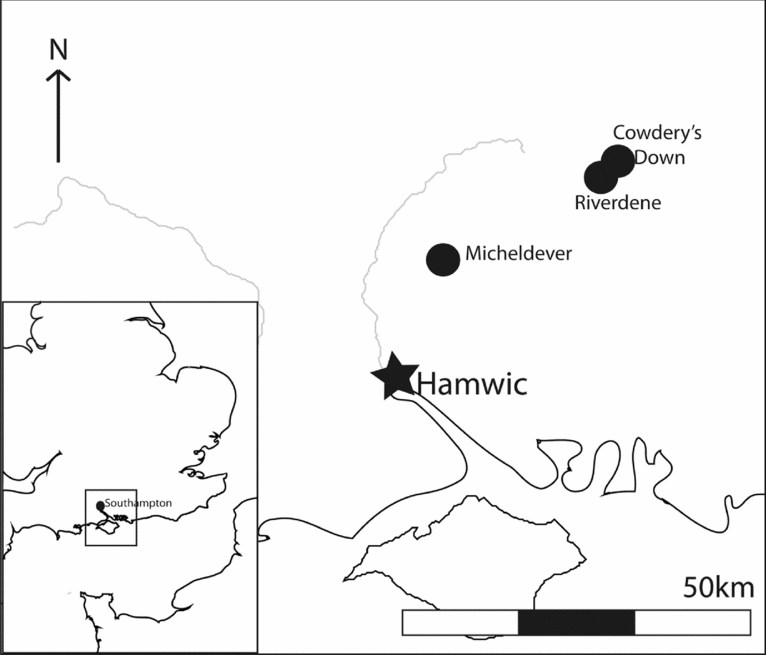
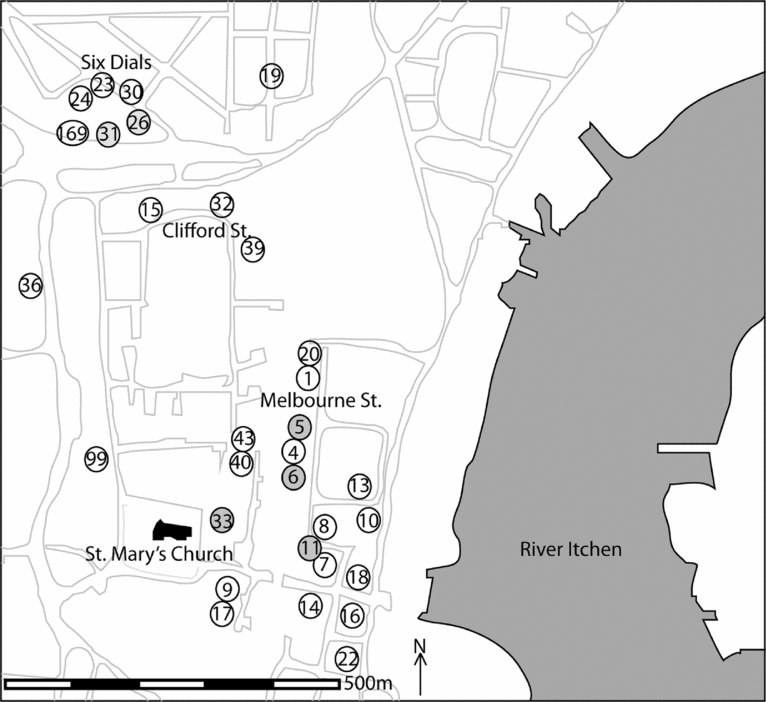
The port of Hamwic was founded in the 6th century A.D. and was a forerunner to the modern city of Southampton (Figs. 1 and 2). It functioned as one of a network of trading centres, or wics, situated around the coast of northern Europe (see Hill and Cowie Reference Hill and Cowie2001 for an overview), declining in the 9th century (Hall Reference Hall and Slater2000). The settlement has been subject to extensive excavations (Holdsworth Reference Holdsworth1980; Morton Reference Morton1992; Andrews Reference Andrews1997; Birkbeck and Smith Reference Birkbeck and Smith2005; Stoodley Reference Stoodley2012) which have revealed a formal street layout, evidence for the management of domestic spaces, intensive craft production and international trade. That the site was closely related to surrounding rural settlements is demonstrated by analysis of faunal remains, which show that animals were not bred in Hamwic, but brought ‘on the hoof’, through a tributary economic system (Bourdillon Reference Bourdillon1980, 185). The settlement appears to have developed from a royal centre (Morton Reference Morton1992, 26), but it is likely that as it expanded its population was drawn from the surrounding countryside, although itinerant merchants and travellers also made up a significant component of this cosmopolitan, proto-urban community. The focus of the analysis of depositional activity presented here is the ceramic assemblage, some 45,000 sherds from 35 sites which have been the subject of several studies (Hodges Reference Hodges1981; Timby Reference Timby and Andrews1988; Jervis Reference Jervis2011). Three ceramic phases have been identified. In the earliest phase the main types in use are organic-tempered wares, similar to those used at surrounding rural settlements (Jervis Reference Jervis, Jervis and Kyle, A.2012). As the settlement became established, new types of pottery, sandy wares, were produced and used. These are distinctive, as similar types are not widely known from nearby rural sites. Finally, the latest phase of settlement activity is characterized by the presence of gritty wares, similar to those used at surrounding rural sites and in the later Saxon settlement of Southampton founded on higher ground to the west. A range of imported wares, mostly from northern France and Flanders, are present throughout the ceramic sequence. Due to the absence of vertical stratigraphic sequences, close dating beyond this relative chronology remains problematic. Against this sequence, however, it is possible to identify general trends in depositional practice within the settlement.
The location of Hamwic in southern England and of other sites mentioned in the text.

The location of sites in Hamwic (those mentioned in the text are shaded in grey).
Through the analysis of levels of fragmentation (for methods see Orton, Tyers and Vince Reference Orton, Tyers and Vince1993, 167–71) and the identification of cross-fitting sherds between layers and features, it has been possible to build a detailed picture of depositional practice in Hamwic. Although the majority of pottery was recovered from cut features such as pits, discrete secondary deposits (as defined by Schiffer Reference Schiffer1987), where material was deposited directly into a feature, are comparatively rare, with the majority of deposits being tertiary (as defined by Schiffer Reference Schiffer1987) in nature, meaning that they are the result of re-deposition from other features, most likely middens. Secondary fills are characterized by the presence of larger, often less abraded, sherds, many of which fit together, suggesting that they were deposited in a single episode. Tertiary fills are more likely to be highly fragmented and mixed, with cross-fitting sherds occurring between features, suggesting that these features were filled from a common source (such as a midden). The mean sherd weight was used as an index of fragmentation to identify whether deposits were most likely to be secondary or tertiary in nature. The composition of each individual assemblage was then considered, to identify cross-fits and to determine whether different phases of deposition might be present. For example, this was accomplished by looking at the range of ware types represented and determining whether there were differences in the levels of fragmentation of wares of different phases.
Later use of this area of Southampton for agriculture, clay extraction and Victorian development has removed any trace of these positive features from the archaeological record, although a single midden base was identified in excavations at Melbourne Street (SOU 5) (Cottrell Reference Cottrell and Holdsworth1980, 30).Footnote 1 The evidence for middening largely comes from the presence of cross-fitting sherds between pits, in some cases up to 25 metres apart (Timby Reference Timby and Andrews1988, 119), indicating re-deposition from surface deposits. The high level of fragmentation also indicates that sherds were exposed on the surface for some time; in some features the average sherd weight is as low as 5 grammes. Differences in the average sherd weight of different types of pottery, for example the identification of pits with highly fragmented phase 2 material (sandy wares) and less fragmented phase 3 material (gritty wares) at Chapel Road (SOU 11), may suggest that pits were filled with a mixture of secondary and tertiary material in some instances. Further evidence of re-deposition from tertiary deposits comes in the form of a pit at Six Dials (SOU 26; Pit 353) which exhibits reverse stratigraphy, with the latest material at the base, suggesting that it was filled from a surface deposit. Further examples of depositional practice are discussed in depth below. In general, however, homogeneity of deposits, coupled with a high level of fragmentation and the presence of cross-fitting sherds between pits, is suggestive of re-deposition from surface middens. This is supported by faunal remains, many of which exhibit gnawing and are extremely fragmented (Bourdillon, n.d.), suggesting that these too spent time on the surface prior to deposition. Similar middening activity has been identified in mid-Saxon London (Lundenwic) (Malcolm, Bowsher and Cowie Reference Malcolm, Bowsher and Cowie2003, 102) and also appears common at nearby rural sites such as Cowdery's Down (Millet and James Reference Millet and James1983), where little material was recovered from cut features, and settlements at Micheldever (Johnstone Reference Johnstone1998, 88–89) and Riverdene (Hall-Torrence and Weaver 2003, 84) (figure 2), where the bulk of material recovered from the cut features appears to be re-deposited.
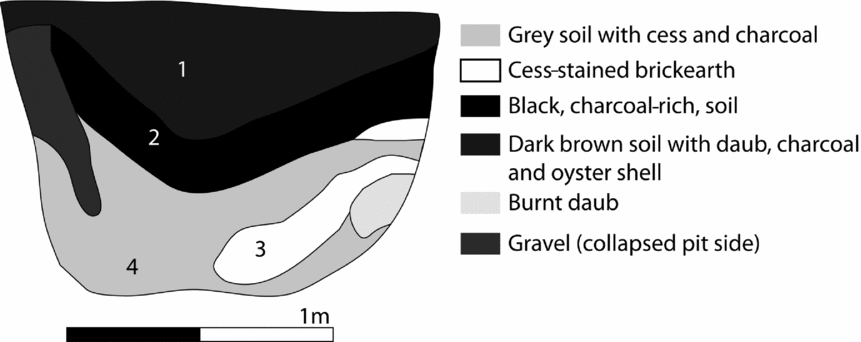
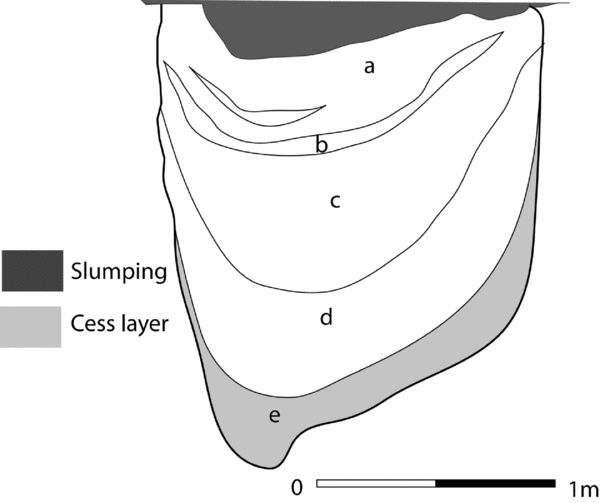
The generalization that the majority of deposits are tertiary in nature masks the complexity of depositional activity in Hamwic, however. Pits were dug for a variety of functions, as is demonstrated by variation in size and shape (Morton Reference Morton1992, 42–43). Few, if any, were primarily receptacles for waste; rather they were dug as quarries, latrines and storage pits, and to mark boundaries. With the exception of quarry pits, which were redundant once excavated, most pits had to be kept clear of waste to fulfil their function. Analysis of the fills of these features indicates a great deal of variability in depositional practice. Cesspits at Melbourne Street (SOU 6), for example, appear to have been filled episodically, with layers having discrete ceramic assemblages and clear stratigraphic banding being visible. For example, in Pit 3 (figure 3), the primary deposit contained a mixture of soil and cess, with little pottery (two large sherds, probably contemporary with the deposit). This was sealed with a layer of brickearth soil, which may have contained some re-deposited pottery (three small sherds). The feature was closed with a charcoal-rich layer, followed by a dump of material which included pottery. Of this pottery earlier material was fragmented (average sherd weight 9 grammes), whilst later material was more intact (average sherd weight 17 grammes), suggesting that this feature may have been sealed by a mixture of re-deposited (supported by the presence of a sherd which cross-fits with another pit on the site) and secondary material. A range of other finds was also present in this final fill. The filling of this pit may relate to its history of use, with the cess layer being sealed for hygiene reasons (the charcoal perhaps being used to purify the deposit), with further banding perhaps indicating continued use or compensation for the slumping of earlier dumped material.
Section of a cesspit at SOU 6 (redrawn from Holdsworth Reference Holdsworth1980).
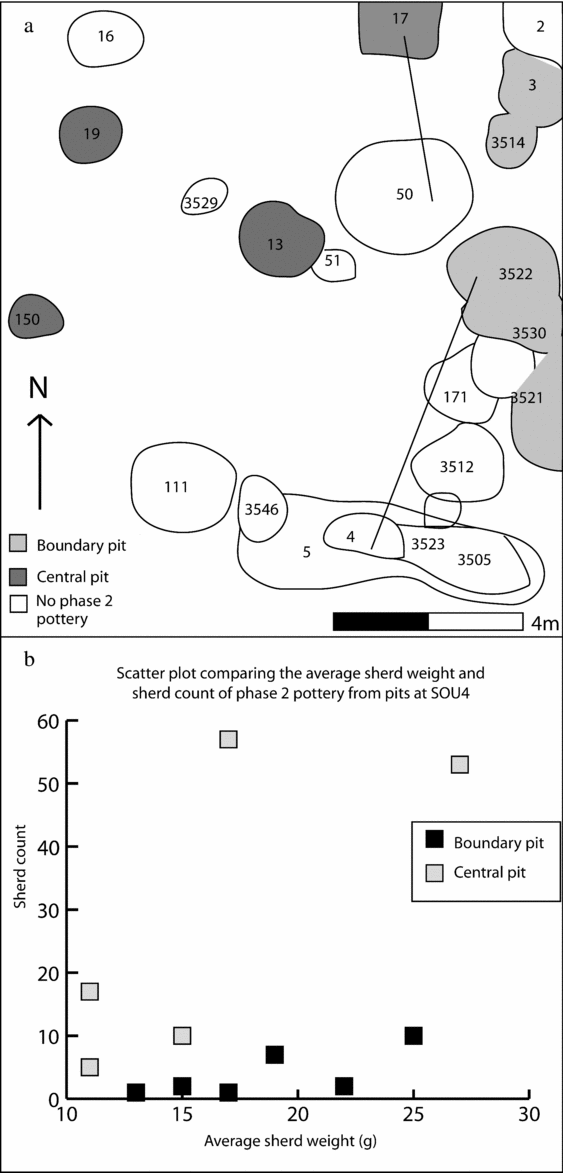
Pit alignments, dug as boundaries, functioned differently to cesspits and have distinctive depositional histories. Typically the lower fills contain few finds, with these perhaps forming slowly through processes of silting. Typically the ceramic assemblages from these features consist of low quantities of often fragmented pottery. The presence of cross-fits between pits suggests that this material accumulated as the remnants of surface deposits were swept into them. This can be seen, for example at Melbourne Street (SOU 4), where contrasts can be drawn in the level of fragmentation between boundary pit alignments and pits dug for other functions, which were filled with dumped tertiary waste (figure 4). The upper fills of the boundary pits contain dumped secondary and tertiary material as these boundaries were closed as part of a process of spatial reorganization in the final ceramic phase.
(a) Plan showing the presence of cross-fits at SOU 4 (redrawn from Holdsworth Reference Holdsworth1980); (b) scatter plot comparing the average sherd weight and sherd count of pits at SOU 4.
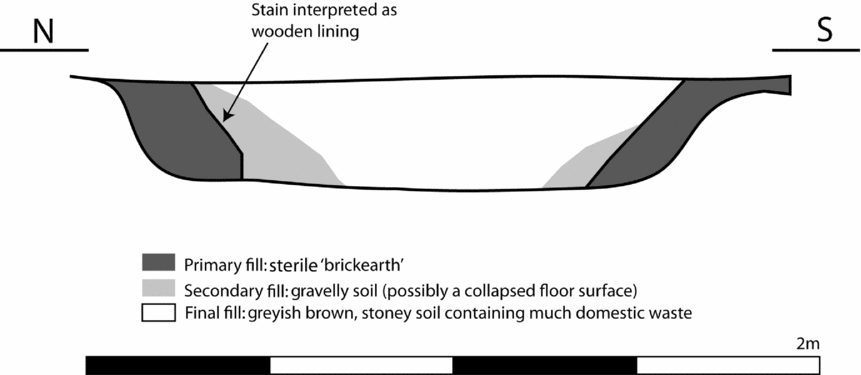
Despite the predominance of tertiary deposits, a small number of secondary dumps have also been identified. The earliest occurrence is the filling of a grubenhaus (sunken-featured building) at the periphery of the settlement. Such structures are common features of rural early and mid-Saxon sites (5th–8th centuries A.D.), although their function remains a matter of debate (see Tipper Reference Tipper2004). Only two of these structures have been excavated in Hamwic, both at the periphery of the settlement and dating, based on ceramic evidence, to its earliest phase, suggesting that, at least in this phase, the fringe of the settlement had a semi-rural character, a notion supported by the recent excavations in the southern part of the settlement (Stoodley Reference Stoodley2012). The deposit dumped into this feature includes joining sherds from three ceramic vessels, which display evidence of having been used in food preparation, as well as some more fragmented, probably tertiary, waste, likely derived from a midden (figure 5). Studies of grubenhäuser from elsewhere in England indicate that it is quite common for the fills of these structures to contain a mixture of tertiary and secondary waste (Tipper Reference Tipper2004, 159). A further unusual feature is a deep pit dug close to St Mary's Church (figure 6), the ecclesiastical centre of Hamwic (SOU 33, Pit 8; see Morton Reference Morton1992, Microfiche 1:G3). It contained a high quantity of pottery, principally in the form of secondary deposits, on the basis of the larger sherd size and the presence of cross-fitting sherds. It also contained a large quantity of animal bone. The lowest layer was characterized by the presence of cessy deposits. The feature appears to have been rapidly filled with pottery and animal bone, mixed with a small quantity of re-deposited material. It would appear that this pit contained the waste from a feast of some kind, perhaps a religious event given the pit's proximity to a church. In both of these cases secondary deposition can be related to specific and rare events, the closure of a structure and the deposition of waste from a major event, which occurred outside the ordinary rhythm of daily life in Hamwic.
Section of the grubenhaus at SOU 11 (redrawn from Morton Reference Morton1992).
Section of Pit 8 at SOU 33 (redrawn from Morton Reference Morton1992).
The secondary deposits can perhaps be categorized as ‘odd’, in that they contrast with the tertiary deposition which was undertaken across the settlement. The closure of the grubenhaus can be interpreted within its wider context as a fairly common occurrence, in which deposition marks a transition in the life of the settlement and its inhabitants, something which may also be true of the closure of the boundary pits identified at Melbourne Street. The link between secondary deposition and transition perhaps made the process of closure meaningful. Whilst the deposit was arguably formed through a ritualized form of action, interpretation of such a feature as ‘structured’, ‘special’ or ‘ritual’ forces us to ignore the more mundane and functional need to close a disused feature, divorcing this action from everyday life (see also Garrow Reference Garrow2012a, 97–98), but also failing to explore what was the effect and broader role of this potentially ritualized action. The deposit at SOU 33 is also ‘odd’ in that it is quite different from anything else identified in the settlement. However, this characterization must be tempered against the high level of variability identified within the settlement. Within Hamwic it has been possible to identify deposits at both ends of Garrow's (Reference Garrow2012a) spectrum, odd deposits and material culture patterning, related to the function of specific features. That is not to say that the processes behind the patterning of material culture were not meaningful; however, it is unsatisfactory to see these deposits as simply the result of habitual activity. Rather, we can explore how meaning emerged through the process of deposition, particularly by considering how waste and features afforded particular ways of deposition, as the biographies of objects, people and features or spaces became entwined.
Biography, affordances and technologies of remembrance
The majority of the material excavated from settlements of any date has been subject to some form of secondary or tertiary depositional process. ‘Special’ deposits typically appear to contain material which had been deliberately selected for deposition; however, even in their deposition these most likely underwent some form of transformation in meaning (see, for example, Morris Reference Morris2011 on animal burials). Whilst waste can be satisfactorily defined as valueless and unwanted material, anthropological and sociological studies have demonstrated variability in how this categorization is arrived at. Reno's (Reference Reno2009) study of the sociology of a contemporary landfill site demonstrates that people within the same society need not share the same conceptualization of waste, with items being scavenged and reused, a process through which objects are transformed from valueless to valuable, and through which complex identities are negotiated as people understand this activity either as creative or as an indication of poverty and deprivation. Furthermore, whilst one person may be satisfied that waste has been disposed of through dumping, it does not cease to have the potential to impact people. Edensor (Reference Edensor2005) argues that whilst waste can lie latent in the background, it has the potential to re-enter social discourse as a potentially disruptive presence, for example as contamination on an abandoned plot which is intended to be brought back into use. As valueless to the disposer, waste is a disruptive presence and the act of disposal can be seen to have a role in neutralizing the disruptive power of waste. Past depositional action also guides practice and brings order through structure; in essence all but casual deposition is structured in some way, although the rules and other considerations guiding this action may not be immediately apparent (Pollard Reference Pollard2001, 330; Brück Reference Brück1999, 156).
The transition to waste is therefore not a linear transformation, but a complex process which can only be understood through close analysis. Such a perspective relates closely to the biographical approaches to material culture which have developed over the last two decades (Gosden and Marshall Reference Gosden and Marshall1999; Jones Reference Jones2002; Mytum Reference Mytum2010; following Kopytoff Reference Kopytoff and Appadurai1986). Fundamental to these approaches is that the meaning of things changes throughout their lives as we relate to them in new ways, but the ways in which they become meaningful are limited by a number of factors, including their material properties and cultural knowledge. Two elements of such an approach are represented in Garrow's (Reference Garrow2012b, 134–35) paper: that the pre-depositional lives of objects are an important consideration in understanding how they came to be deposited in particular ways, and that deposits need not be inherently meaningful, but rather meaning emerges through the practice of deposition. As such, becoming waste is a phase in the life cycle not only of material, but also of the places in which this material is dumped and in the lives of those who dispose of this material, or who engage with it and bring it ‘back to life’ as an item of value (potentially many centuries later as archaeological evidence; see Holtorf Reference Holtorf2002).
We can consider, therefore, that things do not become valueless because they are waste, or indeed become waste because they are valueless; rather, through this process of transition they lose value and become recategorized as waste simultaneously. The process of deposition is therefore effective, in that it causes material to be recategorized, but also impacts upon the character of the place of deposition and the identities of those interacting with this rubbish. Rather than habitual action taking place within a social context, it is a process of entanglement of people, places and things, in which all of these actors shed and gain meaning, having a direct effect on the constitution of the social contexts which can be considered to be formed through action rather than being a backdrop against which it is situated (see Latour Reference Latour2005, 159–62). In other words, the challenge in exploring processes of deposition is to identify and articulate biographical motion, not by seeing the archaeological record as a materialization of values and perceptions of the world, but by seeing deposition as a process through which these emerged and were enacted and maintained (Edensor Reference Edensor2005; Hill Reference Hill1995, 126).
Various methodologies and metaphors have been employed to meet this challenge. Following Chapman (Reference Chapman2000) it can be shown that the process of fragmentation leads to a process of accumulation (or assemblage) and that the associations formed create enchained relationships. This is a useful metaphor, but the term ‘enchainment’ implies a linear and logical formation of associations in the emergence of archaeological assemblages. However, these associations are messier, formed of partial (in the sense that every actor is not connected to every other actor in a physical uniform way) connections between people, objects and the landscape, leading to the emergence of a varied assemblage which has multiple effects. An approach is required which acknowledges this messiness, that sees the archaeological assemblage as an entangled bundle of associations between human and non-human actors, in which associations can emerge and dissolve in a sometimes uncontrolled and unexpected manner (Knappett Reference Knappett2011, 213; see also Hodder Reference Hodder2012). Such an approach lies in seeing the archaeological assemblage as a process of assembly, rather than the pre-assembled, static group of objects which appears in archaeological reports. Assembly draws together the objects we recover, but also their spatial context, people, objects which do not survive and the baggage located in the wealth of associations these individual actors have left in their wake. Deposits are phenomena with a variety of histories; the materials which make them up are drawn from multiple places and multiple times, forming a messy bundle of associations (Needham and Spence Reference Needham and Spence1997, 79; Olsen Reference Olsen2010, 127). Furthermore, the meaning of these deposits is not inherent within them, but emerges through engagement (Needham and Spence Reference Needham and Spence1997, 84–85; Edensor Reference Edensor2005, 317; Hill Reference Hill1995, 126); they are assemblages in themselves, but are also part of a wider assemblage of physical and metaphorical connections which make up the world. We have the methodologies needed to understand these processes of assembly (Brudenell and Cooper Reference Brudenell and Cooper2008; Hill Reference Hill1995; Sørensen Reference Sørensen, Needham and Spence1996), but to apply these to debates about whether deposition is structured, ritualistic or functional misses the point; what we are seeking is to situate the emergence and treatment of waste within a wider social assemblage, to understand its emergence and effects (Pollard Reference Pollard2001, 317).
My intention in this paper is to explore the effect of the relationships between people, objects and spaces in deposition and to consider the process through which things and spaces become waste. From a biographical perspective deposition can be considered to mark the end of the life of an object or of a cut feature into which material is dumped, but can also relate to the emergence or maintenance of elements of identity. In understanding depositional patterning, therefore, biography becomes a central theme, as we seek to understand how something came to be deposited in a particular way, or how a space came to be a focus of deposition. A useful concept in articulating this process is that of affordances, taken from the work of James Gibson (Reference Gibson1979; see Knappett Reference Knappett2005, 45–58, for archaeological applications). At a basic level an object can afford many different things (and different things at different points in its biography); however, these affordances are limited by a number of constraints, principally their material properties and the relationships which they form with an object through action, which may be with a knowledgeable human, but equally an object may afford different things in different assemblages, as can be seen in Reno's (Reference Edensor2009) study of contemporary waste. Affordances are not independent, but rather are relational, emerging in the coming together of action. The object then becomes a mediator in action; depending upon the nature of engagement it can be enacted as multiple things, being variously categorized and having, or affording, multiple effects (Mol and Law Reference Mol, Law, Knappett and Malafouris2006). The concept of affordances, therefore, is important when considering deposition. First, by becoming categorized as waste an object can be considered to afford nothing, other than treatment as rubbish, unless it is drawn back into action through a process of recycling or reuse whereby it may develop new affordances; second, spaces or features come to afford deposition as they too reach a particular stage in their biography. Therefore, by considering how things and spaces afford waste, we can develop a more nuanced understanding of the processes through which what Garrow (Reference Garrow2012a, 105) terms ‘material culture patterning’ emerges.
Drawing upon discussions of technological choice and the chaîne opératoire, an inherently biographical approach, in the consideration of the construction of artefacts and monuments, Jones (Reference Jones and Williams2003) developed the concept of ‘technologies of remembrance’. In summary, this concept considers that as monuments or artefacts unfold through practice, memories are evoked in certain ways, with memories being constantly produced and reproduced through action as the past becomes reinterpreted in the present (Jones Reference Jones and Williams2003, 69). We can consider, therefore, that the process of deposition is one such course of action, in which memory is evoked and things become meaningful in relation to past practice and experience. Furthermore, if deposition can lead to deposits affording the evocation of memory, it follows that it may be effective in other ways, for example in contributing to the development of identities or senses of place. Therefore, depending upon past experience and the nature of engagement, interaction with an object or place may afford the evocation of different forms of memory, or affect participants in multiple ways. Rather than focusing on what a deposit means, therefore, we can shift our focus to understand what afforded the formation of a deposit and what the broader effects of this practice were. In doing so, we can break past a dichotomy between the symbolically meaningful and the mundane (interpretations based around communication within a context), to explore how, through deposition, all deposits developed meanings as they were enrolled in the unravelling of a context.
The effects of waste
In order to move from addressing the symbolism and meaning of deposits (or the processes behind them), we need to shift focus to the effect of these actions. This will be achieved through discussion of the formation of a number of specific deposits from Hamwic.
The mnemonic qualities of middens
We can begin by considering the mnemonic qualities of the middens, which it has been suggested were the most common focus for the deposition of waste both in Hamwic and at surrounding rural sites. Whilst it is unlikely that there was a conscious ‘remaking’ of rural settlements in Hamwic, the reproducing of specific interactions with waste materials can be considered to have had a role in forging memory, re-creating social relationships and building a sense of familiarity in this new environment. If we consider that Hamwic was likely peopled, in part at least, from this hinterland, the presence of middens is suggestive of the translation of rural practices into a proto-urban setting, a process which can also be seen in the ways in which pottery was produced and used in the earliest phase of Hamwic (Jervis Reference Jervis2011, 247). It was not the feature of the midden which was translated, but the process of middening, through which middens emerge as a means to neutralize the disruptive potential of waste. Middens do more than afford management of waste (see also Needham and Spence Reference Needham and Spence1997; Pollard Reference Pollard, Brück and Goodman1999; Brück Reference Brück1999 for similar discussions in relation to prehistoric settlements). It can be considered that, through their development and constant interaction with these features, people become enrolled in technologies of remembrance, as interactions with waste and middens cited experiences in other places, and waste developed a mediatory character in this process of remembrance. Middens brought this about in two ways. First, they were imposing and durable landscape features. Their properties, particularly their smell and shape, meant that they were constantly experienced, even outside the process of deposition. Therefore middens acted by stimulating sensory experiences, forcing people to continually interact with them and developing a mnemonic quality through the constant remaking of this relationship. Second, the practice of middening itself involved repeated action, the process of adding to the midden, with each action cuing memory of experience at other times and in other places, activating the latent potential agency of discarded objects to structure depositional activity, as the feature demanded further deposition in order for its neutralizing role to be maintained. Conversely, whilst the process of middening can be considered a form of remembering, it also created a medium for forgetting, as defined objects were deposited onto it, losing their definition and becoming integrated into what Edensor (Reference Edensor2005, 219) terms ‘a mulch of matter’. Middening can therefore perhaps be termed a conscious act of forgetting, of concealing and managing the disruptive vestiges of past action, but one which had a potentially subconscious mnemonic effect as it contributed to the remaking of the human–material associations which brought a sense of familiarity and continuity to Hamwic. Midden building therefore cited rural activity, creating durable links between domestic activity in Hamwic and its rural hinterland.
Technologies of remembrance are, however, reliant on the interpretation of past experience in the present. Although mimicking rural practice, Hamwic can be considered a very different social assemblage to rural sites (Jervis Reference Jervis2011),Footnote 2 and, as such, the relationships leading to the emergence of waste as a category differed. As surface deposits, middens act as a focus for materials in flux, categorized as waste, but open to the formation of new relationships, through which the material may become recategorized as a resource. In rural settings this material was often drawn back into action, its original character forgotten as it became something else, emerging as manure, used to fertilize fields and occasionally being used in the closure of structures (see below). This was not the case in Hamwic, however, which, as has already been discussed, was provisioned from its rural hinterland. Therefore, this and other practices constituted a network of associations built through middening which did not completely translate into the urban setting. Some waste material, particularly bone, was likely scavenged as a craft resource (see Morton Reference Morton1992, 56, for a summary of bone-working evidence; for analogy, Irish early medieval satire refers to a comb maker who scavenged bone from middens (Kelly Reference Kelly1988, 63)). Some material may therefore have progressed further in its biography, as a new value, as a craft resource, emerged through re-engagement. It is likely, however, that much material was dumped outside the settlement, possibly into the river or the sea, as at the Dutch wic site at Dorestad (Van Es and Verwers Reference Van Es and Verwers1980) – out of sight, forgotten, and with its disruptive potential neutralized. Here, then, objects lay latent; middens emerged as a neutralizing force which brought order prior to material being removed from people's consciousness altogether. Therefore, whilst the process of middening allowed the urban population to continue to relate to rural communities, its effect within the social assemblage of Hamwic was very different, as it served to differentiate Hamwic from nearby rural sites; forced people to relate to waste in particular ways (therefore impacting upon their identities); and led to the material itself, on the whole, being considered insignificant and awaiting disposal, rather than having potential and awaiting activation as a resource. Middens were fluid features, constantly in motion, acting as a location in which the qualities and affordances of waste could be renegotiated by being drawn into particular sets of relationships with people, other objects and the wider landscape. To understand waste management it must be related to other partial connections with other zones in the messy bundle of associations which make up this social context. This includes identifying, for example, that the agency for waste's value not to be renegotiated was located in new provisioning strategies, which fundamentally altered the relationships between people in Hamwic, foodstuffs and the land. The development of middens therefore played a role in differentiating Hamwic as a particularly urban social assemblage, but also created a mnemonic and experiential link with its rural hinterland.
Boundaries: waste and the making of urban space
Within the regional context the maintenance of boundaries is unique to Hamwic; they do not become a major feature of rural sites until the later Anglo-Saxon period (Reynolds Reference Reynolds, Griffiths, Reynolds and Semple2003). Analysis of the filling of boundary pits (above) has demonstrated that these features only afforded deposition once they went out of use, removing them from consciousness and allowing them to be forgotten as action led to the definition of new spaces. The treatment of waste in a way which respected these boundaries was therefore central to the creation and maintenance of Hamwic's distinctly urban landscape, contrasting the continued use of middens which infused elements of rural life into the townscape. Hamwic, then, was more than a stage upon which depositional activity occurred. Rather, this and other practices constituted it as a distinctive place, a spatially situated social assemblage or landscape (see Ingold Reference Ingold1993; Gregson and Rose Reference Gregson and Rose2000, 441; Knappett Reference Knappett2011, 22). The practices through which these features were filled, or kept clear of waste, did more than this. They also served to constrain future action (Thrift Reference Thrift2008, 16). Boundaries functioned to separate and therefore the treatment of waste played a role in formalizing social relationships within the settlement, creating social, as well as physical, boundaries between households, which were not materialized within rural communities. The function of these pits was to separate, the use of space within the settlement acting to formalize social relationships (see Gosden Reference Gosden2005, 202), yet also playing a role in creating a cohesive community who respected and enforced these boundaries. The agency to differentiate urban and rural communities and to build, maintain and structure neighbourhoods within the settlement can therefore be partially located in the treatment of waste, with repeated action serving to continually make divisions durable.
Features such as pits did not automatically afford deposition. They were enrolled in courses of action which demanded that they were not filled. Features such as boundaries only afforded deposition at particular times, transitional periods when the social network of Hamwic underwent considerable remapping. Boundaries are only meaningful if enacted as such. In the latest phase of Hamwic the settlement was reorganized, new spaces were formed and old ones forgotten. For example, new pits were dug through graves in the Clifford Street area of the settlement (Morton Reference Morton1992, 179; an act which can perhaps be considered a conscious act of forgetting), and, based on the ceramic assemblage, the boundary pits at Melbourne Street were closed. Therefore the relationships through which the affordances of boundary pits emerged as spatial markers were reconfigured, meaning that, as these were redundant and not enacted as boundaries, they became suitable venues for the deposition of waste, allowing them to be forgotten. The treatment of boundary pits had served to make social relationships of division and separation in the settlement durable, but the closure of these pits dissolved these connections, contributing to a complete reconfiguration of the social as well as physical landscape of the settlement. By being deposited in these features, waste entered a new biographical phase, shifting from the transient and ambiguous state of provisional waste (for example being a component of a midden), to be redefined in relation to these pits and a broader process of change, gaining utility as filling material, actively becoming enmeshed in a broader process of change, standing for a metaphorical discarding of existing social relationships and becoming enrolled as mediators in a process of social reassembly.
Memory and transition: the closing of a structure
The closure of the grubenhaus at the south-eastern periphery, early in the life of the settlement, can also be related to a process of transition. As discussed above, recent debates in Anglo-Saxon archaeology have considered the presence of ‘special deposits’ in Anglo-Saxon settlements. The deposit in question cannot be considered ‘special’ in the sense that the material was specifically selected for deposition. This does not, however, mean that it did not develop meaning through the act of deposition. These items can be considered to have come to stand for the process of closure. The nature of these objects was inconsequential; it was the process of filling, the building of a particular relationship between people and the abandoned structure through the medium of waste, which was important. Across northern Europe (Hamerow Reference Hamerow2006, 22–24), grubenhäuser appear to have been deliberately closed, in some cases through the placement of objects or animal remains, but in others through the disposal of domestic material apparently derived from the same waste streams from which middens were built and other features closed. This feature can be considered part of a wide-reaching tradition, which relates to depositional activity at nearby rural sites. As such, the material dumped in these features can be considered ‘icons of memory’ (Jones Reference Jones2007, 31), providing a medium through which memory of past depositional events could be cued, through the forming of mental associations which broke down the material distinctions afforded to these objects in use. Particular circumstances therefore afforded the possibility for material which might, in other instances, be characterized as disruptive and negative to gain positive connotations (see Morris and Jervis Reference Morris and Jervis2011), as it became enrolled in what appear to be consciously mnemonic courses of action which led to the creation of deposits, some of which might have the appearance of being in some way ‘special’ or ‘odd’.
This feature dates to the earliest phase of Hamwic and, therefore, can be placed in a context of changing associations between people, the land and the material world through the laying out of a formal settlement, the growth of an urban population, the increased specialization of craft activity and a changing relationship with surrounding rural settlements. This deposit is more than the functional closing of an abandoned feature, yet it would be wrong to see its filling as a purely ‘ritual’ act. Instead, its closure evoked memory of past events in other places, causing objects to occupy a mediatory role, with the agency to bring continuity to a process of transition, which must be considered as a complete remapping of the associations between people, landscape and the material world (see Jervis Reference Jervis2011), emerging through this practice. Yet we can also consider that the closure of this feature caused it, and perhaps even the rural character of the place, to be forgotten. As with the development of middening, the act of closing the structure was a mnemonic one, but the result was the eradication of the material presence of the past social assemblage to make way for the emergence of a new, urban, settlement. Here, then, we see a deposit in motion, as through action, as both the abandoned feature and the material dumped came to afford deposition, which, in the process, enacted them as icons of memory enrolled within a wider process of forgetting, thus mediating continuity in a changing social assemblage.
Waste and forgetting: the treatment of pits
Whilst deposition in buildings and boundaries stripped their utility and caused new affordances to develop in a linear manner, other features came to afford deposition more episodically (for example when a cesspit needed relining or when a quarry pit had become exhausted). We can deconstruct this process and consider how the utility of waste material as well as the recategorization of the pit itself emerged. Whilst the cesspit operated, waste created disorder, hindering the ability for people to engage with this feature in the intended way. Eventually, however, the pit would act upon people, the smell of human waste would become overwhelming and the pit might attract pests. The pit, then, temporarily, afforded deposition, and transient, provisional waste developed a role as filling material to seal the cess deposits and allow their presence to be forgotten. Once this episode was complete, the pit lost its affordances, as it once again became desirable for it to be kept clear of waste. The meanings of the pit and the waste developed relationally and were fluid, emerging episodically through a particular set of relationships between people and their material surroundings, with the pit only affording deposition which would close it once it ceased to be enacted as a cesspit.
So far, the discussion has focused on the affordances of features as foci of deposition. We can consider how the material itself came to afford disposal and how waste was perceived in Hamwic. On the whole, waste occupied a transient position on middens, only being deposited when a feature demanded closure as it became disruptive itself. Although some may have been recycled for craft activities, it appears that, unlike in the countryside, waste was not recycled on the fields. The development of middens suggests a level of conservativeness, keeping waste as a provisional presence in a neutral state, acknowledging its potential as a resource in the future, rather than it coming to be identified as fully disposable. With this in mind, the large deposit from close to St Mary's Church, discussed above, stands out as unusual. Based on the presence of a cessy deposit at its base, this pit was initially dug as a cesspit, before being quickly backfilled with secondary waste and some redeposited material. This material appears to represent waste from a feast or similar large-scale consumption event, and, on the basis of its location close to St Mary's Church, it is tempting to relate this to a religious celebration. Religious events happen cyclically, on a different timescale to the daily ebb and flow through which the majority of waste was created. Broken pottery and food remains came to be categorized as waste, just as in a domestic setting, but rather than this cuing deposition in a midden, it became disruptive as it occurred outside a usual process of waste management. In this light, secondary deposition allowed the waste to be neutralized, perhaps also causing an emergent utility in the filling of a feature dug in association with this event. This deposit emerged as a restabilizing influence, restoring normality by removing a disordering presence. Parallels can perhaps be drawn with the way that today we quickly clear up traces of religious festivals such as Christmas, as if, left to linger too long, the material culture associated with these events becomes disruptive, one might even argue polluting. Rather than being enmeshed in a process of remembering, this action can be framed as careful forgetting, focused on the quick and structured removal of waste, rather than allowing it to linger in the domestic sphere through inclusion in domestic deposits (Edensor Reference Edensor2005; Knappett Reference Knappett2011, 200–1). It can therefore be concluded that the value of waste emerged through its mnemonic qualities, as the transition from rural to urban maintained a lingering sense that waste could develop utility. Whilst typically it seems that waste was left to linger in middens for long periods of time in a controlled manner, acknowledging its potential to be of use, in some circumstances it seems that this may have been undesirable. Certain objects may cue memory of specific events or, by the associations they carry with them, be a disruptive force (the potent afterlife discussed by Thrift (Reference Thrift2008, 9)). It seems that for waste associated with particular events, which occurred outside the rhythms of daily life, it was deemed more appropriate to neutralize the potential for re-engagement through quick deposition.
Conclusions
The aim of this contribution has been to develop further a number of the points raised in relation to Garrow's (Reference Garrow2012a; Reference Garrow2012b) discussion of ‘odd deposits’. The approach proposed is a departure from considerations of the symbolic meaning of deposits or a consideration of odd/special and normal/mundane, whether considered as different ends of a spectrum or as discrete opposites. Rather, following Garrow (Reference Garrow2012b), the concept of biography is introduced and the process through which meaning emerges in the process of deposition forms the central element of this analysis. By introducing the concept of affordances to the discussion it has been possible to think about how patterning in material culture relates to the entangled biographies of features and the material deposited into them. People, places and categories of material emerge together. They can be considered to gather their own logic, which can be unpacked by focusing upon the processes through which they developed (Pollard Reference Pollard, Alberti, Jones and Pollard2013, 191). Rather than focusing on these deposits as having some symbolic meaning, the concept of technologies of remembrance has been introduced, along with insights from relational approaches within archaeology and other disciplines, to consider the effect of deposition as a mnemonic act, but also as a component of a wider bundle of connections and associations which constitute people (for example by mediating the development of forms of urban identity), places and objects. Through the application of this approach to deposition in the early medieval settlement of Hamwic, it has been argued that deposition was enrolled in the process of transition from rural to urban living, and that the process of middening mediated continuity in the face of change, through its mnemonic qualities. The extent to which similar conclusions are applicable to other early medieval proto-urban centres can only be understood through further analysis; however, the evidence for middening in deposits of this date from London may suggest that similar processes were occurring there. The temporality of deposition has also been addressed, with some deposits being linked to processes of transition, others being filled in a more cyclical manner and a small number of deposits appearing to relate to neutralizing the disruptive effects of a discrete event. As Garrow (Reference Garrow2012a, 115) states, patterning should not be read as a meaningful text, but as the residue of past action, with deposits becoming meaningful through practice (Garrow Reference Garrow2012b, 137). By conceptualizing this action as the formation and dissolution of social relationships, and acknowledging through the concept of biography and the development of affordances that meanings are emergent, multiple and unstable, we can consider that objects and deposits do not have a single meaning. Rather, they effectively contributed to the development of multiple identities and social realities, those elements of life in the past that archaeology seeks to understand.
Acknowledgements
This work derives from Ph.D. research undertaken at the University of Southampton, under the supervision of Dr Andrew M. Jones and funded by the AHRC. I would like to thank the past and present staff of Southampton Museum for providing access to collections and Dr James Morris, Alison Kyle and Dr Lesley McFadyen for comments on earlier drafts of this paper.