Introduction
Bilingualism has been associated with several cognitive and metalinguistic advantages in child development. Indeed, greater attentional and executive functions have been reported among bilingual children (Barac, Bialystok, Castro & Sanchez, Reference Barac, Bialystok, Castro and Sanchez2014; Bialystok, Reference Bialystok2005), despite controversial data regarding such a cognitive advantage (see Antoniou, Reference Antoniou2019, for review). Bilinguals also show enhanced metalinguistic awareness (Bialystok, Reference Bialystok2001; Dodd, So & Lam, Reference Dodd, So and Lam2008; Loizou & Stuart, Reference Loizou and Stuart2003), possibly leading to faster reading acquisition (Bialystok, Luk & Kwan, Reference Bialystok, Luk and Kwan2005), despite overall poorer vocabulary (Poulin-Dubois, Bialystok, Blaye, Polonia & Yott, Reference Poulin-Dubois, Bialystok, Blaye, Polonia and Yott2013) and slower lexical access (Gollan, Montoya, Fennema-Notestine & Morris, Reference Gollan, Montoya, Fennema-Notestine and Morris2005). In addition, several studies have shown a bilingual advantage in foreign language learning (especially, vocabulary learning) in adults compared to monolinguals (Cenoz & Valencia, Reference Cenoz and Valencia1994; Kaushanskaya & Marian, Reference Kaushanskaya and Marian2009a, Reference Kaushanskaya and Marian2009b; Kaushanskaya & Rechtzigel, Reference Kaushanskaya and Rechtzigel2012; Kaushanskaya, Yoo & Van Hecke, Reference Kaushanskaya, Yoo and Van Hecke2013; Keshavarz & Astaneh, Reference Keshavarz and Astaneh2004; Papagno & Vallar, Reference Papagno and Vallar1995; Sanz, Reference Sanz2000; Van Hell & Mahn, Reference Van Hell and Mahn1997), questioning whether this learning advantage might be extended to bilingual children (Kaushanskaya, Gross & Buac, Reference Kaushanskaya, Gross and Buac2014). This study aimed to explore whether children attending a bilingual classroom-immersion program show a greater ability to learn vocabulary, including written, spoken and conceptual forms, in a third language (L3) compared to children attending standard monolingual classrooms, and to what extent this potential advantage varies depending on whether the words to be learned are L2/L3 cognates words or not. In this article, the term L1 referred to native language, L2 to the first foreign language and L3 to the second one.
Since the 90s, the beneficial influence of bilingualism on vocabulary skills in a foreign language has been documented (Cenoz & Valencia, Reference Cenoz and Valencia1994; Edele, Kempert & Schotte, Reference Edele, Kempert and Schotte2018; Keshavarz & Astaneh, Reference Keshavarz and Astaneh2004; Sanz, Reference Sanz2000). For instance, Sanz (Reference Sanz2000) reported higher English proficiency, using a multiple-choice vocabulary test, among Catalan–Spanish bilingual adults compared to Spanish monolinguals, even when inter-individual measures such as intelligence, motivation and socioeconomic status were controlled. They concluded that bilingualism has a positive effect on L3 acquisition (see Keshavarz & Astaneh, Reference Keshavarz and Astaneh2004 for a larger effect of bi-literate compared to mono-literate bilinguals). This bilingual advantage reported for L3 vocabulary measures was documented for L1/L3 close languages (Cenoz & Valencia, Reference Cenoz and Valencia1994; Sanz, Reference Sanz2000), as well as for L1/L3 more distant languages (Abu-Rabia & Sanitsky, Reference Abu-Rabia and Sanitsky2010; Keshavarz & Astaneh, Reference Keshavarz and Astaneh2004). Recently, several studies have adopted an experimental approach and used various word learning paradigms to investigate learning abilities more directly from the onset of L2/L3 language learning. Two main learning paradigms have been reported: first, using mediation with the native language translation, commonly presented visually (Kaushanskaya & Marian, Reference Kaushanskaya and Marian2009a, Reference Kaushanskaya and Marian2009b; Kaushanskaya & Rechtzigel, Reference Kaushanskaya and Rechtzigel2012; Valente, Ferré, Soares, Rato & Comesaña, Reference Valente, Ferré, Soares, Rato and Comesaña2018; see the Revised Hierarchical Model, RHM by Kroll & Stewart, Reference Kroll and Stewart1994 for underlying mechanisms); or, second, a more direct mapping of the novel word with its corresponding concept through the presentation of a picture (Bartolotti & Marian, Reference Bartolotti and Marian2012; Eviatar, Taha, Cohen & Schwarz, Reference Eviatar, Taha, Cohen and Schwarz2018; Kaushanskaya et al., Reference Kaushanskaya, Yoo and Van Hecke2013; Kaushanskaya et al., Reference Kaushanskaya, Gross and Buac2014). Interestingly, most studies focused on the learning of L2/L3 phonological forms – and their link to the concept – and only few addressed the issue of L2/L3 novel spelling form (Bartolotti & Marian, Reference Bartolotti and Marian2018) or included a multi-sensory presentation of the novel form, i.e., including both phonological and written forms (see Ricketts, Bishop & Nation, Reference Ricketts, Bishop and Nation2009 for L1 pseudoword learning).
As for the testing phase, learning was mostly assessed immediately through productive tasks, such as L3-L1/L2-L1 backward translation (Kaushanskaya, Reference Kaushanskaya2018; Kaushanskaya & Marian, Reference Kaushanskaya and Marian2009a, Reference Kaushanskaya and Marian2009b; Kaushanskaya & Rechtzigel, Reference Kaushanskaya and Rechtzigel2012), L3 naming (Bartolotti & Marian, Reference Bartolotti and Marian2017a, Reference Bartolotti and Marian2017b) or through recognition tasks. Forced-choice recognition tasks are the most widely used and assess the ability for participants to select the correct picture among several options corresponding to the L2/L3 spoken form (Eviatar et al., Reference Eviatar, Taha, Cohen and Schwarz2018; Kaushanskaya et al., Reference Kaushanskaya, Yoo and Van Hecke2013; Kaushanskaya et al., Reference Kaushanskaya, Gross and Buac2014) or to the L3 written form (Bartolotti & Marian, Reference Bartolotti and Marian2017a), but also to link L2/L3 spoken form with its corresponding L1 written form (Kaushanskaya & Marian, Reference Kaushanskaya and Marian2009a, Reference Kaushanskaya and Marian2009b; Valente et al., Reference Valente, Ferré, Soares, Rato and Comesaña2018). Fewer studies also investigated learning retention after delay (Kaushanskaya, Reference Kaushanskaya2018; Kaushanskaya & Marian, Reference Kaushanskaya and Marian2009a, Reference Kaushanskaya and Marian2009b). Although most of these studies highlighted that bilingual adults outperformed monolinguals in learning L3 novel forms, this bilingual advantage was reported in studies with large variability regarding the learning context, whether environment-basedFootnote 1 (Kaushanskaya & Marian, Reference Kaushanskaya and Marian2009a, Reference Kaushanskaya and Marian2009b) or classroom-based (Kaushanskaya et al., Reference Kaushanskaya and Rechtzigel2012; Van Hell & Mahn, Reference Van Hell and Mahn1997), and in terms of age of acquisition, with late (Bogulski, Bice & Kroll, Reference Bogulski, Bice and Kroll2019) or early bilinguals (Kaushanskaya & Marian, Reference Kaushanskaya and Marian2009a, Reference Kaushanskaya and Marian2009b).
Fewer studies have investigated whether this advantage might be extended to children. Learning a second language (L2) as a child does not involve similar challenges as for adults. Greater L1 interference should increase the difficulty of learning a L2 among adults owing to an accumulated experience as a monolingual (Birdsong, Reference Birdsong1999; MacWhinney, Reference MacWhinney, Robinson and Ellis2008). Yet, L2 word learning may be more challenging for children, owing to their more limited cognitive resources and to their tendency to avoid using a second label for a single concept, also known as the mutual exclusivity constraint (Clark, Reference Clark2009). To our knowledge, only two studies reported a bilingual learning advantage among children (Eviatar et al., Reference Eviatar, Taha, Cohen and Schwarz2018; Kaushanskaya et al., Reference Kaushanskaya, Gross and Buac2014). Using a learning paradigm in which L3 spoken form was presented with a picture of a familiar concept, Kaushanskaya and colleagues (Reference Kaushanskaya, Gross and Buac2014) observed an advantage in classroom-immersion first-graders, i.e., L1-English–L2-Spanish, over monolingual children, in the forced-choice recognition task. A similar bilingual advantage was retrieved in Eviatar et al. (Reference Eviatar, Taha, Cohen and Schwarz2018) for familiar and unfamiliar referents (i.e., linked to a novel concept) on several groups of monolinguals (Hebrew and Arabic) and bilinguals (Hebrew–Arabic and Arabic–Hebrew).
Several mechanisms may account for this bilingual advantage: namely, enhanced phonological short-term memory (Papagno & Vallar, Reference Papagno and Vallar1995; Van Hell & Mahn, Reference Van Hell and Mahn1997), decreased sensitivity to L1 interference (Bartolotti & Marian, Reference Bartolotti and Marian2012; Kaushanskaya & Marian, Reference Kaushanskaya and Marian2009b; Meuter & Allport, Reference Meuter and Allport1999; Van Assche, Duyck & Gollan, Reference Van Assche, Duyck and Gollan2013), and enhanced phonological discrimination abilities (Kaushanskaya & Marian, Reference Kaushanskaya and Marian2009a). According to Papagno and Vallar (Reference Papagno and Vallar1995), phonological short-term memory plays a major contribution in foreign vocabulary learning, consistent with studies conducted in monolinguals (Gathercole & Baddeley, Reference Gathercole and Baddeley1989) and bilinguals (Majerus, Poncelet, Van der Linden & Weekes, Reference Majerus, Poncelet, Van der Linden and Weekes2008). Nevertheless, the bilingual advantage still persisted when bilingual and monolingual adults were matched on their phonological memory skills (Kaushanskaya & Marian, Reference Kaushanskaya and Marian2009a; Kaushanskaya & Rechtzigel, Reference Kaushanskaya and Rechtzigel2012), tempering the account of phonological memory on the bilingual advantage. Kaushanskaya and Marian (Reference Kaushanskaya and Marian2009a) suggested that bilinguals were less sensitive to cross-language interference as bilingual learning performance was similar in the unimodal and bimodal procedures, although the simultaneous presentation of spoken and written information confronted them with letter-sound incongruences. The bimodal learning procedure was, however, detrimental to monolingual adults compared to the unimodal one (Kaushanskaya & Marian, Reference Kaushanskaya and Marian2009b; see also Bartolotti & Marian, Reference Bartolotti and Marian2012 on cross-language lexical interference). Nonetheless, this hypothesis failed to explain why the bilingual advantage remains for languages with different writing scripts (see Kaushanskaya & Marian, Reference Kaushanskaya and Marian2009a), so a third hypothesis proposed enhanced phonological discrimination abilities among bilinguals. Indeed, dealing with two different phonological systems early in life might facilitate the learning of new phonological forms in L3.
In this study, we test a fourth mechanism by which the bilingual advantage might be influenced by the linguistic properties of words, and more especially by cross-linguistic similarities between languages. Cognate words are commonly defined as translation equivalents sharing a partial-to-complete orthographic overlap and a partial phonological overlap between two languages. A distinction is made between identical cognate words, i.e., with a complete orthographic overlap (baby and Baby in English and German) and non-identical cognates (apple-Apfel). Research in the field of bilingual visual/auditory word recognition reported that cognate words are recognized faster and more accurately as real words compared to non-cognates in written modality (Dijkstra, Miwa, Brummelhuis, Sappelli & Baayen, Reference Dijkstra, Miwa, Brummelhuis, Sappelli and Baayen2010). This cognate facilitation reflects the co-activation of lexical representations in both languages, supporting a language non-selective access to lexicon (see theoretical models such as Bilingual Interactive Activation Plus model, BIA+; Dijkstra & Van Heuven, Reference Dijkstra and van Heuven2002). Thus, for cognate words, both orthographic representations are automatically co-activated (and even for a task that required one of the two languages only), and this is followed by post-lexical language membership activation (see Dijkstra et al., Reference Dijkstra, Miwa, Brummelhuis, Sappelli and Baayen2010).
Learning cognate words should be facilitated compared to non-cognate words because they already share a large written and/or spoken overlap across languages in addition to a common conceptual representation. Most studies reported a learning advantage for cognate words among adults (de Groot & Keijzer, Reference De Groot and Keijzer2000; Valente et al., Reference Valente, Ferré, Soares, Rato and Comesaña2018; Rogers, Webb & Nakata, Reference Rogers, Webb and Nakata2015; Lotto & De Groot, Reference Lotto and de Groot1998; Van Hell & Mahn, Reference Van Hell and Mahn1997) and children (Tonzar, Lotto & Job, Reference Tonzar, Lotto and Job2009; Comesaña, Soares, Sánchez-Casas & Lima, Reference Comesaña, Soares, Sánchez-Casas and Lima2012b; Comesaña, Moreira, Valente, Hernández-Cabrera & Soares, Reference Comesaña, Moreira, Valente, Hernández-Cabrera and Soares2019). While cognate words include shared features such as large orthographic overlap across languages, which facilitates novel word learning (Bartolotti & Marian, Reference Bartolotti and Marian2017a, Reference Bartolotti and Marian2017b), they also have conflicting features such as incongruent grapheme-to-phoneme correspondences that might also lead to interference in learners. Nonetheless, Bartolotti and Marian (Reference Bartolotti and Marian2017a) still reported a learning advantage for pseudowords with incongruent grapheme-to-phoneme correspondences, as long as spellings were close to those of the known languages.
Our study explored whether the bilingual vocabulary learning advantage could be extended to children attending a linguistic immersion program at school, and whether it is modulated by cross-language similarities conveyed by cognate words. Using a paired-associate word learning paradigm, we contrasted the learning performance of 44 English words presented in both written and spoken forms, along with their corresponding pictures, among two groups of French fifth-graders, including children attending a classroom-immersion to German and children from a standard monolingual program. The immersion program included a balanced teaching time in both languages since preschool (half in French L1, half in German L2), so these children could be considered as emergent bilinguals (see Kaushanskaya et al., Reference Kaushanskaya, Gross and Buac2014 for a different type of immersion program). We were also interested in the locus of this potential learning advantage. Thus, half of the selected words were L2-German–L3-English cognates (e.g., Apfel-apple) while the other half were non-cognates (e.g., fork).
Based on the work of Kaushanskaya et al. (Reference Kaushanskaya, Gross and Buac2014) with a similar population, we expected a learning advantage for the classroom-immersion children compared to the monolinguals. Previous findings revealed a bi-literacy advantage in L3 vocabulary knowledge for L1/L3 close and distant languages. Hence, we hypothesized that such a learning advantage would be rather general, i.e., also observed for non-cognate words. However, besides an expected generalized bilingual advantage, we also wondered whether this learning advantage would be reinforced for L2/L3 cognate words. If so, this would indicate that the L2 was activated early during L3 learning, and in children still considered as emergent bilinguals. In addition, most studies used the forced-choice recognition task, which focuses on the form-to-concept mapping. However, a bilingual advantage might extend to other dimensions of vocabulary acquisition, such as L3 phonetic learning among adults (Antoniou, Liang, Ettlinger & Wong, Reference Antoniou, Liang, Ettlinger and Wong2015). Therefore, we wondered whether the beneficial influence of bilingualism would be observed for the learning of two formal dimensions, i.e., spoken and written forms. If so, we sought to determine whether a specific recognition advantage for cognate words would be retrieved for both spoken and written modalities among classroom-immersion children.
To assess this, we constructed three experimental tasks: 1) a forced-choice recognition task of the spoken form-to-picture relationship; 2) a go/no-go auditive recognition task (discrimination between spoken English words and close phonological distractors); and 3) an orthographic judgment task (recognition of the correct English written form among three written distractors). Learning was assessed immediately after learning and after a one-week delay. Consistent with Kaushanskaya et al. (Reference Kaushanskaya, Gross and Buac2014), we expected a L3 word learning advantage in the forced-choice recognition task for the classroom-immersion children compared to the monolinguals. Classroom-immersion children might also outperform the monolinguals in spoken and in written word recognition. Besides, the bilingual advantage in orthographic learning might be even reinforced for cognate words, due to their large form overlap with German, in accordance with L1/L2 vocabulary learning studies with children (Tonzar et al., Reference Tonzar, Lotto and Job2009; Comesaña et al., Reference Comesaña, Soares, Sánchez-Casas and Lima2012b; Comesaña et al., Reference Comesaña, Moreira, Valente, Hernández-Cabrera and Soares2019; Valente et al., Reference Valente, Ferré, Soares, Rato and Comesaña2018). For the spoken word recognition, however, it was still unclear whether the bilingual advantage might be reinforced for cognate words or not, as phonology is much more transient than orthography.
Method
Participants
Eighty-nine fifth-graders were recruited from two schools in the Grand Est region, France. All were French native speakers. Among them, 41 children (mean age = 10.42 years; SD = .24) had been attending a classroom-immersion program to German since kindergarten. Attending this bilingual immersion program did not depend on children's academic performance or on any suggestion of the headmaster, but rather on familial and cultural history. Indeed, many families make this decision, because of the cross-border situation with Germany and the existence of a local patois, Alsatian, which is now only spoken by some elders from this region of France and bears some similarities with German. These linguistic immersion classes were conducted in traditional elementary schools and teaching was carried out in German for half of the school time. Thus, classroom-immersion children had a robust exposure to German as a L2. The remaining 48 participants (mean age = 10.25 years; SD = .24) were monolinguals enrolled in the same elementary schools as the immersion group. Despite no measure of parents’ socio-economic status (SES), we expected no such differences in SES within and between groups, as all participants came from the same catchment area. Eighteen participants (11 monolinguals vs. 7 immersion children) did not complete all sessions and were removed, leaving 34 classroom-immersion children and 37 monolinguals for analysis; the two groups were matched on chronological age (t (69) = −1.06, p =.29). Importantly, children had no exposure to English either at school, or at home before the study. All children and their parents signed a written consent form for this study, which was approved by the Ethics and Research Committee of the University of Strasbourg (accreditation number: Unistra/CER/2020-14).
Cognitive and language control tests
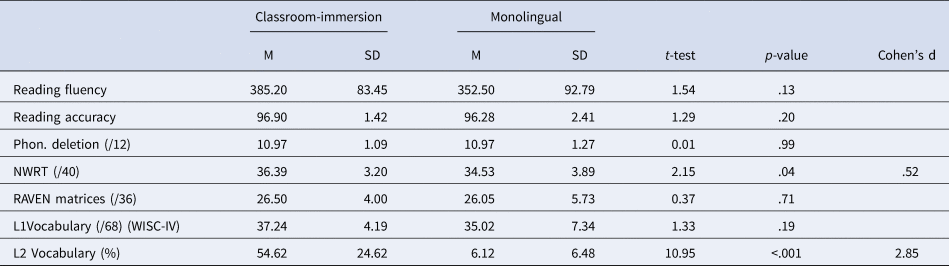
Participants’ abilities in French were assessed using standardized tests to ensure that any difference between groups were not attributed to better general cognitive or linguistic skills of the classroom-immersion children. Non-verbal and verbal intelligence were assessed respectively through the colored progressive RAVEN matrices (Raven, Reference Raven1981) and the vocabulary subtest of WISC IV (Wechsler, Reference Wechsler2005) that requires participants to define orally a list of French words with decreasing frequency and increasing difficulty. Phonological-short term memory was controlled through the pseudoword repetition task subset of the NEPSY II (Korkman, Kirk & Kemp, French adaptation ECPA, Reference Korkman, Kirk and Kemp2012) due to its correlation with vocabulary learning (Gupta et al., Reference Gupta, MacWhinney, Feldman and Sacco2003). In addition, given our interest for the contribution of orthography and phonology on learning novel words, we also measured several L1-related linguistic skills. Reading accuracy and fluency were measured by using the Alouette task (Lefavrais, Reference Lefavrais1967), which consists in reading aloud a French text composed of unpredictable words within three minutes. Phonological awareness was assessed with the phoneme deletion subset of the EVALEC (Sprenger-Charolles, Colé, Béchennec & Kipffer-Piquard, Reference Sprenger-Charolles, Colé, Béchennec and Kipffer-Piquard2005). Finally, German (L2) expressive vocabulary was assessed using a French-English translation task, adapted to German (Casalis, Commissaire & Duncan, Reference Casalis, Commissaire and Duncan2015), to ensure that classroom-immersion children exhibited a larger L2 vocabulary size compared to monolinguals. Participants’ scores on these tests are presented in Table 1. Independent sample t-tests were conducted to ensure that participants were matched on language and cognitive tests. While classroom-immersion children outperformed monolinguals in the pseudoword repetition task (p =.05), groups were matched on all other cognitive and language tasks (all p-values >.10). Importantly, we also checked that the classroom-immersion group knew the German translations of the English material to be learned by asking them to complete a picture naming task – using the picture material used in the learning sessions – in German (L2). If no answer was provided, a German forced-choice recognition task was performed, in which participants had to choose the correct form corresponding to the picture, between three spoken items. These tasks showed that the classroom-immersion children already knew 85% (about 37.4 out of the 44 German words) of the German equivalentsFootnote 2 on average. Therefore, the German translation equivalents of both L2/L3 cognate and non-cognate English words were already known by classroom-immersion children.
Summary of the participants' performances to cognitive and linguistic background tasks

Note—Reading measures were obtained at the Alouette test (Lefavrais, Reference Lefavrais1967; 2005): Reading fluency scores reflect the number of words that would have been read in three minutes (reading fluency score higher than 265 means that the participant have read the whole text in less than three minutes); Reading accuracy was calculated by multiplying by 100 the ratio between the number of words read accurately compared to the number of words read; Phon. Deletion: phoneme deletion subset of the EVALEC (Sprenger-Charolles et al., Reference Sprenger-Charolles, Colé, Béchennec and Kipffer-Piquard2005); NWRT: Nonword repetition task subtest of NEPSY II (Korkman et al., French adaptation ECPA, Reference Korkman, Kirk and Kemp2012) and assessed short-term phonological memory skills; RAVEN matrices were used as a measure of non-verbal reasoning skills (Raven, Reference Raven1981); L1(French) Vocabulary subtest of Wechsler Intelligence Scale for Children (WISC IV; Wechsler, Reference Wechsler2005); L2 (German) Vocabulary test was assessed using a French-English translation task, adapted to German (Casalis et al., Reference Casalis, Commissaire and Duncan2015) .
Learning and testing phases
This study was split into two learning sessions and four testing sessions. Each learning session was immediately followed by a testing session. A delayed testing took place one week after each learning session. The second learning session took place two weeks after the first one. The experimental design is illustrated in Figure 1. Both learning and testing sessions took place in elementary schools.
Organization of the learning and testing sessions

Learning phase
Stimuli
Forty-four English words were selected from the SUBTLEX-US-database (Van Heuven, Mandera, Keuleers & Brysbaert, Reference Van Heuven, Mandera, Keuleers and Brysbaert2014). The English words were between three and eight letters long (mean = 4.76, SD = 1.2). Half of these words were English–German non-identical cognate words (e.g., swan - Schwan). The other half were non-cognate English words. The words were selected according to their concreteness and imageability to ensure participants would directly retrieve the concept associated with the picture. We ensured that they were highly frequent in German, using lexical frequencies provided for native German children speakers by the childLex-database (Schroeder, Würzner, Heister, Geyken & Kliegl, Reference Schroeder, Würzner, Heister, Geyken and Kliegl2015) and by asking participants’ teachers to determine whether the German translation equivalents were already known by their students (in both written and spoken modalities). According to them, the German words were already known by the participants (5.78 for the spoken form and 5.22 for the written form on a 6-point scale). The learning material is available in Supplementary Materials (see Appendix S1, Supplementary Materials).
Independent sample t-tests showed that English–German cognate words and English non-cognate words were matched on several variables in English: lexical frequency (p =.89), orthographic (p =.28) and phonological length (p =.66), concreteness (p =.45) and imageability (p =.18). Furthermore, minimal bigram frequencies, as well as cross-language orthographic and phonological similarities of selected English words with French and German were estimated by using CLEARPOND database (Marian, Bartolotti, Chabal & Shook, Reference Marian, Bartolotti, Chabal and Shook2012). Learning material was matched on minimal bigram frequency (p = .20) as well as on the frequency of their German translation equivalents (p =.42). We reported the degree of orthographic and phonological overlap with German translation equivalents for all items by using the Orthographic and the Phonological Levenshtein Distance, respectively, which were calculated using the vwr-package (Keuleers, Reference Keuleers2013) on R-Software (R Core Team, Reference Team2017); the phonemes were transcribed into the phonetics alphabet using a X-SAMPA converter. Cognate English–German words exhibited a smaller orthographic (M = 2.36; SD= .85) and phonological distance from German (M = 3.32; SD = 1.9) compared to the English non-cognates (M = 5.32, SD= .84, and M = 6.64, SD = 1.6, for orthographic and phonological distance, respectively, both p-values <.001). For the statistical comparisons between cognate and non-cognate words, see the Appendix S2 (Supplementary Materials).
A set of corresponding black-and-white pictures was selected from the MULTIPIC-database (Duñabeitia, Crepaldi, Meyer, New, Pliatsikas, Smolka & Brysbaert, Reference Duñabeitia, Crepaldi, Meyer, New, Pliatsikas, Smolka and Brysbaert2018). Each selected word was pronounced by two English native speakers and recorded using AUDACITY software (Team, Reference Team2015) to ensure that participants heard different speakers for each learning and testing session. The audio stream was normalized across each word and we performed a noise attenuation procedure.
Procedure
Twenty-two English words were learned during each learning session. The order of the two learning sessions was counterbalanced across participants and, within each session, the presentation order of these words was randomized among participants. Before learning, we ensured that pictures were recognized by participants using a French naming task. We also ensured that they did not already know their English translation equivalents. For each trial, the spoken and written form of an English word were provided by the computer and associated with their related picture. Each English word was visually presented in a random order for at least three seconds (with no time limit) and participants were then allowed to move to the next word. The spoken information was only displayed once for each trial. Thus, children were exposed nine times to each English word during the learning session. This ensured a significant exposure to the learning material. Participants were exposed to both speakers for each item, as a switch occurred every three repetitions. Learning sessions lasted between 20 and 35 minutes long.
Testing phase
Both the immediate and the one-week delayed testing phases comprised three computerized experimental tasks, i.e., a forced-choice recognition task, a go/no-go auditive recognition task and an orthographic judgment task. Testing material is available in Supplementary Materials, (see Appendix S3 for the forced-choice recognition task; Appendix S4 for the go/no-go auditive recognition task; Appendix S5 for the orthographic judgment task – all in Supplementary Materials). These tasks were displayed in the order presented above for immediate and one-week delayed testing. However, the delayed session started with an additional ‘spontaneous’ go/no-go auditive recognition task to assess participants’ recognition performance with no re-exposure to the spoken material. The speaker's voice was switched after each experimental task. Immediate and one-week delayed testing lasted between 25 to 45 minutes including experimental tasks and linguistic and cognitive background tests.
Forced-choice recognition task
For each trial, four pictures were presented simultaneously on the computer screen while participants heard one of the learned words in spoken form. Using the computer mouse, participants had to select the picture corresponding to the spoken English word, presented alongside three distractive pictures chosen among those used in the same learning phase. The position of the target word and that of the distractive pictures was randomized across sessions. For the same experimental item presented during the immediate and delayed sessions, two out of three distractive pictures were identical. One of them was substituted by another one to avoid familiarization with the distractive pictures. Accuracy was recorded for each trial.
Go/no-go auditive recognition task
Stimuli
Besides the 44 learned English words, two lists of 44 pseudowords were constructed using WUGGY software (Keuleers & Brysbaert, Reference Keuleers and Brysbaert2010). They were close phonological distractors to the learning material (one phoneme different from the real words, like furk for the item fork). The same two native speakers pronounced the word and its corresponding pseudoword to ensure overall comparable pronunciation of the two items (and accent). The first list of pseudowords was used for immediate and delayed testing, whereas the second one was displayed for the spontaneous go/no-go task presented at the start of the delayed session.
Procedure
Participants were instructed that, for each trial, an item (word or pseudoword) would be presented in the headphones only. Children had to press the button as fast as possible when they recognized a learned English word and to refrain from giving any response when the spoken form was a pseudoword. The up-coming items were displayed immediately after pressing the Space key or after a three-second delay. This response time interval allowed sufficient time for participants to produce an answer. Accuracy and response times were recorded for each trial. Contrary to the immediate testing, two go/no-go auditive recognition tasks were conducted during the delayed testing session further called as delayed and spontaneous go/no-go auditive recognition tasks. The delayed go/no-go task was presented at the same time in the testing sequence as for the immediate testing and thus included the same pseudowords. The spontaneous one, however, was presented at the start of the one-week delayed testing and included novel pseudowords, to prevent any familiarization effect to the spoken pseudowords for the delayed go/no-go task. Through this experimental design, we explored whether the bilingual advantage for spoken discriminative performance could persist spontaneously after delay, without re-exposure to spoken material. Nonetheless, the bilingual advantage could possibly emerge, only if re-exposure to spoken material, i.e., through the experimental tasks, was provided in similar conditions to those of the immediate session.
Orthographic judgment task
Stimuli
Three types of distractors were created for each of the 44 experimental stimuli: close and distant orthographic distractors, and phonological distractors. The close orthographic distractors were created by a one-letter transposition (horse-hosre) when possible, or by a one-letter substitution (duck-dulk). The distant ones shared a small orthographic overlap with the target word. This overlap was restricted to one-to-three graphemes (horse-hopan), depending on word size. The phonological distractors were homophonicFootnote 3 to the real words when using French grapheme-to-phoneme correspondences (duck-deuque). We designed the orthographic judgment task this way in order to identify whether and to what extent participants paid attention to the English spellings during the learning phase.
Procedure
The target word was presented alongside its three distractors on each corner of the screen. Participants were asked to select the correct written transcription for each of the learned English words among the four different stimuli displayed. For each session, the position of the various written transcriptions was randomized. Accuracy was recorded as well as the pattern of distractive errors, i.e., the selection of one of the distractive spellings.
Results
Data analysis
Accuracy was analyzed for each experimental task. Although response times were recorded for each task, we analyzed them only for the go/no-go auditive recognition task, which was the only task with a speed criterion and statistical analyses on response times are available in Appendix S6 (Supplementary Materials). Statistical analyses were conducted for each experimental task following the same procedure. Mixed model analyses were conducted on R software (R Core Team, Reference Team2017), using lmer and glmer functions from the lme4 package (Bates, Maechler, Bolker, Walker, Christensen, Singmann & Bolker, Reference Bates, Maechler, Bolker, Walker, Christensen, Singmann and Bolker2015). Indeed, through these models, the potential variability across participants, items and schools was considered for each experimental task through random intercepts: the random effect structure model included at least random intercepts for participants and for items. The modelling of random effects was a compromise between the maximal random structure (Barr, Levy, Scheepers & Tily, Reference Barr, Levy, Scheepers and Tily2013), in order to alleviate the lack of model convergence, and the parsimonious one (Bates et al., Reference Bates, Maechler, Bolker, Walker, Christensen, Singmann and Bolker2015).
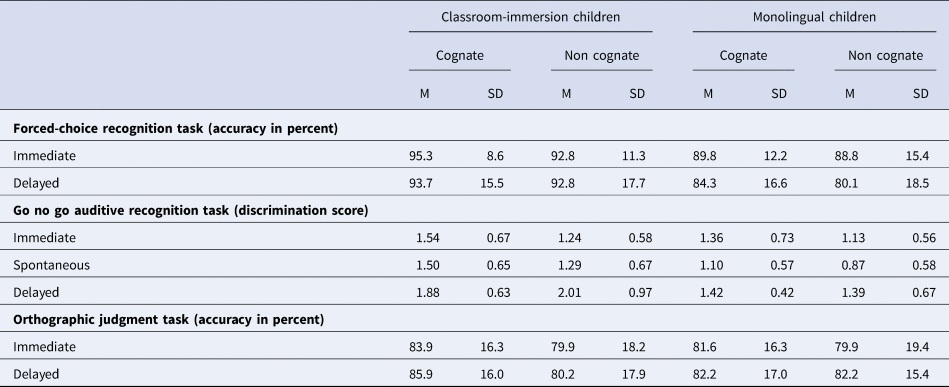
For each experimental task, we then adjusted the model by including the fixed effects: session (immediate vs. delayed), group (classroom-immersion vs. monolingual children) and cognateness (L2/L3 cognate vs. non-cognate words). We used a model comparison approach by progressively entering each fixed main and interaction effects, by comparing each model with the previous one, and eventually including the variables that led to the most adjusted model. At each step, Chi-squared were calculated to test the significant adjustment differences across models; p-values were determined using the lmertest package (Kuznetsova, Brockhoff & Christensen, Reference Kuznetsova, Brockhoff and Christensen2017). This led to the selection of the most adjusted model, i.e., with the smallest Akaike Information Criteria (AIC). This statistical approach seemed very relevant, given that the existing scientific literature did not give us a clear idea of how some of our variables would contribute or not to learning performance. We used treatment contrasts for these analyses. In the event of interaction, we conducted post-hoc analyses including a Bonferroni correction. The best fitted model for each task is presented below. Furthermore, descriptive statistics for all three experimental tasks are reported in Table 2. Given that participants were not matched on their phonological short-term memory skills, we conducted statistical analyses both with and without a non-word repetition task as a covariate. They did not reveal any significant statistical difference: thus, we chose to present the analysis with no covariate to minimize the number of factors included in the models.
Participants' performance for all three experimental tasks according to Group (classroom-immersion vs monolingual children), cognateness (cognate vs. non-cognate words) and session (immediate vs. delayed sessions; and vs. spontaneous session).

Furthermore, we needed to ensure that the classroom-immersion group was familiar with the German translations of the cognate material learned in order to properly investigate any potential cognate effect. Unlike with the teacher's questionnaire, we found that some German words were unknown for the classroom-immersion group, as indicated by the German naming post-test measure. Given that classroom-immersion children experienced difficulties in spontaneously naming the German translation equivalents, the identification of unknown cognate and German translation equivalents words was conducted on the German recognition task. Therefore, we removed the unknown German translation equivalents, whether there were cognate words or not, corresponding to the removal of 15% of the remaining data for all the experimental tasksFootnote 4. The average number of known items was 18.5 out 22 (84%) for the cognates and 19 out 22 (86%) for the German translation equivalents. Statistical analyses were conducted on known (cognate and non-cognate) items but as they did not reveal any significant statistical differences with the analyses conducted with all the items, we only report the latter one, to keep a maximum number of items in our analyses. Importantly, given the lack of previous conducted meta-analyses, we could not estimate our a-priori statistical power. Nonetheless, following the recommendations of Brysbaert and Stevens (Reference Brysbaert and Stevens2018), the statistical power depends on the total number of observations, i.e., the number of participants and of items, with at least 1600 observations by group (40 participants x 40 observations), as data are not averaged when using generalized mixed model analyses. Here, for each experimental task, there were at least 2992 observations by group, supporting a rather high statistical power.
Forced-choice recognition task
The accuracy data were analyzed using mixed logistic models since the dependent variable is binary. The best-fitted model included Session, Group, interaction between Session and Group as fixed effects, and by-participant, by-item and by-school random intercepts (AIC = 3465, χ2(1) = 8.25, p = .004, OR= .57). This model and its parameter estimates are reported in Table 3.
Summary of the logistic mixed model analysis for variables predicting accuracy in forced-choice recognition task.

Model = glmer (forced_choice$Accuracy~Session+Group+Session:Group+(1|participant) + (1|item)+(1|school), data=forced_choice,family=binomial(link=logit),control=glmerControl(optimizer=“bobyqa”))
Higher accurate performances were observed among classroom-immersion participants compared to monolinguals (respectively, 94% vs. 86%, t (3123) = 10.27, p < .001, Cohen's d = .26). However, the proportion of correct associations between picture and spoken form significantly decreased after delay among the monolingual children (respectively, 89% vs. 82%, t (1627) = 6.96, p < .0001, d = 0.17), whereas the performance of classroom-immersion children remained stable across sessions (respectively, 94% vs. 93%, t (1495) = 1.04, p = .30). The inclusion of the cognate status factor did not fit the model better to the data (χ2 (1) = 2.62, p = .11).
Go / No-go auditive recognition task
Discrimination score
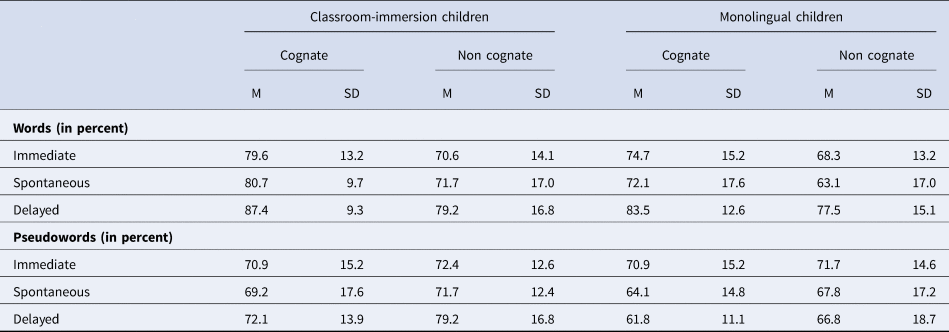
Nine participants (four classroom-immersion and five monolingual children) did not complete all go/no-go tasks and were removed from the analysis. Thus, the statistical analyses were conducted on the 62 remaining participants, i.e., 30 classroom-immersion children and 32 monolinguals. Surprisingly, our participants made a large amount of false recognition for five pseudowords (hirse, hulmet, swun, upple and wetch). After having listened to them again, we realized they were phonologically too ambiguous for being recognized by participants and, thus, were removed from the analysis. In total, the summed deleted data reached 3.76% for this task. The proportion of accurate recognition for words and rejection for pseudowords according to group and session (immediate, delayed, and “spontaneous”) is presented in Table 4. The nature of the go/no-go auditive recognition task could led to potential response strategies, i.e., pressing the space key for all items or for none: thus, we calculated d’ score for sensibility further termed as discrimination score in this article. Hit rates and false alarms were calculated for each participant for both the cognate and non-cognate items. Discrimination scores were obtained by the difference between the z-transformed distribution of correct word identification (hits) and those of the incorrect acceptance of pseudowords (false alarms). A preliminary transformation was conducted on the extreme recognition scores, using Macmillan and Kaplan's (Reference Macmillan and Kaplan1985) requested transformation. Scores equal to 1 were transformed following the (n-0.5/n) equation (with n defined as the number of items). Null scores were recalculated using the (0.5/n) correction.
Summary of the accurate recognition of words and pseudowords in the go/no-go auditive recognition task according to group (classroom-immersion vs. monolingual children) and session (immediate vs. spontaneous vs. delayed)

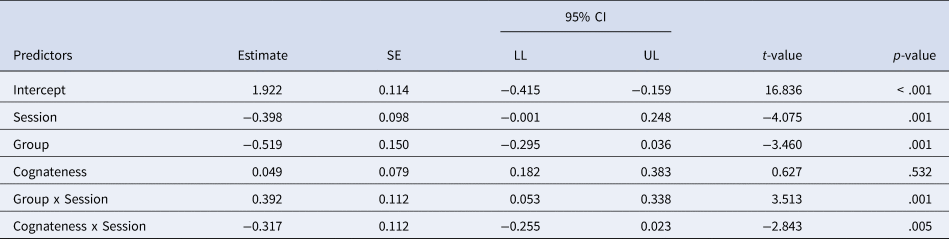
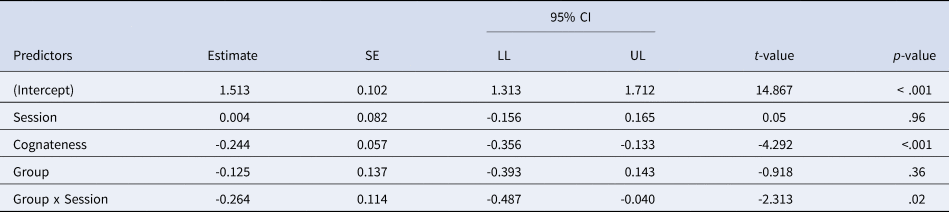
Discrimination scores were analyzed for immediate and delayed sessions using generalized mixed models. Due to the calculation of the discrimination scores, the random structure included by-participant random intercepts. First, only immediate and delayed scores were considered in the analysis. This design gave us a measure of discriminative performance after a one-week delay, for the go/no-go task conducted in the same condition for immediate and delayed testing. The best-fitted model included Session (immediate vs delayed session), Group, as well as the interaction between Session and Group, Cognateness and the interaction between Session and Cognateness as a fixed effect and by-participant random intercepts (AIC = 417, χ2 (1) = 8.08, p = .005). Despite no significant differences in discriminative performance across group in immediate testing (t (122) = 1.27, p = .21), classroom-immersion children outperformed their monolingual peers after delay (respectively, 1.95 vs 1.41, t (122) = 4.34, p < .001, Cohen's d = .78). Furthermore, classroom-immersion children exhibited larger discriminative performance in delayed compared to immediate testing (respectively, 1.95 vs 1.39, t (118) = 4.18, p < .001, Cohen's d = .76), whereas the monolinguals did not (respectively, 1.41 vs 1.21, t (126) = 1.54, p = .13). Surprisingly, participants exhibited larger discriminative performance for cognate items compared to non-cognate ones but restricted to immediate testing (respectively, 1.45 vs 1.18, t (122) = 2.35, p = .02, Cohen's d = 0.42). Indeed, no difference in discriminative performance was retrieved between cognate and non-cognate words in delayed session (respectively, 1.64 vs 1.69, t (122) = −0.37, p = .71). Furthermore, larger discrimination scores were retrieved for non-cognate words in delayed session compared to the immediate one (respectively, 1.69 vs 1.18, t (122) = 3.67, p = 0004, Cohen's d = 0.66). The interaction between Group and Cognateness (AIC = 419, χ2 (1) = 0.16, p = .69), as well as the one between Group, Session and Cognateness did not reach significance (AIC = 420, χ2 (1) = 1.10, p = .29). The parameter estimates for this model are reported in Table 5.
Summary of the mixed linear regression analysis for variables predicting discrimination scores in the go/no-go auditive recognition task in the analysis including immediate and delayed sessions.

Model=lmer(go_nogo$Discrimination_score~Session+Group+Cognateness+Group:Session+Cognateness:Session+(1|participant),data=go_nogo)
Follow-up analyses
The bilingual advantage emerged after delay, with classroom-immersion children outperforming their monolingual peers for discriminative scores. We further conducted a statistical analysis to compare discriminative performance between immediate and “spontaneous” session. As a reminder, the “spontaneous” go/no go task took place at the beginning of the delayed testing to determine whether the bilingual advantage would arise in the absence of re-exposure to the spoken material. Discriminative differences between the immediate and the “spontaneous” go/no-go on tasks were investigated through a linear mixed model.
Here, the best-fitted model included Session (immediate vs. spontaneous session), Cognateness, Group, and the interaction between Session and Group as fixed effects and by-participant random intercepts (AIC = 410, χ2(1) = 5.36, p = .02). This model and its parameters are presented in Table 6. Discriminative scores were higher among the classroom-immersion children compared to the monolingual ones, but for spontaneous session only (respectively, 1.40 vs 0.98, t (122) = 3.66, p = .0004, Cohen's d = .66). However, monolinguals’ discriminative performance decreased significantly in the spontaneous session compared to the immediate one (respectively, 0.98 vs 1.24, t (126) = 2.37, p = .02, Cohen's d = .42) whereas classroom-immersion children did not exhibit differences in discriminative performance between immediate and spontaneous sessions (respectively, 1.39 vs 1.40, t (118) = −.03, p = .97). Once again, larger discriminative scores were retrieved for cognate compared to non-cognate words (respectively, 1.37 vs 1.13, t (246) = 3.00, p = .003, Cohen's d = 0.37).
Summary of the mixed linear regression analysis for variables predicting discrimination scores in the go/no-go auditive recognition task in the analysis including immediate and spontaneous sessions.

Model = glmer(go_nogo$Discrimination_score~Session+Cognateness+Group+Group:Session+(1|participant), data=go_nogo)
Summary
Classroom-immersion children exhibited higher discriminative scores than the monolinguals at delayed testing. This discriminative difference was retrieved, even when participants were not re-exposed to the spoken and written material. Nonetheless, the bilingual advantage was reinforced after re-exposure to the spoken material.
Orthographic judgment task
Three classroom-immersion children did not complete the whole task and were removed from the analysis. Furthermore, response files from three monolingual children were corrupted and were not included for the analysis. Thus, analyses were conducted on the remaining 65 participants, including 31 classroom-immersion and 34 monolingual children. The summed deleted data amounts 9% for this task.
Accuracy
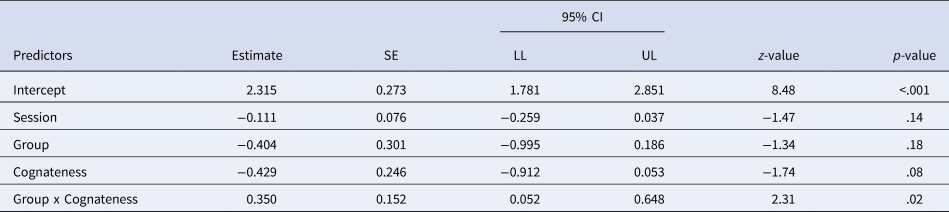
Measures of accuracy were analyzed through mixed logistic models, given that this variable is binary. The best-fitted model included Session, Cognateness, Group and the interaction between Cognateness and Group as fixed effects, as well as by-participant and by-item random intercepts (AIC = 4633, χ2(1) = 5.21, p = .02, OR = 1.39). The parameter estimates are reported in Table 7. Recognition performance remained stable between immediate and delayed session (respectively, 81.3% vs 82.6%, t (5718) = 1.3, p = .19). Post-hoc analyses showed that classroom-immersion children exhibited a higher recognition rate for cognate words compared to non-cognates (respectively, 84.9% vs. 80.1%, t (2694) = 3.33, p = .001, d = 0.10), whereas monolingual children did not (respectively, 81.9% vs 81.1%, p = .57). Furthermore, despite no significant differences between groups for non-cognate words (t (2822) = -0.69, p = .49), classroom-immersion children outperformed monolinguals for cognates (t (2857) = 2.17, p = .03, d = 0.14).
Summary of the logistic regression analysis for variables predicting accuracy in the orthographic judgment task.

Model=glmer(ortho_judgment$Accuracy~Session+Group+ Cognateness+ Group: Cognateness+(1|participant)+(1|item), data=ortho_judgment, family=binomial(link=logit), control=glmerControl(optimizer=“bobyqa”))
Discussion
The present study explored the potential benefit of linguistic immersion in a second language on vocabulary learning in a third language. Our study also explored whether any bilingual advantage would be generalized for all items or driven by cross-linguistic similarities conveyed by cognate words, an issue little addressed so far. Indeed, most alphabetic languages share a large amount of cognate words. Therefore, cumulated experience with closely related languages might be helpful to learn novel vocabulary. For this purpose, we compared the English word learning performance of grade 5 French native children who attended either a monolingual program at school or a classroom-immersion program with German as an L2 since grade 1 and we contrasted the learning performance between German-English (L2-L3) cognate words (Apfel-apple) and non-cognate English words (fork). The selected English words did not share any orthographic or phonological overlap with participants’ native language (French) to minimize the influence of L1 French typology on learning performance in L3 German since the influence of L1 on L3 is generally known to be greater than that of L2, regardless of their interlinguistic distance (see Schepens, Van der Slik & Van Hout, Reference Schepens, Van der Slik and Van Hout2016).
Evidence for a generalized bilingual advantage in L3 vocabulary learning
The results revealed a bilingual advantage in learning vocabulary in L3, with classroom-immersion children outperforming their monolingual peers on two of the three experimental tasks: namely, forced-choice recognition and go/no-go auditive recognition task. Except for the orthographic judgment task in which classroom-immersion children outperformed the monolingual group for English cognate words only, we found no interaction between group and type of items, English/German cognates or English non-cognates – that is, no evidence of an impact of the L2/L3 cross-linguistic similarities in the L3 learning performance of bilinguals. This suggests that, except for orthographic learning, the bilingual advantage could be generalized for all items and is rather not modulated by or restricted to the form and meaning overlap between the English words to be learnt and German words. Furthermore, this bilingual advantage persisted after a one-week delay, with the classroom-immersion children still performing better on all tasks than the monolinguals in the delayed session.
To date, only two studies reported a bilingual advantage on L3 vocabulary learning among children, conducted with rather young aged children exposed to an L2 since kindergarten and with an average cumulated exposure to L2 of seven to eight months (Eviatar et al., Reference Eviatar, Taha, Cohen and Schwarz2018) and two years (Kaushanskaya et al., Reference Kaushanskaya, Gross and Buac2014). In our study, classroom-immersion children were exposed to German as L2 for five years. However, in spite of longer exposure time, our participants attended a dual-language immersion program, with equivalent exposure to native and second language consistent with L1/L2 vocabulary learning studies with children (Tonzar et al., Reference Tonzar, Lotto and Job2009; Comesaña et al., Reference Comesaña, Soares, Sánchez-Casas and Lima2012b; Comesaña et al., Reference Comesaña, Moreira, Valente, Hernández-Cabrera and Soares2019; Valente et al., Reference Valente, Ferré, Soares, Rato and Comesaña2018). In Kaushanskaya and colleagues (Reference Kaushanskaya, Gross and Buac2014), however, participants were mainly exposed to the L2, in an 80%-20% (L2-L1) ratio. Our results are therefore consistent with the literature on a bilingual advantage in children (Kaushanskaya et al., Reference Kaushanskaya, Gross and Buac2014) and in adults (Kaushanskaya & Marian, Reference Kaushanskaya and Marian2009a) insofar as we observed a bilingual advantage in a task that required participants to link the spoken form to its concept: namely, the forced-choice recognition task. Within the information-processing framework, word learning can be seen as a dynamic process including encoding, storage and retrieval of information into the lexicon, and, taken together, these results suggest that bilinguals experience enhanced memory skills for word learning. Interestingly, Kaushanskaya (Reference Kaushanskaya2018) suggested that bilingual children may experience deeper encoding of semantic information, as they outperformed their monolingual peers in word learning and made a greater amount of deep semantic-related errors in a translation task compared to monolinguals. Our study allows to generalize such bilingual effect to a different type of linguistic immersion in L2, with participants whose daily exposure to L2 is much lower and whose L2 proficiency can be considered as moderate, as shown by their scores on the French-to-German translation task and on the post-test knowledge measure on the experimental items. Importantly, despite that monolinguals exhibited a lower learning performance compared to the classroom-immersion children, they were still able to associate the spoken form correctly with its concept for about 39 of the 44 English (89%) words, suggesting that robust learning is reached after only nine repetitions during the learning phase. Our results also show that the paired associate learning paradigm is adapted for vocabulary learning studies among children, as reported by Ricketts et al. (Reference Ricketts, Bishop and Nation2009), since it allows the simultaneous presentation of spoken and written words along with their matching pictures. The multiple sources of information provided during learning promoted the creation of a strong multimodal lexical representation, consistent with the lexical quality hypothesis (Perfetti & Hart, Reference Perfetti and Hart2002).
Evidence for a bilingual advantage extended to semantic, orthographic and phonological learning
Importantly, our results extended the bilingual advantage to multiple dimensions of L3 learning, including semantics but also orthography and phonology, an issue that has received little attention so far. An advantage was observed in the immersion group in both the orthographic judgment task, which required participants to detect the correct spelling of the English words among orthographic distractors, and in the go/no-go auditive recognition task, which required them to detect the correct phonological forms of the English words among phonological distractors. Nevertheless, while the bilingual advantage on orthographic learning was limited to L2/L3 cognate words (see below for discussion), it was found independently of item properties in phonological learning. The bilingual advantage observed in the go/no-go task, characterized by an enhanced recognition of spoken words, was retrieved after delay, with no re-exposure to spoken forms, given that discrimination performance remained stable between immediate and spontaneous session, contrary to monolinguals whose performance decreased over time. Furthermore, this bilingual advantage was even reinforced after the phonological reactivation of the learning material, with classroom-immersion children outperforming the monolinguals in discrimination scores after delay. Interestingly, the raw data showed an increased false alarm rate among monolinguals, i.e., erroneously considering a pseudoword as a word, whereas classroom-immersion children exhibited a higher recognition rate of both words and pseudowords. Thus, classroom-immersion children benefited from re-exposure to spoken information during the testing phase. These results support the idea that bilinguals have an advantage in learning novel phonological forms, in line with Antoniou et al. (Reference Antoniou, Liang, Ettlinger and Wong2015) with adults, which may be explained by the fact that classroom-immersion participants had to deal with two phonological systems (French and German) early in life. A surprising interaction between cognateness and session appeared in the go/no-go task, with no significant interaction with group. This result cannot be attributed to participants’ prior knowledge of English words, as none of them reported knowing the words to be learned. Furthermore, the two item conditions (i.e., cognates vs. non-cognates) were matched on several linguistic variables and no such pattern was observed in the other two experimental tasks, which may rule out any methodological bias; still, this pattern cannot yet be explained and future studies with a larger sample may help uncover whether this pattern reflects a statistical artifact or lack of power for interaction with group to emerge.
Mixed evidence for a cognate facilitation effect
Despite this unexpected pattern, we found no specific cognate facilitation on L3 vocabulary learning in the classroom-immersion group in two out of three experimental tasks. Two main arguments may be put forward. First, it is likely that L3 word learning was not directly mediated through German, especially for L2/L3 cognate words. According to the scaffolding model (Bartolotti and Marian, Reference Bartolotti and Marian2017a), L3 vocabulary learning is characterized by the creation of direct links between a novel word and a pre-existing one sharing the same concept; thus, at the first step of L3 learning, the weak language is anchored to a more experienced one. In this study, we thought that exposure to German as an L2 was sufficient to help classroom-immersion children building links between L2/L3 German-English cognate words. Indeed, the post-test measure assessing participants’ knowledge of the German translation equivalents showed rather high accuracy on the forced-choice recognition measure. Follow-up analyses conducted on a sub-sample of items, whose German translations were known to classroom-immersion participants, led to a comparable result, i.e., a lack of cognate effect in these participants. However, our participants had some trouble spontaneously naming them, suggesting that they had not gathered enough experience with spoken German (L2), possibly limiting the activation and impact of L2 during L3 learning. Furthermore, the present study did not emphasize the L2/L3 cognateness to the classroom-immersion group, which could have hindered the emergence of a specific vocabulary learning advantage among bilingual children. Indeed, this advantage might be dependent of participants’ cognate awareness, which is defined as the explicit knowledge for learners that a novel word shares some similarities (meaning, spoken and written overlap) with an already well-known word in another language (Malabonga, Kenyon, Carlo, August & Louguit, Reference Malabonga, Kenyon, Carlo, August and Louguit2008). Nonetheless, a recent study highlighted that cognate awareness did not contribute to facilitate the learning of L1/L2 cognates (Otwinowska, Foryś-Nogala, Kobosko & Szewczyk, Reference Otwinowska, Foryś-Nogala, Kobosko and Szewczyk2020), suggesting that explicit learning was not mandatory for the cognate facilitation to arise. Future studies using more frequent L2/L3 cognate words, as well as older children with longer L2 exposure/learning, will help determine whether such a cognate effect exists.
Second, the lack of cognate facilitation might also be attributed to the differential degree of overlap between orthographic and spoken forms. Interestingly, most German/English cognates had a larger orthographic than phonological cross-language overlap (mean Levenshtein distance: 2.36 and 3.32, respectively). This inconsistency may reduce the cognate effect as words were presented in both modalities. This hypothesis is consistent with Valente et al. (Reference Valente, Ferré, Soares, Rato and Comesaña2018), who reported a decline in cognate facilitation during L2 word learning with decrease in cross-language orthographic and phonological overlap. These two studies therefore highlight the need to carefully examine cognate facilitation learning effects depending on both orthographic and phonological overlap (see, for instance, Dijkstra, Grainger & van Heuven, Reference Dijkstra, Grainger and van Heuven1999, and Comesaña, Sánchez-Casas, Soares, Pinheiro, Rauber, Frade & Fraga, Reference Comesaña, Sánchez-Casas, Soares, Pinheiro, Rauber, Frade and Fraga2012a for a similar approach on cognate visual processing).
Moreover, the fact that the specific bilingual advantage for cognateness emerged only in the orthographic judgment task also reflects the importance of modality. Irrespective of the cross-language formal similarities at the item level, it is possible that cognate facilitation during language learning mostly appears in written tasks, owing to the salience of the orthographic information, which is a stable source of visual information. On the contrary, spoken forms are more transient in time, which is an additional constraint for the cognate facilitation to emerge in phonologically-focused tasks. To our knowledge, Valente et al.'s study (Reference Valente, Ferré, Soares, Rato and Comesaña2018) is the only one that has reported a cognate facilitation effect in an auditory recognition task. Conversely, the cognate written facilitation effect on vocabulary learning has been much more documented in previous studies among adults (de Groot & Keijzer, Reference De Groot and Keijzer2000; Valente et al., Reference Valente, Ferré, Soares, Rato and Comesaña2018; Rogers et al., Reference Rogers, Webb and Nakata2015; Lotto & de Groot, Reference Lotto and de Groot1998; Van Hell & Mahn, Reference Van Hell and Mahn1997) and children (Tonzar et al., Reference Tonzar, Lotto and Job2009; Comesaña et al., Reference Comesaña, Soares, Sánchez-Casas and Lima2012b; Comesaña et al., Reference Comesaña, Moreira, Valente, Hernández-Cabrera and Soares2019).
Consistent with these studies, we highlighted the contribution of cognateness on the bilingual learning advantage for the sole “pure” orthographic task, with enhanced spelling recognition abilities among classroom-immersion children that was limited to L2/L3 cognate words. Our results suggest that the activation of L2 written form during the early steps of L3 vocabulary learning contributed to the more accurate recognition of the spellings of L3 cognate words, even if they shared a partial orthographic overlap, suggesting a relative tolerance of the recognition system to written dissimilarities. In line with our results, Bartolotti and Marian (Reference Bartolotti and Marian2017b) also reported a similar benefit from cross-language orthographic similarities among bilingual adults, with an equivalent spelling advantage retrieved for pseudowords close to both L1 and L2 (English and German), as well as for those related to one of the languages only (English or German).
The bilingual advantage on orthographic learning cannot be generalized to all items, since a similar performance was observed in the two groups for non-cognate items. Therefore, while a bilingual advantage emerged for phonologically-focused experimental tasks regardless of cross-language similarities in the absence of a cognate effect, such an advantage relied on cross-language similarities conveyed by L2/L3 cognate words for the orthographic learning task. Interestingly, despite a well-documented bilingual advantage on phonological skills for L3 phonetic learning (Antoniou et al., Reference Antoniou, Liang, Ettlinger and Wong2015) and enhanced metalinguistic skills (Bialystok, Reference Bialystok2001; Dodd et al., Reference Dodd, So and Lam2008; Loizou & Stuart, Reference Loizou and Stuart2003), fewer studies have investigated its impact on orthographic skills (see Schwartz, Kahn-Horwitz & Share, Reference Schwartz, Kahn-Horwitz and Share2014 for enhanced spelling recognition among bilingual children). Future studies will have to shed light on the differential bilingual effects on phonological versus orthographic learning.
Limitations and future directions
In this study, participants were matched on multiple cognitive and linguistic dimensions in their native language, except in phonological memory, with the classroom-immersion group exhibiting enhanced phonological short-term memory skills compared to monolinguals. Phonological memory is thought to play a large contribution in foreign vocabulary learning (Papagno & Vallar, Reference Papagno and Vallar1995; Van Hell & Mahn, Reference Van Hell and Mahn1997), suggesting that the bilingual advantage could result from bilingual-enhanced memory skills. However, when statistically controlled, classroom-immersion children still outperformed the monolinguals in all the experimental tasks, suggesting that the bilingual advantage cannot be entirely accounted for by differences in phonological memory skills between the two groups, in line with studies conducted by Kaushanskaya and collaborators (Kaushanskaya & Marian, Reference Kaushanskaya and Marian2009a, Reference Kaushanskaya and Marian2009b; Kaushanskaya, Reference Kaushanskaya2012).
Nevertheless, contrary to Kaushanskaya et al. (Reference Kaushanskaya, Gross and Buac2014), our study did not include any objective measure of socioeconomic status (SES). Those questionnaires are not well received by schools and parents owing to French sociocultural norms regarding wealth and success, and that educational system stems on the erasing of cultural, religious and social differences. Fortunately, this lack of measure does not seem to have been detrimental to this work. Firstly, the participants were recruited from the same elementary schools for both classroom-immersion and monolingual groups; thus, children came from the same catchment area. As the assignment of children to a linguistic immersion program to German is based solely on parents’ demand, and not on children's academic performance, any family whose child participated in the study freely chose to enroll their child in either of these programs. Furthermore, German suffers from a lower attractiveness compared to other languages (only 16.3% of French high school students have chosen German as one of their two foreign languages compared to 99% of them for English and 57% for Spanish, see the MENJS-MESRI-DEPP, RERS 2020), likely because of a rather low level of proficiency in citizens themselves (only 20% of French adults report knowing two foreign languages, while around 40% report knowing only one – which is often English; see Eurostat.edat_aes_l23); thus family decisions are partly based on their language and cultural history rather than SES; in this respect, we believe that an SES bias would have been more likely if teaching had been provided in English. Secondly, SES has an impact on children's cognitive and verbal development (Noble, McCandliss & Farah, Reference Noble, McCandliss and Farah2007) and academic success such as literacy acquisition (Fluss et al., Reference Fluss, Ziegler, Warszawski, Ducot, Richard and Billard2009), likely due to differential familial environments (see for example the Home Literacy Environment model by Sénéchal & LeFèvre, Reference Sénéchal and LeFèvre2014). And yet, we found no group differences on the different control measures that we used, such as nonverbal reasoning, vocabulary, reading or phoneme awareness, giving us confidence with the data and indicating the absence of any SES-related bias. Beyond SES, other family-related variables may explain this bilingual effect, such as a stronger multilinguistic environment at home for the classroom-immersion group, or higher motivation or different attitudes towards foreign language learning.
Interlinguistic typology between L2-German and L3-English may also account for the bilingual learning advantage, given that both languages share more interlinguistic similarities compared to L1-French; an assumption questioned by Schepens et al.'s mega-study (Reference Schepens, Van der Slik and Van Hout2016) which reported a larger contribution of the similarity between L1/L3 typology compared to the L2/L3 one. Furthermore, here participants were not exposed to the German language (L2) during the learning and testing sessions, thus, alleviating the contribution of L2/L3 typology on the bilingual advantage. Despite our study cannot give a full picture of indirect effects of these variables on the bilingual learning advantage, this concern might be partially alleviated by the fact that participants had no prior exposure to English at school, nor knew any English vocabulary before the study.
Although this study focused only on the first steps of L3 learning, it is noteworthy that the bilingual advantage remained across sessions, suggesting that the benefit on L3 vocabulary learning was not transient, in line with Sanz (Reference Sanz2000). Indeed, they pinpointed this advantage among bilingual adults, with Catalan/Spanish bilinguals exhibiting larger L3 vocabulary compared to monolinguals, after a larger academic exposure to L3, suggesting a relative stability of the bilingual advantage across time. Nevertheless, monolingual children also exhibited rather stable recognition performances after delay, despite a slight decline in the forced-choice recognition task. This stability over time can be accounted for by the creation of robust multimodal lexical representations, consistent with the lexical quality hypothesis (Perfetti & Hart, Reference Perfetti and Hart2002), but also with offline sleep consolidation. Indeed, previous studies evidenced the large contribution of sleep on word learning facilitation among adults (Dumay & Gaskell, Reference Dumay and Gaskell2007), and among monolingual children (Brown, Weighall, Henderson & Gareth Gaskell, Reference Brown, Weighall, Henderson and Gareth Gaskell2012).
Conclusion
To conclude, this study shows a bilingual advantage in L3 vocabulary learning in children with five years of classroom immersion to German as an L2. Thus, a dual-language immersion program seems sufficient for the emergence of the bilingual advantage on L3 vocabulary learning, although the minimal amount of classroom-immersion required remains to be established. Importantly, we highlighted a bilingual advantage for all the recognition tasks, including spoken and written accurate recognition of L3 words. Recognition is overall less cognitively demanding than language production, which also requires reinforced management of cross-linguistic interferences. Future studies will need to clarify whether the bilingual advantage can be extended to production tasks. This learning advantage was not restricted to cross-language similarities conveyed by L2/L3 cognate words for spoken tasks, suggesting that the bilingual advantage could be generalized for all items, but was limited to L2/L3 cognate words for spelling recognition. Therefore, the bilingual advantage on L3 vocabulary learning cannot be fully accounted for either by the specific linguistic properties of cognate words, nor by enhanced linguistic skills, especially short-term phonological memory. Our study did not focus on the underlying mechanisms explaining the bilingual vocabulary learning advantage in children. To fill this gap, future studies should adopt a longitudinal approach to monitor the development of bilingual children, within a more general framework that considers cognitive and linguistic development as well as inter-individual variables such as positive attitude and motivation towards vocabulary learning in an L3.
Supplementary Material
For supplementary material accompanying this paper, visit https://doi.org/10.1017/S1366728921000687
Appendix S1. Learning material including English spellings (/phonological form/) and German translation equivalents
Appendix S2. Overview of Items' characteristics between cognate and non-cognate English words
Appendix S3. Target and distractive pictures used for the forced-choice recognition task
Appendix S4. Experimental English words and distractive pseudowords according to list, cognateness and session for the go/no-go auditive recognition task
Appendix S5. Word and orthographic distractive pseudowords for the orthographic judgment task
Appendix S6. Statistical analyses conducted on the response times for the go/no-go auditive recognition task
Acknowledgments
The authors have declared no potential conflict of interest. This research was funded and supported by the ANR-16-CE28-0009 (National Research Agency), to whom we are grateful. We extend our thanks to participants but also to the school staff in the district of Strasbourg for their involvement in this study. We address special thanks to Lisa Knopf for her help in data collection and to Laurent Ott, research engineer at the University of Lille, for designing the computer program.