CHDs are the most common type of birth defects affecting approximately 40,000 births per year in the United States of America.Reference Triedman and Newburger1 The Centers for Disease Control and Prevention estimated that over 2 million US infants, children, adolescents, and adults are living with CHD.2 Now that survival has become the norm, it is important for healthcare providers to help these patients develop and grow despite their life-long condition. Over the last three decades, physical activity and exercise training have gained acknowledgement as being essential for maintaining good health and improving quality of life for all ages.Reference Riner and Sellhorst3 Children and adolescents with CHD can and should be encouraged to participate in physical activity and regular exercise. Many patients with CHD do not engage in regular physical exercise, and although consensus reports have identified that exercise should be performed regularly and encouraged, unfortunately, it is not a common practice.Reference Takken, Giardini and Reybrouck4
Cardiac rehabilitation programmes for adults have been widely established. Research has significantly advanced adult cardiac rehabilitation ranging from simple monitoring programmes to multidisciplinary team approaches that promote physical activity and education.Reference Mampuya5 Cardiac rehabilitation has proven to be an effective modality with health benefits for adult patients living with coronary heart disease with the goal being to delay and/or prevent further disease and return to a former state of health.Reference Mampuya5 In sharp contrast, the goal for children with CHD across a range of anatomic variants would be to help them rise towards their optimal cardiac functioning and enable them to learn to thrive physically, socially, and emotionally.Reference Longmuir, Brothers and de Ferranti6 However, research and available clinical resources similar to what has been achieved with coronary heart disease are scarce for the CHD paediatric population, and cardiac rehabilitation among this population has yet to be well defined.Reference Tikkanen, Oyaga, Riano, Alvaro and Rhodes7
In the paediatric CHD population, studies published over the last 35 years cite benefits of physical activity and structured exercise in patients with CHD,Reference Bradley, Galioto, Vaccaro, Hansen and Vaccaro8–Reference Rhodes, Curran and Camil11 yet these studies lack consensus and consistency on prescribing specific elements for inclusion into a formal cardiac rehab programme. The commonalities among the research findings conclude that programmes should broadly include aerobic, strength, and flexibility training, and be accompanied with education and psychological intervention in order to achieve the desired physiologic and psychologic benefits of exercise training.Reference Tikkanen, Oyaga, Riano, Alvaro and Rhodes7 However, to date, there are no formal recommendations documenting educational opportunities, optimal training quantity, intensity, type of training, or how to best affect behaviour change and increase self-efficacy and confidence in the paediatric cardiac rehabilitation field.
The paucity of literature in this field identifies a need to specify elements for inclusion in a formal paediatric cardiac rehabilitation curriculum. The purpose of this e-Delphi study was to identify relevant content for the development and structure of a paediatric cardiac rehabilitation curriculum for young patients (aged 8–18 years) with any form of CHD and establish consensus around recommended standards and practice guidelines that can be used by exercise physiologists (EP), paediatric and adult congenital cardiologists, and other healthcare team members. The main research question was, “What do experts in congenital heart disease and paediatric exercise physiology identify as optimal content for a paediatric cardiac rehabilitation curriculum?” In order to explore the research question, four separate domains guided the study. Domain 1 explored exercise training elements, domain 2 explored education elements, domain 3 explored outcome and assessment elements, and domain 4 explored the importance of promoting self-confidence in a paediatric cardiac rehabilitation programme.
Materials and methods
A three-round e-Delphi method was developed to identify specific content for a paediatric cardiac rehabilitation curriculum. The e-Delphi method for this study was selected for its efficiency and ability to access a geographically distant and small specialised group of CHD and paediatric EP. Institutional review board approval for the study was obtained from Boston Children’s Hospital and Simmons University and qualified as exempt from the requirements of 45 Code of Federal Regulations 46.
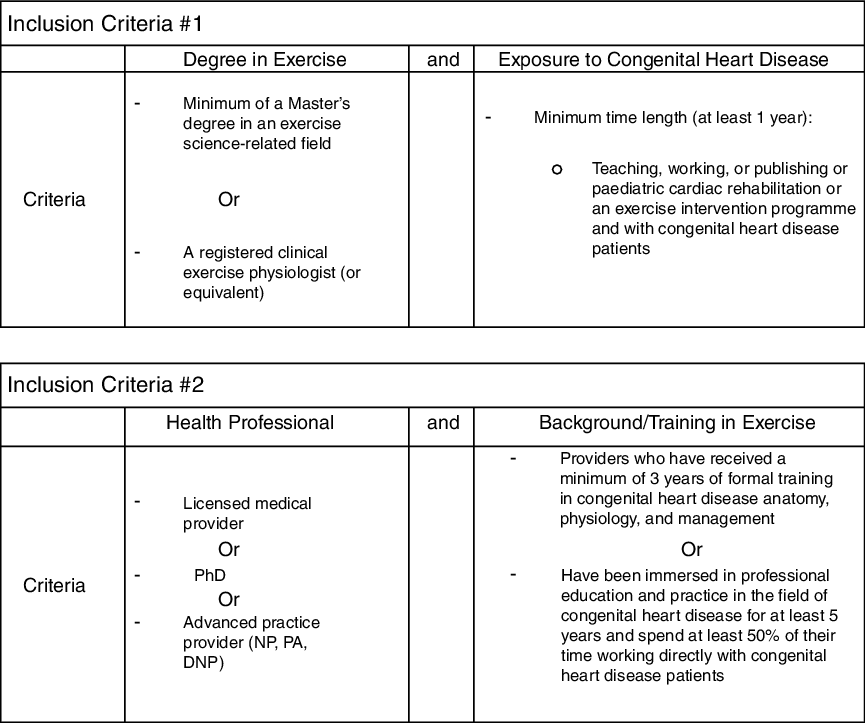
A list of healthcare professionals in the field of CHD and paediatric EP and rehabilitation from across the nation was created from paediatric exercise clinical studies, the Pediatric Heart Network and the vast network at Boston Children’s Hospital.12 The expert panellists included CHD and paediatric exercise professionals. CHD experts were providers who had a minimum of 3 years of formal training in congenital heart disease anatomy, physiology, and management (such as completing Pediatric or Adult Congenital Cardiology Fellowship for MD/DO’s) or who had been immersed in professional education and practice in the field of congenital heart disease for at least 5 years (for Advanced Practice Providers), and who also spent at least 50% of their time working directly with congenital heart disease patients as part of their careers. Exercise professionals were defined as having a Master of Science (or higher) in Exercise Science/Physiology, Exercise Related Field, or Physical Therapy and at least 1 year of exercise rehabilitation or exercise training experience in paediatric CHD (Fig 1).
Delphi process – expert panel inclusion criteria.

As a consensus panel usually consists of 15–30 participants from the same discipline, or 5–10 participants from different professional groups,Reference de Villiers, de Villiers and Kent13 the aim of the study was to invite a minimum of 20 experts from each field for a total minimum of 40 experts because groups of more than 30 panellists do not seem to improve results.Reference de Villiers, de Villiers and Kent13,Reference Fink, Kosecoff, Chassin and Brook14 Attrition was anticipated through the sequential rounds, thus a minimum sample size of 20 participants was determined a priori to be sufficient. This study invited 47 experts: 20 experts met the CHD inclusion criteria and 27 experts met the exercise professional inclusion criteria.
The Delphi is at greater risk for attrition, when compared to other research methods, because it typically involves two to three rounds, which can cause expert fatigue, distraction between rounds, or discouragement with the Delphi research process.Reference Donohoe and Needham15 To prevent attrition and encourage commitment from the experts in this study, a clear explanation of the e-Delphi process and study expectations and instructions were provided during the informed consent process before completing round 1.
Participant experts interested in taking part in the e-Delphi study were given access to an online consent form and subsequent surveys via a secure hyperlink provided to participants’ professional e-mail address. Confidentiality of data by the research team, and anonymity between respondents, was maintained throughout the study through the use of the protected online survey platform (REDCap). Only the investigator had access to the password-protected survey research.
Round 1 consisted of a literature-driven, investigator-developed, and qualitative and quantitative questionnaire intended to define the broad elements for inclusion in a paediatric cardiac rehabilitation curriculum (Supplementary survey S1). Four parts of the questionnaire were developed to correspond with the four anticipated domains required to seek expert stakeholder opinions.
In domain 1, experts were asked to “define paediatric cardiac rehabilitation and identify exercise training elements necessary to maximise physical fitness in children and adolescents with congenital heart disease” using a survey which consisted of nine open- and closed-ended questions with the option to comment on each question. In domain 2, experts were asked to “identify education topics that set heart healthy habits for life in children and adolescents with congenital heart disease” using a survey which consisted of 12 closed-ended questions and one open-ended question. In domain 3, experts were asked to “identify patient outcome measures and assessments for inclusion in a paediatric cardiac rehabilitation curriculum for children and adolescents with congenital heart disease” using a survey which consisted of 22 open- and closed-ended questions with the option to comment on each question. Lastly in domain 4, experts were asked to “identify whether promoting self-confidence was important to include in a paediatric cardiac rehabilitation programme”. This survey consisted of three closed-ended questions with the option to comment on each question. In addition, one open-ended question was included in this domain to collect feedback from experts regarding any component they felt was critical to include in a paediatric cardiac rehabilitation curriculum, but was not addressed in the four domains.
The data collected and analysed from participants in round 1 were used to develop round 2 and round 3 surveys. This study used three rounds, which took 4 months to complete, which is considered suitable.Reference Stone Fish and Osborn16 Consistent communication with reminder e-mails were sent out automatically every week for up to 3 weeks to the experts and one reminder e-mail was sent 3 days before each survey expired. A summary of the aggregated results and open-ended feedback was provided for rounds 1 and 2. It was determined in round 2 that only one additional round was required and this was communicated to participants to boost motivation and reduce the potential for expert fatigue.
Consensus for the e-Delphi research study was determined a priori and was considered achieved when the majority of the expert panel responses met that threshold (described below). There is no defined threshold for consensus in the Delphi literature. Some researchers feel consensus occurs at 51% of participant endorsement, while other researchers feel consensus occurs at 80%.Reference Keeney, Hasson and McKenna17 It is necessary to define consensus as pre-determined percentages of participant responses on research questions before data collection.Reference Hsu and Sandford18 For this e-Delphi research study, the operational definition of consensus was predetermined to mean that 60% of participants rated measures within one category for certain survey items. In addition, consensus would be considered if at least 80% of participants rated within —two to three contiguous categories for certain survey items. This criterion was chosen because of the lack of literature available within each subject domain. The purpose of using the multiple consensus assessments was to get well-rounded results to add to the literature for future research. Items that reached consensus were not rated again in any subsequent round. Once desired consensus was reached between rounds, the Delphi process was terminated.
Statistical analysis used in Delphi studies is descriptive, including measures of central tendency (means, median, and mode) and level of dispersion (standard deviation and inter-quartile range) in order to present information reflecting the collective judgements of respondents.Reference Keeney, Hasson and McKenna17 Median and mode are generally favoured. The use of these descriptive statistical methods provided an understanding towards determined consensus or lack of consensus. Likert ranking scales were used in round I, II, and III questionnaires in order to assess the level of agreement or disagreement or level of importance of each item. Statistical analysis for this study primarily used median, mode, and relative frequency for determining consensus. Qualitative responses from open-ended questions and comments were analysed into categories to develop new questions and reported back to participants to gather further judgement and/or consensus when needed.
In addition, the coefficient of variation was used for one item that calculated a standard deviation to analyse how closely experts agreed with the statement between rounds I and II. The absolute difference was calculated by subtracting the coefficient of variation obtained from round 2 from that obtained from round 1 [absolute difference in coefficient of variation = coefficient of variation (round 1) − coefficient of variation (round 2)], which determined the stability between rounds. A small coefficient of variation value is an indication that the data scatter or variation compared to the mean is small, which signifies stability between rounds and no further Delphi rounds needed. A large coefficient of variation value compared to the mean is an indication that the amount of variation is large, suggesting the use of further Delphi rounds.Reference Shah and Kalaian19 Data from REDCap were exported to Microsoft Excel, version 15.40, for data analysis.
Results
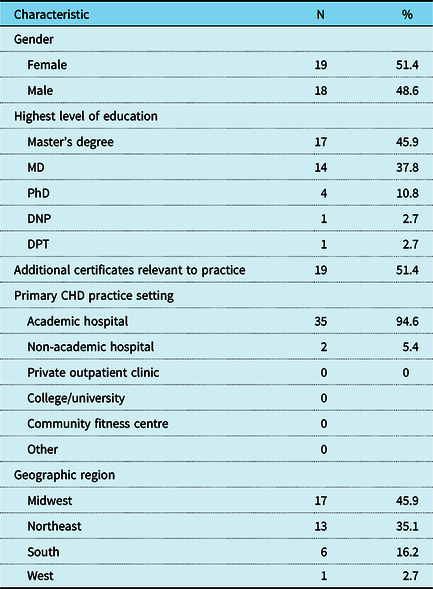
Of the 47 experts that met the study inclusion criteria, 37 experts agreed to participate (79% response rate): 15 were CHD experts with a mean of 16.4 years immersed in professional education and practice, and the remaining 22 were paediatric exercise physiology experts with a mean of 13.3 years of exercise intervention experience with paediatric patients with CHD. Table 1 shows demographic characteristics of the e-Delphi panel members. Of the 37 experts who initially agreed to participate, a total of 35 experts completed round 1 (95% response rate), 29 experts completed round 2 (83% response rate), and 28 experts completed round 3 (80% response rate). Response rates for each round were calculated based on the total number of participants in round 1. Attrition was anticipated through the sequential rounds, and a 70% response rate or greater between rounds is considered ideal.Reference Sumsion20 The study extended over 4 months using REDCap as the online survey and data collection platform.Reference Harris, Taylor and Thielke21
e-Delphi panel demographics

Domain 1 results
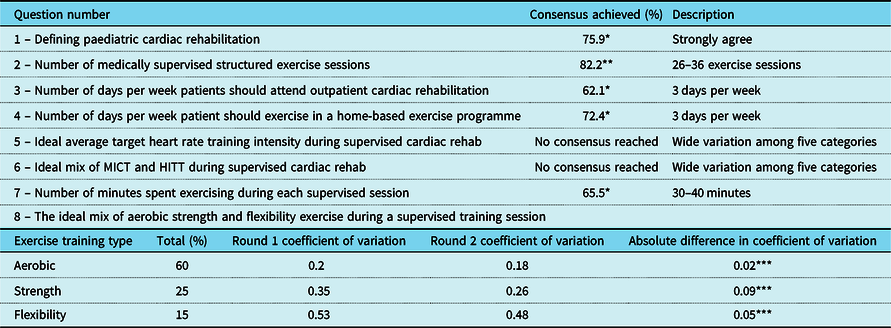
Domain 1 explored how to define paediatric cardiac rehabilitation and identify exercise training elements for the CHD population. In round 1, experts rated eight closed-ended items, with the option to provide comments, and one open-ended item. Feedback provided was categorised for each item and reported back to expert respondents (Supplementary round 1 survey results S2). Of the eight closed-ended questions, two items required revisions among the categories that experts would choose from rounds 2 and 3. In round 2, five of the eight questions (63%) reached consensus and were not added to round 3, while three questions moved on to the third round due to lack of consensus. In the third and final round of this study, three remaining exercise training questions were re-rated by the experts. One of the three questions (33%) reached the consensus threshold, while two questions did not meet the defined consensus cut-off (see Table 2).
Domain 1

* Consensus of >60% between rounds reached.
** Consensus of >80% between rounds within a range of two categories reached.
*** Stability reached between rounds, the absolute value of the difference in CV < 0.20.
HIIT = high intensity interval training; MICT = moderate intensity continuous training.
In domain 1, experts strongly agreed (76%) with the stated definition for a PCR programme for the CHD population: “Paediatric cardiac rehabilitation is a medically supervised programme designed to optimise a congenital cardiac patients’ cardiovascular function, self-confidence, nutrition, and habits for leading heart healthy lives. This includes physician prescribed, developmentally appropriate exercise and physical activity goals, patient and family education, psychosocial assessment, nutrition assessment, and outcomes assessment”. General feedback included the possibility of rewording “physician prescribed” to “clinically prescribed” due to the nature of who typically “prescribes” the exercise, adding physical function and/or cardiorespiratory fitness as a benefit, and thinking about not limiting to “congenital cardiac patient’s”, but possibly including non-congenital patients such as Kawasaki, cardiomyopathy, and so on.
The following five exercise training elements that reached consensus for inclusion in a paediatric cardiac rehabilitation programme were: (1) patients should attend 26–36 medically supervised structured exercise sessions, a few of the experts felt the number of sessions should be individualised based on patient status; (2) patients should attend outpatient cardiac rehabilitation 3 days per week, a few experts suggested 2–3-day ranges. If the data were analysed using the contiguous method, 2–3 days per week would have increased consensus to 97%; (3) patients should exercise 3 days per week in a home-based exercise programme; (4) each supervised exercise session should consist of 30–40 minutes spent exercising and (5) each supervised exercise session should consist of 60% aerobic training, 25% strength training, and 15% flexibility training.
Domain 2 results
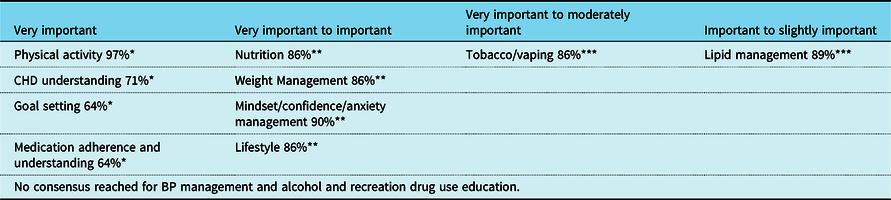
Domain 2 explored education elements. In round 1, experts rated 12 closed-ended questions and provided feedback on one open-ended question. Fourteen of the 35 (40%) expert respondents made comments regarding education in a PCR programme (Supplementary Survey Round 1 Results S2). Based on the feedback provided, four additional education items were added to round 2 for rating. Those education topics were CHD understanding, alcohol and recreational drug use (specific to age), goal setting, and medication adherence/understanding. In round 2, experts re-rated 12 survey items. Eight of the 12 questions (67%) reached consensus and were not added to round 3. The four initial questions from round 1 and the four additional questions added moved on to round 3. In round 3, experts re-rated eight survey items. Six of the eight education questions (75%) reached consensus and two did not meet the defined consensus cut-off (Table 3).
Domain 2

* Consensus of >60% between rounds reached.
** Consensus of >80% between rounds within a range of two contiguous categories reached.
*** Consensus of >80% between rounds within a range of three contiguous categories reached.
In domain 2, experts felt it was very important to include heart healthy education in a paediatric cardiac rehabilitation programme. Experts unanimously thought it was very important to include family (parent, caregiver, siblings) in receiving heart healthy education as well. When asked to rank the method of how education should be received from most to least, most felt it should occur during an exercise session with both patient and family present, mid-rank was during an individual exercise session and least preferred method was during a group exercise session. When asked to rank the method of how education should be delivered from most to least, most felt it should be in person, second rank via an app, third rank via video conferencing, fourth rank in print and the least preferred method was online.
Experts also rated the original eight education topics, which were physical activity counselling, nutrition counselling, weight management, mindset/confidence/anxiety management, lipid management, blood pressure management, tobacco, and lifestyle topics. The four additional education topics that were added based on expert feedback were rated in rounds 2 and 3 for consensus. Those topics again were the following: congenital heart disease understanding, alcohol and recreation drug use (specific to age), goal setting, and medication adherence. Of the 12 education topics, all but two topics reached consensus. The two topics that did not meet the consensus cut-off were blood pressure management and alcohol and recreational drug use.
Domain 3 results
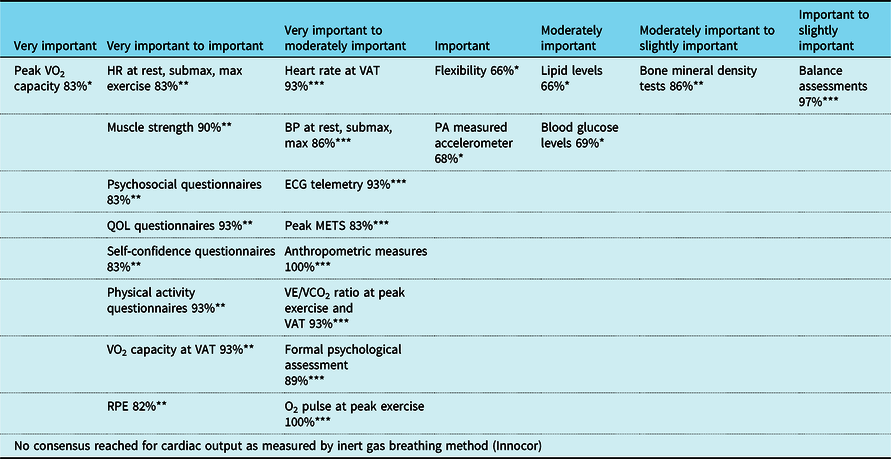
Domain 3 explored patient outcomes and assessments. In round 1, experts rated 21 closed-ended items and provided feedback on one open-ended question regarding the frequency of ongoing assessment for patients actively enrolled in a paediatric cardiac rehabilitation. Respondents felt it was very important to include baseline assessments prior to starting cardiac rehabilitation (100%), to include discharge assessments prior to exiting cardiac rehabilitation (93%), and to include ongoing assessments during cardiac rehabilitation (83%). Respondents provided suggestions for how frequently ongoing assessments should occur for patients actively enrolled in cardiac rehabilitation. Responses were analysed and separated into five categories that experts would choose from in round 2 and re-rate in round 3. Those category choices were the following: every 2 weeks, every 30 days/monthly, every 45 days, every 2–3 months, or halfway through the programme. Eight-two per cent of respondents achieved consensus that ongoing assessments should occur every 30 days (or monthly).
In addition, 11 of 35 (31%) expert respondents made comments for other measurable patient outcomes to be included in a paediatric cardiac rehabilitation programme (Supplementary survey round 1 results S2). From this open-ended feedback, suggested additional outcome measures were added to round 2 for rating. The seven outcome measurements added were physical activity tracked by activity monitors, rate of perceived exertion scale, balance assessments, ventilation/carbon dioxide ratio at peak exercise and ventilator anaerobic threshold, oxygen pulse at peak exercise, cardiac output as measured by inert gas breathing methods, and formal psychological assessments. In round 2, experts re-rated the 22 survey items and the additional 7 survey items that were created from expert feedback. Fourteen of the 29 questions (48%) reached consensus and were not added to round 3, and 15 remaining questions moved on to round 3. In round 3, experts re-rated 15 survey items. Fourteen of the 15 outcome metric questions (93%) reached consensus, while one outcome metric, cardiac output as measured by inert gas breathing method, did not meet the defined consensus cut-off (Table 4).
Domain 3

* Consensus of >60% between rounds reached.
** Consensus of >80% between rounds within a range of two contiguous categories reached.
*** Consensus of >80% between rounds within a range of three contiguous categories reached.
Domain 4 results
Domain 4 explored the importance of promoting self-confidence within a paediatric cardiac rehabilitation and sought out any additional components that should be included that were not on the investigator-developed questionnaire. In round 1, experts rated two closed-ended questions and provided comments on each question. The third question identified those who include self-confidence building techniques in their exercise programme. Sixty per cent of experts responded “yes” to including self-confidence building techniques. Fifteen of the 21 (71%) expert respondents who answered “yes” shared their strategies/techniques. Fourteen of the 25 (56%) expert respondents shared ideas to promote self-confidence for this patient population; all feedback was reported back to experts in round 2 (Supplementary Survey Round 1 Results S2).
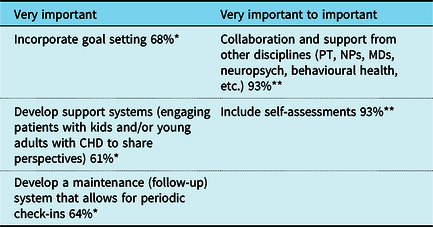
In addition, one open-ended question collected feedback from experts regarding any component they felt was critical to include in a paediatric cardiac rehabilitation curriculum but was not addressed in the four domains. Eight of 35 (23%) expert respondents made general comments. Based on the feedback from the general comments, five additional items were added to round 2 for rating. Topics included the incorporation of goal setting, collaboration and support from other disciplines, inclusion of self-assessments, developing support systems, and maintenance/follow-up system for periodic check-ins (Supplementary survey round 1 results S2).
In round 2, experts re-rated the two self-confidence questions and reached the 60% consensus threshold set by the study on both questions. Respondents felt it was very important to understand the degree of self-confidence in helping to establish successful exercise and heart healthy habits (62%) and to develop strategies to promote self-confidence as part of a PCR (86%). Five additional survey items were added to round 3 for re-rating. In round 3, experts re-rated five survey items. Five out of five items (100%) reached consensus (Table 5).
Domain 4

* Consensus of >60% between rounds reached.
** Consensus of >80% between rounds within a range of two contiguous categories reached.
Discussion
Children and adolescents with CHD should participate in lifelong physical activity. To achieve this goal, the literature recommends many approaches that encourage, motivate, and educate patients to become physically active and enhance their belief in their abilities.Reference Longmuir, Brothers and de Ferranti6 Patients who have participated in structured exercise intervention studies have demonstrated improved physical activity levels,Reference Morrison, Sands and McCusker22–Reference Fredriksen, Kahrs and Blaasvaer24 self-esteem, and mental health.Reference Moons, Barrea and De Wolf25 Cardiac rehabilitation is a key opportunity to instil these behaviours in the paediatric CHD population. However, there are no guidelines on how to implement as part of a rehabilitation curriculum. The primary aim of this study was to identify the necessary elements for a comprehensive paediatric cardiac rehabilitation programme for children and adolescents with CHD. This study achieved expert consensus among many exercise training elements, education needs, and outcome measures, and gave insight into strategies that could help develop enhanced self-confidence in physical activity. The following discussion outlines the results of each of the four domains.
In domain 1, the goal was to define paediatric cardiac rehabilitation and reach consensus on specific exercise training elements relevant to frequency, intensity, training, and type principles.Reference Riebe, Ehrman, Liguori and Magal26 Prior to this study the basic principles applied to exercise training had been borrowed from the healthy paediatric population and the definition of a paediatric cardiac rehabilitation programme was defined and implemented by a single institution and not widely disseminated to other paediatric programmes across the nation. The achieved consensus among the experts of this study will serve to define paediatric cardiac rehabilitation in the CHD population for future cardiac rehabilitation programmes and research.
The recommended frequency for attending a paediatric medically supervised exercise programme according to the majority of experts was 26–36 sessions, where 36 sessions are the standard recommendation for adults. Most experts felt 3 days per week were optimal; however, if analysed using a two-category cluster range, which increased the consensus percentage significantly, 2–3 days per week would be a more acceptable recommendation. This is consistent with multiple studies that have measured the efficacy of a medically supervised exercise programme, where most studies have reported patients attending 2 or 3 days per week.Reference Tikkanen, Oyaga, Riano, Alvaro and Rhodes7 Experts also recommended patients should engage in an additional 3 days per week of home exercise. According to the most recent guidelines, it is recommended that healthy children and adolescents engage in at least 60 minutes or more of moderate to vigorous daily physical activity.27 The current e-Delphi study supports that at least 5–6 days per week of exercise is important and should be encouraged during participation in a paediatric cardiac rehabilitation programme.
Two items that did not achieve consensus were related to the intensity of exercise training. That the first item, setting a standard exercise training intensity, did not reach consensus. This is consistent with the exercise and CHD literature in which training intensity ranges vary greatly.Reference Tikkanen, Oyaga, Riano, Alvaro and Rhodes7 The e-Delphi process used for this study highlighted a possible reason for this variation, which was a concern that the complexity and range of congenital heart disease sub-types would necessitate individualised exercise intensity based on disease severity rather than using a universal standard baseline. The second item that did not reach consensus was the question of high intensity interval training versus moderate intensity continuous training. Adult heart disease literature has found improvements in aerobic capacity when utilising high intensity interval training protocols with higher work interval intensities.Reference Moholdt, Madssen, Rognmo and Aamot28 To date, there have been no studies that have explored this type of training in children and adolescents with CHD; therefore, it is plausible that paediatric experts could not reach consensus on recommending the ideal mix of moderate intensity continuous training and high intensity interval training for patients with CHD due to lack of exposure or data on this method. One aspect worth noting is that just over half of the experts in this study did agree to a 70% moderate intensity continuous training and 30% high intensity interval training mix, yet the set consensus agreement threshold of 80% was not reached. The inconsistency and lack of consensus around exercise training intensities will remain a challenge until future research studies explore this training principle in paediatric patients with CHD.
The time and type of exercise performed during a medically supervised exercise session are also important principles to consider when prescribing exercise. The majority of experts in this study recommend patients spend at least 30–40 minutes exercising during each supervised session and that each supervised exercise session consists of 60% aerobic training, 25% strength training, and 15% flexibility training. Aerobic exercise is the most frequently reported type of training performed during cardiac rehabilitation programmes for multiple reasons; however, the benefits of adding strength and flexibility training often vary in the literature, as well as the amount of time spent exercising.Reference Tikkanen, Oyaga, Riano, Alvaro and Rhodes7 This study is the first to document a consensus of the ideal mix of exercise training type and time spent exercising for patients with CHD.
More importantly, many of the physical activity recommendations, such as frequency, time, and type that exist for the healthy children and adolescents, are comparable with this study’s expert consensus recommendations for young patients with CHD.Reference Tikkanen, Oyaga, Riano, Alvaro and Rhodes7 These new consensus exercise recommendations will help guide healthcare providers in the future develop appropriate, individualised exercise prescriptions for patients who attend a paediatric cardiac rehabilitation programme.
In domain 2, experts were queried about the importance of heart healthy education topics and how to best deliver and receive patient and family education in a paediatric cardiac rehabilitation programme. Every expert panel member agreed it was “very important” that both the patient and family receive education while attending a medically supervised cardiac rehabilitation programme. Experts ranked in-person education as the most preferred method of delivery, while the primary delivery mode for adult education occurs in group settings.
Education methods, as well as education topics, are grossly under-studied in the CHD patient population yet widely established in the adult cardiac rehabilitation model. This consensus study is the first to the author’s knowledge to identify education topics around heart healthy habits for children and adolescents with CHD. Paediatric patients with CHD have different education needs when compared to adult patients with heart disease. While topics that reached high importance in this study such as physical activity, disease understanding, medication adherence and understating, and nutrition are similar topics taught for adults, the content within each topic is unique and requires special considerations. Also, topics of goal setting and the concept of mindset, confidence, and anxiety management have not been previously identified in the literature in a paediatric cardiac rehabilitation setting, but were felt to be “very important” by the expert panel. Including these topics in a directed way could lead to improved health outcomes when combined with exercise interventions for patients with CHD. Developing and testing an education curriculum as part of a paediatric exercise programme will be an important research endeavour for the future.
Three topics that are often included in adult education programmes either were not considered important or did not achieve consensus. Specifically, lipid management received a low importance ranking, while blood pressure management and alcohol and recreational drug use did not reach consensus. This supports the notion that paediatric and adult cardiac rehabilitation programmes are different, and while one model is successful in reducing cardiovascular disease risk factors through structured patient education by providing practitioners with specific recommendations for dyslipidaemia, hypertension, and alcohol and recreational drug use, a model for paediatric patients with CHD should educate and empower children and adolescents about the importance of improving physical activity and overall quality of life through a variety of heart healthy education topics.
Domain 3 addressed the need for identifying specific outcome measures and assessment needs for patients who attend a paediatric cardiac rehabilitation programme. In order to optimise health and wellness both physically and mentally, healthcare team members need a standardised comprehensive approach for assessing patient outcomes. A “Cardiac Rehabilitation Outcome Matrix” that connects outcome evaluation to core components of care has been developed and used in adults.29 This structural framework provides a list of measures that guides programmes in the development of standardised assessment protocols to accommodate their individual needs.
Serial cardiopulmonary exercise testing that measures the physiological benefits of exercise training in CHD is most often reported in studies, and results from this study are consistent with that literature.Reference Longmuir, Brothers and de Ferranti6,Reference Tikkanen, Oyaga, Riano, Alvaro and Rhodes7,Reference Rhodes, Curran and Camil11 Experts ranked several cardiopulmonary exercise testing variables as high importance, such as peak and submaximal oxygen uptake and heart rate responses. Important outcome measures such as balance assessments, bone mineral density tests, lipid levels, and blood glucose levels that are important outcomes and regularly measured in the adult cardiac and secondary prevention programmes were reported as least important in this study. This is the second indicator that paediatric cardiac rehabilitation programmes are unlike adult cardiac rehabilitation programmes, supporting the need for a separate outcome matrix. The majority of experts agreed it was necessary to assess patients every 30 days or at least once a month.
The one measurement that did not reach consensus was cardiac output measured by inert gas breathing methods, which is a unique practice in paediatric exercise physiology testing labs and was an outcome measure suggested from a few experts on the e-Delphi panel. There was wide variability among this category which may be related to the complexity of using this testing method and/or lack of personnel and resources needed in order to measure this outcome successfully. Further research using this as an outcome measurement in paediatric cardiac rehabilitation is warranted.
To the authors’ knowledge, this consensus study is the first to rank the importance for specific outcomes while identifying new measures that could lead to the creation of a framework and guide a comprehensive outcome assessment for paediatric cardiac rehabilitation programmes. Furthermore, as paediatric cardiac rehabilitation programmes continue to grow and become better recognised, the use of a standardised approach for data measurement and collection will only strengthen future research and benefit patients with CHD who enrol in paediatric cardiac rehabilitation programmes.
Finally, the purpose of domain 4 was to explore and share ideas towards promoting and developing self-confidence strategies as part of a paediatric cardiac rehabilitation programme. There are no studies to date that have sought ways to best develop transformative experiences while attending a medically supervised exercise programme in which the patient gains widespread self-confidence. In this research, experts noted that it was “very important” to assess the degree of self-confidence that assists patients with CHD to establish successful exercise regimens, heart healthy habits, and strategies to promote and enhance that self-confidence.
Surprisingly, although this is not widely discussed in the literature, more than half of the experts in this study reported including self-confidence building techniques in their programme. Of those, 71% shared their strategies in the open-ended questions. Some examples were positive self-talk; promotion of physical activity self-efficacy through motivational interviewing, praise, and structured goals that are easy to meet; collaboration with psychologists within the programme; positive reinforcement; encouragement; and having reward systems. When asked to share ideas to promote self-confidence, 40% of experts responded. Some ideas shared were similar to what some experts already include in their programmes, and other ideas were new, such as including ‘celebrations’ of success and the promotion of self-directed activities. There is very limited data regarding these practices, yet experts not only value the concept of promoting self-confidence, they are also incorporating these techniques in their own programmes. These findings are important for future collaboration and research efforts in the field of paediatric cardiac rehabilitation.
This study is unique and contributes to the literature as it established consensus to inform programme structure, exercise training principles, educational content, and patient outcome measures, and explored the importance of including self-confidence strategies for a paediatric cardiac rehabilitation programme. Given the high response rate in such a small and specialised field, where there are only a handful of identified paediatric cardiac rehabilitation programmes in the United States of America, this research and methodology speaks to the validity of the data collected.
There are known limitations of an e-Delphi research design. First, the pressure of conformity concern, which could lead to poor group decision-making, is a weakness of the Delphi method overall. However, the mode was also reported after each round as the mean and median can sometimes skew the distribution, and comments were allowed during each round to voice concerns. Next, participants did not have the option to justify their responses in the second and third round of data collection, which makes the handling of opposing opinions challenging. This was addressed by allowing participants to leave general comments and reflections at the end of each survey round, which was taken into account by the investigator. Lastly, it is not guaranteed that every expert in CHD and Exercise Physiology was identified and contacted and the few that did not respond to the survey may have altered the results.
Given the scarcity of resources available to design an exercise and education programme, these findings contribute to the current research utilised by hospitals and other institutions to build effective programmes that maximise the health benefits of their patients. Before this study, there was no template or consistent practice for how to exercise train and educate patients with CHD. In addition, there were no clear indications for what to use as clinical patient outcome markers in a paediatric cardiac rehabilitation curriculum.
This study is the first to identify detailed content for a comprehensive paediatric cardiac rehabilitation programme. These practice guidelines within each domain set a new benchmark for the future development and implementation for paediatric cardiac rehabilitation programmes. It is now time to finalise the first comprehensive paediatric cardiac fitness curriculum from the consensus data and disseminate these results and educate other heart centres looking to implement paediatric cardiac rehabilitation programmes for their patients with CHD.
Supplementary material
To view supplementary material for this article, please visit https://doi.org/10.1017/S1047951120002346
Acknowledgements
Tracy Curran executed the study survey, conducted analyses, and wrote the manuscript. Naomi Gauthier, Susan Duty, and Rachele Pojednic helped developed the e-Delphi survey, advised on statistical analyses, and revised the manuscript.
Financial Support
This research received no specific grant from any funding agency, commercial or not-for-profit sectors.
Conflict of Interest
None.
Ethical Standards
Not applicable.