Implications
Development of CH4 mitigation strategies for ruminants without disrupting normal digestive function and reducing productivity is a major challenge. Genome sequencing is an effective way of gaining information on how rumen methanogens and bacteria interact and contribute to rumen function. This knowledge will be important when considering the design and implementation of ruminant CH4 abatement strategies. Genomic information is already contributing to vaccine and small molecule inhibitor programmes that are aimed at reducing ruminant CH4 emissions, but it will also underpin the analysis and comprehension of metagenomic sequence data sets, allowing the generation of testable hypotheses to gain a better understanding of rumen biology.
Introduction
Ruminants are foregut fermenters and have evolved an efficient digestive system in which microbes ferment plant fibre and provide fermentation end-products and other nutrients for growth of the animal (Clauss et al., Reference Clauss, Hume and Hummel2010). Feed ingested by ruminants is fermented by a complex microbial community, which includes bacteria, ciliate protozoa, anaerobic fungi, archaea and viruses. The rumen is the first and largest foregut compartment and is the main site for microbial fermentation. The microbial ecology of the rumen has been the focus of numerous studies (reviewed by McSweeney and Mackie, Reference McSweeney and Mackie2012), but very little information is available regarding the microflora of the ruminant oral cavity and lower gastrointestinal tract. The rumen provides optimal conditions for microbes to achieve rapid breakdown of complex plant polysaccharides, with fermentation of the released sugars to produce short-chain fatty acids (SCFAs), principally acetic, propionic and butyric acids. Microbial disposal of hydrogen (H2) generated as a fermentation end-product is essential to the optimum functioning of the ruminant digestive system (Hungate, Reference Hungate1967). Methanogenic archaea use H2 derived from polysaccharide breakdown as their energy source and combine it with carbon dioxide (CO2) to form methane (CH4), which is belched from the animal and released to the atmosphere. Other fermentation end-products including formate and methyl-containing compounds are also important substrates for methanogenesis in some organisms (Hungate et al., Reference Hungate, Smith, Bauchop, Yu and Rabinowitz1970; Liu and Whitman, Reference Liu and Whitman2008). Ruminant-derived CH4 accounts for about one quarter of all anthropogenic CH4 emissions (Thorpe, Reference Thorpe2009), and is implicated as a driver of global climate change. The development of strategies to reduce CH4 emissions from farmed animals are currently being investigated (reviewed by Hook et al., Reference Hook, Wright and McBride2010; Martin et al., Reference Martin, Morgavi and Doreau2010; Buddle et al., Reference Buddle, Denis, Attwood, Altermann, Janssen, Ronimus, Pinares-Patino, Muetzel and Wedlock2011).
Methanogens are the sole producers of ruminant CH4, and therefore CH4 abatement strategies can either target the methanogens themselves or target the other members of the rumen microbial community that produce substrates necessary for methanogenesis. Consequently, exploring the relationship that methanogens have with other rumen microbes is crucial when considering CH4 mitigation strategies for farmed ruminants, but this area remains poorly understood. Genome sequencing is an important tool to gain knowledge on both of the methanogens, and of the processes that underpin the interactions between methanogens and other rumen microbes. The ability to sequence a genome provides access to its entire gene repertoire from which its metabolic capability and mode of life can be predicted. Currently, several rumen bacterial and archaeal genome projects are either complete or underway, and the use of information from these studies in the development of methane mitigation strategies is the subject of this review.
Rumen bacterial genome projects
Following the development of techniques for cultivating strictly anaerobic organisms, a variety of bacteria were isolated from the rumen and characterized on the basis of their morphology and phenotypic properties (Bryant, Reference Bryant1959). Over the years >100, different bacterial species have been reported in the scientific literature. The development of cultivation-independent techniques led to a decline in isolation and cultivation studies, and results from 16S ribosomal RNA gene sequencing and metagenomic studies consistently emphasize that the majority of sequences are derived from organisms that are phylogenetically distinct from currently cultivated species (Kim et al., Reference Kim, Morrison and Yu2011; Fouts et al., Reference Fouts, Szpakowski, Purushe, Torralba, Waterman, Macneil, Alexander and Nelson2012). In recent years, there have been few attempts to systematically bring additional organisms into cultivation; however, recent studies in Japan (Koike et al., Reference Koike, Handa, Goto, Sakai, Miyagawa, Matsui, Ito and Kobayashi2010; Nyonyo et al., Reference Nyonyo, Shinkai, Tajima and Mitsumori2013) and New Zealand (Kenters et al., Reference Kenters, Henderson, Jeyanathan, Kittelmann and Janssen2011; S.J. Noel et al., unpublished) have successfully increased the number of taxa of rumen bacteria that have cultured representatives. Nevertheless, the full spectrum of bacterial diversity in the rumen is only beginning to be revealed.
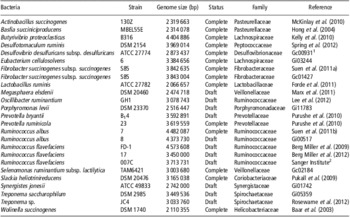
At present, genome sequence information is publicly available for a small number of rumen bacteria (Table 1), including several that are not regarded as major contributors to rumen function. These have been studied for a variety of reasons including improving fermentative succinate production (Hong et al., Reference Hong, Kim, Lee, In, Choi, Rih, Kim, Jeong, Hur and Kim2004; McKinlay et al., Reference McKinlay, Laivenieks, Schindler, McKinlay, Siddaramappa, Challacombe, Lowry, Clum, Lapidus, Burkhart, Harkins and Vieille2010), understanding their role in environmental sulphate reduction, characterization of taxonomically unusual organisms (Pukall et al., Reference Pukall, Lapidus, Nolan, Copeland, Glavina Del Rio, Lucas, Chen, Tice, Cheng, Chertkov, Bruce, Goodwin, Kuske, Brettin, Detter, Han, Pitluck, Pati, Mavrommatis, Ivanova, Ovchinnikova, Chen, Palaniappan, Schneider, Rohde, Chain, D'haeseleer, Göker, Bristow, Eisen, Markowitz, Kyrpides, Klenk and Hugenholtz2009) and lactate utilization and potential probiotic usage (Marx et al., Reference Marx, Graf, Tatto, Thallinger, Mattanovich and Sauer2011). However, most bacteria have been investigated because of their role in the processes of plant polysaccharide degradation and SCFA production, which are central to the growth and productivity of ruminant animals. Consequently, some of the first genomes to be sequenced from the rumen were those of cultivated bacteria considered to have key roles in the breakdown of the cellulose (Fibrobacter and Ruminococus) and hemicellulose (Butyrivibrio and Prevotella) components of plant cell walls. As expected, these fibrolytic bacteria have a particularly wide range of degradative abilities and produce acetate, butyrate and propionate that can be used by the animal, as well as CO2, formate, methanol and H2, which are substrates for methanogenesis. Other bacteria may not initiate polysaccharide breakdown, but contribute to the supporting cast that facilitates the degradation process. Genome sequence information is available for members of the genera Eubacterium, Oscillobacter, Selenomonas and Treponema, which are known to use a wide array of carbohydrates.
Publicly available genome sequences of rumen bacteria

Draft genomes assembled from metagenomic data (Hess et al., Reference Hess, Sczyrba, Egan, Kim, Chokhawala, Schroth, Luo, Clark, Chen, Zhang, Mackie, Pennacchio, Tringe, Visel, Woyke, Wang and Rubin2011) are also available for rumen bacteria belonging to the following orders: Bacteroidales (5), Clostridiales (7), Myxococcales (1) and Spirochaetales (2). 1Genomes online database (http://www.genomesonline.org/cgi-bin/GOLD/index.cgi).
Although these sequenced bacteria include 21 species belonging to 14 different bacterial families, they only scratch the surface of the taxonomic and functional diversity present in the rumen. Estimates of the number of rumen microbial species based on 16S ribosomal RNA gene sequences vary from 300 to 1000 (Fouts et al., Reference Fouts, Szpakowski, Purushe, Torralba, Waterman, Macneil, Alexander and Nelson2012). Consequently, genomic studies have yet to make a sizeable impact with respect to improving our understanding of rumen microbial ecology, and how specific rumen microbes interact with the animal, the feed or each other to influence animal production or the release of greenhouse gases. In addition, there remains considerable opportunity for studies on gene expression (Dodd et al., Reference Dodd, Moon, Swaminathan, Mackie and Cann2010), and for co-culturing studies to determine inter-species interactions (Leahy et al., Reference Leahy, Kelly, Altermann, Ronimus, Yeoman, Pacheco, Li, Kong, McTavish, Sang, Lambie, Janssen, Dey and Attwood2010). To develop a foundation to address some of these issues, the Hungate1000 project has been launched (www.hungate1000.org.nz). This initiative aims to generate a comprehensive reference set of rumen microbial genome sequences from cultivated rumen bacteria and methanogenic archaea, together with representative cultures of rumen anaerobic fungi and ciliate protozoa. This project will expand our knowledge of the rumen microbiome significantly.
Rumen methanogen genome projects
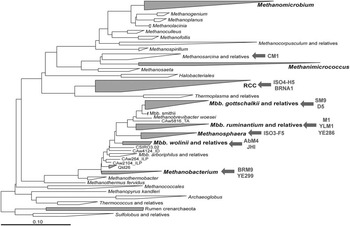
A variety of methanogens can be found in the rumen (Figure 1) and are estimated to comprise ∼0.3% to 3% of the biomass. Surveys of archaeal 16S ribosomal RNA gene sequences from ruminants around the world fed a variety of diets show that three methanogen groups dominate. These are Methanobrevibacter spp., Methanomicrobium spp. and Rumen Cluster C (RCC), also known as Thermoplasmatales-affiliated lineage C but more recently proposed as a seventh order of methanogenic archaea, the ‘Methanoplasmatales’ (Paul et al., Reference Paul, Nonoh, Mikulski and Brune2012). Remaining groups of methanogens include representatives of the genera Methanosphaera, Methanimicrococccus, Methanosarcina and Methanobacterium (Janssen and Kirs, Reference Janssen and Kirs2008; St-Pierre and Wright, Reference St-Pierre and Wright2013). In terms of their metabolism, methanogens typically fall into three groups, hydrogenotrophic methanogens that convert H2 and/or formate to CH4 and that include members of the genera Methanobrevibacter, Methanomicrobium and Methanobacterium, methylotrophic methanogens that metabolize H2 plus methyl compounds to CH4 and that include members of the genera Methanosphaera, and Methanimicrococcus, together with the RCC organisms, and acetoclastic methanogens that utilize acetate and include members of the genus Methanosarcina. Obtaining representative genome sequences from each of these genera will be important to understand the metabolic capacity of these types of organisms and how they contribute to rumen fermentation processes.
Phylogenetic dendrogram illustrating rumen archaea. Arrows indicate where current genome sequencing efforts are based, strains names are listed. Figure adapted from Janssen and Kirs, (Reference Janssen and Kirs2008).

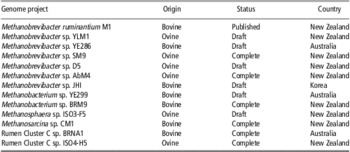
Very few rumen methanogen cultures have been deposited in culture collections, and therefore the choice of well-characterized methanogen candidates for genome sequencing is limited. In recent years, new species of rumen Methanobrevibacter have been described (Rea et al., Reference Rea, Bowman, Popovski, Pimm and Wright2007), and groups in Australia and New Zealand have active programmes to isolate additional rumen methanogen cultures. Organisms within the large uncultured RCC group are of particular interest and may be targeted as enrichment cultures if they cannot be isolated in pure culture. The slow growth of rumen methanogens in vitro, low cell yields, difficulty in lysing cultures with pseudomurein-containing cell walls and isolate contamination are compounding issues to conduct genomic research on rumen methanogens. At the time of writing, there are two rumen methanogen genome sequences publicly available. In addition, researchers in New Zealand and Australia have several rumen methanogen genome projects that are in progress, or nearing completion (Table 2). The first rumen methanogen genome sequence was Methanobrevibacter ruminantium M1 (Leahy et al., Reference Leahy, Kelly, Altermann, Ronimus, Yeoman, Pacheco, Li, Kong, McTavish, Sang, Lambie, Janssen, Dey and Attwood2010). M. ruminantium M1 (DSM1093) was isolated from bovine rumen contents by Bryant (Reference Bryant1965) and is designated the neotype strain for this species. The 2.93 Mb genome of M. ruminantium M1 revealed an intriguing insight into the lifestyle of a rumen methanogen. A prophage genome was described and its lytic enzyme, endoisopeptidase PeiR, was shown to lyse M1 cells in pure culture. A predicted stimulation of M1 growth by alcohols was confirmed and microarray analysis indicated the upregulation of methanogenesis and formate utilization genes during co-culture with Butyrivibrio proteoclasticus, a formate and H2-producing rumen bacterium. The identification of non-ribosomal peptide synthetase genes in M. ruminantium M1, the first reported in an archaeal species, was also an unexpected discovery. Since its publication, the M1 genome has been used to identify genes and proteins that can be targeted to reduce CH4 production through vaccine and chemogenomic-based approaches (see following sections). The second genome sequence is that of Methanobrevibacter sp. JHI, isolated from the rumen of a native Korean cow (Lee et al., Reference Lee, Rhee, Kumar, Lee, Chang, Kim, Choi, Lee, Yoon and Kim2013). Analysis of the JHI draft genome shows it to be highly syntenous with the genome of Methanobrevibacter sp. AbM4 (Supplementary Figure S1), suggesting that these two organisms belong to the same species and are most similar phylogenetically to Methanobrevibacter wolinii (Figure 1). AbM4 was isolated from the abomasal contents of a New Zealand sheep and its genome is complete (S. C. Leahy et al., unpublished). A preliminary examination of the gene content of JHI and AbM4 highlights their similarity (Supplementary Figure S2). However, one striking difference is the presence of a prophage in the JHI genome that is not present in AbM4. Other rumen methanogens also contain prophage, but the role of these genetic elements in rumen microbial ecology is not understood. Comparison of the JHI and AbM4 genomes with the much larger M1 genome reveals that their gene content is largely comparable and suggests that the central metabolism and the methanogenesis pathway of the these strains is similar. All three genomes lack the coenzyme M reductase II (mrt) genes that are present in many other hydrogenotrophic methanogens. There are, however, some differences in cofactor biosynthesis. For example, both AbM4 and JHI contain a complete coenzyme M biosynthesis pathway in contrast to M1. With several rumen methanogen genome sequencing projects either completed or underway, comparative and pan-genomic studies will become more important, and these will help in determining the degree of conservation among genes involved in the methanogenesis pathway and the biosynthesis of methanogenic coenzymes in rumen methanogenic archaea. The genome sequences of the rumen methanogens discussed above have given us an insight into the likelihood that rumen methanogens may occupy different niches within the rumen environment. Understanding these niche-defined roles will be important for any anti-methanogen mitigation strategy to be successful.
Rumen methanogen genome sequencing projects (adapted from the study by Morgavi et al., Reference Morgavi, Kelly, Janssen and Attwood2013)

Methane mitigation
Advances being brought about through individual genome sequencing of rumen bacteria and archaea serve to broaden our understanding of the relationship that methanogens have with other rumen microbes. This information is helping researchers redefine and refine various approaches to CH4 mitigation strategies.
Vaccines
Vaccines are commonly used to prevent diseases in livestock, have a proven record of prolonged efficacy, are relatively easy to administer and can be produced at a low cost. They offer green solutions to animal health problems as they are sustainable and can reduce reliance on pharmaceutical drugs and pesticides (Innes et al., Reference Innes, Bartley, Rocchi, Benavidas-Silvan, Burrells, Hotchkiss, Chianini, Canton and Katzer2011). Therefore, vaccination of farmed ruminants against rumen methanogens offers an attractive approach to reduce their CH4 emissions. The mode of action of a vaccine would be through the generation of antibodies to selected methanogen antigens that enter the rumen via saliva and bind to targets on the surface of rumen methanogens inhibiting their ability to produce CH4. Given the diversity of methanogens in the rumen, a vaccine will need to contain protein antigens that have vital cellular functions and are cross-reactive for a range of ruminal methanogens. Vaccines based on whole methanogen cells have had limited success at reducing CH4 emissions in sheep (Wright et al., Reference Wright, Kennedy, O'Neill, Toovey, Popovski, Rea, Pimm and Klein2004), which may be because of a failure of this type of vaccine to produce cross-reactive antibodies. A recent strategy for vaccine development is based on identifying relevant methanogen protein antigens, which can be used for a sub-unit vaccine (Wedlock et al., Reference Wedlock, Janssen, Leahy, Shu and Buddle2013). Such antigens need to be accessible for antibody binding, and thus vaccine candidates could include membrane associated/surface exposed proteins and adhesin-like proteins. The two main approaches to identifying such vaccine candidates have been the identification of strongly immunogenic proteins using Western blot analysis with sheep antisera raised against various methanogen fractions and the prediction of suitable vaccine antigens through bioinformatic analysis of methanogen genomes (Wedlock et al., Reference Wedlock, Janssen, Leahy, Shu and Buddle2013). Although the former approach has identified a number of immunogenic proteins, few of these have had the attributes of a good vaccine candidate. Conversely, the availability of genomic sequences has provided guidance in the purposeful selection of potential vaccine antigens. Modern vaccine development has seen a change towards genome-based ‘Reverse Vaccinology’ approaches that use high-throughput in silico screening of an organism to identify genes that encode proteins with the attributes of a good vaccine target (Dormitzer et al., Reference Dormitzer, Grandi and Rappuoli2012). This approach to identify targets for a methanogen vaccine has already proven fruitful, as sequence-based bioinformatic analysis of M. ruminantium M1 has led to the identification of a large number of potential vaccine targets for evaluation and, to date, two lead candidates (Leahy et al., Reference Leahy, Kelly, Altermann, Ronimus, Yeoman, Pacheco, Li, Kong, McTavish, Sang, Lambie, Janssen, Dey and Attwood2010; Wedlock et al., Reference Wedlock, Janssen, Leahy, Shu and Buddle2013). The increasing number and diversity of rumen methanogen genomes available for comparative and pan-genomic studies will make this approach more powerful and will greatly assist in the search for cross-reactive and efficacious vaccine antigens.
Small molecule inhibitors
Genomic information also forms the basis of a second CH4 mitigation strategy using small-molecule inhibitors to target enzymes essential for the growth of methanogens. An ideal inhibitor would be methanogen specific, target all methanogens in the rumen, be non-toxic to the host, not significantly affect microbes involved in fibre degradation, environment friendly, not accumulate in host tissues and cost-effective (Van Nevel and Demeyer, Reference Van Nevel and Demeyer1995). There are two established enzyme-based strategies to find novel inhibitors that would satisfy the above criteria. These are the in silico use of enzyme structure data using modelling software to screen large chemical compound libraries or the in vitro screening of large-scale diverse chemical compound libraries using enzyme assays. The combined use of these two strategies is a widely recognized approach used to identify and develop novel inhibitors. Enzyme-based strategies require the identification of suitable target enzymes using genome sequence data, metabolic pathway analysis and analysis of relevant literature followed by the cloning, expression and purification of target enzymes. The purified recombinant enzymes are used for identifying optimal crystal formation conditions to aid their subsequent structural determination and development of assays compatible with high-throughput screening. Any potential inhibitors need to be further tested against pure cultures of methanogens, followed by rumen fluid-based in vitro assays and their toxicological properties assessed before attempting animal trials. A third possible strategy is phenotypic screening, whereby methanogen cells would be directly screened against arrays of inhibitors. The advantage of this strategy is that all essential genes would be targeted simultaneously. However, this approach is technically difficult, given the cumbersome techniques required to grow methanogens, their inherently slow growth kinetics and their extreme sensitivity to oxygen.
Historically, a number of studies using various halogenated compounds have demonstrated the ‘proof of principle’ of small molecule inhibitors, especially in shorter-term animal experiments; however, unfortunately, the inhibitors are either unacceptable because of environmental or toxicology concerns, or tend to become less effective over time (Johnson et al., Reference Johnson, Wood, Stone and Moran1972; Czerkawski and Breckenridge, Reference Czerkawski and Breckenridge1975; Van Nevel and Demeyer, Reference Van Nevel and Demeyer1995; McCrabb et al., Reference McCrabb, Berger, Magner, May and Hunter1997).
One consideration with a small molecule inhibitor approach is the requirement to accommodate the metabolic diversity seen in rumen methanogens. Genomic comparisons of existing rumen methanogens have already revealed enzymatic differences between the hydrogenotrophic and methylotrophic rumen methanogens (S.C. Leahy et al., unpublished). This reiterates the importance of obtaining genomic information from as wide a variety of rumen methanogens as possible. It is clear that inhibitory compounds will need to target specific phylogenetic groups, for example, the RCC, or Methanobrevibacter clades (Figure 1). It is envisaged that suites of inhibitors could lead to stronger and more sustained suppression of CH4 emissions and an increased ability to counter any resistance development.
Animal breeding
Individual animals within populations of ruminant livestock show natural variation in phenotypic traits, and this variation is the basis for selection of individuals with desired traits in breeding programmes. Direct measurements of CH4 emitted from sheep indicate that there is a natural variation between individual animals in the amount of CH4 produced per unit of feed eaten (Pinares-Patiño et al., Reference Pinares-Patiño, Ulyatt, Lassey, Barry and Holmes2003 and Reference Pinares-Patiño, McEwan, Dodds, Cárdenas, Hegarty, Koolaard and Clark2011a). Similarly, variation in efficiency of feed conversion as measured by residual feed intake (RFI) in cattle has previously been correlated with CH4 emissions. Cattle with higher feed efficiencies are reported to produce 20% to 30% less CH4 (Zhou et al., Reference Zhou, Hernandez-Sanabria and Guan2009). The differences observed in ruminant CH4 output as measured directly or as part of RFI studies, appear to be repeatable and persistent over time, and therefore an altered, but stable rumen metabolism seems to be involved, supporting the notion that a rumen microbial component contributes at least a part of the animal CH4-emission phenotype. Logically, altered CH4 output must involve some change in the population or activity of rumen methanogens, for example, as a result of altered substrate supply. Therefore, a change in methanogen community structure can be expected to correlate with a change in the bacterial community, which produces these substrates. Preliminary observations of rumen samples from high and low CH4-emitting ruminants showing differences in both rumen bacteria and methanogens support such an idea. These observations open the possibility of selecting for low CH4-emitting ruminants via animal breeding (Clark, Reference Clark2013).
The exact mechanism(s) responsible for the variation in animal CH4 emissions are currently unknown, but it is likely to have both animal and rumen microbial components. Research has indicated that the ruminal microflora contributes to host feed efficiency, but the effect is modulated by diet. Guan et al. (Reference Guan, Nkrumah, Basarab and Moore2008) showed that the microbial profiles generated from feed-efficient steers clustered together and observed higher concentrations of the SCFA fermentation end-products, butyrate and valerate, in the efficient steers. They also observed that bacterial profiles were more likely clustered within a certain breed, suggesting that host genetics may play a role in rumen microbial structure. Subsequently, Hernandez-Sanabria et al. (Reference Hernandez-Sanabria, Goonewardene, Wang, Durunna, Moore and Guan2012) examined whether specific bacterial groups were associated with cattle feed efficiency, and whether these relationships are affected by the host diet. Steers belonging to the same RFI group under both low-energy and high-energy diets were used to identify specific bacterial phylotypes related to feed-efficiency traits. Similar conclusions were drawn from a study by Carberry et al. (Reference Carberry, Kenny, Han, McCabe and Waters2012). Analysis of the methanogenic community by Zhou et al. (Reference Zhou, Hernandez-Sanabria and Guan2009) using 16S ribosomal RNA gene sequences from feed efficient and inefficient cattle showed differences in variability and diversity. No difference was detected in total numbers of methanogens but the prevalence of organisms similar to Methanosphaera stadtmanae and Methanobrevibacter sp. strain AbM4 were two times higher in inefficient animals. In a further study, Zhou et al. (Reference Zhou, Hernandez-Sanabria and Guan2010) examined ruminal methanogenic profiles in beef cattle differing in feed efficiency as well as diet (low-energy diet v. high-energy diet) using polymerase chain reaction denaturing gradient gel electrophoresis. For each diet, the methanogenic pattern was strongly associated with the feed efficiency of the host. Again, the total methanogen numbers did not correlate with differences in feed efficiency, diet or metabolic measurements, implying that the methanogenic community structure was more important for determining host feed efficiency under different dietary conditions.
Few studies have assessed rumen microbiomes in animals naturally divergent in CH4 emissions, mainly because of the lack of animals with suitable CH4 measurements. The development and use of respiration chambers for ruminants has enabled accurate and repeatable CH4 measurements and work by researchers in New Zealand has resulted in the selection of high and low CH4-emission lines in sheep (Pinares-Patiño et al., Reference Pinares-Patiño, McEwan, Dodds, Cárdenas, Hegarty, Koolaard and Clark2011a and Reference Pinares-Patiño, Ebrahimi, McEwan, Dodds, Clark and Luo2011b). The advent of high-throughput DNA sequencing technology has enabled the characterization of the rumen microbial environment to a great sequencing depth (Hess et al., Reference Hess, Sczyrba, Egan, Kim, Chokhawala, Schroth, Luo, Clark, Chen, Zhang, Mackie, Pennacchio, Tringe, Visel, Woyke, Wang and Rubin2011). This approach is now being used to deep sequence the metagenome and metatranscriptome of rumen samples collected from animals with divergent CH4 outputs. It is hoped that this work will identify rumen microbes associated with high and low CH4 emissions in sheep and cattle, and will give a defined set of microbial genes, enzymes, metabolic pathways and genomes correlated with CH4 production providing a large and useful public data set for targeting CH4 reductions in ruminants. Availability of genome sequence information from individual rumen microbes will be vital to interpret large data sets of this nature.
Manipulation of the rumen microbiome
Interactions between fermentative organisms and methanogens are not well understood, but other functional groups of microbes are likely to have a strong influence on CH4 production in the rumen, either because they produce substrates essential to methanogen survival, or because they affect the numbers of methanogens or other members of the microbiota, which produce methanogenic substrates. Modifying other microbial groups in the rumen, thereby changing the dynamics of rumen fermentation may offer the possibility of reducing CH4 output.
Hydrogen is necessary for methanogenesis and this has led to proposals that other organisms that compete for H2 could be used to reduce CH4 production. In particular, bacteria capable of reductive acetogenesis (homoacetogens) use the Wood–Ljungdahl pathway to combine CO2 and H2 to form acetate, which is available to the animal. The process is not energetically favoured by conditions found in the mature rumen but some homoacetogens have been reported to compete successfully with methanogens in vitro (Joblin, Reference Joblin1999; Wright and Klieve, Reference Wright and Klieve2011). Several homoacetogens have been isolated from the rumen, but analyses of sequences of formyltetrahydrofolate synthetase, a key enzyme of the Wood–Ljungdahl pathway, indicated that additional species remain uncultured (Henderson et al., Reference Henderson, Naylor, Leahy and Janssen2010). The genome sequence of a rumen acetogen Eubacterium limosum SA11 (W. J. Kelly et al., unpublished) shows that the Wood–Ljungdahl pathway is present together with genes that enable a wide range of other substrates to be utilized including methanol and other methyl-containing compounds. Acetogenic bacteria are thought to be the dominant hydrogenotrophs in early rumen microbiota (Fonty et al., Reference Fonty, Joblin, Chavarot, Roux, Naylor and Michallon2007; Gagen et al., Reference Gagen, Mosoni, Denman, Al Jassim, McSweeney and Forano2012). Understanding the ecology of hydrogenotrophs in the developing digestive tract of ruminants may reveal key features that lead to the prevalence of methanogens and the restriction of homoacetogens in the adult rumen, and present new opportunities to programme microbial populations for later life through probiotic and prebiotic style approaches.
Alternatively, understanding the relationship between microbes and methanogens in the rumen could lead to approaches that reduce CH4 production without adversely affecting normal rumen function and strategies for achieving this have been reviewed in a study by McAllister and Newbold (Reference McAllister and Newbold2008). Methanogens are dependent on the other rumen microbes to provide them with substrates essential for survival and growth. Redirecting fermentation, so that the availability of methanogenic substrates is affected, will be central to this approach. For example, studies with gnotobiotic lambs have shown that CH4 is reduced in the rumen when the dominant fibrolytic species is a non-H2-producer (Chaucheyras-Durnand et al., Reference Chaucheyras-Durand, Masséglia, Fonty and Forano2010). Direct-fed microbials may offer a route to affecting substrate availability, and the use of bacteria involved in lactate production and utilization are hypothesized to influence CH4 production (Seo et al., Reference Seo, Seon-Woo, Kim, Santi, Kam and Jong2010). In vitro, methanogens are known to grow better syntrophically (Sakai et al., Reference Sakai, Imachi, Sekiguchi, Tseng, Ohashi, Harada and Kamagata2009). Indeed, many new rumen isolates are obtained as enrichment cultures, suggesting a co-dependence or a close association with other rumen microbes. An important area of investigation will be in elucidating which genes are involved in mediating interactions (particularly H2, formate or methyl group transfer) between methanogens and other members of the rumen microbiome. Further characterization of the fundamental microbial biochemistry of substrate production in the rumen may provide insight for the development of effective strategies for reducing CH4 emissions from ruminants. Homoacetogens, probiotic bacteria and methanogenic syntrophic partners are among the organisms targeted in the first phase of the Hungate1000 initiative.
Future prospects
Reducing ruminant-derived CH4 and developing strategies that endeavour to modify microbial communities that have co-evolved with their ruminant hosts represents a considerable challenge to researchers. To be successful, a thorough understanding of microbial fermentation not just of the rumen but of the entire ruminant digestive tract will be required. Researchers have only begun to fully describe the microbial communities of the rumen and elucidate the extent of the interactions between host and microbiota. However, much remains to understand how microbes have an impact on the remainder of the ruminant digestive tract. For example, hindgut fermentation in ruminants typically provides 5% to 10% of dietary energy and is responsible for 6% to 14% of CH4 output (Gressley et al., Reference Gressley, Hall and Armentano2011). The role hindgut microbes have to play in ruminant nutrition remains largely unstudied and may present researchers with new avenues for CH4 reduction not previously considered. The principles and mechanisms that underlie microbial community structure and host–microbe relationships in the ruminant are complex. However, development of the host–microbe relationship begins at birth and continues throughout adult life. Incomplete information exists about the microbial diversity and colonization dynamics that occur during the developmental stage of a young ruminant. It is conceivable that early-life microbial intervention represents the ideal time point to manipulate the indigenous microbial populations of the ruminant to influence the lifelong environmental impact and productivity of the animal. As such, an appreciation of the microbes of the young ruminant and their colonization pattern will be essential to any strategy targeted for that time point.
As researchers forge ahead with the design and development of strategies that target ruminant-derived CH4, it is clear that whole genome sequences of rumen microbes will be essential for revealing how the metabolic potential of the microbiome has an impact on the animal and the environment. Furthermore, complete genomes will assist in the taxonomic and functional assignments of data from DNA and protein-sequencing studies. Progress in rumen metagenomics has been the subject of a recent review (Morgavi et al., Reference Morgavi, Kelly, Janssen and Attwood2013), and particular questions of interest are whether the presence of individual microbial species or particular microbial groups correlates with animal genotype, with high or low feed conversion-efficiency animals, or with high or low CH4-producing animals. Reference genome data sets will be crucial for the analysis of any ‘omics’ style research.
Genome sequencing of rumen microbes through the Hungate1000 initiative will present microbiologists with new opportunities to understand rumen function, feed conversion efficiency and plant cell wall degradation with the goals of finding the balance between food production and greenhouse gas emissions. Future farming systems may have to consider farming for both the livestock and their microbes.
Acknowledgements
The authors gratefully acknowledge the financial support for the methanogen genome sequencing projects from the following New Zealand funding sources: The NZ Pastoral Greenhouse Gas Research Consortium, NZ Ministry for Agriculture and Forestry Subtainable Land Management Mitigation and Adaptation to Climate Change and the NZ Agricultural Greenhouse Gas Research Centre. The Hungate1000 project is funded by the New Zealand Government in support of the Livestock Research Group of the Global Research Alliance on Agricultural Greenhouse Gases (http://www.globalresearchalliance.org/), and forms part of the Rumen Microbial Genomics Network (http://rmgnetwork.org.nz/) also funded by the New Zealand Government in support of the Livestock Research Group of the Global Research Alliance on Agricultural Greenhouse Gases. The Hungate1000 sequencing effort is supported by the US Department of Energy Joint Genome Institute Community Sequencing Program.
This paper was published as part of a supplement to animal, publication of which was supported by the Greenhouse Gases & Animal Agriculture Conference 2013. The papers included in this supplement were invited by the Guest Editors and have undergone the standard journal formal review process. They may be cited. The Guest Editors appointed to this supplement are R. J. Dewhurst, D. R. Chadwick, E. Charmley, N. M. Holden, D. A. Kenny, G. Lanigan, D. Moran, C. J. Newbold, P. O'Kiely, and T. Yan. The Guest Editors declare no conflict of interest.