Introduction
Gender-affirming care encompasses multidisciplinary services that support transgender and gender diverse individuals socially, legally, and medically. The number of adolescents who identify as transgender and gender diverse doubled from 0.7% to 1.4% of Americans from 2017 to 2022. Reference Herman, Flores, Brown, Wilson and Conron1,Reference Herman, Flores and O’Neill2 Major medical organisations, including the American College of Obstetrics and Gynaecology and the American Academy of Paediatrics, support gender-affirming care for transgender and gender diverse youth, recognising the mounting evidence of its positive benefit in physical and mental health. Reference Cronin and Stockdale3–Reference Rafferty, Yogman and Baum7 As adolescents and young adults continue to consider gender-affirming care options, it is vital that healthcare providers become familiar with these therapies (Table 1). Paediatric cardiologists should participate in the care team of children they follow with congenital or acquired heart disease and consult for other individuals who may be at risk for, or experience, cardiovascular side effects of gender-affirming care.
Terms and definitions.

Adapted from the AAP and Advocates For Trans Equality. Reference Rafferty, Yogman and Baum7,92 This is not an exhaustive or all-inclusive list of gender identities but is aimed to allow a respectful, shared language for providers to learn about their transgender and gender diverse patients.
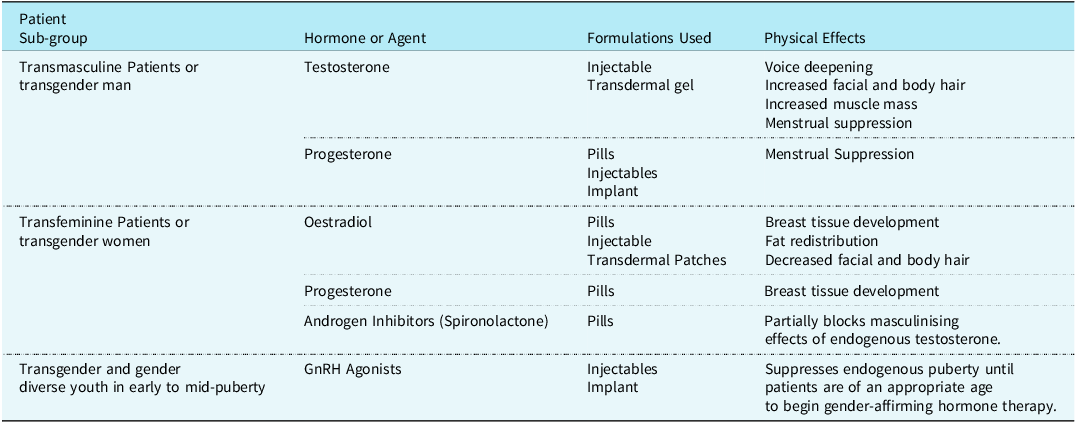
From a medical standpoint, gender-affirming hormone therapy is the mainstay of treatment that can be tailored by the gender-care provider to the individual’s wishes, needs, and age. Hormone therapy may include various formulations of testosterone, oestrogen, and progesterone, aimed to help individuals in achieving physical sex characteristics that match their gender identity (Table 2). Reference Hembree, Cohen-Kettenis and Gooren8 While an increased rate of cardiovascular disease has been described in transgender and gender diverse adults compared to cisgender peers, in part associated with hormone therapy, Reference van Zijverden, Wiepjes, van Diemen, Thijs and den Heijer9 these potential complications in youth have been largely understudied. Cardiovascular disease is a leading cause of death in transgender adults with a significantly increased morbidity and mortality rates compared to the general population. Reference van Zijverden, Wiepjes, van Diemen, Thijs and den Heijer9 The aetiology, as recent studies show, is multifactorial and not all related to the medical or surgical intervention, but also to increased prevalence of physical and mental health risk factors, including obesity, addiction, and access to healthcare and psychosocial stressors. Reference Shawky, Reckelhoff, Alexander and Yanes Cardozo10–Reference Downing and Przedworski13
Commonly used gender-affirming hormone therapies. Reference Hembree, Cohen-Kettenis and Gooren8

It is therefore postulated that safe delivery of gender-affirming care may benefit young patients in primary and secondary prevention of cardiovascular disease. With the scarcity of direct data that can serve as a clinical guideline, this article seeks to provide an up-to-date review on topics related to gender care, with a focus on exogenous hormone therapy, relevant to cardiology care.
Methods
A primary review was conducted through PubMed by the primary author (Appendix SA1), and the secondary search was conducted by a medical librarian in Ovid Medline, Embase, JBI, and CINAHL (Appendix SA2). This initial source list was provided to all authors as a base for review summary. The authors of this article served as a multidisciplinary team that includes paediatric cardiologists (authors 2 and 5), paediatric endocrinologist (author 3), adult (author 4), and adult congenital cardiologists (authors 4 and 5). The authors screened the provided literature based of their respective subsections: venous thromboembolism (author 3), atherosclerotic heart disease (author 4), Kawasaki disease (author 2), arrhythmias (authors 1 and 2), perioperative management (authors 1 and 5), and CHD (authors 2 and 5). Additional resources were added to supplement the initial source list, provide relevant evidence when direct literature data are missing, or cite societal guidelines, based on interprofessional discussions between authors (including, e.g. further extrapolation of data than initially intended, while acknowledging this limitation). For the final review, 13 articles pertaining to venous thromboembolism, 24 articles on atherosclerosis or coronary artery disease, 9 on Kawasaki disease, 8 on arrhythmias, 9 on perioperative care, and 15 on CHD were included. This review summary is not a systematic review and is not designed to serve as a practice guideline. For evidence-based conclusions on treatment benefit or harm, or practice suggestions, when relevant and based on human studies, the authors proposed the level of evidence based on the American Heart Association/American College of Cardiology grading scale: level A high-quality evidence, level B moderate-quality (B-R—based on randomised, B-NR—based on non-randomised studies), level C-LD limited data, and level C-EO expert opinion. Reference Halperin, Levine and Al-Khatib14
Thromboembolic disease
Venous thromboembolism is perhaps the primary concern for cardiovascular complications of oestradiol, as is experienced with oral contraceptives in the general population. Reference Abou-Ismail, Citla Sridhar and Nayak15 Thromboembolism is overall rare in the paediatric population compared to adults, estimated at 0.07–0.14 events per 10,000 children per year, with the vast majority among hospitalised children. Reference Monagle, Cuello and Augustine16 Young individuals with preexisting cardiovascular disease, however, have higher rates of thromboembolic events in 2.1% of children and up to 6% postoperatively. Reference Faraoni, Gardella, Odegard, Emani and DiNardo17 Children and adolescents with complex CHD, with heart failure, Fontan circulation, surgical shunts or mechanical valves, carry a disproportionate burden of thromboembolic complications. The exact risk of thromboembolism with oestrogen therapy is difficult to assess, in children or adults, due to differences in dosing and formulations. Ethinyl oestradiol, the formulation of oestrogen used in oral contraception that is most frequently associated with venous thromboembolism, is not recommended for use in gender-affirming hormone therapy. Reference Hembree, Cohen-Kettenis and Delemarre-van de Waal18 Bio-identical forms of oestradiol are used for gender-affirming hormone therapy, including oral or sublingual 17β oestradiol, transdermal oestradiol, parenteral oestradiol valerate, or oestradiol cypionate. Of these formulations, transdermal oestradiol has the lowest risk of thromboembolic complications in adults (evidence level A). Similarly, with oral 17β oestradiol, the rate of actual venous thromboembolism remains low (level B-NR). Reference Scarabin, Oger and Plu-Bureau19–Reference Arnold, Sarkodie, Coleman and Goldstein21 In adult transgender women, oestrogen therapy has been shown to be associated with prothrombotic changes in the coagulation profile and incidence of venous thromboembolism. Reference Scheres, Selier, Nota, van Diemen, Cannegieter and den Heijer22,Reference Getahun, Nash and Flanders23
Hormone therapy with testosterone for transgender men has no proven risk of thromboembolism but is associated with erythrocytosis. When severe, erythrocytosis could theoretically increase clotting risk. One large retrospective study showed that among transgender and non-binary adults taking testosterone, 20% had haematocrit above 50%; thromboembolic events were uncommon (0.8%) and mostly associated with increased haematocrit (evidence level B-NR). Reference Oakes, Arastu and Kato24 There were no other procoagulant changes associated with exogenous testosterone for gender-affirming hormone therapy. Reference Scheres, Selier, Nota, van Diemen, Cannegieter and den Heijer22
Progesterone therapy may be used for menstrual suppression in transgender men or in gender-affirming hormone therapy for transgender women (Table 2). Progesterone is not typically associated with an increased risk of venous thromboembolism in adults, except with higher dose formulations such as depo-medroxyprogesterone and oral norethindrone acetate (evidence level B-NR). Reference Tepper, Whiteman, Marchbanks, James and Curtis25,Reference Cockrum, Soo, Ham, Cohen and Snow26
When evaluating transgender and gender diverse adolescents and young adults only, a large retrospective study showed no significant increase in thrombotic events with testosterone or oestradiol use for gender-affirming hormone therapy. Reference Mullins, Geer and Metcalf27 The study reviewed records of 611 adolescents who elected to start gender-affirming hormone therapy (28.8% were transgender women and 68.1% were transgender men), 5 of whom were on anticoagulation (2 for a former clot and 3 for assessment of increased risk). None of the participants, including those with increased risk, developed thromboembolic complications over a median of 554 and 577 day follow-up period (evidence level C-LD). Reference Mullins, Geer and Metcalf27
Atherosclerosis and coronary artery disease
Hormone replacement therapy has a history of conflicting evidence of the risk of coronary artery disease and acute cardiac events in cisgender adults. There is no reported incidence rate of clinically manifested atherosclerosis in paediatric population, but it is recognised that atherosclerosis can begin in childhood in those with significant risk factors. CHD, even with low complexity, is a recognised risk factor. Adults with CHD were found to have increased predicted hazard ratios (1.6–2) for myocardial infarction compared with the general population. Reference Fedchenko, Mandalenakis, Giang, Rosengren, Eriksson and Dellborg28,Reference Olsen, Marino and Kaltman29 Minimising added risk factors in individuals with preexisting heart disease is therefore emphasised. Reference de Ferranti, Steinberger and Ameduri30 It is difficult to determine whether any gender-affirming hormone therapy in a young individual may be a risk factor for atherosclerosis or adult ischaemic heart disease. Early observational studies, recent randomised control studies, and systematic reviews suggest that oestrogen monotherapy in post-menopausal women does not increase the risk of atherosclerotic disease while combination therapy with progestin may increase the incidence of coronary heart disease (evidence level A). Reference Hodis, Mack and Henderson31– Reference Alzahrani, Nguyen and Ryan33 As for testosterone replacement therapy, early studies in adult cisgender men suggested higher incidence of myocardial infarction, Reference Vigen, ODonnell and Barón34– Reference Basaria, Coviello and Travison36 and as a result, the FDA issued a black box warning regarding the increased risk which reduced its use among men. 37,Reference Baillargeon, Kuo, Westra, Urban and Goodwin38 More recent large randomised controlled trials as well as large observational trials and meta-analyses proved the safety of testosterone replacement therapy in men with increased risk for atherosclerotic disease and did not find an association with increased cardiovascular mortality, non-fatal myocardial infarction or non-fatal stroke (evidence level A). Reference Lincoff, Bhasin and Flevaris39,Reference Morgentaler, Dhindsa and Dobs40
Several studies assessed the risks for atherosclerotic cardiovascular disease in transgender and gender diverse adults on gender-affirming hormone therapy using a variety of markers for clinical outcomes. Nota et al published a large, multicentre study that assessed the prevalence of cardiovascular events (stroke, myocardial infarction, and venous thromboembolism) in 2517 transgender women and 1358 transgender men (median age 30 years and 23 years, respectively), without a previous history of cardiovascular disease. Reference Nota, Wiepjes, de Blok, Gooren, Kreukels and den Heijer41 The retrospective analysis compared the outcome incidence among transgender men and women to cisgender men and women to account for both sex assigned at birth and exogenous hormone use. For transgender women on oestrogen, who had an average follow-up duration of about 9 years, there were significant increases in rates of stroke, myocardial infarction, and venous thromboembolism compared to cisgender women, but not a significant increase in myocardial infarction compared to cisgender men. Reference Nota, Wiepjes, de Blok, Gooren, Kreukels and den Heijer41 For transgender men on testosterone, who had an average follow-up period of 8 years, there was an increased incidence of myocardial infarction compared to cisgender women and no noticed increased rate of stoke or venous thromboembolism. Compared to cisgender men, there were no increased rates of myocardial infarctions, venous thromboembolism, or stroke. Reference Nota, Wiepjes, de Blok, Gooren, Kreukels and den Heijer41 A meta-analysis by Maraka et al found only one incident of myocardial infarction among 478 transgender women over a short-term follow-up. Reference Maraka, Singh Ospina and Rodriguez-Gutierrez42 Denby et al showed an increased incidence of atherosclerotic disease in transgender and gender diverse population at baseline, even prior to initiation of gender-affirming hormone therapy, suggesting increased general risk factors in this adult population, including hypertension and dyslipidemia. Reference Denby, Cho, Toljan, Patil and Ferrando43 A multicentre prospective study showed that transgender men, 2 years after initiation of testosterone therapy, had increased 30-year risk assessed by the Framingham cardiovascular disease risk estimate. Reference Cocchetti, Castellini and Iacuaniello44 Overall, there may be an increased risk of myocardial infarction in adult transgender women on oestrogen medications (evidence level B-NR) but not when compared to cisgender men and no significant risk reported for adult transgender men.
When evaluating cardiac biomarkers, high-sensitivity cardiac troponin and N-terminal pro-brain natriuretic peptide (NT-pro-BNP), transgender individuals had results similar to cisgender controls with similar hormonal states (transgender and gender diverse individuals on testosterone were comparable to cisgender men, and those on oestrogen comparable to cisgender women). Reference Greene, Schmidt and Christenson45 Another study using flow-mediated vasodilation to evaluate endothelial function showed that this was significantly lower in transgender men on testosterone compared to cisgender females with no comparison to cisgender men. Reference Gulanski, Flannery, Peter, Leone and Stachenfeld46 A review of literature on the association of hormone level or therapy with echocardiographic parameters of cardiovascular health showed a dose-dependent effect with testosterone potentially impairing cardiac mechanics, and the opposite with oestrogen, but effects were thought clinically insignificawnt in physiologic hormone doses. Reference Moudgal, Peritz, Turco and Taub47 Coronary artery calcium scoring has been shown to be similar in transgender and gender diverse individuals on hormone therapy compared to age-matched cisgender peers (evidence level C-LD). Reference Duro, McClain and Aragon48
Few studies evaluated transgender and gender diverse youth for acquired risk factors, but there is no evidence of increased atherosclerotic disease. Valentine et al showed a higher prevalence of dyslipidemia and obesity among individuals on testosterone replacement compared to controls, with no comparison to cisgender males (evidence level C-LD); no cardiometabolic effects were found for oestrogen or GnRH agonists. Reference Valentine, Nokoff and Bonny49 Other studies found that transgender and gender diverse youth were also had higher body mass index, independent on whether hormone replacement therapy was given but with no appreciable difference in blood pressure, insulin resistance, or lipid profiles compared to cisgender peers. Reference Valentine, Davis and Furniss50,Reference Klaver, de Mutsert and van der Loos51 Overall, given the differences in methodologies of existing studies, variations in age and population risk factors, the risk for atherosclerosis and coronary artery disease that is directly associated with exogenous hormone therapy cannot be accurately determined. Primary prevention of traditional risk factors of cardiovascular disease is essential for reducing the risk of cardiovascular disease in adulthood in transgender and gender diverse individuals on gender-affirming hormone therapy.
Kawasaki disease
Kawasaki disease is an acquired vasculitis of the young child with coronary artery tropism leading to coronary artery dilation, ectasia, or aneurysm. Reference Burns, Shike, Gordon, Malhotra, Schoenwetter and Kawasaki52 Kawasaki disease with coronary involvement, especially when large aneurysms are present, can lead to coronary thrombosis or stenosis and premature acute myocardial infarction or ischaemic cardiomyopathy. Reference Denby, Clark and Markham53,Reference Dionne, Ibrahim and Gebhard54 Patients with history of Kawasaki disease could be at a higher risk for coronary thrombosis given thrombogenic endovascular changes in the coronary endothelium. The recent American Heart Association guidelines recommend systemic anticoagulation for children with large aneurysms using low-molecular weight heparin or warfarin and suggest a role of direct oral anticoagulation that is under clinical trials. Reference Montanez, Sexson Tejtel and Menon55– Reference McCrindle, Rowley and Newburger58 To our knowledge, there are no studies evaluating the risk of coronary artery changes or outcomes in transgender and gender diverse individuals with history of childhood Kawasaki disease. A potential consideration for transgender and gender diverse individuals who require chronic anticoagulation is for the risk of thrombosis with oestrogen-based hormone replacement therapy. Providers may recommend an oestrogen formulation, such as transdermal oestrogen, with lower risk for thromboembolism, and there should be no contraindication for testosterone therapy (no evidence or expert opinion exists). Reference Harrison, Prada and Nokoff59
All adolescents who had Kawasaki disease in childhood should be educated about their illness and reducing risk factors for atherosclerosis. The current guidelines recommend life-long cardiology follow-up even for individuals with persistent small (Z ≥2.5) or moderate (Z ≥4) coronary aneurysms and chronic antiplatelet therapy. Reference McCrindle, Rowley and Newburger58 Kawasaki disease with coronary injury is thought to portend a unique risk factor for atherosclerosis, even when echocardiographic evidence of dilation has resolved. Reference Burns, Shike, Gordon, Malhotra, Schoenwetter and Kawasaki52,Reference Tsuda60 For transgender and gender diverse individuals with cardiovascular disease due to Kawasaki disease, we recommend diligent counselling on early management of risk factors for atherosclerosis and the symptoms of myocardial ischaemia.
Cardiac arrhythmias and ECG changes
Gender-affirming hormone therapy has been hypothesised to be associated with increased risk of cardiac arrhythmias. Cardiac myocytes have receptors for oestrogen, progesterone, and testosterone that modulate key ion channels and could affect myocardial activation and electrical conduction in the heart. Reference Costa, Saguner, Gasperetti, Akdis, Brunckhorst and Duru61 While this effect has not been studied in transgender and gender diverse populations, clinical significance could only be presumed from what is known about sex hormone association with dysrhythmias. In Brugada syndrome, for example, there is increased prevalence of arrhythmias and sudden death in individuals assigned male at birth. Long QT syndrome manifests more significantly in individuals assigned female at birth which is believed to be related to a hormonal effect (no evidence). Reference Costa, Saguner, Gasperetti, Akdis, Brunckhorst and Duru61 Reports suggest that exogenous oestrogen therapy may be associated with prolonged QTc intervals and cardiac arrhythmias. Reference Grouthier, Moey and Gandjbakhch62,Reference Wamboldt, Haseeb, Waddington and Baranchuk63 Finally, cisgender men with hypogonadism are known to have increased risk of atrial fibrillation and right ventricular outflow tract arrhythmias (evidence level C-LD). Reference Zeller, Schnabel and Appelbaum64 One reported case is of an adult transgender man with previously undiagnosed Brugada syndrome who suffered cardiac arrest after initiation of exogenous testosterone therapy. Reference Sichrovsky and Mittal65 Rare incidence of post-operative arrhythmias are reported after gender-affirming surgeries that is comparable to previously reported post-operative arrhythmias in cisgender adults (evidence level C-LD). Reference Antwi-Amoabeng, Doshi and Adalja66 We recommend that for transgender and gender diverse youth with known channelopathies or known risk for arrhythmias, pharmacologic review in consultation with the cardiologist should be done prior to prescribing gender-affirming hormone therapy.
There are no recommendations to obtain an electrocardiogram prior to starting gender-affirming hormone therapy for adolescents or adults because there is no clearly defined risk for patients without heart disease. There is a reported risk of long QT syndrome after initiation of GnRH agonists in paediatric patients, used as puberty blocking agents, similar to adults starting gonadotropin-releasing hormone (GnRH) agonists for prostate cancer treatment. Reference Waldner, Doulla, Atallah, Rathwell and Grimbly67 An ECG is recommended prior to initiation of GnRH agonists if there is a family history of prolonged QT or sudden cardiac death, or if patient is on QT-prolonging medications (evidence level C-EO). 68
Perioperative management
Gender-affirming surgeries are often desired by transgender and gender diverse young adults to further align their physical appearance and characteristics with their gender identity. While not all transgender and gender diverse individuals seek gender-affirming surgery, there are multiple benefits for patients who desire them, including specific proven outcomes such as lower psychological distress, smoking rates, and suicidal ideation. Reference Almazan and Keuroghlian69 A survey of surgeons who perform gender-affirming surgery showed that providers often continued gender-affirming hormone therapy around the surgical intervention and provided standard venous thromboembolism prophylaxis. Reference Hung, Assi and Park70 The paper, however, did not provide procedural details, use of anticoagulation postoperatively or other risk factors for thromboembolic events. In a study of 280 transgender women undergoing facial feminisation surgery, no venous thromboembolisms were observed at 1 week or 6-month post-operative periods. Reference Price, Debryn, Mukerji, Nozari, Spiegel and Kim71 Snyder et al reported an incidence of 1.1% of venous thromboembolism in 1588 transgender women following gender-affirming vaginoplasty, with higher incidence among older patients with prior risk factors, 47.1% with personal history of venous thromboembolism. Reference Snyder, Hebert and Horns72 The study did not investigate which patients were on oestrogen preoperatively. Other studies have supported that there is no increased risk of venous thromboembolism with the continuation of oestrogen perioperatively for vaginoplasty, but patients did not report history of cardiac disease. Reference Nolan, Haley, Morrison, Pannucci and Satterwhite73,Reference Badreddine, Lee and Mishra74 A retrospective study of 490 transgender men undergoing gender-affirming mastectomy showed no difference in complications including haematomas, seromas, and venous thromboembolism for patients who did or did not pause testosterone therapy preoperatively, including those with cardiovascular disease. Reference Robinson, Rifkin and Kloer75 Another study reported no post-operative thromboembolic events among 64 transgender men who continued testosterone therapy, with a mean age of 25. Reference Wu, Raymer, Kaufman, Isakov and Ferrando76 Overall, there is very little evidence suggesting increased risks in continuing hormone therapy perioperatively in adults (evidence level C-LD for both oestrogen and testosterone) and no data exists for paediatric population. Patients with significant cardiac history may require special consideration and assessment of perioperative risk in the question of continuing hormone therapy. We recommend that surgeons and anaesthesiologists triage patients for potential need for cardiac anaesthesia if they have a significant cardiac history (no evidence). Finally, the current American Heart Association guidelines do not recommend prophylactic antibiotics for the prevention of endocarditis for patients who undergo genitourinary or gastrointestinal surgical procedure (even for individuals who meet criteria for prophylaxis prior to dental procedures). Reference Wilson, Taubert and Gewitz77
Congenital heart disease
As operative and long-term care practices for children with CHD advance, children with complex and single-ventricle heart disease now thrive and reach adolescence and adulthood. These individuals may consider various options of gender-affirming care, and their cardiologists should recognise and share specific considerations or risks. These may be related to palliation procedures and abnormal physiology, or to their increased risk of developing acquired heart disease. Primarily, atherosclerotic coronary artery disease is recognised as the leading cause of cardiovascular morbidity and mortality in adults with CHD, even among those with non-complex congenital lesions. Reference Tutarel, Kempny and Alonso-Gonzalez78 Individuals with post-surgical structural coronary anomaly or coronary dysfunction may be at a higher risk for coronary artery disease, for example, after the repair of congenital anomalous coronary artery origin, arterial switch operation, Ross procedures, or aortic root replacement. Studying the relationship between gender-affirming hormone therapy and atherosclerotic disease is important, as well as recognising psychosocial stressors, like gender dysphoria, social stigma, legislative discrimination, and exclusion from group activities (i.e. sports). These added risk factors should be recognised and addressed by collaboration with gender providers and early enrolment in cardiac rehabilitation programmes.
Adults with CHD are at a high risk for developing kidney disease and systemic hypertension, further increasing their risk of acquired cardiovascular disease, cardiac events, and strokes. Studies reported a hypertension prevalence of up to 47% among adults with CHD. Reference Jepson, Danford, Cramer, Tsai and Yetman79 Studies in the paediatric population report early onset of hypertension and kidney disease among children with CHD that is often undiagnosed, up to 30% within 5 years after surgical repair. Reference Greenberg, Zappitelli and Devarajan80,Reference Greenberg, McArthur and Thiessen-Philbrook81 Prospective studies on the effect of hormone therapy on blood pressure in adult transgender population showed that testosterone has a lasting increase in blood pressure within a month of therapy. Reference van Velzen, Paldino and Klaver82,Reference Banks, Kyinn, Leemaqz, Sarkodie, Goldstein and Irwig83 There has been no evidence, however, of an association between testosterone therapy and the diagnosis of hypertension (evidence level C-LD). Reference Pyra, Casimiro and Rusie84 In a recent observational study, oestrogen therapy with an anti-androgen agent showed a lowering blood pressure effect. It is prudent that cardiologists monitor and treat hypertension for patients on testosterone therapy. Reference Flynn, Kaelber and Baker-Smith85 Shared decision making and closer monitoring should be considered for patients for whom blood pressure control is particularly important, including patients with aortopathies and aortic root dilation, heart failure, aortic or mitral valve disease.
As previously discussed, oestrogen has a prothrombotic effect and is associated with increased risk of venous thromboembolism and stroke. The 2018 American Heart Association-ACC Guideline for the Management of Adults with CHD provides a class III recommendation against the use of oestrogen-containing contraception in patients with CHD at high risk of thrombosis (evidence level C-EO). Reference Stout, Daniels and Aboulhosn86 This represents a small subset of individuals living with complex CHD, including unrepaired cyanotic CHD, Fontan palliation, mechanical prosthetic heart valves, prior thrombotic events, and pulmonary arterial hypertension. Reference Lindley, Bairey Merz and Davis87 The guidelines also mention that there is inadequate data to provide a recommendation regarding the safety of oestrogen-containing contraception in these patients who are also prescribed warfarin for anticoagulation. An American College of Obstetrics and Gynaecology 2020 Committee Opinion also included patients with prior atrial switch surgery for D-transposition of the great arteries in this higher risk group. 88
To our knowledge, only one study to date, by Harrison et al, assessed the impact of gender-affirming hormone therapy on adolescents and young adults with CHD. Reference Harrison, Prada and Nokoff59 This retrospective study identified 33 gender diverse youths with CHD, 21 of whom chose to start gender-affirming hormone therapy or have surgery, 14 with moderate to complex congenital lesion. The median age at first gender-affirming appointment was 16.8 years (interquartile range 14.8, 21.5) and at the time of the study was 21.2 years [16.5, 24.4]. The types of gender-affirming care pursued included oestradiol (8), testosterone (6), GnRH agonists (4), and surgery (3 patients). None of the individuals identified had any thrombotic events or unplanned hospitalisations (evidence level C-LD).
Finally, complex CHD is a risk factor for reaching orthotopic heart transplantation. Orthotopic heart transplantation also has special considerations for atherosclerotic and thromboembolic events. Cardiac allograft vasculopathy, an accelerated multifactorial form of coronary artery disease, is the leading cause of mortality after orthotopic heart transplantation. Reference Ramzy, Rao, Brahm, Miriuka, Delgado and Ross89 Given the variable effects of testosterone and oestrogen on smooth muscle cells, cardiac allograft vasculopathy prevention and endothelial dysfunction monitoring are important considerations. In a rat model, 17β-oestradiol showed increased fibrosis and worsened allograft function. Reference Lange, Renner, Sagstetter, Harms and Elert90 One retrospective chart review of 19 adult cisgender women on exogenous oestrogen therapy showed no significant increase in 5-year survival rate, allographic vasculopathy, or other major adverse cardiac defect. Reference Kobashigawa, Hamilton, Rafiei, Stern and Bairey Merz91 While further studies are needed to evaluate these potential risks and in younger population, it is a probable best practice that a multidisciplinary team, including transplant specialist, transplant pharmacist and the gender care provider review the patients’ medications list to minimise drug interaction and provide psychosocial support to patients who choose to proceed with gender care therapy.
Discussion
In a limited evidence landscape, this review summarises relevant available data to provide a framework for safe and effective gender care while addressing its potential cardiac considerations. There is limited published research on most reviewed topics for adolescents and young adults, and most practices still require extrapolation from the observed effects of hormone therapy in older cisgender adults. There has been an established risk of coronary artery and thromboembolic disease with the use of oestrogen that can be modified with alternative formulations. There has been an FDA black box warning for increased risk of myocardial infarction with the use of testosterone that has been debated with a good level of evidence. Both do not serve as contraindication for hormone replacement therapy in the studied population that has other cardiovascular risk factors. Studies on the adult transgender population are limited to non-randomized observational trials, registry studies with limitations or mechanistic studies, also not concluded with an indication to preclude gender-affirming hormone therapy for any cardiovascular effect. It is therefore unlikely that any cardiovascular side effects of hormone therapy should pose a significant concern in an otherwise low-risk young individual who is interested in gender-affirming care.
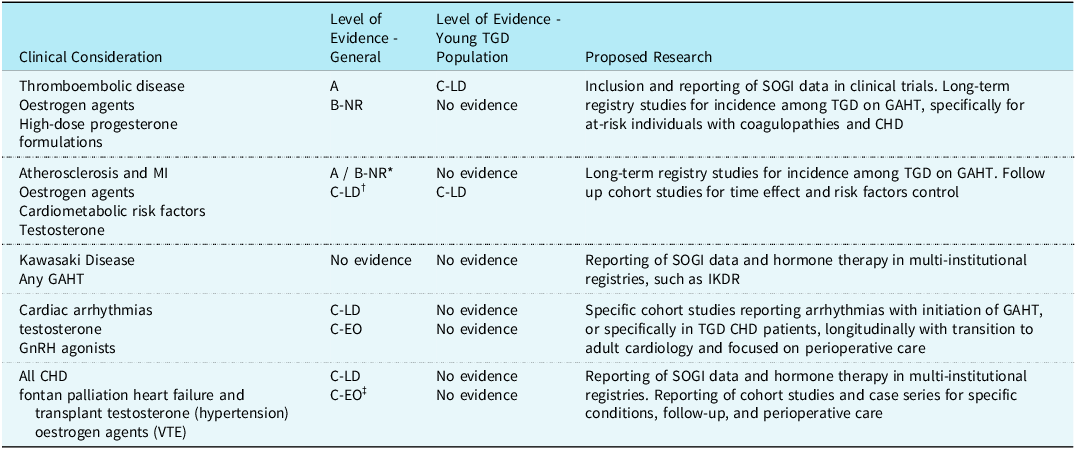
The current authors find it overwhelming how lacking the data on hormone therapy is in the young population, specifically missing prospective data in adolescents and young adults with CHD. In Table 3, we summarise specific knowledge gaps between evidence of cardiovascular implications of hormone therapy in the general population versus young transgender and gender diverse individuals. The gaps call for research initiatives including: 1. Standardised inclusion and reporting of transgender and gender diverse individuals in clinical trials and registry studies by researchers, editors, and funding bodies, to increase the level of evidence on common cardiovascular morbidities among transgender populations; 2. Establishing a multicentre data registry that prospectively follows transgender youth with CHD (or other paediatric cardiac diagnoses) as they transition to adult CHD care, to achieve sufficient power to identify specific consideration in this at-risk population; 3. Specific longitudinal studies on cardiovascular disease in young transgender population initiating gender-affirming hormone therapy, including observational studies and pharmacological trials for drug-drug interactions with cardiovascular medications (anticoagulants, antihypertensives, and dyslipidemia medications or transplant immunosuppression and antimicrobials); 4. Mixed-method evaluation of mental health outcomes for depression, substance use, and access to inclusive medical care and cardiac rehabilitation programmes, recognising that discrimination and minority stress experienced by transgender individuals may primarily lead to poor cardiovascular outcomes.
Current knowledge gaps in gender care and cardiovascular considerations.

Suggested knowledge gaps and necessary future research suggested. This list is not exhaustive on knowledge and research needs. TGD = transgender and gender diverse; SOGI = sexual orientation and gender identity; CHD = congenital heart disease; GAHT = gender-affirming hormone therapy; IKDR = international Kawasaki disease registry; VTE = venous thromboembolism.
*Evidence level A in adult cisgender women; level B-NR in adult transgender women.
†Evidence both in cisgender and transgender men for hypertension and dyslipidemia.
‡Evidence for congenital heart disease population specifically.
When initiating gender-affirming hormone therapy, adolescent and young adult patients should be counselled on potential cardiovascular complications and advised on risk reduction for acquired heart disease. Specific considerations for patients with significant preexisting congenital or acquired heart disease should be reviewed with the patients when choosing among available treatment options. Given the life-saving health benefits of gender-affirming care, we suggest that cardiovascular disease should not be a barrier, but that a multidisciplinary approach to care is taken. Shared decision making in a direct and unbiased manner, that is, guided by patient goals and assessed individualised risk, should be implored when supporting transgender and gender diverse patients with gender-affirming care along with psychosocial evaluation of social stressors and access to care.
Supplementary material
The supplementary material for this article can be found at https://doi.org/10.1017/S1047951125101571
Competing interests
None.