Introduction
The lichen flora of the Russian Far East has been investigated for more than a century (Brummitt Reference Brummitt2001). In particular, Primorskiy Krai, the most south-eastern region of Russia, is comparatively well studied (Skirina & Moiseyevskaya Reference Skirina and Moiseyevskaya2004 and references therein). However, large areas and many lichen genera remain largely unexplored. One genus we know little about in this region is Bacidia. Previous reports of Bacidia from this area can be found in a number of lichen checklists and papers (Brotherus et al. Reference Brotherus, Okamura and Zahlbruckner1936; Skirina Reference Skirina1995, Reference Skirina2015; Tchabanenko Reference Tchabanenko2002; Galanina Reference Galanina2008; Kuznetsova et al. Reference Kuznetsova, Motiejūnaitė, Galanina and Yakovchenko2013).
Historically, Bacidia included crustose lichens with a chlorococcoid photobiont and biatorine apothecia producing ascospores that have at least three septa (Zahlbruckner Reference Zahlbruckner1921–1940). During the second half of the 20th century, Bacidia sensu Zahlbruckner was partially split up and numerous species were transferred to other taxa, resulting in the recognition of more than 20 genera (e.g. Santesson Reference Santesson1952; Vězda Reference Vězda1978, Reference Vězda1986, Reference Vězda1991; Hafellner Reference Hafellner1984; Lücking Reference Lücking1992; Sérusiaux Reference Sérusiaux1993; Ekman Reference Ekman1996).
The first phylogenetic study (Ekman Reference Ekman2001) indicated that many species referred to as Bacidia, in particular those with blue-green pigmentation in the epithecium and/or with fusiform or bacilliform spores, were more closely related to Toninia s.l. Bacidia in the strict sense is consequently characterized by acicular spores and a well-developed, prosoplectenchymatic proper exciple composed of radiating, abundantly furcate and rarely anastomosed hyphae with heavily gelatinized cell walls and cell lumina that become compressed and narrower with age. Since this first phylogenetic study, a limited set of Bacidia s.s. species have been investigated further (Andersen & Ekman Reference Andersen and Ekman2005; James et al. Reference James, Kauff, Schoch, Matheny, Hofstetter, Cox, Celio, Gueidan, Fraker and Miadlikowska2006; Reese Næsborg et al. Reference Reese Næsborg, Ekman and Tibell2007; Jeon et al. Reference Jeon, Lökös, Han, Ryu, Kim, Koh and Hur2009; Schmull et al. Reference Schmull, Miadlikowska, Pelzer, Stocker-Wörgötter, Hofstetter, Fraker, Hodkinson, Reeb, Kukwa and Lumbsch2011; Sérusiaux et al. Reference Sérusiaux, van den Boom, Brand, Coppins and Magain2012; Miadlikowska et al. Reference Miadlikowska, Kauff, Högnabba, Oliver, Molnár, Fraker, Gaya, Hafellner, Hofstetter and Gueidan2014; Mark et al. Reference Mark, Cornejo, Keller, Flück and Scheidegger2016; Lendemer et al. Reference Lendemer, Harris and Ladd2016).
We present here a taxonomic study of Bacidia s.s. using morphological and molecular data and focusing on material from the Russian Far East. In this area, members of the genus are abundant in habitats that have high humidity and moderate insolation. These include open forests, forest edges, swamps, river banks and valleys, as well as hill and mountain slopes close to the sea or near lakes or swamps. The aim of the present study was to clarify species boundaries in members of Bacidia s.s. from the Russian Far East.
Material and Methods
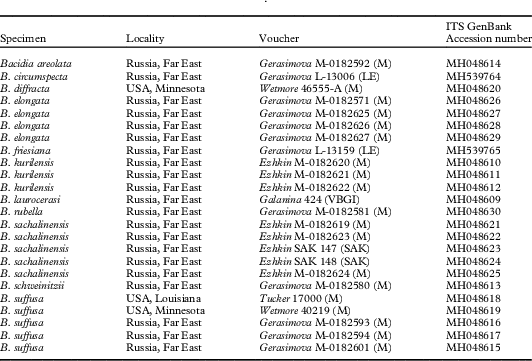
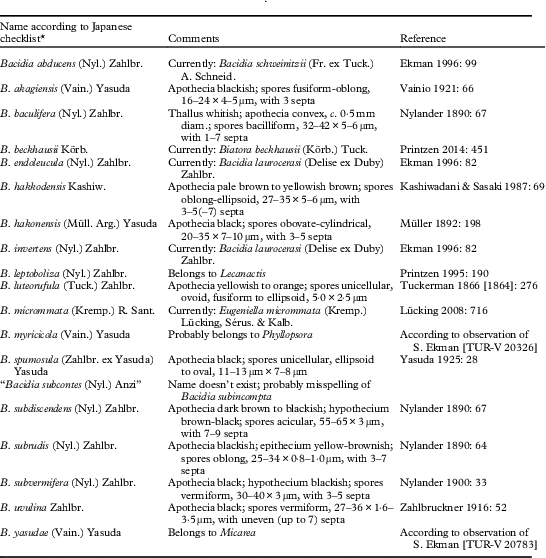
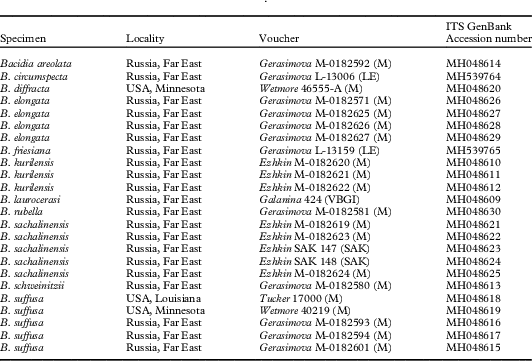
The material for this study primarily consisted of 83 fresh collections of Bacidia gathered in the field by the authors in the southern part of the Russian Far East (Primorskiy and Khabarovskiy Krai), as well as on Sakhalin and the Kurile Islands, from 2013 to 2015. All material was collected in old forest communities ranging from about sea level up to 1350m. The forests were mainly in floodplains and were mixed conifer-broadleaf and spruce-fir forests in river valleys which were open with a high humidity. Herbarium material from the Pacific Institute of Geography (PIG, without acronym) and the Botanical Garden-Institute of FEB RAS (VBGI) was also studied. In order to confirm the taxonomic position of Bacidia suffusa (Fr.) A. Schneid. from the Russian Far East and verify the status of a specimen of that species from GenBank (AF282091), two additional specimens of B. suffusa and one specimen of B. diffracta S. Ekman that had been collected in North America were studied and sequenced. The type material of all species present in this study was analyzed. Voucher specimens were deposited in the herbaria of the Botanische Staatssammlung München (M) and Komarov Botanical Institute RAS (LE). Detailed information of the newly obtained sequences together with their respective voucher information and GenBank Accession numbers are given in Table 1. GenBank Accession numbers additionally included in the phylogenetic analyses are given in Supplementary Table S1 (available online). Voucher information for all investigated specimens are given in Supplementary Table S2 (available online). Localities and herbarium numbers for all specimens investigated in the course of this study are given in the Supplementary Material (available online). As Japan is geographically close, we included species of Bacidia recorded in checklists of the lichens of Japan (Kashiwadani & Inoue Reference Kashiwadani and Inoue1993; Inoue Reference Inoue1994; Harada et al. Reference Harada, Okamoto and Yoshimura2004; see Table 2). Bacidia arceutina (Ach.) Arnold, B. laurocerasi (Delise ex Duby) Zahlbr., B. polychroa (Th. Fr.) Körb., B. rosella (Pers.) De Not., B. rubella (Hoffm.) A. Massal., B. schweinitzii (Fr.) A. Schneid. and B. subincompta (Nyl.) Arnold have been recorded before and not specifically from Japan and are therefore not included in Table 2.
Specimens used in the phylogenetic study of Bacidia together with their voucher information and GenBank Accession numbers
Bacidia species from Japan studied in this research for comparison with the newly described species from the Russian Far East
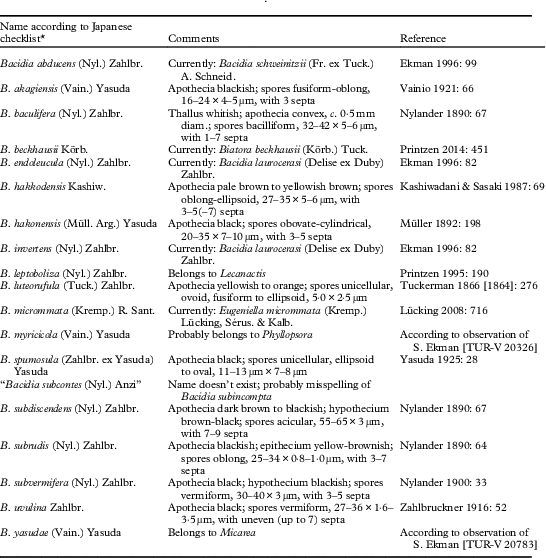
*Kashiwadani & Inoue 1993; Inoue 1993; Harada et al. 2004.
Morphology
All specimens were examined using standard microscopic techniques following Ekman (Reference Ekman1996). Microscopic observations were made using light microscopes and a Zeiss Axioplan microscope equipped with differential interference contrast. Micrographs of cross-sections were taken on a Zeiss Axio Imager microscope with an attached AxioCam MRc5 camera and processed with the Zeiss ZEN2012 image program. Images of the external features of the species were obtained from a Zeiss Stemi-2000 CS microscope with an attached AxioCam MRc5 camera and processed with the Zeiss AxioVision image program. The photomicrographs with detail of exciple structures in Fig. 4C were taken with a Zeiss AxioScope A1 compound microscope equipped with a Canon 60D digital camera. Spore and apothecium measurements are given as mean
 $$(\bar{x})$$
±1SD with outliers in parentheses. All other measurements are given as minimum, mean
$$(\bar{x})$$
and maximum values. In those cases where not enough measurements were available for the calculation of a mean value, only minimum and maximum values are given.
DNA extraction, PCR amplification and DNA sequencing
DNA extraction was carried out using PCR Template Preparation Kit (Roche, Mannheim, Germany) following the manufacturer’s instructions. 5–8 apothecia were used from fresh material not older than 3 years and thallus fragments were removed in order to minimize the risk of contamination.
PCR amplifications for the ITS1, ITS2 and 5.8S regions were performed using 5 µl 5× Green GoTaq® Flexi buffer, 1·75 µl MgCl2, 2·5 µl dNTPs, 1·25 µl of each primer, 0·1 µl Taq polymerase and 1–5 µl of DNA solution in 25 µl volume. Cycling conditions included initial denaturation at 95 °C for 2 min, 5 cycles of 95 °C for 45 s, 54 °C for 60 s and 72 °C for 60 s, 33 cycles of 95 °C for 45 s, 52 °C for 60 s and 72 °C for 60 s, with a final extension step at 72 °C for 7 min. We used the primers ITS1F (White et al. Reference White, Bruns, Lee and Taylor1990) and ITS4m as described in Beck & Mayr (Reference Beck and Mayr2012) or, for old herbarium specimens, primers ITS3 and ITS4 (White et al. Reference White, Bruns, Lee and Taylor1990).
All PCR products were run on an agarose gel, cut out under UV-light and purified with the PCR Clean-Up & Gel Extraction Kit (SLG, Gauting, Germany). Purified products were labelled with the BigDye Terminator v3.1 Kit (Applied Biosystems, Darmstadt, Germany). Cycle sequencing consisted of 30 cycles of 95 °C for 10 s, 50 °C for 15 s and 60 °C for 3 min, using the PCR primers individually. Post-sequencing clean-up was performed using gel filtration with Sephadex G-50 Superfine (GE Healthcare, Uppsala, Sweden) following the manufacturer’s protocol. Forward and reverse strand sequences were detected on an ABI 3730 48-capillary automatic sequencer (Applied Biosystems) and assembled using the program PhyDE (http://www.phyde.de/index.html).
Alignment and phylogenetic analyses
BLAST searches in GenBank were performed to detect and exclude accessory/lichenicolous fungi and potential contaminants. Alignments were carried out using standard settings in MUSCLE v.3.8.31 (Edgar Reference Edgar2004) as implemented in the program PhyDE and optimized by hand using the ITS2 secondary structures (see below) as a guide. Positions that possessed numerous indels and presented a nucleotide in less than 3% of the sequences as well as ambiguously aligned regions were excluded.
Two datasets were analyzed for this study. Using the first dataset, we aimed to ensure that the new sequences belonged to Bacidia s.s. and to examine the relationships of this genus within the broader context of the Ramalinaceae. This large dataset comprised 130 sequences that included: 1) the sequences of all representatives of former Bacidiaceae used in the publication by Ekman (Reference Ekman2001); 2) all other ITS sequences of Bacidia as well as Bacidina available from GenBank (Groner & LaGreca Reference Groner and LaGreca1997; James et al. Reference James, Kauff, Schoch, Matheny, Hofstetter, Cox, Celio, Gueidan, Fraker and Miadlikowska2006; Reese Næsborg et al. Reference Reese Næsborg, Ekman and Tibell2007; Jeon et al. Reference Jeon, Lökös, Han, Ryu, Kim, Koh and Hur2009; Schmull et al. Reference Schmull, Miadlikowska, Pelzer, Stocker-Wörgötter, Hofstetter, Fraker, Hodkinson, Reeb, Kukwa and Lumbsch2011; Czarnota & Guzow-Krzemińska Reference Czarnota and Guzow-Krzemińska2012; Sérusiaux et al. Reference Sérusiaux, van den Boom, Brand, Coppins and Magain2012; Miadlikowska et al. 2014; Lendemer et al. Reference Lendemer, Harris and Ladd2016; Mark et al. Reference Mark, Cornejo, Keller, Flück and Scheidegger2016); 3) the ITS sequences of Bacidia s.s. generated in this study. The second dataset was restricted to Bacidia s.s. sequences, based on the results of the first analysis. This allowed the use of a larger part of the alignment because it did not contain ambiguous parts.
The ITS nrDNA sequence dataset was subjected to maximum likelihood (ML) and Bayesian inference (BI) analyses. To select the nucleotide substitution model and parameters for the ML searches, a statistical selection of best-fit models was carried out in jModelTest 2.1.5 (Guindon & Gascuel Reference Guindon and Gascuel2003; Darriba et al. Reference Darriba, Taboada, Doallo and Posada2012). The optimal model was identical using either the corrected Akaike information criterion or the Bayesian information criterion (TIM2ef+I+G). The model provided estimations of equal nucleotide frequencies, a rate matrix with six different substitution types, assuming a heterogeneous rate of substitutions with a gamma distribution of variable sites (number of rate categories=4, shape parameter a=0·7160) and a proportion of invariable sites (pinvar) of 0·2781. Heuristic phylogenetic searches were conducted using 100 random addition sequence (RAS) replicates, tree bisection-reconnection branch swapping (TBR), saving all trees and collapsing branches with a maximum length equal to zero using PAUP* v4.0b10 (Swofford Reference Swofford2002). Due to the size of the dataset, the most likely phylogeny was calculated using PAUP* as this allows the use of a more extensive search option than for instance RAxML, which computes only an approximate log likelihood score of the alternative topology after subtree reinsertion (Stamatakis et al. Reference Stamatakis, Hoover and Rougemont2008). However, support values were calculated in independent runs using RAxML and MrBayes to allow better comparability with other studies. Support values using a bootstrap search in PAUP* are indicated on the respective branches of the phylogeny.
Further ML analysis was performed using RAxML v8.2.4 on both datasets using 1000 rapid bootstrap pseudo-replicates, following a GTRGAMMA model of molecular evolution (Stamatakis Reference Stamatakis2014). Bayesian inference was carried out using the Markov chain Monte Carlo method (MCMC) using MrBayes v3.2.6 (Ronquist et al. Reference Ronquist, Teslenko, van der Mark, Ayres, Darling, Höhna, Larget, Liu, Suchard and Huelsenbeck2012). As the model recommended by jModelTest (TIM2ef+I+G) is not available in MrBayes, the GTRGAMMA model was selected instead based on the recommendation of Huelsenbeck & Rannala (Reference Huelsenbeck and Rannala2004). Two parallel runs were performed (two cold chains) with a single tree saved every 100th generation for a total of 10 000 000 generations. As convergence was reached after 25% of the trees, the initial 25% was discarded as burn-in and the results summarized as a 50% majority-rule consensus tree.
The phylogenetic trees were visualized using FigTree v1.4.2 (Rambaut Reference Rambaut2009). Only clades that received bootstrap support ≥70% in ML and PP ≥0·95 in BI were considered highly supported.
ITS secondary structures
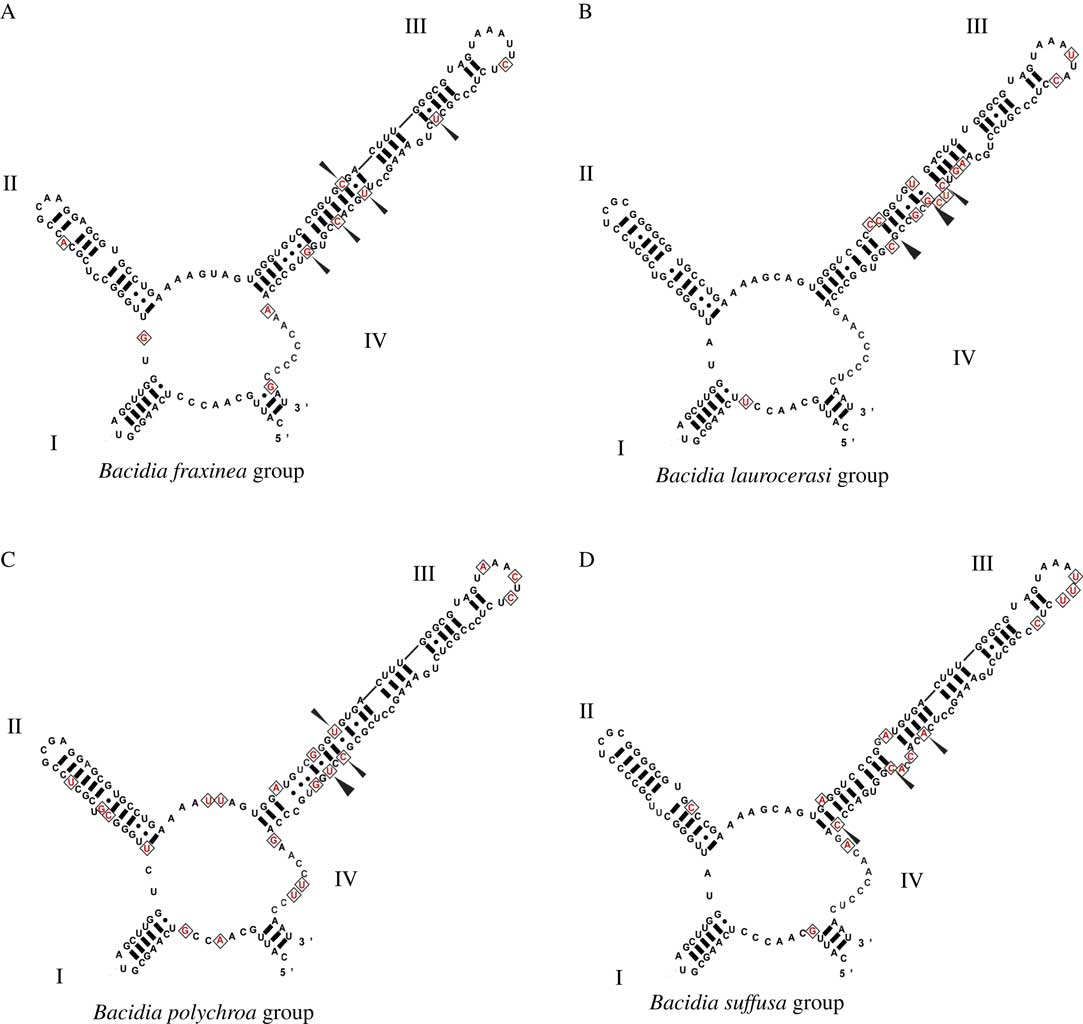
As additional evidence, we further analyzed ITS2 secondary structure, using compensatory base changes (CBCs) and hemi-CBCs in the structurally conserved regions of helix III (Coleman Reference Coleman2003). CBCs are mutations that occur in a primary RNA transcript, whereby both nucleotides paired in the secondary configuration of the ITS transcript mutate so that their bond is retained (e.g. G-C mutates to A-U). A hemi-CBC (hCBC) is the mutation of one of the two nucleotides while maintaining the nucleotide bond. Most likely ITS2 secondary structures of the RNA transcript were determined by delimiting the highly conserved start and end region of the first three helices. The structure of these sequence sections was deduced using the RNAfold web server (http://rna.tbi.univie.ac.at/cgi-bin/RNAfold.cgi), folding helices I, II, III and IV individually and therefore more reliably. In all cases we used the minimum free energy (MFE) structure obtained. The depictions of ITS2 secondary structure were made for morphologically close species of Bacidia s.s., corresponding to the species groups as indicated on the phylogenetic tree. Comparisons among sequences from each group are shown, using the entire ITS2 structure of one species per group as a “core” and indicating nucleotide substitutions on this core. The following sequences have been used as core: Bacidia rubella (GenBank, AF281087) for Bacidia fraxinea group, B. laurocerasi (AF282080), B. polychroa (AF282089), and B. suffusa (MH048616) for respective groups.
Results
Morphology
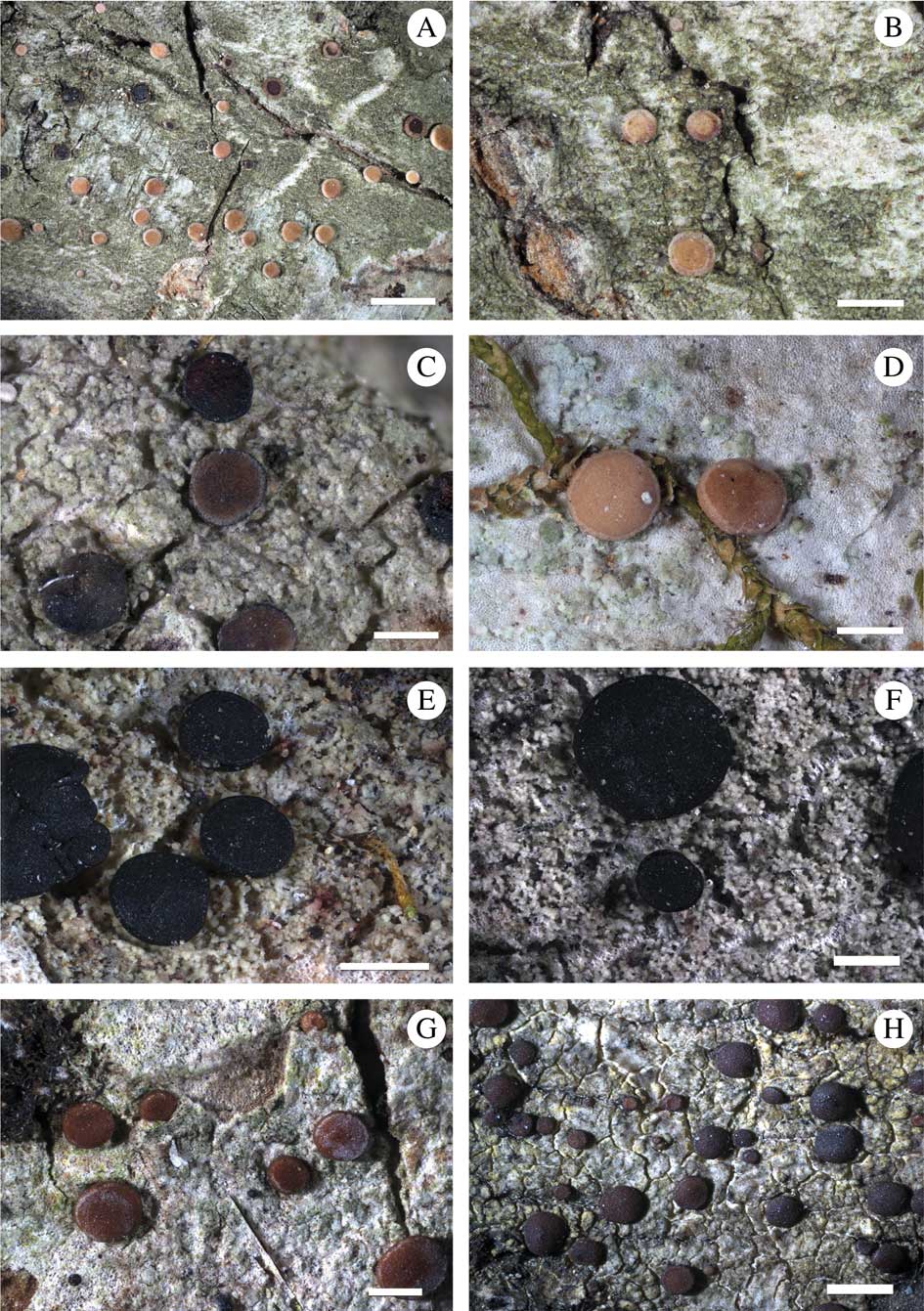
Ten species of Bacidia s.s. were distinguished based on morphological analysis, including the previously described Bacidia friesiana (Hepp) Körb., B. rubella (Hoffm.) A. Massal., B. laurocerasi (Delise ex Duby) Zahlbr., B. polychroa (Th. Fr.) Körb., B. schweinitzii (Fr.) A. Schneid. and B. suffusa (Fr.) A. Schneid. As no name was available for four morphologically distinct entities, B. areolata, B. elongata, B. kurilensis and B. sachalinensis are described as new. In addition, B. schweinitzii is reported from Russia for the first time.
The revision of all available herbarium collections (172) resulted in a new determination for some specimens. A specimen of B. arceutina (Ach.) Arnold, previously reported from a single locality in Kamchatka (Neshataeva et al. Reference Neshataeva, Chernyagina, Czernyadjeva, Himelbrant, Kuznetsova and Kirichenko2004), was identified as B. laurocerasi. Specimens from our own collections, initially described as B. fraxinea Lönnr., were finally determined to be B. elongata sp. nov. One herbarium specimen (PIG 28798), previously labelled as B. fraxinea and which was old with a damaged thallus, had several apothecia with only a few spores with uneven septa. We were unable to differentiate this species from the closely related B. rubella, consequently its identification is uncertain. The herbarium specimens of B. biatorina (Körb.) Vain. (e.g. Galanina Reference Galanina2008; Skirina Reference Skirina2015) were redetermined as B. schweinitzii, B. friesiana or as belonging to Bacidia s.l. Therefore, the occurrence of B. biatorina in the Russian Far East also remains questionable. The specimen of B. rosella (Pers.) De Not., previously reported from a single locality (Yakovchenko et al. Reference Yakovchenko, Galanina, Malashkina and Bakalin2013), is related to B. suffusa. In conclusion, there are four species, B. arceutina, B. biatorina, B. fraxinea and B. rosella, which should probably not be included in the list of Bacidia s.s. that occur in the Russian Far East.
Detailed morphological examination was carried out for previously sequenced specimens belonging to B. diffracta, B. polychroa and B. suffusa (GenBank AF282090, AF282089, AF282091) and these were compared with specimens from the Russian Far East.
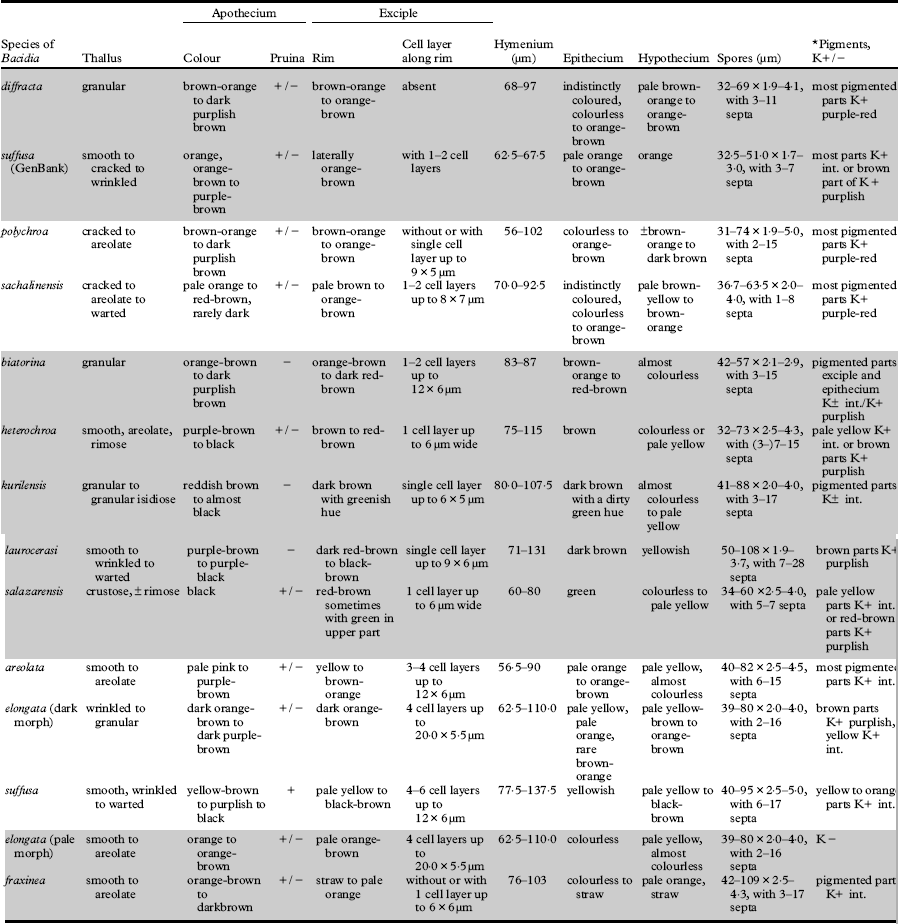
Based on morphological studies, it should be noted that the new species are characterized by variations in thallus structure and apothecium colour, which is characteristic of the whole genus (Ekman Reference Ekman1996). Features of Far Eastern species are summarized in Table 3 including, for comparison, all morphologically similar species.
Main diagnostic features of the Russian Far Eastern species of Bacidia s.s., including several morphologically close species for comparison. Morphologically similar groups are indicated by grey or white banding
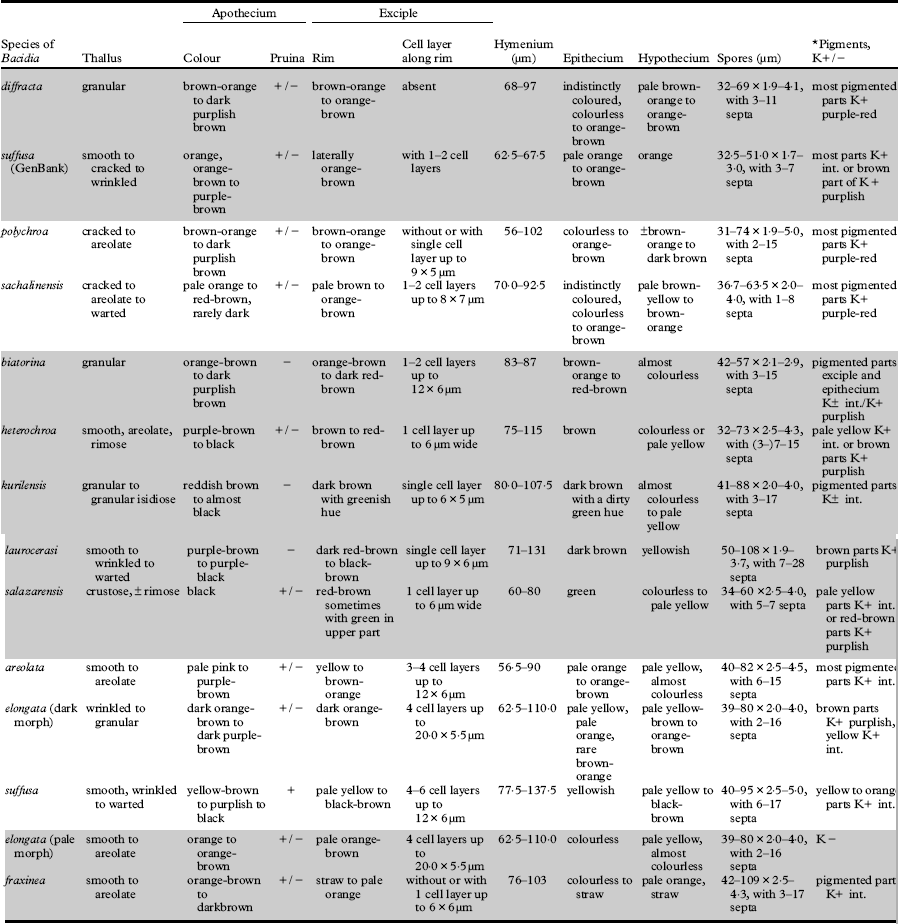
*int.=intensifying
Phylogeny
The first alignment of the larger dataset comprised 130 sequences and 485 characters. Tylothallia biformigera was selected as outgroup. The new specimens of Bacidia from the Russian Far East were shown to belong to Bacidia s.s. However, three specimens of Bacidia sp. from GenBank (KX098339, KX098340 and KX098341) were found to belong to the Bacidina group and were therefore not included in the subsequent analyses.
The second alignment of the reduced dataset contained 62 sequences (including 22 obtained for this study) and 481 characters, with Bacidia incompta, Biatora globulosa, B. hemipolia and Cliostomum griffithii as outgroups. This dataset contained 20 Operational Taxonomic Units (OTUs) of Bacidia s.s.
The ML and BI analyses recovered highly concordant topologies of the phylogenetic trees. Only the phylogeny resulting from the ML search in PAUP* is presented here as there were no contradictions in supported parts of the trees.
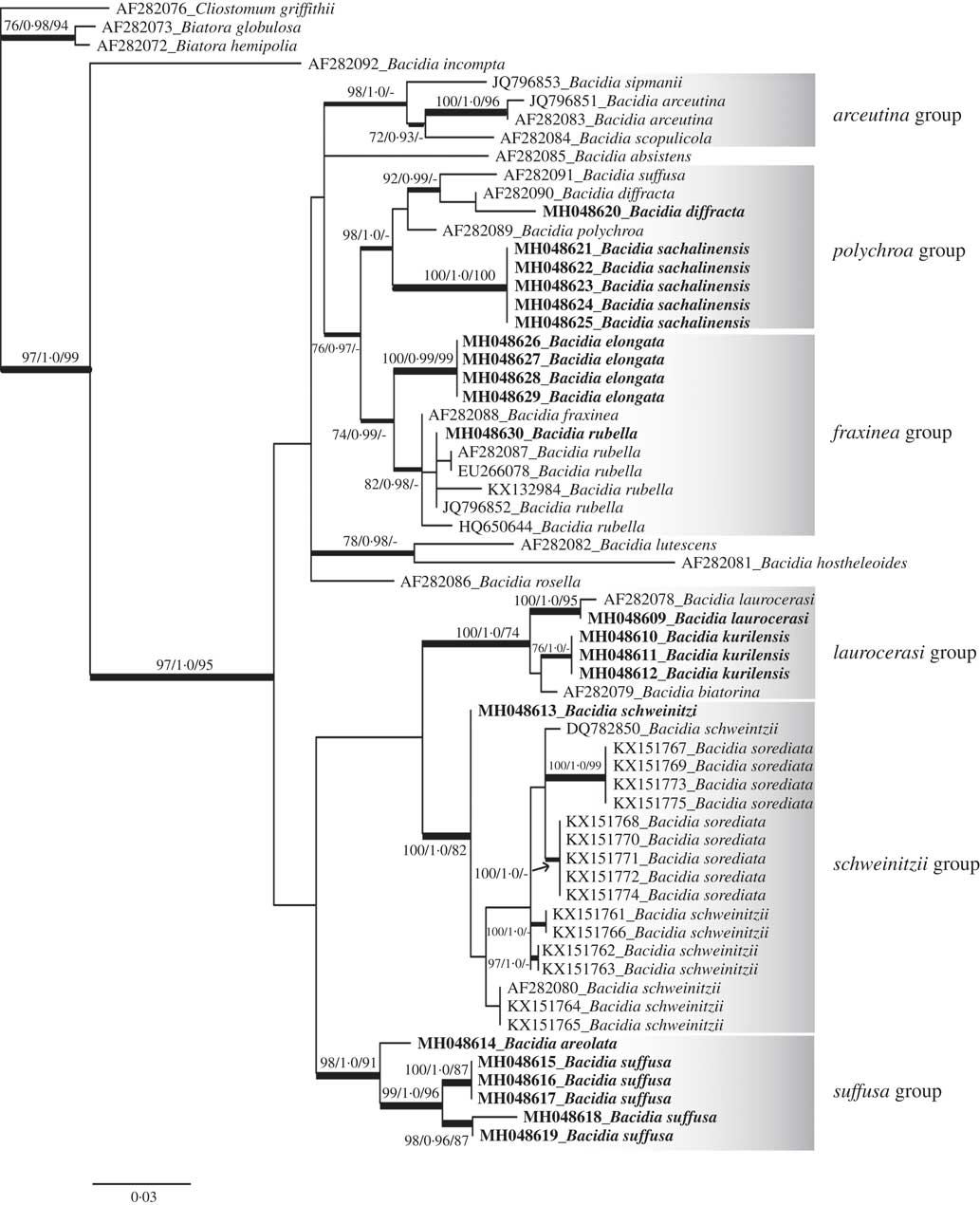
The backbone within Bacidia s.s. is poorly resolved; only species groups were recovered with significant support values but the relationships between these are unclear. As a result of the phylogenetic analyses, a number of well-supported clades can be recognized within the Bacidia s.s. clade (Fig. 1).
The most likely tree generated by phyologenetic analysis of ITS1 and ITS2 regions and 5.8S gene in PAUP* ML analysis and representing the phylogenetic relationships of Bacidia s.s. Bootstrap support ≥70% in RAxML analysis (first value), posterior probability ≥0·95 (second value) and ≥65% bootstrap support in ML analysis by PAUP* (third value) were considered as highly supported and denoted by very thick lines. Support values between 50 and 70% were considered as weakly supported and are indicated by lines of medium thickness. New sequences are in bold.
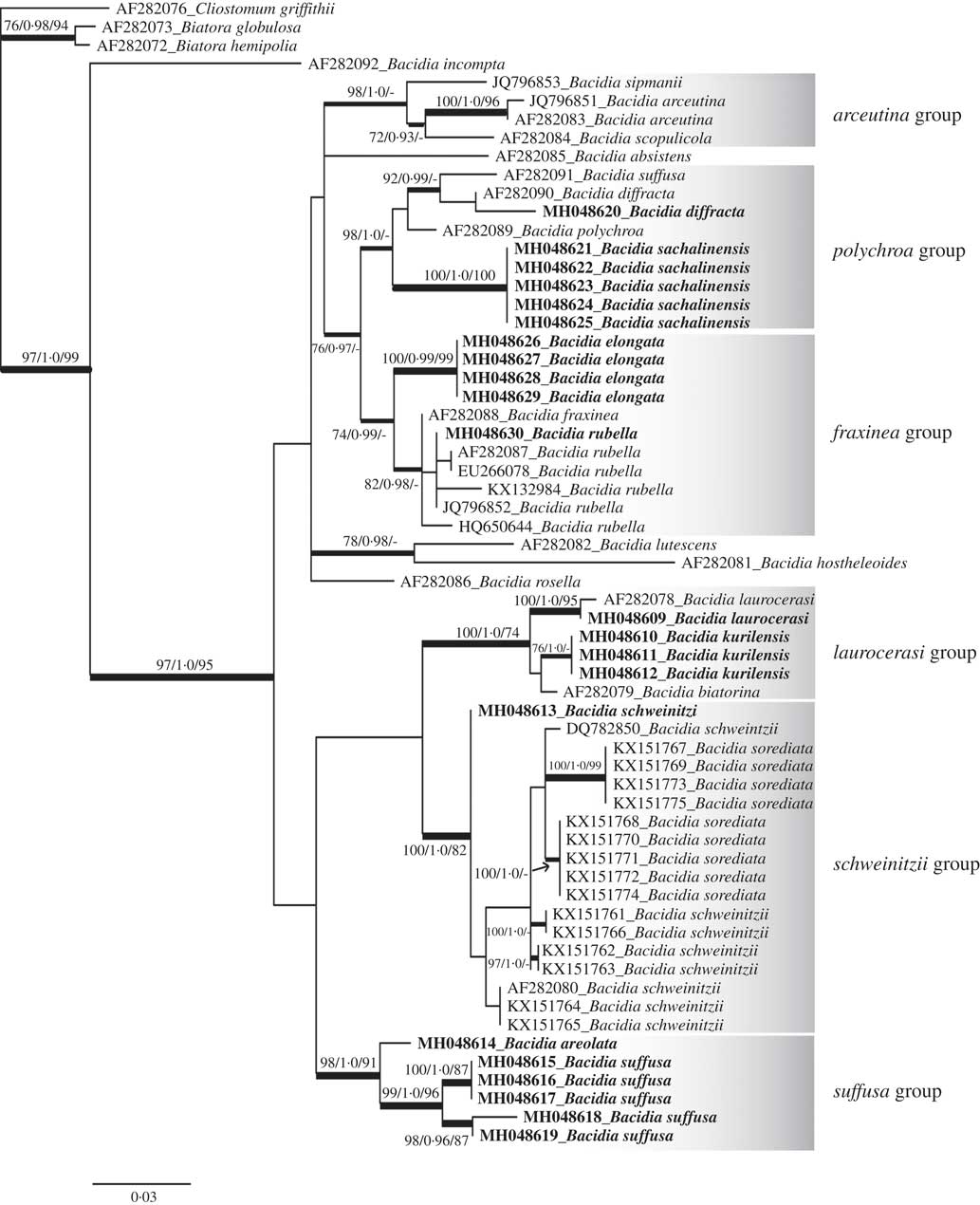
Bacidia polychroa, B. diffracta and B. sachalinensis belong to a highly supported polychroa group (ML/BI: 98/1·0) and split into two main clades, with B. sachalinensis as sister to the other species. Two sequences of B. diffracta specimens group together with GenBank sequences of B. suffusa from the USA (AF282091) in a supported clade (92/0·99). Given that B. sachalinensis is recovered as a strongly supported group, as well as its morphological differences, it is described here as a species new to science.
Sister to the polychroa group is a group including B. elongata, B. fraxinea and B. rubella (74/0·99). The last two form a clade (82/0·98), with the position of B. rubella remaining uncertain. In addition, as only one sequence of B. fraxinea was included in the analysis, we consider this group needs further work using a larger number of samples. Specimens of B. elongata sp. nov. form a monophyletic group with strong support (100/0·99).
Bacidia laurocerasi, B. biatorina and B. kurilensis form a strongly supported clade (100/1·0), the laurocerasi group (Fig. 1). Within this group, another strongly supported clade (100/1·0) includes B. laurocerasi sequences from the Russian Far East (MH048609) and North America (GenBank AF282078). A second clade within this group contains B. biatorina, and a third is composed of three sequences of B. kurilensis sp. nov. with high support (76/1·0). Bacidia biatorina was placed as sister to B. kurilensis in the heuristic search using PAUP*, but without support. In contrast, B. biatorina is sister to B. laurocerasi in RAxML and BI with strong support (95/1·0). In all analyses the relationships within the schweinitzii group are only weakly supported, require further investigation and are not discussed here.
Bacidia suffusa and B. areolata form a strongly supported group (98/1·0). Sequences of B. suffusa were split into two main lineages: Far Eastern populations (100/1·0) and those from North America (98/0·96). The sequence representing B. areolata sp. nov. was placed as sister to B. suffusa, forming a separate branch and described here as new to science.
There are sequences of several other species of Bacidia available which were included in the phylogeny but which were not found in the Russian Far East. An example is B. absistens (Nyl.) Arnold which is so far known from a single locality in European Russia (Gerasimova Reference Gerasimova2016). Bacidia lutescens Malme and B. hostheleoides (Nyl.) Zahlbr. belong to a well-supported clade with long branches and both of which are widely distributed in the Neotropics (Malme Reference Malme1935; Ekman Reference Ekman1996). Species of the highly supported arceutina group, including B. scopulicola (Nyl.) A.L. Sm. and B. sipmanii M. Brand et al., are also not present in the Russian Far East. As mentioned above, the occurrence of B. rosella in the Russian Far East also remains questionable.
ITS secondary structure
Differences in the ITS2 secondary structure support all main groups of Bacidia s.s. and the different lineages within the clades (Fig. 2), often involving CBCs and hemi-CBCs in the structurally conserved regions of helix III. By comparison, helices I, II and IV show only minor variation between groups and clades.
Differences in secondary structure of ITS2 among groups within Bacidia s.s. Variable nucleotides among species within the groups are marked with diamonds, CBCs and hemi-CBCs are indicated by broad and narrow arrows, respectively.
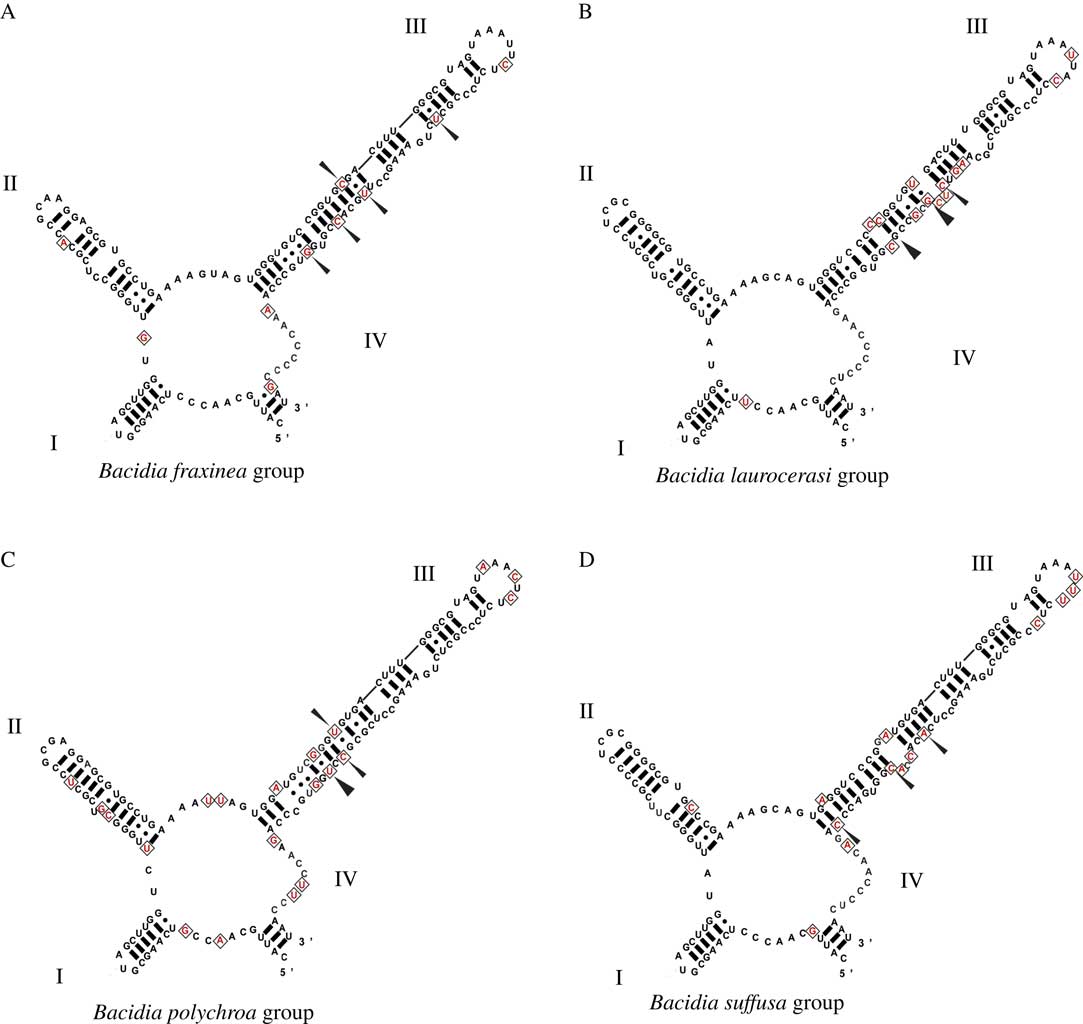
The four newly described species are supported by differences in their ITS2 secondary structure, mainly in hemi-CBCs. Thus, by comparison with the core (Bacidia suffusa, GenBank MH048616), B. areolata differs from B. suffusa and B. elongata by the presence of three hemi-CBCs, and from B. fraxinea by five hemi-CBCs (Fig. 2D & A). Bacidia sachalinensis differs from B. polychroa by one CBC, G–U instead of C–G (Fig. 2).
Bacidia kurilensis differs from B. laurocerasi by two CBCs and one hemi-CBC in the conserved part of helix III (U–G instead of C–U, and C–G instead of G–U, respectively; Fig. 2C). Bacidia biatorina differs from B. laurocerasi by one CBC, where a U–A pairing was observed instead of G–C in the latter.
The ITS2 secondary structures in the schweinitzii group correspond to the clades in the trees. The two subclades of B. sorediata differ by one hemi-CBC, but in the case of the first group (including KX151767 etc.) there is an unpaired A–G that would reveal the presence of one CBC. Several schweinitzii subgroups form sister clades, but without support, while ITS2 secondary structure supports this grouping, based on three hemi-CBCs in helix III. These ITS secondary structure subgroups are comprised of: AF282080, KX151764 & KX151765; KX151761 & KX151766; DQ782850, KX151762 & KX151763, and a separate lineage of MH048613 from the Russian Far East.
The comparisons within the lutescens-hostheleoides “group” reveal one CBC and three hemi-CBCs in helix III as compared to the other groups. This “group” is very diverse with high nucleotide variation in the other helices and many specimens have not yet been sequenced.
Discussion
Since the first phylogenetic study, more than 50 additional ITS sequences of Bacidia s.s. have been added to GenBank, including the sequences obtained in this study. This has enabled the phylogeny of Bacidia s.s. to be refined and has made possible a better interpretation in the wider context. Phylogenetic relationships within Bacidia s.s. agree with the previous results presented by Ekman (Reference Ekman2001), with the exception of the lutescens-hostheleoides “group” which is not considered to be a natural group. It has an uncertain position with weak support. Both taxa have sequences that have evolved a great variety of nucleotides, which was demonstrated particularly in ITS2 secondary structure (see Results). This indicates that the grouping in this part of the phylogeny most likely results from incomplete species sampling rather than from a natural relationship. Thus long-branch attraction artefacts may occur and further sampling in this group is required to draw reliable conclusions.
Our study indicates that much of the diversity within Bacidia s.s. still needs to be investigated. Of the ten species found in the Russian Far East, four were not known from geographically close areas and thus are new to science. Table 2 provides a comparison of Bacidia species from Japan with those newly described species from the Russian Far East. The additional study of ITS2 has distinguished and supported all main groups of the genus. Despite a number of well-supported clades being recognized, the backbone within Bacidia s.s. remains poorly resolved. To overcome this problem and the relationships among the groups, sequences from additional loci are needed for follow-up studies.
Bacidia polychroa group
All species within the polychroa group share the K+ purplish/violet reaction in cross-sections of apothecia. The morphology of B. polychroa was first examined in a broad sense, including “typical” B. polychroa, granular B. diffracta, the specimen from GenBank first identified as B. suffusa (AF282091), and specimens from the Russian Far East initially identified as “Bacidia polychroa sp.” The European specimen of B. polychroa from GenBank (AF282089), which was placed as a sister to B. diffracta (Fig. 1), was a typical morph and consequently corresponds to the type of B. polychroa. The B. polychroa typical morph is characterized by a wrinkled to warted thallus of scattered or contiguous areoles that become finally granular. It has orange-brown to dark red-brown apothecia with a distinct orange-brown hypothecium which is darker than the exciple below. Bacidia sachalinensis has a mainly cracked to areolate thallus and lighter orange to orange-brown apothecia which is also characteristic of the North American morph of B. polychroa (see Table 3). The separation of B. sachalinensis from B. polychroa is also supported by hemi-CBCs in the ITS2 secondary structure and a low similarity of the sequences (94%).
Two species belonging to B. diffracta and a misidentified specimen of B. suffusa from North America (AF282091) present two distinct morphotypes. The specimen previously referred to B. suffusa is probably a separate species which is more closely related to B. diffracta. However, it represents an intermediate form between B. diffracta and B. polychroa and is characterized by a smooth, partly granular thallus and orange-brown to purplish brown apothecia as well as the typical K+ violet reaction (see Table 3). This could mean that either the European and North American specimens of B. polychroa are different species or simply that the lineage sorting is not complete between B. diffracta and B. polychroa. Both representatives of the granular forms of B. diffracta, AF282090 and MH048620, are similar to one another. The sequences reveal differences between them but, as only one specimen of each has been analyzed, they are treated here as a single species.
Bacidia sachalinensis exhibits substantial variation in thallus structure and apothecial colour, even in the same specimen, and this is also typical for both B. diffracta and B. polychroa. To study whether B. polychroa from the Far East was close to B. polychroa in a strict sense, we obtained several additional sequences from Far Eastern specimens, using as much variation in thallus and apothecial structure as possible with the intention of using these characters to delimit species. Despite this variation, all specimens examined in the phylogenetic analyses were found to belong to B. polychroa s.s. Only a single European specimen of B. polychroa (Sweden) and material from Sakhalin were included in the current analyses. Further study is required using collections from other parts of Europe, the Far East and North America to reveal the heterogeneity of this group.
Bacidia fraxinea group
Bacidia fraxinea and B. rubella represent two morphologically well-distinguished species, differing mainly in thallus structure (Ekman & Nordin Reference Ekman and Nordin1993). Our dataset is not yet sufficient to make conclusions about the relationship between these morphospecies. Currently there is not enough evidence to challenge the recognition of B. rubella and B. fraxinea as distinct species because only one sequence of B. fraxinea is available. Further work is necessary here, so we recommend retaining the morphologically differentiated species.
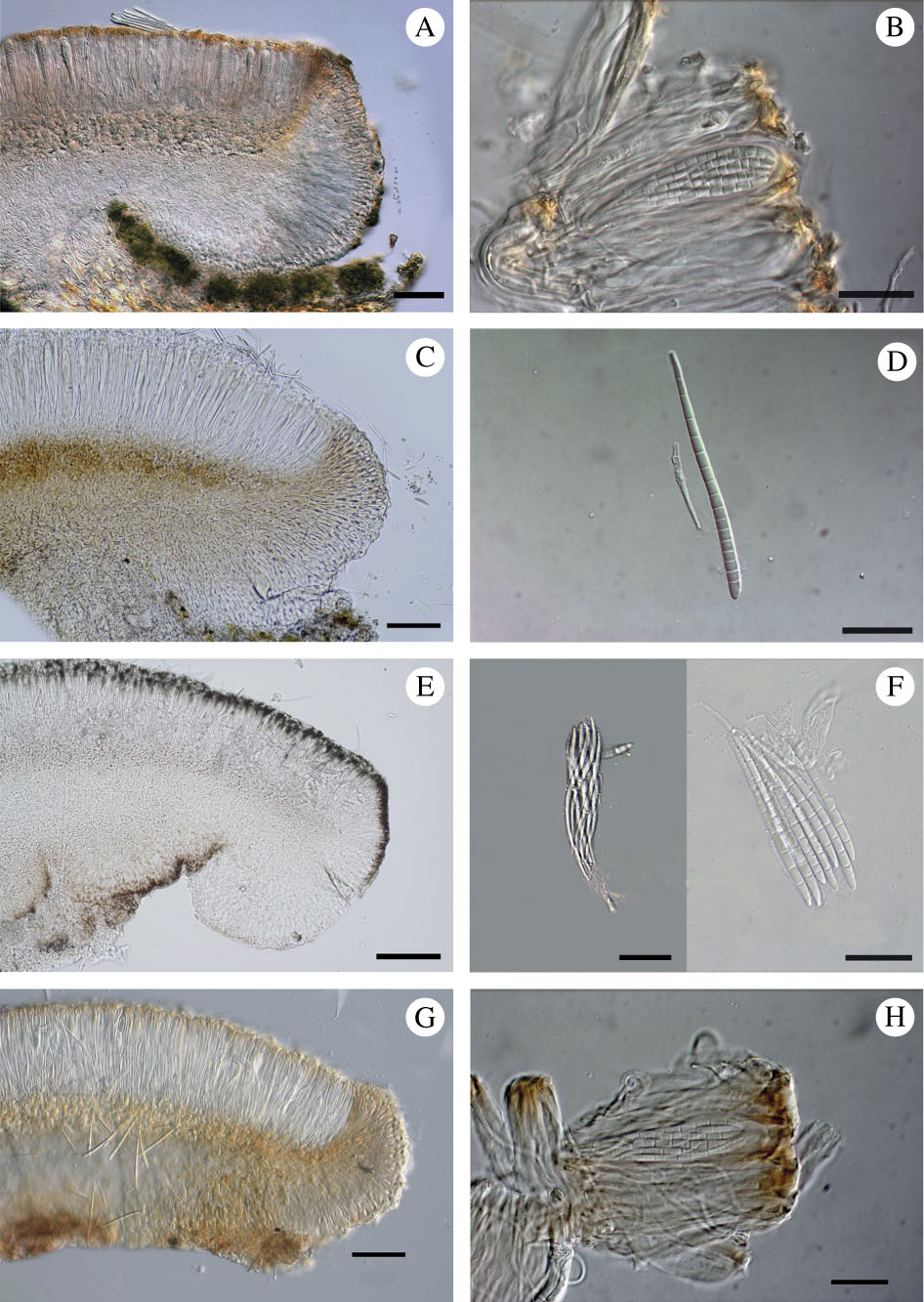
Bacidia elongata represents a morphologically discrete, monophyletic entity, distinct from B. fraxinea mainly in its exciple structure. Consequently, it is here described as a new species. It falls close to the fraxinea group but the zone of enlarged cells (Fig. 3C) is characteristic for B. elongata and is rather exceptional. There are several species of Bacidia with a zone of enlarged cells such as B. russeola but it is closely related to B. laurocerasi (laurocerasi group) and B. heterochroa. We suggest that this zone of enlarged cells is a character which has evolved more than once and B. elongata is the first example known in the fraxinea group. These morphological differences are also supported by the low similarity of sequences (93–95%) and hemi-CBCs in the ITS2 secondary structure.
New species of Bacidia from the Russian Far East. A & B, Bacidia areolata, holotype (M-0182592). C, B. elongata, dark morph, Primorskiy Krai (M-0182625). D, B. elongata, light morph, Khabarovskiy Krai, holotype (M-0182571). E & F, B. kurilensis, Kurile Island, holotype (M-0182620). G & H, B. sachalinensis, Sakhalin, holotype (M-0182619); G, smooth to warted thallus with light apothecia; H, cracked thallus with dark apothecia. Scales: A–G=0·5 mm; H=1·0 mm. In colour online.
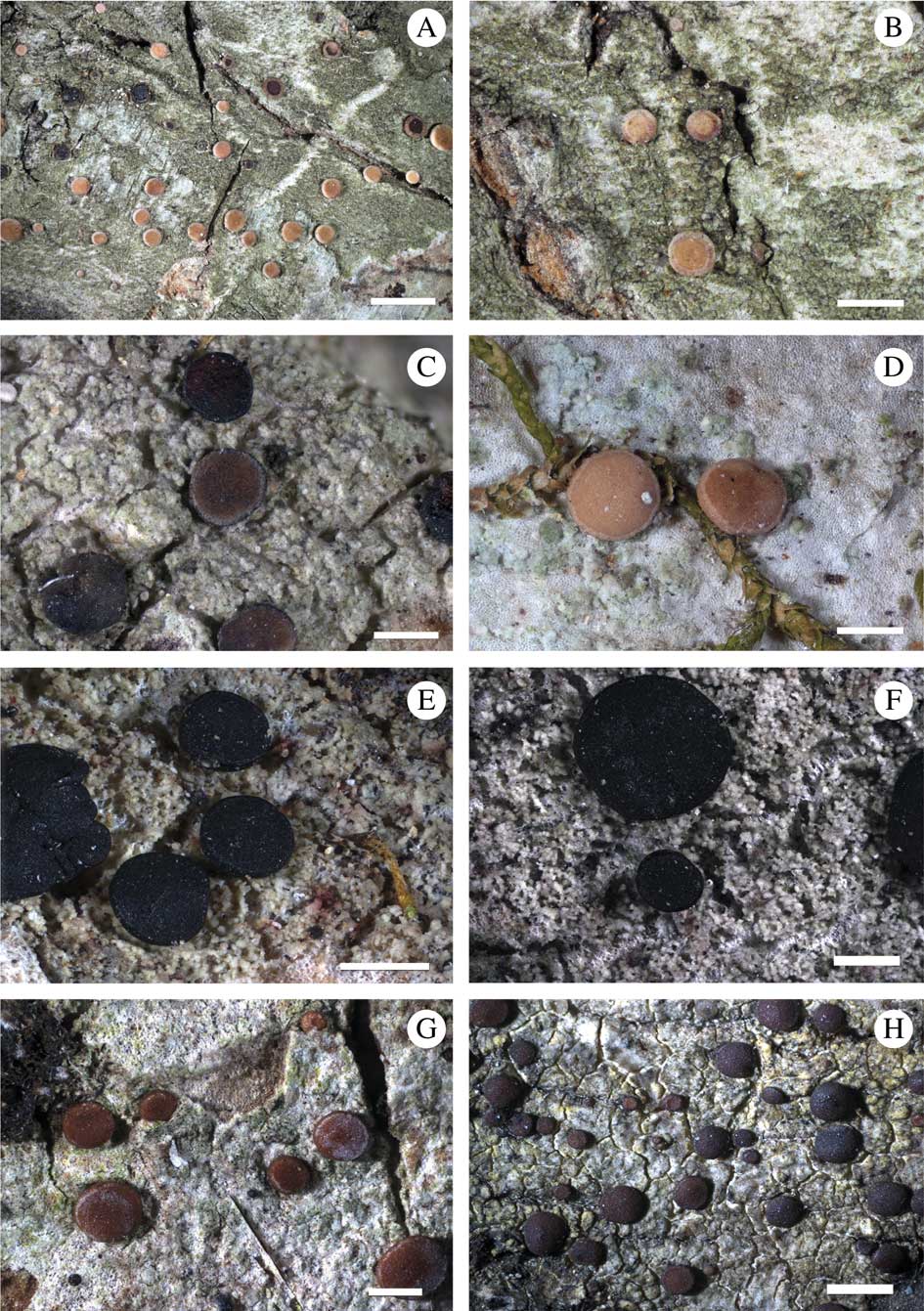
Bacidia laurocerasi group
Bacidia laurocerasi from the Russian Far East is placed as sister to the specimen for the USA on a zero-length branch, which confirms its identification (Fig. 1). Furthermore, morphological analysis has shown that B. laurocerasi from the Far East represents the “typical” form, corresponding to B. laurocerasi subsp. laurocerasi as detailed by Ekman (Reference Ekman1996). This form is characterized by a poorly defined smooth thallus, black apothecia and brown epihymenium and exciple edge. In contrast, the four sequences of the new species B. kurilensis, sister to B. laurocerasi, reveal a morphologically discrete entity, characterized by a granular thallus and a greenish pigment in the epihymenium and upper part of the exciple (for details see Taxonomy). These morphological differences are also supported by the low similarity of the sequences (95%) and hemi-CBCs in the ITS2 secondary structure. The green pigmentation in the upper part of the hymenium in B. kurilensis is similar to that of B. heterochroa and B. salazarensis B. de Lesd., which also has a granular thallus. Neither B. heterochroa nor B. salazarensis were represented in this phylogenetic study.
Bacidia schweinitzii group
This group comprises B. schweinitzii and B. sorediata Lendemer & R.C. Harris. Specimens of the schweinitzii group were recovered in multiple clades within both B. schweinitzii s.s. (i.e. esorediate populations) and the sorediate morphotype (Bacidia sorediata), in accordance with the findings of Lendemer et al. (Reference Lendemer, Harris and Ladd2016). The sequence from the Russian Far East specimen is placed basal to all other members of that group, but without significant support (59/0·93). In spite of this, according to Lendemer et al. (Reference Lendemer, Harris and Ladd2016), B. schweinitzii from the Far East belongs to B. schweinitzii s.s. It is characterized by a granular thallus, black apothecia, blue-green pigmentation in the epihymenium and a dark reddish brown hypothecium. The specimen from GenBank (AF282080) was also obtained from a typical B. schweinitzii with a granular thallus and black apothecia. The internal branches in the schweinitzii s.l. part of the tree do not have significant support for the most part, leaving any relationships within this group unclear.
Bacidia suffusa group
The final group of the tree combines two morphologically indistinct lineages of B. suffusa from the Russian Far East and from North America. Both have characters which correspond with those of type material and can be referred to as the typical morph (Table 3). They probably represent different populations or cryptic species which can be separated geographically. Owing to the lack of good morphological characters, they are treated here on the population level. Although B. areolata is represented by only one sequence, there is quite strong morphological evidence for considering it to be a discrete species. Moreover, this is also supported by a low similarity of the sequences (92%) and hemi-CBCs in the ITS2 secondary structure. There are three hemi-CBCs between B. suffusa (Fig 2D) and B. areolata (not shown), and these are located in the most conserved region of helix III (Coleman Reference Coleman2009).
Taxonomy
Bacidia areolata J. Gerasimova & A. Beck sp. nov.
MycoBank No.: MB 821184
Similar to Bacidia suffusa but distinguished mainly by an areolate thallus and lighter-coloured apothecia.
Type: Russia, Khabarovskiy Krai, Khabarovskiy Rayon, Bolshekhekhtsirskiy State Natural Reserve, 48°25'N, 134°77'E, 160 m, coniferous-broadleaf forest, on a terrace above the river, on bark of Acer tegmentosum, 6 September 2013, J. V. Gerasimova s. n. (M M-0182592—holotype; LE L-13014, UPS L-721140—isotypes). GenBank Accession no: MH048614
New species of Bacidia from the Russian Far East. A & B, Bacidia areolata: A, TS apothecium; B, ascus with spores. C & D, B. elongata: C, TS apothecium; D, spore. E & F, B. kurilensis: E, TS apothecium; F, ascus with spores. G & H, B. sachalinensis: G, TS apothecium; H, ascus with spores. Scales: A, C & G=50 µm; E=100 µm; B, D, F & H=20 µm. In colour online.
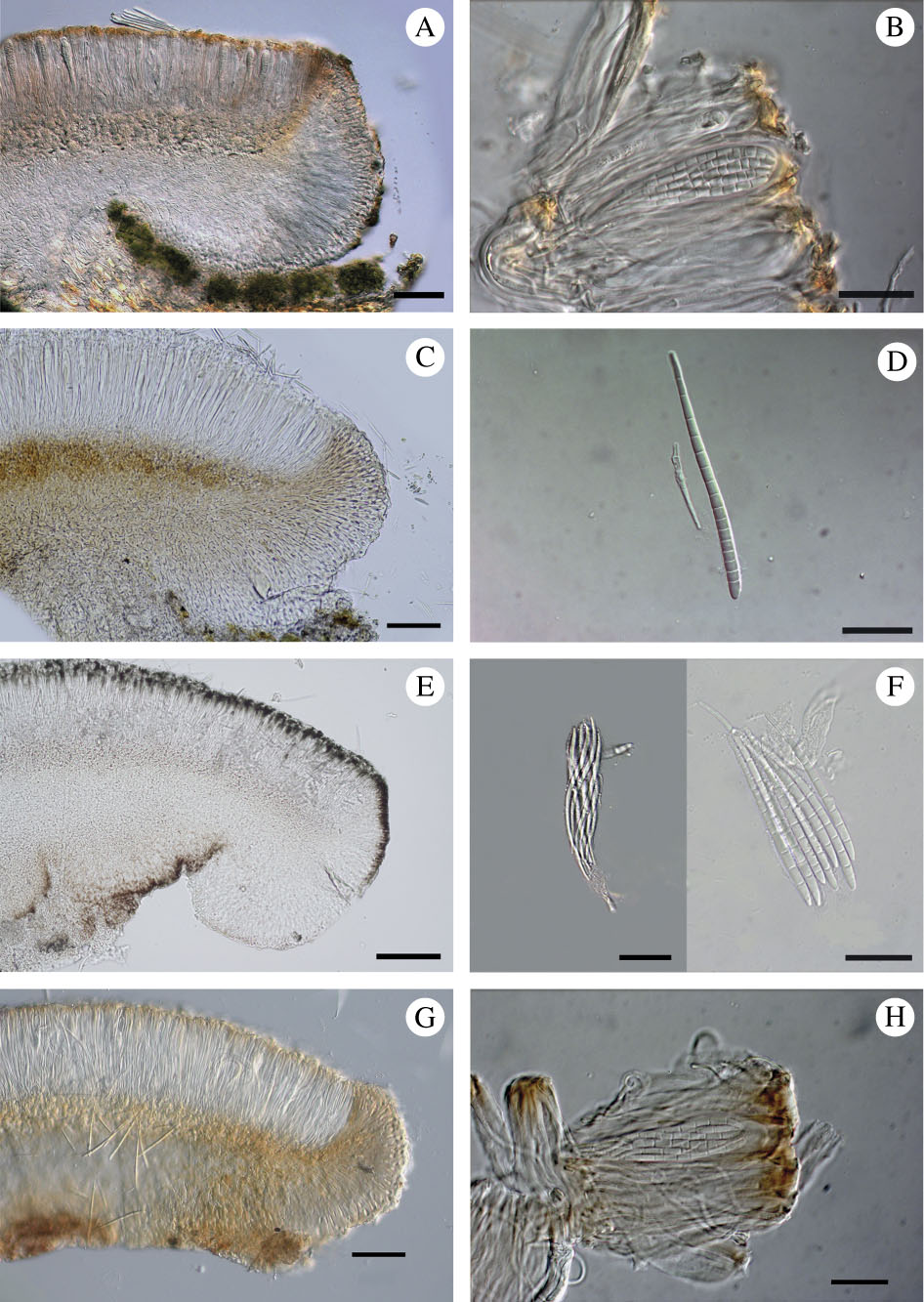
Thallus poorly defined, either thin, partly smooth to areolate, of scattered, discrete or contiguous, flattened or±convex areoles, or thick, continuous, wrinkled to warted; never with distinct granules; white, greyish green to deep green. Prothallus present between discrete areoles, white or rarely black along the border of the thallus. Photobiont chlorococcoid green alga, 6–15×8–18 μm.
Apothecia (0·3–)0·4–0·5–0·6(–0·9) mm, ±plane when young, remaining plane when mature or becoming slightly convex, epruinose, rarely with thin white pruina on the edge and disc of young and medium-aged apothecia. Disc pale pink, peach-coloured, pale beige to pale brown, rarely purple-brown when mature, often mottled. Margin pale pink, yellow-brown, raised above disc in young apothecia, later becoming±plane. Exciple laterally 49·0–60·4–80·0 µm wide, without crystals or sometimes with radiating clusters of crystals dissolving in N. Rim yellow, yellow-brown, brown-orange, often darker in the upper part than in the lower part, 3–4 cell layers thick along the edge, distinct zone of enlarged cells with lumina that are 7–12 µm long and 4–6 µm wide; inner part paler than or±concolorous with rim, downwards almost colourless to pale yellowish, K−. Hymenium 56·5–76·2–90·0 µm high, in lower part colourless; upper part pale orange to orange-brown, K+ yellow. Hypothecium pale yellow, almost colourless, K± yellow (reaction unclear). Paraphyses simple, thin, 1·0–1·5 µm wide in mid-hymenium,±clavate or only slightly swollen in the apices, without internal pigment. Asci cylindrical or clavate, 50–68 µm long, 7–13 µm wide, I/KI+ blue, with indistinct or sometimes tapering ocular chamber. Ascospores straight or slightly curved, (40·0–)47·2–57·0–66·9(–82·0) µm long, (2·50–)2·95–3·45–3·95(–4·50) µm wide (n=66), with (6–)7–9–11(–15) septa (n=43).
Pycnidia immersed in the thallus, black, 50–100 µm diam. Conidia curved, non-septate, 14–17×1·0 µm.
Etymology. The species is named with reference to the thallus structure.
Habitat and distribution. The species is known only from a single locality in Khabarovskiy Krai, in a coniferous-broadleaf forest with high humidity on a terrace above the river.
Comments. Bacidia areolata is very similar to B. suffusa but differs by its smooth, cracked to areolate thallus, lighter apothecia with less developed and often inconspicuous white pruina on the exciple edge, and shorter spores. It can also be separated by the thinner hymenium, which never exceeds 100 µm, but this feature alone is not enough to confirm the species. Bacidia suffusa from North America differs by having larger pycnidia, 100–125 µm diam., with filiform curved, non-septate conidia, 10–27×0·8 µm.
Additional specimens examined. Only type material seen.
Bacidia elongata J. Gerasimova & A. Beck sp. nov.
MycoBank No.: MB 821185
Similar to Bacidia fraxinea but differs in having a wide zone of enlarged cell lumina along the edge of the exciple.
Type: Russia, Khabarovskiy Krai, Khabarovskiy Rayon, Bolshekhekhtsirskiy State Natural Reserve, 48°25'N, 134°77'E, 160 m, coniferous-broadleaf forest, on a terrace above the river, on bark of Acer mono, 5 September 2013, J. V. Gerasimova s. n. (M M-0182571—holotype; M M-0182572, LE L-13007—isotypes). GenBank Accession no: MH048626
Thallus poorly defined, thin to rather thick, smooth to areolate, consisting of scattered or contiguous,±flattened or convex areoles; or granular, consisting of±globose, scattered or cluster-forming granules; rarely cracked. If the thallus forms a thick crust it is wrinkled to warted, consisting of layered irregularly-shaped warts; whitish when smooth, greyish, light green, greyish green, dark grey-green, with crystals in the upper cortex. Prothallus inconspicuous, sometimes present in between areoles, whitish. Photobiont chlorococcoid green alga, 6–15×8–18 µm.
Apothecia (0·25–)0·40–0·55–0·70(–0·95) mm, sessile,±plane. Young apothecia occasionally barrel-shaped, when mature±plane, to only slightly convex, rarely strongly convex or irregularly shaped. Disc almost white or pinkish in young apothecia, orange, orange-brown to dark orange-brown and dark purple-brown when mature. Margin concolourous or paler, light orange, rarely brown; persistent, often with thick layer of white pruina on the edge, especially in young apothecia. Exciple 49·0–79·5–110·0 µm wide, without crystals, but sometimes with clusters of crystals along the rim dissolving in N; colourless to orange-brown, with 4 layers of enlarged cells along the edge (1 layer of terminal cells±globose, up to 5·0×5·0–7·0 µm, other 3 layers±cylindrical with lumina that are 9–14(–20)×4·0–5·5 µm). Exciple rim laterally almost colourless, yellowish, pale yellow-brown to orange-brown, consisting of radially arranged hyphae. Middle exciple orange-brown to colourless, consisting of periclinally arranged thin hyphae; K+ yellow or brown, parts K+ purplish, N−. Hymenium 62·5–92·0–110·0 µm high, colourless in lower part; upper part diffusely coloured, colourless to pale yellow, pale orange, rarely brown-orange. Hypothecium almost colourless to pale yellow, pale yellow-brown to orange-brown, usually darker than exciple below. Paraphyses simple, sometimes fork-branched, some with unclear septa, thin, 1·0–1·5–1·8 µm wide in mid-hymenium,±clavate or only slightly swollen in the apices, 2·0–2·5–3·0 µm wide, without internal pigment. Asci cylindrical, 43–72–95 µm long, 7–11–19 µm wide, I/KI+ blue, ocular chamber inconspicuous. Ascospores acicular, straight or slightly curved, (39–)51–59–68(–80) µm long, (2·0–)2·5–3·0–3·5(–4·0) µm wide (n=93), with (2–)5–7–12(–16) septa (n=71).
Pycnidia not seen.
Etymology. The species is named with reference to the exciple structure, characterized by a wide zone of enlarged cell lumina along the edge.
Habitat and distribution. Corticolous species, occurring in mixed forests on the bark of hardwoods. Known phorophytes: Acer mono, Fraxinus mandshurica and Ulmus glabra.
Comments. There are some differences between specimens of this species collected in Khabarovskiy (holotype) and those from Primorskiy Krai. The type specimen from Khabarovskiy Krai differs partly in having apothecia mainly without pruina, hypothecium and exciple almost colourless or yellowish K± intensifying, and only the rim is coloured, brown-orange to orange-brown. By contrast, the specimens from Primorskiy Krai have a coloured hypothecium and exciple, and apothecia primarily with a thick layer of white pruina on the edge.
A pale specimen of B. elongata with a mostly smooth thallus appears to be close to B. fraxinea, but the wide zone of cells with enlarged lumina along the edge of the exciple clearly differentiates it from that species. In fact, the zone of cells with enlarged lumina in combination with its overall habit, places it morphologically close to B. suffusa, B. millegrana, B. campalea and related species. The dark morph of B. elongata is similar to B. suffusa but differs in lacking abundant clusters of crystals in the exciple, a distinct pigment in the exciple rim and having different cell size along the edge of the exciple.
Additional specimens examined. Russia: Primorskiy Krai: Chuguyevskiy Rayon, Verkhneussuriyskiy Statsionar, in the valley of the Sokolovka River, conifer-broadleaf forest, on bark of Ulmus glabra, 1973, L. N. Vasil’yeva s. n. (PIG 29682); Krasnoarmeiskiy Rayon, forest close to the Mel’nichnoye settlement, birch forest (Betula costata), on bark of Fraxinus mandshurica, 21 viii 2013, J. V. Gerasimova s. n. (M M-0182626, LE L-13010); birch forest (Betula costata), on bark of Ulmus glabra, 21 viii 2013, J. V. Gerasimova s. n. (M M-0182627, LE L-13011); mixed forest with a predominance of Pinus koraiensis, with undergrowth of Acer mono and Populus tremula, on bark of Acer mono, 22 viii 2013, J. V. Gerasimova s. n. (M M-0182628, LE L-13012); mixed forest with a predominance of Pinus koraiensis, with undergrowth of A. mono and Populus tremula, on bark of F. mandshurica, 22 viii 2013, J. V. Gerasimova s. n. (M M-0182625, LE L-13013); the Sikhote-Alin’ Nature Reserve, lowland forest, on bark of A. mono, 30 vi 1977, I. F. Skirina s. n. (PIG 28762); Partizanskiy Rayon, north-western slope of Mt. Lazovskaya, 43°39'12·9''N, 133°35'48·0″E, 1132 m, spruce-fir forest, on bark of Picea sp., 17 viii 2009, I. F. Skirina s. n. (PIG 26560); Mt. Ol’khovaya, 540 m, coniferous-broadleaf forest, on bark of Acer mandshuricum, 2010, I. F. Skirina s. n. (PIG 29468); valley of Postyshevka River, surroundings of the Krasnoarmeyskiy way station, 43°10'6·49''N, 133°00'9·35''E, 312 m, lowland forest, on bark of Chosenia sp., 26 viii 2012, I. F. Skirina, F. V. Skirin s. n. (PIG 32040).
Bacidia kurilensis J. Gerasimova, A. Ezhkin & A. Beck sp. nov.
MycoBank No.: MB 821186
Similar to Bacidia laurocerasi but differs by the presence of a green hue in the epihymenium and upper part of the excipulum edge, as well as by a distinctly granular thallus.
Type: Russia, Sakhalin Oblast, Kurile Islands, Kunashir Island, at the foot of the Mendeleev Volcano, 44°00'4·78''N, 145°42'26·85''E, 135 m, mixed conifer-broadleaf forest, on bark of Salix udensis, 26 July 2013, A. K. Ezhkin [B11/11.15] (M M-0182620—holotype; SAK 276—isotype).
GenBank Accession no: MH048610
Thallus poorly defined, thin to thick, partly smooth, granular to granular isidiose; composed of discrete or more often contiguous,±globose or extended, irregular granules, forming a loose assemblage, sometimes slightly flattened to subsquamulose; light green-grey, grey-green, in the herbarium becoming partly brownish; lacking crystals in the upper cortex. Prothallus epiphloeodal, often present between granules or bordering the thallus, white or greyish. Photobiont chlorococcoid green alga, 6–15 × 8–18 μm and frequently with associated, free-living cyanobacteria.
Apothecia (0·5–)0·7–0·9–1·2(–1·4) mm diam., sessile,±plane or very slightly convex, becoming moderately convex when mature, epruinose. Disc reddish brown, fuscous brown to almost black, rarely mottled and light brown in the middle. Margin concolorous with the disc, sometimes paler in the lower part of young apothecia or reddish brown. Exciple laterally 62·5–78·0–112·5 µm wide, without crystals. Rim dark brown in upper part with a greenish hue, lower down paler, brown to orange-brown; colourless in inner part and under hypothecium; brown pigment along the full length of the edge or rim with a single layer of enlarged cells up to 6×5 µm, without crystals, K+ intensifying. Hymenium 80·0–95·0–107·5 µm high, colourless in lower part, without crystals; upper part dark brown with a dirty green pigmentation, K+ intensifying. Hypothecium pale yellow, pale brown-yellow, almost colourless. Paraphyses simple, 1·5–2·0 µm in mid-hymenium, non-septate, slightly swollen at apices 2·5–4·0 µm, without internal pigment. Asci clavate to cylindrical, 54–70×9–11 mm; I/KI+ blue, ocular chamber inconspicuous. Ascospores acicular, straight or slightly curved, sometimes coiled in the ascus, (41–)55–65–74(–88) µm long (n=85), (2·00–)2·30–2·75–3·15(–4·00) µm wide, with (3–)5–9–13(–17) septa (n=85).
Pycnidia not seen.
Etymology. The epithet ‘kurilensis’ refers to the group of islands where the species was first collected.
Distribution and habitat. Known from Kunashir Island at the foot of the Mendeleev Volcano. It grows on the bark of Hydrangea paniculata, Kalopanax septemlobus and Salix udensis in a sparse conifer-broadleaf forest with Abies sachalinensis and Picea jezoensis in a small river valley. The habitat is associated with high humidity and moderate insolation.
Comments. Bacidia kurilensis is closely related to B. biatorina, B. heterochroa, B. laurocerasi and B. salazarensis. Bacidia biatorina has a similar thallus structure and dark apothecia but differs in the shorter spores (42–57 µm) and lack of green pigmentation in the epihymenium and edge of the exciple. Bacidia salazarensis is characterized by spores having a lower length-width ratio, a rimose thallus and a different distribution (the only Asian specimen of B. salazarensis seen was from southern China). Bacidia laurocerasi has a similar exciple structure and long multiseptate spores but differs by having a smooth to areolate thallus and lacking the green pigmentation in the exciple and epihymenium. Bacidia heterochroa differs mainly by lacking the granular thallus.
Additional specimens examined. Russia: Sakhalin: Sakhalin Oblast, Kunashir Island, at the foot of the Mendeleev Volcano, 44°00'4·78''N, 145°42'26·85''E, 135 m, mixed conifer-broadleaf forest, on bark of Kalopanax septemlobus, 2013, A. K. Ezhkin B7/11.15 (M M-0182621, LE, SAK 272); 44°00'4·78''N, 145°42'26·85''E, 135 m, mixed conifer-broadleaf forest, on bark of Hydrangea paniculata, 2013, A. K. Ezhkin B17/11.15 (M M-0182622, LE, SAK 282).
Bacidia sachalinensis J. Gerasimova, A. Ezhkin & A. Beck sp. nov.
MycoBank No.: MB 821187
Similar to Bacidia polychroa but differing in thallus and exciple structure, and in its shorter spores with fewer septa (40–58×2–3 µm with 1–8 septa).
Type: Russia, Sakhalin, Sakhalin Oblast, Yuzhno-Sakhalinsk, Rogatka River, 46°58'5·70''N, 142°47'49·03''E, 163 m, floodplain forest, on bark of Populus maximowiczii, 19 May 2014, A. K. Ezhkin [B8/12.14] (M M-0182619—holotype; LE L-12961, SAK 145—isotypes).
GenBank Accession no: MH048621
Thallus poorly defined, thin to thick, either discontinuous, smooth, indistinctly areolate, consisting of scattered, discrete to contiguous,±flattened small areoles, or continuous, warted to wrinkled, cracked; white, whitish green, pale grey to dirty grey, grey-green. Prothallus sometimes present, between areoles, white. Photobiont chlorococcoid green alga, 6–15 × 8–18 μm.
Apothecia (0·30–)0·45–0·65–0·85(–1·30) mm diam.,±plane when young, later becoming convex, epruinose or rarely with thin white pruina on the edge and the disc of young to medium-aged apothecia. Disc pale orange to intensely orange, brown-orange, yellow-brown, rusty brown to dark orange-brown and red-brown, rarely dark brown when mature. Margin concolorous with the disc or slightly darker, raised above disc in young apothecia, later level with the disc, and finally excluded in old and convex apothecia. Exciple laterally 46·0–63·8–75·0 µm wide, without crystals. Rim pale brown, yellow-brown, orange-brown, lower down almost colourless, along the margin edge with 2 layers of enlarged cells with lumina that are 2·3–3·8–7·8×2·6–5·4–7·7 µm (if±globose then up to 8×8 µm), without crystals; inner part (the same as rim) pale brown, yellow-brown, orange-brown, sometimes almost colourless below; K+ purplish. Hymenium 70·0–78·8–92·5 µm high, in lower part colourless, in upper part indistinct and diffusely coloured, pale yellow-brown, pale orange-brown to orange-brown, sometimes olive, yellowish, almost colourless. Hypothecium pale brown-yellow to yellow-brown, brown-orange, darker than exciple, K+ purplish. Paraphyses simple, thin, 1·60–1·85–2·10 µm wide in mid-hymenium,±clavate or only slightly swollen in the apices, 1·8–2·4–3·5 µm wide, without internal pigment. Asci cylindrical or clavate, 37·0–54·5–66·0×7·0–11·0–16·7 µm wide, I/KI+ blue, with tapering ocular chamber. Ascospores acicular, straight or slightly curved, sometimes coiled in ascus (36·7–)43·5–49·1–54·7(–63·5) µm long (2·00–)2·40–2·70–3·00(–4·25) µm wide (n=125), with (1–)3–5–7(–8) septa.
Etymology. The epithet ‘sachalinensis’ refers to the locality where the species was collected.
Distribution and habitat. Known only from a single locality on Sakhalin. It was collected on the bark of mature trees, in an old floodplain poplar-willow forest with high understorey in a very humid habitat with a fair amount of sunlight. Known phorophytes include Populus maximowiczii and Ulmus laciniata.
Comments. Bacidia sachalinensis has a very variable thallus structure and apothecial colour and this is also typical for North American and European specimens of B. polychroa. It is morphologically and anatomically very similar to B. polychroa but differs in having 1–2 layers of cells with enlarged lumina along the edge of the exciple, shorter spores with fewer septa (40–58×2–3 µm with 1–8 septa) and a usually smooth and poorly defined thallus with light coloured apothecia. North American specimens of B. polychroa have longer and wider spores with more septa (31–74×1·9–5·0 µm with 2–15 septa (Ekman Reference Ekman1996)) while European specimens have spores that are intermediate in size (33–75×2·0–4·5 µm with 3–16 septa (Foucard Reference Foucard2001; Llop Reference Llop2007; Coppins & Aptroot Reference Coppins and Aptroot2009; Wirth et al. Reference Wirth, Hauck and Schultz2013)). Bacidia diffracta differs mainly by having a granular thallus.
Additional specimens examined. Russia: Sakhalin: Sakhalin Oblast, Yuzhno-Sakhalinsk neighbourhood, Rogatka River, 46°58'4·789''N, 142°48'18·88''E, 161 m, floodplain forest, on bark of Populus maximowiczii, 2014, A. K. Ezhkin B7/12.14 (M M-0182621, LE L-12960, SAK 144); 46°58'5·707''N, 142°47'49·03''E, 163 m, floodplain forest, on bark of Populus maximowiczii, 2014, A. K. Ezhkin B9/12.14 (M M-0182623, LE L-12962, SAK 146); 46°58'2·118''N, 142°46'16·75''E, 108 m, floodplain forest, on bark of Populus maximowiczii, 2014, A. K. Ezhkin B10/12.14 (LE L-12963, SAK 147); 46°58'5·707''N, 142°47'49·03''E, 162 m, floodplain forest, on bark of Ulmus laciniata, 2014, A. K. Ezhkin B11/12.14 (LE L-12964, SAK 148); 46°58'4·789''N, 142°48'18·88''E, 161 m, floodplain forest, on bark of Populus maximowiczii, 2014, A. K. Ezhkin B12/12.14 (M M-0182624, LE L-12965, SAK 149).
Bacidia schweinitzii (Fr.) A. Schneid.
Bacidia schweinitzii occurs in the temperate forests of Canada around the Great Lakes and the Maritimes but it also occurs in eastern Asia and the eastern parts of the USA as far south as northern Florida (Ekman Reference Ekman1996; Lendemer et al. Reference Lendemer, Harris and Ladd2016). The species is reported here from Russia for the first time. It was collected in the temperate region of the southern part of the Russian Far East, in Primorskiy and Khabarovskiy Krai, and also on Kunashir Island.
This species has been found on the bark and trunks of a wide variety of conifer and deciduous trees, often among or on top of the branches colonized by mosses in dense coniferous-broadleaf and spruce-fir forests. At the Russian sites, the understorey often has ferns, bryophytes and bamboo present. Specimens were collected on several occasions on the bark of fallen, well-decomposed trees in shaded, very humid sites. Known phorophytes in the Russian Far East include: Abies nephrolepis, Acer ukurunduense, Betula costata, B. ermanii, Fraxinus mandshurica, Kalopanax septemlobus, Picea jezoensis, Picea sp., Pinus sp., Populus tremula, Prunus cerasus, Quercus mongolica, Quercus sp., Tilia amurensis and Ulmus laciniata.
Specimens examined. Russia: Khabarovskiy Krai: Khabarovskiy Rayon, Bolshekhekhtsirskiy Nature Reserve, 48°25'N, 134°77'E, 157 m, coniferous-broadleaf forest, on a terrace above the river, on bark of Picea jezoensis, 5 ix 2013, J. V. Gerasimova s. n. (LE L-13004); 48°22'N, 134°77'E, 865 m, spruce-fir forest with Betula ermanii, on bark of Picea jezoensis, 3 ix 2013, J. V. Gerasimova s. n. (M M-0182635, LE L-13003); 48°21'N, 134°79'E, 845 m, thick spruce forest, on bark of Picea jezoensis, 4 ix 2013, J. V. Gerasimova s. n. (M M-0182634, LE L-12999); 48°23'N, 134°77'E, 451 m, coniferous-broadleaf forest near the cordon, on bark of Fraxinus mandshurica, 2 ix 2013, J. V. Gerasimova s. n. (M M-0182580, M M-0182629, LE L-13001, L-12998); 48°22'N, 134°77'E, 820 m, spruce forest with Betula ermanii on the edge of drying zone, on bark of Picea jezoensis, 3 ix 2013, J. V. Gerasimova s. n. (M M-0182629, LE L-12998); ibid, J. V. Gerasimova s. n. (M M-0182630, LE L-13000); 48°22'N, 134°77'E, 865 m, spruce-fir forest with Betula ermanii, on bark of Abies nephrolepis, 3 ix 2013, J. V. Gerasimova s. n. (M M-0182631, LE, UPS L-721214); 48°23'N, 134°77'E, 451 m, coniferous-broadleaf forest near the cordon, on bark of Betula costata, 2 ix 2013, J. V. Gerasimova s. n. (LE L-13002); Kukanskiy Range, 50°55'N, 134°26'E, 715 m, spruce-larch green moss forest, on bark of Picea sp., 23 viii 2012, I. A. Galanina, L. S. Yakovchenko s. n. (VBGI). Primorskiy Krai: Chuguyevskiy Rayon, Mt. Snezhnaya, south-west slope, old spruce-fir forest, on top of moss twigs on bark of Picea sp., 5 viii 2003, I. F. Skirina, F. V. Skirin s. n. (PIG 15673); Verkhneussuriyskiy Statsionar, in the valley of the Sokolovka River, conifer-broadleaf forest, on bark of Acer ukurunduense, 1973, L. N. Vasil’yeva s. n. (PIG 13267); Verkhneussuriyskiy Statsionar, in the valley of the Sokolovka River, conifer-broadleaf forest, lowland forest, on bark of Prunus cerasus, 15 vii 1980, L. N. Vasil’yeva s. n. (PIG 13268); Khasanskiy Rayon, neighbourhood of Kravtsovka settlement, 42°38'N, 141°44'E, oak (Quercus mongolica) forest, on bark of Quercus mongolica, 6 v 2013, I. A. Galanina s. n. (VBGI); ibid., on bark of Q. mongolica, 6 v 2013, I. A. Galanina s. n. (VBGI); Ryazanovka River, oak forest, on bark of Quercus sp., 1985, I. F. Skirina s. n. (PIG 5653); neighbourhood of Peschanyy Peninsula, oak forest, on bark of Quercus sp., 17 viii 2008, I. F. Skirina s. n. (PIG 23811); Krasnoarmeiskiy Rayon, western slope of the Sikhote-Alin’, 46°13'N, 136°70'E, 1338 m, slope of the upper reaches of Valincu River, on bark of Picea jezoensis, 25 viii 2013, J. V. Gerasimova s. n. (M M-0182579, LE, UPS L-721217); 46°21'N, 136°66'E, 1010 m, thick spruce-fir forest with fir and mosses in the understorey, on bark of Abies nephrolepis, 29 viii 2013, J. V. Gerasimova s. n. (LE L-12997); 46°15'N, 136°70'E, 1180 m, spruce-fir forest with mosses in the understorey, on bark of Picea jezoensis, 26 viii 2013, J. V. Gerasimova s. n. (LE); 46°14'N, 136°70'E, 1275 m, thick spruce-fir forest, the southern slope, in the upper reaches of Valincu River, on bark of Picea jezoensis, 26 viii 2013, J. V. Gerasimova s. n. (LE); ibid., on bark of Betula costata, 26 viii 2013, J. V. Gerasimova s. n. (LE L-12996); western slopes of the Sikhote-Alin’, upper reaches of the Bol’shaya Ussurka, the northern slope, spruce-fir forest, on a fallen tree, 1981, I. F. Skirina s. n. (PIG 6653); ibid., on bark of Acer ukurunduense, 1981, I. F. Skirina s. n. (PIG 6600); Sikhote-Alin’ Nature Reserve, Sredniy Creek, birch (Betula ermanii) forest, on bark of Betula ermanii, 1980, I. F. Skirina s. n. (PIG 5578); Sikhote-Alin’ Nature Reserve, neighbourhood of Mt. Kolumbe, spruce-fir forest, on bark of Abies sp. and Picea sp., 15 vii 1980, I. F. Skirina s. n. (PIG 3437); Lazovskiy Rayon, neighbourhood of Valentin settlement, the Mt. Koldun rise, coniferous-broadleaf forest, on bark of Quercus sp., 25 viii 2009, I. F. Skirina s. n. (PIG 24140); Partizanskiy Rayon, Alekseyevskiy Range, Mt. Olkhovaya, the southern slope, 700 m, conifer-broadleaf forest, on bark of Quercus sp., 4 vii 2007, I. F. Skirina s. n. (PIG 21200); Alekseyevskiy Range, Mt. Ol’khovaya, 540 m, lowland forest near the river on bark of Populus tremula, 7 viii 2007, I. F. Skirina s. n. (PIG 23804); the spur of Mt. Chantinza, 43°08'N, 132°58'E, 602 m, coniferous-broadleaf forest, on bark of Tilia amurensis, 25 viii 2012, I. F. Skirina, F. V. Skirin s. n. (PIG 32039); Pozharskiy Rayon, spurs of Strel’nikov Range, 1 km from the outpost, 263 m, oak forest, oak on the slope, on bark of Quercus sp., 20 vii 2007, I. F. Skirina s. n. (PIG 21850); Spasskiy Rayon, neighbourhood of Orlovka settlement, 45°20'46·5''N, 133°36'50·5''E, mixed forest, on bark of Quercus sp., 26 vi 2009, I. F. Skirina, F. V. Skirin s. n. (PIG 25692); Terneiskiy Rayon, Terneiskiy forestry, neighbourhood of Tayozhnyy settlement, Lagernaya River, 45°42'18·2''N, 136°17'40·3''E, 717 m, pine-spruce forest on the west-south-west slope, on bark of Pinus sp., 10 vii 2011, I. A. Galanina s. n. (VBGI); neighbourhood of Tayozhnyy settlement, Mrachnyy Creek, 45°44'38·9''N, 136°09ʹ29·3''E, 745 m, pine-spruce forest, on bark of Picea jezoensis, 9 vii 2011, I. A. Galanina s. n. (VBGI); neighbourhood of Tayozhnyy settlement, 45°41'07·4''N, 136°10'26·5''E, 713 m, pine-spruce forest on a gentle slope, on the top of moss twigs on bark of Picea sp., 8 vii 2011, I. A. Galanina s. n. (VBGI); neighbourhood of Tayozhnyy settlement, Mrachnyy Creek, 45°44'13·6''N, 136°09'31·9''E, 745 m, pine-spruce forest, on bark of Picea jezoensis, 2011, I. A. Galanina s. n. (VBGI); ibid., on bark of Picea jezoensis, 2011, I. A. Galanina s. n. (VBGI). The Jewish Autonomous Oblast: Bastak Nature Reserve, “Dubovaya Sopka”, near the cordon, oak forest, on bark of Quercus sp., 17 x 2005, I. F. Skirina s. n. (PIG 18012). Sakhalin: Sakhalin Oblast, Kunashir Island, at the foot of the Mendeleev Volcano, 43°59'37·07''N, 145°46'50·62''E, 105 m, old spruce-fir forest with Abies sachalinensis, Picea glehnii and P. jezoensis, on bark of fallen strongly decomposing tree, 2014, A. K. Ezhkin B20/11.15 (SAK 285); neighbourhood of Lagunnoye Lake, 44°02'50·2''N, 145°46'01·6''E, 79 m, mixed conifer-broadleaf forest, on bark of Kalopanax septemlobus, 2015, A. K. Ezhkin B10/11.15 (SAK 275); neighbourhood of Lagunnoye Lake, 44°02'50·2''N, 145°46'01·6''E, 79 m, mixed conifer-broadleaf forest, on bark of Ulmus laciniata, 2015, A. K. Ezhkin B21/11.15 (SAK 286).
We thank S. Ekman (Uppsala, Sweden) for many helpful comments on an earlier draft of this manuscript and advice on characters of the new Bacidia species. We are grateful to David Richardson (Halifax, Canada) and the editors of the Lichenologist for their corrections to the English text. The curators of LE, MIN, UPS, US, VBGI, Pacific Institute of Geography, as well as I. A. Galanina and I. F. Skirina (both Vladivostok, Russia), provided herbarium material used in this study. Our thanks to the late J. Heinrichs (Munich, Germany) for access to photographic equipment and J. Bechteler (Munich, Germany) for assistance at the early stage of laboratory work.
The field work was supported by the World Wildlife Fund (WWF352/RU009622/GLM) within the project “Study of the indicator species of lichens and fungi in the dark conifer forests” and the Russian Foundation for Basic Research (no. 14-04-01411). Molecular work was supported by a grant from the Bayerisches Staatsministerium für Bildung und Kultus, Wissenschaft und Kunst in the “Barcoding Fauna Bavarica” framework, and a BAYHOST fellowship (MB-2017-1/35) to the last author.
Supplementary Material
For supplementary material accompanying this paper visit https://doi.org/10.1017/S0024282918000397