Scope ambiguities arise when a sentence contains two (or more) scope-bearing operators. Scope-bearing operators are typically logical expressions such as quantifiers, negation, disjunction, and conjunction. Semantic scope can be defined as follows (Szabolcsi, Reference Szabolcsi, Baltin and Collins2001, p. 607):
The scope of an operator is the domain within which it has the ability to affect the interpretation of other expressions.
For example, Sentence (1) has two possible meanings, depending on the scope that is assigned to the universally quantified noun phrase every horse with respect to the negation operator not.
-
(1) Every horse did not jump over the fence.
a. None of the horses jumped over the fence. (every > not)
b. Not all of the horses jumped over the fence. (not > every)
If every horse takes scope over negation, then the resulting interpretation is that all the horses failed to jump over the fence. This meaning is indicated in (1a). In contrast, if negation takes wider scope than every horse, then the resulting interpretation is that it is not the case that every horse jumped over the fence (some horses probably jumped over the fence, but some horses definitely did not). This meaning is indicated in (1b).
An important issue in the language acquisition literature has been to determine how children resolve such scope ambiguities. If children initially favor one reading, what acquisition model best accounts for their preference? One of the first observations made about children's scope preferences was dubbed the observation of isomorphism. This observation was based on the findings of a study asking 5- to 6-year-old English-speaking children to judge sentences like (1) in a context in which two horses managed to jump over a fence, and one tried but failed to make it over (Musolino, Crain, & Thornton, Reference Musolino, Crain and Thornton2000). The children overwhelmingly rejected the sentences in this kind of context, whereas adults accepted the same sentences 100% of the time. It was thus suggested that children might only have access to the isomorphic (or surface) scope interpretation of scopally ambiguous sentences. On the isomorphic reading, the scope-bearing element that is positioned higher in the surface syntax is assigned scope over the element that is positioned lower in the surface syntax (Lidz & Musolino, Reference Lidz and Musolino2002). Because “every” is higher than negation in sentences like (1), the isomorphic interpretation is (1a), the interpretation according to which none of the horses jumped over the fence. Even though this interpretation made the test sentences false in the contexts provided, children firmly favored this reading and rejected the test sentences.
Subsequent research called the observation of isomorphism into question. It was shown that contextual manipulations could facilitate children's access to the nonisomorphic reading of sentences like Every horse didn't jump over the fence (e.g., Gualmini, Reference Gualmini2005; Musolino & Lidz, Reference Musolino and Lidz2006; Zhou & Crain, Reference Zhou and Crain2009). In a groundbreaking study, Gualmini (Reference Gualmini2005) demonstrated that English-speaking children aged 3 years, 0 months to 5 years, 7 months (3;0–5;7) actually accessed the nonisomorphic interpretation of sentences like (1) 81% of the time when the experimental conditions made it felicitous to interpret negation as taking scope over the universal quantifier. This was accomplished by setting up the stories such that the focus was on whether or not all of the horses could jump over the fence. Another study, using a similar contextual manipulation, found that Mandarin-speaking children aged 3;4–4;3 accessed both the nonisomorphic reading (89% of the time) and the isomorphic reading (100% of the time) of the Mandarin counterparts to sentences like Every horse didn't jump over the fence (Zhou & Crain, Reference Zhou and Crain2009). These studies showed that, across languages, children do not seem to be initially limited to a single isomorphic reading of these kinds of ambiguous sentences. An account of children's scope assignment preferences based on isomorphism has now been largely abandoned (Musolino, Reference Musolino, de Villiers and Roeper2011).
There are now some more recent models of children's scope assignment preferences. These are the semantic subset maxim (SSM; Notley et al., Reference Notley, Zhou, Jensen and Crain2012) and the question–answer requirement (QAR) model (Gualmini, Hulsey, Hacquard, & Fox, Reference Gualmini, Hulsey, Hacquard and Fox2008; Hulsey, Hacquard, Fox, & Gualmini, Reference Hulsey, Hacquard, Fox, Gualmini, Csirmaz, Gualmini and Nevins2004). The present paper explores the predictions of these two models as they relate to children's interpretations of sentences like (2). These sentences have two hypothetically possible meanings depending on the scope that is assigned to the negation operator with respect to conjunction ([not > and] vs. [and > not]).
-
(2) The elephant didn't eat both the carrot and the capsicum.
a. The elephant didn't eat both vegetables, but may have eaten one or neither.
(not > and)
b. It was both the vegetables that the elephant didn't eat.
(and > not)
If negation takes scope over conjunction (not > and), then the resulting interpretation is that it is not the case that the elephant ate both vegetables, but the elephant may have eaten one (or possibly neither). This meaning is given in (2a). This scope assignment is normally preferred by English speakers. In contrast, if conjunction is assigned scope over negation (and > not), then the resulting interpretation is that it was both vegetables that the elephant did not eat (in other words, the elephant ate neither vegetable). This meaning is given in (2b). This scope assignment is usually preferred by Mandarin speakers when they are presented with the Mandarin counterpart of (2). The question we will address here is which reading of these sentences children prefer, in both languages. In the following sections, we introduce the two scope preference models under consideration and the specific prediction each model makes for children's interpretive preferences of sentences like (2). We then move on to the experiments we devised to test these predictions.
THE SSM
The first scope preference model we will consider is the SSM (Notley et al., Reference Notley, Zhou, Jensen and Crain2012). The SSM is based on the earlier semantic subset principle (SSP), introduced by Crain, Ni, and Conway in 1994. The SSM differs in certain crucial respects from the SSP, as we outline below. The SSP was originally introduced in light of the observation that children could potentially encounter a semantic learnability problem when faced with ambiguous sentences like (1) above. This is because the two possible meanings of these kinds of sentences form a special relationship: one reading asymmetrically entails the other. For example, reading (1a) is only true in one context, that in which none of the horses jumped over the fence. By contrast, reading (1b) is true in this circumstance, but also in other circumstances. That is, sentence (1) is true on reading (1b) if none of the horses jumped over the fence, but the sentence is also true on this reading if some of the horses, but not all of them, jumped over the fence. In short, if none of the horses jumped over the fence, then not all of them did. However, the reverse does not hold. If not all the horses jumped over the fence, it is not necessarily true that none of them did.
When one interpretation of an ambiguous sentence asymmetrically entails another interpretation, then we will call the interpretation that makes the sentence true in the narrowest set of circumstances, and entails the other interpretation, the “strong” or “subset” reading. We will call the interpretation that makes the sentence true in the broader range of circumstances the “weak” or “superset” reading. For sentence (1), interpretation (1a) is the strong reading and interpretation (1b) is the weak reading. The problem identified by Crain et al. (Reference Crain, Ni, Conway, Clifton, Frazier and Rayner1994) is the following: suppose that in some language, adult speakers only assign a strong reading to a sentence like (1), but in another language, adult speakers assign both the strong and weak readings. Suppose further (contrary to what has been observed), that children initially hypothesize that (1) has the weak reading, whereas adult speakers allow only the strong reading. In this situation, as Crain et al. observed, children would not be able to acquire a grammar that is equivalent to that of adults (with only the strong reading), at least not on the basis of direct positive evidence provided by adult speakers.
For example, suppose that English-speaking adults only interpreted Every horse didn't jump over the fence to mean that none of the horses jumped over the fence (every > not). Now, suppose that a child acquiring English were to initially hypothesize that the same sentence meant not all of the horses jumped over the fence (not > every). The problem is that the child's reading (not > every) is consistent (true) in circumstances in which none of the horses jumped over the fence. Of course, for these children, the same sentence would also be true in circumstances in which it was not true for adults when some, but not all, of the horses jumped over the fence. The problem is: how will the child find out that such statements are only true, for adults, in one circumstance: when none of the horses jumped over the fence? In order to revert to the strong reading (every > not) from their initial hypothesis (not > every), children would have to record that adults do not use statements like (1) in certain circumstances in which these sentences are acceptable for children; that is, in circumstances in which (not > every) is true, but in which (every > not) is false. According to Crain et al., observing and mentally recording what does not happen (e.g., the circumstances in which adults do not use particular sentences) is likely to be beyond the cognitive capacities of most adults, much less children. We know that even when negative evidence of this type is made explicit to adults, only a small percentage of them actually manage to make use of such information in learning scenarios (Hovland & Weiss, Reference Hovland and Weiss1953).
One way out of this dilemma would be to assume that adults provide appropriate feedback when children produce (1) in a circumstance that makes the sentence true on the weak reading but false on the strong reading. In this scenario, if a child produced Every horse didn't jump over the fence in a circumstance in which only one horse managed to do so, then the adult could come to the rescue and provide feedback informing the child that what he or she said was false, because in the circumstance at least one horse had jumped over the fence. Although conceivable, Crain et al. argued that it could be risky to assume that all children who hypothesized a weak reading of such a sentence could count on corrective feedback from adults to set their grammars straight. Any child who was not fortunate enough to have the necessary parental interactions, in sufficient quantities, would not converge on an equivalent grammar to that of adult speakers of the local language. However, as we know, this never happens. With few exceptions, if any, all normally developing children converge on a system that assigns the same scope preferences as those of adults. This suggests that whatever input is required by children is available in abundance for all language learners. Negative feedback of exactly the right kind by adults, therefore, seems to be an unlikely explanation of children's universal mastery of scope assignments (for a similar argument, see Lasnik & Crain, Reference Lasnik and Crain1985).
A more reliable way out of the potential dilemma was advanced by Crain et al. (Reference Crain, Ni, Conway, Clifton, Frazier and Rayner1994). These researchers postulated that children adhere to a learnability principle called the SSP. The SSP orders children's linguistic hypotheses such that children initially hypothesize the strong (subset) readings of the kinds of scope ambiguities where the alternative readings are in an asymmetric entailment relationship. This ensures that children will always have the requisite positive evidence to converge on the grammar of the local language, regardless of the reading that is favored by adult speakers of the local language. Because the child initially assigns the strong reading to sentences such as (1), if adult speakers assign the strong reading, then the child has already converged on the adult grammar. Conversely, if adult speakers assign both the strong and the weak readings, then children will witness “unexpected” circumstances in which only the weak reading of (1) is true. Such circumstances constitute positive evidence that the local language allows the weak reading in addition to the strong reading, and children can add this reading to their grammars.Footnote 1
A learnability dilemma of this type was expected to arise for sentences like (1). In English, sentences of this form can receive both strong and weak readings. By contrast, when such sentences are translated into some other languages (e.g., Mandarin Chinese or German), only the strong reading is possible (or at least highly preferred). It has been argued that languages like Mandarin Chinese have a structural constraint on scope relations that enforces an isomorphism between surface syntax and semantic interpretation (Aoun & Li, Reference Aoun and Li1989; Huang, Reference Huang1982; Lee, Reference Lee1986). The SSP would predict that children acquiring all languages should initially assign the strong (Mandarin or German) interpretation to the sentences under consideration, such that the English sentence Every horse didn't jump over the fence should initially be judged by English-speaking children to be true only in the circumstance in which no horse jumped over the fence. This would enable English-speaking children to add the weak reading to their grammars, based on circumstances in which adult usage makes the sentence true only on the weak reading, that is, where not all horses jumped over the fence. In this way, children always have the positive evidence necessary to converge on grammars equivalent to those of adults.
The original finding that children seemed to prefer the isomorphic reading of sentences like (1) was in line with the predictions of the SSP, because the isomorphic reading of (1) is also the strong subset reading. However, just as subsequent research called into question the observation of isomorphism, the finding that the nonisomorphic reading of sentences like (1) was available to young children was seen to challenge the SSP. Because the nonisomorphic reading is the weak superset reading, the SSP does not anticipate that children would have access to this reading early in the course of language development. To the contrary, weak readings are expected to emerge in children's grammars only after the requisite positive evidence is encountered. Of course, the amount of evidence children require in order to add meanings to their grammars is an open question, but on the face of it, the SSP is undermined, at least to some extent, by such experimental findings.
Nonetheless, these findings are completely consistent with a reformulation of the SSP, dubbed the SSM (Notley et al., Reference Notley, Zhou, Jensen and Crain2012). The SSM recasts the learnability principle as a maxim for assigning preferences to alternative interpretative options, rather than as a categorical constraint on children's initial hypotheses. The SSM is expected to apply whenever two (or more) scope-bearing elements appear in a sentence and where the scope interaction between the operators results in both strong and weak readings that are in an asymmetrical entailment relationship.
The first difference between the SSM and the SSP is that the SSM anticipates that both scope assignments will be available to children, even in languages that display a strong preference for a particular scope assignment. The disfavored scope assignment is available to both children and adults, according to the SSM, but it is often only elicited when it is “marked” by prosodic stress and/or accompanied by contextual support. The second difference between the SSM and the SSP is that the SSM predicts a default preference for the strong reading of the relevant sentences initially, whereas the SSP predicts the categorical absence of the alternative weak reading in children's grammars.
On the SSM, the assumption remains that children are faced with a semantic subset problem when scope ambiguities result in asymmetric entailments. However, the nature of the problem is slightly different than the one the SSP was designed to solve. The task for children becomes to determine which of their available readings is preferred by adult speakers of the local language. If children initially favor the strong reading, they will be able to converge on the adultlike scope preferences using positive evidence, following the same logic as the SSP. That is, children who witness circumstances in which a particular sentence is used on the weak superset reading will be able to adjust their preferences, adding weight to this way of resolving the relevant ambiguities. In contrast, supposing that children were to initially favor the superset reading, then the majority of the input would be consistent with that interpretation, and the alignment with adult preferences would be much more prolonged. Adhering to the SSM will prevent this potential delay in the acquisition of the adultlike preferences.
The predictions of the SSM are confirmed in much previous work, looking at various operator combinations and across various languages. In the absence of contextual manipulations, we have seen that children appear to have a default preference for the strong reading of sentences containing the universal quantifier “every” and negation like Every horse didn't jump over the fence. This effect has also been shown in Mandarin for sentences like Mei zhi xiaotuzi dou bu zai chi huluobo, “Every rabbit is not eating carrots” (Fan, Reference Fan2010). Moreover, it has been shown that even when the negation operator appears higher in the sentence structure than the universal quantifier (e.g., The strong guy didn't put every elephant on the table; Bu-shi mei-ge xiaonühai dou chuan qunzi, “It is not every girl who is wearing a skirt”), English-speaking and Mandarin-speaking children display a preference for the strong reading of these sentences, as opposed to adults (Fan, Reference Fan2010; Musolino & Lidz, Reference Musolino and Lidz2006).Footnote 2
The results of studies looking at children's interpretation of sentences containing negation and an existential quantifier like “some” or “a” also support the predictions of the SSM (e.g., The detective didn't find some guys). Actually, for English-speaking adults, sentences like The detective didn't find some guys usually only have one reading; “some” must take scope over “not.” The resulting weak meaning is that there were some guys who the detective did not find (but, by implication, he probably also did find some guys). This is because “some” is a positive polarity item (PPI) in English. PPIs typically must not occur in the scope of negation. However, if children are not initially sensitive to this constraint on PPIs, then they could access two hypothetically possible meanings of a sentence like The detective didn't find some guys. The first reading is the adultlike one (that there were some guys who the detective did not find). This is the weak reading because it is true if the detective did find some guys and not others, and also if the detective found no guys. The second reading is one in which “not” takes scope over “some.” In this case, the sentence means that the detective did not find any guys. This is the strong reading. Musolino et al. (Reference Musolino, Crain and Thornton2000) tested children on sentences like these and found that children initially display a preference for interpreting “some” within the scope of negation, thereby assigning a strong interpretation to the test sentences (something adults never do).Footnote 3 This effect has also been found in languages like Dutch for sentences like De jongen heft een vis niet gevangen, “The boy didn't catch a fish” (Kramer, Reference Kramer2000),Footnote 4 and in Kannada for sentences like Avanu biskit tinn-al-illa, “He didn't eat a cookie” (Lidz & Musolino, 2005/Reference Lidz and Musolino2006).
Finally, the SSM is supported by studies investigating children's interpretation of sentences like The pig didn't eat the carrot or the pepper and The dog reached the finish line before the turtle or the bunny across languages. These sentences can be grouped together because they contain a downward entailing operator (“not” or “before”) and a disjunction (“or”). When a downward entailing operator takes scope over disjunction, disjunction is assigned a conjunctive interpretation. For example, when negation is assigned scope over disjunction in the sentence The pig didn't eat the carrot or the pepper, the interpretation is that the pig did not eat either vegetable. In contrast, if disjunction is assigned scope over negation, the interpretation is that the pig either did not eat the carrot or did not eat the pepper, and it is not clear which. The strong reading is the one on which the pig ate neither vegetable, because if this is true, then it is certainly true that the pig did not eat one vegetable. English speakers have a preference for assigning the strong reading to sentences like this. Conversely, Japanese speakers have a preference for assigning the weak reading. Nonetheless, it has been shown that 3- to 5-year-old English-speaking and Japanese-speaking children pass through a stage at which they prefer the strong reading (Crain, Gardner, Gualmini, & Rabbin, Reference Crain, Gardner, Gualmini, Rabbin and Otsu2002; Goro & Akiba, Reference Goro, Akiba, Chand, Kelleher, Rodriguez and Schmeiser2004a, Reference Goro, Akiba, Chand, Kelleher, Rodriguez and Schmeiser2004b; Gualmini, Reference Gualmini2005; Gualmini & Crain, Reference Gualmini, Crain, Skarabela, Fish and Do2002, Reference Gualmini and Crain2005).
Similar results have been reported for English- and Mandarin-speaking children's interpretation of sentences like The dog reached the finish line before the turtle or the bunny. English has a strong preference for assigning a strong reading to these sentences, on which the dog reached the finish line before both other participants. Mandarin allows for the same sentences to be assigned a weak reading, on which the dog arrived before one of the other participants, about 25%–40% of the time. However, again, children acquiring either English or Mandarin have been shown to pass through a stage at which they prefer to assign the strong reading (Notley et al., Reference Notley, Zhou, Jensen and Crain2012).
In sum, there appears to be a wealth of evidence supporting the predictions of the SSM as a default scope interpretation strategy in children. In addition, given that the SSM assumes that both interpretations of a scopally ambiguous sentence are available to the child, it is not surprising that certain contextual changes can affect which scope interpretation he or she accesses. However, it then becomes reasonable to ask whether the SSM is necessary, or whether children's scope assignment preferences can be explained entirely in terms of the context in which the sentences are presented. An alternative scope preference model that attempts to do just that is the QAR model (Gualmini, Reference Gualmini, Zeijlstra and Soehn2007a, Reference Gualmini and Otsu2007b, Reference Gualmini2008; Gualmini et al., Reference Gualmini, Hulsey, Hacquard and Fox2008; Hulsey et al., Reference Hulsey, Hacquard, Fox, Gualmini, Csirmaz, Gualmini and Nevins2004).
THE QAR MODEL
The QAR model takes as its starting point that every statement in a conversation is understood as the answer to a question, made salient in the context. The full model outlined by Hulsey et al. (Reference Hulsey, Hacquard, Fox, Gualmini, Csirmaz, Gualmini and Nevins2004) makes two predictions. The first prediction is that children (and adults) base their preferred interpretation of a scopally ambiguous sentence on whether it is a good answer to the salient “question under discussion” (QUD) in the context. For example, for a yes/no-question, a good answer is defined as being an assertion that entails either the “yes” or “no” answer to that question. The second prediction is that if both possible scope interpretations address the relevant question, then children (and adults) are expected to choose the interpretation that makes the sentence true in the context, following the conversational principle of charity (for conversational principles, see Grice, Reference Grice, Cole and Morgan1975). The QAR model purports to be able to explain all the data accumulated so far on children's scope preferences (without the need for an isomorphic account or the SSM). For example, in the original studies investigating children's interpretation of sentences like (1), we could imagine that, perhaps, the QUD was something like whether or not any of the horses would succeed in jumping over the fence, as in (3).
-
(3) QUD: Did any of the horses jump over the fence?
-
(4) Every horse didn't jump over the fence.
a. None of the horses jumped over the fence. (every > not)
b. Not all of the horses jumped over the fence. (not > every)
If the statement Every horse didn't jump over the fence is the speaker's attempt to answer this unspoken question, then assigning the universal quantifier wide scope over negation results in a good “no” answer to the QUD, along the lines of (4a). By contrast, assigning negation wide scope over the universal quantifier results in a circuitous answer to the question, along the lines of (4b). The interpretation in (4b) could entail either a “yes” or “no” answer to the QUD, because it is true if some horses jumped over the fence or if no horses jumped over the fence. According to this model, (4a) therefore represents the only good answer to the QUD. In the contexts tested by Musolino et al. (Reference Musolino, Crain and Thornton2000), (4a) was false (because some horses had jumped over the fence). This is thought to explain why children rejected test sentences like (4) in the original studies: because (4a) was the only good answer to the QUD, not because (4a) was the strong (or isomorphic) reading.
In subsequent studies, the QUD was supposedly set up to be whether or not all of the horses would succeed in jumping over the fence, as in (5).
-
(5) QUD: Did all of the horses jump over the fence?
If the same answer (4) is given to this question, both scope interpretations (4a) and (4b) constitute acceptable answers to the question. Both interpretations now entail a “no” answer to the QUD. In this situation, children are expected to choose the scope interpretation that makes (4) true. In a context in which some horses did not jump over the fence, and some did, this is interpretation (4b). This is thought to explain why children accepted test sentences like (4) in the studies designed to satisfy the felicity conditions of negation (e.g., Gualmini, Reference Gualmini2005). Thus, according to the QAR model, the most important factor driving children's scope interpretations is whether a possible interpretation of a proposition represents a good answer to the supposed QUD. Although adults are assumed to be driven by the same considerations as children, adults are thought to be better able to accommodate a question that differs from the one made salient by the context. This leads adults to select (4b) as their interpretation of (4) in both kinds of experimental settings.
A similar line of reasoning can be employed to explain why children sometimes access the weak reading of negative statements with the existential quantifier. As we discussed, it has been shown that English-speaking children appear to prefer to assign a strong interpretation to sentences like The dwarf didn't deliver some pizzas, contrary to adults (Musolino et al., Reference Musolino, Crain and Thornton2000). The strong interpretation is that the dwarf did not deliver any pizzas. However, with some contextual manipulations, Gualmini (Reference Gualmini2005) found that 15 English-speaking children (aged 4;01–5;06) were able to access the weak reading of sentences like this 90% of the time. Essentially, the contextual manipulations set up an expectation that the dwarf should deliver all of the pizzas, but the actual outcome of the story failed to meet this expectation (he only delivered some of the pizzas). Again, the explanation offered by proponents of the QAR model is that in the original study, the QUD may have been understood to be whether the dwarf would deliver any pizzas, but with the contextual changes in the subsequent study, the question was more likely to be whether the dwarf would deliver all the pizzas, as in (6).
-
(6) QUD: Did the dwarf deliver all of the pizzas?
-
(7) The dwarf didn't deliver some pizzas.
a. There were some pizzas that were not delivered. (some > not)
b. The dwarf delivered no pizzas. (not > some)
Now, for sentence (7), both possible interpretations are suggested to be good answers to the QUD. They both entail a “no” answer to the question. Because only interpretation (7a) was true in the context, however, the QAR model expects children to adhere to the principle of charity and select this interpretation. This is precisely what Gulamini observed in his 2005 study. A similar result has been obtained for passive sentences like Some pizzas were not delivered, when the same contextual manipulations are used (Gualmini et al., Reference Gualmini, Hulsey, Hacquard and Fox2008). In all these cases, these experiments show children favoring a weak interpretation of the target sentences.Footnote 5
STUDY PREDICTIONS
The question now becomes whether all data on children's scope preferences for sentences in which one reading asymmetrically entails the other can be adequately accounted for by the QAR model, or whether the SSM is necessary to capture underlying patterns of behavior.Footnote 6 The QAR model and the SSM make identical predictions in all cases in which only one of the two available interpretations of a scopally ambiguous sentence entails an answer to the QUD (when one of the interpretations asymmetrically entails the other). That is, if only one of the two interpretations entails an answer to the QUD, it must be the strong one. This is because, by definition, it is impossible for an answer to be entailed by the weak interpretation unless it is also entailed by the strong interpretation.Footnote 7 The SSM assumes, in these cases, that children select the strong interpretation because an underlying preference for the subset interpretation will allow them to converge more rapidly on adultlike preferences in their language on the basis of positive evidence. The QAR model assumes, in these cases, that children select the strong interpretation because it is the only good answer to the QUD. It is logically impossible to tease these reasons apart in such contexts.
Where the QAR model and the SSM diverge, however, is in cases in which contextual manipulations have made both available interpretations of a sentence good answers to the QUD. The QAR model does not assume that children have any underlying preference for one interpretation over the other, so in these cases, children are expected to adhere to the principle of charity and select the interpretation that makes the sentence true in the given context. Moreover, when only one of the available interpretations makes the sentence true, this will always be the weak interpretation. Thus, if this second prediction of the QAR model is correct, we expect to see a preference for the weak interpretation in children's data whenever this interpretation constitutes a good answer to the QUD. In contrast, the SSM assumes that children have an underlying preference for the strong interpretation, and that this preference could potentially surface even when the weak interpretation is a good answer to the QUD. The SSM does acknowledge that children's hypothesized preference for the strong interpretation can be overridden with contextual manipulations. However, exactly what these contextual manipulations need to be is not clear, because no previous research has actually set up a QUD explicitly. Even in the experiments specifically designed to test the QAR model, no question was explicitly asked before the presentation of the test sentences. Therefore, in this study, we deliberately pit the predictions of these two models head to head, and in particular we make our QUD explicit. Our aim is to clearly test whether making the weak interpretation a good true answer to some QUD is sufficient to elicit a preference from children for the weak interpretation of a scopally ambiguous sentence (in which one reading asymmetrically entails the other). If this is the case, then this will be further evidence for the QAR model. If not, then this will be evidence against the QAR model, and in line with the SSM. We turn now to our experiments.
EXPERIMENT 1
Methodology
We used a truth value judgment task (TVJT) to test English- and Mandarin-speaking children's and adult's interpretations of sentences like The elephant didn't eat both the carrot and the capsicum. The TVJT is designed to investigate which meanings children can and cannot assign to sentences (Crain & Thornton, Reference Crain and Thornton1998). The task involves two experimenters: one acting out stories with toy characters and props, and the other playing the role of a puppet who watches the stories alongside the child. At the end of each story, the puppet explains to the child subject what he thinks happened in the story. The child's task is to decide whether the puppet said the right thing or not. If the child informs the puppet that he was wrong, then the child is asked to explain to the puppet what really happened.
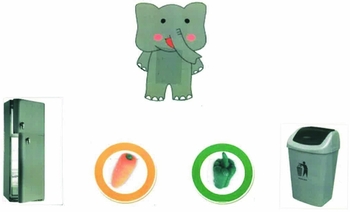
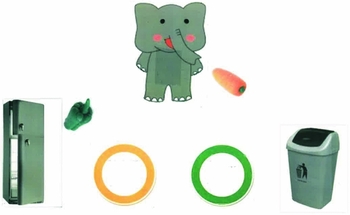
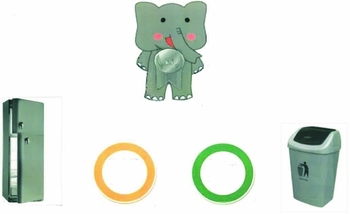
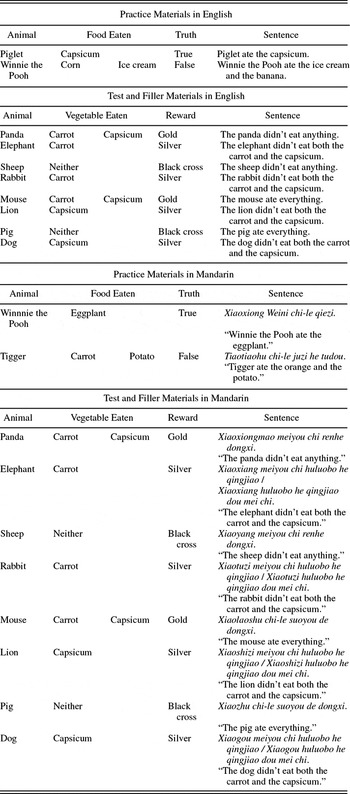
Our task was an adaptation of a task used by Goro and Akiba (Reference Goro, Akiba, Chand, Kelleher, Rodriguez and Schmeiser2004a, Reference Goro, Akiba and Otsu2004b). The task consisted of eight short scenarios in which an animal was asked whether it would like to eat a carrot and a green capsicum. If the animal in question decided to eat both vegetables, the child was asked to give the animal a gold medal. If the animal only ate one vegetable, the child was asked to give the animal a silver medal. If the animal ate neither vegetable, the child was asked to give the animal a black cross. Animals that did not want to eat their vegetables had the option of placing these unwanted vegetables in a fridge or rubbish bin. This meant there were never any vegetables left in front of the animals. Once the last animal had finished eating, our puppet then produced a target sentence about each animal. There were four critical trials on which the animal had only eaten one vegetable and had therefore received a silver medal. An example of a critical trial is illustrated in Figures 1–3.
Elephant presented with choice of vegetables.

Elephant eats the carrot and puts the capsicum in fridge.

Elephant receives a silver medal.

On the critical trials, the puppet produced a sentence like (8) for English speakers, or (9) or (10) for Mandarin speakers.
-
(8) The elephant didn't eat both the carrot and the capsicum.Footnote 8
-
(9)

-
(10)


We included the floating quantifier both in our English test sentences in order to increase the rate at which adults demonstrate the weak reading of these sentences (in which negation takes scope over conjunction). Other work testing English-speaking adults’ interpretation of sentences without both, like The smurf didn't jump over the tree and the pond, has found that adults actually reject the sentences in contexts in which the smurf jumped over the tree, but not the pond, over two-thirds (66%) of the time (Goro, Minai, & Crain, Reference Goro, Minai, Crain, Bateman and Ussery2006). A scope reading in which conjunction takes wide scope over negation is very much available to English adults. As will be seen in the Results Section, by adding the operator both to our test sentences, we increase the rate of adults’ acceptance of these kinds of sentences.
To mirror the English sentences, the critical Mandarin sentences needed to contain the quantificational adverb dou (“all” or “both”). However, the presence or absence of dou results in two different word orders in Mandarin. As can be seen in (9), without dou, negation precedes conjunction. In (10), with dou contributing the meaning of the English particle both, conjunction precedes negation. We therefore included both types of sentence to ensure these ordering differences had no effect.Footnote 9
The sentences were presented with a neutral intonation pattern, with no contrastive focus on either both/dou or on and/he. This was done to avoid potentially biasing our subjects toward one of the possible scope interpretations. To avoid running our experiment with multiple prosodic conditions (e.g., stress on both and and; stress on and, but not both; stress on didn't and both; etc.), some of which may have favored the weak interpretation and some the strong interpretation, we opted to remove prosodic cues. This ensured that both interpretations of the test sentences remained potentially available to our subjects.Footnote 10 These test sentences were not preceded by an explicit QUD in Experiment 1.
Sentences like (8)–(10) have two possible interpretations, and one of these possible interpretations asymmetrically entails the other. The interpretations are given in (11).
-
(11)
-
a. The elephant did not eat both of the vegetables, just one. (or possibly neither) (not > and, the weak reading)
-
b. It is both the carrot and the capsicum that the elephant did not eat. (neither) (and > not, the strong reading)
-
Interpretation (11b), on which the elephant ate neither vegetable, is the strong subset reading, and asymmetrically entails interpretation (11a). The two meanings may, initially, be difficult to see for English speakers, because adult English speakers tend to prefer the weak reading (11a) of sentences like (8). However, looking across languages, the other possible meaning becomes apparent. For example, adult Mandarin speakers prefer the strong reading (11b) of Mandarin sentences like (9) or (10).
The four critical trials were interspersed with four filler trials. On two filler trials, the animal in question had eaten both vegetables. These were “Gold Medal Fillers.” On the other two filler trials, the animal in question had eaten neither vegetable. These were “Black Cross Fillers.” The puppet uttered sentences like (12) and (13) in response to one Gold Medal Filler and one Black Cross Filler trial each.
-
(12) The panda didn't eat anything.
-
(13) The mouse ate everything.
Sentences like (12) were false for Gold Medal Filler trials, but true for Black Cross Filler trials, while sentences like (13) were true for Gold Medal Filler trials and false for Black Cross Filler trials. This meant there were a balanced number of true and false filler trials across the testing session. The fillers were included to check that the children were concentrating and could answer both “yes” and “no” correctly, and to obscure the purpose of the experiment. Children who failed more than one filler were excluded from the data set.
Before commencing a testing session, each subject was introduced to our puppet and given two practice items. On one practice item, our puppet made an obviously true statement about a story, and on the other, he made an obviously false statement about the same story. This was so that the subjects would know that the puppet could say something wrong and to familiarize them with the task. The full list and ordering of practice, test, and filler sentences is given in Appendix A.
Predictions
The SSM would predict that children, across languages, should prefer the strong subset reading of the test sentences. This reading was always false in the contexts provided. For example, in our elephant example, the elephant had eaten one vegetable (the carrot), but the strong interpretation of the test sentence The elephant didn't eat both the carrot and the capsicum is that the elephant ate neither vegetable. Therefore, the SSM would predict that children, across languages, should reject the puppet's statement (and point out that the elephant did eat one vegetable).
What about the QAR model? In Experiment 1 we made no special contextual manipulations and we did not ask an explicit QUD of our puppet. One possibility is to imagine that the QUD was something like (14).
-
(14) Did the x (e.g., elephant) eat any vegetables?
If the puppet's statement The elephant didn't eat both the carrot and the capsicum is taken as an attempt to answer this question, then only the strong interpretation, on which the elephant ate neither vegetable, makes the statement a good answer. This is because the strong interpretation entails a clear “no” answer to the question: that the elephant did not eat anything. By contrast, the weak interpretation could entail either a “no” answer (the elephant did not eat anything) or a “yes” answer (the elephant did eat one vegetable). Therefore, according to the QAR model, children could also be expected to favor the strong interpretation in this context. The results from this experiment will therefore not allow us to distinguish between the two accounts, but will allow us to establish a baseline to identify which reading is present by default in this context.Footnote 11
If children show a preference for the weak reading of these sentences, this will be evidence against both accounts (and possible evidence that children prefer an isomorphic scope interpretation in this case, because the weak reading is the isomorphic one in which negation takes wide scope over conjunction in both English and Mandarin). The results will also allow us to establish whether an identifiable cross-linguistic pattern exists in children's scope assignment preferences for these types of sentences, or whether children mirror the scope preferences they are exposed to in the input of their particular language.
Subjects
We tested 21 English-speaking children (11 male, 10 female) between the ages of 3;10 and 5;6 (mean age = 4;9) and 15 English-speaking adult controls (3 male, 12 female) between the ages of 19 and 38 (mean age = 22). The English-speaking child subjects were recruited from two daycare centers at Macquarie University, Sydney, Australia, while the adult subjects were students at Macquarie University.
In addition, we tested 40 Mandarin-speaking children: 20 children (9 male, 11 female) between the ages of 4;1 and 4;8 (mean age = 4;5) heard test sentences without dou, while the other 20 children (7 male, 13 female) between the ages of 4;1 and 4;7 (mean age = 4;5) heard test sentences with dou. Forty Mandarin-speaking adult controls were also tested: 20 adults (12 male, 8 female) between the ages of 21 and 26 (mean age = 24) heard test sentences without dou, while the other 20 adults (10 male, 10 female) between the ages of 23 and 27 (mean age = 25) heard test sentences with dou. The Mandarin-speaking child subjects were recruited from the kindergarten at Beijing Language and Culture University, while the adult subjects were undergraduates at Beijing Language and Culture University. All subjects were tested individually.
Results
All of the English-speaking and Mandarin-speaking children responded correctly to at least three out of four filler trials (two English-speaking children failed to respond correctly in one filler trial each). Therefore, the responses to the test sentences by all of the children were included in the final data set. We present the results grouped by language.
English results
The 21 English-speaking children rejected the test sentences on critical trials 95% of the time (80/84 trials). A typical justification for these rejections from a child aged 4;4 is given in (15).
-
(15) Puppet: The lion didn't eat both the carrot and the capsicum.
Child: No, he ate one thing.
On two of the remaining four trials, two different children rejected the test sentences but justified their rejections by stating that the animal in question had eaten both vegetables. Because this was not the case (the animal had only eaten one vegetable), these rejections were omitted from the rejection count. On the remaining two trials, 1 child aged 3;10 accepted the test sentences.
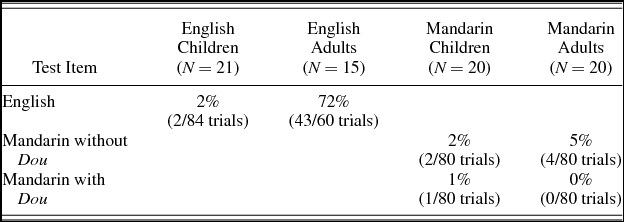
The 15 English-speaking adults only rejected the test sentences on critical trials 28% of the time (17/60 trials). A Mann–Whitney test revealed a highly significant difference between the acceptance rates of English-speaking children versus adults (Z = 4.63, p < .001).
Mandarin results
The first group of 20 Mandarin-speaking children heard critical trials without dou. The children rejected the test sentences on these trials 98% of the time (78/80 trials). A typical justification for these rejections from a child aged 4;4 is given in (16). As the example indicates, Mandarin-speaking children rejected the test sentences on the same grounds as English-speaking children.
-
(16)

The group of 20 Mandarin-speaking adults who heard test sentences without dou performed similarly to the children. They rejected the test sentences on these trials 95% of the time (76/80 trials). One adult consistently accepted the target sentences. A Mann–Whitney test showed no significant difference between Mandarin-speaking children's and adults’ acceptance rates to critical trials without dou (Z = 0.036, p = .989).
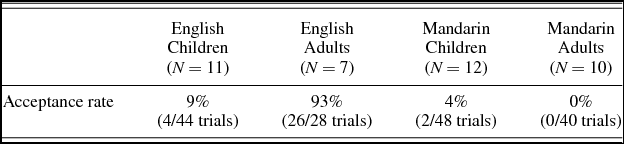
The second group of 20 Mandarin-speaking children heard critical trials with dou. The children rejected the test sentences on these trials 99% of the time (79/80 trials). The group of 20 Mandarin-speaking adults who heard test sentences with dou rejected these sentences on critical trials 100% of the time (80/80 trials). A Mann–Whitney test showed no significant difference between Mandarin-speaking children's and adults’ acceptance rates of critical trials with dou (Z = 1.00, p = .799). Moreover, the presence or absence of dou (and the resulting different word orders) had no effect on children's or adults’ responses. The two groups performed similarly in response to sentences of both types. Mann–Whitney tests confirmed there were no significant differences between the two groups of children's responses (Z = 0.036, p = .989) or the two groups of adults’ responses (Z = 1.00, p = .799) in the two conditions. The English and Mandarin results are summarized in Table 1.
English and Mandarin acceptance rates in Experiment 1

Discussion
The results of this first experiment show that children acquiring English or Mandarin Chinese overwhelmingly interpret sentences like The elephant didn't eat both the carrot and the capsicum to mean that the elephant ate neither vegetable, at least in the contexts used in this experiment. The children rejected these test sentences when the elephant had eaten a carrot. This behavior was similar to Mandarin-speaking adults, but was in clear contrast to English-speaking adults who showed a preference to accept the same sentences. In other words, children are not necessarily responding to the input of the language around them, but appear to have a strong universal preference to assign conjunction wide scope over negation in the context used in this experiment. These results rule out an explanation based on isomorphism; however, they could equally well support either an explanation based on the SSM or on the QAR model.
According to the SSM, children, across languages, prefer the strong reading of a scopally ambiguous sentence in which one interpretation asymmetrically entails the other because this bias allows them to rapidly converge on the actual preferences of adult speakers of their language based on positive evidence. According to the QAR model, by contrast, children across languages simply favor the strong reading because it constitutes the only good answer to the question that was presumably under discussion. To rule out one of these explanations, we need to define a QUD that also makes the weak reading a good answer to the question. This was the objective of Experiment 2.
EXPERIMENT 2
Methodology and predictions
Experiment 2 was identical in methodology to Experiment 1, except that the focus of the game was on whether the animals could eat both their vegetables. After the game, we told the puppet that we wanted to know if he could remember which animals had eaten both vegetables. We then asked a question like (17) in English, or (18) in Mandarin, before the production of each target (and filler) sentence. Given that no significant differences were found in child or adult Mandarin responses to sentences with and without dou in Experiment 1, we only used sentences with dou in Experiment 2.
-
(17) Did the elephant eat both the carrot and the capsicum?
-
(18)

Recall that (8), repeated here as (19), is the answer produced by the puppet (in English). The two possible interpretations of (19) are repeated in (20).
-
(19) The elephant didn't eat both the carrot and the capsicum.
-
(20)
-
a. The elephant did not eat both of the vegetables, just one. (or possibly neither) (not > and, the weak reading)
-
b. It is both the carrot and the capsicum that the elephant did not eat. (neither) (and > not, the strong reading)
-
It is crucial that both possible interpretations now constitute good answers to question (17); both entail a “no” answer. Thus, according to the QAR model, children should be expected to adhere to the principle of charity in this situation, and they should favor the interpretation that makes the puppet's statement true. This is interpretation (20a), the weak interpretation, because the elephant did eat one vegetable. If the acceptance rate of our test sentences goes up in this experiment as compared to Experiment 1, this will provide support for the second prediction of the QAR model. In contrast, if adherence to the principle of charity is not the right way to account for children's shifting scope preferences in certain contexts, then it is possible that children might still prefer the strong interpretation (20b), even in this context, and continue to reject our test sentences. Such a result would provide support for the predictions of the SSM, and not those of the QAR model.
We should point out that by making our QUD explicit, we run a risk that children's responses are merely an answer to the question itself, rather than a judgment of the puppet's statement. This was important because on critical trials, the answer to the question “Did the elephant eat both the carrot and the capsicum?” was always “no.” Therefore, children who reject the puppet's statement The elephant didn't eat both the carrot and the capsicum could do so for two possible reasons. Either they interpret the statement on its strong reading to mean the elephant did not eat anything (which is false in the context), or they are simply answering the question asked of the puppet themselves (and ignoring the puppet's statement). Our fillers allowed us to control for children who may have been answering in this way. Two of the filler items presented a mismatch between the answer to the question and the judgment of the statement. For example, in our filler about a panda, the panda ate both vegetables. The puppet was then asked “Did the panda eat both the carrot and the capsicum?” The answer to this question was “yes.” However, the puppet's statement was The panda didn't eat anything, which was false in the context. Thus, if children rejected this filler item, rather than accepting it, we could be confident that they were performing the task correctly by judging the puppet's statement. Children who failed the two crucial mismatch fillers were excluded from the data set.
Subjects
For the English version of Experiment 2, we tested 12 English-speaking children (6 male, 6 female) between the ages of 3;7 and 5;7. One child was excluded for failing the two crucial mismatch fillers. The mean age of the remaining 11 children was 4;9. We also tested 7 English-speaking adult controls (all female). The English-speaking child subjects were recruited from three daycare centers at or near Macquarie University, Sydney, Australia, while the adult subjects were undergraduate students at Macquarie University.
For the Mandarin version of Experiment 2, we tested 13 Mandarin-speaking children (7 male, 6 female) between the ages of 3;9 and 5;5. One child was excluded for failing the two crucial mismatch fillers. The mean age of the remaining 12 children was 4;6. We also tested 10 Mandarin-speaking adults (4 male, 6 female). The Mandarin-speaking child subjects were recruited from Beijing Language and Culture University, while the adult subjects were undergraduate students at Beijing Language and Culture University.
Results
English results
The 11 child subjects included in the final English data set responded correctly to at least three out of four filler trials (1 child failed to respond correctly in one noncrucial filler trial). The children rejected the test sentences on critical trials 89% of the time (39/44 trials). A typical justification for these rejections from a child aged 4;3 is given in (21).
-
(21)
-
Experimenter: Did the rabbit eat both the carrot and the capsicum?
-
Puppet: The rabbit didn't eat both the carrot and the capsicum.
-
Child: He ate the carrot.
-
Experimenter: So was the puppet right or wrong?
-
Child: Wrong.
-
On one of the remaining five trials, 1 child rejected the test sentence, but justified her rejection by stating that the animal in question had eaten both vegetables. Because this was not the case (the animal had only eaten one vegetable), this rejection was omitted from the rejection count. On the remaining four trials, 1 child aged 3;7 accepted the test sentences.
The seven English-speaking adults only rejected the test sentences on critical trials 7% of the time (2/28 trials). A Mann–Whitney test revealed a significant difference between the acceptance rates of English-speaking children versus adults (Z = 3.454, p < .001).
Mandarin results
The 12 child subjects included in the final Mandarin data set responded correctly to all filler trials. The children rejected the test sentences on critical trials 96% of the time (46/48 trials). A typical justification for these rejections from a child aged 4;8 is given in (22).
-
(22)

The 10 Mandarin-speaking adults rejected the test sentences on critical trials 100% of the time. A Mann–Whitney test confirmed there were no significant differences between the acceptance rates of Mandarin-speaking children versus adults (Z = 0.913, p = 1). These results are summarized in Table 2.
English and Mandarin Acceptance Rates in Experiment 2

Discussion
The results of Experiment 2 show that English-speaking and Mandarin-speaking children persisted in assigning the strong interpretation to sentences like The elephant didn't eat both the carrot and the capsicum, as they did in Experiment 1, even when an explicit QUD makes the weak interpretation of these sentences a good true answer to the question. This finding stands in clear contrast to that of English-speaking adults, who showed an even stronger preference to accept the same sentences (accessing the weak reading) in this experimental context. These results clearly do not support the second prediction of the QAR model. Without this second prediction, the QAR model falls short of being able to explain how children will behave when both interpretations of a scopally ambiguous sentence constitute good answers to the QUD. There is no reason for children to show a preference for either interpretation in these cases. The SSM model, however, is able to account for why children in our experiment preferred the strong interpretation, because the SSM model assumes that children have an underlying preference for this interpretation.
The present results are at odds with the results of studies previously discussed and cited in support of the QAR model (e.g., Gualmini, Reference Gualmini2005, Reference Gualmini, Zeijlstra and Soehn2007a, Reference Gualmini and Otsu2007b; Hulsey et al., Reference Hulsey, Hacquard, Fox, Gualmini, Csirmaz, Gualmini and Nevins2004). In these previous experiments, children did shift their interpretation of similar types of test sentences from a strong to a weak interpretation, when the weak interpretation was a good true answer to a supposed QUD. The crucial difference between our study and previous studies is that we actually made our QUD explicit. In so doing, we have shown that making the weak interpretation a good true answer to the QUD is not actually sufficient to account for the previously documented changes in children's behavior. Children continue to show a preference for the strong interpretation under these conditions. We would suggest that, instead, some additional factor (or factors) may have been pushing children to the weak interpretation in the previous studies. That is, the weak interpretation not only must be available pragmatically as a good answer to the QUD but also must be favored by the context somehow as being the intended reading.
One possibility for how the weak interpretation may have been favored in previous studies is through the manipulation of expected and actual outcomes in the test stories. It has been argued that in order to make a particular reading of a test sentence felicitous for children, a possible outcome on which the child could plausibly accept or reject the test sentence should be presented in a test story, before the actual outcome occurs (Crain & Thornton, Reference Crain and Thornton1998). This is termed the condition of plausible assent (or dissent). The condition of plausible assent can be applied when a test sentence is false for adults in a given context. Children might erroneously accept these false test sentences, despite knowing the relevant grammatical principle under investigation, if the context does not provide a clear reason for rejecting the sentence. To guard against this, TVJT stories can outline a possible outcome, different from the actual outcome, on which a false test sentence would have been true. On the flip side, the condition of plausible dissent requires that a story make clear the reason for accepting a true test sentence by outlining a possible outcome, different from the actual outcome, on which the sentence would have been false. For example, in our stories, it was possible that animals might end up eating none of the vegetables, one of the vegetables, or both of the vegetables. Whatever the actual outcome was, there were thus possible outcomes available that made both the weak and strong interpretations of our test sentences felicitous. On our critical trials, the animals started off by surveying the vegetables on offer. At this point in the story, if they had decided not to eat any vegetables (as some animals in filler trials did), this would have made the strong interpretation of our test sentences true. The animals in question then saw a vegetable they liked and decided to eat it. Next, they were asked to consider the second vegetable. At this point in the story, if they decided to eat the second vegetable (as some animals in filler trials did), this would have made the weak interpretation of our test sentences false. However, the animals on critical trials each made a decision to either throw their second vegetable away or store it in the refrigerator. This actual outcome ended up making the strong interpretation of our sentences false and the weak interpretation true. By setting up the stories in this way, we tried not to favor either possible reading of our test sentences. However, it could potentially be possible to favor one reading by focusing more strongly on the possible and actual outcomes for that reading alone. If, for example, the condition of plausible dissent is accentuated for the weak reading of a scopally ambiguous sentence, this may provide the extra contextual support needed to push children to access this reading.
We believe this may have been the extra factor leading to the results found in previous studies. For example, in Gualmini's (Reference Gualmini2005) stories, testing sentences like The dwarf didn't deliver some pizzas, the condition of plausible dissent was satisfied for the weak interpretation. Recall that the weak interpretation is that there were some pizzas that the dwarf did not deliver (the strong interpretation is that he delivered none). In his story, Gualmini set up an expectation that the dwarf was going to deliver a set of four pizzas, ordered by another character. There was thus a possible outcome in the story that all four pizzas would be delivered, making the weak interpretation of the test sentence false. Then during the story, the dwarf lost two pizzas, and so he only delivered two. This actual outcome ended up making the weak interpretation true. The children Gualmini tested accessed this weak interpretation and accepted the test sentences under these conditions 90% of the time. Note that it is critical that in these stories there was never a possible expectation that the dwarf would deliver none of the pizzas (which would have made the strong interpretation possibly true, before the actual outcome made it false). We would suggest then that at least two factors in the design of these stories pushed children to access the weak interpretation as the intended meaning in this context. First, there was a focus on whether the dwarf would be able to deliver all four pizzas. This presumably defined the QUD as Will the dwarf deliver all the pizzas?, to which the weak interpretation was a possible good answer. Second, there was a mismatch between an expected and actual outcome corresponding uniquely to the weak interpretation, making this interpretation possibly false at one point in the story and true by the end of the story.
We are not the first to make these observations. In discussing his own results, Gualmini pointed to the manipulation of expected and actual outcomes as critical (Gualmini, Reference Gualmini2005). As we understand it, this idea underpins the development of the QAR model, which proposes that manipulating expected and actual outcomes in this way is what defines the QUD. However, it is possible to dissociate the contribution of, on the one hand, a mismatch between an expected and actual outcome, and, on the other, a particular QUD.
The original study testing children on sentences like Every horse didn't jump over the fence (Musolino et al., Reference Musolino, Crain and Thornton2000) is a case in point. In this study, the condition of plausible dissent for the weak interpretation was satisfied. For example, in the horse story, all three horses try to jump over a barn and fail. They then decide to try a smaller fence. There is a plausible expectation at this point that the horses will be able to jump over the fence, because it is smaller than the barn. Two horses jump over the fence, and the third is about to. This is a possible outcome in the story that would have made the weak interpretation false (because every horse would have jumped over the fence). Then, the third horse remembers that he hurt his leg the day before, and so he decides not to jump. This was the actual outcome in the story that made the weak interpretation true (because not every horse jumped over the fence). Children still accessed the strong interpretation in these contexts and rejected the test sentence (because it was not true that none of the horses jumped over the fence). This shows that just providing a mismatch between an expected and an actual outcome is insufficient to push children to the weak interpretation.
In a subsequent study, Musolino and Lidz (Reference Musolino and Lidz2006) used the same story about three horses, but this time they preceded their test sentence with a positive lead-in, as in (23).
-
(23) Every horse jumped over the log but every horse didn't jump over the fence.
Under these conditions, children were found to accept the test sentences 60% of the time (compared to only 15% of the time without the positive lead-in). We would argue that providing the positive lead-in actually helped to define the QUD as being about what every horse did in the story (rather than being about any horse). If children understood the QUD to be Did every horse jump over the fence?, then the weak interpretation was both supported by tailoring the condition of plausible dissent to this interpretation and by being a good answer to the QUD. These two factors combined were then enough to allow children to access this interpretation more often.
In the stories presented to children in the present study, we purposefully introduced only one kind of contextual manipulation: at the beginning of each story, the focus was on whether the animals in our stories could eat both their vegetables and get a gold medal, and then, at the end of each story, children were asked an explicit question about whether each animal had eaten both vegetables. This manipulation was introduced to test whether defining an appropriate QUD for the weak interpretation was sufficient to push children to access this reading (via the principle of charity). It was not. We could test whether favoring the weak reading, by focusing more strongly on the mismatch in expected and actual outcomes for that reading alone, might push children to access the weak interpretation of our test sentences. We could perhaps make each animal in our critical stories eat their first vegetable (say, the carrot) and declare that they will eat their second (which perhaps they think is a nice piece of green lettuce). This would provide a stronger focus on the possible outcome that makes the weak interpretation false (because the animal would have eaten both vegetables). At the last minute, the animal in question could realize that the second vegetable is actually a green capsicum, not a piece of lettuce. Because the animal doesn't like capsicums, he decides not to eat it after all. This would be the actual outcome making the weak interpretation true. Perhaps with this additional contextual support favoring the weak interpretation, we would see children being able to access this reading. However, there may be still other factors in the experimental designs of the previous studies that remain to be identified and that contributed to children accessing the weak interpretation in those studies.
In short, we do not challenge the claim that children (and adults) assign interpretations to ambiguous sentences that correspond to good answers to an intended QUD. However, we think that this is not sufficient to explain when children will access the weak interpretation of a scopally ambiguous sentence in which one interpretation asymmetrically entails the other. Nor is it sufficient to explain why, in many contexts, children display a preference for the strong interpretation. We have shown that even when the weak interpretation constitutes a good (and true) answer to the QUD, children persist in assigning the strong interpretation to the sentences we tested. The QAR model cannot account for this data, but the SSM can, because the SSM assumes that children have an underlying preference for the strong interpretation of these kinds of sentences. It would seem that this preference can only be overridden if several contextual manipulations conspire to strongly favor the weak interpretation.
GENERAL DISCUSSION
Our two experiments were designed to adjudicate between two hypotheses about children's initial preferences for resolving scope ambiguities. One hypothesis was the SSM. The SSM makes a specific prediction about children's decisions when they are confronted with ambiguous sentences, where one of the scope readings asymmetrically entails the other. According to the SSM, children initially prefer the strong or subset reading of these ambiguities. This preference assists children in efficiently aligning their preferences for interpreting scope ambiguities with those of adults. If adult speakers of the language favor the weak (superset) reading, children will encounter adult input that is not in line with their initial preference, because adults will use the relevant sentences in contexts that are only true on the weak reading. Assuming that adults speak truthfully, it will be straightforward for children to shift their preferences to favor the weak reading, as adults do. If children were to initially favor the weak reading, by contrast, then the majority of evidence children encounter will be consistent with this interpretation, and there will be no impetus for children to shift their preferences. This remains true, moreover, even if adult speakers of the local language strongly favor the strong reading, because the circumstances associated with the weak reading include the one circumstance that makes the sentence true on the strong reading.
The second account under consideration was the QAR model. This model predicts, first, that when faced with scopally ambiguous sentences, children assign an interpretation that best answers a salient QUD. For a yes/no question, a good answer is defined as being an assertion that entails either the “yes” or “no” answer to that question. Second, if both possible scope interpretations address the relevant question, the model predicts that children will choose the interpretation that makes the sentence true in the context, following the conversational principle of charity.
Until now, much of the evidence that has been accumulated on children's resolution of scope ambiguities could be equally well explained by either model. The present study aimed at adjudicating between the models, by evaluating competing predictions that are made by the two accounts. We investigated children's interpretation of sentences like The elephant didn't eat both the carrot and the capsicum in English and in Mandarin. These sentences present a scope ambiguity of the kind we were interested in, depending on whether conjunction is assigned wide or narrow scope in relation to negation. If conjunction is assigned wide scope over negation, the resulting meaning is a strong one (corresponding to a single truth condition), on which the elephant ate neither vegetable. If negation is assigned wide scope over conjunction, the resulting meaning is a weak one (corresponding to several possible truth conditions), on which the elephant possibly ate the carrot, or the capsicum, or neither vegetable. The strong reading entails the weak reading, because if it is true that the elephant ate neither vegetable, then it is also true that he did not eat one of them.
According to the SSM, children acquiring English or Mandarin should initially favor the strong reading of these kinds of sentences. According to the QAR model, children's preferences should fluctuate depending on the QUD. If, as was possibly the case in Experiment 1, the question is something like Did the elephant eat any vegetables?, then children should prefer the strong interpretation because this is the only interpretation that entails a clear “no” answer to the question. If, as was the case in Experiment 2, the question is Did the elephant eat both the carrot and the capsicum?, then children should prefer the weak reading because this now entails a good “no” answer to the question, and in addition was true in the context provided.
The findings of the present study demonstrated that both English-speaking children and Mandarin-speaking children overwhelmingly assigned the strong reading to our test sentences, rather than the weak reading. Moreover, they did this regardless of the QUD. In Experiment 1, English-speaking children rejected critical trials on which the elephant had eaten a carrot, but not both a carrot and a capsicum, 98% of the time; Mandarin-speaking children rejected the same trials 98%–99% of the time. In Experiment 2, in which the QUD and the principle of charity favored the weak reading, English-speaking children still rejected critical trials 89% of the time, while Mandarin-speaking children did so 96% of the time. These results are in line with the SSM, but not the QAR model.Footnote 12
Given these results, we conclude that the QAR model does not adequately explain the shifts in children's scope assignment preferences documented in the previous literature. Instead, we have suggested that it may take both the definition of an appropriate QUD and some additional focus on an expected and actual outcome supporting the weak interpretation to push children to the weak reading of sentences in which one reading asymmetrically entails the other.
It is worth noting here that some other recent experimental results present a further challenge for any model purporting to predict children's scope interpretation preferences. Conroy, Lidz, and Musolino (Reference Conroy, Lidz and Musolino2009) tested children on sentences like Every cat didn't hide behind the sofa, while using exactly the kind of contextual manipulations recommended to make the weak reading of these sentences available (and true) for children. In addition, these researchers satisfied the condition of plausible dissent for the weak interpretation of their test sentences. They found that while younger English-speaking children (between 4;5 and 5;2) preferred to assign a weak reading to the test sentences (as we might expect under either the QAR model or the SSM, given the contextual manipulations present), children aged 5;3–5;7 preferred to assign a strong reading to the sentences (Conroy et al., Reference Conroy, Lidz and Musolino2009). This finding with older children deserves further attention. It certainly cannot be accounted for under the second prediction of the QAR model, nor is it entirely clear how it can be reconciled with the version of the SSM presented thus far. According to the SSM, children have both scope readings available to them, but they are expected to have a preference for the strong reading. They can be pushed to access a weak reading, but only if a combination of contextual manipulations favor this interpretation. We have suggested that the necessary combination may be that the weak interpretation be supported by the QUD, and by a mismatch between an expected and an actual outcome in the test story that uniquely favors the weak interpretation. Conroy et al. satisfied these conditions, yet older children nonetheless showed a preference for the strong interpretation of the test sentences. In other words, it would seem that these contextual manipulations are still insufficient to push older children to a weak interpretation. Perhaps as children are attempting to systematically sort out the scope preferences of their local language, they pass through a stage in which they display a preference for the strong reading regardless of the contextual manipulations? Whatever the answer, the QAR model as it currently stands has no means to account for Conroy et al.’s findings with older children. Conversely, the SSM could potentially accommodate the findings with both the younger and older children. However, further work is needed to understand exactly how age or developmental stage interacts with the preference for strong readings.
Before summing up, we should address some recent concerns that have been raised in the literature about the rationale behind the SSP, a rationale that the semantic SSM shares. We have suggested that the SSM is necessary because if children initially prefer the weak reading of an ambiguous sentence of the type we have been discussing (and adults prefer a strong reading), then it will be difficult for children to notice from the input that adults actually prefer the strong reading. This is because the child's preferred weak reading will be true in the same contexts in which the adult's preferred strong reading is true. However, Gualmini and Schwarz (Reference Gualmini and Schwarz2009) have argued that forms of alternative evidence in the input that children could use to eventually arrive at a strong reading of a sentence if they have initially hypothesized a weak reading do exist. These researchers suggest two main sorts of evidence that children could use. We will discuss these in turn.
The first suggestion applies to constructions that are subject to scalar implicatures. For example, the sentence The elephant didn't eat both the carrot and the capsicum can be interpreted with a scalar implicature as follows. The sentence is compared to a stronger alternative, namely, The elephant didn't eat the carrot or the capsicum, which corresponds to a single truth condition on which the elephant ate neither vegetable. Because this alternative expression was not used in the context under consideration, the hearer assumes the truth condition on which the elephant ate neither vegetable was not the intended meaning. Rather, the hearer is led to understand that the elephant ate exactly one of the vegetables. This means that the two possible meanings of the sentence The elephant didn't eat both the carrot and the capsicum are no longer in a subset–superset relationship. On the strong reading, the elephant ate neither vegetable. On the weak reading, the elephant ate exactly one vegetable. Now the potential semantic subset problem disappears. A child who computes adultlike scalar implicatures, and who initially prefers the weak reading of a sentence like this, could shift his or her preference to the strong reading by hearing the sentence used in a context in which the elephant ate neither vegetable. Because this condition no longer forms part of the truth conditions of the weak reading, the child will have positive evidence for adults’ preference for the strong reading. This would allow a child acquiring Mandarin, for example, who might have an initial preference for the weak reading of such a sentence, to correct his or her scope preference so as to be in line with adult Mandarin speakers who prefer the strong reading of such sentences.
As Gualmini and Schwarz themselves point out, however, children are highly unlikely to adopt a solution based on drawing adultlike scalar implicatures until relatively late. It has been consistently found that children do not reliably compute adultlike scalar implicatures, up to as late as age 6 (e.g., Chierchia, Crain, Guasti, Gualmini, & Meroni, Reference Chierchia, Crain, Guasti, Gualmini, Meroni, Do, Domínguez and Johansen2001; Gualmini, Crain, Meroni, Chierchia, & Guasti, Reference Gualmini, Crain, Meroni, Chierchia and Guasti2001; Guasti et al., Reference Guasti, Chierchia, Crain, Foppolo, Gualmini and Meroni2005; Noveck, Reference Noveck2001). Moreover, if children were going to be relying on this kind of evidence, then we should not necessarily expect to see a strong preference for either scope reading before age 6. That we do see a preference for the strong reading favors the SSM instead.
The second type of evidence that Gualmini and Schwarz (Reference Gualmini and Schwarz2009) suggest children may be able to use is intended to represent a more general solution to the entailment problem faced by children. The relevant evidence should be available for any sentence subject to an asymmetrical entailment problem, not just those that are also subject to a scalar implicature. The explanation hinges on the entailment-reversing properties of downward entailing operators. Gualmini and Schwarz (Reference Gualmini and Schwarz2009) point out that when an ambiguous sentence of the kind we have been discussing is embedded under a downward entailing operator, then the entailment relations between the two possible meanings of the sentence are reversed. They use the case of sentences like (23) to illustrate. The two possible meanings of this sentence are given in (24a) and (24b).
-
(23) Every horse didn't jump over the fence.
-
(24)
-
a. No horse jumped over the fence. (every > not, strong reading)
-
b. Not all the horses jumped over the fence. (not > every, weak reading)
-
Meaning (24a) is the strong reading, and entails meaning (24b), because if none of the horses jumped over the fence, then it is certainly true that not all of them did. Now, when (23) is embedded under a downward entailing expression like “it's impossible,” the entailment relations between the two possible meanings are reversed, as illustrated in (25).
-
(25) It's impossible that every horse didn't jump over the fence.
-
(26)
-
a. It's impossible that no horse jumped over the fence.
i.e., at least one horse must have jumped over the fence
(impossible > every > not, weak reading)
-
b. It's impossible that not all the horses jumped over the fence.
i.e., every horse must have jumped over the fence
(impossible > not > every, strong reading)
-
Meaning (26b) becomes the strong reading, and entails meaning (26a), because if every horse jumped over the fence, then it is certainly true that at least one did. Gualmini and Schwarz (Reference Gualmini and Schwarz2009) argue that a child who initially hypothesizes only meaning (24b), the weak reading, for the sentence Every horse didn't jump over the fence could receive evidence for meaning (24a) by hearing sentence (25) in a context in which at least one horse (but not every horse) has jumped over the fence. This context makes meaning (26b) false, but meaning (26a) true. Having concluded that meaning (26a), the weak reading, exists for a sentence like It's impossible that every horse didn't jump over the fence, the child could then infer that meaning (24a), the strong reading, also exists for a sentence like Every horse didn't jump over the fence.
This proposal is subject to the same caveat we raised before. If evidence of the relevant kind exists, it is presumably relatively rare in children's experience, because the structures are complex, and are difficult to compute even for adults. Presumably, children would not be exposed to sufficient evidence of this type until relatively late in the course of acquisition. In addition, however, it is not clear that this solution actually can be generalized to all instances of ambiguity arising when one possible meaning of a sentence asymmetrically entails the other. A case in point would be trying to apply this solution to the types of sentences we tested in this study. Consider a sentence like (27). The two possible meanings of this sentence are given again in (28a) and (28b).
-
(27) The elephant didn't eat both the carrot and the capsicum.
-
(28)
-
a. It is both the carrot and the capsicum that the elephant did not eat. (and > not, strong reading)
-
b. The elephant didn't eat both vegetables, but may have eaten one or none. (not > and, weak reading)
-
Embedding (27) under the downward entailing expression “it's impossible” as in (29) yields the two possible meanings in (30a) and (30b).
-
(29) It's impossible that the elephant didn't eat both the carrot and the capsicum.
-
(30)
-
a. It's impossible that it is both the carrot and the capsicum that the elephant didn't eat.
i.e., The elephant did eat one of those vegetables, or possibly both
(impossible > and > not, weak reading)
-
b. It's impossible that the elephant didn't eat both vegetables.
i.e., The elephant did eat both vegetables
(impossible > not > and, strong reading)
-
While meaning (28a) asymmetrically entails meaning (28b), in (29) this relationship is reversed, so (30b) is the stronger reading, and asymmetrically entails (30a). Following Gualmini and Schwarz's argument, a child who initially hypothesizes only meaning (28b), the weak reading, for the sentence The elephant didn't eat both the carrot and the capsicum could receive evidence for meaning (28a) by hearing a sentence like It's impossible that the elephant didn't eat both the carrot and the capsicum in a context in which the elephant has eaten one vegetable, but not both. This context makes meaning (30b) false, but meaning (30a) true. Having concluded that meaning (30a), the weak reading, exists for a sentence like It's impossible that the elephant didn't eat both the carrot and the capsicum, the child could then infer that meaning (28a), the strong reading, also exists for a sentence like The elephant didn't eat both the carrot and the capsicum. This would be particularly important for a Mandarin-speaking child who initially preferred the weak reading of (27) and would need to realign this preference to be in line with adult speakers of Mandarin who prefer the strong reading.
The problem is that Mandarin speakers would not tend to use sentence (29) in the crucial weak context. We surveyed six Mandarin speakers who all reported that they would only use (or would very strongly prefer to use) the counterpart of sentence (29) in Mandarin with meaning (30b). Our intuition as native English speakers is that (30b), the strong reading, would also be the meaning English speakers would prefer to assign to (29). Thus, it seems that this kind of evidence would never (or extremely rarely) be available for children. It may be that whenever the strong reading of a sentence involves an inverse (or nonisomorphic) scope relationship, then the generalized solution proposed by Gulamini and Schwarz will fail.Footnote 13 That is, although the proposed solution is logically sound, it is not practically applicable across the board because some sentences may never (or hardly ever) be used in the crucial contexts.
We think that there may not be a general solution to the entailment problem, which is precisely why children would benefit from adhering to a learning maxim like the SSM. It is conceivable that children learning a language that favors a strong reading of a sentence subject to an entailment problem, and who initially prefer the weak reading, could eventually recover. However, they would probably need to use evidence from a variety of sources, depending on the structure in question, and this evidence may not be available until relatively late in the acquisition process. Adhering to the SSM prevents this delay in children's attainment of their target grammar in the majority of cases.
Furthermore, the need for an explanatory mechanism to account for children's development of semantic scope preferences is highlighted by children not necessarily initially mirroring the scope preference patterns of the adults around them. In the sentences tested here, we found that English-speaking children behaved like Mandarin-speaking adults, who preferred a strong reading of our test sentences, and unlike English-speaking adults, who preferred a weak reading. Recall that this has also been shown in other cross-linguistic work, where Japanese- and Mandarin-speaking children prefer a strong reading of sentences like The pig didn't eat the carrot or the pepper and The dog reached the finish line before the turtle or the bunny, even though adult speakers of these languages prefer, or at least also often allow, a weak reading of the same sentences (Goro & Akiba, Reference Goro, Akiba, Chand, Kelleher, Rodriguez and Schmeiser2004a, Reference Goro, Akiba and Otsu2004b; Notley et al., Reference Notley, Zhou, Jensen and Crain2012). Results like these suggest that children are following a developmental trajectory in this domain that is not initially driven by the input. Rather, we propose that our data constitute new evidence that children's initial scope assignment preferences (when one scope reading of an ambiguous sentence asymmetrically entails the other) are driven by a universal tendency across languages to favor the strong reading, as predicted by the SSM. Children who are then exposed to a language (e.g., Mandarin) that favors the strong reading for a particular sentence will have already converged on the adultlike preferences. Conversely, children who are exposed to a language (e.g., English) that favors the weak reading for a particular sentence will be able to shift their preferences for this reading on the basis of positive evidence.
Experiment materials

ACKNOWLEDGMENTS
This work was supported by the Australian Research Council Centre of Excellence in Cognition Disorders Grant CE110001021 (http://www.ccd.edu.au) and by Australian Research Council Discovery Grant DP0879842. We thank research assistants Rowan Cox and Cory Bill for taking on the role of Cookie Monster with such enthusiasm, and we thank the staff and parents of children at Gumnut and Berry Cottages at Macquarie University and at Berry Cottage Eastwood for allowing us to work with their children. We also thank the Second Language Acquisition Research Group of Beijing Language and Culture University headed by Professor Liqun Gao for their assistance and support in conducting the Mandarin experiments. Of course, we thank the children and adults who took part in the experiments for their time and patience. Finally, we acknowledge the insightful contributions of our anonymous reviewers, whose comments have helped to make this a better paper.