1. Introduction
The connection between law and economic prosperity has been examined and, to a large extent, confirmed by numerous theoretical and empirical studies. For example, inspired by North’s pioneering work in exploring the role of property rights in economic history,Footnote 1 a long line of economic researchFootnote 2 has used historical, comparative, and empirical evidence to show that property rights, especially formal, individualized property rights, are crucial to long-term economic success. Similarly, contract law is claimed as a significant determinant of a country’s prospects for economic development.Footnote 3
Based on studies of the relationship between law and economic prosperity, it is natural to argue that an efficient legal system precedes and underlies sustainable economic growth, and that less-developed countries cannot achieve the same level of economic success as industrialized economies without certain fundamental legal changes. This “law matters” hypothesis has been embraced by many economists and lawyers, and it has become the theoretical foundation for policy recommendations submitted to developing countries.Footnote 4
However, there are certain apparent anomalies in the “law matters” hypothesis, of which China is the most notable. Despite its weak legal framework, China has undergone remarkable economic growth over the past three decades and has surpassed Japan as the world’s second-largest economy. According to Allen et al.,Footnote 5 “China is an important counterexample to the findings in the law, institutions, finance, and growth literature: Neither its legal nor financial system is well developed, yet it has one of the fastest growing economies.”
Based on the foregoing, scholars have argued that China’s economic growth has been primarily supported by non-legal substitutes, such as governance mechanisms based on reputation and relationships.Footnote 6 However, certain studies question whether formal law in China is entirely irrelevant. For example, Milhaupt and PistorFootnote 7 show that formal laws, such as corporate and bankruptcy laws, are an important tool used by the Chinese central government in managing the state-owned sector. PeerenboomFootnote 8 also implies that China’s legal system contributed to increased foreign direct investment during the second decade of reforms.
This study will contribute to the argument on the role of law in China’s economic development from a unique perspective. It will focus on its contribution to China’s unbalanced macroeconomic structure, which facilitated China’s extraordinary economic growth in the short run at the cost of environmental quality, ordinary citizens’ welfare, and long-term economic health. The primary conclusion of this study is that China is a challenge to the “law matters” hypothesis, according to which economic growth is impossible without the support of a liberal legal order, which is claimed to protect property rights, enforce contracts, and maintain the operation of a free market economy. China’s legal system is dysfunctional, property rights are weak, and the operation of the market economy is distorted. However, in contradiction to the prediction derived from the “law matters” hypothesis, China has achieved remarkable economic success. The secret lies in the fact that in such a legal environment, factor prices will be lowered, investment and production will be subsidized, and growth will therefore be accelerated.
The remainder of this study is organized as follows. In Part 2, we discuss the “law matters” hypothesis and show its limitations. In Part 3, we describe the apparent paradox of the co-existence of a weak legal system and a fast-growing economy in China. In Part 4, we attempt to solve this paradox by exploring the relationship between China’s legal system and its imbalanced growth model. In Part 5, we present some general conclusions and discuss the policy implications of our findings.
2. The “Law Matters” Hypothesis and Its Limitations
The significance of law for economic development has been an appealing subject in social scientific studies, among which the works of North stand out as the most path-breaking and influential contributions. In The Rise of the Western World, North and ThomasFootnote 9 attribute the rise of the Western world, specifically the success of the Netherlands and England versus the failure of France and Spain, to the creation and evolution of an efficient property rights regime, which provides the incentives necessary for sustained economic growth. In Structure and Change in Economic History, the First (Neolithic or Agricultural) and Second (Industrial) Economic Revolutions are explained by the complicated interaction between property rights and organizations.Footnote 10
North’s contributions become the seeds for a flood of articles that explore the connection between law and economic growth, leading to a general conclusion that “law and legal institutions are fundamental to a nation’s economic development.”Footnote 11 Recently, a new version of this “law matters” hypothesis, the so-called “legal origin” theory, was developed by four economists, La Porta, Lopez-de-Silanes, Shleifer, and Vishny (hereafter LLSV), through a series of cross-country econometric studies. The most notable finding of LLSV is that common-law countries protect investors (shareholders and creditors) better than civil-law countries. Free of expropriation by corporate insiders, investors are more willing to finance firms; hence, financial markets flourish in common-law countries.Footnote 12
The developers of the “legal origin” theory also find that, compared to common-law countries, civil-law countries are associated with higher government ownership of banks,Footnote 13 more entry regulation,Footnote 14 and more stringent regulation of labour markets.Footnote 15 Many of these indicators of government ownership and regulation are, in turn, correlated with adverse impacts on markets, such as greater corruption, a larger unofficial economy, and higher unemployment. Common-law countries are further found to be associated with a lower formalism of judicial procedureFootnote 16 and greater judicial independenceFootnote 17 than civil-law countries. These indicators have been shown to be good predictors of better contract enforcement and greater security of property rights.
The major conclusion of LLSV is that legal origins are central to understanding the divergence in living standards across the regions and countries of the world. Furthermore, compared with civil-law countries, especially those countries with a French civil-law tradition, common-law countries have enjoyed superior economic outcomes. One important channel through which legal origin influences economic performance is politics.Footnote 18 More specifically, legal traditions differ in their emphasis on the rights of private property owners versus the power of the state. Civil law tends to emphasize the power of the state rather than the rights of private property owners to a greater degree than common law. A powerful state will tend to create policies and institutions that divert the flow of society’s resources towards favoured ends, which is harmful to the operation of a free market economy.
It may be argued that the complicated relationship between law and the market has been oversimplified by LLSV.Footnote 19 To LLSV, the legal world is clear and simple. There are “good” legal rules, such as those that have been enacted in common-law countries, which are believed to help reduce transaction costs, encourage productive activities, and foster economic growth, and “bad” legal rules, such as those that can be found in (French) civil-law countries, which are believed to be inefficient, unproductive, and detrimental to economic prosperity. The major difference between “good” and “bad” law lies in the intention of the law with respect to the market and the state: “good” law “seeks to support private market outcomes,” whereas “bad” law “seeks to replace such outcomes with state-desired allocation.”Footnote 20
However, the actual effects of laws on real-world economies fall outside the scope that can be covered by LLSV’s dichotomy. As the growth experience of East Asian countries has shown, in certain developmental stages, a fast-growth economy and a weak or “bad” legal system can co-exist. For example, after reviewing competing explanations for how Japanese judges are controlled, UphamFootnote 21 concludes:
Japanese judges appear embedded in a tight web of professional and social relationships … Japanese judges put a relatively low emphasis on following the law and are prepared to change, manipulate, or distort the law when necessary for professional advancement and survival.
The independence of judges in Taiwan is also compromised by the fact that the promotion and transfer of Taiwanese judges are controlled by the Judicial Yuan, the highest authority of judicial administration in Taiwan.Footnote 22 Compared with networks of interpersonal relationships, law is shown to play a less important or even marginalized role in promoting Taiwan’s economic development.Footnote 23 Regarding Korea, LeeFootnote 24 argues that the role of law and lawyers in Korea was “negligible” in economic development.
In general, OhnesorgeFootnote 25 concludes that:
… legal systems in high-growth Northeast Asia failed in many ways to move beyond formalist thinking, failed to put judiciaries and problem-solving lawyers at the center of the governance process, failed to serve as convenient fora for private litigation to enforce property and contract rights, failed to protect minority shareholder rights, failed to take intellectual property rights, competition law, or insolvency law very seriously, and failed to legalise state–private sector relations through constitutional and administrative law.
A similar conclusion is reached by GinsburgFootnote 26 and by Pistor and Wellons.Footnote 27 The case of East Asian countries is therefore in conflict with LLSV’s theory.
In spite of their weak and flawed legal systems, many East Asian countries experienced extraordinary growth between 1965 and 1990.Footnote 28 During this period, eight East Asian economies (Japan, Hong Kong, the Republic of Korea, Singapore, Taiwan, Indonesia, Malaysia, and Thailand) grew more than twice as fast as those of the remainder of East Asia, approximately three times as fast as Latin America and South Asia, and five times faster than Sub-Saharan Africa. These East Asian economies also significantly outperformed the industrial economies and the oil-rich Middle East-North Africa region.
In contrast to the prediction of “legal origin” theory, weak or “bad” legal systems in East Asian economies helped rather than hindered economic growth because such legal systems could be manipulated more easily by the government to intervene in the nation’s economy. With the help of these legal systems, East Asian states could implement a unique development strategy: distorting relative prices so that (compared with a laissez-faire environment) more economic resources can be directed to capital accumulation, which, in turn, paves the way for faster economic growth. In Amsden’s words,Footnote 29 in East Asian economies, “economic expansion depends on state intervention to create price distortions that direct economic activity toward greater investment.” In that sense, the state “has set relative prices deliberately ‘wrong’.” A similar conclusion is reached by Wade,Footnote 30 who argues:
… [g]overnment policies deliberately got some prices “wrong”, so as to change the signals to which decentralized agents responded, and also used nonprice means to alter the behavior of market agents. The resulting high level of investment generated fast turnover of machinery and hence fast transfer of newer technology into actual production.
For example, in Taiwan, the government manipulated relative prices in such a way as to enhance industrialists’ profits and thereby encourage more investment. In the 1950s and 1960s, it fixed low agricultural prices, allowing industrial wages to be lower and industrial profits and investment to be higher. It also ensured that labour costs were not driven by union power, and it used fiscal investment incentives and concessional credit to lower the costs of production and thereby drive investment, first in heavy and chemical industries and more recently in electronics and machinery. Last, it lowered the costs of export production by establishing subsidies, duty-drawbacks, and similar measures.
Although they successfully accelerated economic growth, these unorthodox institutional arrangements finally led East Asian countries to a trajectory of investment-driven rather than productivity-driven economic growth. Kim and LauFootnote 31 find that:
… [b]y far the most important source of economic growth of the East Asian newly industrialized countries (Hong Kong, Singapore, South Korea, and Taiwan) is capital accumulation, accounting for between 48 and 72% of their economic growth, in contrast to the case of the Group-of-Five industrialized countries (France, West Germany, Japan, the United Kingdom, and the United States), in which technical progress has played the most important role, accounting for between 46 and 71% of economic growth.
A similar conclusion is reached by Kim and LauFootnote 32 and by Young.Footnote 33
The inescapable problem encountered with the investment-driven growth model is that there are diminishing returns associated with the addition of any one factor of production. As the famous Solow model has shown, regardless of the level of capital with which an economy begins, without technological progress the economy will end up at a steady state in which there is no per capita growth.Footnote 34 To avoid diminishing returns, an economy must transform its growth style from investment-based growth to technology-based growth. The key to converting a country’s growth pattern to the latter is redesigning the institutional framework under which the economy operates to transfer the decision-making power from bureaucrats to entrepreneurs. This transition should be accompanied by a process of systematic and extensive market liberalization so that entrepreneurs can be directed and motivated by a free market to meet actual social preferences with the most suitable production methods. Market-augmenting laws and regulations such as those suggested by LLSV will accordingly become a requisite for economic success during periods of technology-based growth.
Historical evidence shows that in the process of pursuing sustainable economic growth, winners (such as many economies in Western Europe and North America) and losers (such as the former Soviet Union) distinguish themselves by their capability to change their economies from investment-based economies to technology-based ones.Footnote 35 East Asian countries do not seem to provide a counter-example to the regularity of economic evolution. The East Asian financial crisis of 1997–98, which brought growth in many countries to an abrupt halt, can be cited as the strongest evidence for the unsustainable nature of the East Asian “miracle.”Footnote 36
Taking the growth experience of East Asian countries into consideration, a deeper understanding of the relationship between law and economic development can be reached. A less-developed economy may initially adopt the investment-driven economic growth model to ignite economic growth as quickly as possible. Under this approach, economic growth is easily initiated, controlled, and directed by the government, whose main task is to use a combination of policies and institutions (such as those we have seen used in East Asian countries) to maximize capital accumulation to propel the economy. Law and regulations will be either weakened or ignored, if they are in conflict with the development strategy of the government, or enacted and enforced with the intention of augmenting the power of economic policies by, in AmsdenFootnote 37 and Wade’sFootnote 38 words, “getting the prices wrong.” The unusual combination of a fast-growth economy and a weak legal system then emerges.
Such a growth pattern will, however, finally face a watershed: without some fundamental institutional reforms from which a productivity-driven growth model can be expected to arise, the economy will be trapped in the status quo, or, in Solow’s term, a steady state. Laws and regulations that sustain the functioning of a competitive market system from which entrepreneurship, innovation, and efficiency can stem will play a crucial role in shifting the growth trajectory to a sustainable one, such as that of Western Europe and North America. The connection between law and economic growth will therefore be more in line with the prediction of LLSV only in the long run. In summary, law plays different roles in different growth trajectories (investment-driven versus technology-driven), and the relationship between law and economic growth is context (growth model or stage)-dependent, dynamic, and more complicated than can be inferred from LLSV’s theory.
3. China’s Legal System and Its Role In Economic Development
Over the last 30 years, China has experienced a great transformation from a planned economy to a market economy, beginning with the restoration of household agriculture. The most remarkable consequence of this transformation is the massive expansion of China’s economy, which is now the second largest in the world (the US economy is the first), with a US$5.87 trillion nominal GDP in 2010. Another important outcome of this process is the general increase in the standard of living, which has lifted hundreds of millions of Chinese out of absolute poverty and helped China become a middle-income country. This transformation allowed China to become a global economic superpower and, with the current slowdown of other principal economies (especially that of the US), the chief driver of world growth.
Since 1978, China’s legal system has also experienced a great transformation. Much legislation has been passed by the National People’s Congress (NPC) to lay the foundation for China’s economic reform and social change. Today, virtually all of the important areas, such as property, contracts, and business organizations, are covered by national legislation as well as low-level regulations. Law has therefore come to play an increasingly important role in regulating economic activities, resolving civil disputes, and shaping state behaviour. In addition, as part of China’s efforts to merge into the international community, many legislative efforts, particularly those in business law and intellectual property law, have sought to bring China into line with international practice.
Courts have undertaken significant reforms designed to strengthen both the competence of judges and the professionalism of the court system.Footnote 39 One of the most important accomplishments of court reforms is that the education levels of judges have improved dramatically. Prior to the 1995 Judges Law, there were no requirements to be a judge except that one be a cadre. Since 2002, however, all new judges in China have been required to possess bachelor’s degrees and to pass the national unified judicial exam, which had a pass rate of approximately 10% before 2007. In 2005, for the first time, more than 50% of Chinese judges had university degrees, which marks a sharp increase from 6.9% in 1995. Other measures, especially those addressing technical or administrative problems, rather than changing the court’s power relative to other state actors (such as reforming the appointment system, improving the quality of court decisions, and fighting corruption), have also been adopted by the Supreme People’s Court (SPC, which is responsible for the administration of the judiciary) in recent years.
As a result of China’s legal reform, there has been a dramatic increase in commercial, civil, and administrative lawsuits since the early 1980s, which may be considered evidence that courts are performing a more important role in resolving various conflicts in Chinese society. For example, Clarke et al. Footnote 40 report that, between 1983 and 2001, economic disputes accepted by courts of first instance increased at an average annual rate of 18.8%; civil disputes increased at 8.3% per year on average over the same period; and administrative cases increased at an average annual rate of 21.8% for the 1987–2001 period. In addition, from 1983 to 1998, the total value of disputes grew 40.9% per year on average, whereas the average value of disputes grew at 11.9% per year on average.
Although far from ideal, courts in China do enforce court judgments and arbitral awards, as demonstrated by some recent empirical studies. PeerenboomFootnote 41 reports that applicants who turned to the courts for compulsory enforcement of arbitral awards were able to recover at least half of the award in 40% of the cases. Moreover, in many cases, non-enforcement for legitimate reasons is set forth in international treaties and Chinese law or due to the respondent’s lack of assets. Put differently, the rate of non-enforcement for suspect or illegitimate reasons such as local protectionism, judicial incompetence, corruption, and the like was between 17% and 29%. HeFootnote 42 finds that the enforcement outcomes in the Pearl River Delta of China are reasonable: in 50 cases, or 76% of the selected 66 cases, the plaintiffs recovered fully or partially; overall, 61% of the plaintiffs recovered more than 50% of the awarded sums. In addition, He shows that the enforcement process is relatively efficient, the problem of local protectionism is not serious, and the plaintiffs’ impressions of the courts are quite positive.
Despite the considerable improvements that have been made during the last three decades, China’s legal system is still under severe criticism for several reasons. First, there is widely dispersed legislative authority.Footnote 43 According to China’s Constitution and the Law on Regulation, the NPC and its standing committee, which stand at the apex of China’s legal system, have the power to pass statutes that are more authoritative than any type of rule other than the Constitution. The State Council, which is at the head of the executive branch of the government, has the authority to enact “administrative regulations.” In addition, People’s Congresses, which exist at the provincial level as well as in certain large cities, may enact “local regulations” that govern local issues. All of the preceding enactments have the formal status of law within the Chinese legal system and are, at least in theory, enforceable by the courts. Lastly, ministries of the State Council and local governments may issue “rules,” which, although they are not generally enforceable by courts, can substantially alter the rights of individuals and can be appealed to by one party in private litigation against another.
In addition to the dispersion of legislative authority, another factor that contributes to the problem is that there is no effective system that can be used to clearly define the law-making power of different organs of the state and to authoritatively resolve conflicts between different rules. The multiple sources of law therefore inevitably lead to disorder, inconsistency, and confusion in China’s legal system. The most notable example of this disorder is that regulations promulgated by lower levels of government often seem, in practice, to trump theoretically superior regulations promulgated by higher levels of government. For example, in the mid 1990s, the State Council enacted regulations that effectively negated creditor rights established by the Security Law, the Bankruptcy Law, and the Civil Procedure Law. Similarly, in 2001, the Beijing municipal government issued regulations on limited partnerships that, if effective, would reverse rules on liability appearing in central-level statutes such as the General Principles of Civil Law and the Contract Law.Footnote 44 LubmanFootnote 45 also shows that provincially approved tax incentives for foreign investors have sometimes varied widely from national legislation. The authority of the law is therefore damaged, and property rights cannot be said to be secured by such a weak legal underpinning.
Another important weakness of China’s legislation is that most legal rules remain poorly drafted and are characterized by excessive generality and vagueness. It has been argued that laws and regulations in China are intentionally drafted in broad terms to allow for sufficient flexibility in implementation to meet diversified local conditions in a quickly changing environment.Footnote 46 For this reason, certain drafting techniques, such as the use of general principles, undefined terms, broadly worded discretion, omissions, and general catch-all phrases, are often used to create a wide scope for administrative discretion in interpretation.
The case of land ownership in rural China can be presented as an example that illustrates the vague nature of China’s legislation. According to China’s Land Administration Law, the land in rural areas should be owned by farmers’ collectives. However, the law does not provide a clear definition of the term “farmers’ collectives.” Although various levels of rural organization, including the collective economic organization of the township (town), the village collective economic organization (or the villagers’ committee), and the villagers’ group, are entitled by law to manage and administer rural land, it is unclear whether they can legally represent and exercise land ownership or reap the profits from ownership.Footnote 47 Such “intentional institutional ambiguity,” in Ho’s terms,Footnote 48 is created to avoid potential large-scale social conflict resulting from the collapse of the commune system. The resulting legal indeterminacy, however, often leads to widespread confusion. For example, in a survey of 250 rural households in Anhui and Shandong provinces, it was shown that the farmers interviewed had certain misconceptions as to land ownership: in Anhui and Shandong provinces, 68.85% and 44.44% of respondents, respectively, considered that the rural land is owned by the state, whereas 21.31% and 40.74%, respectively, believed that rural land is owned by individual farmers.Footnote 49
The excessive generality and vagueness of laws in China gives local authorities great leeway in interpreting and implementing the laws, often leading to the application of greatly divergent patterns rather than universal rules, and thereby undermining the predictability and certainty of law. As described by Peerenboom,Footnote 50 the outcome is that:
… [a]t minimum, it typically increases transaction costs by making it more difficult, time-consuming, and expensive to figure out just what the rules are at any time in a given place. At worst, it breeds corruption and a reliance on connections that erodes the normative force of law.
Such a situation as this can hardly be argued to create a market-friendly legal environment.
Although courts are a key institution for turning the law into social reality, they remain weak and lack independence from political interference. The most powerful influence comes from the Chinese Communist Party (CCP, hereafter the Party), which possesses ultimate power in China’s society. In practice, the Party influences the courts in various ways and through various channels.Footnote 51 The Party primarily exerts influence in the areas of ideology, policy, and personnel matters, although it is sometimes directly involved in deciding the outcome of particular cases, such as politically sensitive cases, cases that could have a significant impact on the local economy, and cases involving conflicts between the courts and the procuracy or government.
Interference from administrative bodies and officials is another serious threat to the independence of the courts. Such interference takes various forms, such as harassing witnesses, approaching judges to “inquire” about a case and to “exchange” views about the case to ensure favourable treatment, and pressuring plaintiffs to have the case withdrawn from the courts.Footnote 52 As a consequence, courts accept a relatively small number of administrative cases. From 1990 to 2002, courts across the country accepted approximately 60 million first-instance criminal, administrative, civil, and commercial cases; administrative cases, however, accounted for only slightly more than 1% of this case-load, in spite of the fact that approximately 75% of Chinese laws are administrative laws and regulations.Footnote 53 PeiFootnote 54 further reports the increasing difficulty with which plaintiffs win their cases against the government in courts; this reflects the courts’ “pro-government bias” and discourages many citizens from taking their cases to the courts.
The independence of the courts is further undermined when the economic and political interests of the local governments are involved. Judges are selected and paid by local governments rather than by the central government, and this relationship pressures the courts to favour the localities in litigation that involves foreigners and parties from other parts of China.Footnote 55 For example, the courts may favour local litigants in commercial disputes with parties from other provinces, government agencies and local banks may shield the assets of local litigants from seizure by courts from other jurisdictions, and courts may refuse to enforce or assist in enforcing civil judgments reached by courts in other jurisdictions as required by law.Footnote 56 The effectiveness of China’s judiciary is seriously impaired by such local protectionism.
Political interference, lack of independence, and local protectionism have been serious impediments to the effective enforcement of court judgments. In March 2004, Xiao Yang, the former president of the Supreme People’s Court, stated in his work report to the NPC that “[t]he difficulty of executing civil and commercial judgments has become a major ‘chronic ailment’, often leading to chaos in the enforcement process; there are few solutions to the problem.”Footnote 57 According to Ge Xingjun, the head of the SPC’s Judgment Enforcement Division, only approximately 60% of civil and economic judgments could be enforced at the basic-level court, 50% could be enforced at the intermediate-level court, and 40% could be enforced at the provincial high-level court.Footnote 58
When faced with difficult or sensitive cases, courts may even close their doors. For example, the Guangxi High People’s Court issued a notice in 2004 listing 13 categories of case that courts in Guangxi would not accept.Footnote 59 These include real-estate disputes arising from government decisions or institutional reforms, claims brought by workers who were laid off due to corporate restructuring, and lawsuits from a party’s failure to implement a government decision on property ownership or usage rights. The weak judicial system exemplified by these events can hardly be relied on to protect property rights against private infringement or public intrusion. In Clarke et al.’sFootnote 60 words: “the courts in China do not play the role nor do they have the power that would be consonant with a legal regime that provided secure property rights.”
At the heart of the problems that plague China’s legal system is the tension that exists between the unchallenged power of the Party and the authority of law. Despite 30 years of economic, political, and social change, at its core China is still a Leninist Party-state in which the Party plays a leading role in political life and enjoys the monopoly of power through the exclusion of all other parties.Footnote 61 To the Party, law is merely an administrative tool that can be used to maintain and implement Party policies, rather than a fundamental source of authority to which the Party should also be subject. Accordingly, judges are tailored to be loyal servants of the Party-state rather than independent adjudicators to whom ordinary citizens can appeal. This instrumentalist approach to law finally leads to a situation in which “law in China is distinctly subordinate to the state bureaucracy,”Footnote 62 and “if there is any conflict between party policies and law, judges are expected to handle a case in accordance with party policies.”Footnote 63 Thus, China’s legal system can be compared to a bird constrained by the cage of the Party’s dictating.Footnote 64
Such a mixed picture of legal reform leads to different or even contradictory assessments of the relationship between legal reform and economic growth in China. On the one side, some scholars argue that formal legal rules matter for China’s economic growth, at least when attention is paid to the formal sector, when the observation is conducted in the long run, or when the analysis is undertaken in terms of necessary rather than sufficient conditions. For example, Yu and ZhangFootnote 65 document and analyze the informal contracts developed in the city of Wenzhou, Zhejiang Province, and three formal contractual arrangements (Bills of Exchange, Documentary Credit, and Secured Lending) that have been increasingly used in China. They argue that the general pattern appears to be that economic actors rely on self-enforcing informal contractual arrangements first and adopt more formal arrangements when these are feasible. They therefore conclude that “if viewed as a gradual process, formal law has indeed played an important role in Chinese economic development and will continue to do so.”Footnote 66 Peerenboom also shows great sympathy for the hypothesis that “the high levels of foreign investment, coupled with the high growth rates, might be explained at least in part by improvements in the legal system.”Footnote 67 He argues that “property rights are more enforceable and rule-of-law issues less pressing than the oftentimes scathingly critical accounts of China’s legal system would suggest,” and that “there clearly has been considerable progress in providing investors with a framework with at least a somewhat higher degree of predictability.”Footnote 68
On the other side, however, more scholars doubt the significance of formal law in explaining China’s economic miracle, and some of them claim that it is more likely that a reverse causal relationship exists: economic development paves the way for legal reform rather than vice versa. For example, one scholar of Chinese law characterized the situation in 1999 as follows:
A striking feature of economic reform … is the ambiguity of rights over the acquisition, management, and disposition of property. Chinese economic reforms have been successful to date despite the absence of any systematic attempt to clarify what economists call … “property rights.”Footnote 69
After reviewing the evidence concerning the role of law in China’s economic development, Clarke et al. Footnote 70 reach a similar conclusion by stating:
… [a]lthough the legal system has made great strides since the beginning of reforms and currently has a role of some significance in the economy, it is impossible to make the case that formal legal institutions have contributed in an important way to China’s remarkable economic success. If anything, economic success has fostered the development of law, rather than the reverse.
China is not included in the sample of countries covered by LLSV’s studies of law and stock market development. Allen et al. fill this gap by giving China scores on shareholder and creditor rights based on the methodology developed by LLSV. They find that the “overall evidence thus suggests that the majority of LLSV-sample countries have better creditor and shareholder protection than China.”Footnote 71 In addition, they show that “for two key categories of law enforcement, the rule of law and (government) corruption, China’s measures are significantly below all average measures of LLSV-sample countries, regardless of their legal origins.”Footnote 72
World Bank Doing Business reports also borrow their methodology from LLSV and attempt to measure the efficiency of the legal environments of different countries, establish the rank of these countries according to certain variables, and provide policy recommendations accordingly. According to Doing Business 2012, China’s overall “Ease of Doing Business” rank was 91 of 183 economies in 2012.Footnote 73 Some of China’s indicators, such as “enforcing contracts” and “registering property,” are strong. However, other indicators tell a different story. For “protecting investors,” a measure of the strength of minority shareholder protection against directors’ misuse of corporate assets for personal gain, China is ranked 97th out of the 183 economies. In terms of “starting a business,” an indicator recording all procedures that are officially required for an entrepreneur to start and formally operate an industrial or commercial business, China ranks 151st. The worst score that China has received, 179th, is in the field of “dealing with construction permits,” an indicator that records all procedures required for a business in the construction industry to build a standardized warehouse.
It can therefore be argued that China presents an obvious anomaly to the “law matters” hypothesis suggested by LLSV. As we have shown, the power and effectiveness of China’s legal system have been intentionally weakened by the design of its legislative and judicial processes. As a result, functions that are intended to be performed by a reliable legal system, such as securing property rights and enforcing contracts, can hardly be counted on by economic agents in case of need. According to LLSV, the presence of a market-hostile legal system of this type will prevent an economy from achieving continuous economic growth. However, this prediction is obviously at odds with the fact that China has enjoyed 30 years of double-digit economic growth and has become a dominant economic power in the world.
4. Law and China’s Unbalanced Economy
In this section, we will show that, as in other East Asian economies, laws and regulations have been intentionally used by the Chinese government to distort prices, especially the prices of factors such as land, capital, and labour, to subsidize production, to encourage capital accumulation, and to depress consumer spending. As a result, a structural imbalance has emerged that has helped China achieve excessive economic growth in the short run but that endangers its long-term economic sustainability. China’s experience is therefore more in line with that of other East Asian economies, but in contradiction to the prediction of “legal origin” theory.
In recent years, scholars and politicians have expressed concerns regarding the sustainability of China’s growth. Most of the concerns are based on the existence of a fundamental imbalance in China’s economy, namely the imbalance between investment and consumption. Theoretically, in all economies, output expansion is the sum of growth in consumption, investment, and the net export of goods and services. A key feature of China’s growth pattern is that expanding investment, rather than increasing consumption (which is the most significant factor in GDP growth for other major economies), has been a major and increasingly important driver of growth.Footnote 74 Therefore, China can be described as an investment-driven economy.
As Lardy shows (see Figure 1), investment averaged approximately 36% of GDP over the first decade of economic reform in China. This average is relatively high by developing country standards, but it is not high compared to the percentage values achieved by China’s East Asian neighbours when their investment shares were at their highest. However, since the beginning of the 1990s, the trend of China’s investment rate has been increasing. In 1993, as well as in both 2004 and 2005, investment as a share of GDP was 43%, a level well above the levels of China’s East Asian neighbours during their high-growth periods. In 2009, this ratio reached an unprecedented 47% due to China’s economic stimulus programme, which was enacted as a response to the global economic crisis that originated in the US in 2008. In addition, although the longest period over which any other Asian country has maintained an investment-to-GDP ratio in excess of 33% is nine years (Thailand from 1989 to 1997, and Singapore from 1991 to 1999), China is now in the 14th year of its investment boom.Footnote 75
Capital Formation as Percent of GDP (From Lardy, 2007, p. 3)

Although TFP (Total Factor Productivity)Footnote 76 has contributed significantly to China’s economic growth since the introduction of reforms at the end of the 1970s, its importance is thought to have declined over time. By contrast, the contribution of capital accumulation to GDP growth is increasingly high. For example, Kuijs and WangFootnote 77 show that growth in capital stock contributed to more than half of China’s GDP growth from 1978 to 2004. However, TFP growth contributed one-third of the GDP growth, and employment growth contributed the modest remainder. In addition, by splitting the sample into two periods, Kuijs and WangFootnote 78 find that between 1993 and 2004, the contribution of capital accumulation to GDP growth was even higher, at 62%.
The growth of consumption in China has been rapid in absolute terms throughout the reform period, but it has lagged behind the underlying growth of the economy.Footnote 79 In the 1980s, household consumption in China averaged slightly more than half GDP. This share fell to an average of 46% in the 1990s. However, after 2000, household consumption as a share of the GDP fell sharply; by 2005, it was only 38% of GDP, the lowest share of any major economy in the world. In the US in the same year, household consumption accounted for 70% of GDP, whereas in India it was 61%. Even in Japan, which is famous for its high household savings, household consumption in 2005 was 57% of GDP.
The formation and continuation of the current economic growth pattern in China can be traced to the laws and regulations used by the government to distort factor prices. The laws regarding rural land provide a remarkable example that illustrates the distorting nature of Chinese law. As we have mentioned, ownership of rural land in China has not been clearly defined by legal provisions, and, in many cases, no one knows in practice who is entitled to ownership. In addition, farmers are often deprived of their rights to benefit from urbanization and industrialization, which demands that a tremendous amount of land be converted from agricultural to non-agricultural uses. According to the Land Administration Law, unless it is to be converted to state-owned land through the land-taking process, collective land cannot be sold, transferred, or leased for non-agricultural construction such as industrial development. That is, the only channel through which rural land can be allocated to industrial, commercial, or other non-agricultural use is land-taking by the state. The state, in turn, acts as the monopoly land supplier rather than permitting direct negotiation between farmers and land consumers. Farmers are therefore legally excluded from the process of marketization of rural land. The only reward that farmers can expect from land loss is compensation for land-taking rather than value appreciation from land-use conversion.
As another major player in this game, local governments are motivated by a growth-oriented incentive systemFootnote 80 to make full use of the resources under their control to pursue economic growth. Economic growth can be promoted by accommodating as many manufacturing enterprises as possible. However, a special attribute of manufacturing enterprises, namely location non-specificity, means that they can move to other areas and set up production facilities there with relative ease, resulting in fierce competition among local governments to attract manufacturing investment.Footnote 81 Taking rural land has therefore become a powerful weapon of competing local governments, who attempt to engage in this practice as much as possible, minimize the compensation they will pay to farmers, and offer the taken land to manufacturing enterprises at discounted or even zero cost to attract them.
Law plays a role as an accomplice in this land-taking process. According to the Constitution, the Property Law, and the Land Administration Law, the purpose of land-taking should be in the public interest, and those who have been adversely affected by the land-taking should receive just compensation. However, no details have been offered on what constitutes “public interest.” Even worse, as we have shown, under the present legal regime a farmer has no power to negotiate or make a private transfer of his or her land rights for non-agricultural use. If a commercial developer is interested in converting a parcel of agricultural land for non-agricultural use, he or she must ask the local government to exercise its power of eminent domain so that the designated use of the land can be legally changed. This inevitably expands the legal scope of land acquisition to the extent that “the operation of the LML (Land Management Law) is in effect an authorisation of state expropriation of rural land for all purposes, including pure commercial purposes.”Footnote 82
Much rural land in China is taken by local governments for purely private or commercial purposes. For instance, in the province of Zhejiang, land has been acquired for a variety of projects. Although land acquired for basic infrastructure, such as transportation, energy, and water projects, represents the highest percentage of all acquisitions (52%), commercial projects accounted for 22% of all acquisitions in 2000–01.Footnote 83 Similarly, in a survey conducted in 2008 that covered 1,773 rural households in 1,657 villages of the 17 major agricultural provinces, Prosterman et al. Footnote 84 show that 40% of the seizures can hardly be categorized as in the public interest (12.9% for developmental zones or industrial parks, 9.1% for factories, 6.4% for urban housing, 0.9% for gas stations, and 10.7% for other uses).
The legal provisions regarding compensation also stain the legitimacy of China’s land-taking framework. According to Article 47 of the Land Administration Law, compensation for rural land under requisition consists of three components: (i) compensation for the land itself (six to ten times the annual average output value for the three years preceding the taking of the land); (ii) compensation for resettlement (four to six times the annual average output value for the three years preceding the taking of the land); and (iii) compensation for attachments to or green crops on the land. The law also stipulates that the maximum compensation for land acquisition cannot exceed 30 times the annual average output value for the three years preceding the taking of the land and that the maximum compensation can only be awarded under special circumstances and with approval from the provincial authorities. In summary, the compensation owed to farmers is calculated only according to lost income from the original agricultural use of the land for a limited time period, rather than according to a standard reflecting the expectation of continued land use for the lifetime of the adult presently involved in the agricultural use of the land. Thus, it falls substantially short of the potential commercial or speculative gains that are associated with the land urbanization process.Footnote 85
In practice, compensation for land-taking is further reduced due to other factors, including artificially depressed agricultural pricesFootnote 86 and the reluctance of village cadres who represent the collective to defend the interests of farmers against local officials.Footnote 87 Compensation for farmers’ lost land is therefore very low. Cao et al. Footnote 88 report that in the Yangtze River Delta, the price of the land leased in markets for commercial usage is, per hectare, seven to ten times the compensation offered to the owners of the taken rural land. This finding is supported by many other studies, which confirm that land-losing farmers typically receive only 10–20% of the market value of the land.Footnote 89 In some extreme cases, the amounts of compensation were only ¥21 per mu (one-fifteenth of a hectare).Footnote 90
Following the land-taking process, local governments typically offer the taken land at a very low price to attract manufacturing enterprises. This is equivalent to a subsidy of these enterprises. For example, HuangFootnote 91 reports that in Zhejiang Province, approximately a quarter of the land was leased to enterprises for less than half the amount that it cost the local government to develop it for sale. Similarly, Cao et al. Footnote 92 show that in the province of Jiangsu, the 2005 average leasing price for industrial land was only one-third of that for residential land leasing and one-fifth of that for commercial land leasing. Between 2000 and 2005, the average leasing price of industrial land grew only by 7%, whereas the prices for commercial and residential land rose by 42% and 68%, respectively.
When facing unfair compensation or violation of the principle of public interest, farmers can, in principle, file a lawsuit with the courts. However, given the dependence of the courts on the local governments for funding and other political support, judges are not in a position to aggressively pursue allegations of violation of law on the part of local officials. In practice, local courts rarely take cases pertaining to land-taking by local governments.Footnote 93 Aggrieved farmers are therefore forced to appeal to the petition system or to engage in mass protests.Footnote 94
In addition to land prices, the price of labour is also distorted by laws. The major force contributing to the distortion of labour cost is China’s notorious hukou (household registration) system. The hukou system was introduced in the late 1950s as a major instrument of migration control. According to the Regulation of the People’s Republic of China on Household Registration issued in 1958, which even today represents the only national legislation on migration and residence and remains fully in force, hukou designates a person’s legal place of residence and work at the time of his or her birth based on the locality of the mother’s registration. Possession of the appropriate hukou (agricultural versus non-agricultural) also determines one’s access to various amenities and social services such as health care, schooling, and, until recently, rationed or subsidized food products that were provided only to urban residents.
Although the harsh restrictions on rural-urban migration have gradually been eased, the hukou system remains a critical barrier to the development of an integrated labour market in China. Compared with urban residents who have secure jobs, receive high salaries, and are entitled to many social benefits, rural migrants suffer considerable discrimination and exploitation in the labour market.Footnote 95 The income gap between urban residents and rural migrants is therefore very large. For example, HuangFootnote 96 reports that in Guangzhou, the capital city of Guangdong Province and one of the major destinations of rural migrant workers, an employed urban hukou resident earned more than twice as much as a rural migrant worker. Moreover, migrants have almost no chance of obtaining valuable pension, unemployment insurance, or health insurance benefits, and they must pay significantly higher school fees for their children if they do not have a local hukou. Footnote 97 Being excluded from the benefits customarily associated with urban citizenship, rural migrant workers exhibit a much higher savings rate compared with their urban hukou counterparts. HuangFootnote 98 finds that in 2007, the urban hukou household savings rate for Guangzhou was 15.6%, whereas for Shenzhen, it was 27.5%. By contrast, the rural migrant workers in Guangzhou in 2007 had a household savings rate of 41%, and those in Shenzhen had a savings rate of 42%. The funds available to these workers for consumption are therefore very limited.
The interests of rural migrant workers are further impaired by some of the strategies adopted by their employers, who are equipped by the hukou system with extremely strong bargaining powers. These strategies include the illegal extension of work hours and arrears of wages. For example, a report shows that of 142 factories surveyed, 133 had employees who worked longer than the legal limit, with the largest percentage of employees working more than 100 hours of overtime a month.Footnote 99 The Beijing Youth Center for Legal Aid and Research conducted a survey of more than 8,000 rural migrant workers in eight provinces in December 2003 and found that 48% of these migrants had experienced non-payment of wages they had earned.Footnote 100 When the illegally long work hours and unpaid wages are taken into consideration, a sizeable proportion of rural migrants are receiving considerably less pay than can be inferred from payrolls.
The bargaining power of employers has been strengthened by another legal principle, the deprivation of collective rights such as the rights of workers to organize, strike, and bargain collectively. According to the Trade Union Law, the right to organize must be exercised through the official union controlled by the Party, the All-China Federation of Trade Unions (ACFTU); independent union organization remains illegal and can lead to suppression.Footnote 101 However, the official union is generally viewed by workers as irrelevant as a source of effective representation because, as a subordinate to the Party, whose primary goal is to promote economic growth, the union’s interest is inevitably aligned with the interests of business owners and the management.Footnote 102 Moreover, the right to strike was removed from the 1982 Constitution, and, since that time, strikes have been considered illegal. As a result, “unions in China lack the basic weapon to defend workers’ rights from arbitrary and abusive management practices.”Footnote 103 Last, although unions have the legal power to negotiate collective contracts, collective contracts are often the result of the local government’s direct intervention in the signing process, and the contract thus becomes in effect “an agreement between the local party-state and the firm’s management.”Footnote 104 Workers are seldom consulted before the negotiations or informed of the contents of the contracts thereafter. Many workers are simply not aware of the existence of a collective contract in their enterprises. The collective contracts thus become “formalistic and ritualistic, having limited effects on labour relations.”Footnote 105
Migrant rural workers can hardly resort to courts or regulatory agencies to challenge the illegal activities conducted by their employers. As HoFootnote 106 clearly puts it: “China has earned a reputation for lax enforcement of its labour laws, and the gap between the law on the books and the law in practice has been wide indeed.” On the one hand, public enforcement by labour authorities has proven to be too weak to be regarded by law-breaking factories as a serious threat to their operation. Administrative fines, the only meaningful legal enforcement tool available to labour inspectors, are charged at a very low level; for example, in one major manufacturing district in Guangzhou, the average fine was only ¥3,000.Footnote 107 In contrast, private enforcement of their labour rights through litigation is not a very practical option for migrant workers, who are “too poor to afford legal representation, too poorly educated to navigate the labyrinthine regulations of the legal system, too scared to challenge authority.”Footnote 108 Other factors, such as shortages of qualified judges and lawyers, the courts’ lack of resources to enforce their judgments, and political influence from local governments who try to attract investment by limiting labour disputes, further undermine the effectiveness of the judicial system as a protector of the interests of migrant workers.
For the reasons cited above, the cost of labour in China has been depressed to an extremely low level. For example, Banister and CookFootnote 109 report that in 2008, the average hourly compensation for manufacturing workers in China was only US$1.36, approximately 4% of that in the US and approximately 3% of that in the Eurozone. By 2007, China’s manufacturing wage level was comparable to the levels of the Philippines and Thailand, although still significantly below that of Brazil, Malaysia, Mexico, and the majority of other emerging economies.Footnote 110 By one estimate, Chinese labour costs are even lower than the wages handloom operators earned in the early Industrial Revolution in the UK, and the wages workers in a Chicago lumber yard received in the mid nineteenth century.Footnote 111
Certainly, law is not the only tool that can be used by the Chinese government to distort factor prices. Policies, including both monetary policy and fiscal policy,Footnote 112 also matter for China’s unbalanced economic structure. For example, the cost of capital in China has been artificially lowered by monetary policy, especially by the tight government control over interest rates. The liberalization of interest rates in China is placed relatively late in the sequence of economic reforms and follows a gradual approach. The sequencing of interest rate liberalization was carefully crafted.Footnote 113 The process involved lifting restrictions on wholesale transactions, followed by the gradual liberalization of retail transactions. The progression of liberalization was as follows: deposit and lending interest rates on foreign currencies were liberalized before those on the local currency; loan rates were liberalized before deposits; and the liberalization of long-term and large loans and deposits preceded short-term and small loans and deposits. The policy of the gradual liberalization of interest rates on loans and deposits, however, was largely abandoned after 2004. No further reform has been conducted since, although, in some critical respects, interest rate liberalization is far from complete. For example, the central bank maintained the cap on deposit rates for all financial institutions and mandated that lending rates could not fall below 0.9 times its established benchmark rates.
More importantly, the central bank seems to adjust the benchmark interest rates in an asymmetric manner as a response to inflation.Footnote 114 In practice, the central bank adjusts deposit and lending rates downwards faster than it adjusts them upwards. When inflation increases, the rigidity of interest rates leads to lower or even negative real interest rates. This trend became more obvious after 2004. For example, LardyFootnote 115 reports that:
… beginning in 2004, whenever inflation picked up, the central bank raised the nominal deposit rates with a lag, and the upward adjustment was substantially less than the increase in inflation. When inflation ebbed, the bank adjusted the nominal deposit rate downward rather quickly.
The direct result of the way in which the central bank sets nominal interest rates is that household interest earnings in China have been far less than they would have been in a more liberalized financial environment, in which market forces play a major role in determining interest rates. From 1997 to 2003, the real return on a one-year bank deposit was persistently positive and averaged 3%. Since the beginning of 2004, however, the real return on a one-year deposit has been in negative territory approximately half the time and has averaged –0.5%. By contrast, the corporate sector benefits significantly from such a monetary policy. There was a marked decline in real lending rates after 2003. Whereas the real rate on a one-year loan in 1997–2003 averaged 6.8%, since the beginning of 2004 the real interest rate on a one-year loan has averaged only 1.7%, thus artificially lowering the cost of capital and encouraging investment in projects that have much lower returns.Footnote 116
The low cost of capital in China has made it an anomaly when compared with other countries, developed or developing. For example, based on data for 30,000 firms across 53 economies, Geng and N’DiayeFootnote 117 show that the real cost of capital—defined as a weighted average of the real cost of bank loans, bonds, and equity—faced by Chinese listed firms is below the global average. These authors further argue that compared with the high productivity of the Chinese economy, capital in China is especially cheap. An estimate of the marginal product of reproducible capital (i.e. capital adjusted for land) shows that China’s return to capital is well above its real loan rate, which makes China an outlier in international comparisons.
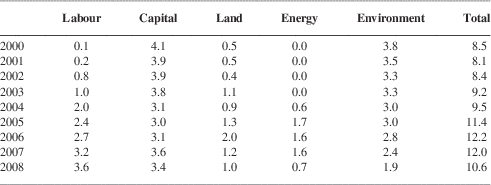
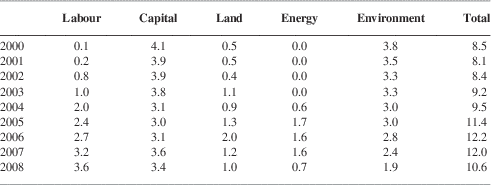
A series of studies conducted by Huang and his colleagues provide crude estimates of factor market distortions in China. For example, HuangFootnote 118 shows that total cost distortions, including labour market distortion (¥411 billion), capital market distortion (¥607 billion), land market distortion (¥120 billion), energy price distortion (¥204 billion), and environmental cost distortion (¥591 billion) (which are beyond the scope of this study), were ¥2,138 billion in 2008, or 7.2% of GDP. The estimated percentages obtained by Huang and Tao, which extend the period to include the nine years from 2000 to 2008, are summarized in Table 1. Although the estimates vary from year to year, the findings are clear: producers in China receive significant subsidies from the rest of the economy, and these subsidies range from 8.1% to 12.2% of GDP.
Estimated factor market distortions in China, 2000–08 (% GDP) (from Huang and Tao, Reference Huang and Tao2010)
China’s investment-driven growth has resulted in developments that are increasingly seen as problematic by both scholars and policy-makers. These developments include environmental degradation,Footnote 119 slower job creation,Footnote 120 urban-rural inequality,Footnote 121 and production capacity overexpansion.Footnote 122 The Solow model shows that, without technological progress, an economy has a limited ability to raise output per capita via capital accumulation. Following the principle of diminishing returns, the impact of capital accumulation on GDP growth will continuously decline. In fact, as Kuijs and WangFootnote 123 have shown, if China’s current economic growth pattern is continued, it will require an investment-to-GDP ratio at an unprecedented level of 55% on average in 2014–24 to maintain GDP growth at 8% per year. It is impossible to finance such a high level of investment in the long run; under these circumstances, the investment-driven economy will ultimately reach a dead end.
5. Concluding Remarks
Scholars have long argued that China is an exception to the so-called “law matters” hypothesis. According to this hypothesis, an effective legal system that reliably protects property rights, enforces contracts, and sustains the operation of the market mechanism is indispensable in pursuing economic prosperity. Most scholars agree that China has realized an economic miracle despite its poor legal system, which features a legislative system in disarray and a weak judiciary. Thus, law has been relatively irrelevant to China’s economic success. In this study, however, it has been shown that the connection between law and China’s economic growth is more complicated than has formerly been elucidated. Current Chinese law and regulations for factor markets are enacted and enforced in such a way that factor prices are low, production and investment are subsidized, and citizens’ welfare and growth sustainability are sacrificed. Therefore, China has become an unbalanced fast-growing economy.
It is fair to say that China’s leadership has realized the necessity and urgency of a transition from an investment-driven growth pattern to a growth path that relies more on expanding domestic consumption. During the past several years, Premier Wen and his government have adopted a wide range of policy measures, including administrative controls, monetary instruments, and fiscal tools that are aimed at adjusting China’s economic structure. However, rebalancing the sources of economic growth has proven to be a much greater challenge than expected. The policy efforts have failed to reverse the overall trend towards a worsening economic structure, and China’s economic growth has become even more imbalanced since 2003. We believe that the most important reason for this is that the majority of the policy measures implemented thus far have not been directed towards the laws and regulations that cause serious factor market distortions, such as interest rate controls, the hukou system, and the land-taking system. Without systematic legal and institutional reform aimed at liberalizing factor markets, and hence setting factor market prices in accordance with relative scarcities and social preferences, China is unlikely to balance its economy.
It is difficult to predict whether systematic reform will be adopted and implemented before the window of opportunity closes. As PeiFootnote 124 argues, China’s gradualist reform strategy allows the ruling elite to protect its rents in vital sectors such as factor markets, and to use the rent to maintain political support among key constituencies. Therefore, any further reform that may reduce economic distortion (and hence economic rents) will undermine the regime’s survival and risk resistance or sabotage by the ruling elite. That is, a rebalancing strategy is economically efficient but politically infeasible. Therefore, political reform, which is a precondition of further economic reform, especially factor market liberalization, is a task that the Party can no longer overlook. However, as NaughtonFootnote 125 has cautioned, given China’s weakly institutionalized political system and a highly contingent and perhaps precarious set of circumstances, only time will tell whether such a political transition will materialize and, if so, what form and cost such measures will take.