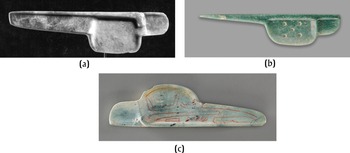
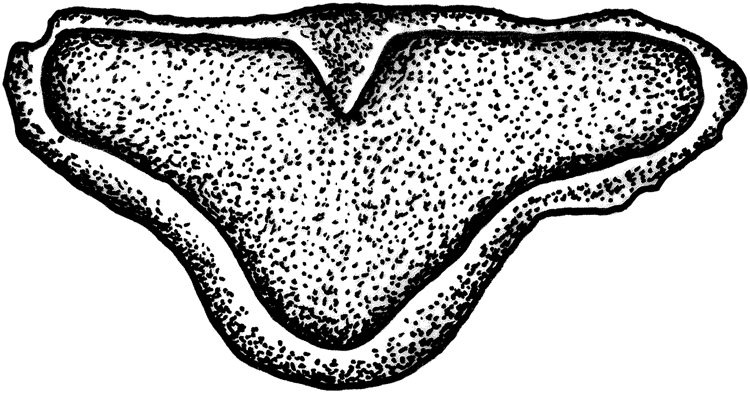
Along with greenstone celts and figurines, jade “spoon” pendants are among the most distinct and recognizable forms of small-scale Olmec sculpture. Although there is ample evidence that they were worn as pendants, the name given to this enigmatic class of objects implies that they also served as instruments or receptacles, an inference based on the bowl-like depression situated toward one end and a long, tapered flange that could have served as a handle (Figure 1). Most previous attempts to understand “spoon” pendants have been framed by hypothetical uses for these objects and have assumed that form followed function or, conversely, that their shape was an abstraction of naturally occurring forms, modified accordingly to fit within the ritual or symbolic context of their presumed usage. Through these lines of inquiry, “spoon” pendants appear as anomalous objects whose cultural relevance did not outlive the Middle Formative period (900–400 b.c.) during which they were produced.
Middle Formative jadeite “spoon” pendants. (a) Ritual spoon pendant (1979.206.1175, Metropolitan Museum of Art, https://www.metmuseum.org/art/collection/search/313337). (b) Spoon pendant (2015.1.8, Yale University Art Gallery; https://artgallery.yale.edu/collections/objects/196655). (c) Spoon pendant with incised bird head (2010.228.7, Yale University Art Gallery, https://artgallery.yale.edu/collections/objects/134480).

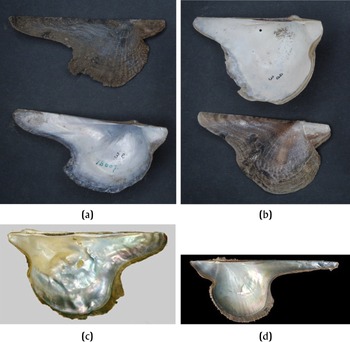
This study departs from previous interpretations of “spoon” pendants by arguing that their distinct form was not designed to serve any particular function, nor was it abstract, but was instead based specifically on the shells of marine bivalves of the genus Pteria (Figure 2). The shells of wing (or winged) oysters, as they are commonly known, are notable not only for their distinct shape, which strongly resembles that of “spoon” pendants, but also for their nacreous interiors and ability to produce iridescent pearls. Further consideration of “spoon” pendants demonstrates that the replication of wing oyster shells in jade by Olmec artists was guided by socially and economically based decisions and conceptual relationships between the precious materials that constituted both types of objects. While the production of “spoon” pendants is firmly based in the Middle Formative period, the multilayered and overlapping meanings embedded in jade, certain types of shell, and pearls, which include relationships to breath, wind, and ancestral power, became firmly entrenched and widespread among later Mesoamerican cultures.
Wing oyster valves. (a) Pteria colymbus (RMNH.MOL.318263, Naturalis Biodiversity Center, https://bioportal.naturalis.nl/multimedia/RMNH.MOL.318263_0/term=Pteria+colymbus&from=4). (b) Pteria colymbus (RMNH.MOL.318257, Naturalis Biodiversity Center, https://bioportal.naturalis.nl/multimedia/RMNH.MOL.318257_0/term=Pteria+colymbus&from=0). (c) Pteria sterna (NMR 82032, Natural History Museum Rotterdam, https://www.nmr-pics.nl/Pteriidae/album/slides/Pteria%20sterna.jpg). (d) Pteria sterna (Worldwide Seashells Collection, http://www.idscaro.net/sci/01_coll/plates/bival/pl_pteriidae_1.htm#apte).

“SPOON” PENDANTS IN CONTEXT
“Spoon” pendants are often made of blue-green jadeite, a material preferred by Middle Formative Olmec artists, and were frequently carved thin to promote translucency. The typical form of a “spoon” pendant is distinct, consisting of a long, straight edge that runs the length of one side, a large, rounded or rectangular concave bulge that protrudes outward in the direction opposite the straight edge and is set off-center, and two tapering flanges of unequal length situated to either side of the bulge (Figure 1a). In some cases, the longer flange is thin and gradually tapers to a point (Figure 1b). The shorter flange also may be concave, and these objects are named for the combination of the larger bowl-like depression and longer flange that putatively served as the handle of the “spoon.” Their use as pendants is affirmed by representations of these objects as worn on the chests of anthropomorphic sculptures and the usual presence of two holes for suspension drilled along the slightly thicker straight edge, which would have caused them to hang horizontally with the “bowl” oriented downward. The rounded “bowl” can be set off-center to either side, and the concave surfaces may be further embellished with incised carving of a variety of subjects including avian, reptilian, and anthropomorphic imagery in Middle Formative Olmec style (Figure 1c). In some cases, three-dimensional carving protrudes from the surface of the “bowl,” effectively preventing or at least hindering possible utilitarian functions.
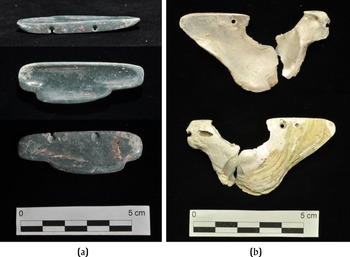
While the carving style and choice of material of “spoon” pendants are based in Middle Formative Olmec canons, relatively few of the known examples have been excavated from Middle Formative contexts. Two small examples were excavated at Chalcatzingo, Morelos (Thomson Reference Thomson and Grove1987:298, Figure 17.5). A jade “spoon” pendant was found with another that seems to have been carved from a river-clam shell (as suggested by the excavators) in Cache 145, dating from around 850–800 b.c., at Ceibal, Guatemala (Figure 3; Inomata et al. Reference Inomata, Pinzón, Palomo, Sharpe, Ortíz, Méndez and Román2017:211, 225; Inomata and Triadan Reference Inomata, Triadan, Golden, Houston and Skidmore2015:79–80). The earlier (1000–850 b.c.) Cache 183 at the same site contained an unfinished “preform” greenstone “spoon” (Inomata et al. Reference Inomata, Pinzón, Palomo, Sharpe, Ortíz, Méndez and Román2017:219, 225, Figure 31). Another greenstone “spoon” from a Middle Formative context was excavated at Ka'Kabish, Belize (Inomata and Triadan Reference Inomata, Triadan, Golden, Houston and Skidmore2015; Lockett-Harris Reference Lockett-Harris, Tremain and Haines2013), and several have been found in Yucatan at the sites of Chacsinkin (Andrews Reference Andrews and Wyllys Andrews1986, Reference Andrews1987), Tipikal (Peraza Lope et al. Reference Lope, Carlos and Ojeda2002:265, Photograph 17), and, most recently, Paso del Macho, where Parker and colleagues (Reference Parker, Bey and Negrón2020) reported a remarkable foundational offering that included six “spoons,” dating to around 750 b.c. Surprisingly, no “spoon” pendants have been excavated from the Gulf Coast Olmec “heartland,” with the exception of a possible broken and reworked example from La Venta, Tabasco identified by Follensbee (Reference Follensbee2008:97; see Drucker et al. Reference Drucker, Heizer and Squier1959:166, Plate 37), and several miniatures from the same site regarded by their excavators as decorative “spangles” once attached to garments (Drucker Reference Drucker1952:170–171, Plate 58; Drucker et al. Reference Drucker, Heizer and Squier1959:147, 149, 166, Plates 28, 37; Follensbee Reference Follensbee2008:99). Many of the looted “spoons” and other Olmec greenstone objects that made their way into museum and private collections in the mid-twentieth century reportedly came from the state of Guerrero, Mexico, particularly the Río Balsas drainage (Coe Reference Coe and Willey1965:745, 766–767; Covarrubias Reference Covarrubias1946:Figure 24; Griffin Reference Griffin and Benson1981:219).
“Spoon” pendants from Cache 145, Ceibal: (a) greenstone pendant and (b) shell pendant. Photographs courtesy of Takeshi Inomata.

Other “spoon” pendants of Olmec manufacture have been recovered in much later deposits, indicating that they were objects valued by later cultures. A “spoon” pendant was found at Uxbenka, Belize near a Classic-period tomb, although its precise context is uncertain (Healy and Awe Reference Healy and Awe2001). Yet another was dredged from the Sacred Cenote of Chichen Itza (Proskouriakoff Reference Proskouriakoff1974:36, Plate 38a7). These finds raise the possibility that they were collected by Classic-period Maya from Middle Formative deposits, or were perhaps kept as heirlooms before their final deposition (Diehl Reference Diehl, Berrin and Fields2010:78–79). Middle Formative Olmec jades, including nearly a dozen “spoon” pendants, have been recovered in Costa Rica, although in much later contexts (Graham Reference Graham and Jones1998:46). One such jadeite “spoon” pendant, reportedly found in Costa Rica's Guanacaste Province, bears an early Mayan hieroglyphic inscription (see section Shell, Breath, and Wind Symbolism in Mesoamerica), indicating that it had been previously owned by a Maya lord before its ultimate deposition (Graham Reference Graham and Jones1998:51–52). Such objects are testaments to the complex life histories that valuable and symbolically potent portable objects can have.
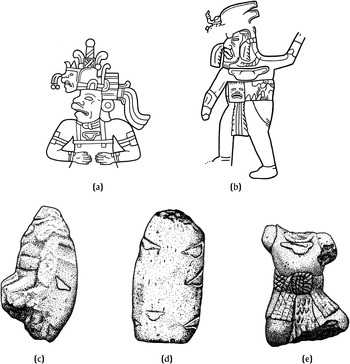
Representations of “spoon” pendants, or objects that share their form, appear on Olmec sculptures of the Early and Middle Formative periods. A Middle Formative monument from San Antonio Suchitepéquez, Guatemala known as the Shook Panel (Figure 4a) shows a supernatural being wearing a “spoon” pendant on the upper chest as a pectoral (Shook and Heizer Reference Shook and Heizer1976). The recently discovered Early Formative Monument 3 from Ojo de Agua, Chiapas (Figure 4b) likewise portrays a “spoon” pendant-shaped object on the chest of a figure with supernatural features, presumably hanging from a cord around the neck (Hodgson et al. Reference Hodgson, Clark and Murrieta2010). Monument 130 from San Lorenzo, Veracruz, and two Early Formative sculptures from the nearby site of Loma del Zapote, Monuments 5 and 11 (Figures 4c–4e), portray “spoon” pendants, or “spoon”-like objects (Cyphers Reference Cyphers, Grove and Joyce1999, Reference Cyphers2004:208–210, 243–244, 256–257; Cyphers Guillén Reference Cyphers Guillén1994). San Lorenzo Monument 130 and Loma del Zapote Monument 11 (Figure 4e) bear clear representations of “spoon”-shaped pectorals on their upper chests. Loma del Zapote Monument 5 (Figures 4c and 4d), a battered kneeling or seated figure, wears a round pectoral and a cape that is decorated with seven “spoon” pendant-shaped silhouettes. These forms, likely intended to be read as having been sewn onto the garment, immediately recall the “spangles” of similar shape found at La Venta, although in larger scale. What is particularly intriguing about the appearance of “spoon” pendant-shaped objects on the San Lorenzo and Loma del Zapote monuments is the scarcity of jadeite and greenstone objects at San Lorenzo (Coe and Diehl Reference Coe and Diehl1980:232–259), and the lack of jadeite “spoon” pendants from any known Early Formative context. This discrepancy raises the question of whether the monuments were meant to portray actual jadeite pendants or objects similar in form but made of different material.
Middle and Early Formative Olmec sculptures of anthropomorphic figures wearing “spoon”-shaped ornaments. (a) Detail of Shook Panel. Drawing by the author after Shook and Heizer (Reference Shook and Heizer1976:Figure 1). (b) Detail of Ojo de Agua Monument 3. Drawing by the author after Hodgson et al. (Reference Hodgson, Clark and Murrieta2010:Figure 3). (c) Side view of Loma del Zapote Monument 5. Drawing by the author after Cyphers (Reference Cyphers2004:Figure 160). (d) Back view of Loma del Zapote Monument 5. Drawing by the author after Cyphers (Reference Cyphers2004:Figure 160). (e) Loma del Zapote Monument 11. Drawing by the author after Cyphers (Reference Cyphers2004:Figure 172).

PREVIOUS INTERPRETATIONS OF FORM AND FUNCTION
Most interpretations of “spoon” pendants have attempted to determine their possible function before addressing what their unique form might represent. Furst (Reference Furst and Benson1968) suggested that the pendants in question were used in shamanic ceremonies to inhale hallucinogenic snuff. Although Furst's argument was based on ethnographic analogy drawn from contemporary Amazonian cultures, his interpretation nonetheless gained widespread acceptance among scholars. For Furst, these objects fit within a scheme that he presented in which Olmec rulership was based on shamanic power, which has since served as a dominant paradigm through which the Olmecs and their artwork have been interpreted. Others have suggested that the concave depressions on these objects may have been used to collect sacrificial blood drawn during bloodletting ceremonies (Griffin Reference Griffin and Benson1981:219; Joralemon Reference Joralemon, Benson and de la Fuente1996:256). Drawing an analogy to shell paint palettes used and often worn by Classic Maya scribes, Kerr (Reference Kerr1994) argued that “spoon” pendants may have served the same scribal function. More recently, Follensbee (Reference Follensbee2008:96–99, Reference Follensbee, Scher and Follensbee2017:108–111) presented a case for their possible use as high-status weaving implements, referring to them as “‘spoon’ battens,” and suggesting that they could have been worn as pectorals that marked gender or exceptional skill at the loom.
Interpretations of what “spoon” pendants may represent have tended to be shaped by the hypothetical functions that have been ascribed to them. For Furst (Reference Furst and Benson1968:162), “spoon” pendants used for ingesting hallucinogenic substances fittingly represented the outlines of stylized birds, which he associates with shamanic transformation and ecstatic flight. Pohorilenko (Reference Pohorilenko1972:38–39, Reference Pohorilenko and Benson1981:311–314, Reference Pohorilenko, Benson and de la Fuente1996:129) read the basic shape of a “spoon” pendant as that of a tadpole (“atepocate”), with a bulbous body and a long tapering tail. Drawing on Pohorilenko's interpretation, Tate (Reference Tate2012:43–44) acknowledges their resemblance to tadpoles and relates the forms of both “spoons” and tadpoles to human embryos in the third week of development. She incorporates Follensbee's (Reference Follensbee2008) proposal that “spoons” functioned as weaving implements, and draws in later Mesoamerican analogies between weaving and gestation as further evidence to support her claim. These interpretations are unsatisfactory for several reasons. First, the general resemblance of a presumably abstracted form to a specific referent (birds, tadpoles, or human embryos) relies primarily on the investigator's subjective reading of the shape in silhouette. Second, the incised or sculpted embellishments on the surfaces of the pendants do not weigh favorably toward any particular interpretation, as a variety of subject matter, including birds, reptiles, and anthropomorphic beings, was cleverly employed by carvers to make use of the fairly standard contours of these objects. Finally, in these cases, possible but unverified interpretations of the functions of these objects as snuff trays and weaving implements frame the interpretations of the symbolic form and associated incised or carved imagery. These arguments tend toward circularity, as the presumed function of the object dictates the interpretation of its imagery, and the interpretation is then used as evidence in support of the presumed function.
While other uses cannot be ruled out, what can be stated with certainty is that Olmec “spoon” pendants were worn as ornaments, based on their usual drilled holes for suspension and their representation on carved monuments, and that many were eventually cached in offerings and burials. Houston (Reference Houston, Finamore and Houston2010:78) has noted that, both in terms of use and form, “spoon” pendants may be conceptual antecedents to T-shaped Classic Maya jade pectorals, a comparison also made in other recent studies (Azarova Reference Azarova2016; Braswell Reference Braswell2017:79; Prager and Braswell Reference Prager and Braswell2016:268). Frequently appearing in Classic Maya art, jade T-shaped pectorals embody the Maya symbol for wind and breath, ik’ (Taube Reference Taube2005:32). Stela 15 (Figure 5b) and Stela 2 of Nim li Punit, Belize, dating respectively to a.d. 721 and 731, portray a ruler who actually may wear the same jade ik’ pectoral (Figure 5a) recovered in a Terminal Classic tomb (Prager and Braswell Reference Prager and Braswell2016). Like Olmec “spoon” pendants found in later contexts, the Nim li Punit ik’ pectoral was kept for generations before its final burial. Ik’ pectorals are also worn by dynastic ancestors in representations, such as those that appear on the sides of Pakal's sarcophagus at Palenque (Figure 5c). If Olmec “spoon” pendants were precursors to Maya ik’ pectorals, they may be linked to broader domains of Mesoamerican breath, wind, and jade symbolism (Taube Reference Taube, Fields and Zamudio-Taylor2001, Reference Taube2005).
Classic Maya ik’ pectorals. (a) Jadeite pectoral from Nim li Punit. Drawing by the author after Prager and Braswell (Reference Prager and Braswell2016:Figure 7a). (b) Detail of Nim li Punit Stela 15. Drawing by the author after Prager and Braswell (Reference Prager and Braswell2016:Figure 8). (c) Detail of ancestral figure on the side of Pakal's sarcophagus from Palenque. Drawing by the author after Robertson (Reference Robertson1983:Figure 190).

“SPOON” PENDANTS AND MARINE SHELLS
In a pioneering study of Olmec art, Covarrubias (Reference Covarrubias1946:172) noted that, like other types of jadeite pendants shaped more recognizably as clamshells, the form of “spoon” pendants also could be based on shells. In descriptions of three Early Formative Olmec sculptures, Cyphers (Reference Cyphers2004:209, 243–244, 246) likewise refers to similarly shaped pendants worn by carved figures on San Lorenzo Monument 130 and Loma del Zapote Monuments 5 and 11 (Figures 4c–4e) as valvas de almeja (“clamshells”). According to Griffin (Reference Griffin and Benson1981:219), the form of the “spoon” is that of “a razor-clam shell with a bulge,” an assertion more reservedly echoed by Follensbee (Reference Follensbee2008:101). What likely suggested to Covarrubias and others that “spoon” pendants represent bivalve shells was the rounded concave form that Furst and others view as a receptacle for powdered or liquid substances, the raised, hinge-like ledge that often borders the upper edge of the concavity, and a possible analogy to other Olmec jade pendants that more faithfully replicate the valves of clams as they occur in nature (Drucker Reference Drucker1952:163, Plate 53). The question that casts uncertainty on these interpretations is why Olmec artists would so closely replicate clamshells in the form of jade pendants on some occasions and so drastically alter their forms on others. The form of the “spoon” pendant presents a radical departure from the basic petaloid shape of most clam valves, and bears little resemblance to the typical elongated rectangular or elliptical silhouette of razor clam shells. If “spoon” pendants do directly represent shells in a manner that is closely inspired by naturally occurring forms, the correct type has not been convincingly identified.
Based on the hinge-like features and internal contours of many “spoon” pendants, it does appear more likely that their form is based on bivalve shells than other interpretations that have been proposed. While there is no particular species of clam that these objects resemble, they are remarkably similar to two species of marine wing oyster that are found on either coast of Mesoamerica. Bivalve shells of the genus Pteria are recognizable by their distinct elongated, tapering asymmetrical auricles (or “ears”) that extend to either side of the mantle cavity along a straight, elongated hinge (Figure 2). Thus, the general form and interior contours of the pendants in question appear to faithfully mimic those of Pteria shells. Shell morphology varies and changes throughout the life of the individual wing oyster and the longer anterior auricle of some specimens may even taper to a point (Figure 2d), similar to some Olmec pendants (Figure 1b). The fact that the “bowl” of a “spoon” pendant can appear off-center to either side is further evidence that they represent shells, as they could be based on either the right of left valve of a wing oyster. The Pacific Wing Oyster, Pteria sterna, reaches a length of 10 cm (Keen Reference A. Myra1971:77), roughly the size of a typical “spoon” pendant, whereas the Atlantic Wing Oyster, Pteria colymbus, is slightly smaller than its Pacific counterpart (García-Cubas and Reguero Reference García-Cubas and Reguero2007:31). Both species live close to shore on rock ledges in shallow water and would have been relatively easy to harvest, especially compared to other valued shells, such as Spondylus, that were collected in great numbers in pre-Hispanic times (Donkin Reference Donkin1998:300). Pteria valves are also notable for their nacreous iridescent interiors, a characteristic that was conceivably replicated by the highly polished concave surfaces of “spoon” pendants that faced outward when worn. Rather than stylized clams, birds, tadpoles, or embryos, so-called Olmec “spoon” pendants appear to be fairly naturalistic, if not slightly idealized, representations of iridescent wing oyster shells rendered in lustrous greenstone.
Although relatively rare, worked and unworked Pteria valves have been documented in excavations. A Pteria colymbus shell was found in the Middle Formative Tomb 1 in Mound 11 of Chiapa de Corzo, Chiapas (Velázquez Castro et al. Reference Velázquez Castro, Maldonado and Lowe2015:128). Also of note, the tomb's primary occupant wore a necklace composed of seventeen “hinged” jade clam shell pendants, similar to the pendant found at La Venta, spaced with nearly 1,000 spheroid beads (Bachand and Lowe Reference Bachand, Lowe, Lowe and Pye2012:54). At Dzibilchaltun, Yucatan, an unworked Pteria colymbus shell was found in an unstratified deposit (Andrews Reference Andrews1969:24, Plate 14f). In Classic Maya contexts, a Pteria shell was found in Cache 175 at Tikal, Guatemala (Moholy-Nagy Reference Moholy-Nagy2008:Figure 174i), and 209 ornaments made from the nacreous shells of Pteria colymbus have been identified at Jaina, Campeche (Valentín Maldonado et al. Reference Valentín Maldonado, Hernández, Castro and Cossio2018:53). Given the scarcity of objects of jadeite and greenstone at Early Formative San Lorenzo, it is reasonable to assume that the figures represented in San Lorenzo Monument 130 and Loma del Zapote Monuments 5 and 11 (Figures 4c–4e) were understood to have worn actual Pteria shells rather than those later rendered in jadeite.
The shells of a closely related genus, Pinctada (the pearl oyster, represented by P. mazatlanica in the Pacific and P. imbricata and P. radiata in the Atlantic), have been identified in archaeological deposits far more frequently than those of Pteria (Donkin Reference Donkin1998:300), but nonetheless demonstrate that nacreous marine shell was both highly prized and widely exchanged in Formative-period Mesoamerica. Pinctada mazatlanica shells are among the most common species identified at Early Formative sites in the Valley of Oaxaca, including Abasolo, San José Mogote, and Tierras Largas, and the Pacific Coast sites Laguna Zope, La Victoria, and Salinas la Blanca, and continued to be an important raw material at Middle Formative Zacatenco and Tlatilco, in the Valley of Mexico, and Nexpa, Morelos (Feldman Reference Feldman and Hammond1974:131; Pires-Ferreira Reference Pires-Ferreira and Flannery1976:312–313, Reference Pires-Ferreira and Browman1978:80–81, 83). The Olmec site of Teopantecuanitlan, Guerrero, located strategically near the Río Balsas drainage, appears to have played a major role in both the importation of nacreous shell and the production of finished ornaments (Martínez Donjuan and Solís Ciriaco Reference Martínez Donjuan, Solís Ciriaco, Castro, Tízoc and Gastélum2011; Niederberger Reference Niederberger, Niederberger and Robles2002). In Teopantecuanitlan's Lomeríos Group, a residential workshop, Pinctada mazatlanica accounted for 78 percent of shell fragments collected (Niederberger Reference Niederberger, Niederberger and Robles2002:194). From Teopantecuanitlan, unworked shells and finished mother-of-pearl ornaments likely traveled via trade routes to distant locations such as Tlatilco and Tlapacoya, in the Basin of Mexico (Niederberger Reference Niederberger, Niederberger and Robles2002:196). It should also be recalled that several looted “spoon” pendants were reportedly found near the Río Balsas drainage of Guerrero (Coe Reference Coe and Willey1965:745, 766–767; Covarrubias Reference Covarrubias1946:Figure 24; Griffin Reference Griffin and Benson1981:219).
Although both were likely prized for their nacreous interiors, there are several factors that may account for the lesser archaeological distribution of Pteria shell in comparison to Pinctada. Pteria shells are thin and brittle (Keen Reference A. Myra1971:77), and are thus less conducive to preservation. Pinctada, on the other hand, was likely favored as a material for making mother-of-pearl ornaments and mosaics because the thicker shell better lent itself to being worked, and provided greater usable and workable surface area (Pires-Ferreira Reference Pires-Ferreira and Flannery1976:312–313, Reference Pires-Ferreira and Browman1978:84–85). It is also possible that Pteria are underrepresented because fragmentary or poorly preserved valves have been misidentified as Pinctada.
“Spoon pendant” is an inaccurate and misleading title for objects that had no certain utilitarian function and only superficially resemble the utensils for which they are named. Although somewhat rare in archaeological contexts, there is evidence that wing oyster shells of the genus Pteria were collected, imported, cached, and displayed as ornamentation from the Formative through Classic periods. Based on their distinct resemblance to these shells, I propose replacing “spoon pendant” with “wing oyster pendant” as a more appropriate term for the objects in question. While addressing the question of what these objects represent rather than what possible functions they might have served (beyond their use as pendants) appears to be a more productive approach, it does not resolve the issue of why artists so frequently reproduced them and other types of shells as jade pendants. Although their fragility and relative rarity may have been practical concerns that led to the reproduction of Pteria valves in jade and other materials, there are several probable motivations, discussed below, that inspired Middle Formative artists to make wing oyster pendants.
SKEUOMORPHS AND SHELLS
Archaeologists have long been fascinated by the transfer of forms and embellishment across objects made of different materials (Houston Reference Houston2014:51–66). Intrigued by once utilitarian features that are retained as decoration as new technologies or materials render them otherwise non-functional, Colley March (Reference Colley March1889:166) coined the term “skeuomorph,” based on the Greek term for “tackle, tools, vessels, equipment, dress,” to contrast such forms of decoration composed of animal-shaped zoomorphs or plant-shaped phyllomorphs. For Colley March and his peers, decorative skeuomorphs were akin to a vestigial residue left over as technological advancement outpaced style in a Darwinian progression (Frieman Reference Frieman and Card2013:319; Houston Reference Houston2014:52). Modern definitions of skeuomorphism extend beyond decoration to include objects in which the entire form resembles an object made of a different material. Among ancient skeuomorphs, ceramic vessels that were made to resemble counterparts of fiber, wood, leather, metal, and other materials, have been of particular interest to archaeologists as evidence for reconstructing prototypes that no longer exist and understanding how new technologies are adopted (Hurcombe Reference Hurcombe2008; Manby Reference Manby, Kinnes and Varndell1995; Vickers Reference Vickers, McGovern, Notis and David Kingery1989). While such studies may serve as a productive counterbalance against an archaeological record weighted heavily in favor of more durable materials, it is important to note that skeuomorphic objects do not inevitably replace the prototypes that they reference. In ancient Mesoamerica, for example, the production and use of vessels of gourd, wood, and basketry continued alongside those of ceramic skeuomorphs for millennia.
The study of skeuomorphs has generated several compelling hypotheses to explain why such objects are made. One especially productive line of inquiry addresses how shifts in material affect value. In broad terms, remaking an esteemed form may elevate the value of a new material or a familiar material of lesser worth (Vickers Reference Vickers, McGovern, Notis and David Kingery1989; Vickers and Gill Reference Vickers and Gill1994), or the use of a valued material may mark an object as distinct among other similar objects made of less-valued materials (Houston Reference Houston2014:65–66). In a similar vein, some scholars have argued that skeuomorphs may have recalled established technologies in order to help new technologies or materials gain acceptance (Blitz Reference Blitz2015; Taylor Reference Taylor, Young, Mark Pollard, Budd and Ixer1999). Although perhaps not central to their arguments, early theorists of skeuomorphism recognized an ancient tendency to replicate prototypes in more durable material, which in particular seems to have been a driving force in the production of skeuomorphs among the Classic Maya (Houston Reference Houston2014:54). The desire to imbue forms with greater permanency may carry both practical and symbolic implications (Houston Reference Houston2014:60–61). Houston adds “claimed transubstantiation” to the list of possible motivations, in which by magical means, the material of a copy is changed but “the essential substance remains the same” (Houston Reference Houston2014:58). While each explanation given for the production of skeuomorphs informs the decision-making process, no single motive can account for their cross-cultural prevalence. A combination of factors may contribute to their production in a single instance (Blitz Reference Blitz2015; Frieman Reference Frieman and Card2013; Houston Reference Houston2014:68–73; Hurcombe Reference Hurcombe2008), and specific motivations can only be understood through consideration of the social contexts in which skeuomorphs were produced and used (Frieman Reference Frieman and Card2013; Houston Reference Houston2014:68).
If so-called Olmec “spoon” pendants can be considered more appropriately pectorals that replicate the form of a specific type of marine shell, they and other similar shell-shaped ornaments present an intriguing case for the study of ancient skeuomorphs. A minor point is that shell-shaped pendants are only narrowly definable as skeuomorphs; they could be classified as zoomorphs, except for the small drilled holes that mark them as ornaments intended to be worn. Similar shell pendants made from materials other than jade add further complication to what would otherwise be a straightforward case of material transfer. At the site of Puerto Escondido, Honduras, a ceramic shell-shaped pendant (Figure 6) was found in deposits that included Early Formative Olmec-style materials (Joyce and Henderson Reference Joyce and Henderson2010:193). The elongated auricles along its “hinge” suggest that the ceramic pendant may have represented a Pteria valve, perhaps reflecting an early effort to recreate this type of shell in a more durable or readily available material. The aforementioned Cache 145 from Ceibal (Figure 3), dated from 850–800 b.c., contained a greenstone pendant and a possible river-clam shell (Inomata and Triadan Reference Inomata, Triadan, Golden, Houston and Skidmore2015:79–80; Inomata et al. Reference Inomata, Pinzón, Palomo, Sharpe, Ortíz, Méndez and Román2017:211, 225), both carved to resemble Pteria shells. The pairing of two objects that share similar form but are carved of two different materials suggests a complementary relationship between greenstone and shell. Although more secure identification of the type of shell found in the cache could provide further resolution, the possible modification of one type of shell to resemble another is compelling. Like Pteria, the shell from Cache 145 appears to have a nacreous interior. If both a Pteria shell and that of the putative river clam were understood to be composed of the same material (but differing in origin and perhaps quality or value), this particular example is something other than a skeuomorph. Was this an “imitation” Pteria shell pendant created to deceive, or did it essentially become a Pteria shell pendant through its shared material substance and appearance after its form had been modified?
Ceramic shell-shaped pendant from Puerto Escondido, Honduras. Drawing by the author after Joyce and Henderson (Reference Joyce and Henderson2010:Figure 6).

Based on shared qualities and symbolic associations that are further discussed in this study, I argue that there was a certain material equivalence between jade and nacreous shell for Middle Formative Olmecs that became widely recognized in Mesoamerica, and in some contexts, the two materials were interchangeable. The qualities shared by these materials provided a field in which forms could be transferred between them, but other conditions were necessary to drive these exchanges and determine their direction. For Middle Formative Olmecs, the brittleness of Pteria valves was probably a factor that led artists to reproduce wing oyster pendants in durable jadeite and other types of greenstone. Value was almost certainly an important consideration as well. Although both Pteria shell and jade were rare, imported materials, the value of a piece of jade was augmented by the considerable labor and specialized skill necessary to transform it into a shell-shaped pendant as well as the impression such a transformed object might make on viewers. Citing economic competition among burgeoning Late Classic Maya courts as an example, Houston (Reference Houston2014:66) suggests that skeuomorphs often come about during times of social change. The Middle Formative period marks significant shifts in power structures with the collapse of San Lorenzo, the rise of La Venta and other sites, and the advent of new subsistence patterns, art styles, and exchange networks. Taube (Reference Taube1996, Reference Taube, Clark and Pye2000) argues that, within this social context, the Middle Formative Olmec introduced a value system that linked exotic materials such as jadeite and the iridescent green tail feathers of the male quetzal to a new set of rituals and symbolism that accompanied the adoption of maize agriculture as a source of elite power. This palpable shift in value also may have driven the reproduction of pectorals of Pteria and other nacreous and reflective shells as jadeite ornaments. Arguably, for jade to be considered the ideal material in which to produce shell skeuomorphs, the inherent symbolic associations of jade as a material required conceptual expansion in order to overlap with those of shell, or vice versa. Understanding the perceived relationships between these two materials, which likely originated in the Middle Formative period, requires a broader consideration of the shared symbolism of jade and shell in Mesoamerica.
SHELL, BREATH, AND WIND SYMBOLISM IN MESOAMERICA
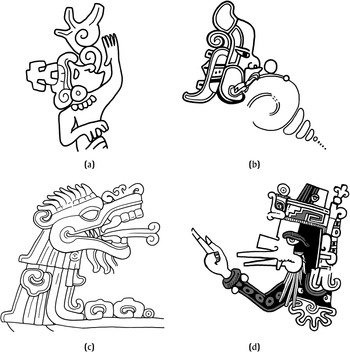
Symbolic meanings pertaining to shells are particularly rich and multilayered in Mesoamerica, and the relationship of breath and wind to marine shells, especially conchs, is remarkably widespread. Kaminaljuyu Stela 9 (Figure 7a), dating to the Late Preclassic period, portrays a conch as the spiraling breath or speech of an anthropomorphic figure (Houston and Taube Reference Houston and Taube2000:265), a convention that also appears on a slightly later portrayal of the Maya Maize God on the North Wall Mural of San Bartolo (Figure 7b; Houston and Taube Reference Houston, Taube, Isendahl and Persson2011:22; Saturno et al. Reference Saturno, Taube and Stuart2005:7–8). These examples provide an early basis for a widespread association of breath, wind, music, and spiraling shells as conch trumpets in Mesoamerica (Saturno et al. Reference Saturno, Taube and Stuart2005:8; Taube Reference Taube, Fields and Zamudio-Taylor2001:112; Zender Reference Zender, Finamore and Houston2010). The symbolic relationship between shell and breath is especially prevalent in Classic Maya art, often appearing as cross-sectioned conch shells on the snout of the earth crocodile or exhaled from the corners of its mouth (Houston and Taube Reference Houston, Taube, Isendahl and Persson2011:22). A jade burial mask from Calakmul has breath elements made of actual shell escaping from corners of the mouth and nose (Houston and Taube Reference Houston and Taube2000:270; Taube Reference Taube2005:32).
Breath and wind as conch shells. (a) Detail of Kaminaljuyu Stela 9. Drawing by the author after Houston and Taube (Reference Houston and Taube2000:Figure 2d). (b) Detail of North Wall Mural, San Bartolo. Drawing by the author after Saturno et al. (Reference Saturno, Taube and Stuart2005:Figure 8a). (c) Detail of feathered serpent with cross-sectioned conch shells, Pyramid of the Plumed Serpents, Xochicalco. Drawing by the author. (d) Detail of Codex Borgia, page 19, showing Ehecatl-Quetzalcoatl wearing an ehecacozcatl cut-conch wind jewel and an epcololli ear ornament. Drawing by the author after Códice Borgia (1992:19).

In central Mexico, the intersections between shell, breath, and wind are explicit in artistic representations and symbolism. The Epiclassic (a.d. 600–900) façade of the Pyramid of the Plumed Serpents at Xochicalco, Morelos, portrays undulating feathered serpents carrying seated lords. Cross-sectioned conch shells nested among the long quetzal feathers on the bodies of the serpents denote these beings as manifestations of wind (Figure 7c). Sectioned conch shells later appear as the ehecacozcatl wind jewel worn on the chest of Ehecatl-Quetzalcoatl, the Late Postclassic central Mexican god of wind (Figure 7d; Taube Reference Taube, Fields and Zamudio-Taylor2001:111–112). The ehecacozcatl appears to have been made from non-nacreous shells of Strombus gigas, Pleuroploca gigantea, or Turbinella angulata (Suárez Diez Reference Suárez Diez2011:28; Velázquez Castro Reference Velázquez Castro1999:70–71), whereas recovered examples of the curving epcololli ear ornaments (also worn by the central Mexican wind god and other closely related deities) from the Templo Mayor are made of nacreous Pinctada mazatlanica valves (Figure 7d; Suárez Diez Reference Suárez Diez2011:30; Velázquez Castro et al. Reference Velázquez Castro, Arellano and Maldonado2017:Figure 3a).
For the Maya, the T-shaped ik’ symbol serves as a glyph in writing, and as the day sign “wind” in the 260-day calendar, and appears in art in such contexts as the ear ornaments of the Classic Maya wind deity (Taube Reference Taube, Fields and Zamudio-Taylor2001:109). Worn on the chest and symbolizing vital breath, jade ik’-shaped pectorals are analogous to the cut conch wind jewels of central Mexico (Prager and Braswell Reference Prager and Braswell2016:268). One of the earliest occurrences of the ik’ symbol appears superimposed on the mouth of a being that exhales breathy volutes on the Late Preclassic Altar 14 from Kaminaljuyu (Figure 8a; Houston and Taube Reference Houston and Taube2000:267–270). This early example demonstrates that the ik’ symbol signified breath and wind prior to its widespread use by Maya scribes, and strengthens the possible relationship between the symbol's form and that of the Middle Formative Olmec pendants discussed in this paper, as suggested in recent studies (Azarova Reference Azarova2016; Braswell Reference Braswell2017:79; Houston Reference Houston, Finamore and Houston2010:78; Prager and Braswell Reference Prager and Braswell2016:268).
The T-shaped ik’ sign. (a) Detail of Altar 14 from Kaminaljuyu portraying an anthropomorphic being with an ik’ sign and breath volutes. Drawing by the author after Houston and Taube (Reference Houston and Taube2000:Figure 5a). (b) Detail of jade ornament in the form of a shell with ik’-shaped perforation from the Sacred Cenote, Chichen Itza. Drawing by the author after Proskouriakoff (Reference Proskouriakoff1974:Plate 64b). (c) Wing oyster pendant with Mayan inscription, found in Costa Rica. Drawing by the author after Mora-Marín (Reference Mora-Marín, Jones and Jones1997:Figure 5.) (d) Detail of ik’-based glyph from Figure 8c.

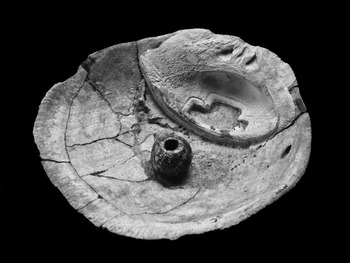
Beyond a broader Mesoamerican domain of breath and shell symbolism, Maya artists directly associated the ik’ symbol with nacreous and non-nacreous shells. The probable burial of Ruler 4 of Piedras Negras, Burial 13, contained a shell pectoral with an ik’ symbol carved in its interior, exemplifying the association of bivalve shells with breath and wind (Figure 9; Houston et al. Reference Houston, Escobedo, Scherer, Child, Fitzsimmons, Ruiz, Ruz Sosa and Ponce de Leon2003:131–132; Houston and Taube Reference Houston, Taube, Isendahl and Persson2011:25). Adding to this symbolic complex, a jade pectoral in the form of a bivalve shell that is pierced with an ik’ symbol (Figure 8b), dredged from the Sacred Cenote of Chichen Itza, links both jade and shell to breath and wind. Hammond and colleagues (Reference Hammond, Clarke and Belli1992:960) note the resemblance of a Middle Preclassic blue jadeite shell-shaped pectoral from Cuello, Belize, to the ik’ symbol, likely exemplifying an early acknowledgement of the relationship between breath, jade, and shell. The aforementioned Olmec wing oyster pendant that later turned up in Costa Rica bears a Mayan text that incorporates an ik’ sign (Figures 8c and 8d), suggesting that the scribe who carved it recognized the relationship between that particular object and breath and wind (Houston Reference Houston, Finamore and Houston2010:78). These examples suggest that the Olmec pendants were indeed considered ancestral to the ik’ pectorals of the Classic Maya, and that T-shaped Pteria shells likewise may have been associated with breath and wind by the Olmec artists who replicated their form as jade pendants.
Shell with carved ik’ sign and jade bead from the probable tomb of Ruler 4 (Burial 13), Piedras Negras, excavated by Héctor Escobedo de Ayala, Proyecto Arqueológico Piedras Negras. Photograph by Jorge Pérez de Lara, courtesy of Stephen Houston.

JADE, SHELL, AND PEARLS
Despite earlier efforts to make shell pendants in other materials, such as the ceramic example from Puerto Escondido, Honduras (Figure 6), jade seems to have become and remained the favored material for artistic recreation of shells. The distinct luster of polished jade carried divine connotations and probably served as a fundamental basis of comparison with the reflective interiors of certain types of shell. In fact, scholars have related Olmec jadeite “clamshell” pendants to obsidian and pyrite mirrors, referring to them as “symbolic representations of mirrors” (Andrews Reference Andrews1987:80) or, in the case of the Middle Preclassic example from Cuello, “a blue jade mirror-skeuomorph” (Hammond Reference Hammond, Grove and Joyce1999:52). Classic Maya artists overcame the challenge of how to pictorially convey the gleaming surfaces of jade by denoting them with two parallel curving lines (Schele and Miller Reference Schele and Miller1986:43). This convention also appears in the luminous eyes of diurnal solar deities (Taube Reference Taube, Gallaga M. and Blainey2016:290), as well as the celt-shaped “god markings” that adorn the bodies of certain Maya supernatural beings (Coe Reference Coe1973:13). Such god markings are arguably rooted in Middle Formative Olmec artistic traditions, appearing as celts lashed to the wrists and upper arms of the being on the Shook Panel (Figure 4a), among other examples (Taube Reference Taube1996:50). According to Stuart (Reference Stuart, Guernsey, Clark and Arroyo2010:291), a Classic Maya personification of the brilliant quality of polished stone appears as an “animate mirror” that he terms the “shiner.” The shiner is distinct, though similar to the personified face of sacrality, k'uh (Houston Reference Houston2014:92), suggesting that shining surfaces also may have signaled divinity. The divine reflectivity of polished jade may have been considered inherent to iridescent shells such as Pteria and Pinctada, but also likely encompassed the gleaming interiors of other types of valued shells, such as Spondylus and conch, within a spectrum of luminosity, especially among the Maya and later cultures of central Mexico.
An essential characteristic of Pteria and Pinctada that likely attracted the attention of ancient Mesoamerican shell collectors is their ability to produce iridescent pearls. All bivalves can form pearls, although only those with an inner shell layer of mother-of-pearl, such as Pteria and Pinctada, are capable of producing nacreous pearls (Gosling Reference Gosling2015:21–22). In contrast, bivalves with porcellaneous inner shells, such as Spondylus, produce pearls that are white and crystalline in appearance, but lack iridescent qualities. Unfortunately, the extent of ancient Mesoamerican pearl usage cannot be estimated accurately due to a tendency toward poor archaeological preservation. Consisting of primarily calcium carbonate, pearls are especially vulnerable to mineral, organic, and atmospheric acids, and their high water content renders them prone to destruction through desiccation (Andrews Reference Andrews1969:108; Donkin Reference Donkin1998:37; Ruz Lhuillier Reference Ruz Lhuillier1973:200).
Although they are inherently perishable, pearls have been found in some of the major Mesoamerican excavations of the last century. Pearls have been found in dedicatory caches at sites including Cerro de las Mesas (Stirling Reference Stirling1941:286), Copan (Longyear Reference Longyear1952:111), Palenque (Ruz Lhuillier Reference Ruz Lhuillier1973:151, 158), and Piedras Negras (Coe Reference Coe1959:82, 88), and in high-status burials at Altun Ha (Pendergast Reference Pendergast1965), Chichen Itza (Thompson and Thompson Reference Thompson and Thompson1938:53), Copan (Bell Reference Bell2007:216–218, 401, 416; Longyear Reference Longyear1952:43), El Zotz (Newman et al. Reference Newman, Houston, Garrison, Román, Houston, Newman, Román and Garrison2015:164), Kaminaljuyu (Kidder et al. Reference Kidder, Jennings and Shook1946:152), Monte Albán (Caso Reference Caso1969:159–160), Palenque (Ruz Lhuillier Reference Ruz Lhuillier1973:200), Tikal (Moholy-Nagy Reference Moholy-Nagy2008:33, 49–50), and Uaxactun (Kidder Reference Kidder1947:67). Particularly prominent examples include the pearls that were incorporated into Pakal's ear ornaments at Palenque (Ruz Lhuillier Reference Ruz Lhuillier1973:200), and the more than 2,000 pearls found in the Late Postclassic Tomb 7 of Monte Albán (Caso Reference Caso1969:159). Surprisingly, these finds seldom receive more than brief mention, and central questions regarding the procurement, value, and cultural meanings of pearls in Mesoamerica have not been explored thoroughly.
In some instances, objects of jade or greenstone appear to substitute for pearls. “Spondylus caches,” occasionally found in Classic Maya dedicatory offerings and burials, typically consist of a pair of Spondylus valves, placed lip to lip, that contain jadeite objects including figurines, masks, and plaques (Chase and Chase Reference Chase, Chase and Houston1998:315; Gann and Gann Reference Gann and Gann1939:52; Taube Reference Taube, Finamore and Houston2010), or most often, one or more pierced jade beads (Coe Reference Coe1959:82, 88; Miller and Martin Reference Miller and Martin2004:119). As Scherer (Reference Scherer2015:113) suggests, “the placement of jade beads within Spondylus may have been inspired by the Maya's observation of pearls occasionally found within mollusk shells.” To follow this observation further, the paired valves in Spondylus caches may substitute for nacreous shells, and a material equivalence between jade and pearls is implied by their contents. The comparison and interchangeability between jade beads and pearls are affirmed by the occurrence of actual pearls found in Spondylus caches at Copan, Palenque, and Tikal (Andrews Reference Andrews1969:108; Longyear Reference Longyear1952:111; Moholy-Nagy Reference Moholy-Nagy2008:32; Ruz Lhuillier Reference Ruz Lhuillier1973:158), and four blister pearls and a jadeite pendant found together in a Spondylus cache at Pusilha (Gruning Reference Gruning1930:483, Plate XXI). Like Spondylus caches, the shell found in Burial 14 of Piedras Negras with a carved ik’ sign also contained a jade bead (Figure 9; Houston et al. Reference Houston, Escobedo, Scherer, Child, Fitzsimmons, Ruiz, Ruz Sosa and Ponce de Leon2003:132). An articulated pair of Spondylus valves containing two greenstone beads was found in Offering 41 at the foot of the Aztec Templo Mayor (López Luján Reference López Luján, de Montellano and de Montellano1994:411; Matos Moctezuma Reference Matos Moctezuma1988:Figure 104), demonstrating that the significance of Spondylus caches extended well beyond Classic Maya ritual practice (Taube Reference Taube, Finamore and Houston2010).
Descriptions of valuable raw materials in Book 11 of the Florentine Codex (Sahagún Reference Sahagún, Anderson and Dibble1950–1982:bk. 11) relate pearls and nacreous shells to other precious materials, including jade, in much the same way that Spondylus caches do. The term quetzalli (“quetzal feather,” “precious”) is often used to describe precious stones as well as pearls and nacreous shells, evoking not only the green color of quetzal plumes, but also likely the iridescent qualities that these materials share. For example, the authors describe quetzalchalchiuhuitl, a particular type of jade, in the following manner:
The name of this comes from quetzalli [quetzal feather], then from chalchiuitl [green stone], because its appearance is like the quetzal feather, so green, so herb-green is it…It is perfect, fine, well-textured; it has iridescent colors… (Sahagún Reference Sahagún, Anderson and Dibble1950–1982:bk. 11, p. 223).
Epiollotli (“pearl,” or literally “oyster heart”) is simply described as white, crystalline, and translucent (Sahagún Reference Sahagún, Anderson and Dibble1950–1982:bk. 11, p. 224), but for quetzalitzepyollotli,
The name comes from quetzalitztli [emerald green jade] and epyollotli [pearl], because it looks a little green. It is only its name of esteem; it is not really that it is just like the emerald-green jade, for it is white. When turned, one side appears green, the color of the lovely cotinga. Thus it is really very marvelous, a marvel. It is green, verdant; it becomes green. It gives off rays; it is luminous. (Sahagún Reference Sahagún, Anderson and Dibble1950–1982:bk. 11, pp. 225–226)
Interestingly, although the author(s) give conflicting information about whether the quetzaliztepyollotli is actually green, the salient quality that they wish to draw out may be that both pearls and quetzal feathers are valued for their luminosity and iridescence. The nacreous interiors of other types of shells are compared to iridescent bird feathers. Quetzalatzcalli is illustrated as a shell containing a quetzal feather (Figure 10a), and uitzitzilatzcalli as a shell from which a hummingbird (the feathers of which were esteemed by featherworkers for their iridescent qualities) emerges (Figure 10b), and they are described as radiating different colors like a rainbow (Sahagún Reference Sahagún, Anderson and Dibble1950–1982:bk. 11, p. 231). The verbal relationship of nacre to precious blue-green materials was not unique to Early Colonial Nahua speakers. Stephen Houston (personal communication 2020) notes that Yukatek lexical sources compiled by both Beltrán de Santa Rosa María (Reference Beltrán de Santa Rosa María1859 [1746]:239) and Pío Pérez (Reference Pío Pérez1877 [1866]:405) gloss “pearl” as yaxil tuun (“the green-blue-like stone”). Iridescence and reflective luster, and the value ascribed to these qualities, may be conceptual bases for the material substitution of jade beads for pearls in Spondylus caches and perhaps similar comparisons guided the recreation of nacreous Pteria shells as jade pendants much earlier during the Middle Formative period.
Nacreous shells and pearl as illustrated in Book 11 of the Florentine Codex. (a) Quetzalatzcalli. (b) Uitzitzilatzcalli. (c) Chalchiuatzcalli. Drawings by the author after Sahagún (Reference Sahagún, Anderson and Dibble1950–1982:bk. 11, Figure 790).

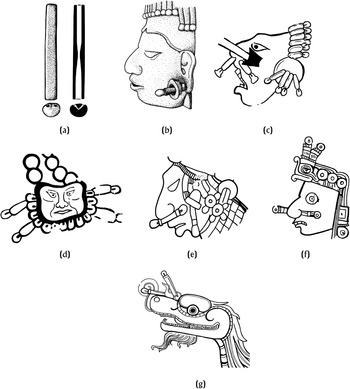
The extent to which pearls are represented in Mesoamerican art as objects of value and elements of elite regalia has not been assessed thoroughly. White-painted pearls have been identified as jewelry on isolated examples of Classic Maya polychrome vessels (Houston et al. Reference Houston, Brittenham, Mesick, Tokovinine and Warinner2009:52; Moholy-Nagy and Ladd Reference Moholy-Nagy, Ladd and Coggins1992:126), but they may be much more widespread in Late Classic Maya art and that of later cultures than previously recognized. In Classic Maya representations, headdresses, collars, pectorals, bracelets, anklets, and ear and nose ornaments, are commonly composed of one or more tubular beads, each with a round or tear-shaped bead protruding from the end. Most representations of this style of finery lack pigments that might hint at what materials constitute these adornments. Late Classic burials at Tikal yielded tubular jade beads found in situ with pierced pearls, and even some tube and bead assemblages with pierced imitation pearls made of cut nacreous shell (Moholy-Nagy Reference Moholy-Nagy2008:48, Figures 111c, 115a, 115b, 115d). In these examples, thread presumably was run through the jade tube and V-shaped perforation in the pearl, and looped back through the jade tube, effectively making the pearl into a “stopper” that would protrude from the end of the tube and hold together the assemblage in place (Figure 11a). Jade tube and pearl assemblages could serve a basic component of ear and nose ornaments, and several could be tied together as diadems, bracelets, anklets, and other adornments. A censer stand from Palenque that portrays a figure wearing a series of painted Maya blue tubes with white beads at their ends appears to be a rare color rendering of a diadem composed of jade tube and pearl assemblages (Figure 11b). The artists that painted the murals of Cacaxtla, Tlaxcala, which show strong stylistic and iconographic affinities with Late to Terminal Classic art from the Maya lowlands, used Maya blue to color quetzal feathers and jade. Many of the figures in Cacaxtla's Battle Mural wear ornaments composed of tube and pearl assemblages, including diadems and ear ornaments (Figure 11c), as well as jade mask pectorals decorated with pearls and tube and pearl pendants (Figure 11d). Each of the white-painted pearls has a red or black line that runs from the center toward the objects to which they are attached. This feature, which commonly appears in Maya relief sculpture (Figures 5c and 11e), probably represents the thread that pierces the pearl and affixes the pearl bead to the tube from which it appears to emerge. Most pearls that have been recovered in excavations in Mesoamerica are pierced, and the artists of the Florentine Codex represented pearls as pierced by thread (Figure 10c). Late Postclassic artists working in Aztec and Mixteca-Puebla styles represented pearls similarly to their Classic Maya forebears in representations of jade and pearl ornaments that appear to have been based originally on Maya tube and pearl assemblages (Figure 11f).
Jade tube and pearl assemblages. (a) Jade tube and pearl, exterior and cross-section, found at Tikal. Drawing by the author after Moholy-Nagy (Reference Moholy-Nagy2008:Figure 111c). (b) Censer stand from Palenque showing jade tube and pearl diadem and ear ornament. Drawing by the author. (c) Detail of Battle Mural, Cacaxtla, showing jade tube and pearl diadem and ear ornament. Drawing by the author after Matos Moctezuma (Reference Matos Moctezuma1987:81). (d) Detail of Battle Mural, Cacaxtla, showing jade mask pectoral lined with pearls and four jade tube and pearl assemblages. Drawing by the author after Matos Moctezuma (Reference Matos Moctezuma1987:89). (e) Detail of Yaxchilan Lintel 17 portraying nose bar and ear ornament with pearls. Drawing by the author. (f) Detail of Codex Borgia, page 18, portraying solar deity with pearls in nose bar, ear ornament, and diadem. Drawing by the author after Códice Borgia (1992:18). (g) Detail of Structure A south portico mural, Cacaxtla, showing feathered serpent with jade tube and pearl nasal emanations. Drawing by the author after Matos Moctezuma (Reference Matos Moctezuma1987:115).

SHELLS, BREATH, AND ANCESTORS
As Coe (Reference Coe, Benson and Griffin1988:225) noted, the widespread Mesoamerican funerary practice of placing jade objects in tombs, and often jade beads within the mouth of the deceased, renders jade a permanent manifestation of the otherwise ephemeral and immaterial breath soul. In artwork, the breath souls of animate beings are often visible as beads that hover in front of the nose or face (Houston and Taube Reference Houston and Taube2000:265–267; Taube Reference Taube2005:31). In some instances, breath beads are clearly intended to represent jade, as in an Olmec mural at Oxtotitlan, Guerrero, in which a green sphere sits beneath the nose of an anthropomorphic figure dressed in an avian costume (Grove Reference Grove1970). In other examples, nasal protrusions of certain zoomorphic beings are identical to the jade tube and pearl assemblages that appear as elite Maya ornamentation (Figure 11g). Nose bars capped with pearls (Figure 11e), often worn by Late Classic Maya elites, likely also incorporate the symbolic relationship of jade and pearls to breath. In some artistic renderings that lack pigment in which a sphere protrudes from or hovers in front of the nose, it is difficult to determine whether breath is represented as jade beads or pearls. Given the interchangeability between jade beads and pearls and their mutual relationship with breath, such ambiguity may have been deliberate.
Among its many associations, jade was linked to ancestors for the Classic Maya (Taube Reference Taube2005). This association may be due in part to its relationship to the breath of both the living and deceased, the recovery of jade objects from earlier tombs and caches, and the trans-generational nature of jade heirlooms passed down among Maya elite. The practice of passing down jade heirlooms and the link between jade and ancestral breath are apparent in the previously discussed ik’ pectoral found at Nim li Punit (Prager and Braswell Reference Prager and Braswell2016). Although not made of jade but containing a jade bead, it is noteworthy that the aforementioned shell carved with an ik’ sign found in the probable burial of the Late Classic Ruler 4 of Piedras Negras (Figure 9) was also likely an Early Classic dynastic heirloom (Houston et al. Reference Houston, Escobedo, Scherer, Child, Fitzsimmons, Ruiz, Ruz Sosa and Ponce de Leon2003:131–132). A jade clamshell pendant excavated in a Late Classic royal tomb at Nakum, Guatemala, also exemplifies these motives and may have been exhumed in ancient times, deepening its association with ancestors. The pendant, likely of original Olmec manufacture, was later inscribed with an Early Classic Mayan text on its exterior, but was interred in a Late Classic burial (Źrałka et al. Reference Źrałka, Koszkul, Martin and Hermes2011:895–899). The life history of this object almost mirrors that of the re-inscribed Olmec wing oyster pendant that was ultimately found in Costa Rica (Figures 8c and 8d), although it remained in the Maya lowlands. The meaning of the Nakum clamshell pendant was further augmented with an incised image on its interior (Figure 12a) that follows an Early Classic convention of portraying an ancestor as a head floating in clouds, mist, or smoke, visible in such other notable examples as Tikal Stela 31 (Houston and Taube Reference Houston, Taube, Isendahl and Persson2011:25; Houston et al. Reference Houston, Stuart and Taube2006:50–51; Schele and Miller Reference Schele and Miller1986:84; Źrałka et al. Reference Źrałka, Koszkul, Martin and Hermes2011:897).
Images of probable ancestors within jade shell skeuomorphs. (a) Clamshell pendant from Nakum. Drawing by the author after Źrałka et al. (Reference Źrałka, Koszkul, Martin and Hermes2011:Figure 7). (b) Wing oyster pendant. Drawing by the author after Covarrubias (Reference Covarrubias1946:Figure 24). (c) Wing oyster pendant. Drawing by the author after Taube (Reference Taube2004:Figure 18a).

In addition to the jade clamshell pendant from Nakum, the floating heads and often the names of ancestors appear on a number of Classic Maya pendants and other objects made of actual shell (Houston Reference Houston, Finamore and Houston2010:77–78; Houston and Taube Reference Houston, Taube, Isendahl and Persson2011:25; Schele and Miller Reference Schele and Miller1986:84). Houston (Reference Houston2014:94) notes that glyphic labels on shell pendants often include a term that incorporates ik’, like the Olmec wing oyster pectoral found in Costa Rica (Figures 8c and 8d), and that “these compact dwellings for ancestors would rise and fall on the chests of descendants, strengthening and responding to the breath of the living.” The ancestors represented on shells almost inevitably exhale breath beads (Figure 12a), further associating the shell pectorals with ik’, as a concept that encapsulates wind and breath. The placement of breath beads within the interiors of shells immediately recalls the natural formation of pearls, suggesting that, like jade beads, pearls may have been conceived as a permanent and radiant manifestation of the breath of ancestors.
Along with jade, the Classic Maya appear to have associated shell and pearls with ancestors, particularly with ancestral breath souls. Within the context of a set of perceived material relationships, durable jade objects, especially those shaped as shells, were fitting dynastic heirlooms. Their occasional recovery from older Olmec and Preclassic Maya deposits further enhanced their allure as ancient manifestations of ancestral power. Although the evidence is not as clear as it is for the Classic Maya, it is possible that these materials also embodied the souls of ancestors for the Olmecs. Some wing oyster pendants portray anthropomorphic heads in profile within the “mantle cavity” (Figures 12b and 12c), analogous to representations of ancestors on Maya shells. In fact, Taube (Reference Taube2004:90) suggests that the incised imagery on one pendant (Figure 12c) prefigures the floating flowers and jewels that appear in Classic Maya representations of the floral paradise, a luminous domain of ancestors. The association of ancestral breath with brilliant polished jade and luminous shells and pearls also finds an immediate parallel among afterlife beliefs in Late Postclassic highland Mexico. According to one account, the souls of Tlaxcalteca nobles became clouds, birds of rich plumage, and precious stones (Mendieta Reference Mendieta1980:97; see Houston and Taube Reference Houston, Taube, Isendahl and Persson2011:26). Book 11 of the Florentine Codex provides further clarification of the relationships between materials such as feathers and precious stones in highland Mexico, as well as certain shells and pearls, which were named, classified, and valued based on their color, sheen, and iridescence. Vital ancestral power was embodied in these precious materials, and the souls of elites made their presence known to the living through extraordinary flashes of light and color.
CONCLUSION
This study has argued that objects of Middle Formative origin that have long been referred to as “spoon pendants” are actually skeuomorphic recreations of ornaments made of iridescent wing oyster valves of the genus Pteria. While this identification of form does not preclude any possible functional uses as snuff trays, receptacles for sacrificial blood, scribal palettes, or weaving implements, their distinct resemblance to Pteria shells, holes for suspension, appearance as pendants on carved monuments, and relationships to other types of wind jewels from other Mesoamerican traditions demand reconsideration of these objects and more accurate terminology to describe them. I have proposed “wing oyster pendant” as a more accurate term for this type of object.
The choice to recreate Pteria shell pendants in jade was not arbitrary, but was guided by several factors. The durability and permanence of jade over marine shell were probably important considerations. The sudden appearance of these objects and other jade shell pendant skeuomorphs during the Middle Formative period at a variety of centers was accompanied a palpable turning of the political and economic tide in Mesoamerica. For the Olmecs of San Lorenzo and other Early Formative centers, the ability to import a variety of raw materials, including Pteria shells, which were then transformed into trappings of elite authority, was a means of expressing power. Middle Formative Olmecs made use of established symbols of authority but reproduced them in an exotic raw material, jadeite, that also involved the expression of a different type of power in the form of the mobilized labor and specialized skill necessary to bring them into form. The production of skeuomorphs of culturally meaningful symbols and other objects of elite authority, especially in jadeite, would have allowed some groups to tighten control over the movement of a narrowed range of raw materials, and the labor required to turn them into finished objects of great value and ideological significance. Although shell and jade obviously differ in their physical properties and origins, emphasis on their essential shared qualities provided conceptual space for shell objects to be reproduced in jade.
Wing oyster pendants fit within a broader category of jade shell skeuomorphs, and were embedded within a set of symbolic relationships that associated jade, shell, and pearls with luminosity, vital breath, and wind. Analysis of the cultural meanings of nacreous shell and jade sheds light on essential material relationships that motivated the continued ritual substitution of jade for luminous shell in the form of jade shell pendant skeuomorphs and other wind jewels, the placement of jade “pearls” in Spondylus caches, the conceptual overlap of nacreous shell and iridescent plumage, and the appearance of pearls and jade beads as divine breath emanations. Although it is possible but uncertain whether the Olmecs explicitly associated jade and shell with ancestors, the jade, shell, pearl, and feather finery worn by Maya elites were charged with ancestral power and divine luminosity. These long-enduring and widespread material associations were subject to continual refinement among the later Mesoamerican cultural traditions that adopted them, but were ultimately rooted in Middle Formative ideology and systems of value.
RESUMEN
El significado de los pendientes de jade Olmecas del periodo formativo medio (900–400 a.C.), conocido como “cucharitas” (“spoon pendants”), ha sido poco conocido. Estudios previos han interpretado estos objetos basándose en diversas funciones hipotéticas que pudieron haber servido. El presente estudio propone que la forma específica de estos pendientes está basada en la concha de la ostra perlera alada (Pteria), un bivalvo nacarado que forma perlas y que se encuentra en ambas costas de mesoamérica. El estudio de estas recreaciones esqueumorfas que simulan conchas marinas ilustra la relación conceptual entre el jade y la concha iridiscente, así como las motivaciones económicas e ideológicas detrás de tales sustituciones materiales. Aun cuando los pendientes de ostra alada fueron producidos únicamente durante el periodo formativo, los mayas del periodo clásico continuaron valorando las perlas formadas por estos y otros moluscos productores de nácar al colocarlas en tumbas reales y ofrendas. La importancia de las perlas ha sido ignorada en estudios académicos previos, pero este estudio demuestra su frecuente aparición en el arte mesoamericano. Los pendientes de ostras aladas constituyen una muestra temprana de la sustitución material de jade, concha, y perla. Esta asociación conceptual entre estos valiosos materiales se extendería a nociones de aliento, viento, y ancestros entre las tradiciones mesoamericanas posteriores.
ACKNOWLEDGMENTS
I would like to thank Richard Diehl, Mónica Domínguez Torres, Ángel González López, Eric Heller, Stephen Houston, Alejandra Martínez Berdeja, Cameron McNeil, Evan Parker, Karl Taube, and the reviewers of this article for graciously sharing their thoughtful insights, suggestions, and critiques for the improvement of this paper. I am grateful to Takeshi Inomata and Stephen Houston for providing permission to publish their photographs, and to the Metropolitan Museum of Art and the Yale University Art Gallery for making their resources available to the public. This work would not have been possible without the support of Andrés Turner Martínez and Alejandra Martínez Berdeja.