Introduction
Rice (Oryza sativa L.) is a staple crop that meets the dietary needs of more than 60% of the global population and thus plays a crucial role in global economic and social stability (Mahajan et al. Reference Mahajan, Bhagirath, Kumar, Chauhan and Mahajan2014). Weeds negatively affect crop growth and yield by competing with crops for nutrients, sunlight, and water; they are recognized as one of the most important yield-limiting biological constraints on rice production systems (Keller et al. Reference Keller, Gutjahr, Möhring, Weis, Sökefeld and Gerhards2014; Mahajan et al. Reference Mahajan, Bhagirath, Kumar, Chauhan and Mahajan2014). Rice yield reductions caused by weeds are generally 10% to 20% and can exceed 50% in heavily infested paddy fields (Rathod and Somasundaram Reference Rathod and Somasundaram2017). Chemical herbicides are currently widely used for weed control, because they have low labor requirements, can be applied in a timely manner, and typically result in high economic returns; thus, they are expected to be an irreplaceable weed control strategy for many years to come (Gao et al. Reference Gao, Zhang, Shen, Mao, Wei, Wei, Zuo, Li, Song and Qiang2020). However, the increased use of chemical herbicides has been accompanied by concerns over weed species population shifts, herbicide-resistance evolution in weeds, increased herbicide costs, surface water pollution, and effects on non-target organisms (Chauhan and Johnson Reference Chauhan and Johnson2010; Primot et al. Reference Primot, Valentin-Morrison and Makowski2006; Qasem Reference Qasem and Kortekamp2011). These concerns have increased the interest among weed scientists in developing integrated weed management strategies.
Fertilizers are one of the major input costs in many cropping systems, the main source of nutrients for cultivated plants, and key determinants of both crop growth and soil nutrient status (Blackshaw et al. Reference Blackshaw, Molnar and Larney2005; Pan et al. Reference Pan, Zhang, Wang and Fu2020). Continuous fertilizer input not only maintains the high soil fertility required for high crop yields and quality but also profoundly affects the species composition, density, diversity, and biomass of associated weeds in farmland (Mi et al. Reference Mi, Gao, Sun, Zhao, Yang, Guo, Chen and Wu2018; Tang et al. Reference Tang, Wan, Cheng, Li, Wang, Pan, Tao, Xie and Chen2013; Wan et al. Reference Wan, Tao, Li, Pan, Tang and Chen2012; Wang et al. Reference Wang, Liu, Dong, Liu and Lu2019). Thus, significant research has been conducted to explore the effects of fertilizer type, dose, and application timing and method on weed dynamics as one part of integrated weed management. Surface broadcasting of basal fertilizer may result in high weed pressure in dry-seeded rice systems (Chauhan and Abugho Reference Chauhan and Abugho2013). Lal et al. (Reference Lal, Gautam, Raja, Tripathi, Shahid, Mohanty, Panda, Bhattacharyya and Nayak2016) reported that weed species diversity was significantly reduced by the application of inorganic nitrogen (N), either with potassium (K) or alone, in a rice–rice system. Blackshaw et al. (Reference Blackshaw, Molnar and Larney2005) found that the density and biomass of wild oat (Avena fatua L.), green foxtail [Setaria viridis (L.) P. Beauv.], wild mustard (Sinapis arvensis L.), and common lambsquarters (Chenopodium album L.) were sometimes lower when N was applied in spring than when it was applied in fall. Therefore, there is a clear need to identify optimal strategies for managing soil nutrients in farmlands to meet both crop growth and weed management objectives.
Rice–wheat (Triticum aestivum L.) rotation is the most popular cropping system in East and Southeast Asia; approximately 26 million ha of farmland is cultivated in this way (Timsina and Connor Reference Timsina and Connor2001), constituting 60% of the paddy fields in southeastern China (Hu et al. Reference Hu, Wang, Gu, Tao, Zhang, Hu, Zhu and Meng2016). The long-term application of chemical fertilizers to fields under rice–wheat rotation has already caused severe environmental pollution (Guo et al. Reference Guo, Zhu, Wang, Wu and Zhang2004; Yin et al. Reference Yin, Cai and Zhong2005), and continuous rice and wheat production generates large amounts of rice and wheat straw (Jin et al. Reference Jin, Shah, Zhang, Liu, Peng and Nie2020; Wang et al. Reference Wang, Yang, Liu, Wu, Chen, Wu, Zhu and Bian2015). Straw return has been regarded as an effective approach to dispose of agricultural waste that avoids the pollution caused by straw burning and stimulates soil microbial activity (Zhao et al. Reference Zhao, Li, Zhou, Qiu, Huang and He2016), therefore increasing the ability of the soil to provide mineral nutrients for crop growth (Chatterjee 2013). To remediate the severe environmental pollution caused by excessive chemical fertilizer application and straw burning, replacing a portion of the applied chemical fertilizer with manure and returning straw to the soil have been widely adopted in China owing to the vigorous promotion of these practices by the Chinese government (Huang et al. Reference Huang, Gao, Wang, Tian, Tao and Wang2016; Zhang et al. Reference Zhang, Wang and Chen2008). Understanding the shifts in weed community composition under different long-term fertilization treatments would help in designing effective weed management programs and identifying indicator species for soil nutrient availability. The effects of long-term amendment of soil with composted pig manure and rice straw on weed richness and abundance in the wheat crop of the main cropping system (rice–wheat rotation) in the middle and lower reaches of the Yangtze River in China were assessed in our previous study (Zhang et al. Reference Zhang, Sun, Li, Sun, Yuan, Han, Duan, Ji, Zhu, Shen and Ran2019). However, weed species is specific to crop type (Mahajan et al. Reference Mahajan, Bhagirath, Kumar, Chauhan and Mahajan2014), and the differences of crop management methods and growing seasons between rice and wheat are likely to lead to different effects of fertilizer on weed infestation. Therefore, in the same experimental plots used by Zhang et al. (Reference Zhang, Sun, Li, Sun, Yuan, Han, Duan, Ji, Zhu, Shen and Ran2019), we assessed in 2018 and 2019 the species richness, density, shoot biomass, and abundance of weeds in paddy fields subjected to different long-term fertilization treatments (replacement of 50% of chemical fertilizer with composted pig manure and wheat straw return combined with chemical fertilizer, and set no fertilizer and chemical fertilizer only as controls) to identify whether composted manure and straw amendments would affect the infestation of rice-associated weeds and to assess the efficacy of these strategies to serve as components of improved weed management programs for rice-associated weeds in rice–wheat rotation systems.
Materials and Methods
Experimental Site
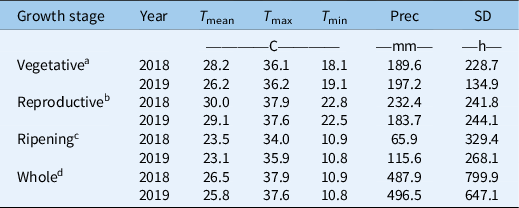
The study was conducted within a long-term experiment with an annual rotation of summer rice and winter wheat in Jianchun village (31.662°N, 119.473°E, 10 m above sea level), Changzhou City, Jiangsu Province, China. The experiment started in the wheat-growing season in November 2010. The region has a humid subtropical monsoon climate with average annual temperature, humidity, and precipitation of 15.3, 78%, and 1,084 mm, respectively. The mean, maximum, and minimum temperature, rainfall, and sunlight duration of the study area during the vegetative, reproductive, and ripening stages of rice in 2018 and 2019 are presented in Table 1. The soil is classified as Fe-leachic-gleyic-stagnic Anthrosol and has a clay loam texture with 9.8% sand (1 mm to 0.05 mm), 38.5% coarse silt (0.05 mm to 0.01 mm), and 51.7% clay (<0.01 mm).
Minimum (T min), maximum (T max), and mean (T mean) temperature, rainfall (prec), and sunlight duration (SD) of the study area in different growth stages of rice in 2018 and 2019.

a From transplant to panicle initiation. From June 17 to July 23 in 2018 and June 17 to July 24 in 2019.
b From panicle initiation to grain fill. From July 24 to August 24 in 2018 and July 25 to August 25 in 2019.
c From grain to harvest. From August 25 to October 20 in 2018 and July 26 to October 20 in 2019.
d From transplant to harvest. From June 17 to October 20 in 2018 and June 17 to October 20 in 2019.
Experimental Design and Agricultural Practices
The field study consisted of four treatments replicated four times in a randomized complete block design. Individual plots (8 m by 5 m) were surrounded by cement ridges to ensure no interflow of water and fertilizer between adjacent plots. During the rice-growing season (duration from June to October), the treatments were as follows: (1) a control (CK): no fertilizer; (2) only chemical fertilizer (CF); (3) replacement of 50% of the chemical fertilizer with composted pig manure (PM); and (4) all straw from the preceding wheat crop and chemical fertilizer (SF). Details about the type and composition of the fertilizers applied as treatments in the rice-growing season are presented in Table 2. During the wheat-growing season, the same amount of composted pig manure was applied in the PM treatment, and all the straw from the rice crop was returned to the soil surface in the SF treatment. The amounts of chemical fertilizer were 240 kg N ha−1, 83 kg P2O5 ha−1, and 53 kg K2O ha−1 in the CF and SF treatments and 120 kg N ha−1, 41.5 kg P2O5 ha−1, and 26.5 kg K2O ha−1 in the PM treatment. Twelve soil cores that were 3.5 cm in diameter and 15-cm deep, which is equal to the plow layer, were equidistantly sampled from each treatment in late October after each rice harvest in 2010 and 2019. The samples were then air-dried and ground to pass through a 2-mm sieve followed by a 0.149-mm sieve. The chemical properties of soil (available K, available N, available phosphorus [P], organic matter, total K, total N, total P, and pH) were measured following the methods reported by Page et al. (Reference Page, Miller and Keeney1982), and data are presented in Table 3.
Type and composition of the fertilizers applied as treatments in the rice-growing season.

a CK, control; CF, chemical fertilizer; PM, composted pig manure combined with chemical fertilizer; and SF, wheat straw return combined with chemical fertilizer treatments.
b Basal fertilizer applied before planting.
c Tiller fertilizer applied 10 d after planting.
d Supplementary fertilizer applied at the panicle stage.
e Straw from the previous wheat crop (excluding weed seeds) was carefully harvested, shredded to a particle size of less than 5 cm, and uniformly broadcast onto the plot from which it was harvested. The wheat straw contained 46% organic matter, 0.38% N, 0.24% P2O5, and 0.58% K2O.
f The composted pig manure contained 45.4% organic matter, 2.0% N, 2.9% P2O5, 1.2% K2O, and 29.1% water.
Soil fertility properties in the experimental plots in 2010 and 2019 after the rice harvest. a

a Mean values ± SDs. The values with different lowercase letters within a column are significantly different at P < 0.05.
b CK, control; CF, chemical fertilizer; PM, composted pig manure combined with chemical fertilizer; and SF, wheat straw return combined with chemical fertilizer treatments; the number is the year of the experiment.
Rice (‘Wuyunjing No. 23’) seedlings were transplanted by hand on June 17 of every year at a hill spacing of 12 cm by 30 cm (27.75 by 104 hills ha−1) with three seedlings per hill from 2011 to 2019. In the annual rice-growing season, weeds were controlled exclusively by hand (no herbicides were used at all) at the active tillering and panicle initiation stages. However, no weeding was conducted during the weed survey years of 2011, 2018, and 2019. Tillage, irrigation, pesticide application, and other management operations followed local agricultural practices.
Data Collection
At the jointing-booting stage of the rice, when most of the weeds had started flowering and fruiting, the density of each weed species was determined on August 20, 2011 (initial weed density data in the rice field) in nine 0.25-m2 (0.5 m by 0.5 m) quadrats positioned in accordance with an inverted W 9-point sampling method (Thomas Reference Thomas1985) in each experimental plot. The species, number, and plant height of weeds and the panicle density and plant height of rice in each experimental plot were determined at the jointing-booting stage of the rice on August 19, 2018, and August 20, 2019, using the same number of quadrats with the same method. The aboveground parts of all weeds in each quadrat in 2018 and 2019 were brought back to the laboratory, dried at 70 C for 48 h to constant weight, and weighed. Rice yields in 2018 and 2019 were measured by weighing the rice grain collected in 20 m2 from each plot at maturity.
Data Processing
The frequency, relative frequency, density, height, and abundance values of the weed species in each plot were calculated in accordance with the following formulas (Zhang Reference Zhang2004):
 $${\rm{Frequency}} = {{{\rm{Number}}\;{\rm{of}}\;{\rm{quadrats}}\;{\rm{with}}\;{\rm{species}}\;{\rm{present}}} \over {{\rm{Total}}\;{\rm{number}}\;{\rm{of}}\;{\rm{quadrats}}}}$$
 $${\rm{Relative}}\;{\rm{frequency}}\;(Rf) = {{{\rm{Frequency}}\;{\rm{of}}\;{\rm{a}}\;{\rm{species}}} \over {{\rm{Sum}}\;{\rm{of}}\;{\rm{frequency}}\;{\rm{of}}\;{\rm{all}}\;{\rm{species}}}} \times 100\% $$
 $${\rm{Relative \ density \ (}}Rd{\rm{) }} = {{{{\rm{Mean \ density \ of \ a \ species}}}}\over{{{\rm{Sum \ of \ density \ of \ all \ species}}}}} \times 100\% $$
 $${\rm{Relative \ height \ (}}Rh{\rm{) }} = {{{{\rm{Mean \ height \ of \ a \ species}}}}\over{{{\rm{Sum \ of \ height \ of \ all \ species}}}}} \times 100\% $$
 $${\rm{Relative}}\;{\rm{abundance}}\;(Ra) = {{Rf + Rd + Rh} \over 3}$$
The diversity of weeds was assessed based on the species richness, S (i.e., the number of species in a quadrat).
Multivariate analyses of variance were conducted to determine the effects of the year (the differences in sunlight duration, temperature, and rainfall between 2018 and 2019) and the fertilization treatment (as independent variables) as well as their interaction effects on the species richness, density, plant height, and shoot biomass of the rice-associated weed community and the panicle density, plant height, and yield of rice (as dependent variables) at a significance level of 5%. The species richness, density, plant height, and shoot biomass data were log transformed to ensure that they satisfied the assumptions of the normal distribution of residuals (Shapiro-Wilk W-test) and homoscedasticity (Levene’s test). Pairwise comparisons (0.05 LSD test) were also performed on treatment means; data were averaged over the years only when no significant interaction between fertilization treatment and year occurred. To assess possible weed shifts due to long-term use of the fertilizer treatments, weed densities for the years 2011 and 2019 were used to calculate the mean density variation (density of a species minus density of this species in 2011) of rice-associated weeds. The paired-sample t-test was also used to assess the significance of mean density variation at a significance level of 5%. All analyses were carried out using SPSS 20 software (SPSS, Chicago, IL, USA); graphs were generated using Origin 9.0 (OriginLab, Hampton, MA, USA). Canonical correspondence analysis (CCA) was performed to explore the relationships among soil fertility properties (i.e., available K, available N, available P, organic matter, total K, total N, total P, and pH as environmental variables) and distribution of the dominant weeds (the Ra of dominant weed species in 2018 and 2019 as species variables). A Monte Carlo permutation test was used to investigate the statistical significance of the effects of soil fertility properties on species distribution using Canoco for Windows v. 4.5 (Microcomputer Power, Ithaca, NY, USA).
Results and Discussion
Height, Panicle Density, and Yield of Rice
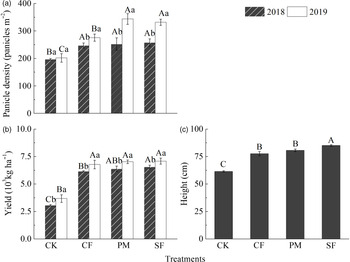
The interaction effect between year and fertilization treatment was significant for panicle density (P = 0.015) and yield of rice (P < 0.001) but not for the height of rice; therefore, the effect of fertilizer treatment on the height of rice in 2018 and 2019 was averaged over the years (Figure 1). Fertilization significantly increased the height (P < 0.001) of rice, which was highest in the SF treatment. The panicle density (P < 0.001) and yield of rice (P < 0.001) were significantly increased with fertilization as well. However, greater yield component responses in 2019 than 2018 may have been due to more favorable weather conditions in 2019 than in 2018 (Table 1). Early studies found that higher daily mean temperature can negatively affect rice yield (Krishnan et al. Reference Krishnan, Swain, Chandra Bhaskar, Nayak and Dash2007), and there is a positive impact on paddy rice yield of higher daily minimum temperature during the vegetative stage, a negative impact of increased sunlight duration during the vegetative stage, and a negative impact of rainfall during the reproductive stage (Chen et al. Reference Chen, Chen and Xu2016). Compared with 2018, the lower daily mean temperature and higher minimum temperature in the vegetative stage in 2019 (Table 1) may have been more conducive to the production of more tillers and panicles than in 2018 in the same treatment, and the lower rainfall in the reproductive stage in 2019 could have been more beneficial to rice pollination, resulting in an increase in rice yield in the same treatment.
Panicle density (a), yield (b), and mean height (c) of rice under different fertilization regimes in 2018 and 2019. CK, control; CF, chemical fertilizer; PM, composted pig manure combined with chemical fertilizer; SF wheat straw return combined with chemical fertilizer. Bars with different capital letters indicate differences in the effects of the fertilization regimes according to the LSD test at P = 0.05. Bars with different lowercase letters indicate differences in the same fertilization regime between different years according to the LSD test at P = 0.05.

Species Richness, Density, and Biomass of Different Weed Types
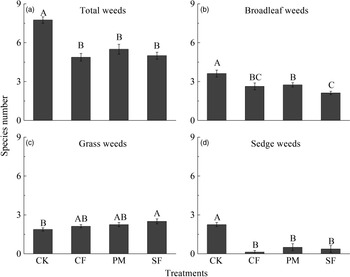
A total of 16 species belonging to 15 genera and 8 families were found in the experimental paddy fields in 2018, and 13 weed species belonging to 13 genera and 7 families were recorded in 2019 (data not shown). There was no significant effect of year by treatment interaction on the total (P = 0.539) and disaggregated (broadleaf: P = 0.861; grass: P = 0.384; and sedge: P = 0.506) number of rice-associated weed species; therefore, the effects of different fertilization treatments were averaged over the years (Figure 2). Our results indicate that fertilization significantly reduced the species richness of rice-associated weeds (P < 0.001), while no difference among the fertilization treatments was observed. The number of broadleaf weed species was significantly reduced by fertilization (P < 0.001), and the effect was greatest with the SF treatment. The number of grass weed species increased with the SF treatment but was not significantly affected by the CF and PM treatments. With fertilization, a decline in broadleaf weed species of wheat-associated weeds was also observed in the previous report of this long-term trial, but no effect on the grass weed species was detected (Zhang et al. Reference Zhang, Sun, Li, Sun, Yuan, Han, Duan, Ji, Zhu, Shen and Ran2019). Fertilization significantly decreased (P = 0.016) the number of sedge weed species, but no difference among the fertilization treatments was observed.
Mean total (a) and disaggregated (b, broadleaf; c, grass; d, sedge) weed species numbers in paddy fields under different fertilization regimes in 2018 and 2019. CK, control; CF, chemical fertilizer; PM, composted pig manure combined with chemical fertilizer; SF wheat straw return combined with chemical fertilizer. Bars with the same letter are not significantly different according to the LSD test at P = 0.05.

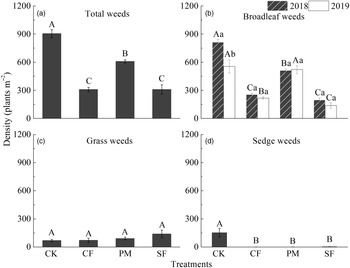
The density of broadleaf rice-associated weeds was significantly affected by the interaction effects between treatment and year (P < 0.001), while total weed density (P = 0.336) and the densities of grass (P = 0.970) and sedge weeds (P = 0.427) were not significantly affected by year by treatment interaction. Therefore, the effects of the different fertilization treatments on total, grass, and sedge weed densities in paddies in 2018 and 2019 were averaged over the years (Figure 3). While the density of grass weeds was not affected by the fertilization treatments (P = 0.230), total (P < 0.001) and sedge (P = 0.033) weed densities were lower with the fertilization treatments than with the CK treatment. Greater declines in total weed density occurred with the CF and SF treatments than with the PM treatment, while there was no difference in sedge weed density among fertilizer treatments. Although all three fertilization treatments resulted in lower broadleaf weed densities than the CK in 2018, only the CF and SF treatments significantly reduced the density of broadleaf weeds in 2019. The mean temperature and sunlight duration in the vegetative stage of rice were lower in 2019 than in 2018 (Table 1), which might have led to the lower germination of broadleaf weeds in 2019 than in 2018 in the CK treatment and resulted in the decrease of broadleaf weed density between years in the CK treatment. However, the density of broadleaf weeds in each fertilization treatment was not significantly affected by the different weather conditions between years. The broadleaf species contributed the majority of the total weed density in all treatment plots, which could be due to the higher seed density of the broadleaf species in the soil weed seedbank, while compared with the no-fertilizer control, fertilizer application tended to decrease the densities of broadleaf and sedge weeds but did not significantly affect the density of grass weeds. The effect of fertilization on weed density can vary with weed species (Yin et al. Reference Yin, Cai and Zhong2005; Zhang et al. Reference Zhang, Sun, Li, Sun, Yuan, Han, Duan, Ji, Zhu, Shen and Ran2019); therefore, to explain the differential effects of fertilizer application on the densities of broadleaf and grass weeds, the species composition and the effect of fertilization on the density of each species of these two weed types must be clarified. However, only a few sedge weeds were observed in response to the fertilization treatments, which may indicate that sedge weeds in a rice–wheat cropping system are more likely to germinate and persist in infertile fields than in well-fertilized conditions. Similarly, Zhang et al. (Reference Zhang, Sun, Li, Han, Yuan and Zhang2015) reported that sedge weeds, such as rice flatsedge (Cyperus iria L.) and fimbry (Fimbristylis littoralis Gaudlich.), typically infest old tea gardens with less tillage and lower organic matter content and infertile soil.
Mean density of total (a), broadleaf (b), grass (c), and sedge (d) weeds in paddy fields under different fertilization regimes in 2018 and 2019. CK, control; CF, chemical fertilizer; PM, composted pig manure combined with chemical fertilizer; SF wheat straw return combined with chemical fertilizer. Bars with different capital letters indicate differences in the effects of the fertilization regimes according to the LSD test at P = 0.05. Bars with different lowercase letters indicate differences in the same fertilization regime between different years according to the LSD test at P = 0.05.

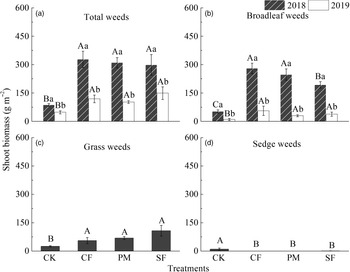
The shoot biomass per square meter of total (P = 0.003) and broadleaf rice-associated weeds (P < 0.001) was significantly affected by interactions between fertilization treatment and year, while that of grasses (P = 0.994) and sedges (P = 0.664) was not significantly affected by the year by treatment interaction effects; therefore, the effects of different fertilization treatments on the shoot biomass of grasses and sedges in paddies in 2018 and 2019 were averaged (Figure 4). The total weed shoot biomass per square meter increased with fertilizer application (P < 0.001), and weeds produced more biomass in 2018 than in 2019 (P < 0.001). The shoot biomass per square meter of broadleaf weeds was significantly increased by the fertilization treatments (P < 0.001) and was higher in 2018 than in 2019, regardless of the treatment. The mean temperature and sunlight duration throughout the season were lower in 2019 than in 2018 (Table 1), which may explain the lower shoot biomass of total and broadleaf weeds in 2019 than in 2018 in each treatment. Fertilizer treatments significantly increased the shoot biomass per square meter of grass weeds (P = 0.028) but significantly decreased that of sedge weeds (P = 0.025). Weed communities are constantly changing in response to crop management practices (Chauhan and Opena Reference Chauhan and Opena2012; Mahajan et al. Reference Mahajan, Bhagirath, Kumar, Chauhan and Mahajan2014), but ultimately, their changes can be attributed to a large degree to specific agricultural practices (e.g., tillage, rotation, fertilization, and weeding) (Wan et al. Reference Wan, Tao, Li, Pan, Tang and Chen2012). Fertilization alters soil fertility, which affects not only crop growth but also the species diversity, composition, and growth of associated weeds (Major et al. Reference Major, Steiner, Ditommaso, Newton and Lehmann2005; Mi et al. Reference Mi, Gao, Sun, Zhao, Yang, Guo, Chen and Wu2018; Wang et al. Reference Wang, Liu, Dong, Liu and Lu2019). Long-term field experiments are important for evaluating changes in plant community composition and can provide insights into the long-term effects of treatments (Yin et al. Reference Yin, Cai and Zhong2005). Our results from 2018 and 2019 indicate that fertilizer application decreased the species richness and total density of rice-associated weeds but increased their total shoot biomass. The species richness and density of broadleaf weeds decreased under fertilizer application, while the density of grass weeds was not affected. The shoot biomass per square meter of grass and broadleaf weeds was significantly increased by the fertilizer treatments compared with the CK treatment, while that of sedge weeds was significantly decreased due to the lower density of sedge weeds in fertilized paddy fields.
Total (a) and broadleaf (b) weed shoot biomass and mean grass (c) and sedge (d) weed shoot biomass in paddy fields under different fertilization regimes in 2018 and 2019. CK, control; CF, chemical fertilizer; PM, composted pig manure combined with chemical fertilizer; SF wheat straw return combined with chemical fertilizer. Bars with different capital letters indicate differences in the effects of the fertilization regimes according to the LSD test at P = 0.05. Bars with different lowercase letters indicate differences in the same fertilization regime between different years according to the LSD test at P = 0.05.

Weed Community Composition and Relationships of Weed Distribution to Soil Fertility Properties
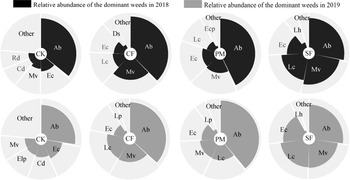
The relative abundance (Ra) of a weed species indicates its degree of dominance in the weed community; the greater the relative abundance of a species in the weed community is, the higher its dominance (Poggio Reference Poggio2005). According to our surveys, there were 11 weed species that constituted the five most dominant rice-associated weed species under different treatments in 2018 and 2019 (Figure 5). Among the dominant rice-associated weeds, monarch redstem (Ammannia baccifera L.) was the most dominant weed species in all plots regardless of the treatment, and its relative abundance was the highest in the rice-associated weed community in 2018 and 2019, ranging from 43% to 28%. Four weed species—A. baccifera, monochoria [Monochoria vaginalis (Burm. f.) C. Presl ex Kunth], Chinese sprangletop [Leptochloa chinensis (L.) Nees], and barnyardgrass [Echinochloa crus-galli (L.) P. Beauv.]—dominated the rice-associated weed community in all fertilization treatments in both 2018 and 2019. Only three dominant species—A. baccifera, M. vaginalis, and E. crus-galli—occurred in the CK and the fertilization treatments. Leptochloa chinensis was only dominant species in the fertilization treatment, while C. difformis was only dominant species in the CK treatment.
Relative abundance of the five most dominant rice-associated weeds under different fertilization regimes in 2018 and 2019. CK, control; CF, chemical fertilizer; PM, composted pig manure combined with chemical fertilizer; SF wheat straw return combined with chemical fertilizer. Ab, Ammannia baccifera; Ec, Echinochloa crus-galli; Mv, Monochoria vaginalis; Cd, Cyperus difformis; Rd, Rotala indica; Lc, Leptochloa chinensis; Ds, Digitaria sanguinalis; Ecp, Eclipta prostrata; Lh, Leersia hexandra; Elp, Eleocharis plantagineiformis; Lp, Lindernia procumbens; other, all other weeds excluding the five most dominant rice-associated weeds.

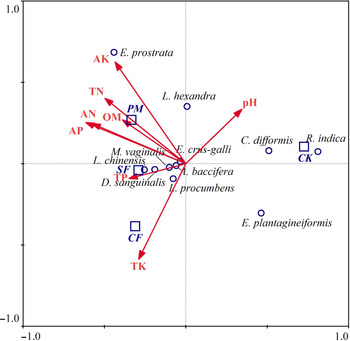
To determine what caused the difference in dominant weeds between different treatments, CCA was used to analyze the relationships between the distribution of the dominant weeds (the Ra of the dominant weeds) and the soil fertility properties (i.e., organic matter, total N, total P, total K, available N, available P, available K, and pH) under different treatments. The Monte Carlo tests for the first canonical axis and overall were both significant (P = 0.002, F = 4.909 and P = 0.002, F = 1.898, respectively), suggesting that the weed species were not distributed randomly but were significantly correlated with soil fertility properties and soil pH (Figure 6). The distribution of L. chinensis and large crabgrass [Digitaria sanguinalis (L.) Scop.] was positively correlated with all soil fertility properties but negatively correlated with pH, which could explain why L. chinensis was only dominant in the fertilization treatments (as shown in Figure 5) and the Ra of D. sanguinalis was higher with fertilization (data not shown). Echinochloa crus-galli, A. baccifera, and M. vaginalis occurred in the center of the two-dimensional plot, indicating that they occurred regardless of the fertilization treatment; as shown in Figure 4, these three species dominated the rice-associated weed community in all treatments in both 2018 and 2019. Indian toothcup [Rotala indica (Willd.) Koehne], meesia moss [Meesia triquetra (L. ex Jolycl.) Angstr.], and the sedge species C. difformis and Eleocharis plantagineiformis Tang & F.T. Wang, which were only dominant in the CK treatment (Figure 4), were positively correlated with pH but negatively correlated with most of the soil fertility properties. The occurrences of eclipta [Eclipta prostrata (L.) L.] and southern cutgrass (Leersia hexandra Sw.) were closely and positively related to available K, while those of prostrate false pimpernel [Lindernia procumbens (Knock.) Borb.], bermudagrass [Cynodon dactylon (L.) Pers.], and alligatorweed [Alternanthera philoxeroides (Mart.) Griseb.] were closely and positively related to total K. Additional knowledge of the effects of nutrient sources on weeds grown in competition with crops would allow for a better understanding of the causes of the differences among the different fertilization treatments and would aid in the development of fertilization strategies as components of comprehensive integrated weed management programs (Blackshaw et al. Reference Blackshaw, Molnar and Larney2005). Yin et al. (Reference Yin, Cai and Zhong2005) demonstrated that the wheat-associated weeds thymeleaf sandwort (Arenaria serpyllifolia L.), crossflower [Chorispora tenella (Pall.) DC.], wormseed wallflower (Erysimum cheiranthoides L.), and birdeye speedwell (Veronica persica Poir.) were best adapted either to N, P, or K deficiency or to a balanced treatment in the wheat fields of a corn (Zea mays L.)–wheat rotation system and that the changes in the weed community composition were due primarily to soil-available P, followed by light intensity on the soil surface. In our study, A. baccifera, E. crus-galli, and M. vaginalis gained competitive advantages whether in fertile or infertile soil and were consequently the most widely distributed and dominant weeds in all treatments. Leptochloa chinensis and D. sanguinalis were positively correlated with all fertility properties, and their Ra values were higher in fertilization treatments than in the unfertilized treatment; nutrient deficiency was more favorable to the infestation of sedge weeds such as C. difformis and E. plantagineiformis.
Canonical correspondence analysis of soil fertility properties and the distribution of the rice-associated weed species. OM, organic matter; TN, total N; TP, total P; TK, total K; AN, available N; AP, available P; AK, available K; pH values are the same as those presented in Table 2. Arrows correspond to soil fertility properties; squares correspond to different fertilization treatments; and circles correspond to weed species. CK, control; CF, chemical fertilizer; PM, composted pig manure combined with chemical fertilizer; SF wheat straw return combined with chemical fertilizer. CK, PM, CF, and SF are presented here as nominal variables.

Density, Plant Height, and Shoot Biomass of the Rice-associated Weeds Occurring at the Highest Frequency
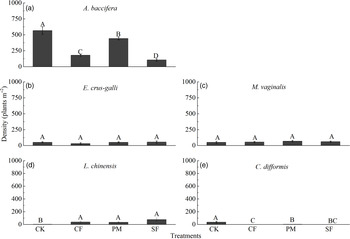
Ammannia baccifera, M. vaginalis, E. crus-galli, L. chinensis, and C. difformis were the weeds that occurred at the highest frequencies (above 19%) in all plots in both years regardless of the treatment (data not shown). The total density of the five weed species with the highest frequency accounted for only 73% of the total weed density in the CK treatment but more than 94% of the total weed density in the CF, PM, and SF treatments (data not shown). There was no significant effect of year by treatment interaction on the densities of the five weed species with the highest frequency (P = 0.834, P = 0.805, P = 0.700, P = 0.783, and P = 0.084); therefore, the effects of the fertilization treatments were averaged over the years (Figure 7). Fertilization significantly increased the density of L. chinensis (P < 0.001) and decreased the densities of A. baccifera (P < 0.001) and C. difformis (P < 0.001) but did not significantly affect those of E. crus-galli (P = 0.569) and M. vaginalis (P = 0.084). Among the fertilization treatments, the density of A. baccifera was highest with the PM treatment, followed by the CF and SF treatments. In a related study, the effect of different fertilizer regimes (chemical only, manure only [16 yr of pig manure followed by 15 yr of oil rape cake], or chemical applied together with manure) on the heterogeneity of the soil weed seedbank was evaluated in a rice–wheat rotation system for 31 years (Jiang et al. Reference Jiang, Shen, Gao, Shen and Dai2014). Compared with the corresponding chemical fertilizer-only treatments, the chemical N fertilizer applied together with the manure treatment resulted in significant increases in the seed density of A. baccifera, while the chemical P–K fertilizer applied together with the manure treatment led to significant decreases in the seed density of A. baccifera. Additionally, the chemical N–P–K fertilizer applied with and without manure treatment resulted in no significant difference in the seed density of A. baccifera. The differences in the responses of A. baccifera maybe due to the differences in the fertilizer regimes. Jiang et al. (Reference Jiang, Shen, Gao, Shen and Dai2014) applied the manure treatment alone or in addition to the chemical fertilizer, whereas in our study, 50% of the chemical fertilizer was replaced with composted pig manure (at a similar N application rate).
Mean density of rice-associated weeds occurring at the highest frequency under different fertilization regimes in 2018 and 2019. CK, control; CF, chemical fertilizer; PM, composted pig manure combined with chemical fertilizer; SF wheat straw return combined with chemical fertilizer. Bars with the same letter are not significantly different according to the LSD test at P = 0.05.

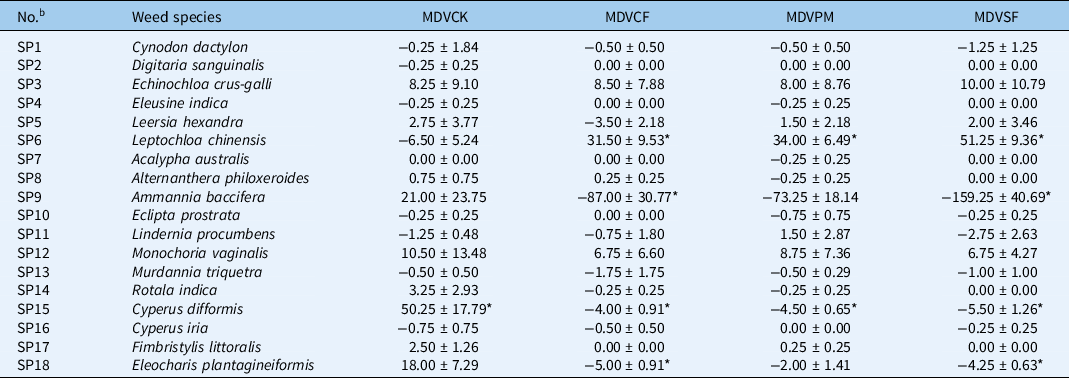
When data from 2011 and 2019 were compared, significant changes in rice-associated weed densities were observed for only L. chinensis, A. baccifera, C. difformis, and E. plantagineiformis (Table 4). Surprisingly, relatively large mean density variations with E. crus-galli and M. vaginalis obtained with all treatments were not significant (P > 0.05). The mean density variation of A. baccifera was positive with the CK treatment and negative with the CF, PM, and SF treatments; however, only the density variations with the CF and SF treatments were significant (P = 0.047, P = 0.003). Significant positive mean density variation of L. chinensis was observed with the CF (P = 0.045), PM (P = 0.010), and SF (P = 0.001) treatments, while the negative mean density variation with the CK treatment was not significant. The result with the fertilization treatments was consistent with the results in Figure 7D. Among sedge weeds, there were positive mean density variations that were significant for C. difformis (P = 0.022) and nonsignificant for E. plantagineiformis (P = 0.074) with the CK treatment. Whereas the mean density variations for C. difformis were significantly decreased with all fertilization treatments (P = 0.005, P = 0.005, and P = 0.006), the negative values obtained with the fertilization treatments for E. plantagineiformis were significant only with the CF (P = 0.005) and SF (P = 0.001) treatments. Sweeney et al. (Reference Sweeney, Renner, Laboski and Davis2008) found that spring N fertilizer application increased soil inorganic N and weed growth, but the influence of N on weed emergence was dependent on the weed species, seed source, and environmental conditions. Blackshaw and Brandt (Reference Blackshaw and Brandt2008) found that the competitive abilities of the weakly N-responsive species Persian ryegrass (Lolium persicum Boiss. & Hohen. ex Boiss.) and Russian thistle (Salsola spp.) were not influenced by the N rate, while the competitiveness of the highly N-responsive species redroot amaranth (Amaranthus retroflexus L.) progressively improved as the N application rate increased. The present results suggest that long-term N application at a similar rate increased the density of L. chinensis and decreased the density of C. difformis but did not significantly affect the density of E. crus-galli or M. vaginalis, while chemical fertilizer only or combined with straw return led to the significant decrease of A. baccifera density.
The mean density variation of rice-associated weeds under different fertilization treatments between 2011 and 2019 (mean ± SE; plants m−2). a

a MDVCK, MDVCF, MDVPM, and MDVSF represent mean density variation of rice-associated weeds between 2011and 2019 in no-fertilizer, chemical fertilizer, composted pig manure combined with chemical fertilizer, and wheat straw return combined with chemical fertilizer treatments, respectively. For the value of mean density variation, a positive value indicates an increase and a negative value indicates a decrease and values with an asterisk (*) represent a significant response according to the LSD test at P = 0.05.
b SP1–5, grassy weeds; SP6–14, broadleaf weeds; SP14–18, sedge weeds.
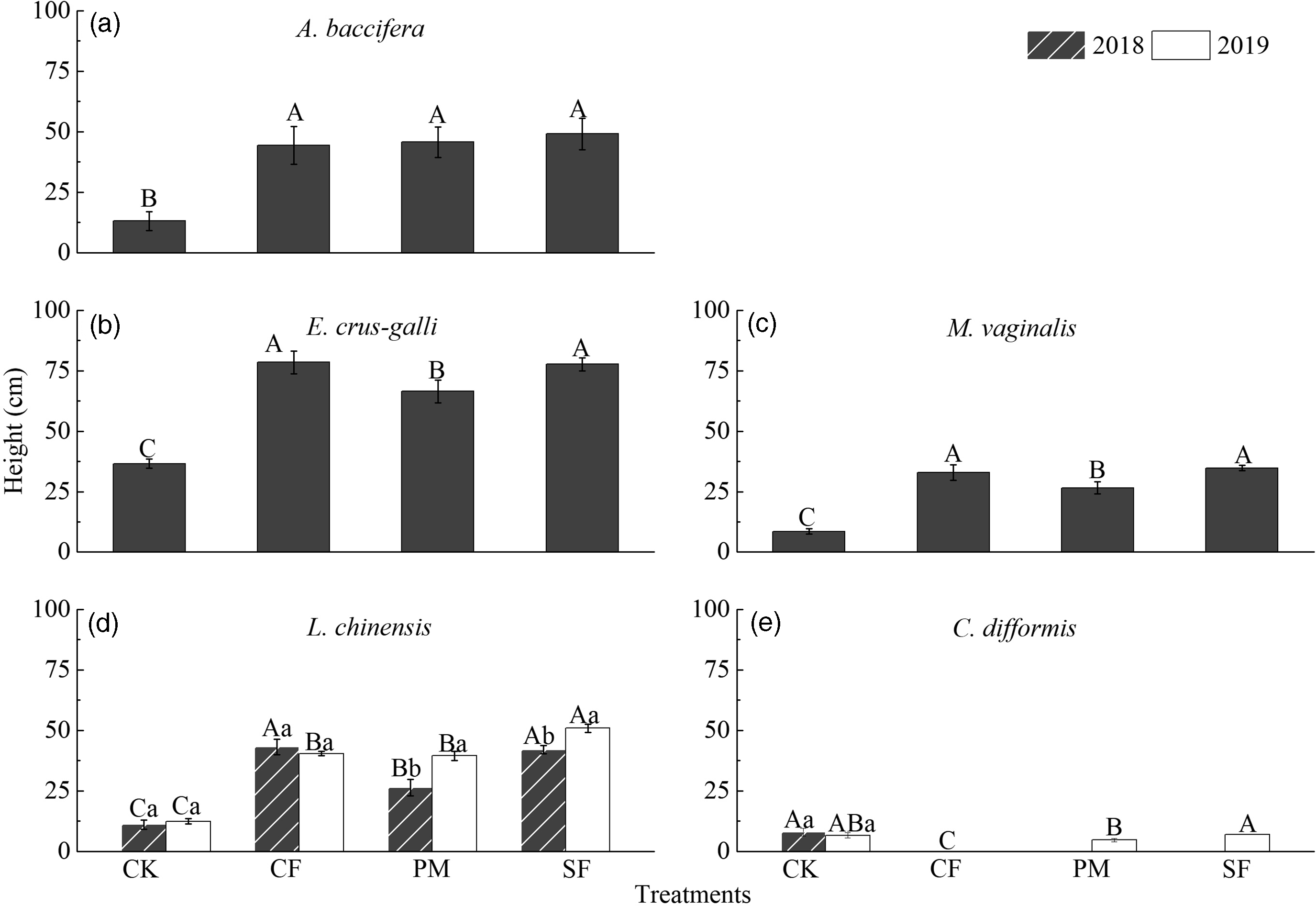
The interaction between year and treatment significantly influenced the heights of L. chinensis (P = 0.002) and C. difformis (P < 0.001), while the interaction was not significant for A. baccifera (P = 0.090), E. crus-galli (P = 0.355), and M. vaginalis (P = 0.429). Therefore, the effects of treatment on the height of A. baccifera, E. crus-galli, and M. vaginalis were averaged over the years (Figure 8). Compared with the CK treatment, fertilizer application significantly increased the plant height of A. baccifera (P < 0.001), E. crus-galli (P < 0.001), M. vaginalis (P < 0.001), and L. chinensis (P < 0.001). The plant height of A. baccifera did not significantly differ among fertilization treatments, whereas E. crus-galli and M. vaginalis were shorter with the PM treatment than with the CF and SF treatments, as was L. chinensis in 2018. In the fertilization treatments, only a few C. difformis plants were observed in the SF and PM treatments in 2019, and the height of C. difformis in the SF and PM treatments in 2019 did not significantly differ from that in the CK treatment. Generally, under high soil fertility conditions, similar to crops, weed species may grow taller to capture more sunlight and increase their competitiveness (Tang et al. Reference Tang, Cheng, Wan, Li, Wang, Tao, Pan, Xie and Chen2014). However, as mentioned earlier, C. difformis may not obtain competitive advantage in fertilization treatments, and other weeds that have the potential to grow taller than C. difformis and are more responsive to N could outcompete this species.
Mean plant height of Ammannia baccifera (a), Echinochloa crus-galli (b) and Monochoria vaginalis (c) and plant height of Leptochloa chinensis (d) and Cyperus difformis (E) under different fertilization regimes in 2018 and 2019. CK, control; CF, chemical fertilizer; PM, composted pig manure combined with chemical fertilizer; SF wheat straw return combined with chemical fertilizer. Bars with different capital letters indicate differences in the effects of the fertilization regimes according to the LSD test at P = 0.05. Bars with different lowercase letters indicate differences in the same fertilization regime between different years according to the LSD test at P = 0.05.

There were significant year by treatment interaction effects on the shoot biomass per plant of A. baccifera (P = 0.002) and L. chinensis (P < 0.001) but not E. crus-galli (P = 0.943), M. vaginalis (P = 0.287), and C. difformis (P = 0.082); therefore, the effects of fertilization treatment on the shoot biomass per plant of E. crus-galli, M. vaginalis, and C. difformis were averaged over the years (Figure 9). The shoot biomass per plant of A. baccifera was significantly increased by fertilization (P < 0.001) and significantly affected by year (P < 0.001); values were higher in 2018 than in 2019 for all treatments, which may have been due to the lower mean temperature and sunlight duration in the whole growth stage of rice in 2018 than in 2019. Among the fertilization treatments, the shoot biomass per plant of A. baccifera was the lowest in the PM treatment in 2018 and lower in the PM and CF treatments than in the SF treatment in 2019. The shoot biomass per plant of E. crus-galli was significantly increased by fertilizer application (P = 0.013) and was not significantly different among the different fertilization treatments. The shoot biomass per plant of M. vaginalis was significantly increased by fertilizer application (P < 0.001). Among the fertilization treatments, the shoot biomass per plant of M. vaginalis was the lowest with the PM treatment. Shoot biomass per plant of L. chinensis was significantly increased by fertilization (P< 0.001). In 2018, the increase in shoot biomass per plant was higher with the SF treatment than with the CF and SF treatments, whereas no difference was apparent among the three fertilization treatments in 2019. The shoot biomass per plant of C. difformis was significantly lower with the fertilization treatments than with the CK treatment (P = 0.002).
Mean shoot biomass per plant of Echinochloa crus-galli (b), Monochoria vaginalis (c), and Cyperus difformis (e) and shoot biomass per plant of Ammannia baccifera (a) and Leptochloa chinensis (d) under different fertilization regimes in 2018 and 2019. CK, control; CF, chemical fertilizer; PM, composted pig manure combined with chemical fertilizer; SF wheat straw return combined with chemical fertilizer. Bars with different capital letters indicate differences in the effects of the fertilization regimes according to the LSD test at P = 0.05. Bars with different lowercase letters indicate differences in the same fertilization regime between different years according to the LSD test at P = 0.05.

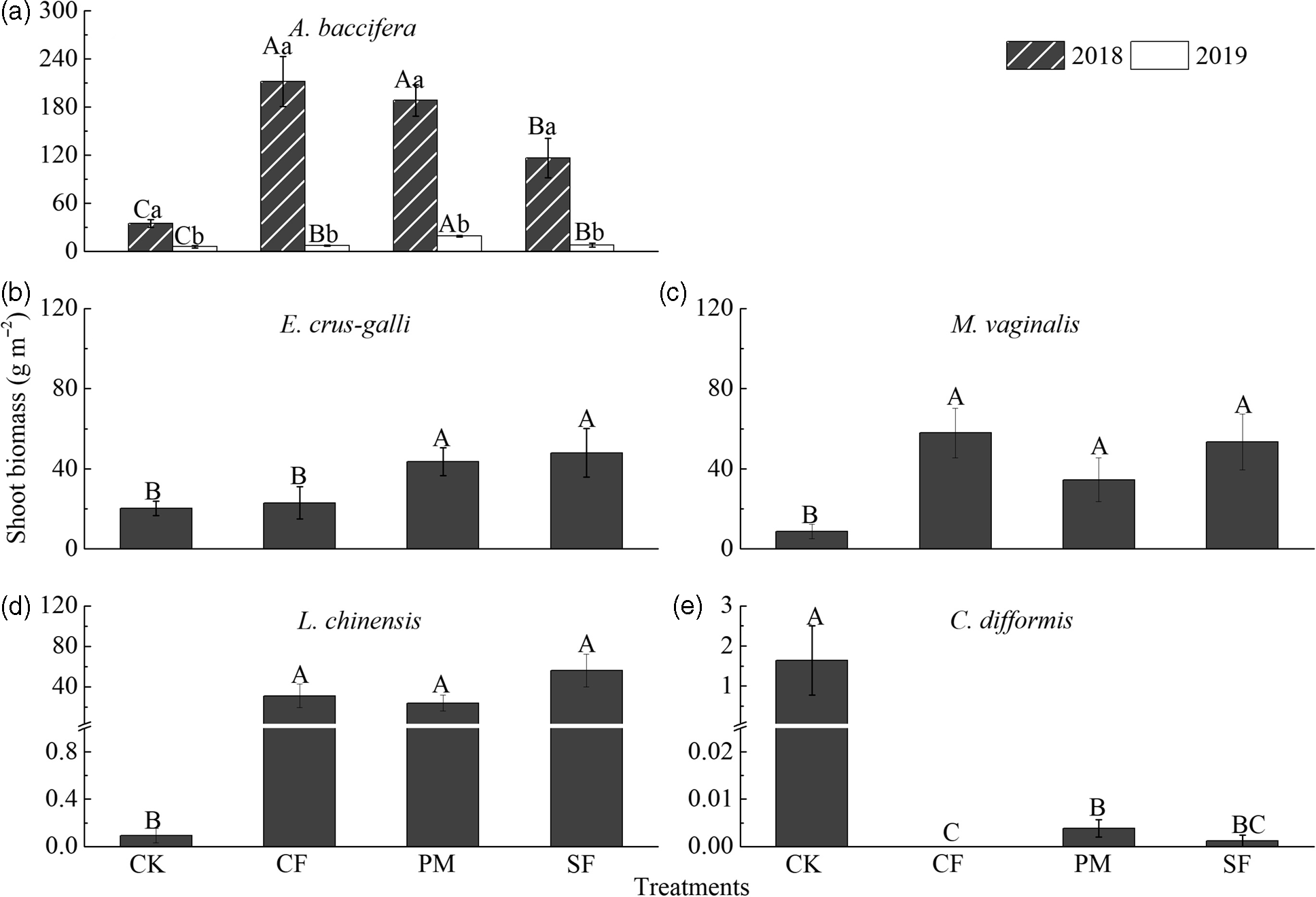
Only the shoot biomass per square meter of A. baccifera was significantly influenced by the interaction effect between year and fertilization treatment (P < 0.001) among the five rice-associated weed species with the highest frequency, and thus the effects of fertilization treatment on the shoot biomass per square meter of E. crus-galli, M. vaginalis, L. chinensis, and C. difformis were averaged over the years (Figure 10). The shoot biomass per square meter of A. baccifera was significantly increased by fertilization (P < 0.001) and significantly affected by year (P < 0.001). The higher values in 2018 than in 2019 for all treatments may also be due to the lower mean temperature and sunlight duration throughout the season in 2018 than in 2019. Among the fertilization treatments, the shoot biomass per square meter of A. baccifera was the lowest in the SF treatment in 2018 and was lower in the SF and CF treatments than in the PM treatment in 2019. The shoot biomass per square meter of E. crus-galli was higher in the PM and SF treatments than in the CK and CF treatments. The shoot biomass per square meter of M. vaginalis (P = 0.004) and L. chinensis (P = 0.012) was significantly increased by fertilization, while that of C. difformis (P = 0.040) was significantly decreased, with no significant difference among the fertilization treatments.
Shoot biomass of Ammannia baccifera (a) and mean shoot biomass per square meter of Echinochloa crus-galli (b), Monochoria vaginalis (c), Leptochloa chinensis (d), and Cyperus difformis (e) under different fertilization regimes in 2018 and 2019. CK, control; CF, chemical fertilizer; PM, composted pig manure combined with chemical fertilizer; SF wheat straw return combined with chemical fertilizer. Bars with different capital letters indicate differences in the effects of the fertilization regimes according to the LSD test at P = 0.05. Bars with different lowercase letters indicate differences in the same fertilization regime between different years according to the LSD test at P = 0.05.

As remarked earlier, nutrient deficiency was more favorable to the infestation of sedge weeds, and the lower panicle density and plant height of rice in the unfertilized treatment may have provided more light and space, allowing for an increase in C. difformis shoot biomass. Organic fertilizers tend to release N more slowly than synthetic fertilizers (De Cauwer et al. Reference De Cauwer, Van den Berge, Cougnon, Bulcke and Reheul2010). The use of organic nutrient sources that limit nutrient availability early in the growing season may favor crop growth relative to weed growth (Liebman and Davis Reference Liebman and Davis2000). In our previous study on the effect of fertilizer amendments on dominant weeds of wheat in a rice–wheat rotation system for 8 yr, compared with the no-fertilizer control, the application of the chemical fertilizer-only treatment resulted in increases in the density, shoot biomass, and seed yield of American sloughgrass [Beckmannia syzigachne (Steud.) Fernald], while the composted manure and straw amendments applied together with chemical fertilizer led to significant increases in the density, shoot biomass, and seed yield of catchweed bedstraw (Galium aparine L.) (Duan et al. Reference Duan, Zhang, Han, Hong, Li, Sun, Gao, Sun, Ran, Shen, Shen, Wu and Ji2021). For our current report on the rice phase of this rice–wheat cropping system, A. baccifera was the most dominant weed species in all experimental fields, and our current results indicate that compared with the chemical fertilizer-only treatment, the composted pig manure application increased the density of A. baccifera while decreasing its shoot biomass per plant in 1 of the 2 yr during which surveys were conducted. The respective decrease and increase in the shoot biomass and density of A. baccifera may be due to the higher fertility and slower release of N from the composted manure amendment. Consistent with our results, Blackshaw et al. (Reference Blackshaw, Molnar and Larney2005) reported that the gradual N release from composted beef cattle manure with time appeared to increase the total density of wheat-associated weeds in a wheat continuous-cropping system. Crop residues can change the chemical environment around weed seeds via allelopathy and serve as physical barriers that can prevent both light penetration and seedling emergence (Derksen et al. Reference Derksen, Anderson, Blackshaw and Maxwell2002; Wu et al. Reference Wu, Pratley, Lemerle and Haig2001). Steinsiek et al. (Reference Steinsiek, Oliver and Collins1982) reported that weed species differed in their responses to the aqueous extract of wheat straw, with the seed germination and seedling growth of ivyleaf morning-glory (Ipomoea hederacea Jacq.) being inhibited the most and that of Japanese barnyard millet [Echinochloa crus-galli var. frumetaceae (Roxb.) Link] being affected the least. Therefore, it is possible that our results may be due to allelochemicals in wheat straw that are leached into the soil to selectively influence the growth of certain weeds in the vicinity. Our results demonstrated that straw return treatment resulted in lower density and shoot biomass per square meter in 1 of 2 yr of A. baccifera than the chemical fertilizer-only treatment. This result is consistent with our previous report of the suppression of B. syzigachne with a rice-straw amendment plus chemical fertilizer during the wheat cycle for two consecutive years of this long-term rice–wheat rotation trial (Zhang et al. Reference Zhang, Sun, Li, Sun, Yuan, Han, Duan, Ji, Zhu, Shen and Ran2019).
In conclusion, during 2018 and 2019 of a long-term rice–wheat rotation trial, we found that fertilization decreased the species richness and total density of rice-associated weeds but increased their total biomass. Although the effects of fertilization on the density and shoot biomass differed with weed category, the density and shoot biomass of sedge weeds were significantly decreased with fertilization. Comparison of weed densities from 2011 and 2019 provided evidence that the increased density of L. chinensis and the decreased C. difformis were due to long-term effects of the fertilization treatments. Composted pig manure and wheat straw amendments supplemented with chemical fertilizer had significant effects on the abundant weed, A. baccifera. Composted pig manure application plus chemical fertilizer increased the density of A. baccifera while decreasing its shoot biomass per plant; whereas wheat straw return plus chemical fertilizer decreased the density and shoot biomass per square meter of A. baccifera. Therefore, it may be possible to use fertilization strategies that correspond to the suppression of specific weeds as components of improved weed management programs in rice production systems; for example, reduced fertilization in fields with serious infestations of L. chinensis, increased fertilization to manage infestations of C. difformis, and wheat straw return for decreasing infestations of A. baccifera.
Acknowledgments
We would like to thank Bernal E. Valverde (Tropical Agriculture Research and Development, Costa Rica) for his thoughtful advice on improving the article. This research was financially supported by the Key Research & Development Program of Jiangsu Province (BE2019343), the Postdoctoral Science Foundation of China (2020M671616), the Priority Academic Program Development of Jiangsu Higher Education Institutions (PAPD), the National Key Research and Development Program (2016YFD0200503-4; 2016YFD0200805), and the Special Fund for Agro-scientific Research in the Public Interest of China (201103004). The authors have no conflicts of interest to declare.