Introduction
Tropical rainforests host a huge diversity of life forms, even at small spatial scales (Carson & Schnitzer Reference Carson and Schnitzer2011, Turner & Corlett Reference Turner and Corlett1996). Much of this diversity is related to the vertical stratification of these environments (Oliveira & Scheffers Reference Oliveira and Scheffers2019). For instance, different groups of animals forage on trees, using their leaves, exudates, bark and other plant structures for feeding and nesting (Antoniazzi et al. Reference Antoniazzi, Garro, Dáttilo, Ribeiro and Neves2019, Power Reference Power1992, Shaw Reference Shaw, Lowman and Rinker2004). Distribution of these plant resources varies across vertical strata, and biotic communities respond to that variation (Shaw Reference Shaw, Lowman and Rinker2004). Moreover, abiotic conditions change among different strata, since in the canopy sunlight incidence and temperatures are higher and humidity is lower than at ground level (Fetcher et al. Reference Fetcher, Oberbauer and Strain1985, Madigosky Reference Madigosky, Lowman and Rinker2004, Parker Reference Parker, Lowman and Nadkarni1995). Hence, in tropical rainforests, vertical stratification is a well-known pattern for the spatial distribution of a wide number of taxa from plants to animals (Basset et al. Reference Basset, Hammond, Barrios, Holloway, Miller, Basset, Novotny, Miller and Kitching2003, Gregorin et al. Reference Gregorin, Bernard, Lobão, Oliveira, Machado, Gil and Tavares2017, Oliveira & Scheffers Reference Oliveira and Scheffers2019, Popma et al. Reference Popma, Bongers and Meave-Del-Castillo1988, Smith Reference Smith1973). In addition, species composition also changes across horizontal space as community similarity generally declines with increasing distance; this is known as the distance–decay relationship (Nekola & White Reference Nekola and White1999). The distance–decay relationship is mainly due to the decrease in similarity of environmental features with distance, leading to changes in the biotic community since species have different niche requirements (Nekola & White Reference Nekola and White1999). The distance–decay relationship can be found over large distances (Nekola & White Reference Nekola and White1999, Soininen et al. Reference Soininen, McDonald and Hillebrand2007), but also occurs at smaller scales, such as within a single forest (Basham et al. Reference Basham, Seidl, Andriamahohatra, Oliveira, Scheffers, Seidl and Scheffers2018). At small scales within forests, environmental conditions such as canopy openness (Brown Reference Brown1993, Schnitzer & Carson Reference Schnitzer and Carson2001) or terrain slope (Lang et al. Reference Lang, Härdtle, Bruelheide, Kröber, Schröter, von Wehrden and von Oheimb2012) can change over relatively short distances, driving rapid turnover. Thus, horizontal (i.e. geographic) and vertical (i.e. tree height) components combine to form a three-dimensional structure with a variety of microhabitats and microclimates in which a high diversity of life forms coexist (Oliveira & Scheffers Reference Oliveira and Scheffers2019).
Among all the arthropods in tropical forests, ants form a notable group since they exhibit great abundance (Wilkie et al. Reference Wilkie, Mertl and Traniello2010) and account for a considerable proportion of total arthropod biomass (Fittkau & Klinge Reference Fittkau and Klinge1973, Tobin Reference Tobin, Lowman and Nadkarni1995). Ants are also ecologically dominant, both behaviourally and numerically (Davidson Reference Davidson1998), and they perform several roles in ecosystem functioning, including nutrient cycling and contributing to energy flow (Folgarait Reference Folgarait1998). Moreover, ants are highly responsive to microclimatic changes, both on the forest floor (Soares & Schoereder Reference Soares and Schoereder2001) and in the canopy (Basset et al. Reference Basset, Cizek, Cuénoud, Didham, Novotny, Ødegaard, Roslin, Tishechkin, Schmidl, Winchester, Roubik and Aberlenc2015). So, ant species distribution and activity are shaped by differential use of the available microhabitat at each stratum as well as by biotic interactions, e.g. competition (Basset et al. Reference Basset, Cizek, Cuénoud, Didham, Novotny, Ødegaard, Roslin, Tishechkin, Schmidl, Winchester, Roubik and Aberlenc2015, Soares & Schoereder Reference Soares and Schoereder2001, Tavella et al. Reference Tavella, Alvarez-Pringles and Cagnolo2018, Theunis et al. Reference Theunis, Gilbert, Roisin and Leponce2005). Although previous studies state that ant species composition changes among vertical strata, there is no consensus in the literature about ant species richness. Some studies have found that ant species richness was quite similar between canopy and ground (Brühl et al. Reference Brühl, Gunsalam and Linsenmair1998, Wilkie et al. Reference Wilkie, Mertl and Traniello2010), while others have found greater ant species richness in vertical strata below the canopy (Longino & Nadkarni Reference Longino and Nadkarni1990, Vasconcelos & Vilhena Reference Vasconcelos and Vilhena2006). Differences in these studies’ conclusions are likely related to the sampling methods used not being standardized between strata, a well-known bias in ecological studies with ants (Gotelli et al. Reference Gotelli, Ellison, Dunn and Sanders2011). Thus, investigation of the spatial distribution of ants in highly diverse environments, such as tropical forests, remains an exciting theme in ecology, whether concerning vertical stratification or horizontal distance.
Changes in species composition among different environments can be quantified using β-diversity (i.e. spatial species turnover and nestedness; Whittaker Reference Whittaker1960). However, β-diversity is highly context-dependent in terms of the organism and habitat type (Soininen et al. Reference Soininen, McDonald and Hillebrand2007). For instance, in a temperate forest, β-diversity in lepidopteran communities is higher between vertical strata than among sites, while the pattern is reversed in coleopteran communities (Hirao et al. Reference Hirao, Murakami and Kashizaki2009). Furthermore, a recent study showed that the distance–decay relationship of amphibian communities differs among vertical strata in a tropical rainforest (Basham et al. Reference Basham, Seidl, Andriamahohatra, Oliveira, Scheffers, Seidl and Scheffers2018). Specifically, within-stratum comparisons show a classic distance–decay relationship for canopy and understorey communities, but not for ground communities (Basham et al. Reference Basham, Seidl, Andriamahohatra, Oliveira, Scheffers, Seidl and Scheffers2018). This study hypothesized that amphibians can more easily disperse at ground level than in the canopy, because the canopy lacks continuity in physical structure compared with the ground level (Basham et al. Reference Basham, Seidl, Andriamahohatra, Oliveira, Scheffers, Seidl and Scheffers2018). However, distinct organisms exhibit differences in their dispersal abilities across vertical strata (Schnitzer et al. Reference Schnitzer, Bongers, Burnham and Putz2015).
Distinct ant species present differences in home range size and dispersal ability, particularly in relation to the habitat they occupy (Yanoviak & Kaspari Reference Yanoviak and Kaspari2000). For instance, in tropical rainforest canopies, some ant species have large colonies and move among treetops of contiguous trees or use ground trails to interconnect neighbouring trees (Adams et al. Reference Adams, Schnitzer and Yanoviak2019, Antoniazzi et al. Reference Antoniazzi, García-Franco, Janda, Leponce and Dáttilo2020 a, Dejean et al. Reference Dejean, Compin, Delabie, Azémar, Corbara and Leponce2019). However, the drivers of the spatial distribution of ground-dwelling ants tend to operate at small scale, being related to microclimate and microhabitat conditions (Luque & Reyes-López Reference Luque and Reyes-López2007, Theunis et al. Reference Theunis, Gilbert, Roisin and Leponce2005) or food availability (McGlynn Reference McGlynn2006). Although some ant species have large foraging areas, such as ants of the Atta genus (Kost et al. Reference Kost, DeOliveira, Knoch and Wirth2005), most ground-dwelling ant species in tropical forests forage over small spatial distances (restricted to a few metres; Eguchi et al. Reference Eguchi, Bui and Yamane2004). Furthermore, several ant colonies may co-occur in small areas, with overlapping foraging areas on the ground (Hanisch et al. Reference Hanisch, Suarez, Tubaro and Paris2018) and in the canopy (Tanaka et al. Reference Tanaka, Yamane and Itioka2010). Therefore, canopy and ground ants present differences in habitat use and distribution in tropical forests, which can lead to distinct patterns of species distributions in the horizontal dimension.
While it has been repeatedly demonstrated that the taxonomic similarity of ground ants decreases with increasing geographic distance, changes in species composition as a function of distance within different vertical strata are relatively unexplored. In this study we evaluated the patterns of vertical stratification of the richness, composition and distance–decay relationship of ant assemblages in a tropical rainforest. We aimed to test whether species richness and composition are similar between ground and canopy strata and whether distance–decay relationships exist within each vertical stratum since these two habitats present differences in abiotic conditions and physical structure. To achieve these aims we sampled ants in the canopy and at ground level in a rainforest remnant on the coast of the Gulf of Mexico using an identical sampling method in both the vertical strata. Firstly, we expected to find strong vertical stratification patterns, in both ant species richness and species composition, since the canopy and ground strata present marked differences in abiotic conditions and resource availability (Shaw Reference Shaw, Lowman and Rinker2004, Yanoviak & Kaspari Reference Yanoviak and Kaspari2000). Secondly, we expected β-diversity to be higher between vertical strata (canopy strata and ground level) than among individual trees, considering both strata together, because changes in abiotic and biotic conditions are generally more extreme in the vertical than in the horizontal dimension within a forest (Shaw Reference Shaw, Lowman and Rinker2004, Smith Reference Smith1973). Thirdly, we expected β-diversity to increase with geographic distance at ground level, since tropical environments are very heterogeneous in microhabitats and microclimatic conditions at short spatial distances (Benson Reference Benson, Prance and Lovejoy1985), but less so in the canopy, mainly because canopy ants can move through the treetops and often present large dominant colonies spread over large territories (Dejean et al. Reference Dejean, Corbara, Orivel and Leponce2007).
Methods
Study area
The study was conducted in a 130-ha forest fragment located in the municipality of Ixhuatán, Veracruz, Mexico (18°2′22.99″N, 94°21′27.61″W, 20–60 m asl). The fragment is located inside a private protected area (Área de Protección y Desarrollo de Ceratozamia) established in 2015 by the Braskem Idesa Company as a Management Unit for Wildlife Conservation (Retes López et al. Reference Retes-López, Cuevas-González, Moreno-Medina, Denogean-Ballesteros, Ibarra-Flores and Martín-Rivera2010). The climate in the study area is warm and humid with a mean annual temperature of 27°C and an annual rainfall of 1800 mm. The driest months of the year (less than 200 mm of rainfall/month) are between January and May, while the rains are concentrated from June to December (more than 500 mm of rainfall in September). About 50% of the fragment consists of grasslands with some isolated trees and the other 50% is composed of a remnant of secondary lowland tropical rainforest, with some representative species: Bursera simaruba (L.) Sarg. (Burseraceae), Cecropia obtusifolia Bertol. (Urticaceae), Coccoloba hondurensis Lundell (Polygonaceae), Cupania dentata Moc. & Sessé ex DC. (Sapindaceae), Guazuma ulmifolia Lam. (Malvaceae), Miconia argentea (Sw.) DC. (Melastomataceae) (Ortiz-Lozada et al. Reference Ortiz-Lozada, Pelayo-Martínez, Mota-Vargas, Demeneghi-Calatayud and Sosa2017).
Ant sampling
We selected 10 trees separated by 339.9 m on average (SD: 161.4 m, min: 94.0 m and max: 767.9 m) which we considered the tallest (height around 20 m) and safest to climb. To sample ants in the tree crowns (here called canopy), we used the ‘single rope climbing technique’ (Perry Reference Perry1978). We also sampled ants on the ground around the trunk of each tree climbed (here called the ground level). Sampling in both strata was performed between 9 a.m. and 4 p.m. in May 2016. To sample ants, we used tuna bait, honey bait and hand collection (Adams et al. Reference Adams, Schnitzer and Yanoviak2017, Antoniazzi et al. Reference Antoniazzi, Ahuatzin, Pelayo-Martínez, Ortiz-Lozada, Leponce and Dáttilo2020 b, Yanoviak & Kaspari Reference Yanoviak and Kaspari2000), each deployed independently and simultaneously for each stratum. Bait was placed near the main fork at the highest point that could be safely reached in the canopy (10–15 m above the ground, depending on the tree height) and on the ground by each tree. Samples were collected after 60–90 min in individual plastic bags (Bestelmeyer et al. Reference Bestelmeyer, Agosti, Alonso, Brandão, Brown, Delabie, Silvestre, Agosti, Majer, Alonso and Schultz2000). Hand collection was carried out in the canopy, on the trunk, and from branches as high and as far as the climber could safely reach, and at the level of ground vegetation, e.g. herbs and small shrubs, always close to the focal tree, in an area similar to that of the canopy survey to make comparisons possible. Hand collection was limited to 10 min for each stratum. All samples were stored in 70% ethanol and transported to the laboratory for sorting, mounting, and identification to the lowest taxonomic level possible. For genus identification, we used a genus guide (Baccaro et al. Reference Baccaro, Feitosa, Fernandez, Fernandes, Izzo, Souza and Solar2015) and for species identification we used the databases AntWeb (Fisher Reference Fisher2002), AntCat (Bolton Reference Bolton2012), Ants of Costa Rica (Longino Reference Longino2007) and Mexico ants (Dáttilo et al. Reference Dáttilo, Vásquez-Bolaños, Ahuatzin, Antoniazzi, Chávez-González, Corro, Luna, Guevara, Villalobos, Madrigal-Chavero, Falcão and Bonilla-Ramírez2020). All material was deposited in the Entomological Collection (IEXA) of the Instituto de Ecología, A. C. (INECOL), Mexico.
Data analysis
To determine whether our sample effort was sufficient we constructed accumulation curves for the ant species with our number of samples (n = 10), i.e. trees combining all sample methods. For this, we used rarefaction and extrapolation curves, in which the number of samples was extrapolated to double the sample size as suggested by Chao et al. (Reference Chao, Gotelli, Hsieh, Sander, Ma, Colwell and Ellison2014). We implemented these methods using the package iNEXT (Hsieh et al. Reference Hsieh, Ma and Chao2016) in R software (R Core Team 2017).
To test whether the ant species richness was different between strata we used Generalized Linear Mixed Models (GLMM; Bolker et al. Reference Bolker, Brooks, Clark, Geange, Poulsen, Stevens and White2009, Zuur et al. Reference Zuur, Ieno, Walker, Saveliev and Smith2009), following the data exploration procedures proposed by Zuur et al. (Reference Zuur, Ieno and Elphick2010). Specifically, we built the fixed-effect model structure using ant species richness as a function of the vertical strata (canopy and ground level). We used the tree as a random effect intercept (n = 10). All models followed a Poisson error distribution and logarithmic link function, frequently used for count data (O’Hara & Kotze Reference O’Hara and Kotze2010, Zuur & Ieno Reference Zuur and Ieno2016). We analysed the residual distribution to verify the adequacy of the assumed error distribution.
To visualize the overlap of species composition between vertical strata we used non-metric multidimensional scaling (NMDS) plotted on a two-dimensional graph. For this, we used a data matrix of presence/absence data and the Jaccard dissimilarity index. Then, we tested if ant species composition differed between the ground and canopy strata using Permutation Multivariate Analysis of Variance (PERMANOVA). Since our sample design was nested (i.e. ‘two vertical strata’ within ‘tree individuals’), we considered the tree individual as a block factor to ensure that randomizations were made only within trees and not among all trees combined. Then, we estimated significance based on 9999 permutations within each tree individual to account for the differences in species composition among all tree individuals. For this, we used the argument strata in the adonis function of the vegan R package (Oksanen et al. Reference Oksanen, Kindt, Legendre, O’Hara, Stevens, Oksanen and Suggests2018).
To test whether species composition changed more between vertical strata or over horizontal distance, we evaluated the contribution of diversity at different spatial scales. Then, we used additive partitioning of diversity (γ = α + β1 + β2), where γ is total species richness, α is species diversity of each sampling point (a given vertical stratum of a tree), β1 is β-diversity between vertical strata within a tree, and β2 is β-diversity among trees within the forest fragment (Lande Reference Lande1996, Veech et al. Reference Veech, Summerville, Crist and Gering2010), as used by several studies, for instance, to investigate habitat-level patterns (Dáttilo et al. Reference Dáttilo, Vizentin-Bugoni, Debastiani, Jordano and Izzo2019, Devries et al. Reference Devries, Murray and Lande1997). We tested the statistical significance of the observed β-diversity values relative to the expected values using a null model that fixes each of the diversity components (i.e. α, β1, β2), with 999 randomizations (Crist et al. Reference Crist, Veech, Gering and Summerville2003). In this case, the null hypothesis is that the mean observed diversity is equal to that expected by the null model, and this should occur if the distribution of diversity is spatially homogeneous. On the other hand, if the mean observed diversity is greater than expected by the null model, this could be the result of strong variation within one of the diversity components (i.e. α, β1, β2). Moreover, to understand the processes that regulate the spatial variation in ant diversity, we separated the β-diversity of the whole community into two components: (i) nestedness (species gain/loss) and (ii) turnover (species change). In addition, we deconstructed β-diversity into these two components, the Sørensen (βSOR) and Simpson (βSIM) indexes (Baselga Reference Baselga2010, Reference Baselga2012). βSOR is a measure of the total β-diversity and includes species composition variation, in terms of both nestedness and turnover. βSIM does not depend on species richness variation and only measures turnover. Thus, the percentage of β-diversity contributed by nestedness alone (βNES) can be calculated using the difference between index values: βNES = βSOR − βSIM (Baselga Reference Baselga2010, Reference Baselga2012). Finally, we tested whether β-diversity increases with the geographic distance between sampling points (i.e. distance–decay relationship) using the βSOR of the canopy, ground level, and both strata together. For this, we performed a Mantel test (Smouse et al. Reference Smouse, Long and Sokal1986) using the Jaccard dissimilarity index as a function of the linear distance (in metres) between individual trees in the canopy, at ground level, and in both strata together. In calculating and representing the Mantel significance graphically, we employed linear models using the Euclidean distances between sampling points and species composition dissimilarity (’Jaccard’). All analyses were performed using R software (R Core Team 2017) with the vegan (Oksanen et al. Reference Oksanen, Kindt, Legendre, O’Hara, Stevens, Oksanen and Suggests2018), lme4 (Bates et al. Reference Bates, Mächler, Bolker and Walker2015), and betapart (Baselga & Orme Reference Baselga and Orme2012) packages.
Results
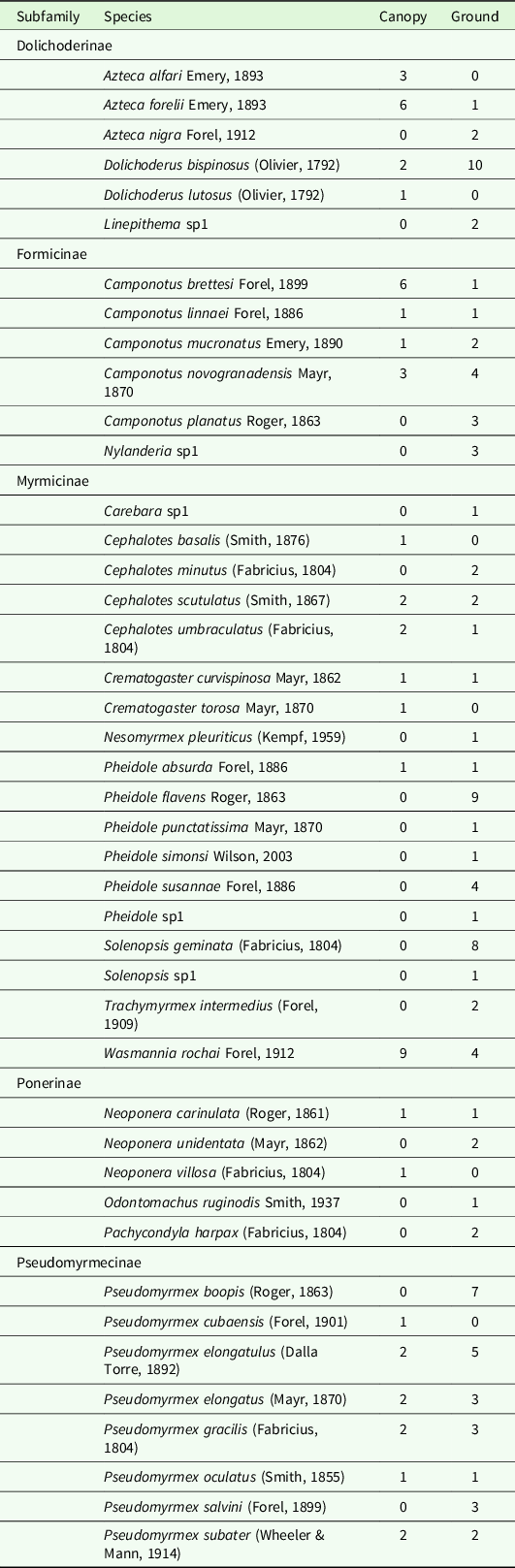
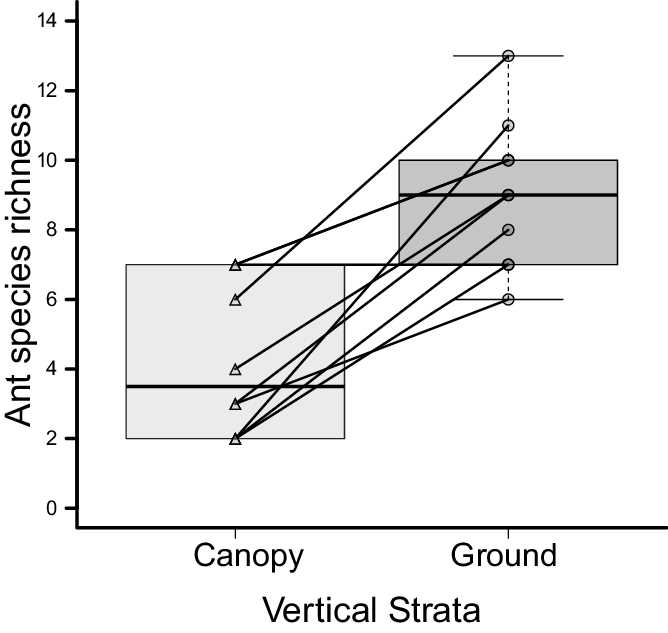
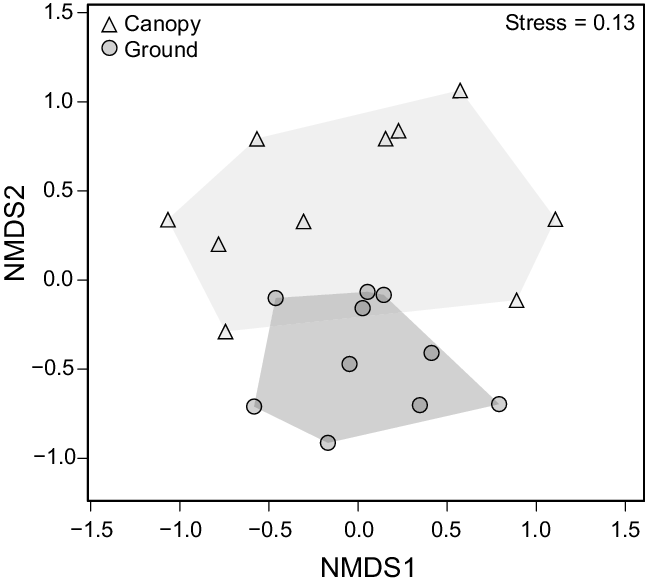
We recorded 43 ant species belonging to 17 genera and five subfamilies (Table 1). The subfamily Myrmicinae had the highest species richness (41%, 18 ant species), followed by Pseudomyrmecinae (18%, eight species), Dolichoderinae (16%, seven species), Formicinae (14%, six species), and Ponerinae (11%, five species; Table 1). Rarefaction analysis showed that the sample coverage estimate was similar in the canopy (76.9%) and at ground-level (78.5%) since the 95% confidence intervals overlapped (Figure S1). Ant species richness was lower in the canopy (mean ± SD: 1.7 ± 2.1) than at ground level (3.3 ± 2.9; χ2 = 15.9; df = 1; P < 0.001; Figure 1). Moreover, we found that ant species composition differed between the canopy and ground level (PERMANOVA: F = 3.1, df = 1, P < 0.001; Figure 2).
Occurrences of ground and canopy ant species in a lowland tropical forest fragment on the coast of the Gulf of Mexico

Ant species richness in the canopy (left) and at ground level (right) in trees from a tropical rainforest fragment in Mexico. Lines show the same tree at different vertical strata.

Non-metric multidimensional scaling plot of species composition divided by stratum (canopy = light grey, ground-level = dark grey) in a tropical rainforest fragment on the coast of the Gulf of Mexico.

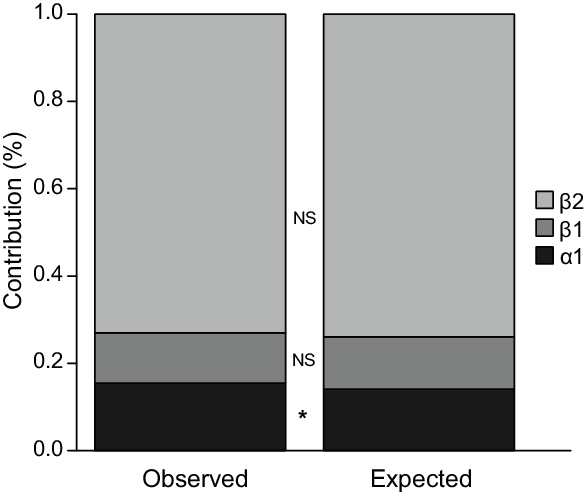
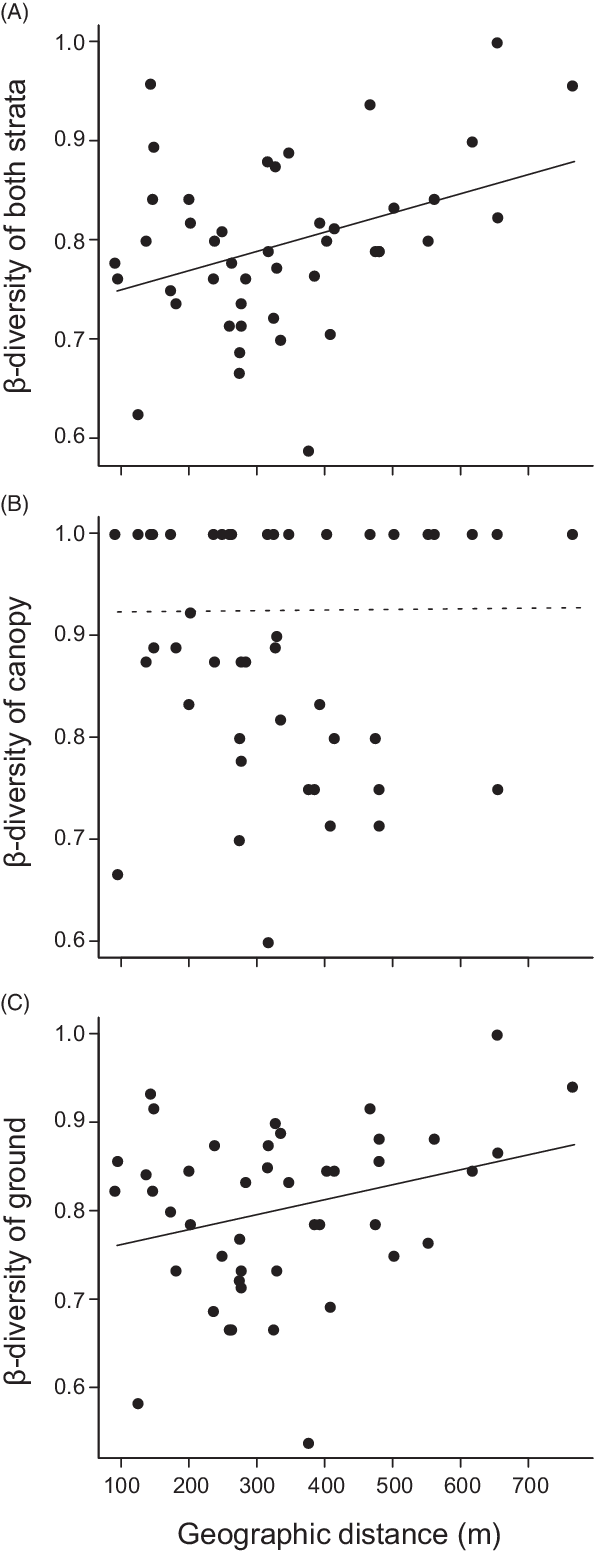
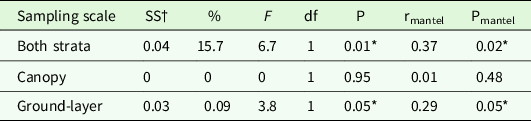
Additive partitioning of the total ant diversity showed that local ant species (α-diversity) accounted for 15.4% of the total species richness (γ), β-diversity between strata (β1) accounted for 11.5%, and the β-diversity among the sample points (β2) accounted for 73% (Figure 3). The observed β diversity between vertical strata within trees (β1obs = 11.5) and among trees within the forest fragment (β2obs = 73.0) were not different from those expected by the null hypothesis (mean value from the 999 randomizations: β1exp = 12.0, P = 0.54; β2exp = 74.0, P = 0.23). On the other hand, the contribution made by local ant species (αobs = 15.5) was greater than that expected by the null model simulations (αexp = 14.1, P = 0.001; Figure 3). Species turnover was the main contributor to β-diversity (93.5%), while nestedness contributed 6.5%. We found a positive relationship between total β-diversity and geographic distance when the ant assemblages of both strata were combined (Mantel test: r = 0.37, P = 0.02; Figure 4A; Table 2) and when ground-layer assemblages were analysed alone (Mantel test: r = 0.29, P = 0.05; Figure 4C; Table 2). However, we found no relationship between β-diversity and geographic distance when considering the canopy assemblages alone (Mantel test: P = 0.46; Figure 4B; Table 2).
Observed and expected contribution (%) of alpha (α1; local species), β1 (β-diversity between canopy and ground level), and β2 (β-diversity between trees considering both ground and canopy strata) of a tropical rainforest fragment on the coast of the Gulf of Mexico. ‘NS’ refers to non-significant and asterisk to significant differences (P < 0.05) between observed and expected values, given by 999 simulations using null models.

Mantel test regression of β-diversity (Jaccard dissimilarity) with geographic distance among sampling points for (A) both strata combined, (B) canopy and (C) ground level, in a tropical rainforest fragment on the coast of the Gulf of Mexico. For model statistics, see Table 2.

Linear model and Mantel test statistics presented in Figure 4 for sampling scale comparisons (both vertical strata together, only canopy, and only ground-layer) of dissimilarity between samples (Jaccard index) against geographic distance among samples. Values with asterisks denote P < 0.05

† SS refers to the sum of squares of each model.
Discussion
We found that although ant species richness and composition differed between canopy and ground level, there was greater β-diversity between individual trees than between vertical strata. Moreover, we also showed a clear distance–decay relationship between individual trees, i.e. with canopy and ground-layer combined. However, analysing ant assemblages of each stratum separately, we only found a distance–decay relationship for ground ant assemblages. Our results make clear that different rules determine the organization of ant assemblies in each stratum, probably as a result of the conditions that these habitats impose and, consequently, of the limitations to the dispersal capacity of the species that occupy them (Soininen et al. Reference Soininen, McDonald and Hillebrand2007). Importantly, a potential limitation of our findings could be the low number of trees sampled, which could reduce the inference of our results. However, we observed 76.9% and 78.5% of estimated sampling coverage for canopy and ground level, respectively (Figure S1). A previous study involving local inventories of the Lepidoptera from an isolated Pacific island has reviewed under-sampling and the measurement of β-diversity (Beck et al. Reference Beck, Holloway and Schwanghart2013) and found that biases were low when sample coverage was ~80% using the Jaccard index, as used in this study. Moreover, in the β-diversity analyses we performed 90 comparisons between all possible pairs for each stratum (Figure 4), and employed the same sampling effort and method in each vertical stratum. Therefore, despite the apparently low number of trees sampled, for the first time our study enables us to show empirically a distance–decay relationship in ant assemblages separately for canopy and ground strata. Nonetheless, a better understanding of how insects are distributed in tropical forests would benefit from greater sampling coverage (Basset et al. Reference Basset, Cizek, Cuénoud, Didham, Novotny, Ødegaard, Roslin, Tishechkin, Schmidl, Winchester, Roubik and Aberlenc2015). In particular, future studies should evaluate in detail the distance–decay relationship at different spatial and temporal scales. In addition to improving the sampling effort, investigating other insect taxa with different dispersal abilities and life histories in different environments should broaden the debate started here.
We found fewer ant species per tree than other arboreal ant surveys that also used hand collecting and baiting sampling methods (Adams et al. Reference Adams, Schnitzer and Yanoviak2017, Yanoviak et al. Reference Yanoviak, Fisher and Alonso2007). However, in such studies ants were surveyed for a longer period than in our study (a minimum of 2 h over 1–3 days) and in a primary rain forest (Yanoviak et al. Reference Yanoviak, Fisher and Alonso2007). Here, we sampled for 10 min at each sampling site and our sampling sites were in a secondary rainforest, and these are known to host fewer species than primary forests (Klimes et al. Reference Klimes, Idigel, Rimandai, Fayle, Janda, Weiblen and Novotny2012). Related to vertical strata, we found fewer ant species in the canopy than in the forest floor, as reported in previous studies in tropical systems (Neves et al. Reference Neves, Queiroz-Dantas, DaRocha and Delabie2013, Schmidt et al. Reference Schmidt, Ribas and Schoereder2013). Sampling bias is considered to be one of the main issues that must be taken into account when making comparisons among biological communities in general (Gotelli et al. Reference Gotelli, Ellison, Dunn and Sanders2011). Using intense and diverse sampling methods in distinct tropical rainforests, Brühl et al. (Reference Brühl, Gunsalam and Linsenmair1998) and Wilkie et al. (Reference Wilkie, Mertl and Traniello2010) found similar ant species richness between canopy and ground level, while other studies have found that the ground level has greater richness than higher strata (Longino & Nadkarni Reference Longino and Nadkarni1990, Vasconcelos & Vilhena Reference Vasconcelos and Vilhena2006), as we found here. While many studies use different sampling methods in each vertical stratum, here we have used the same (complementary) sampling methods in both strata — namely, hand collecting, tuna bait, and honey bait (Adams et al. Reference Adams, Schnitzer and Yanoviak2017, Antoniazzi et al. Reference Antoniazzi, Ahuatzin, Pelayo-Martínez, Ortiz-Lozada, Leponce and Dáttilo2020 b, Yanoviak & Kaspari Reference Yanoviak and Kaspari2000). We are therefore confident that our richness data were collected in a way that makes them comparable between strata.
Climate, habitat and resources are markedly different between the canopy and the ground level (Madigosky Reference Madigosky, Lowman and Rinker2004), and ants that occupy these habitats endure these conditions and use these resources differentially (Yanoviak & Kaspari Reference Yanoviak and Kaspari2000). While at ground level microhabitat conditions and nutrient availability are the main determinants of the ant community (McGlynn & Kirksey Reference McGlynn and Kirksey2000), in the canopy nest availability, tree height and surrounding conditions promote changes in ant diversity (Antoniazzi et al. Reference Antoniazzi, Garro, Dáttilo, Ribeiro and Neves2019, Campos et al. Reference Campos, Vasconcelos, Ribeiro, Neves and Soares2006, Friedrich & Philpott Reference Friedrich and Philpott2009, Klimes et al. Reference Klimes, Idigel, Rimandai, Fayle, Janda, Weiblen and Novotny2012). In this study, although some of the ant species we collected on the ground are known to nest strictly in the canopy (e.g. most Camponotus spp. and Pseudomyrmex spp., all Cephalotes spp., and Neoponera carinulata), we found a distinct species composition in each vertical stratum (Figure 2). These findings are consistent with a broad pattern in the literature dealing with the vertical stratification of ants (Antoniazzi et al. Reference Antoniazzi, García-Franco, Janda, Leponce and Dáttilo2020 a, Arruda et al. Reference Arruda, Pesquero, Marcelino, Leite, Delabie and Fagundes2015, Brühl et al. Reference Brühl, Gunsalam and Linsenmair1998, Hashimoto et al. Reference Hashimoto, Morimoto, Widodo and Mohamed2006, Vasconcelos & Vilhena Reference Vasconcelos and Vilhena2006, Wilkie et al. Reference Wilkie, Mertl and Traniello2010). Typical ant species in each vertical stratum must respond to distinctive abiotic conditions and resources for feeding and nesting (Folgarait Reference Folgarait1998, Klimes Reference Klimes, Oliveira and Koptur2017). For instance, arboreal ants are often associated with carbohydrate sources that are provided by plant structures or insects, e.g. extrafloral nectaries and sap-sucking trophobiont insects (Del-Claro et al. Reference Del-Claro, Rico-Gray, Torezan-Silingardi, Alves-Silva, Fagundes, Lange, Dáttilo, Vilela, Aguirre and Rodriguez-Morales2016), while at ground level ants have more nitrogen sources in the form of available prey (Yanoviak & Kaspari Reference Yanoviak and Kaspari2000). Therefore, ants’ use of multiple available microhabitats and resources in tropical rainforests supports their high diversity (Cloudsley-Thompson Reference Cloudsley-Thompson2003, Ellwood & Foster Reference Ellwood and Foster2004, Sarty et al. Reference Sarty, Abbott and Lester2006, Tobin Reference Tobin, Lowman and Nadkarni1995).
We found that most of the changes in ant species occurred horizontally, among individual trees, rather than between vertical strata, highlighting the great variation of ant assemblages in a tropical environment, even at a very small scale (Theunis et al. Reference Theunis, Gilbert, Roisin and Leponce2005). This was an especially interesting result given the small spatial scale of our sample (the maximum horizontal distance between trees was around 700 m). Moreover, since β-diversity between vertical strata (β1) and between trees (β2) was not significantly different from the expected value, ant assemblages are subsamples of the same species pool. However, the differences observed between the local ant species (α-diversity) and those expected by the null model suggest structural differences in the ant community between trees (Figure 3). Part of this variation may be explained by host tree species, a factor influencing associated ant species composition (Dejean et al. Reference Dejean, Compin, Delabie, Azémar, Corbara and Leponce2019, Klimes Reference Klimes, Oliveira and Koptur2017). Other factors that may influence ant species composition, e.g. tree development stage (Antoniazzi et al. Reference Antoniazzi, Garro, Dáttilo, Ribeiro and Neves2019, Dejean et al. Reference Dejean, Djiéto-Lordon, Céréghino and Leponce2008), were comparable among the trees we sampled, but other axes of variation may exist, caused by factors such as epiphytes or tree-bark structure. Future studies should incorporate these tree characteristics as much as possible, because they may have a significant influence on small-scale turnover. Indeed, we found that turnover (93.5%) was the main component of β-diversity when considering the whole community.
Despite the differences in ant species composition and richness between the canopy and ground level and contrary to what we had expected, we found lower β-diversity between vertical strata (β2) than over horizontal dimension (β1). Several factors can have led to the lower vertical stratification we found, such as the successional stage of the forest, the ant foraging patterns, and seasonality (i.e. dry vs. wet season). Secondary forests have lower structural complexity than primary forest, which may result in a lack of clear vertical stratification (Brokaw & Lent Reference Brokaw, Lent and Hunter1999, Pinotti et al. Reference Pinotti, Pagotto and Pardini2012). Previous studies have shown that some species are able to traverse the vertical axis, from ground to canopy, particularly in secondary forests (Antoniazzi et al. Reference Antoniazzi, Garro, Dáttilo, Ribeiro and Neves2019, Marques et al. Reference Marques, Espiríto-Santo, Neves, Schoereder, Espírito-Santo, Neves and Schoereder2017). Indeed, secondary forests often benefit generalist species, since these species may be more thermotolerant, allowing them to move between ground and canopy strata, e.g. some Pseudomyrmex species (Spicer et al. Reference Spicer, Stark, Adams, Kneale, Kaspari and Yanoviak2017), agreeing with our results. Further, seasonality is an important factor that affects the vertical stratification of animals, as shown by previous studies with amphibians (Basham & Scheffers Reference Basham and Scheffers2020) and spiders (Quijano Cuervo et al. Reference Quijano-Cuervo, Rangel-Acosta, Martínez-Hernández and Sabogal-Gonzalez2019), in which vertical stratification declined in the dry season. Here, we sampled in the dry season, and future sampling in the wet season may provide additional insight into seasonal variation in vertical stratification.
In addition to the higher β-diversity of ant assemblages among trees than between vertical strata when we combined both strata, we also found a positive correlation between β-diversity and geographic distance, known as the distance–decay relationship. However, when we analysed this relationship within each stratum, the classic distance–decay relationship only occurred at ground level. The dissimilarity of ant species composition in the canopy was uniformly high (β > 0.6) and not related to geographic distance. This uniformity may be due to the ability of ants to traverse the canopy using lianas and other structures that facilitate movement (Adams et al. Reference Adams, Schnitzer and Yanoviak2019), with many canopy species forming large territories spread across multiple trees (Dejean et al. Reference Dejean, Corbara, Orivel and Leponce2007). Thus, canopy ants tend to exhibit higher territoriality (Adams Reference Adams2016) while at ground level the territories of ground ants often overlap in space and time (Morrison Reference Morrison1996), possibly due to the greater heterogeneity of microhabitats and conditions on the forest floor (McGlynn Reference McGlynn2006, Soares & Schoereder Reference Soares and Schoereder2001).
Overall, we found a strong pattern of vertical stratification, since species composition and richness changed significantly across vertical strata and species richness was higher at the ground level. We would caution against sampling for ants in only one stratum to avoid under-sampling the total community, since our results show that the distance–decay relationship was not consistent between canopy and ground level assemblages, exhibiting a classic distance–decay relationship for the ground assemblage but not the canopy assemblage. The patterns we observed here describe the inverse of the trend seen in Basham et al. (Reference Basham, Seidl, Andriamahohatra, Oliveira, Scheffers, Seidl and Scheffers2018), where canopy dwelling amphibians showed high turnover in horizontal space, but ground amphibians showed no turnover. Thus, this study illustrates how taxa may differ in their patterns of spatial distribution, making it difficult to generalize patterns of horizontal and vertical trends without further taxon-specific studies.
Acknowledgements
We are grateful to Lynna Kiere, Tatiana Joaqui, and Daniel González Tokman for helpful discussion and comments on previous versions of the manuscript. We also thank Erick Corro, Diana Ahuatzin, Brenda Rattoni, Felipe Aoki and João Penna for ideas and comments in the early stages of this study and Braskem Idesa for the support provided to carry out this study in the Ceratozamia Area of Protection and Development, and especially Roberto Velasco (Industrial Director), Antonio Santos Souza Galvão (Sustainability), Ana Luisa Martínez López and Ana Paulina Deméneghi Calatayud (Environment). We are also grateful to José Alberto Toto Hernández for support in the field. We would like to thank two anonymous reviewers for their valuable suggestions and comments that significantly improved the manuscript. We also thank CONACYT, which provided support for RA’s PhD studies (CONACYT scholarship, CVU 771787), and Biodiversity Research Consortium Brazil-Norway (Hydro-Alunorte) for ABVJr. postdoctoral scholarship.
Financial support
RA was supported by CONACYT PhD scholarship CVU 771787.
Supplementary materials
For supplementary material for this article, please visit https://doi.org/10.1017/S0266467420000188