

1. INTRODUCTION
Max Weber's famous argument that Protestant Christians are prone to save and work long hours and thereby contributed to the rise of capitalism in Northern Europe has inspired a vast literature on the link between religion and economics (recently, Becker and Woessmann (Reference Becker and Woessmann2009) provided a human capital interpretation). Botticini and Eckstein (Reference Botticini and Eckstein2005, Reference Botticini and Eckstein2007, Reference Botticini and Eckstein2012) argued that the Jewish communities enjoyed a high level of human capital, gained by religious motivations early-on, which provided them with a comparative advantage in entering skilled professions when urbanisation started.
The Catholic Monarchs expulsed Jews from their kingdoms in the late 15th century and for more than three centuries the Inquisition in the Iberian Peninsula persecuted «New Christians», formerly Jews or Muslims, and other religious minority groupsFootnote 1. This may have had negative long-term consequences for economic development, partly due to emigration and partly due to persecution. The historian Antonio Saraiva (Reference Saraiva2001, p. 34) makes the point that «the departure of the Jews was a devastating blow to the Spanish economy». Joseph Pérez (Reference Pérez2014, pp. 118-119), a prominent Hispanicist, holds that without resulting in a «national catastrophe» in Spain, the expulsion caused disturbances in the economy at the local level, mainly because artisans and merchants disappeared from one day to the nextFootnote 2. In a quantitative study, Vidal-Robert (Reference Vidal-Robert2014) finds that inquisitorial activity had a negative impact on economic development, which he proxies by population growth, until the second half of the 19th century. Anderson (Reference Anderson2015) compares the development of what he calls «top-achievers» in countries with established Inquisitions (Italy, Spain and Portugal), most of them of Jewish origin, with other countries in which oppression was not institutionalised. His findings suggest that the Inquisition-countries experienced a significant decline in the numbers of top-tier scientists, artists, authors and composers after the Inquisition began, whereas other countries saw an increase in them.
In this study, we quantify the numeracy advantage of religious groups persecuted by the Inquisition, with the use of the age-heaping technique, now well established in the literature. It is a human capital measurement exercise, which compares the different (religious) categories of Inquisition defendants with a representative sample of the early modern Iberian populationFootnote 3. We confirm our hypothesis that people tried for secretly practicing Jewish rites (crypto-Jews) had a substantial advantage in numeracy over the average Catholic majority, although the gap narrowed over time. An additional finding is that other (religious) elite groups of society that became occasional targets of the Inquisition had a similar or even higher numeracy. The non-elite defendants who were tried for «minor heresies» were not significantly more numerate than the non-Inquisition control group. However, our study focuses on Jews, because this religious minority is thought to have played an important role in the Iberian economy and polity, particularly before the expulsion, and it represented one of the key targets of the Inquisition.
We use a novel dataset composed of defendants of various «crimes» in the courts of the Spanish and Portuguese Inquisition to assess the numeracy of religious groups from the late 15th until the late 18th century. The original sources are trial records and relaciones de causa in particular; trial summaries carried out by every district court and sent to the Inquisitor General in Madrid, which contain valuable information on the defendants. The non-Jewish majority is captured by a comparison sample based on population censuses as well as parish registers (see online Appendix Table A.1). The focus on the Iberian Peninsula has the advantage that the majority of the population was relatively homogeneous culturally.
We must note from the outset, however, that our samples are not without definition issues. For example, the Inquisition did not accuse every person who secretly practiced Jewish rites, and some individuals who were accused probably did not adhere to the Jewish religion (the same is true for those accused of Protestantism and other «crimes»). For this reason, we will refer to our sample of alleged Jews as «Jewish-accused» or JA. Our sample might come close to a core group of Spanish and Portuguese who adhered to Jewish religion and custom, even if it is has its limitations.
In section 2, we provide a brief overview of the literature on the relation between (particularly Jewish) religion on the one hand, and education and occupations on the other. We discuss various hypotheses regarding Jewish motivations for investing into education more than other groups. Section 3 gives a historical background on Jews and the Inquisition in Iberia. Section 4 introduces the method, the data and the sources. We also address potential caveats in the research design, like the representativity of the samples. In section 5 we discuss the results, and section 6 concludes.
2. RELIGION, HUMAN CAPITAL AND THE ECONOMY: A LITERATURE REVIEW
«The Protestant Ethic and the Spirit of Capitalism» (Reference Weber1905), Max Weber's seminal work, strongly influenced the subsequent literature on religion and economics. His argument that Protestant Christians (particularly Calvinists) are prone to save and to work long hours, thereby contributing to the rise of capitalism, has inspired economic theories on why adherents of a particular religious belief are more successful than othersFootnote 4. More recently, Becker and Woessmann (Reference Becker and Woessmann2009) offered an alternative explanation to Weber's theory. Analysing differences in literacy between 19th-century Prussian Protestant and Catholic counties and using instrumental variable methods, they conclude that the human capital that was gained by Lutherans due to the need to read the Bible (in German) allowed Protestant regions to prosper economically and caused Catholic regions to fall behind.
In answer to Weber's seminal work, the economist Werner Sombart (Reference Sombart1911) argued that the characteristics ascribed by Weber to Protestants apply to a greater degree to Jews. In «The Jews and Modern Capitalism», Sombart hypothesises that there may be a connection between the shifting of the economic centres from Southern to Northern Europe and the movement of the Jews. For example, at the end of the 16th century, Holland enjoyed sudden economic development that coincided with the establishment of a prosperous Jewish community in Amsterdam formed by refugees from Portugal. Although these populations were small in quantity, one can imagine learning effects within the non-Jewish population, knowledge transfer and crucial entrepreneurial input. In a similar vein, Ashraf and Galor (Reference Ashraf and Galor2011, pp. 76-77) argued that the Jewish and other minorities played a beneficial role for economic development.
Several scholars have attempted to identify the reasons for the selection of Jews into urban high-skilled occupations. Werner Sombart (Reference Sombart1911) maintained that Jews and other persecuted religious or ethnic minorities preferred to invest in human capital rather than physical capital because it was portable and could less easily be expropriated. Therefore, Jews did not invest in land, and their educational advantage allowed them to engage in highly skilled urban occupations. Historians of Judaism including Cecil Roth (Reference Roth1938) and Solomon Katz (Reference Katz1937) argue that restrictions imposed on Jewish minorities by local rulers refrained them from engaging in agricultural activities and encouraged them to specialise in trade and crafts and, later, in money lendingFootnote 5. An alternative explanation was proposed by the economist Simon Kuznets (Reference Kuznets and Finkelstein1960, Reference Kuznets1972), who analysed the occupational structure of the Jewish population in 19th century Eastern Europe and North America. He attributes the engagement of Jews in non-farming occupations to a non-economic decision common to small minorities. To maintain their cohesion, group identity and customs, the Jewish community (like other small minorities, such as the Parsi in India or the Huguenots in early modern Western Europe) preferred to be concentrated in selected industries, which happened to be urban occupations. Before Kuznets, Max Weber had hypothesised that Jews voluntarily segregated into certain occupations to correctly observe their strict religious rituals, which, in his view, was a trait common to all religious minorities (Botticini and Eckstein Reference Botticini and Eckstein2012).
On the other hand, Botticini and Eckstein (Reference Botticini and Eckstein2005, Reference Botticini and Eckstein2007, Reference Botticini and Eckstein2012) argued that the Jewish communities enjoyed a high level of human capital, gained by religious motivations, which provided them with a comparative advantage in entering skilled professions. These authors attribute this educational advantage to a religious law invoked in the first century CE by the religious group of the Pharisees that forced Jewish fathers to teach their male children to read Hebrew, or to send them to school to do so. During this time, the Pharisees became the dominant religious group among the Jews in Israel, and Judaism transformed from a religion of «sacrifices in temples» to a religion of the study of the Torah in the synagogue. Although not its goal, this religious emphasis on literacy was a precondition for the specialisation of Jews in highly skilled and well-paid occupations when urbanisation progressed in the 8th century Muslim world. The ability to read and write constituted an advantage for Jewish farmers to take over particular activities such as commerce, crafts, medicine and finance. When they dispersed in Europe, Jews had already specialised in urban professions and continued to pursue them in the Diaspora.
Despite the existing documentation, quantitative evidence on Jew's human capital relative to the non-Jewish majority's in the same historical period and region is scarceFootnote 6. Whereas Botticini and Eckstein (Reference Botticini and Eckstein2005, Reference Botticini and Eckstein2007, Reference Botticini and Eckstein2012) focus on the period before 1500 and mostly on other world regions, the available information on literacy of Jews and New Christians in Iberia in the modern era is scattered and comes mostly from records of particular Inquisition trialsFootnote 7.
3. BACKGROUND: RELIGIOUS MINORITIES AND THE INQUISITION IN IBERIA
Until the 15th century, the Iberian population consisted of mixed confessions (Muslim, Christian and Jewish). Jews had prospered socially during the Muslim rule of Al-Andalus—which lasted in parts of today's Spain and Portugal from 711 and until 1492—and some kept occupying important positions in the economy and polity during the «Reconquista» in Christian SpainFootnote 8. In the Christian kingdoms of Iberia, Jews held high-ranked posts in public administration, including the posts of royal counsellors, royal treasurers and bankers, and heads of the king's chanceries. Other typical professions included small- and large-scale merchants, physicians and lawyers. Money lending and other financial operations, stigmatised activities in medieval Europe, played a key role in Jewish economic life as well. Jews in Iberia also produced artisans; typically tailors, jewellers and blacksmiths (Kamen Reference Kamen1965, Roth Reference Roth1995).
Anti-Semitic tensions in Iberia had long been latent and worsened during the 14th century, leading to Jewish massacres in 1391 and in 1412Footnote 9. Probably up to 200,000 Jews accepted conversion during this period, starting with the upper classes (Pérez Reference Pérez2005, p. 141). During the reign of the Catholic Monarchs of Castile and Aragon (covering most of the Spanish territory), several measures were taken to isolate Jews from the rest of the population, culminating in the issuance of a royal edict of expulsion of the Jews from Spain in 1492 (Pérez Reference Pérez2005). As a result of the proclamation of the edict, of the approximately 200,000 Jews living in Castile and Aragon in 1492 (Pérez Reference Pérez2005, p. 164), an estimated 50,000 left in exile for good while the rest converted to Christianity (Pérez Reference Pérez2005, p. 192)Footnote 10. Roughly half of them migrated to Portugal, the rest to North Africa, Turkey, Italy and Western Europe. Portugal granted them temporary asylum in return for payment. Because the Jews who remained in Spain or returned from exile had been forced to convert, they were suspected of secretly practicing Jewish rites.
The Spanish Inquisition was officially introduced with the promulgation of the Papal Bull «Exigit Sincerae Devotionis» under the rule of the Catholic Monarchs Isabella I of Castile and Ferdinand II of Aragon in 1478 and was suppressed for good in 1834. Since the first tribunal, based in Seville, commenced its activity in 1480, more than 100,000 trials were conducted against so-called Judaisers, converted Muslims, Protestants and other «heretics» (Vidal-Robert Reference Vidal-Robert2014). It established sixteen permanent courts in the Spanish Peninsula, the Canary Islands and Mallorca, each ruling over a certain jurisdiction. Since the late 16th century, the Inquisition also set up courts and persecuted JA (Jewish-accused) throughout the Spanish Empire in Latin America, including Lima, Mexico and Cartagena de Indias, as well as in Spanish territories in ItalyFootnote 11. The Inquisition soon acquired a reputation outside Iberia for being a repressive instrument of racial and religious intolerance that regularly employed torture and restricted Spain's intellectual development for centuries (Rawlings Reference Rawlings2006, p. 1)Footnote 12.
The motive of the Catholic Monarchs to set up this institution was most probably to reach (social and) religious uniformity in their highly religiously fragmented kingdoms, as a way of securing political stability (see also Johnson and Koyama Reference Johnson and Koyama2019)Footnote 13. One of the aims of the Inquisition was to assure the orthodoxy of New Christians who converted from Judaism and, to a lesser extent, IslamFootnote 14. The royal decrees of expulsion of Jews and forced baptism of Muslims, of 1492 and 1502 respectively, led to forced mass conversions and resulted in more targets for the Inquisition. Religious and intellectual reformers, Protestants, as well as so-called «minor heresies», behavioural attitudes that violate Christian rules, were also persecuted. While at the beginning the Spanish Inquisition dealt mostly with Judaism, this crime became relatively infrequent from the 16th century. Even though the Spanish Inquisition was a centralised institution, there were some differences between regional courts in the type (and number) of crimes they dealt with. For example, in comparison with other courts, the tribunal in the Canary Islands tried a much larger share of Protestants—all of them foreigners—given the active relations with Dutch and German traders and the high levels of immigration in the archipelago (Fajardo Spinola Reference Fajardo Spinola2005, p. 113).
In Portugal, the Inquisition was formally established in 1536 and endured until 1821Footnote 15. It set in place permanent courts in Coimbra, Lisbon and Evora in Iberia, as well as in Goa, a Portuguese colony in India. More than 40,000 trials took place during its existence and at least 85 per cent of them concerned Judaising (Saraiva Reference Saraiva2001). Despite the anti-Semitic sentiments of the population and the forced baptism of all Jews in 1497, the persecution of crypto-Jews was initially less severe than in Spain. In fact, the newly baptised Jews (including those who had fled Spain) were protected from any investigations into their religious beliefs and practices for a few decades after 1497. King Manuel III wished to retain the New Christian population in Portugal; he actually banned the emigration of New Christians under threat of death and confiscation of goods. Thus, converted Jews probably continued to practice their former religion until King João III finally obtained a papal bull for an Inquisition in Portugal in 1536 (Saraiva Reference Saraiva2001). When the Portuguese throne was taken over by the Spanish monarch in 1580 (and until 1640), the Holy Office courts of Portugal became more aggressive against «Judaisers» and other heretics. In fact, the late 16th and early 17th centuries are the era during which most sentencing took place (Saraiva Reference Saraiva2001).
4. METHOD, DATA AND CLASSIFICATION
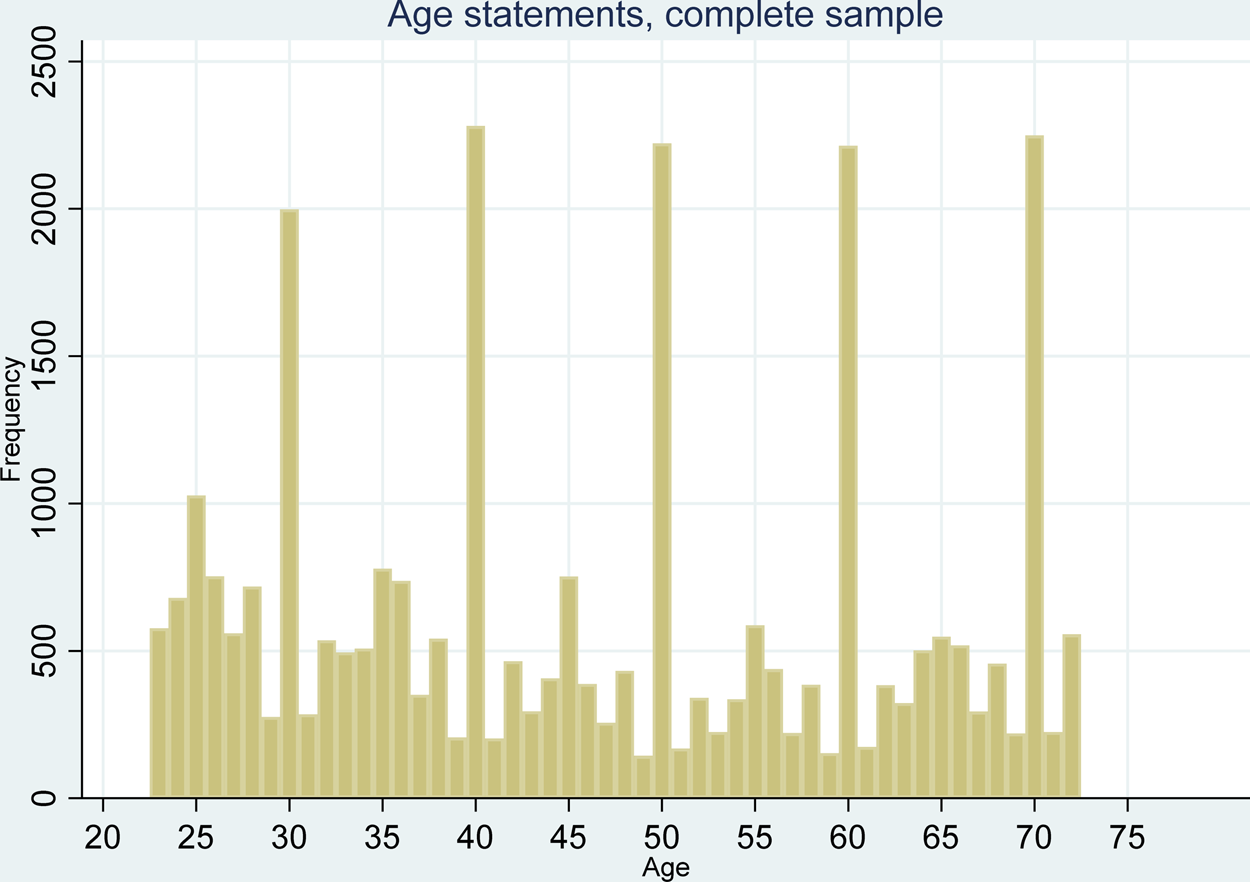
The method used here to measure human capital is the «age-heaping» technique. Age-heaping captures the numeracy component of human capital, which is an important precondition for the adoption and development of technologies and a prerequisite for modern market economies (see also A'Hearn et al. Reference A'Hearn, Baten and Crayen2009). The phenomenon of heaping applies to historical populations (as well as people in the poorest countries today), in which a substantial share of the people are unable to state their exact age and hence reported a rounded age, such as «I am 30», when they were in fact 29 or 31, for example. This results in an age distribution with peaks on multiples of five (Figure 1).
Age distribution of the Inquisition and the control dataset.

How is the degree of age-heaping calculated? The ratio between the preferred ages and other ages can be measured by several indices, the most common of which is the Whipple index. This index measures the proportion of people who state an age ending in a five or zero, assuming that each terminal digit should appear with the same frequency in the «true» age distribution (or the degree to which the distribution of age statements approaches an equal distribution).
 $$Wh = \left( {\displaystyle{{(Age25 + Age30 + Age35 + \cdots + Age70)} \over {1/5 \times (Age23 + Age24 + Age25 + \cdots + Age72)}}} \right) \times 100$$
For an easier interpretation, A'Hearn et al. (Reference A'Hearn, Baten and Crayen2009) suggested another index, which is called the ABCC index. This is a simple linear transformation of the Whipple index and yields an estimate of the share of individuals who correctly report their age, thus ranging from 0 to 100:
 $${\rm ABCC} = \left( {1-\displaystyle{{(Wh-100)} \over {400}}} \right) \times 100\quad {\rm if}\,Wh \ge 100;\quad {\rm else}\,{\rm ABCC} = 100.$$
A technical requirement of the ABCC index is that it is applied to an age distribution in which every final digit occurs with roughly the same frequency. It is usually calculated for fixed age ranges starting with the final digit 3 and ending with the final digit 2; 43-52, for instance. This allows the final digits of 0 and 5 to be spread more evenly across the age ranges, mitigating the effect that more people are alive for example at 60 than at 69, and thus the number of 60-year-olds will be higher (Crayen and Baten Reference Crayen and Baten2010). In this study, we consider individuals aged 23 to 72. We usually ascribe the ABCC index to the decade of birth. The share of persons able to report an exact age has been shown to be highly correlated with other measures of human capital, such as literacy and schooling, across countries and individuals and over time (Mokyr Reference Mokyr1983; A'Hearn et al. Reference A'Hearn, Baten and Crayen2009; Crayen and Baten Reference Crayen and Baten2010). While age-heaping-based numeracy is not without problems, it complements other indicators of human capital (which are also imperfect; see Crayen and Baten Reference Crayen and Baten2010)Footnote 16.
A potential objection to this line of research could be that Inquisition litigants were actually asked about their literacyFootnote 17. Usually, numeracy is considered as a proxy indicator for education which is particularly useful if literacy data is not available. However, for a number of reasons, numeracy also has advantages over literacy measures. One advantage of age-heaping-based numeracy—and perhaps the most crucial one—is that we can create a comparative sample of the general Iberian population, which would not be possible with literacy in this studyFootnote 18. A second advantage is that age reporting was less the focus of the Inquisition. Literacy can be heavily biased in Inquisition records, because it was most likely interpreted as a signal for being Jewish or Protestant. Age was much less suspicious, because contemporaries did not know about the proxy function of rounded ages.
Finally, the relationship between economic growth and numeracy is far stronger than to school enrolment or literacy, as the recent economic growth literature has shown: numerical skills are the ones that matter most for economic growth. Hanushek and Woessmann (Reference Hanushek and Woessmann2012) argued that math and science skills were crucial for economic success in the 20th century. They observed that these kinds of skills outperform simple measures of school enrolment in explaining economic development. Hence, if there were an effect of religious persecution on economic development, it would more likely be related to numeracy.
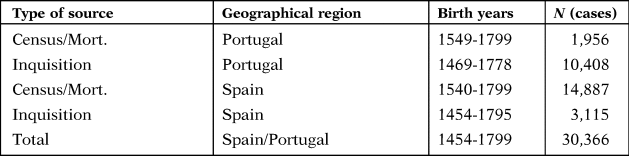
We construct a large database that includes (1) a sample based on Inquisition trials from Spain and Portugal, and (2) a comparative sample based on non-Inquisition sources. In Table 1, we present the earliest and latest birth years of individuals recorded in both Inquisition and census/mortality sources as well as the number of cases. We only take into account the individuals born between the mid-15th and the late 18th centuries, who reported an age between 23 and 72 years. In order to avoid potential temporal composition effects, we will include time fixed effects below.
INQUISITION AND NON-INQUISITION SOURCES (COMPARATIVE SAMPLES), INDIVIDUALS AGED 23 TO 72

Source: See text.
Appendix Table A.1 (online) cites all the sources used to compile the database. The comparative sample consists of individuals recorded both in «padrones»/«visitas» (regional, usually municipal, population counts) and «catastros» carried out during the Inquisition era, such as the Catastro de Ensenada, as well as ecclesiastical death records of Spain and PortugalFootnote 19.
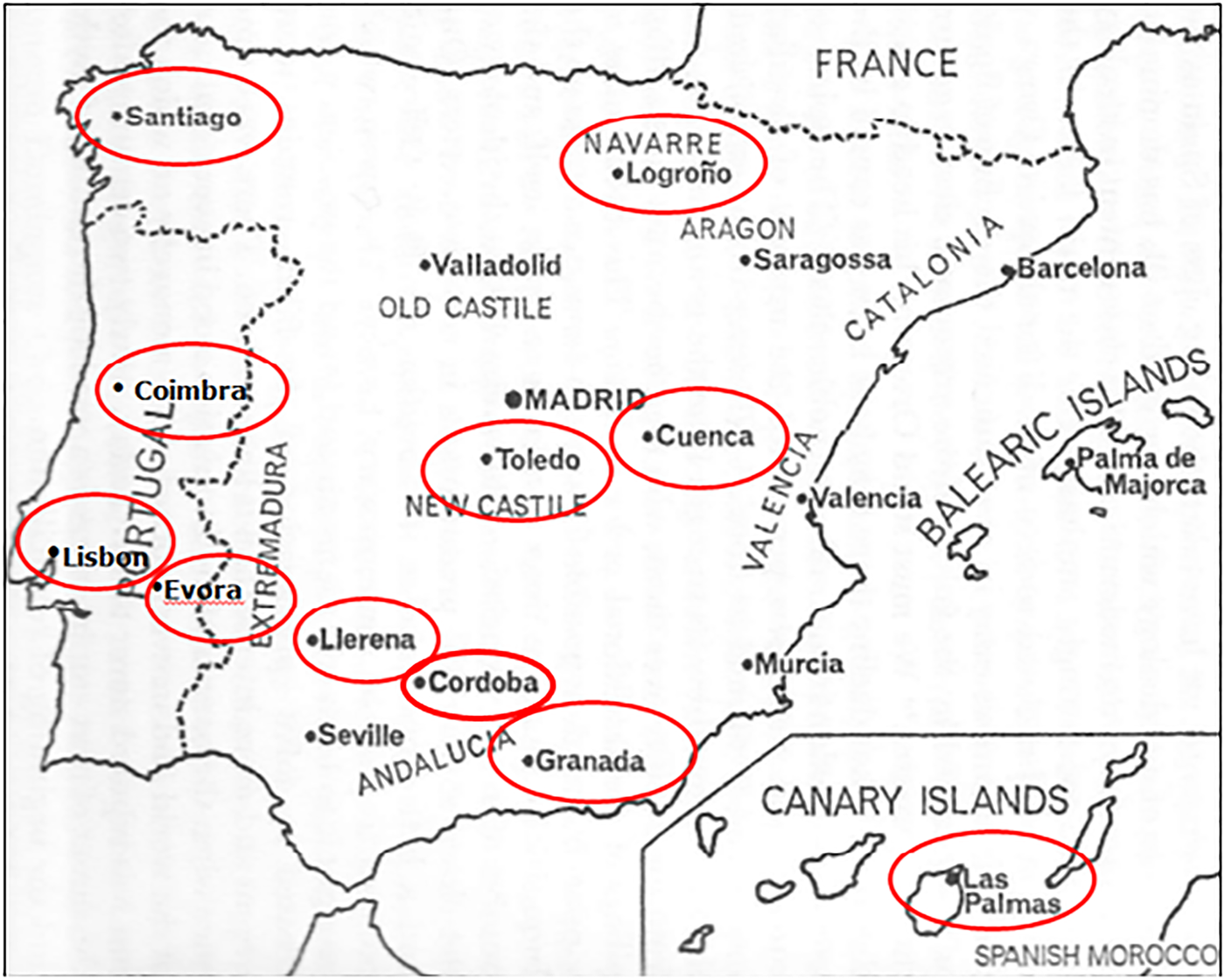
The Inquisition sample was compiled using information on the defendants who were tried in eleven out of nineteen district courts that existed in the Iberian Peninsula (Figure 2 locates Inquisition courts). In Portugal, the Inquisition had courts in Lisbon, Coimbra and Évora, and our dataset includes defendants at all threeFootnote 20. The Inquisition in Spain, including the Canary and Balearic Islands, had permanent courts in 16 cities, and our dataset includes trials from eight different courts spread across the country; regional bias is therefore less of an issue. Our main data sources are summaries of Inquisition trials (relaciones de causa), which contain valuable information on defendants including their name, age, occupation, genealogy, place of residence and origin, along with brief notes on charges, confessions, remorse and sentencingFootnote 21. Given the large amount of information collected by officials, this source constitutes a useful instrument for the historiography of the social and economic position of Jews and New Christians.
Inquisition courts in Portugal and Spain.

The two types of sources (census and mortality registers) used to construct our control group sample have already been used for numeracy analyses by A'Hearn et al. (Reference A'Hearn, Baten and Crayen2009), but we will still discuss potential social and regional biases. The social sample selection bias in the Spanish and Portuguese «control group» samples, based on census and mortality data, is not substantial because these sources aimed to include the entire population at the year of census taking or death. In Spain and Portugal, almost everyone was Catholic and was entered into the death registers. Potential exceptions are emigrants; however, emigration affected only a modest share of the Christian population during the early modern period. The mortality records are obviously not self-reported ages, but earlier studies found that spouses or other close relatives typically reported the ages of the deceased (A'Hearn et al. Reference A'Hearn, Baten and Crayen2009). The priests sometimes based the age statements on interviews with the deceased just before death. In a minority of cases, when neither source of information was available, they simply estimated the age, which might result in a slightly lower estimate of numeracy relative to the true value. Ploetz (Reference Ploetz2013) found that death-register-based and census-based numeracy correlated strongly where both estimates were available, but death-register-based ones were slightly lower. Hence, in the regressions below we will add a dummy variable for the control group observations coming from mortality registers. In addition, we also run a robustness test using only census type samples, which are usually considered not to contain substantial bias. We find that the differences were small compared with the other estimates (see online Appendix Table A.2). Both strategies yield almost the same results; hence, the mortality register bias does not cause problems.
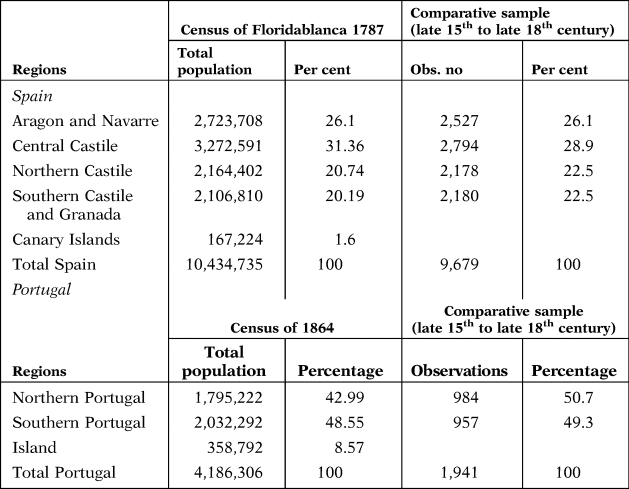
Given the regional differences in education levels, especially in Spain, we carefully verified that our data were representative for both Spain and Portugal by comparing the regional coverage of our samples with the regional distributions of the actual populations in the censuses of the 18th and 19th centuries (the Appendix discusses changes from the 16th to 18th century regional population weights). In Table 2, we compare our samples with the population statistics of the earliest national censuses of Spain (census of Floridablanca 1787) and Portugal (national census of 1864)Footnote 22.
DATA REPRESENTATIVENESS OF REGIONAL UNITS IN SPAIN AND PORTUGAL

Note: This table includes 11,6211 observations from the comparative sample, for which birth region information was available.
Source: Spanish population: Instituto Nacional de Estadísticas de Espana (http://www.ine.es); Portuguese population: Instituto Nacional de Estatística do Portugal (http://www.ine.pt).
The regional categories for Spain were made along with the historical distribution that included the kingdoms of Aragón, Navarre, Castille and Granada. The regional units are composed of the following provinces: Centre-Castille: Albacete, Ciudad Real, Toledo, Cuenca, Guadalajara, Madrid, Badajoz, Cáceres, Salamanca, Avila, Segovia, Soria, Burgos, Valladolid, Zamora, León, Palencia and la Rioja. North-Castille: La Coruna, Pontevedra, Ourense, Lugo, Asturias, Cantabria, Vizcaya, Guipúzcoa and Álava. South-Castille and Granada: Huelva, Sevilla, Cadiz, Córdoba, Jaén, Murcia, Granada, Almeria and Malaga. Aragon and Navarre: Alicante, Valencia, Castellon, Tarragona, Lleida, Barcelona, Girona, Teruel, Zaragoza, Huesca and Navarra.
The regions of Portugal are composed of the following provinces: Northern Portugal includes Braga, Bragansa, Vila Real, Vianna do Castello, Porto, Aveiro and Coimbra. Southern (incl. Central) Portugal includes Setubal, Portalegre, Beja, Evora, Faro, Viseu, Guarda, Castelo Branco, Leiria, Santarem and Lisbon. Islands includes Azores and Madeira.
In our original comparison dataset, the regions of South Castile, Granada and Northern Portugal were overrepresented, as we had managed to gather more information on residents of those regions. We drew a random sample (using the stata command sample) from both regions to make the regional distribution of our comparison sample coincide with the one of the Floridablanca census and the 19th century national census of Portugal. How regionally representative is our dataset for the whole population of Portugal and Spain now? In general, the Spanish source seems quite representative by region: the larger units of the country have relatively similar population shares in the census and in our sample. The same is true for Portugal. The only exceptions are the islands, for which we have no control group. Any remaining regional bias will be controlled using regional fixed effects in the regressions.
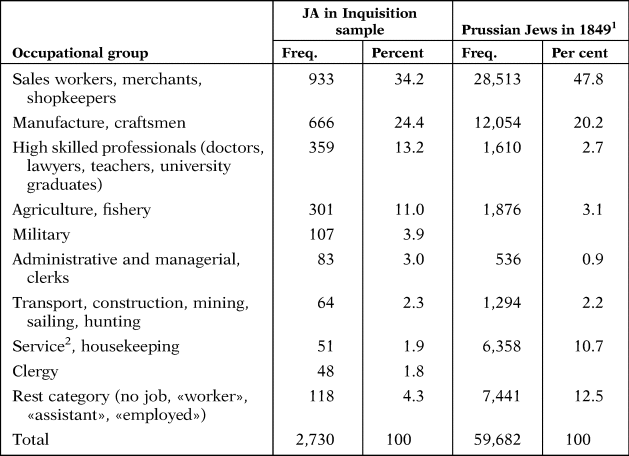
Finally, is our sample of JA representative of the total Jewish population? Unfortunately, there is no other (unbiased) source for Iberia that can show the numeracy of Jews or New Christians. However, all Jews and New Christians who remained on the Iberian Peninsula after the edict of expulsion were potential «victims» of the Inquisition court, independent of their educational level; and a substantial share was actually accused, given that conversos were widely believed to practice Jewish rites secretly (e.g. Rawlings Reference Rawlings2006, p. 49). Moreover, although the occupational status of the Jews included in our sample is on average high, their occupational structure coincides with that ascribed in the literature to the Jewish population in Spain and Portugal at the time (Kamen Reference Kamen1965, Saraiva Reference Saraiva2001). As in several other European countries, for example Prussia in 1849, the Jewish occupation structure was very much skewed towards commerce, professionals, and crafts (see Table 3)Footnote 23. Clearly, Prussia had a more rapidly progressing industrial development in the 1840s; hence, we can observe a composition of occupations that shows more accountants and tradesmen than our earlier sample for Iberia. If we only look at the post-1650 period in our Inquisition sample, the share engaged in commerce rises to 40 per cent (not shown), approaching the Prussian share. The structure of Jewish occupations in both countries can be considered similar, but, in Prussia, slightly more individuals belonged to those occupational groups of trades and services, relative to agriculture and traditional professional occupations, including doctors and lawyers. In conclusion, our sample of Jewish occupations that we find in the Spanish Inquisition documents seems plausibly representative for early modern Spain, and occupational selectivity is therefore probably limited.
GROUPED OCCUPATIONS OF MALE JA, 1450 TO 1799, AND A COMPARISON WITH PRUSSIAN JEWS IN 1849, BASED ON HISCO CATEGORIES

Source: See text.
Note: HISCO stands for Historical Standard Classification of Occupations (Van Leeuwen et al. Reference Van Leeuwen, Maas and Miles2002).
2 Includes barber, brewer and butcher.
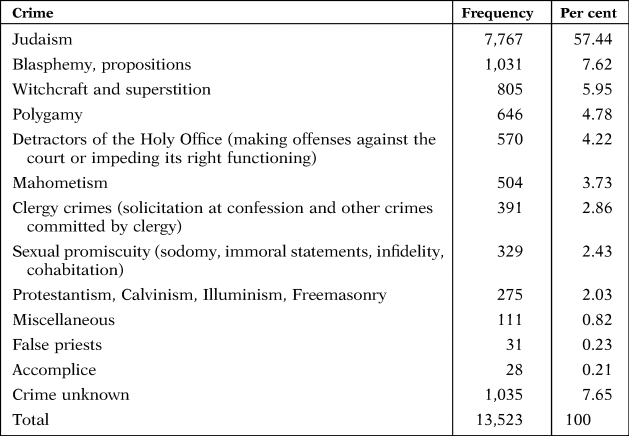
As noted above, Inquisitorial trial documents provide comprehensive personal information on the defendants, such as their age, birthplace, occupation and gender. We can also derive information on the alleged crime for most of the individual cases. We classify the Inquisitorial crimes into categories based on Contreras and Henningsen (Reference Contreras, Henningsen, Henningsen and Tedeschi1986) in Table 4Footnote 24.
CLASSIFICATION OF CRIMES FOLLOWING CONTRERAS AND HENNINGSEN (Reference Contreras, Henningsen, Henningsen and Tedeschi1986)

Judaism, Islam and Protestantism were considered the three «major heresies» by the Inquisition. The category of Protestantism includes Calvinism, Lutheranism, Erasmism, Illuminism and Freemasonry because these schools were perceived as similar to each other in doctrinal orientation. A number of defendants were actually brought to trial for various «major heresies» at the same time. For example, Maria Cazalla was arrested and accused of Lutheranism, Illuminism, Erasmism and Molinism (a Catholic theological line named after the Spanish Jesuit Luis de Molina who claimed that divine grace and human free will are not mutually exclusive) in 1532 (see Kamen Reference Kamen1965, chapter 5). «Minor heresies» refers to unorthodox beliefs and behaviours of Old Christians, which the Inquisition began to be responsible for after the 1560s. They included polygamy, other crimes related to sexual promiscuity (such as sodomy, cohabitation or infidelity), blasphemy and propositions, superstition and witchcraft, offenses against the Holy Office or impeding its correct functioning (including giving false court testimony; not serving an imposed sentence and corrupted «family of the Inquisition») and being an accomplice to a crimeFootnote 25. Contreras and Henningsen include the category of «solicitation» in the «minor heresies». «Solicitation» occurred if a priest seduced a woman during confession. We have ascribed this type of crime to a category we call «clergy crimes». It includes other offenses such as clergymen getting married and secretly married men becoming priests, priests holding more than one Mass per day, or holding a Mass without having fasted. This category is particularly interesting because it represents Catholics who belonged to one of the presumably best-educated social groups of early modern society, given that they had to be literate and have studied theology. A last category is the one of «false priests», preachers pretending to be priests. These people celebrated Mass without being entitled to it.
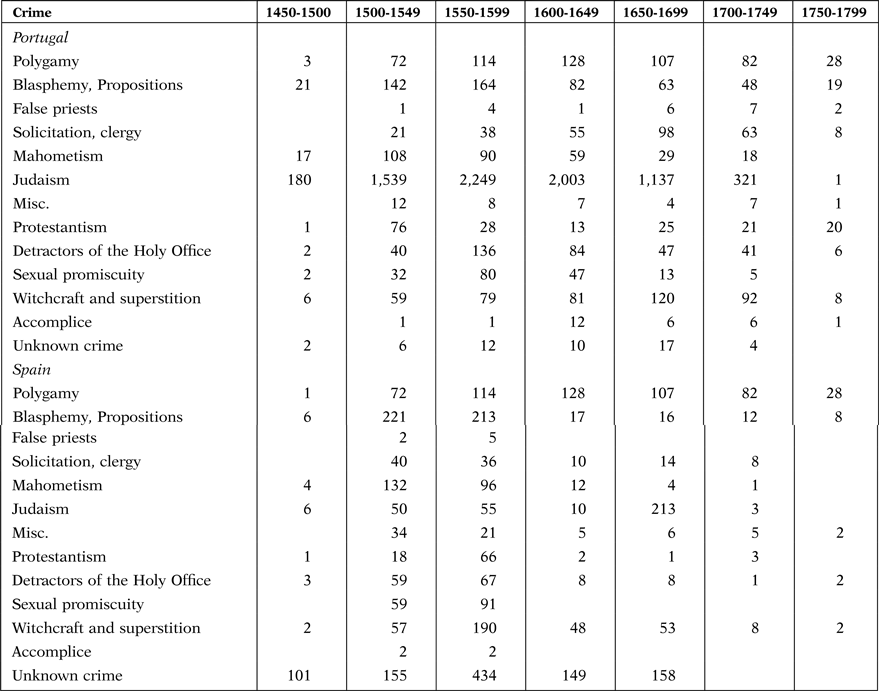
Naturally, the relative frequency of the different crimes addressed by the Inquisition varied between Inquisition courts and across time (see Table 5). For example, whereas the Spanish Inquisition dealt mostly with converted Jews at its inception, 50 years later, when most Inquisition trial documents of our sample begin, this crime was already much less frequent. Moreover, with the rise of Lutheranism in Germany in the 16th century, the court turned its attention to religious and intellectual reformistsFootnote 26. There is a slight surge in the relative number of JA at the Spanish Inquisition in the 17th century. The latter could be due to the revival of the persecution of Jews by the Spanish Inquisition some decades after the union of Portugal and Spain in 1580, when Portuguese New Christians emigrated en masse to Castile (Saraiva Reference Saraiva2001). In total in our dataset, «Judaism» is by far the most frequent crime, accounting for 60 per cent of all alleged crimes while the other crime categories each account for less than 8 per cent (Table 4). However, this is mainly due to the fact that our Portuguese Inquisition sample is three times larger than our Spanish one and Judaism represents around 71 per cent of crimes in the former sample (in the latter, only 11 per cent).
NUMBER OF TRIALS BY CRIME CATEGORY AND HALF CENTURY OF BIRTH, SPAIN AND PORTUGAL SEPARATELY

Source: See text.
In sum, we can hypothesise that, on average, the defendants at the Inquisition were more numerate than the rest of the population. Part of the accused was «major heretics», including Jews, Protestants and other spiritual devotees. Illuminists, «Erasmians», Lutherans and other Protestants were usually individuals who had thought critically about theological (and political) issues and had adopted innovative views on spiritual and intellectual life. They were often familiar with devotional literature censored by the Inquisition or had even written it themselves (Kamen Reference Kamen1965; Rawlings Reference Rawlings2006, pp. 90-113). As described before, Jews in the Iberian Peninsula were often professionals, successful merchants and craftsmenFootnote 27. One could thus imagine that a share of the persons tried at Inquisition courts were relatively well-educated, but other groups of defendants, such as polygamists, not necessarily. This is what we will test in the following section. Moreover, we will assess whether the JA were more numerate than the Catholic control group even if we hold occupations constant.
5. RESULTS
We test the numeracy differences described above in logistic regressions, controlling for other potential determinants of numeracy such as gender, age, time period or region. A logistic regression model was used because it meets the requirements of a dichotomous dependent variable best.
The binary dependent variable, «not heaped age (more likely numerate)», takes the value of 1 if the age reported was not a multiple of five, and 0 otherwise (the inverse of «age statement is a multiple of five»). Roughly one-half of the sample reports an age ending on 5 or 0. Both genders are almost equally represented and one quarter belongs to the «young» age group (age 23-32). We control for both gender and age (by including a young age dummy) because these variables are important determinants of age-heaping; in other words, the numeracy advantage of men over women was considerable at the time and younger individuals more often rounded on multiples of two and less on multiples of five (see Crayen and Baten, Reference Crayen and Baten2010, on this). Moreover, we include time dummies (half centuries of birth) because our dataset covers a long period of time, as well as region dummies to control for regional differences in education.
Given that logit models are sometimes more sensitive to measurement error, we also test a linear probability model (LPM). Recently, LPMs have been frequently used, partly because the issue of heteroscedasticity can easily be circumvented using robust standard error estimation. Using these two alternative approaches, the logit and the LPM models, allows us to test the robustness of our results. The basic model setting is described in equation [3] (which applies similarly to the logit):
 $${\rm nu}{\rm m}_{itr}\; = \; \; \alpha + \beta \; _1{\rm J}{\rm A}_{i\;} {\rm}+{\rm } \beta _k{\rm crime}{\rm s}_i\; + \; {\delta} ^{\prime}X\; + \; \gamma _t\; + \; \mu _r\; + \; u_{itr}$$
where i denotes the respective individual, t denotes the period of birth and r denotes the region in which this individual was born. As the main variable to be explained, num is the binary response variable that represents numeracy, α is a constant term, β 1 is the coefficient of those accused of engaging in Jewish practices, and β k is the coefficient vector for the other crimes persecuted. δ′X is a matrix of other controls (gender, age group, sources).γ t and μ r denote time and region fixed effects, and u is the error term.
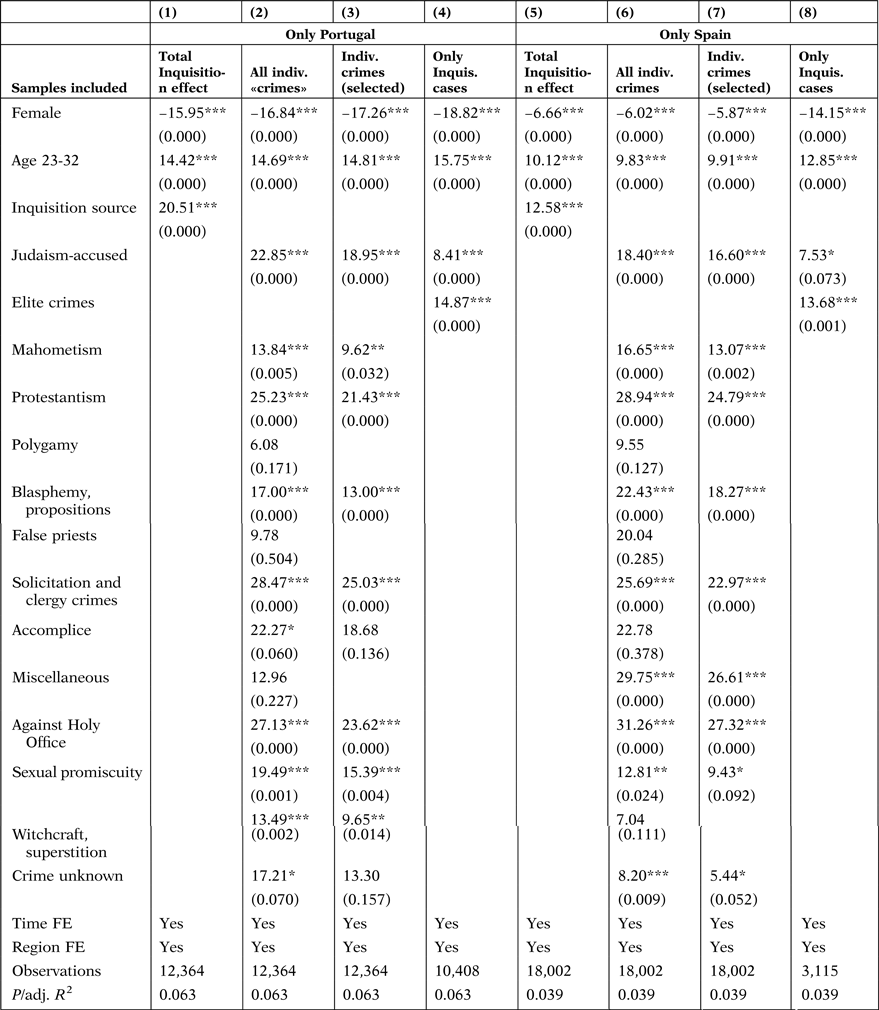
Table 6 reports the results of the logistic regressions for Portugal and Spain separately. In Appendix Table A.3 (online), we also report the regression results for the pooled sample (Spain and Portugal together), of both the logistic and the linear probability regressions. Marginal fixed effects (mfx) are displayed for the logit models. We multiplied the marginal fixed effects by 125 as to report per cent values and to adjust them for the 20 per cent of ages that were truly multiples of five, given a normal age distribution (see Juif and Baten (Reference Juif and Baten2013) and online Appendix B for details)Footnote 28.
DETERMINANTS OF NON-HEAPING (I.E. THOSE MORE LIKELY TO BE NUMERATE) IN LOGIT REGRESSIONS

Notes: The dependent variable is «not heaped age» (more likely to be numerate). The reference category is male individuals, aged 33–72, born between 1600 and 1649 (all specifications); drawn from a census source (models 1-2 and 5-6); from a census source or accused of selected crimes at the Inquisition (models 3 and 7); drawn from the Inquisition-database and not accused of Judaism or an elite crime (models 4 and 8). We controlled for regional fixed effects by including regional dummies and for time effects including half centuries of birth; we also controlled for the source being a death register where appropriate (omitted from this table). We multiplied the coefficient of the regressions by 125 as to report percentages and to adjust them for the 20% of ages that were truly multiples of five, given a normal age distribution. Robust P-Values are given in parentheses: ***P < 0.01, **P < 0.05, *P < 0.10.
In columns 1 and 5, we assess the differential between all defendants of the Inquisition and the control group that reflects the average Spanish or Portuguese population. The tried sample was considerably more numerate than the control group, on average, confirming our above hypothesis that many of them were more educated.
The coefficients of the core variable in this study are displayed in columns 2, 3, 6 and 7: those accused of practicing Jewish rites had 15–23 per cent higher numeracy (i.e. lower probability of stating a rounded age) than the comparison group, and this was both statistically as well as economically significant. The difference in the numeracy advantage of JA between Spain and Portugal might be a consequence of the lower numeracy of the control sample in Portugal; there was 16 per cent less numeracy in the 17th century, for exampleFootnote 29. As the Spanish control sample had already reached a higher numeracy level, there was less space for the JA to tower them.
These JA coefficients were also economically meaningful. Their average, 16 per cent, accounts for approximately one-third of the total numeracy increase of Europe from the late 15th to the late 18th century (A'Hearn et al. Reference A'Hearn, Baten and Crayen2009)Footnote 30.
When examining the average numeracy for every crime category and the corresponding index for the complete comparison sample, we can observe higher numeracy for many crime categories when compared with the non-Inquisition sample. In columns 2, 3, 6 and 7 of Table 6, we show the deviation of numeracy levels from the comparison sample. The Catholic elite had the greatest numeracy, as observed from the high values for «Solicitation and clergy crimes». The defendants acting «against the Holy Office», even though it was not necessarily expected, also had a high numeracy (both groups were 24–31 per cent less likely to report a rounded age than the control group). The Protestants, Freemasons and similar religious groups followed close behind. Those accused of blasphemy had a considerable advantage over the (Christian) control group as well. Interestingly, Muslims who were caught by the Inquisition also displayed higher numeracy than the average Spanish and Portuguese population during the early modern period (by 10–16 per cent). The lowest numeracy among Inquisition trial categories corresponds to polygamy, false priests, miscellaneous (for Portugal) and, in the case of Spain, witchcraft and superstition. For those crimes, the coefficient was modestly sized and insignificant in some cases (certainly smaller than the JA coefficient). In columns 3 and 7, we omit the categories that were insignificant, and results remained robust.
The fact that defendants of crime categories such as miscellaneous, false priests, polygamy and witchcraft were only modestly (and not significantly) more numerate than the ordinary Iberian population included in our control sample can serve as evidence that there was no substantial selectivity into the Inquisition source per se. Those «crimes» were usually not committed by the particularly highly educated, but by ordinary persons. Thus, if Inquisition defendants were more numerate, on average, it was probably due to the religious backgrounds of some target groups (JA, Protestants) of the Inquisition, and some special occupations (priest, book printers etc.).
We now know that the most educated individuals in the Inquisition sample—excluding JA—are those accused of «solicitation and other clergy crimes», Protestantism and «detractors of the Holy Office»; but we also expect document falsifiers and prohibited book keepers and printers, who were included in other crime categories like «witchcraft and superstition», «propositions and blasphemy» or «miscellaneous», to be more numerate. To segregate the effect of this intellectual elite being part of the control group in the regressions focusing on the Inquisition sample only (columns 4 and 8), we added an independent dummy variable («elite crimes»). In fact, relative to other tried categories, this newly created category performed best. JA were around 8 per cent more numerate than the other (non-elite) defendants (columns 4 and 8). As noted above, in all these regressions, we control for gender, the age group 23-32, as well as time and region fixed effects.
The gender gap in numeracy is also an interesting aspect. The disadvantage of females is 16-17 per cent for Portugal and 6 per cent for Spain (see Table 6). However, within the Inquisition sample, the numeracy gap is larger and men are 14 per cent (Spain) to 19 per cent (Portugal) more likely to be numerate (Table 6, columns 4 and 8). It seems to be the case that women are considerably underrepresented in the elite-crimes-category (only 5 per cent in this category are women), and overrepresented in the crime category of witchcraft and superstition, for instance. Accusation of witchcraft did often hit poor and marginalised women (Oster Reference Oster2004).
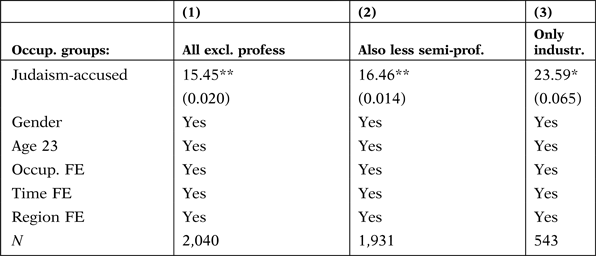
The JA often had highly skilled, professional occupations. Hence, we were curious whether those accused of Judaism still had higher numeracy compared with the control population, if we restrict both samples to specific occupation groups. That is, we assess if there is an extra «Jewish» numeracy bonus. We consider Portugal first, because we have many cases within both the Inquisition and the control groups, including occupational information. In Table 7, column 1, we exclude the highly skilled professionals and merchants, that is occupations for which the JA were famous. If we only take into account the JA in this broad, non-elite group and compare them with the corresponding control group of the Catholic majority, we still find a significant numeracy difference of 15.45 per cent, which is a quite substantial value. We also control for gender, age groups, occupational fixed effects between the different groups of occupation (within the non-elite sample), time fixed effects and region fixed effects in this regression. In column 2, we perform a second test that was more restrictive: in addition to the highly skilled professionals, we also exclude the semi-professionals (clerks, for example). We still have a significant and strong effect. In column 3, we restrict the sample to the craftsman and other industrial groups. Here, we again have a very large and significant coefficient for the Portuguese JA.
REGRESSIONS, COMPARING ONLY JA IN PORTUGAL WITH THE COMPARATIVE GROUP

Note: The number of Inquisition defendants (JA) is for columns 1, 2 and 3, respectively: 1,639, 1,538 and 475; the number of cases of the normal population (control) group is for columns 1, 2 and 3, respectively: 401, 393 and 68. The «Yes» statements indicate that these variables are included, but the main coefficients of interest here are those of the JA.
We repeated this set of regressions for southern and central Spain (online Appendix Table A.4). Only for this part of Spain do we have a substantial amount of occupational information in the control group (and at least a modest number of cases in the Inquisition group), whereas for other parts of Spain, occupational information was lacking, especially for the early centuries. However, even for the centre and south, the sample sizes for the JA with occupational information is small, with a maximum of 41 cases per occupational group. Interestingly, the size and significance of the coefficients is very similar to the Portuguese case, even if we cannot fully interpret the result due to the small N. Among the broad group that excludes the highly skilled professionals and merchants, we have 41 cases. The JA of this group have an additional numeracy of 29.52 per cent, relative to the control group. Among the narrower group of craftsmen and other industrial occupations, we have 24 cases and a coefficient of 27.68 per cent. In sum, we can conclude that the religious rule effect is still visible, even if we only study specific occupational groups, thereby holding the occupational effect constant. The results were strong for the Portuguese case, for which we have a substantial amount of observations (including occupations), and less clear for Spain (due to small N).
5.1 Cross-Checks: Were Ages Determined Differently in Inquisition Sources? What was the Role of Migration?
We have already discussed some potential selectivity issues above. In this section, we discuss some further potential caveats of our research design. First, we assess the potential concern that there were perhaps incentives for defendants to lie about their age, which may have influenced the accuracy of age statements in Inquisition sources. For example, one could imagine that people might have been more exact than, say, in census age reporting situations, because they were more afraid of inquisitors. However, asking for one's age was most likely the least exciting part of an Inquisition trial, because ages did not play a role in the decision; very young as well as very old people were tried, and if mercy towards younger or older defendants was given by some individual Inquisition officials the difference between, for example, the reported age of 30 or 31, did not play a role. Moreover, in the original trial transcriptions the age question was asked in the same way as by census enumerators: «what is your age?» In response, the accused mentioned his or her ageFootnote 31.
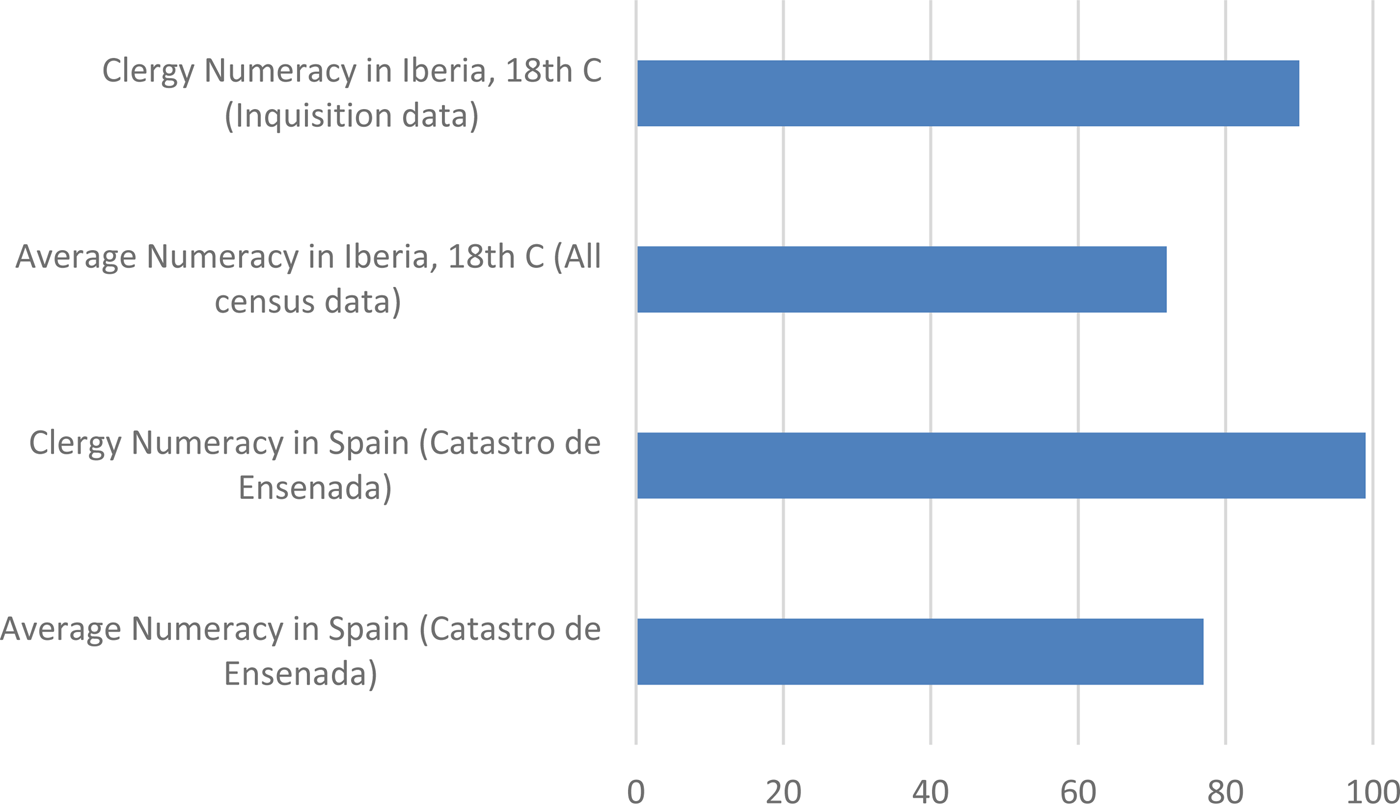
Another way to test if age was reported with a different degree of precision in Inquisition trials is to compare the numeracy of persons with the same occupation (and religion) included in both the Inquisition and the comparative samples. One possibility is to compare basic numeracy based on the age statements of priests and the average population using census records only. Even if the numeracy of a typical village priest were not identical to priests accused by the Inquisition, a similar magnitude of the numeracy differential might suggest that numeracy estimates based on Inquisition age data are not implausible. We consider the Spanish Ensenada census (which reflects the late 17th and early 18th century birth cohorts) and find that priests had a numeracy of 99 per cent, whereas the average population had a numeracy of 77 per cent (Figure 3). Hence, priests had a 22 percentage point advantage in numeracy. For the early 18th century, we obtain a difference of 20 percentage points by comparing the numeracy of clergy accused at the Inquisition and the average (census population) numeracy during this period. This finding indicates that the magnitude of the difference between those accused of elite crimes and the average population was not unrealistic (compare Figure 3 and Table 6).
ABCC index of clergy and the population average, according to the Inquisition sample and the «census only» sample of the Catastro de Ensenada census.

Did migration play a major role? Clearly, a large share of Spanish Jews fled to North Africa, North-western Europe, Northern Italy and elsewhere (see section 3). The exact number of Jews who emigrated is unknown, and even less is known on who they were and how they were selected. Ladero Quesada (Reference Ladero Quesada1988) presents scattered evidence of Jews from the Kingdom of Granada who embarked from Málaga and Almería to North Africa in 1492. Of the 115 exiled, only five declared that they had no possessions (pp. 255-259). On the other hand, Ladero Quesada (Reference Ladero Quesada2007) found that of the 266 families who embarked from Almuñecar in the same year, 57 declared that they had no property (p. 284). Also, he finds proof that the exiled rich tried to help the poorer ones cover the expenses of emigration. Based on existing evidence, it is difficult to pin down whether the Jews who left after the edict of expulsion were richer or more numerate than those who stayed behind and became potential targets of the Inquisition. However, we would speculate that the leavers were rather positively selected. The purity of blood requirements for holding important posts made it increasingly difficult to keep the same role in economic and political life that some of them had before the expulsion (Kamen Reference Kamen1965; Reference Kamen1988; Pérez Reference Pérez2005; Reference Pérez2014). Furthermore, migration costs are generally thought to create a filter, particularly in historical times when transport was expensive and knowledge about distant places scarce. Thus, we can probably conclude that our estimates of the substantial numeracy advantage of the JA are rather a lower bound estimate, as (positively selected) Jews and New Christians who left Iberia are not taken into account.
5.2 Trends Over Time
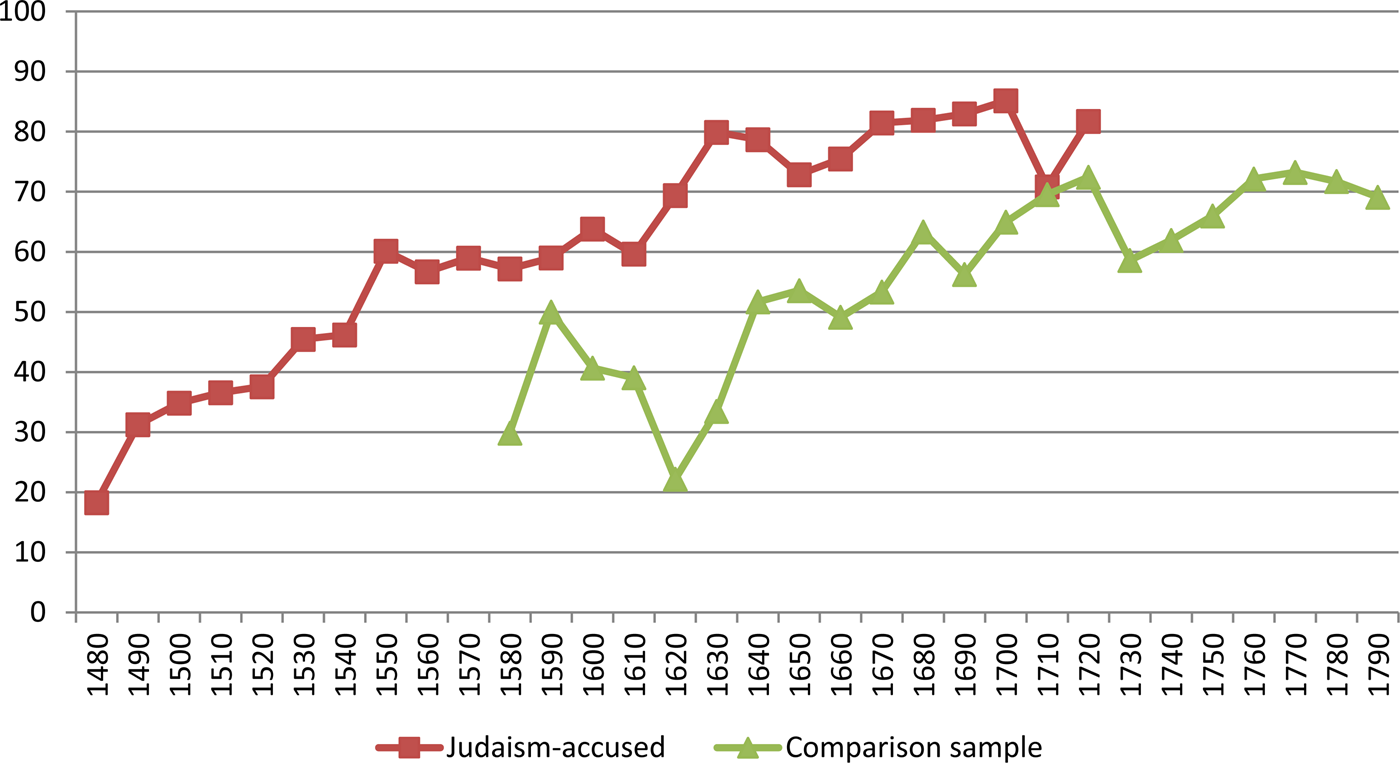
Apart from observing the average numeracy advantage of JA over the comparison group in the period under observation, it is also interesting to see how the numeracy gap evolved over time. For that purpose, we portray the average numeracy levels of both the JA and the comparative sample by birth decade in Figure 4. Our dataset allows us to compare both groups over a period of two centuries. The gap seems to be largest at the beginning (although we rely on a relatively small comparative sample for the 16th century) and becomes gradually smaller, although the numeracy levels of both groups increases substantially between the late 16th and late 18th centuries. What may explain this secular rise in numeracy? Globalisation and a rise in trade with other regions of the world certainly played a strong role, given the importance of numeracy for engaging in trade activities. However, although we observe a considerable rise in numeracy, it is slower than in other parts of Europe. This period, from the 16th to the 18th centuries, contained the height of the European human capital revolution (Tollnek and Baten Reference Tollnek and Baten2017). A'Hearn et al. (Reference A'Hearn, Baten and Crayen2009) estimated that numeracy grew by 50 percentage points in north-western Europe (UK, Netherlands and protestant Germany), from 45 per cent in the 1450s, to 95 per cent in the 1750s; while in southern Europe, their numeracy estimates for northern Italy yielded a growth from 55 per cent to 85 per cent in the same period. Thus, although we observe a rise in numeracy from around 40 in the late 16th to 70 in the late 18th century in our control groups for Portugal and Spain, the growth is slower than elsewhere in Europe (see also online Appendix Figure A.1). Interestingly, southern Europe and Iberia in particular, fell back in relative terms from the 16th century, precisely during the hottest phases of the Inquisition. Although this is not a clear proof that the Inquisition had a detrimental effect, at least the timing supports this view.
ABCC index of JA and the comparative sample in the Iberian Peninsula.

A reason for the declining gap between JA and the average population may be that the Jews and New Christians who could afford it had left the peninsula by the 18th century given the reigning hostility towards them (even though most probably left immediately after the edict of expulsion). Another explanation could be that the Catholics took over jobs that were freed by Jews and New Christians, given that Inquisition sentences and the purity of blood requirements introduced from the 15th century barred the latter and their descendants from holding many economically and socially important posts (Kamen Reference Kamen1965, Reference Kamen1988). The exclusion of those who could not proof purity of blood from public offices, university colleges, military and religious orders, guilds, etc. may have disincentivised educational investments. A further possibility is that the most numerate New Christian families assimilated Catholic doctrine and rites more successfully, or acquired the support of influential Old Christians, and thus did not become targets of the Inquisition (and therefore do not appear in our JA sample)Footnote 32.
6. CONCLUSION
In this study, we quantified the numeracy of the different groups of defendants of the Spanish and Portuguese Inquisitions and compared it with that of the general Iberian population. In line with previous qualitative research, we confirmed the hypothesis that Jews and New Christians enjoyed a substantial advantage in numeracy over the Catholic majority.
Botticini and Eckstein (Reference Botticini and Eckstein2007, Reference Botticini and Eckstein2012) and others have claimed before that Jews made large investments into education and this allowed them to enter relatively skilled occupations. At the time when purity of blood requirements removed Jews and New Christians in Iberia from some of the most important posts, their numeracy advantage was still substantial. Furthermore, when comparing Jews and Christians with the same occupations, we show that Jews still age-heaped less. The numeracy advantage continued to distinguish them from their Catholic compatriots throughout the period of our research, even though the gap narrowed over time. The gap may have narrowed due to (a) the ceiling of our numeracy measure, (b) the rise in demand for skilled positions, incentivising investments into education by Old Christians, and the fact that New Christians were banned from pursuing some occupations, particularly in the public sector and (c) the eventual skill selective emigration of Jews and a gradual, successful assimilation of the more educated New Christian families (they may have had better access to information on Catholic doctrines).
We also found that other groups who became targets of the Inquisition had a substantial educational advantage: Protestants, who were largely foreign or intellectuals, and formed a small group in Iberian society; Catholic priests, who had gone through higher education; and those who were accused of impeding the correct functioning of the Inquisition. We discussed the potential biases of the samples that were used to analyse the Jewish and control groups and found them to not be substantial.
Can we draw any conclusions on the effect of inquisitorial activity against religious minorities on economic development? In his early 20th century study «The Jews and Modern Capitalism», Sombart (Reference Sombart1911) already hypothesised that there may be a connection between the shifting of economic centres from Southern to Northern Europe and the forced movement of the Jews expelled from Spain and Portugal who settled, for instance, in Holland. Ashraf and Galor (Reference Ashraf and Galor2011) also argued that small religious minorities can have an important effect on economic growth.
Even if religious persecutions also took place in other areas of Western Europe, which entered a steeper growth path, it seems likely that the effect of persecution of quite numerate groups was detrimental for economic development in IberiaFootnote 33. This is in line with Vidal-Robert's (Reference Vidal-Robert2014) finding that Spanish inquisitorial activity had negative long-run economic effects. We can speculate that without the danger of being denounced to the Inquisition, the average human capital of the Iberian Peninsula—also counting the spill-over effects of religious minorities' human capital to the rest of the population—would have been higher. Pérez (Reference Pérez2005) has convincingly argued that the numbers of emigrants and persecuted JA were modest relative to the whole Iberian population, but the high visibility of executions generated an element of terror that should not be underestimated in its effect on retarding human capital formation. The Inquisition probably deterred converts who stayed in or returned to Iberia, as well as the Old Christian majority population, from reading Enlightenment literature and eventually from entering occupations that required but also exercised numeracy, and that were associated with Jews (see online Appendix Table A.5 for a numeracy rank by occupation groups in the Inquisition sample). That human capital is a crucial prerequisite for modern economic growth highlights the probable adverse effects of Inquisitorial activity on the development of this region. However, the quantification of those effects lies outside the scope of this study.
SUPPLEMENTARY MATERIAL
The supplementary material for this article can be found at https://doi.org/10.1017/S021261091900034X
ACKNOWLEDGEMENTS
We are grateful for valuable comments of three anonymous referees and the editors of the journal. Brian A'Hearn, Sascha Becker, Maristella Botticini, Marta Feliz Rota, Victor Gómez Blanco, Karine van der Beek and the members of the Tübingen Economic History research group commented on previous versions. We also thank the participants of the FRESH Meeting in Barcelona, 2015. Special thanks for sharing data to Sarah Nalle and Francisco Fajardo Spinola, as well as to Rosemarie Triebe for her assistance in data entry. We acknowledge financial support by the NWO and the German Science Foundation via the SFB 1070.
APPENDIX
CHANGES IN REGIONAL POPULATION WEIGHTS BETWEEN THE 16TH AND 18TH CENTURIES
We are aware that the 18th century is relatively late, and the regional distribution of the population might be different to the early inquisitorial era. However, the mean year of our comparison sample is later than for the Inquisition sample (around 1700). Still, we have compared the regional distribution of the population in the 18th century with that of the 16th century as portrayed in Nadal (Reference Nadal1984). According to these estimates, the share of the population living in Aragon and Navarre was lower (ca. 21 per cent), and the growth rate in this part of Spain (between the 16th and 18th centuries) was higher than the national average. On the other hand, the share of the population living in central Castile was higher in the 16th century (ca. 35 per cent) and the rate of population growth was lower. Thus, it could be that Aragon and Navarre are slightly overrepresented and central Castile slightly underrepresented, when using the 18th century weights. However, the accuracy of the 16th century census has been questioned. We performed a test with the average of the 16th and 18th century weights and we found that the results did not change substantially. With respect to Portugal, de Oliveira Marques and Alves Dias (Reference De Oliveira Marques and Alves Dias1994, p. 178) hold that the distribution of the population among the different provinces was not very different in the early modern period when compared with the 20th century, even though urbanisation meant that growth rates between smaller localities varied.