Grassroots community governance has long remained a crucial issue in studies of state–society relations in China.Footnote 1 After Xi Jinping 习近平 took power, China's idea of social governance changed significantly.Footnote 2 Diverging from the guidance of “community building” (shequ jianshe 社区建设) of the Hu–Wen administration, with its goal of “establishing a social governance model based on collaboration, participation and common interests,”Footnote 3 the Chinese Communist Party (CCP) began ramping up the Party committee's (PC hereafter) leading role in grassroots governance. Party building has become a new focus in community governance nationwide and the Party has employed a variety of regional experimental models at the grassroots.Footnote 4 However, little is known empirically about the details of these local experiments.
This article investigates Shenzhen as a regional empirical model for the Party's reconfiguration of community governance. By bringing the Party back in and separating it from government, this article constructs a triadic analytical framework of Party–government–society.Footnote 5 Using P district's experience of Party advancement in Shenzhen, this article identifies the Party's strategies for reconfiguring the power structure and the governance mode at the grassroots level.
To regain its leadership role, the local PC reformulated the relationship between the Party, government and society in two ways. First, the district and the street PCs reclassified the relationships among various actors along with the Party's organizational structure and regarded all community matters as Party-building affairs (dangwu 党务). They kicked government affairs (zhengwu 政务) back to the street level by separating government affairs from Party-building affairs, thus achieving the separation of Party and government (dang zheng fenkai 党政分开). Second, as the government retreated, the Party began to reshape relations between the Party and the masses (dang qun guanxi 党群关系) rather than reinvigorating civil society to fill the vacancy in grassroots governance left by the “politics-economy/society separation” (zheng jing/she fenli 政经/社分离). Specifically, the district and street PCs renewed their leadership within the community via three approaches: reconstructing the centre–periphery organization system, incorporating community elites in a top-down way, and exploiting the concept of “service delivery taking the lead” (fuwu yinling 服务引领) in a reciprocal exchange. We further find that through the separation of Party and government and the reshaping of Party–mass relations, the Party reframed the community governance structure. The ideas, mechanisms and morphologies of the Party-governance mode are different from those of traditional governance that stress autonomy, the market or the use of administration.
Our findings make two further contributions. First, at the grassroots level, the Party and the government differ in terms of ideas, organizational structures, institutional arrangements and governance mechanisms. This study provides evidence that the state–society relationship framework obscures the Party; hence, we need to separate “Party” from “government” in contemporary China's community studies. Second, in the context of a Party–government–society framework, Party–mass relations in communities might be a new line of investigation in contemporary China. Shenzhen's experience shows that the government's retreat does not always lead to an expansion of social space. Instead, the Party's interplay with the government and society fills the social space through Party–mass relations rather than government–society relations.
Theoretical Background
Bringing the Party back in
The state–society framework dominates current community studies in China.Footnote 6 From a state-centric perspective, community construction is regarded as the party-state's infrastructural power-building process. To adaptively respond to socioeconomic changes and make society governable, the party-state makes a strategically balanced calculation between governance costs, social risks and political legitimacy.Footnote 7 From a society-centric perspective, recent decades in urban China have witnessed greater social mobility, a retreating state and emerging social organizations.Footnote 8 Under a linear assumption, scholars mainly focus on the advance and retreat of the state,Footnote 9 the negotiation and resistance of society,Footnote 10 and the limited cooperation between the two.Footnote 11
From the perspective of state–society relations, the role of the Party in the community is ignored. In the Hu-Wen era, community building was mainly dominated by the Ministry of Civil Affairs (MCA hereafter). Many studies assume that the Party, which is equivalent to the party-state, always appears with the government, behind it or as part of it. Despite this finding, there is a dearth of research about the Party's role in the community.Footnote 12 As Xi came to power, a 20-word policy stressing the Party's leading role in the social governance system was proposed by the Fifth Plenary Session of the 18th CCP Central Committee. Xi's revival of Maoism has significantly impacted China's social governance system.Footnote 13 Since then, studies on China's state–society relations have emphasized the dominant role of the Party and have provided much evidence on the strategies and mechanisms used for Party building in private and social sectors.Footnote 14
Xiaojun Yan and Jie Huang together investigate how the Party navigates the private sector in Anhui province;Footnote 15 Han Zhang analyses Party-building strategies in Shanghai's urban business districts;Footnote 16 and Daniel Koss proposes the concept of institutional bricolage, which he identifies as the core mechanism used by the Party to re-establish its authority in the business frontier.Footnote 17 With regard to the social sector, the Party penetrates and controls NGOs using many diverse strategies.Footnote 18 Meanwhile, NGOs have been shown to adopt various mechanisms to cope with the pressures of Party building including embedding, compromise and avoidance.Footnote 19 At the grassroots level, pro-active entrepreneurs in the private sector have been shown to take advantage of the institutional opportunities provided by Party building to guarantee their economic and social rights.Footnote 20
There is a rich body of research on the Party's role in the non-public sector, but these studies focus primarily on the private sector and NGOs. Except for Han Zhang's study of Shanghai's urban business districts as special communities without neighbourhood committees,Footnote 21 and Karita Kan and Hok Bun Ku's study on the Party's construction of community links through grassroots NGOs in Kunming's urban villages,Footnote 22 there is little research on how the Party reconstructs urban grassroots communities. How the Party re-establishes its authority in the context of community building and what new governance structures are constructed still require in-depth empirical investigation.
In addition, studies often view the Party as an “organizational emperor” that can manipulate different social groups in the non-public sector Party-building process.Footnote 23 From the adaptive governance perspective, the Party can penetrate and control the non-public sector through institutional bricolage and other flexible strategies, such as building institutions and agencies, rewarding and co-opting elites and reorienting their work to be more service oriented.Footnote 24 However, these studies ignore the fact that the Party's penetration of communities is a complex process of power struggles and political negotiations. The interactions between the Party and the government are hidden behind “the Party”; negotiations between the Party and social actors are similarly murky.
In short, the extant studies either focus on macro policy changes or address the Party's strategies and mechanisms for navigating the non-public sector, viewing the Party's advancement in the Xi era as part of the grand process of Party building.Footnote 25 However, the central and local governments have different preferences for social governance, and state–society relations vary by region.Footnote 26 Strides have been made in recognizing the Party's role in the non-public sector since the early 2000s, but little is understood either about the shifting policies that have been introduced to push the Party to the foreground or the various regional experiments in local Party building, or grassroots Party–government and Party–community relations. And there is still a dearth of empirical evidence on what kind of community governance structures the Party builds or how they are constructed in specific local contexts.
The analytical framework
As the Party's role in social governance continues to be reoriented, scholars have begun to re-examine state–society relations.Footnote 27 An important issue is locating the Party in the research landscape. As the Party is brought back into grassroots governance, the concept of the party-state must first be debunked.Footnote 28 When differentiating between the Party and the government, it is necessary to analyse the complex relationships between the Party and the government and between the Party and society.Footnote 29 With regard to the relationship between the Party and the government, China's governance system can be described as “a partocracy” wherein the Party has absolute power and priority.Footnote 30 The Chinese party-government structure is a “dual normative system,”Footnote 31 through which “the Party asserts and exercises its prerogatives in its administration of state affairs without relying on constitutional arrangements.”Footnote 32 In a fragmented horizontal structure,Footnote 33 the Party and the government may have different social governance ideas and strategies, which may significantly affect the social governance structure.Footnote 34 In addition, the Party's roles have multiple layers and dimensions – including formal and informal institutions, ideology, discourse and actors.Footnote 35 Regarding the relationship between the Party and society, society is composed of various subjects at the grassroots level and their interactions with the Party as well as the government further complicate the Party's strategies and the governance structure.Footnote 36
Based on the discussions above, we propose a Party–government–society trichotomy as the basic framework for understanding the community governance structure. This framework transcends the traditional conceptual frameworks of Party–state and state–society relations, making the Party a core part of the analysis along with the government and society. In addition, it should be noted that the Party's penetration of a community and the reconfiguration of its governance structure take place in a specific local context. Different regions have diverse institutional histories and governance needs, and local Party organizations may have distinct governance ideas, all of which can influence the Party's advancement strategies and the constructed governance structures. When applying the Party–government–society framework to community governance, we need further empirical evidence to observe how the Party interacts with the government and other diverse social actors at the grassroots level. Specifically, what ideas and strategies does the Party exploit, and what community governance structure is ultimately shaped through the interplay between the Party, the government and society in a particular region?
Context and Methodology
Shenzhen was selected as a “revelatory case study” with which to answer the research questions.Footnote 37 Rather than producing grand generalizations, it offers contextual knowledge of the complex processes required to investigate the Party's community reconfiguration. Under the Jiang Zemin 江泽民 and Hu-Wen administrations, Shenzhen's community reforms were meant to instantiate a radical society-market model, at least compared to other Chinese cities.Footnote 38 Its rapid economic and social development, geographical proximity to Hong Kong and relaxed political environment provided Shenzhen with many opportunities to foster the necessary elements of civil society.Footnote 39 However, under Xi Jinping and with the launch of a new idea of social governance, the Party's role has become the focal point for reconfiguring Party–government–society relations within the community. As it reverses the society-market model, the Party is faced with much greater difficulties and challenges in regaining leadership and reconstructing community governance in a now pluralistic community such as Shenzhen. Hence, “making the Party work” in Shenzhen's communities produces more tension and complexity. Such a least likely case enables us to better trace the complex inner processes, logic and mechanisms of Party advancement in the Xi era.
In the first decade of the 21st century, Shenzhen promoted a two-handed approach to community reform – the government and market/society – which was called “the MCA approach” (minzheng na yitao 民政那一套).Footnote 40 The city established a community governance system composed of the PC, residents’ committees (RC), community workstations, community service centres, shareholding companies and other social organizations. However, the MCA approach brought about an identity crisis for the Party. First, the community workstations edged the PC out of the community until only workstation affairs (zhanwu 站务) received attention, while Party building was largely ignored.Footnote 41 Second, neither the community service centres’ operation nor their working content, including service delivery, reflected the Party's leading role in communities. Third, the separation of politics and the economy disabled the mechanism for mediating conflicts of interests between shareholding companies and district/street PCs.
In this context, Shenzhen began to implement a “Party-building standardization” (dangjian biaozhunhua 党建标准化) policy to reaffirm the Party's leading position within the community and to reframe the relations between Party organizations and other community actors. The Party's approach became the new tool for community governance in Shenzhen.
To unravel these processes, we went to P district in Shenzhen in September 2018 and December 2018. We conducted interviews with the district PC, PS Street and SJ Street offices in the district, six communities on the two streets, and some residents’ groups (jumin xiaozu 居民小组) and resident representatives of the communities. In all, we conducted 103 in-depth interviews, including with staff in the district government, street offices and community departments; the Party secretaries of the communities; members of the RCs; representatives of the communities’ residents; and the managers of the shareholding companies. On average, each interview lasted 90 minutes. We also conducted a focus group with people from the district Party committee organizational department (PCOD), the SJ Street offices and four communities on SJ Street to gain an in-depth understanding of how local governments and their departments at various levels govern the communities. The focus group lasted 150 minutes.
The Separation of Party and Government
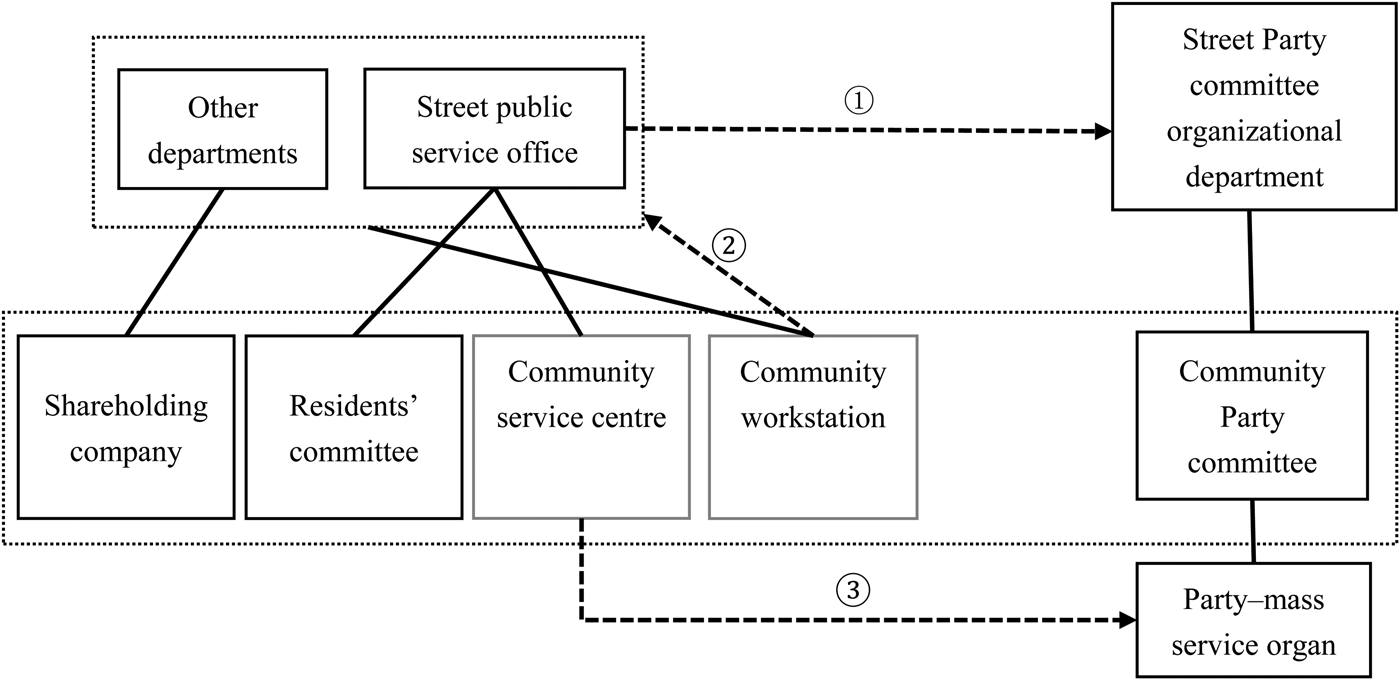
As mentioned above, the MCA approach weakened the Party's ability to penetrate communities. To reassert its leadership, the Party first distinguished itself from the government in community governance. This Party–government disaggregation used three main mechanisms (see Figure 1). First, community governance was redefined as a Party-building affair. Second, community workstations’ affairs were passed back to be dealt with by the street government. Third, the Party's leadership was strengthened by asserting control over the community service centres and limiting their service-purchasing authority.
Three Mechanisms for Disaggregating the Party and the Government
Notes: ① At the street level, the street public service office has transferred most of its affairs to the street Party committee organizational department, and the street organizational department has taken over most of the grassroots governance work. ② At the community level, the community work station is marginalized and most responsibilities assigned to the street (including the street public service office and other government departments) are “kicked back.” ③ As all community affairs are incorporated into the “big Party–mass” framework, the community service centre is now the community Party–mass service organ, which is subordinate to the community Party committee.

Party-building affairs in community building
Since 2016, the district and the street PCODs have taken over most of the governance work at the grassroots level. The MCA used to be responsible for infrastructural power building; however, the original administrative organs subordinated to the MCA were then excluded from the community. Once re-establishing the Party's leadership was confirmed as the central issue in community governance, Party-building work became a primary task: “Party building always comes first in community meetings. Addressing traditional issues such as production safety and urban management is the ‘fundamental line’ while conducting Party building is a top priority.”Footnote 42 Standardized and increasingly stringent rules regarding Party members’ behaviour were also implemented. For example, before the reform, Party members in communities were not required to take part in all the activities; now, their participation matters.
In addition, all community organizations were integrated to form the Party–mass service centre (PMSC) (dangqun fuwu zhongxin 党群服务中心). As the embodiment of “big Party-mass” (da dangqun 大党群) relations, the PMSC brings all organizations and services in the community under one roof. According to the “Party-building standardization” policy, the PMSC was established through a unified and systematic renovation of the original community's infrastructure, enabling all other community organizations to be included under the unified PMSC logo. The community was allocated a large amount of funding by the street office to carry out Party-building work. According to a PC official:
Everything can be framed within the PMSC. “Party–mass services” were once explained only as “convenience services” (bianmin fuwu 便民服务) open to all residents, but their remit extends further now. All community activities are part of Party–mass services.Footnote 43
Finally, conducting Party building in the resident groups was also added to the agenda. To advance the quality of Party building in these groups, P district launched a “Residents’ group foundation and consolidation project” (jumin xiaozu guben qiangji xiangmu 居民小组固本强基项目) in 2018. Under this project, Party–mass service stations (dangqun fuwuzhan 党群服务站) were established in all 171 communities.
Station affairs upwards
With the transfer of community-governance responsibility from the street public service office (SPSO) to the street PCOD, the community governance structure underwent a significant transformation. Community workstations were the first to be affected. They specialized in specific governmental functions. Under the rubric that “government is supposed to deal with affairs that it must do, while the community is supposed to deal with affairs that it can do,”Footnote 44 P district drew up a list of community powers and responsibilities (shequ quanze qingdan 社区权责清单). The list stipulated that, first, community workstations could continue but that they needed to be reduced in size. Generally, the number of community workstation staff corresponded with the size of the community and was equivalent to the number of the community PC and residents’ committee members, ranging from 14 to 22. However, the number dropped after 2014 when the stations stopped recruiting to replace departing staff. As a result, there were at least five vacancies in most community workstations.
Second, the street PCOD took over the specialized enforcement powers and labour of the workstations, dismissing the community's administrative duties. This change is evident in the case of safety production. Before the reform, every community was equipped with several inspectorate teams who were responsible for ensuring safe production within the community. In 2016, the street withdrew regulatory authority of safety production from the community, leaving the community simply to provide assistance and propaganda work. As a result, 12 inspectorate teams in the SJ community were reduced to a single listed team. Similarly, most of the civil affairs that were previously handled by the community were taken over by the “municipal administration service hall” (shizheng fuwu dating 市政服务大厅). Only some auxiliary services were left for the community to manage. These services usually involved “persuasive endeavours” (mo zuipizi 磨嘴皮子) and “using personal relationships to ask the residents for a favour” (jiang qingmian 讲情面), tasks which rely on the community's local knowledge. For example, our fieldwork coincided with efforts by the Shenzhen safety production department to address the safety risks associated with charging electric bicycles indoors. The community workers’ local knowledge and personal relationships were especially useful when persuading residents not to charge their bicycles indoors. As one member of staff said,
We know where the risk points are. Simultaneously, these things are very difficult to do legally, so they [street-level government] have to rely on us to persuade [the residents]. After all, we are all from the same community, and [the offending residents] will more or less give us a little face.Footnote 45
From community service centres to CPMSOs
Under the original design, the SPSO had responsibility for community service centres. However, in 2016, the centres became community (Party–mass) service organs (shequ (dangqun) fuwu jigou 社区(党群)服务机构) and so began to report to the street PCOD. As the Party-building standardization continued to develop, the community (Party–mass) service organ was renamed the community Party–mass service organ (CPMSO) (shequ dangqun fuwu jigou 社区党群服务机构), becoming a vital cog in “big Party–mass” relations.
The district social construction bureau (qu shehui jianshe ju 区社会建设局) previously served as the procurement contractor for the community service centres. Since the hand-over, however, the street PCODs have become involved, taking responsibility, for example, for interviewing and recruiting social workers. Party member applicants meeting the basic requirements are now given priority. More importantly, social workers must be aware that it is the PC that sends them to provide services in the community.
The PCOD continuously indoctrinates the social organizations under its umbrella with the idea that the Party is the de facto investor and service provider, while social organizations are merely doing the Party a favour. Throughout the service delivery process, the street PCOD and the district Party committee stress that “Party building takes the lead” (dangjian yinling 党建引领). Social worker organizations have evolved to become representatives of the CPMSO and all social workers must wear a uniform and carry official work cards bearing the CPMSO logo. Their services must also reflect the distinctive characteristics of Party building. It is now a strict requirement that Party-building elements are inserted into the service delivery process and content.
Reshaping Party–Mass Relations
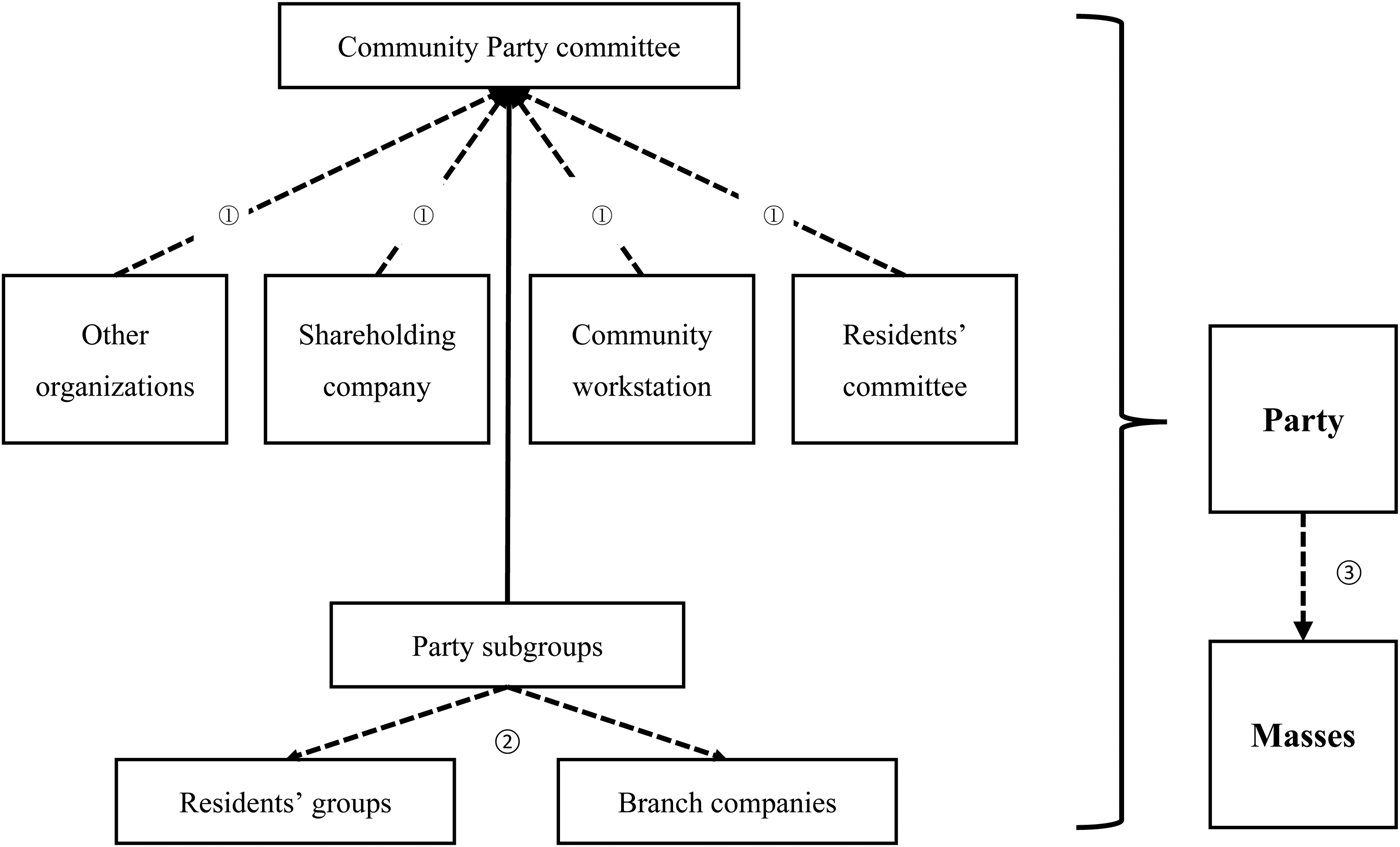
Once community affairs were reclassified as Party-building matters and the Party had separated from government and the government was no longer in charge of the community, the local PC and PCOD started dominating the community-building agenda. From the Party's perspective, Shenzhen's previous community reform had left grassroots governance in a chaotic situation.Footnote 46 To re-establish its leading role, re-embed itself within the community and rebuild community governance, the Party turned to traditional Party-building methods. According to one official from the PCOD in P district, “community governance needs to return to the Party building of the Maoist and revolutionary periods” in a move which we refer to as reshaping Party–mass relations.Footnote 47 During this process, the Party used three strategies to penetrate different targets (see Figure 2). To address chaotic organizational relations, the Party first regained control by incorporating organizations into the “one dominant core party and other plural players” (yi he duo yuan 一核多元) system. The Party's leadership was then further consolidated by recruiting and absorbing the community elites. For residents, the Party adopted a “service delivery taking the lead” strategy to purchase political recognition.
Three Strategies for Reshaping the Party–Mass Relations
Notes: ① The community Party committee incorporates the residents’ committee, community workstation, shareholding company and other organizations into the “one dominant core party and other plural players” system. ② The Party further penetrates the grassroots level by recruiting and absorbing the elites from the residents’ groups and shareholding company via cross-section appointment and election manipulation. ③ The Party comprehensively makes “service delivery taking the lead” a viable strategy to reshape Party–mass relations.
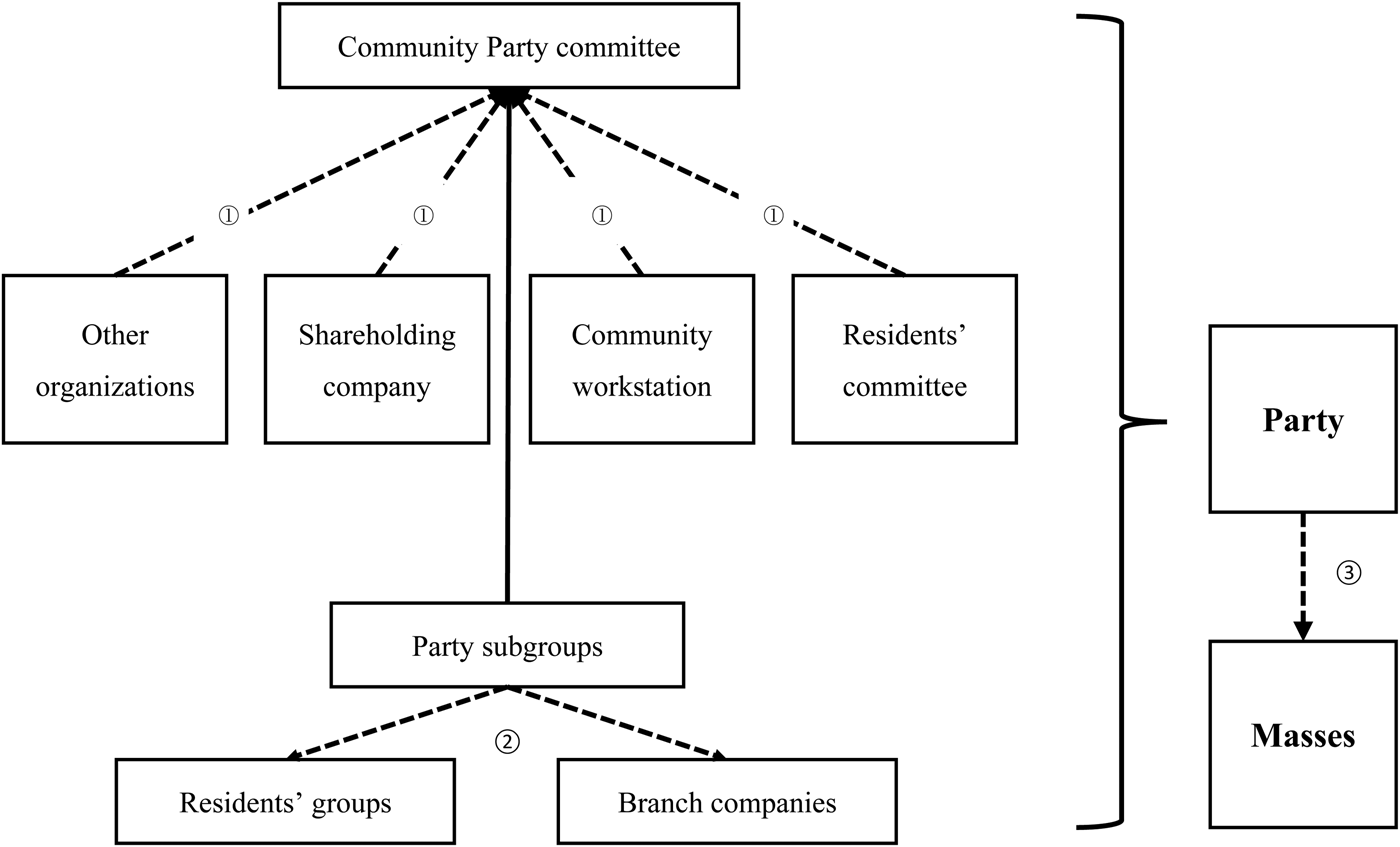
Incorporating organizations into the “one dominant core party and other plural players” system
Under the original governance structure, there were scattered organizations throughout the community.Footnote 48 Some of these were the “legs” and “feet” of street and district governments and their departments in the community, although the vast majority were not formally staffed. Others, such as community workstations, community service centres and residents’ groups, were formed during the community reform process. The priority was to bring the marginalized Party back to the centre of all community matters.
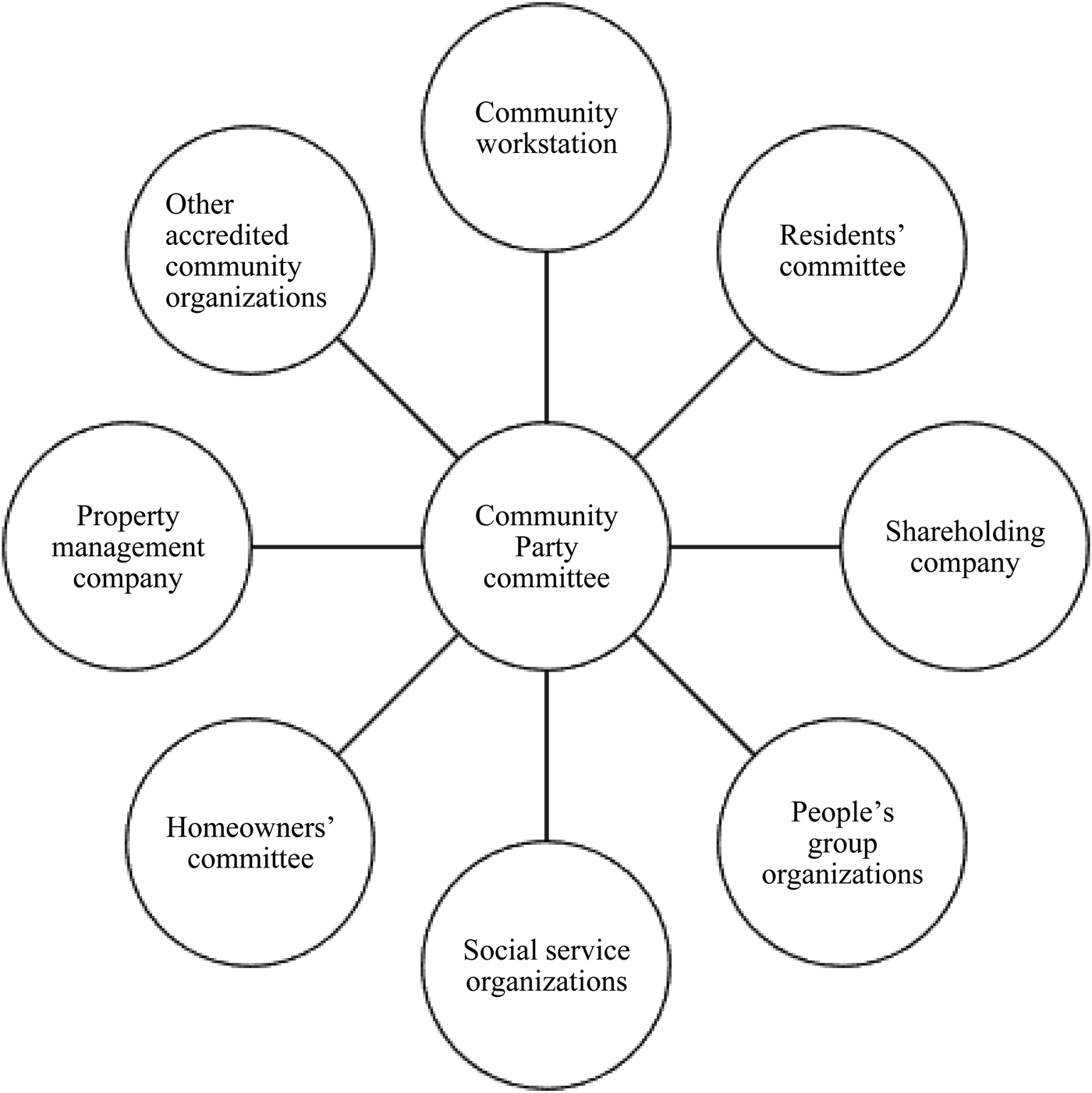
Restructuring organizational arrangements and developing a radiation system in which the Party is at the centre and other organizations are on the periphery were key to putting the Party back in charge. There were two dimensions to the strategies for absorbing organizations into the system. Vertically, by assigning authority for community governance to the PCOD, the Party reorganized the top-down command-and-control chain from the street Party working committee (dang gongwei 党工委) to the community PC and then down to the Party subgroup of the residents’ groups. Horizontally, the Party implemented the measures proposed in its “Opinion on promoting the standardized construction of community Party building” (Opinion hereafter)Footnote 49 to construct a standardized grassroots governance structure based on “one dominant core party with plural players.” Specifically, the Party restructured the complex community system, putting community workstations, shareholding companies, CPMSOs, neighbourhood committees and other social organizations in order (see Figure 3).
Urban Grassroots Governance Structure Featuring “One Dominant Core Party and Other Plural Players” in Shenzhen
Source: General Affairs Office of Shenzhen Municipal Committee of the CCP. 2016. “Opinion on promoting the standardized construction of community Party building.”

Apart from rearranging the organization system, the Party also used the mechanisms provided by the Opinion to put its leadership role into effect. The Opinion endowed each community PC with the power to make significant decisions, appoint personnel, assume the highest leadership position within the community, and supervise and monitor other community organizations. For example, in community decision making, each community matter must follow the “four consultations, two disclosures” (si yi liang gongkai 四议两公开) route and adopt a more open and democratic decision-making process. In this way, “nothing can be passed without the agreement of the PC,”Footnote 50 and “the community PC's status is indeed raised.”Footnote 51
The organizational arrangements also rebuilt the relationships between the Party and other organizations in the community, as seen in the changing relationship between the Party and shareholding companies. Before 2006, the shareholding company within a community played a critical role in community governance. However, the separation of politics and economy significantly reduced the local PC's ability to lead and control community development. It also undermined shareholding companies’ incentives to engage in public service provision. For example, the TT community proposed building a cricket ground, which required the requisition of the shareholding company's land in 2015. However, owing to concerns over the ownership of the ground, the company would not cooperate with the implementation of the plan. Therefore, construction was put on hold for years. One of the staff members of the district PCOD explained that “it is too early to implement the separation of community workstations and companies. How can the PC's authority be guaranteed?”Footnote 52 To restore the PC's authority, Shenzhen devised a new cross-sectional appointment system between the Party and the shareholding companies. Now, the chairman of a company also holds the office of PC deputy secretary, while the committee Party secretary simultaneously serves as the director of the collective asset management committee (jiti zichan guanli weiyuanhui 集体资产管理委员会). Although the PC is not responsible for every aspect of the practical management work, it is in charge of the shareholding company's major affairs such as asset transactions and dividend policies. For example, during the shareholding company innovation process, “issues such as whether the company should innovate and how to innovate were both decided by the PC and thus the Party's will is more likely to be implemented.”Footnote 53
After the PCOD took over the CPMSO, the community PC became responsible for its leadership and the original independent relationship ended. Before 2016, the director of the SPSO held the office of community service centre director; after the community service centre was transformed into the CPMSO, the community Party secretary took over the position. As a community leader, the director of the CPMSO is entitled to join the community PC meetings, where Party leaders discuss and decide crucial issues concerning the CPMSO. Essentially, the Party's role in the CPMSO is now a leadership one, rather than being a guiding hand as was the case with the community service centre.
The centre-periphery system can be extended further. For instance, the PC attempted to extend its penetration to “two new organizations” (liang xin zuzhi 两新组织) and absorb them into the organization system (see Figure 3). However, although the community PC claimed that it “welcomes social organizations to work in the community,”Footnote 54 the independent activities of these social organizations were gradually stymied and their function of incubating more social organizations was abolished. Under the new Party governance structure, every social organization must be registered. The filing of the documentation and the rising registration costs have stopped most grassroots organization activities.
Recruiting and absorbing the elites
To further strengthen the Party's leading role and achieve the Party's will, elite absorption has become an essential strategy in restoring the PC's authority. In Shenzhen, which experienced rapid urbanization owing to the openness of the opportunity structure, recruiting elites to the Party organization is particularly crucial and particularly difficult.
The first step in absorbing elites is to control the community election procedure, ensuring the selection of high-quality Party members who can demonstrate outstanding ability, a strong commitment to service and loyalty to the Party. In general, the street PCOD determines which candidates may stand in community elections. “We must make sure each candidate obeys and follows the Party. If not, they will be replaced immediately.”Footnote 55 To guarantee that the cross-section appointment is in line with the Party's will, the PCOD usually manipulates the election. However, the elections of two committees (the residents’ committee and the PC), the shareholding company, and the residents’ group vary significantly in terms of voter composition, procedures and preferences. In light of this fact, the 2017 election became “the most complicated and difficult one ever.”Footnote 56 “Exhausting the means of manipulating the election of the ‘two committees’’’ has become a political task.Footnote 57 During this procedure, the Party deploys several strategies to achieve its aims. First, the street Party working committee and the community PC each form election committees, both of which are under the leadership of the street PCOD. First, small-group deliberation (xieshang 协商) and “trial” elections (shi xuanju 试选举) ensure that the “fermentation” (yunniang 酝酿) round goes well in terms of selecting a pool of “suitable” candidates. This is a crucial stage in determining the formal candidates. Next, a joint meeting is organized to consider the shortlist of candidates who failed the qualification check according to the “negative list” (fumian qingdan 负面清单). A persuasive strategy is then adopted to gain a consensus among the candidates, including those destined not to be elected.
Not all election manipulations are successful, however. For example, a renowned political “accident” in Shenzhen – the “PH incident” – occurred in PH Street in the LH district of Shenzhen. In the election for the post of secretary of the community PC, the candidate favoured by the PH Street PC lost to the vice-secretary, who was also the chairman of the shareholding company. In the Party's view,
It may be owing to the failure of grassroots governance, which is a disaster. The problem is either brought about by other unpredictable forces or the wrong procedure, which broke the Party's discipline [rules]. [All these problems arose] because those organizations don't have all the pieces in place.Footnote 58
When such an incident occurs, the Party can deliberately suspend the election process or even discredit the election outcome. The PH election was declared null and void, and the vice-secretary was punished for soliciting votes. By using a combination of the above-mentioned strategies, the Party has eliminated the fierce competition among candidates, and instead those with the desired political qualities are elected as PC secretaries, leading group members and residents’ group heads.
The Party's attempts to extend its penetration at the grassroots level also focus on the residents’ groups, as these groups are more likely to represent residents’ interests and so the residents accordingly pay more attention to these elections than the community ones. In 2016, the Party launched the “Foundation consolidation project” among the residents’ groups on PS Street. Recruiting the heads of the residents’ groups as Party members is a priority for Party building purposes. Usually, the Party intervenes in group member selection, recruits Party members from among group leaders and then incorporates them into the Party's reserve cadre system (houbei ganbu 后备干部). According to one community secretary, “by developing Party membership, carrying out the education plan in the spirit of the Party (dangxing jiaoyu 党性教育) and through political indoctrination, members in the residents’ groups gradually acknowledge, obey and even assist in achieving the Party's will.”Footnote 59 An interviewee added, “In the past, the head of the residents’ group did not listen to the PC or the government. However, things have changed now. [The Party's will] of implementing the ‘last kilometre’ has been realized.”Footnote 60 There is less resistance (from residents and companies) to implementing the political mandate in terms of plant management, old city regeneration and demolition.
Finally, the policy resources provided in the Party's campaign to advance its influence have made it possible to rebuild elite teams. The street and community organizations are abundant with political and economic opportunities that attract elites. After the reform, most of the companies’ chairmen returned to become PC secretaries: “Following the Party's will and organization's orientation pays off.”Footnote 61 In addition, the salaries of the staff in the community organizations greatly increased. The street PC can even supplement the salaries and benefits of workers who are not paid by the finance agencies, such as the heads of residents’ groups, because it has control of shareholding companies.
“Service delivery taking the lead”
The residents' involvement is critical to the Party's community reconstruction and grassroots penetration. Conventional tactics to gain control have gradually become obsolete; “service delivery taking the lead” has become the new strategy.Footnote 62 Before the reform, the community mainly assumed responsibility for administrative affairs. “It hardly paid attention to serving residents.”Footnote 63 Now that government affairs have been transferred back to street-level governance, the community focuses on service delivery, which is regarded as endogenous to Party building. As a PCOD official said, “A political party's goal is to gain and keep power for a long time. The same is true of the CCP. How can this be achieved? We provide services for the people, and the point of any service is to enhance and consolidate Party building.”Footnote 64
The CPMSO is the direct symbol of “service delivery taking the lead.” It was launched as a “service brand” covering all three levels, from the district to the community and residents’ group. The Party–mass service organ in the district was even called a “flagship store.” The CPMSOs follow the Party line. They are embodiments of the Party; their services must uphold the Party.
The PC and Party members must be visible in a significant way. Party organizations and Party members must “be at the head and achieve tangible results” (zou zai qianmian, gan zai shichu 走在前面,干在实处) in service delivery. Community PCs use services as a “carrot” to attract and influence residents:
The purpose is to let the residents know that the Party brings these services. People used to know only “how they could reap benefits” (hui zaihechu 惠在何处); now, we want them to know “who brings the benefits to them” (hui cong helai 惠从何来). The answer is undoubtedly the Party.Footnote 65
The SJ Street PCOD asked each community to create “highlights” according to specific characteristics. For instance, based on its tourism resources, the JG community in SJ Street refurbished its passenger service station to promote Party building. Travellers who rest there are now left in little doubt that it is the Party who provides that service. In addition, the approval authority for the allocation of funds for the “people's livelihood project” has been removed from the SPSO and now rests with the street PCOD.Footnote 66 Every community event is a means of Party building. The masses are ever reminded that it is the Party that is delivering these services.
In addition, all community events, activities and services are regarded as Party–mass activities (dangqun huodong 党群活动). After the street PCOD took over the community service centre and transformed it into the CPMSO, the PCOD set a new standard. In any bidding and appraisal process, Party-building activities must account for at least 20 per cent of the CPMSO's annual activity plan; otherwise, the social organization that wins the bid from the CPMSO will be replaced under the one-vote veto assessment system. Normal services provided by the CPMSO should also contain elements of Party building. For example, more red movies were shown during the “four thirty extracurricular” (sidianban xuetang 四点半学堂) activities, and Party history books were displayed in the reading room. On specific holidays and festivals, the community might organize singing and dancing competitions, or games with patriotic and socialist themes.
Conclusion and Discussion
By bringing the Party back into state–society relations and incorporating the strategic interactions between the Party, government and multiple social agents at the grassroots level, this article analyses how the Party rebuilt community structures in Shenzhen to conform with its own ideas and strategies. We further find that through “Party–government disaggregation” and “reshaping Party–mass relations,” the Party reframed the community governance structure, which we call the Party-governance structure, with different ideas, components and morphologies from the traditional governance structures that stress autonomy, market or administrative roles. In the end, the government is minimized and the Party is maximized. “Kicking” the government back and swallowing up society indeed fills the authority gaps in the community. These are not methods for realizing “minimalist governance” at the grassroots level.Footnote 67 Constructing Party–mass relations, aimed at creating a people's society rather than a civil society, became the new orientation of Party-governance of the community.Footnote 68
Contemporary research mainly views the Party's advancement in the non-public sector as an adaptation process.Footnote 69 However, Shenzhen's experience illustrates that the Party's penetration of grassroots communities results from the conjuncture of emerging social governance ideas and local contexts as well as local PCs’ translation and reinterpretation of the new idea. The transition is embedded in Shenzhen's grassroots governance history, capacity, resources and changing governance needs. Undoubtedly, this will lead to regionalized models of grassroots governance. In addition, Shenzhen's Party advancement is a power struggle process. The community workstations that cannot be abolished, the potentially uncooperative local elites as seen in the PH incident, or the NGOs that retreat and avoid the Party's capture all suggest that the Party's penetration is an ongoing negotiation process. Similarly, the private sector and NGOs may develop complicated strategies to respond to and even exploit the Party's pressure.Footnote 70
If the Party's march into the community is intended to create a people's society, the Shenzhen experience suggests that it is neither straightforward nor unstoppable. The Party expects to penetrate the community through service capacity enhancement, which requires significant resources, waged Party staff and diverse strategies.Footnote 71 However, the trade-off between professionalization and politicization profoundly impacts the Party-governance structure. Professionalization is a prominent element of administrative and social organizations. Once the Party's political needs were prioritized, bureaucrats, social workers and specialists no longer applied their corresponding expertise to community governance. Instead, grassroots NGOs inclined to autonomy opted for avoidanceFootnote 72 or were kicked out by the Party owing to the threat they posed to its position of control. As a result, the Party can undoubtedly degrade the communities’ professional capacity, but its ability to build it up is limited. The reconfiguration of power structures does not always result in re-engineering community governance and service provision capacity.
In addition, the Party focuses on reconstructing its legitimacy through value leadership. The effect of these efforts is questionable. According to one SJ Street PCOD official, “Now, the [Party's] biggest problem is the declining ability to mobilize the masses. Can we still do what we did in the revolutionary era when you wave your hands at the crossroads and the masses follow you?”Footnote 73 For a long time, the CCP regarded economic performance as the key resource of legitimacy. In recent years, discourses such as “no CCP, no new China,”Footnote 74 “service purchasing recognition,” “shaping Party–mass relations,” and affective governanceFootnote 75 constitute the Party's new legitimacy-construction strategies. However, these strategies have limitations. First, the Party's organizational capacity is insufficient to mobilize private enterprises and the masses, especially floating populations, to serve the Party's goals.Footnote 76 Second, the local PCs are confused over how to put the “service delivery taking the lead” policy into practice. Social interests and needs are diverse – whether, what and how to serve them all remain a puzzle. In terms of essential public goods such as education and healthcare, it is beyond the Party's capacity at the grassroots level. As a community worker said, “the regular and normal services we provide are not what they need, while those services that can truly attract them, we are not able to provide.”Footnote 77 As a result, while the Party can reconstruct the community's power structure, it cannot purchase legitimacy and value leadership through service provision.
The Party–government–society framework and the Shenzhen experience also have theoretical implications for understanding China's social governance structure. As Holly Snape and Weinan Wang point out, “how Party, state, and society interact with each other” is critical for understanding China's social governance and state–society relations under Xi.Footnote 78 In other political arenas, relationships between the Party, the government and society might vary by policy realm and level. For example, in upper-level government, the Party has narrowed the gap between itself and the government by extending further into the government so that close relations between them are institutionalized.Footnote 79 Regarding professional associations, the Party allows the government to manage them through administrative regulation, and the associations have sufficient autonomy to develop expertise.Footnote 80 Even in communities, the relationships and structures between the Party, the government and community entities are diverse. For example, the community governance structure of Zhejiang village 浙江村 in Beijing was transformed from “grey” to “red” through Party building; however, unlike Shenzhen, this transition relied on a group of migrant businessmen and entrepreneurs to make it happen.Footnote 81 As in southern peri-urban China, to restructure state power in those communities transitioning from villages, the local party-state progressively promoted open, competitive grassroots elections as a core strategy.Footnote 82 In south-west China, the Party has adopted a strategy of service provision to regain legitimacy in village communities in Kunming. Unlike in Shenzhen, the Party appropriated social forces and co-opted NGOs as “partners” and “collaborators” to fill the Party's capacity deficit.Footnote 83 In this sense, our research does not address external validity concerns. Further research should consider other factors that can influence governance structure, such as the various ideas and strategies the Party produces and exploits, the strategic responses of other subjects and the various policy domains.
Hence, it is too early to say whether a particular social governance structure will ultimately be constructed following the Party-advancement initiative. Even in Shenzhen, the relationship between the Party, the government and other social actors continuously changes. In particular, with the shock of an unforeseen outbreak of COVID-19, Shenzhen's Party-governance mode has reformed. Owing to the recent iterative lockdowns since 2019, the role of PCs, community workstations, community service stations and other social agents has shifted. COVID-19 provided the Party with an opportunity for an intensive and comprehensive penetration of society. The Party's domination and mobilization of government agencies and social forces was the foundation of grassroots epidemic prevention and control.Footnote 84 However, the Party's intention to supplant the government and remodel society seems to have hit a roadblock. Large numbers of issues require community workstations’ assistance and the government departments behind it; grassroots NGOs and volunteers also play diverse and specialized roles. The Party's control has increased, and the pace of Party building has accelerated. In the meantime, the negotiation capacity of the government and social subjects has significantly improved.Footnote 85 The relationships between the Party, the government and social forces have been continuously reshaped. This means that grassroots governance in post-COVID-19 China will undoubtedly have more of a Party presence, and the Party will increasingly be at the forefront of government and society. However, it remains to be seen how the Party will redefine its relationships with the government and society and what mode of governance it will adopt.
Acknowledgement
This study was supported by the Fundamental Research Funds for the Central Universities (Grant No. 2019WKYXQN036).
Conflicts of interest
None.
Changkun Cai is an assistant professor at the College of Public Administration, Huazhong University of Science and Technology. He earned his doctoral degree at the School of Public Administration and Policy, Renmin University of China. His research interests include politics and policy in China, public service delivery and institutional analysis.
Ying Liu is a doctoral student in the School of Public Affairs and Administration at Rutgers University-Newark. Her research interests include public management and leadership, citizens' perception of public service provision, and representation in public and non-profit organizations.
Weiqi Jiang is a PhD candidate at the College of Public Administration, Huazhong University of Science and Technology. Her research focuses on public service delivery and local governance in China.