Blood culture is one of the most important methods of determining serious infection in hospitalized patients with suspected sepsis. Reference Magadia and Weinstein1 Traditionally, blood cultures take 1–5 days to provide results. A positive blood culture enables the accurate diagnosis of an infection and allows targeted antimicrobial therapy. Reference Lodise, McKinnon, Swiderski and Rybak2 However, false-positive blood cultures can arise if the blood specimen becomes contaminated with organisms not present in the blood. Unfortunately, this frequently encountered problem results in extended hospital stays and unnecessary antimicrobial treatment. Reference Bates, Goldman and Lee3–Reference Geisler, Jilg, Patton and Pietzsch8 Contaminated blood cultures are a challenge because, at times, it is difficult to differentiate true-positive from false-positive cultures. Reference Magadia and Weinstein1 Some of the most common contaminants, such as coagulase-negative staphylococci and viridians group streptococci, have increasingly been found as a cause of true bacteremia in patients with central venous catheters and prosthetic devices. If these organisms are considered contaminants and patients are left untreated, life-threatening conditions could develop. Reference Gilligan9 However, unnecessary treatment is also problematic. Reference Rello, Ollendorf and Oster10,Reference Al-Helali, Al-Asmary, Abdel-Fattah, Al-Jabban and Al-Bamri11 Inappropriate antibiotic use can result in antibiotic-related complications such as alteration of gut flora and increased risk of Clostridioides difficile infection, increase in colonization with multidrug-resistant organisms, as well as allergic reactions, side effects, toxicity, and increased cost. Reference Fridkin, Baggs and Fagan12–Reference Slimings and Riley15 Patients with contaminated blood cultures have extended hospital stays, which result in increased risk of developing hospital-acquired infections and other conditions such as falls and pressure ulcers. Reference Aranda-Gallardo, Morales-Asencio and Canca-Sanchez16,Reference Borghardt, Prado, Araujo, Rogenski and Bringuente17
The recent introduction of molecular-based, rapid diagnostic testing has greatly shortened the time needed to define pathogens in blood cultures. However, it is unclear whether this technologic advancement has influenced provider behavior when caring for patients with blood-culture contamination. In this study, we assessed the impact of contaminated blood cultures on duration of hospital stay and antibiotic therapy among hospitalized patients at an institution where rapid blood-culture identification was in use.
Methods
Study design
This was a retrospective cohort study involving secondary analysis of data extracted from hospital medical records. All patients who had blood culture(s) performed at any time during an admission during the study period were included in the study population.
Study setting
Electronic medical records data from inpatients admitted between June 1, 2014, and December 31, 2016, at the University of Nebraska Medical Center were included in the study. Admissions that did not fit the study definitions of contaminated or negative blood-culture episodes and those of patients aged <18 years were excluded. To maintain uniformity of data, only the first admission was included in the study sample if a patient had >1 eligible admission. Pregnant women, prisoners, decisionally impaired persons, and other vulnerable persons were not excluded. Patients admitted to and discharged from the emergency department were not included; however, patients who were initially evaluated in the emergency department and subsequently admitted to the hospital were included. A molecular-based, rapid blood-culture identification system (Biofire FilmArray Blood Culture Identification) was introduced at the study site in 2013.
Study definitions
Contaminated blood culture
A blood culture was considered contaminated if any skin-residing organism(s), such as coagulase-negative staphylococci (CoNS), Cutibacterium acnes (formerly known as Propionibacterium acnes), Micrococcus spp, viridians group streptococci (VGS), Corynebacterium spp or Bacillus spp, were identified in 1 of the 2 or more blood-culture sets.
Contaminated episode
A patient admission was considered associated with a contaminated blood-culture episode if the first ordered blood culture was reported as contaminated and any subsequent blood culture was negative during the same admission.
Negative episode
If all blood cultures during an admission were negative for any microorganism, it was considered a negative episode.
Positive episode
If even 1 positive blood culture was reported during a hospital admission due to a non–skin-residing organism, it was categorized as a positive episode.
Equivocal episode
Any combination of blood culture results during a patient admission that did not fall under contaminated, negative, or positive episode were labelled as an equivocal episode.
Study size
The final analytical sample (n = 11,474) consisted of 464 (4%) contaminated blood-culture episodes and 11,010 (96%) negative blood-culture episodes.
Variables
The primary independent variable was blood-culture status. Admissions were categorized as contaminated or negative episodes based on blood-culture status per study definitions. Socio-demographic variables included age, which was categorized based on quartiles (<50 years, 50–61 years, 62–73 years, >73 years), sex (male or female), race (white, black, or other), body mass index (BMI in kg/m2), smoking status (smoker/former smoker/current smoker, nonsmoker), alcohol status (drinks alcohol/drinks alcohol daily/drinks alcohol occasionally, does not drink alcohol), marital status (married/partner/significant other, single/divorced), and medical insurance (insured, uninsured). Underlying diseases that have been shown to affect the association between blood-culture contamination and increased hospitalization and antibiotic therapy were also included in the analysis. These comorbidities were extracted from International Classification of Disease, Tenth Revision (ICD-10) codes listed in the electronic medical record of each admission. They included chronic obstructive pulmonary disease, chronic kidney disease, liver cirrhosis, and diabetes mellitus. Additional variables included hospitalization-related factors such as stay in intensive care unit (ICU) during admission, admission from emergency department (ED), and location of blood drawn for blood culture (central intravenous line, peripheral vein).
Outcomes
The primary outcome was length of hospital stay (in days) and the secondary outcome was duration of antibiotic therapy (in days). Patient admissions that included length of hospital stay and antibiotic therapy >30 days were recorded as 30 days, assuming that treatment of patient with contaminated blood cultures, even if interpreted as a deep-seated infection, would not typically continue beyond 30 days. Data on antibiotic therapy included intravenous antibiotics and some of the highly bioavailable oral antibiotics that may be used appropriately to treat bacteremia. Only antibiotics prescribed within 72 hours of the blood culture draw were included, based on the assumption that antibiotics ordered in this time frame were likely related to the blood-culture event. Antibiotic therapy was measured as the average maintenance dose of antibiotics required per day (ie, daily defined dose). A random subset of 50 patient records were manually checked to ensure that electronic extraction of antibiotic administration and length of stay (LOS) data were correct.
Power calculation
Using an independent t test with a 2-sided α = 0.05, a sample of 464 contaminated episodes and 11,010 negative episodes provided 80% power to detect a standardized difference of 0.132. G*Power software was used for power analysis. Reference Faul, Erdfelder, Lang and Buchner18
Statistical analysis
For descriptive statistics, means and standard deviations were calculated for continuous variables, and counts and percentages were calculated for categorical variables. The χ2 test and 2-sample independent t test were used to determine associations between main variables and covariates. Covariates associated with both the primary dependent and independent variables based on α = 0.01 in crude analyses were included in the multivariable model. We used generalized linear models with a negative binomial distribution for univariable and multivariable analyses of both outcomes. Forward stepwise selection was utilized to create the final model, and the Akaike Information Criterion (AIC) value was used to assess model fit. All analyses were performed in SAS version 9.4 software (SAS Institute, Cary, NC).
Results
In total, 19,255 admissions that included blood-culture testing were documented between June 1, 2014, and December 31, 2016 (Fig. 1). After exclusions, 11,474 patients with 11,010 negative episodes and 464 contaminated episodes were included in the final analytical sample. Socio-demographic and clinical characteristics were comparable between the 2 groups (Table 1). Some variables had missing data. Race, marital status, and health insurance had <1% missing data, while body mass index, and location of blood draw had <5% missing data. Also, <10% of data were missing smoking status and 30% were missing alcohol status.
Flowchart of study participants. aEquivocal accounts for any combination of blood culture results that did not fit into study definitions of positive, negative, or contaminated episode.

Patient Clinical and Socio-demographic Characteristics by Blood Culture Status

Note. SD, standard deviation; ICU, intensive care unit; BMI, body mass index.
a χ2 test.
b <1% missing data.
c Other includes Asian, Hawaiian, Pacific Islander, Native American.
d <30% missing data.
e Drinks alcohol includes drinks alcohol daily, drinks alcohol every other day, drinks alcohol occasionally.
f <10% missing data.
g Smoker includes current smoker, former smoker, daily smoker.
h <5% missing data.
i 2-sample independent t test.
j Fisher exact test.
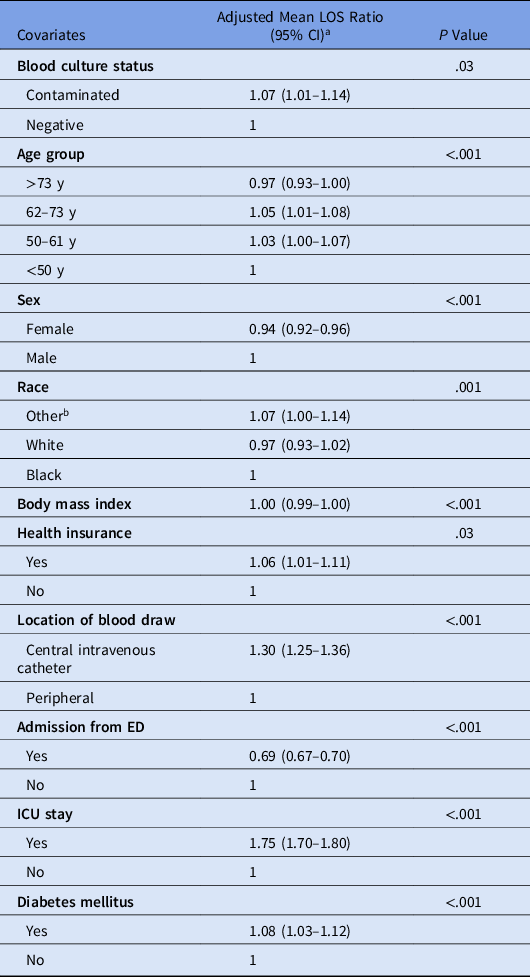
Final Multivariable Model for Length of Stay After Adjustment of Covariates

Note. ED, emergency department; ICU, intensive care unit.
a Adjusted for age, sex, race, body mass index, health insurance, location of blood draw, admission for ED, ICU stay, and presence of diabetes mellitus.
b Other includes Asian, Hawaiian, Pacific Islander, Native American.
Duration of hospital stay
Secondary variables independently associated with duration of hospital stay on univariate analysis were included in multivariable analysis (Table 2). After controlling for age, sex, race, BMI, marital status, health insurance status, location of blood draw, diabetes mellitus, admission from ED, and ICU stay, patients with contaminated episodes stayed in the hospital on average 0.8 days longer than those with negative episodes (P = .032) (Table 4).
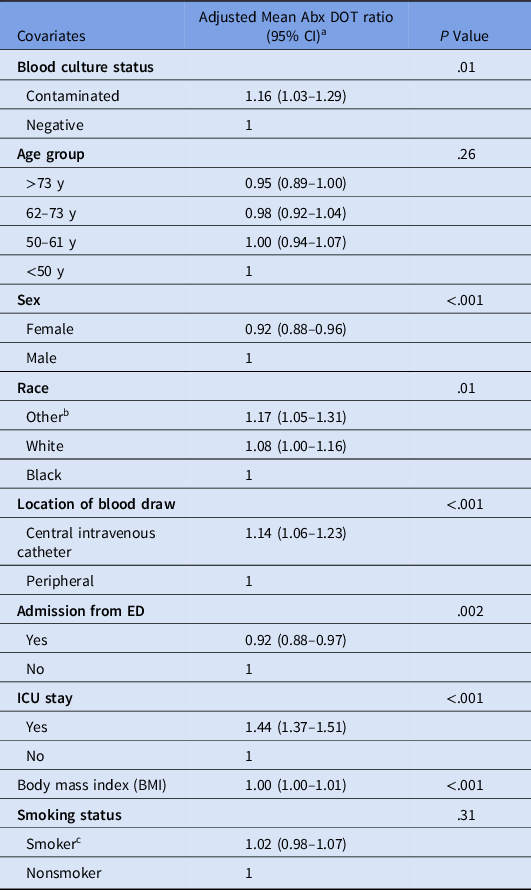
Final Multivariable Model for Antibiotic Days of Therapy (Abx DOT) After Adjustment of Covariates

Note: ED, emergency department, ICU, intensive care unit.
a Adjusted for age, sex, race, body mass index, location of blood draw, admission from ED, ICU stay, and smoking status.
b Other includes Asian, Hawaiian, Pacific Islander, Native American.
c Smoker includes current smoker, former smoker, daily smoker.
Comparison of Unadjusted Mean Number of Days to Mean Number of Days Adjusted for Covariates for Each Outcome

Note. CI, confidence interval; ED, emergency department; ICU, intensive care unit.
a For days of hospital stay, mean was adjusted for age, sex, race, body mass index, health insurance, location of blood draw, admission from ED, ICU stay, and presence of diabetes mellitus.
b For days of antibiotic therapy, mean was adjusted for age, sex, race, body mass index, location of blood draw, admission from ED, ICU stay and smoking status.
Days of antibiotic therapy
Duration of antibiotic therapy for patients with contaminated blood-culture episodes was also 0.8 days longer than antibiotic therapy for patients with negative blood-culture episodes after controlling for age, sex, race, smoking status, BMI, location of blood draw, diabetes mellitus, admission from ED, and ICU stay (P = .011) (Tables 3 and 4).
Discussion
The study results indicate that despite the use of a molecular-based rapid blood-culture identification system, contaminated blood cultures continue to have a significant effect on duration of hospital stay and antibiotic therapy. Patients with contaminated blood-culture episodes were shown to have stayed an additional day (0.8 days) in the hospital compared to patients with negative blood-culture episodes, even after adjusting for factors independently associated with duration of hospitalization (P = .032). These results corroborate past studies in the pre–rapid-blood-culture identification era, which reported an increased length of hospitalization in relation to contaminated blood cultures. In one study, the median length of stay increased by 3 days (IQR, 3–5) in patients with contaminated blood-culture episodes compared to patients with negative blood cultures. Reference Surdulescu, Utamsingh and Shekar6 Meanwhile, in an another study, the mean increase in length of stay was 2.35 days (P = .008) for patients with contaminated blood-culture episodes. Reference Geisler, Jilg, Patton and Pietzsch8 Thus, although we noted a decrease in the extended hospital stay documented in studies conducted prior to the widespread use of rapid blood-culture identification systems, a significant increase in hospital stay associated with blood-culture contamination remains. Similar to hospital length of stay, patients with contaminated blood-culture episodes remained on antibiotic therapy for an additional day compared to patients with negative blood-culture episodes (P = .011). These results align with observations from a previous study showing that patients with contaminated blood-culture episodes were maintained on antibiotic therapy for an additional 3 days. Reference Surdulescu, Utamsingh and Shekar6 In addition to longer hospital stay and use of antibiotic therapy (including vancomycin), other studies have shown that contaminated blood cultures also result in increased pharmacy cost and laboratory utilization. Reference Souvenir, Anderson and Palpant5,Reference Bates and Lee19
Our study is different from past studies in several ways. First, the rapid blood-culture identification system was implemented at our institution in 2013, which shortened the turnaround time for blood-culture results by 24–48 hours and allowed for rapid differentiation between likely contaminants, such as coagulase-negative staphylococci, and likely pathogens, such as Staphylococcus aureus, as well as other targeted pathogens. Faster pathogen identification may allow clinicians to withhold, stop, or change antibiotics more quickly.
Additionally, to our knowledge, only one other study used multivariable analyses to control for confounders. Reference Bates, Goldman and Lee3 Univariate analysis that does not control for confounders can lead to over- or underestimation of results. However, even though Bates et al Reference Bates, Goldman and Lee3 controlled for confounders, the authors used a 48-hour window to define blood-culture episode. Subsequent positive blood cultures during the same hospitalization may have been missed, resulting in erroneous data. Our study definition of a contaminated episode only included admissions where the first blood culture was contaminated and any subsequent blood cultures were negative, thereby excluding the possibility of a true positive culture beyond the 48-hour initial culture window.
Results of our study might be a reflection of increasing awareness among clinicians about harms imposed by inappropriate use of antibiotics in patients with contaminated blood cultures, such as emergence of antibiotic resistance, unnecessarily extended hospital stay, and resultant increase in hospital-acquired infections. Reference Al-Helali, Al-Asmary, Abdel-Fattah, Al-Jabban and Al-Bamri11,Reference Slimings and Riley15 Our hospital has had a robust antimicrobial stewardship program in place since 2004 that actively emphasizes the adverse effects resulting from inappropriate antimicrobial administration. Awareness of the aforementioned factors might have contributed to reducing the gap between clinical outcomes of contaminated blood cultures and negative blood cultures that we observed compared to older studies. However, at the same time, our results provide sufficient evidence to support the claim that contaminated blood cultures continue to have an adverse effect on patient outcomes.
The current study had several limitations; some because of study design and others because of the nature of the data that were used. First, it was not possible to track, measure, and account for all potential risk factors. For example, the increase in duration of hospital stay could have been due to other comorbidities that we did not capture. Reference Aliyali, Mehravaran, Abedi, Sharifpour and Yazdani Cherati20,Reference Kuwabara, Imanaka and Matsuda21 A more objective measure of severity of illness or underlying conditions such as a Pitt bacteremia score or Charlson comorbidity index was not available. However, based on past literature we included 4 underlying diseases in the analysis that have been shown to affect the association between contaminated blood cultures and duration of hospitalization. Another factor that has shown to play a role in blood-culture contamination is the mental status of the patient, due to potential difficulty in drawing blood from combative or uncooperative patients. Reference Bates, Goldman and Lee3 For this study, a valid indicator of the mental well-being of the patient was not available. Individual physicians’ management of patients with contaminated cultures can also influence a patient’s hospital length of stay and duration of antimicrobial therapy, which we could not control for in this analysis. Finally, our retrospective cohort study was prone to information or misclassification bias because we were unable to fully ascertain the accuracy of the archived data in electronic medical records. However, we did perform manual review of a subset of records to check the accuracy of length of stay and antibiotic administration data, which demonstrated 100% concordance with the electronic data extraction.
We observed a significant difference in length of stay and antibiotic utilization associated with blood-culture contamination. Although these findings are consistent with previous literature, the effect appears to be considerably smaller than observed by previous investigators and may reflect the influence of more rapid blood-culture identification, or increased awareness of the ill effects of inappropriate antibiotic administration. Nonetheless, a significant adverse effect of blood-culture contamination on clinical outcomes continues to exist despite diagnostic improvements. In this era of scarce medical resources, an extra day of hospitalization and an extra day of antibiotic administration is substantial and justifies additional efforts to prevent blood-culture contamination.
Acknowledgments
Financial support
This work was partially supported by a grant (Rupp –PI) from Magnolia Medical Technologies via a contract with the University of Nebraska Medical Center. The sponsor participated in the design of the project, but had no role with data collection, analysis, interpretation, manuscript preparation, review, approval, or decision to submit. Magnolia Medical Technologies manufactures an initial specimen diversion device that is designed to prevent blood-culture contamination.
Conflict of interest
M.E.R. reports having received honoraria from Magnolia Medical Technologies. All other authors declare no potential conflicts of interest.