Current theories of developmental psychopathology involve the concept of bidirectional or transactional processes between children and their environments over time. Transactional processes are mutual and reciprocal exchanges involving individuals and their context, including their social environment, that bring about an interrelated series of changes observable in both the individuals and their context (Bronfenbrenner & Morris, Reference Bronfenbrenner, Morris, Lerner and Damon2006; Cicchetti, Reference Cicchetti1993; Sameroff, Reference Sameroff1975). Conceptual models of parenting and developmental psychopathology, in particular, often include the concept of a bidirectional reciprocal relation between the parents’ behavior and the development of children's internalizing and externalizing behavior problems (e.g., Bell, Reference Bell1968; Belsky, Reference Belsky1984; Sameroff, Reference Sameroff, Olson and Sameroff2009). In practice, however, much of the current literature focuses on unidirectional parenting effects and views children as essentially recipients of parenting and other environmental effects.
Child characteristics have been increasingly included in longitudinal studies as mediators and moderators of parenting and other influences. In this way children's “influence” on the developmental process is sometimes included within empirical models in current research, including a number of the studies in this Special Section. However, relatively few studies have directly examined child-to-parent or bidirectional effects. Longitudinal studies that clarify the direction of effects through the mutual prediction of parenting and problem behaviors over time are particularly rare in the literature. Consequently, relatively little is known about the reciprocal relations between parenting and children's behavior problems, or about the importance of bidirectional processes for the development of child and adolescent psychopathology (Pardini, Reference Pardini2008).
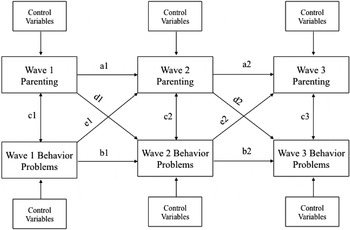
Researchers following a transactional model would anticipate that relations (including bidirectional relations) between parenting and child behavior would change across the course of development. In transactional models variables are not assigned to one specific role (predictor, mediator, or outcome); rather, the variables involved may be hypothesized to play all of these roles in sequence over a certain period of time (Véronneau & Vitaro, Reference Véronneau and Vitaro2007). Accordingly, use of a cross-lagged design that allows for changes in relations between variables across successive time periods may be informative in understanding the ongoing transactional processes involved in developmental change (Kline, Reference Kline, Hancock and Mueller2013; Little, Preacher, Card, & Selig, Reference Little, Preacher, Selig and Card2007). Figure 1 presents a schematic diagram of a model of reciprocal change in parenting and child behavior problems over time. The model illustrates a repeated interval “time-lagged panel” approach, controlling for both the ongoing stability of parenting and child behavior and for extraneous variables (e.g., demographics) that might have various impacts on the reciprocal relations between parenting and child behavior over time. Note that parenting and child behavior each play predictor and outcome roles in successive phases of the model.
Autoregressive, cross-lagged panel path model. Model 1: Reciprocal associations model (all paths included). Model 2: Parent effects model (parenting predicts behavior problems, e paths are dropped). Model 3: Child effects model (behavior problems predicts parenting, d paths are dropped). Model 4: No cross-lagged associations (d and e paths are both dropped).

Of the recent work that has examined the impact of child behavior on parenting, or their reciprocal relations, the literature suggests that effects differ depending on the specific developmental period examined (e.g., middle childhood vs. adolescence; Pettit & Arsiwalla, Reference Pettit and Arsiwalla2008). The concept of changing reciprocal relations over the course of development suggests that there may be several types of possible relations between parenting and child behavior, variously defined as “positive” and “negative” feedback loops (Kuczynski, Reference Kuczynski2003; Sameroff & Mackenzie, Reference Sameroff and MacKenzie2003) or as “vicious” versus “virtuous” cycles (Lerner, Reference Lerner1982; Shahar, Reference Shahar2006). Among the most documented of these reciprocal transaction models is Gerald Patterson and his colleagues’ classic work on coercive family processes (e.g., Patterson, Reference Patterson1982). In Patterson's model, the child's disruptive behavior (e.g., verbal or physical aggression; temper tantrums) leads to a progressively less effective parental response (e.g., scolding, “giving in,” physical punishment) in terms of reducing the rate of the child's behavior and raising the likelihood of more disruptive behavior from the child in the future. In this classic example, the parent finds the child's behavior highly aversive and may alternatingly try to escape or avoid the disruptive behavior (e.g., acquiesce, ignore), or react to the behavior with scolding or punishment. Inconsistent and punitive parental responses result in continuing and escalating outbursts from both the child and the parent over time.
This type of positive feedback loop or vicious cycle (defined here as a positive correlation between the child's aversive behavior and parental aversive or ineffective response, leading to successive escalation of both over time) is in contrast to a negative loop, or virtuous cycle, in which the parent responds in an effective way that results in a lessening of the child's problem behavior over time. An example of a virtuous feedback loop may occur when a parent offers empathy and support to a child who expresses fear and hesitates or avoids entering a novel situation. If this intervention is effective in lowering the child's avoidance and anxiety regarding novel situations over time, the reduction in the child's fearful behavior results in a subsequent reduction in the need for this type of “supportive” parenting intervention (Belsky, Rha, & Park, Reference Belsky, Rha and Park2000; Lengua & Kovacs, Reference Lengua and Kovacs2005). Of course, vicious and virtuous cycles are not necessarily linked specifically with either internalizing or externalizing behavior. Either type of problem may elicit an effective (i.e., virtuous cycle) or exacerbating (i.e., vicious cycle) parenting response, depending on parenting skills and context.
To identify ongoing transactional processes that transform both child behavior and parenting over time, it would be necessary to study both child and parent behavior at multiple time points spread far enough apart to capture changes in parenting and children's problem behavior that may occur gradually. Other influences on parenting and child behavior, including those that may themselves potentially change over time (e.g., environmental/family conditions; maturational changes in cognition or social abilities) may also need to be included as repeated control variables in an autoregressive cross-lagged design, as illustrated in Figure 1. The changes in family or individual circumstances, characteristics, and conditions that occur during the course of a study (including developmental transitions such as puberty) may themselves change the nature of the ongoing relations between parenting and child behavior. To identify feedback loops, processes that change both parent and child behavior over time, a minimum of three successive points of observation spaced at developmentally relevant intervals and controlling for additional variables that may impact child and parent behavior across various points in the study would be necessary.
As mentioned above, the literature to date includes relatively few actual examinations of changes in reciprocal behavioral relations between child and parent behavior across successive periods in development. Many longitudinal studies to date have reported relatively strong parent-to-child effects over time without examining child-to-parent effects at all or have not included child-to-parent effects as repeated measurements at successive time points. For this reason, the extensive reports of parenting effects on child problem behavior in the literature may be telling only a portion of the story that is implied by a transactional model. It is also possible that parent-to-child effects are inflated when the reverse possibility of a child-to-parent effect is not included in the model at all, or only in a portion of the design (e.g., when child behavior is entered only at the initial or final time point in a longitudinal analysis). Child-to-parent effects, in other words, may have been underestimated within the literature, which repeatedly demonstrates parent-to-child effects but frequently not the reverse (Pardini, Reference Pardini2008; Pettit & Arsiwalla, Reference Pettit and Arsiwalla2008).
Parent-to-Child Effects
Within both unidirectional studies (i.e., parent-to-child effects) and the bidirectional studies published to date, the longitudinal literature over the past 30 years has fairly consistently demonstrated evidence of parenting influences on child behavioral problems and psychopathology (Berg-Nielsen, Vikan, & Dahl, Reference Berg-Nielsen, Vikan and Dahl2002). Specific aspects of parenting, such as support and structure, may represent a style of effective parenting referred to as “authoritative” by Baumrind (Reference Baumrind1971, Reference Baumrind and Damon1989) and others (Maccoby & Martin, Reference Maccoby, Martin and Hetherington1983), which is characterized by both responsiveness and demandingness. This parenting style integrates high levels of parental involvement, nurturance, and responsiveness with the use of reasoning, direction, consistency, and limit setting. It has been found to be a relatively characteristic style, which parents use with some consistency and which has a broad and generally positive impact on child development (see Maccoby & Martin, Reference Maccoby, Martin and Hetherington1983 for review). Conversely, harsh parenting (e.g., use of physical punishment) has also been found to be a fairly consistent parenting style which has generally negative effects on development over time, including a variety of serious behavioral problems (e.g., Baumrind, Reference Baumrind and Damon1989; Kochanska, Reference Kochanska2002). Using instruments such as the Parenting Dimensions Inventory (Power, Reference Power2002; Slater & Power, Reference Slater, Power and Vincent1987) research over several decades has found these characteristic styles to be predictive of children's behavioral problems and health (Hughes, Power, Orlet Fisher, Mueller, & Nicklas, Reference Hughes, Power, Orlet Fisher, Mueller and Nicklas2005; Maccoby & Martin, Reference Maccoby, Martin and Hetherington1983). Harsh and punitive parenting practices (e.g., scolding, criticizing, use of physical punishment), for example, have been widely associated with higher levels of both externalizing and internalizing problems from early childhood through adolescence, both in single time point (i.e., contemporaneous) studies and also over time (for a review, see Berg-Nielsen et al., Reference Berg-Nielsen, Vikan and Dahl2002). Although less frequently studied in the context of the development of psychopathology, parenting styles associated with support and structure are generally associated with fewer behavior and emotional problems (Denham et al., Reference Denham, Workman, Cole, Weissbrod, Kendziora and Zahn-Waxler2000; Kawabata, Alink, Tseng, van IJzendoorn, & Crick, Reference Kawabata, Alink, Tseng, van IJzendoorn and Crick2011; Maccoby, Reference Maccoby, Grusec and Hastings2007; Zahn-Waxler, Iannotti, Cummings, & Denham, Reference Zahn-Waxler, Iannotti, Cummings and Denham1990).
Child-to-Parent Effects
As discussed above, we know much less about the impact of child behavior and other characteristics on parenting, especially from studies using longitudinal designs. Some exceptions include a series of studies published in the Journal of Abnormal Child Psychology (Pettit & Arsiwalla, Reference Pettit and Arsiwalla2008) in a special section on bidirectional parent–child relationships. Some of the studies in this section had significant limitations, such as the use of only one rater (typically mother) for both child and parent behavior measures, the inclusion of only one gender (usually male), and a focus primarily on externalizing child behavior and punitive parenting. In addition, many of the studies did not examine changes in relations between child and parent behavior across multiple time points or control for changes in the external environment over time. Given these limitations, however, some interesting patterns of results emerged from this set of studies.
For example, in one study from the section utilizing a cross-lagged design, Larsson, Viding, Rijsdijk, and Plomin (Reference Larsson, Viding, Rijsdijk and Plomin2008) reported that the longitudinal association between parental negativity and children's antisocial behaviors in preschool was best explained by both parent-driven and child-driven effects. Similarly, Pardini, Fite, and Burke (Reference Pardini, Fite and Burke2008) and Burke, Pardini, and Loeber (Reference Burke, Pardini and Loeber2008) reported longitudinal evidence of bidirectional effects between boys’ externalizing problems and a variety of parenting dimensions, including physical punishment, quality of parental monitoring, inconsistent discipline, positive reinforcement, involvement, and quality of parent–child communication. In another study from that section, Hipwell et al. (Reference Hipwell, Keenan, Kasza, Loeber, Stouthamer-Loeber and Bean2008) found bidirectional relations between girls’ depression and conduct problems and harsh discipline and lowered parental warmth.
Verhoeven, Junger, Van Aken, Deković, and Van Aken (Reference Verhoeven, Junger, Van Aken, Deković and Van Aken2010) recently examined the longitudinal associations between preschoolers’ externalizing symptoms and parenting (e.g., parental support and physical punishment) and found only child-to-parent effects. Finally, Pearl, French, Dumas, Moreland, and Prinz (Reference Pearl, French, Dumas, Moreland and Prinz2014) found empirical support for bidirectional relations between parenting quality (e.g., positive parenting and effective discipline) and reduced externalizing problems among a sample of African American school-aged children. To summarize, the literature to date provides mixed results, with some studies reporting similar or stronger child-to-parent effects (e.g., Burke et al., Reference Burke, Pardini and Loeber2008; Hipwell et al., Reference Hipwell, Keenan, Kasza, Loeber, Stouthamer-Loeber and Bean2008; Larsson et al., Reference Larsson, Viding, Rijsdijk and Plomin2008; Pardini et al., Reference Pardini, Fite and Burke2008; Verhoeven et al., Reference Verhoeven, Junger, Van Aken, Deković and Van Aken2010) and others suggesting that child-to-parent effects are typically weaker than parent-to-child effects (e.g., Hipwell et al., Reference Hipwell, Keenan, Kasza, Loeber, Stouthamer-Loeber and Bean2008; Pearl et al., Reference Pearl, French, Dumas, Moreland and Prinz2014).
Multiple Time Points
As discussed above, most of the published studies examining bidirectional effects using a classic cross-lagged panel or other regression-based design have been limited to two time points, while a reciprocal transactional relation in which a sequence of changes occurs over time logically requires at least three time points to confirm (i.e., arrows from Time 1 to Time 2 and Time 2 to Time 3, as per the model in Figure 1). In addition, the results reported in studies showing relatively weak (or non) effects of child behavior on parenting may be related to the specific developmental periods chosen in those studies. In other words, the preceding or following developmental period might have shown evidence of child-to-parent (or of reciprocal parent–child, child–parent) effects. In the case of either a negative or positive feedback loop, implying a transactional relation between parenting and child behavior over time, change in the magnitude or direction of coefficients could be expected from one period to the next. Child-to-parent effects, for example, may be more limited to specific developmental periods or contexts (when a child's problem behavior is very salient; e.g., separation anxiety at the transition to schooling) or more transitory than parent-to-child effects.
The Present Study
The present study utilized data collected for the Concordia Longitudinal Research Project, a large intergenerational study of risk for psychopathology, health, and psychosocial problems in a lower income community sample that was initiated in 1976 by Jane Ledingham and Alex Schwartzman (Schwartzman, Ledingham, & Serbin, Reference Schwartzman, Ledingham and Serbin1985; Serbin et al., Reference Serbin, Cooperman, Peters, Lehoux, Stack and Schwartzman1998). Using this data set, we had the opportunity to carry out a transactional study of the relations between parenting and children's externalizing and internalizing problems over time. A sample of 138 mother–child dyads who participated at repeated time points approximately 3 years apart were included. For the purposes of the present study, measures of parenting and of child behavioral problems by different raters (mothers and teachers, respectively) were available at three time points covering a 6-year period, at children's average ages of 7 (Wave 1), 10 (Wave 2), and 13 years (Wave 3). The design therefore facilitated a developmental examination of transactional relations and of changes in the relations between parenting and child behavior across two successive periods of development (i.e., across middle childhood and across the transition to early adolescence).
The present study has several methodological strengths relative to existing literature that are important to highlight. First, we relied on multiple-informant data to test our hypotheses. That is, we used different informants to measure different variables (i.e., mothers were used to assess parenting practices and teachers were used to assess children's behavior problems). This strategy avoided the problem of shared rater variance (typically occurring when all measures are completed by a single rater), which is likely to inflate the associations between constructs. Second, the design included important control variables, including family socioeconomic status (SES) and child's gender, reducing the likelihood that the associations found in our model were due to these potential confounding variables. SES and gender have often been found to predict both variation in family interaction processes and youth psychopathology (Conger & Donnellan, Reference Conger and Donnellan2007; Zahn-Waxler, Shirtcliff, & Marceau, Reference Zahn-Waxler, Shirtcliff and Marceau2008). Third, we included two dimensions of children's behavioral problems (i.e., internalizing and externalizing) and two styles of parenting (i.e., use of support and structure and physical punishment) within the design, allowing us to make comparisons between processes over time. Fourth, the analysis spanned three repeated time points, 3 years apart, from middle childhood into early adolescence. The use of three successive time points with identical measures of parenting and child behavior made it possible to use a cross-lagged panel design (Kline, Reference Kline, Hancock and Mueller2013; Little et al., Reference Little, Preacher, Selig and Card2007) and to investigate reciprocal relations between parenting and child behavior which might change over time. We were therefore able to investigate whether either positive or negative feedback loops characterized these relations across a 6-year period, when major developmental changes in terms of both children's behavior and parenting behavior were likely to be observed.
Hypotheses and predictions
Specific hypotheses were that externalizing and internalizing child behavior problems would have reciprocal relations with the parenting dimensions, although in different directions depending on the nature of the parenting measure (e.g., a negative relation between behavior problems and supportive parenting; positive relation between behavior problems and punishment).
We expected to find positive feedback loops across time, in which sequential reciprocal relations between successive time periods had the same direction (i.e., child behavior and ineffective parenting amplified each other across time). For example, externalizing problems were expected to predict an increase in harsh parenting (and vice versa) across successive time periods. Conversely, externalizing was expected to predict lower levels of supportive parenting (and vice versa) across successive periods. Both examples reflect positive feedback loops (i.e., vicious cycles) because the direction of the coefficients remains the same in successive time periods, reflecting an amplifying effect between child behavior problems and ineffective parenting.
We also expected to find some relations between parenting and child behavior in which the coefficients linking parenting and child behavior changed direction or became nonsignificant between successive time periods, reflecting a negative feedback loop or virtuous cycle.” Predictions of a negative loop included relations between internalizing and supportive parenting, which might be positive for the first developmental period in the sequence (i.e., from Wave 1 to Wave 2, middle childhood), when internalizing was expected to lead to higher levels of parental support, but negative during the subsequent period (from Wave 2 to Wave 3, early adolescence), when higher support might result in fewer internalizing problems across time.
We had no specific predictions about cross-lagged relations between internalizing and harsh punishment over time. Harsh parenting has been associated with children's anxiety and other internalizing symptoms in the literature, but there is no evidence that children's internalizing problems consistently increase (or decrease) the use of this type of parental behavior. A final hypothesis, based on the literature showing gender differences in both problem behaviors and parenting styles (Blakemore, Berenbaum, & Liben, Reference Blakemore, Berenbaum and Liben2009; Connell & Goodman, Reference Connell and Goodman2002), was that gender would moderate the reciprocal relations between parenting and child behavior, although this was exploratory due to a lack of previous investigations of gender as a moderator of reciprocal relations.
Method
Participants
The original sample
The Concordia Longitudinal Research Project is an ongoing, prospective, longitudinal study of families from disadvantaged backgrounds. The Concordia Project began in 1976 with the screening of 4,109 French-speaking children attending Grade 1 (age 6–7 years), Grade 4 (age 9–10) or Grade 7 (age 12–13) at public schools serving inner city neighborhoods of Montreal and Quebec in Canada. The original sample came primarily from lower SES backgrounds and was 51% female (Schwartzman et al., Reference Schwartzman, Ledingham and Serbin1985). Most of the original participants and their families have been followed since that time via archival records of health, educational, social services, and criminal offenses (Schwartzman et al., Reference Schwartzman, Bukowski, Serbin, Stack, Hastings and Ledingham2015). Many of the original participants have become parents, providing opportunities to examine long-term prediction of family functioning and the intergenerational transfer of health and psychosocial risk (Serbin et al., Reference Serbin, Cooperman, Peters, Lehoux, Stack and Schwartzman1998; Serbin, Stack, Hubert, & Schwartzman, Reference Serbin, Stack, Hubert, Schwartzman, Kerr, Stattin, Rutger, Engles, Overbeek and Andershed2011).
Since the original screening in 1976, smaller subsets of the participants have been selected for follow-up studies involving such varied measures as diagnostic mental health interviews, observation of family functioning, parenting, and diurnal neuroendocrine patterns (Serbin et al., Reference Serbin, Stack, Hubert, Schwartzman, Kerr, Stattin, Rutger, Engles, Overbeek and Andershed2011). The subsamples used for each of these follow-up studies are representative of the original sample in terms of gender, family SES, neighborhood, and behavioral characteristics in childhood. Of relevance to the present study, an intensive longitudinal follow-up sample of 693 participants has been seen at 3- to 5-year intervals since childhood (currently up to midadulthood) and screened on observational and interview-based measures and questionnaires concerning health, education, family and occupational functioning. Of these 693 people, 550 have become parents. This subsample was used to identify the families recruited for the present study (see below). For a more detailed description of the intergenerational project's methodology, please refer to Serbin et al. (Reference Serbin, Cooperman, Peters, Lehoux, Stack and Schwartzman1998).
The current sample
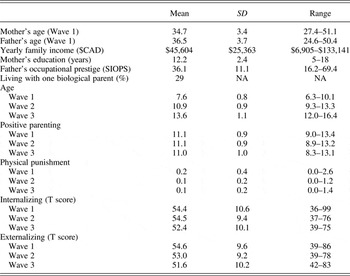
A subsample of 138 original participants in the Concordia Project who had children (65 boys) aged 6–9 (mean age = 7.6 years) during the first phase of the current study were selected for the present analyses (see Table 1). All families with children in this specific age range who were living within a 2-hr drive from our laboratory (N = 165 eligible families) were identified and invited to participate. The families spoke French at home and the children attended French language schools. The sample of 138 families included 93 women and 45 men who had been participants in the Concordia project since their own childhood, plus their spouses and children of the appropriate age (one child per family).
Sample characteristics and descriptive statistics

Note: Observed, rather than imputed values are presented. Internalizing and externalizing T scores are provided, but only raw scores were used in the present analysis. N = 138.
Approximately 84% of invited families agreed to participate during the period of the current study (see Procedures, below). These 138 families did not differ from those who did not participate (N = 27) or from the complete sample of families (N = 550) in terms of family income, maternal education, neighborhood disadvantage, rate of single parenthood or welfare enrollment (analyses of representativeness within sample; all ps >.10). In addition, participants who participated in all three waves of the study did not differ significantly from those who only participated at one or two waves in terms of demographic characteristics or the child behavior scores and parenting scores used for this study (see below).
The average age of the participating mothers at the first phase of the study was 34.7 years (SD = 3.4). Fathers’ ages averaged 36.5 years (SD = 3.7). In terms of demographics, families in the current sample fell below population averages on several measures of social and economic functioning. At Wave 1, when the children had entered elementary school, families had an average annual income of $45,604 (SD = $25,363). This was well below the median family income in Quebec and across Canada for that time ($50,242 and $55,016, respectively; Statistics Canada, 2010). In terms of educational attainment, the mean number of years of education completed by participating mothers was 12.2 years (SD = 2.4). According to the Standard International Occupational Prestige Scale (Ganzeboom & Treiman, Reference Ganzeboom and Treiman1996), the average rating of occupational prestige for the participants corresponded to jobs such as trade worker or machine operator. Approximately 29% of children were not living with both their biological parents (in almost all cases, children lived with their biological mother).
Procedure
Children and their families were followed across three waves at approximately 3-year intervals. Although a total of 138 families were involved in the present study, participation rates varied somewhat across the three phases of the study (i.e., families that did not participate at a given wave of data collection were recontacted approximately 3 years later and invited to participate at the following wave). At Wave 1 (collected during 1999–2003), children had entered elementary school (ages 6–9; participating N = 129, M = 7.6 years, SD = 0.8), at Wave 2 (2003–2005) children were in preadolescence (ages 9–12; N = 110, M = 10.9 years, SD = 0.9), at Wave 3 (2005–2009) children were in the early adolescent years (ages 12–15; N = 109, M = 13.6 years, SD = 1.1). At each of the three waves, mothers completed standardized questionnaires assessing parenting practices and teachers completed questionnaires assessing youth's internalizing and externalizing behavior problems. Informed consent and demographic information (educational attainment, occupation, income, marital status, family structure) were obtained during a telephone interview followed by signed consent forms and questionnaires obtained by mail at each of the three phases of data collection. Families were compensated with a nominal honorarium. These procedures were approved by the university's Institutional Review Board.
Measures
Parenting dimensions
A French translation of the Parenting Dimensions Inventory (PDI; Power, Reference Power2002; Slater & Power, Reference Slater, Power and Vincent1987) was administered to mothers at each phase of the study. The French language version of the PDI has been used for a variety of studies and has shown good concurrent and predictive validity as a predictor of observed parent–child interactions and quality of parent–child relationship, as well as correlations with current and subsequent parental psychopathology (Ellenbogen & Hodgins, Reference Ellenbogen and Hodgins.2004, Reference Ellenbogen and Hodgins.2009). Within the Concordia sample, the PDI scales of support and structure (see below) were significantly related both concurrently and predictively to quality of observed parenting, as assessed by the Emotional Availability Scales (Biringen, Robinson, & Emde, Reference Biringen, Robinson and Emde1998; Stack et al., Reference Stack, Serbin, Girouard, Enns, Bentley and Ledingham2012).
The PDI is a self-report measure that assesses several dimensions of parenting, including parental support and structure, which were used for the present study. Parental support includes 18 items that assess three subscales: parental nurturance, responsiveness, and nonrestrictiveness. Sample items are “I encourage my child to talk about his or her troubles” and “I believe that most children change their minds so frequently that it is hard to take their opinions seriously” (reverse scored). Scale scores for the support measure could range from 3 to 18. Internal consistency of the support subscale at each wave was acceptable (αs = 0.74–0.78). Parental structure includes 12 items assessing two subscales, parental consistency and organization, which reflect demandingness and limit setting. Sample items are “I think a child should be encouraged to do things better than other children” and “There are times I just don't have the energy to make my child behave as he or she should” (reverse-scored). Scale scores for the structure measure could range from 2 to 12. Internal consistency of the structure subscale at each wave was also acceptable (αs = 0.73–0.74).
Preliminary confirmatory factor analysis on subscales of the PDI revealed that the parenting dimension subscales were not better represented by a smaller number of latent factors. In addition, at each wave, factor analysis produced latent factors that showed nonequivalent measurement structures (i.e., subscales did not load onto factors in a similar way over each wave, indicating that factor structures were different across developmental periods). A large body of research has shown that when analyzing SEM models with repeated observations, it is essential to establish the equivalence, or invariance, of measurement structures over time in order to coherently interpret model results (e.g., Bollen & Curran, Reference Bollen and Curran2006; Flora, Curran, Hussong, & Edwards, Reference Flora, Curran, Hussong and Edwards2008; Khoo, West, Wu, & Kwok, Reference Khoo, West, Wu, Kwok, Eid and Diener2006). Following these recommendations, we used manifest rather than latent variables in the analyses. Preliminary analyses revealed that parental support and structure showed small positive correlations at each measurement point (rs = .16–.19) and were both negatively related to children's internalizing and externalizing problems. Given the importance of support and structure in the parenting literature, particularly in relation to the theoretical construct of authoritative parenting (Baumrind, Reference Baumrind and Damon1989; Hughes et al., Reference Hughes, Power, Orlet Fisher, Mueller and Nicklas2005) as well as their statistical nonindependence in our sample, support and structure were averaged to form a measure of positive parenting.
In addition to providing the scales described above, the PDI also assesses the types of punishment employed by parents. Six disciplinary situations are presented to parents who indicate on a 4-point Likert scale, ranging from 0 to 3, how likely it is that they would use various forms of punishment in response (e.g., physical punishment, scolding, reminding, reasoning, material consequences, and letting the situation go). These did not significantly intercorrelate or load together onto a latent factor. Given that the literature has consistently demonstrated that use of physical punishment is related to children's behavior problems (Deater-Deckard & Dodge, Reference Deater-Deckard and Dodge1997; Gershoff, Reference Gershoff2002), physical punishment was selected for use in the present analysis. Internal consistency of the physical punishment subscale at each wave was acceptable to good (αs ranged from 0.70 to 0.87). Mothers’ ratings of how likely they were to use physical punishment in the presented scenarios were averaged across the six disciplinary situations to create a scale score for use of physical punishment that could range from 0 to 3. Correlations between positive parenting and physical punishment were low to moderately negatively correlated (rs = –.18 to –.32 across the three waves).
Internalizing and externalizing problems
A French language translation of the ASEBA Teacher Report Form (TRF 6/18; Achenbach, Reference Achenbach1991) was administered to children's teachers at each wave to assess children's behavioral and emotional problems. The items are scored on a 3-point scale: 0 if the item is not true of the child, 1 if the item is somewhat or sometimes true, and 2 if the item is very true or often true. Broadband internalizing and externalizing problem scales were derived from teachers’ reports based on these questionnaires (Achenbach & Rescorla, Reference Achenbach and Rescorla2001). Internal consistency of the internalizing and externalizing scales at each wave was excellent (αs = 0.87–0.93 and 0.94–0.97, respectively). Raw scores were used in the present analysis (as recommended for the multiple wave cross-lagged design; Kline, Reference Kline2005).
Family SES
Given that lower SES is associated with greater rates of children's emotional and behavioral problems (e.g., McLoyd, Reference McLoyd1998) and with poorer parenting practices (Bornstein & Bradley, Reference Bornstein and Bradley2002), SES was included as a control in all models. Yearly family income, mother's years of education and father's occupational prestige were used to create a factor representing family SES. Principle components analysis extracted one factor with an Eigenvalue of 1.63, which explained 54% of the variance. Yearly family income, mother's years of education, and father's occupational prestige all loaded highly and positively on the factor, with factor loadings of 0.73, 0.76, and 0.71, respectively.
Child's gender
Given that gender is often a predictor of internalizing and externalizing problems, as well as use of different parenting styles (Maccoby, Reference Maccoby, Grusec and Hastings2007; Zahn-Waxler et al., Reference Zahn-Waxler, Shirtcliff and Marceau2008), gender was also included as a control in all models.
Child's age
Because the age of children at each measurement point varied (e.g., children were between ages 6 and 9 at Wave 1) and because intervals between measurement points were also somewhat variable (3 years was average, but there was variability due to availability and other practical issues such as summer holidays or family illness), age was controlled at each wave in the analyses.
Analytic strategy
Cross-lagged path analysis is widely used to infer temporal, directional associations between variables in longitudinal research designs. Causality cannot be examined directly in a time-lag design, which is a correlational rather than an experimental design. However, the sequence and control for contemporaneous relations between variables makes it possible to see whether a set of results is consistent with a causal model (Kline, Reference Kline2005). Analyses were conducted using an autoregressive cross-lagged panel model approach (Curran, Reference Curran, Rose, Chassin, Presson and Sherman2000), a model that is well suited for testing hypotheses related to reciprocity and mutual influence (e.g., Ge, Conger, Lorenz, Shanahan, & Elder, Reference Ge, Conger, Lorenz, Shanahan and Elder1995). The model tested in our work is displayed in Figure 1. This type of model allows for simultaneous examination of longitudinal influences of one construct on another, and vice versa, while also controlling for contemporaneous associations between constructs and the stability of each construct over time. In the model, autoregressive path weights account for the stability of each measure across consecutive waves (i.e., paths a1, a2 and b1, b2 in Figure 1), while the contemporaneous correlations between the two constructs at each time point (c1, c2, and c3 in Figure 1) are also estimated. In all models, we controlled for the effects of child gender and family SES, which were included at Wave 1 as time-invariant covariates as well as for variation in child age, which was included as a time-varying covariate.
In order to understand the developmental associations between parenting and children's behavior problems, we tested four competing autoregressive cross-lagged models. The first model is a reciprocal model (Model 1 in Figure 1) that includes all cross-lag paths, implying a bidirectional relationship between the variables. That is, the model tests the hypothesis that, in addition to parenting affecting the development of children's behavior problems, children's behavior problems influence the quality of parenting that they receive at a later time. The cross-lag paths (d1, d2 and e1, e2 in Figure 1) indicate the extent to which early parenting or behavior problems (either internalizing or externalizing problems) predict scores on the other measure at a later wave, independent of the longitudinal correlations between measures of the same construct and the contemporaneous correlation between the constructs at each wave. Models 2–4 are then tested by removing specific cross-lag paths from the saturated reciprocal model. In Model 2, the parent effects model, paths e1 and e2 are dropped because this model predicts that early parenting will predict later behavior problems, but early behavior problems will not predict later parenting. In contrast, in Model 3, the child effects model, paths d1 and d2 are dropped because the model predicts the opposite. Finally, all cross-lag paths are dropped in Model 4 because this model suggests that the relation between parenting and behavior problems is fully explained by a third factor that is not included in the model,or that the variables are not related at all.
Given the time span of our analysis, from middle childhood (Wave 1 and Wave 2) across the transition to adolescence (Wave 3), our theoretical model did not assume that the prospective relationships between variables were equal over time (i.e., relations between variables were not constrained to be equal over time). It is important to note that the nature of bidirectional relations likely changes over the course of children's development (Scarr & McCartney, Reference Scarr and McCartney1983). Parenting practices might influence children's problem behavior more during childhood than during adolescence. Conversely, the ability of a child's problem behavior to influence parenting might be greater during adolescence than during childhood. In addition, constrained models were not used because the theoretical model suggesting positive versus negative feedback loops would suggest that effects are not the same across time (e.g., a negative feedback loop would reduce child effects at a successive wave, potentially changing the direction of a relation between variables). After the model was identified that best captured the developmental associations between parenting and children's behavior problems, we examined whether the path coefficients in these models supported a positive feedback loop (i.e., a self-perpetuating process wherein parent–child transactions increase child problems and negative parenting over time), a negative feedback loop (i.e., a reductive process wherein parent–child transactions decrease child problems and in turn decreases the need for positive parenting interventions over time), or no loop at all (i.e., no reciprocal relation between parenting and child behavior).
The autoregressive cross-lagged panel analyses were analyzed with Mplus (Version 5.1 (Muthén & Muthén, Reference Muthén and Muthén1998). Given the high degree of skew in the behavior data, all models were estimated using the MLM estimator, which produces maximum likelihood parameter estimates with standard errors and a mean-adjusted chi-square test statistic that are robust to nonnormality (Muthén & Muthén, Reference Muthén and Muthén1998). Missing data were not imputed; rather, all available observations were included in the analysis, using the full information maximum likelihood (FIML) approach of Mplus. Unlike listwise and pairwise deletion, which can result in biased parameter estimates due to nonrandom attrition, FIML treats data as missing at random and uses all the data available in the data set to generate parameter estimates (Arbuckle, Reference Arbuckle1999). In the present study, the amount of missing data for the parenting and behavior variables of interest ranged between 8% and 46%, with greater amounts of missing data on teacher-reported measures compared to mother-reported measures, reflecting increased difficulty in obtaining teacher participation in the two later waves of the study. Data were available for 129 participants at Time 1 (93%), 110 participants at Time 2 (80%), and 109 participants at Time 3 (79%). Recent work has shown that FIML produces unbiased and efficient parameter estimates in a large variety of contexts, including small sample sizes (e.g., N = 50) and when there is a substantial amount of missing data for the dependent variable (e.g., about 50%; Graham, Reference Graham2009; Graham & Schafer, Reference Graham, Schafer and Hoyle1999). Thus, the amount and nature of missing data in the present study is considered acceptable given the models employed. Nevertheless, to ensure that missing data did not bias our results, we compared our findings with and without the FIML procedures. For each retained model, we reran the analyses without FIML procedures (i.e., listwise deletion was employed). These analyses were largely identical to the models based on FIML procedures (i.e., fit indices were good, coefficients of interest remained statistically significant), indicating that our results are not biased by missing data.
We evaluated model fit of SEM analyses using Kline's (Reference Kline2005) guidelines according to which good model fit is reached when the chi-square value is nonsignificant, comparative fit index (CFI) values are at 0.95 or more, root mean square error of approximation (RMSEA) values at 0.05 or less. Chi square difference testing was utilized to compare the fit of competing models. If two models fit the data equally well, then selection was based on theoretical and statistical considerations (Kline, Reference Kline2005). That is, if the reciprocal model was an equally plausible representation of the data as the parent or child effects model, the reciprocal model was retained. This decision follows our theoretical model, which hypothesizes that children's and parents’ behaviors do not occur in isolation and are best represented through transactional processes. We then examined the statistically significant coefficients within the model to interpret specific parent-to-child and child-to-parent effects.
Results
Descriptive statistics
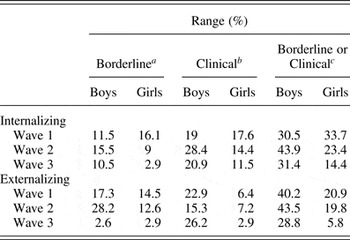
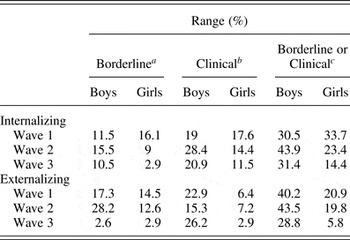
Table 1 provides the means, standard deviations, and ranges for all study measures. Note that for clarity, standardized age- and gender-normed T scores for the TRF scales (Achenbach, Reference Achenbach1991) are given in Table 1, but raw scores rather than standardized scores were used for the analyses (see above). As shown in Table 2, approximately 35% of boys and 24% of girls had internalizing problems in the borderline (84th to 91st percentile) or clinical (≥91st percentile) range, as averaged across the three measurement points in the study. In addition, approximately 38% of boys and 16% of girls had externalizing problems in the borderline or clinical range across the three waves.
Percentage of the sample at risk for borderline or clinical level behavior problems
Note: N = 138.
a Represents a T score between 60 and 63, equivalent to a score within the 84th to 91st percentile.
b Represents a T score between 60 and 63, equivalent to a score ≥91st percentile.
c Represents a T score above 60, equivalent to a score ≥84th percentile.
Stability over time and intercorrelations
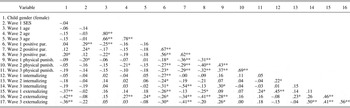
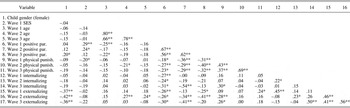
Table 3 displays the correlations among study variables. The two measures of parenting and children's externalizing problems were each stable over time (rs = .41–.56). In contrast, children's internalizing problems were not stable over time (rs = .01–.22). Consistent with previous literature documenting the high degree of comorbidity between internalizing and externalizing behavior problems, internalizing and externalizing problems were significantly associated at concurrent waves (rs = .23–.50). It is interesting that there was no suggestion of reciprocal influence over time between internalizing and externalizing problems; the association between internalizing and externalizing problems were not significant across waves, suggesting that problems in one domain are not consistently associated with the later development of problems in the other domain (rs = –.08 to .26). SES was positively associated with positive parenting at each wave, whereas SES was negatively associated with use of punishment, although associations were strongest at Wave 1 and reduced in magnitude over time. Child's gender was significantly associated with teacher ratings of children's externalizing problems: Boys had higher levels of these problems than girls at all three waves. Correlations over time between parenting and behavior problems provided initial support for our hypotheses, both in terms of cotemporaneous relations between parenting and problem behavior and in terms of reciprocal relations between parenting and behavior over time.
Correlation matrix of all variables used in the cross-lagged models
Note: Observed, rather than imputed values are presented. N = 138.
*p ≤ .05. **p ≤ .01.
Evaluation of cross-lagged models
Preliminary analysis of models
Given the statistically significant correlations between positive parenting and physical punishment, as well as of internalizing and externalizing behavior problems, preliminary analyses were conducted for each model. In these we controlled for the effects of the other parenting variable and the other behavior variable at each wave (i.e., these variables were included in the model as time-varying covariates). For example, in the positive parenting and externalizing behavior model, we first conducted an analysis controlling for the effects of physical punishment on positive parenting and externalizing behaviors at each wave and then conducted an analysis controlling for the effects of internalizing behaviors on positive parenting and externalizing behaviors at each wave. In all cases, inclusion of the other parenting or behavior problem measure as controls significantly reduced model fit and did not change the significance or direction of coefficients tested in the feedback loops. Given the poor fit of these models, parenting and behavior problems were not included as control variables in the analyses reported below.
Positive parenting and externalizing behavior problems
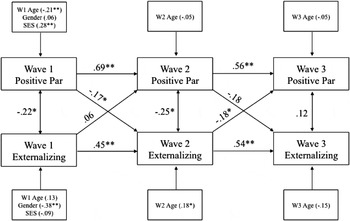
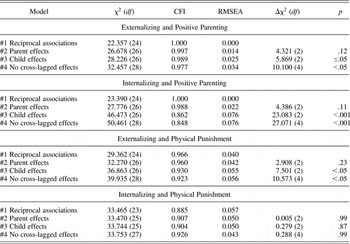
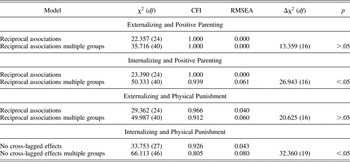
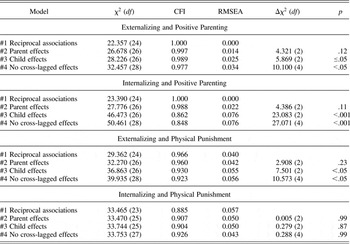
The fits of the four competing models were compared, and Model 1 (reciprocal associations) and Model 2 (parent effects model) fit the data equally well (see Table 4). Model 1 was retained, as it accounts for both the parent and child effects and produced excellent fit: χ2 (24) = 22.36, p = .56, CFI = 1.00, RMSEA = 0.00. Figure 2 provides the results for this model. The coefficients presented in Figure 2 for the cross-lagged paths were significant at the .05 level and were consistent with the positive feedback loop hypothesis. That is, lower positive parenting at Wave 1 was associated with greater externalizing problems at Wave 2, and at Wave 2, greater externalizing problems lead to less positive parenting at Wave 3. In this self-perpetuating loop, low levels of supportive parenting increased the levels of children's externalizing behaviors at the next wave, which then further decreased the level of supportive parenting provided by mothers at the subsequent wave.
Standardized path coefficients for the reciprocal effects model between positive parenting and children's externalizing problems. χ2 (24) = 22.36, p = .56, CFI = 1.00, RMSEA = 0.00.

Fit statistics for competing cross-lagged models
Note: N = 138.
Positive parenting and internalizing behavior problems
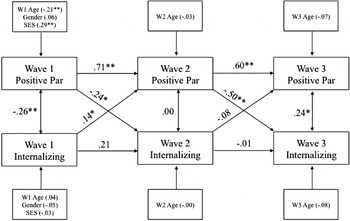
The fits of the four competing models were compared, and Model 1 (reciprocal associations) and Model 2 (parent effects model) fit the data equally well (see Table 4). Model 1 was retained, as it accounts for both the parent and child effects and produced excellent fit: χ2 (24) = 23.39, p = .50, CFI = 1.00, RMSEA = 0.00. Figure 3 provides the results for this model. The coefficients presented in Figure 3 for the cross-lagged paths were consistent with the negative feedback loop hypothesis. From Wave 1 to Wave 2, reciprocal relations between parenting and internalizing problems were shown: Positive parenting at Wave 1 was associated with fewer internalizing problems at Wave 2 and greater internalizing problems at Wave 1 are associated with mothers’ providing more positive parenting at Wave 2. In addition, more positive parenting at Wave 2 was associated with a further reduction in internalizing problems at Wave 3. In this negative feedback loop, mothers’ response to children's early internalizing problems reduces the likelihood of later internalizing problems. Because a negative feedback loop involves reduction in the child's problematic behavior, mothers become more likely to reduce the reactive aspect of their behavior when internalizing problems improve, thus reciprocal relations are observed primarily in the early stages of the feedback loop.
Standardized path coefficients for the reciprocal effects model between positive parenting and children's internalizing problems. χ2 (24) = 23.39, p = .50, CFI = 1.00, RMSEA = 0.00.

Physical punishment and externalizing behavior problems
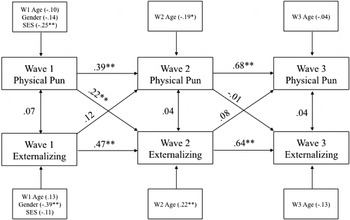
The fits of the four competing models were compared, and Model 1 (reciprocal associations) and Model 2 (parent effects model) fit the data equally well (see Table 4). Model 1 was retained, as it accounts for both the parent and child effects and produced good fit: χ2 (24) = 29.36, p = .21, CFI = 0.97, RMSEA = 0.04. Figure 4 provides the results for this model. However, despite the fact that the overall reciprocal model fit equally well as the parent effects model, indicating that there are reciprocal effects embedded within the analysis, the only statistically significant cross-lagged coefficient for the model was the effect of punishment at Wave 1 predicting higher levels of externalizing problems at Wave 2.
Standardized path coefficients for the parent effects model between physical punishment and children's externalizing problems. χ2 (24) = 29.36, p = .21, CFI = 0.97, RMSEA = 0.04.

Physical punishment and internalizing behavior problems
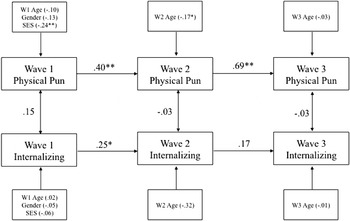
The fits of the four competing models were compared and Model 4 (no cross-lagged effects) fit the data best: χ2 (27) = 33.75, p = .17, CFI = 0.93, RMSEA = 0.04 (see Table 4). Note, in these models the covariance between Wave 2 age and Wave 2 internalizing problems was estimated, given preliminary testing that showed a significant increase in model fit when this modification was included in the analysis. Figure 5 provides the results for this model. In other words, in contrast to physical punishment and externalizing, which showed a predictive effect of parenting on behavior from Wave 1 to Wave 2, there were no predictive relations between punishment and internalizing over time.
Standardized path coefficients for the model with no cross-lagged effects of physical punishment and children's internalizing problems. χ2 (27) = 33.75, p = .17, CFI = 0.93, RMSEA = 0.04.

Moderation by gender
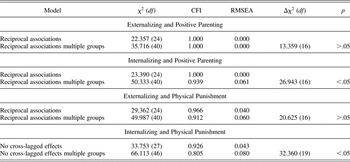
To test the effects of gender as a moderating variable, multiple-group structural equation modeling analysis was used (Kline, Reference Kline2005). A nonsignificant difference in chi square would indicate that the model fit equally well for both groups (i.e., girls and boys) and the regression paths did not vary in magnitude across the groups (i.e., that gender did not moderate the effects). We tested whether each of the above-tested models (positive parenting and externalizing problems, positive parenting and internalizing problems, physical punishment and externalizing problems, physical punishment and internalizing problems) fit equally well for boys and girls. Wave 1 SES and age (included as a time-varying covariate) were included as controls in these analyses. Results showed that for each model, the multiple group model did not significantly improve model fit (and in two cases it significantly worsened model fit), indicating that gender does not moderate the relation between parenting and children's behavior problems (see Table 5). In addition, the regression paths within each model did not vary in magnitude across the groups, demonstrating that the relations between parenting and children's behavior problems are similar for boys and girls.
Fit statistics for final models: Moderation across gender
Note: N = 138.
Discussion
Contemporary theories of developmental psychopathology emphasize mutual, transactional processes of change (e.g., Cicchetti, Reference Cicchetti1993; Crouter & Booth Reference Crouter and Booth2003; Sameroff, Reference Sameroff1975). Following this model, the present study investigated the transactional relations between parenting and children's problem behavior across successive developmental periods. In particular, we examined how child behavior may impact parenting across time (i.e., demonstrating “the influential child” effect) and vice versa, allowing for sequential change in both child problems and parenting practices. The results support previous literature suggesting that some reciprocal patterns between children's externalizing problems and parenting style increase behavior problems and reduce effective parental responses on an ongoing basis over time (e.g., Pardini et al., Reference Pardini, Fite and Burke2008; Patterson, Reference Patterson, Reid, Patterson and Snyder2002). This process is sometimes referred to in the literature as a positive feedback loop (because problematic behavior and problematic parenting practices strengthen each other over time) or alternatively as a “coercive,” or vicious, cycle because of the ongoing decrement in quality of the relationship between child and parent (Kuczynski, Reference Kuczynski2003; Lerner, Reference Lerner1982; Sameroff & Mackenzie, Reference Sameroff and MacKenzie2003). In contrast, we also found transactional patterns which appeared to decrease behavior problems over time due to increases in effective parenting behavior elicited by internalizing problems in a negative, or virtuous, feedback loop. These findings represent an important addition to the empirical literature integrating child-to-parent effects within developmental models and point to a limitation of many studies that focus primarily on one-way influence from parenting to child psychopathology.
This study is among the first to explore these issues together in bidirectional models that include two dimensions of children's behavioral problems (i.e., internalizing and externalizing) and two types of parental response (i.e., support and structure and physical punishment) and examining changes in relations between child behavior and parenting across successive developmental periods. The reciprocal models were evaluated using data drawn from three successive waves of a prospective, longitudinal study. A repeated cross-lagged design enabled us to examine reciprocal change across sequential developmental periods, including the major developmental transition from middle childhood to adolescence (from Wave 2 to Wave 3 in this design). Other strengths of the present study in relation to much of the previous literature include the use of different raters of parenting and child behavior and the inclusion of children of both genders. In the preliminary analyses, we ruled out the possibilities of redundancy between the models or inflation of effects due to covariance between the different measures of parenting and child behavior. Finally, the cross-lagged models included controls for the effects of children's gender and family SES. Inclusion of these variables had little bearing on the cross-lagged findings or interpretation of the final models, but such analyses respond to the criticism that contextual variables and other important controls are largely overlooked in this literature (Cui, Donnellan, & Conger, Reference Cui, Donnellan and Conger2007; Little et al., Reference Little, Preacher, Selig and Card2007).
Consistent with transactional theory, lower use of support and structure, key elements of an authoritative parenting style, during the beginning of the study when the children's ages ranged from 6 to 9, led to higher levels of externalizing problems 3 years later, when the children's ages ranged from 9 to 12. This in turn led to an ongoing incremental cycle of more behavioral problems and further reduction in use of support and structure by parents from middle childhood to early adolescence (ages 12–15): a classic incremental, or vicious, cycle (e.g., Patterson, Reference Patterson, Reid, Patterson and Snyder2002). Reciprocal relations between externalizing and hostile/punitive parenting have been previously reported and discussed in the literature, but relatively few studies have examined positive parenting styles in relation to externalizing problems among both boys and girls. By using a repeated cross-lagged analysis, this may also be one of the first studies to actually demonstrate the effects of the ongoing reciprocal relation between parenting and child externalizing across successive developmental phases.
Note also that across the two intervals of the cross-lagged model there was a significant reciprocal effect between child and parent behavior, but there was no statistically significant reciprocal effect within either of the periods. These results are interesting developmentally as they suggest that the presence of reciprocal parenting and child effects may depend on the developmental period. For example, children's externalizing problems appear to have a more negative effect on positive parenting when children are older (i.e., from Wave 2 to Wave 3), but they do not reduce positive parenting at a younger age (i.e., from Wave 1 to Wave 2). One explanation could be that parents are less discouraged by disruptive behavior when it is shown by a younger child; however, disruptive behavior that is exhibited by an older child may be considered less acceptable by parents, eliciting more frustration and an ineffective parental response.
These results also highlight the fact that if only one interval had been examined in the study (i.e., change between two measurement points) either a statistically significant parent-to-child or a child-to-parent effect would have been observed but not a reciprocal effect. This points to a likely reason for inconsistent reports in the literature about reciprocal effects and demonstrates the ongoing “transaction” of reciprocal change between child behavior and parenting across successive periods. It is interesting that it was positive parenting (support and structure) that showed the incremental feedback loop with externalizing problems from Wave 1 to Wave 2 and from Wave 2 to Wave 3, successively, while the physical punishment model showed primarily parent-to-child effects (and these were significant only from Wave 1 to Wave 2). The latter finding is consistent with some reports of a unidirectional relation between harsh parenting and externalizing (e.g., Rothbaum & Weisz, Reference Rothbaum and Weisz1994) but may also be specific to the parenting measure (i.e., physical punishment) and the developmental periods included in the study.
In contrast, internalizing problems (a scale which included anxiety, depression, social withdrawal, and other related problems), did not show either a child-to-parent or parent-to-child relation to use of physical punishment across these developmental periods. However, they did show a negative feedback loop with positive parenting practices, including support and structure. Higher internalizing problems at Wave 1 lead to increased positive parenting at Wave 2. Subsequently, when use of supportive interventions by parents increased at Wave 2 internalizing problems declined at Wave 3. This adaptive cycle could reflect lessening of intensive parental support after it is no longer required (i.e., as the child becomes less fearful), encouraging exploration of the environment while effectively reducing internalizing symptoms (Maccoby, Reference Maccoby, Grusec and Hastings2007).
It may be that internalizing problems in 9–12 year olds (i.e., at Wave 2) no longer invoke an increase in supportive parenting, as they do when shown by younger children. This would have interesting developmental significance in terms of the emergence of and environmental response to symptoms of internalizing disorders at different ages. It should be noted that internalizing problems, and in particular virtuous cycles between internalizing problems and positive parenting, have not been widely examined in the literature to date. This is the first study that we are aware of to actually demonstrate these effects, although they have been hypothesized and widely discussed in the context of both normal development and emerging psychopathology (e.g., Shahar, Reference Shahar2006).
The present results may shed light on how individual differences in behavior stabilize across development: Of young children who show high levels of internalizing and externalizing symptoms, roughly half have symptoms that persist into the adolescent years (Campbell, Reference Campbell2002). The quality of parenting is thought to be critical to the understanding of why some children persist in their problem behavior while others develop normally (Bates, Goodnight, Fite, & Staples, Reference Bates, Goodnight, Fite, Staples, Olson and Sameroff2009). Our results illustrate this differentiation by showing that parents who are able to respond adaptively to their children's internalizing problems with increased support and structure may reduce the severity and chronicity of their child's symptoms. In contrast, parents who respond to children's externalizing problems with poorer parenting (e.g., lowered support and structure, higher levels of harsh punishment) may exacerbate the child's externalizing difficulties, putting them on a trajectory for persisting problems. It is interesting to note that across the study, individual differences in internalizing problems (which elicited effective parenting in a corrective process) were considerably less stable than individual differences in externalizing problems (which elicited ongoing cycles of ineffective parenting). Teaching parents to use positive parenting behaviors (and minimize punitive responses) is a primary focus of many empirically supported parental education and intervention programs (Greenberg, Domitrovich, & Bumbarger, Reference Greenberg, Domitrovich and Bumbarger2001; Patterson, Reference Patterson, Reid, Patterson and Snyder2002). The effect of this type of parent training may be to prevent or disrupt coercive cycles, while reducing levels of both externalizing and internalizing problems over time.
Gender differences
This is the first study to address the potential impact of gender differences on the reciprocal effects of parenting on both the development of internalizing and externalizing problems over time. Although boys and girls differed in levels of externalizing problems, the reciprocal and transactional processes did not differ as a function of gender. Punitive and supportive parenting styles were equally effective or ineffective for both boys and girls in raising or lowering levels of behavioral problems. Similarly, child-to-parent effects, the impact of behavior problems on parenting, did not differ between the sexes. Other recent studies confirm this finding, specifically in regard to externalizing problems (e.g., Combs-Ronto, Olson, Lunkenheimer, & Sameroff, Reference Combs-Ronto, Olson, Lunkenheimer and Sameroff2009).
The very low rates of internalizing problems reported at adolescence for girls suggest that teachers may not be as aware of these problems in girls or may attribute withdrawn, anxious, or introverted behavior as “normal” roles for girls in early adolescence because of gender stereotypes (Blakemore et al., Reference Blakemore, Berenbaum and Liben2009). In contrast to the present findings based on teacher reports, epidemiological and clinical studies suggest that internalizing problems become more common for girls as they enter adolescence (Kessler, Ruscio, Shear, & Wittchen, Reference Kessler, Ruscio, Shear, Wittchen, Stein and Steckler2010). Self-ratings, which were not available for the three waves of data used for the present study, may be more useful for detecting internalizing problems among older children and adolescents (Stanger & Lewis, Reference Stanger and Lewis1993).
Limitations of the present research
Although designed to identify both reciprocal and unidirectional effects over time, cross-lagged panel analyses remain correlational. Because of a lack of random assignment, a third variable (i.e., a confounding factor) that is not measured or controlled may cause relations between variables to appear over time that are not causal. Because correlational designs can only suggest causality, an experimental design would be necessary to confirm that change in either child or parent behavior during the periods identified in the present study will affect the other.
Another limitation of the present design was the relatively small sample of mother–child dyads eligible for inclusion. Review of the previous literature suggests that when bidirectional effects were detected in previous studies, they were sometimes quite small in magnitude (e.g., Lansford et al., Reference Lansford, Criss, Laird, Shaw, Pettit and Bates2011). Even small reciprocal effects, which the present study did not have the power to detect, may have important implications for the development of children's psychopathology, as parent and child behaviors appear to potentiate each other over time. In other words, small effects may accumulate and enhance each other reciprocally over time, leading to larger bidirectional parent–child effects that are observable over the course of successive developmental periods.
With large enough sample sizes, it could be possible in future research to simultaneously study vicious and virtuous cycles within a common analysis, providing a more comprehensive understanding of complex reciprocal processes. For example, the present results suggest that while many parents may react negatively to children's externalizing behaviors some manage to be supportive, and this may help to break the coercive cycle. In other words, there is variability in parental response. It is important not to leave the impression that vicious cycles are invariably associated with externalizing problems and virtuous cycles with internalizing problems. There may also be patterns of internalizing that elicit an ineffective or amplifying response from some parents (e.g., increasing parental control or overinvolvement, which in turn maintains internalizing symptoms; McLeod, Wood, & Weisz, Reference McLeod, Wood and Weisz2007). There may be situations or contexts in which externalizing behavior elicits responses from supportive parents that reduce the frequency or intensity of these problems. This complex issue could be addressed with a fuller design (e.g., additional measures of parenting, child behavior, and age ranges; a variety of contexts; additional developmental periods) and larger sample size.
The overlapping ages of some children at successive waves are another limitation in interpreting the results of the present study developmentally (e.g., some children were age 9 at Wave 1 while others were this age when tested for Wave 2). Although the children's ages at each specific wave were controlled in the statistical analyses, ideally the ages between waves of testing in future studies would correspond to distinct, nonoverlapping developmental intervals.
A potential confound in all studies of reciprocal parent and child effects that do not include “genetic” controls (e.g., molecular or behavioral genetic design) is that both parent and child behavior may result from shared genetically based characteristics. It is also likely that any genetic factor underlying both parent and child's behavior might lead to strengthening of parent-to-child effects over time, as reported for some of the analyses here. As children mature toward adulthood, they typically increasingly resemble their parents because of shared genetic background (Avinun & Knafo, Reference Avinun, Knafo, Grusec and Hastings2014).
It is important to point out that the measures of parenting available at each measurement point were restricted to mother reports. In addition, in order to have independent ratings of parenting and behavior problems, we used only teacher reports (ASEBA-TRF) to measure child behavior problems. Teachers’ reports are obviously constrained by the amount, context, and variety of their contacts with students, and these typically decline after the elementary grades. Finally, reports of parenting were obtained from standardized questionnaires rather than direct observational measures. Observationally based measures might be more sensitive than these questionnaire measures, especially with regard to measuring behavioral changes over time. The specific measures of both parenting and child behavior problems used in this study were limited to those available from the longitudinal project's data set. While there were validated scales available for measuring child behavior problems and positive parenting (i.e., support, structure) only physical punishment was available at each time point to represent harsh parenting. Inclusion of more aspects of parenting and child behavior in future research, and use of multiple measures and observers, will enhance both the understanding and generalizability of the present findings.
Future directions for translating research on the influential child into preventive interventions
The participants in the present study were part of a lower income community sample, at elevated risk for psychopathology because of both low SES and the relatively high percentage of children with behavioral problems in the borderline and clinical ranges at the start of the study. In addition, there was a wide range of diversity within the sample, as evidenced by the high degree of variability in the SES of these families and in the level of children's behavioral problems. Within this diverse sample, we identified parenting styles that seem to reduce both externalizing and internalizing behavior problems over time. This points to directions for preventive intervention aimed at increasing positive parenting strategies and reducing children's problem behavior, particularly during the years after school entry. Effective interventions for children displaying behavioral difficulties must necessarily take into account the parent's role and the child's reciprocal role within a comprehensive developmental framework, (e.g., Cummings, Davies, & Campbell, Reference Cummings, Davies and Campbell2002). Based on the present results, a direct focus on reciprocal child-to-parent and parent-to-child effects may enhance the effectiveness of both preventive and treatment interventions.
In general, the prevention and treatment literature support the effectiveness of parenting interventions in terms of long-term outcomes (Greenberg et al., Reference Greenberg, Domitrovich and Bumbarger2001). Many of these effective intervention programs focus on enhancing authoritative parenting styles, emphasizing both responsiveness and structure, and minimizing the use of harsh discipline. The present results may pinpoint particularly favorable developmental periods after school entry when an increase in positive parenting and reduction in use of physical punishment may be effective in preventing escalation of externalizing problems. In addition, the current results suggest that children showing internalizing problems during middle childhood (which have been relatively neglected in the prevention and intervention literature) may also benefit from programs focused on effective parenting. The lack of gender differences in the reciprocal equations also suggests that intervention programs should target all children with elevated externalizing and internalizing symptoms, regardless of their gender.
To enhance the effectiveness of interventions based on these findings, it will be important to replicate and extend the present results with diverse samples from different regions and a variety of ethnic backgrounds. Exploring the reciprocal relations between various aspects of child behavior problems and additional types of parenting is clearly warranted. Regarding parenting, use of a latent variable approach might help enhance the developmental appropriateness of the design by permitting different aspects of parenting to be emphasized during different developmental stages. Finally, it would expand our understanding of transactional processes across development to include additional developmental periods (i.e., infancy and early childhood; middle and late adolescence) within future designs.
Conclusion
The present study demonstrates the feasibility of developmental studies investigating the changing transactional relations between children and their environments. Incorporating both child and parent behavior into repeated measures designs can be done by using methods similar to the repeated cross-lagged longitudinal analyses used here. Incorporating repeated measures of both child and parent behavior yields more information than utilizing only one of these (i.e., either child or parent behavior) at repeated time points. The actual process of development can be more fully explored utilizing this transactional approach to design.
The current results provide empirical support for transactional theories of child development, specifically theories regarding ongoing bidirectional processes in the emergence of psychopathology across middle childhood and adolescence. In addition, the study points to important developmental changes in the mutual influence process and also to potential avenues for prevention of behavior disorders. It is both feasible and informative to examine child-to-parent effects in conjunction with parent-to-child effects to understand developmental processes over time. As empirical models incorporating transactional processes become more familiar, we anticipate that they will be increasingly incorporated into longitudinal research designs.