Britt, Shen, Sinclair, Grossman, and Klieger (Reference Britt, Shen, Sinclair, Grossman and Klieger2016) discuss employee resilience trajectories, noting that only a few studies taking this approach have been conducted in the workplace. They recommend that with such an approach it is essential to assess baseline functioning, document adversity, and gather longitudinal data. They also point out the need to clarify what variables should be measured in the demonstration of resilience and suggest that resilience trajectories across different outcomes may or may not converge. We agree that trajectories are a promising approach to studying employee resilience. However, conceptualizing trajectories as profiles provides additional meaningful concepts for describing the demonstration of resilience. These concepts have the potential for moving theory and research beyond the work on trajectories described by Britt et al.
Resilience profiles pertain to the process of resilience, that is, patterns of adaptation during and following adversity. Yates and Masten (Reference Yates, Masten, Lindley and Joseph2004) argued that, compared with other approaches, treating resilience as a process is more intellectually and practically productive. We agree. However, as a whole, the related literature has been highly fragmented, with different authors emphasizing one facet of resilience while ignoring others. For instance, Carpenter, Walker, Anderies, and Abel (Reference Carpenter, Walker, Anderies and Abel2001) discussed resilience in terms of the magnitude of disturbance that a system can tolerate before it transitions into a different state. In contrast, most of the literature on stress has concentrated on resilience as a means of slowing declines in health and effectiveness produced by adversity (Lamontagne, Keegel, Louie, Ostry, & Landsbergis, Reference Lamontagne, Keegel, Louie, Ostry and Landsbergis2007). Rebounding from adversity is another aspect of resilience that has usually been studied in isolation. For instance, Harvey's (Reference Harvey1996) work on recovery from medical trauma emphasized rebounding, particularly as it is influenced by individuals’ environmental context.
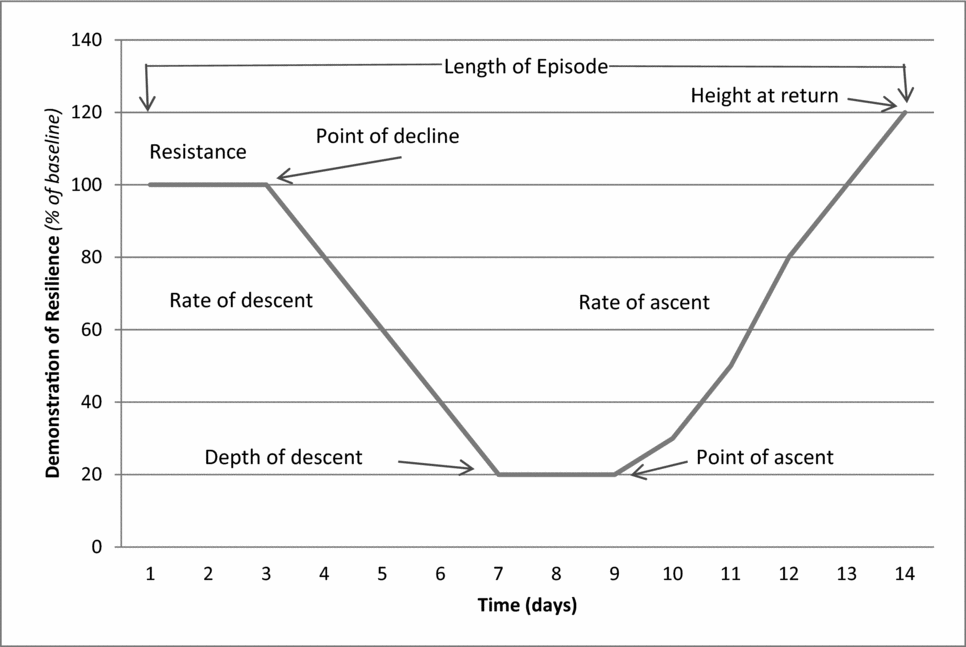
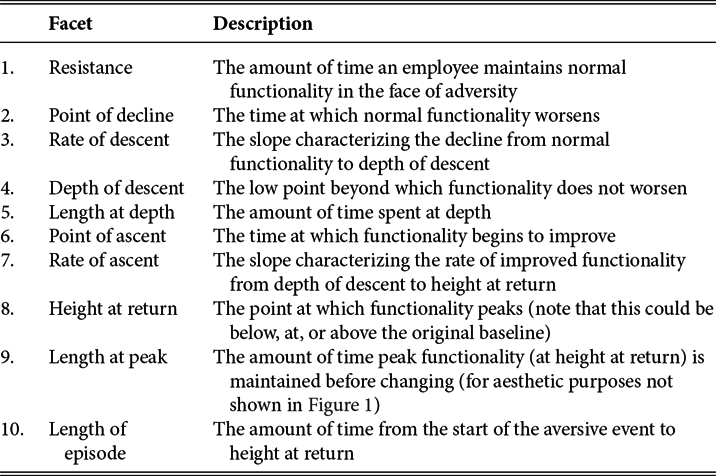
Although the above work has offered insights into resilience, the disconnection among the different research streams has limited understanding of the larger picture. Figure 1 illustrates our conception of resilience profiles, including key concepts that we assert are required to understand, measure, and evaluate patterns of adaptation. The particular profile of resilience shown in the figure is for illustration only. We have also included for illustrative purposes time in days on the abscissa, although other meaningful periods could be used instead. Following Britt et al., we have labeled the ordinate “demonstration of resilience.” Demonstrations of resilience are indicators of physical and psychological health such as job performance, well-being, and healthy relationships. Table 1 describes each facet relative to normal functionality, that is, the baseline level of resilience for a given indicator.
Figure 1.A sample profile illustrating facets of resilience.
Table 1.Descriptions of the Ten Facets of Resilience
Forms of Resilience
As Britt et al. note, some past authors have argued that only some phases of adaptation should count as resilience. We believe approaches that exclude parts of the process shown in Figure 1 are somewhat arbitrary and do not recognize that resilience can have different forms. In our approach, resilience is a process characterized by scores on the fundamental facets and summarized by one's profile. From this perspective, a high level of resilience would be reflected in one or more profile characteristics. These different characteristics can be thought of as different forms of resilience, that is, different ways in which an employee can be resilient:
• A strong resistance to adversity, such that an employee's functionality persists longer than that of a typical employee. Said another way, the point of decline occurs at a later time than it does with lower resistance.
• A relatively flat rate of descent, such that an employee's functionality declines more slowly than that of a typical employee.
• A shallow depth of descent, such that an employee's functionality reaches its lowest point at a level higher than that of a typical employee.
• A brief length at depth, such that an employee's lowest level of effectiveness lasts for a shorter period of time than that of a typical employee.
• A sharp rate of ascent, such that an employee's functionality increases from depth at a rate faster than that of a typical employee.
• An elevated height at return, such that an employee's functionality reaches a greater height, relative to baseline, than that of a typical employee.
• An extended time at height at return, such that an employee's highest level of functionality following ascent lasts for a longer period of time than that of a typical employee.
• A relatively brief episode length, such that an employee's overall length of the episode from the beginning of the adversity to height at return is shorter than that of a typical employee.
It is in principle possible to assess an employee's overall resilience by summing across the separate facets such that total resilience is an additive function of level of resistance, rate of descent, and so on. In some cases such a summation might be useful, as when a researcher is interested in the relationships between employees’ overall resilience and particular work outcomes. However, some forms of resilience may be more relevant in certain contexts. For example, in the following situation, resistance to adversity is the hallmark of resilience:
There exists an imminent threat of layoffs in a manufacturing organization. A low-resilience employee, Employee A, is overcome by the stress associated with the threat, and his or her work output suffers. A high-resilience employee, Employee B, feels relatively less stress, and his or her job performance is unaffected. Due to decreased job performance, Employee A gets laid off.
However, there are other contexts for which a flat rate of descent is more essential. Here is an example:
Employees A and B have recently been transferred to an overseas location where it is imperative that their productivity not suffer, or not suffer for long, because this would threaten the success of the operation. Due to Employee A's lack of experience with international assignments, the pressure of adjustment more quickly erodes his motivation. Thus, his productivity declines more quickly than Employee B's, resulting in an increased threat to the success of A's business unit.
In still other circumstances, a brief length at depth may be the focal issue:
Individuals A and B are sales personnel who have suffered extended abuse from a supervisor. As a result, sales of both have fallen to an equally low level. The abusive supervisor is fired and replaced by a nonabusive but demanding supervisor who expects employees to get back on track quickly. Individual A has a hardier personality than Individual B and is able to begin improving her sales quickly. Individual B, on the other hand, struggles with overcoming the anxiety and depression produced by the abusive supervisor, and her sales performance remains low for a longer period of time, resulting in Individual B failing to meet the expectations of the new supervisor and being given a less desirable sales territory.
Similar examples could be provided for each form of resilience, but the central point is that the importance of different forms of resilience can vary by situation. Other implications are that the source of resilience (e.g., capacity to tolerate stress, job experience, personality) may differ depending on context, as might the effect of higher or lower resilience (e.g., job retention, success of business unit, job assignments). Resilience profiles promote the detection of different forms of resilience, whereas narrower perspectives do not. Further, distinguishing among forms of resilience allows one to assess the degree to which the relevance and importance of the distinctions vary across contexts, which would not be possible if summing across the forms.
Additional Insights Provided by Resilience Profiles
One insight involves trait, state, and process approaches to resilience. There are trait- and statelike qualities to resilience profiles, but there are key differences too. A baseline level could be drawn through the episode illustrated in Figure 1 by taking the average level of functionality across the relevant time period. One might label this baseline “trait resilience,” but it would be misleading to do so. First, the level of effectiveness is not “relatively stable,” so from this perspective, calling resilience a trait would be imprecise. In addition, the profile represents a process, not an internal attribute. There is clearly variability around the baseline and, indeed, we maintain that it is this variability that is most germane to the notion of resilience as a process. However, again, this variability does not reside exclusively in a mental state or as a characteristic of individuals but, rather, is a characteristic of the process. We agree with Britt et al. that individual-level mental states compose part of the capacity for resilience rather than the actual demonstration of resilience. In our view, they are not part of the resilience process.
Another insight from the profile approach is that an employee can be highly resilient in one sense but not very resilient in another. This further suggests that two employees can have the same overall level of resilience during a given episode but have very different profiles of resilience. In addition, these different profiles may have dissimilar consequences. For example, one employee might have a short resistance period followed by a steep descent but brief length at depth and a rapid ascent. Another might have a long resistance period followed by a flatter descent but a long length at depth and slow ascent. The first employee could be ineffective in the face of severe but brief adversity (e.g., handling a customer crisis involving timely delivery) but reasonably effective in the face of less severe, longer-term adversity (e.g., addressing the gradual loss of customers to a competitor). The reverse would be true of the second employee.
Finally, a profile approach to resilience has several implications for Britt et al.’s recommendations. Their second recommendation is that researchers clarify the role of time by using better models and designs. Models and designs utilizing profiles offer an ideal means of intricately tying time to the demonstration of resilience because profiles explicitly require longitudinal data. Further, the 10 facets of resilience that we have explained provide a way of clearly describing resilience trajectories across time, and the different forms of resilience have the potential to reveal unique ways that employees can be resilient at different points in time.
Britt et al.’s third recommendation is to address the resilience criterion problem. We believe the issue is not so much a problem as it is a fact. In our view, resilience is not an all-or-none categorical variable with a single, positive effect. Rather, resilience is multifaceted, having multiple forms with multiple antecedents and consequences. The criterion problem is a function of the assumption that the indicators (“demonstrations”) of resilience, such as job performance, well-being, and healthy relationships, must converge. There is no need for this assumption in a profile approach because resilience is expected to be contextual. Similarly, Britt et al.’s suggestion that it is uncertain whether the same individuals would be classified as resilient if different dependent variables were used is not problematic from a profiles perspective. Because different people may have different forms of resilience and the relevance of the forms can vary across situations, people cannot adequately be classified as resilient or not resilient even with respect to a single indicator of resilience.
Conclusion
Britt et al. do an outstanding job discussing much of the literature on resilience. We hope that our commentary has enriched the appreciation of a profiles approach. Although this perspective implies more complex theory and research in the area, we assert that such complexity is needed to better understand, predict, and develop employee resilience.





Britt, Shen, Sinclair, Grossman, and Klieger (Reference Britt, Shen, Sinclair, Grossman and Klieger2016) discuss employee resilience trajectories, noting that only a few studies taking this approach have been conducted in the workplace. They recommend that with such an approach it is essential to assess baseline functioning, document adversity, and gather longitudinal data. They also point out the need to clarify what variables should be measured in the demonstration of resilience and suggest that resilience trajectories across different outcomes may or may not converge. We agree that trajectories are a promising approach to studying employee resilience. However, conceptualizing trajectories as profiles provides additional meaningful concepts for describing the demonstration of resilience. These concepts have the potential for moving theory and research beyond the work on trajectories described by Britt et al.
Resilience profiles pertain to the process of resilience, that is, patterns of adaptation during and following adversity. Yates and Masten (Reference Yates, Masten, Lindley and Joseph2004) argued that, compared with other approaches, treating resilience as a process is more intellectually and practically productive. We agree. However, as a whole, the related literature has been highly fragmented, with different authors emphasizing one facet of resilience while ignoring others. For instance, Carpenter, Walker, Anderies, and Abel (Reference Carpenter, Walker, Anderies and Abel2001) discussed resilience in terms of the magnitude of disturbance that a system can tolerate before it transitions into a different state. In contrast, most of the literature on stress has concentrated on resilience as a means of slowing declines in health and effectiveness produced by adversity (Lamontagne, Keegel, Louie, Ostry, & Landsbergis, Reference Lamontagne, Keegel, Louie, Ostry and Landsbergis2007). Rebounding from adversity is another aspect of resilience that has usually been studied in isolation. For instance, Harvey's (Reference Harvey1996) work on recovery from medical trauma emphasized rebounding, particularly as it is influenced by individuals’ environmental context.
Although the above work has offered insights into resilience, the disconnection among the different research streams has limited understanding of the larger picture. Figure 1 illustrates our conception of resilience profiles, including key concepts that we assert are required to understand, measure, and evaluate patterns of adaptation. The particular profile of resilience shown in the figure is for illustration only. We have also included for illustrative purposes time in days on the abscissa, although other meaningful periods could be used instead. Following Britt et al., we have labeled the ordinate “demonstration of resilience.” Demonstrations of resilience are indicators of physical and psychological health such as job performance, well-being, and healthy relationships. Table 1 describes each facet relative to normal functionality, that is, the baseline level of resilience for a given indicator.
A sample profile illustrating facets of resilience.
Descriptions of the Ten Facets of Resilience
Forms of Resilience
As Britt et al. note, some past authors have argued that only some phases of adaptation should count as resilience. We believe approaches that exclude parts of the process shown in Figure 1 are somewhat arbitrary and do not recognize that resilience can have different forms. In our approach, resilience is a process characterized by scores on the fundamental facets and summarized by one's profile. From this perspective, a high level of resilience would be reflected in one or more profile characteristics. These different characteristics can be thought of as different forms of resilience, that is, different ways in which an employee can be resilient:
• A strong resistance to adversity, such that an employee's functionality persists longer than that of a typical employee. Said another way, the point of decline occurs at a later time than it does with lower resistance.
• A relatively flat rate of descent, such that an employee's functionality declines more slowly than that of a typical employee.
• A shallow depth of descent, such that an employee's functionality reaches its lowest point at a level higher than that of a typical employee.
• A brief length at depth, such that an employee's lowest level of effectiveness lasts for a shorter period of time than that of a typical employee.
• A sharp rate of ascent, such that an employee's functionality increases from depth at a rate faster than that of a typical employee.
• An elevated height at return, such that an employee's functionality reaches a greater height, relative to baseline, than that of a typical employee.
• An extended time at height at return, such that an employee's highest level of functionality following ascent lasts for a longer period of time than that of a typical employee.
• A relatively brief episode length, such that an employee's overall length of the episode from the beginning of the adversity to height at return is shorter than that of a typical employee.
It is in principle possible to assess an employee's overall resilience by summing across the separate facets such that total resilience is an additive function of level of resistance, rate of descent, and so on. In some cases such a summation might be useful, as when a researcher is interested in the relationships between employees’ overall resilience and particular work outcomes. However, some forms of resilience may be more relevant in certain contexts. For example, in the following situation, resistance to adversity is the hallmark of resilience:
There exists an imminent threat of layoffs in a manufacturing organization. A low-resilience employee, Employee A, is overcome by the stress associated with the threat, and his or her work output suffers. A high-resilience employee, Employee B, feels relatively less stress, and his or her job performance is unaffected. Due to decreased job performance, Employee A gets laid off.
However, there are other contexts for which a flat rate of descent is more essential. Here is an example:
Employees A and B have recently been transferred to an overseas location where it is imperative that their productivity not suffer, or not suffer for long, because this would threaten the success of the operation. Due to Employee A's lack of experience with international assignments, the pressure of adjustment more quickly erodes his motivation. Thus, his productivity declines more quickly than Employee B's, resulting in an increased threat to the success of A's business unit.
In still other circumstances, a brief length at depth may be the focal issue:
Individuals A and B are sales personnel who have suffered extended abuse from a supervisor. As a result, sales of both have fallen to an equally low level. The abusive supervisor is fired and replaced by a nonabusive but demanding supervisor who expects employees to get back on track quickly. Individual A has a hardier personality than Individual B and is able to begin improving her sales quickly. Individual B, on the other hand, struggles with overcoming the anxiety and depression produced by the abusive supervisor, and her sales performance remains low for a longer period of time, resulting in Individual B failing to meet the expectations of the new supervisor and being given a less desirable sales territory.
Similar examples could be provided for each form of resilience, but the central point is that the importance of different forms of resilience can vary by situation. Other implications are that the source of resilience (e.g., capacity to tolerate stress, job experience, personality) may differ depending on context, as might the effect of higher or lower resilience (e.g., job retention, success of business unit, job assignments). Resilience profiles promote the detection of different forms of resilience, whereas narrower perspectives do not. Further, distinguishing among forms of resilience allows one to assess the degree to which the relevance and importance of the distinctions vary across contexts, which would not be possible if summing across the forms.
Additional Insights Provided by Resilience Profiles
One insight involves trait, state, and process approaches to resilience. There are trait- and statelike qualities to resilience profiles, but there are key differences too. A baseline level could be drawn through the episode illustrated in Figure 1 by taking the average level of functionality across the relevant time period. One might label this baseline “trait resilience,” but it would be misleading to do so. First, the level of effectiveness is not “relatively stable,” so from this perspective, calling resilience a trait would be imprecise. In addition, the profile represents a process, not an internal attribute. There is clearly variability around the baseline and, indeed, we maintain that it is this variability that is most germane to the notion of resilience as a process. However, again, this variability does not reside exclusively in a mental state or as a characteristic of individuals but, rather, is a characteristic of the process. We agree with Britt et al. that individual-level mental states compose part of the capacity for resilience rather than the actual demonstration of resilience. In our view, they are not part of the resilience process.
Another insight from the profile approach is that an employee can be highly resilient in one sense but not very resilient in another. This further suggests that two employees can have the same overall level of resilience during a given episode but have very different profiles of resilience. In addition, these different profiles may have dissimilar consequences. For example, one employee might have a short resistance period followed by a steep descent but brief length at depth and a rapid ascent. Another might have a long resistance period followed by a flatter descent but a long length at depth and slow ascent. The first employee could be ineffective in the face of severe but brief adversity (e.g., handling a customer crisis involving timely delivery) but reasonably effective in the face of less severe, longer-term adversity (e.g., addressing the gradual loss of customers to a competitor). The reverse would be true of the second employee.
Finally, a profile approach to resilience has several implications for Britt et al.’s recommendations. Their second recommendation is that researchers clarify the role of time by using better models and designs. Models and designs utilizing profiles offer an ideal means of intricately tying time to the demonstration of resilience because profiles explicitly require longitudinal data. Further, the 10 facets of resilience that we have explained provide a way of clearly describing resilience trajectories across time, and the different forms of resilience have the potential to reveal unique ways that employees can be resilient at different points in time.
Britt et al.’s third recommendation is to address the resilience criterion problem. We believe the issue is not so much a problem as it is a fact. In our view, resilience is not an all-or-none categorical variable with a single, positive effect. Rather, resilience is multifaceted, having multiple forms with multiple antecedents and consequences. The criterion problem is a function of the assumption that the indicators (“demonstrations”) of resilience, such as job performance, well-being, and healthy relationships, must converge. There is no need for this assumption in a profile approach because resilience is expected to be contextual. Similarly, Britt et al.’s suggestion that it is uncertain whether the same individuals would be classified as resilient if different dependent variables were used is not problematic from a profiles perspective. Because different people may have different forms of resilience and the relevance of the forms can vary across situations, people cannot adequately be classified as resilient or not resilient even with respect to a single indicator of resilience.
Conclusion
Britt et al. do an outstanding job discussing much of the literature on resilience. We hope that our commentary has enriched the appreciation of a profiles approach. Although this perspective implies more complex theory and research in the area, we assert that such complexity is needed to better understand, predict, and develop employee resilience.