


In Interface strategies, Tanya Reinhart presents evidence from an array of grammatical operations as well as from the acquisition of these operations, to defend a new comprehensive framework for our understanding of the language faculty and the interaction of its different components. The main goal of the book is to discuss the evidence supporting reference-set strategies and how these modify existing Minimalist economy principles. What makes these strategies interesting is that, unlike operations such as feature checking, they are not derived from purely formal considerations of the Computational System (CS), but from conditions imposed by the interfaces.
Reference-set strategies are motivated on the basis that, on the one hand, the CS is imperfect and syntactic derivations cannot always meet the interface needs, and on the other, the well-formedness of derivations cannot always be determined by absolute syntactic conditions. Reinhart's central argument is that, when the outputs generated by the CS are insufficient for the interface needs, a reference set formed by competing candidates is generated. These reference-set computations establish whether an otherwise illicit syntactic operation is necessary as a repair strategy to preserve the well-formedness of linguistic outputs.
Reinhart explains that in a reference-set computation, a given convergent derivation is evaluated against a set of alternatives in the form of <d(erivation), i(nterpretation)> pairs. Only derivations with an identical numeration (i.e. with what, in pre-Minimalist terms, would be described as the same deep structure) can be part of the reference set; these are checked against the context interface and are subject to economy principles which, for Reinhart, aim to minimise the interpretative options available. The author makes it clear that reference-set computations come at a high processing cost and consequently can only be used in specific situations where the creation of a set is the only mechanism available for an output to be legible by the interfaces. The processing difficulty, Reinhart argues, is the result of the computation involved in creating and comparing a reference set and the limitations of human working memory. The existing parsing limitations restrict the number of candidates available in each reference set, which sets Reinhart's view of competing outputs apart from other similar approaches, like Optimality Theory, where candidate sets apply without restriction.
Reinhart presents evidence to support the need for reference-set computations from four different phenomena: quantifier scope, stress shift in focus constructions, anaphora and scalar implicatures (although the last one is not covered as extensively as the other three). She starts her discussion in chapter 1, ‘Reference-set computation’, by introducing Chomsky's (Reference Chomsky1995) Minimal Link Condition (MLC) since, although traditionally a syntactic operation, ‘it introduces reference-set computation into syntax’ (14). Following Golan (Reference Golan1993) and Reinhart (Reference Reinhart1998), she notes that not all cases where the MLC applies can be accounted for by a syntactic restriction (some superiority violations serve as an example), and that interpretative considerations, which are the basis of reference-set computations, are necessary as well. This is illustrated by the following examples.
(1)


(2)

The sentence Whom did Lucie persuade to visit whom? has the reference set in (1a) and (1b). Only (1a) converges; (1b) is ruled out as a superiority violation. However, example (2), where the distance between the base and the target position of the wh-element is the same as in the ungrammatical (1b), is grammatical. Reinhart takes this as evidence that a syntactic restriction, like the MLC, which applies in superiority, cannot be used in absolute terms to generate the correct derivation in all instances; instead, she argues that it can only apply if a reference set is generated as in (1).
Reinhart proposes that an output is selected from a reference set because it is the most economical option in interpretative terms. Following Fox (Reference Fox1995), she argues that ‘the set out of which the MLC selects the most economical derivation includes only derivations that end up with the same interpretation’ (28), which explains why (1a) and (1b) are members of the same reference set. Since there is no other derivation with the same interpretation as (2), no reference set is generated for the example in (2), and (2) qualifies by default as the most economical derivation. This implies the existence of further (interpretative) restrictions on the MLC in addition to those imposed by the syntax.
Chapter 2, ‘Scope shift’, is devoted to the analysis of Quantifier Raising (QR) and covert scope-shift operations. The hypothesis that Reinhart develops in this chapter is that, contrary to the traditional analysis of QR, this operation is not obligatory, given that quantified NPs can be interpreted in situ by means of a choice function. Unlike previous analyses that supported in-situ quantifier interpretation, Reinhart's analysis retains QR as an optional operation which applies only when it is necessary to create alternative scope construals (105). The starting point in Reinhart's analysis is the well-known fact that QR cannot correctly account for the scopal behaviour of all quantifiers, which for Reinhart is evidence that mechanisms such as scope-shift are difficult to explain in absolute syntactic terms. Crucial for the author's argument that the traditional view of QR as a case of syntactic covert movement is problematic are strong quantifiers (which show unexpected behaviour in questions and when combined with other quantifiers) and existential quantifiers (which seem indifferent to islands and therefore violate syntactic restrictions on movement). Citing evidence from other similar operations, like wh-in-situ and sluicing, Reinhart proposes that scope shift does not involve movement and that quantifiers can be bound in situ by an operator. Under this new approach, QR is an operation that increases the number of possible interpretations of a given derivation. It thus violates economy, which makes it an illicit operation that cannot apply freely.
In chapter 3, ‘Focus: The PF interface’, Reinhart reviews her past work on stress shift in focus constructions and concludes that this is a case of reference-set computation as well. Her starting argument is that identifying the focus by means of a simple rule of main stress assignment is not always possible – an imperfection in the system, which can be fixed if an operation like stress shift applies. Assuming that stress is assigned to the most embedded element of each metrical level via a Strong label, she presents a system of neutral stress assignment that combines Cinque's (Reference Cinque1993) approach in terms of embeddedness and Szendröi's (Reference Szendröi2001) relative prominence and transparency in stress assignment. Reinhart's rule can only assign neutral stress and therefore it can only be used to identify the focus if this is included in the set of possible foci generated by stressing the most embedded element. Reinhart argues that the correct member of the focus set will be selected at the interface since it is the discourse, and not the syntax, that determines which derivations are appropriate in each context. This model assumes that each derivation is associated with a set of possible foci, as opposed to just one focus, and that it can only identify the focus correctly as long as the actual focus is a member of that set. However, this is not possible in cases where the subject, which is hardly the most embedded element, is the focus. For these cases, Reinhart argues that a repair mechanism must apply to shift the main stress to the subject noun phrase and that a reference set must be constructed to check its appropriateness. When stress shift applies, the focus is associated with marked stress, which is different from the type of stress assigned by sentence stress.
In this chapter, the author also presents evidence that supports the distinction between two types of operations that alter the stress pattern of a sentence: anaphoric destressing, which destresses an element which has been assigned stress by the sentence stress rule, and stress shift, which strengthens an element which is not part of the focus set. Reinhart examines Cinque's earlier insights regarding this distinction and, using evidence from Neeleman & Reinhart (Reference Reinhart1998), argues that these two operations are indeed different and can therefore both apply in the same sentence. An example is (3), where Max is stressed via stress shift and identified as the focus, whereas the anaphoric pronoun her, which is the most embedded element, is destressed:
(3)

Reinhart argues that anaphoric destressing, unlike stress shift, is independent of the focus set and is used when a constituent denotes an entity already present in the context; it applies incrementally during the phonological derivation and is a local operation (154). In contrast, stress shift is a marked operation because of its computational complexity; it applies at the sentence level and constitutes a global operation used to alter the stress pattern of the entire derivation.
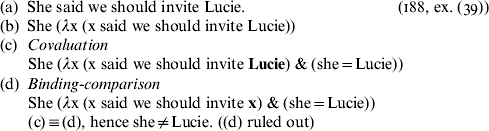
Binding and anaphora are at the centre of analysis in chapter 4, ‘The anaphora reference-set strategy’, where Reinhart proposes that some of the problems traditionally associated with these operations, such as how to restrict the set of potential antecedents for a given pronoun, can be resolved by modifying the principles of the Binding Theory (in particular Principle C) and assuming that covaluation, which assigns values to free variables from the discourse storage, involves a reference-set computation. She offers an account of variable binding which is affected both by restrictions imposed by logic (Condition C) and by considerations of the CS (Conditions A and B). The crucial argument in her approach is that variables can be assigned their values by two different means: (i) binding, i.e. a logical relation between operators and variables; and (ii) covaluation, i.e. a relation between arguments. The bulk of this chapter is a review of her previous work (mainly Reinhart Reference Reinhart, Hans, Martin and Eric2000) that shows how Condition C does not in fact affect binding and should be modified to account for the restrictions that it imposes on covaluation. She then argues that covaluation is excluded whenever the same output, with the same interpretation, is derivable via binding, since covaluation involves a reference-set computation and is a more costly operation. This is illustrated in example (4), where the derivation involving covaluation (4c) and the one involving binding (4d) are semantically indistinguishable. Consequently, covaluation is ruled out and no reference set is generated; the binding construal in (4d) is excluded because Lucie is not a free variable that can be bound.
(4)
In the last chapter (chapter 5), ‘The processing cost of reference-set computation’, the author presents empirical evidence from child language (L1) acquisition to support her claim about the processing cost involved in reference-set computations. If Reinhart's hypothesis is correct, and these operations require a higher load of working memory to process them, children should perform worse in tasks where covaluation and stress shifts are involved. This is exactly how Reinhart interprets the results of a variety of L1 acquisition studies in these areas. She argues that reference-set computations exceed the memory capacity of children, who use bypassing strategies instead, such as guessing in the case of coreference, and a default disambiguating strategy in the case of focus structures. When reference-set computations are involved, children show a success rate of only around fifty per cent, indicating a processing failure. This is also observed in the acquisition of scalar implicatures, another area where coreference plays a role and where a set of scalar alternatives is generated.
Reinhart succeeds in bringing together many previously published works to present a coherent argument that our understanding of the language faculty and the nature of the interfaces need to be re-examined. This is an issue which is still under debate and which will set the research agenda of many linguists working in theoretical linguistics and/or language acquisition. Although Interface strategies is at times somewhat dense and verbose, and would have benefited from a summary chapter, Reinhart's explanations are clear, and her insightful understanding of the issues always elucidates the discussion. She is to be commended for the inclusive approach she takes in her argumentation, bringing together early and recent developments in the field and engaging with possible competing accounts. It is fortunate that Reinhart leaves us with a distillation of her work that is so comprehensive. Yet, some questions remain for scholars to tackle, such as the nature of the complexity of reference-set computations when two or more of these operations apply in the same derivation (stress shifts and coreference, for instance), how languages establish focus-to-stress alignment other than by stress-shift (for example, word order in Romance), and why second language learners find coreference a problem when reference-set computations are supposed to be innate. Moreover, the idea that interface-based strategies should impose a processing load higher than other complex strategies of the CS, regardless of how they are implemented, models the language faculty as a system where difficulties arise when operations are licensed by some, but not all, of its modules, and moves away from a unified approach to the CS and the interfaces.
Interface strategies is an important, theory-shaping study, which should be required reading for all students and linguists interested in the nature of movement, interface levels and fundamental questions of human language design.


