


1. Introduction
Peridotites have been extensively studied; they are of great importance because they can provide direct information about the heterogeneity of the mantle composition and also about the geodynamics of the plates above them (Bodinier & Godard, Reference Bodinier, Godard, Carlson, Holland and Turekian2003; Pearson, Canil & Shirey, Reference Pearson, Canil, Shirey and Carlson2004). Tectonically emplaced mantle rocks include orogenic peridotite massifs and ophiolites. Abyssal peridotites are sampled from the oceanic mantle by dredging on the ocean floors (ridge segments or transform fault zones) or recovered from drill cores (e.g. Dick & Bullen, Reference Dick and Bullen1984; Karson et al. Reference Karson, Cannat, Miller and Elthon1997). Orogenic (or alpine) peridotite massifs are generally dispersed ultramafic bodies and are associated with continental rocks (e.g. Bodinier & Godard, Reference Bodinier, Godard, Carlson, Holland and Turekian2003). Ophiolites represent slivers of the ancient oceanic lithosphere obducted onto continental or oceanic crust (e.g. Coleman, Reference Coleman1977; Dilek et al. Reference Dilek, Moores, Elthin and Nicolas2000). Ophiolitic mantle rocks are sometimes found to be associated with the formation of back-arc (Pearce et al. Reference Pearce, Alabaster, Shelton and Searle1981) or forearc setting (Shervais, Reference Shervais2001). Various exposures of peridotite bodies within an ophiolitic mélange have been found in island arcs and continental margins in and around the Caribbean Plate, including the Great Antilles, Costa Rica, Venezuela and Guatemala (e.g. Giunta et al. Reference Giunta, Beccaluva, Coltorti, Mortellaro and Siena2002; Choi et al. Reference Choi, Mukasa, Andronikov and Marcano2007; Denyer & Gazel, Reference Denyer and Gazel2009; Madrigal et al. Reference Madrigal, Gazel, Denyer, Smith, Jicha, Flores, Coleman and Snow2015).
The evolutionary history of the Caribbean Plate is still a topic of great debate with several models (stabilist versus mobilist views; see Donnelly, Reference Donnelly, Stehli and Webb1985; Meschede & Frisch, Reference Meschede and Frisch1998; Pindell et al. Reference Pindell, Kennan, Maresch, Stanek, Draper, Higgs, Lallemant and Sisson2005, Reference Pindell, Maresch, Martens and Stanek2012) proposed, although the Pacific provenance model is the most widely accepted. This model proposes that what we know today as the thickened Caribbean oceanic floor is a captured piece of the now largely disappeared Farallon Plate which was located in the Pacific Ocean during Late Jurassic time, before it slowly drifted into its present position between North and South America (Burke, Fox & Şengőr, Reference Burke, Fox and Şengőr1978; Duncan & Hargraves, Reference Duncan, Hargraves, Bonini, Hargraves and Shagam1984; Denyer & Gazel, Reference Denyer and Gazel2009; Kerr & Tarney, Reference Kerr and Tarney2005). It has been proposed that faulting and related subduction processes produced by the drifting of the Caribbean ocean floor stimulated the emplacement of mantle rocks that are today exposed in the Caribbean Plate. In the SW Igneous Province (SIP) of Puerto Rico, there is a mélange of serpentinized spinel peridotite. The serpentinite contains an abundance of Jurassic–Cretaceous xenolithic clasts of amphibolites, pillow basalts and pelagic cherts (Mattson, Reference Mattson1960; Mattson & Pessagno, Reference Mattson and Pessagno1979). Marchesi et al. (Reference Marchesi, Jolly, Lewis, Garrido, Proenza and Lidiak2011) show that the peridotites are fertile abyssal mantle rocks from mid-ocean ridge, which might be a section of ancient Proto-Caribbean lithospheric mantle trapped in a forearc region generated by northwards subduction of the Caribbean Plate beneath the Proto-Caribbean ocean.
Meanwhile, Jolly et al. (Reference Jolly, Lidiak, Schellekens and Santos1998) suggested that the peridotites might be emplaced into the overlying island-arc complex during a slow upwelling that took place during Maastrichtian time and was associated with a crustal extension induced by strike-slip fault movement. Furthermore, Lidiak, Jolly & Dickin (Reference Lidiak, Jolly and Dickin2011) and Laó-Dávila (Reference Laó-Dávila2014) suggested that the peridotites might be a lithospheric mantle formed in the back-arc region. Based on spatial relations between the pelagic cherts and amphibolites, Schellekens (Reference Schellekens, Lidiak and Larue1998 a, b) suggested that the amphibolites likely represent part of a transform fault on the ocean floor on which the pelagic cherts have been deposited, or the obducted part of a seamount on the ocean floor that was subducted. Meanwhile, they have a geochemistry which is transitional between normal and enriched mid-ocean-ridge basalt (N-MORB and E-MORB) and arc-like (Schellekens, Reference Schellekens, Lidiak and Larue1998 b). The mélange-forming processes are therefore not yet fully understood. To better constrain the tectonic evolution of the Caribbean Plate we determined the Sr–Nd–Hf–Pb isotopic compositions, including major- and trace-element concentrations, of the mafic and ultramafic rocks within an ophiolitic mélange from Puerto Rico.
2. General geology
Located in the Caribbean Plate, the smallest and easternmost island of the Greater Antilles archipelago, Puerto Rico, has a complex geology. This might be the result of multiple subduction and collision events, with its history starting at c. 195 Ma (Schellekens, Reference Schellekens, Lidiak and Larue1998 a, b; Smith & Schellekens Reference Smith, Schellekens, Lidiak and Larue1998; Laó-Dávila, Reference Laó-Dávila2014) (Fig. 1a). The Greater Antilles were formed during Early Cretaceous time, somewhere in the Pacific Ocean (Schellekens, Reference Schellekens, Lidiak and Larue1998 a). The geology of this island arc is preserved in the basement rocks of Puerto Rico, which are classified into three main groups based on lithostratigraphy, petrography and geochemistry: the North Igneous Province (NIP), the Central Igneous Province (CIP) and the SW Igneous Province (SIP) (Schellekens, Reference Schellekens, Lidiak and Larue1998 a) (Fig. 1b). In the CIP and NIP, stratified volcanic island-arc rocks indicate that the first volcanic activity took place during Aptian time (c. 120 Ma) and continued until middle Eocene time (c. 45 Ma); both are the result of the apparent Antillian-type SW-dipping subduction of the adjacent Atlantic Basin (Jolly et al. Reference Jolly, Lidiak, Schellekens and Santos1998; Jolly, Lidiak & Dickin, Reference Jolly, Lidiak and Dickin2008 a, b). However, the geology of the SIP shows no relation whatsoever to the origin of the NIP and CIP; it appears to be a totally different island arc whose first volcanic activity took place during Santonian time (c. 85 Ma) by NE-dipping Cordilleran-type subduction, before it later collided with the CIP (Schellekens, Reference Schellekens, Lidiak and Larue1998 a; Jolly, Schellekens & Dickin, Reference Jolly, Schellekens and Dickin2007).
(a) Map of the Caribbean and Central American region. The box shows the location of the study area. (b) Simplified geological map of the igneous provinces of Puerto Rico. NIP – North Igneous Province; CIP – Central Igneous Province; SIP – SW Igneous Province. Modified after Schellekens (Reference Schellekens, Lidiak and Larue1998a). (c) Geological sketch map of the SW block of Puerto Rico with sample locations (stars), after Marchesi et al. (Reference Marchesi, Jolly, Lewis, Garrido, Proenza and Lidiak2011) and Lidiak, Jolly & Dickin (Reference Lidiak, Jolly and Dickin2011).

The SIP of Puerto Rico is composed primarily of Santonian – middle Eocene stratified island-arc volcanic, sedimentary and subaerial domains (Jolly et al. Reference Jolly, Lidiak, Schellekens and Santos1998). The SW part comprises pre-arc basement rocks called the Bermeja Complex, which is considered an ophiolite complex comprising serpentinized spinel peridotites. These contain blocks of partially recrystallized radiolarian chert (the Mariquita chert) and altered MORB-like basalts (the Las Palmas amphibolite and metabasalts, and the Cajul basalts), and most of its contacts are faults (Mattson, Reference Mattson1960; Schellekens, Reference Schellekens, Lidiak and Larue1998 b) (Fig. 1c). The ophiolite complex is cut by dioritic dykes and sills (the Maguayo Porphyry of 85 Ma; Laó-Dávila, Reference Laó-Dávila2014), and unconformably overlain by the Parguera limestone of Campanian age (Mattson, Reference Mattson1960).
The Bermeja Complex crops out in three distinct belts: the Monte del Estado, the Rio Guanajibo and the Sierra Bermeja (Fig. 1c). The Monte del Estado massif, the largest and northernmost belt, consists predominantly of peridotites (Marchesi et al. Reference Marchesi, Jolly, Lewis, Garrido, Proenza and Lidiak2011; Laó-Dávila, Llernadi-Román & Anderson, Reference Laó-Dávila, Llernadi-Román and Anderson2012). The middle Rio Guanajibo belt also comprises mainly peridotites (Hess & Otalora, Reference Hess, Otalora and Burk1964; Roehrig, Laó-Dávila & Wolfe, Reference Roehrig, Laó-Dávila and Wolfe2015). The southernmost belt of the Bermeja Complex contains blocks (up to several hundred metres in size) of amphibolite, metabasalt, basalt and chert within the serpentinized peridotite (Mattson, Reference Mattson1960; Schellekens, Reference Schellekens, Lidiak and Larue1998 b). Fragments of amphibolite, metabasalt and chert also occur in the Monte del Estado and Rio Guanajibo serpentinite, but much less than in the Sierra Bermeja (Mattson, Reference Mattson1960; Schellekens, Reference Schellekens, Lidiak and Larue1998 b; Laó-Dávila, Llernadi-Román & Anderson, Reference Laó-Dávila, Llernadi-Román and Anderson2012). Radiolarian biostratigraphy indicates that the ages of the cherts range from Early Jurassic to mid-Cretaceous (Montgomery, Pessagno & Pindell, Reference Montgomery, Pessagno and Pindell1994). The Cajul basalt is intercalated with the Mariquita chert, indicating its coeval origin (Volckmann, Reference Volckmann1984). K–Ar age determinations on hornblende in the amphibolite range over 126–85 Ma, indicating a metamorphism during this period (Cox et al. Reference Cox, Marvin, M'Gonigle, McIntyre and Rogers1977). The age of serpentinized peridotites is unknown. The stratigraphy indicates that the final crustal emplacement of the ophiolitic mélange is Coniacian–Turonian (86–94 Ma) (Laó-Dávila, Reference Laó-Dávila2014).
3. Materials and methods
3.a. Petrography
3.a.1. Peridotites
Peridotites were collected from three localities: Monte del Estado, Rio Guanajibo and Sierra Bermeja. They are composed of olivine, orthopyroxene, clinopyroxene and spinel. Hydrous minerals and garnet are absent. Modal compositions were determined by point-counting (Table 1). The rock types were spinel lherzolites and harzburgites. Lherzolites contain 64–68% olivine, 20–21% orthopyroxene, 10–12% clinopyroxene and 2% spinel. Harzburgites contain 62–69% olivine, 30–37% orthopyroxene, 1–3% clinopyroxene and 1–3% spinel. Most of the samples studied were overprinted by the growth of serpentine minerals, which ranged over 66–98% (Table 1). Some portions of serpentinized peridotites contain fresh relicts of primary minerals; however, only a few spinel relicts are observed in highly (c. 98%) serpentinized Sierra Bermeja peridotites.
Modal analyses of spinel peridotite bodies from the SW block of Puerto Rico. ND – not determined.

3.a.2. Basaltic rocks
Basaltic samples were collected at the Sierra Bermeja Complex located in the south-westernmost part of the SIP. They were classified as the Las Palmas amphibolites (PRAMP02, PRAMP04) and metabasalts (PRAMP01-G, PRAMP03, PRAMP01-V), the Lower Cajul basalts (PRLCJ01, PRLCJ02) and the Upper Cajul basalts (PRNUC01, PRNUC02, PRNUC03). The amphibolites are composed of foliated green-brown hornblende, albite plagioclase and quartz, with relict clinopyroxene also present in sample PRAMP02. The metabasalts have a porphyritic texture with hornblende and plagioclase phenocrysts in a groundmass of the same phases, where chlorite and/or prehnite alteration of the hornblende crystals is also present.
Both the Lower Cajul and Upper Cajul samples are pillow basaltic rocks, and hydrothermal alteration has greatly affected the original mineralogy. The Lower Cajul samples have a porphyritic texture, and plagioclase phenocrysts lie in a plagioclase–clinopyroxene matrix showing an ophitic texture. The clinopyroxenes are altered to green chlorite. Calcitic veinlets crosscut the Upper Cajul samples. In sample PRNUC01, chloritized clinopyroxenes dominated the main mineralogy. Samples PRNUC02 and PRNUC03 had a relatively fresh ophitic texture with some chloritized clinopyroxene phenocrysts.
3.b. Analytical procedures
Mineral compositions were obtained from thin rock sections using a wavelength-dispersive electron microprobe (JXA-8100: JEOL Ltd., Tokyo, Japan) with ZAF matrix correction at the Gyeongsang National University in Jinju, South Korea. The analysis was conducted with an accelerating voltage of 15 kV, beam current of 10 nA, beam diameter of 1 μm, and a counting time of 20 s for each spot. Natural minerals were used as standards for Na, Si, Fe, K, Al, Mn, Ca, Mg, P, Cr and Ti, and a synthetic oxide was used for Ni. All of the mineral analyses reported here represent averages of various analytical targets of each mineral in each sample. The results are listed in online supplementary Table S1 (available at http://journals.cambridge.org/geo). Accurate measurements of the Ca concentration in olivines were made using an accelerating voltage of 20 kV, a beam diameter of 100 nA and a counting time of 100 s. The accuracy of the analysis was 3% (1σ), with a detection limit of c. 20 ppm Ca. The raw data were corrected to a preset olivine matrix (Fo90). The reported CaO values in online Table S1 obtained under these operating conditions represent the average of five rounds of analysis of several grain cores.
Samples for whole-rock analysis were crushed into <0.5 cm pieces in a tungsten carbide mortar and ultrasonically cleaned with milli-Q ultrapure water. Fresh fragments were pulverized with an agate ball mill prior to geochemical analysis. Whole-rock major elements were analysed by X-ray fluorescence spectrometry at the Pukyong National University in Pusan, South Korea. The data were reduced with a weighted regression line created with standards (BIR-1 and MO-5). The precision of the technique for preparing and analysing the standards was within 5%. The results are given in Tables 2 and 3. Whole-rock trace-element concentrations were determined using inductively coupled plasma mass spectrometry (ICP-MS) at Act Labs, Ontario, Canada. Precision was estimated to be ±10% based on replicated analyses of international rock standards (BIR-1, JR-1 and DNC-1). The results are presented in Table 3.
Whole-rock major-element contents (wt%) for spinel peridotites from the SW block of Puerto Rico.

*Total Fe as Fe2O3.
Whole-rock major-element contents (wt%) and Sr–Nd–Pb–Hf isotopic composition for basaltic rocks from the Sierra Bermeja Complex, SW block of Puerto Rico. ND – not determined; LOI – loss on ignition.

a Age values as given by Lidiak, Jolly & Dickin (Reference Lidiak, Jolly and Dickin2011).
b Total Fe as Fe2O3.
c εNd and εHf are calculated via 147Sm/144Nd = 0.1963, 143Nd/144Nd = 0.512638, 176Lu/177Hf = 0.0342, and 176Hf/177Hf = 0.282772 for present-day chondritic Earth.
d Mg no. calculated assuming Fe2O3/FeO = 0.15.
The isotope analyses for peridotites were performed on nearly pure clinopyroxene separates to avoid the effects of serpentinization and weathering. Clinopyroxene grains were prepared from unweathered samples using nylon sieves for sizing, a magnetic separator to eliminate grains with dark inclusions, and hand-picking under a binocular microscope to select only the optically clear grains for analysis. Prior to dissolution for the isotopic analyses, the minerals were washed in milli-Q ultrapure water in a heated ultrasonic bath for 1 hour. After removing the milli-Q ultrapure water and rinsing the minerals repeatedly, two leaching steps with 2 N HCl and 6 N HCL (30 min at 120°C) were performed, with a milli-Q rinse after each of these steps. Chemical separations of Sr, Nd, Pb and Hf for clinopyroxenes and basaltic rocks were performed at Chungnam National University in Daejeon, South Korea. The column procedures used for Sr, Nd, Pb and Hf isotopic compositions have been described elsewhere (Mukasa et al. Reference Mukasa, Shervais, Wilshire and Nielson1991; Münker et al. Reference Münker, Weyer, Scherer and Mezger2001). Separation of Sr and Nd was performed following standard ion exchange techniques (Bio-Rad AG50W-X8 for Sr and REEs, HDEHP-coated Teflon for Nd). The separation of Pb and Hf was achieved using Bio-Rad AG1-X8 and EICHROM LN resin chromatography, respectively. The isotopic analyses for Sr, Nd and Pb were performed at the Korea Basic Science Institute using a thermal ionization mass spectrometer (TIMS; VG Sector, VG Analytical, London, UK). The 87Sr/86Sr and 143Nd/144Nd ratios were corrected for instrumental mass fractionation by normalizing to 86Sr/88Sr = 0.1194 and 146Nd/144Nd = 0.7219, respectively. Replicated analyses of NBS-987 and JNdi-1 standards yielded 87Sr/86Sr = 0.710247±0.000003 (N = 10, 2σ) and 143Nd/144Nd = 0.512102±0.000004 (N = 10, 2σ). Measured Pb isotopic ratios were corrected for instrumental mass fractionation of 0.1% amu−1 by reference to replicate analyses of the NBS-981 standard. Total blanks averaged 30 pg for Sr and Nd and 50 pg for Pb. The Hf isotopic analyses were conducted using a Neptune mass spectrometer (Thermo Fisher Scientific, Waltham, MA, USA) at the Institute of Earth Sciences, Academia Sinica, in Taipei, Taiwan. To monitor machine performance, the JMC-475 standard was run between study samples. A mean 176Hf/177Hf ratio of 0.282149±0.000007 (N = 20, 2σ) was obtained, and the values reported were normalized to the accepted value of 0.282160. The total blank level was approximately 30 pg for Hf. The results are reported in Tables 2 and 3.
4. Results
4.a. Peridotites
4.a.1. Mineral chemistry
Spinel: The Monte del Estado and Rio Guanajibo peridotites contain spinels with low Cr numbers (100 Cr/(Cr+Al) = 13.0–21.0) and high Mg numbers (100 Mg/(Mg+Fe) = 67.0–72.4) (online supplementary Table S1, available at http://journals.cambridge.org/geo). The Sierra Bermeja peridotites contain spinels with much higher Cr numbers (20.9–37.8) and lower Mg numbers (63.3–69.6) than the Monte del Estado and Rio Guanajibo peridotites (online Table S1). However, all of the spinels along with literature data for spinels from the Monte del Estado peridotites were plotted within the field of abyssal peridotites (Fig. 2a).
Plots of spinel quad and (a) 100 Cr/(Cr+Al) of spinel and (b) 100 Mg/(Mg+Fe) content of coexisting olivine from Monte del Estado, Rio Guanajibo and Sierra Bermeja peridotites. The ferrous iron content in spinel was calculated on a stoichiometric basis. The olivine–spinel mantle array and melting trend (annotated by melting %) given in (b) are from Arai (Reference Arai1994). Abyssal peridotite and suprasubduction zone (SSZ) peridotite fields are from Dick & Bullen (Reference Dick and Bullen1984) and Choi et al. (Reference Choi, Mukasa and Shervais2008). Small symbols represent Monte del Estado peridotite data from Marchesi et al. (Reference Marchesi, Jolly, Lewis, Garrido, Proenza and Lidiak2011). FMM – fertile mantle.
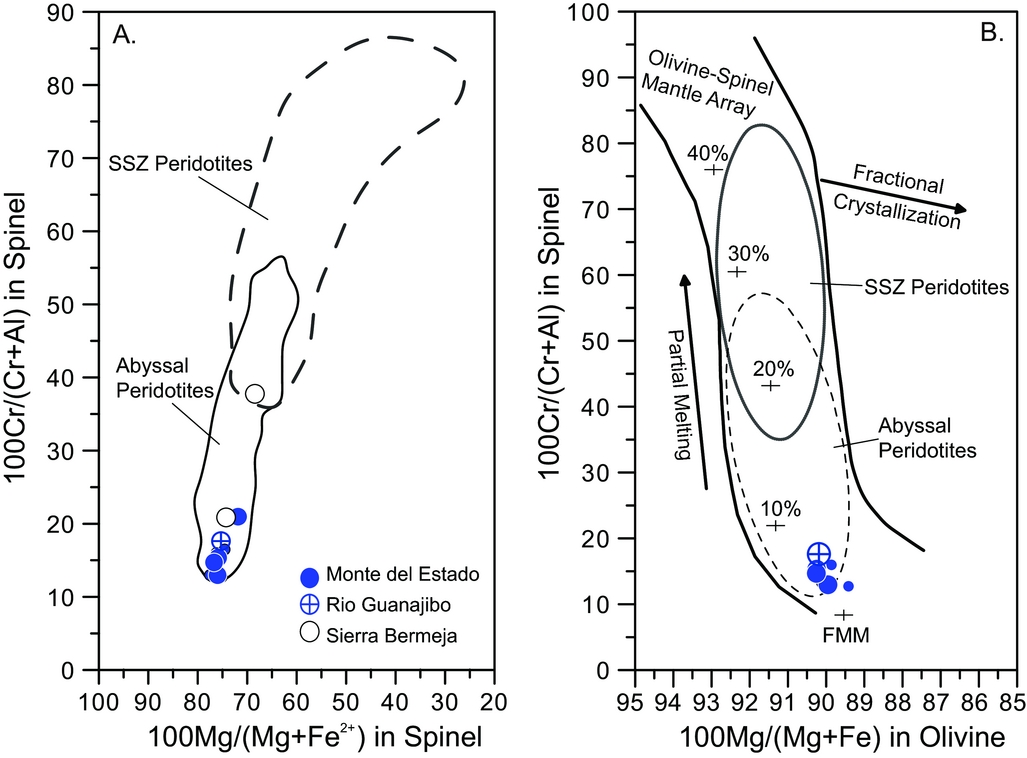
Olivine: Relict olivines (i.e. remaining from the original unserpentinized peridotites) from the Monte del Estado and Rio Guanajibo peridotites range in composition from Fo90.0 to Fo90.3 (online supplementary Table S1, available at http://journals.cambridge.org/geo), which are within the compositional range of literature data for olivines from the two peridotites (Hess & Otalora, Reference Hess, Otalora and Burk1964; Marchesi et al. Reference Marchesi, Jolly, Lewis, Garrido, Proenza and Lidiak2011). Olivine grains from the Sierra Bermeja peridotites have been totally overprinted by the growth of serpentine minerals. The compositions obtained were plotted in a diagram showing spinel Cr no. versus coexisting olivine Mg no. (Fig. 2b). All of the samples plotted within the olivine–spinel mantle array inside the abyssal peridotite field, indicating that the composition of olivine is correlated with that of spinel.
Pyroxenes: The chemical composition of relict pyroxenes could only be measured for the Monte del Estado and Rio Guanajibo peridotites due to the strong serpentinization of the Sierra Bermeja peridotites. Orthopyroxenes are enstatite, with a composition of Wo1.2–1.5En87.6–89.0Fs9.8–10.8 (online supplementary Table S1, available at http://journals.cambridge.org/geo). The Mg numbers ranged over 91.5–93.6. The Al2O3 and Cr2O3 concentrations ranged over 4.1–4.4 wt% and 0.4–0.8 wt% respectively (Table S1). Clinopyroxenes are diopside, with a composition of Wo45.6–49.6En46.3–49.7Fs3.6–4.9 (Table S1). The Mg numbers ranged over 92.7–94.5. The Al2O3 and Cr2O3 concentrations ranged over 3.6–4.9 wt% and 0.6–0.8 wt%, respectively (Table S1).
4.a.2. Whole rock
Whole-rock major-element concentrations for the spinel peridotites studied here are given in Table 2. The Mg numbers varied over the range 89.4–92.3, which is in agreement with the values of previous studies on the Monte del Estado (Mg no. = 89.5–91.4; Marchesi et al. Reference Marchesi, Jolly, Lewis, Garrido, Proenza and Lidiak2011) and Rio Guanajibo peridotites (Mg no. = 89.6–91.8; Hess & Otalora, Reference Hess, Otalora and Burk1964). The CaO and Al2O3 concentrations ranged over 0.1–2.8 wt% and 2.0–2.6 wt%, respectively. Average TiO2 and K2O values were 0.05 and 0.02 wt%, respectively. Loss on ignition (LOI) values ranged over 11.4–15.3%. In the plot of MgO/SiO2 versus Al2O3/SiO2 ratios (Fig. 3), all samples were within the terrestrial mantle array (Jagoutz et al. Reference Jagoutz, Palme, Blum, Cendales, Dreibus, Spettel, Lorenz and Wanke1979; Hart & Zindler, Reference Hart and Zindler1986), indicating that the major-element concentrations were not significantly affected by hydrothermal alteration despite the large degree of serpentinization represented by LOI values and modal analyses (Table 1). The Puerto Rico peridotites had lower Al2O3 and higher MgO contents than the primitive mantle composition (Fig. 3), suggesting that they are residues after various degrees of partial melting.
Whole-rock MgO/SiO2 v. Al2O3/SiO2 ratios for spinel peridotites from the SW block of Puerto Rico. The terrestrial mantle array is from Jagoutz et al. (Reference Jagoutz, Palme, Blum, Cendales, Dreibus, Spettel, Lorenz and Wanke1979) and Hart & Zindler (Reference Hart and Zindler1986). Primitive mantle compositions are from Wänke (Reference Wänke1981).

4.a.3. Clinopyroxene isotopes
Clinopyroxenes are major carriers of rare earth elements (REEs) and possibly Hf in the anhydrous spinel peridotite mineral assemblages (e.g. Eggins, Rudnick & McDonough, Reference Eggins, Rudnick and McDonough1998; Bedini & Bodinier, Reference Bedini and Bodinier1999; Choi et al. Reference Choi, Mukasa and Shervais2008); we therefore considered the data for this mineral to be representative of each peridotite. The Hf isotopic compositions of clinopyroxenes separated from the Monte del Estado peridotites are given in online supplementary Table S1 (available at http://journals.cambridge.org/geo). The 176Hf/177Hf ratios ranged over 0.283418–0.283958 (εHf = 22.8–41.9), indicating a time-integrated depleted nature of the peridotites.
4.b. Basaltic rocks
4.b.1. Major and trace elements
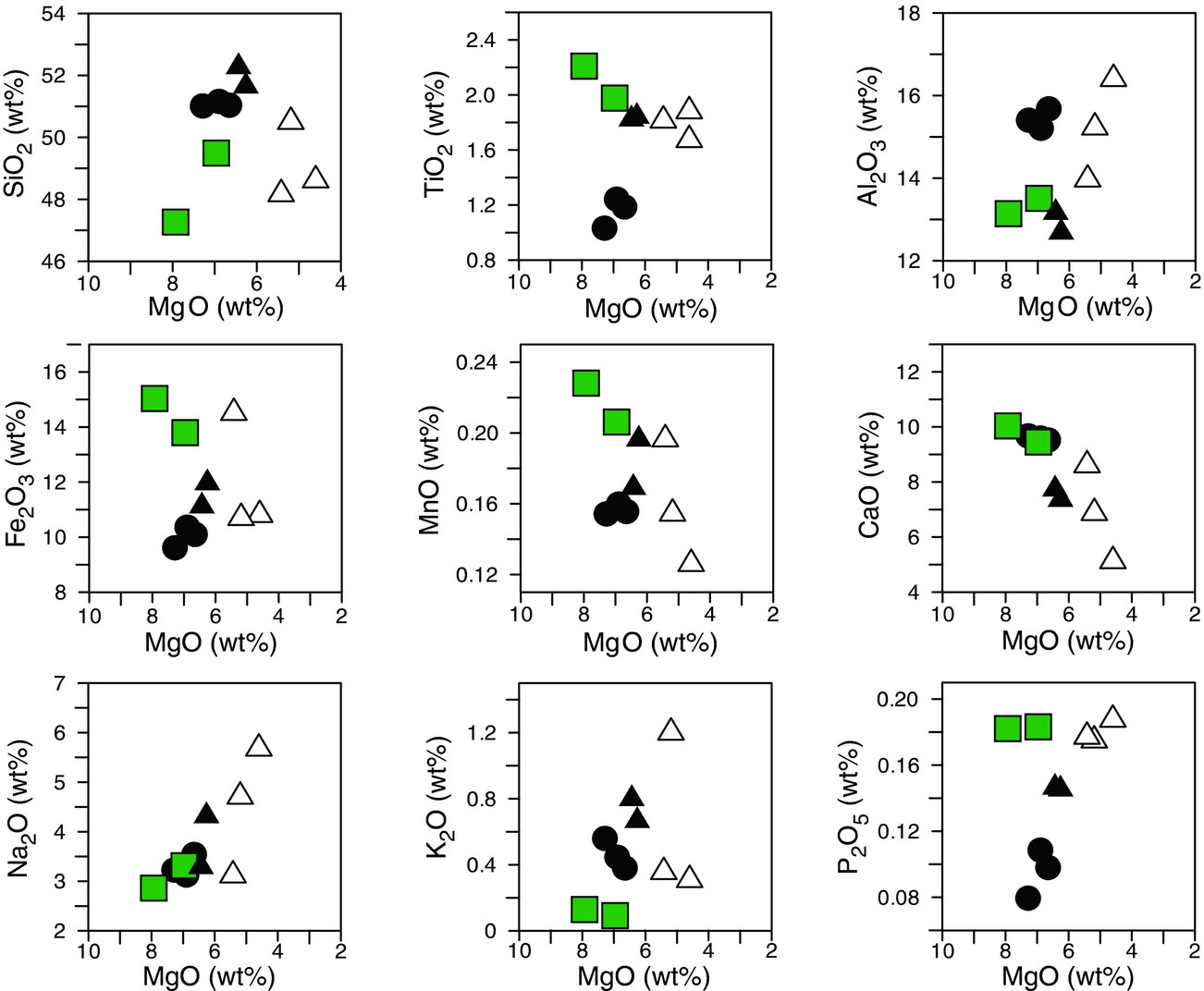
Whole-rock major- and trace-element concentrations of the basaltic rocks from the Sierra Bermeja Complex are given in Tables 3 and 4. For the classification, the samples were plotted in a total alkali versus silica diagram (TAS) (Fig. 4). The Las Palmas amphibolites and metabasalts had a subalkaline (tholeiitic) basalt composition. The amphibolites had Mg no. in the range 53.9–52.8 and the metabasalts 62.5–59.2. The Lower Cajul samples were subalkaline basaltic andesites, with Mg no. of 55.5–53.1. The Upper Cajul samples had transitional basalt to basaltic trachyandesite composition, with Mg no. 51.8–45.3. Although the Cajul samples were classified as basalt to basaltic andesites and trachyandesites in Figure 4, we used the commonly accepted terminology of basalts for the samples in this area. The Ni, Co and Cr contents of the basaltic rocks were 60–30, 45–32 and 170–30 ppm, respectively (Table 4). The Mg no. and the Ni and Cr contents of the basaltic rocks were lower than the values observed in primitive basalts (Mg no. >70, Ni >400–500 ppm, Cr >1000 ppm; Frey, Green & Roy, Reference Frey, Green and Roy1978; Wilkinson & Le Maitre, Reference Wilkinson and Le Maitre1987), reflecting olivine ± clinopyroxene fractionation during the magma evolution. Variations in the major oxides are shown in Figure 5. MgO was negatively and positively correlated with CaO and Na2O, respectively. However, the large intersample variations in SiO2, TiO2, Al2O3, Fe2O3, MnO, K2O and P2O5 could not be explained by simple fractional crystallization of these minerals from a single parent magma; instead, they indicated variable primary magmas.
Trace-element contents (ppm) for basaltic rocks from the Sierra Bermeja Complex, SW block of Puerto Rico.

Classification of basaltic rocks in terms of SiO2 v. total alkali (Le Maitre et al. Reference Le Maitre, Bateman, Dudek, Keller, Lameyre Le Bas, Sabine, Schmid, Sorensen, Streckeisen, Woolley and Zanettin1989).

Major oxide variations for basaltic rocks from the Sierra Bermeja Complex. Symbols as in Figure 4.
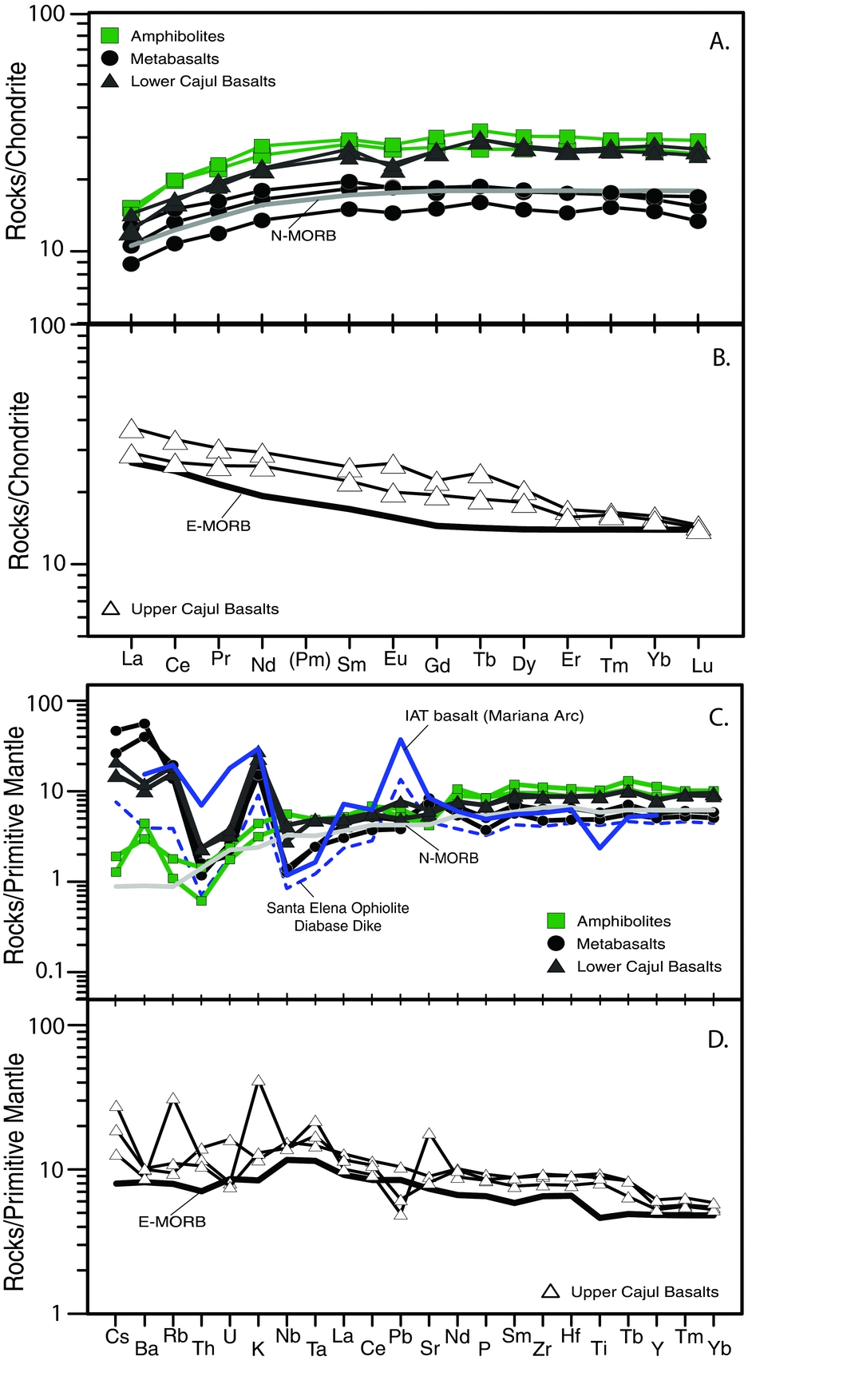
Chondrite-normalized REE patterns for the Sierra Bermeja basaltic rocks are shown in Figure 6a and b. The amphibolites, metabasalts and Lower Cajul basalts exhibited N-MORB-like light-rare-earth-element- (LREE-) depleted patterns, with (La/Yb)N in the range 0.4–0.7 and (Yb)N in the range 14.7–29.4. However, the amphibolites were distinguished from the metabasalts by relatively higher REE abundances and a slight negative Eu anomaly, reflecting plagioclase fractionation. The Lower Cajul basalts had a similar REE pattern to the amphibolites, also with slightly higher abundances in REE than the metabasalts and with a negative Eu anomaly. The Upper Cajul basalts exhibited an E-MORB-like LREE pattern, with a (La/Yb)N range of 1.9–2.3 and a (Yb)N range of 15.3–17.1. They did not have a significant Eu anomaly. Primitive mantle-normalized trace-element patterns are shown in Figure 6c and d, revealing a major chemical distinction between metabasalt and amphibolite. The amphibolites exhibited a depleted N-MORB-like pattern. However, we observed weak enrichments in Cs, Ba and Rb, which are fluid mobile elements, and a depletion in Sr in the amphibolites compared to the N-MORB. Together with the negative Eu anomaly observed in the amphibolites, the negative Sr anomaly (Fig. 6a, c) reflects the effect of plagioclase fractionation. The metabasalts were more enriched in highly incompatible elements such as Cs, Rb, Ba and K compared to the amphibolites, and were characterized by negative Nb and positive Sr anomalies (Fig. 6c). The Lower Cajul basalts resembled the metabasalts, exhibiting enrichments in Cs, Rb, Ba and K and a weak negative anomaly in Nb (Fig. 6c). The Upper Cajul basalts generally resembled E-MORB, but sample PRNUC02 had positive anomalies in Cs, Rb, K and Sr and negative anomalies in U and Pb (Fig. 6d).
Chondrite-normalized rare earth element patterns for (a) amphibolites, metabasalts and Lower Cajul basalts, and (b) Upper Cajul basalts from the Sierra Bermeja Complex. Primitive mantle-normalized trace-element abundance patterns for (c) amphibolites, metabasalts and Lower Cajul basalts, and (d) Upper Cajul basalts. Normal mid-ocean-ridge basalt (N-MORB) and enriched mid-ocean ridge basalt (E-MORB) compositions are from Sun & McDonough (Reference Sun, McDonough, Saunders and Norry1989). Island-arc tholeiite (IAT) basalt from the Mariana arc (Gazel et al. Reference Gazel, Abbott and Draper2011) and Santa Elena ophiolite diabase dyke (Madrigal et al. Reference Madrigal, Gazel, Denyer, Smith, Jicha, Flores, Coleman and Snow2015) are also shown for comparison.
4.b.2. Isotopes
The Sr–Nd–Pb–Hf isotopic compositions are given in Table 3 and are illustrated in a series of isotopic correlation diagrams (Figs 7–9). For comparison, the fields for Atlantic and Pacific MORBs and for Caribbean Plateau basalts are also shown. Age corrections were applied after Jolly, Schellekens & Dickin (Reference Jolly, Schellekens and Dickin2007): 185 Ma for the amphibolites, metabasalts and Lower Cajul basalts, and 85 Ma for the Upper Cajul basalts.
Age-corrected 143Nd/144Nd versus 87Sr/86Sr ratios for basaltic rocks from the Sierra Bermeja Complex. Data sources: Pacific/Atlantic MORB (Ito, White & Gopel, Reference Ito, White and Gopel1987; Bach et al. Reference Bach, Hegner, Erzinger and Satir1994; Mahoney et al. Reference Mahoney, Sinton, Kurz, Macdougall, Spencer and Lugmair1994; Niu et al. Reference Niu, Collerson, Batiza, Immo and Regelous1999; Chauvel & Blichert-Toft, Reference Chauvel and Blichert-Toft2001), Caribbean Plateau basalts (Hauff et al. Reference Hauff, Hoernle, Van den Bogaard, Alvarado and Garbe-Schönberg1999, Reference Hauff, Hoernle, Tilton, Graham and Kerr2000; White et al. Reference White, Tarney, Kerr, Saunders, Kempton, Pringle and Klaver1999; Mamberti et al. Reference Mamberti, Lapierre, Bosch, Jaillard, Ethien, Hernandez and Polve2003; Hastie et al. Reference Hastie, Kerr, Mitchell and Millar2008). Errors (2σ) are within the size of the symbol in the plot.

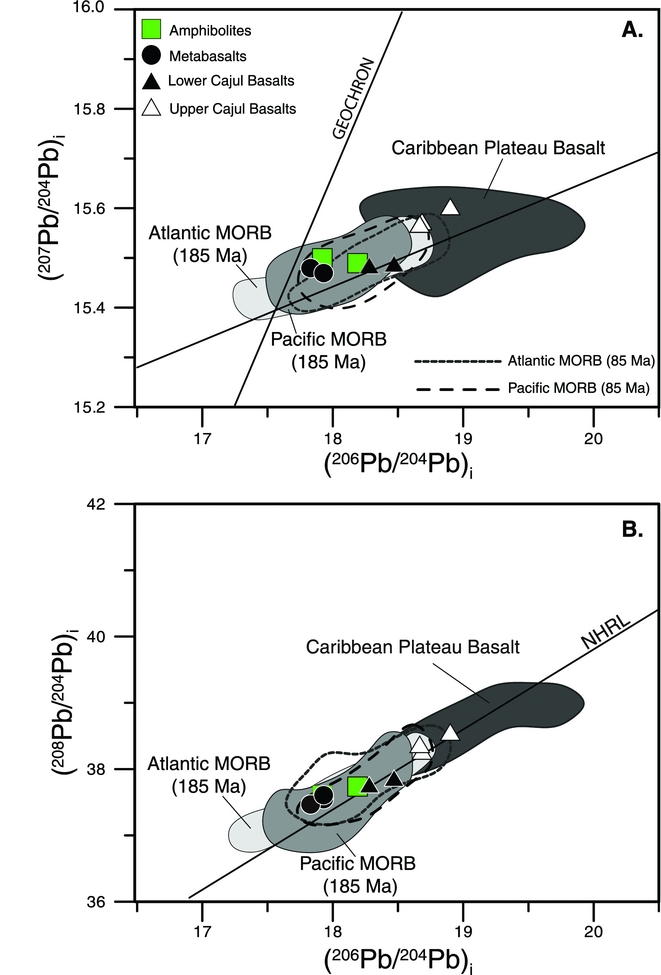
Age-corrected (a) 207Pb/204Pb v. 206Pb/204Pb and (b) 208Pb/204Pb v. 206Pb/204Pb ratios for basaltic rocks from the Sierra Bermeja Complex. Fields for the Pacific/Atlantic MORB and Caribbean Plateau basalts are shown for comparison. Data sources: Pacific/Atlantic MORB (Ito, White & Gopel, Reference Ito, White and Gopel1987; Mahoney et al. Reference Mahoney, Sinton, Kurz, Macdougall, Spencer and Lugmair1994; Niu et al. Reference Niu, Collerson, Batiza, Immo and Regelous1999; Kempton et al. Reference Kempton, Fitton, Saunders, Nowel, Taylor, Hardarson and Pearson2000; Chauvel & Blichert-Toft, Reference Chauvel and Blichert-Toft2001; Debaille et al. Reference Debaille, Blichert-Toft, Agranier, Doucelance, Schiano and Albarède2006) and Caribbean Plateau basalts (Hauff et al. Reference Hauff, Hoernle, Van den Bogaard, Alvarado and Garbe-Schönberg1999, Reference Hauff, Hoernle, Tilton, Graham and Kerr2000; White et al. Reference White, Tarney, Kerr, Saunders, Kempton, Pringle and Klaver1999; Mamberti et al. Reference Mamberti, Lapierre, Bosch, Jaillard, Ethien, Hernandez and Polve2003; Thompson et al. Reference Thompson, Kempton, White, Kerr, Tarney, Saunders, Fitton and McBirney2003; Hastie et al. Reference Hastie, Kerr, Mitchell and Millar2008). The Northern Hemisphere reference line (NHRL) is from Hart (Reference Hart1984). Errors (2σ) are within the size of the symbol in the plot.
Age-corrected 176Hf/177Hf v. 143Nd/144Nd ratios for basaltic rocks from the Sierra Bermeja Complex. Fields for the Pacific/Atlantic MORB and Caribbean Plateau basalts are shown for comparison. Data sources: Pacific/Atlantic MORB (Ito, White & Gopel, Reference Ito, White and Gopel1987; Mahoney et al. Reference Mahoney, Sinton, Kurz, Macdougall, Spencer and Lugmair1994; Nowell et al. Reference Nowell, Kempton, Noble, Fitton, Saunders, Mahoney and Taylor1998; Salters & White, Reference Salters and White1998; Niu et al. Reference Niu, Collerson, Batiza, Immo and Regelous1999; Chauvel & Blichert-Toft, Reference Chauvel and Blichert-Toft2001) and Caribbean Plateau basalts (Hauff et al. Reference Hauff, Hoernle, Van den Bogaard, Alvarado and Garbe-Schönberg1999, Reference Hauff, Hoernle, Tilton, Graham and Kerr2000; White et al. Reference White, Tarney, Kerr, Saunders, Kempton, Pringle and Klaver1999; Geldmacher et al. Reference Geldmacher, Hanan, Blichert-Toft, Harpp, Hoernle, Hauff, Werner and Kerr2003; Mamberti et al. Reference Mamberti, Lapierre, Bosch, Jaillard, Ethien, Hernandez and Polve2003; Thompson et al. Reference Thompson, Kempton, White, Kerr, Tarney, Saunders, Fitton and McBirney2003; Hastie et al. Reference Hastie, Kerr, Mitchell and Millar2008). The mantle–crust array is from Blichert-Toft & Albarède (Reference Blichert-Toft and Albarède1997). Errors (2σ) are within the size of the symbol in the plot.
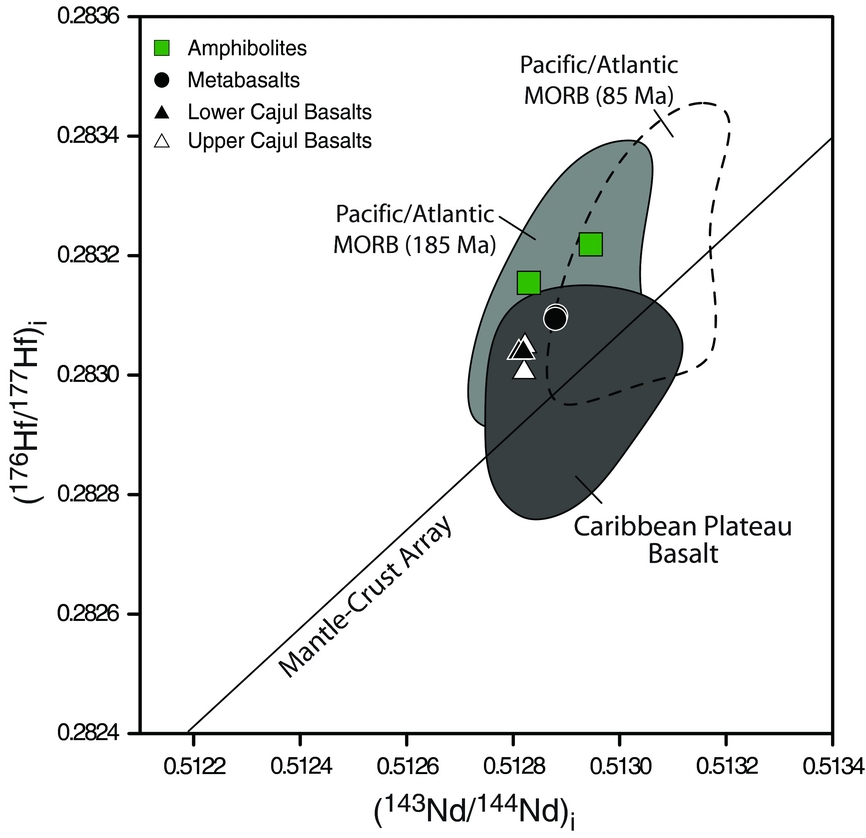
The variation in the Sr–Nd–Hf–Pb isotopic compositions for the amphibolites was limited, with (87Sr/86Sr)i = 0.70361–0.70367; (143Nd/144Nd)i = 0.512829–0.512865 ((εNd)i = 8.4–9.1); (176Hf/177Hf)i = 0.283155–0.283219 ((εHf)i = 17.6–19.9); (206Pb/204Pb)i = 17.93–18.19; (207Pb/204Pb)i = 15.47–15.49; and (208Pb/204Pb)i = 37.61–37.74. The metabasalts exhibited more radiogenic Sr, Nd and Hf and less radiogenic Pb isotopic compositions: (87Sr/86Sr)i = 0.70339–0.70380; (143Nd/144Nd)i = 0.512879–0.512881 ((εNd)i = 9.3–9.4); (176Hf/177Hf)i = 0.283095–0.283100 ((εHf)i = 15.5–15.7); (206Pb/204Pb)i = 17.83–17.93; (207Pb/204Pb)i = 15.47–15.50; and (208Pb/204Pb)i = 37.47–37.61. The Lower Cajul basalts had a limited range of more radiogenic Sr–Pb and less radiogenic Nd–Hf isotopic compositions than the amphibolites: (87Sr/86Sr)i = 0.70384; (143Nd/144Nd)i = 0.512811–0.512819 ((εNd)i = 8.0–8.2); (176Hf/177Hf)i = 0.283044 ((εHf)i = 13.7); (206Pb/204Pb)i = 18.28–18.47; (207Pb/204Pb)i = 15.49; and (208Pb/204Pb)i = 37.77–37.87. The Upper Cajul basalts were characterized by a wide range of highly radiogenic Sr and Pb isotopic compositions: (87Sr/86Sr)i = 0.70406–0.70562; (206Pb/204Pb)i = 18.71–18.96; (207Pb/204Pb)i = 15.57–15.61; and (208Pb/204Pb)i = 38.37–38.62. Their Nd and Hf isotopic compositions were the least radiogenic among the samples studied: (143Nd/144Nd)i = 0.512821–0.512823 ((εNd)i = 5.7); and (176Hf/177Hf)i = 0.283011–0.283055 ((εHf)i = 11.9–12.5).
In the Sr–Nd isotope correlation diagram (Fig. 7), the amphibolites, metabasalt and Lower Cajul basalts are positioned slightly to the right of the Pacific/Atlantic MORB field. The Upper Cajul basalts have highly enriched Sr isotopic ratios compared to those of the amphibolites, metabasalts and Lower Cajul basalts, being widely spread with a subhorizontal trend. With regard to the isotopic composition of Pb for the basaltic samples, a large contrast exists between the older amphibolites, metabasalts and Lower Cajul basalts and the younger Upper Cajul basalts, with the latter having significantly higher Pb isotopic ratios than those for the amphibolites, metabasalts and Lower Cajul basalts. With the exception of the Lower Cajul Basalts, the samples are positioned above the Northern Hemisphere reference line (NHRL; Hart, Reference Hart1984) in the Pb–Pb isotope correlation diagrams (Fig. 8). The amphibolite samples, together with metabasalts and the Lower Cajul basalts, are positioned within the age-corrected Pacific MORB field, whereas the younger Upper Cajul basalts are positioned outside the Pacific MORB field and fall more into the Caribbean Plateau basalts field. In the Nd–Hf isotope correlation diagram (Fig. 9), the amphibolites, metabasalt and Lower Cajul basalts are positioned within the age-corrected Pacific/Atlantic MORB field. The Upper Cajul basalts are positioned outside the MORB field, and fall within the range of Caribbean Plateau basalts (Fig. 9).
5. Discussion
5.a. P–T estimation
Two-pyroxene geothermometers (T/Wells (Wells, Reference Wells1977) and T/BKN (Brey & Köhler, Reference Brey and Köhler1990)), calibrated for the solubility of the enstatite component in diopside coexisting with orthopyroxene, were used to estimate equilibration temperatures. The accuracy of the models was within ±70°C. The results are presented in online supplementary Table S1 (available at http://journals.cambridge.org/geo). The peridotites from Monte del Estado had equilibrium temperatures of 870–970°C for T/Wells and 800–960°C for T/BKN. Peridotite from Rio Guanajibo exhibited an elevated temperature of 1040°C with both geothermometers (Table S1). The two thermometers yielded consistent results within the observed level of accuracy (Fig. 10).
Comparison of temperature estimates from the two-pyroxene thermometers of Brey & Köhler (Reference Brey and Köhler1990) and Wells (Reference Wells1977) for peridotites from Monte del Estado and Rio Guanajibo.

The Ca-in-olivine/clinopyroxene geobarometer of Köhler & Brey (Reference Köhler and Brey1990) is a unique model that is used to estimate the pressure of spinel peridotites. The estimated temperature (T/BKN) was used as the input temperature for the pressure estimation. The results are presented in online supplementary Table S1 (available at http://journals.cambridge.org/geo). The estimated pressures were 26–72 kbar for peridotites from Monte del Estado and 92 kbar for Rio Guanijibo. Peridotites carrying spinel as a principal aluminous phase are considered stable at pressures of 8–25 kbar (Nickel, Reference Nickel1986; Webb & Wood, Reference Webb and Wood1986). The estimated pressures therefore exceeded the upper limit of the spinel stability field. The Ca-in-olivine/clinopyroxene geobarometer is highly temperature-dependent and sensitive to the diffusion of Ca in olivine (Köhler & Brey, Reference Köhler and Brey1990). The diffusion coefficient of Ca in olivine is 3–4 orders of magnitude higher than that in clinopyroxene (Köhler & Brey, Reference Köhler and Brey1990). These unrealistically high pressures might have been induced by intense cooling with re-equilibration of olivines to low temperatures during shallow-level intrusions of the peridotite bodies. The peridotites moved upwards, possibly along shallow-angle thrust faults (Laó-Dávila, Llernadi-Román & Anderson, Reference Laó-Dávila, Llernadi-Román and Anderson2012).
5.b. Petrogenesis of peridotites
Spinel Cr no. is a sensitive indicator of the extent to which the spinel peridotites have lost basaltic components (e.g. Dick & Bullen, Reference Dick and Bullen1984; Aswad, Aziz & Koyi, Reference Aswad, Aziz and Koyi2011). The Fo olivine content can also provide information regarding the degree of melt depletion in mantle peridotites (Arai, Reference Arai1994). Spinel Cr no. and Mg no., as well as the olivine Fo composition, were used to identify the tectonic setting of the formation of the Puerto Rico peridotites (Fig. 2a, b). The spinel Cr no. of abyssal peridotites ranged over c. 10–55. Suprasubduction zone peridotites are characterized by spinels with much higher Cr numbers than abyssal peridotites, ranging over c. 38 to >80 (Fig. 2a, b). With the increasing degree of melt depletion, the spinel Cr no. grew with the increase of olivine Fo content within the olivine–spinel mantle array (Fig. 2b). On a diagram of spinel Cr no. versus spinel Mg no. (Fig. 2a), the Puerto Rico peridotites are positioned inside the abyssal peridotite field. They also belong to the abyssal peridotites in terms of the Fo of olivine and Cr no. of spinel (Fig. 2b). However, it should be noted that the spinels from the Sierra Bermeja Complex peridotites had a higher Cr no. than those from the Monte del Estado and Rio Guanajibo peridotites. The TiO2 content in the spinel from the Monte del Estado and Rio Guanajibo peridotites was low (≤0.07 wt%) and incompatible with the Sierra Bermeja samples, in which the TiO2 content reached 0.10 wt% (online supplementary Table S1, available at http://journals.cambridge.org/geo). When spinel Cr no. was plotted against spinel TiO2 content (Fig. 11), it was apparent that the Monte del Estado and Rio Guanajibo peridotites were positioned within the most fertile abyssal peridotite field, close to the modelled depletion trend from the fertile MORB mantle (FMM). However, the peridotite spinels from the Sierra Bermeja Complex departed from the modelled trend, with higher TiO2 content similar to that of abyssal peridotites that reacted with a MORB-like melt.
TiO2 content v. 100 Cr/(Cr+Al) in the spinel of Puerto Rico peridotites. The line with short dashes represents the field of abyssal peridotite spinels. The grey arrow represents the effect of a MORB-like melt reaction on refractory abyssal peridotite spinels. The data for spinels from abyssal peridotites and basalt are from Dick & Bullen (Reference Dick and Bullen1984).
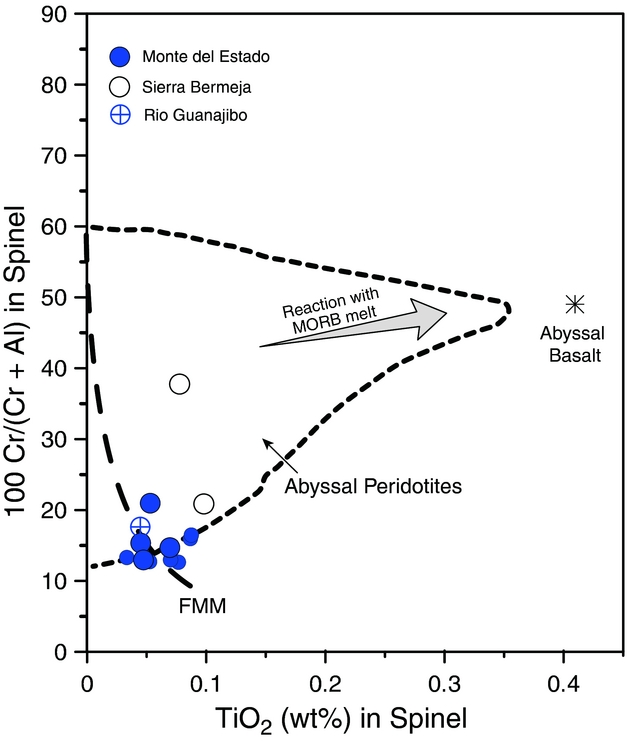
Hellebrand et al. (Reference Hellebrand, Snow, Dick and Hofmann2001) developed a quantitative melting indicator for mantle residue as a function of spinel Cr no., yielding the relationship F = 10 ln (Cr no.)+24, where F (%) is the degree of partial melting. For the Sierra Bermeja and Rio Guanajibo samples, we obtained values for the degree of melting of 4–8%, whereas for the Sierra Bermeja Complex peridotites the range was 8–14% (almost twice the value of the Monte del Estado and Rio Guanajibo peridotites; Table S1). Oceanic crustal thickness can be calculated from the peridotite spinel compositions after Hellebrand, Snow & Mühe, (Reference Hellebrand, Snow and Mühe2002): H = Z 0 F – (F 2/2B), where H is crustal thickness (km), Z 0 = 70 km, F is the degree of partial melting (%) and B is the melt production rate (km–1). The crustal thickness above the Monte del Estado and Rio Guanajibo peridotites ranged over 2.3–4.8 km (Table S1), and above the Sierra Bermeja peridotites 4.8–6.9 km (Table S1). Given that the degree of melting and crustal thickness are directly related to the velocity at which a mid-ocean ridge spreads (Reid & Jackson, Reference Reid and Jackson1981), we assumed that the thinner block containing the Monte del Estado and Rio Guanajibo peridotites belonged to an ultra-slow-spreading ridge, whereas the block containing the Sierra Bermeja Peridotites belonged to a faster-spreading ridge.
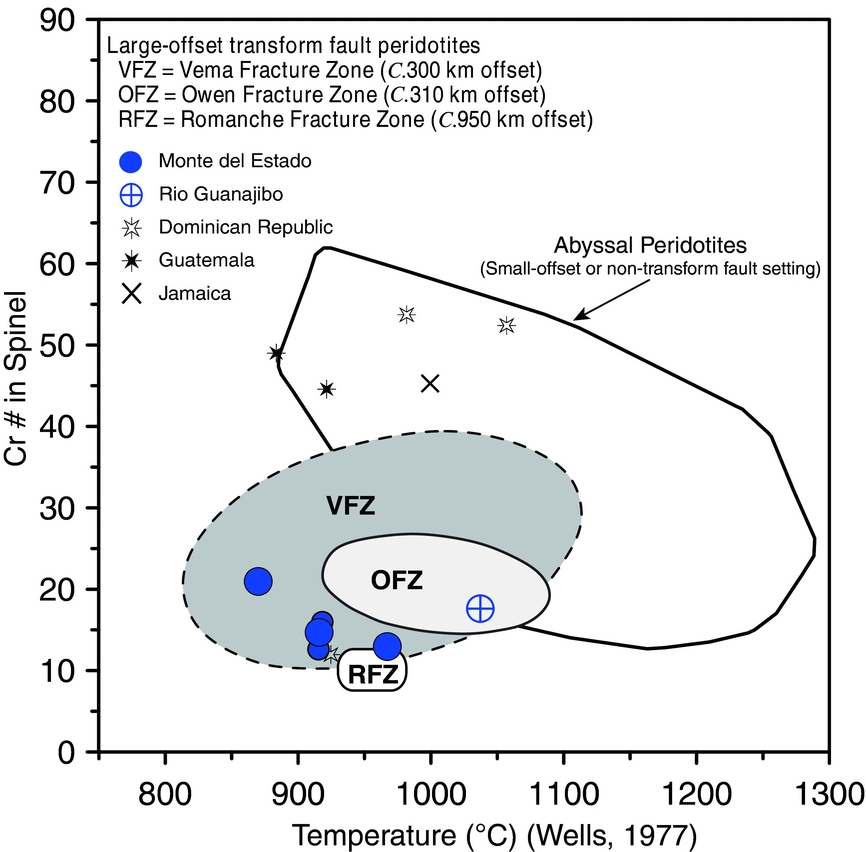
To better constrain the petrogenesis and tectonic environment of the formation of the Puerto Rico peridotites, spinel Cr no. was plotted against the temperature obtained by the two-pyroxene geothermometer of Wells (Reference Wells1977) (Fig. 12). The fields for abyssal peridotites are shown for comparison, as well as the published data for other Caribbean abyssal peridotites. Large-offset transform fault-related peridotites are characterized by relatively lower equilibration temperatures than those of the small-offset or non-transform-setting abyssal peridotites (Fig. 12). In contrast to other Caribbean samples, the Monte del Estado peridotites are positioned outside the small-offset or non-transform-setting abyssal peridotite field. They fall within the fields for large-offset transform fault-related peridotites, such as the Vema Fracture Zone, Owen Fracture Zone and Romanche Fracture Zone (Fig. 12). The single available Rio Guanajibo peridotite is positioned along the boundary between the two settings. Large-offset transform fault-related peridotites were generally less depleted than the nearby centre segment peridotites, possibly due to the relatively lower degree of melting induced by the colder thermal regime (Choi, Mukasa & Shervais, Reference Choi, Mukasa and Shervais2008). Given the unrealistically high pressures estimated by the Ca-in-olivine/clinopyroxene geobarometer (online supplementary Table S1, available at http://journals.cambridge.org/geo) and the small degree of melting experienced by the Monte del Estado and Rio Guanajibo peridotites, we suggest that a large-offset transform fault might have induced intensive cooling in the peridotites.
Cr no. (100 Cr/(Cr+Al)) in spinels from the Monte del Estado and Rio Guanajibo peridotites v. the equilibration temperatures estimated by the two-pyroxene thermometer of Wells (Reference Wells1977). The data for large-offset transform fault peridotites are from OFZ (Hamlyn & Bonatti, Reference Hamlyn and Bonatti1980), RFZ (Bonatti, Seyler & Sushevskaya, Reference Bonatti, Seyler and Sushevskaya1993), and VFZ (Brunelli et al. Reference Brunelli, Syler, Ciprianti, Ottolini and Bonatti2006). Data for small-offset or non-transform-setting abyssal peridotites from Choi et al. (Reference Choi, Mukasa and Shervais2008). Data for peridotites from the Dominican Republic, Guatemala and Jamaica (Bourgois et al. Reference Bourgois, Desmet, Tournon and Aubouin1984; Abbott, Jackson & Scott, Reference Abbott, Jackson and Scott1999; Escuder-Viruete, Castillo-Carrion & Perez-Estaun, Reference Escuder-Viruete, Castillo-Carrion and Perez-Estaun2014) are also plotted for comparison.
5.c. Petrogenesis of basaltic rocks
The Las Palmas amphibolites had depleted N-MORB-like REE (Fig. 6a) and incompatible trace-element patterns (Fig. 6c). In the Pb–Pb (Fig. 8) and Nd–Hf (Fig. 9) isotopic correlation diagrams they are positioned within the range of Pacific/Atlantic MORB of similar age, reflecting their N-MORB origin. However, in the Sr–Nd isotopic plot (Fig. 7), the amphibolites are slightly to the right of the MORB field. Note also that they are slightly enriched in highly incompatible Cs, Ba and Rb when compared to the N-MORB in Figure 6c. During low-temperature alteration, Cs, Ba and Rb are highly mobile elements (Dostal, Dupuy & Pudoignon, Reference Dostal, Dupuy and Pudoignon1996), and in hydrothermal fluids, Sr is a relatively mobile element (Kogiso, Tatsumi & Nakano, Reference Kogiso, Tatsumi and Nakano1997). To better constrain the tectonic setting of the basaltic rocks, we compared their Ti–Zr–Y concentrations using Ti–Zr–Y (Fig. 13a), Zr/Y v. Zr (Fig. 13b) and Th/Yb v. Nb/Yb (Fig. 13c) discrimination diagrams. The use of these elements in petrogenetic modelling is practical because the high-field-strength elements are generally resistant to post-magmatic alteration or low-grade metamorphism (Pearce & Norry, Reference Pearce and Norry1979). The amphibolites fall within the MORB field on the Ti–Zr–Y and Zr/Y–Zr plots. They also have normal MORB-like Nb/Yb and Th/Yb ratios (Fig. 13c). Seawater had relatively high Sr concentrations (8 ppm) and high 87Sr/86Sr values of 0.7075 during Early Jurassic time (Veizer, Reference Veizer1989). The elevated 87Sr/86Sr ratios of the amphibolites could therefore be the result of submarine hydrothermal metamorphism.
(a) Ti–Zr–Y tectonic discrimination diagram for basaltic rocks from the Sierra Bermeja Complex (after Pearce & Cann, Reference Pearce and Cann1973). A: field of island-arc tholeiites; B: field of mid-ocean-ridge basalt (MORB), island-arc tholeiites and calc-alkali basalts; C: field of calc-alkali basalts; D: field of within-plate basalts. (b) The Zr/Y v. Zr (ppm) tectonic diagram (after Pearce & Norry, Reference Pearce and Norry1979). A: field of volcanic-arc basalts; B: field of MORB; C: field of within-plate basalts: D: field of MORB and volcanic-arc basalts; E: field of enriched-MORB and within-plate basalts. (c) The Th/Yb v. Nb/Yb diagram (after Pearce & Peate, Reference Pearce and Peate1995). E-MORB – enriched MORB; OIB – oceanic-island basalt.
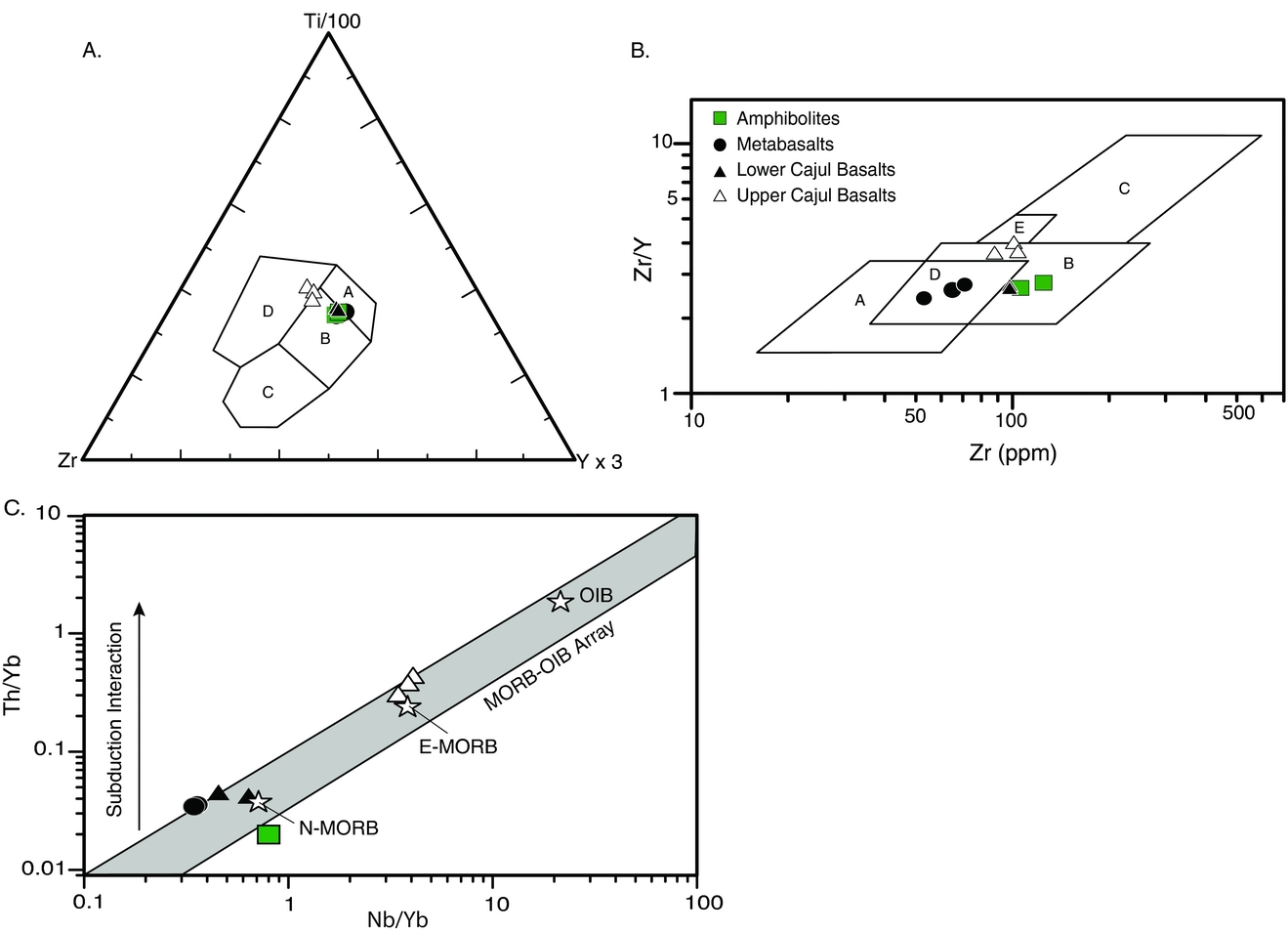
The metabasalts and Lower Cajul basalts also had N-MORB-like LREE-depleted patterns (Fig. 6a). However, in contrast to the amphibolites, the primitive mantle-normalized incompatible trace-element patterns (Fig. 6c) indicate significant enrichment in highly incompatible elements (such as Cs, Ba, Rb and K), characteristic of a mantle wedge metasomatized by fluids from a subducting slab (Parlak et al. Reference Parlak, Höck, Kozlu and Delaloye2004). The slight depletion in Nb and enrichment in Sr should also be noted. In this respect, they resemble the island-arc tholeiite from the Mariana arc (Fig. 6c) and the diabase intrusion (c. 121 Ma) in the Santa Elena ophiolite, Costa Rica (Fig. 6c) formed in a slow/ultraslow-spreading back-arc basin (Madrigal et al. Reference Madrigal, Gazel, Denyer, Smith, Jicha, Flores, Coleman and Snow2015). On the plots of Ti–Zr–Y (Fig. 13a) and Zr/Y v. Y (Fig. 13b), they are positioned along the boundary between the island-arc tholeiite and MORB fields, again marking their island-arc or back-arc affinity. Also note that they have Nb/Yb ratios less than normal MORB, and slightly elevated Th/Yb ratios plotting towards the subduction interaction vector in Figure 13c. In the Pb–Pb (Fig. 8) and Nd–Hf (Fig. 9) isotopic correlation diagrams, they are positioned within the range of Pacific/Atlantic MORBs of similar age. In the Sr–Nd isotope plot (Fig. 7) however, the 87Sr/86Sr ratios are elevated compared to the MORB at a given 143Nd/144Nd. The elevated 87Sr/86Sr ratios could be the result of contamination by fluids dehydrated from a seawater-altered subducting slab.
The Upper Cajul basalts had E-MORB-like LREE and large-ion-lithophile element (LILE, e.g. K, Rb, Cs and Ba) enrichment (Fig. 6b, d). However, some samples exhibited positive anomalies in Cs, Rb, K and Sr and a negative anomaly in Pb (Fig. 6d). The slight enrichment in Nb and Ta (Fig. 6d) provides evidence that they were not generated in an island-arc or back-arc setting. Anomalously high Cs, Rb and K contents in the Upper Cajul basalts may be the product of low-temperature subaerial or submarine alteration, likely due to the mobility of these elements during surface processes (e.g. Dostal, Dupuy & Pudoignon, Reference Dostal, Dupuy and Pudoignon1996). During submarine alteration, Sr can be mobile but Pb redistribution during low-temperature alteration is relatively small (Dostal, Dupuy & Pudoignon, Reference Dostal, Dupuy and Pudoignon1996). Both Pb and Sr are highly mobile in hydrous fluids (Kogiso, Tatsumi & Nakano, Reference Kogiso, Tatsumi and Nakano1997). The anomalous low Pb and high Sr that were observed in the Upper Cajul basalts might therefore have been produced by hydrothermal activity.
On the plots of Ti–Zr–Y (Fig. 13a) and Zr/Y v. Y (Fig. 13b), the Upper Cajul basalts are positioned along the boundary lines of MORB and within-plate basalt fields, being somehow ambiguous; they do plot along the E-MORB position on the Th/Yb v. Nb/Yb correlation (Fig. 13c) however, consistent with their E-MORB origin. The 87Sr/86Sr and 143Nd/144Nd isotopic compositions of the Upper Cajul basalts are however positioned outside the range of Pacific/Atlantic MORB of similar age (Fig. 7), precluding their derivation from the convective MORB source. For comparison, the available isotopic data for Caribbean oceanic plateau basalts are shown in the plot (Fig. 7). The Caribbean Plateau magmatism occurred during 95–72 Ma, with a peak at c. 92–88 Ma (Sinton et al. Reference Sinton, Duncan, Storey, Lewis and Estrada1998; Hauff et al. Reference Hauff, Hoernle, Tilton, Graham and Kerr2000; Hastie et al. Reference Hastie, Kerr, Mitchell and Millar2008). The Caribbean oceanic plateau basalts have E-MORB-like to transitional tholeiite basalt compositions, generated from a mantle plume and possibly recycled oceanic crust (Walker et al. Reference Walker, Storey, Kerr, Tarney and Arndt1999; Hauff et al. Reference Hauff, Hoernle, Tilton, Graham and Kerr2000). The Sr and Nd isotopic compositions of the Upper Cajul basalts are positioned along the enriched edge of the Caribbean Plateau basalt field (Fig. 7). The highly elevated 87Sr/86Sr ratios are a common feature of most Caribbean Plateau lavas, which are considered to have resulted from post-magmatic processes such as hydrothermal alteration rather than reflecting primary magmatic characteristics (Sinton et al. Reference Sinton, Duncan, Storey, Lewis and Estrada1998; Thompson et al. Reference Thompson, Kempton, White, Kerr, Tarney, Saunders, Fitton and McBirney2003; Hastie et al. Reference Hastie, Kerr, Mitchell and Millar2008). The 87Sr/86Sr increase in the Upper Cajul basalts might be due to secondary alteration. In the Pb–Pb isotopic correlation diagrams (Fig. 8), two samples (PRNUC02 and 03) are positioned within the range of Pacific/Atlantic MORB of similar age. However, one sample (PRNUC01) is positioned outside the range, falling within the field of the more radiogenic Caribbean Plateau basalts. Substantial alteration by seawater would not significantly alter the Pb isotope ratios because of the low abundance of Pb (2×10⁻⁶ ppm), Th (1×10⁻⁵ ppm) and U (3.2×10⁻³ ppm) in seawater (Brown et al. Reference Brown, Colling, Park, Phillips, Rothery and Wright1997, p. 86–87). The Pb isotopic values therefore probably represent the primary magmatic compositions of the Upper Cajul basalts. The Nd and Hf isotope systems are more resistant to alteration or metamorphism than the Sr and Pb isotopic system; their ratios therefore represent the primary compositions of the lavas (e.g. White & Patchett, Reference White and Patchett1984). In the Nd–Hf isotopic correlation diagram (Fig. 9), the Upper Cajul basalts falls within the range of the Caribbean oceanic plateau basalts. We therefore conclude that the Upper Cajul basalts are likely the tectonized equivalent of the Caribbean oceanic plateau.
5.d. Tectonic implications
Palaeomagnetic data indicate that a thin proto-Caribbean ocean floor (less than 5 km in thickness) began to form between the North and South American plates during Jurassic and Early Cretaceous time (153–127 Ma) at an ultra-slow spreading rate of 0.4–0.5 cm a–1 (Ghosh, Hall & Casey, Reference Ghosh, Hall, Casey, Bonini, Hargraves and Shagam1984). Based on a palaeotectonic reconstruction of the Cretaceous Caribbean realm, Marchesi et al. (Reference Marchesi, Jolly, Lewis, Garrido, Proenza and Lidiak2011) proposed that the Monte del Estado peridotite belt might be the ancient Proto-Caribbean lithospheric mantle. Our results showing the relatively fertile mineral compositions, low degree of melting and low equilibration temperatures suggest that the Monte del Estado and Rio Guanajibo peridotites might be the slow-spreading proto-Caribbean large-offset transform fault-related oceanic lithospheric mantle. With their relatively high spinel Cr no., the Sierra Bermeja peridotites are likely to have been the comparatively fast-spreading proto-Pacific (Farallon) lithospheric mantle.
Schellekens (Reference Schellekens, Lidiak and Larue1998 a) suggested that the Sierra Bermeja amphibolites might be the remnants of a transform fault at the ocean floor that initiated subduction in this area, and could be the same large-offset transform fault that is believed to have imposed a cold thermal regime on the lithospheric mantle beneath the Monte del Estado. The amphibolites may represent the subducted fragments of the Farallon oceanic plate basalts or metamorphic soles formed in a hanging wall (Wakabayashi & Dilek, Reference Wakabayashi and Dilek2003). The metamorphic age of the amphibolites (126±3 Ma; Cox et al. Reference Cox, Marvin, M'Gonigle, McIntyre and Rogers1977) indicates that they underwent metamorphism during Early Cretaceous time. A new subduction zone can form along pre-existing lithospheric weakness zones, such as transform faults (e.g. Casey & Dewey, Reference Casey, Dewey, Gass, Lippard and Shelton1984; Stern & Bloomer, Reference Stern and Bloomer1992). We suggest that the eastwards subduction might have been initiated along a large-offset transform fault, and the Monte del Estado peridotite could be part of the intact Proto-Caribbean lithospheric mantle trapped in the forearc of an eastwards-subducting slab (Fig. 14). The Sierra Bermeja peridotites were likely emplaced into a serpentinite subduction channel by tectonic off-scraping from the down-going Farallon Plate (Fig. 14). The island-arc tholeiite basalt-like Sierra Bermeja metabasalts and Lower Cajul basalt were produced in the suprasubduction zone by the eastwards subduction of the Farallon Plate (Fig. 14). A subduction complex can be active for many tens of millions of years (e.g. Brueckner et al. Reference Brueckner, Avé Lallemant, Sisson, Harlow, Hemming, Martens, Tsujimori and Sorensen2009). Determining the exact timing of the subduction initiation and duration will be the focus of future work.
Cross-section of suggested local plate evolution represented in the SW Igneous Province of Puerto Rico. (a) Eventual transform fault relation between the Farallon and Proto-Caribbean plates and (b) subduction initiation of the Farallon Plate under the Proto-Caribbean Plate during Early Jurassic time. Peridotite Source I for the Sierra Bermeja peridotites; Peridotite Source II for the Monte del Estado and Rio Guanajibo peridotites; IAT – island-arc tholeiite.

The Caribbean Plate is moving eastwards relative to North and South America at a rate of c. 2 cm a–1, although the exact velocity is controversial (e.g. Jansma et al. Reference Jansma, Mattioli, Lopez, DeMets, Dixon, Mann and Calais2000). Plate reconstructions of the tectonic evolution of the Caribbean Plate generally propose that the plateau formed c. 90 Ma in the eastern Pacific region as part of the Farallon (proto-Pacific) Plate, in the vicinity of the present-day Galápagos hotspot, and this was followed by a NE-directed motion (Burke, Fox & Şengőr, Reference Burke, Fox and Şengőr1978; Duncan & Hargraves, Reference Duncan, Hargraves, Bonini, Hargraves and Shagam1984; Herzberg & Gazel, Reference Herzberg and Gazel2009; Gazel, Abbott & Draper, Reference Gazel, Abbott and Draper2011). Shortly after its formation the plateau collided with the Greater Antilles Arc, which extended along the Pacific margin of the proto-Caribbean. This resulted in a reversal in the polarity of subduction from east to west, possibly due to its buoyancy, and the subsequent emplacement of the plateau between North and South America (Burke, Reference Burke1988; Pindell & Barrett, Reference Pindell, Barrett, Dengo and Case1990, p. 426; Kerr & Tarney, Reference Kerr and Tarney2005). Fossil evidence from the Greater Antilles also suggests a Pacific origin for the plateau. Chert intercalated with the Cajul basalts contains Early Jurassic and mid-Cretaceous radiolarians derived from the subducting Farallon Plate (Montgomery, Pessagno & Pindell, Reference Montgomery, Pessagno and Pindell1994; Bandini et al. Reference Bandini, Baumgartner, Flores, Dumitrica, Hochard, Stampfli and Jackett2011). Recently, Pindell et al. (Reference Pindell, Maresch, Martens and Stanek2012) and Boschman et al. (Reference Boschman, van Hinsbergen, Torsvik, Spakman and Pindell2014) suggested that the Greater Antillean Arc formed at around or before 135 Ma by inception of SW-dipping subduction along an ‘inter-American transform’ connecting the west-facing subduction zones of the North and South American Cordillera, without an arc polarity reversal. We note however that this model is hard to reconcile with the fossil evidence together with the NE-dipping subduction polarity based on distribution of Late Cretaceous high-Mg andesites and related lavas from the SIP of Puerto Rico (Jolly, Schellekens & Dickin, Reference Jolly, Schellekens and Dickin2007). We suggest that the Upper Cajul basalts belong to the tectonized Caribbean oceanic plateau basalts, as it has also been suggested by Lidiak, Jolly & Dickin (Reference Lidiak, Jolly and Dickin2011). This observation, together with the overlying Campanian limestone and intrusive Maguayo Porphyry (86 Ma), indicates that the serpentinites must have been emplaced during Coniacian–Turonian time (Laó-Dávila, Reference Laó-Dávila2014).
6. Conclusions
-
1. Peridotite bodies found in the SW block of Puerto Rico originated in two different tectonic settings. The Monte del Estado and Rio Guanajibo peridotites, with low spinel Cr no., might be the ultra-slow-spreading proto-Caribbean oceanic lithospheric mantle. The Sierra Bermeja peridotites, with higher Cr no. and TiO2 content, likely originated from the relatively fast-spreading Farallon Plate lithospheric mantle.
-
2. The two lithospheric mantles are related to each other by a large-offset transform fault, which caused intensive cooling. The proto-Caribbean mantle peridotites were trapped in the forearc of the eastwards-subducting Farallon Plate, while tectonic off-scraping from the down-going proto-Pacific lithospheric mantle emplaced the Sierra Bermeja peridotites into the subduction channel.
-
3. REE and trace-element patterns and Sr–Nd–Hf–Pb isotopic compositions indicate an ancient Pacific N-MORB origin for the Sierra Bermeja amphibolites and an island-arc tholeiitic melt origin for the Lower Cajul basalts and metabasalts, which were affected by fluids dehydrated from a seawater-altered subducting slab. We suggest that the formation of the metabasalts and Lower Cajul basalts could be related to the subduction initiated by the large-offset transform fault and that they formed in a mantle wedge as the Pacific N-MORB-type amphibolite protoliths were subducted.
-
4. E-MORB-like Upper Cajul basalts are considered to be tectonized equivalents of the Caribbean oceanic plateau basalts. Highly elevated 87Sr/86Sr isotopic ratios indicate post-magmatic hydrothermal alteration, which is a characteristic of Caribbean plateau-related basalts. The Pb–Pb and Nd–Hf isotopic correlations indicate primary Caribbean plateau basalt composition.
Acknowledgements
This research was supported by the Basic Science Research Program through the National Research Foundation of Korea (NRF) funded by the Ministry of Science, ICT and Future Planning (NRF-2013R1A2A2A01004382 and NRF-2013R1A2A1A01004418). We would like to thank James Joyce, Fernando Martínez Torres, Nak Kyu Kim and Francisco Hernández for their assistance with fieldwork. Insightful reviews by Esteban Gazel and an anonymous reviewer greatly improved the manuscript.



